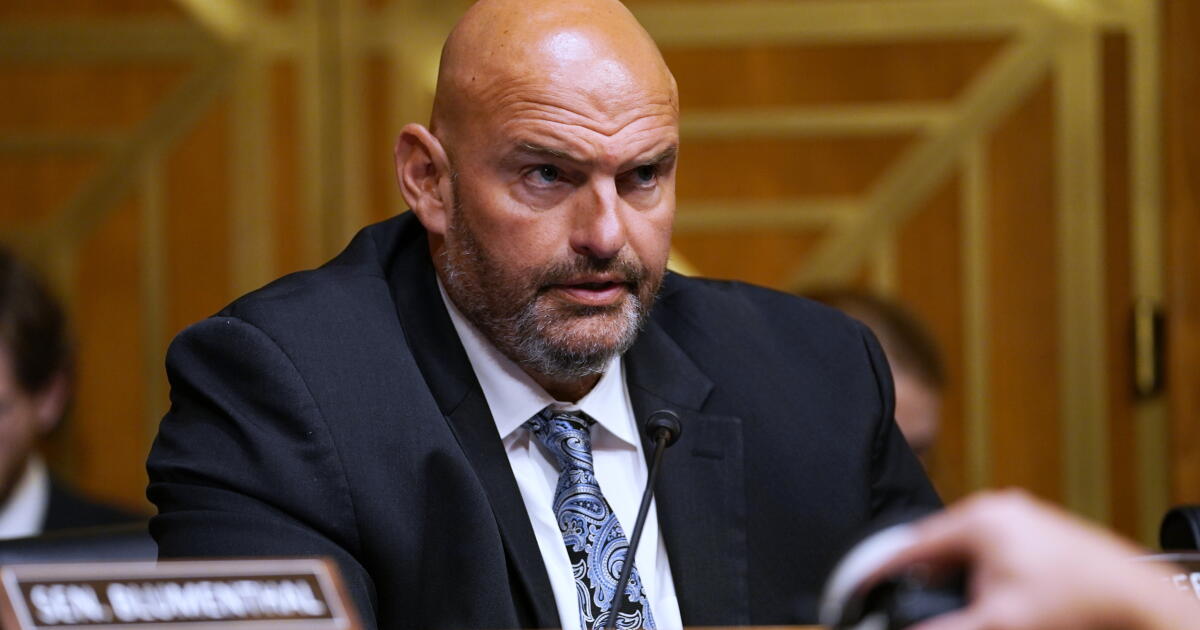
Sen. John Fetterman’s isolation from Democrats grows stark in Pennsylvania
HARRISBURG, Pa. — Around this time two years ago, Sen. John Fetterman was in high demand on the campaign trail, going county-to-county in Pennsylvania to help Democrats up and down the ballot.
Now, after two years of crossing swords with Democrats and backing some of President Trump’s priorities, he’s nowhere on the stump.
No Democrat in the state wants to be seen with him. His approval ratings are better with Republicans — far better — than they are with Democrats. And a shadow primary of sorts is taking shape for Fetterman’s Senate seat in 2028, even if he runs again.
Fetterman has acknowledged his isolation in the party as he maintains staunch support of Israel’s war in Gaza and criticizes left-wing candidates who are members of the Democratic Socialists of America. He’s often gone his own way in the Senate, voting repeatedly with Republicans to end the shutdown last year while supporting multiple Trump nominations and opposing efforts to end the war in Iran.
Still, Fetterman has repeatedly said that he wouldn’t switch parties because of his support for labor unions, LGBT rights and other issues held dear by the left.
“I’m not going to be a Republican, but I’m going to be a Democrat that’s going to have a conversation with whoever is playing it straight,” Fetterman told Fox News host Sean Hannity.
Fetterman’s office and political adviser did not return messages seeking comment.
Fetterman has fallen out of favor with Pennsylvania Democrats
Fetterman has been silent about any plans to campaign in Pennsylvania this year, and Democrats say they aren’t asking him for help.
“I absolutely think that Fetterman would bring us more harm than good,” said Lori McFarland, the Democratic Party chair in Lehigh County, which is home to a congressional seat and a state Senate seat that Democrats are trying to flip. “Nobody’s asked to see him, nobody’s requested his presence, and people, quite honestly, they’re mad at him and they don’t want anything to do with him. The local feel here is they feel betrayed by him.”
Polling captures the shift. Only about 2 in 10 registered Democrats in Pennsylvania have a favorable view of Fetterman, according to a New York Times poll from August. That’s a sharp reversal from 2024, when 74% had a positive view. He’s now seen more favorably by Republican voters in the state, with 73% giving him a positive rating. That’s up from 25% a couple years ago.
A Quinnipiac poll from July similarly found most Republicans approve of how Fetterman is handling his job, while most Democrats do not.
Cindy Durian, a Democrat voting in May’s primary in suburban Harrisburg, said she would never vote for Fetterman again.
“I think he might as well change parties, he might as well change from a D to an R,” she said.
Frustration with Fetterman has been building
Fetterman had a stroke on the campaign trail before winning his Senate seat in 2022 and then was hospitalized for clinical depression in the first months of his term.
Progressive frustration with Fetterman began to emerge in late 2023 with his support for Israel’s war against Hamas. But it’s moved beyond that since Trump took office. Democrats have watched him belittle their attempts to push back on Trump while emerging as a conservative media darling.
“He is antagonizing Democrats, seemingly for pleasure,” said J.J. Abbott, a Democratic strategist.
Fetterman’s dedication to the job has also been called into question. Last year, he began racking up missed votes and missed hearings in the Senate. A meeting in Washington with representatives from a teachers union broke up after he began repeating himself, shouting and slamming his hands on a desk. And he has avoided other meetings and public events, including the funeral for three police officers killed in the line of duty.
Public officials around Pennsylvania say they haven’t seen him in several years. Some can’t remember when they last saw him.
“I couldn’t tell you,” said state Rep. Peter Schweyer of Allentown. “We assumed that when we got him there that we were going to get somebody who’s going to fight for us. And what we got instead was somebody who just disappeared.”
Pennsylvania Democrats have a lot on the line in November
The state has several marquee races this year. Democratic Gov. Josh Shapiro, seen as a likely presidential candidate in 2028, is running for reelection and leading the party’s efforts to hold a narrow state House majority, capture a state Senate majority for the first time in decades and flip four U.S. House seats.
In one of those competitive U.S. House races, Democrat Bob Harvie is trying to unseat Republican Rep. Brian Fitzpatrick. A campaign spokesperson said Harvie hasn’t asked Fetterman for help.
It’s unclear whether Fetterman will ever return to the campaign trail, or whether he even wants another term in 2028, given that he spends much of his time criticizing his party and the dysfunction of Congress. He often sits alone in the hallway during Senate votes, eschewing conversations with colleagues inside the chamber.
Talk of 2028 among Democrats often turns to several others — Reps. Chris Deluzio and Brendan Boyle and former U.S. Rep. Conor Lamb — who have become outspoken critics of Fetterman.
“I don’t think that Democrats want John Fetterman campaigning for them, and I say that as a guy who’s campaigning with Democrats in the most competitive and toughest districts across Pennsylvania,” Deluzio told The Associated Press.
Deluzio said he’ll decide after the November election whether to run for Senate in 2028. But, he said, “Pennsylvanians elected John Fetterman as a Democrat to the United States Senate. They expect him to be a Democrat in these two years he has left in this term.”
Fetterman says he has a ‘red line’ with his party
While Fetterman has insisted he won’t change parties, he hasn’t ruled it out, saying the Democratic Party becoming anti-Israel would be a “red line” that would force him out.
He’s also become close with Pennsylvania’s other senator, Republican David McCormick, appearing at events alongside him and launching a joint political fundraising committee, an unusual arrangement for senators from opposing parties.
Senate Majority Leader John Thune, R-S.D., in July said he and other Republicans had spoken with Fetterman about the “challenges” he has in the Democratic caucus. “If he ever comes to the conclusion that he’s ready to move, we’d certainly welcome him.”
Democrats hold 47 seats in the Senate. If they were to pick up four seats in the election, a Fetterman party-switch could reset the Senate back to a 50-50 split, giving Republicans the majority and putting Vice President JD Vance in a position to break ties.
Levy writes for the Associated Press. AP writer Mary Clare Jalonick in Washington contributed to this report.