South

South Korean food conglomerate, Harim affiliate deals top $938 million

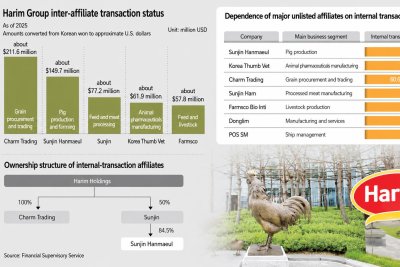
Harim Group’s internal affiliate transactions reached high levels in 2025, with Charm Trading recording about $211.6 million in internal transactions and some unlisted affiliates depending on group transactions for more than 80% of sales. Data from Financial Supervisory Service. Graphic by Asia Today and translated by UPI

June 3 (Asia Today) — Harim Group’s domestic transactions among affiliates exceeded 1.4 trillion won, or about $914 million, last year, raising concerns that some unlisted units remain heavily dependent on business from within the group.

An analysis of Financial Supervisory Service filings and affiliate transaction data showed Harim Group’s domestic internal transactions totaled 1.44 trillion won, or about $938 million, in 2025.

That accounted for about 11.5% of the group’s total revenue of 12.41 trillion won, or about $8.11 billion.

Harim Group has a vertically integrated business structure spanning feed production, livestock, food processing, distribution and logistics. The structure has drawn attention because several unlisted affiliates reported high levels of sales from transactions with other group companies.

Sunjin Hanmaeul, an agricultural company involved in pig farming, generated 229.2 billion won, or about $150 million, of its 256.6 billion won, or about $168 million, in total revenue last year through transactions with affiliates including Harim Holdings and Sunjin. That means 89.3% of its sales came from internal group transactions. Sunjin Hanmaeul is a sub-subsidiary of Harim Holdings.

Korea Thumb Vet, an animal pharmaceutical affiliate, also generated 94.8 billion won, or about $62 million, of its 130.1 billion won, or about $85 million, in total revenue from affiliate transactions. The company is also a sub-subsidiary of Harim Holdings.

Charm Trading, a Harim Holdings subsidiary responsible for grain procurement and trading, posted 323.9 billion won, or about $212 million, in internal transactions out of 534.5 billion won, or about $349 million, in total revenue last year. That was the largest amount among the group’s affiliate transactions.

Sunjin, a core affiliate in the feed and processed meat businesses, recorded 118.138 billion won, or about $77 million, in sales through affiliate transactions. Sunjin also owns an 89.4% stake in Sunjin Hanmaeul, whose internal transaction dependence reached 89.3%.

Other unlisted affiliates also showed high dependence on internal transactions. Sunjin Ham, a processed meat manufacturer, posted an internal transaction ratio of 99.9%. Farmsco Bio Inti, a livestock production affiliate, recorded 85.8%, while ship management company POS SM reported 85.4% and manufacturing and services affiliate Donglim posted 80.2%.

Harim Group was sanctioned by the Fair Trade Commission in 2021 over allegations that affiliates steered business to Orpum, a private company wholly owned by Kim Jun-young, the eldest son of Harim Chairman Kim Hong-kuk and an assistant managing director at Pan Ocean.

At the time, the commission said affiliate support provided unfair economic benefits to the owner family and imposed corrective orders and fines. Harim challenged the decision and the case is currently in administrative litigation.

The continued transaction structure involving major affiliates such as Charm Trading, Sunjin Hanmaeul and Korea Thumb Vet has drawn attention because it appears to have changed little since the commission’s sanctions.

Harim Group’s succession structure is widely seen as centered on Kim Jun-young. Through Orpum and Korea Investment, Kim has secured influence within the ownership structure of Harim Holdings, and key affiliates are also included under that structure.

Some level of internal transactions may be inevitable in a vertically integrated industry. But critics say it is a separate issue when some unlisted affiliates continue to depend on internal group transactions for 60% to nearly 100% of their revenue, especially as regulators strengthen oversight of tunneling and unfair support involving owner families.

The Fair Trade Commission says it does not determine illegality based only on the share of internal transactions.

“Internal transactions become a problem when illegal conduct such as unfair business steering or private benefit-taking is involved,” a commission official said. “If unfair support or private benefit-taking is found, the transaction can be subject to sanctions under relevant laws.”

— Reported by Asia Today; translated by UPI

© Asia Today. Unauthorized reproduction or redistribution prohibited.

Original Korean report: https://www.asiatoday.co.kr/kn/view.php?key=20260604010001065

Source link

South Korean banks face $716 million in long-overdue loans

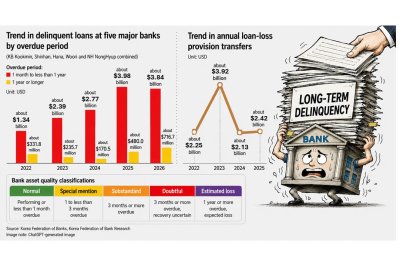
South Korea’s five major banks saw long-term delinquent loans rise to about $716.7 million in 2026, while loans overdue for one month to less than one year remained elevated at about $3.84 billion. Data from Korea Federation of Banks and Korea Federation of Bank Research. Graphic by Asia Today and translated by UPI

June 3 (Asia Today) — South Korea’s major commercial banks are facing growing pressure from a sharp rise in long-overdue loans, with the amount of loans unpaid for more than one year exceeding 1 trillion won, or about $716 million, in the first quarter.

Loans overdue for less than one year, which could later worsen into long-term delinquencies, also approached 6 trillion won, or about $3.84 billion. The increase suggests that borrower distress is deepening, especially among corporate borrowers, despite banks’ efforts to dispose of nonperforming loans.

The sequential expiration of COVID-19 loan maturity extensions also appears to be adding pressure on delinquent borrowers.

Banks, which have continued to post strong earnings, are concerned that rising long-term delinquencies could increase loan-loss provision burdens. The longer a loan remains overdue and the lower its chance of recovery becomes, the more banks must set aside in provisions.

If the Bank of Korea raises its base rate in the second half, borrowers’ repayment burdens could grow further, increasing the risk of additional long-term delinquencies. Analysts say asset quality management could become a key factor determining banks’ earnings performance.

According to financial industry data released Wednesday, the combined balance of loans overdue for at least one year at KB Kookmin Bank, Shinhan Bank, Hana Bank, Woori Bank and NH NongHyup Bank reached 1.0972 trillion won, or about $716 million, in the first quarter.

That was up 49.3% from 734.9 billion won, or about $480 million, a year earlier. Compared with 261 billion won, or about $170 million, in 2024, the figure has more than quadrupled. It was also more than double the 508 billion won, or about $332 million, recorded in 2022 during the COVID-19 pandemic.

The increase appeared across all five banks. By bank, NH NongHyup had the largest balance of long-term overdue loans at 474.8 billion won, or about $310 million, followed by KB Kookmin at 166.9 billion won, or about $109 million, Hana at 155.2 billion won, or about $101 million, Shinhan at 151.5 billion won, or about $99 million, and Woori at 148.8 billion won, or about $97 million.

Loans overdue for at least one month but less than one year totaled 5.8851 trillion won, or about $3.84 billion, approaching the 6 trillion won mark. The figure was slightly lower than 6.1002 trillion won, or about $3.98 billion, a year earlier, but remained high by historical standards.

By category, loans overdue for at least one month but less than three months rose from a year earlier to 2.8225 trillion won, or about $1.84 billion. Loans overdue for at least six months but less than one year, which are considered more likely to become long-term delinquencies, reached 1.1111 trillion won, or about $726 million. Both were record highs since the banks began disclosing the relevant data.

The surge in long-term delinquencies is widely attributed to a sharp increase in new overdue loans in 2024 and 2025. Higher interest rates and weak domestic demand weakened borrowers’ repayment capacity, with some distressed borrowers slipping into long-term delinquency.

The increase appears particularly concentrated among corporate borrowers, whose loans are relatively large and harder to recover. At the end of March, the banking sector’s corporate loan delinquency rate stood at 0.68%, up 0.06 percentage point from 0.62% a year earlier.

“Distress pressure has continued for a long period in sectors such as construction and real estate leasing because of the weak housing market,” an official at a commercial bank said.

A renewed period of rate increases could add to the problem. The Bank of Korea left open the possibility of at least one base rate increase in the second half during last month’s monetary policy meeting, raising concerns that banks could face greater asset quality pressure.

Higher base rates can push up market rates, including bank bond yields, increasing borrowers’ interest burdens. That could deepen distress among loans already in arrears and increase new delinquencies, potentially expanding the volume of long-term overdue loans later.

That would likely translate into higher loan-loss provisions for banks. Banks classify loans into five asset-quality categories: normal, precautionary, substandard, doubtful and estimated loss.

When a loan is classified as substandard, banks must set aside provisions equal to 20% of the loan amount. As the overdue period grows longer and repayment capacity worsens, the required provision ratio rises. Doubtful loans, which are overdue for more than three months and have low recovery prospects, require 50% provisioning. Loans classified as estimated losses after more than one year overdue require 100% provisioning.

That means if a doubtful loan deteriorates into an estimated loss, the provisioning burden doubles.

A rise in provision expenses would directly weigh on bank earnings. In 2022, the five major banks set aside 3.5422 trillion won, or about $2.31 billion, in annual loan-loss provisions, while their combined net profit rose 18.6% from a year earlier to 13.7472 trillion won, or about $8.98 billion.

But in 2023, when banks set aside more than 6 trillion won, or about $3.92 billion, in provisions because of real estate project financing distress and other factors, their net profit growth slowed to 2.6%.

Provision expenses fell sharply the following year, but as delinquencies continue to rise, the possibility of renewed growth in provisions has increased. Analysts say careful risk management has become more important.

“As the delinquency period lengthens, the sale price of nonperforming loans tends to fall, so if long-term delinquencies increase, banks disposing of bad loans will also face greater loss burdens,” a financial industry official said.

“The key will be whether banks can prevent new distress from expanding while effectively clearing existing bad loans,” the official said.

— Reported by Asia Today; translated by UPI

© Asia Today. Unauthorized reproduction or redistribution prohibited.

Original Korean report: https://www.asiatoday.co.kr/kn/view.php?key=20260604010001073

Source link

South Korean small businesses seek labor consulting

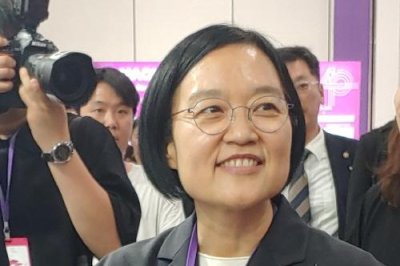
Han Seong-sook, minister of SMEs and startups. Photo by Asia Today

June 2 (Asia Today) — South Korean small business owners called for more practical labor consulting and measures to ease payroll burdens during a government meeting Tuesday.

The Ministry of SMEs and Startups held a roundtable on labor difficulties facing small businesses at the Korea Certified Public Labor Attorneys Association in Yeongdeungpo-gu, Seoul.

Minister Han Seong-sook, government officials and representatives from convenience stores, restaurants and cafes attended the meeting to discuss labor management difficulties in the field.

Participants said complicated wage rules, including weekly holiday allowances and severance pay, have become a major management burden. They urged the government to provide professional consulting support.

At the meeting, the ministry announced support measures to help small businesses manage labor issues. The measures include a question-and-answer guidebook on commonly missed labor rules, regional on-site briefings and stronger online guidance through short-form videos.

The ministry also plans to help resolve disputes through counseling centers and labor lawyers. It said it will link a 24-hour artificial intelligence labor law counseling service with Small Business 24, a government support platform for small businesses.

Small business groups, however, expressed disappointment with the measures. They said expanding online and offline counseling channels could become a formality unless the government also secures enough budget and staffing to handle a surge in labor complaints.

They also said 24-hour AI counseling may have limits because labor disputes often involve complicated facts and competing interests that differ from case to case.

Participants emphasized that small businesses need more than basic information or counseling. They said the government should build a field-based consulting system and adopt policies that directly reduce labor cost pressures.

They said the government needs a bolder approach that goes beyond publicity-focused measures to address the core problems facing small businesses, including complex employment structures and allowance management.

“We will implement the measures announced today without disruption to create an environment where small business owners can run their businesses with confidence,” Han said.

The government said it will continue listening to difficulties in the field and review possible improvements to the system.

— Reported by Asia Today; translated by UPI

© Asia Today. Unauthorized reproduction or redistribution prohibited.

Original Korean report: https://www.asiatoday.co.kr/kn/view.php?key=20260602010000499

Source link

South Korea inflation tops 3% on Middle East oil shock

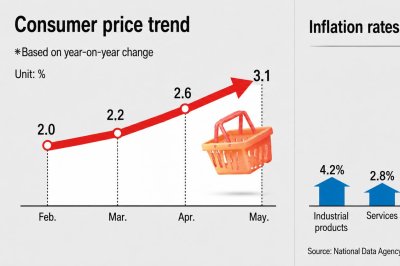
Consumer prices in South Korea rose 3.1% in May from a year earlier, driven by sharp increases in petroleum products, international airfares and overseas group tour fees. Data from National Data Agency. Graphic by Asia Today and translated by UPI

June 2 (Asia Today) — South Korea’s consumer price growth topped 3% in May for the first time in 26 months as a prolonged Middle East war drove up global oil prices, raising concerns that high inflation could continue through the second half of the year.

The consumer price index stood at 119.92 in May, with 2020 set as the base year of 100, up 3.1% from a year earlier, according to consumer price data released Tuesday by the National Data Agency. It was the first increase of 3% or more since March 2024.

Industrial products rose 4.2% from a year earlier, while service prices increased 2.8%. Petroleum prices showed the sharpest increase, jumping 24.2%, the largest gain in three years and 10 months since July 2022, when the Russia-Ukraine war was at its height.

Gasoline prices rose 23.1%, diesel prices climbed 33.3% and kerosene prices increased 21.7%.

Among services, international airfares, which are directly affected by fuel costs, rose 33.5%, while overseas group tour fees increased 26.3%.

The living price index, which tracks frequently purchased items with a high share of household spending, rose 3.3% from a year earlier, showing a worsening burden felt by consumers.

Lee Doo-won, an official in charge of economic trend statistics at the data agency, said petroleum prices rose more sharply because of higher international oil prices caused by the Middle East war.

“International airfares and prices for travel and lodging-related items rose sharply as fuel surcharges linked to global oil prices increased and the number of peak-season days, including holidays, grew,” Lee said.

The government said it will work to reduce price uncertainty by stabilizing petroleum prices.

A Finance Ministry official said the government’s petroleum price cap and fuel tax cut reduced the May consumer price increase by 0.6 percentage point.

“We will make every effort to stabilize prices felt by households through petroleum price stabilization measures and a task force on livelihood prices,” the official said.

Experts said inflation led by higher global oil prices is likely to continue in the second half.

“Although the United States and Iran have announced plans to discuss reopening the Strait of Hormuz, the high oil price trend is likely to continue in the second half even if the war ends, given the destruction of local oil facilities,” said Jeong Se-eun, an economics professor at Chungnam National University.

“For South Korea, which imports all of its oil, oil prices affect overall inflation. There is also concern that abnormal weather forecast for this summer could raise agricultural prices,” Jeong said.

“With no notable downward factor in the second half, inflation is expected to stay around 3%,” she added.

Park Jin, a professor at the Korea Development Institute School of Public Policy and Management, said prices are determined by market supply and demand.

“On the supply side, there are inflation concerns caused by unstable oil prices. On the demand side, there are price-increase factors such as a strong domestic stock market,” Park said. “Preemptive steps, including consideration of an interest rate hike, are needed.”

— Reported by Asia Today; translated by UPI

© Asia Today. Unauthorized reproduction or redistribution prohibited.

Original Korean report: https://www.asiatoday.co.kr/kn/view.php?key=20260602010000704

Source link

Mozambique says 5 citizens killed in ‘xenophobic attacks’ in South Africa | Protests News

The violence prompted 300 Mozambicans to return home by their own means over the weekend, with more than 500 still in the country now beginning the official repatriation process.

At least five Mozambican nationals have been killed in “xenophobic attacks” in South Africa over the weekend, the Mozambican government said, marking the first deaths officially linked to country-wide protests against undocumented immigration.

About 800 Mozambicans got caught up in violence that broke out in the southern coastal city of Mossel Bay on Friday, the government press office said in a statement received on Tuesday.

Recommended Stories

list of 3 itemsend of list

“Regrettably, seven Mozambican citizens have died, five of them as a direct consequence of the xenophobic attacks and the other two as a result of a road accident, when they were travelling in a private vehicle on their way back to Mozambique,” the statement said.

The violence prompted 300 Mozambicans to return home on Saturday, said the statement.

“The remaining just over 500 have since been sheltered in a safe location in the Western Cape Province, and as of today, 1 June, the process of their repatriation to Mozambique is already underway,” it said.

South African police said on Sunday they were investigating the deaths of two men at an informal settlement in Mossel Bay, a port town about 380km (236 miles) east of Cape Town, where xenophobic attacks had been reported.

They did not say whether the deaths were linked to the protests. It was also not immediately clear what nationalities the two men were.

But the area mayor, Dirk Kotze, voiced “deep concern and dismay at the current xenophobic attacks where people have been murdered, houses burned and families displaced”.

The region has seen anti-migrant protests similar to those reported in the financial capital Johannesburg, Durban and parts of the Eastern Cape province in recent weeks.

South Africa has faced recurring waves of xenophobic violence since 2008, when dozens of migrants were killed and thousands displaced in attacks across the country. Similar flare-ups occurred in 2015 and 2021.

The latest spike in anti-immigrant tensions comes as political parties seek support before local government elections in November.

Source link

South Africa’s World Cup delegation departs for Mexico without coach | World Cup 2026 News

Bafana Bafana’s departure was delayed due to non-issuance of visas for several players and support staff.

The South African national team members have left for their World Cup training base in Pachuca, Mexico, in advance of their opening game against the tournament cohosts on June 11.

The delegation that left on Monday did not include assistant coach Helman Mkhalele, who has yet to obtain a United States visa.

Recommended Stories

list of 4 itemsend of list

The charter flight departed Johannesburg following a frantic 24 hours after the squad was originally scheduled to leave on Sunday, but was held back by a delay in obtaining visas in what was described as an administrative bungle by the South African Football Association (SAFA).

Mkhalele, a former international winger who played 66 times for Bafana Bafana, including at their World Cup debut in France in 1998, will have to travel later after his visa application was initially denied.

Blaming the US Consulate General in Johannesburg for the delay, SAFA president Danny Jordaan told the South African Broadcasting Corporation, “They refused the visa, but gave no reasons. It is very difficult to deal with the process where you get no information.”

“We don’t know [why it was denied], we are clutching in the dark, but we hope the matter will be resolved [soon]. All of the players are [on the flight] and 99 percent of the technical staff.”

South Africa are due to play Jamaica in a friendly on Friday before taking on Mexico in the showpiece opening match in Mexico City.

“Now we are very happy that we can go to Mexico,” South Africa coach Hugo Broos said. “The past days have been a little bit stressful with all the problems we had, but those problems are behind us now, and we can focus on what’s coming.”

“These 10 days go very fast. Once we get there, we will start working, focusing on the first game against Mexico, so time will pass very quickly. I think everybody is looking forward to starting the World Cup.”

South Africa are in Group A and will face Czechia in Atlanta on June 18 and South Korea in Monterrey, Mexico, six days later.

They are appearing in their fourth World Cup and looking to advance from the group stage for the first time.

INTERACTIVE-Football FIFA How teams are group World Cup 2026-1776670778

Source link

South Korea may revive presidential watchdog after vote

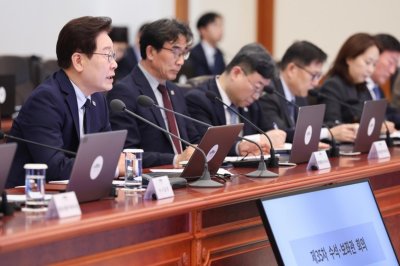
President Lee Jae Myung (L) attends a meeting with his senior secretaries at the presidential office Cheong Wa Dae in Seoul, South Korea, 28 May 2026. Photo by YONHAP / EPA

June 1 (Asia Today) — South Korea is expected to begin procedures to appoint a special inspector general after Wednesday’s local elections, potentially reviving a presidential watchdog post that has been vacant for nearly a decade.

The special inspector general is tasked with inspecting possible misconduct involving the president, the president’s relatives and senior presidential office officials.

The system was introduced in 2014 under then President Park Geun-hye, but the post has remained vacant since 2016. Neither the Moon Jae-in administration nor the Yoon Suk Yeol administration appointed a special inspector general.

Political sources said Sunday that the ruling Democratic Party is preparing to begin the recommendation process shortly after the June 3 local elections.

The main opposition People Power Party has already selected Kang Ji-sik, a former prosecutor and lawyer at Baeksong Law Firm, as its candidate for the opposition’s share of the nomination process. Kang graduated from the Judicial Research and Training Institute in its 27th class.

The Democratic Party formally said it would begin the recommendation process after Presidential Chief of Staff Kang Hoon-sik publicly asked the National Assembly in April to move forward. But the process appears to have been delayed by the party’s floor leader election and the local elections.

Han Byeong-do, floor leader of the Democratic Party, said the party would proceed under the rules and procedures, though he did not specify a date.

A presidential official said the Blue House had asked that the appointment process move as quickly as possible.

“With the new party leadership in place and the election nearing completion, the process appears likely to begin immediately after the election,” the official said.

Under the law, the National Assembly recommends three candidates and the president selects one. The ruling and opposition parties each recommend one candidate, while the Korean Bar Association selects the third, who is jointly recommended by both parties.

The president’s nominee must then go through a parliamentary confirmation hearing before final appointment. The special inspector general serves a three-year term.

Lee said at a news conference marking his first 30 days in office last July that power should be subject to checks.

“Power should be checked,” Lee said at the time. “Even for the safety of those who hold power, it is better to be checked. I have already ordered the appointment of a special inspector general.”

After the National Assembly showed little movement, Kang Hoon-sik again urged lawmakers in December to quickly recommend candidates.

Lee renewed the request on April 19 before leaving for visits to India and Vietnam.

“President Lee believes the appointment of a special inspector general is essential under the principles of democracy and popular sovereignty, which require all power to be subject to institutional oversight,” Kang Hoon-sik said at the time.

“As the president has expressed his firm will, we ask the National Assembly to begin the relevant procedures as soon as possible,” he said.

— Reported by Asia Today; translated by UPI

© Asia Today. Unauthorized reproduction or redistribution prohibited.

Original Korean report: https://www.asiatoday.co.kr/kn/view.php?key=20260601010000407

Source link

South Korea Getting Nuclear Submarines Is A Huge Deal

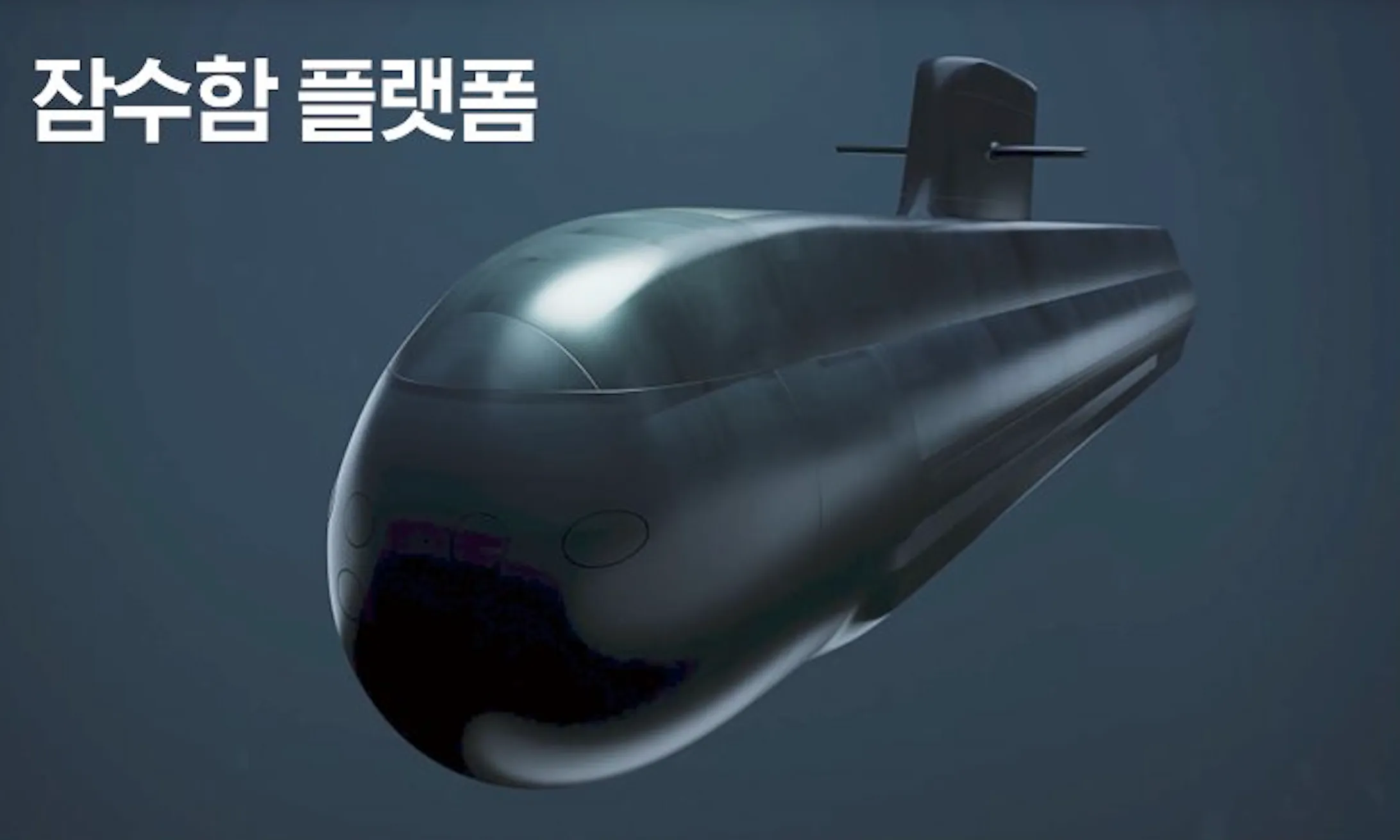
South Korea has confirmed plans to develop a new class of nuclear-powered submarines under the Jang Bogo N Project. These will put South Korea in an exclusive class of nations operating nuclear-powered subs, with currently only China, France, India, Russia, the United Kingdom, and the United States having them in active service. The move has larger implications than providing the Republic of Korea Navy (ROKN) with just more capable submarines.

A Ministry of National Defense rendering shows how the Jang Bogo N Project boats may look. MND

South Korea’s Ministry of National Defense (MND) today published a document, the Basic Plan for the Development of Nuclear-Powered Submarines in the Republic of Korea, that sets out its ambition for a major advance in the country’s naval capabilities. The name of the program alludes to South Korea’s first submarine, the Jang Bogo class.

📌「대한민국 핵추진잠수함 개발 기본계획」 발표

국방부는 5월 26일(화)에 「대한민국 핵추진잠수함 개발 기본계획」을 발표했습니다.

「대한민국 핵추진잠수함 개발 기본계획」은 대한민국이 핵추진잠수함을 체계적으로 개발하기 위한 추진 방향을 국내·외에 최초로 제시하는 문서로서 주요 내용은… pic.twitter.com/jkVjS3soQt

— 국방부 (@ROK_MND) May 26, 2026

The MND has presented the thinking behind its nuclear-powered sub plans, noting that the vessels will offer “dramatically enhanced operational capabilities” compared to the ROKN’s existing diesel submarines. As well as their functionally unlimited range, the MND says the new nuclear-powered submarines will offer “higher mobility” than their predecessors, which pairs with nuclear submarines’ abilities to travel farther, and do so faster, as well as their underwater agility, at least in certain performance envelope areas.

The ministry also outlines that the new submarines “will play a core role in responding to threats such as North Korea’s submarine-launched nuclear and missile threats.”

“The Republic of Korea will transparently and firmly fulfill its nuclear non-proliferation obligations based on the trust of the international community,” the MND adds.

Clearly, this is a long-term program, with it being Seoul’s first venture into nuclear propulsion for a military application, although it does develop reactors for civilian purposes, which could be leveraged for such work.

An official rendering showing one of the Jang Bogo N Project boats under construction. MND

The defense ministry expects that the construction process will take up to 10 years, after which the boats will be operated for more than 30 years.

A precise timeline has not been released, and it is also unclear how many hulls are expected to be built.

Back in October last year, TWZ reported on a key milestone toward the program launch, when U.S. President Donald Trump announced that he’d signed off on the plan.

“Our Military Alliance is stronger than ever before and, based on that, I have given them approval to build a Nuclear Powered Submarine, rather than the old fashioned, and far less nimble diesel powered submarines that they have now,” Trump wrote in a post on Truth Social.

The U.S. leader also claimed that at least some of the boats would be built in the United States. The MND hasn’t mentioned this possibility, and the wording of its announcement stresses the sovereign nature of the program and local industrial participation. However, with South Korean firms already building ships in Philadelphia and the United States needing more nuclear shipbuilding capacity, this dynamic could also come into play as a result of the Jang Bogo N Project.

Collapse of U.S. shipbuilding poses national and economic security risks | 60 Minutes thumbnail

Collapse of U.S. shipbuilding poses national and economic security risks | 60 Minutes


Before Trump’s remarks, South Korea had been open about its nuclear-powered submarine ambitions for years. In fact, related discussions date back to at least around 2003.

However, the plans long faced pushback, including from the United States, especially over nuclear proliferation concerns.

The ROKN already operates a sizable diesel-electric submarine force made up of 12 Jang Bogo class boats, nine Sohn Won-yil class submarines, and three Dosan Ahn Changho class vessels — these are also referred to under the Korean Submarine (KSS) nomenclature, being the KSS-I, KSS-II, and KSS-III, respectively.

The Republic of Korea Navy’s submarine Jang Bogo, one of the KSS-I boats. U.S. Navy

The Jang Bogo and Sohn Won-yil classes are based on the German Type 209 and Type 214 designs, respectively, while the Dosan Ahn Changho class is a fully South Korean design.

The KSS-III submarine ROKS Dosan Ahn Changho during trials. Defense Acquisition Program Administration

Last year, South Korea also launched the first of three planned Jang Yeongsil class (KSS-III Batch II) submarines, the nation’s largest and most technologically advanced submarine class so far. You can read more about them here.

The launch ceremony for the ROKS Jang Yeongsil, the first of the KSS-III Batch II boats. ROKN

Whatever Seoul’s plan is for the production of the new boats, it is still possible, indeed likely, that the United States will provide assistance at least in relation to their propulsion systems.

Last year, South Korea’s defense minister said that South Korea would build its own submarines and modular reactors, but would receive a supply of enriched uranium fuel from the United States. Seoul’s Defense Acquisition Program Administration (DAPA), meanwhile, said that the country was already working on developing small nuclear reactors.

This fuel issue is interesting, bearing in mind that one of the hurdles for the program is a bilateral agreement that prevents it from enriching uranium and reprocessing spent fuel without Washington’s approval. Today’s announcement would suggest that the U.S. government has given the program the green light.

The Ohio class guided-missile submarine USS Michigan in Busan, South Korea, in 2017. U.S. Navy

When it comes to the nuclear issue, it’s worth noting that, as it now stands, all nations operating nuclear-powered submarines also field nuclear weapons. Already, however, Australia is moving to acquire nuclear-powered submarines through the trilateral Australia-United Kingdom-United States (AUKUS) defense cooperation agreement. Canberra has no plans for fielding nuclear weapons.

A rendering of what the AUKUS nuclear-powered submarine design for Australia may look like. U.K. Ministry of Defense

For South Korea, however, there remains a possibility that it may seek to develop a nuclear deterrent, something South Korean officials have talked about in the past, and that we have discussed on many occasions. The primary driver for this is the fact that neighboring North Korea possesses a ballooning nuclear arsenal and a growing number of delivery systems to convey it. Furthermore, it may now be pursuing its own nuclear-powered submarines with assistance from Russia. The degree to which Moscow is providing assistance is unclear, but it may well be propelling the program forward significantly. There is also the factor that, at least in some cases, the United States is not seen globally as the strategic partner it once was. In a South Korean context, Trump has reportedly talked about pulling some U.S. troops out of South Korea.

North Korean Premier Kim Jong-un on board one of the country’s Soviet-era Romeo class submarines. KCNA

As a signatory of the Non-Proliferation Treaty (NPT), this would also stand in the way of South Korea acquiring nuclear weapons. Indeed, separate from weapons, the process of building enrichment or other nuclear facilities, or otherwise acquiring the highly enriched fissile material to power the submarines, would be an issue for the NPT.

The Jang Bogo N Project is certainly ambitious, and not just in terms of constructing the boats and securing the fuel required for them.

There will also be enormous investments required to develop suitable infrastructure to sustain a fleet of nuclear-powered subs, as well as training personnel in the operational and maintenance of naval reactors.

Beyond that, there is the question about the degree to which Seoul even needs nuclear-powered submarines. South Korea is already developing conventionally-armed submarine-launched ballistic missiles (SLBM) that can be fired from some of its more modern diesel submarines. These would already offer a conventional second-strike capability to help deter North Korea. The ranges involved in striking North Korean targets hardly need a launch platform with nuclear propulsion.

At the same time, South Korean diesel-electric submarine technology already outstrips North Korea’s limited anti-submarine warfare capabilities.

South Korea Test Launches Ballistic Missile From Submarine thumbnail

South Korea Test Launches Ballistic Missile From Submarine


On the other hand, while South Korea’s new diesel-electric subs offer a conventional quasi-second strike capability, it is not anywhere comparable to a true strategic nuclear second-strike deterrent of the kind that highly survivable nuclear-powered boats could provide, if South Korea one day chooses to go nuclear. Even with just conventional ballistic missiles aboard, the ability of a nuclear submarine to disappear out to sea for long periods is unmatched, which would enhance the survivability of the boats and their missiles, and help the credibility of a far more limited conventional second strike deterrent.

Beyond the North Korean threat, the nuclear-powered submarine program promises boats with extreme endurance and a higher level of underwater performance that can range much farther afield, reflecting Seoul’s growing focus on a broader regional security picture. With this in mind, it’s clear that the Jang Bogo N Project is also directed against the threat posed by China. Beijing’s military capabilities are a growing concern for South Korea, a fact reflected in Seoul looking increasingly toward security challenges beyond the peninsula. 

In an underwater warfare context, China maintains a very large submarine force that includes diesel-electric and nuclear-powered types, and which it continues to expand in both size and capability.

A stock picture of a Chinese Type 039A or Yuan class nuclear attack submarine. via U.S. Navy

The Chinese government has also previously spoken out against South Korea’s nuclear-powered submarine plans, calling for Seoul and the U.S. “to fulfill their nuclear non-proliferation obligations and do things to promote regional peace and stability, and not the other way around,” according to Reuters.

South Korea’s burgeoning submarine plans underscore how quickly its naval ambitions in general are evolving from coastal defense to a far more capable regional deterrent force, and one that will increasingly be able to undertake long-duration bluewater operations.

With the Jang Bogo N Project now underway, the ROKN can look forward to fielding its most advanced vessels yet. Depending on final plans for the production of these boats, it may well also cement its position as one of the few countries capable of designing and building nuclear-powered vessels. At the very least, it should put yet another piece in place should South Korea decide it needs a true second-strike strategic nuclear deterrent.

Contact the author: thomas@thewarzone.com

Thomas is a defense writer and editor with over 20 years of experience covering military aerospace topics and conflicts. He’s written a number of books, edited many more, and has contributed to many of the world’s leading aviation publications. Before joining The War Zone in 2020, he was the editor of AirForces Monthly.


Tyler’s passion is the study of military technology, strategy, and foreign policy and he has fostered a dominant voice on those topics in the defense media space. He was the creator of the hugely popular defense site Foxtrot Alpha before developing The War Zone.


Source link

Can AI cure loneliness? South Korea’s robot companions for seniors | Newsfeed

NewsFeed

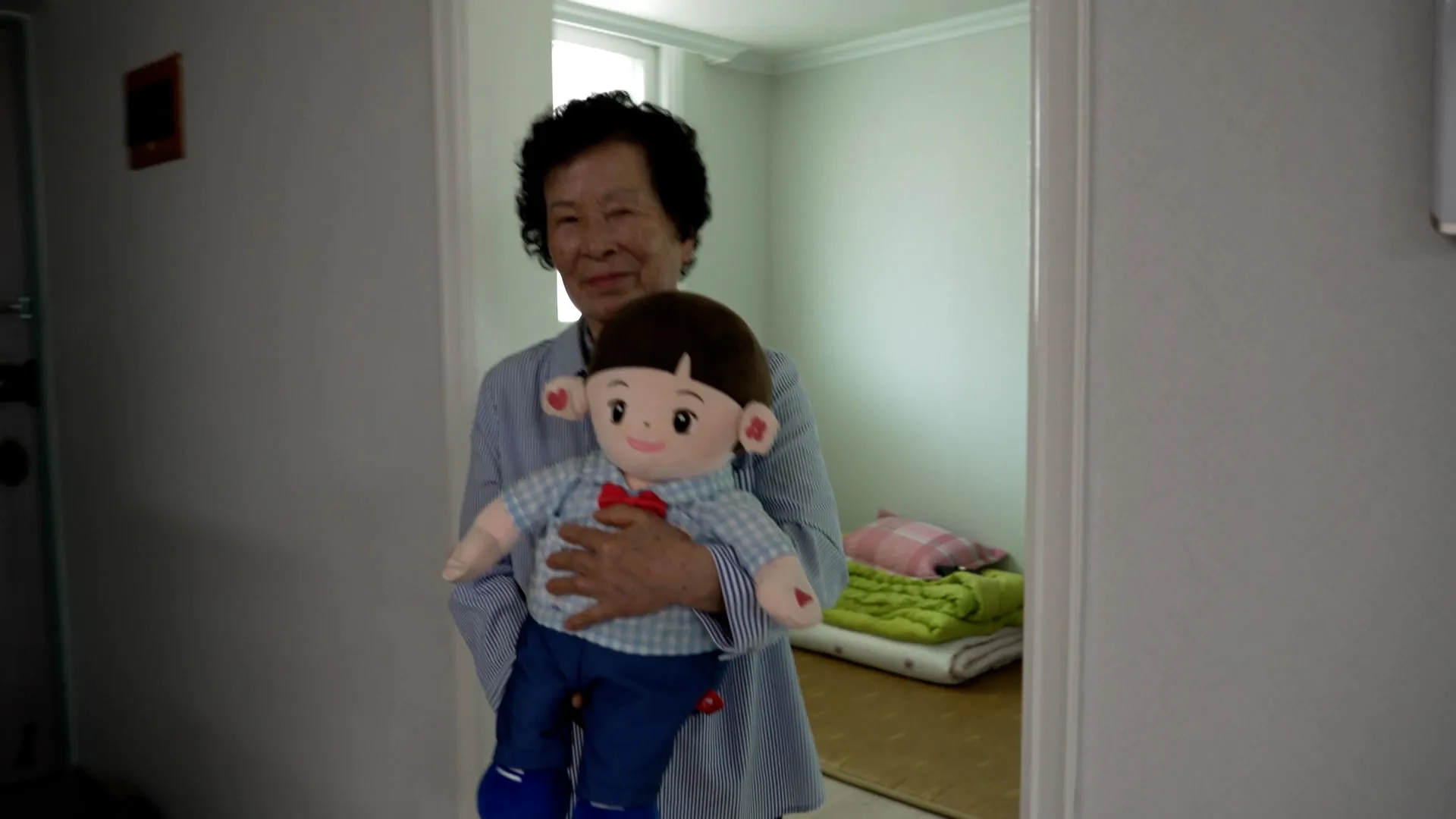
South Korea is using AI-powered companion dolls to help tackle loneliness in its ageing population. The robots remind seniors to take medication, monitor wellbeing and call for help in emergencies. As AI expands, concerns remain over whether it can ever replace human connection.

Source link

Experts urge South Korea to hold Iran accountable over HMM ship attack

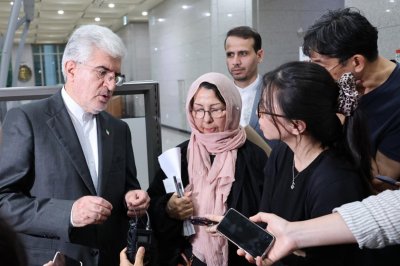
Iranian Ambassador to South Korea Saeed Koozechi (L) speaks to reporters as he exits the foreign ministry building in Seoul, South Korea, 27 May 2026. The ministry summoned Koozechi to lodge a protest over a 04 May attack on the HMM Namu, a South Korean-operated vessel, in the Strait of Hormuz. The ministry said Iranian-developed anti-ship missiles were likely used in the attack earlier this month. Photo by YONHAP / EPA

May 29 (Asia Today) — South Korean defense experts said the government should take a tougher position toward Iran after investigators concluded that an Iranian-developed anti-ship missile was likely used in an attack on the HMM Namu.

Experts said Thursday that Seoul needs a firm diplomatic response to the results of the government investigation into the unidentified aerial objects that struck the HMM-operated vessel.

The government said Wednesday that the objects were highly likely to have been Noor-series anti-ship missiles developed by Iran. Technical analysis found the engine resembled an Iranian-made turbojet engine, and some components carried markings believed to be from an Iranian manufacturer.

South Korean officials said the evidence points toward Iran but stopped short of making a final judgment on who carried out the attack or whether it was intentional. The government summoned Saeed Koozechi, Iran’s ambassador to South Korea, but Koozechi denied that Iran was involved.

“If it was actually confirmed to be an Iranian missile, it should be viewed as an act by the Iranian government,” said Kwon Yong-soo, professor emeritus at Korea National Defense University. “The missile’s maximum range is short, and because of the flame at launch, it would have been visible where it came from.”

Kwon said the government should be able to explain whether the missile was fired from land, a ship or a fast boat.

“If it was not Iran’s act, Iran itself should present evidence,” he said.

Yang Uk, a research fellow at the Asan Institute for Policy Studies, said the evidence points to an Iranian-made anti-ship missile.

“Even if Iran denies it, that denial is not persuasive,” Yang said. “Anti-ship missiles are weapons that only states, governments and militaries can operate.”

Yang said Iran may have provided missiles to an armed group, such as the Houthi rebels, but the distance would have been too far for such a launch.

“If the Islamic Revolutionary Guard Corps fired it and the Iranian government pretends not to know, that would prove Iran’s own command and control is inadequate,” he said.

Some experts said the South Korean government’s response has been too weak, even though it summoned Koozechi immediately after announcing the investigation results.

A Foreign Ministry official said summoning Iran’s ambassador was a serious diplomatic measure.

“Summoning the Iranian ambassador to South Korea is by no means meaningless,” the official said. “The measure itself shows our firm position.”

The official said Seoul had sent investigation teams twice, collected debris, reached its conclusion through analysis by expert agencies, publicly announced the findings and explained them to the other country.

“That itself is a serious diplomatic step,” the official said.

Yang said some may argue South Korea does not need to create unnecessary conflict with Iran. But he said Seoul should at least secure something from the Iranian government if it takes that position.

“Given that the evidence points to Iran, we should at least apply pressure to ensure our ships are allowed to return safely,” Yang said. “If we do not even do that, then we are refusing to do what a state should do.”

— Reported by Asia Today; translated by UPI

© Asia Today. Unauthorized reproduction or redistribution prohibited.

Original Korean report: https://www.asiatoday.co.kr/kn/view.php?key=20260528010008578

Source link

South Korea, U.S. to open security talks on nuclear subs

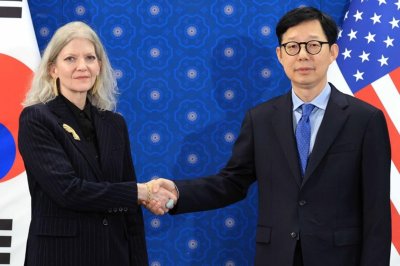
South Korean Vice Foreign Minister Park Yoon-joo (R) shakes hand with his US counterpart, Allison Hooker, at the foreign ministry in Seoul, South Korea. Photo by YONHAP / EPA

May 29 (Asia Today) — South Korea and the United States will hold their first meeting in Seoul next week to discuss security issues agreed to at last year’s bilateral summit, including South Korea’s acquisition of nuclear-powered submarines.

South Korea’s Foreign Ministry said Friday the two sides will hold a launch meeting June 2-3 in Seoul for follow-up consultations on the security provisions of the joint fact sheet issued after the summit.

The meeting will come eight months after the two leaders announced agreements in the security section of the joint fact sheet in October.

The two sides are expected to discuss specific measures related to South Korea’s construction of nuclear-powered submarines, as well as expanded authority over uranium enrichment and spent nuclear fuel reprocessing.

With U.S. midterm elections scheduled for November, negotiations in individual areas are expected to gain momentum.

South Korea will send an interagency delegation led by First Vice Foreign Minister Park Yoon-joo. Officials from the presidential National Security Office, Foreign Ministry, Defense Ministry, Ministry of Climate and Energy, Ministry of Science and ICT, Ministry of Trade, Industry and Resources and Nuclear Safety and Security Commission will also attend.

The U.S. delegation will be led by Allison Hooker, under secretary of state for political affairs. Officials from the White House National Security Council, State Department, Energy Department and War Department are expected to travel to Seoul for the talks.

— Reported by Asia Today; translated by UPI

© Asia Today. Unauthorized reproduction or redistribution prohibited.

Original Korean report: https://www.asiatoday.co.kr/kn/view.php?key=20260529010008720

Source link

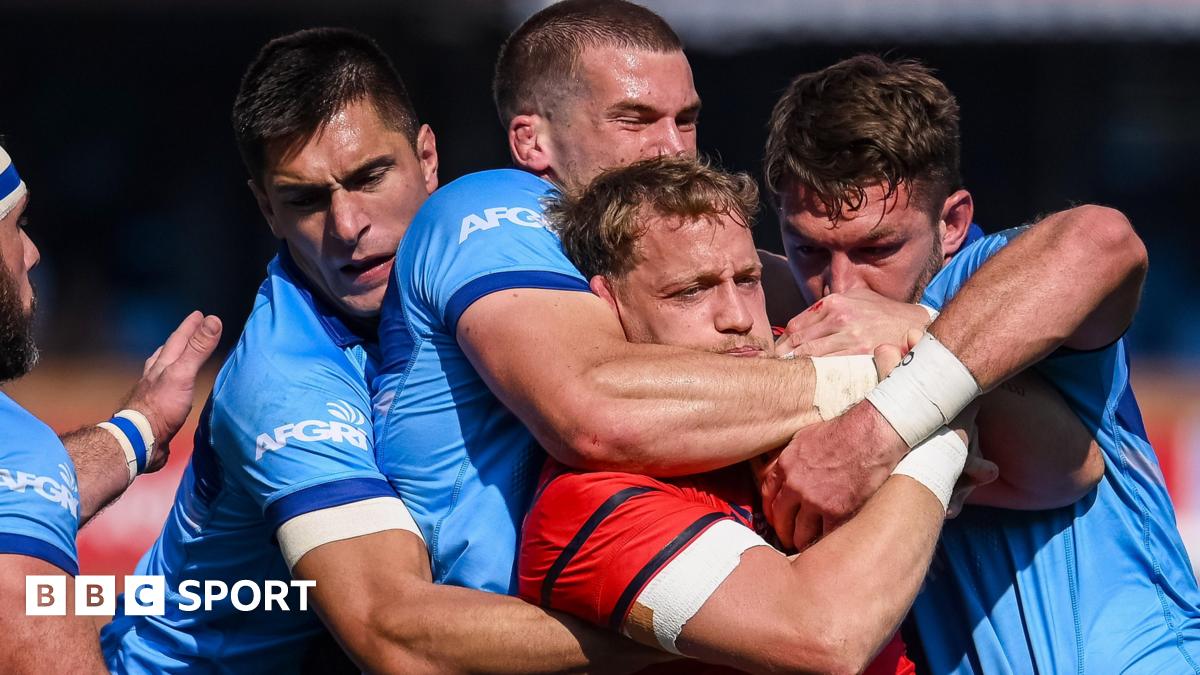
Bulls 45-14 Munster: South Africans ease into United Rugby Championship semi-finals

Bulls: Le Roux; Arendse, Moodie, Vorster, Jacobs; Pollard, Papier; Steenekamp, Grobbelaar, Klopper; Vermaak, Nortje; Coetzee (capt) Louw, Hanekom.

Replacements: van Staden, Wessels, Smith, Wiese, Rudolph, de Wet, Gans, Petersen.

Munster: Haley; Smith, Nankivell, O’Brien, Daly; Hanrahan, Casey (capt); Loughman, N Scannell, Ala’alatoa; Ahern, O’Connell; O’Donoghue, Hodnett, Gleeson.

Replacements: D Barron, J Wycherley, Bartley, F Wycherley, Coombes, O’Donovan, Kelly, Kendellen.

Source link

South Korea party leaders split on early voting strategy

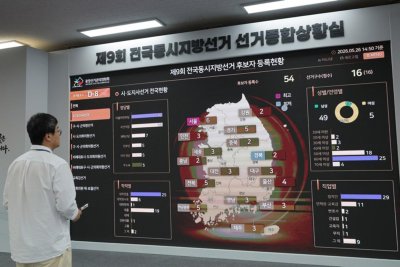
Election-related information is displayed on an electronic board at the National Election Commission’s situation room in Gwacheon, south of Seoul, South Korea, 26 May 2026, eight days ahead of the 03 June local elections. Photo by YONHAP / EPA

May 29 (Asia Today) — Leaders of South Korea’s rival political parties urged voters to cast ballots Friday, the first day of early voting for the June 3 local elections, but their strategies showed different approaches.

Chung Chung-rae, leader of the Democratic Party, and Han Byung-do, the party’s floor leader, both voted on the first day of early voting. People Power Party leader Chang Dong-hyeok and floor leader Song Eon-seok divided their roles, with Chang choosing to vote on Election Day and Song planning to vote early.

Chung began his schedule Friday by casting an early ballot at the Seongsan 2-dong Community Service Center in Mapo District, Seoul. After voting, he attended a meeting of the party’s central election committee in Seoul and urged voters to participate.

“Voting is stronger than bullets,” Chung said. “Power does not come from the barrel of a gun. It comes from the polling place.”

Han also visited an early voting station before heading to campaign events in Namwon, North Jeolla Province.

“Early voting will be held for two days starting today,” Han said. “Please exercise your precious vote for the future of South Korea.”

The major opposition People Power Party took a different approach. Chang plans to vote on Election Day, while Song is scheduled to cast an early ballot Saturday.

The move is seen as a strategy to appeal both to the party’s hard-line conservative base and more moderate conservative voters. Chang and Song have also divided campaign duties during the election period, focusing on separate schedules.

Chang campaigned Friday in Sejong and western Gyeonggi Province.

“The atmosphere is changing as we lead this election, but if we lose by even one vote, there is no future for South Korea,” Chang said. “Everything depends on your one vote. Please do not leave yourself with regret by failing to go to the polling place.”

Song said he plans to vote early Saturday in Gimcheon, North Gyeongsang Province, his electoral district.

At a news conference at the National Assembly earlier Friday, Song acknowledged that some political figures have argued against early voting.

“It is true that there are some movements in political circles saying people should not vote early, but I will not say that is our party,” Song said. “There is a big difference between holding voting over three days and holding it for only one day.”

“In reality, the number of votes cast during the two days of early voting and on Election Day is close to half and half,” he said. “I think voters should vote over the three days, including early voting, according to their circumstances and schedules.”

Park Sung-hoon, chief spokesperson for the People Power Party, said both early voting and Election Day voting are important exercises of political rights.

“To strategically encourage both early voting and Election Day voting, we decided that the floor leader would vote early and the party leader would participate in Election Day voting, taking his schedule into account,” Park said.

— Reported by Asia Today; translated by UPI

© Asia Today. Unauthorized reproduction or redistribution prohibited.

Original Korean report: https://www.asiatoday.co.kr/kn/view.php?key=20260529010008858

Source link

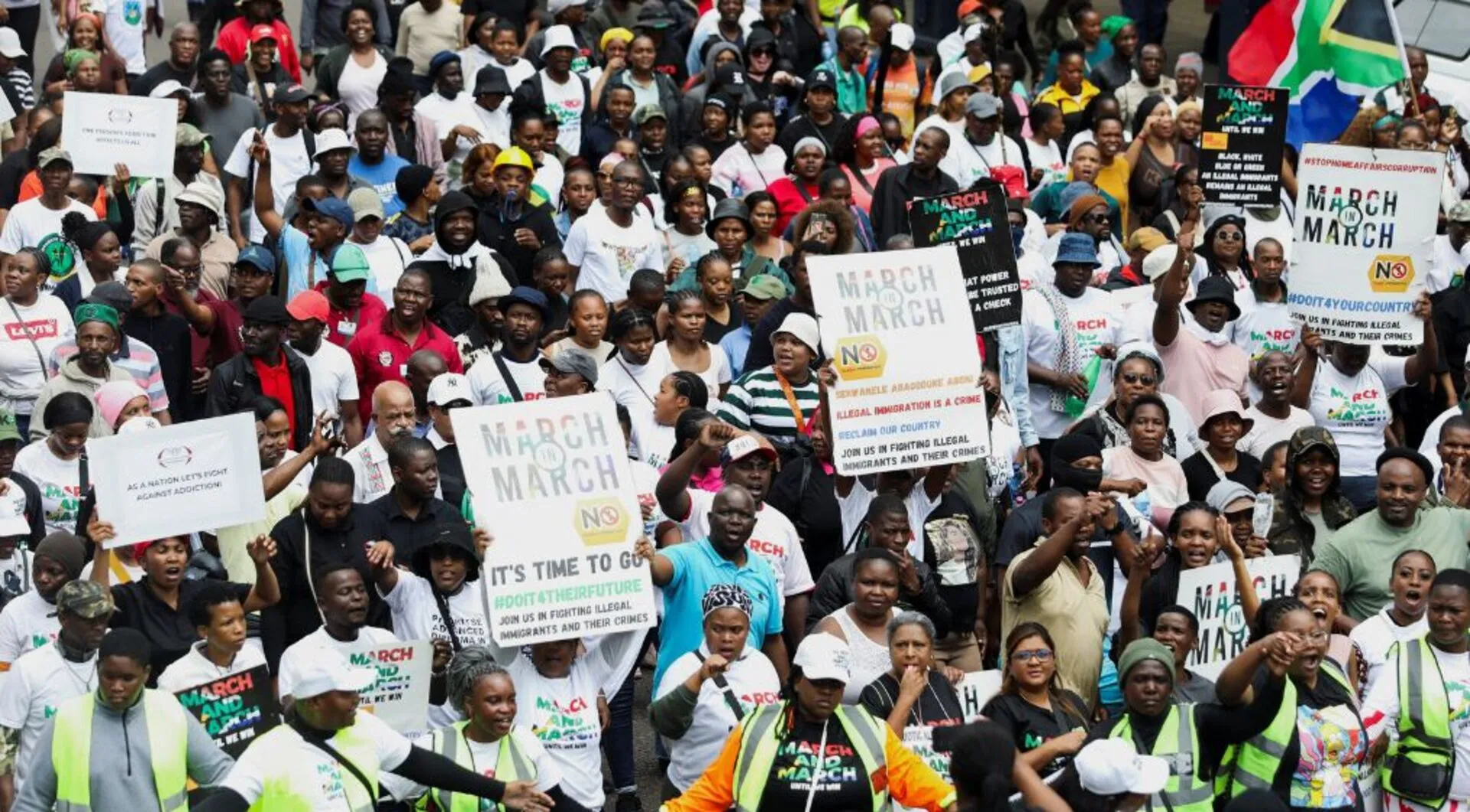
What’s behind South Africa’s anti-migrant protests? | Migration News

Foreign workers in South Africa are yet again facing violence and protests by anti-immigrant groups. They accuse them of residing and working in the country illegally and are demanding that they leave by June 30.

South Africa has seen recurrent waves of anti-immigrant violence in the past decade – often directed at other African nationals.

Recommended Stories

list of 3 itemsend of list

Since the end of apartheid in 1994, the country has become a destination for thousands of workers from neighbouring countries. But many South Africans say the government is not upholding its immigration laws.

So, does South Africa still need foreign workers?

Presenter: Tom McRae

Guests:

William Gumede – Associate professor, School of Governance at the University of the Witwatersrand

Lindiwe Zulu – Member of the ANC Committee on International Relations and a former South African minister of social development

Ashraf Essop – Immigration lawyer

Source link

Ghana welcomes home citizens evacuated from South Africa | Migration News

NewsFeed

The first flight carrying around 300 Ghanaians evacuated from South Africa following anti-immigrant tensions and reported attacks on foreign nationals has arrived in Accra. Authorities welcomed returnees with reintegration support and transport assistance.

Source link

OpenAI names South Korea key partner for AI cyber defense

OpenAI Chief Strategy Officer Jason Kwon speaks during a press conference on the Korea Cyber Action Plan in Seoul on Wednesday. Photo by Asia Today

May 27 (Asia Today) — OpenAI said Wednesday it will expand artificial intelligence-based cyber defense cooperation with the South Korean government, public agencies and companies in key industries.

The company announced its Korea Cyber Action Plan during a press conference at the JW Marriott Hotel in Seoul’s Seocho District. The plan is designed to give government agencies, public institutions and companies broader access to OpenAI’s advanced AI cyber models.

Jason Kwon, OpenAI’s chief strategy officer, said AI has entered a third stage as an “intelligence utility,” becoming core infrastructure for the economy and society after earlier phases focused on capability breakthroughs and broader access.

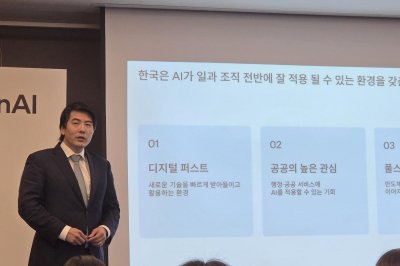
Kwon said South Korea is well positioned to adopt AI because it is a digital-first society that quickly embraces new technologies and has a “full-stack economy” with global semiconductor companies including Samsung Electronics and SK hynix.

“Advanced cyber AI capabilities should not remain in the hands of only a few,” Kwon said. “Korea’s key defenders should be able to use them to strengthen collective security and public safety.”

“Korea is a very important country for OpenAI,” he said. “We hope to become an important partner in Korea’s AI transformation and in strengthening national resilience.”

The Korea Cyber Action Plan is part of Daybreak, OpenAI’s global cybersecurity initiative that aims to build security into systems from the earliest stages of development. OpenAI says Daybreak is designed to help cyber defenders identify threats, generate patches and verify fixes across code and systems.

A key part of the plan is expanding Trusted Access for Cyber, a program that gives verified defensive users access to specialized cyber AI models. OpenAI said in April it was scaling the program to thousands of verified individual defenders and hundreds of teams responsible for protecting critical software.

Kwon said access for the South Korean government to the government version of the program is in its final stage. He said OpenAI is also discussing adoption of the private-sector program with several Korean companies.

Asked about potential misuse of cyber models and data leakage risks, Kwon said OpenAI is controlling risk by granting access only to “trusted defenders” who go through strict verification.

He also said OpenAI supports data residency in South Korea, allowing data to be processed on domestic servers. Public agencies and companies may also choose an option in which data is not stored at all, he said.

Kwon said OpenAI has begun talks with the Korea AI Safety Institute under the Ministry of Science and ICT. He said the company will draw on its experience working with AI safety institutes in the United States and Britain to help South Korea build its own model evaluation capabilities.

Before Wednesday’s announcement, OpenAI had been deepening cooperation with South Korea’s public sector. On May 18, Sasha Baker, OpenAI’s head of national security policy, visited South Korea and demonstrated the company’s latest cyber-focused models to major agencies including the science ministry, the Foreign Ministry, the Interior Ministry, the Financial Services Commission and the National AI Strategy Committee.

On Tuesday, Kwon met with Ryu Je-myung, second vice minister of science and ICT, to discuss AI security cooperation. OpenAI also signed memorandums of understanding with Korea Water Resources Corp. and Korea Technology Finance Corp.

Kwon emphasized the company’s expectations for the Korean market.

“Korea is a country with very favorable conditions to turn AI into national competitiveness,” he said. “Based on ChatGPT, Korea is already one of the top 10 markets globally, and the speed of AI adoption is very fast.”

OpenAI said use of Codex in South Korea is also growing quickly. Weekly active users of ChatGPT Codex in the country have increased tenfold since the beginning of the year, placing South Korea among the top five countries by usage.

More than half of the requests come from non-development work such as document writing, analysis, research and operations, showing the potential for wider enterprise use, the company said.

Kwon said changes in OpenAI’s partnership with Microsoft have made it possible to provide OpenAI API services through a wider range of cloud providers, including Amazon Web Services, and that enterprise growth is expected to accelerate.

On pricing for enterprise services, Kwon said consumer subscriptions and corporate services are different, and that business customers already use contract-based pricing. Over the long term, he said OpenAI aims to provide stronger AI performance at the same cost or lower unit prices so more users can benefit.

— Reported by Asia Today; translated by UPI

© Asia Today. Unauthorized reproduction or redistribution prohibited.

Original Korean report: https://www.asiatoday.co.kr/kn/view.php?key=20260527010008011

Source link

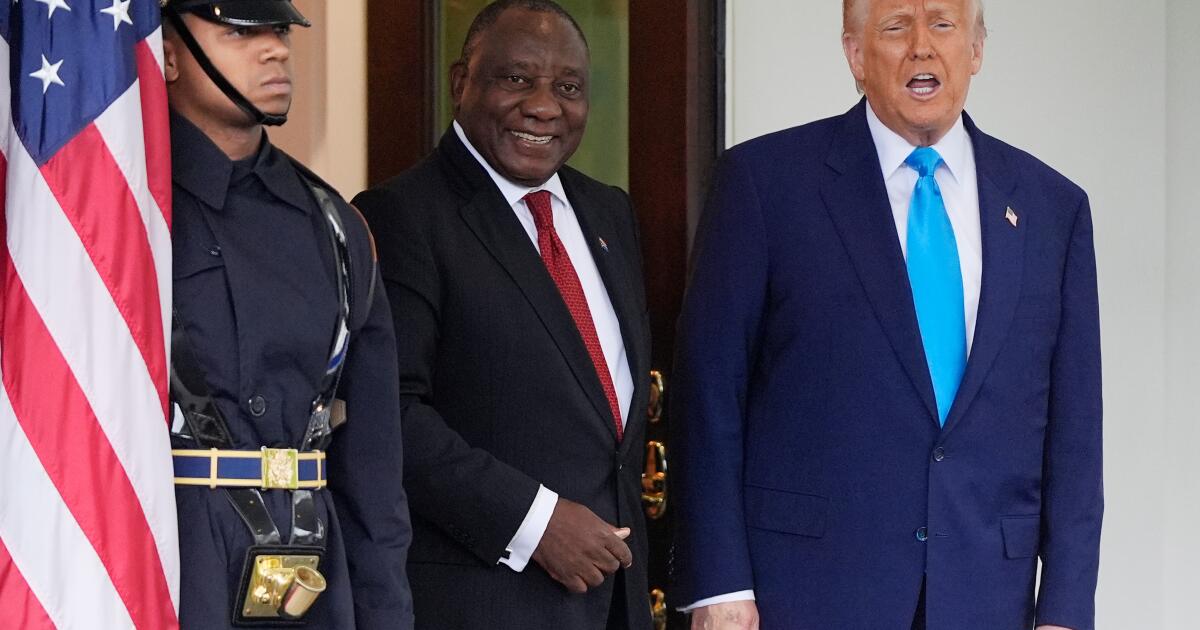
South African government rejects U.S. position that there’s a humanitarian emergency for white people

The government in South Africa and Afrikaner advocacy groups on Wednesday rejected the position of the Trump administration that there’s a humanitarian emergency affecting white people in South Africa.

The argument served as the rationale for raising the U.S. refugee cap, but only for white Afrikaners. The Trump administration said Tuesday that it will admit an additional 10,000 white South Africans into the U.S. as refugees this year, increasing its annual cap, but blocking people from other countries from entering through the program.

President Trump’s announcement on the Federal Register that he was increasing the refugee cap because of “an unforeseen emergency refugee situation.” He blamed the South African government for “recent increases in the incitement of racially motivated violence,” but Trump gave no specific information.

The South African government’s international relations department said Wednesday that accusations of systemic persecution of white Afrikaners are unfounded, pointing out that some beneficiaries of an immigration program have chosen to return to South Africa.

“This reality is further corroborated by the actions of individuals who, despite having availed themselves of this preferential immigration program, have since resolved to return home,” spokesman Chrispin Phiri said.

Afrikaner trade union, Solidariteit, argued that refugee status isn’t a viable solution for Afrikaners, who should thrive in South Africa instead. Spokesman Jaco Kleynhans said that the organization hadn’t discussed any “unforeseen emergency refugee situation” with the Trump administration, but respects the autonomy of U.S. refugee policy toward Afrikaners.

The union “is in no way aware of anything that the Trump administration could be referring to,” Kleynhans said.

AfriForum, a lobbying organization for the country’s white Afrikaner minority with more than 300,000 members, said it “does not have information” regarding the specific assertion that there’s an emergency refugee situation.

The organization’s CEO, Kallie Kriel, said the group’s focus is “fighting to create the circumstances in South Africa where there is no need for Afrikaners to leave.”

Trump suspended the U.S. refugee program on his first day in office and, since then, has turned it into a vehicle to allow Afrikaners — a group of white South Africans descended mainly from Dutch settlers — into the United States. Advocates say the decision to focus a decades-old program on one group has left people around the world fleeing war and strife stranded and with few options.

Refugee groups have questioned why white South Africans are being prioritized ahead of people from countries facing war and natural disasters. Vetting for refugee status in the U.S. often takes years.

The Trump administration’s preference for white Afrikaner refugee admissions, according to Dr. Bryony Fox, a social justice researcher at Stellenbosch University, raises questions about selective humanitarianism, inconsistent refugee protection and favoring privileged groups, while ignoring other refugee populations experiencing severe hardships.

“This risks politicizing refugee protection in a way that may ultimately weaken the legitimacy and universality of the refugee regime itself,” she said.

Gumede writes for the Associated Press.

Source link

South Carolina Senate adjourns without new map, defying Trump

May 26 (UPI) — South Carolina’s state Senate adjourned Tuesday without acting on a new congressional map that would have redrawn voting districts in favor of Republicans.

President Donald Trump has called on states to redraw their voting maps to favor Republicans, especially after a recent U.S. Supreme Court decision that badly weakened a part of the landmark federal Voting Rights Act of 1965 that helped protect minority voting power.

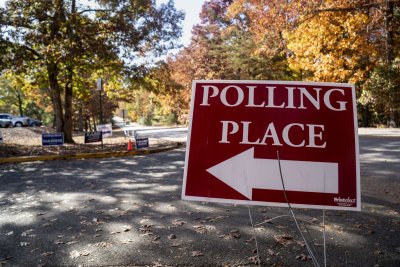
However, as voters started heading to the polls Tuesday for the first in-person voting in primaries, state senators said it was just too late. If the state Senate pushed the map through Tuesday, the state would have had to throw out tens of thousands of ballots that had already been cast that day and schedule a new primary.

“Neither my conscience nor my common sense would allow me to stop an election that is already underway,” Republican state Sen. Richard Cash said during the vote, The BBC reported.

The new congressional map pitched for South Carolina would do away with the state’s only majority Black district, which is represented by Rep. James Clyburn, a Democrat. Clyburn is seeking his 18th term in office this year.

Republicans have a narrow majority in the U.S. House of Representatives, and Trump and other conservatives are calling for district changes to hold on to that majority during the midterm elections in November. Other states, including Tennessee, have already redrawn and approved new maps eliminating majority Black districts.

CNN reported that Trump called Republican state Senate Majority Leader Shane Massey at least twice about the plan, and the president has posted regularly on social media about the matter as well.

“South Carolina Republicans: BE BOLD AND COURAGEOUS, just like the Republicans of the Great State of Tennessee were last week!” the president wrote in a post earlier this month.

South Carolina state senators will likely pick up the matter again after the primary voting ends June 9. State Sen. Brad Hutto, a Democrat, said his party members worked all weekend to make voters headed out to the polls today, The New York Times reported.

“The people in South Carolina were sending us a message that their vote mattered,” he said. “It was important, and they didn’t want us to cancel their vote.”

Democrats had another win in the redistricting wars on Tuesday, with a federal court temporarily blocking Alabama from using its newly redrawn congressional map, which includes only one Black majority district out of seven. The population of Alabama is about 27% Black.

The South Carolina map in question, meanwhile, would have resulted in no Black majority districts out of the state’s seven. The state is about 26% Black, based on 2025 U.S. Census numbers.

Source link

Press Freedom Crisis Deepens Across South Asia as Media Credibility Faces Growing Scrutiny

Across South Asia, concerns over press freedom, political influence, and media credibility are drawing increasing international scrutiny. From Bangladesh and Pakistan to India, journalists and independent media organisations face mounting political, economic, and legal pressures that are reshaping how information is produced and consumed.

Recent international assessments point to what rights groups describe as a broader regional decline in media independence. The 2026 World Press Freedom Index placed multiple South Asian countries near the lower end of global rankings, reflecting concerns over censorship, political pressure, and growing ideological polarisation within news ecosystems.

Among these cases, India continues to attract the most sustained global attention due to its scale, democratic profile, and influence as the world’s largest electoral democracy.

When a country that defines itself as a global democratic model falls to 157th out of 180 nations on the World Press Freedom Index, the question is no longer whether there are challenges within its media environment. The question is how deeply those challenges have reshaped journalism itself.

Together with other regional indicators, the findings suggest not isolated failures but a structural transformation in how media systems operate across South Asia.

The concerns highlighted in global reports do not exist in isolation. Across South Asia, governments and political actors are increasingly accused of exerting pressure on journalists through legal action, advertising influence, regulatory scrutiny, and informal intimidation.

According to World Press Freedom Index in 2026, Bangladesh stood at 152nd. Afghanistan remained among the lowest-ranked countries globally, reflecting ongoing restrictions on press activity. Nepal, while comparatively better positioned at 87th, has also faced periodic concerns over political influence and media ownership concentration.

Analysts argue that while each country’s political context differs, a shared pattern is emerging: fragile media economies, heightened political polarisation, and increasing hostility toward independent journalism.

However, India’s trajectory is often singled out due to its democratic stature and its role as a regional political and cultural benchmark. This contrast between democratic identity and media freedom rankings has intensified global debate about the state of its information ecosystem.

Political Influence and the Changing Nature of News

Within India, one of the central concerns raised by international observers is the perceived growth of political influence over large sections of mainstream media.

A detailed report by Genocide Watch described what it termed a “severe crisis of credibility” in parts of the Indian media landscape, arguing that dominant narratives in some outlets increasingly align with those of the ruling Bharatiya Janata Party rather than independently scrutinising power.

This does not imply uniformity across the entire media sector. India still has a diverse ecosystem of investigative journalists, regional newspapers, and independent digital platforms producing critical reporting. However, critics argue that the dominant tone of mainstream television and high-visibility digital media increasingly reflects political messaging rather than adversarial journalism.

The Reporters Without Borders (RSF) assessment echoed concerns about structural vulnerabilities. It highlighted the heavy dependence of Indian media on advertising revenue, including significant spending by both central and state governments. Critics argue that this financial structure creates subtle incentives for compliance, where editorial decisions may be influenced not through direct censorship, but through economic dependency.

In such an environment, formal restrictions are often unnecessary. Editorial caution can emerge internally, as news organisations weigh political and financial risks before pursuing certain stories.

The Rise of Divisive Television Narratives

Another recurring concern involves the increasing polarisation of televised political discourse.

Genocide Watch and other rights-focused assessments have warned that sections of mainstream media increasingly frame political and social issues through identity-based narratives, often centred on religion and nationalism. Complex policy debates are frequently simplified into binary positions, contributing to heightened social tension.

Human Rights Watch, in its World Report 2026, also documented concerns that hostile rhetoric in parts of media and online spaces has coincided with rising incidents of discrimination and attacks against minority communities, including Muslims in different parts of the country.

While causation is difficult to establish definitively, observers argue that repeated framing of communities through suspicion or collective identity can contribute to an environment where social hostility becomes easier to normalise.

The RSF report additionally pointed to structural imbalances within media representation, noting concerns about concentration of leadership within certain social groups and the underrepresentation of women in prominent political debate programming. These imbalances, critics argue, shape not only who speaks in media spaces, but also which perspectives are amplified or marginalised.

Self-Censorship and Invisible Constraints

Not all constraints on journalism are explicit. In many cases, they manifest as self-censorship.

According to Genocide Watch, journalists and editors increasingly avoid topics that could lead to political backlash, regulatory scrutiny, legal threats, or coordinated online harassment campaigns. Over time, this produces a newsroom culture in which certain subjects are quietly excluded before formal editorial decisions are even made.

This form of pressure is difficult to measure, but its effects can be significant. When reporters internalise risk calculations, the range of publicly available information can narrow without any formal ban or directive.

RSF similarly highlighted concerns over actions taken against independent journalists, commentators, and publications. It cited instances of restrictions, legal pressure, and bans on certain media outlets in sensitive regions, including Jammu and Kashmir, where authorities have taken action against publications accused of promoting separatism.

Critics argue that such measures contribute to a wider climate of caution, particularly around politically sensitive reporting.

A Broader Democratic Stress Test

The implications of these developments extend beyond journalism alone.

Genocide Watch framed the weakening of press freedom as part of a broader institutional credibility challenge linked to political polarisation and majoritarian dynamics. In this view, media independence is not an isolated issue but part of a wider ecosystem that includes accountability, governance, and civic trust.

A free press plays a central role in democratic systems by enabling scrutiny of power and facilitating informed public debate. When that role weakens, the consequences extend into how citizens engage with institutions and interpret political realities.

India’s trajectory in the RSF index over recent years reflects this concern. The country ranked 150th in 2022, fell further to 161st in 2023, improved slightly to 151st in 2025, and then declined again to 157th in 2026. Analysts interpret this pattern not as random fluctuation but as part of a longer-term structural challenge.

At the same time, government supporters argue that India remains a robust electoral democracy with active institutions, a vibrant political opposition, and a highly diverse media landscape. They contend that international rankings often fail to capture the complexity of India’s scale, security challenges, and internal diversity.

The debate, therefore, is not solely about classification, but about how democratic quality itself should be assessed.

South Asia in a Global Decline

These concerns are unfolding within a broader global downturn in press freedom. RSF’s 2026 index noted that worldwide media freedom has reached its weakest level in 25 years, with more than half of all countries classified as having “difficult” or “very serious” conditions.

South Asia reflects this global trend particularly sharply. Alongside India, countries such as Bangladesh remain in the lower tiers of the global rankings, highlighting shared regional challenges around political influence, media ownership concentration, and journalist safety.

Yet despite this broader pattern, analysts continue to emphasise that each country’s trajectory is shaped by its own political history and institutional structures. In India’s case, its global influence and democratic identity make developments in its media landscape particularly consequential for international observers.

What Is Ultimately at Stake

The credibility of media systems plays a central role in shaping the health of democratic life. Journalism informs not only public debate but also citizens’ ability to evaluate leadership, understand policy decisions, and hold institutions accountable.

When trust in media declines, democratic accountability becomes harder to sustain.

The findings from Genocide Watch and RSF should therefore be viewed not simply as criticism of individual outlets or governments, but as indicators of broader institutional stress across South Asia.

Addressing these challenges would require a combination of stronger protections for editorial independence, more diversified ownership structures, reduced reliance on state advertising, and greater safeguards for journalists facing intimidation or harassment.

Despite these pressures, the region continues to produce significant investigative journalism and independent reporting under difficult conditions. Many journalists continue to work at considerable personal and professional risk to maintain public access to information.

Acknowledging structural challenges across South Asia is not an indictment of any single democracy. Rather, it is increasingly seen by analysts as a necessary step toward strengthening the democratic principles that the region’s constitutions and institutions claim to uphold.

With information from Reuters.
Source link

South Lebanon’s agriculture falls victim to Israeli attacks

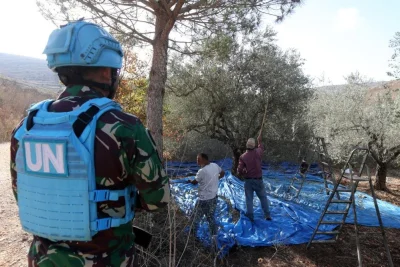
A United Nations Interim Force in Lebanon soldier stands guard as farmers harvest olives in the village of Odaisseh, located close to the Blue Line border with Israel, in southern Lebanon, in October. File Photo by Wael Hamzeh/EPA

BEIRUT, Lebanon, May 22 (UPI) — Lebanon’s agriculture sector emerged as another victim of Israel’s widespread attacks across southern Lebanon, damaging vast areas of farmland, displacing the majority of the region’s farmers and threatening the country’s food security, economic resilience and cultural identity.

The sector, which is key to Lebanon’s economy and plays a vital role in sustaining rural communities and preserving cultural traditions, had not yet recovered from the impacts of the 2023-2024 war between Hezbollah and Israel when it was again hit by resumed hostilities in March.

The fresh escalation severely disrupted farming activities, with an estimated 22.5% of agricultural areas (56,264 hectares) damaged, including farms and greenhouses, and nearly 80% of farmers (more than 6,593) displaced and unable to access their land due to Israeli military activities, according to an updated report released by the Lebanese Ministry of Agriculture on May 5.

The report indicated that the most affected crops in the south are bananas (95%), citrus trees (97%), olives (91%) and small-scale farming, which accounts for 80% of Lebanon’s total agricultural area.

Moreover, more than 1.8 million heads of livestock (cows, goats, sheep and poultry), 29,121 beehives, and 2,030 tons of fish have been lost.

Nizar Hani, the minister of agriculture, said the sector suffered its biggest losses compared with previous wars, adding that agricultural losses have doubled since the March 2 escalation to about $1.5 billion, out of an estimated total war damage that exceeds $20 billion.

Hani said Israel is establishing a buffer zone in southern Lebanon “empty of any life, where no one can pass through, hide or live,” through destruction of entire villages, properties, orchards and olive trees.
He said southern Lebanon produces 70% of the country’s citrus fruits and 90% of its bananas, supplying the local market and exporting to neighboring countries such as Syria, Jordan and Iraq.

And he told UPI that the heavy agricultural losses, inflation, and resulting job losses had a direct impact on food security, with 24% of people living in Lebanon — including Syrian displaced persons, Palestinian refugees and others — requiring immediate assistance.

According to an analysis by the Agriculture Ministry, in collaboration with the U.N.’s Food and Agriculture Organization and the World Food Programme, 1.24 million people were expected to face food insecurity between April and August 2026, marking a significant increase from the November 2025-March 2026 period, when an estimated 874,000 people experienced acute food insecurity.

Nora Ourabah Haddad, the Food and Agriculture Organization representative in Lebanon, warned that damage to irrigation systems, productive infrastructure, livestock systems and agricultural supply chains is further weakening local production capacity.

Haddad referred to substantial declines in the production of milk, meat, eggs and honey after 1,600 farms were affected and more than 1.8 million animals killed during the war.

She said the scale of the damage is “extremely serious” and extends far beyond the affected agricultural land that included some of the country’s most productive farming areas.

“What is at stake today is Lebanon’s capacity to sustain local food production, protect rural livelihoods and preserve the resilience of its agrifood systems at a time when the country is already heavily dependent on food imports and facing severe economic pressures,” she told UPI in an interview.

Haddad said food prices rose by 8.4% in the first quarter of 2026, while transport costs increased by 21%, adding that higher fuel and logistics costs expected to continue to drive up prices.

This time, farmers fear prolonged displacement after being forced to leave their land and homes under Israeli evacuation orders in early March — as many were preparing for the planting season.

Hussein Salameh, head of an agriculture cooperative in the Bint Jbeil-Marjeyoun area, recalled how they fled without having time to take any belongings, move their cows away or release them.

Salameh, an inhabitant of the village of Aitaroun, said the displaced farmers mostly feel “frustrated and abandoned” after exhausting their savings on working their land and repairing their damaged homes when they first returned after the Nov. 27, 2024, cease-fire.

He noted that Hezbollah did not provide them then with any financial assistance, saying it no longer had the funds to do so.

Unlike other displaced employees or skilled workers who could still find work in their areas of refuge, they have lost their only source of livelihood away from their land, he said.

“This is a big tragedy. … Farmers have only their land to live on and survive,” he told UPI.

The fear is that when farmers remain separated from their land, livestock and livelihoods for extended periods, many gradually lose the ability to sustain themselves and may eventually abandon agriculture altogether, Haddad warned.

Helping farmers protect what remains of their livelihoods by providing emergency agricultural support and restoring the country’s agricultural capacity before losses become “irreversible” were emerging priorities for the Food and Agriculture Organization, she said.

However, soil contamination presents another major concern after Lebanon and international rights groups accused Israel of unlawfully using white phosphorus and the herbicide glyphosate during its attacks on southern Lebanon, destroying crops and damaging beehives and livestock.

“This is an international environmental crime,” Hani said, adding that Israel “sprayed everything with glyphosate.”

The destruction and uprooting of old olive trees — some of which have been cultivated and preserved across generations, and in some cases for centuries — was equally painful.

“It is the loss of a living heritage … olive trees are deeply connected to family history, local traditions, food culture and rural economies,” Haddad said, adding that their destruction carries not only economic consequences, but also profound social and cultural impacts on farming communities.

Restoration is possible, but it requires time as newly planted trees require many years before becoming fully productive.

“Some of these ancient olive trees may also contain unique genetic heritage that has adapted to local environmental conditions over centuries, making parts of this loss potentially irreversible from a biodiversity perspective,” Haddad said.

Even if hostilities were to stop today, recovery in southern Lebanon’s agriculture sector would not be immediate and would require extensive international funding and support.

Farmers would also need time to recover from the “deep psychological impact” of being uprooted from their land, after their “cultural and environmental values” were destroyed, according to Hani.

To Salameh, Israel was not just targeting Hezbollah but carrying out what he described as “collective punishment” against everyone living in the south, including those opposed to the Iran-backed group.

“Would such collective punishment ensure security for Israel? Would that bring peace?” he asked.

Source link

CPJ warns of ‘invisible pressure’ on media in South Korea, Japan

1 of 2 | Jacob Weisberg, chairman of the Committee to Protect Journalists, speaks during a news conference Thursday at the Foreign Correspondents’ Club of Japan in Tokyo. Photo by Asia Today

May 22 (Asia Today) — The head of the U.S.-based Committee to Protect Journalists warned Friday that pressure on press freedom is not limited to imprisonment, killings or direct censorship, saying lawsuits, access restrictions and online attacks can also intimidate reporters and encourage self-censorship.

Jacob Weisberg, chairman of the Committee to Protect Journalists, made the remarks during a news conference at the Foreign Correspondents’ Club of Japan in Tokyo when asked about indirect pressure on journalists in democracies such as South Korea and Japan.

“The issue of reporters being prevented from doing their jobs or being punished in unofficial ways, and the issue of threats and self-censorship, are much more difficult matters,” Weisberg said.

Asia Today asked how the organization evaluates cases in which press freedom is restricted not through direct censorship but through exclusion, intimidation or loss of access, citing press corps-centered reporting restrictions, limits on access to government briefings, defamation lawsuits and online harassment.

Weisberg said the CPJ is still considering how to respond to such issues.

“That does not mean CPJ is not concerned about such issues, but to be fair, we are still thinking about how to deal with questions like that,” he said.

He said the group’s top priority remains helping journalists who face physical danger.

“CPJ’s first obligation is to help journalists who are in physical danger,” he said. “We first deal with cases involving journalists who are imprisoned, abused, tortured or killed.”

But he stressed that this does not mean the organization is unconcerned about more subtle and complicated issues surrounding press freedom.

Weisberg also addressed Japan’s press club system. While saying he did not know enough about Japan, he said he had often heard about the country’s press clubs and the inherent limits of that system.

He said reporters outside press clubs may not have the same access to information and that the system can function as an exclusive channel through which information is delivered.

Weisberg did not equate the issue with censorship seen in authoritarian countries.

“It is not censorship, but it is a lower-level problem than that,” he said.

He also cited the United States, saying there have been no confirmed recent cases of journalists being jailed or killed there, but that the environment for reporters has worsened and become more dangerous in several ways.

He mentioned “media capture,” in which government approval or corporate merger issues can be used as leverage over broadcasters and media companies, as well as concerns over lawsuits and self-censorship.

Referring to the Trump administration, Weisberg also raised concerns about restrictions on White House access for certain media outlets and limits on access to Pentagon briefings.

Restricting government access to the press because of political views is “illegal and unconstitutional,” he said.

On Asia, Weisberg expressed more direct concern. He said that as of May 13, CPJ counted 103 journalists imprisoned across Asia. China had the largest number, with 51, followed by Myanmar with 18 and Vietnam with 16.

Weisberg also said that while Japan has no recorded cases of journalists being imprisoned or killed, worsening press freedom across Asia affects the safety, movement and reporting ability of Japanese journalists working abroad.

He cited the case of NHK Tehran bureau chief Shinnosuke Kawashima, who was arrested in Iran and later released but has not yet been able to return to Japan.

Weisberg said Japan could play a more active diplomatic role in defending press freedom in Asia.

His remarks suggested that press freedom debates in South Korea and Japan should move beyond the question of whether censorship exists and ask who monopolizes information, who loses the right to ask questions and who is pressured into silence.

— Reported by Asia Today; translated by UPI

© Asia Today. Unauthorized reproduction or redistribution prohibited.

Original Korean report: https://www.asiatoday.co.kr/kn/view.php?key=20260522010006683

Source link