South Korea

Why is Chinese President Xi Jinping visiting North Korea now? | International Trade News

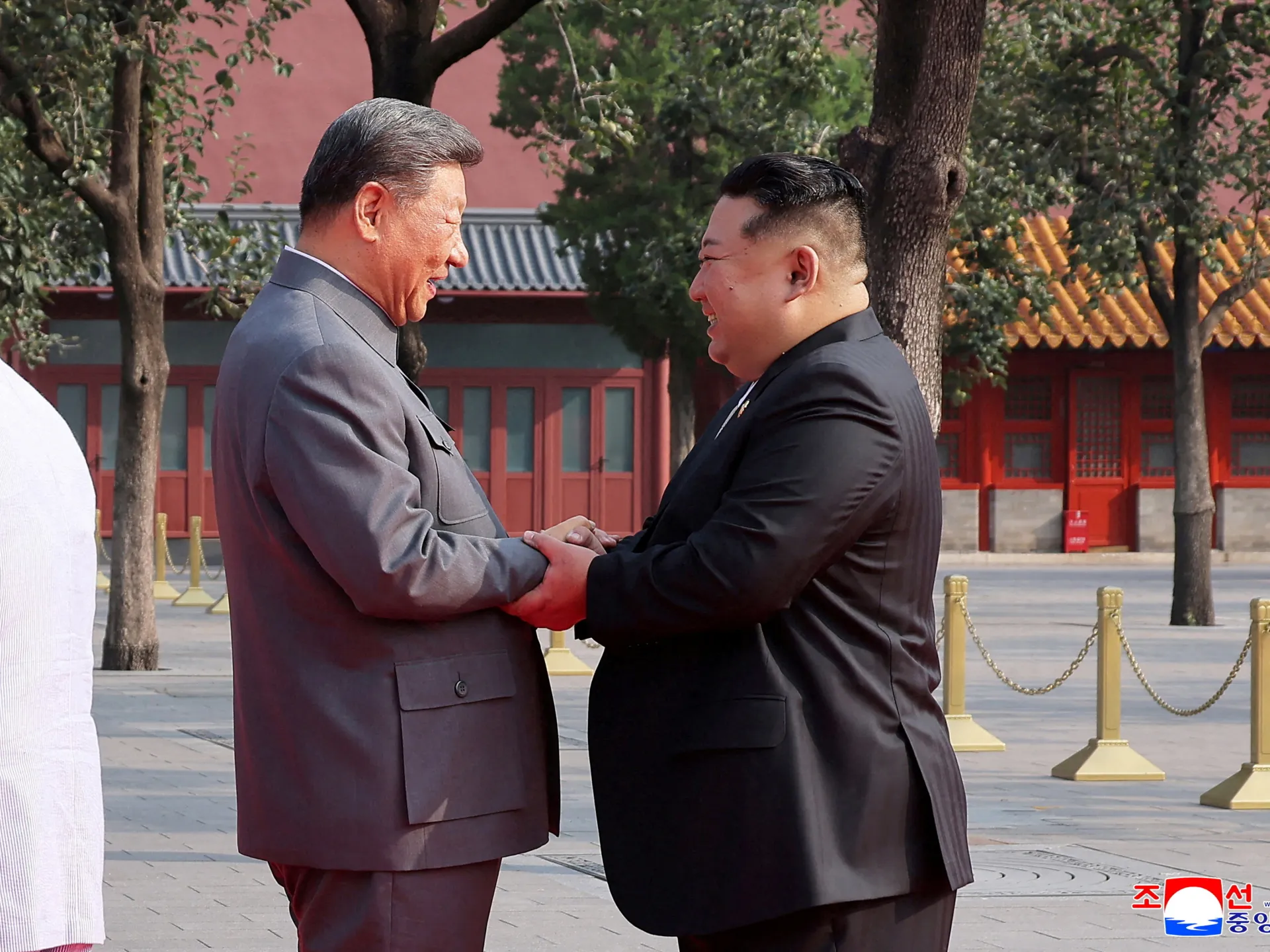
Chinese President Xi Jinping’s meeting with North Korea’s Kim Jong Un in Pyongyang on Sunday is significant for one reason.

It’s not that they are meeting: The two men met in Beijing just a year ago when China held a massive military parade to mark 80 years since Japan surrendered unconditionally to Allied forces, bringing an end to the second world war.

Recommended Stories

list of 4 itemsend of list

What’s surprising is that Xi is travelling at all.

The Chinese leader has not travelled to Pyongyang since 2019, having steadily cut down his travel in recent years, and world leaders like US President Donald Trump and Russian leader Vladimir Putin generally come to him these days.

“We need to remember that Xi Jinping has not really travelled abroad that much,” William Yang, Crisis Group’s senior analyst for Northeast Asia, told Al Jazeera. “The growing trend is foreign leaders heading to Beijing to meet with him.

“For Xi Jinping to be the one who decides to travel to Pyongyang, it shows the level of significance that China attaches to this trip.”

Xi averaged about 14 trips a year between 2013 and 2019, but dropped to approximately six a year between 2022 and 2025, according to the Asia Society. In 2020, he made just one overseas trip, and in 2021, he made none, as China grappled with the COVID-19 pandemic.

He may be travelling now, though, amid concerns about North Korea’s relationship with Russia, Yang said.

Senior partner no more?

Traditionally, Beijing played the role of senior partner in the China-North Korea relationship, with North Korea heavily dependent on China for as much as 95 percent of its trade, according to one 2022 estimate from the National Committee on North Korea, a US-based nonprofit.

That dynamic has been changing since Russia’s 2022 invasion of Ukraine, however. North Korea has provided Russia with critical weapons, artillery and manpower and is credited by observers with helping to keep Moscow’s war machine going.

South Korea’s Institute for National Security Strategy, a government-funded research institute, estimates that since 2023, Moscow has paid North Korea as much as $14.4bn for troop deployments and the export of “artillery, shells, and guided and ballistic missiles”.

The report said that North Korea may only have received between $580m and $1.5bn of that in the form of “goods”, which means there is a “significant possibility that the majority of the payment from Moscow was in the form of ‘sensitive military technology or related precision parts and materials that are difficult to observe via satellite’,” according to a translation.

Although China shares a mutual defence treaty with North Korea, it is still wary of North Korea acquiring new military technology, Yang said.

“Beijing has always been very careful about providing military assistance to North Korea because they do not see a militarily stronger North Korea as necessarily in its favour,” he said. “A North Korea that is militarily emboldened through its relationship with Russia could be a potential source of disruption to the balance of power and status quo on the Korean Peninsula.”

North Korea has already carried out eight missile launches since the start of the year, and in May unveiled a new AI-guided tactical cruise missile, according to North Korean media and the US Naval Institute.

Earlier this week, North Korean state media also released photos of Kim touring a new “weapons-grade nuclear materials” factory, which would be used to expand Pyongyang’s nuclear capability at an “exponential rate”.

Fluctuating tensions

North Korea has technically been at war with South Korea since 1950, with the conflict suspended by a 1953 armistice agreement. The two countries are divided by a 250-kilometre-long (155-mile-long) Demilitarized Zone, splitting the Korean Peninsula.

Tensions have fluctuated dramatically over the years, reaching a recent low point in 2024 when Kim abandoned the long-term goal of Korean unification.

He has largely cut off communications ever since, according to observers. On Friday, South Korea’s Ministry of Foreign Affairs said that it hopes that Xi’s trip will “play a constructive role in addressing issues related to the Korean Peninsula” – suggesting that Seoul may have lobbied the Chinese leader to try to smooth over relations.

South Korean Minister of Unification Chung Dong-young separately told reporters last month that he expects the two leaders to discuss a possible meeting between Kim and Trump later in the year.

Xi may also be alarmed by other security developments in East Asia, including news of a possible military-logistics ‌‌‌‌‌‌‌‌support pact between South Korea and Japan, which was raised at the Shangri-La Dialogue of regional defence officials in Singapore last weekend.

While China and South Korea’s relationship fluctuates, its ties with Japan are acrimonious due to longstanding grievances dating back to Imperial Japan’s occupation of China in the 1930s and 1940s. Beijing has also objected to recent moves by Tokyo to expand its de facto military.

Source link

Saturday 6 June Memorial Day in South Korea

The Korean War began on June 25th 1950, when troops from Communist-ruled North Korea invaded South Korea. 

There was a boycott of the United Nations by the Soviet Union at the time, and therefore, no veto, which allowed the UN to intervene when it became apparent that the superior North Korean forces would easily take over the entire country. 

The Soviets and the Chinese backed North Korea, with the participation of millions of Chinese troops. After large advances on both sides, the war eventually reached a stalemate. 

The 1953 armistice, never signed by South Korea, split the peninsula along the demilitarized zone near the original demarcation line. 

No peace treaty has ever been signed and technically, the two countries are still at war.

The Korean War was the first war in which a world organization, the United Nations (UN), played a military role and a major challenge for the United Nations, which had come into existence only five years earlier.

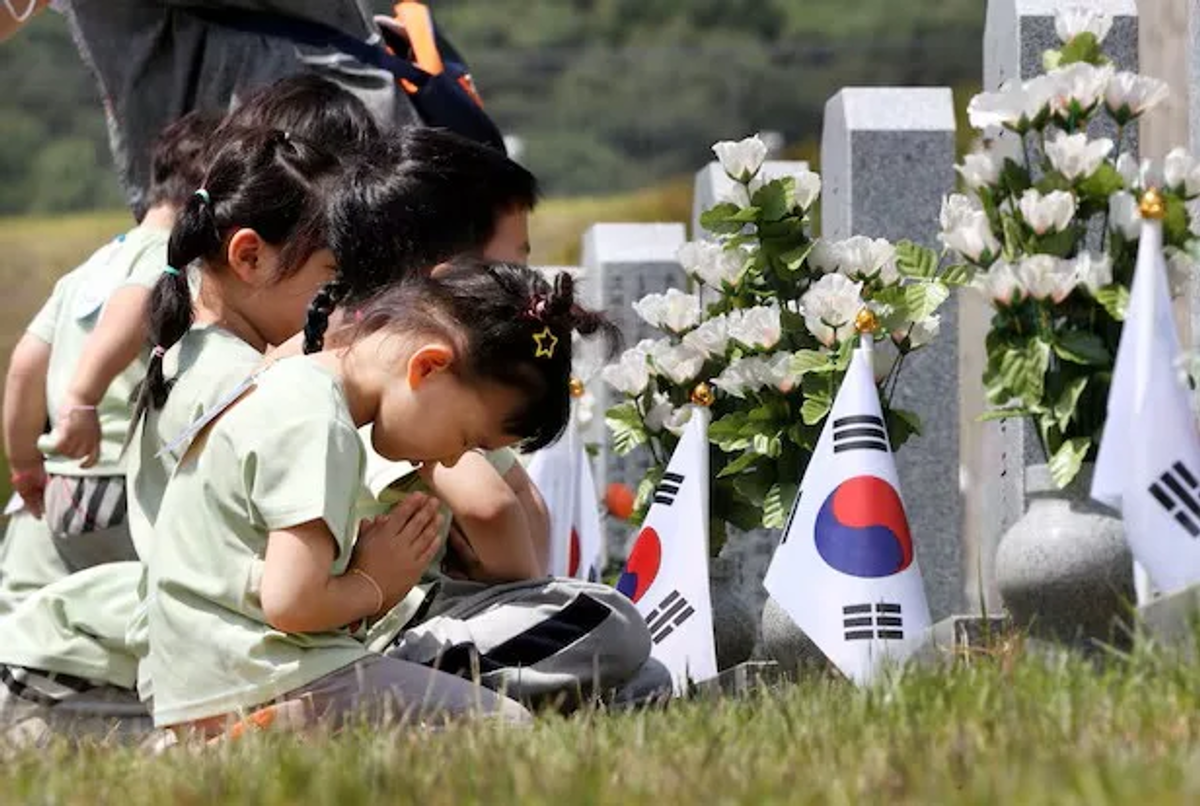
Across South Korea, officials and citizens will pray and lay flowers at the graves of the war dead. It is common practice to display the flag of South Korea on the front doors of homes to commemorate the civilians and soldiers who died in war. 

In 1956, South Korea held its first memorial ceremony for soldiers who died in the Korean War. Memorial Day was declared a public holiday on April 19th 1956, just three years after the war ended.

Starbucks’ Korean sales fall after backlash to ‘Tank Day’ ad campaign | Protests

Coffee chain has seen ‘very significant’ drop in sales after campaign that evoked deadly crackdown, local operator says.

Starbucks Korea has suffered a “very significant” drop in sales after a marketing campaign that evoked a brutal 1980 military crackdown on pro-democracy protesters triggered a public outcry, according to the coffee chain’s local operator.

Shinsegae Group, whose subsidiary E-Mart owns the coffee chain in South Korea, has faced mounting criticism over its so-called “Tank Day” campaign, launched on the anniversary of the May 18 Gwangju Uprising, when the military government deployed troops and tanks to suppress pro-democracy demonstrations.

Recommended Stories

list of 4 itemsend of list

In a news conference on Tuesday, Shinsegae Group chairman Chung Yong-jin made a public apology and asked people not to take out any anger on Starbucks Korea employees and front-line staff.

“I take it very seriously, the fact that many people felt deep pain and anger because of Starbucks Korea’s inappropriate marketing campaign,” Chung said.

“I will take all responsibility for the incident.”

Chung also asked people not to take out their frustration on staff at Starbucks shops, saying the responsibility lies with management. There were no immediate reports of major incidents at stores.

Chung issued his first apology on May 19, saying in a statement that the campaign caused “deep pain to the victims and bereaved families of the May 18 Democratization Movement as well as to the public”.

Shinsegae fired the head of Starbucks Korea last week after apologising over the campaign. Starbucks Global also apologised and said that an investigation had begun.

A Shinsegae official said sales had fallen sharply since the marketing controversy.

“While sales are not our main concern at the moment, we have seen a very significant drop,” said the official.

At Tuesday’s news conference, Jeon Sangjin, a senior Shinsegae Group executive, said the company had yet to find conclusive evidence that Starbucks Korea marketing employees intended to mock the pro-democracy movement, an accusation the employees have denied.

However, he said some employees refused management requests to hand over their smartphones during a weeklong internal review.

Jeon said the company would look at the results from the police inquiry, and any employee found to have intended to ridicule protesters would be fired.

The anger over the campaign has triggered public calls for boycotts, amplified by government officials, including Interior and Safety Minister Yoon Ho-jung, who said Starbucks products will no longer be used at government events and lamented the chain’s “anti-historical behaviour”.

The country’s president, Lee Jae Myung, said on X last week that the campaign displayed “inhumane and disgraceful behaviour by cheap profiteers who deny the values of the South Korean community, basic human rights and democracy”.

Hundreds of people are estimated to have died ⁠or gone missing when Chun Doo-hwan’s military government cracked down on the protests in Gwangju.

Many details remain unconfirmed, including who gave the order to open fire.

Source link