The shadow of Bill Cosby hangs over the “The Peterson Show,” a new play by Janine Nabers about the fallout of a disgraced TV dad on the grown-up cast members who played his children on the show.
Echo Theater Company, which is presenting the world premiere of this play in a production directed by Michelle Bossy, has reconfigured its Atwater Village Theatre space for the occasion. The refresh — in terms of the position of the stage and the audience and in the level of the design elements, including video monitors showing clips of Black sitcoms — promises a vital evening of theater.
Unfortunately, the production is hamstrung by fundamental problems in the writing, directing and acting, all pointing to a failure of control. Control of the story, control of the tone and control of the cast.
In my fall preview item for this show, I wrote that the “production is all but guaranteed to be more enlivening than an evening spent surfing Netflix.” Well, it’s certainly lively, but in a boisterous way that made me regret I had left my couch.
Not even Netflix would give “The Peterson Show” the greenlight. The story centers on the adult lives of the sitcom’s five child stars who are thrust once again into the spotlight after a reunion rumor goes viral and their TV mom, Valerie, kills herself.
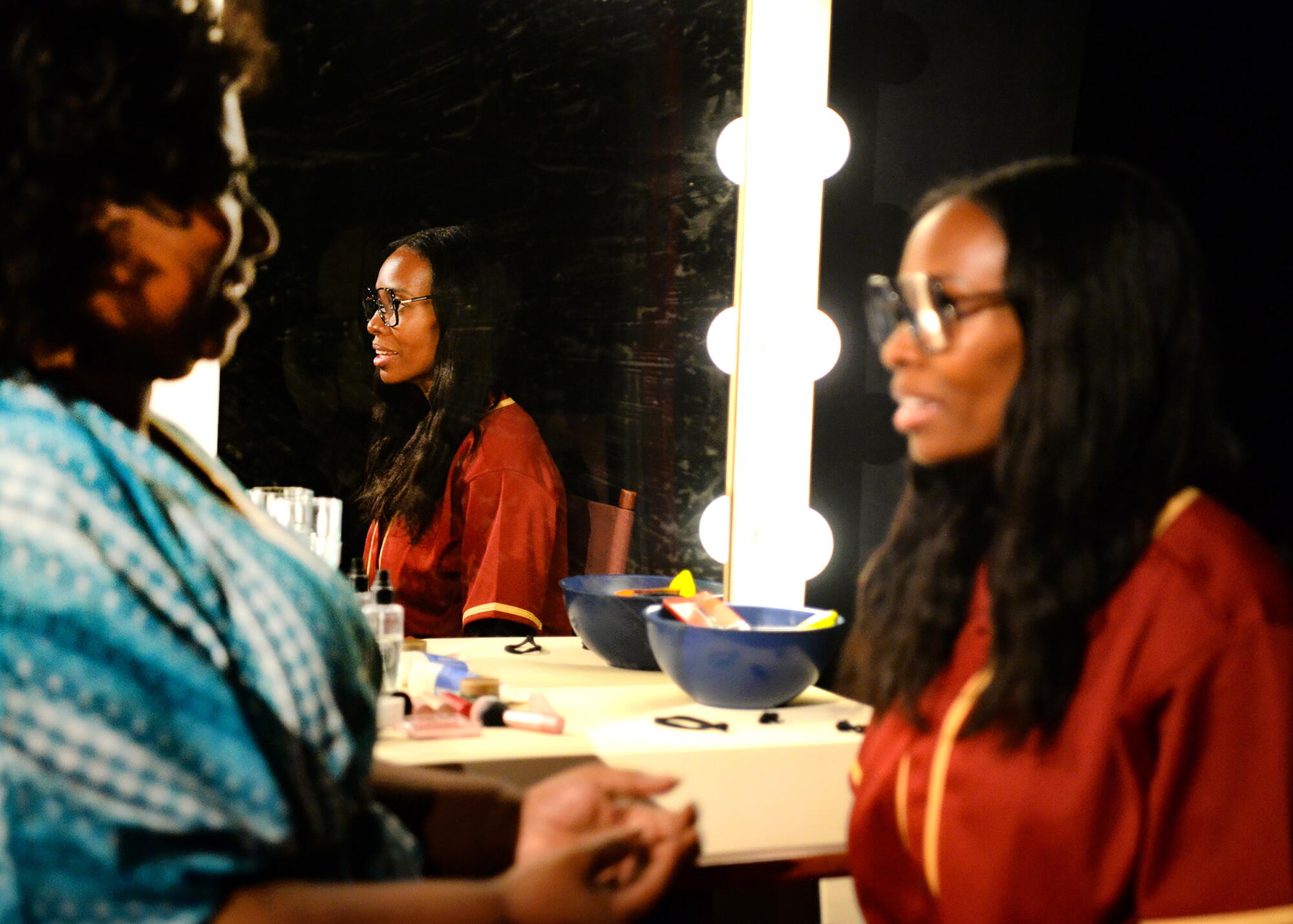
Deanna Reed-Foster, left, and Tamberla Perry in “The Peterson Show” at the Echo Theater Company.
(Cooper Bates)
Ronika (Tamerla Perry), the troublemaker of the group, careens through life with faulty brakes. Zoe (Kristen Ariza), who has traded TV stardom for an academic career and motherhood, wants the normalcy that her former fame keeps threatening.
Dwight (Devere Rogers) is messy and loud as well as addicted to fame and other substances. Blair (Kelly McCreary), who pulled herself out of a miserable childhood, has made a successful career as an award-winning actor and isn’t going to let her flimsy talent or her TV siblings stand in her way. Elliot (John Clarence Stewart), who seems the best adjusted of this crew, left the business to become a lawyer and hasn’t looked back.
Haywood Peterson, the patriarch of the TV show who’s serving jail time for rape, doesn’t appear in “The Peterson Show.” But his voice tyrannically resounds with sadistic orders and conservative cultural commentary during the second-act flashback scene, in which a fateful day on the set of the show changes the lives of Ronika and Blair.
The unsettled first act, full of false starts, feels like an early draft of the play. Nabers, an Emmy-nominated TV writer and author of the play “Serial Black Face” (winner of the Yale Drama Series Prize), can’t figure out how to center the work.
Ronika is the protagonist, but her introduction is off-putting — not only to Zoe, whose home she has invaded, but to the audience, who isn’t given much reason to care about this abrasive, screechy and just-plain-annoying personality.
The cast members perform at a fever pitch of amateur sitcom acting. Ronika evolves as the scene shifts to Blair’s home (which confusingly has the same layout as Zoe’s house in Michael Kramer’s eye-catching scenic design) for the home funeral of their TV mom. But more thought is spent in reworking Ronika’s hairstyle and outfit than in developing her story.
Kristen Ariza, left, Devere Rogers, Kelly McCreary, John Clarence Stewart and Tamberla Perry in “The Peterson Show” at the Echo Theater Company.
(Cooper Bates)
Ronika’s resentment toward Blair, who has avoided condemning Haywood in public, seethes monotonously until her own backstory is finally unearthed. Ronika’s trauma plot, however, has to compete with Valerie’s related breakdown story, and neither is given its dramatic due.
In the meantime, there’s a lot of unwieldy comic commotion involving a missing corpse, a tweaking, naked Dwight and enough insipid TV sibling bickering to clog the airwaves for a decade.
“The Peterson Show” is exhausting. The play isn’t ready for prime time. Bossy’s direction raises the clamorous volume instead of sorting out the disordered structure or digging into the unexamined silences.
The actors are led completely astray. Echo has built its reputation on quirky plays idiosyncratically performed. The theatrical marching orders here seem to involve throwing spaghetti against the wall and laughing uproariously as it slides to the floor.
Filming a broadcast television show can leave even the most seasoned actors feeling like they’ve lost sense of time. But by afternoon on a recent weekday, Josh Charles actually looks like he teleported to the past as he collapses into a seat inside his production trailer in upstate New York.
He’s in the throes of filming Season 2 of “Best Medicine,” the Fox dramedy he headlines that’s set in a small fishing village in Maine, and the reason he’s shed his character’s usual suit and tie for gaitered trousers and a navy coat with red facings eventually reveals itself: Port Wenn, the show’s fictional town, is putting on a Revolutionary War reenactment. And if you’re familiar with Martin Best, the curmudgeonly doctor with an almost permanently furrowed brow portrayed by Charles, the character’s willingness to don such a getup likely took some coaxing.
That’s the fun of it all for Charles.
He’s been a working actor since childhood — making his debut at 15 in John Waters’ cult classic “Hairspray,” followed soon after by his turn as Knox Overstreet in “Dead Poets Society” — and a fixture in TV and film ever since.
While best known for dramatic roles like high-powered lawyer Will Gardner in “The Good Wife,” Charles easily pivots to comedy — like the time he memorably played the triple-collared, snobby camp ringleader in “Wet Hot American Summer: First Day of Camp.” Now, “Best Medicine” lets Charles leans into the push and pull of the comedy and drama within his tightly wound alter ego.
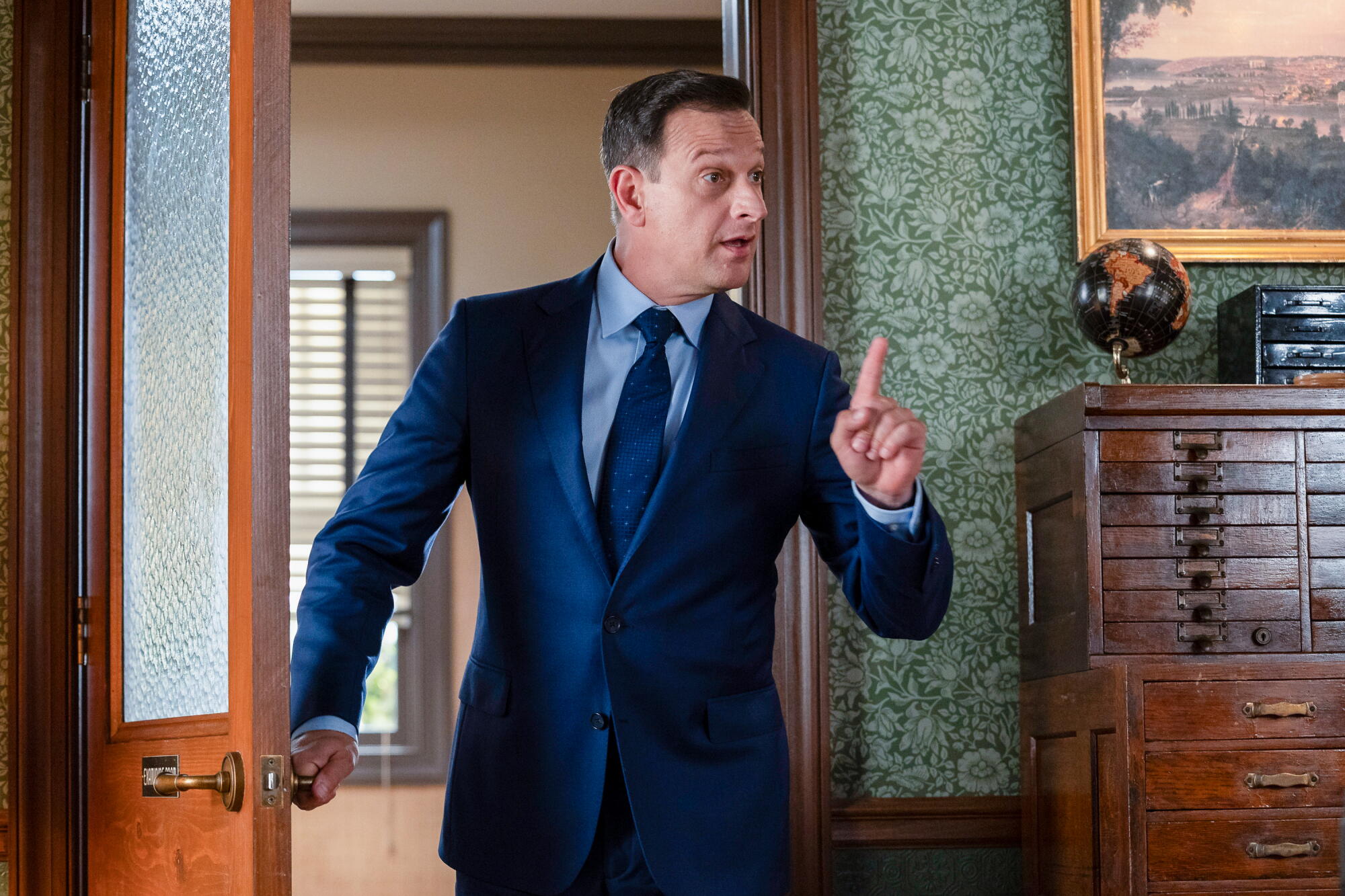
Josh Charles as Martin Best in Fox’s “Best Medicine.”
(Francisco Roman / Fox)
Created by Liz Tuccillo (“How to Be Single,” “Sex and the City”), the series follows a brilliant but cranky heart surgeon who, after developing a crippling blood phobia spurred by a traumatic medical case, abandons his thriving career in Boston to become a general practitioner in the town where he spent summers as a child. Martin Best is a doc whose bedside manner could use some TLC, but he came to town hoping he can still practice medicine — that is, if the townspeople would actually do as he says.
“I have been really wanting to do more comedy lately and looking — especially if I was going to call a place home for a particular period of time, like you do in a television show — for something that was a little more lighter air than I had been networking in of late,” says Charles, whose recent credits include dystopian drama “The Handmaid’s Tale” and spy thriller “The Veil.”
The series is based on the beloved British dramedy “Doc Martin,” which starred Martin Clunes as a doctor with a similar storyline, that aired between 2004 and 2022. Tuccillo says Charles brought an elegance and depth to the fish-out-of-water dynamic his character navigates in the quirky town.
“He never hits a false note,” she says in a separate video call. “I knew the material would be in great hands in that he would always elevate it just by his artistry and being. I knew he was going to be able to play the gruffness, but any time that you’re doing a show, there is a question mark on so many things. To be honest, we were like, ‘But is he going to be super funny? Is he going to want to do pratfalls? Is he going to be game for the comedy part of it?’ When we started working, it was clear he was game for all the shenanigans … he likes to laugh. So I try to devise things that I think will amuse him.”
A special advance preview of the Season 2 premiere aired Sunday, but the show will move into its regular time slot Tuesday. Here are edited excerpts from the conversation with Charles.
Josh Charles poses for photos on the “Best Medicine” set in upstate New York. He says he was drawn to the Fox dramedy because it was “a little more lighter air” than the other work he had done recently.
(Ebru Yildiz / For The Times)
“Best Medicine” hit Netflix after its first season aired. Building an audience outside the traditional linear viewing has become such a key component of television today. How do you feel about it?
One of my dad’s best friends told me, “I’m watching the show on Netflix!” He’s like, “I just can’t watch shows with commercials anymore” — as people are programmed now. That is the new shift. You go into these platforms for periods of time, build your audience in a different way and hopefully keep growing that audience. [Television] keeps evolving and growing in a way that I don’t fully understand, but I do know that it’s a different world right now. Netflix has a great reach, and it’s great that we’re on there and that people are discovering it. And apparently we did very well.
Season 2 opens with Martin on probation and under review by the medical board. What is Martin in for this season?
When it starts off, he’s really in it. Eden [Martin’s ex-girlfriend played by Eliza Coupe] is now back in the picture. She’s coming from Boston every weekend, and she’s rubbed a lot of people in town the wrong way. And the progress that Martin made, we see him maybe take a few steps back in the way that he interacts with people. He’s with her and I think there’s feelings there, but I think their relationship feels very — I don’t know, it’s interesting. It doesn’t have the fire. But she doesn’t make him feel bad about himself. She respects him, and I think those things are important. And he’s around in this town where nobody’s listening to him half the time. People are just always mad at him about something, and she’s not. She puts him a little bit on a pedestal, and I think he really needs that.
All that presents an obstacle for the show’s slow burn: Martin and Louisa (Abigail Spencer). There’s been some discourse about the art of the slow burn and how the pacing has changed in an era of short episode orders and unpredictable renewals. You have experience in this department with “The Good Wife.”
Liz and I have talked about it a little bit. You don’t want to muck bait it and drag it out for the sake of dragging it out. I think they’ve done a good job of putting the obstacles in a way that still feels organic and genuine and not yet a reach. In the British show, things accelerated so much faster. They only made eight [episodes] a year. We want to also have it feel like it’s plausible. It is really fun to have Eliza Coupe here. It’s fun to play scenes with her and [see] the different side that brought out in Martin. That is the challenge because I don’t think we’re as interested in doing it quite that fast [as the British show]. I have faith in them that we’ll land it in a good way.
Ellen Soraya Nikbakht as a peculiar patient and Josh Charles as Martin Best in the Season 2 premiere of “Best Medicine.”
(Danielle Mathias / Fox)
You’ve played in comedy and drama in your career. It’s fun to watch you straddle both sides with this character. How has it been finding the rhythm or tone with him?
A lot of the comedy I’ve done, I’ve done some stuff that’s more silly and kind of over the top. I love playing the fool. What’s really fun [here], to me, are the circumstances they put Martin in where things are blowing up in front of him and he’s just trying to deal. I’ve enjoyed doing a lot of the physical comedy on the show.
I [also] found it really interesting to have a character who doesn’t want to be around people, but he actually does. He just doesn’t really know how to do it, and he’s never really had any kind of practice at it in his life. And he’s gone through a lot of trauma in his life. He’s a really specific kind of workaholic. For him to grow up with what he did, and losing his sister really young in his life — I did research on that and what that does to people and how that can sort of frame your life. I imagine he went to private school, maybe a boarding school, then he goes on the track of going to college and medical school — we know how hard that is, the kind of hours they put in; then to be really successful at it, you put everything you have into your work. There’s this other side of his life that is completely empty. This town kind of just softens off the edges of him a little bit and helps him become a little more authentic version of who he was maybe meant to be. That gives me some place to build off of and to go with the character, other than it feeling kind of just very one-note.
Matthew Goode, left, as Finn Polmar and Josh Charles as Will Gardner in a scene from Season 5 of “The Good Wife.”
(CBS)
This series marks your return to broadcast television after leaving “The Good Wife” in its fifth season. You’ve done TV since then, of course. But a big reason you left broadcast was because of the grind of a 20-plus episode season. With “Best Medicine,” you’re the lead and the second season will have 14 episodes. Does that feel like the sweet spot?
If “The Good Wife” was “The Good Fight,” I would have done that until the wheels come off. I would have never wanted to leave that because I would have had a life. I could have been able to go do a play, travel with my family, see my kids. At the time of “The Good Wife,” I didn’t have kids, but we were about to get married and wanted to have children. I was only going to do 18 [episodes] at most with this show, if they wanted it. And then I asked them this year, “Well, we’re just at 14. What was the decision [there]?” And I’m happy about it. They also agree. This just feels like where the show wants to live creatively. You work really hard for four or five months, and then you get to go explore other projects and travel and live your life.
Your departure from “The Good Wife,” with your character Will Gardner dying, felt like an out–of–body viewing experience as it happened. The fact that it was kept under wraps —
I can’t believe we did it, honestly. There was one journalist who obviously had a source somewhere and did find out. Part of being able to keep that silent until the moment was an agreement that they would come to set and be there as long as it was [kept secret]. I remember like when the episode aired, I was in the editing bay with the editors in L.A. [for an episode I directed]. I’m seeing things come in and I was like, “Oh my God!” I thought it was going to get ruined for people on the West Coast. These days, you know how they make something, how much this cost, how they did this scene … we used to be surprised by things. To be able to truly shock people you know like in an Orson Welles-style “War of the Worlds” way. I felt like in our own sort of network TV way, this was the equivalent of that. We really got to narratively pack a punch. That season was one of the great treats of my career. I just felt the writing on that show that season was at another level.
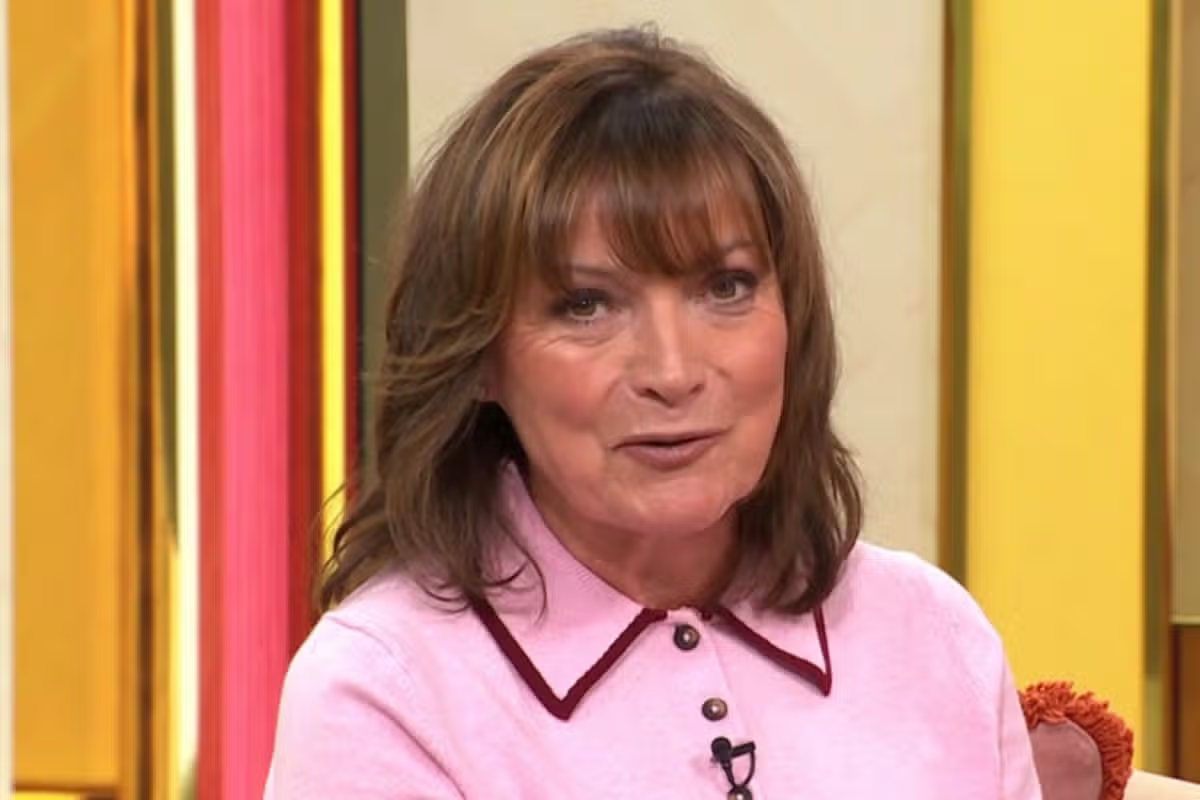
Lorraine Kelly sent a sweet message to her mum, Anne Kelly, on Tuesday’s episode of the show
Lorraine Kelly sent a sweet message to her mum, Anne Kelly, on Tuesday’s episode of the show (Image: ITV)
Lorraine Kelly revealed her mum had suffered a ‘bad fall’ on Tuesday’s episode of Lorraine.
During the latest installment, Lorraine, 66, marked her mum Anne Kelly’s 85th birthday with a sweet message live on air before sharing a sad update regarding her mother.
Lorraine said: “Happy birthday to my wee mum. Happy birthday. There we are” to which a photo of Lorraine and Anne appeared on screen before a picture of Lorraine, Anne and her brother Graham was also shown.
In a sad update, Lorraine added: “Sadly, she’s back in hospital. She had a bad fall. She’s in Hairmyres Hospital. So thanks to everybody that’s looking after her, saw her at the weekend, of course. But yeah, God bless her. I hope she has a good day.”
Lorraine continued: “Mum, have a great day. Have a great day as much as you can. Happy birthday!”
Taking to Instagram, Lorraine also shared a post for her mother, writing: “Happy 85th birthday to my mum. Sadly celebrating in hospital today after a bad fall resulted in broken arm.
“Saw her at weekend and she’s getting well looked after. Hopefully back home with us soon #birthday #mum.”
Responding in the comments, one person said: “Happy birthday to your mum, hope she gets well soon” with a heart emoji.
Another account wrote: “Happy birthday hope you’re better soon xx” while another follower added: “Happy Birthday wishes to your lovely mum. Hope she has a good recovery.”
A different show watcher put: “Happy birthday/speedy recovery” while another fan added: “Happy birthday to your gorgeous mum. It’s my birthday tomorrow xx.”
Earlier this year, Lorraine announced the death of her dad. The Scottish broadcaster took to Instagram at the time to share the devastating news with her online followers.
Lorraine’s father, John, worked as a TV service engineer and was known for his passion for science and astronomy, which the TV presenter had inherited from him.
Sharing a snap of herself and her late dad, the ITV star said: “Very sad news. My dad has died. I am mourning the man who bought me a telescope when I was five years old, who watched the moon landings with me and taught me to always be curious and interested in everything. He was in poor health but it has still been a shock.
“Any of you who have experienced a similar loss will know how my brother Graham and I are feeling. Our priority is taking care of my mum and the family would very much appreciate privacy at this distressing time. We will miss you dad.”
Lorraine continues on weekdays at 9:30am on ITV and ITVX
NEW YORK — Imelda Marcos made a cash payment of $50,000 to then-Gov. George Ariyoshi of Hawaii when she visited Honolulu in 1982, three days after the Democrat announced that he was running for reelection, according to logs of the former Philippine first lady’s travel expenses.
A record of the previously undisclosed cash payment to Ariyoshi was found amid voluminous evidence recently introduced here by federal prosecutors in the fraud and racketeering trial of Mrs. Marcos.
It was unclear from the document whether the $50,000 cash payment was intended to aid the Ariyoshi campaign or was tendered for some other reason. Ariyoshi did not list it among his campaign contributions, which by law were limited to $2,000 from any one source in the primary election.
Although unrelated to any of the criminal charges pending against Mrs. Marcos, the Ariyoshi payment discovered in the Marcos expense logs raises new questions about how the former first lady spent what the U.S. Justice Department asserts were Philippine government funds.
No explanation for the $50,000 expenditure was listed in the court documents, and Ariyoshi did not respond to numerous requests by The Times for an interview.
In the past Ariyoshi has acknowledged receiving gifts from the Marcoses but has declined to describe the extent or nature of those offerings, calling gift giving “a private act of courtesy” that he would not discuss publicly.
The recently admitted court documents are notebooks in which a private secretary to Mrs. Marcos, identified in testimony as longtime aide Fe Roa Gimenez, maintained a running log of expenses incurred by the Philippine first lady and her entourage during trips abroad. Many of the handwritten entries record payments for art, jewelry and shopping trips that federal prosecutors contend were financed with money looted from the Philippine national treasury.
Prosecutors submitted the expense logs to support charges in the federal indictment that Mrs. Marcos spent great amounts of Philippine public money for non-governmental and other personal expenses. For instance, some of the recorded art and jewelry transactions have been confirmed by other documents and testimony.
Ariyoshi’s name appears in the log of a July, 1982, trip that Mrs. Marcos made to the Soviet Union, Morocco and the United States.
On a page listing “cash disbursements” for July 20, 1982, is the brief handwritten entry: “$50,000–Given to Gov. Ariyoshi.”
Also on July 20, Ariyoshi’s lieutenant governor, Jean King, announced that she would challenge him for the Democratic gubernatorial nomination. It would be, according to local news accounts, the toughest campaign of Ariyoshi’s political career.
The Marcoses’ possible financial interest in U.S. political campaigns became the object of a federal investigation in 1986, soon after the deposed couple arrived in Honolulu after fleeing a popular revolt that February.
U.S. customs agents, going through more than 300 boxes and suitcases filled with cash, jewelry and documents, found a financial statement indicating that the Marcoses may have made illegal contributions in excess of $175,000 to 10 U.S. politicians, including then-President Ronald Reagan and former President Jimmy Carter. The document was dated 1982 and purported to recount spending of Philippine military intelligence money in the United States as approved by Fabian C. Ver and Irwin Ver, former leaders of military and security forces under Marcos.
Based in part on discovery of that document, the Federal Election Commission launched an inquiry into whether the Marcoses had secretly funneled intelligence funds into American political campaigns through a California company owned by a Philippine businessman.
The investigation was dropped in 1988 for lack of evidence, over the objection of one commission member who complained that investigative leads had not been thoroughly pursued. How the document came to be among Marcoses’ private papers was never established.
Although contributions from foreign sources are not permitted in federal elections, Hawaii state races were not subject to such restrictions in 1982. The names of contributors who gave more than $100 had to be reported to the Hawaii Campaign Spending Commission, however, and a limit of $2,000 from any single source in both the primary and general gubernatorial campaigns was set.
State records show that Ariyoshi, who was governor from 1974 to 1986, did not report the $50,000 payment from Mrs. Marcos as a campaign contribution.
The former governor and his wife, Jean Ariyoshi, are longtime friends of the Marcoses, and Mrs. Ariyoshi has been a regular shopping companion of Mrs. Marcos on the former Philippine first lady’s frequent stopovers in Hawaii.
When the Marcos regime fell in 1986 and the Marcoses were forced to go into exile, Ariyoshi invited them to make their new home in Hawaii.
When the Marcoses stepped from an American military aircraft at Hickham Air Force Base in Honolulu, the governor was the highest-ranking American official to meet them, offering a traditional red carpet and Hawaiian lei greeting.
Soon after the Marcoses arrival, reports surfaced that the Ariyoshis had received unspecified gifts from the Philippine leader over the years. Under pressure from local media, Ariyoshi issued a statement in which he called gift giving by officials “a custom which prevails among people as private citizens or formal representatives.”
“The govern engages in this custom with government officials and other dignitaries, national and international,” the statement continued. “This is done in a variety of settings and is an especially traditional custom in Asia and the Pacific.
“Because the governor regards the bestowing and receiving of gifts a very personal matter, it will remain a private act of courtesy between himself and others.”
Ariyoshi is now an attorney in private practice in Honolulu. A secretary said he was traveling on business in Japan but that she had forwarded The Times’ interview requests to him.
Honolulu freelance writer Susan Essoyan contributed to this story.
Be careful what you wish for when you’re wishing for a new offensive coordinator.
Chargers fans were so over Greg Roman. Anything would be better than his run-heavy scheme stunting quarterback Justin Herbert’s anticipated ascension. Anyone would be preferable to the man holding the reins while the Chargers scored just three points in last season’s wild-card loss to the New England Patriots, after which Roman was fired.
Somehow, after just two games, the Chargers’ offense under McDaniel has Bolts fans wishing anyone else was running the show. Roman included.
Because Roman wouldn’t have overcomplicated a third-and-inches play-call. He wouldn’t have had the 6-foot-6, 240-pound Herbert line up in shotgun and call for motion.
Share via
The Chargers lost to the Las Vegas Raiders 26-14 on Sunday, and the schedule doesn’t get any easier for them moving forward.
And the subsequent snap wouldn’t have hit receiver Tre’ Harris before it got to Herbert. And instead of losing five yards and having Herbert, in a rare show of emotion, slapping the turf in frustration, the Chargers probably would have gotten a fresh set of downs.
So far, McDaniel’s brief Chargers’ tenure hasn’t just been a disappointment. It has, through two games, been a disaster. Because the Chargers really needed these first two wins against opponents who both won only three games last season.
Instead, the Chargers’ offense looked as disjointed and discombobulated in Sunday’s 26-14 loss to the Las Vegas Raiders as it did the previous week in their 26-14 loss to the Arizona Cardinals.
It was an unwanted second helping of “humble pie,” as McDaniel described the Chargers’ Week 1 defeat. And it was nasty.
Now the Chargers’ schedule is about to come at them fast, with their next games against the Buffalo Bills, the Super Bowl champion Seattle Seahawks, Denver Broncos, Kansas City Chiefs and then the Rams, the preseason Super Bowl favorites.
After consecutive 11-win seasons under Jim Harbaugh — who’d never lost to the Raiders and never previously lost two consecutive games to start a season — the Chargers might blink and find themselves 0-7.
What’s worse than frustratingly quick postseason exits? Not making the playoffs at all.
And the Chargers are going to need to engineer a quick turnaround if they’re going to be among the 15% of teams that start a season 0-2 and still reach postseason play.
Chargers offensive coordinator Mike McDaniel walks on the sideline before a preseason game against the San Francisco 49ers at SoFi Stadium on Aug. 20.
(Robert Gauthier / Los Angeles Times)
To do that, they’ll need to score more points. They’ll need to stop shooting themselves in the proverbial feet and take some better shots downfield. Stop dropping the ball — figuratively, literally. They fumbled six times Sunday!
And stop thinking so much. Sundays are for reacting, and any amount of thinking is overthinking.
Maybe it’s personnel? The fact that, outside of Ladd McConkey, the Chargers are short on receivers who can reliably create separation.
Maybe it’s just a matter of time that the Chargers don’t have much of, cramming to learn McDaniel’s methods, to dial in the timing and coordination.
Or maybe, for McDaniel, it’s as simple as simplifying what he’s trying to do with this Chargers offense.
When he was hired in January, the prevailing thought was that the cerebral partnership between McDaniel and Herbert would prove a perfect match.
Even though McDaniel was dismissed after the Dolphins missed the playoffs two consecutive seasons, the coach — who’d developed a reputation as a talented offensive mind under Kyle Shanahan with the San Francisco 49ers — was a hot commodity on the coaching market.
McDaniel reportedly drew interest from the Baltimore Ravens, Cleveland Browns, Tampa Bay Buccaneers, Bills and Raiders. But he opted to come to L.A. to work with Herbert as the All-Pro QB’s fifth offensive coordinator in seven seasons (following three offensive coordinators in his four years at Oregon).
Starting over again, in these two games with McDaniel, Herbert has thrown for a modest 401 yards, just two touchdowns and three interceptions — though one of them bounced off David Njoku’s hands Sunday.
Chargers quarterback Justin Herbert watches a pass attempt fall incomplete after he is hit by Raiders defensive end Malcolm Koonce during the fourth quarter Sunday.
(Allen J. Schaben / Los Angeles Times)
There have also been protection problems, fumbles, a missed field goal, and lots of penalties — including four on star left tackle Joe Alt, who was called for a hold that resulted in a safety on an anything-that-can-go-wrong-will-go-wrong Sunday.
“I’m not looking in any one direction,” Harbaugh said Sunday. “I’m looking at it all.”
On TV, Herbert appeared to be looking off into space on the sideline as McDaniel sat chattering beside him, the game mercifully winding down.
Asked what McDaniel’s message was to the offense, Herbert said: “I haven’t been able to speak with him after.”
There’s a lot to talk about, but be careful what you ask.
Is President Trump holding the Kennedy Center hostage? The allegation has been made at least twice, most recently by John F. Kennedy’s niece Kerry Kennedy, and earlier by Rep. Joyce Beatty (D-Ohio), an ex-officio member of the board, who has sued to keep Trump’s name off the building.
The Merriam-Webster dictionary defines “hostage” as, “a person taken by force to secure the taker’s demands.” Swap, “person” for the “Kennedy Center” and “taker” for “Trump,” and you have a pretty straightforward “yes.”
The ongoing Kennedy Center dumpster fire points to an unusual presidential obsession with the nation’s premier performing arts venue that dates back to Trump’s first term when he became the first sitting president in history to twice miss the annual Kennedy Center Honors.
In his second term, Trump turned that snub upside down by firing the board and strong-arming his way into being named chairman. If he expected to be welcomed into the arts community with open arms, he was gravely mistaken. His takeover resulted in a wave of high-profile cancellations that ultimately led to a massive dip in ticket sales. The exodus became even worse when the Trump-appointed board voted to add Trump’s name to the building late last year. The reaction, it seems, injured the president’s fragile ego and incurred his wrath.
By early February the president announced he would close the center for a two-year, $257-million renovation. Calling the historic venue “dilapidated,” Trump said he would be the one to restore it to glory. Behind the scenes another story was unfolding, and six months later the Washington Post reported that “ticket sales and fundraising collapsed” after Trump’s name was added to the building, “even as the center’s leaders publicly touted a financial turnaround.”
This week saw chaos at the venue that even the most seasoned journalists struggled to keep up with as the board voted to close the building on the same day that a federal judge upheld an order that Trump’s name could not be restored to its facade after he ordered it removed in late May.
Trump took to social media to decry the decision, threatening to withhold his support for the renovation and noting that the center could be “ripped down” if he wasn’t formally honored with his name on the building. Despite a preliminary injunction barring the venue from closing, people were kicked out of the building and barricades erected in the name of public safety that same day.
Those prone to hyperbole might be tempted to call this presidential tantrum disguised in procedural clothes a constitutional crisis. Or you could just say that Trump has taken the Kennedy Center hostage. The taker wants his name on the building, and the center will not be released for renovation or reopening if that doesn’t happen.
In the meantime an image of Trump on Air Force One was captured that shows him holding a large placard that reads, “Kennedy Center DEMO[LISHED],” leaving concerned parties to wonder just what exactly the chairman of the board has in mind. Is he using a Sharpie at this very moment to slash a line through the image at the center on that board, or is it just a prop to be trotted out in a cruel bit of future social media hazing?
Getting lost in all the drama: a beloved arts venue has gone pointlessly dark, and the people who loved it are heartbroken. If no one is inside to hear the wind whistle, does it make a sound?
I’m Arts editor Jessica Gelt, willing to rustle up a ransom. This is your arts and culture news for the week.
You’re reading Essential Arts
Our critics and reporters guide you through events and happenings in the SoCal arts scene. In your inbox every Friday.
By continuing, you agree to our Terms of Service, which include arbitration and a class action waiver. You agree that we and our third-party vendors may collect and use your information, including through cookies, pixels and similar technologies, for the purposes set forth in our Privacy Policy such as personalizing your experience and ads.
The week ahead: A curated calendar
FRIDAY
Oliver Lee Jackson: Form Follows Feeling The Bay Area painter, sculptor, and printmaker’s work, created over decades, is inspired by the human figure in its composition and structure. Opening reception, 6-8 p.m. Friday; 10 a.m.-6 p.m. Tuesday-Saturday. Lisson, 1037 N. Sycamore Ave. lissongallery.com
“Vitruvian Figure (Los Angeles Memorial Coliseum),” 2026, 3D model by Paul Pfeiffer.
(Paul Pfeiffer/Perrotin)
Paul Pfeiffer: Olympia In new work focused on Los Angeles, the artist explores the intersection between media, spectacle, architecture and the body ahead of the city hosting the 2028 Olympic Games. Opening reception, 6-8 p.m. Friday; Pfeiffer in conversation with Britt Salvesen, 3 p.m. Saturday; exhibition, 10 a.m.-6 p.m. Tuesday-Saturday, through Nov. 7. Perrotin, 5036 W Pico Blvd. perrotin.com
SATURDAY
“Couple walking, Park Avenue,” 1960.
(Estate of Roy DeCarava)
Roy DeCarava: the sound i saw The exhibition presents more than 130 images created between the late 1940s and 1960s, depicting the photographer’s intense interest in the relationship between the visual and the aural. Accompanying the exhibition, in the gallery next door, will be “SIDE B: the sounds,” a listening room featuring DeCarava’s personal playlists and favorite jazz album. Opening reception, 6-8 p.m.; exhibition runs through Oct. 31. David Zwirner Gallery, 606 and 6166, N. Western Ave. davidzwirner.com
Sutton Foster The two-time Tony winner and TV star performs Broadway hits and standards with Pacific Jazz Orchestra, featuring new arrangements by conductor Chris Walden. 8 p.m. The Soraya, 18111 Nordhoff St., Northridge. thesoraya.org
Mia Middleton: Summoning Cleo New work by the artist explores interpreting familiar forms through a surreal lens. Opening reception, 5-7 p.m. Saturday; exhibition runs through Oct. 24. Roberts Projects, 442 S. La Brea Ave. robertsprojectsla.com
Mrs. Warren’s Profession Real-life mother and daughter Cyndy Fujikawa and Nell Murphy star in this production of George Bernard Shaw’s 1893 play about a Victorian woman coming to terms with how she built a business empire. Directed by Michael Rothaar. Opening night, 8 p.m. Saturday; 8 p.m. Thursdays, Fridays and Saturdays; 3 p.m. Saturdays and Sundays (check website for exceptions), through October 25. Pacific Resident Theatre, 707 Venice Blvd, Venice. pacificresidenttheatre.org
Grammy Award-winning composer and bandleader Arturo O’Farrill and Afro Latin Jazz Orchestra open the Segerstrom Center for the Arts’ Jazz series.
(John Abbott)
Arturo O’Farrill & Afro Latin Jazz Orchestra The pianist and composer, a six-time Grammy winner, and his ensemble kick off the Segerstrom Center for the Arts’ 2026-27 Jazz series with Afro-Cuban rhythm, modern jazz harmony and big-band sounds. 8 p.m. Segerstrom Center for the Arts, 600 Town Center Drive, Costa Mesa. scfta.org
Other Places An alternative art fair devoted to contemporary art spaces and projects, plus workshops, readings, talks and performances. Noon-7 p.m. Angels Gate Cultural Center, 3601 S. Gaffey St., San Pedro. opaf.info
Karma The gallery presents solo exhibitions by painters Randy Wray (“Hothouse”) and Felipe Suzuki, one featuring vivid abstractions, and the other, work created through the lens of memory . Opening reception 6-8 p.m. Saturday; 10 a.m.-6 p.m. Tuesday-Saturday, through Oct. 24. Karma, 7351 Santa Monica Blvd. karmakarma.org
SUNDAY
Alexander Apóstol “Regime: Dramatis Personae” (2017), a series of black-and-white portraits of archetypal figures in both populist and authoritarian governments, uses photography to analyze the intertwining of art and political power in Latin America. 11 a.m.-5 p.m. Tuesday, Wednesday and Friday; 11 a.m.-8 p.m. Thursday; 11 a.m.-6 p.m. Saturday-Sunday; through Jan 3, 2027. Museum of Contemporary Art, 250 S. Grand Ave., downtown L.A. moca.org
Textile Alchemy: The Art of Reiko Sudō and NUNO More than 100 limited-edition textiles, along with numerous objects, including drawings, sketches, raw materials, tools, mock-ups, and prototypes, are part of the largest retrospective ever of the Japanese designer’s work created with her textile collective and other collaborators from throughout Japan, Through March 7, Los Angeles County Museum of Art, Resnick Pavilion, 5905 Wilshire Blvd. lacma.org
TUESDAY
The entrance of the Lucas Museum of Narrative Art in Los Angeles in Exposition Park.
(Ron De Angelis/For The Times)
Lucas Museum Of Narrative Art Where else will you see Luke Skywalker, Vincent Van Gogh, Norman Rockwell, Gordon Parks and Charles Schulz under one roof? The new museum officially opens Tuesday, featuring 100,000 square feet of space spread across more than 30 galleries, exhibiting a mind-bending range of visual storytelling. Check out our full coverage. Public opening, 10 a.m.-5 p.m. Tuesday; regular hours, 10 a.m.-5 p.m. Mondays, Wednesdays and Thursdays; 10 a.m.-5 p.m. Fridays; 9 a.m.-9 p.m. Saturdays; 9 a.m.-5 p.m. Sundays. Lucas Museum of Narrative Art, Exposition Park, 3800 S. Vermont Ave. lucasmuseum.org
THURSDAY
Bilal The Grammy Award-winning singer-songwriter delivers a blend of soul, funk, and jazz. Queens-born R&B musician Yaya Bey is the opening act. 8 p.m. Carpenter Center, 6200 E. Atherton St., Long Beach. carpenterarts.org
Each Other’s Hands: Trans Mutual Aid, 1966—1996 Oxy Arts, Occidental College’s community-based arts hub, presents an exhibition featuring the work of six L.A. artists. curated by Umi Hsu. The opening reception marks the launch of the 2026 CIRCA Queer Histories Festival hosted by One Institute. Opening reception, 7 p.m. Thursday; 11 a.m.-4 p.m. Monday-Saturday. Oxy Arts, 4757 York Blvd. oxyarts.oxy.edu
Arts Anywhere
Robert Wilson and the Civil Wars The newly remastered 4K version of Howard Brookner’s 1987 documentary, the essential yet long elusive film about the 1984 L.A. Olympics Arts Festival, can finally be streamed courtesy of Criterion Channel. It is everything LA28 doesn’t want you know. criterionchannel.com
— Mark Swed
Culture news and the SoCal scene
Christian Barillas, Melinda Page Hamilton and John Lavelle in “The Visit” at Pasadena Playhouse.
(Jeff Lorch)
Pasadena Playhouse opened a new production of Swiss dramatist Friedrich Dürrenmatt’s revenge tragicomedy “The Visit,” and The Times got in on the action. Contributor Jenelle Riley wrote a preview about how the new show features more than a dozen creatives behind the Playhouse’s production of Peter Shaffer’s “Amadeus” earlier this year, including director Darko Tresnjak and actor Jefferson Mays. “Amadeus” was a major hit, so Artistic Director Danny Feldman welcomed the team back with open arms.
Meanwhile, Times theater critic Charles McNulty attended opening night and declared the play a refreshing success (with a few caveats), and expressed “gratitude for the high-level production, gratitude for making the case for why the play still matters, and gratitude for the opportunity of allowing us to make up our own minds about whether the work earns its designation as a modern classic.”
Castulo Guerra as Tlahtoani Klion in a dress rehearsal ahead of its premiere of “Antigone: In the Language of the Kings” by the Latino Theater Company at the Getty Villa.
(Ariana Drehsler/For The Times)
McNulty also headed to the Getty Villa for its annual outdoor theater production. This year, the Villa’s outdoor stage marks its 20th anniversary with a co-production with Latino Theater Company of Sophocles’ “Antigone,” reimagined to take place in pre-conquest Tenochtitlan and performed in English, Spanish and Nahuatl. “If the drama is oversimplified, it nonetheless makes for a gripping spectacle,” McNulty writes.
Finally, a very busy McNulty checked out out a revival of José Rivera’s “Marisol” in an Open Fist Theater Company production at Atwater Village Theatre. The play originally opened in the early 1990s around the same time as Tony Kushner’s “Angels in America,” and McNulty says this new staging is gratifying because it allows a new generation to “embrace the play’s kinetic freedom.”
There are as many acrobats as actors in “Water for Elephants,” which is running at the Hollywood Pantages Theatre through Sept. 27 before heading to Segerstrom Center for the Arts (Nov. 10-22, with stops in Portland, Seattle, Reno, Sacramento, Tempe, Fresno and Eugene in between). Contributor Jenelle Riley headed backstage before opening night to watch the high-stakes performers warm up with poles, hoops, ropes and more. When the curtain raises, there’s a real circus onstage.
Enjoying this newsletter? Consider subscribing to the Los Angeles Times
Long Beach Opera will perform its 2026-27 season aboard the Queen Mary.
(Allen J. Schaben / Los Angeles Times)
Long Beach Opera announced its 2026-27 season, which is slated to be performed aboard the historic Queen Mary. First up: three works by composer Georges Aperghis, with vocal performances from coloratura soprano Habin Kim. Next: soprano Amanda Forsythe and Opera Prima in a performance of “Tormento Seicento.” Four additional productions include: an Anna Schubert recital, Peter Brook’s “Impressions of Pelleas,” Handel’s “Tolomeo” and Ana Sokolović’s “Svadba.”
The Jewish Federation of Greater Los Angeles and Daniel Gryczman, the federation’s board chair, sued Pasadena’s Norton Simon Museum for the return of the diptych “Adam and Eve,” a pair of 16th century masterpieces by Lucas Cranach the Elder. The suit was one of two filed in the state “since California and Congress passed a pair of laws bolstering U.S.-based claims to Nazi-looted artwork around the world,” reports the Times’ Kevin Rector.
The broadcaster has been accused of ‘classic overkill’ after it removed 11 sketches from the comedy duo’s BAFTA-winning television show amid concerns of racism and racial stereotyping
Rachel Vickers-Price UK and World News Reporter and Rachel Vickers-Price
03:01, 21 Sep 2026Updated 03:01, 21 Sep 2026
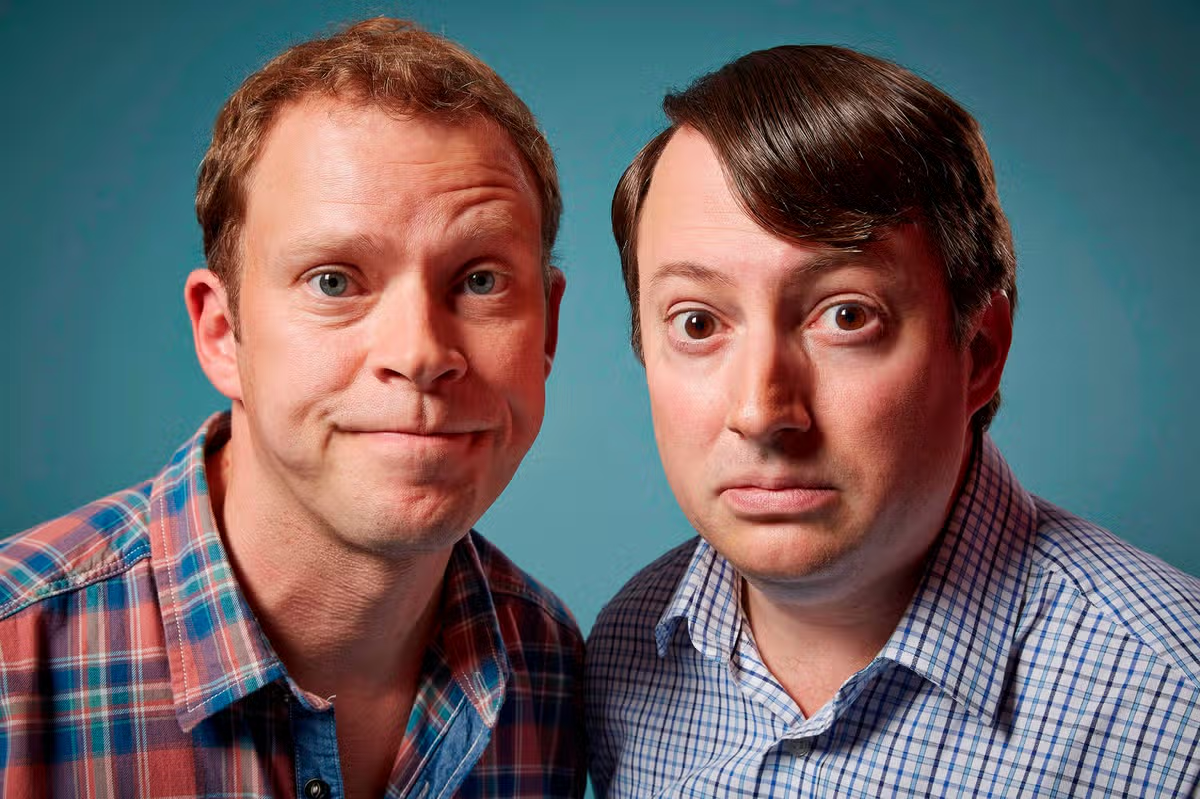
Removed material included scenes featuring war re-enactors in blackface, a joke about Jimmy Savile and a sketch about a contestant on a makeover show wearing a burka(Image: Channel 4)
The BBC has removed several sketches from That Mitchell and Webb Look on iPlayer after deciding some of the comedy show’s material “no longer works today”.
To celebrate the sketch comedy programme’s 20th anniversary, the national broadcaster added four seasons of the smash-hit show onto iPlayer for fans to enjoy – but with a few notable omissions.
A total of 11 sketches have been edited out amid fears of racism and ethnic stereotyping.
“That Mitchell and Webb Look has been made available on BBC iPlayer,” the British broadcaster said in a statement. “This is a 20-year-old sketch show; in consultation with the programme makers, we have included the ones that still work today and not the ones that don’t.”
As per The Times, material removed from the programme included scenes featuring war re-enactors in blackface, a joke about Jimmy Savile, and an indigenous tribe living in a garden centre.
One now-deleted sketch sees Mitchell play a woman in a burka in a scene sending up reality TV programming.
The sketch then cuts to the pair – as themselves – discussing whether or not the sketch itself is actually offensive.
“I’m not sure we quite know what we’re trying to say,” Webb suggests, asking: “Aren’t we just taking the piss out of people’s sincerely held beliefs?”
Mitchell says: “I think you can worry too much about this kind of thing. I mean, what’s offensive to one person is just good, clean fun to another.”
He then pulls off the burqa to reveal he is wearing blackface underneath.
Comedian Dom Joly told The Times: “I totally get it if the BBC is putting out something really racist, which is laughing at and encouraging other people to feel that it’s OK to do that.”
He dubbed the decision to cut the scenes as “classic BBC overkill” and an act of “hysterical censorship”.
“But it’s so clear that Mitchell and Webb are not doing that. Their intent was not to be racist.”
As a possible alternative solution, broadcasters could put trigger warnings on older programmes if they believed they were necessary, he told The Times.
A smash-hit in its day, the three-season skit show began in 2003, starring David Walliams and Matt Lucas, who also wrote the gags.
But it was later pulled from the BBC’s Player in 2020 due to its offensive content, such as the use of blackface, homophobic jokes, and ablesit humour. The series did return to iPlayer in late 2022, but in an edited format, complete with removed scenes and a trigger warning for audiences.
ED Sheeran has made a major show change as he admitted he was “afraid” of being pelted by projectiles after the Macklemore controversy.
The singer yesterday broke his silence on the huge Palestine row, which saw Macklemorebe pulled from his gigs over comments about the conflict – andhis own band quit in protest.
Singer Ed Sheeran admitted he was ‘afraid’ to be near the crowd at his show last night for fear they would throw projectiles at himCredit: ReutersMacklemore was pulled from Ed Sheeran’s gigsCredit: Redferns
As masked protesters waving Palestinian flags gathered outside the Lincoln Financial Field venue in Philadelphia, Ed took to the stage.
Near the end of the gig, Ed confessed he was forced to pivot from his original show plan over fears he didn’t know what the “audience would be like.”
Sign up for the Showbiz newsletter
Thank you!
Speaking at his stadium show, Ed said: “The show itself, at this point in the show, to be honest like I usually go out to B stage and I’m gonna be totally honest with you I didn’t know what the audience would be like tonight.
“I didn’t know if I was going to have things thrown at me. I didn’t know if people would be angry at me.”
The audience cheered as Ed continued: “I apologise that today is not the usual Loop show where I stand on the B stage but I was afraid of standing in the middle.
“I will admit that.”
Elsewhere in the show, Ed broke down in tears as he bowed to pressure threatening the future of his US tour, Loop, and apologised.
He said he had tried not to be a “political commentator” because he wanted his music to be about “unity”.
Ed Sheeran broke down in tears at his Philadelphia gig last nightCredit: InstagramThe 35-year-old told fans he’d questioned whether he even wanted to be an artist anymore following the controversyCredit: YouTube
But then admitted on stage: “I cannot hide how I feel about it anymore.”
“What is happening in Gaza is catastrophic and unjustifiable and disproportionate.
“My heart has been broken by the scale of devastation and loss of civilians’ lives, children’s lives.
“And the systemic injustice we are seeing unfold in the West Bank cannot be overlooked.”
The controversy started when US rapper Macklemore was banned by Gillette Stadium owner Robert Kraft from performing at the venue at a gig planned for later this month.
Kraft said he would not “provide a platform for hate speech” after the rapper spoke out about Palestine onstage.
But when Macklemore was pulled from the tour, several other support acts quit in solidarity – including Ed’s own band.
Other acts who dropped out included Grammy award-winning musician Finneas, Irish singer Aaron Rowe and Danish singer Lukas Graham.
Thousands then cancelled tickets and the musician was unsure if he’d be able to carry on with performances at all.
Emotional Ed said he had questioned whether he “wanted to be an artist at all” after the toxic fallout.
The devastated star thanked his fans for still coming out to his gig, saying: “This concert is still a place where everyone is welcome and everyone here can stand beside people that have opposing views, and everyone can stand beside people that they don’t agree with on everything, but they can all agree on singing these songs.”
STRICTLY Come Dancing fans raged at bosses over an “unfair pairing” after the celebrities and pro partners were revealed during the launch show’s twist.
Graeme Hall and Lauren Oakley were paired up last nightCredit: PAFans are furious with the pairing and have taken to X to slam bossesCredit: PA
In a complete overhaul, the 15 celebs were split into three groups of five and danced alongside multiple pros as their partners were revealed live in the studio.
While the celebs beamed as they finally found out who they’d be vying for the Glitterball Trophy with, some fans were not happy about one particular match.
One fan wrote on X: “Oh Lauren. Dear dear Lauren has her work cut out with Graham. Unfair pairing in my opinion. Graham was exhausted after 3 minutes. Poor thing.”
“Lauren putting on a brave face knowing she’s the best dancer and she’s been set up again,” penned another fan.
A third fan said: “Awww I was so hoping Lauren would get a decent partner this year (sorry canine expert) she’s such an underrated pro.”
Meanwhile, a fourth fan added: “Think they may have done Lauren bad this year.”
In 2023, Lauren was paired with Krishnan Guru-Murthy and they came 8th place.
PHILADELPHIA — Ed Sheeran opened a solo concert in Philadelphia on Saturday with comments about Gaza, saying what’s happening is “catastrophic and unjustifiable.”
“My heart has been broken by the scale of devastation and loss of civilians’ lives, of children’s lives,” Sheeran said at his nighttime performance at Lincoln Financial Field.
Sheeran also said he wants his music and shows to be about unity and humanity, not politics.
He then addressed the controversy that unfolded since his supporting acts withdrew in solidarity with opener Macklemore, who was dropped from the tour after making pro-Palestinian comments onstage.
Sheeran has performed much of his Loop Tour concerts solo, but he had been joined for several songs at each stop by the Irish folk band Beoga. Macklemore, Sheeran’s original U.S. opener, had been replaced by Danish band Lukas Graham and Irish singer Aaron Rowe before they backed out.
Finneas, Billie Eilish’s brother and musical collaborator, was due to tour with Sheeran in South America later this year before he too dropped out earlier this week.
As of Saturday afternoon, tickets were still available for the show, and Sheeran’s website did not list any replacement acts.
Earlier a group of about 50 pro-Palestinian demonstrators congregated outside the stadium before the show. Hillary Steinberg, 34, of Philadelphia, said she got tickets a year ago but wound up getting a refund and attending the demonstration instead, disappointed that Sheeran had not taken a stand.
“I was, until this week, a big Ed Sheeran fan,” Steinberg said. “I think all art is political, and all music is political, and so this choice — even though he was saying that he wasn’t complicit — is a political choice.”
The show comes after a tumultuous week that opened with Macklemore being dropped in response to exclaiming “Free Palestine!” during a Sept. 5 show in New Jersey. Sheeran has said he was not responsible for the decision, which came at the urging of New England Patriots owner Robert Kraft. His company owns a stadium where Sheeran’s tour was scheduled to play Friday.
Within hours of Sheeran’s statement Tuesday, his supporting acts withdrew.
Diane Savitz, a 53-year-old concertgoer from Stroudsburg, Pa., got her tickets to the show months ago and is a big Sheeran fan. She said she does not think that he did anything wrong or that a concert is the place for politics.
“A concert should be for people enjoying the music. Music should bring people together,” Savitz said. “Everyone has their right to freedom of speech, but not every platform is the place for it.”
Macklemore said Wednesday he is donating $1 million to support Palestinian relief efforts and called on Kraft to match the gift; a spokesperson for Kraft has said the billionaire and Sheeran have each agreed to donate $2 million but have not specified where the money will be directed. Sheeran’s representatives have not responded to multiple requests for comment.
Sheeran’s Loop Tour was the highest-grossing in the world, with an average box office gross of over $7 million per city, Pollstar said in May. Through the end of 2025, Sheeran was the No. 3 top-earning concert act since 2021.
Sheeran has said the tour promoter was ultimately responsible for the decision to drop Macklemore.
The Grammy winner was adamant in his Tuesday statement that he wouldn’t be drawn into discussion of the war in Gaza, arguing that his fans don’t come to his shows to hear about these issues.
He also said he “spoke with the venues at length all week to try to build a bridge” before Macklemore was dropped. He insisted he would never willingly let down his fans or abandon the touring crew and others who rely on him to make a living.
While promoters and venues wield great power over concert tours, experts say an artist of Sheeran’s magnitude generally has the final say about what happens concerning the shows.
Sheeran told the crowd in Philadelphia that everyone is welcome at his concerts, and they can have opposing points of view while still singing his songs, which are about “love, hope, and unity.”
Vejpongsa writes for the Associated Press. AP journalist Jessica Hill in Las Vegas contributed to this report.
Sir Tom Jones proved he’s “still got it” on The Voice UK tonight with an impromptu rendition of It’s Not Unusual.
Hayley Anderson Screen Time TV Reporter
21:29, 19 Sep 2026Updated 21:32, 19 Sep 2026
ITV The Voice UK fans say axing Sir Tom Jones is a ‘huge mistake’ (Image: ITV)
The Voice UK fans slam ITV’s “huge mistake” in getting rid of Sir Tom Jones as he shares heartwarming story about his career.
ITV’s hit singing contest The Voice UK returned tonight, Saturday, September 19, as the judges continued to blindly listen to singers hoping one of stars would give them a chance.
As always was veteran The Voice UK icon Sir Tom Jones who recalled when he first realised the moment he “made it” in his music career, after he was asked by Will.i.am.
“It’s Not Unusual I did in 1964 so that was 61 years ago”, Tom said.
“My band and myself were driving back to London and It’s Not Unusual came out on the Friday but I didn’t know until I picked up the Sunday paper in a transport cafe, and there it was, It’s Not Unusual, number 10.
“There were truck drivers there right and I was like ‘You see this!’ And they were like ‘yeah, yeah, yeah yeah!’
“And just seeing my name at number 10 I thought ‘This is it. It was a tremendous feeling.’
This story then prompted the audience to ask for him to sing It’s Not Unusual which Sir Tom happily obliged with many fans impressed by his performance.
However, it also angered viewers as they were reminded that the 86-year-old will not be returning for The Voice UK next year as he will be replaced by former Girls Aloud star Cheryl.
“To the powers that be at The Voice UK this is the legend you dropped!”, someone angrily wrote.
A second agreed: “ITV making a very big mistake getting rid of Sir Tom Jones, idiots.”
Another agreed: “It was such a huge mistake axing Tom Jones”, with another writing: “Still can’t believe they fired THE Tom Jones. He’s amazing.”
While a fellow viewer added: “Don’t care what anyone says Sir Tom Jones has still got it!” Silliest move to let this frigging legend go..shame on you producers who make stupid decisions on The Voice UK.”
Sir Tom has also shared that it wasn’t his decision to go, explaining on social media: “The reason given is because of a financial difficulty with insurance.
They now say in the press they wanted to ‘refresh’ the show, and with a new coaching line-up there wouldn’t be a chair for me.”
He has instead been offered a reduced role in the series, something that Sir Tom isn’t “thrilled” about.
The Voice UK continues every Saturday on ITV and ITVX
CARROT Top has been hospitalised in Las Vegas after an emergency.
His Friday night show at the Luxor was scrapped as a result.
Comedian Carrot Top, whose real name is Scott ThompsonCredit: AlamyThe comedian was reportedly rushed to hospital, forcing him to scrap his Friday night showCredit: Alamy
A source told TMZ Carrot Top, 61, had been rushed to hospital after a suicide attempt.
His rep said the comedian was recovering in hospital with “the care and support he needs”.
Sign up for the Showbiz newsletter
Thank you!
The performer’s real name is Scott Thompson.
He got his nickname from a high school swimming coach.
The comedian also snagged roles on the big screen, including in Chairman of the Board, Dennis the Menace Strikes Again and Tugger: The 4×4 Jeep Who Wanted to Fly.
He has appeared on many talk shows, including a 2010 episode of The Jay Leno Show, when he had pies chucked at him by Leno and guest Emma Roberts.
His agent Jami Schlicher said: “Mr. Thompson is recovering in the hospital and is receiving the care and support he needs.
“His family and those closest to him are deeply grateful for the concern, prayers and respectfully ask for privacy.”
The Sun contacted Scott Thompson’s agent for comment.
Hundreds of thousands of Iranians have marched in a government-organised show of defiance in Tehran, pledging their readiness to take up arms.
The Iranian government showcased a newly formed volunteer force at the rally on Friday. It will receive limited military and emergency response training to serve as an additional layer of security for Iran’s Islamic Revolutionary Guard Corps (IRGC) and the Basij militia.
Recommended Stories
list of 3 itemsend of list
Volunteers rallied through downtown Tehran in combat uniforms, some carrying flags and weapons, while the government displayed drones, anti-aircraft batteries and other weaponry.
Iranian authorities said 313,000 people joined the event in the capital. Attendance figures could not be independently verified.
Tehran’s IRGC chief, Hassan Hassanzadeh, told the state broadcaster IRIB that over 600,000 people had registered to participate in the voluntary Janfada-ye-Iran campaign. That roughly translates to “Those who sacrifice their lives for Iran”, with over one million expected to take part in the training.
Senior Iranian leaders at the rally included President Masoud Pezeshkian and Basij head, Hossein Taeb.
Taeb told participants that the volunteers would be ready for “full-fledged defence” and would be a “nightmare” for Iran’s enemies.
Members of the Basij paramilitary force at the military rally in Tehran on Friday [AFP]
A broader strategy
Iranian authorities say mobilising the new volunteer force is part of a broader defence strategy.
“The Islamic Republic has mobilised these people to show that they are united, that they have solidarity and that their people are ready to give anything for the country,” said Al Jazeera’s Sinem Koseoglu, reporting from the rally.
Women and teenagers have also registered with the volunteer units, she added.
“I want to show the world that Iran is strong and united. We don’t want war, but we’re ready to defend our country to the very end,” one of the volunteers, Bahera, told our reporter.
Another volunteer, wearing a combat uniform and carrying a rifle, said: “This is our homeland and we won’t let others decide its future”.
President Pezeshkian said in a speech that the rally was a show of solidarity, Koseoglu noted.
“This is not only a message to countries like the US and Israel, which are attacking Iran, but also to the Islamic Republic that we are ready for any crisis.”
Members of Iran’s Basij paramilitary force at the rally [AFP]
Economy and mobilisation
Friday’s rally happened as the Iranian economy struggles under the US naval blockade of Iranian ports and new US sanctions.
Esmaeil Baghaei, Iran’s Foreign Ministry spokesman, condemned the “brutal economic war, deliberately designed to inflict maximum pain and suffering on every Iranian citizen”.
As the latest addition to its economic pressure campaign, the US administration on Thursday went after digital currency networks that it says are illegally providing sanctioned Iranian entities with access to the international financial system.
The struggling economy was a key driver for protests last December that quickly turned into a challenge to the political system in place since the Islamic Revolution in 1979. Iran said about 3,000 people were killed in the protests, but activists say the state crackdown killed over 7,000.
However, the war launched in late February by US-Israeli strikes has since allowed the authorities to regain the initiative by presenting themselves as a bulwark against the country’s enemies.
The volunteer mobilisation campaign started in early April, at the height of US-Israeli attacks.
According to the authorities, more than 30 million people registered for a potential call-up, about a third of the population of 86 million.
Four days before they’re set to play the first-ever concert by their new band, Dhani Harrison and Nigel Godrich sit down to enjoy a post-rehearsal libation in the parking lot of a North Hollywood practice space.
“Is there an opener?” asks Godrich, who holds a bottle of fancy root beer. Harrison, who’s clutching a Sapporo, grabs his friend’s drink and neatly pops the top off using his own bottle.
“I went to Brown,” he says with a little smile. “That’s what they teach you in the Ivy League.”
Harrison, 48, is the son of the late Beatles legend George Harrison; long before college, he got a priceless musical education from his father, whose final solo album — 2002’s Grammy-winning “Brainwashed” — Dhani helped complete after George’s death in 2001. Godrich, 55, made his name working in the studio with Radiohead on game-changing records like “OK Computer” and “Kid A”; he’s also produced for Beck, Paul McCartney and Roger Waters and played with Thom Yorke and Flea in Atoms for Peace.
Now the two have teamed up in Dragonflies, a spacey and atmospheric art-rock duo with a self-titled debut album due Friday from Dark Horse Records, the label George Harrison founded in 1974 and Dhani Harrison relaunched in 2020. This weekend, Harrison and Godrich will celebrate the LP’s release with two shows at Hollywood Forever’s Masonic Lodge, where they’ll be joined by guitarist Nick Valensi (of the Strokes) and drummer Joey Waronker (who’s played with Beck, R.E.M. and Oasis).
Asked how exactly the group came together, Godrich and Harrison look at each other across a picnic table and shrug. “The real reason we did it was as a vehicle to hang out,” Godrich says of the two, who’ve been pals since both were living in Los Angeles in the early 2000s and who both found themselves back home in England a few years ago.
Yet “Dragonflies” has plenty to offer the rest of us: Built around Harrison’s high, sighing vocals, the music moves with a funky rhythmic propulsion rooted in Godrich’s signature tape loops; lush string arrangements by David Campbell (also known as Beck’s dad) add a touch of slightly spooked romance to songs about nature and friendship.
Harrison describes the band’s sound as “a bit creaky” and compares it to the feeling of being out on the water. “I always thought that’s a cool place to start — like you’re on a sinking ship,” he says.
Godrich laughs and adds, “Well, I hope not.”
For Harrison, working with Godrich provided a kind of full-circle moment nearly two decades after he caught one of Atoms for Peace’s first gigs at downtown L.A.’s Orpheum Theatre in 2009.
“I remember it made me want to quit music,” he says, which draws a frown from his bandmate.
“That’s not a great review,” Godrich says.
“No, that concert blew me away,” Harrison replies. “I went home and I was like, Oh, they’ve already done all the things I want to do. So I just went and sulked for a few days.”
Dragonflies began after Harrison returned to England, where he’d grown up on his father’s Friar Park estate, following the death of his grandmother, who famously raised George Harrison’s widow, Olivia Harrison, in Hawthorne. “I was still here basically to be around her,” says the musician, who formed the bands Thenewno2 and Fistful of Mercy while in L.A. “When she passed, that was the last of my grandparents. My mom was living in England, and so I just thought, Well, time to go.”
Harrison sought out Godrich for help on his 2023 solo album, “Innerstanding”; later, he lent the producer one of his dad’s old tape machines — “They did ‘Shankar Family & Friends’ on it,” he points out — which led to a series of casual jam sessions at Godrich’s studio in London’s Brixton neighborhood.
“It was like, ‘Hey, you want to get some Japanese food and make some tape loops?’” Harrison recalls.
Godrich notes proudly that “the way the record was made was completely mechanical,” meaning nothing was programmed on a computer but instead recorded “live on the fly” using older equipment.
“Fortunately, we both own a ridiculous amount of analog gear,” Harrison adds. “Because we’re nerds.”
“I’m not a nerd,” Godrich says. “I hate gear chat.”
“That’s true,” Harrison says. “He doesn’t nerd out about that stuff — I’m the nerd. He won’t even let me use six Kaoss Pads onstage.”
What’s a Kaoss Pad?
“You don’t want to know,” Godrich replies.
Gearhead or no, the producer was adamant that Dragonflies not rely on prerecorded backing tracks when it starts playing live.
“No computers were harmed in the making of this show,” Harrison says — thus the extra players.
(Brian Feinzimer / For The Times)
Waronker is an old friend of Godrich’s who played drums in Atoms for Peace and on Beck’s “Sea Change” and “Morning Phase” (not to mention Beck’s brand-new “Ride Lonesome,” which Godrich mixed); the producer has known Valensi since he “didn’t work with the Strokes,” as he puts it, in 2003, when Godrich tried a couple of sessions with the New York garage-rock band before deciding it wasn’t a good fit.
Godrich says he plays bass in the live group because it’s easy. But also: “Bass is such an important part of the sound that if somebody else was doing it, they would never do it the same as me, and it would annoy me.”
Top three bass players of all time, according to Dragonflies?
“McCartney’s good, isn’t he?” Godrich asks.
“Les Claypool,” says Harrison. “I’m a huge Primus fan.”
“I like David J from Bauhaus,” Godrich says. “He’s an incredibly innovative bass player — always did very interesting things. Stylistically, he’s someone that I probably copy a lot from. It’s just the root notes, but whoever’s in control of the root notes is in control of everything.”
“It really is a power move to be the bass player,” Harrison says.
“I don’t want to be at the front — that’s not my thing,” says Godrich. “I don’t want to be the guy.”
Does Harrison?
“It takes me a while to get warmed up,” he says. “I don’t really look at people when I’m playing a show. I’m not sure if that means I’m mildly spectoral. I took the test, actually — I scored highest in my old band. I know a lot of neurodivergent people who perform.” He shrugs. “Sometimes you don’t get to choose if you’re the guy, but you’re the guy.”
In addition to his father, one of Dhani’s mentors was George’s friend and latter-day creative partner Jeff Lynne, who for all his musical genius has never seemed particularly comfortable onstage.
“He’s brilliant at what he does, but you talk about in-ear monitors or the sound onstage or the lighting or something, and it’s over,” Harrison says. “It’s too much input. That’s why Jeff wears the Spider-Man goggles,” he adds, referring to the ELO frontman’s ever-present aviator shades. “He has too much Spider-Sense. My dad was the same way. He definitely was like, ‘Look at him — don’t look at me!’”
After Dragonflies’ Hollywood Forever shows, Godrich and Harrison have dates scheduled in Europe for November and hope to play more in the future, depending on when Godrich finishes a couple of records he’s producing. (To give a sense of the stress he’s under, he mimes putting a gun to his head.) The duo already has enough material for a second album too.
How much time does Harrison intend to dedicate to the project?
“As much as I can, really,” he says. “How much do you want to hang out with your mate? I got bored of being Dhani Harrison anyway — I like being Dragonflies now.”
A solitary man believes he’s been wronged by a vast, overarching system. Feeling helpless to take it on directly, he picks up a gun and violently confronts the most powerful person he can think of who embodies his grievance.
It is a chilling dynamic that keeps repeating itself in American culture, and one at the heart of “American Hostage,” a dramatic miniseries making its debut Sunday on MGM+.
The eight-episode series re-creates the true story of Tony Kiritsis, an Indianapolis man who, in 1977, kidnapped Richard O. Hall, a mortgage broker whose family Kiritsis blamed for his own financial hardships.
The standoff lasted 63 hours, during which Kiritsis kept a shotgun attached by wire to Hall’s neck, and it became a national media spectacle. Throughout the crisis, Kiritsis made live calls to Fred Heckman, a local AM radio news broadcaster, pleading to listeners for the justice he believed he was due.
A half-century after this incident, not even the creators and stars of “American Hostage” can say for certain why we find stories like this so compelling — or why they keep happening in real life.
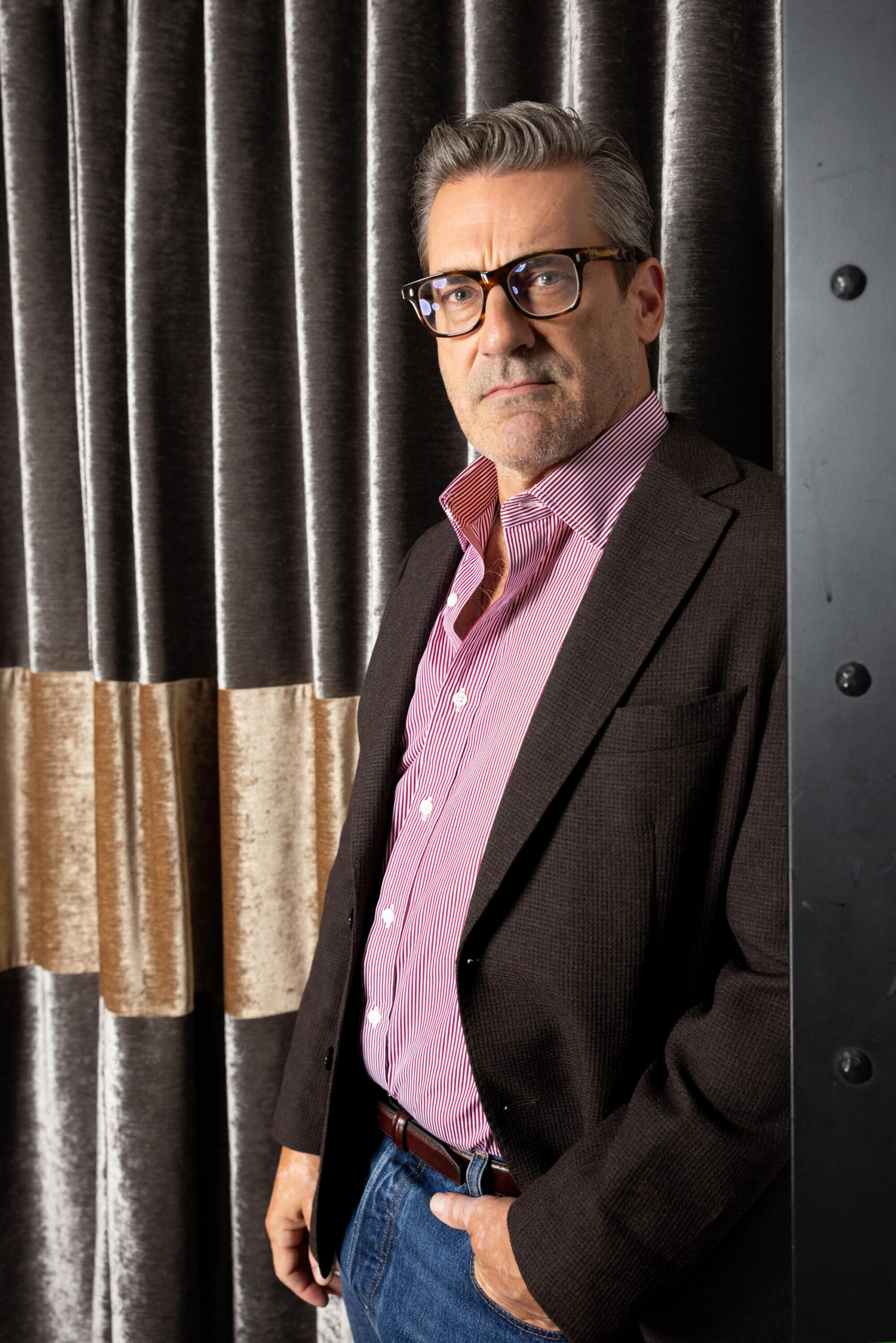
“We haven’t quite figured this situation out,” said Jon Hamm, who plays Heckman in “American Hostage” and is one of its executive producers.
Jon Hamm plays Fred Heckman, a radio news broadcaster, in “American Hostage” and is an executive producer.
(Jason Armond/Los Angeles Times)
The “Mad Men” star — no stranger to period pieces — said that beneath its retro production values and wide lapels, “American Hostage” is fundamentally about how people who feel voiceless in our society fight to be heard, even if the means is violence.
“There’s a lot that really resonates in the current media landscape and culture 50 years down the road, that people can still really connect with,” Hamm said.
Hamm and his colleagues hardly need to argue that point when the nation has been fixated on the case of Luigi Mangione, who in August pleaded guilty to federal charges in the December 2024 killing of Brian Thompson, the chief executive of UnitedHealthcare.
Though work on “American Hostage” had begun before Mangione’s crimes and the show was not inspired or motivated by them, series co-creator Shawn Ryan said that audiences have a boundless fascination with these types of stories — with or without any counterparts in current events.
“Dramatically, it’s always very interesting to see somebody do the wrong thing for the right reason,” Ryan said.
The TV series originated with a 2022 scripted podcast, produced by Criminal Content and also called “American Hostage,” on which Hamm also played the role of Heckman. It told of how Kiritsis, an Army veteran, enacted the kidnapping on his belief that the Hall family had swindled him on his mortgage — a loan for land where he had hoped to build a shopping center.
While Kiritsis sought to use Hall’s life as a bargaining chip for prosecutorial immunity, he also portrayed himself as an underdog taking on powerful financial interests. On the other end, Heckman wrestled with the moral predicament of giving airtime to a potential murderer while hoping to keep Hall alive. (Hall survived the ordeal and Kiritsis, acquitted of his crimes by reason of insanity, was later institutionalized.)
In the spring of 2022, Hamm approached Ryan, the creator of TV thrillers like “The Shield” and “The Night Agent,” with the idea of adapting the “American Hostage” podcast into a miniseries.
Ryan created the TV adaptation with Eileen Myers, a collaborator of his on shows like “Last Resort” and “Mad Dogs.” They both saw in the source material a story that was a combination of classic 1970s films like “Network” and “Dog Day Afternoon.”
(In a parallel development, Kiritsis’ story was also adapted into the Gus Van Sant film “Dead Man’s Wire,” which was a box-office disappointment earlier this year.)
Ryan and Myers said they were fascinated with how the American news media covered the kidnapping in instantaneous fashion and in an era long before the internet. In the 1970s, Ryan said, “There were fewer journalists and they were better and more trusted, and if Walter Cronkite said something, you believed it.”
Shawn Ryan, Jon Hamm and Eileen Myers executive produce the TV adaptation of “American Hostage.” Hamm approached Ryan, who brought in Myers to co-create and co-showrun the series.
(Jason Armond / Los Angeles Times)
The question that journalists like Heckman were confronted with, Myers said, was, “Do you allow a man who’s got a shotgun to somebody’s head dictate the terms of whether you’re going to put them on the air or not?”
Hamm, who has played alluring if ultimately disreputable characters on “Mad Men” and now Apple TV’s “Your Friends & Neighbors,” said he appreciated that “American Hostage” gave him a character who an audience can feel good about rooting for.
“I thought, I’m 55 years old,” Hamm said. “I was close to Fred’s age when this all went down. It was fun to play somebody morally conflicted that is actually on the good side.”
With some hesitation, Hamm pointed to the career trajectory of Bryan Cranston, who followed his celebrated heel turn on “Breaking Bad” with projects like “All the Way,” the play and TV film about President Lyndon B. Johnson.
“I don’t want to draw a comparison that’s stretching the bounds of reality,” Hamm said, “but Bryan went from Walter White to LBJ. You go, ‘All right — he’s still morally conflicted, but at least he’s on the right side of things.’”
“American Hostage” also benefited from the casting of Giovanni Ribisi (“Saving Private Ryan,” “Avatar,” “Sneaky Pete”), who brings a blend of volatility and humanity to the role of Tony Kiritsis.
Hamm recalled how Ribisi was in the midst of shooting another project — the upcoming Prime Video miniseries “The Greatest,” about Muhammad Ali — when he agreed to do a reading for “American Hostage” over Zoom.
“He brings value to every project he does, and he’s picky, as he should be,” Hamm said. “He’s a phenomenal DP — he might just go be a camera person or something if he wants to do it. So we were lucky to get him.”
Giovanni Ribisi plays Tony Kiritsis, the man who kidnapped Richard O. Hall. “So we were lucky to get him,” Hamm said.
(Steven Ackerman / MGM+/Sony Pictures Television)
There are of course unavoidable parallels between the stories of Kiritsis and Mangione, including the fact that both men were celebrated as folk heroes by some people who identified with their broader resentments.
But Hamm drew a crucial distinction between the two cases: Mangione “killed a guy,” he said. “He shot a man in cold blood. Like, I don’t care how good your point is. That’s not how we do it.”
Going back to the Boston Tea Party, Hamm said, every era of American history has had its dissidents who feel “wronged and done over by a system that is stacked against you” and are willing to take aggressive actions against it.
Hamm said that feeling persists and thrives today. “I think this is a big part of the rise of Trumpism,” he said. “I think this is a big part of the rise of the MAGA mentality, of ‘I have been done wrong and no one is hearing my complaints.’”
When those feelings go unaddressed for long enough, Hamm said, people will come to accept a certain amount of lawlessness from the figures they feel can solve their problems.
“We have a guy in the Oval Office right now who thinks that the laws don’t apply to him and a Supreme Court that said, ‘Yeah, they don’t — you can do whatever you want,’” he said.
For supporters of President Trump, Hamm said, “I think it’s fun for them to be able to flout the law and say, ‘Who cares?’ and all the things that they’re currently saying, but it’s not the principles that we were founded on.”
Hamm and Ryan make no secret of the fact that they’d like to keep “American Hostage” going as an anthology series and explore more of what Hamm called “these watershed moments of American life, to see how they rippled and how we got here from there.”
One could certainly imagine other events that would fit the show’s interest in real-life hostage crises that became media spectacles — the 1974 abduction of Patty Hearst; the 1963 kidnapping of Frank Sinatra Jr. — though Hamm kept any specific plans for the series close to the vest.
Perhaps the upper limits they face are the hours in a day to make and to broadcast the show.
“We’re living in great times right now for television,” Hamm said. “There’s so many opportunities to tell stories. Almost too many.”
“The Pineapple” promised to be intense, but even hours before the show had begun, it had me startled.
I was warned, via a waiver attendees must sign to experience the production, to expect “intimate, and/or aggressive physical contact,” “confined spaces and passageways,” and that I may be asked to crawl, kneel or lie down. All of it would happen in a show that I was cautioned would present simulated violence or “disturbing imagery.”
As much as I love participatory, immersive theater — productions that often rely on some form of audience participation — “The Pineapple” was providing me with a checklist of things I generally avoid. It was a feeling that only grew when I reached the waiver’s end, and signed off that I was OK with claustrophobia (I am not).
What had I done?
None of it, though, had fully prepared me for what Candle House’s “The Pineapple” actually was. By the time the hourlong experience in North Hollywood had reached its conclusion, I had been straddled by a woman who forced a gloved finger down my throat, outfitted with hooded, vision-impairing face masks, grabbed by the wrists as they were taped together, ordered to crawl toward a blood-stained room, and spooned or kissed by multiple male performers.
“The Pineapple” is a secretive hourlong show that seeks to disorient attendees.
(Sona Earnest)
“The Pineapple” is a buzzed-about show among the tight-knit immersive community, one that fits into the medium’s long tradition of productions designed for a sole audience member. A short run last year in New Jersey sold out. Candle House has such a devoted following that its L.A. shows have been selling out almost as instantly as they are announced. While it’s thus far been shrouded in secrecy — “The Pineapple” will not even release a program or cast list until its run has concluded — it comes highly recommended from acquaintances who saw it on the East Coast. I was alternately excited and apprehensive to take part, and my editor would like me to note that I pitched this story on my own accord.
“The Pineapple” in its limited online description promises an alien encounter. Sign up, and an email will tell you that it will “change your life.”
For the passionate crowd of immersive enthusiasts who may want to experience “The Pineapple” and are worried I just spoiled the show, I call nonsense. For one, I believe audiences should know exactly what they are paying for, and two, I do not think “The Pineapple” can be properly spoiled. It was at times otherworldly, in moments psychedelic, and while there were scenes in which I felt fear, there were also others in which I laughed. While “The Pineapple” flirts with horror, torture and conspiracy nuts, it also provides space for Jimmy Buffett’s “Margaritaville.”
And in “The Pineapple’s” best instances, it created a sense of personal intimacy with its performers. These were actors who may have earlier been needling at or attempting to push my boundaries. “The Pineapple” wants to toy with our trust, to create a safe space where it can intermix themes of abuse and empathy until their lines are blurred. Consider its waiver, then, not just a warning but an attempt to weed out those who may be offended or triggered.
“The Pineapple” tries to break us. And it charges nearly $250 for the privilege.
“How do I put this,” says the show’s core creator/director Evan Neiden when asked his intentions behind “The Pineapple.” “I think the show is designed to boil you. Like the lobster in the pot. It gets warmer and warmer and warmer and it’s slowly acclimating you to this new set of rules that keep changing to this new environment of degeneracy and conspiracy.”
“The Pineapple” teases an alien encounter. It is theatrical production designed for one guest.
(Sona Earnest)
Neiden, the 27 year-old founder of Candle House, has long specialized in one-on-one phone productions designed to be done from the caller’s home. While drastically different in narrative content, his horror show “Claws,” in which its solo guest acts as an emergency line operator, is good prep for “The Pineapple” as it also seeks to push people to the brink of comfort.
If there is an artistic thesis behind the work of the New York-based Candle House, it is to cast its audience as performers, but then poke, prod and disorient until they stop performing and start reacting on instinct — or, in theory, become unguarded. It’s an idea that simply to get through the day we are playing a role of sorts, tuning our conversations to please others, or presenting exaggerated, false or tidied-up versions of ourselves on social media.
“In an experience like this, you’re alone with the inhabitants of the world, and they’re all there as part of your hallucination, your dream and your journey,” Neiden says. “You don’t need to worry about presenting a certain way or being perceived in a certain way. All the characters in ‘The Pineapple’ are degenerates, and this show invites you to become one as well. That’s very hard to do if someone from the respectable, outside world is watching.”
The setup for “The Pineapple” is simple. I was playing a respondent to an ad for a meeting with an alien. But things quickly spiral beyond clear narrative recognition, as piecing together the story becomes a puzzle unto itself. And it will shift depending on how one reacts, as there are multiple endings. But know only that in its opening minutes we learn that we have been swindled and are now part of a ritual of sorts to summon said alien.
“The Pineapple” offers intimate actor interactions designed to push boundaries.
(Sona Earnest)
You may find yourself, as I did, raising your voice, as “The Pineapple” did light research on me. My career was insulted, and I was mocked for fumbling around while attempting to juice a pineapple with a woefully inadequate kitchen utensil. Neiden says many attendees try to break the show itself, to push back and see how far its narrative can bend. This is typically not how I play, wanting to experience a production as its designers have intended and thus I let “The Pineapple” take the lead rather than trying to force my will upon it.
I am not easily offended and never used the safe word provided, although there were instances where I came close, namely when my feet were being aggressively, unwelcomely massaged. And yet there were scenes in which I thought about deeply personal relationships I have had, specifically when a character asked me to think of a time when forgiveness or an apology was craved from someone I am no longer closely connected with.
“The Pineapple” then began to feel like a metaphor. As I moved from darkened room to darkened room, ridiculed in one, flirted with in another, a thread of finding one’s own personal paradise in a hellscape began to emerge. Is it aliens we are seeking, “The Pineapple” begins to ask, or simply perhaps purpose? The act of forgiveness, Neiden tells me, was on his mind when crafting the show.
“I never really felt like I fully understand it,” Neiden says. “What is forgiveness? Some people say it’s letting someone off the hook. Others say it’s releasing yourself of the burden of a grudge. And it’s a word wrapped in religion and politics. There are so many definitions of it, and we hear it everywhere — forgiveness and its counterparts of guilt, shame and accountability. What does it mean? The show doesn’t answer that.”
Maybe. That’s up to the audience, not its creator.
Days after I’ve seen “The Pineapple,” friends and peers keep asking if I enjoyed it, and I don’t think it’s a simple answer. It’s not for everyone. I’m not sure it’s even for me. Simulated torture is not my idea of a good time. But “The Pineapple” did wear me down, and it’s beautiful in the way it highlights the lonely anguish at the heart of Buffett’s “Margaritaville.”
As its small cast obsesses over a fabled alien encounter and seems willing to stop at nothing to find release in a divine being, be careful, “The Pineapple” argues, of the personal Eden you seek.
At least that was my takeaway. You might walk away with an entirely different message.
“Maybe you just fell in with the wrong crowd and got abducted by aliens,” Neiden says.
The duo entered the experiment on Sunday (September 13), alongside 14 other contestants. But they have now been spotted laying together in bed and holding hands, prompting fans to suggest that they have already ‘hard launched’ their connection.
The moment came during Thursday (September 17) night’s episode, when the house was transformed into a ‘dreamland’. While nominated housemates Millie, Pauline and Rochelle stayed in the main house, the remaining contestants were sent to a much smaller ‘nightmare room’.
As they were settling into the their new living space, Chelsey and Lynx were seen holding hands while chatting with their co-stars. And the duo didn’t appear to be hiding their intimate body language from the rest of the house.
This has sparked conversation on X, formerly Twitter, where one viewer wrote: “Finger interlocking holding hands in front of basically everyone, oh they really hard launching this romance thing init #bbuk.”
Many fans have complained about the pair’s alleged “showmance,” arguing that they are treating the social experiment like a dating show. “Chelsey & Lynx need to realise this is not Love Island #BBUK,” said one.
Another frustrated viewer posted: “Stop trying to make a chelsey and lynx showmance happen! it’s not going to happen! #bbuk,” while a third added: “they’re holding hands now? #bbuk.”
Someone else chimed in with: “Do they know its not love island ffs stop holding hands #bbuk,” with a final viewer putting forward: “We’ll have to get one of Lynx or Chelsey out soon if they continue, they think they’re on Love Island. #bbuk,” reports OK!.
Although their romance has come under fire, Chelsey and Lynx have separately attracted some support since joining the show. Manchester-based Chelsey has been described as “a sweetheart”, with one fan writing: “I really like Chelsey so far, she’s got a great bubbly personality. #BBUK.”
Lynx has his admirers, too. “I like lynx #BBUK,” one supporter posted, while another declared: “Lynx might be the coolest name i’ve ever heard #bbuk.” Chelsey and Lynx aren’t the first pair to find a connection on the series. 2025 contestants Marcus and Elsa, who met on the show, recently announced their engagement and first pregnancy together.
Away from the romances, the house is preparing for an eviction. Big Brother’s undercover moles, Tays and Philip, nominated Millie, Pauline and Rochelle, leaving the public to decide who goes.
The result will be revealed during Friday’s live broadcast, with AJ Odudu and Will Best on hand to interview the departing housemate.
Big Brother continues on ITV2 and ITVX tomorrow night at 9pm
An unprecedented surge in border crossings over the last decade reshaped America: Millions of people from more than 150 countries arrived, bringing the U.S. immigrant population to its highest levels.
Now, data obtained exclusively by the Associated Press paint a picture of who these migrants are, where they went and what happened after the border.
Some went to cities that have long been magnets for immigrants — New York, Miami — but increasingly, others found their way to smaller cities with less developed immigrant footholds. Blocks, neighborhoods and entire cities were remade in places like Elkhart, Ind., Knoxville, Tenn.,and Dodge City, Kan.
And while the vast majority of migrants traditionally were from Mexico, this surge included people from an astonishing number and diversity of countries: India, Ecuador, Ghana.
Via a Freedom of Information Act request, AP obtained federal records on the self-reported destinations of 4.5 million migrants released in the United States after crossing the Mexican border — both legally and illegally — between October 2018 and July 2025.
Migrants must provide U.S. Customs and Border Protection with a street address. AP obtained their destination ZIP codes, citizenship by country, ages, genders and the dates and border regions where they encountered authorities.
Some probably never arrived at the addresses they gave. Authorities lacked resources to check, though migrants must report truthfully to pursue their cases in court and get work permits. Some have moved elsewhere in the United States or left the country, voluntarily or involuntarily. But many have stayed put.
Data on their initial destinations after the southern border provides both a sweeping and an unusually granular look at how the immigration surge — one that peaked during President Biden’s administration and was a major reason voters returned his predecessor, Donald Trump, to the White House — is playing out today.
Here are some key takeaways from the data.
Cities drew migrants from several continents
The Border Patrol encountered migrants from 174 countries in one year alone, a sharp departure from earlier periods when they were nearly all Mexican and Central American. The growth of social media and new migration routes were key in bringing people from around the world. Cincinnati, for example, experienced a large number of arrivals from West Africa, Uzbekistan and India.
Some cities — ones that for generations have had robust international communities — were further diversified by the range of countries from which people arrived.
New York City’s Queens borough registered at least 25 nationalities with significant arrivals, including five countries that each sent more than 7,000 people: Ecuador, China, Colombia, Venezuela and India.
Philadelphia had 11 nationalities with at least 1,000 new arrivals, led by Brazil, Haiti and the Dominican Republic but also including Russia and Venezuela. The city’s metro area also received more than 1,000 migrants from Georgia.
Florida remained No. 1, but many people looked elsewhere
While Florida was the most popular state, Latin American immigrants increasingly looked elsewhere for more promising job prospects and a better quality of life. Many turned to places with small but established communities of immigrants from their homelands.
For Cubans, nine of the top 10 destination ZIP codes were in Florida, but people of the Caribbean nation also flocked to Louisville, Ky., Grand Island, Neb., and Odessa, Texas. Colombians went to the Denver suburb of Aurora. Paterson, N.J., was the top pick among Peruvians. Some Venezuelans headed to the growing suburbs south of Salt Lake City; others to pockets of Atlanta, Chicago and Denver.
More women and children came than men
Nearly 6 of every 10 migrants released at the border were women and children, a dramatic shift from a few years earlier when migrants were predominantly men.
The change is visible in many places and across nationalities, but some stand out. Tulsa, Okla., attracted Mexican women and children. Ecuadorian women and children went to Spring Valley, N.Y. Guatemalan women were drawn to Chattanooga, Tenn.
Those who came from China headed to L.A. and New York
Chinese migrants, who trekked by hundreds nightly in California’s mountainous border with Mexico, largely gravitated to two places: New York City, especially the Queens and Brooklyn boroughs, and a cluster of neighborhoods in the Los Angeles area.
Trump’s deportation machine hit some migrant magnets and overlooked others
Immigration arrests have hit some areas that ranked among the most popular destinations for migrants in recent years, including Miami and New York. Others that experienced a large migrant influx have gotten less attention from authorities, including Silicon Valley, Madison, Wis, and Stamford, Conn.
Jarrett, Kessler, Lodhi and Spagat write for the Associated Press.
FANCY experiencing something totally sexy for an evening out? Well, you can, can, can at one London stage show.
Moulin Rouge! The Musical at Piccadilly Theatre on London’s West End is high-octane magic and what makes it even better is you can get cheaper tickets with Sun Club.
Moulin Rouge! has been on the West End for five yearsCredit: Cyann FieldingThe set is glamourous as is the productionCredit: Cyann Fielding
Sun Club members can get 10% off tickets with London Theatre Direct, when booking via our Sun Club Promo page.
To get your tickets, sign up to Sun Club for £1 in our flash sale, which gives you three months of access (£1.99 per month thereafter), then head to the Sun Club Offers hub and London Theatre Direct page or click here.
Sign up for the Travel newsletter
Thank you!
And let’s be honest: a night out surrounded by leather, lace and a stage bursting with hit songs is pretty hard to top.
If you’ve been living under a rock, Moulin Rouge! follows Christian, an optimistic American songwriter who lands in bohemian Paris and gets swept up by a pair of flamboyant locals.
They then introduce him to Satine, the Moulin Rouge’s sparkling star.
Mistaking him for the wealthy Duke, who is needed to bankroll the struggling venue, Satine seduces him.
But behind her vibrant facade lies a tragic secret, kicking off a tale of forbidden romance – think Romeo and Juliet, but injected with explosive choreography, killer pop hits and pure, unapologetic queer glamour.
The magic starts from the moment you step inside the theatre, where the stage glows with dazzling warm yellow lights framed by massive arches that transform the space into a giant heart.
And you can get money off with The SunCredit: Cyann Fielding
Side podiums host alluring bohemians moving to the seductive and rhythmic music, before the curtain even lifts.
Beyond the podiums, there’s a giant elephant in one of the boxes looming over the audience and directly opposite, there’s the iconic red windmill setting the Parisian scene.
When it comes to the show, rather than an original score, the production of Baz Luhrmann’s iconic musical movie mashes up iconic hits spanning decades including A-ha’s Take on Me to Lady Gaga‘s Bad Romance.
The result? A gripping and energetic performance that leaves you singing along in your head.
Each stage set is cleverly laid out to bring the audience in, with scenes of Paris in the background including smoky night- time skies and sparkling lights.
The costumes are just as decadent as the set itself as well.
The show mashes-up pop hitsCredit: Cyann FieldingTickets start from £25 per personCredit: Cyann Fielding
And the cast brings all of this excitement to boiling point with remarkably talented singing and acting.
Who doesn’t love a show with a villain? The Duke is suave and sexy and while I know I should have hated him, I found myself loving his characterisation.
Other standout performances include Santiago, “the finest tango dancer in Paris” played by Ivan De Freitas – his cheeky and endearing charm lightens the tragedy unfolding.
Alistair Brammer, who plays Christian and Karis Anders, on who plays Sat, ine deliver a stunningly alluring performance, too bringing the chemistry of the characters to life.
Everything oozes sexiness, but with sophistication.
November marks five years since the show launched in the West End and I simply cannot name a single fault with the show – it is a must-see that I hope stays around a lot longer as I will be back.
Tickets start from £25 per person.
Q&A What you need to know
Is there a minimum age requirement for attending the show?
Children under five-years-old are not permitted.
The show recommends guests to be 12-ears-od and above due to mature themes and adult content.
Do you agree with the age rating?
I would say leave this one for the adults – a date night or girls night out is best.
How much is the programme and is any merch available?
There are two programmes available. The show programme costs £7 and a souvenir programme costs £12. You can also purchase both for £16. There is also merchandise available such as magnets and pin badges.
Any extras?
There are four bars in the theatre including the Piano Bar and Tanqueray Gin Bar. There is also a paid-for cloakroom. And if you want to elevate your experience, you can book the premium Can Can! Table Seating which is right by the stage, with prices starting from around £105 per person.
Is there a best seat in the house?
The stalls are slightly tiered, which is where I sat and had no issue even with someone in front of me. Seats in the circle also look great. The theatre is smaller than most, so everything feels closer and more intimate.
Where’s the closest affordable hotel?
A couple of minutes’ walk from the theatre is Zedwell Piccadilly Circus capsule hotel which costs from £30 per night. If you don’t want to sleep in a pod, a few minutes more away is Z Hotel Piccadilly with rooms from £85 per night.
Where is the closest place to get a pint?
Right next to the theatre is The Queen’s Head, where a pint will set you back around £5.20.
Where is the closest place to have a meal?
The Piccadilly area has plenty of places to grab a bite to eat, including Bill’s, The Devonshire and Flat Iro, n and numerous watering holes for pub grub.
I want to make a day of it. What else is nearby?
Thanks to being in central London, there is a lot on your doorstep. Piccadilly Circus is just around the corner, where you can see the giant LED screens. Just off Piccadilly Circus is Regent Street if you fancy some shopping. And for a fun experience, you can head to the Crystal Maze Live Experience – you can read what we thought of the experience here.
18+ Subscription to Sun Club required. Online access required. Save an additional 10 per cent off tickets. Offer ends at 23:59pm on Thursday, December 31, 2026. Sun Club: 18+ UK only. Introductory offer: £1 for the first 3 months, then £1.99 thereafter unless you cancel at least 7 days before your next billing date. Offer ends 4pm Monday, September 21 2026. For full T&Cs, visit thesun.co.uk/club
In a matter of days, Ed Sheeran has gone from the most agreeable, defiantly middle-of-the-road singer-songwriter on the pop charts to music’s newest villain. The Times’ August Brown and Mikael Wood gathered to break down what happened — and to figure out what it all means.
August Brown: To recap, Sheeran dropped his tour opener, the rapper Macklemore, after the MC described Israel’s actions in Gaza as a genocide and said “Free Palestine” onstage this month at two New Jersey dates of Sheeran’s ongoing stadium tour. Macklemore, in a statement, cited his long friendship with Sheeran while criticizing the singer for allegedly acquiescing to a demand from Robert Kraft, the owner of the NFL’s New England Patriots, that the rapper not be allowed to perform at the Patriots’ Gillette Stadium outside Boston due to his comments.
Kraft, a Trump-supporting billionaire with his own colorful history, released a statement about the tour, saying he was “ensuring that events held at our venue do not provide a platform for hate speech.”
But Sheeran, who performed at Kraft’s wedding in 2022, arguably made things much worse with his own comments on the decision to drop Macklemore from the tour, which ranged from shifting accountability (“Macklemore coming off tour was the promoter’s decision, it was not mine”) to promising that he held compassionate beliefs on this volatile issue but wouldn’t articulate them publicly (“I am not complicit. I have my personal views on this devastating conflict. Just because I choose not to speak publicly, it doesn’t mean I don’t have them, and it doesn’t mean I don’t care.”)
This prompted Sheeran’s remaining openers — including the musician and producer Finneas, the Danish rock combo Lukas Graham and singer-songwriter Aaron Rowe — to drop off the tour, each giving their plainspoken support for both Macklemore’s advocacy and the Palestinian people as their reasons for leaving. The traditional Irish group Beoga, which backs Sheeran for a portion of his nightly show, also quit the tour, saying it was responding to “the silencing of Macklemore by Zionist lobbies.”
It’s too soon to know how this will affect a CVS-core pop star like Sheeran, but it’s clear that for the first time in his career, he’s chosen the path of maximum conflict and controversy for little gain. What do you think he should he have done instead?
Macklemore
(Morgan Hancock / Getty Images)
Mikael Wood: Not let Macklemore be booted from his tour?
Look, I understand Sheeran’s position here: that he views himself as an artist whose audience comes to his show precisely because they’d like to avoid the messy realities of the world for two or three hours. We can choose a different day to discuss how tenable (or not) that position is here in the era of a reality-TV president who long ago blurred the line between politics and entertainment.
But setting aside one’s views on Israel and Palestine, it’s impossible for me to see how Sheeran ever thought his actions would be seen as anything other than allowing a fellow artist to be silenced — a clear loser in the eyes of both the left and the right.
It would be one thing if Macklemore’s comments in New Jersey truly resembled the hate speech that Kraft accused him of dispensing. (Many online have posted images of a costume the rapper wore onstage in 2014 that resembled an ugly Jewish caricature; Macklemore apologized at the time, saying he understood the criticism.)
And of course I get that the very idea of hate speech is slippery — one reason, perhaps, that the folks at AT&T Stadium near Dallas (where Sheeran is scheduled to perform next month) appear to have no problem hosting a concert in November by Ye, who not so long ago released a song called, uh, “Heil Hitler.”
But given how measured Macklemore’s comments were, Sheeran’s decision to go along with the demands for his removal feels less like a fulfillment of his desire to create a conflict-free zone and more like a capitulation to a rich and powerful friend.
August, what do you make of the various statements from the musicians who’ve opted to leave the tour in the wake of all this?
August Brown: The other openers had the most to lose here by bowing out of a huge tour. Yet they took unambiguous stances in favor of Macklemore’s Palestinian advocacy. (On Wednesday, the rapper said on Instagram that he planned to donate “the entire $1 million of my net earnings” from Sheeran’s tour to six organizations “working directly to support the Palestinian people.” He also invited Kraft to match his donation.)
“Artists must not be silenced when they speak up for the oppressed,” Finneas wrote. “I stand with Palestine and its people.”
Lukas Graham went even harder: “We should be able to speak about war, about civilians being killed, about children who deserve to grow up,” the group wrote. “Money doesn’t give you the right to own the conversation.”
Sheeran could have done what many fans regard as the right thing: Defy Kraft’s demands, cancel the Gillette Stadium dates with Macklemore and reroute the tour to somewhere that would support an opening act’s fairly anodyne support of a popular human rights cause. Sheeran is extremely wealthy, and he’d have been on the right side of history, if for no other reason than to say that billionaires shouldn’t have a veto over an artist’s human rights advocacy onstage.
I’m sympathetic to the idea that crews’ livelihoods and fans’ investment in the shows are meaningful things to toss out. But an artist as big as Sheeran can make up the difference. Even a hypothetical statement like “I stand for Macklemore’s freedom of speech and the rights of the Palestinian people. My team’s livelihoods depends on the shows happening, so I will play the Gillette dates as planned,” with a promise for a donation or a benefit show with Macklemore down the line — even that would have smoothed this over.
But his actions here — deflecting accountability, being vague yet defensive about his own politics — and his history with Kraft suggest his sympathies might not lie with the causes his opening acts stand for.
It’s interesting that Beoga and Aaron Rowe, both Irish acts, acknowledged their own country’s history of colonial occupation as reason to stand up for Palestinians (and free speech around it). “Ed has been a friend to me and has changed my life, I could never thank him enough for this,” Rowe wrote in his statement. “But as Irish people we know all too well about genocide, forced famine, and violent occupation.”
Even Lukas Graham cited the band’s roots in Christiania, a Danish enclave with a history as an anarchist commune, as an example they’re following by bailing on this tour. Sheeran likes to say that, through his father, he is culturally Irish though he was born and raised in England. In a country that rallied for Kneecap, the Irish rap group and advocates for Palestinians, his reputation is likely taking a real hit. Whether that extends to his ultra-mainstream U.S. fan base remains to be seen.
Not every artist is obliged to comment on contentious issues — though the success of Olivia Rodrigo’s Daisy Chain Fields festival, which raised money for an array of abortion-rights advocacy groups, showed that A-listers can speak out when they want to. But whatever he actually believes, Sheeran’s long-cultivated neutrality is in tatters. Taking a stand would have been the path of least resistance. Instead, he committed the most basic onstage error: a failure to read the room.
Kevin McCloud appeared on BBC’s The One Show to discuss the latest series of Grand Designs which will see the presenter revisit a project from the very first series
20:43, 16 Sep 2026Updated 21:03, 16 Sep 2026
Kevin McCloud appeared on The One Show to promote the new series of Grand Designs(Image: BBC)
Grand Designs presenter Kevin McCloud has confessed there’s moments from the Channel 4 show which leaves him reaching for the remote control.
The 67-year-old designer and presenter returns to television screens on Wednesday (September 16) to front a brand new series of the beloved renovation programme.
When discussing watching back old clips, Kevin joked: “Yeah that’s painful to watch for me! I have to skip through the fast forward button a lot through these early episodes but the house has not changed, everything is as it was, and when you make the stuff and you record a moment in time, you don’t know whether that idea, that style and approach, whether it will last and have value, and remarkably that house has remained the same and is almost a fantastic example of a mid-1990s building so sometimes it comes back to surprise you.”
Channel 4 announced earlier this month that Grand Designs and Grand Designs: House of the Year will be coming back this Autumn. The iconic and much-loved house building and design show returns with four extraordinary new builds and two long-awaited revisits, spanning across the United Kingdom.
According to bosses, the new series series embraces bold ideas and innovation, showcasing pioneering construction methods and ambitious architecture whilst never losing sight of the people behind them.
Kevin previously said: “It is always a joy to get a series of Grand Designs complete and ready for broadcast – especially when it can run alongside its sister series, House of the Year.
“Together they celebrate the very best in British architecture and remind me of the extraordinary imaginative and resilient potential of human beings. This year is no exception: there are some astonishing stories and homes to discover.”
When asked what he believes is the reason that Grand Designs keeps coming back, Kevin explained: “I think it is the unpredictability of it all. If we were restoring people’s homes for them, then we might have slipped into a predictable format but we haven’t.
“Some of the projects on this series are fascinatingly unpredictable. For example, we see Seb in North-West London, building a house which was completed in 13 months and I was so shocked because O am used to things taking forever.
“We also have a project in Edinburgh, which has been going for over 10 years, and when you look at the date stamps as we go through the programme, you sort of appreciate how some people dedicate a lot of their lives to a building.”
He added: “I thought in series one we might run out of projects. We thought that we had done an eco-project, a modern white block, a glass house, we did the eccentric thing. We thought, will people still tune in if we do another glass box? But the answer is yes, because from the beginning we set ourselves the challenge that in every episode there has to be something new – there has to be some story, some angles, something, a hook.
“Luckily, since architecture is so much about place and response to a place and so much about people and response to people and because places are so infinitely diverse, people are infinitely diverse, this is what makes every project and what keeps me on my toes every time.
“If you look at this coming series, every single project has something unique about it and i find that so fascinating, all of the individual narratives are so different. The houses are all so unique architecturally and in the way they are built.”
The One Show airs weekdays on BBC One and BBC iPlayer at 7pm and Grand Designs returns to Channel 4 at 9pm on Wednesday, September 16
When Judy Collins comes to Los Angeles, she likes to stay at the Beverly Hilton in part because “they serve a fabulous breakfast,” she says over coffee at the hotel on a recent morning. “That’s rare today,” she adds. “Too often a place will just send up a cardboard shopping bag with the things you ordered in it.”
Collins knows her amenities: At 87, the Grammy-winning singer and songwriter still plays about 120 shows a year, drawing audiences around the world with her high, clear voice and an expansive repertoire that blends the hits that made her famous in the 1960s and ’70s — Joni Mitchell’s “Both Sides Now,” Leonard Cohen’s “Suzanne,” Stephen Sondheim’s “Send in the Clowns” — with traditional folk tunes and material of her own.
Yet now she’s preparing to hang it up with a lengthy farewell tour she’s calling Sweet Judy Blue Eyes (after “Suite: Judy Blue Eyes,” the folk-rock classic her one-time lover Stephen Stills wrote about her for Crosby, Stills & Nash). The night before our interview, Collins played L.A.’s Ford Theatre; she’ll be back through Southern California for a Sept. 27 date at the Lobero Theatre in Santa Barbara and again next year for shows in Palm Springs and Aliso Viejo.
After we talk, she plans to do a bit of tai chi, for which she uses an app on her phone and which she wishes more people practiced. “Maybe that would alter civilization,” she says. “If we were all doing tai chi, we couldn’t be at war with Iran.” Then she’ll head to the airport for a flight home to New York, where she’s lived for decades — most of them with her husband, industrial designer Louis Nelson, who died in 2024.
At breakfast, Collins is wearing a patterned turquoise jacket over a matching dress and high-heeled black leather boots.
“You like these?” she asks of the boots. “These are Stuart Weitzman. I bought them 30 years ago, and I’ve never stopped wearing them.”
That’s a well-made boot. They fit, they’re great and I reject all invitations to get rid of them.
Has your thinking about clothes changed over the decades? I used to dress in jeans because I was a cowgirl — I hung out with rodeo riders in Colorado. As I came up, I liked what was simple. My mother made all our clothes on a Singer sewing machine for years. Now I love beaded things. I have full closets I need to go through.
Before you came onstage last night, an announcer told the audience not to take pictures or videos. That’s my management’s doing — it’s important to them, so I go along with it. But the pictures are usually bad. Also, the phones take people’s minds off what’s going on onstage. People need the chance to focus. We’re in a period of insanity right now, so people need time to sit wherever they are. They could go to the ballet or to the theater, but they choose to come to me, and they get to sit there and they get to listen and they get to think about their own lives.
As a performer, that’s what you seek to provide. I’m providing silence. It’s such a noisy world — so full of crappy music that plays outside all these hotels and places where we stay. It drives me nuts.
You have a line in the show where you say, “Something unexpected happened — I turned 87.” It got a good laugh. People applaud too.
What are they saying by applauding? They want to be acknowledged for their own ages, whether they’re 87 or 90 or 19. People are coming to see me, but they’re also coming to see their history. They’ll remember what happened 60, 70 years ago — they were probably marching at the same things I was marching at. And if they’re 19, they want to know why we’re not marching now.
Judy Collins performs on “The Smothers Brothers Comedy Hour” in 1969.
(CBS via Getty Images)
You said we’re in a period of insanity. This country is losing so much of the depth of our origin. The fact that workers who’ve come to this country are being taken off to God knows where — it makes no sense. Number one, these people often have some sort of legality. And secondly, they do the work here. Nobody else wants to go up to the orchards in Oregon and pick the fruit. Do you?
I can’t say that I do. I don’t want to do that.
This tour is billed as your grand farewell. So long, you guys.
I’m always reluctant to trust that framing. Cher’s done like eight farewell tours. I hadn’t counted them up — shame on me.
Should we really believe you? I think we have to believe in the present tense. What you’re hearing is what’s happening.
You had a music stand onstage with you. What was on it? All the lyrics to all the songs.
You can’t possibly need the lyrics anymore. Oh, yes, I do.
You’ve been singing some of them for decades. Doesn’t matter — it has to be there in case you have to look at it.
Would you say you do look? Or is it more of a security blanket? It’s a security blanket. But my eyes wander — I like to see who’s in the audience and what’s going on. I like to look up and down the aisles, and I like to fantasize: How did this happen?
Your life and career? I mean, I know how it happened. I was 16, and I started going to the Denver Folklore Society, which was run by a guy named Lingo the Drifter. And Lingo the Drifter had these wonderful evenings where we all played the guitar and sang and drank illegal whiskey and so on.
Judy Collins last month in Beverly Hills.
(Allen J. Schaben / Los Angeles Times)
Before Denver, you lived briefly as a kid in Los Angeles. My father was a very eclectic and fabulous radio personality. He had a radio show for 30 years in Seattle then here in Hollywood, broadcasting out of CBS — a big deal. If we weren’t in school, we would drive up Santa Monica Boulevard into Hollywood and we’d stand around and watch them produce the radio mysteries. People would walk in a sandbox to get the sound of somebody walking up the gravel road to the door.
Are you familiar with the term “nepo baby”? No.
It refers to the child of a famous artist who follows in their parent’s footsteps. Oh, that’s interesting.
People use it derisively, as if to say that a kid has overly benefited from their advantages. We certainly had advantages. For instance, the Library of Congress, which is the jewel in the crown — I don’t know what they’re doing now — but they sent us Braille books and they sent us all the shows from New York and they sent us the recordings of all the Shakespearean plays by the great Dame Judith Anderson and John Gielgud. I had all that growing up. In some ways, I wasn’t raised — I was trained. I got to see how a professional has to handle his life. My father was a professional in all ways. He drank — occasionally, not all the time — but he was absolutely organized about everything, including that.
You’ve been sober for something like half a century. Forty-eight years. I’m in my 49th now.
You ever miss drinking? Oh, my God, no. I was so sick — I was gone. Bye-bye.
Some people replace one addiction with another. I had an eating disorder, which is still kind of … You know, last night, I asked for apple juice during the show — I was in trouble because I wasn’t eating. When my husband died, I stopped eating again. I’d stopped eating in the ’60s and ’70s and ’80s, but I got over that. But suddenly I didn’t want to eat again.
Would you consider that disordered eating? I don’t know. Anyway, I have to really be careful. We had a talk about it last night. I have to eat these protein bars, and I have to eat them all the time.
Do you remember the first gig you played after your husband died? Oh, yes — I had to go out. When my son took his life in 1992, I got a call from Joan Rivers — she and I knew each other pretty well. She was getting ready to go out and do her show in Las Vegas, and she called me in New York and she said, “I have to tell you this” — her husband had just killed himself — she said, “You cannot stay home. You have to go out.” I was canceling all my shows, and she said, “You can’t do that because you won’t ever get over this if you do.”
How did you take that advice? I said, “Thank you,” and I called my staff and I said, “Put ’em back on.” My mother came out with me, Louis came out with me, my sister came out with me, and it was incredibly true: I had to be working or else I would die. So when it came to Louis, I was out three days later.
What did that feel like? Well, it was wonderful because I was working. I can work and get through anything — that’s the psychological effect of what I’m doing on the stage. I’m interacting with people, I’m hearing the laughter, I’m hearing the music. What could be more healing?
This is why I’m wondering why you plan to stop touring. But you see, I have all these other things to do — I have a life that’s not just touring. I’m working on the music for a Broadway show. And I’m doing a new book — it’s called “Singing Through the Storm,” and it’ll be out next year, I hope.
Judy Collins and Leonard Cohen attend the 41st annual Songwriters Hall of Fame ceremony in New York in 2010.
(Larry Busacca / Getty Images)
You’ve interpreted the music of so many great songwriters: Joni Mitchell, Bob Dylan, Leonard Cohen. Was there ever a writer whose work you admired but couldn’t find your way into? No.
OK. I’ll tell you my funniest Leonard story. In 2014, I think it was, I went to this little group in Norway called Democrats Abroad — lonely group of people. That night, this woman came up to me and said, “Hi, I’m Marianne.” I said, “Hi, Marianne.” And then she said, “I’m Leonard’s Marianne.” She said, “There’s something I’ve wanted to tell you for many years: We were living together in Spain, Leonard and I, and he was writing songs and we were swimming in the nude. And then one day he came to me and he said, ‘Marianne, I’m going to New York to sing my songs for Judy Collins,’ and he went to New York and he played you all his songs and you recorded them.” Marianne said, “I just wanted to tell you that you ruined my life.” Fortunately, we became friends on Facebook.
You opened last night’s set with “Both Sides Now.” Oh, yes.
This might be the most famous song you do. Some artists would save it for later in the show. I don’t want people to wonder for an hour and a half: Will she? Won’t she? What will I do if she doesn’t?
Do you still enjoy singing “Both Sides Now”? I love it. It was Al Kooper who brought me to Joni — she sang it to me over the phone. Al is living a very sane, quiet life in the Northeast now. He’s married — never goes out anymore. It’s hard to think of Al Kooper just sitting there enjoying his marriage and his garden.
What will you do on the plane home today? I’ll probably get out the computer and noodle around on the book and see what I can come up with.
The work never ends. It never ends because it’s not done.