Court reminds California sheriff he’s not above the law
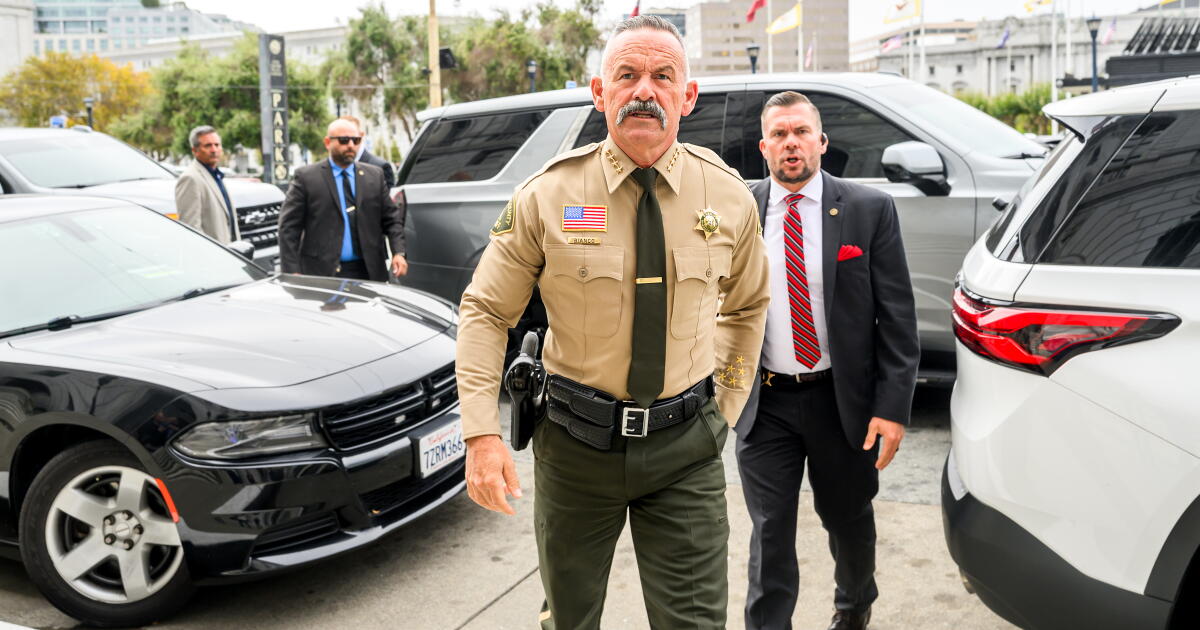
SACRAMENTO — Riverside County Sheriff Chad Bianco got slapped down Thursday by the California Supreme Court in not one but two cases. Ouch.
First, the court told Bianco to return more than 600,000 ballots he had seized as part of an ill-conceived, conspiracy-laden “investigation” into voter fraud — making it clear it was the sheriff who was the criminal.
“The seizure of the ballots was unlawful,” the court wrote, before ordering Bianco to give them back to the registrar of voters and “refrain from further handling of the ballots except as necessary to comply with our order.”
Then the court, in a separate case, told Bianco he’s not a law unto himself, and in fact does have a boss in the form of the state Atty. Gen. Rob Bonta. Bonta had previously ordered Bianco to pause his investigation, and Bianco largely ignored him.
The court found that the constitutional authority held by the attorney general “includes the power to give binding directions to sheriffs.”
While the high-profile lawsuit about Bianco’s seizure of hundreds of thousands of ballots from last year’s special election on redistricting has grabbed headlines, the second case about the authority of the state attorney general to oversee all California sheriffs and district attorneys is equally powerful.
It’s the first time the court has weighed in on a long-running debate in California over whether elected sheriffs have to answer to anyone. Not only did Bianco lose for election deniers everywhere in the first case, he also managed to clarify for all California sheriffs in the second case that they are not as powerful as some would like to believe.
Combined, the two opinions by the state’s highest court give another layer of assurance to Golden State residents that the integrity of the November midterm elections is as secure as the state can make it — some welcome news in a national landscape where free and fair elections are increasingly at risk.
The quiet advocate
Before we get into what the ruling means for midterms in California, there are two overlooked bits that make these cases even more interesting.
First, gubernatorial candidate and former Atty. Gen. Xavier Becerra has been closely involved in the ballot-seizing case, but also pretty quiet about it.
Whenever a politician does something good and doesn’t advertise it, it always catches my attention. Politicians, especially ones running for office, aren’t big on modesty.
But Becerra has not spent a lot of time talking about this, even though he is actually a working attorney on this case, as an advisor to the UCLA Voting Rights Project. He came up with ideas, he participated — this wasn’t just a put-my-name-on-it role, I’ve been told by folks who know.
And it’s not the first time Becerra has helped the Voting Rights Project in a major endeavor. It was their work that helped define the legal arguments that made Proposition 50 happen. That’s last year’s ballot initiative that redrew California voting maps to favor Democrats, in response to a Texas effort to gerrymander in favor of Republicans. It was Proposition 50 ballots that Bianco seized.
“Today the California Supreme Court handed voters a great victory,” Becerra said in a statement from the voting project. “The Court knocked election deniers off their feet and strengthened our hand in election protection just ahead of the November vote. We must use every lever at our disposal to beat back voter interference and intimidation.”
That line about knocking election deniers is not hyperbole. In some far-right, conspiracy-rich circles, Bianco’s cowboy-saving-the-day routine was viewed as heroic. Maybe even something to emulate.
Across the country, there are rumblings — including from President Trump — about seizing ballots from past or future elections. While this ruling is firmly rooted in California law, most states have similar chains of custody when it comes to ballots. So it’s likely to at least make other would-be-Biancos pause.
In a later interview, Becerra told me that the Voting Rights Project was “the one thing I decided I would do after I came home from being secretary in Washington, D.C.,” whether he ran for office or not, “just because I so believe in the work that they do.”
He said as he campaigns this year, he’s seeing anxiety in minority communities from that interference and intimidation, maybe even fear that could pressure some legal voters to sit this one out.
“It makes it tough when you’ve got all these things standing in your way before you even get to thinking about going to vote,” Becerra said. “The Latino community, other communities, mostly under-served communities, I always tell them, we’re not rich. The way we win these things is by voting.”
The Liu concurrence
The second fact that caught my attention was a concurring opinion on the ballot case by Justice Goodwin Liu.
While the court was unanimous in its findings, Liu wrote his own opinion highlighting how the Riverside registrar of voters was “caught between a rock and a hard place” when the sheriff of his own county showed up with a warrant, guns and “enough trucks to remove several pallets of materials.”
That trifecta, Liu wrote, left the registrar little room for dissent — but that’s a problem.
Liu’s point seemed to be that with the current state of our president making election denial chic, our voting officials need to step up. He said the registrar should have come directly to the court for relief, and not left it to the Voting Rights Project and other plaintiffs.
“It is a lot to ask of our election officials that they not only do their jobs competently but also stand ready to sue anyone who unlawfully interferes with their duties,” Liu wrote. “Yet here we are.”
Since Bianco seized the ballots, state law has been changed. This session, legislators passed (and Gov. Gavin Newsom signed) at least 13 laws pertaining to election security, including making it a felony to break the chain of ballot custody, and ensuring that local election officials immediately contact the state in instances when that is threatened. Those laws will offer protection to election officials if a situation like this comes up again.
But Liu’s point is still valid. Being an election official is no longer a sleepy little job, but a front-line battle for democracy, and for “our democracy to flourish, our elections must be conducted in accordance with the law.”
Which brings us back to the midterms. California shouldn’t be complacent, but the state isn’t slouching on preparation, or resolve.
As Bonta put it, “if you can imagine it, we are ready for it.”
I’m not quite that confident — and definitely concerned for contests outside of the Golden State — but Thursday’s rulings are a reminder that the law still holds, even when lawmen try to break it.
What else you should be reading:
The must-read: Ballot seizure by Riverside County sheriff was ‘unlawful,’ California Supreme Court rules
The California angle: This deadly fungus isn’t just a rural threat anymore. New studies point to cities and oil wells
The L.A. Times Special: Hollywood would get 20% federal film tax credit under proposed new bill
Stay Golden,
Anita Chabria
—
Was this newsletter forwarded to you? Sign up here to get it in your inbox.