Novak Djokovic to face Daniil Medvedev in the semifinals in Beijing after the Russian defeats Francisco Cerundolo.
Published On 5 Oct 20265 Oct 2026
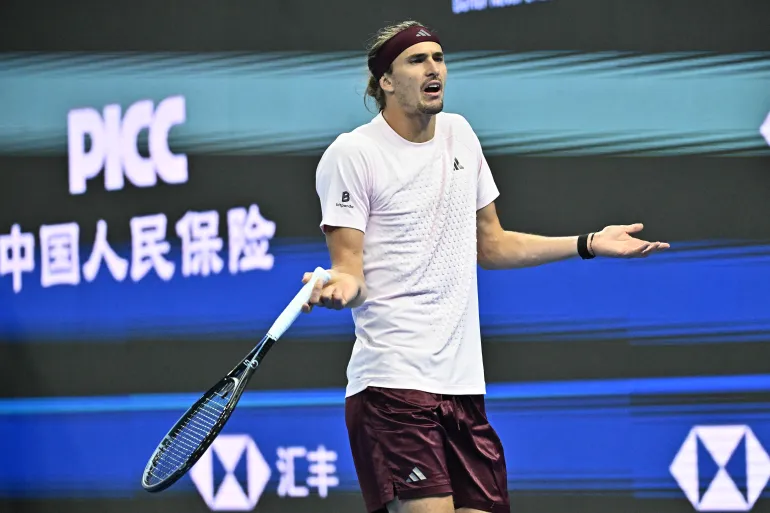
Novak Djokovic has brushed aside ongoing injury-related struggles and produced a trademark comeback to defeat top seed Alexander Zverev 4-6, 6-4, 6-4 for a place in the China Open semifinals, extending his unbeaten record in the tournament.
Playing the ATP 500 event in Beijing for the first time since 2015, the six-time champion was pushed to the limit by reigning French Open and US Open champion Zverev, who delivered 19 aces in the match on Sunday.
Recommended Stories
list of 4 itemsend of list
Meeting for the first time in nearly 16 months, Djokovic struggled to contain the German’s power in the early stages as the 29-year-old Zverev claimed the opening set, but the Serb gradually worked his way into the match and refused to let his opponent pull away.
“I had a terrible start – two double faults at the beginning. It was quite cold, and honestly, I didn’t feel warmed up, but my fault,” Djokovic said.
“I gave him an early break, and then it was hard to come back in the first set.”
The contest was briefly interrupted by a moment of controversy when Zverev argued that the electronic advertising signage had gone dark during a rally and requested a video review after losing the point.
Replays showed a section of the signage had switched off although not as Zverev was missing the forehand. The chair umpire ordered the point to be replayed, prompting a frustrated exchange from Djokovic.
Zverev had a strong start in the match before being outplayed by Djokovic [Pedro Pardo/AFP]
‘Held my nerves’
The turning point came late in the second set when Djokovic broke at 5-4 to level the match, shifting the momentum in his favour after a tightly contested battle.
With little separating the pair in the third, the Serbian struck again at 5-4 on the Zverev serve, securing the decisive break to seal the victory in two hours and 35 minutes.
“I was trying to be aggressive and come to the net and change up the pace, not giving the same pattern,” Djokovic said.
“I am just glad that I held my nerves, played good shots at important moments, 5-4 in the second and third.”
The pair had not met since Roland Garros in 2025, where Djokovic won in four sets, and Sunday’s encounter again highlighted the Serb’s ability to deliver under pressure despite a season disrupted by physical issues.
With the victory, Djokovic moved a step closer to a seventh China Open title and an elusive first trophy of the year while denying Zverev another opportunity to strengthen his bid for the world number one ranking.
Djokovic will face Daniil Medvedev in the semifinals after the Russian defeated Francisco Cerundolo 7-6(4), 6-3 earlier.
Djokovic has been plagued by health issues that he has not disclosed, admitting that ‘this year has been a big, big struggle for me’ [AFP]
Rybakina withdraws from Wuhan after China Open exit
World number one Elena Rybakina withdrew from this month’s Wuhan Open due to a foot injury, tournament organisers said on Sunday, a day after the Kazakh suffered a shock defeat in her opening match at the China Open.
Rybakina, who lost to world number 118 Alina Charaeva in Beijing, said she would take time away from competition to recover.
“I’m very sorry to the fans who were looking forward to seeing me play,” Rybakina said in a story posted on the tournament’s Instagram account.
“I’ll take some time to rest and recover. Thank you for your understanding and continued support.”
The 27-year-old has been managing a lingering lower leg and foot problem that also forced her to retire from her Cincinnati quarterfinal against Iga Swiatek in August.
Despite the setback, Rybakina recovered in time for the US Open, where she claimed her third Grand Slam title, rose to world number one and became the first player to qualify for the season-ending WTA Finals.
Rybakina is next expected to compete this month in the Ningbo Open in China, where she will try to defend her title.
The Wuhan Open is scheduled to take place from October 12 to 18.
Former Serbian President Aleksandar Vucic is seeking to extend his hold on power through a parliamentary vote.
Published On 4 Oct 20264 Oct 2026
Former Serbian President Aleksandar Vucic has launched his campaign for prime minister ahead of a pivotal election on October 25.
Thousands of supporters of the populist politician packed the largest indoor arena in Belgrade on Saturday, as Vucic pledged a “comprehensive” victory in the upcoming parliamentary vote.
Recommended Stories
list of 3 itemsend of list
The snap election, which polls suggest could be tight between Vucic’s party and a group of candidates fielded by a student-led protest movement, was called before Vucic resigned as president on September 27, cutting short his second term by more than seven months.
Dozens of buses from across Serbia clogged streets around Belgrade Arena on Saturday, as supporters arrived at the rally in the capital carrying Serbian flags and banners bearing Vucic’s picture.
The event, televised by dozens of channels across Serbia, capped a week of Vucic touring towns and villages in an apparent bid to shore up his popularity, which has been shaken after almost two years of sustained antigovernment protests.
Vucic, on the Serbian Progressive Party (SNS) ballot, has dominated Serbian politics as president or prime minister since 2014. Barred from seeking a third presidential term, he is now seeking to extend his hold on power through the parliamentary vote.
If the SNS wins a majority of seats, the parliament is expected to elect Vucic as prime minister.
Youth movement
The youth-backed movement that led the protests has demanded accountability for the November 1, 2024, train station canopy collapse that killed 16 people in the northern city of Novi Sad.
The movement’s quest for justice over the tragedy and against corruption has grown into a nationwide political force whose electoral arm, the Student List, will attempt to oust Vucic’s government.
The Student List includes university professors, teachers, experts and others from across the political spectrum. Vucic accused those behind the movement of seeking to “bring Serbia to a halt” and claimed, without providing evidence, that it is backed by unspecified foreign agents.
On Saturday, Vucic told his supporters: “Absent an intervention of some [foreign intelligence] service, we will defeat them. And they know that.”
Serbia’s former President Aleksandar Vucic speaks during a rally of the governing Serbian Progressive Party (SNS) ahead of the parliamentary election, in Belgrade, Serbia, on October 3, 2026 [Zorana Jevtic/Reuters]
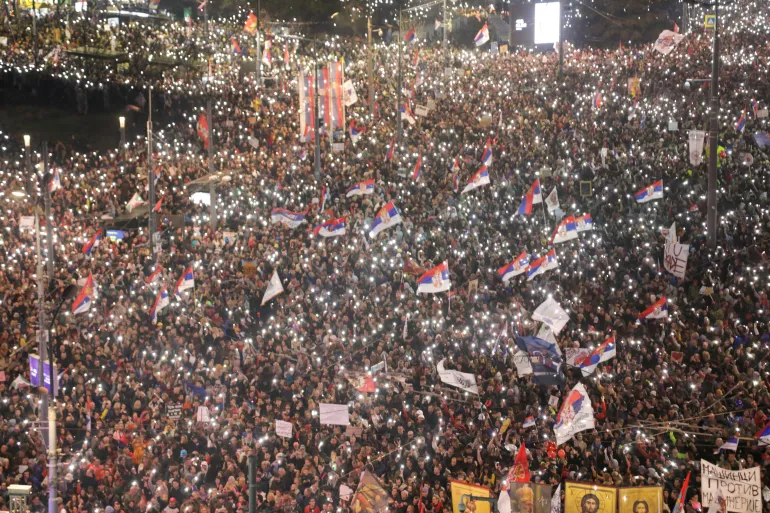
For weeks, the streets of Serbia were teeming with young people rallying against the government. At the height of the protests in March 2025, more than 100,000 took to the streets.
With the elections originally not due until December 2027, the early vote is seen as an attempt by governing populists to cling to power despite widespread discontent.
Students and anti-government demonstrators light the flashlights of their mobile phones during a protest, which became a national movement for change following the deadly November 2024 Novi Sad railway station roof collapse, in Belgrade, Serbia, March 15, 2025 [Igor Pavicevic/Reuters]
Vucic is vying for the prime minister’s post, a role he has held before, appearing to yield to protesters’ demands not out of goodwill but in the hopes of ushering in a result that keeps him in office, analysts say.
But experts warn that elections will hardly solve the underlying political tensions gripping the country, triggered after 16 people were killed in 2024 when a concrete canopy collapsed at a railway station. Student protesters blamed the disaster on government negligence and alleged corruption.
The move “is essentially about reducing political risk”, Viktor Stamenkovic, a researcher at Belgrade’s Institute for Political Studies, told Al Jazeera.
“Given the circumstances, the ruling camp is choosing the electoral sequence it considers least dangerous,” he said, referring to Vucic’s Serbian Progressive Party (SNS).
Saving his skin: Elections a cling to power
Vucic could stall no more – both the presidential and parliamentary vote would have had to be held next year.
“Vucic has, for some time, been aware that further delay is unlikely to work in his favour,” Stamenkovic said.
Vucic’s presidential term expires before the mandate of the current parliament, said Stamenkovic. Serbia’s recent political history explains the order of the elections – the parliamentary before the presidential, the analyst added.
Presidential elections can fundamentally alter the parliamentary dynamics that follow – which is how Vucic’s party came to power, Stamenkovic explained.
Vucic cannot run for a third term under Serbia’s constitution, and no other SNS figure is as popular as him.
“In 2012, the presidential victory of the SNS candidate Tomislav Nikolic changed the political momentum so dramatically that the bloc, which had previously appeared capable of forming a parliamentary majority, was ultimately unable to do so,” said Stamenkovic. “The presidential result altered the calculations of the parliamentary parties and paved the way for a government led by SNS.”
Vucic, therefore, has good reason to fear the same scenario being repeated.
Aleksandar Vucic has resigned as president to run for the premiership [File: Pierre Suu/Getty Images]
Vucic has built a personalised political system centred on himself rather than his party or any successor, said Stamenkovic.
“He therefore has to find a way of transferring his own political strength from the presidency into the parliamentary arena … effectively staking his political future on the parliamentary election.”
For Milica Vojinovic, an investigative reporter at the Serbian outlet KRIK, the goal of the governing party is to stay in power at any cost.
“They [want to] continue their corruption projects, which usually means finding new ways and public procurements through which they can take money… [including from] public budgets,” Vojinovic told Al Jazeera.
She cited irregularities in past elections, such as vote buying by the SNS, documented by election observers and human rights organisations, and feared that the next elections will see an “escalation of these tactics, now that the student movement is actually threatening to win the election and take power from Vucic’s party”.
The vote will not resolve country’s discord
Since 2024, the governing party has lost a sense of political legitimacy, said Stamenkovic.
“Even if – and this is a big if – SNS wins another parliamentary majority, it is difficult to envisage a return to a situation in which it can govern normally and claim the kind of broad social legitimacy it once enjoyed,” he said. “Virtually all polling shows that a majority of the country believes Serbia is heading in the wrong direction and that the time has come for change.”
Mass demonstrations have not taken place in Serbia for some time, as the student movement has shifted from organising large rallies to election campaigning.
The youth movement recently submitted their election list to state election authorities after a jubilant march through the capital of Belgrade, formally entering the race.
Polls show that this vote could bring representatives of the student movement into parliament and state institutions, said the Serbia-based Center for Research, Transparency and Accountability (CRTA).
“This is important for Serbia’s democracy … [They] will definitely improve the legitimacy of the parliament as the representative body,” the group said.
Transparency and anticorruption are priorities for most citizens, with the social and political reality in the country having changed in the two years since the railway station incident, the organisation added.
Vojinovic, however, predicted that if Vucic’s party continues to hold power, “we are to expect the most repressive measures seen so far against everyone who has been criticising, or in any way opposing, the government”.
Criminal cases have already been brought against some activists in the student movement, as well as a political analyst, she said.
According to Human Rights Watch, foreign agent laws, first introduced by Russia and seen being picked up by other nations, have been used to brand independent civil society, media and other dissenting voices as illegitimate and acting on behalf of foreign interests. Such a law was proposed in Serbia in 2024.
“Recent smear campaigns against my newsroom, as well as other independent media outlets and NGOs, lead us to believe that they may be a precursor to the introduction of a ‘foreign agents law’ in the near future, should Vucic’s party remain in power,” Vojinovic added.
EU rift no matter
Meanwhile, Serbia is no closer to joining the European Union, but that is not a real priority for Vucic, the experts said.
“It is widely understood that Serbia cannot make meaningful progress towards EU membership under the current system of government,” said Stamenkovic. “What matters much more to Vucic is avoiding serious political pressure and criticism from Brussels.”
Ratko Mladic’s funeral illustrates this balancing act: Serbia hosted the semi-official honouring of the former Bosnian Serb army general – who died while serving a life sentence for genocide, war crimes and crimes against humanity committed during the 1992–1995 war in Bosnia – but Vucic did not attend, he said.
“In some ways, the relationship between Vucic’s government and the EU resembles a couple trapped in a disastrous marriage who nevertheless do not divorce because both sides continue to benefit from the relationship.
“Vucic cooperates with the EU on issues that matter to Brussels, while the EU has for years been willing to overlook a great deal about the increasingly authoritarian nature of his rule,” he added.
The two are also at odds over Russia, which Serbia has ties with.
A public opinion poll in June by the CRTA and Stanford University’s Democracy Action Lab showed that among SNS voters, 15 percent wanted closer ties with the EU while 60 percent favoured relations with Russia.
“There is every reason to expect election day itself to be highly contentious,” said Stamenkovic.