separation

How Israel’s separation wall compares with the Berlin Wall | Israel-Palestine conflict News

In the occupied West Bank, a barrier of concrete and fencing cuts Palestinians off from their land, their families and nearby towns.

Israel began building its separation wall in 2002. Planned to stretch 712km (442 miles), it runs deep inside Palestinian territory rather than along the boundary with Israel. In 2004, the International Court of Justice ruled it illegal.

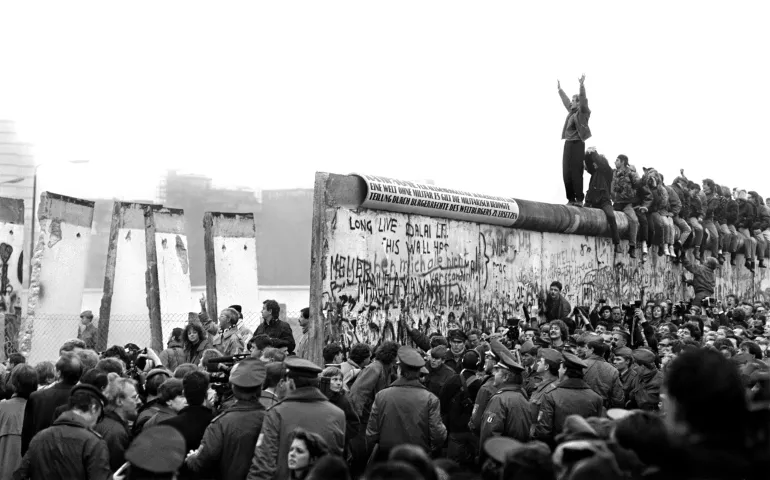
Today’s date carries extra weight. Thirty-seven years ago on November 9, 1989, the Berlin Wall fell.

Built by East Germany in 1961 to stop its citizens fleeing to the West, it encircled West Berlin for 155km (96 miles), dividing the city and its people for 28 years.

People celebrate at the Berlin Wall and begin to dismantle it after communist East Germany opened the border between East and West Berlin on November 9, 1989
People celebrate at the Berlin Wall and begin to dismantle it after communist East Germany opened the border between East and West Berlin on November 9, 1989 [Carol Guzy/The Washington Post via Getty Images]

Since 2003, Palestinians have marked the same date as an international day of action against Israel’s wall, which is more than four times as long and still being built. In urban areas, its concrete rises to about 9 metres (30ft), more than twice the height of Berlin’s.

But the wall is more than a physical structure. It operates alongside a wider network of checkpoints, roadblocks, gates and permits that restricts Palestinian movement across the occupied territory.

Interactive - How long is Israel's separation wall berlin wall comparison West Bank-1794199281
(Al Jazeera)

Where does the wall run?

According to the United Nations Office for the Coordination of Humanitarian Affairs (OCHA), about 456km (283 miles), or 64 percent, of the planned route had been built by April.

About 85 percent of it runs inside the West Bank rather than along the Green Line, the 1949 armistice line separating Israel from the West Bank. That route determines which communities, roads and farmland are cut off from their surroundings.

23 June 2022, Israel, village of Salem: Constration workers carry on building a new Part of the Separation Wall around the village of Salem in North border of Israel with West-Bank city of Jenin. Photo: Ilia Yefimovich/dpa (Photo by Ilia Yefimovich/picture alliance via Getty Images)
Workers build a new section of Israel’s separation wall around the village of Salem near Nablus in the occupied West Bank on June 23, 2022 [Ilia Yefimovich/dpa picture alliance via Getty Images]

In some urban areas, the barrier is a concrete wall. Elsewhere, it is made up of fences, patrol roads, ditches and other security infrastructure.

For Palestinians, the comparison with Berlin carries a message. “It doesn’t matter how high the barriers will be, they will fall,” a Palestinian activist in Bir Nabala told Al Jazeera. “Like the Berlin Wall fell, the Palestinian wall will fall.”

A picture taken on February 11, 2020 shows the Israeli settlement of Pisgat Zeev (L), built in a suburb of the mostly Arab east Jerusalem, and the Palestinian Shuafat refugee camp (R) behind Israel''s
The Israeli settlement of Pisgat Zeev, left, and the Palestinian Shu’fat refugee camp, right, on either side of Israel’s separation wall in occupied East Jerusalem [File: Ahmad Gharabli/AFP]

How many people are cut off from their land?

The wall’s impact reaches far beyond the structure itself. Its route cuts Palestinian communities off from neighbouring towns, workplaces and farmland, disrupting livelihoods and everyday life.

More than 14,000 Palestinians live between the wall and the Green Line in an area known as the Seam Zone. To reach basic services, markets and relatives on the other side, they must pass through checkpoints.

Interactive - How the wall separates people from their communities and land West Bank-1794199287
(Al Jazeera)

Farmers are among the hardest hit. According to OCHA, about 150 Palestinian communities have land in this area. Reaching it depends on permits, prior coordination with Israeli authorities and access through designated agricultural gates.

There are about 62 such gates along the wall, and most stay closed for much of the year. During the 2025 olive harvest, 74 percent opened only on a limited number of days.

NABLUS, WEST BANK, PALESTINE - 2024/11/27: Israeli soldiers guard the gate as Palestinian farmers wait for the Israeli occupation army to open the gate of the Israeli settlement of Elon Moreh to access their olive fields in order to pick up olives during the olive harvest season in the village of Salem, east of the West Bank city of Nablus. Israel has constructed a wall encircling the lands around the Jewish-Israeli settlement of Elon Moreh, all of which are owned by Palestinians. Access for Palestinian farmers to tend their lands is restricted, with an Israeli-controlled gate opened at specific times or sometimes not at all. Despite coming from different areas, the farmers share a common bondthe rightful ownership of these lands. (Photo by Nasser Ishtayeh/SOPA Images/LightRocket via Getty Images)
Palestinians wait as Israeli soldiers guard a gate controlling access to their olive groves near Elon Moreh, east of Nablus [File: Nasser Ishtayeh/SOPA Images/LightRocket via Getty Images]

In Qalqiliya, the wall wraps around much of the city, cutting it off from nearby Palestinian communities and the land around it. Journeys to neighbouring towns that were once short can now mean passing through checkpoints or taking long detours.

The wall restricts more than movement. It reshapes how communities relate to their land and places that are part of their everyday lives.

Israel’s wider system of control

The wall is only one part of a much wider network restricting Palestinian movement across the West Bank.

As of December, OCHA documented 925 checkpoints, road gates, earth mounds and other obstacles across the West Bank and occupied East Jerusalem. They restrict the movement of about 3.4 million Palestinians, often forcing long detours to reach work, school, hospitals and other services.

The network includes 89 permanently staffed checkpoints, 218 partial checkpoints, 232 road gates, 167 earth mounds, 114 linear closures and 105 roadblocks.

Checkpoints and road gates now make up nearly 60 percent of these obstacles, up from 15 percent two decades ago when temporary blockages, such as earth mounds and roadblocks, were far more common.

Interactive - How the wall becomes a system of restrictions checkpoint West Bank-1794199284
(Al Jazeera)

Crossing the wall itself requires permits. Of its 13 checkpoints, only three can be used by Palestinians with West Bank IDs and Israeli-issued permits to enter East Jerusalem and Israel. OCHA said these permits are hard to get and many have been revoked or suspended since the Hamas-led attacks on southern Israel and the start of Israel’s genocidal war on Gaza in October 2023.

The wall stretches for hundreds of kilometres, but its impact cannot be measured by distance alone. It is measured in the farmland farmers struggle to reach, the communities cut off from nearby towns and the checkpoints between people and the places they need to go.


HEBRON, WEST BANK - SEPTEMBER 04: Palestinians pass through a rotating gate barriers to enter the Ibrahimi Mosque during the celebrations for Mawlid al-Nabi, birth anniversary of Muslims' beloved Prophet Mohammad, while many Palestinians were unable to attend prayers due to restrictions imposed by Israeli forces on Palestinians entering and exiting the mosque in Hebron, West Bank on September 04, 2025. (Photo by Amer Shallodi/Anadolu via Getty Images)
Palestinians pass through a gate to enter the Ibrahimi Mosque in Hebron in the West Bank as Israeli restrictions keep many from prayers [File: Amer Shallodi/Anadolu via Getty Images]

Source link

Carmelo and La La Anthony reach divorce settlement 9 years after split

Carmelo Anthony and La La Anthony (née Vázquez) reportedly have reached a settlement agreement after almost a decade-long split.

Although terms of the separation are confidential, there was a pending judgment of divorce that needed approval from the New York County Supreme Court as of Wednesday, according to People.

Once the former MTV VJ and the NBA star receive the official imprint from a judge, they’ll be newly minted singles.

La La filed for divorce from the NBA star back in 2021, citing irreconcilable differences, according to TMZ, which first reported on the settlement Wednesday.

The couple began dating in 2003 after being introduced through a mutual friend, DJ Clue. They became engaged on Christmas Day 2004 and three years later welcomed their son, Kiyan Anthony, now a 19-year-old sophomore at Syracuse University, where he is playing college basketball.

The two tied the knot in July 2010 in a New York ceremony with hundreds of guests, among them sports and entertainment stars including LeBron James, Spike Lee, Serena Williams, Ciara, Kim Kardashian and Ludacris, The Times reported.

Reports of their separation surfaced in April 2017, and by August of that year, Carmelo had welcomed a daughter with ex Mia Burks.

Although the Anthonys reconciled in late 2018, they ultimately called it quits in July 2019, according to People.

La La was already using a divorce label despite it not yet being official.

In a 2022 episode of Alex Cooper’s “Call Her Daddy” podcast, La La opened up about her split from Carmelo, saying that there were still difficult moments, especially regarding the co-parenting of Kiyan.

“I learned how strong I am,” she said when asked about what she’d learned from the divorce. “You just find yourself getting stronger and stronger. What do they say? Like you don’t know how strong you are until being strong is your only option.”

La La also shared that the demise of their marriage began around the time that Carmelo was traded from the Denver Nuggets to the New York Knicks in 2011.

At the time of the 2022 interview, she shared that her perspective on love had changed. “I just don’t know if it’s in the cards for me,” she said on the podcast.

However, in a more recent October interview on “The Jennifer Hudson Show,” she revealed she was “open” to dating and that this was her “season of being open” for someone who is confident and adventurous.

As for the NBA Hall of Famer, he was rumored to be dating Racquel Smith, the widow of former NFL defensive end Will Smith. The two were seen together in June.

Source link

Alberta rejects separation referendum: What’s next for Canadian province? | Independence News

Voters in Alberta have chosen to remain part of Canada in a first-ever independence referendum.

Canadian state broadcaster CBC News called the results of Monday’s vote late on the same day after 48 percent of the ballots counted showed overwhelming support for the “remain” side, with 76 percent opting to stay with Canada.

The result marks a major win for Prime Minister Mark Carney, who is facing a trade and political war with the United States amid US President Donald Trump’s higher tariffs and repeated suggestions of annexing the country.

On his way into a cabinet meeting on Tuesday morning, Carney called it a “great day.”

“I’m thrilled that Albertans have chosen unity. They’ve chosen to build together. They’ve chosen to continue to take care of each other, to move forward together with purpose,” he said.

But the result also comes as a disappointment for those Albertans seeking independence for the resource-rich region following years of grievances laid at Ottawa’s door. Here’s what we know:

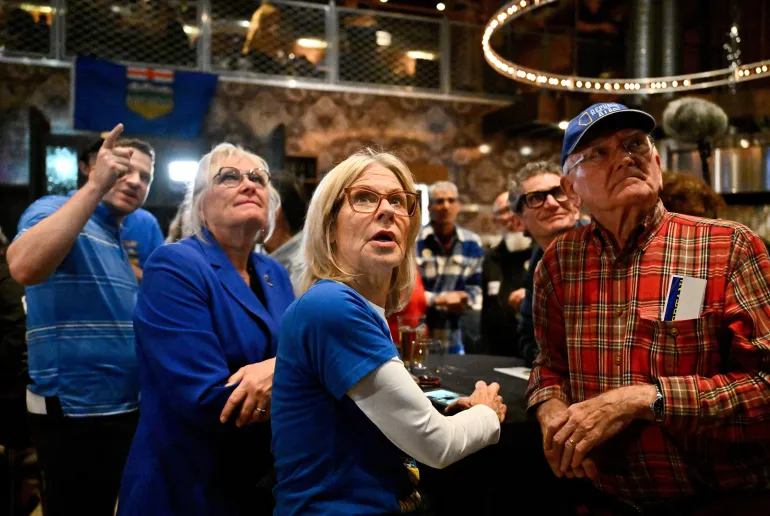
Supporters of the Alberta Prosperity Project, a group that promotes independence from Canada, gather at a watch party on the day of a nonbinding referendum on Alberta sovereignty, in Edmonton, Alberta, Canada, October 19, 2026
Supporters of the Alberta Prosperity Project, a group that promotes independence from Canada, gather at a watch party on the day of a nonbinding referendum on Alberta sovereignty, in Edmonton, Alberta, Canada, October 19, 2026 [Jennifer Gauthier/Reuters]

What was the referendum about?

The nonbinding referendum was first announced in May following a campaign and petition by a group of Albertans who want to be an independent country.

While only about one-third of Albertans were found to be pro-independence in polls, Alberta Premier Danielle Smith argued in her announcement that a referendum was necessary to respect the 300,000 Albertans who had petitioned officials for it.

In the referendum, voters answered 10 questions, including whether the government should begin a binding process to seek independence from Canada. They also answered questions on immigration, access to provincial services like education, social care and healthcare, and voter identification requirements.

Prime Minister Carney had campaigned for Albertans to vote “remain”, saying last week at a rally in Calgary that separation would be “ a dangerous bluff that will lead to years of deep division”.

“There are some outside our borders who are working to break us so they can own us,” he said.

Researchers have pointed to possible online influence campaigns by both Russian and US entities that helped amplify the call for separation and allegedly shared misleading information. Alberta PM Smith told media in August that the online activity was under observation.

What have the reactions been?

Prime Minister Carney, who grew up in the region, said “Albertans made a clear choice” in a statement he made early on Tuesday.

“They chose unity, to build together, and to take care of each other,” he said, adding that “Canadians will move forward together with renewed purpose and high ambition.”

Alberta’s Premier Smith said she was pleased to see the results and that “Albertans have voted for a stronger Alberta in a united Canada.”

Separatist leaders from the groups Let Alberta Decide, the Alberta Prosperity Project and the Pathway to Independence said they will wait for all votes to be counted before conceding.

First Nations groups turned out in strong numbers to vote to remain with Canada, with one southern Alberta polling station in an area home to the Siksika Nation temporarily running out of ballots, local media reported.

Why is Alberta important, and why are there calls for independence?

Many Albertans have long complained that their critical natural resources are funding the government in Ottawa and the commercial hubs of Toronto and Montreal, but that the province does not receive proportionate benefits.

The province, with a population of 5.1 million, holds massive oil deposits. It also holds reserves of critical and rare-earth metals including lithium, titanium and zircon, which are essential for manufacturing many tech items, from smartphones to fighter jets.

Separatist movements, some of which even support Alberta joining the US, go back to the 1940s, following the discovery of oil reserves. Some of Alberta’s premiers have had spats with Ottawa over wealth distribution.

US President Trump has made remarks about Canada becoming a US state in recent months.

Last week, he told a political rally in the US state of Arizona that Canada will “end up being the 51st state, because it’s the only way it works”.

The two countries have been embroiled in a trade war since talks fell apart in August this year and they slapped each other with tit-for-tat tariffs.

Earlier this month, tech billionaire Elon Musk called for Alberta, Saskatchewan and Quebec to separate from Canada, saying “they’d be better off”.

But the matter of Alberta’s independence gained intense scrutiny last year after pro-separatists launched a petition to pressure the government.

Alberta, alongside other western provinces of British Columbia, Saskatchewan and Manitoba, have all complained about “western alienation” by the government in the centre.

Is it over for Alberta’s independence bid?

With separatism agitations running so far back, experts say the referendum will likely not end the movement altogether.

Ahead of the vote, some separatist leaders said they would pursue another referendum if necessary, arguing that the referendum shows that independence is legally possible.

“Regardless of what happens on Monday, we’ve already won,” Keith Wilson, co-leader of Let Alberta Decide, said at a rally last week.

Source link

Alberta voters reject separation from Canada, early results show | Elections News

With more than one million votes counted, about 76 percent supported remaining in Canada.

Alberta residents have voted to remain ⁠part of Canada in the province’s first-ever referendum on separation, in a much-needed win for Prime Minister Mark Carney as he ‌attempts to unify the country amid an ongoing trade war with the United States.

With more than one million votes counted, about 77 percent supported remaining in Canada, compared with 23 percent who backed beginning a process that could lead to separation, early results showed on Tuesday.

Recommended Stories

list of 3 itemsend of list

The vote was not a direct referendum on independence but would have set oil-rich Alberta on a path towards a future vote on separation from Canada.

Carney welcomed the result and said Albertans had made a “clear choice” in favour of unity.

“They chose unity, to build together, and to take care of each other,” he said in a statement on X.

Jeffrey Rath, a top leader of the secessionist Alberta Prosperity Project, told reporters his push for an independent Alberta will “absolutely” continue, despite the result from Monday’s vote.

“We’ve learned a lot of lessons from this fight,” he said.

Alberta Premier Danielle Smith, a conservative, said she voted against independence but called the referendum to settle an issue that has divided the province.

She has said a win for the federalists would close the secession question.

Alberta has the world’s fourth-largest proven oil reserves, and much of the secessionist momentum has been driven by anger over oil industry management.

Smith has blamed Carney’s predecessor Justin Trudeau for igniting the secessionist fire, accusing him of trying to crush oil production to advance his pro-climate agenda.

Alberta’s independence push has also drawn sustained interest from the allies of US President Donald Trump, including Treasury Secretary Scott Bessent, who called Alberta Washington’s “natural partner”. Elon Musk, the world’s richest person and eminent Trump supporter, also posted on X that Alberta “should separate”.

Carney, who grew up in Alberta, has worked to improve relations between the province and Ottawa since taking office last year. He has partnered with Smith on advancing a new pipeline to export more Alberta bitumen overseas, a project considered a nonstarter during Trudeau’s tenure.

Source link