sentences

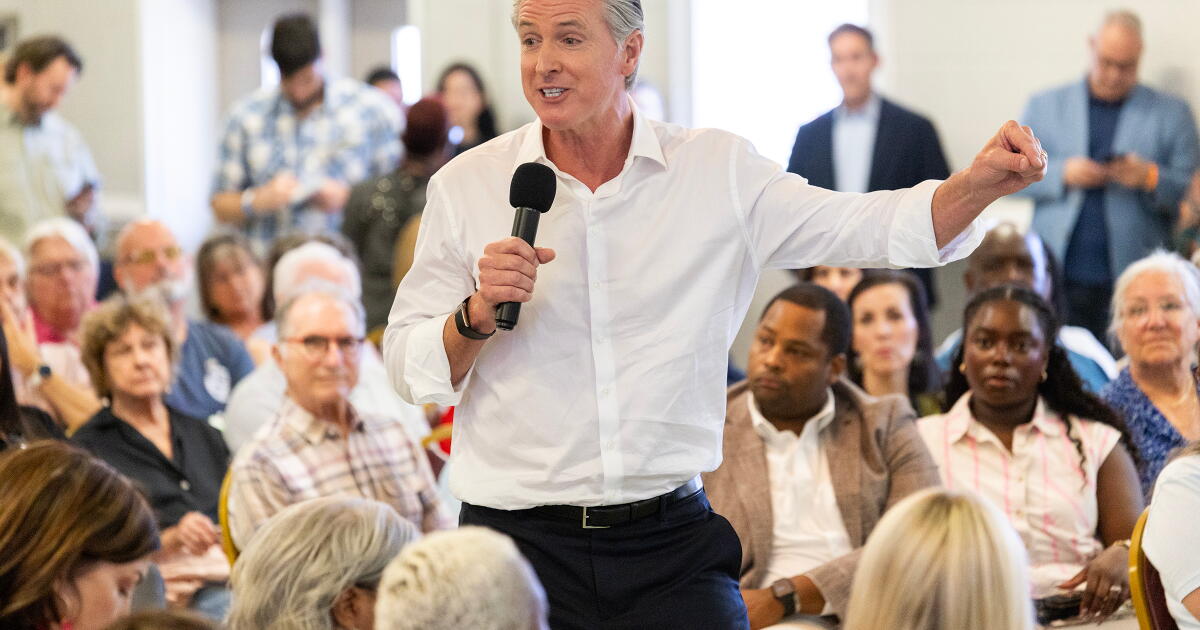
Newsom should commute 563 death sentences. Here’s why

With not-terrible odds heading into the 2028 Democratic primaries, Gov. Gavin Newsom is getting one shared warning whispered in his ear by roughly 3,729 political consultants right now: Do not mess with the murderers.

Do not, under any circumstance, follow that inner voice that may be telling you to commute the death sentences of the 563 killers on California’s death row to life without parole, as Newsom recently admitted he was considering. Doing so would be a stupid move for an Oval Office wannabe, one already hobbled by the progressive persona of the Golden State.

“I’m getting all those people in my ear,” Newsom said during a podcast conversation with Bryan Stevenson, one of the preeminent death penalty lawyers in the country. “Don’t do it. Politics.”

Newsom already dismantled San Quentin’s execution chamber a few years ago, so the state can’t kill people even if it wanted to. But the governor has made it clear that he opposes the death penalty in principle because every year the evidence mounts that its implementation is flawed and racially biased. As he put it, the decision on commuting the largest death row in the Western Hemisphere may be his “rocking chair test,” a measure of whether he will have lived up to his own ideals when he looks back on his life.

Most other western countries have already banned the death penalty, leaving the U.S. in the company of places including North Korea and Libya when it comes to this punishment. Twenty-three states have abolished it, and three besides California have a moratorium. Nine governors over the years have commuted their entire death row, including one Republican. In 2024, on his way out of office, President Biden commuted the death sentences of 37 federal prisoners, in part, Stevenson said, to prevent the Trump administration from using executions as theater.

But none of that is why Newsom should do it.

He should do it because we, the voters, are exhausted by the venality of politicians whose every move is controlled by politics and self-dealing. We need to believe that conscience is not a relic of America’s past, and roll reality back to a time when, occasionally, leaders acted because they believed in something, even if it wasn’t popular.

He should do it because our president glorifies violence and death (more on that in a moment) and people need a reminder that the America of hope and dreams, the America that always strives to be better, may be down, but she’s not out.

He should do it simply because he thinks it’s right.

“A lot of people in this country want a leader who is not trying to promote themselves, who’s not trying to advance themselves, is not always scheming for the angles and the corners,” Stevenson told me. “That’s not trying to just do what makes them get the most votes.”

Showing mercy to murderers historically has not been popular with voters. The tale of Willie Horton, the convicted murderer whose subsequent felonies tanked the 1988 presidential ambitions of then-Massachusetts Gov. Michael Dukakis, is still invoked like a Biblical lesson about the sin of soft-on-crime.

Horton’s warning happened during what now seems like the benign and civilized days of the President George H.W. Bush era, though. This moment is different, and all the advice about dodging this dodgy issue is now wrong.

America is increasingly in the death business, to steal a phrase from the late Supreme Court Justice Harry Blackmun — or at least our leaders are. Under the Trump administration, brutality, cruelty, corruption and even killings are being used as misguided and ugly proxies for strength and power. Fear is a weapon, death the point — the state can kill you if you make its leaders mad.

“It’s a handful of people whose view of the social order is very violent. It uses power. It abuses power. They think death is good for demonstrating strength,” Stevenson said.

Think that sounds overblown?

Just ask the family of Renee Good. Or Alex Pretti. Both Americans were killed by masked federal officers only 10 months ago. But so many other deaths have happened since then, they’re just ghosts in our collective psyche — haunting reminders that faceless, nameless agents are now empowered to roam our streets.

Most of us can no longer place the name Nurul Amin Shah Alam, the near-blind Rohingya refugee dumped by federal agents in the freezing cold on a February night. He was found dead five days later, his passing ruled a homicide.

Do you remember Lorenzo Salgado Araujo? Or Johan Sebastián Duran Guerrero? That’s what the business of death does, normalizes killings until they blend and fade in significance.

What about the 120 Iranian children, many of them little girls, who were killed when the U.S. bombed their school?

Then there are the roughly 238 people who have been executed by U.S. bombings of boats in the Caribbean and Pacific, allegedly while transporting drugs, though the killings took place with no arrests, no trials and no real evidence. Four of those killings happened in October, though they barely made news.

And there is the profiteering from death — the talk of resorts on the shores of Gaza, the government money saved by Elon Musk cutting off aid to starving children.

Now, if Defense Secretary Pete Hegseth has his way, a year that began with televised footage of the death of Good and Pretti will end with the live-streamed execution of Nidal Hasan, the paralyzed, wheelchair-using former Army psychiatrist who 17 years ago killed 13 and wounded 32 at Fort Hood in Texas. If the grotesque spectacle happens, it will be a throwback to the days of the Roman Colosseum when the business of state-sponsored death was at an apex, combining public violence with propaganda, politics and social control.

Stevenson warns that “we’re in the midst of a narrative struggle, and this struggle is for the soul of America.”

Newsom has the chance to, if not change that narrative, offer an alternative one — an America that rejects killing as the ultimate display of power. An America that seeks justice with dignity and wisdom, not arrogance and gore. An America that feels safe because our leaders act with integrity and honor, not with a slavish, intemperate ego.

Though there is a political risk inherent in striking out in a solitary direction, there can also be reward. As Stevenson told Newsom, that’s the “beauty of struggling for things that are right, struggling for things that are moral, struggling for things that are just — all kinds of people will come along, and when you feel like you just can’t take another step, there’ll be something there. There’ll be somebody there.”

My mercy isn’t for those on our death row, many of whom are guilty of gut-churning crimes. I’m not arguing that they are victims themselves, or even that some may have been unfairly tried, or even innocent, though that may be true. I acknowledge some families of victims may be angry if Newsom commutes sentences, though some will not.

My mercy is reserved for America, and those who are exhausted by the business of death, this business Trump wants us to believe is just American business — necessary and unavoidable.

A commutation of California’s death row sentences would be a rejection of Trump’s manic desire to pull us ever lower; a rejection of our growing cynicism that there is no such thing — Republican or Democrat — as a leader who acts from conscience. An assurance, instead, that it is still possible to heed an internal moral compass that is more powerful than the need for power.

Would voters really reject the leader who offered that?

Would you?
Source link

Harvey Weinstein’s prison sentences, criminal convictions explained

Harvey Weinstein’s winding legal saga took a new turn this week, one that reaffirmed that the former Hollywood kingmaker — whose alleged history of sexual assault and abuse sparked the cross-industry #MeToo reckoning — will likely spend the rest of his life in prison.

Weinstein, 74, was sentenced on Wednesday to 15 years in prison for a felony sex crime tied to allegations from former “Project Runway” production assistant Miriam “Mimi” Haley. After a retrial last year, a majority-female jury found the disgraced Hollywood mogul and co-founder of the defunct Weinstein Co. guilty of sexually assaulting Haley in 2006 at his New York apartment.

Haley described the lasting and “devastating” effects of Weinstein’s assault as she addressed the court during Wednesday’s sentencing.

“Making the decision to speak up will have me looking over my shoulder for years to come,” she said. “It’s a life sentence for me.”

Weinstein said he has “remorse for Miriam Haley’s pain,” but maintained that he’s innocent.

The New York sentencing this week was not the first time Weinstein received a lengthy prison sentence for sex crimes. Since the damning sexual assault and harassment allegations against Weinstein first entered the legal spotlight in 2017, the Oscar-winning producer has faced convictions for rape and sexual assault over the course of trials — and retrials — from 2020 to 2025.

Weinstein has already served more than six years in New York, leaving him with about nine years left on that sentence. A pending resentencing in California — he was sentenced to more than a decade for a 2013 rape — could keep the mogul behind bars for life, the Associated Press reported.

Here’s a look back on Weinstein’s previous convictions and the prison sentences that followed.

March 2020: 23-year prison sentence in New York

Weinstein was first sentenced for his sex crimes against women in New York almost three years after the #MeToo movement upended his career as a prolific movie producer.

The mogul’s 2020 sexual assault trial, the first in a handful that would follow in the coming years, ended in February 2020 with a jury delivering a mixed verdict. The jury convicted Weinstein of committing a criminal sexual act and third-degree rape based on accusations from Haley and former actor Jessica Mann, respectively. The jury acquitted him on the most serious charges, including two counts of predatory sexual assault.

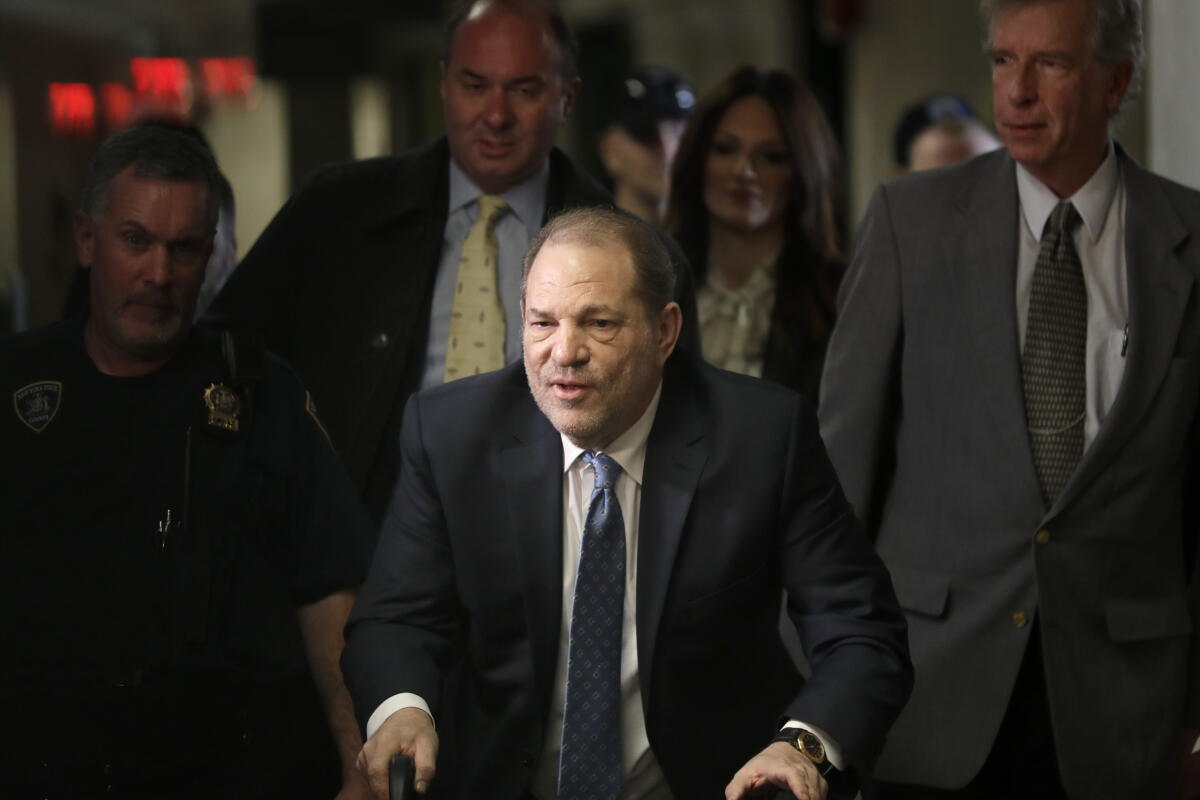
Harvey Weinstein in a suit holding onto a walker as he arrives at a Manhattan courthouse.

Harvey Weinstein arrives at a Manhattan courthouse for jury deliberations in his rape trial, Monday, Feb. 24, 2020, in New York.

(Seth Wenig / Associated Press)

A month later, New York Supreme Court Judge James Burke announced that Weinstein would carry out a 23-year prison sentence for his crimes. He was ordered to serve 20 years for his 2006 attack against Haley in his Manhattan apartment. The judge added three years to Weinstein’s sentence for raping Mann in a Manhattan hotel in 2013. Weinstein was to serve those sentences consecutively.

At the time, the Miramax co-founder denied all wrongdoing and planned to appeal. Those efforts come into play in 2024.

February 2023: 16 years in California

Weinstein, a movie titan who once dominated Hollywood and produced some of the modern film industry’s most defining titles, including “Pulp Fiction” and the divisive Oscar best picture winner “Shakespeare in Love,” was tried in his stamping grounds in October 2022. He was prosecuted for allegations that he raped and attacked four women in Beverly Hills hotel rooms between 2004 and 2013. Before the trial, Weinstein was indicted on 11 counts of rape, forcible oral copulation and sexual battery in Los Angeles and Beverly Hills. He denied all wrongdoing.

The acrimonious trial, which stretched more than a month, ended in December 2022 with a jury convicting Weinstein of forcible rape, forcible oral copulation and sexual penetration by a foreign object. The jury acquitted Weinstein of the sexual battery of a massage therapist and failed to reach verdicts on counts involving two other women. Los Angeles County Superior Court Judge Lisa Lench declared a mistrial on the charges that left the jury deadlocked.

Weinstein’s conviction hinged on an account from an Italian model and actor identified in court as Jane Doe 1. She said the producer barged into her hotel room in Beverly Hills, where she was staying while attending a film festival, to assault her. He was sentenced to 16 years in prison in February 2023.

Harvey Weinstein with a somber expression. He wears a suit and sits in a courtroom.

Harvey Weinstein appears in court at the Clara Shortridge Foltz Criminal Justice Center on Oct. 4, 2022, in Los Angeles.

(Pool / Getty Images)

“There is no prison sentence long enough to erase the damage,” Doe said during the sentencing. “He deserves to experience the same shame, humiliation and fear as I did.”

Lench ruled at the time that Weinstein cannot serve his New York and Los Angeles sentences concurrently. His attorney said the producer would return to New York to carry out the remainder of that sentence before going to prison in California.

Earlier this year, a three-panel judge from California’s 2nd District Court of Appeal unanimously agreed to deny Weinstein’s efforts to appeal the Los Angeles conviction. The Los Angeles trial judge was also ordered to resentence the mogul.

“This is not the end of the appellate process,” Juda Engelmayer, Weinstein’s publicist, said in June. “We intend to seek review in the California Supreme Court because we continue to believe significant legal errors affected the proceedings and warrant further review.”

Weinstein is awaiting resentencing for this case.

April 2024 to now: New York retrial leads to an updated prison sentence

Weinstein, imprisoned and suffering from declining health, sought relief in both California and New York. A glimmer of that relief arrived in April 2024, when a New York appeals court overturned the sex assault conviction that launched his first lengthy prison sentence.

In a dramatic reversal of the landmark #MeToo case, a state appeals court found that the judge who presided over Weinstein’s 2020 trial prejudiced his case by allowing four women who said Weinstein had assaulted them to serve as witnesses, even though their allegations were not part of the case. The appeals court also ruled the judge made a mistake in ruling prosecutors could cross-examine Weinstein about uncharged and decades-old allegations if he decided to testify.

What ensued was a retrial in 2025 that exceeded a month and featured emotional testimony from former accusers Haley and Mann, and model Kaja Sokola, who did not testify against the mogul in the 2020 trial.

The fallen Hollywood boss was retried on the allegations that led to his original rape and criminal sex act convictions. He was also tried on a new sexual assault charge stemming from Sokola’s allegation that he forced oral sex on her in 2006 when she was 19. Weinstein pleaded not guilty and his defense maintained the alleged sexual encounters were consensual. He did not take the stand, similar to his first trial in New York and his rape trial in Los Angeles.

Before Weinstein was convicted in June 2025 of forcing oral sex on Haley, he declared “it’s just not fair.”

“My life is on the line, and you know what? It’s not fair,” he said at the time. “It’s time, it’s time, it’s time, it’s time to say this trial is over.”

Time, it appears, is of the utmost importance for Weinstein, considering his renewed prison sentences in New York and an incoming sentence in California. Weinstein spoke at length with the Hollywood Reporter in March about carrying out his sentence and the possibility of dying behind bars. The former executive was jailed at the notorious Riker’s Island jail complex in New York at the time of the interview.

“It scares the s— out of me. Cold and heartless,” he told THR. “It’s incredible to have the life that I had and the things that I did for society and not have the leniency to deal with me in a kinder way. Whatever they think I did bad in my life, I didn’t get the death penalty.

“I don’t want to die in here.”

The Associated Press contributed to this report.

Source link