Sending

Syria confirms sending troops to Saudi Arabia amid battle against Houthis | Syria’s War

Shortly after Syrian President Ahmed al-Sharaa’s visit to Riyadh last week, reports emerged that Damascus was aiding Saudi Arabia in its war against Yemen’s Houthis, an armed group also known as Ansar Allah (Arabic for Supporters of God) and backed by Iran.

Security and financial aid appeared to be the cornerstone of the meeting between al-Sharaa and Saudi Crown Prince Mohammed bin Salman, which concluded with Riyadh pledging $403m in loans to help Syria rebuild infrastructure damaged by 13 years of its civil war.

Recommended Stories

list of 3 itemsend of list

Syria’s Ministry of Foreign Affairs and Expatriates noted that cooperation between the two countries’ defence ministries was the “most notable” of the deals, but it did not elaborate.

Days after the visit concluded, media reports suggested Syria was sending fighters to Saudi Arabia to help fight the Houthis. The Reuters news agency reported that Syria was providing Riyadh with military advice and training inside the kingdom after Saudi cities were targeted in hundreds of Houthi missile attacks.

On Sunday, Syrian officials told The Associated Press news agency that Damascus has already sent Syrian military advisers to Saudi Arabia and 600 special forces were due to arrive in the kingdom next week.

Despite denying the initial reports, a Syrian government official told the state’s news agency SANA that Syrian soldiers were sent to Saudi Arabia in a “training, expertise exchange and military consultations” capacity.

“The Syrian role would probably count for more in Riyadh than on Yemen’s front lines because it would show that the new Syria can share a partner’s security burden,” Nanar Hawach, a Syrian analyst, told Al Jazeera, adding that even a training and support role from the Syrian government rather than a direct combat role would satisfy Riyadh.

“The reports and the denials can both be partly right since Syrian officers training Yemeni forces inside the kingdom is different from Syrian troops fighting in Yemen. If Syrian forces are involved, Damascus has good reasons to avoid acknowledging it, from avoiding retaliation to reassuring Syrians that rebuilding at home comes first,” Hawach explained.

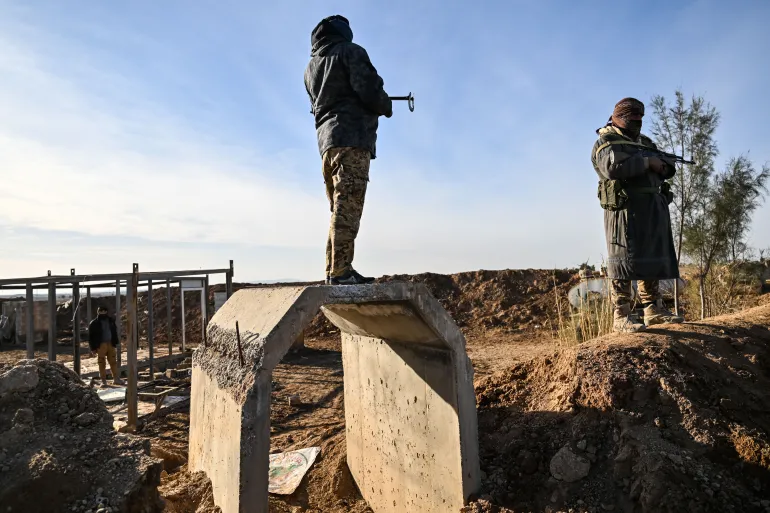
AL HASAKAH, SYRIA - JANUARY 21: Soldiers of Syrian government forces stand by on a position 10 km away from the city of Hasakah in northeastern Syria on January 21, 2026. The Kurdish-led Syrian Democratic Forces said they were committed to a four-day ceasefire deal announced by the Damascus authorities as part of an understanding reached on January 20. Syrian government forces have taken control over large swaths of northeast Syria amid clashes with the Kurdish-led Syrian Democratic Forces (SDF). In Al Hasakah governate, government forces have taken control of the infamous al-Hol (Al-Hawl) camp, previously controlled by the SDF, that houses families accused of having links to Islamic State fighters. (Photo by Abdulmonam Eassa/Getty Images)
Syrian government soldiers are deployed 10km (6.2 miles) from Hasakah in northeastern Syria [File: Abdulmonam Eassa/Getty Images]

Houthi threat

Yemen has been a central concern for Saudi Arabia since Houthi fighters captured the capital, Sanaa, in September 2014. Saudi Arabia has led an Arab military coalition to support Yemen’s internationally recognised government since March 2015. It has provided material and air support to anti-Houthi forces.

Saudi Arabia has been eager to form a regional military alliance that would help counter the threats from the Houthis and their patron Iran.

Tehran’s attacks on its Gulf neighbours since the US-Israel war on Iran began on February 28 and recent Houthi missile strikes on Saudi cities have highlighted the need for a regional security umbrella.

The Mecca Joint Defence Agreement, agreed by Saudi Arabia, Turkiye and Pakistan in August, has been viewed as a mechanism for this collective defence by many in Riyadh.

Syria and its thousands of battle-hardened soldiers with some expertise in drone warfare would be considered a useful addition to this alliance. The Syrian official who spoke to SANA said the current military arrangement between Damascus and Riyadh could lead to Syria joining the Mecca Defence Alliance.

“Interest in the Mecca pact could reflect Syria’s wish to anchor its recovery in a regional security framework. Yemen is far enough away for Damascus to present any role as standing by an Arab partner while Lebanon is next door, and intervention would reopen its history there and risk destabilising Syria itself,” Hawach said.

“However, distance does not make it cost-free. Confronting Iran’s allies anywhere invites retaliation, and soldiers killed far from home would be hard to justify to a public that expects peace to bring recovery.”

Syrian expertise

Syria’s post-war government has already come under pressure to act militarily outside its borders. US President Donald Trump has spoken numerous times this year about trying to get Syria to intervene in Lebanon to help disarm Hezbollah, another Iran-backed group.

Syrian rebels have been deployed to other conflicts in the Middle East and North Africa during their attempts to overthrow Bashar al-Assad’s government from 2011 to 2024. Syrian fighters allegedly took part in Azerbaijan’s war against Armenia in 2020.

“Syrians are combat-experienced and -capable, and they’re cohesive, so there’s a potential tactical advantage there,” Rob Geist Pinfold, a lecturer on security studies at King’s College London, told Al Jazeera.

“Overall, this is very much a common Saudi approach to strategy and security issues, basically leaning on partners they courted through diplomatic links.”

Since the fall of al-Assad’s regime in December 2024, Saudi Arabia is believed to have been instrumental in helping the US remove Assad-era sanctions on Syria, which has been critical in legitimising the post-war government in Damascus.

With Saudi Arabia now fully embroiled in the Yemen war by backing its internationally recognised government and being targeted by regular Houthi air attacks, the deployment of Syrian troops would provide it with additional expertise and guidance on how to confront the Houthis.

The AFP news agency reported that Syrians in Yemen are now leading drone operations against the Houthis although the Syrian government has denied these claims.

Samy Akil, senior programme adviser with The Syria Report website, said Syria’s cooperation gives Riyadh another ally in the region and potential partner in the Mecca Defence Alliance.

“Syria has so far tried to navigate different competing regional interests across several regional capitals. It tried to not align itself with a specific camp, but I think as time goes on, it needs to kind of start settling on [a] hierarchy in terms of regional partners, and obviously, Saudi Arabia is one of the top contenders to do so,” he told Al Jazeera.

“It’s basically signalling that Syria is willing to support and help with the limited resources and capabilities it has, but it also inadvertently legitimises the Syrian government’s foreign policy approach of supporting regional countries and kind of showcase that it is not only a country that is asking for support, but it is also a country willing to provide support.”

With Israeli raids and attacks on southwestern Syria continuing, Damascus could also benefit from having a regional power such as Saudi Arabia as an ally.

“The fact is that Syria recognises that it has little policy options to deter a further entrenchment of Israeli forces into southern Syria in [the] hope that the potential of joining the [Mecca] agreement would act somewhat of a deterrence to, at the very least, stop further encroachment of Israeli troops in Quneitra and Daraa.”

Source link

Why is Russia sending fighter jets and air defences to Ethiopia? | Weapons News

Ethiopia has received 12 Russian Su-35 fighter jets and will acquire four S-400 air defence batteries, in a deal experts say strengthens Moscow’s foothold in the Horn of Africa while bolstering Addis Ababa’s military amid conflict at home and tensions with neighbouring Eritrea.

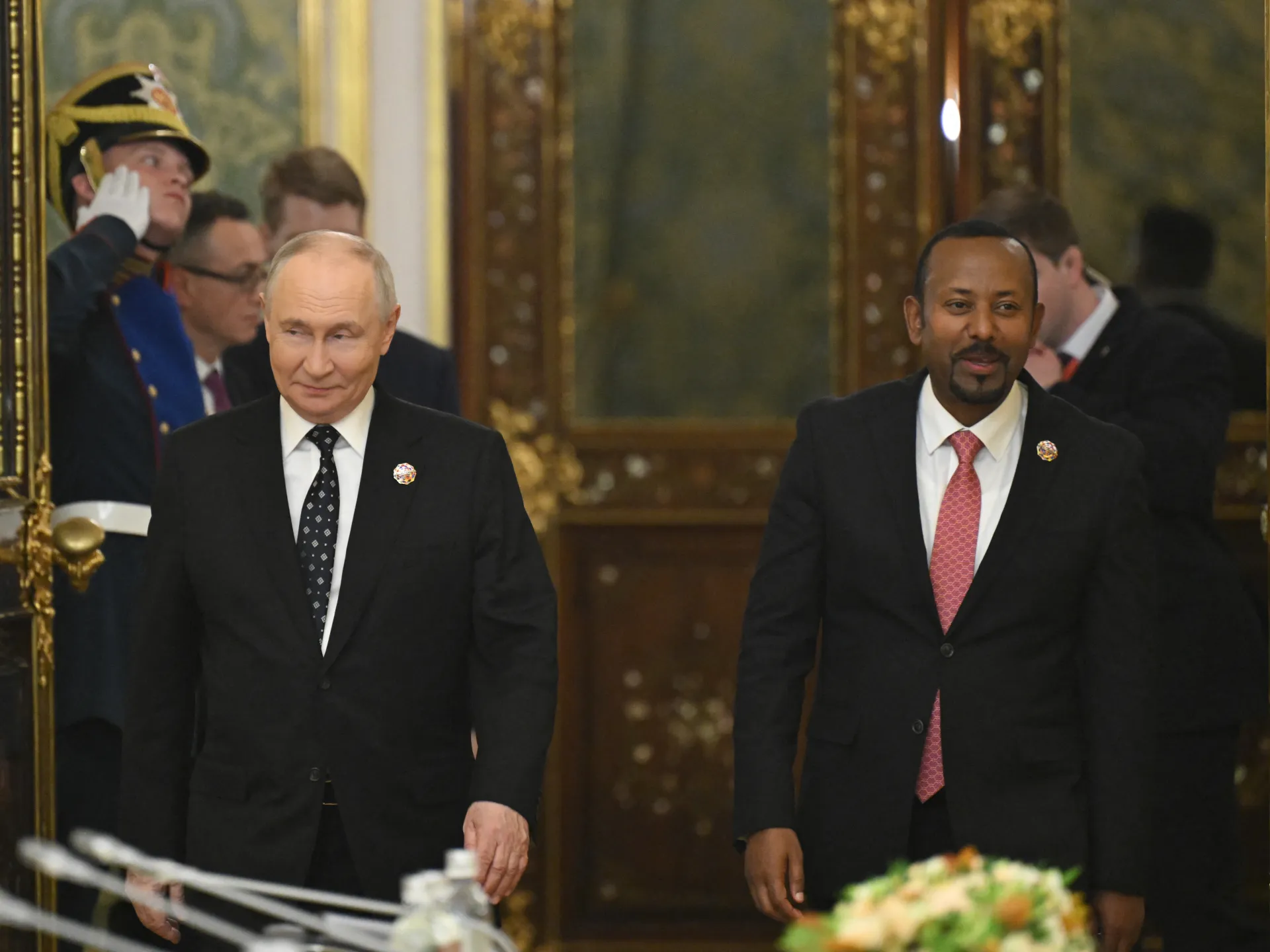
Prime Minister Abiy Ahmed announced the deal in Moscow during the two-day Russia-Africa Summit.

Recommended Stories

list of 4 itemsend of list

“I value the friendly relations between Russia and Ethiopia,” Russian President Vladimir Putin said in a statement. “Russia and Ethiopia stand together in international affairs.”

Experts say the agreement builds on decades of military cooperation, offering Moscow arms revenue and diplomatic influence while allowing Ethiopia to strengthen its armed forces amid its ongoing conflict in Tigray.

Here is what we know:

What weapons is Ethiopia acquiring?

Abiy said Ethiopia had taken delivery of its first 12 Su-35s under an earlier agreement with Russia, with four S-400 batteries to follow, but did not say when the air defence systems would arrive.

The aircraft would expand an air force already equipped with Russian fighter jets. The S-400 systems would complement this existing fleet by helping the military defend itself against aerial threats, experts say.

“They would be best used against conventional air threats,” Benedict Manzin, a lead analyst on the Middle East and Africa at risk consultancy Sibylline, told Al Jazeera. “In a war with Eritrea, they could be used against Eritrea’s limited air force and drones.”

However, air defences do not provide protection against every kind of attack.

“As we have seen in Ukraine, conventional air defence systems can be overwhelmed by small, cheap drones,” he said.

Why does Russia want closer ties with Ethiopia?

The relationship predates the current competition for influence in Africa.

“Russia has been engaged in Ethiopia for decades, part of the legacy of the Cold War,” Manzin said.

The Soviet Union backed Ethiopia’s former communist government. Today’s cooperation builds on those foundations, with the two countries having signed military agreements intended to improve the Ethiopian armed forces’ capabilities through technology, knowledge and training, according to the Ethiopian News Agency.

Commercial interests also matter.

“Russia is also in the business of making money through arms sales,” Manzin said. “This is one of Russia’s primary exports to Africa.”

Weapons sales provide revenue while sustaining relationships with governments that require training, maintenance and replacement equipment. But the partnership extends beyond defence.

Abiy said his talks with Putin covered nuclear energy, health and trade, alongside bilateral and multilateral cooperation, while in a statement, Putin said bilateral trade exceeded $1.3bn in January-September, more than twice the figure for all of 2025.

He identified energy, agriculture, industry and education among potential areas for further cooperation.

Ethiopia’s size also makes it attractive to competing powers, with experts saying that because it is Africa’s second-most populous country, it offers a substantial market.

“Everyone engages a bit, and Ethiopia tries to maximise its gains,” Manzin said.

Does this mean Ethiopia is turning away from the West?

Manzin suggested Ethiopia is widening its options rather than committing exclusively to Moscow.

“African states are aware that they are a focus of geopolitical competition,” he said.

That competition gives governments room to seek weapons, investment and diplomatic backing from different partners. Ethiopia’s relationship with Russia coexists with a significant Chinese presence and continuing Western investment in the country.

“China has a huge presence in Ethiopia, and Russian arms have always been a huge factor,” Manzin said. Moscow is seeking to turn those established connections into broader influence as Western sanctions over its war in Ukraine constrain its international relationships.

Russia supplied 15 percent of African imports of major weapons in 2021–2025, behind the United States at 19 percent and China at 17 percent, according to the Stockholm International Peace Research Institute (SIPRI).

Could the weapons be used in Tigray?

In his statement, Abiy thanked Putin for ensuring the aircraft were delivered a year ahead of schedule and said the equipment would strengthen Ethiopia’s ability to “preemptively deter aggression”.

The delivery comes amid renewed fighting in Tigray, a separate rebellion in Amhara and concerns about a possible conflict with Eritrea.

“Ethiopia is buying a lot of aircraft,” Manzin said. “The timing comes as Ethiopia is going through conflict in Tigray, with speculation about war with Eritrea.”

He cautioned against assuming the latest battlefield developments directly prompted purchases negotiated earlier.

“Aircraft are helpful regardless, as they are using aircraft and the air force heavily during any suppression,” he said.

What’s the conflict about?

Fighting between Ethiopia’s federal army and Tigrayan forces intensified in late September, in effect unravelling the November 2022 Pretoria peace agreement that ended a devastating two-year war.

Each side has blamed the other for renewed violence. Tensions grew following the formation of a seven-group alliance seeking to overthrow Abiy’s government and establish a transitional administration.

Government troops and allied forces entered Mekelle, Tigray’s capital, earlier in October after Tigray People’s Liberation Front (TPLF) fighters withdrew.

Addis Ababa subsequently installed a six-month caretaker administration, but rebel commanders have promised to continue fighting.

Source link

Prep talk: Southern California has long history of sending officials to NFL, college

Jimmy Crowley, the son of former Southern Section commissioner Dean Crowley, had a Friday night off from officiating Big Sky Conference football games, so he went to St. John Bosco last week to evaluate the high school officials for a game against Orange Lutheran.

Southern California high school football games have been used as a proving ground for years and a first stop for officials wanting to move to college and the NFL.

It used to be that the commissioners in the City Section and Southern Section were high school or college officials. Jim Cheffers, a former City Section commissioner, used to officiate in the Pac-8. Now his son, Carl, is one of the top NFL referees and has worked three Super Bowls.

Tony Corrente, a former baseball coach at La Mirada who won a CIF title in 1988, made it to the NFL for 26 years as an official and was referee for Super Bowl XI. Former Hollywood High principal Jim Tunney was a long-time NFL referee.

While fans sometimes don’t appreciate officials, in Southern California high school football, you might be watching a future college or NFL referee.

This is a daily look at the positive happenings in high school sports. To submit any news, please email eric.sondheimer@latimes.com.

Source link