send

Send us a tip about a memorable Greek holiday experience | Travel

The new Hollywood adaptation of Homer’s epic work The Odyssey, released next month, is expected to give a huge tourism boost to Greece this summer. We’d love to hear about your favourite travel experiences in Greece, whether it’s island hopping, exploring antiquities in Athens, trekking in the Peloponnese or watching the sun set into the Aegean from the perfect beachfront taverna.

The best tip of the week, chosen by Tom Hall of Lonely Planet, wins a £200 voucher to stay at a Coolstays property – the company has more than 3,000 worldwide. The best tips will appear in the Guardian Travel section and website.

Keep your tip to about 100 words

If you have a relevant photo, do send it in – but it’s your words we will be judging for the competition.

We’re sorry, but for legal reasons you must be a UK resident to enter this competition.

The competition closes on Monday 22 June at 10am GMT

Have a look at our past winners and other tips

Share your tip

Share your travel tip using the form below.

Your responses, which can be anonymous, are secure as the form is encrypted and only the Guardian has access to your contributions. We will only use the data you provide us for the purpose of the feature and we will delete any personal data when we no longer require it for this purpose. For alternative ways to get in touch securely please see our tips guide.

If you’re having trouble using the form click here. Read terms of service here and privacy policy here.

Source link

National League clubs send letter to FA to block academy proposals

The 52 clubs involved have outlined in the letter an agenda they hope to discuss at the meeting with the FA.

Among the issues they raise are:

  • Whether the process adopted by the board “complies” with the constitutional rights of the member clubs

  • The use of “anonymous” surveys instead of a formal voting procedure

  • The “incentive of financial distributions” to press for an agreement

  • “Concerns” regarding the independence of decision-making on the board

  • A need for “transparency and accountability”

The letter asks that the FA is bound by a notice period to agree the meeting and confirm an agenda, which is believed to be between seven and 14 working days.

Anthony Shaw, operations manager at Hashtag United FC, pulled the 52 clubs together and signed the letter on their behalf.

All clubs were listed. Among them were Middlesbrough, Derby County, Halifax, Doncaster Belles and Hull City.

Former Women’s National League chair Carol West has strongly opposed the proposals, writing on social media: “The damage being done here should not be underestimated. I can’t quite believe it’s being allowed to happen.

“The overriding issue with all of this is that the vast majority of clubs do not want PGA (Professional Game Academy) teams in their league but have repeatedly been denied their democratic right to vote to formalise this once and for all.

“Instead, they’ve been told it’s happening regardless which isn’t right.”

Source link

Becerra takes top spot in Calif. governor primary; feds send in election observer

June 6 (UPI) — Democrat Xavier Becerra is advancing to the November election in the California governor’s race, while Republican Steve Hilton and Democrat Tom Steyer battle for the second spot.

California’s primary is nonpartisan, so the top two finishers advance, regardless of party.

If elected, Becerra, 68, would be California’s first Latino governor since 1875. The state’s population is about 41% Latino.

“The people of the great state of California, in the greatest nation on Earth, have spoken — loudly and proudly,” Becerra said in a statement. “We will not be bought. We will not be bullied. And we are never backing down.”

Becerra was the U.S. Health and Human Services Secretary under President Joe Biden and is a former California attorney general.

No Republican has won statewide office since 2006. Hilton has also been endorsed by President Donald Trump, who is unpopular in the state. California Gov. Gavin Newsom can’t run for re-election because of term limits.

The vote count has taken several days because California has mail-in voting. It’s not unusual for California’s elections to take a long time to count. Trump-endorsed Hilton led early, but it’s likely that’s because Republicans voted early, while Democrats waited because they had many more contenders from which to choose, The New York Times reported.

Hilton, 56, is a British-born former Fox News host who once worked for Prime Minister David Cameron. Steyer, 68, is a New York-born billionaire philanthropist and climate activist who ran for president in 2020.

On Friday, the Department of Justice sent a federal prosecutor to observe ballot counting in Los Angeles after Trump claimed that the count was being rigged by Democrats.

The Los Angeles County registrar-recorder said in a statement Friday: “Our office was notified late yesterday that the U.S. attorney’s office would send an assistant U.S. attorney to the Ballot Processing Center to observe ballot processing activities.”

“The individual arrived this morning, was provided an overview of the public observation program and participated in a walkthrough of the ballot processing operations,” spokesperson Mike Sanchez said in an email to CNN.

Sanchez noted that ballot processing is open to the public.

California law gives election officials 30 days to complete the counting and certification process, California Secretary of State Shirley Weber said in a statement.

“Our commitment is immediate: in California, every ballot is counted properly and every ballot is accounted for,” Weber said.

President Donald Trump discusses renovations to the Lincoln Reflecting Pool and makes an announcement on coal in the Oval Office at the White House on Thursday. Photo by Samuel Corum/UPI | License Photo

Source link

Rising costs in Argentina, much of Latin America send retirees to work

BUENOS AIRES, June 5 (UPI) — Argentine retirees have become one of the groups hardest hit by President Javier Milei’s fiscal austerity measures, which have pushed a growing number of older adults back into the workforce to supplement incomes that no longer cover the cost of living.

Over the past two years, the number of employed Argentines age 65 and older increased 12.7%, sociologist Candelaria Rueda, a researcher at the Argentina Grande Institute, told UPI.

The trend has had a particularly strong impact on women. Labor force participation among people older than 65 increased 14.5% for women, nearly four percentage points higher than the 10.8% increase recorded among men, according to a report by the think tank based on official data from the National Institute of Statistics and Census, known as INDEC.

One of those women is Patricia Guscione, 63. She worked as a teacher for decades and retired in 2021 at age 60, the legal retirement age for women in Argentina.

But rising living costs gradually eroded the value of her pension, leaving her unable to cover household expenses. When a call for retired teachers was issued in 2024, she applied. Today, she is back teaching in public schools.

“I lived on my pension for three years, but the reality is that it lost so much value that there came a point when I could no longer make it to the end of the month. I still have two teenage children who depend on me,” she told UPI.

Rueda said inflation remains a defining factor in Argentina’s economy and “causes incomes to lose value at an unusually rapid pace.”

“In addition, there has been a clear political decision to deregulate prices, which has led private health insurance premiums to rise 400% over the past two years,” she said.

At the center of the issue is Argentina’s minimum pension, the basic benefit received by more than half of the country’s retirees. It currently totals 450,300 Argentine pesos per month, or about $320. That includes a government assistance bonus that has remained frozen since early 2024.

Because the supplement has not been adjusted, the purchasing power of the minimum pension has fallen by nearly 10% compared with late 2023.

At the same time, food prices have continued to rise sharply, further reducing retirees’ spending power. Economic pressures have also intensified following cuts to free prescription drug coverage provided through the Comprehensive Medical Care Program, known as PAMI, Argentina’s main public healthcare system for retirees and pensioners.

Mario Perelli, 70, spent most of his career as an accountant, but now drives for ride-shareing platforms to supplement his income.

“I had never seen an economic situation like the one we are living through now. It keeps getting harder. I thought I had completed my working years and that retirement would allow me to enjoy life, travel and rest. Instead, I ended up driving for an app because I need to help support my household,” he said.

Juan Gómez, 76, faces a similar reality. After years working at an accounting firm, he now work for Uber and drives a taxi.

“I lived through different economic periods, and there were difficult moments under other governments, but this is terrible. I see it in retail stores, butcher shops, auto parts stores and oil-change businesses. There are hardly any customers. I hope things can be resolved and that we can move forward,” he said.

Gala Díaz Langou, executive director of the International Panel on Social Progress, linked the crisis to public spending cuts implemented by the current administration.

“In 2024, which was the year of the deepest adjustment, 19% of fiscal spending cuts were applied to the pension system,” she told UPI.

She also pointed to the continued freeze on the bonus supplement for lower pensions and the end of a program that allowed workers who had not completed the legally required 30 years of contributions to qualify for retirement benefits.

The trend of older adults extending their working lives is not limited to Argentina. It has become a regional phenomenon as Latin America faces a rapid demographic transition, lower levels of economic development and weaker social protection systems.

According to the Economic Commission for Latin America and the Caribbean, employment among older adults is increasing across much of the region because pensions are insufficient to cover basic living expenses.

“As a result, employment among retirees functions as a refuge from the shortcomings of the system rather than a choice. When someone who contributed for decades ends up cleaning houses at age 82 or selling goods on the street, what that reflects is a protection system that failed to sustain the old age it helped create,” the commission said.

Carlos Román, executive director of SeniorLab UC, an aging innovation laboratory at the Pontifical Catholic University of Chile, told UPI that 1 in 4 older adults in Latin America was part of the labor force in 2024.

He said the trend is particularly visible in Chile among older age groups, where a significant share of people who have already reached retirement age continue working.

For Román, the phenomenon raises two key questions: Under what conditions do older adults work and what drives them to remain economically active?

Regarding working conditions, he warned that labor informality rises sharply with age.

“Labor informality does not decline over time. It accelerates, rising from 27.7% among people ages 60 to 64 to nearly 48% in the next age group and exceeding 60% among those older than 70,” he said.

He added that the impact is uneven across social groups.

“Among the poorest women ages 65 to 69, nearly 9 out of 10 work without a contract or pension coverage. About half of older adults working informally are self-employed workers without access to social protection,” he said.

While some older adults continue working because they are living longer and want to remain active, Román said “the evidence shows that, in most cases, the primary reason is economic necessity.”

He contended that the trend reflects a deeper structural problem that goes beyond national circumstances.

“Aging arrived in Latin America before the region built the economic model and social protection system capable of supporting it,” he said. “Economists often summarize this reality with a phrase that has become common in regional discussions: We will grow old before we grow rich.”

He said the region’s long-term challenge is to ensure that longer life expectancy does not translate into more years of economic insecurity and precarious living conditions.

Source link

Protesters want to send ‘fascists to Mars’ aboard mock rocket | Environment

NewsFeed

Environmental activists in Rome built a mock rocket with caricatures of Giorgia Meloni and Donald Trump, calling for ‘fascists’ to be launched to another planet. The protest condemned government inaction on climate change and the global rise of authoritarian politics.

Source link

Crowds gather in Tehran to send off Iran’s World Cup team | World Cup 2026

NewsFeed

Huge crowds gathered in Tehran’s Revolution Square to celebrate and send off Iran’s national football team ahead of the 2026 World Cup. The new jersey of the Iranian national team, which will be worn in the World Cup competitions, was unveiled at the event.

Source link

U.S. weighs plan to send Afghans who helped with war effort from Qatar to a third country

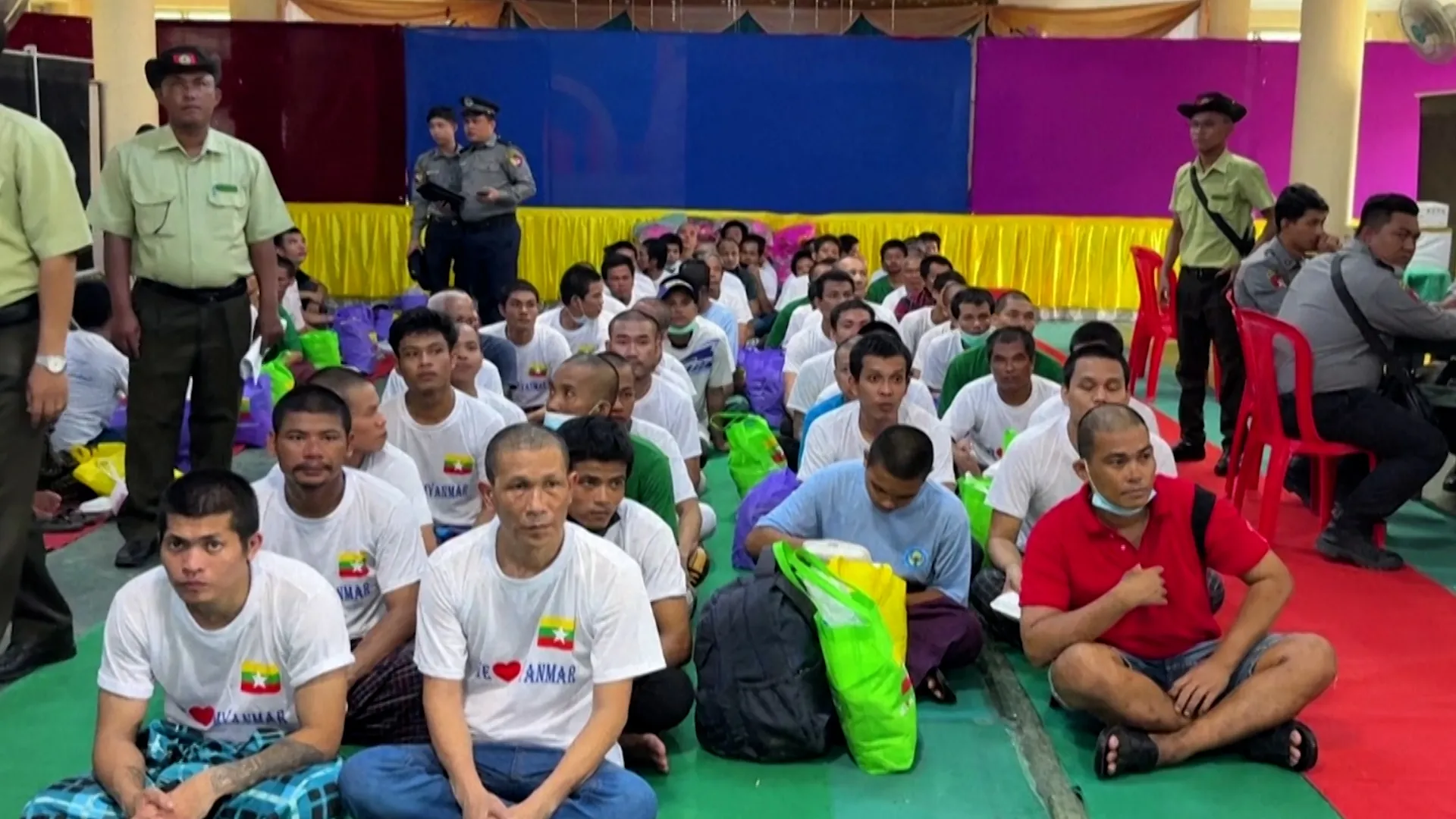
The Trump administration is in discussions to potentially send more than 1,000 Afghans who assisted America’s war effort and relatives of U.S. service members stuck in Qatar to a third country, the U.S. government and some advocates said. Congo is an option, the advocates said.

Shawn VanDiver, a Navy veteran who heads a coalition that supports Afghan resettlement efforts called #AfghanEvac, said Wednesday that U.S. officials informed him and other groups of discussions between the United States and Congo about taking the Afghan refugees who have been in limbo at a U.S. base in Doha for the last year.

The 1,100 refugees at Camp As-Sayliyah include Afghans who served as interpreters and with Special Operations Forces as well as the immediate families of more than 150 active-duty U.S. military members.

The State Department said Wednesday that it is working to identify options to “voluntarily” resettle the refugees in a third country, but it did not confirm which nations were being discussed.

An alternative provided to the refugees, VanDiver said, is to return to Afghanistan, where they face likely reprisal or even death at the hands of the Taliban for working alongside the U.S. during the two-decade war.

“You cannot call a choice voluntary when the two options are Congo and the Taliban, civil war or an oppressor who wants to kill you,” VanDiver said at a virtual news conference. “That is not a choice. That is a confession extracted under duress.”

The discussions — which were reported earlier by the New York Times — come more than a year after President Trump paused his predecessor’s Afghan resettlement program as part of a series of executive orders cracking down on immigration.

That policy left thousands of refugees who fled war and persecution, and had gone through a sometimes years-long vetting process to start new lives in America, stranded at places worldwide, including the base in Qatar.

From one war-torn country to another

Negotiations between the U.S. and several other countries, including Botswana and Malaysia, started months ago, according to an executive at a refugee resettlement agency who was briefed by U.S. officials. The executive, who spoke on condition of anonymity to share private negotiations, said that Botswana was seen by many refugee advocates as the most promising option but that talks between senior U.S. officials and the country’s leadership fell through. In early April, the executive was briefed that Congo was now the main option being discussed.

A person familiar with the matter who was not authorized to comment publicly and spoke on condition of anonymity said they had heard from State Department personnel that the U.S. was looking at sending the Afghans at the base in Qatar to countries in sub-Saharan Africa. The person said the Afghans were told Wednesday that there was no final deal on where to send them.

The base in Doha “was always intended as a transit platform. It was never designed to hold families for months or years, which is the situation that people are currently in,” said Jon Finer, who was deputy national security advisor to then-President Biden. “What I want to emphasize is that this was intended to honor a wartime commitment.”

Finer and other former U.S. officials and refugee advocates warned of the risk of resettling Afghans in Congo, a country that U.N. officials say is facing “one of the most acute humanitarian emergencies in the world.”

The African country has been battered by decades-long fighting between government forces and Rwanda-backed rebels in its eastern region.

Congolese authorities did not immediately respond to AP’s request for comment on the discussions, which did not come as a surprise to some there. Congo is one of at least eight African nations that were paid millions in controversial deals with the Trump administration to receive migrants deported from the U.S. to countries other than their own.

Like most other African nations involved in the deportation program, Congo is also among the worst-hit by the Trump administration’s policies on aid and trade. At least 70% of the country’s humanitarian aid came from the U.S. before Trump’s second term, and aid workers say American aid cuts have led to avoidable deaths in the conflict-hit region.

Sean Jamshidi — an Afghan American who served in the U.S. military, including a stint in Congo — said he was deeply concerned about his brother possibly being sent from the Doha base to the war-torn country.

“I saw the security situation and what it looked like there. I saw the displacement camps. … I stood in places where the United Nations has counted the dead,” Jamshidi said. “I’m telling you, as someone who has been in uniform, the Democratic Republic of the Congo is not a place you send vetted Afghan allies and their children to live.”

Refugees are in the dark as they await their fate

Negina Khalili, a former prosecutor in Afghanistan who fled during the 2021 U.S. withdrawal, has been waiting to hear about the resettlement status of her father, brother and stepmother since they arrived at the Doha base in January 2025. That was just days before Trump suspended the refugee program soon after he returned to the White House.

Khalili told the Associated Press on Wednesday that she spoke to her family about reports that they could be sent to Congo.

“They are not giving them any information or updates regarding which countries they will go to,” she said. “They were so stressed and worried about it and said that Congo is not a safe place either. They don’t know if it’s a temporary location for them there or a permanent location. They are worried.”

She said U.S. officials at the camp have been suggesting to refugees that they go back to Afghanistan and offering them money to do so.

Amiri, Santana and Asadu write for the Associated Press. Amiri reported from New York and Asadu from Abuja, Nigeria. AP writer Matthew Lee contributed to this report.

Source link