Dinorah Figuera was allowed to return from exile thanks to her participation in this initiative. The same happens with some members of the opposition delegation
On August 1, representatives of Venezuela’s two rival legislatures sit down together under Washington’s supervision in the most concrete attempt to negotiate again since the Barbados talks of 2023.
The talks, framed by Washington as the start of a transition, are driven by the Department of State and pair two delegations of ten. On one side sits the current National Assembly controlled by chavismo, led by its president Jorge Rodríguez. On the other is the Comisión Delegada of the National Assembly elected in 2015 — the last legislature the US and many other countries recognized as democratically legitimate.
According to Dinorah Figuera, president of the Delegate Commission, the primary objective is laying out the institutional groundwork for a political transition: renovating Venezuela’s key state bodies, establishing a new National Electoral Council (CNE) capable of holding elections with credible guarantees, and extending to the Supreme Tribunal’s electoral and constitutional chambers. Figuera has said she hopes to deliver a transition proposal by December 2026, conveniently timed for the Trump administration to show a foreign-policy success just after the US midterm legislative election in November.
Figuera and Jorge Rodríguez first met on June 18, along with U.S. Chargé d’Affaires John Barrett, hours after Figuera returned to Caracas after years in exile. Those contacts were interrupted by the June 24 earthquakes, seeming as though the political track would freeze indefinitely behind the humanitarian emergency, especially as Delcy Rodríguez said on July 13 that the government had “no head” to think about elections while managing the disaster.
The roots of Dinorah Figuera, the opposition’s co-chair, lie on the left. She belonged to the labor party La Causa R in the 1990s (then an important force in the rising Venezuelan Left) and served as deputy secretary of the Libertador municipality in Caracas under Aristóbulo Istúriz, who later jumped onto the chavista wagon. She eventually joined Primero Justicia and was re-elected as a lawmaker in 2015 before being forced into exile in 2018. Shortly after she led protests denouncing the death of party colleague Fernando Albán under SEBIN custody —a PJ councilman, key aide to Julio Borges and the godfather of Figuera’s daughter— she was threatened by the intelligence services and took shelter in the French Embassy of Caracas for 10 days before fleeing to Spain and receiving political asylum.
Sources close to Primero Justicia describe Figuera as a principled politician willing to serve without seeking personal or financial gain from her sacrifices. She maintained a very low profile in this role until the State Department elevated her visibility several weeks ago.
While exiled in Spain, and following the collapse of the interinato, Figuera succeeded Juan Guaidó as the figure managing Venezuela’s overseas assets in the US via the 2015 National Assembly’s Comisión Delegada (recognized by Washington as Venezuela’s sole democratically elected institution until this year). Sources close to Primero Justicia describe Figuera as a principled politician willing to serve without seeking personal or financial gain from her sacrifices. She maintained a very low profile in this role until the State Department elevated her visibility several weeks ago. Figuera and US representatives have been undertaking preparatory meetings in Madrid for over two weeks, coordinated by Mauricio Claver-Carone, Secretary of State Marco Rubio’s principal interlocutor on Venezuela.
Figuera has called herself “an instrument” of the reinstitutionalization process. She acknowledges Edmundo González Urrutia as president-elect and María Corina Machado as the opposition’s leader, yet notes she holds “a different vision.” She is, in the role the State Department has cast for her, what Edmundo González was to Machado in 2024: a figure admitted by chavista institutions because she isn’t a threat, and little enough ambition to follow guidelines from influential people in the opposition alliance.
Jorge Rodríguez, her counterpart, is chavismo’s veteran negotiator and the brother of acting president Delcy Rodríguez. He led the government’s delegation in the Mexico talks of 2021–2022 and signed the 2023 Barbados Agreement on Maduro’s behalf. Before that, he was Chávez’s vice president, communications minister, and president of the CNE in 2005–2006.
Up until yesterday, the opposition’s full roster was not yet public. The opposition’s ten were revealed in stages and through extraofficial communications. In June, El Pitazo confirmed six names: Dinorah Figuera, Juan Miguel Matheus, Ramón López, Jorge Millán, Marco Aurelio Quiñones and Sergio Vergara. The remaining four were disclosed on July 29th: Elimar Díaz, Julio César Moreno, Macario González and Desiré Barboza.
Six are from Primero Justicia: Figuera, constitutional lawyer Juan Miguel Matheus, engineer Ramón López, Caracas legislator Jorge Millán, and recent additions Elimar Díaz and Julio César Moreno.
Four are from Voluntad Popular, Leopoldo López’s party: Marco Aurelio Quiñones; Táchira legislator Sergio Vergara; and late additions Macario González and Desiré Barboza. Nearly all have spent recent years in exile, or in González’ case, in detention. Several are returning only now, under the process’s complicit US security guarantee.
For most of the last two years, Primero Justicia has effectively been two parties. After Henrique Capriles chose to participate in the 2025 regional and legislative elections, the party’s official leadership, aligned with Machado’s abstentionist line, expelled him, Tomás Guanipa, and others for legitimizing what it called a fraud. Both Tomás Guanipa and Capriles were elected members of the NA that Rodríguez presides over. What remained of Primero Justicia, keeping the party’s name and recognition, was the abstentionist wing, led by Juan Pablo Guanipa, with Julio Borges as coordinator and María Beatriz Martínez as president.
The delegation Washington seated is drawn substantially from the faction of Primero Justicia most doctrinally opposed to negotiating an electoral path with chavismo. The party has tried to hold both positions: in its July 27 statement it backed the dialogue as a route toward free elections while, in the same breath, ratifying its support for Machado.
Who’s Who?
Juan Miguel Matheus (PJ, Carabobo) is a lawyer with a PhD in constitutional and parliamentary law behind the Estatuto que rige la Transición a la Democracia, the legal framework that underpinned Guaidó’s 2019 interim presidency. Elected for Carabobo in 2015, he was among the sharpest critics of the 2017 Constituent Assembly, calling it fraudulent. He is in exile in Austin and coordinates PJ’s board of directors.
Ramón López (PJ, Distrito Capital) is an engineer and the former vice president of Venezuela’s Colegio de Ingenieros. López sat in the 2015 Assembly and the Parlasur, Mercosur’s parliament. Exiled in Spain after being threatened by Diosdado & Co., he became PJ’s international spokesperson. He flew back to Caracas alongside Figuera on June 18 for the meetings that launched the process..
Jorge Millán (PJ, Distrito Capital) is an industrial engineer and administrator. Millán is PJ’s Caracas coordinator and one of the opposition’s longtime specialists on the collapse of the national electric system. In 2019, the Constituent Assembly ordered his prosecution on charges including treason and instigation to insurrection. When Maduro issued him a pardon in 2020, Millán rejected it, arguing he had committed no crime and that Maduro had no legitimacy to pardon anyone.
Elimar Díaz (PJ, Zulia) is the delegation’s youngest member. Díaz began in Manuel Rosales’s Un Nuevo Tiempo before moving to Primero Justicia, where she is now national political coordinator and PJ’s political vice-president in Zulia.
Julio César Moreno (PJ, Falcón) has the thinnest public record of the ten. Moreno was elected to the 2015 Assembly for Falcón and is counted among Primero Justicia’s delegates.
Marco Aurelio Quiñones (VP, Anzoátegui) was elected for Anzoátegui in 2015. In his early career, he was close to Capriles and Borges in Primero Justicia and then crossed to Voluntad Popular in late 2016, becoming a close ally of Guaidó. In December 2024 the exiled Assembly swore him in as second vice president, filling the seat left by Auristela Vásquez’s resignation and making him the highest-ranking officer of the 2015 legislature at the table after Figuera.
Sergio Vergara (VP, Táchira) is a founding member of Voluntad Popular alongside Leopoldo López and Daniel Ceballos. He was elected for Táchira in 2015 with nearly 76% of his circuit’s vote. He served as acting mayor of San Cristóbal after Ceballos was jailed in 2014, andhas been in exile since 2019, when the SEBIN raided his home in connection with the Roberto Marrero case. He is also among the signatories of the document tied to the failed Jordan Goudreau incursion, asking for a military foreign intervention.
Macario González (VP, Lara) is a veteran Lara politician and former mayor of Barquisimeto’s Iribarren municipality. González was detained by the SEBIN in September 2025 as he left a university in Barquisimeto, held incommunicado, in what Voluntad Popular denounced as a forced disappearance for what he says was 68 days without charge, judicial hearing, or explanation. He was released near midnight on November 19, 2025, hours after the Inter-American Commission on Human Rights granted him precautionary measures. He has publicly held Interior Minister Diosdado Cabello politically responsible for his detention.
Capriles, now sitting in the Rodríguez-controlled national assembly, cautioned that a negotiation excluding Machado “will be condemned to fail.”
Desiré Barboza (VP, Zulia) was an alternate deputy for Zulia in the 2015 Assembly and is Voluntad Popular’s regional coordinator there. Like most of the delegation, she has built her recent political life in exile and within the structures of the 2015 legislature.
On the ‘chavista’ side, only Jorge Rodríguez has been named to the time of writing. While the opposition’s ten were leaked or rumored until confirmed, the radio silence from those representing the current national assembly clashes awkwardly with Diosdado Cabello’s boasts of chavista unity. Francisco Arias Cárdenas, 1992 coup veteran and former Zulia governor, urged Rodríguez’s delegation to consult the PSUV’s base and submit any agreement to the Venezuelan public, warning that dialogue must not become a matter of simply following Washington’s instructions.
The positions around the table
Primero Justicia and Un Nuevo Tiempo have called August 1 a “historic opportunity,” with PJ setting conditions: free, fair elections and the restoration of popular sovereignty. Voluntad Popular was the first to back the US initiative outright. But Acción Democrática’s Henry Ramos Allup has warned against any process that sidelines the coalition and Machado. Capriles, now sitting in the Rodríguez-controlled national assembly, cautioned that a negotiation excluding Machado “will be condemned to fail.”
Machado and González stated their own position on July 26, claiming they will neither participate in nor obstruct the process, having taken no part in its “design, construction and functioning,” and will judge it by concrete, verifiable results: institutional recovery, the release of political prisoners, guarantees without exclusions, a presidential electoral calendar, and respect for popular sovereignty.
IF you‘re already thinking about next year’s holiday and want to bag a bargain then set your alarm for tomorrow.
easyJet is set to put lots of flights on sale for summer 2027 in its next Big Seat Release – and they’ll be cheap too.
The easyJet Big Seat Release puts thousands of flights on saleCredit: Markus MainkaEarlier this year flights to Agadir started from £37.99 in the saleCredit: Getty
From tomorrow, the airline will put flights on sale for travel between June 14 and September 26.
Talking to MoneySavingExpert, easyJet revealed that almost 14million seats will be available to book – that’s more than 78,000 flights.
Sign up for the Travel newsletter
Thank you!
But if you want to get cheap deals, you’ll need to start early as when demand goes up, so do the prices.
A time for the release hasn’t been confirmed yet, but usually it’s around 6am or sometimes earlier.
An easyJet spokesperson told the publication: “We encourage customers to book early to get the best fares.
“Fares are demand-driven so they start low and rise as more seats on the aircraft are booked.”
Talking about the easyJet seat release, Martin Lewis described it as “the most predictable time to get cheap flights” – which means there’s likely to be a sharp increase in flight prices.
In its last release, which was in March, millions of seats were available for holidays in winter 2027, including February half-term.
Some of its deals included one-way flights to Paris from London Gatwick from £31.99.
There were also flights to Agadir inMoroccofrom London Gatwick on February 23, 2027, for £37.99 one-way.
If you want the best fares – make sure to be on the site as soon as possibleCredit: REUTERS
Islamabad, Pakistan – Pakistan-administered Kashmir, formally known as Azad Jammu and Kashmir (AJK), has spent the summer under an unofficial state of emergency.
Since early June, nearly 40 people have been killed in clashes between protesters and security forces, with sit-ins and road blockades regular features in the region over this period.
Recommended Stories
list of 4 itemsend of list
Banks remained shut for two weeks. Mobile and internet services remain suspended across most of the territory. Poonch division, which borders India and has been the epicentre of the unrest, was effectively sealed off for weeks, disrupting the supply of flour and other essentials to a region that depends heavily on them.
The Jammu Kashmir Joint Awami Action Committee (JAAC), the movement behind the protests, was banned by the local government on June 5, days before a planned demonstration.
Its leadership has since been arrested, has gone underground or has continued organising from sit-in camps in Rawalakot, the administrative headquarters of Poonch division.
Its demands, once centred on subsidised flour and cheaper electricity, have expanded to 38 points, chief among them the abolition of 12 assembly seats reserved for Kashmiri refugees.
All of this is unfolding as the region prepares to vote. Elections for the 45-seat Legislative Assembly, originally scheduled for July 27, have been split across three dates.
Mirpur division votes as planned, Muzaffarabad division and the 12 seats reserved for Kashmiri refugees follow on August 2, while Poonch division, where tensions remain highest, goes to the polls on August 10.
JAAC’s leadership is not on the ballot and has urged supporters to boycott the vote.
Of all the movement’s demands, one issue has proved impossible to resolve: the 12 refugee seats. The government says they cannot be touched without a constitutional amendment. JAAC wants them abolished outright.
Between those two positions lies a legal argument stretching back nearly a century, and a more fundamental question: who gets to decide who governs Muzaffarabad?
A dozen seats, one dispute
Of the AJK Legislative Assembly’s 45 elected seats, 33 are filled from constituencies within the territory.
The remaining 12 are reserved for refugees from Indian-administered Kashmir who now live in different parts of Pakistan.
People chant slogans as they walk during a protest and shutter-down strike called by the banned Joint Awami Action Committee (JAAC), an alliance of civil society groups, in Neelum Valley, Pakistan-administered Kashmir, June 21, 2026 [Naseer ud Din/Reuters]
The arrangement traces its roots to electoral arrangements introduced in 1960, reinforced through laws in 1964 and 1970, before being formalised in AJK’s 1974 Interim Constitution and reaffirmed by the constitution’s 13th Amendment in 2018.
Chaudhry Muhammad Ibrahim Zia, a former chief justice of the AJK Supreme Court, said the basis for the seats goes back further still, to the AJK government’s founding declaration of October 24, 1947, which he said reflected “the collective will of the people of the State of Jammu and Kashmir”.
Refugee representation, he told Al Jazeera, has “a firm historical basis” rooted in that document. He rejects any suggestion that the seats are unconstitutional.
“They have both historical grounding and constitutional support,” he said. “These seats cannot be described as unconstitutional.”
Pakistan-administered Kashmir’s electorate has grown from 3.2 million voters in 2021 to more than 3.8 million this year, according to Election Commission figures.
Within that, the 12 refugee constituencies account for roughly 439,000 registered voters, scattered across cities including Lahore, Rawalpindi and Sialkot, rather than concentrated in a single geographical area like AJK’s territorial constituencies.
And that’s a problem, says Kashif Abbasi, a JAAC committee member.
“This election is meant for people who actually live in AJK,” he told Al Jazeera. “These 12 seats sit outside AJK’s jurisdiction. This doesn’t happen anywhere else.”
From flour to the assembly floor
JAAC’s demands were not always centred on the refugee seats. Its original charter was almost entirely economic, focusing on subsidised flour, electricity at cost price, and a share in the benefits from the Mangla and Neelum-Jhelum hydropower projects.
The refugee seats first appeared in the group’s expanded charter, submitted in October 2025.
Even then, JAAC did not initially seek their outright abolition. In written proposals submitted on May 30 this year, the group offered two alternatives.
It proposed retaining symbolic refugee representation until the Kashmir dispute is permanently resolved or replacing the 12 assembly seats with four seats in the AJK Council, the Islamabad-chaired body that exercises legislative authority over AJK’s federal-facing affairs.
The 14-member council, chaired by Pakistan’s prime minister, oversees subjects including electricity, banking and parts of taxation, areas that largely fall outside the AJK assembly’s authority. The territory has no representation in Pakistan’s national parliament.
“Our suggestion was that these seat-holders should instead be given representation on the Kashmir Council, and that their assembly seats be eliminated, with that money used elsewhere in the territory,” Khawaja Mehran, a member of JAAC’s core committee, told Al Jazeera recently.
Both proposals were rejected at an All-Parties Conference in Muzaffarabad on June 3.
Constitutional barrier
In June, the AJK Supreme Court addressed the issue directly.
The court held that the seats are protected under AJK’s constitution and can only be abolished through a formal constitutional amendment. They cannot be removed through executive action or public pressure.
A constitutional amendment, the judges wrote, is “a solemn constitutional act, not a concession to be wrested from a government under duress”.
Zia, the former AJK chief justice, said the opinion changed little about the existing legal position.
“These seats simply cannot be abolished without a proper constitutional process,” he told Al Jazeera, adding that, with the outgoing assembly’s term having ended, no such process is possible until a new legislature is elected.
The government’s account
Abdul Majid Khan, AJK’s former finance minister and himself from a refugee family, rejects the idea that the seat holders form an unaccountable political bloc.
A view of Muzaffarabad, the capital of Pakistan-administered Kashmir, on July 15, 2026. The unrest in the city follows the recent banning of the Jammu Kashmir Joint Awami Action Committee (JAAC), with authorities maintaining heightened security and restrictions on internet and phone services across the region [Amiruddin Mughal/EPA]
He points instead to the size of the territory’s budget. AJK’s roughly 310 billion rupees (about $1.1bn) budget last year, he said, far exceeds the development funds allocated to the 12 refugee constituencies – nowhere near enough, in his view, to make them the powerful bloc JAAC describes.
“These are people who migrated for a larger cause,” Khan told Al Jazeera, referring to Kashmiris who fled Jammu, across the border, during the violence of 1947 following the partition of the subcontinent and settled across Pakistan in the decades that followed.
Refugee representation, he said, has existed since AJK’s first parliamentary election in 1975, when the territory’s first prime minister was himself from a refugee family.
At the June 3 conference that rejected JAAC’s proposals, AJK Prime Minister Faisal Mumtaz Rathore said any decision on the seats “can only be taken by the elected representatives in the House”, adding that most of JAAC’s other demands had already been met.
Pakistan’s Defence Minister Khawaja Asif told the National Assembly on June 11 that the future of the 12 refugee seats should be decided by voters, not under pressure from street protests.
He urged JAAC to contest the issue in the election rather than demand its resolution beforehand, asking: “How could you exclude them from the electoral process?”
A senior government official in Poonch, whose division has witnessed the worst of the unrest, took an even harder line.
“This is no longer a rights movement,” the official told Al Jazeera, requesting anonymity since he was not allowed to speak to the media, adding that the protesters were not only “challenging the authority of the state”, but also provoking the public through “inflammatory speeches and actions”.
Who holds power?
In mid-July, JAAC leader Umar Nazir Kashmiri told supporters at a sit-in in Rawalakot, Poonch division, that the group had written directly to army chief Field Marshal Asim Munir after concluding that its concerns were not reaching him “through official channels”.
He thanked Munir by name for “understanding the grievances of the people of Kashmir”.
Shaheen was more direct. “We believe real authority currently sits with Rawalpindi,” he told Al Jazeera, referring to Pakistan’s military establishment rather than the civilian government. “That’s why we’re forced to negotiate through that channel, since nobody else actually holds the authority.”
Ershad Mahmud, a Canada-based researcher on Kashmiri displacement and politics, said that “Islamabad’s bureaucracy, military and intelligence establishment have reduced AJK’s elected leadership to a largely symbolic role”.
The current crisis, he told Al Jazeera, has once again shown that the local leadership “lacks the authority to negotiate a political settlement with its own people”.
People approach a vehicle at a makeshift checkpoint during a protest and shutter-down strike called by the banned Joint Awami Action Committee (JAAC), an alliance of civil society groups, in Neelum Valley, Pakistani Kashmir, on June 21, 2026 [Naseer ud Din/Reuters]
Unmet promise?
The dispute over the refugee seats is unfolding within a framework that predates Pakistan-administered Kashmir itself.
Under a United Nations Commission for India and Pakistan resolution adopted on January 5, 1949, and endorsed by the UN Security Council, Kashmir’s final status was to be determined “through the democratic method of a free and impartial plebiscite”.
Nearly 80 years later, that has yet to happen on either side of the Line of Control.
Mahmud, who is also the author of Poonch: Identity, Politics and Resistance, argues the refugee seats endure partly because they continue to serve Islamabad’s interests.
“They let Pakistan maintain its position that AJK represents the entire former State of Jammu and Kashmir, not merely the territory it administers,” he told Al Jazeera. “And allows Pakistan-based political parties to influence government formation in Muzaffarabad.”
Islamabad, he said, treats the seats “as an instrument of its Kashmir policy and political influence”.
Hassan Kamal Wattoo, a Lahore-based constitutional lawyer, argues that giving greater autonomy to AJK “strengthens Pakistan’s case on the international stage”.
“There is no tension between real autonomy for AJK and an eventual plebiscite,” he told Al Jazeera.
Anam Zakaria, a historian and author of Between the Great Divide: A Journey into Pakistan-Administered Kashmir, however, argued that there was a deeper contradiction within AJK’s constitutional framework.
On the one hand lies India’s “longstanding and ongoing systemic violence and human rights abuses in [Indian-administered] Kashmir”, she said, arguing that nothing Pakistan has done or does in the part of Kashmir it administers can be compared with what’s happened in Indian-administered Kashmir, where tens of thousands of people have been killed in violence involving armed rebels and security forces since 1989.
At the same time, she pointed out, candidates seeking public office in Pakistan-administered Kashmir must first swear allegiance to AJK’s accession to Pakistan.
That requirement, she told Al Jazeera, also “in itself contradicts the right to self-determination” and sidelines Kashmiris who hold a different vision for the region’s future.
If we take it as read that the better the view, the worse the cooking, then by rights south Wales’s Gower peninsula should be a culinary desert. The first time I visited almost 15 years ago, I was unprepared for its loveliness – back in 1956, Gower (never the Gower, as locals were quick to correct me) was the first place in the UK to be designated an area of outstanding natural beauty, and though the peninsula abuts the country’s second city, Swansea, it still feels profoundly rural. Crisscrossed by narrow lanes flanked by towering hedges and ancient churches, it’s a great place to cycle, to drive, and above all to walk up an appetite.
Indeed, it’s been a long-held ambition of mine to hike the 43 miles of the Welsh Coast Path from Mumbles to Loughor. Sadly, it remains just that because on this latest trip I spent considerably more time chomping than yomping … though in fairness I was on a research mission for a walking trip with a friend here later in the summer, because as a food writer and semi-professional glutton, I never like to head anywhere unprepared.
With this in mind, and another friend on hand as a chauffeur, Wilf the dog and I began our investigations in Mumbles, where Swansea thins into a pretty seaside village of colourful Victorian villas culminating in a magnificent, privately owned pier. (A few years ago, a visiting Prince William observed to owner Bert Bollom, the third generation of his family to run it, that this was an unusual career choice. Bert shrugged that he’d inherited the job from his dad. “Tell me about it,” he recalls the prince sighing.)
Though the pier is undergoing restoration work, there’s a good view of the “crown of the Bristol Channel” from another Bollom enterprise, On the Rocks, a steak restaurant with a terrace jutting over the foreshore that’s no doubt a terrific place for a sundowner. But, I tell myself sternly, when you’re starting a walk you need to put one foot in front of the other, not sit around drinking, especially as the friend I plan to come back with later in the summer is happily, if rather inconveniently, pregnant.
Crab sandwich at the Gower Seafood Hut in Mumbles.
There’s thus not much point in returning to the Gower Brewery Taproom, despite the warm welcome and dog biscuits we receive on this occasion – I’ll probably suggest we stop instead at Joe’s, the local cult masquerading as an ice-cream parlour. (Vanilla, freshly churned in-house daily, is the only move here. Unless you’re under the age of 10, do not waste your time on other flavours.) Thankfully, the expectant one is past the nauseous stage, so I can also steer her in the direction of the crab sandwiches (local sourdough and deliciously salty Shirgar butter) at the Gower Seafood Hut with a clear conscience – depending on the time of day, it might also feel appropriate to fortify ourselves with a helping of fried whitebait or cockle popcorn before joining the coast path, particularly as Chris Price, who mans the stoves, has, according to co-owner Sarah Kift, already walked much of it himself.
That said, I reckon I’ve got the fuelling part of the route covered; for a start, there’s another ice-cream parlour, Fortes, just round the headland in Limeslade Bay. From the neat beach huts of Langland to the golden sands of Three Cliffs Bay, however, the sites are more prehistoric than edible (tasty as the Bacon Hole cave sounds, the nearest it gets to cured meat is its hoard of ancient narrow-nosed rhinoceros and straight-tusked elephant bones, now 200 miles away in the British Museum). Take a brief detour into the village of Southgate though, and you’ll happen upon a brilliant Greek cafe – I didn’t anticipate tucking into a sugar-dusted bougatsa custard pie and a punchy little coffee in The Gower Deli, but this place is full of surprises.
Sometimes they come too thick and fast even for my boundless appetite: just 20 minutes inland from Three Cliffs, if you follow the lazy meandering waters of the Pennard Pill past the ruins of a Norman castle, sits the Gower Heritage Centre. Clustered around a 12th-century water mill, it boasts a cider press, organic community agriculture project, sauerkraut producer, jewellery designer and bike shop plus – and the jewel in its crown as far as I’m concerned – the superb Little Valley bakery, whose traditional Gower loaf is produced using the mill’s barley flour. They also make ridiculously flaky pasties, focaccia sandwiches, huge cookies and excellent viennoiserie – in short, a rambler’s dream.
The Beach House restaurant in Oxwich on the Gower.
From Three Cliffs, it’s about another five miles along the coast to Oxwich. If you make one reservation for your Gower trip, make it at the Beach House there. Admittedly, given its Michelin star, one might not want to wander in directly from the path in quick-dry hiking sandals, but our welcome couldn’t be warmer, despite Wilf’s rather over-effusive manner (the terrace is dog-friendly, as is one table inside, which you can bet your boots I will be booking well in advance).
A Michelin-star dish at the Beach House restaurant in Oxwich.
From our seats, we can see the two boats that supply the restaurant with lobster. “They belong to Paul and Jim,” says chef Hywel Griffith. “Every morning, I text them what we need that day.” The lamb is from the North Gower salt marsh; the seaweed in the laverbread rolls (a clever play on the traditional puree) from Selwyn’s in Pen-clawdd; and the dessert, a malted mousse with wood sorrel and fermented pine syrup, is the single most delicious thing I’ve eaten since Sarah Kift’s crab sandwich.
Five more miles brings us to Port Eynon, whose chief attraction on this visit is the tiny, genuinely artisan Gower Gin Company – having enjoyed one solo guided tasting with my designated driver and the teetotal terrier, I’ll pass on another with a reluctant abstainer. It’s six more miles to Rhossili, once, somewhat absurdly, declared the “ninth best beach in the world” by TripAdvisor. What’s not up for debate is that it’s 3 miles long and stunning.
Sunrise over Mumbles lighthouse and privately owned pier. Photograph: leighcol/Getty Images
Thanks to the National Trust, it’s also untouched by the grubby hand of commercialism, so should you be peckish, pause at the aptly named View cafe before you descend the cliff. Offering colourful vegan “power bowls” (popular with the surfing crowd apparently) and homemade falafel alongside the rarebit and bara brith, the only packaged food in sight is a bag of locally produced dog treats I’m bullied into buying for my elderly companion who, despite a brisk trot down to the Worms Head Coastwatch station beforehand, is in no mood to obey the house rule that “shouting is not permitted”.
Turn the corner on to the north coast, and you’re faced with Whiteford Sands, yet another broad expanse of golden gorgeousness with great cooking attached in the form of the Britannia Inn in Llanmadoc, where the salt marsh lamb croquettes at the bar drive the tiny diner under the table to distraction.
Fortunately, I don’t have to test Wilf’s restraint on the living, bleating thing on this occasion, as the remaining seven miles of the route – through the marshes to Pen-clawdd, – will have to wait till next month. When we finally get there, however, I will insist on stopping at the Gower Brewery to toast our achievement. I’ve even road-tested their Zero beer in preparation. As I said, I like to plan ahead.
While the company is known for offering a more luxurious travel experience for passengers in business and first class seats, Emirates has now revealed a brand new upgrade for economy travellers
14:34, 24 Jul 2026Updated 14:34, 24 Jul 2026
Emirates has upgraded the seats in its cheaper economy class (stock image)(Image: Getty Images)
But that doesn’t mean its cheaper, economy class is uncomfortable. The airline has upgraded economy seats in its newer A350 planes to provide more legroom. The on-screen entertainment system has also been given an upgrade. Passengers can also choose to pay an extra fee to enjoy Wi-Fi services on their flight – something budget airlines like Ryanair don’t always offer.
But now, the airline has revealed one more upgrade to their economy seats, and claims to be the first in the world to have upgraded seats’ pillows to provide more support for the passengers’ heads.
Emirates upgrades economy class seats
Taking to Instagram, the airline shared a video with the reveal, writing in the caption of the post: “Emirates just added something to Economy that no other airline has.
“Introducing the U-Dream adjustable headrest – just one of the many ways we’re continuing to invest in Emirates Economy. From thoughtful comfort to award-winning in-flight entertainment, every detail is designed to make your journey even better.”
Content cannot be displayed without consent
The clip showed a female passenger seated in an economy seat aboard an Emirates plane, before pulling down two sections of cushioning behind her head, one on either side, creating a makeshift travel pillow that makes nodding off on the plane considerably easier. The clip went on to explain that, while the carrier is widely recognised for its more premium offerings in business and first class cabins, it is equally committed to delivering a comfortable journey for those travelling in economy.
Branded the U-Dream, the ground-breaking adjustable headrest boasts flexible inward-folding wings designed to cradle the head and neck, enabling passengers to unwind in comfort throughout their journey.
To date, the headrests have been fitted on three A350 aircraft, with plans to install them across all of the airline’s A350s and the majority of its Airbus A380s and Boeing 777s.
Fans have different responses to the news
Viewers were quick to flock to the comments section to share their opinions. While the majority seemed to be happy with the upgrade, some also pointed out some of their worries with the headrests, such as how hygienic they would be.
“Personally, I will never use this new tool as they are never cleaned,” one person wrote. Another said: “U dream: Pre-seasoned headrests, comes with free dried drool flavor from previous passengers.”
Someone else also pointed out: “This doesn’t address the root issue. When people sleep/doze on the plane, their heads fall forward, not sideways; therefore, they really need something that supports the front of their neck and head/face.”
But despite the skepticism, the majority of fans seemed to be excited about the upgrade, with one person saying: “THANK YOU EMIRATES.”
Someone else said: “@emirates taking things up a level AGAIN!” A third person also commented: “”Honestly a simple but beautiful solution.”
The budget airline has confirmed it’ll be cutting the number of aircraft from one of its city bases by five, and its schedule will have two million fewer seats to a popular city break destination as of winter 2026
Two million seats will be cut from Ryanair’s schedule(Image: Jonathan Raa/NurPhoto via Getty Images)
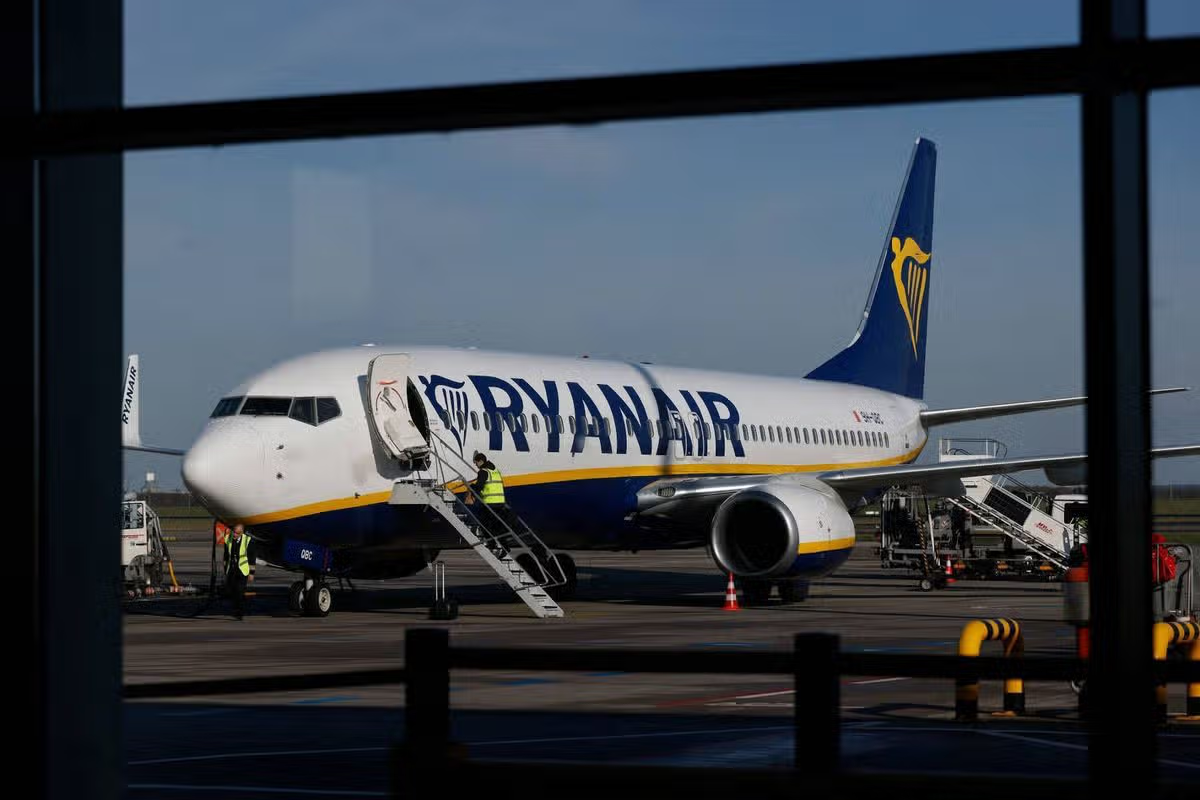
Ryanair has slashed the number of seats from its schedule for a city break destination that’s famous for its Christmas market and historic sites, as well as being a major business hub.
The decision was made in response to the country’s decision to raise aviation taxes, with Ryanair releasing a strongly-worded statement to announce they would be cutting two million seats from two of the capital’s airports.
The Federal Government of Belgium announced plans to raise the country’s aviation tax from €5 (about £4.20) to €7 (about £6) as of January 2027. This was erroneously described by Ryanair in a statement as a “250% increase since 2025.”
As a result, the budget carrier plans to cut five aircraft from its base at Brussels South Charleroi Airport, and reduce capacity by two million seats overall from Belgium’s Charleroi and Zaventem airports. The reductions will be applied to the winter 2026 and summer 2027 schedule.
Brussels is not the first destination to see a cut in the number of Ryanair seats this year. Earlier this year it announced reductions in services to Spain and Portugal, with smaller regional airports the most affected.
Valladolid and Jerez saw cuts to their services, while scrapped routes included Asturias and Vigo. A service to Tenerife North was also scrapped as a result of a dispute over airport fee hikes, leaving the airport with no alternative direct UK routes. Ryanair also closed its two aircraft base at Santiago de Compostela which reduced capacity.
As a result over one million seats were taken from the winter 2025 routes, and 1.2 million cut from the summer 2026 schedule. Another cut was to a Portugal service, with Ryanair cutting six routes to and from the Azores, an emerging tourist destination. It was estimated the cuts affected around 400,000 passengers.
At the time, Ryanair blamed this cutback on growing airport charges set by Portuguese authorities and environmental taxes linked to the EU Emissions Trading System. John Paul II Ponta Delgada Airport, the islands’ main airport, now only has a single seasonal UK route from London Heathrow operated by British Airways.
Speaking about the cuts in Belgium, Ryanair CEO, Eddie Wilson, said in a statement: “It’s absurd that the Federal Govt have decided to increase Belgium’s aviation tax by 250% from Jan ’27, especially when competing EU countries, like Sweden, Hungary, Slovakia, regional Italy, and Albania are abolishing aviation taxes to grow traffic, tourism and jobs.
“We warned Prime Minister De Wever that increasing Belgium’s aviation tax would result in traffic cuts, but he failed to listen. As a result, Ryanair will now remove 5 aircraft from our Charleroi base and 2m seats from our Brussels schedules (Charleroi and Zaventem) for Winter ’26/Summer ’27 and relocate to more competitive economies.”
Have a story you want to share? Email us at webtravel@reachplc.com
Despite this being lower than expected, Ryanair said it is still too high.
When the tax increase was announced at the beginning of the year, Ryanair boss Michael O’Leary slammed the plans, calling them “silly” and “damaging”.
He added: “Over the last 20 years, Ryanair has grown to be Belgium’s largest airline.
“This growth can easily be lost to tax abolishing countries like Sweden Hungary,SlovakiaandItaly, and if Charleroi and Belgium don’t reverse these taxes.”
Ryanair currently carries 11.6million passengers to and from Belgium, making it the largest airline operating in the country.
It’s not yet clear whether the routes axed will be from the UK.
Current flights routes to Charleroi include from Manchester, Newcastle and Edinburgh.
The first planes to get the new headrest will be the A350s by the end of this year.
The airline also previously ordered 270 new Boeing 777Xs, which will all have the headrest.
And then next year, the airline will install the headrest on its Airbus A380s and existing Boeing 777s.
Sir Tim Clark, President, Emirates Airline said: “Emirates never rests on its laurels when it comes to customer experience and we have found a way to significantly improve the comfort for Economy Class passengers, especially those travelling long-haul.
The seat will have a padded headrest meaning you don’t have to take a neck pillow onboardCredit: EmiratesThe new seat will be rolled out before the end of this yearCredit: Alamy
“The U-Dream changes the game if the person wants to sleep – by supporting the neck in full. No more neck pillows needed.
“It’s another innovation that shows our commitment to customers and cements our Economy Class as the best.”
Picking the right plane seat can make all the difference to your journey – and one flight attendant says there’s a simple strategy that could leave you with a much more comfortable flight
The flight attendant has shared the best seats to pre-book (stock)(Image: Getty)
Whether it’s a weekend break or a long-haul holiday, most travellers spend at least a little time trying to pick the best seat on the plane that they can find. Now, one flight attendant has shared the plane seats she always recommends booking in economy – along with the ones she avoids at all costs if you want a more relaxing flight.
Air hostess Sandra Jennie Kwon, who posts as @jeenie.weenie on TikTok, explained how she worked out her ideal seat after years of working onboard aircraft. In the video, she says: “The first elimination should be a no-brainer – the middle seats suck.
The back row of every section doesn’t recline. I’m not a tall person, so I don’t need the emergency exit rows. There’s also nowhere to store your personal belongings there. They also have those flimsy tray tables and seats, so let’s scrap them.”
The travel expert then revealed why she prefers sitting towards the back of the plane, explaining that airlines typically fill seats from the front first to help with weight distribution.
Because of this, she believes passengers at the back are more likely to end up with an empty seat next to them.
“For those odds, I prefer the back,” she said. “Seats near a toilet really stink, so I recommend a five-row buffer just to stay in the safe zone.”
She also ruled out window seats for one simple reason.
Content cannot be displayed without consent
“I hate asking people to move so I can use the toilet,” she explained. “So I eliminate all the window seats.”
However, she admitted there’s one advantage to sitting closer to the front.
“Meals are typically served from front to back, so you have a higher chance of getting your first meal choice.”
After weighing up the pros and cons, Sandra revealed her ideal economy seats are 49 C, D, F or G.
Her advice quickly sparked debate online.
One person joked: “No! Now everyone will rush to these seats and they’ll become more expensive than business class.”
Another wrote: “I was listening right up until you scrapped the window seat.”
A third added: “The amount of people that’ll be fighting for seats 49 C/D/F/G after watching this… omg.”
While someone else commented: “Me taking notes even though I probably won’t be on a plane for another year.”
A plane passenger thought paying extra would guarantee a stress-free flight – but moments after taking his seat, another traveller made a request that quickly turned the journey awkward
The plane passenger wasn’t backing down (stock image)(Image: Getty Images)
For many travellers, paying extra to choose a seat is worth every penny, especially if it means avoiding the dreaded middle seat or securing a window view for a long-haul flight. That’s exactly what one passenger thought he was doing when he paid an extra £150 to reserve a window seat on his flight to Brazil. But shortly after boarding, another traveller approached him with a request that left him in an awkward position.
Sharing his story on Reddit, he explained: “This stranger who was seated on the middle plane seats across from me with his child asked me if I could give up my window seat for his kid. I said, ‘Sorry, but no. I paid an extra 200 dollars for this seat’.” The man assumed that would be the end of the conversation, but says the father responded by glaring at him instead of accepting his answer. He added: “In my head I said, ‘Okay f*** you too!’ and went back listening to my music while looking out the window.”
However, just a few minutes later, the situation escalated when a flight attendant came over to speak to him.
He continued: “Not even five minutes later a flight attendant taps me on the shoulder asking me if I could give up my seat for his kid.
“I pulled out my ticket and the receipt I got when I paid extra for the window seat and told her, ‘No, I paid extra for window seat’.
“She said, ‘Okay, sorry to bother you sir’. I saw her walk back to him and say, ‘no’ for me.”
The passenger claims the father shot him another angry look, seemingly expecting the airline staff to persuade him to move.
Wanting to know whether he’d handled the situation correctly, he turned to Reddit to ask if he was in the wrong for refusing to swap.
Most users backed his decision, arguing that paying extra for a specific seat meant he was under no obligation to give it up.
One person said: “I used to fly for work every few weeks. It was pretty common for this to happen.
“I did the exact same thing. If I paid extra for a seat, I said no. If I was just changing seats so family could sit next to each other, and they were polite, I usually switched.”
They added: “Didn’t matter to me. Just the politeness. I was going to read most of the time anyway. If they were rude I just said no and stuck my head in a book.”
Delta Air Lines Inc. Chief Executive Ed Bastian said travelers care more about their seat than extras like lounge access or limousine shuttles often thrown into costly tickets, as he defended a stripped-down premium product that has irked some customers.
“Consumers want different value decisions to take,” Bastian said in a Bloomberg Television interview on Monday. “If you can give people the opportunity to sit in first class, they may not want different elements and they may not need to go in the lounge.”
Delta is bringing the basic-economy playbook to Delta First, Delta Premium Select and Delta One, offering passengers the same onboard seats, meals and service at a lower price in exchange for fewer benefits. Depending on the product, restrictions can include reduced mileage earnings, lower checked-bag allowances, fees for changes or cancellations and limits on lounge access and advance seat selection.
“What consumers care more about than anything is the seat,” Bastian said. “All the other things are nice, but it’s the seat and the comfort of the seat that’s most important.”
Bastian’s comments contrast Delta’s recent investments in its ground amenities. The airline has spent years opening and expanding swanky Sky Clubs and Delta One lounges, which remain in such high demand that crowding and lines have prompted tighter access rules.
Delta last month opened the first phase of a second Delta One Lounge at Los Angeles International Airport, a 4,000-square-foot space with table-service dining, showers and a premium bar. By 2028, Delta plans to operate four lounges at LAX spanning 60,000 square feet and seating more than 1,000 guests, part of a global network that now includes five Delta One Lounges and more than 50 Sky Clubs.
“One of the things we’re disappointed about is the continued segmentation of the fare structure,” Jefferies analyst Sheila Kahyaoglu said in an interview with Bloomberg Television, referring to how Delta has refined its premium offering into different, sometimes hard-to-follow groups. “You could accidentally get locked out of a lounge if you don’t pick that main business fare.”
Delta last week reported second-quarter earnings that beat Wall Street expectations despite recording the highest quarterly fuel expense in its history. The airline earned an adjusted $1.56 a share, topping analysts’ estimate of $1.51, while revenue rose 14% from a year earlier and capacity increased just 1%. Delta also reaffirmed its full-year profit guidance.
Bastian said strong demand for premium, corporate and international travel helped offset the surge in fuel prices caused by fighting in the Middle East. Although fuel costs eased as the war in Iran appeared to be winding down, renewed US military strikes have raised the risk of another escalation and kept energy markets volatile.
The CEO reiterated that Delta would continue pricing tickets to recover those higher costs and did not expect airfares to decline. The new basic premium fares give the airline another way to appeal to price-conscious travelers without broadly discounting its most valuable seats.
The strategy also allows Delta to widen the pool of passengers who can afford premium cabins while still charging more to corporate travelers and frequent fliers who value flexibility, loyalty benefits and lounge access. It reflects how airlines are increasingly selling each component of the travel experience separately.
But it risks alienating premium and loyalty travelers by introducing complexity or making it seem harder to get the same level of access.
“Delta’s change to its premium-seating offerings suggests competition is weighing on pricing at the front of the cabin, a negative for earnings,” Bloomberg Intelligence analyst George Ferguson said.
A man claims an airline tried to pressure him into giving up his business class seat so a parent could sit with their child – but he refused to play along and the youngster ended up sitting alone
He refused to swap plane seats (stock)(Image: Getty Images)
But after a flight attendant noticed a child sitting alone in economy while their parent was in business class, they reportedly made it their mission to reunite the pair. Taking to Reddit, he said: “I was asked to move from a row of two so a parent and child could sit together, and I don’t feel guilty for declining, no matter how much the flight attendant and the parent tried to guilt me.
“I wasn’t going to take a downgrade to economy. But even if I was asked to change to a seat in the same class, I would refuse. When I have to fly, I choose the seat that I want. Or, in rare cases when there are no assigned seats, I choose the best seat that’s available.”
He argued that parents should pay the extra cost to ensure they are seated with their children, rather than relying on strangers to swap seats at the last minute.
He added: “I’m not moving just because someone else is a parent. If someone is travelling with a small child, they need to plan better.”
The man also criticised the airline’s handling of the situation, claiming staff tried to pressure him into giving up his seat without offering any compensation.
He said: “While I did complain to the airline about 1) being asked to downgrade to economy without a refund or any compensation – I still wouldn’t have moved, but being told I should help without getting a refund was upsetting – and 2) being guilted by the flight attendants because I refused, I don’t expect a response.
“In Canada, the airline is legally required to give a refund if you are downgraded, so being told I wouldn’t be compensated at all if I changed seats was wrong.
“I don’t know what ended up happening, but the seat next to me was empty during the flight and I got to sit alone.
“Just because I’m not a parent doesn’t mean I should have to move. I don’t care if not moving makes me a bad person.”
Commenting on the post, one user said: “I’m surprised you weren’t offered booze by the flight attendant.”
Another added: “Why didn’t they ask the person next to the child to upgrade so the parent could move to economy instead?”
A third wrote: “So the parent booked business class for themselves and economy for the child, hoping they could guilt someone into upgrading the child for free at their own expense. You did the right thing.”
A WIZZ AIR pilot-in-training has revealed all about what it is like to work for the airline including the flying tips and tricks you need to know.
Having joined Wizz Air back in 2024 as cabin crew, Sebastien Harrison is now training to be a pilot through Wizz Air’s Cabin Crew to Captain programme.
Sign up for the Travel newsletter
Thank you!
And from spending years in the air, he has loads of tips for travellers.
When it comes to flying itself, the 20-year-old had many tips including where the best place to sit on Wizz Air planes.
He said: “The best seats in the plane for turbulence are on or about row 15; this is because if the plane is pitching up or dowduringne turbulence in the middle of the plane there is least movement.”
And for nervous fliers, Sebastien says: “If you are a first-time or nervous flyer, let the crew know as soon as you board.
“They are excellent at providing reassurance and will check in on you throughout the flight.”
And when it comes to managing tiredness when you reach your destination, Sebastien recommends not napping before your bedtime so you get solid sleep and avoid “pushing back the tiredness”.
He added: “Go to the gym at maybe 5pm because it’s going to make you tired and then you can go to sleep a bit earlier.”
And of course, there are a number of destinations Seb is excited to see and recommends visiting.
He revealed: “I’m very excited for the Greek destinations like Santorini, because obviously it’s an island with very beautiful weather and beautiful scenery.”
And if you want to head to a really unique destination then Seb recommends Tromso in Northern Norway.
He shared: “It’s in the Arctic Circle and it’s very beautiful, set in a valley surrounded by mountains.
“It is some of the best scenery I’ve seen in the world.
“You can see the Northern Lights, head skiing, spot whales and see reindeer – it’s just a very interesting place with loads to do.”
He added that the destination is also super unique because in the summer you get midnight sun, and in the winter you get polar night, where the sun remains below the horizon between late November and mid-January.
For a more beachy destination, Sebastien suggests heading to Catania in Sicily – which is Italy‘s sunniest destination.
He said: “There’s a volcano which you can see from the airport and the beaches are really cool.”
Having grown up only 10 minutes from Glasgow Airport in Scotland, Seb knew he wanted to one day become a pilot.
He said: “As a child I was always excited to literally leave the earth – you’re defying gravity.
“I think being able to literally fly planes is very rewarding.”
Then in 2024, his dream of working on planes came true as he got a job as Wizz Air cabin crew.
He said: “Being cabin crew has been a very useful experience.”
“Obviously I went into cabin crew knowing that I wanted to become a pilot and I just thought as cabin crew I would have the opportunity to speak to pilots a lot and really gain a lot of insight about the job.
“I knew that if I was cabin crew, I’d kind of see the job firsthand – it’s a very sociable job being cabin crew too.
“When I’m a pilot, it’s probably going to make me a better pilot as well because I’m going to understand what the cabin crew do as well, but some pilots they don’t 100 per cent appreciate it.”
“At the moment we’re only doing classroom theory training and we’re in the classroom for about four hours a day on average.
“There’s quite a lot of testing maybe about two or three tests a week just to make sure that you’re progressing – there’s 13 theory exams that you have to pass in total across around two years.”
FOR the past eight years I’ve wasted hours on busy, overpriced trains, travelling between London and my hometown of Devon.
But I recently discovered I could skip the sweaty crowds and do the journey in my sleep for the same price.
Sign up for the Travel newsletter
Thank you!
The Riviera Sleeper travels between London and CornwallCredit: The Sun – Cyann Fielding
While you might have heard of the Caledonian Sleeper from London to Scotland, I bet you aren’t familiar with Great Western Railway’s Riviera Sleeper from London to Cornwall.
The full journey from London to Penzance in Cornwall takes eight hours overnight, compared to the daytime five hour journey.
With the normal route being popular (and often packed with chaotic carriages where I arrive home disheveled and sweaty) I thought I would opt for the overnight option to Devon instead.
It takes just over five hours compared to my usual 2hr30, departing at 11:45pm and arriving at 5am.
I booked the cheapest seats on offer, paying £47.50 with a railcard, although the cheapest without a railcard is £43.
This got me an upright seat – if I had opted for a sleeper berth with a single or twin cabin, this would have set me back an extra £49 or £59, respectively, on top of the ticket price.
(Although for my journey, I couldn’t find any for less than £200).
The major benefit of booking a cabin is that you can use the fancy lounges – which have showers – at Paddington, Penzance, and Truro, with breakfast also included onboard.
People in the cheap seats get access to an onboard cafe for drinks and snacksCredit: The Sun – Cyann Fielding
I, however, was not one of the lucky ones, and instead boarded my seat shortly after arriving at London Paddington Train Station at around 11pm.
The train itself is weirdly clean – quite different from your standard daytime Great Western Railway train – and devoid of the usual crowds as well.
Replacing the loud beeping mechanical doors are retro-style doors you need to lean out of the window to open.
Then it comes to the part I was both dreading and anticipating – the seats.
Unlike the daytime trains, the Riviera Sleeper has a different style seat, with an overhead reader lightCredit: The Sun – Cyann Fielding
The operator claims they are similar to airline seats and at first glance, look a lot nicer than what you find on Ryanair.
But when it comes to the actual comfort – I think I would have preferred a budget flight middle seat.
It felt like sitting on a stack of squashed cardboard boxes, and bizarrely even more uncomfortable than the daytime GWR seats.
The head rest is annoyingly high, and the promise of extra legroom was unfounded.
Just the same as a daytime carriage you get a tray table, and then you’ll find plug and USB sockets by your feet.
Additions that you don’t get on the daytime trains include an overhead reading light and swish curtain on the window.
The service departs London for Cornwall at 11:45pmCredit: Alamy
So, how did I sleep? Well, I didn’t.
I simply couldn’t get comfortable as the seats are too small to lie across comfortably.
The minutes I did manage to get some sleep was when I put my feet on the seat next to me, I was quickly awoken by someones shouting “FEET” as they walked through the cabin.
I may be just 5″1, but the headrest didn’t help either – I knocked my head a few times just fidgeting and ended up slumping down in my seat to avoid it.
And all of this is without mentioning the disruption of passengers boarding at half-midnight, with the football playing on their phones at full volume.
Even though I saved money compared to a cabin, I definitely would only book this seat again if it was a last resort – I’d rather just stick to the daytime trains (which even in the noise I manage to get quick naps on).
There was one perk to trying this overnight train, however.
My train got into Exeter St David’s around 4:37am and because this was the stop before mine, I was starting to stir.
I also knew what was coming – a section of the track which I believe is home to the most beautiful train journey in the UK.
The biggest perk is getting to see the sunrise as you chug along the Devon coastCredit: The Sun – Cyann FieldingThough you’ll have to get up early to see itCredit: The Sun – Cyann Fielding
From Exeter, the train runs past Starcross, Dawlish Warren, Dawlish and Teignmouth with beaches and red cliffs on the left side of the train.
And at this time in the morning, a beautiful summer sunrise adds washes of orange, red and yellow.
While getting up early to see this might not be attractive and of course it depends on the time of year you are on the sleeper train, I would definitely recommend it.
The sea was perfectly calm, with only a couple of people entertaining their dogs on the beach, the sand was untouched and the water reflecting all the bright colours of the sky made it look like something from a postcard.
It almost made the seriously uncomfortable seat worth it… almost.
THE EU is in the midst of making huge changes when it comes to air travel and all of them will greatly benefit passengers.
These include no extra fees, better compensation rights and families heading on holiday can sit together at no extra charge – but now we’re out of the EU, the new rights will only carry weight for Brits on certain flights.
Sign up for the Travel newsletter
Thank you!
Changes to travel rules in the EU means families no longer have to pay to sit togetherCredit: Alamy
The new regulations were agreed by the EU Council and Parliament yesterday, making it the first overhaul in over 20 years and will come into play in 2027.
Some of the biggest changes include allowing families to sit together at no extra cost, as well as passengers having a free personal item to take onboard.
It will be easier for passengers to get money back for delays or cancellations too.
Airlines will need to immediately acknowledge a claim and then reply within 30 days.
For those who experience delays, there is a right to assistance which includes refreshments every two hours of waiting time, a meal after three hours, internet access and phone calls.
When passengers need overnight stays, they should be given the hotel free of charge and get free transport from the airport to the accommodation and back.
After a cancelled flight or denied boarding, passengers who choose to reroute must be given an alternative journey within three hours.
This all sounds great doesn’t it? Well, there is some bad news – this won’t count for all British travellers leaving the UK.
The new rules will only count on certain flights leaving the UKCredit: Alamy
As a result of Brexit, British holidaymakers won’t necessarily benefit from this as in some cases their flights will fall under passenger rights called UK261.
Whereas for those living in the EU, the new regulations count for all.
For Brits heading on holiday, taking advantage of these EU changes will depend on the route and the airline.
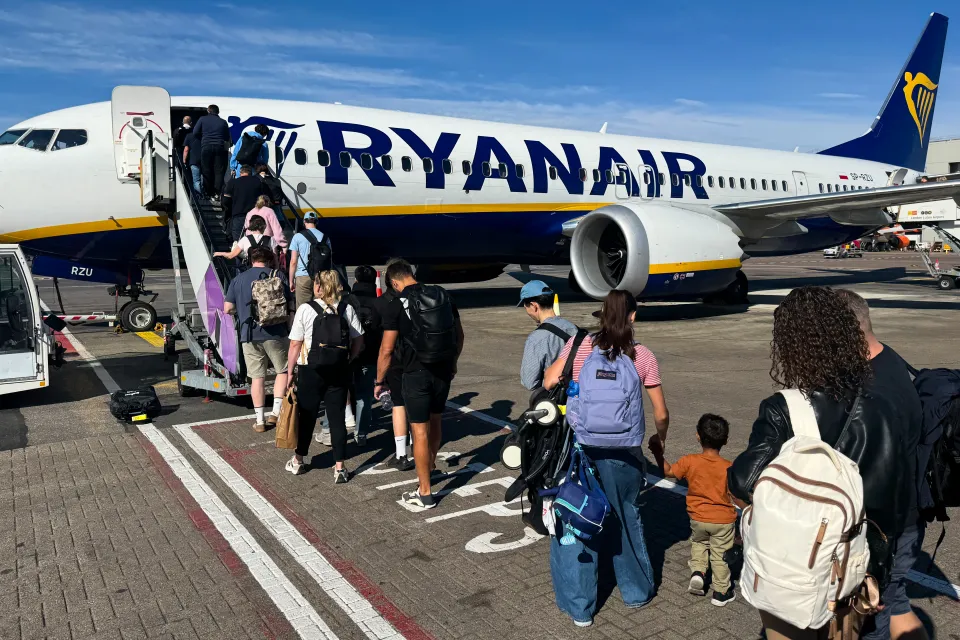
For example, a flight leaving the UK for Malaga with Ryanair will fall under EU rules as Ryanair is an EU airline.
The Malaga to UK return leg will also be under the EU rules – on the return journey, it doesn’t matter if the airline is EU or non-EU, because the flight departs from the EU.
Along with Ryanair, the likes of Wizz Air, easyJet and Lufthansa are all EU-airlines so the new rules automatically count for Brits on both journeys to EU countries.
There will however, be a gap on flights leaving the UK on a non-EU airline.
On EU operated airlines like Ryanair – the new EU rules will apply to Brits on both legsCredit: MoreISO
For example, if a British passenger flies from London to Madrid on a UK airline like British Airways, that outbound leg would remain under UK261 rules rather than the new EU regulations.
But the return would fall under the EU rules because it departs from Madrid in the EU.
So Brits heading on holiday will only get the new benefits if they are travelling on EU-covered flights.
They will not get them automatically on all flights from UK airports.
UK-airlines like British Airways, Virgin Atlantic and Jet2 won’t fall under the new EU rules.
But these do have their own guidelines and policies regarding families sitting together and luggage costs.
AirAdvisor CEO Anton Radchenko, a renowned aviation lawyer, added: “This agreement is a meaningful step forward for European passengers, and it throws the position of UK travellers into sharp relief.
“For the first time since Brexit, we are looking at a real divergence in the everyday rights of passengers flying from the UK versus those flying from the EU.
“The headline compensation amounts remain broadly aligned, but on the things passengers deal with on every single trip, being penalised for a missed leg, paying to sit next to your own child, comparing fares that hide the cost of a bag, EU travellers are about to pull ahead, and UK travellers are at risk of being left behind.”
This isn’t the first time that Turkish Airlines has offered premium-style seats onboard.
It used to offer Comfort Class on some of its routes on Boeing 777 aircraft – but these were withdrawn in 2013.
On the subject, Murat Şeker added that the previous offerings were “not the right time” or “the right configuration”.
Currently, Turkish Airlines has economy seats which have adjustable headrests and arms as well as entertainment screens and USB ports in the seats.
The other are in business class which have lie-flat seats with a massage feature, a cocktail table, touchscreen media screens and adjustable head rests.
Previously, the airline had Comfort Class but discontinued these in 2013Credit: Flickr/Luke Lai
This isn’t the first time either, in fact that award marked the tenth win in a row for the airline.
At the same awards, it scooped up eight accolades in total and placed sixth in the rankings for ‘World’s Best Airline’.
Turkish Airlines also won the ‘Best Economy Class in Europe‘, ‘Best Economy Class Onboard Catering in Europe’, ‘Best Business Class Onboard Catering’.
It also was awarded the ‘Best Business Class in Europe’, ‘Best Business Class in Southern Europe’, ‘Best Business Class Onboard Catering in Europe’, and ‘Best Airline in Southern Europe.’
Turkish Airlines also offers cheap flights from the UK to destinations like Istanbul, Antalya, and other Turkish cities, as well as other destinations like New York, Sharm El Sheikh, and Cape Town.
Los Angeles voters will cast ballots in eight City Council district elections next week, including for two open seats where incumbents are leaving because of term limits.
The contests for the seats being vacated by Councilmembers Bob Blumenfield and Curren Price have drawn large fields of candidates, but the biggest spending has been in the Westside’s District 11, where incumbent Traci Park is facing challenger Faizah Malik, a public interest attorney and one of four council candidates backed by the local chapter of Democratic Socialists of America.
Park has raised $1.3 million, according to the latest campaign finance reports filed Friday, while challenger Faizah Malik reported about $520,000 in contributions. In addition, more than $3 million has been spent in the race by so-called independent expenditure committees that spend money to elect or defeat candidates but which are barred from coordinating their activities with the campaigns.
The district includes Venice, Mar Vista, Brentwood and Pacific Palisades, which was devastated by wildfire in January 2025.
Malik said Friday she is confident heading into the primary election, saying most of her donations are under $100 each, and that she hasn’t taken money from corporations.
Los Angeles City Council candidate Faizah Malik attends a canvassing event March 15 in Westchester.
(Eric Thayer / Los Angeles Times)
“This is what it means to be a grassroots candidate, and it is just more evidence that the people of CD11 believe in our vision for a Westside that is affordable for everyday people,” Malik said.
A Park campaign aide said Park’s haul is indicative of the councilmember’s record of getting results.
“But no one is taking anything for granted,” the aide said in a statement. “We’re working until the final vote is cast because this election will determine whether the Westside keeps moving forward or gets pulled backward into the same failed ideological politics Angelenos are exhausted by.”
Los Angeles City Councilmember Traci Park, center, with members of United Firefighters of Los Angeles City on May 12.
(Genaro Molina / Los Angeles Times)
Park has emphasized her advocacy for fire recovery efforts, including pushing for permit fee waivers for residents wanting to rebuild. Malik has said Park has been too focused on single-family homeowners and said she would focus more energy on renters.
They have contrasting views on policing: Malik said she opposes expanding the size of the Los Angeles Police Department and instead supports shifting more resources to the city’s unarmed crisis response program. Park said the Police Department should have about 10,000 sworn officers, up from about 8,700 currently. She voted in favor of a 2023 LAPD contract that gave raises to officers and increased salaries to new hires.
They stand in contrast of each other on the Venice Dell housing development project, which would turn a city lot into 120 housing units for low-income and homeless people. Park opposed the completion and instead wants to turn it into a “mobility hub” and move the housing project to an adjacent lot. Malik, who represented the developer that filed a suit against the city claiming Park and others sought to kill the project, said the project was a motivating factor for her campaign.
District 9
Six candidates are vying to replace Councilman Curren Price, who hit the 12-year limit, in District 9. The district includes the Convention Center, USC and communities along the Harbor Freeway.
The candidates vary on key issues, including policing and housing. Estuardo Mazariegos, co-director of the Alliance of Californians for Community Empowerment Los Angeles, is backed by the Democratic Socialists of America. He has called for reducing the LAPD budget and redirecting funds to other city departments.
Two other candidates — Jorge Hernandez Rosas, an educator, and Jose Ugarte, who previously worked for Price — said they support hiring more police officers. Another hopeful, Elmer Roldan, executive director of Communities in Schools of Los Angeles, said he believes in keeping the LAPD at its current size.
Ugarte, Roldan, Rosas and Martha Sánchez, a therapist, all support enforcing Municipal Code 41.18, which bars homeless encampments near schools and daycare centers. Mazariegos and Jorge Nuño, an entrepreneur, say the code doesn’t solve homelessness and instead just moves people around.
Ugarte has raised the most in contributions of any candidate and has been endorsed by the Los Angeles County Democratic Party in the nonpartisan race.
District 3
Three candidates are competing for an open seat in District 3, where Councilmember Bob Blumenfield has termed out of office. The district encompasses Woodland Hills, Canoga Park, Reseda, Winnetka and Tarzana.
The candidates are Tim Gaspar, who founded an insurance company, Barri Worth Girvan, district director for Los Angeles County Supervisor Lindsey Horvath, and Christopher Robert “C.R.” Celona, a tech entrepreneur.
The three candidates are similarly positioned on public safety, backing Mayor Karen Bass’ long-term goal to increase the LAPD ranks to at least 9,500 officers. All three also support enforcing Municipal Code section 41.18.
Gaspar and Worth Girvan have both scored key endorsements. Gaspar is backed by Blumenfield, billionaire developer Rick Caruso and Councilmembers Monica Rodriguez, Tim McOsker and John Lee and billionaire developer Rick Caruso. Worth Girvan has endorsements from a long list of state Democratic lawmakers, the county Democratic Party, the Sierra Club and labor unions.
Gaspar leads in campaign contributions, followed by Worth Girvan. Celona, who has promised to resuscitate the city’s entertainment industry by fast-tracking film permits and cutting red tape, trails far behind.
District 1
Councilmember Eunisses Hernandez faces four challengers in District 1, which stretches from Highland Park on the northeast to University Park on the southwest. She is backed by the local Democratic Socialists of America, and her challengers claim the district has suffered under under her leadership, pointing to MacArthur Park as emblematic of the homelessness and drug addiction crisis plaguing the city.
Hernandez counters with a list of accomplishments, including helping secure a $6.3-million state grant to house homeless individuals near the Arroyo Seco riverbed and advocating for a citywide network of unarmed crisis response teams.
She faces challenges from Maria Lou Calanche, a former Los Angeles police commissioner and founder of the nonprofit Legacy LA; Nelson Grande, an executive consultant and former president of Avenida Entertainment Group; Raul Claros, founder of California Rising; and Sylvia Robledo, a small-business owner and former council aide.
Incumbent Katy Yaroslavsky faces two challengers for her District 5 seat, both of whom oppose her stance on housing and public safety spending. The district includes some of the city’s wealthiest neighborhoods, including Bel-Air, Westwood, Cheviot Hills and Hancock Park.
Challengers Henry Mantel, a tenants’ rights lawyer, and Morgan Oyler, an accountant, say Yaroslavsky hasn’t done enough to increase the district’s housing supply. Yaroslavsky, who holds a wide lead in fundraising, has said she supports increasing housing density near transit centers but cautioned against building more than the city can sustain.
District 13
Councilmember Hugo Soto-Martínez, who is also backed by the Democratic Socialists of America’s L.A. chapter, faces three challengers in District 13, which includes Atwater Village, Glassell Park, Elysian Valley, Echo Park, Silver Lake and East Hollywood.
The list of challengers includes Colter Carlisle, vice president of the East Hollywood Neighborhood Council, Dylan Kendall, who runs Grow Hollywood, and Rich Sarian, vice president of strategic initiatives for downtown’s South Park Social District.
While Soto-Martínez supports expanding the city’s unarmed personnel program, Carlisle and Kendall would like to expand the police force. Sarian has said he supports the unarmed personnel program and wants to examine the LAPD’s current size and resources.
District 15
Incumbent Tim McOsker is facing off against community organizer Jordan River in District 15, which covers Harbor City, Harbor Gateway, San Pedro, Watts and Wilmington. McOsker has decades of experience in the political world, having worked in the mayor’s office, and the city attorney’s office before joining the City Council in 2022. Rivers, who is unemployed, is a member of the Green Party.
District 7
Monica Rodriguez is running unopposed for the District 7 seat in the northeast San Fernando Valley.
Times staff writers David Zahniser, Noah Goldberg and Sandra McDonald contributed to this report.
WHEN it comes to flying to the States, a major airline has unveiled a huge new revamp of their planes – and it’s making it much comfier to fly long-haul.
Having flown to and from America several times over the past five years to visit family, I quickly found a love for United Airlines‘.
Sign up for the Travel newsletter
Thank you!
United Airlines has launched a new cabin on its 787-9 Dreamliner aircraft between London Heathrow and San Francisco, AmericaCredit: Cyann FieldingThe new spacious Premium Plus seats feel more like business classCredit: Cyann Fielding
Follow The Sun’s award-winning travel team on Instagram and Tiktok for top holiday tips and inspiration @thesuntravel.
The airline recently announced they were launching a brand new ‘Elevated’ cabin on their 787-9 Dreamliner between San Francisco and London Heathrow, upgrading every single class from economy to business.
This includes the rollout of the first ever new business class United Polaris Studio suites, which have more spacious seats, larger screens and Bluetooth connectivity.
I, however, was trying out United’s new Premium Plus Economy seat which they say has “elements normally reserved for business class customers” – a welcome sight when leaving gloomy London.
Each seat comes with a pillow, blanket and amenity kitCredit: Cyann FieldingEach seat has a 40.6cm screen with Bluetooth connectivityCredit: Cyann Fielding
There’s a total of 35 United Premium Plus seats arranged in a 2-3-2 configuration in the new cabin design, each with privacy dividers and a built-in reading light – both firsts for United Premium Plus seats.
And in all honesty, the seats felt closer to business class than economy and even better than some business class seats I’ve experienced on other airlines.
I opted for the very first row with enough room that when stretching out my legs straight, they still didn’t hit the wall in front of me.
Plonking myself down in my aisle seat – which actually felt more like an armchair – I was immediately impressed by how comfortable it was.
And then when it came to checking out the generous 40.6cm 4K OLED screen, I was excited to snuggle down and watch one of the latest film releases.
Pressing play on Wuthering Heights, I connected my Airpods to the Bluetooth to listen in to the film and placed my phone on the quartzite cocktail table between my seat and the next seat to connect it to the wireless charging.
In the amenity kit, you’ll will find skincare products, an eyemask and socksCredit: Cyann FieldingThe seats even have a bottle holderCredit: Cyann Fielding
As for the amenities, a small ‘United 100’ pouch to celebrate the airline’s centenary was on my seat featuring branded socks, an eye mask and some Vitamin C Perricone MD products.
Also on my seat was a Saks Fifth Avenue pillow and blanket, which added to my cinema experience when Wuthering Heights started to play.
When it comes to space, passengers get 96.5cm pitch and 50.8cm width, and then 15cm of recline – which while not much felt spacious enough and with the new privacy screen acting as a good headrest, I was more than comfortable.
Power outlets and bottle holders are located between the seats for added convenience too.
Located on one armrest is also a remote for the TV and a small cubbyhole where you’ll find your overhead earphones.
Of course, you can now also get Starlink Wi-Fi on United flights – even if it is just for messaging – which I have to admit was super speedy.
The seats also have wireless chargingCredit: Cyann Fielding
Another thing I love about United is that you are always fed well,
My first meal consisted of an artichoke salad and bread for starter, with roast chicken for my main and chocolate truffles for dessert.
Mid-flight, I then enjoyed a chicken burrito and before landing, tucked into another salad and a paneer curry.
In between these courses, the cabin crew were great at always ensuring I had enough water or a drink of my choosing – whether that be alcoholic or non-alcoholic.
You will also get fed well with two meals and plenty of snacksCredit: Cyann FieldingElsewhere in the cabin, Polaris and economy seats have been upgraded tooCredit: Cyann Fielding
United aims to have at least 30 planes with the new Elevated interior flying by the end of 2027.
So if you’re trying to decide which airline to go with on your next trip to the US? I’d recommend United – if you want a business class experience on a premium economy budget.
What about United’s business class?
United Polaris Studio suites (the business class plus) includes lie flat seats, with a total area around 25 per cent bigger than the average Polaris seat.
Each of the eight studios feature a 68.6cm screen – which is the largest among US airlines – accompanied by noise-cancelling Meridian headphones.
They even have privacy doors, an extra ottoman seat, exclusive entree options, caviar and huge amenity kits.
The standard United Polaris seats (standard business class) have also been upgraded.
These seats also lie flat and passengers can choose to either face the window or centre of the plane, with these seats in particular having the ability to remove the wall between if you are travelling with someone.
Screens in United Polaris measure 48.3cm, and there is also a Snack Bar passengers can help themselves to.