saving

Trump’s drugmaker deals may save economy $529B over 10 years, White House says

White House economists estimate that President Trump’s deals with pharmaceutical companies to drop some of their U.S. prescription drug prices to what they charge in other countries could save $529 billion over the next 10 years.

The analysis obtained by the Associated Press includes the first economy-wide projections behind a policy at the core of Trump’s pitch to voters going into November’s midterm elections for control of the House and Senate. Democratic lawmakers have been doubtful about the savings claimed by Trump and these new numbers are likely to trigger additional questions about the data.

Cost-of-living issues are at the forefront of voters’ concerns and higher energy prices tied to the Iran war have deepened the public’s anxiety. Trump has tried in part to address affordability concerns by focusing on his efforts to cut deals with companies so that the cost of prescription drugs in the U.S. would no longer be dramatically higher than in other affluent nations.

“Now you have the lowest drug prices anywhere in the world,” Trump said at a Friday rally before a crowd of seniors in Florida. “And that alone should win us the midterms.”

The analysis was done by administration officials for the White House Council of Economic Advisers. They also estimated that federal and state governments could save a combined $64.3 billion on Medicaid during the next decade because of what Trump calls his “most favored nation” policy on drug prices.

Few of the details of the deals struck by the Trump administration and 17 leading pharmaceutical companies have been made public, making it hard to independently verify the projected savings. The White House analysis sought to estimate the prospective savings as more medications come onto the market and fall under Trump’s framework — with one model in the report tallying the possible savings at $733 billion over a decade.

Trump and his Department of Health and Human Services have touted his drug-pricing deals as transformative and urged Congress to codify their principles into law. Democratic lawmakers have challenged the administration’s claims of savings. Senate Finance Committee Ranking Member Ron Wyden, D-Ore., and 17 Senate Democrats in April proposed a measure requiring the administration to disclose the terms of the agreements signed by pharmaceutical companies.

“If these deals are so great, why is the Trump administration afraid of showing them to the public?” Wyden said when announcing the measure. Health Secretary Robert F. Kennedy Jr. said his team would share details that didn’t include proprietary information or trade secrets.

The White House said it has not shared the text of the agreements because they include highly sensitive data that could move financial markets.

The potential savings estimated by the Trump administration would be substantial as Americans spent $467 billion on prescription drugs in 2024, according to the most recent government data available. The analysis is premised on the idea that foreign countries would also pay more for their prescription drugs, which would diversify drugmakers’ sources of revenue and preserve their ability to innovate with new treatments.

Outside economists have caveated that any savings might not flow directly to patients, many of whom already pay discounted prices for their drugs through their insurance coverage.

The Congressional Budget Office in October 2024 estimated that a plan similar to what Trump ended up adopting could reduce prescription drug prices by more than 5%, though the decrease “would probably diminish over time as manufacturers adjusted to the new policy by altering prices or distribution of drugs in other countries.”

The scope of the savings claimed by the Trump administration are likely to intensify the scrutiny by Democrats, who counter that any price reductions would be offset by higher costs for prescription drugs not covered by the “most favored nation” framework. One of their main critiques is that pharmaceutical companies have increased their profit margins while working with the administration.

In April, staff working for Sen. Bernie Sanders, I-Vt., released an analysis that looked at 15 of the companies that have agreed to this drug-pricing plan and found that their combined profits jumped 66% over the past year to $177 billion. The report noted that the tax cuts Trump signed into law last year “exempted or delayed many of the most expensive drugs” from price negotiations with Medicare.

The Trump administration has countered that they consider Sanders’ critique to be flawed, saying that it’s based on the list prices for pharmaceutical drugs instead of the actual price that patients pay.

Boak writes for the Associated Press.

Source link

I am saving £3,000 on each family holiday by taking the kids away during term-time

Laura Melling, a mum-of-two, is willing to take the fine and the potential hit to her children’s schooling. She claims she’s saving herself a fortune by going against the rules and taking her kids away as and when she pleases

A mum saves £3,000 on each family holiday by taking her kids away during term-time.

It’s no secret that holiday prices soar during the school holidays. According to Go Compare, the high demand for a break away with the kids during the Easter holidays saw trips rise by 9% compared to non-peak periods.

And with the ongoing war between Iran and the US causing fuel shortage scares, some airlines are raising fares to combat jet fuel price increases. It’s a never-ending battle, particularly for state school families who don’t have the luxury of the long holidays as those in the private sector.

In a bid to tackle absenteeism among kids whose parents want to jet away during term time, many schools now fine £80 per parent, per child for any unauthorized absences up to five days outside of official holidays.

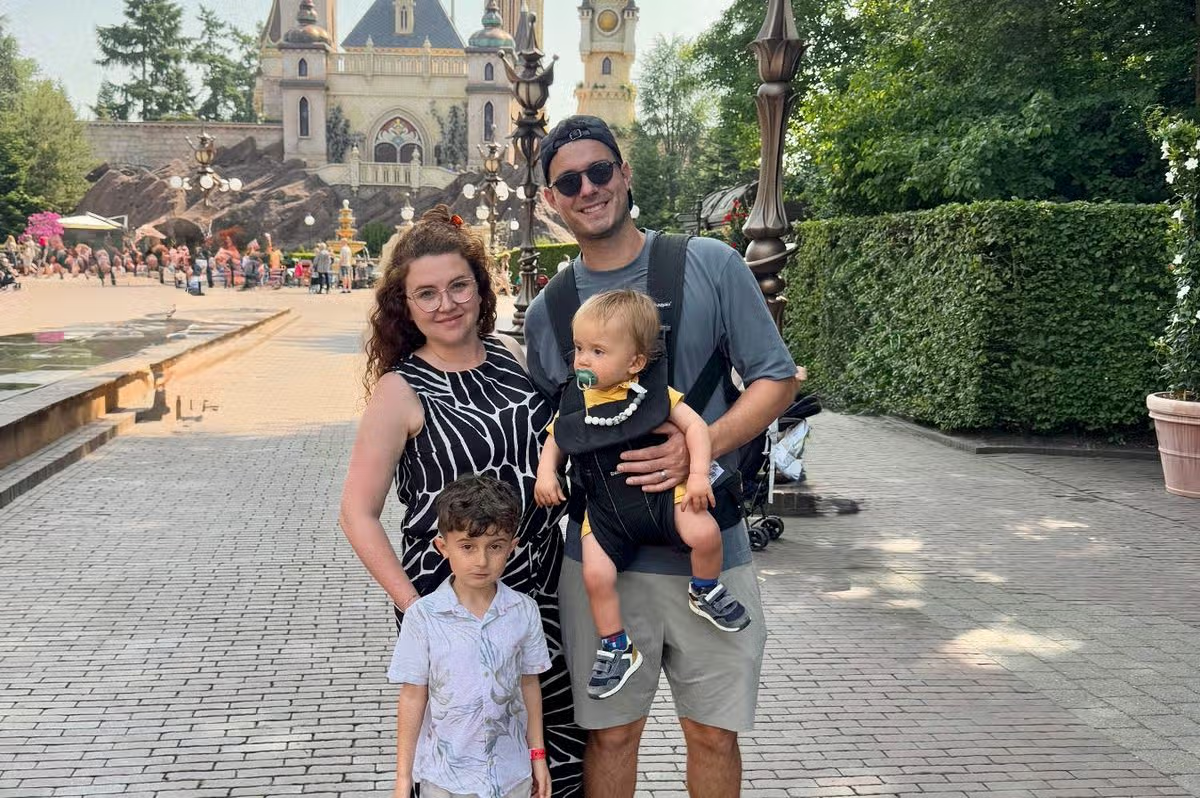
Laura Melling, a mum-of-two, is willing to take the fine and the potential hit to her children’s schooling. She claims she’s saving herself a fortune by going against the rules and taking her kids away as and when she pleases.

READ MORE: I visited the North Korean border – it’s even weirder than I expectedREAD MORE: How I’ve bagged extra days off to travel the world – and get paid for it

“It’s ridiculous, they’re my children – not the school’s,” the nurse, from Leyland, told creatorzine.com. “It works out cheaper to pay the fine than school holiday prices. I don’t feel guilty in the slightest. My kids are having the best experiences rather than sitting in a boring classroom.

“And we’re saving a fortune. It’s a no-brainer.”

Laura, 36, and her husband, Paul, 37, have shelled out over £500 in fines to date. But by jetting off during term-time, they’re saving themselves an estimated £3,000 per trip. And the mum to Lucy, eight, and Emily, seven, admits that teachers aren’t usually too displeased with their decision.

She said: “The teachers are usually supportive and say they wish they could do it. All the parents agree with me too. A few of them have followed suit after seeing us do it.”

So far, they’ve been to Egypt, Tunisia and France. And they’ve never paid more than £1,000 to get away for a week.

Earlier this year the family flew to Lapland. Instead of forking out £700-per-person for the flights in December, they went at the start of term in January, costing just £40-per-head. Their car hire was £189, rather than £545 during the school holidays and their accommodation came to just £500 instead of £1,900. In total, it saved them £2,946.

Laura added: “My kids are learning life skills. They learn in different ways when away, so we’re not neglecting their education. They have learning apps on their iPads and workbooks to complete.

“I would love to [take them out of school full-time], however, I don’t think our balance would cope; we need to work. My children are realising the world is a big place and they are now seeing different cultures.

“Everyone needs a break from the mundane, so being away gives us all time to relax and enjoy each other’s company without being stuck in a routine.”

Currently, parents whose children miss school without a good reason are initially given a fixed penalty notice of £80, which rises to £160 if not paid within 21 days. If the increased fine is then not paid within 28 days, or a child is off school three or more times within three years, the matter can be taken to magistrates’ court.

The court can fine parents up to £2,500, issue a community order, a parenting order or, in the most extreme cases, hand out a prison sentence of up to three months.

The Department for Education is attempting to tackle the scourge of absenteeism, which can impact a child’s prospects and disrupt the classroom.

Its spokesperson told the BBC: “Through our Plan for Change, we’re determined to give children growing up in our country the best start in life. But that can only happen if a strong foundation for learning is built through children regularly attending school.

“We have already made significant progress with five million more days in school in last academic year and 140,000 fewer pupils persistently absent. Poor attendance damages children’s prospects and term time holidays place the burden on teachers to support missed learning – affecting the entire class. That’s why fines have a vital place in our system, so everyone is held accountable for ensuring our children are in school.”

Source link