ruling

The Black Caucus is the ‘conscience of Congress.’ Supreme Court ruling has it bracing for a big hit

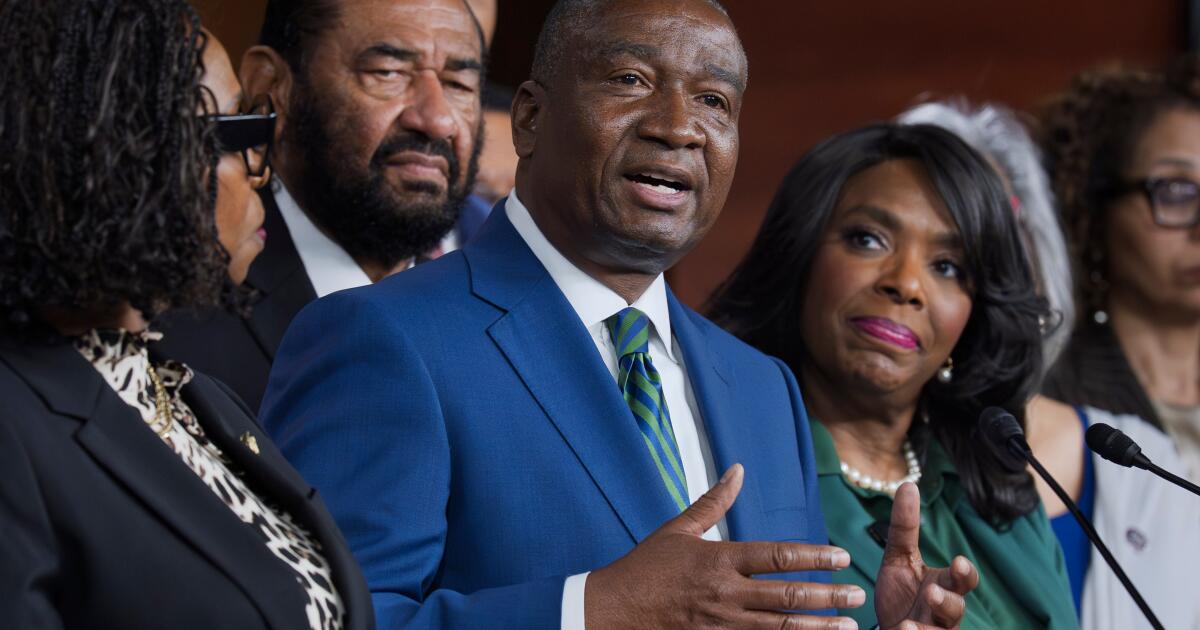
Black members of Congress are bracing for a crippling shake-up of their ranks after a Supreme Court ruling gutted a key section of the Voting Rights Act that had protected minority communities in political redistricting and helped boost their representation.

Wednesday’s decision clears the way for Republican-led states to redraw U.S. House districts without regard to race, potentially creating many more GOP-friendly seats.

Rep. Yvette Clarke, chair of the Congressional Black Caucus, told reporters that its members and Democrats would fight the effects of the ruling.

“The Supreme Court has opened the door to a coordinated attack on Black voters across the country,” Clarke said. “This is an outright power grab.”

Under Section 2 of the Voting Rights Act, voters could challenge electoral maps that appeared to dilute the ability of minority communities to elect representatives of their choosing. The expected wave of congressional redistricting by Republican-controlled states after Wednesday’s ruling, especially for the 2028 election and beyond, is likely to result in a much smaller Black Caucus.

Changes are coming, but how quickly is unknown

Clarke was joined by over a dozen of the 60 Black Caucus members, including Democratic House Minority Leader Hakeem Jeffries. Their responses to the court’s decision ranged from outrage to defiance to mourning.

It’s not clear how many seats will ultimately be affected by the ruling, but redistricting experts predict that more than a dozen now held by minorities could be swept away.

Rep. Troy Carter, one of two Black Democrats from Louisiana, the state at the center of the case, called the ruling “a devastating blow to our democracy, plain and simple.”

Republican leaders in several Southern states already have been discussing how to apply the ruling and create new GOP-friendly congressional maps. In Florida, Republicans wasted no time approving a new U.S. House map, part of which redrew one district created to elect a Black representative.

“I would be surprised if we do not see former slave-holding states moving at lightning speed to target districts that provide Black voters and other voters of color an equal opportunity to elect candidates,” said Kristen Clarke, general counsel for the NAACP and the first Black woman to be assistant attorney general in the U.S. Department of Justice’s civil rights division.

It’s not clear whether state-level voting laws or constitutional prohibitions against racial discrimination will provide any protection, she added.

Republican officials and Black conservatives praised the decision as a victory against race-based mandates. Linda Lee Tarver, of the Project 21 Black Leadership Network, said in a statement civil rights laws were not intended “to institutionalize racial line-drawing as a default feature of our political system.”

Voting Rights Act expanded Black representation

The Congressional Black Caucus was formed in 1971 as court-ordered redistricting under the Voting Rights Act, passed just six years earlier, sent more minorities to Congress.

The number of Black representatives in Congress jumped from nine to 13. Shirley Chisholm, the first Black woman elected to Congress, decided to expand the Democracy Select Committee created in the 1960s by Democratic Rep. Charles Diggs into the more formal Congressional Black Caucus.

The CBC raised its profile in its first year when it boycotted President Nixon’s State of the Union address after he refused to meet with the group. Nixon eventually acquiesced. The group created a list of over 60 recommendations to help the Black community, including counteracting racism and building adequate housing. It earned the nickname the “conscience of the Congress.”

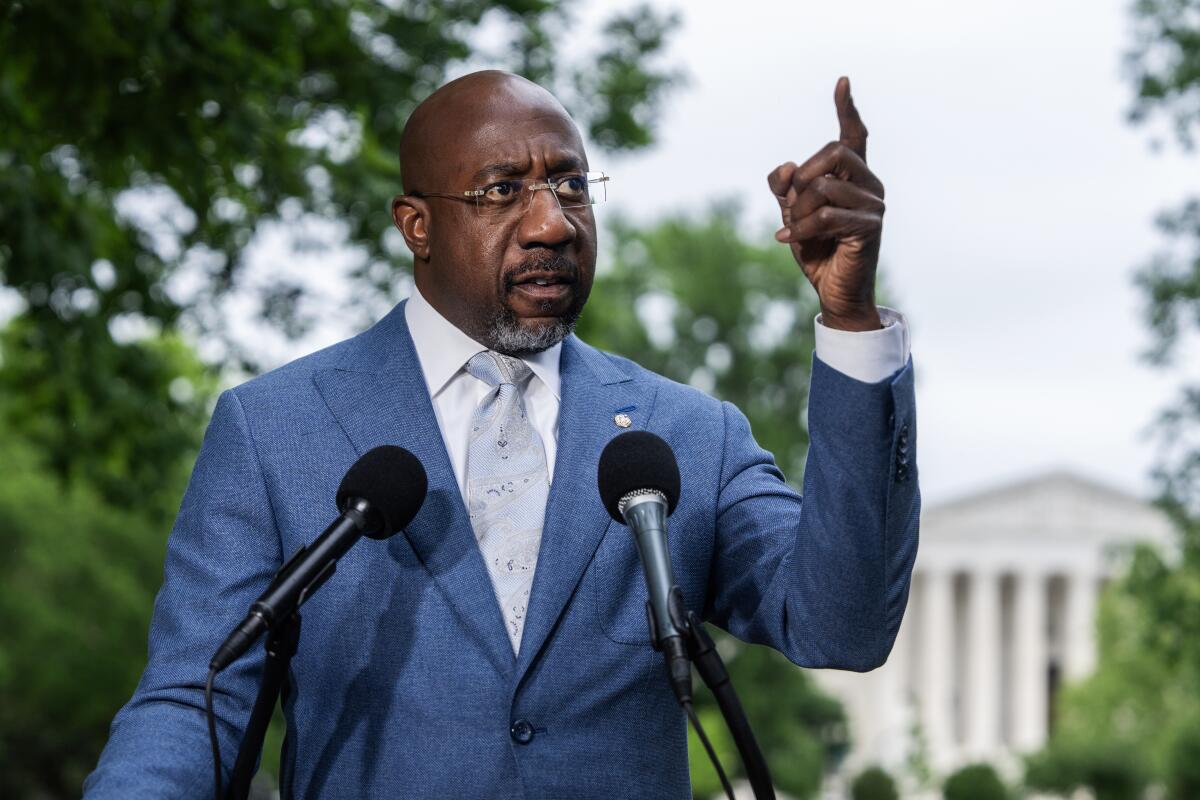
“That caucus has had such an important voice in American politics — the things that we’ve been able to achieve together, the creation of equity and access,” Democratic Sen. Raphael Warnock of Georgia said during a separate news conference Wednesday. “And I’m afraid that with this ruling, we could see that caucus shrink in a hugely significant way.”

What can Black constituents do

The ruling upset Thomas Johnson when he heard about it while visiting Louisiana’s Capitol in Baton Rouge. Johnson, who is Black, is from New Orleans and represented by Carter. He fears Republicans could redraw the state’s congressional map in a way that dismantles predominately Black districts.

“I feel like this is an embarrassing attack upon the minorities, particularly the Black community,” Johnson said. “We have very little [voice] in Congress.”

Antjuan Seawright, a Democratic strategist who advises the Black Caucus, said he expects the group will be involved in multiple legal fights for members whose districts will be targeted after the Supreme Court ruling. He also said the ruling makes voter turnout efforts even more important “if we want to change course on some of the things that are likely to happen because of this decision.”

Democratic Rep. Terri Sewell of Alabama, whose state was at the center of a major Voting Rights Act case decided in favor of Black representation nearly three years ago, agreed that the party now needs to focus on getting voters motivated ahead of this year’s midterm elections.

“Now more than ever, we need communities across this nation to mobilize — in state legislatures, in the courts and at the ballot box,” Sewell said. “We need to vote like we’ve never voted before.”

Tang writes for the Associated Press. AP writers Leah Askarinam, Matt Brown and Ali Swenson in Washington and Sara Cline in Baton Rouge, La., contributed to this report.
Source link

‘Earthquake’: Supreme Court limits Voting Rights Act in setback for Black Democrats, boost for GOP

The Supreme Court’s conservative majority on Wednesday sharply limited a part of the Voting Rights Act that has forced states to draw voting districts to help elect Black or Latino representatives to Congress as well as state and local boards.

In a 6-3 decision in Louisiana vs. Callais, the court ruled that creating these majority-minority districts may amount to racial discrimination that violates the 14th Amendment.

When weighing what the Voting Rights Act requires, “we start with the general rule that the Constitution almost never permits the federal government or a state to discriminate on the basis of race,” Justice Samuel A. Alito Jr. wrote for the court.

Alito said states may draw election districts for partisan advantage but may not use race as a basis for redistricting.

The ruling in a Louisiana case appears to clear the way for Republican-led states across the South to redraw their election maps and eliminate voting districts that favor Black or Latino candidates for Congress, state legislatures and county boards.

UCLA law professor Rick Hasen said, “It is hard to overstate what an earthquake this will be for American politics,” adding that the decision makes the Voting Rights Act a “much weaker, and potentially toothless law.”

Hasen said it’s unclear how the decision will affect the November election because in many states early voting has already started and primaries have already taken place.

But the ruling’s long-term consequences for minority representation in Congress, state legislatures and local government are almost “certainly” going to be felt in 2028, Hasen said.

Republican leaders in states across the South have already signaled they intend to move quickly to redraw congressional maps in the wake of the ruling.

Alabama Atty. Gen. Steve Marshall said the state will “act as quickly as possible” to ensure its congressional maps “reflect the will of the people, not a racial quota system the Constitution forbids.” Marshall called the decision a recognition of how much the South has changed since the civil rights era.

“The court rightly acknowledged that the South has made extraordinary progress, and that laws designed for a different era do not reflect the present reality,” he said in a statement.

Florida was already in motion before the ruling came down. But Gov. Ron DeSantis celebrated the decision and said it was all the more reason for state lawmakers to redraw its congressional maps, in a manner that could give Republicans up to four more seats in Congress.

The proposed congressional maps, drawn by DeSantis’ office, were first unveiled to Fox News on Monday. On Wednesday, both chambers approved the maps, and readied them for DeSantis’ final approval.

In Mississippi, Gov. Tate Reeves had already called lawmakers into a special session at the end of May in anticipation of a court ruling on the Voting Rights Act. In a post on X, Reeves underscored the ideological underpinnings to the ruling’s potential implications.

“First Dobbs. Now Callais. Just Mississippi and Louisiana down here saving our country!” Reeves wrote.

Sen. Raphael Warnock of Georgia speaks outside the Capitol.

Sen. Raphael Warnock (D-Ga.) speaks at a news conference outside the U.S. Capitol after the Supreme Court ruling.

(Tom Williams / CQ-Roll Call / Getty Images)

At issue was how to ensure equal representation for Black and Latino citizens.

About one-third of Louisiana’s voters are Black, but the state seeks an election map that will elect white Republicans to five of its six seats in the House of Representatives.

Lower courts said that map violated the Voting Rights Act because it denied fair representation to Black residents.

The state had one Black-majority district, in New Orleans.

Two years ago, judges upheld the creation of a second Black-majority district that stretched from Shreveport to Baton Rouge on the grounds that it was required under the law.

The state’s Republican leaders appealed and argued that race was the motivating factor in drawing the second district.

Alito and the conservatives agreed and called that district an “unconstitutional racial gerrymander.”

The three liberals dissented. The consequences of the ruling “are likely to be far-reaching and grave,” said Justice Elena Kagan, adding that it will allow “racial vote dilution in its most classic form.”

She said the decision means “a state can, without legal consequence, systematically dilute minority citizens’ voting power. Of course, the majority does not announce today’s holding that way. Its opinion is understated, even antiseptic.”

But she said states across the South may draw electoral districts that deprive Black voters of equal representation. Justices Sonia Sotomayor and Ketanji Brown Jackson agreed.

The decision was the latest example of a partisan political dispute in which the court’s six Republican appointees vote in favor of the Republican state plan, while the three Democratic appointees dissent.

The ruling is likely to have its greatest impact in the Southern states, where white Republicans are in control and Black Democrats are in the minority.

The court’s divide over redistricting is similar to the long dispute over affirmative action.

For decades, university officials said they needed to consider the race of applicants to achieve diversity and equal representation.

But in 2023, the court by a 6-3 vote struck down college affirmative action policies at Harvard and the University of North Carolina and ruled race may not be used to judge applicants.

The historic Voting Rights Act of 1965 succeeded in clearing the way for Black citizens to register and vote across the South, but it took longer for Black candidates to win elections.

The dispute was highlighted in a 1980 case from Mobile, Ala. Its three commissioners were elected to six-year terms, and each of them ran countywide.

Even though one-third of the county’s voters were Black, white candidates always won.

The Supreme Court upheld this arrangement as legal and constitutional. In dissent, Justice Thurgood Marshall said Black residents were left with the right to cast meaningless ballots.

In response, Congress amended the Voting Rights Act in 1982 to say states must give minorities an opportunity to elect representatives of their choice.

Four years later, the Supreme Court interpreted that to mean that states had a duty to draw voting districts that would elect a Black or Latino candidate if these minorities had a sufficiently large number of voters in a particular area.

In recent years, the court’s conservatives, led by Justice Clarence Thomas, have chafed at the rule on the grounds it sometimes required states to use race as a factor for drawing election districts.

Alito’s opinion adopted that view and said states are not required or permitted to use race as a basis for drawing districts.

Hours after the ruling came out, President Trump met with reporters in the Oval Office and said he had not yet seen the decision. He was visibly excited, however, when a reporter explained the decision favored Republicans.

“I love it!” he said. “This is very good.”

Former President Obama said in a statement that the court’s decision “effectively guts a key pillar of the Voting Rights Act, freeing state legislatures to gerrymander legislative districts to systematically dilute and weaken the voting power of racial minorities — so long as they do it under the guise of ‘partisanship’ rather than explicit racial bias.”

The Mexican American Legal Defense and Educational Fund, in Los Angeles, also denounced the decision.

“The Supreme Court’s decision blesses racially discriminatory gerrymandering, and dismantles the legal protections for minority voters,” said Nina Perales, the group’s vice president for litigation. It “openly invites states to dilute minority voting strength, and undermines our democracy.”

Source link

A Civil Rights Ruling Dear to South’s GOP

There is no little irony in the U.S. Supreme Court’s recent holding that racial redistricting is permissible as long as race is not the sole or dominant factor. With the Senate equally divided and Republicans holding a razor-thin advantage in the House of Representatives, the court’s ostensibly liberal ruling, one backed by civil rights organizations and opposed by the court’s four conservatives, could not be more dear to the hearts of Southern Republicans. The 5-4 decision will buttress GOP efforts to retain control of Congress by making the election and reelection of Republicans in the South easier after congressional districts are redrawn to reflect the 2000 census.

The strategy of racial redistricting, or creating “minority majority” congressional districts, was put into full play after the 1990 census. Racial gerrymandering isolates blacks, who vote overwhelmingly for liberal Democrats, in awkwardly shaped districts that often cut across the entire width of some states, particularly in the South. In turn, white conservative voters are placed in surrounding districts, which virtually guarantees the election of Republicans in those districts. As a result, although more minorities may be elected to Congress, fewer Democrats and more Republicans end up in the House of Representatives.

During the first Bush administration, the Department of Justice hit upon racial redistricting as a way to both increase minorities’ representation in Congress and elect more Republicans at the expense of the Democrats. The 1965 Voting Rights Act requires that all redistricting in Old South states not dilute black votes. Somewhat perversely, the department parlayed this standard into an affirmative action policy to benefit Republicans. By forcing Southern state legislatures to redistrict along racial lines, it slightly increased the number of minority-majority districts while greatly boosting the number of those disposed to vote Republican.

The Congressional Black Caucus welcomed the Bush administration’s innovative compliance with the Voting Rights Act, but white Democratic politicians in states like Virginia, North Carolina and Georgia were left in a no-win situation. On the one hand, they could not argue, at least vehemently in public, against the creation of such minority-majority districts without inviting charges of racism. On the other, they faced losing seats in districts that lacked their most reliable supporters.

Make no mistake, this affirmative action strategy worked for Republicans. Following the 1990 census, 26 new minority-majority districts were created. More blacks and Latinos were elected to Congress. But so were Republicans like Newt Gingrich; in 1994, the Grand Old Party won control of the House in large part because of their wins in the South.

Ever since, the Republican National Committee has pushed its self-serving version of affirmative action to maintain party hegemony in the South. Although not widely known, the committee has even developed computer programs and models–so-called “Max Black” plans–to help Southern legislatures draw racially gerrymandered districts for distribution to black politicians.

Ironically, during the last decade, the Supreme Court’s five most conservative justices voted to strike down such districts. The lead case, Shaw v. Reno (1993), involved a challenge to North Carolina’s 12th Congressional District. As redrawn in 1992, it was overwhelmingly black and slithered, snake-like, about 160 miles along Interstate 85, from Charlotte to Winston-Salem and to Durham. Writing for the court in that case, Justice Sandra Day O’Connor was joined by Chief Justice William H. Rehnquist and Justices Antonin Scalia, Anthony M. Kennedy and Clarence Thomas. She held that “bizarre,” ’tortured” and “irregular” minority-majority districts run afoul of the 14th Amendment’s equal protection clause.

O’Connor’s bare majority hung together in rejecting other racial gerrymandered districts in the 1990s. But she never completely ruled out race as a factor in redistricting. By contrast, Scalia and Thomas, the court’s most conservative justices, have held that race-based redistricting is never permissible.

The more liberal members of the court–Justices John Paul Stevens, David H. Souter, Ruth Bader Ginsburg and Stephen G. Breyer–steadfastly dissented. They argued for judicial self-restraint and deference to politics in determining the shape and composition of congressional districts.

The court’s latest ruling on North Carolina’s 12th Congressional District is its fourth. Redrawn three times since the 1993 case, the district is currently about 40% black and more compact, stretching across only one-third of the state, from Charlotte to Winston-Salem.

But this time, O’Connor abandoned her more conservative colleagues and joined with the more liberal dissenters. Race may be considered in redistricting, according to the court’s new majority, but only as long as it’s not the “predominate factor.” In other words, race may be a factor in redistricting but not the sole factor, and blacks apparently may not constitute a majority in the district.

With congressional redistricting underway, the decision in Hunt v. Cromartie could not be more timely. But it is certain to be a hollow victory for liberal Democrats, because, as O’Connor knows, it signals Republicans to press ahead with their brand of affirmative action in racial redistricting to hold onto their control of the House.

It’s noteworthy that the ruling turned on the vote of the justice with the most political experience and, arguably, the vote of the most political justice on the court. Before her appointment in 1981 by former President Ronald Reagan, O’Connor served on state courts and in Arizona’s state legislature, where she must have learned something about the politics of redistricting.

Moreover, she is at the court’s center stage, casting the pivotal vote on such hotly contested political issues as abortion and affirmative action. Recall, too, that on election night in November at a cocktail party, O’Connor reportedly became upset when news organizations initially announced that Vice President Al Gore had won the presidency. Her husband explained that she had planned to retire if Bush was victorious. Time will tell whether O’Connor will give President George W. Bush his first opportunity to make his mark on the Supreme Court.

Source link