ruling

A Civil Rights Ruling Dear to South’s GOP

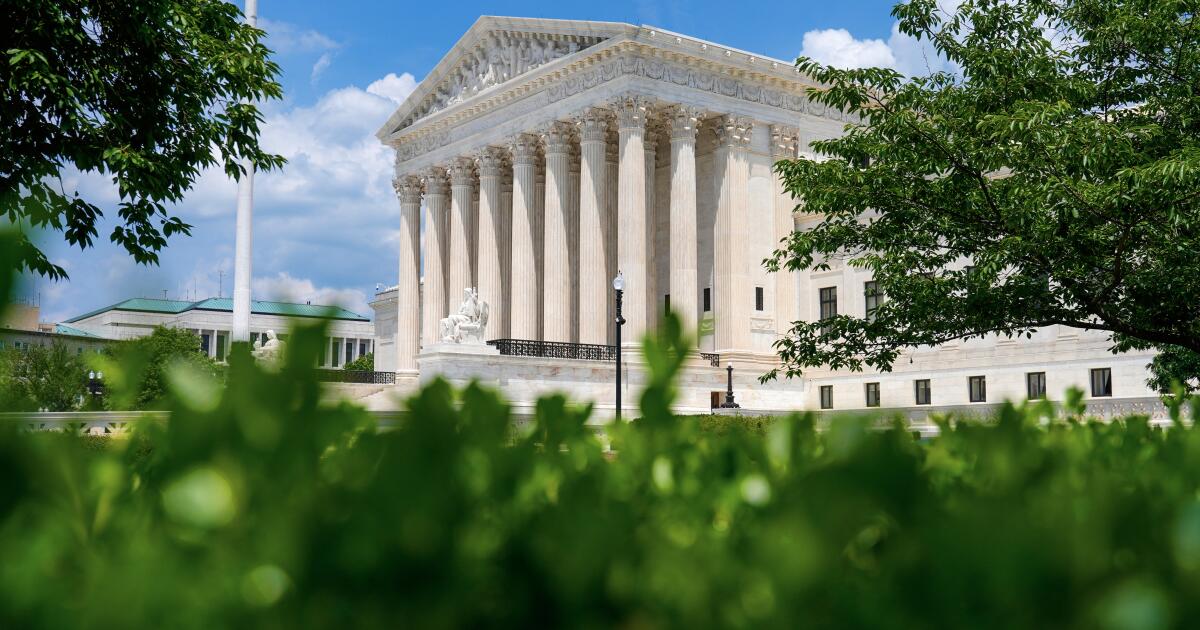
There is no little irony in the U.S. Supreme Court’s recent holding that racial redistricting is permissible as long as race is not the sole or dominant factor. With the Senate equally divided and Republicans holding a razor-thin advantage in the House of Representatives, the court’s ostensibly liberal ruling, one backed by civil rights organizations and opposed by the court’s four conservatives, could not be more dear to the hearts of Southern Republicans. The 5-4 decision will buttress GOP efforts to retain control of Congress by making the election and reelection of Republicans in the South easier after congressional districts are redrawn to reflect the 2000 census.

The strategy of racial redistricting, or creating “minority majority” congressional districts, was put into full play after the 1990 census. Racial gerrymandering isolates blacks, who vote overwhelmingly for liberal Democrats, in awkwardly shaped districts that often cut across the entire width of some states, particularly in the South. In turn, white conservative voters are placed in surrounding districts, which virtually guarantees the election of Republicans in those districts. As a result, although more minorities may be elected to Congress, fewer Democrats and more Republicans end up in the House of Representatives.

During the first Bush administration, the Department of Justice hit upon racial redistricting as a way to both increase minorities’ representation in Congress and elect more Republicans at the expense of the Democrats. The 1965 Voting Rights Act requires that all redistricting in Old South states not dilute black votes. Somewhat perversely, the department parlayed this standard into an affirmative action policy to benefit Republicans. By forcing Southern state legislatures to redistrict along racial lines, it slightly increased the number of minority-majority districts while greatly boosting the number of those disposed to vote Republican.

The Congressional Black Caucus welcomed the Bush administration’s innovative compliance with the Voting Rights Act, but white Democratic politicians in states like Virginia, North Carolina and Georgia were left in a no-win situation. On the one hand, they could not argue, at least vehemently in public, against the creation of such minority-majority districts without inviting charges of racism. On the other, they faced losing seats in districts that lacked their most reliable supporters.

Make no mistake, this affirmative action strategy worked for Republicans. Following the 1990 census, 26 new minority-majority districts were created. More blacks and Latinos were elected to Congress. But so were Republicans like Newt Gingrich; in 1994, the Grand Old Party won control of the House in large part because of their wins in the South.

Ever since, the Republican National Committee has pushed its self-serving version of affirmative action to maintain party hegemony in the South. Although not widely known, the committee has even developed computer programs and models–so-called “Max Black” plans–to help Southern legislatures draw racially gerrymandered districts for distribution to black politicians.

Ironically, during the last decade, the Supreme Court’s five most conservative justices voted to strike down such districts. The lead case, Shaw v. Reno (1993), involved a challenge to North Carolina’s 12th Congressional District. As redrawn in 1992, it was overwhelmingly black and slithered, snake-like, about 160 miles along Interstate 85, from Charlotte to Winston-Salem and to Durham. Writing for the court in that case, Justice Sandra Day O’Connor was joined by Chief Justice William H. Rehnquist and Justices Antonin Scalia, Anthony M. Kennedy and Clarence Thomas. She held that “bizarre,” ’tortured” and “irregular” minority-majority districts run afoul of the 14th Amendment’s equal protection clause.

O’Connor’s bare majority hung together in rejecting other racial gerrymandered districts in the 1990s. But she never completely ruled out race as a factor in redistricting. By contrast, Scalia and Thomas, the court’s most conservative justices, have held that race-based redistricting is never permissible.

The more liberal members of the court–Justices John Paul Stevens, David H. Souter, Ruth Bader Ginsburg and Stephen G. Breyer–steadfastly dissented. They argued for judicial self-restraint and deference to politics in determining the shape and composition of congressional districts.

The court’s latest ruling on North Carolina’s 12th Congressional District is its fourth. Redrawn three times since the 1993 case, the district is currently about 40% black and more compact, stretching across only one-third of the state, from Charlotte to Winston-Salem.

But this time, O’Connor abandoned her more conservative colleagues and joined with the more liberal dissenters. Race may be considered in redistricting, according to the court’s new majority, but only as long as it’s not the “predominate factor.” In other words, race may be a factor in redistricting but not the sole factor, and blacks apparently may not constitute a majority in the district.

With congressional redistricting underway, the decision in Hunt v. Cromartie could not be more timely. But it is certain to be a hollow victory for liberal Democrats, because, as O’Connor knows, it signals Republicans to press ahead with their brand of affirmative action in racial redistricting to hold onto their control of the House.

It’s noteworthy that the ruling turned on the vote of the justice with the most political experience and, arguably, the vote of the most political justice on the court. Before her appointment in 1981 by former President Ronald Reagan, O’Connor served on state courts and in Arizona’s state legislature, where she must have learned something about the politics of redistricting.

Moreover, she is at the court’s center stage, casting the pivotal vote on such hotly contested political issues as abortion and affirmative action. Recall, too, that on election night in November at a cocktail party, O’Connor reportedly became upset when news organizations initially announced that Vice President Al Gore had won the presidency. Her husband explained that she had planned to retire if Bush was victorious. Time will tell whether O’Connor will give President George W. Bush his first opportunity to make his mark on the Supreme Court.

Source link

Judge sides with Arizona election official in ruling that has implications for midterm voting

The top election official in Arizona’s most populous county will get more authority in running elections after a judge sided with his office in a prolonged legal fight with the local board that shares responsibility for overseeing the vote.

The decision could have broad implications in one of the nation’s most prominent battleground states, which will have several high-profile races this fall. Maricopa County, which includes Phoenix, has been roiled by election conspiracy theorists ever since President Trump lost the state to Democrat Joe Biden during his bid for reelection in 2020.

Justin Heap, the Republican recorder in Maricopa County, sued the predominantly Republican county board of supervisors last summer, alleging it had illegally taken control of certain aspects of election administration. Heap claimed the board transferred funding, IT staff and some key functions — including management of ballot drop boxes and establishing early voting sites — away from his office through an agreement negotiated with his predecessor, whom he had recently defeated in a GOP primary.

Maricopa County Superior Court Judge Scott Blaney mostly sided with Heap’s office in his ruling, which was filed Thursday but appeared on the public docket Friday. The board of supervisors “acted unlawfully and exceeded its statutory authority by seizing the Recorder’s personnel, systems and equipment and refusing to return them” to the recorder, he wrote.

Blaney also ruled that the recorder’s office is responsible for overseeing in-person early voting, among other duties, while the board is responsible for other operations, such as selecting election day voting locations, supplying polling locations and hiring poll workers.

“The Board’s assertion of plenary authority over election administration through its general supervisory powers is inconsistent with Arizona law,” the judge wrote.

Board Chairwoman Kate Brophy McGee said the board will consider an appeal.

“I disagree with other portions of the ruling, and I will explore all options with the Board of Supervisors, including an expeditious appeal,” McGee, a Republican, said in a statement. “From day one, the Board of Supervisors has provided Recorder Heap the resources and staffing needed to fulfill his statutory duties. We will continue to do so because voters always come first.”

In a statement, Heap praised the ruling as a “clear and decisive victory for the rule of law and for the voters of Maricopa County.”

“The court confirmed that the Board cannot override state law, use funding as leverage, or take control of election duties assigned to the Recorder,” Heap said. “This ruling restores both the authority and the resources necessary for my office to do its job.”

Heap, a former Republican state lawmaker, was elected in 2024 after unseating incumbent Stephen Richer in the GOP primary and defeating a Democratic candidate in the general election. In the past, Heap has stopped short of repeating false claims that the 2020 and 2022 elections were stolen but has said voters don’t trust the state’s voting system and that it’s poorly run.

False claims of fraud since the 2020 presidential election led to threats of violence against Richer and others in the Maricopa County elections office. Richer blamed Heap for contributing to an atmosphere of distrust and vitriol directed toward the office.

“He catered to the really ugly stuff that the people in that office had to live through,” Richer said of Heap, in an interview last month. “And he allied with people who were very much in the eye of the storm in terms of creating it.”

Once he took office, Heap terminated a previous agreement that was reached between Richer and the board that had revised how election operations were divided between the two offices. Heap filed his lawsuit with the backing of America First Legal, a conservative public interest group founded by Stephen Miller, now deputy chief of staff in the White House.

Kelety writes for the Associated Press.

Source link

Former Chapman University dean disbarred for Trump 2020 election role

The California Supreme Court ordered attorney and former law school dean John Eastman disbarred on Wednesday for his role aiding the Trump administration’s attempt to overturn the 2020 election.

The court ordered Eastman’s name be “stricken from the roll of attorneys” and that he pay $5,000 to the State Bar of California.

Eastman’s attorney, Randall A. Miller, told the Associated Press that the court’s decision “departs from long-standing United States Supreme Court precedent protecting First Amendment rights, especially in the attorney discipline context.” Miller did not immediately return an after-hours phone call seeking comment from The Times.

State Bar Chief Trial Counsel George Cardona said in a statement that the ruling “underscores that Mr. Eastman’s misconduct was incompatible with the standards of integrity required of every California attorney.”

“Today’s California Supreme Court order disbarring John Charles Eastman from the practice of law in California affirms the fundamental principle that attorneys must act with honesty and uphold the rule of law, regardless of the client they represent or the context in which that representation occurs,” said Cardona said.

The Supreme Court’s decision affirms a 2024 ruling from State Bar Judge Yvette Roland that Eastman be prohibited from practicing law.

In a marathon trial that lasted off and on from June to November 2024, the State Bar, which regulates lawyers in California, argued that Eastman was unfit to practice law for peddling bogus claims that fraud cost Trump the election and for promoting a fake-elector scheme to block the electoral count.

“It is true that an attorney has a duty to engage in zealous advocacy on behalf of a client,” Roland wrote in 2024 in a 128-page ruling. “However, Eastman’s inaccurate assertions were lies that cannot be justified as zealous advocacy.”

Roland found Eastman culpable of 10 of 11 counts of misconduct.

Eastman fomented “predictable and destructive chaos” when he stood beside fellow Trump adviser Rudolph W. Giuliani on Jan. 6, 2021, and told an enormous crowd at the Ellipse that the election had been fraudulent, the bar argued.

Eastman claimed he was acting in good faith, and as a vigorous champion of his client. But State Bar attorneys argued that “the evidence, including his often not-credible trial testimony, shows that he held — and still holds — truth and democracy in contempt.”

Despite Eastman’s repeated assertions that Joe Biden’s victory was illegal, Roland ruled, Eastman’s own words showed he knew that proof was lacking.

The judge cited an email that Eastman sent to a friend, Cleta Mitchell, on Nov. 29, 2020, acknowledging that fraud serious enough to sway the results could not be proved.

“It would be nice to have actually hard documented evidence of the fraud in the areas to which the analyses pointed,” Eastman wrote.

After the 2024 ruling Eastman responded on his Substack writing that he hoped the California Supreme Court or U.S. Supreme Court would “step in to put a stop to this lawfare that has become a serious threat to the First Amendment, the right of controversial clients and causes to legal representation, and more broadly to our adversarial system of justice.”

Eastman has a long history in California’s conservative legal circles. He was hired by Chapman’s law school in 1999 and was dean from June 2007 to January 2010, then continued to teach courses in constitutional law, property law, legal history and the 1st Amendment.

He retired in early 2021 after more than 100 Chapman faculty and others affiliated with the university signed a letter calling on the school to take action against him for his role in the Jan. 6 insurrection.

Wednesday’s decision is a bookend in a lengthy investigation into Eastman’s actions that began in 2021. In October of that year, the nonpartisan legal group States United Democracy Center filed an ethics complaint calling on the State Bar to investigate Eastman’s Jan. 6 actions.

Christine P. Sun, senior vice president of legal at the States United Democracy Center, said on Wednesday that the court’s decision is “part of a broader reckoning for those who seek to undermine the rule of law.”

“Eastman played a central role in the plot to overturn the 2020 election—pressuring state officials, advancing baseless claims in court, and promoting a fringe theory that the vice president could reject certified electoral votes,” Sun said in a statement. “His unethical actions have had real, lasting consequences for our democracy, and we applaud the California Supreme Court’s decision to disbar him.”

Staff writer Christopher Goffard contributed to this report

Source link