2026 World Cup guide: Full TV schedule, results and standings
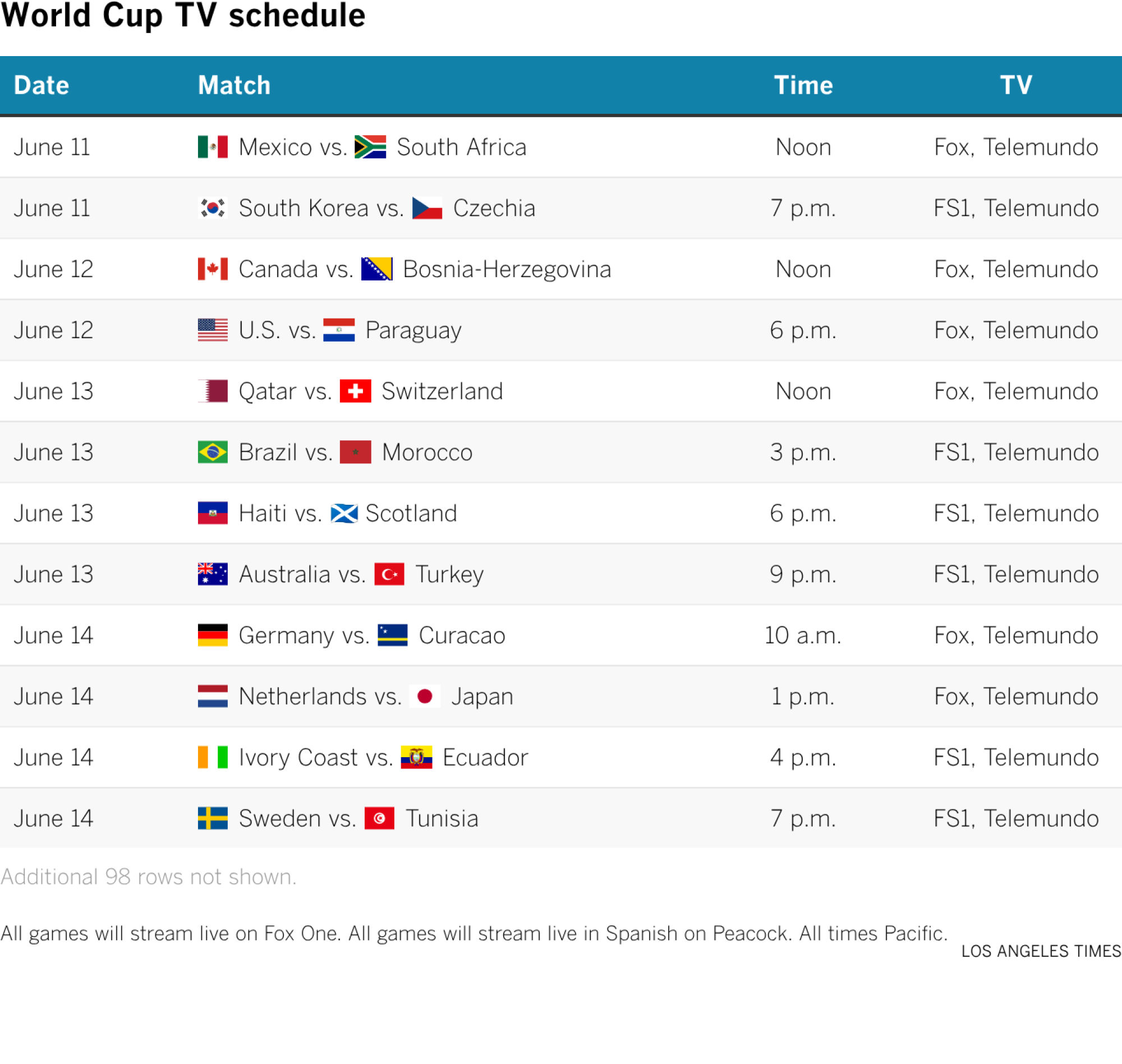
The first three days of the 2026 FIFA World Cup are done, with the U.S. and Mexico each winning their group stage openers. However, most of the World Cup field is still looking to hit the competitive pitch for the first time.
Here’s everything you need to know about matches being played on Sunday, Monday and Tuesday in the 48-team tournament across the U.S., Mexico and Canada (all times Pacific).

Sunday’s Group E games:
Germany vs. Curacao

Germany’s Antonio Rudiger and Deniz Undav walk on the field before a friendly against the U.S. in Chicago on June 6.
(Alexander Hassenstein / Getty Images)
Where: NRG Stadium, Houston
Time: 10 a.m.
TV: Fox, Telemundo
The buzz: This is David vs. Goliath. Germany, a four-time champion ranked 10th in the world, against Curaçao, the smallest country to qualify for a World Cup. But remember David won that first battle, and Curaçao, with a roster full of Dutch-born-and-bred players and an experienced coach in Dick Advocaat, at 78 the oldest manager in the tournament, won’t be a pushover.
Ivory Coast vs. Ecuador

Ecuador’s Piero Hincapie controls the ball during a World Cup qualifier against Argentina in September 2025.
(Franklin Jacome / Getty Images)
Where: Lincoln Financial Field, Philadelphia
Time: 4 p.m.
TV: FS1, Telemundo
The buzz: Ecuador hasn’t lost since September 2024, a run that’s been fueled by the European-based back line of Willian Pacho (Paris Saint-Germain), Piero Hincapié (Arsenal), Pervis Estupiñán (AC Milan) and holding midfielder Moisés Caicedo (Chelsea). Ivory Coast is the youngest team in the World Cup, with an average age of 25.4 years, but it beat France in its final tournament tuneup. In three previous World Cups, the Elephants failed to advance out of the group stage.

Sunday’s Group F games:
Netherlands vs. Japan

Netherlands standout Frenkie de Jong looks on during an international friendly against Algeria on June 3.
(Dean Mouhtaropoulos / Getty Images)
Where: AT&T Stadium, Arlington, Texas
Time: 1 p.m.
TV: Fox, Telemundo
The buzz: The eighth-ranked Dutch, arguably the best team never to win a World Cup, come into this tournament with a golden generation led by defenders Virgil van Dijk and Nathan Ake, midfielder Frenkie de Jong and coach Ronald Koeman. Japan’s only loss in the last 12 months came to the U.S. in a friendly last September; after that it beat fellow World Cup qualifiers England, Scotland, Ghana and Brazil and played Paraguay to a draw. The Dutch have lost just twice, to Algeria and Germany, in the last 23 months.
Sweden vs. Tunisia

Tunisia’s Hannibal Mejbri warms up before an international friendly against Belgium on June 6.
(Omar Havana / Associated Press)
Where: Estadio BBVA, Guadalupe, Mexico
Time: 7 p.m.
TV: FS1, Telemundo
The buzz: Tunisia played in five of the last seven World Cups without getting out of group play, but this time it brings a roster that blends international veterans such as midfielders Hannibal Mejbri (Burnley) and Elias Achouri (Copenhagen) and young talent, including teenager Rayan Elloumi of the Vancouver Whitecaps, the ninth-youngest player in the tournament. Sweden beat Ukraine and Poland in a pair of UEFA playoff games this spring to grab a place in this tournament. Aston Villa defender Victor Lidelof is the most experienced player with 76 caps, including four World Cup appearances.

Monday’s Group G games:
Belgium vs. Egypt

Belgium’s Joaquin Seys, left, and Axel Witsel celebrate after defeating the U.S. in an international friendly on March 28.
(Mike Stewart / Associated Press)
Where: Lumen Field, Seattle
Time: noon
TV: Fox, Telemundo
The buzz: Belgium hasn’t lost in more than a year, but it also hasn’t played a top-10 team since 2024. It has a veteran core of four players — midfielders Axel Witsel and Kevin De Bruyne, goalkeeper Thibaut Courtois and forward Romelu Lukaka — with more than 100 international caps. Egypt, Africa’s oldest national team, is playing in a World Cup for the fourth time and is still looking for its first win. Liverpool forward Mohamed Salah, the team’s active leading scorer, is the only player on the roster with a World Cup goal.
Iran vs. New Zealand

Iran’s Amirhossein Hosseinzadeh plays the ball during an international friendly against Gambia on May 29.
(Khalil Hamra / Associated Press)
Where: SoFi Stadium, Inglewood
Time: 6 p.m.
TV: FS1, Telemundo
The buzz: For the first time in World Cup history a tournament qualifier, Iran, will play in a country with which it is at war, the U.S. The Iranians, with the second-oldest roster in the tournament, are playing in their fourth straight World Cup. Only a 1-0 loss to the U.S. kept them from advancing out of group play in 2022. New Zealand, playing in its third World Cup, was winless the first two times — although it didn’t lose in its last visit in 2010, playing Slovakia, Italy and Paraguay to draws. The Kiwis are the only team this century not to lose in group play while also failing to advance.

Monday’s Group H games:
Spain vs. Cape Verde

Spain’s Ferran Torres scores during an international friendly against Iraq on June 4.
(Manu Fernandez / Associated Press)
Where: Mercedes-Benz Stadium, Atlanta
Time: 9 a.m.
TV: Fox, Telemundo
The buzz: Cape Verde is one of four nations making its World Cup debut and it will open against second-ranked Spain, a tournament favorite which has lost just once since March 2024. Every player on Spain’s roster plays for a top European team; four of them played in last month’s Champions League final.
Saudi Arabia vs. Uruguay

Uruguay’s Federico Valverde heads the ball past Brazil’s Joao Gomes during a Copa America quarterfinal match in 2024.
(Godofredo A. Vásquez / Associated Press)
Where: Hard Rock Stadium, Miami Gardens, Fla.
Time: 3 p.m.
TV: FS1, Telemundo
The buzz: Saudi Arabia, playing in its third straight World Cup, began its last visit by beating eventual champion Argentina in one of the most stunning upsets in tournament history. And the last time the World Cup was held in the U.S., in 1994, the Arabian Falcons became the first Arab-Asian team to reach the round of 16. Uruguay, a quarterfinalist in 2018, comes into this World Cup with an experienced roster led by Real Madrid midfielder Federico Valverde and Atlético Madrid defender José María Giménez.

Tuesday’s Group I games:
France vs. Senegal

France’s Kylian Mbappe works out with teammates in Waltham, Mass., on Friday.
(Martin Meissner / Associated Press)
Where: MetLife Stadium, East Rutherford, N.J.
Time: noon
TV: Fox, Telemundo
The buzz: France, ranked third in the world by FIFA, played in the last two World Cup finals and is favored to make it back again this year. Its best player, captain Kylian Mbappe, holds the tournament record with four goals in World Cup finals, including a hat trick in Qatar four years ago. Senegal is led by former African player of the year Sadio Mane, the country’s all-time leader in goals. Senegal made the quarterfinals in 2002 and the round of 16 in Qatar.
Iraq vs. Norway

Norway’s Erling Haaland controls the ball during a World Cup qualifier against Moldova in March 2025.
(Aurel Obreja / Associated Press)
Where: Gillette Stadium, Foxborough, Mass.
Time: 3 p.m.
TV: Fox, Telemundo
The buzz: Norway is playing in the World Cup for the first time this century which means Manchester City‘s Erling Haaland will finally make his tournament debut. A three-time Premier League scoring champion, Erling has more goals for club at country at 25 than either Lionel Messi or Cristiano Ronaldo had at that age. Iraq has gone even longer between World Cups, making its only appearance in 1986 when it lost all three games. Iraq won its way back with a 2-1 victory over Bolivia in an inter-confederation playoff last March. The winning goal came from forward Aymen Hussein, the team’s active leader in goals and appearances among outfield players.

Tuesday’s Group J games:
Argentina vs. Algeria

Argentina’s Lionel Messi, fourth from left, practices with teammates in Kansas City, Kan., on Thursday.
(Charlie Riedel / Associated Press)
Where: Arrowhead Stadium, Kansas City, Mo.
Time: 6 p.m.
TV: Fox, Telemundo
The buzz: Top-ranked Argentina was upset by lowly Saudi Arabia in its World Cup opener four years ago, then ran the table to give Lionel Messi the one title he was missing. Argentina returns 17 players from its world championship team, among them Messi, the golden ball winner; goalkeeper Emiliano Martínez, the golden glove winner; and midfielder Enzo Fernández, the 2022 tournament’s best young player. Algeria is ranked 28th in the world, it best ranking in more than a decade, and has lost just twice in the last two years. Its roster features 16 players from first-division clubs in Europe.
Austria vs. Jordan

Mousa Al-Tamari of Jordan controls the ball during the international friendly match against Switzerland on May 31.
(Sona Maleterova / Getty Images)
Where: Levi’s Stadium, Santa Clara, Calif.
Time: 9 p.m.
TV: Fox, Telemundo
The buzz: Jordan played its first international match in 1953 but it hasn’t played in World Cup until now, finally qualifying by finishing second to South Korea in its Asian group. Its best player is captain Musa Al-Taamari, a dynamic winger known as the “Jordanian Messi” who leads active players with 91 international caps. Austria is playing in the World Cup for the first time this century and it hasn’t won a game here since 1990. Its best player in Real Madrid defender David Alaba, a four-time Champions League winner and 10-time Austrian footballer of the year.