If you buy books linked on our site, The Times may earn a commission from Bookshop.org, whose fees support independent bookstores.
On a blazing hot Silver Lake morning, ushering in yet another heatwave day, Anna Holmes and I say “no” to a steamy sidewalk table at Millie’s Cafe, opting instead for an indoor, air-conditioned spot. Our server reads our order back to us, shaking his head in theatrical disbelief. “Pancakes. French toast. Biscuit. Waffle with whipped cream.” He glances from one of us to the other. “No protein?” he asks. “Just the carbs?”
“I guess I’ll have some egg whites, too,” I cave. Not so my brunch companion who confirms, “Just the carbs.” Holmes grins, “I’m not a fan of fad diets that make women hate ourselves.”
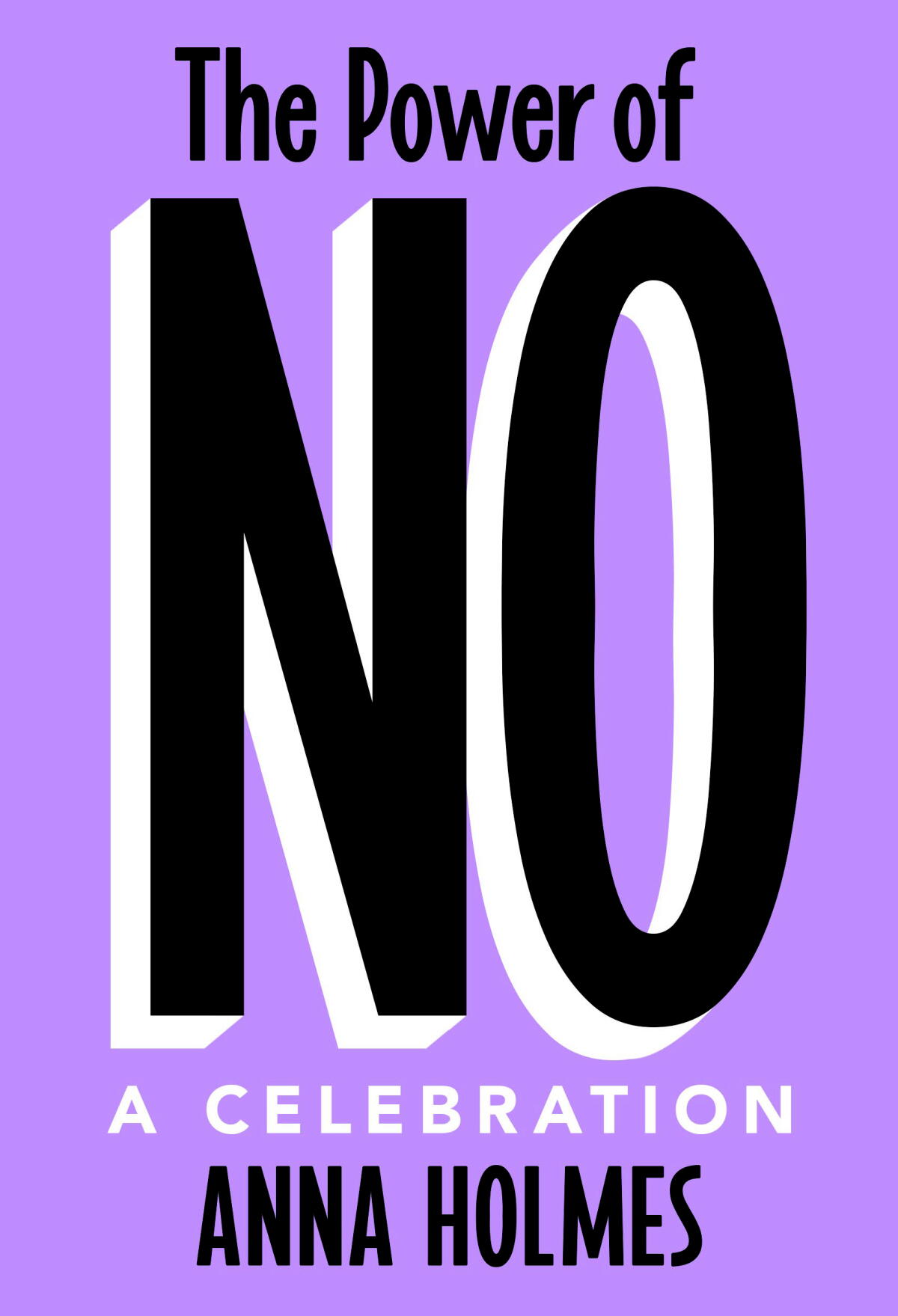
In fact, Holmes has built a career of saying “no” to woman-hating of all kinds — starting in 2007, when she founded the boundary-pushing feminist website Jezebel, the sister site of the notoriously provocative Gawker. “I decided that NO would be our mantra of sorts,” she writes in her new book, “The Power of No: A Celebration.” “‘No’ to diet tips, ‘no’ to sexist gossip, ‘no’ to conspicuous consumption. We drove the point home again and again … creating new definitions and examples of what it means to be female.”
Raised in a biracial, working-class family in Davis, Calif., Holmes escaped to New York at 18, chasing her writer’s dream. “Davis was a safe, homogenous little town,” she tells me, spearing one of the sliced strawberries fanned prettily across her waffle. “Being Black, I wasn’t one of the homogenies. I couldn’t wait to get out.”
“The Power of No: A Celebration” by Anna Holmes
(Crown)
Accepted by several top universities, Holmes said ‘yes’ to New York University. “They gave me money,” she explains. “And they had a journalism school.” After graduating, Holmes grabbed a rung on the media ladder and started climbing: writing and editing for Glamour, InStyle and Entertainment Weekly. Holmes published her first book, “Hell Hath No Fury: Women’s Letters from the End of the Affair,” featuring a collection of breakup letters from the likes of Anaïs Nin, Charlotte Brontë and Sylvia Plath, in 2002.
“So, you’ve always been a slacker,” I say.
Holmes laughs. “I come by my drive honestly. It stems from my fear of failure. And growing up lower-middle class, without the kinds of connections the wealthier kids had.”
Next came the breakthrough media success of Jezebel. Her project quickly reached 10 million monthly views, exceeding Gawker’s. But the bold irreverence that drew droves of devoted readers to Jezebel brought contention, too. In June 2010, Jezebel reported that women’s exclusion from senior positions at “The Daily Show” — which the article called a “boys’ club” — was “frustrating and alienating” for women. The story earned an on-air mention by Jon Stewart, who announced “Jezebel thinks I’m a sexist prick” — and an open letter signed by more than 30 female “Daily Show” employees, refuting Jezebel’s allegations.
Holmes says some Jezebel haters were anti-feminist or far-right. “Others were politically aligned with Jezebel, but felt we were too pop-culture-focused. Some accused us of being snarky to other women,” she adds.
After three years, Holmes resigned. “I’d done what I went to Jezebel to do,” she says. “Also, the 14-hour workdays were threatening my marriage, my sanity and my health. I was smoking too much. Drinking too much. Gaining weight.”
Holmes said a final goodbye to her creation in 2013 by publishing “The Book of Jezebel: An Illustrated Encyclopedia of Lady Things.” Despite — and because of — having founded one of the internet’s most provocative publications, she helped lift up journalists, and journalism, in her wake.
“I would follow Anna off of a cliff, professionally and personally,” says Reyhan Harmanci, Wired’s editorial director, who reported to Holmes at Topic magazine a decade ago. “She channels her curiosity in a way that opens the world to readers.”
Former Gawker editor A.J. Daulerio also lights up at the mention of Holmes’ name. “If you look back at Anna’s history of finding and developing talent, you can see her impact. Writers who’ve worked with and for her can be found on podcasts, on mastheads at major publications and on bestseller lists.” Meanwhile, New York magazine’s Emily Gould, who wrote the biting Slate critique of Jezebel in 2010, has come to admire Holmes. “Nobody’s right 100% of the time,” Gould says, “especially when publishing around the clock and reacting to news as it unfolds. My current sense of Anna is that she’s genuinely brave, clear-sighted and wise. I’m eager to read her new book.”
Post-Jezebel, Holmes wrote the “Bookends” column for the New York Times Book Review. Her byline grew a few picas when she replaced Roxane Gay as editor of the Times’ popular “Work Friend” column. Having “made it there,” Holmes decided to leave New York.
“I never considered myself a New Yorker,” she says, stirring a foam flower into her latte. “When people asked, I’d say, ‘I’m from California but I live in New York.’”
“The Obamas?” I blurt. Holmes nods. “I was tired of New York. And wanting to be closer to my elderly mom.” In the first week of the COVID shutdown, Holmes packed her two hissing black cats, donned an N95 mask and flew to LAX. Six years later, after several moves around town, she shares the upper half of a sun-splashed 1920s duplex with Ewok and Harriet.
“I didn’t have a writing community in New York and I don’t have one here,” Holmes says about her L.A. move. “I had a media community in New York. If that exists here, I’m not invited to those parties.” She cocks her head. “Every once in a while, I wonder, ‘Does Susan Orlean have regular salons? And if so, can I please go?’”
Holmes continues to settle into a slower, more domestic groove. “I’m 53 now,” she says. “I don’t want to go out all the time. I like going to bed early. All the cliches are true of me: moving from NYC to L.A. and ending up in Silver Lake — with a Volvo, no less. In my defense, I dress like a tomboy, I don’t have tattoos and I’ve never been to Bar Stella.”
Since her big move, Holmes has written “The Power of No” and is finishing up her fourth book, a sexual memoir. Her articles on wildly divergent topics continue to appear in the New York Times, the New Yorker, the Atlantic and L.A. Material.
“The Power of No” is a slim but impactful guide to the human dance between yes and no; vulnerability and ambition. The book consists of readily digestible yet smart, sophisticated bits, including quotes from luminaries, research findings, anecdotes from Holmes’ own life and others, practical tips, and lists like “Ways to Say No” (which is especially helpful to have on hand during the upcoming holiday season).
“No,” Holmes writes on Page 1: “As uttered by a woman, a provocation. Has there ever been a more fraught relationship between women and word?” By way of example, she cites what she calls “my biggest NO, my strongest rejection of what was expected of me as a woman: founding Jezebel.”
“Has writing about ‘no’ made you better at saying it?” I ask Holmes.
“I don’t purport to be good at it,” she answers. “But I’m more cognizant now of wanting to say it, at least.”
Miranda Hart broke down in tears on the latest episode of Celebrity Traitors following the exit of Joe Lycett and spoke candidly of the connection they had struck up following her illness
21:27, 16 Oct 2026Updated 21:27, 16 Oct 2026
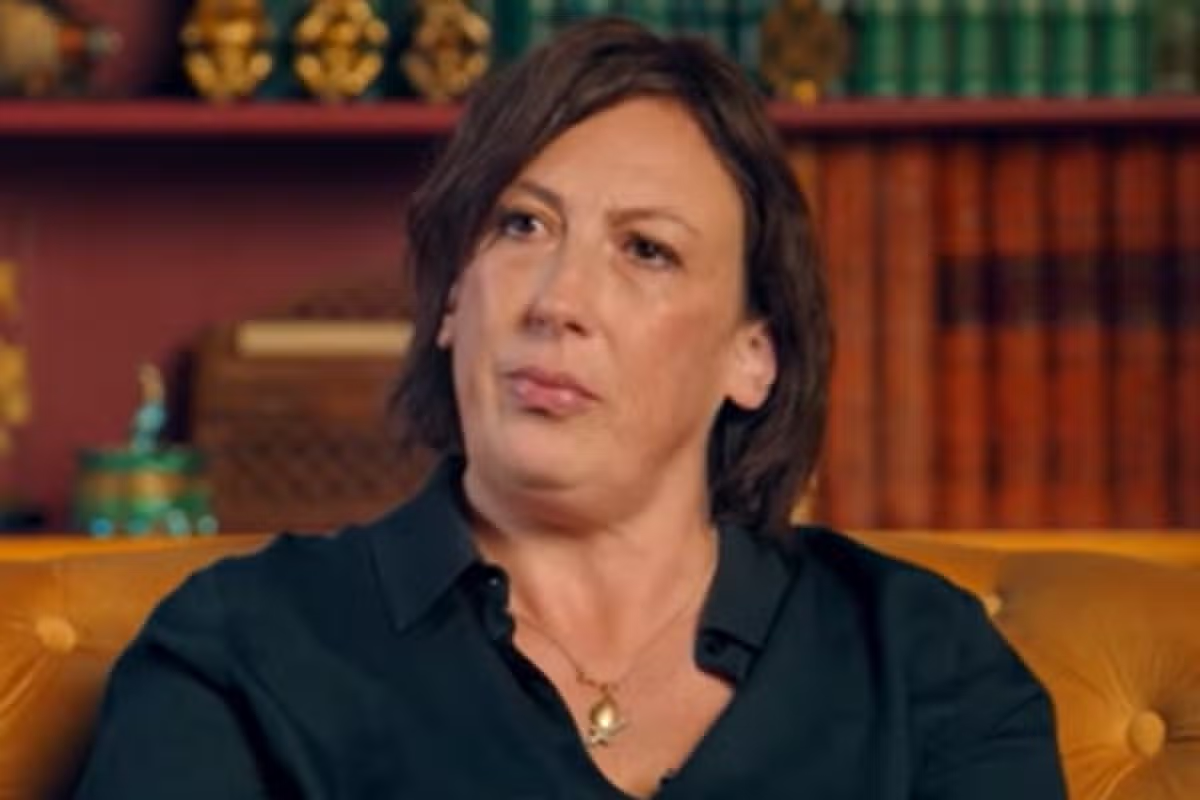
Miranda Hart broke down in tears on the latest episode of Celebrity Traitors(Image: BBC)
The comedienne, 53, had a hugely successful career in the 2010s with her eponymous sitcom but had to take time out of the spotlight after struggling with chronic fatigue. She had struck up such a close bond with fellow Faithful Joe that when he was banished from the castle, she was visibly moved.
She said: “I can’t believe how emotional I’m getting. Wow. Connection and laughter and joy are bigger than this game and to meet someone and just play and laugh – it’s all us humans need.
“I’ve had times in my life when I haven’t had that through illness and it’s brought up that in a silly sensitive soul.”
Ensure our latest headlines always appear at the top of your Google Search by making us a Preferred Source. Click here to activate or add us as your Preferred Source in your Google search settings.
Speaking to Traitor James Acaster, who comforted her with a hug, she said: “I haven’t played like that in so long. The floodgates just opened i guess, it suddenly wasn’t about a silly Faithful or Traitor.”
The TV star previously told how she had suffered a “tick-borne illness” while living in the USA as a teenager. At one point, she was diagnosed with myalgic encephalomyelitis (ME), also known as chronic fatigue syndrome, before eventually being diagnosed with Lyme Disease in 2020.
She said: “My decision making in life generally, and certainly work, is follow the joy. I haven’t done much TV work for a long time, having only recently come out of long-term ill health issues and when I was offered this, my whole body sort of relaxed, I smiled, and I just wanted to jump about like a schoolgirl with joy.
“It’s just fun. It’s outdoors, it’s games. All the stuff I love. It’s play basically. And I’m passionate about encouraging people to play more generally, and this game is that in spades.
“It’s a brilliant television show – the only flaw in taking part is that as a fan of the show it will be less fun to watch it with myself in it!”
Despite her new lease of life, the former Call the Midwife star, who secretly got married in late 2024, is still living with elements of her illness and is struggling to a point but has been able to manage her symptoms and insisted she felt well enough to join Claudia Winkleman’s hit BBC game show.
She added: “I’m still living with elements of ME, and that brings fatigue and pain to manage, but I have come to a point where I feel well enough to step out, and that’s also partly why I’m doing this.
“The joy of mucking about on television again will hopefully outweigh some of the challenges. And I think it will be challenging on my body, so it’ll be interesting, and it’ll take some courage as this is a big next step.
“When you live with a chronic illness, it’s invisible, so people don’t know that you’re sitting there in pain. But then it reminds you that everybody’s got their thing. So, I’m also really looking forward to making friends and looking after each other and hopefully they can carry me up a hill or whatever we’re going to have to do!”
The Fletcher family are back on Sunday with a new instalment of Fletcher’s Family Farm
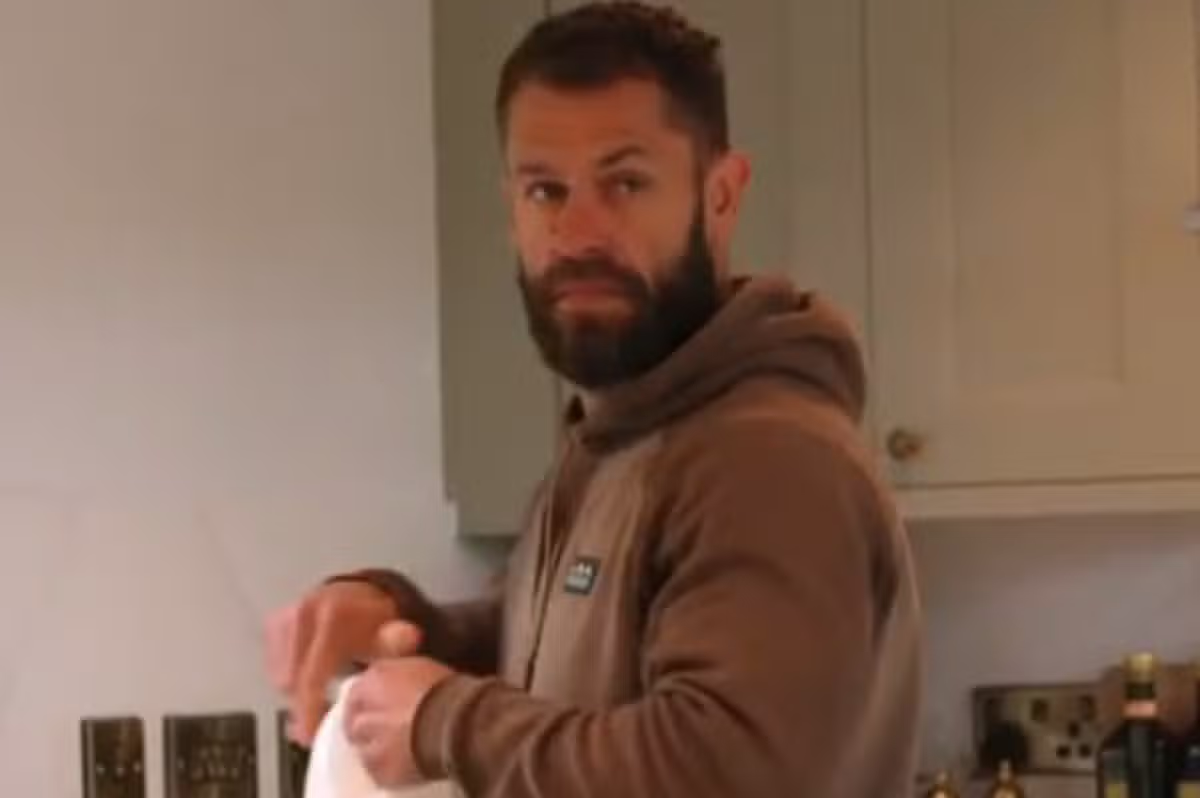
Kelvin moaned about cleaning up after his wife, Liz(Image: ITV)
Kelvin and Liz Fletcher reflected on what the future holds for their Cheshire Farm on Sunday’s Fletcher’s Family Farm.
The episode, airing today, sees the couple, who share the highs and lows of farming in their ITV series, Liz floated the idea of a maize maze with a cafe, while leaving room for Kelvin to grow oats.
Before the couple sat down to discuss their options for the farm, Kelvin had a bone to pick with Liz over the dishes. He said, “Liz made tea last night, and then she just leaves everything as it was last night. When I make tea, as soon as I finish making it, I tidy up. “
Liz chimed in sarcastically, “And on today’s lesson of how to clean, Kelvin is going to talk you through it,” to which the former soap star replied, “What can I say? I like a tidy ship. And before we talk through our plans for the farm, we’ve got a couple of domestic issues to clean up.”
Turning to his wife, he asked, “Tell me why you keep buying eggs and why you’re buying that many eggs when we’ve got chickens?”
As Liz retorted back that they were the farm’s eggs, Kelvin pointed out, ” They’ve got stamps on them though, darling. I can’t get my head around it. Why’d you buy eggs?”
“Because I can’t keep wasting time looking for eggs,” Liz explained. “So I just think if I’ve bought them, I’ve definitely got them. It’s a bonus.”
“Sometimes I just don’t want to be the parent or the wife. I just want to be like 18 again. I’ve got no responsibilities,” Liz added before turning her attention to the future of the farm. “Should we just discuss the front fields with the crop? Got my notebook, which will also make Kelvin annoyed.”
“Are we sitting next to each other or not?” Kelvin asked, prompting Liz to joke: “No, I’m not your friend.” Kelvin added, “Living and working together can sometimes be a challenge, but we always kiss and make up. Eventually.”
Despite the teasing, Liz had a clear idea of how they could divide the field between their two ambitions. She told Kelvin, “Let’s split it. So I’d like to do the maize in this bottom bit, and then you can have your oats in this top bit. Because I’d like to do a maze with something happening in the middle, a cafe.”
Explaining why she wanted to try something different, she added: “Because I don’t want to waste the whole field on oats again, just in case it doesn’t work, and at least we can lift this, and maybe make some money out of it as an event and as a crop.”
“Yeah. Okay,” Kelvin nodded in agreement, to which a surprised Liz asked, “Is that just a straight yes?”
Kelvin added, “Yeah, that’s a good plan.”
Fletcher’s Family Farm airs on Sunday at 11.25am on ITV.