Rebuilding the Arsenal 2026

New-Build F-16s For The USAF Is An Idea That Won’t Go Away, For Good Reason

Lockheed Martin and the U.S. Air Force are once again discussing new-build F-16s. The development comes as the service grapples with a fighter fleet that is simultaneously aging, shrinking, ballooning in sustainment cost and being called upon to do more. This also comes at a time when the Air Force is now investing heavily in the F-15EX, another fourth-generation type it hadn’t bought for many years after committing to an all stealth future fighter fleet in the 2000s.

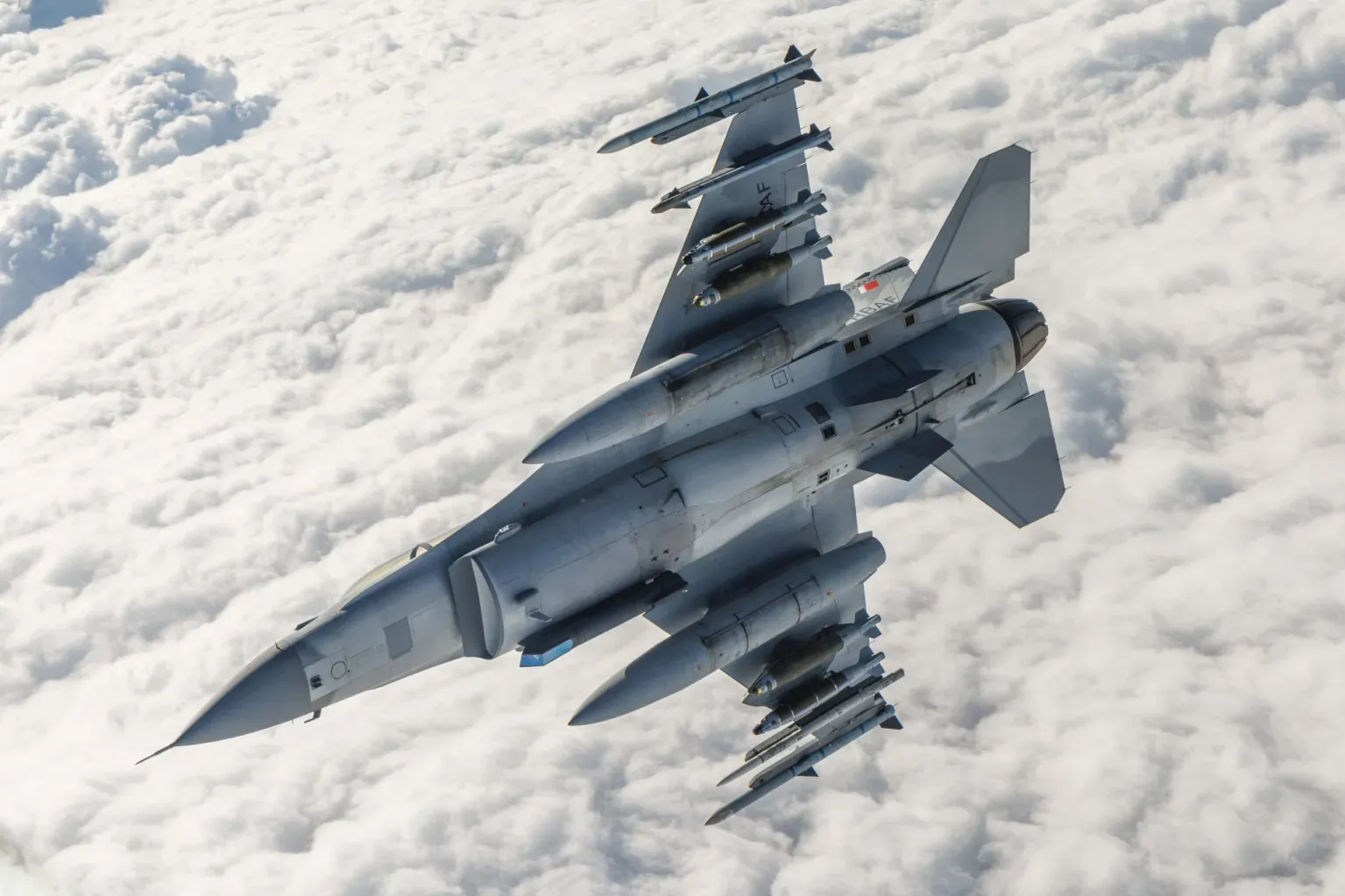
According to Aviation Week, the company has proposed an aircraft called the F-16G, an enhanced derivative of the F-16 Block 70. The proposed configuration reportedly incorporates conformal fuel tanks, 600-gallon wing tanks, an infrared search-and-track (IRST) system, a Sniper targeting pod, and a drag chute. All of these features have appeared on previous F-16s in one form or another. Lockheed is positioning the new version as a potential replacement for USAF F-16 units whose existing aircraft are approaching the end of their useful lives.

A Bahraini Block 70 F-16D flown by members of the 416th Flight Test Squadron pulls away after receiving fuel from a KC-135 tanker with a crew from the 370th Flight Test Squadron during a sortie out of Edwards Air Force Base in California on March 7, 2024. U.S. Air Force

The Air Force, for its part, says that it has not yet settled on either the requirements or the options for addressing the problem. As it stands, the service has not committed to buying any new F-16s. The proposal is nevertheless notable because it follows an earlier round of discussions in which the Air Force was already examining whether a new-build F-16 could help address the growing fighter gap.

In December 2025, Inside Defense reported that the Air Force had reached out to Lockheed Martin about pricing for Block 70 F-16s — the current export standard. The conversations were described as exploratory, with no firm procurement plan, but the reporting established that the idea had moved beyond a purely theoretical discussion. One congressional aide told the publication that officials were looking at ways to “plug their holes” as part of their future force-structure planning.

A new Viper variant based on the Block 70 would be cheaper than replacing an aging F-16 with an F-35, while allowing the Air Force to retain much of the infrastructure, training, and experience associated with the existing aircraft. This is a major advantage as the F-35’s unique infrastructure and support requirements are a costly addition to the aircraft’s base price tag. An even bigger factor is unrelated to acquisition and bed-down costs: a Block 70 is far cheaper to sustain and operate over its service life than an F-35, a difference that compounds significantly across a fleet. 

A formation of F-16 Fighting Falcons sit along the flightline during Operation Northern Cactus at Alpena Combat Readiness Training Center (CRTC), Mich., September 13, 2026. Northern Cactus tests the 149th Fighter Wing’s ability to deploy personnel and equipment, establish operations at an unfamiliar location, and accomplish mission objectives away from home station. (Air National Guard photo by Airman 1st Class Jonathan Rasco)
A line-up of F-16s assigned to the 149th Fighter Wing, a unit of the Texas Air National Guard. Air National Guard photo by Airman 1st Class Jonathan Rasco Airman 1st Class Jonathan Rasco

The idea of a new Viper buy had already reached the highest levels of Air Force leadership several months earlier.

In May 2025, Sen. Tom Cotton asked then-Air Force Chief of Staff Gen. David Allvin about the possibility of buying a U.S.-configured “Block 80” F-16 if Congress provided additional funding. Allvin did not endorse the proposal, but he did not dismiss it either, saying he needed to examine the time required to adapt the Block 70 design, where a U.S. aircraft could fit into Lockheed Martin’s production line, and what the industrial base could support. He also noted that the existing Block 70/72 line was already heavily occupied by foreign military sales.

At the same hearing, Allvin acknowledged the broader force-structure logic, saying the Air Force needed both the high-end capabilities required for an Indo-Pacific fight and other fighters that “may not need to be as sophisticated as our fifth-generation, sixth-generation.” He also emphasized that the first increment of Collaborative Combat Aircraft (CCA) was intended to augment rather than replace crewed fighters like the F-16.

General Atomics’ YFQ-42 for the first increment of the Air Force’s Collaborative Combat Aircraft program, which has now received the official nickname Vengeance. General Atomics

Taken together, the developments show that the concept has remained alive through the Air Force’s evolving force-structure debate.

The Numbers Game

At first glance, the idea of buying new F-16s for the Air Force in the late 2020s might seem puzzling. The F-16 entered U.S. service in the 1970s, and the Air Force stopped buying new examples for itself more than 20 years ago. The established plan has been to replace the legacy F-16 fleet with the F-35A. For a long time, the service’s stated ambition was ultimately an all-stealth tactical fighter force — but that vision has already largely melted away as budget, operational and industrial-capacity realities have set in.

Today, the fighter fleet is still far older on average than it needs to be and legacy fourth generation types, minus a handful of new F-15EXs, are now well over 20-years old at the youngest. The oldest of these aircraft are increasingly challenging and costly to support. Meanwhile, the F-35 has had its fair share of successes and challenges, but replacing all of the USAF’s oldest fighters with JSFs in a timely and efficient manner, and operating those aircraft over future decades, looks increasingly problematic. The F-47 is also on the horizon, but that aircraft fits a different capability set more aligned with the F-22 than the F-16 and will come at a much higher cost than any fighter currently being procured.

Above all else, the problem is that the Air Force’s fighter challenge is one of numbers.

The service’s 2025 long-term fighter force-structure assessment concluded that it needed 1,558 combat-coded manned fighters by 2035 to reach what it considers a low-risk operational posture. The Air Force had only 1,098 fighters in its inventory as of May 2026, below the statutory minimum of 1,145.

At the same time, the service is trying to retire old aircraft, expand F-35A procurement, introduce the F-47, acquire additional F-15EXs, and field large numbers of CCAs. Those programs address different requirements, but they all compete for money, industrial capacity, personnel, and infrastructure.

An MQ-28 Ghost Bat from Boeing Defense Australia and a U.S. Air Force F-15EX Eagle II, assigned to the 85th Test and Evaluation Squadron participate in Valiant Shield 2026 over the Philippine Sea, June 27, 2026. Exercises like Valiant Shield allow U.S. Pacific Command to integrate forces from all branches of service along with our allies to conduct precise, lethal, and overwhelming multi-axis, multi-domain effects that demonstrate our capabilities and commitment to a free and open Indo-Pacific. (U.S. Air Force photo by Tech Sgt. Thomas Barley)
An MQ-28 Ghost Bat and a U.S. Air Force F-15EX participate in Valiant Shield 2026 over the Philippine Sea, June 27, 2026. U.S. Air Force photo by Tech Sgt. Thomas Barley Tech. Sgt. Thomas Barley

For the Air Force, the question has not simply been whether the F-16 remains militarily useful, but also whether the aircraft provides a possible answer to a capacity shortfall, while also dealing with delays in F-35 deliveries, and the retirement of the A-10, blowing another hole in the inventory. Meanwhile, some older F-16s that had been expected to leave the fleet are instead receiving upgrades, including a new radar and electronic warfare suite, to keep them flying longer.

U.S. Air Force Senior Airman David Dussault, 52nd Aircraft Maintenance Squadron F-16 avionics journeyman, works to install a new active electronically scanned array (AESA) radar system onto a 480th Fighter Squadron F-16C Fighting Falcon at Spangdahlem Air Base, Germany, May 23, 2022. The AESA upgrade provides F-16s a massive leap in combat capabilities, making pilots even more effective than ever before while improving air defenses and overall aircraft survivability when faced with enemy forces. (U.S. Air Force photo by Tech. Sgt. Maeson L. Elleman)
A U.S. Air Force airman works to install a new active electronically scanned array (AESA) radar system onto a 480th Fighter Squadron F-16C at Spangdahlem Air Base, Germany, May 23, 2022. U.S. Air Force photo by Tech. Sgt. Maeson L. Elleman 2nd Lt. Maeson Elleman

That creates a difficult transition period. The Air Force wants to retire aging fighters, but it also needs to keep enough aircraft available while their replacements arrive. The F-16 keeps reappearing because it offers a way of addressing at least part of that problem with a very well known commodity and without requiring every legacy fighter to be replaced by an F-35 or F-15EX.

The Production Line Matters

There is another reason the F-16 procurement idea refuses to disappear: Lockheed Martin already has an F-16 production line operating in the United States.

The Greenville, South Carolina, facility was established to produce Block 70/72 aircraft for foreign customers and is now the world’s only F-16 production facility. The Air Force helped establish the line as part of its broader effort to sustain the F-16 industrial base through foreign military sales. The line moved there after the massive Lockheed Martin plant at Fort Worth, Texas — where the F-16 had been built for decades — transitioned fully over to F-35 production.

So, buying new F-16s would not require reviving a dormant production line or spinning up an entirely new aircraft program. The basic manufacturing infrastructure already exists, and the additional work required for a U.S.-specific aircraft may end up being minimal — potentially amounting to little more than taking an existing Block 70 and tweaking it, rather than a large-scale new engineering, testing, and weapons-integration effort.

A two-seat F-16D Block 70 on the production line in Greenville. Lockheed Martin

The Air Force has been aware of that possibility for years. In 2021, then-Air Force Assistant Secretary for Acquisition Will Roper argued that the service should consider the new F-16 production line as part of its capacity solution. Roper specifically pointed to the upgraded capabilities available from the South Carolina production line.

However, Greenville is not an empty production line waiting for a U.S. customer. Lockheed Martin’s F-16 facility already has a substantial Block 70/72 backlog for foreign operators, with the company reporting more than 100 aircraft in the queue and continued potential for additional international orders. It’s also unclear how much the facility could realistically be expanded, since it was designed around a relatively more modest foreign military sales production volume rather than the kind of surge a large U.S. order could require. Still, the USAF could step in and buy up open slots, which would also ensure the line stays open for the foreseeable future, which has major strategic and industrial protection benefits.

That brings us back to Gen. Allvin’s question in May 2025 about where a U.S. aircraft could fit on the production line. Even if the Air Force decided to buy the jets, it would have to compete for production capacity with an established international order book while developing whatever U.S.-specific configuration, testing, and integration work it requires.

This Is Not Your Dad’s F-16

The proposed F-16G is also significant because it is not simply another upgraded F-16C/D like the USAF already has.

Lockheed’s proposed configuration reportedly would add conformal fuel tanks and 600-gallon wing tanks, along with an IRST, and the latest Sniper targeting pod, as well as a drag chute. All of these systems are already fielded and available today rather than requiring new development.

Those additions point toward an aircraft intended to provide even more basing flexibility, range, persistence, weapons and sensing capability than the current F-16, which had already grown into a medium-weight fighter years ago. That is relevant to how such an aircraft might actually fit into the future Air Force.

U.S. Air Force Tech. Sgt. Ryan Keel, an avionics specialist assigned to the Ohio Air National Guard’s 180th Fighter Wing, prepares to install a Sniper Advanced Targeting Pod onto an F-16 Fighting Falcon at the 180FW in Swanton, Ohio, Jan. 26, 2023. The 180FW is the only F-16 fighter wing in the state of Ohio, whose mission is to provide for America; protection of the homeland, effective combat power and defense support to civil authorities, while developing Airmen, supporting their families and serving in our community. (U.S. Air National Guard photo by Airman 1st Class Sarah Stalder Lundgren)
A U.S. Air Force avionics specialist prepares to install a Sniper Advanced Targeting Pod onto an F-16. U.S. Air National Guard photo by Airman 1st Class Sarah Stalder Lundgren Staff Sgt. Sarah Stalder Lundgren

A contemporary F-16 is already a very different proposition from the aircraft that entered U.S. service decades ago. Modern AESA radars, electronic warfare systems, digital architecture, datalinks, advanced cockpit interfaces and weapons have substantially expanded its capabilities. The proposed F-16G would push that evolution further, but, like the F-15EX, it would still occupy a different part of the spectrum from the F-35 and whatever eventually emerges from the F-47 program.

That distinction could be useful in a larger force. An F-35 provides capabilities, particularly its combination of stealth and advanced sensor fusion, that an F-16 can never reproduce. But the Air Force does not conduct every mission in the most heavily defended portion of an adversary’s airspace. Homeland defense, training, defensive counter-air, a range of strike missions, and operations in permissive or partially contested environments don’t necessarily require the same characteristics as a penetration mission against an integrated air defense network. In a major conflict, no fighter will fight alone, either. Far from it. Operation Midnight Hammer, the B-2 strikes against Iran’s nuclear program, provides a salient example here, with F-16s flying deep into the country along with F-22s and F-35s, to clear the way for the B-2 strike force. By now, the Air Force is well-versed in leveraging the total-force fourth-and-fifth-generation mix, and it has discovered that they complement each other in unique ways that can be an advantage, not just compensation for lack of capability.

As far as the drag chute, that is a highly relevant addition to the USAF’s F-16 capability set. The chute would allow for the F-16 to better execute Agile Combat Employment (ACE), which includes operating from austere airfields within the enemy’s weapons engagement zone. The F-16 can get off the runway pretty quick, but landing is a different story. The chute can help greatly in this regard.

A U.S. Air Force C-5M Super Galaxy aircraft assigned to the 9th Airlift Squadron, Dover Air Force Base, left, sits beside an R-11 fuel truck and an F-16C Fighting Falcon aircraft assigned to the 122nd Fighter Wing on the flight line at the 122nd Fighter Wing, Fort Wayne, Indiana, July 24, 2025. The C-5 participated in an agile combat employment exercise that included wet wing defueling to the fuel truck which then provided fuel to the F-16. (U.S. Air National Guard photo by Tech. Sgt. David Sherman)
A U.S. Air Force C-5M Super Galaxy aircraft assigned to the 9th Airlift Squadron, Dover Air Force Base, left, sits beside an R-11 fuel truck and an F-16C Fighting Falcon aircraft assigned to the 122nd Fighter Wing on the flight line at the 122nd Fighter Wing, Fort Wayne, Indiana, July 24, 2025. The C-5 participated in an agile combat employment exercise that included wet wing defueling to the fuel truck which then provided fuel to the F-16. (U.S. Air National Guard photo by Tech. Sgt. David Sherman) Tech. Sgt. David Sherman

There is no question that an F-16 is not a replacement for an F-35. But it could help the Air Force better allocate its limited inventory of increasingly expensive fifth-generation and future sixth-generation aircraft while also maintaining a much larger overall fighter fleet.

CCA Changes the Calculus for Fourth-Gen Jets

One factor that is easy to overlook is Collaborative Combat Aircraft. CCAs are not just a complement to fifth- and sixth-generation fighters, they can also breathe new relevance into fourth-generation types like the F-16. Pairing stealthy, and even optionally expendable CCAs with a fighter like the F-16G could substantially boost its survivability and lethality by pushing sensing, shooting, and some of the risk forward onto uncrewed platforms, extending the F-16’s combat relevance even into higher-end scenarios where it would otherwise be at a disadvantage. In that sense, CCA may end up being arguably as relevant to fourth-generation aircraft as it is to fifth-generation ones.

In other words, CCAs are a positive factor in the F-16G’s business case.

A U.S. Air Force YFQ-44A Fury aircraft, assigned to the Collaborative Combat Aircraft Experimental Operation Unit, takes off for a mission flight during an Agile Combat Employment exercise at Creech Air Force Base, Nevada, July 21, 2026. The flight was part of a broader ACE exercise designed to test the resilience, adaptability, and combat effectiveness of the semi-autonomous fleet. (U.S. Air Force photo by Staff Sgt. Kristal Munguia)
A U.S. Air Force YFQ-44A Fury aircraft, assigned to the Collaborative Combat Aircraft Experimental Operation Unit, takes off for a mission flight during an Agile Combat Employment exercise at Creech Air Force Base, Nevada, July 21, 2026. The flight was part of a broader ACE exercise designed to test the resilience, adaptability, and combat effectiveness of the semi-autonomous fleet. (U.S. Air Force photo by Staff Sgt. Kristal Munguia) Staff Sgt. Kristal Munguia

While the F-22 and F-35 are slated to get CCAs first, the F-16G can be built ready to interoperate with them, which could be a massive force multiplier to what would be the most affordable crewed tactical asset in the inventory. CCAs can eventually be used to also help augment F-16Gs operating in a homeland defense mission and other more mundane roles as well.

The Guard Argument

New Block 70s could make particular sense for the Air National Guard.

The Guard continues to operate F-16s in large numbers, meaning that its personnel, facilities, simulators, and maintenance infrastructure are already built around the aircraft. A new-build F-16 could therefore replace an aging F-16 without requiring the same organizational transition associated with converting a unit to an entirely different fighter, and especially a highly complex fifth-generation type with all its unique support requirements.

That has financial implications beyond the aircraft itself. Replacing an existing F-16 squadron with Block 70s would reduce construction costs and training requirements because much of the existing infrastructure and expertise could be retained.

From left, two U.S. Air Force F-16C Fighting Falcons assigned to the 177th Fighter Wing, New Jersey Air National Guard, and two F-35 Lightning II aircraft assigned to the 158th Fighter Wing, Vermont Air National Guard, follow a KC-135 Stratotanker refueler aircraft assigned to the 171st Air Refueling Wing, Pennsylvania Air National Guard, to perform a routine aerial refueling mission on Oct. 9, 2024, off the coast of Atlantic City, New Jersey. The aircraft flew during "Devilsmoke” 2024, a three-day dogfighting competition organized by the 119th Fighter Squadron's 'Jersey Devils', which included F-15C Eagles from the 104th Fighter Wing of the Massachusetts ANG, A-10 Thunderbolt IIs from the 175th Wing of the Maryland ANG, and F-22 Raptors from the 1st Fighter Wing, Joint Base Langley-Eustis, Virginia. “Devilsmoke” 2024 also received aerial refueling support from tankers with the 108th Wing of the New Jersey ANG and the 101st Air Refueling Wing of the Maine ANG. Dogfighting is a core skill that all fighter pilots must master, and flying against dissimilar aircraft offers valuable experience for fighter pilots. (U.S. Air National Guard courtesy photo by Tech. Sgt. James Norman)
From left, two U.S. Air Force F-16Cs assigned to the 177th Fighter Wing, New Jersey Air National Guard, and two F-35As assigned to the 158th Fighter Wing, Vermont Air National Guard, follow a KC-135 Stratotanker off the coast of Atlantic City, New Jersey. U.S. Air National Guard courtesy photo by Tech. Sgt. James Norman Andrew J. Moseley

The Air Force would still have to pay for the aircraft and sustainment, but it would not be starting from scratch in terms of operating infrastructure, while the modernized fourth-generation capabilities of an F-16G would still mark a step forward for the Guard over its older F-16s.

It’s worth noting there has also been discussion of replacing more aging F-16s with additional F-15EXs instead. That path, however, is more expensive on both the acquisition and operating-cost side, and it would still require units to convert to a different airframe rather than simply recapitalizing in place.

Viper Refreshed

A new F-16 offers a fresh and highly mature airframe — one with a full service-life ahead of it, on the order of 12,000 flight hours without the need for structural upgrades — double that of the original F-16. This is compared to existing F-16s in the inventory with the decades of wear and fatigue already accumulated on them, with structural upgrades keeping them in the air. That difference in remaining structural life is arguably the single biggest advantage a new-build aircraft has compared with extending an existing one.

U.S. Air Force Tech. Sgt. Chase Brossia and Airman 1st Class Vance Weaver, aircraft armament systems specialists assigned to the Ohio National Guard’s 180th Fighter Wing load 20mm bullets into an F-16 Fighting Falcon’s M61A1 Vulcan cannon during Checkered Flag 26-2 and Weapons System Evaluation Program-East at Tyndall Air Force Base, Fla., April 29, 2026. Checkered Flag, a large-scale aerial exercise, hones the skills of the aviators and maintainers who fly and fix aircraft, fostering pride in their craft and ensuring they remain the most lethal combat force in the world. U.S. Air National Guard photo by Master Sgt. Kregg York) *Some photographic elements have been blurred for security purposes
U.S. Air Force aircraft armament systems specialists assigned to the Ohio National Guard’s 180th Fighter Wing load 20mm ammunition into an F-16’s M61A1 Vulcan cannon. U.S. Air National Guard photo by Master Sgt. Kregg York Master Sgt. Kregg York

Dumping more money into existing F-16s is becoming questionable. Service life extensions and technical upgrades can only go so far and supporting these jets is becoming harder as parts dry up and suppliers who made them are long gone. A new airframe would give the Guard many decades of highly efficient service and the piece of mind for future force planning that goes with it.

Also, just like F-15EX, the development of the Block 70 F-16 has already been paid for largely by foreign customers over many years. It is as off-the-shelf of a solution as it gets and that is a very attractive proposition to an air arm trying to balance its books.

Above all, F-16 sustainment and operating costs run far below the F-35’s — a gap that already holds true even with older F-16s, and one that would widen further with new-build jets.

The Argument Against Simply Buying More F-35s

One seemingly obvious alternative would be to accelerate F-35A procurement. But the F-35 is not simply another fighter that can be substituted one-for-one whenever an F-16 reaches the end of its service life. That would also be difficult to do in practice. F-35A production is effectively capped and there are dense order books, and the well-documented troubles with the Block 4 upgrade are a huge factor pushing the Air Force to look at alternatives like the F-16G in the first place.

The Air Force’s current force-structure plans call for significantly more fighters overall, while the service is simultaneously pursuing F-35As, F-15EXs, and the F-47.

A U.S. Air Force F-15EX Eagle II flies over the Gulf of America, September 16, 2025. The F-15EX, from the 40th Flight Test Squadron at Eglin Air Force Base, Florida, is one of the first F-15EXs in the Air Force, and is going through developmental and operational test series at Eglin to prepare the platform to be delivered to the warfighter.  (U.S. Air Force photo by Tech Sgt. Jacob Stephens)
A U.S. Air Force F-15EX Eagle II. U.S. Air Force U.S. Air Force photo by Tech Sgt. Jacob Stephens

Among the reasons why a modernized F-16 might be considered alongside those programs are concerns not only about the cost of those aircraft, but also about the timing of F-35 deliveries, something that has been disrupted by well-publicized problems with Joint Strike Fighter upgrades. At the same time, keeping older F-16s active through upgrades is an increasingly unattractive way of managing the shortfall.

The issue is therefore less about choosing the F-16 instead of the F-35 than about deciding whether the Air Force should use both aircraft for different portions of the force structure.

The service is already doing something along these lines with the F-15EX. It has accepted that a modernized fourth-generation aircraft can have a role alongside the F-35 and the F-22, rather than requiring every new fighter to be stealthy.

A new F-16 would extend that logic to a lower-cost segment of the fleet, potentially allowing the Air Force to use F-35s where their particular capabilities are most valuable while maintaining additional capacity with a less expensive aircraft.

What Could Happen Next?

Even if Air Force leaders conclude that the F-16G makes operational sense, Congress would still have to decide whether it is worth funding.

The December 2025 reporting identified the central problem: lawmakers would want the service to demonstrate that buying new aircraft is preferable to continuing to upgrade the F-16s it already owns. They would also have to weigh the proposal against the F-35 and CCA programs.

If an existing F-16 can be kept operational with a relatively inexpensive upgrade, a new aircraft has to justify its acquisition cost and the additional long-term sustainment burden. But if maintaining an increasingly old F-16 fleet doesn’t save large sums of money over the long haul, the new Block 70 variant begins to look more compelling.

A U.S. Air Force F-16 Fighting Falcon aircraft takes off at a base in the U.S. Central Command area of responsibility Aug. 10, 2026. (U.S. Air Force photo by Staff Sgt. Justin W. Moore)
A U.S. Air Force F-16 takes off at a base in the U.S. Central Command area of responsibility on August 10, 2026. U.S. Air Force photo by Staff Sgt. Justin W. Moore Senior Airman Justin Moore

There remains a substantial gap between Lockheed Martin pitching the F-16G and the Air Force actually buying it. The service told TWZ that it is “in the initial phases of analyzing options for the next Future Years Defense Program.” The Air Force spokesperson added: “At this stage, we have neither defined the precise mission requirements nor the spectrum of options that could fill it.”

That is consistent with the status described by Inside Defense nine months earlier. At the time, the Air Force had no plans to procure Block 70s, and the discussions with Lockheed were described as exploratory. Even if senior officials ultimately favored the aircraft, Inside Defense reported that the program could not appear in the Future Years Defense Program until at least fiscal 2028 because the FY2027 budget process was already too far along.

The F-16G therefore remains a proposal rather than a program. But the persistence of the idea is itself significant. It should be noted that the F-15EX buy emerged out of very similar machinations, with the benefits proving to be undeniable.

The new proposal would let some Guard and Reserve units swap their F-16s for vastly improved F-16s — the same logic that drove the F-15EX buy — while also keeping the Greenville line hot, which is a significant benefit in its own right. And it accomplishes both in the most efficient way possible: not just in acquisition cost, but in sustainment cost, which is really the more problematic burden of the two. In the end, this points to another glaring reality check for the all-stealth-force concept, a vision the Air Force has effectively already abandoned.

The Air Force has spent years describing the F-35 as the replacement for its F-16 fleet, yet it now has to contend with aging F-16s, delayed or constrained fighter production, a larger stated requirement for total fighter capacity, and the lengthy transition toward the F-47 and uncrewed combat aircraft. In that environment, a new-build F-16 provides an option that sits between extending legacy aircraft and buying the most sophisticated — and expensive — fighters available.

Regardless, there are so many priorities facing the force right now, buying new F-16s will be a challenge at every turn, but that doesn’t mean it won’t become too compelling of a proposition to accept. Still, many will argue that every dollar should be invested in higher-end fighter and uncrewed platforms that are more survivable against America’s primary pacing threat, China. That country is rapidly evolving its own air arm with stealth fighters and advanced uncrewed aircraft. Stepping back to the F-16 while facing down such a threat can appear to be counterproductive when taken at face value. At the same time, the F-16 is already slated to stay in the inventory by the hundreds for decades to come, which does take some of the bite out of that argument.

In the end, it is remarkable that the F-16 was supposed to have left the U.S. fighter equation years ago. Instead, every time the Air Force looks closely at the gap between the fighter force it has and the force it says it needs, the aircraft somehow finds a way back into the conversation.

Contact the author: thomas@thewarzone.com

Thomas Newdick is a staff writer at TWZ, where he covers military aviation, defense technology, weapons systems, and international security. Based in Berlin, Germany, he reports on conflicts, military modernization efforts, and emerging aerospace technologies around the world, with a particular interest in airpower and its role in contemporary warfare. His reporting is informed by deep expertise in modern and historical airpower, particularly in Europe, with a focus on military aviation, air campaigns, and aerospace developments across the continent and beyond.


Tyler’s passion is the study of military technology, strategy, as well as foreign policy, and he has fostered a dominant voice on those topics in the defense and national security space. Tyler was the creator of the hugely popular defense site Foxtrot Alpha before developing TWZ, which he continues to lead as the Editor-In-Chief to this day.


Source link

Site Expansions Underpin Lockheed Martin’s Munitions Production Ramp

As spades went into the ground to signal the start of construction of the new Building 47 at Lockheed Martin’s Munitions Production Center in Troy, Alabama, it marked a significant development in accelerating production of the company’s Terminal High Altitude Area Defense interceptor, better known as THAAD. The expansion of factory space in Troy is a key element of the company’s $8-9-billion commitment to expand its munitions production footprint across the United States.

The Department of War’s Acquisition Transformation Strategy is part of a long-term plan that signals clear demand for critical munitions and it enables industry to confidently invest in facilities and workforce development, along with supply chain expansion and advanced manufacturing capabilities. In addition to enlarging the facility in Troy, Lockheed Martin is also growing its plant in Camden, Arkansas, which is another site that’s vital for building more munitions at a faster pace.

The THAAD production line in Troy, Alabama. Lockheed Martin

“My job is to interface and collaborate with the Department of War in achieving the call to action to produce these critical munitions, not only at speed but also at scale, multiplying the current production rates by two, three, or even four times the current rates,” Dan Nimblett, Lockheed Martin’s vice president for Munitions Acceleration Integration told TWZ on the ground in Troy during the groundbreaking event.

“Fundamentally what’s occurred changes how acquisition works [with] long term demand agreements. These long term procurement agreements enable Lockheed Martin and our supply base to make the necessary investments with confidence of the future demand. This allows us to make the investments not only in our people and our facilities, but in the technology necessary to build [these munitions] at a scale and a speed that’s relevant to the threat today,” explained Nimblett.

Lockheed Martin was the first company in the U.S. defense industry to announce a framework agreement with the DoW for munitions acceleration of high-demand missiles – initially tripling production capacity of the PAC-3 Missile Segment Enhancement (MSE) interceptor, followed by a second agreement to quadruple the production capacity of advanced THAAD interceptors. These two defensive missiles are cornerstones of a layered air and missile defense system, and both have been integrated together via Joint All-Domain Operations, including with the U.S. Army’s Integrated Air and Missile Defense Battle Command System (IBCS).

In response to the DoW’s call to action, the company has already invested more than $2 billion in its production facilities and in the related tooling, its key suppliers, and its workforce in order to accelerate production rates.

PAC-3 MSE in production in Camden, Arkansas. Lockheed Martin

Lockheed Martin plans to effectively double the factory footprint in Troy and dramatically increase the workforce. “We’re going to increase that [workforce] by drawing in college students, high school students, veterans, everybody’s welcome,” explains Jason Reynolds, vice president and general manager for integrated air and missile defense. “When they come to Lockheed Martin, they receive training, they get opportunity, and because these programs are on a ramp and in production in such high demand, this is where you come to start your career and you [can] work here for a long time.”

Lockheed Martin currently employs around 1,100 workers at its Camden site, but this is also growing. The Camden training center is seen as being critical in providing the swift increase in skilled operators needed to support this acceleration. “We work closely with the state of Arkansas as well on looking at what else we can do in the community and the infrastructure in that community to support people moving, hopefully into Camden as we ramp up,” says Reynolds.

“People here [in Troy] really know their work matters. It’s meaningful for both the community as well as for our national defense. So, we’re really proud of our employees and we’re on a growth trajectory. We’re hiring and we want as many qualified people to come join our team as possible.”

The Camden site is also accelerating its work on the long-range Precision Strike Missile (PrSM), which is also set to quadruple production over the next few years. Reynolds added that building missiles faster using automation and advanced manufacturing technologies, plus increasing the production line capacity, are some of the vital means for success.

Lockheed Martin is developing the new PAC-3 Adapted Capability Effector (ACE) to help build ammunition reserves faster. Lockheed Martin

“PAC-3 MSE and THAAD are the most capable air defense interceptors on the planet. They’re in extreme demand [and] we’re doing everything possible,” says Reynolds. “With PAC-3, we have been doubling that production over the last four years and now, like I said, we’re going to triple it. We’re working very carefully with our suppliers, with the U.S. government and with our partners and allies all around the world to get all the parts in and get them into factories like you see behind us today to assemble them and get them out to the warfighter as quickly as possible.”

Another way Lockheed Martin is accelerating the delivery of advanced air defense capabilities is the through the introduction this summer of the PAC-3 Adapted Capability Effector, or PAC-3 ACE. This new missile leverages the PAC-3 fire-control system and provides for full integration with the Patriot weapon suite.

The main differentiator of PAC-3 ACE is that it would be produced at less than half the unit cost of MSE and first flight could occur within 18 months. A core part of the rapid fielding strategy is an international, joint-development model. Lockheed Martin is partnering with both American and European industry, sharing production lines, supply chains and expertise.

Lockheed Martin says PAC-3  ACE provides a “cost-effective, multi-threat solution.” The interceptor is engineered to engage a broad spectrum of air-breathing threats, cruise missiles, and both short and medium-range ballistic missiles. By offering a low-cost “kill” per-engagement, it is designed to address the current climate that demands deeper ammunition reserves without compromising on performance.

Inside A Growing Lockheed Martin Site That Is Key To Its Munitions Production Ramp thumbnail

Inside A Growing Lockheed Martin Site That Is Key To Its Munitions Production Ramp


The keys to munitions acceleration

This year, Lockheed Martin has made significant progress in a series of production acceleration projects for munitions programs under its Missiles and Fire Control division. “I was supposed to retire last year. I’m here because this is the most exciting time in the 30 years I’ve been in this industry,” says Dan Nimblett. “These long-term agreements provide us the certainty to enable us to make these investments.”

“What recent conflicts have demonstrated is that Lockheed Martin and the American defense industrial base never lost the technological edge. The technology and the capability has always been there – we have the best systems in the world. We’ve proven that through real world performance.”

Nimblett explained that Lockheed Martin’s supply chain is following suit, and that they are all now investing in similar ways to ensure they meet the demand signals. “We’re evaluating how we produce and increase additive manufacturing and robotics. We’re also looking at how we develop, which I think is a fundamental part of getting capability into the warfighters’ hands at a speed and scale that’s relevant to the threat.”

A PrSM test firing during the missile’s development. Lockheed Martin

Having received Milestone C approval from the U.S. Army in July 2025, PrSM manufacturing has relied on a high level of automation. PrSM was engineered from the start for automated, robot-driven production – automating tasks once done by hand – and that early-stage streamlining is paying dividends as Lockheed Martin seeks to accelerate output.

“We have a lot of robotics built into our munitions production,” explains Gaylia Campbell, vice president, Tactical Missiles. “A lot of times we use robotics to help increase the safety of the assembly, like an explosive charge that has to be integrated into a munition, and we have a robotic arm that places that and tests the placement. We also robotically paint and coat [PrSM]. So, we have a lot of robotics already in Camden and that’s really going to help us with this ramp-up in production – the fact that so much of it is [already] automated.”

Campbell emphasizes that PrSM entered production with a mindset of acceleration. “We got PrSM through preliminary and critical design reviews, and into first flight in times roughly half of what it would normally have taken us. We’ve been amazingly successful on all these flights. Those early [test] flights went off one after the other during the COVID-19 pandemic, at a time when there were a lot of challenges for all of us in our daily lives, and yet we were able to continue to fly and prove the operational performance.”

Lockheed Martin is reshaping the munitions supply chain with an unprecedented slate of manufacturing initiatives that pull together new facilities, strategic partnerships, and workforce development. The company is also expanding a number of its other production facilities, such as a $60-million investment in its complex in Archbald, Pennsylvania, that will add 700 jobs in support of high‑priority programs including PrSM, THAAD, PAC‑3, and Apache sensors. In Orlando, Florida, three legacy paint bays have been merged into a high‑performance shop that can retool a work cell in hours rather than weeks, while Ocala’s new Progressive Work Smart Assembly Line has cut seeker and mission control unit build times by roughly 50 percent.

Production capacity for THAAD is expanding in Troy, Alabama. Lockheed Martin

A partnership with General Motors will bring high‑rate commercial manufacturing expertise into Lockheed Martin’s production processes, and the new Rapid Fielding Center in Grand Prairie, Texas, is tasked to reduce traditional manufacturing development timelines. What once took years of design, testing and tooling is aimed to be prototyped, fabricated and validated in a matter of months.

Echoing endorsement of the DoW’s initiative, Campbell underscores that knowing what the demand signal will be is a critical differentiator when it comes to production ramp-up. “We can plan for some of those really critical rare earth minerals that we need, the batteries for example in our munitions, we need certain rare earth minerals for that. We need to know the total demand signal and that means we can negotiate with the suppliers and guarantee that we have access. That can really help us accelerate.”

To support the wider munitions efforts Lockheed Martin is also investing in solid rocket motor development and production, as well as lower-tier parts that go into solid rocket motors. “We’re working with different suppliers to develop new sources of supply for solid rocket motors,” says Campbell. “We’re investigating heavily right now in designing and prototyping several motors that we plan to test and take to production, and that really will develop a whole new supply chain and will really be critical for all munitions production.”

Having a five-year contract instead of annual contracts allows the manufacturer to have far more buying power to secure sub-components for a far better price point. “I can go and invest. Invest in more capacity, invest in my supplier’s capacity,” explains Campbell.

“Production is all about velocity. Keeping the line moving and not having to stop because we don’t have a part. Being able to order bigger quantities of things up front is really huge when it comes to acceleration.”

Contact the author: Jamie.Hunter@teamrecurrent.io

Jamie is TWZ’s Branded Content and YouTube Editor, overseeing the content side of the site’s industry partner programs and our expanding video programs. He lives in London, U.K. but is regularly on the road particularly with our international trade show presence.


Source link

This Is The New Blackbeard ‘Cheap’ Hypersonic Weapon

Castelion, a startup begun by former SpaceX employees, has provided the first view of its Blackbeard hypersonic weapon. The first look at what has been billed as a lower-cost missile comes as the company announces that it has secured $1 billion in new financing, which it says will help get its first hypersonic weapon into production as part of its ambitious manufacturing strategy. While hypersonic weapons have very attractive qualities, they are extremely expensive and that cost will likely keep them from being bought in large quantities or used against wider target sets. Castelion is focused on trying to shift that, building hypersonic capabilies that can be bought in large quantities and used more freely, even if they have reduced performance.

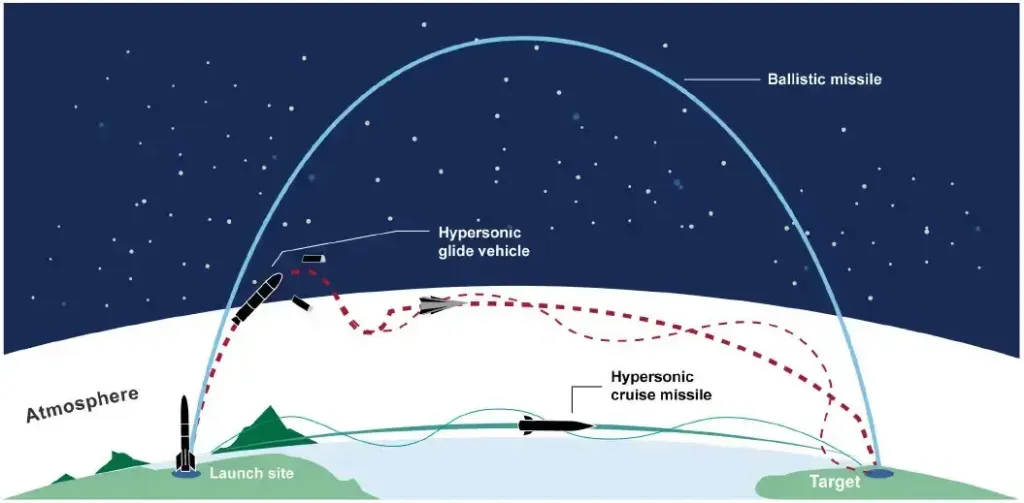
A profile photo at the company’s headquarters reveals a weapon with a ballistic missile-like booster, on top of which is mounted an unpowered hypersonic glide vehicle (HGV). The booster brings the HGV to the desired velocity and altitude before releasing it toward its target. The concept is in contrast to air-breathing cruise missiles capable of traveling at hypersonic speeds. Hypersonic speed is generally defined as anything above Mach 5, which larger ballistic missiles also reach in the course of their flights. More precise performance figures for Blackbeard are lacking, but Castelion has previously hinted it could hit targets out to just under 500 miles.

A graphic showing, in very basic terms, the differences in flight trajectory between a hypersonic glide vehicle (HGV) and a traditional ballistic missile, as well as air-breathing hypersonic cruise missiles. GAO

Both stages of the weapon have cruciform fins, while the HGV features a prominent ‘chine’ line along the length of its body, and a slightly beaklike nose. The trolley on which the weapon is mounted provides some idea of its overall size. The blue stripes seen on each stage normally signify that a munition is an inert, non-explosive round utilized for training or tracking purposes. This would indicate a real (unarmed) missile rather than a dummy or mockup.

The company has previously said that it was aiming to have a more finalized Blackbeard design by 2027, so there is still potential for more design changes to come. We have reached out to Castelion for more information.

Castelion has previously released images of various missiles with very different, far more simple designs, which it has said “are representative of the low-cost internally developed test vehicles we use to enable rapid subsystem design iteration and to ground our performance models in real-world test data.”

Various Blackbeard test articles, emphasizing their difference compared to the latest design. Castelion Corporation

Some of these earlier experimental configurations also look to feature tail sections that are at least heavily inspired by, if not lifted directly from Standard-series surface-to-air missiles as used by the U.S. Navy and other navies globally.

Castelion yesterday also announced it had received Series C financing, comprising $800 million in equity financing and $250 million in committed financing. The equity round values Castelion at approximately $13 billion.

The company says it will use the funds as it transitions from development and flight testing toward producing Blackbeard in significant quantities.

Castelion claims the weapon is the first hypersonic strike system to be designed from the outset to be substantially less expensive and easier to manufacture at scale than traditional high-end missile systems.

“Deterrence depends on unapologetic American strength; highly capable weapon systems that adversaries fear produced in quantities they can’t imagine at a price taxpayers can afford,” Castelion CEO and co-founder Bryon Hargis said.

The company says Blackbeard has gone from a clean-sheet design to a program of record in less than four years, with fielding targeted for 2027. Castelion has also secured more than $500 million in U.S. military contracts over the past 18 months.

A major part of the company’s strategy is its Project Ranger campus in Sandoval County, New Mexico. Castelion describes the roughly 1,000-acre facility as the largest dedicated hypersonic missile manufacturing site in the United States. The company previously committed more than $250 million of its own capital to infrastructure at the site and says it will now invest hundreds of millions of dollars more to expand production capacity.

That emphasis on manufacturing is central to how Castelion distinguishes Blackbeard from many existing hypersonic programs. The company has designed the weapon and its production processes around the expectation that large numbers will eventually be required.

“There’s a manufacturing renaissance underway and this round turbocharges American production of Blackbeard,” Hargis said. “Designed in California, built in New Mexico, supplied from small and large businesses across the United States; Blackbeard is an example of what America can do when private capital and Government work together.”

In May of this year, the Pentagon outlined plans to acquire at least 10,000 Blackbeard missiles, as well as a similar number of lower-cost cruise missiles, over the next three years.

These framework agreements are part of a larger effort to rapidly expand U.S. reserves of long-range, standoff weapons and, at the same time, strengthen the defense-industrial base so manufacturers can keep producing those weapons at a high rate over the long term.

The U.S. Army has made clear it is interested in employing Blackbeard in a ground-launched mode, as you can read more about here. Army budget documents confirm it is pursuing Blackbeard aggressively, but through a phased approach that offers multiple off-ramps. The service has previously talked of firing Blackbeard from new uncrewed launcher vehicles, as well as from existing M142 High Mobility Artillery Rocket System (HIMARS) launchers. How many Blackbeard missiles are compatible with each of these launch systems is unclear.

Another test article that Castelion has used in previous testing related to Blackbeard in front of a palletized launcher loaded on a truck. Castelion Corporation

“The mission of Blackbeard Ground Launch (GL) is to attack/neutralize/suppress/destroy using hypersonic missile delivered precision fires (seeker based) against time sensitive moving targets and hardened targets at a much-reduced cost per missile than currently exists in the Army inventory,” the Army stated in its proposed budget for the 2026 Fiscal Year. “Blackbeard Ground Launch (GL) is an affordable, mass-produced hypersonic weapon designed for mid-range precision. The Army will leverage advancements in technology, materials, and cost-effective production methods to provide superior capabilities through fast, iterative design cycles, flexible hardware development, and modern manufacturing practices.”

Meanwhile, earlier this year, Castelion announced receipt of a contract from the Navy to integrate Blackbeard onto the F/A-18E/F Super Hornet carrier strike fighter and transition the system to an early operational capability in 2027. This will involve extensive system safety and certification testing, flight testing, and other integration activities related to carrier-based operations. This development may well be connected with halting plans for an air-launched, air-breathing hypersonic anti-ship cruise missile. A version of Blackbeard could also find its way onto Navy ships and submarines, as well as ground-based launchers, as we have discussed in the past.

A U.S. Navy F/A-18F with a heavy air-to-air load-out, including four of the very long-range AIM-174B air-to-air missiles. point_mugu_skies

In fact, the Army has also said that the ground-launched version of the weapon that it expects to receive will leverage an “existing air-launched, extended-range Blackbeard design,” without providing more information.

The U.S. Air Force has also awarded Castelion contracts in the past in relation to long-range strike weapon concepts, and TWZ has previously reached out to that service for more information.

Regardless, Castelion’s ambitions extend beyond Blackbeard. The company says it has been developing a much longer-range precision strike weapon for several years and will now accelerate its development and testing. That system is intended to reuse technologies, components, and manufacturing techniques developed for Blackbeard.

Another Blackbeard-related test launch. Castelion Corporation

With a huge demand signal from the Pentagon, Castelion is also working on defensive systems based on the same development and manufacturing philosophy. The company says those efforts are focused on lowering costs, increasing production rates, and providing greater magazine depth for air and missile defense.

The strategy responds to the fact that the U.S. military’s growing interest in hypersonic weapons has been accompanied by persistent questions about production capacity and cost. Hypersonic systems are technically demanding, but the ability to manufacture them in meaningful numbers is ultimately just as important as demonstrating that an individual weapon can fly.

Castelion is betting that a different approach to development and manufacturing can change that equation.

“Castelion is at the forefront of defense manufacturing in the nation,” said Tom Ochinero, chairman and founding partner of Interlagos Capital, which provided some of the equity financing. “They’re building the capabilities to produce thousands of hypersonic weapons a year, something the U.S. has never seen before.”

One of the designs that Castelion has shown in the past. Castelion Corporation

This reflects a steadily growing U.S. military-wide push toward lower-cost precision munitions that are relatively simple to manufacture, while also drawing on non-traditional defense contractors to develop and produce them. Such efforts are widely viewed as essential to building up stockpiles in an economically sustainable manner ahead of a major contingency, such as a large-scale conflict in the Pacific with China, and ensuring a steady supply of weapons throughout a prolonged war.

The next test of this model will be whether Castelion can translate its relatively rapid development timeline into sustained production at the scale it is promising. With Blackbeard targeted for fielding in 2027 and a new generation of longer-range and defensive systems already in development, the company is positioning itself as much as a defense manufacturer as a missile developer, but this remains very much an unproven concept in this notoriously tricky area.

The new view of Blackbeard at Castelion’s headquarters offers a glimpse of the hardware at the center of that effort.

Contact the author: thomas@thewarzone.com

Thomas Newdick is a staff writer at TWZ, where he covers military aviation, defense technology, weapons systems, and international security. Based in Berlin, Germany, he reports on conflicts, military modernization efforts, and emerging aerospace technologies around the world, with a particular interest in airpower and its role in contemporary warfare. His reporting is informed by deep expertise in modern and historical airpower, particularly in Europe, with a focus on military aviation, air campaigns, and aerospace developments across the continent and beyond.


Source link

Wildfire Is General Atomics’ Successor To The MQ-9 Reaper

General Atomics (GA) has unveiled plans for what it calls the Wildfire Unmanned Aerial System, a next generation medium-altitude, long-endurance (MALE) drone. The move comes as the Pentagon is seeking an updated, modular, cheaper successor for the MQ-9 Reaper – one that is easier to produce and can be more freely sent into higher-risk environments where losses are likely to occur. 

The Reaper, a workhorse for U.S. uncrewed strike and ISR missions for decades, suffered heavy losses during the war with Iran and against the Houthis in Yemen. This has added a new level to already existing concerns about how they would perform against a peer threat like China. It also has decreased the MQ-9 fleet so dramatically that there are real concerns above operational impacts and the force size going forward overall. The MQ-9 is now out of production and cannot be directly replaced.

Aviation Week was the first to report about the Wildfire.

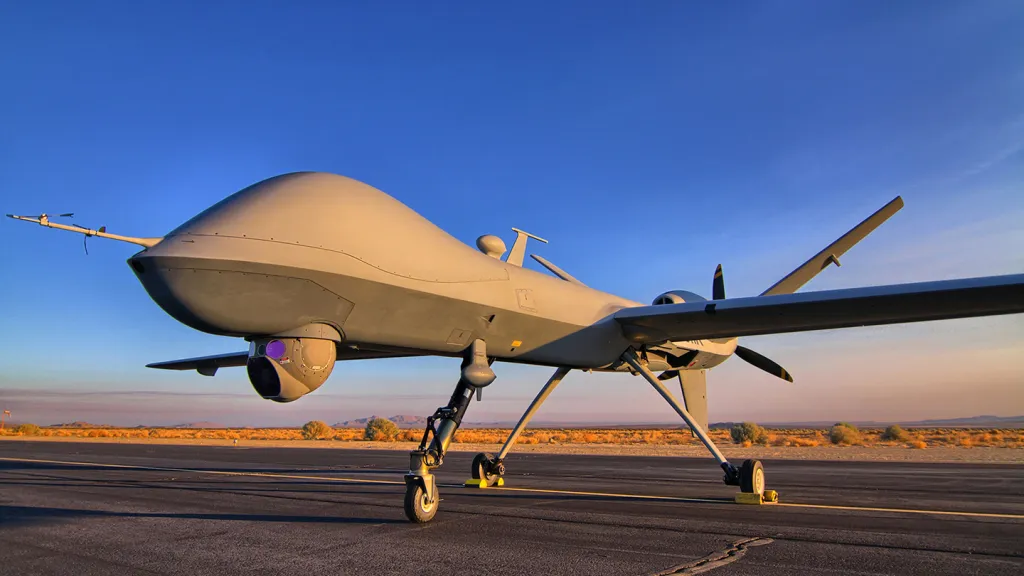
The MQ-9A (General Atomics) (General Atomics)

GA spokesman C. Mark Brinkley offered limited details about the Wildfire system, which he claimed is a leap beyond what the Pentagon is currently seeking in a new MALE combat drone. The company, he added, is not yet providing any images.

“General Atomics is looking at it and asking ourselves, ‘What can we really do? No kidding, no BS, actually do,’” Brinkley told us. “Let’s be honest with ourselves first. How do we come out of the box, day one, with a 10,000-nautical-mile ferry range? Can we carry four LRASMs [AGM-158C Long Range Anti-Ship Missiles]? Can we swarm 100 aircraft under semi-autonomous control? Can we fuse all of that data into a highly effective common operating picture? Can we do that at scalable, affordable mass?”

“So that was the assignment, and our engineers sharpened their pencils and got to work,” he added. “What came out the other side was our new Wildfire UAS. That thing is a beast, and no one who actually does this for a living and is honestly concerned about America’s warfighting edge can look at it and not want 100 of them as fast as we can make them.”

A line of MQ-9B SeaGuardian fuselages at the General Atomics facility. (General Atomics)

Last month, the Pentagon’s Defense Innovation Unit (DIU) announced its plans for what it has dubbed the Massed Modular Aircraft (MMA) program to replace the Reaper. The objective is to bring several companies together to help determine the way forward.

“The math of modern warfare is changing, and our force design must change with it,” DIU stated. “For decades, the Joint Force has relied on low-density, high-value, ‘exquisite’ (>$30M) manned and unmanned aircraft. In a high-end fight, this model is simply unsustainable. To win, we must design for, and accept, inevitable attrition while retaining the advantage.”

MQ-9 (USAF)

“The Joint Force seeks a cost-effective, theater-range, massed, and modular Unmanned Aerial System (UAS) to provide a flexible, operationally-responsive, risk-tolerant option in the air domain,” the DIU explained. “The ability to employ many aircraft at once ensures a persistent overwhelming credible threat despite inevitable attrition.”

Massed Modular Aircraft “are envisioned as in-theater reconfigurable platforms capable of long-range payload delivery,” DIU added. “Crucially, MMA must retain the ability to be outfitted with a variety of payloads, including Full Motion Video (FMV) sensors, to execute missions that the MQ-9A performs today.”

Primarily, DIU wants an aircraft with a munition and sensor payload capacity of at least 2,800 pounds, an unrefueled combat radius of at least 2,300 nautical miles with payload, and able to self-deploy one-way at least 8,000 nautical miles. It must also have a Modular Open Systems Approach (MOSA) to rapidly swap in different payloads and system upgrades.

As for secondary attributes, DIU wants autonomy for control, allowing one pilot to operate several aircraft. In addition, it is seeking “resilient and integrated communications – hybrid SATCOM/mesh network connection” and to be able to conduct “local airfield operations under highly degraded or denied primary C2/SATCOM conditions.”

In addition, the aircraft would have “at least 200 knots true airspeed” and operate from runways with a maximum length of 6,000 feet.

DIU

The MQ-9A Reaper has a 3,850-pound payload capacity and can fly for more than 20 hours unarmed, or more than 12 hours with weapons. In the case of the latest MQ-9B version, with an extended wingspan, flight endurance can be increased to more than 40 hours.”

The deadline for submissions on this program ended July 23, but it is unclear when contracts will be awarded. However, proposed solutions “must be capable of full-scale prototype flight testing within 21 months of award, with a targeted Initial Operating Capability in FY2031 (20 mission-ready aircraft delivered to an operational unit, able to be deployed),” DIU noted.

To put the DIU goal into perspective, official budget documents say the Air Force had 165 Reapers in inventory as of the start of Fiscal Year 2026, which began on October 1 of last year. This had already marked a significant year-over-year decrease, down from 231 MQ-9As at the beginning of Fiscal Year 2025. These figures don’t include the Marine Corps and Central Intelligence Agency, which also fly Reapers.

General Atomics is turning the MQ-9 Reaper family of drones into cruise missile 'trucks' thumbnail

General Atomics is turning the MQ-9 Reaper family of drones into cruise missile ‘trucks’


As noted earlier in this story, the DIU announcement of the MMA program came as Reaper losses in the war against Iran were mounting.

By May, the Air Force’s total MQ-9A fleet had shrunk to 135 aircraft, Air Force Lt. Gen. David Tabor, Deputy Chief of Staff for Plans and Programs, told members of Congress at a hearing.

There was enough concern that the service has scrambled to replace some of those airframes.

“So there’s a bit of a short-term effort to buy back things immediately, in this fiscal year,” Tabor testified.

The picture has only grown bleaker since then.

“The U.S. military has lost at least 45 MQ-9 Reaper drones during the war with Iran, or roughly 25 percent of its fleet,” The Washington Post reported last week, citing three U.S. officials familiar with the matter. The newspaper, citing the Air Force, stated that Reapers can cost between $30 million and $50 million each, depending on the type of sensors and weapons they carry.

“The potential taxpayer cost of recent losses is over $1.3 billion for that weapon system alone,” the publication added.

TWZ cannot independently verify those figures.

The MQ-9 Reaper Keeps Getting Shot Down - And Still Gets Used thumbnail

The MQ-9 Reaper Keeps Getting Shot Down – And Still Gets Used


The MMA program is not the first effort to replace the MQ-9. The Air Force has tried multiple times to develop a Reaper replacement without success. While GA had long held essentially had a monopoly on the MALE combat drone market in the U.S., the DIU competition has a host of other companies competing

As we highlighted in a past report on this subject:

“…the U.S. drone landscape has changed considerably in terms of manufacturers. A few years ago, Northrop Grumman, Lockheed Martin, and General Atomics would have been seen as the front-runners for the MQ-9 replacement. Now, there are more contenders, often with a founding focus on rapidly scaling up production at low cost. Still, these firms have much to prove, especially considering the risk in replacing an aircraft as important as the MQ-9. At the same time, in the more advanced drone space, the legacy defense “prime” contractors are also making major progress in leveraging new technologies to reduce production costs and migrating away from exquisite, very expensive drones as their default offerings.”

A MQ-9 Reaper assigned to the 174th Attack Wing flies over Hancock Field Air National Guard Base, Syracuse, NY, following a routine training flight, Oct. 31, 2024. The 108th Attack Squadron conducts these flights to instruct pilots and sensor operators on proper flight operations of the aircraft. (U.S. Air National Guard photo by Senior Airman Dylan McCrink)
An MQ-9 Reaper assigned to the 174th Attack Wing flies over Hancock Field Air National Guard Base, Syracuse, NY, following a routine training flight, Oct. 31, 2024. (U.S. Air National Guard photo by Senior Airman Dylan McCrink) Staff Sgt. Dylan McCrink

As for General Atomics, Brinkley pushed back against the notion that the MMA program is actually a Reaper replacement.

“I think it’s really unfortunate that MMA has been branded as a ‘Reaper replacement’ because it misrepresents what America needs now and what we need later,” he suggested. “We need an immediate backfill solution to a critical shortage of unmanned MALE ISR/Strike. We need to get going on that now. MMA isn’t a backfill solution, or even a bridge to a backfill solution. This isn’t that.”

“Some say we need cheaper, disposable aircraft, so that we can use them and throw them away, or lose them and not feel bad about it. No one is talking about actual capability, ready today,” Brinkley told us previously. “No one is talking about all of the hard lessons, already learned, about icing and weather and weapons integration. No one is talking about the multiple survivability upgrades available for the existing platforms and the lack of investment in those.”

“These make-believe weapons that don’t exist have the luxury of being anything you imagine them to be,” Brinkely added. “Unscratched lottery tickets, promising all of the win and none of the lose [sic].

Still, the company did submit a proposal for MMA, Brinkley told us on Wednesday, “but the aircraft [Wildfire] is not dependent on that program.”

“We can deliver Wildfires years earlier than the current schedule, and absolutely no one on Earth wants to see them coming over their horizon,” he stated.

Contact the author: howard@twz.com

Howard is a Senior Staff Writer for TWZ. He writes frequently about conflict, focusing heavily on the Middle East and Ukraine, and interviews with military and intelligence officials and industry leaders from around the globe. He lives near Tampa, Florida, home of U.S. Central Command, U.S. Special Operations Command.


Source link