Real

The real winner in Poland’s constitutional battle is Putin | Opinions

Poland’s two main political camps are locked in an escalating fight for control of the Constitutional Tribunal, each claiming to defend the rule of law. In the process, they are undermining the legitimacy of the Polish state in the eyes of its own citizens, playing directly into Putin’s playbook.

The roots of the dispute go back more than a decade. In 2015, the outgoing centre-right Civic Platform-controlled parliament attempted to appoint judges to the Constitutional Tribunal for vacancies that should have been left to the incoming parliament. The newly elected conservative Law and Justice government used this controversy to intensify its efforts to pack the Tribunal with party nominees rather than independent judges.

Now back in power, Civic Platform is trying to bring new judges into the Constitutional Tribunal. But President Karol Nawrocki and the Tribunal’s leadership, both aligned with Law and Justice, have blocked several of the newly appointed judges from taking office. Last month, one of the newly elected judges ordered the suspension of the Tribunal’s president and deputy, and police were deployed to the building. Nawrocki denounced the move as a forcible takeover, while Prime Minister Donald Tusk defended it as an effort to restore the rule of law.

Moscow has already seized on the confrontation to cast doubt on the legitimacy of Poland’s institutions. On November 3, former Russian President Dmitry Medvedev described the intervention as a “coup”.

A decade ago, it was the conservative Law and Justice government that sought to pack the Constitutional Tribunal with party nominees, disregarding legal constraints. Today, it is the coalition of the centre-right Civic Platform and the liberal Left that is acting unlawfully. We see the main parties becoming mirror images of one another. Conservative Law and Justice is calling on its supporters to take to the streets to defend the rule of law, a slogan previously used by the liberal opposition when Law and Justice was in power. Now it is the liberal Prime Minister Donald Tusk who is playing the strongman, with police carrying shields and wearing helmets deployed around the Constitutional Tribunal during the operation. He presents himself as an effective leader who gets things done, with little regard for legal subtleties and doubts raised even by some liberal-leaning experts. Against this backdrop, a photograph of Tusk reading an issue of the philosophical journal Kronos devoted to Carl Schmitt has recently circulated widely on social media. Schmitt, a theorist of decisionism, famously declared, “Sovereign is he who decides on the exception.”

Law and Justice’s efforts to politicise the Constitutional Tribunal pushed middle-aged supporters of the liberals in big cities onto the streets a decade ago. It seems, however, unlikely that Poles will again take to the streets in their millions to support either political bloc. The public is tired of the tug-of-war between politicians, not only because both main blocs demonstrate considerable hypocrisy when invoking the rule of law over force, but also because the fight does not speak to people’s chief everyday concerns: the cost of living and the safety of a country with an aggressive neighbour waging a hot war on its border and a hybrid and cognitive war inside the country.

What has changed drastically compared to the protests that took place a decade ago, when the main forces occupied mirror-image positions, is the geopolitical context: Russia’s full-scale war in neighbouring Ukraine, alongside its hybrid and information warfare aimed at weakening Poland’s position on the global stage.

In the worst-case scenario, this struggle over the legitimacy of state institutions could extend to elections. A precedent can be found in Romania, where, on December 6, 2024, the Constitutional Court annulled the presidential election following intelligence reports of alleged foreign interference, social media manipulation and campaign financing irregularities, and ordered the electoral process to be repeated.

What we might see in other Central and Eastern European countries, including Poland if the situation deteriorates, is, on the one hand, the liberal establishment adopting measures that override electoral outcomes, such as courts annulling elections in response to genuine foreign interference through social media campaigns. On the other hand, the opposition could become increasingly anti-establishment, effectively delegitimising the institutions of the state. The problem will be aggravated by the fact that foreign interference may be real rather than invented by the establishment.

These two opposing forces are squeezing the middle ground on which democracy depends: on one side, social media platforms controlled by foreign superpowers algorithmically manipulating the emotions of the populus and fuelling distrust in the state; on the other, the decisionism of an establishment governing in a state of exception through politically subordinated courts. Both leave less space for thoughtful civic self-determination.

A large part of the commentariat in Poland, however, still sees this dynamic as another round in the familiar two-party struggle between Civic Platform’s EU-oriented liberals and Law and Justice conservatives backed by the US. Beyond this rivalry, Russia- and China-inspired, supposedly anti-establishment radical influencers and parties, both anti-European and anti-American, seek to portray the state as a foreign occupation. The wilder the theories delegitimising the state become, the more pretexts the ruling establishment will have to delegitimise the opposition.

The danger is no longer simply that one political bloc might gain control of the Constitutional Tribunal at the expense of another. It is that, as both sides continue to undermine the legitimacy of state institutions, growing numbers of Poles may cease to see those institutions as their own. What is being weakened is not just the authority of a particular government, but the bond between citizens and the state itself.

No one could be happier about this kind of self-reinforcing dynamic, which weakens Poland’s position, than Putin.

If any healing is possible, it will not come from the existing political forces.

The views expressed in this article are the author’s own and do not necessarily reflect Al Jazeera’s editorial stance.

Source link

Emmerdale Sam actor’s life from real voice and ripped body to rarely-seen partner

Away from Emmerdale, James Hooton’s real life couldn’t be more different from his on-screen Dales alter-ego Sam Dingle

Emmerdale’s James Hooton is a soap legend playing Sam Dingle – but what do we know about his life?

James shot to fame as Sam on the long-running ITV soap, making his debut in 1995. As the beloved son of Zak Dingle (Steve Halliwell), it didn’t take Sam long to become a firm favourite.

He has also been involved in several big storylines too, most notably when he helped his terminally ill wife Alice Dingle (Ursula Holden-Gill) die in a truly heartbreaking twist.

Away from the soap, James’ real life couldn’t be more different from his on-screen Dales alter-ego… Here’s everything we know about soap icon James.

James’ real accent

In July 2024, James featured on ITV’s Loose Women, where he spoke about his continued involvement with Emmerdale. But viewers at the time were left stunned by his real voice.

Fans are well acquainted with hearing Sam deliver his lines in a pronounced Yorkshire dialect, leaving many astonished to learn it differs from the actor’s natural speaking voice.

Emmerdale’s Instagram page previously shared backstage clips showcasing James, who originates from Carlton, Nottinghamshire.

One admirer noted: “Love Sam, and it’s so weird to hear him speak when out of character.” Another startled watcher observed: “James’ accent never fails to surprise me”, while a third added: “An absolutely brilliant actor.”

James’ partner and children

Beyond Emmerdale, James is loved-up with partner Nancy Lucas and is a proud father to their two children, Ava-Rose and Lily.

It has been reported that the pair met on the set of Emmerdale in 2004. Nancy owns her own dance company called Total Dance, where she also works as a Zumba instructor.

The soap star proposed to Nancy, on Valentine’s Day in 2010. The pair have also previously opened up about their struggle to conceive, as they explained they had been trying for another baby for two years.

“We’ve been trying to get pregnant for around two years but it just wasn’t happening,” James explained to OK magazine before Nancy shared that they started going down the fertility route. However, three months in, she fell pregnant “without any intervention”.

Earlier this year, James shared a sweet family update, revealing his eldest Lily would be off travelling soon – something he had “mixed emotions” about.

“Last family breakfast before Lily heads off on her travels! 78 nights away and countless countries to be visited! Can’t wait to chart her journey and hear her stories,” James said. He added: “Mixed emotions but SO proud that she’s arranged and funded it all herself! Conceive, believe, achieve.”

James’ muscle makeover

Ensure our latest stories always appear at the top of your Google Search by making us a Preferred Source. Click here to activate or add us as Preferred Source in your Google search settings

James has built up an incredibly muscular physique over the years and proudly shows it off on social media. He is an avid rock climber and regularly documents his fitness activities on Instagram.

James often travels to different parts of the country in search of the best climbing spots, sharing footage from places, including Pateley Bridge and Shipley Glen in Yorkshire.

The intense sport means James has become quite stacked over the years – and fans have noticed. One comment on his social media reads: “OMG never thought Sammy was such a DILF”, while another says: “You must have muscles of steel.”

Emmerdale airs Monday to Friday at 8:00pm on ITV1 and ITVX

Source link

‘Passing Strange’ premieres in L.A. at Pasadena Playhouse

Twenty years after its world premiere in Northern California — and subsequent success on Broadway and in London — “Passing Strange,” the quintessential L.A. coming-of-age musical, is finally arriving in Southern California, staging its long-awaited area premiere at Pasadena Playhouse on Sunday.

Exactly why it has taken so long for this acclaimed, Tony Award-winning show — much of it set in the heart of Los Angeles — to come here is something its creators, the artist and singer-songwriter, Stew, and Heidi Rodewald (along with this writer) have been scrutinizing since 2009, the year after it opened to critical acclaim on Broadway.

“Passing Strange” tells the story of a young, artistic “Youth” (that’s actually his name in the show) who rejects his single mother and the “Black, middle class dream” of 1970s Los Angeles in favor of leaving home to find “The Real,” an elusive state of mind and authenticity he craves.

The reasons “The Real” took so long to land in its hometown began to make sense during a recent group Zoom with the “Passing Strange” brain trust, including Stew, Rodewald and its new director Zhailon Levingston.

“At my age, at this point, I think it is absolute poetry that this gentleman [Levingston] is the one who brings it to our hometown,” said Stew, pointing to a serendipity of timing.

A director sits in a rehearsal.

Director Zhailon Levingston sits outside before a rehearsal of “Passing Strange” at the Pasadena Playhouse. Levingston recently won a Tony Award for directing, “Cats: The Jellicle Ball.”

(Carlin Stiehl / For The Times)

Levingston is the 32-year-old theatrical wunderkind who won this year’s Tony Award for best director, for the groundbreaking revival of “Cats” on Broadway by re-imagining the long-running ‘80s smash as a ballroom drag competition.

Getting Levingston to do this revival of “Passing Strange” as his immediate follow-up to “Cats: The Jellicle Ball” is a coup for Pasadena Playhouse’s Artistic Director Danny Feldman. Feldman calls Levingston a rare talent, who’s “generous and fearless.” Or as Stew says more bluntly: “Zhailon’s got the receipts. … it’s the right time because it’s him. We made this play for him — literally, I don’t mean figuratively — because me and Heidi don’t make work necessarily for the contemporary time, we make it for the future.”

One of the main themes of “Passing Strange” is how knowledge is awkwardly handed down from one generation to another. In a key scene, the narrator describes a mentor, Franklin, whose words and wisdom wash over Youth “like a Bach fugue creeping out of a cheap car stereo.” In conversation together, Stew and Levingston (the former is twice the latter’s age) seem entirely in sync, having both clearly absorbed the show’s mantra: “Just ask the song.”

Actors rehearse a musical onstage.

Actors rehearse “Passing Strange,” which is based in downtown L.A. but has never been produced in Southern California until now.

(Carlin Stiehl / For The Times)

Stew says he learned the virtues of “asking the song” while casting the original production at Berkeley Repertory Theatre in 2006. The show would go on to play 165 performances on Broadway, but it wasn’t a traditional book musical — it played more like a cabaret or rock experience. “When we had everybody audition, they had to sing a punk rock song,” Stew recounts. “That was the fast track to figure out if they could do what we needed, or not.”

That original Berkeley cast, including Eisa Davis, Daniel Breaker, Rebecca Naomi Jones and Coleman Domingo, won the 2008 Obie Award for ensemble at New York’s Public Theater before transferring to Broadway. That cast was a big part of the show’s success, so much so that Levingston calls them “the Avengers of Black talent.”

Spike Lee filmed the show’s penultimate night at the Belasco Theater. In 2010, PBS broadcast it as part of “Great Performances,” which is how a then 15-year-old Levingston learned about “The Real.”

“My grandmother’s bedroom had a TV and that was kind of my refuge as a kid. I happened to turn on PBS,” Levingston recalls, “and it just so happens that was the night that they were airing ‘Passing Strange.’ I wasn’t looking for it. I just clicked on the television, and the opening credits were happening. I stayed glued. I didn’t leave. I didn’t pee. I just watched it.”

Levingston was hooked. “It became my favorite show ever,” he says, “I had two birthday parties designated to my friends watching it.”

Two people pose for a portrait.

Composer Heidi Rodewald and writer Stew attend the premiere and panel discussion of “Passing Strange” during the 2009 Tribeca Film Festival at Directors Guild Theater on May 2, 2009, in New York City.

(Amy Sussman / Getty Images)

But more importantly, it made him ask questions. “I then went to school the next day. … I got a dictionary and I looked up every word I didn’t know. I looked up every reference I didn’t know,” Levingston says. “I didn’t know who James Baldwin was. I didn’t know who Josephine Baker was. I didn’t know the significance of the Berlin Wall. I had never been out of the country, let alone Louisiana.”

None of the creators of “Passing Strange” would wince at the musical being described as a “bildungsroman,” or a classic coming-of-age story. Its title is derived from Shakespeare’s “Othello,” and the show earned Joycean comparisons, including to “A Portrait of the Artist as a Young Black Man,” from critics.

“Passing Strange” pokes fun at the pretensions of youth, how a young person can know every indie rock album or French New Wave film and still be clueless about their own emotions and need for family. The truth and timelessness of Stew’s story — about a boy in the 1970s wanting to escape what he sees as L.A.’s “fishbowl of philistines” resonated so much for Levingston that he was inspired to escape his own fishbowl (Louisiana) for a life in Los Angeles, where he enrolled in AMDA College of the Performing Arts in Hollywood.

He lived in L.A. for four years, before making his name in theater back east. He had never dreamed of directing “Passing Strange,” saying, “it felt like too ‘full circle’ to actively pitch myself as the director.” But when he took a meeting with Pasadena’s Feldman: “I mentioned ‘Passing Strange,’ kind of as a secret menu option.”

Two actors onstage.

Britton Smith, left, and Tanerélle in a rehearsal for “Passing Strange” at the Pasadena Playhouse.

(Carlin Stiehl / For The Times)

Feldman loved the idea, and now “Passing Strange” is here. Asked during a recent rehearsal whether he’s deconstructing or re-inventing the show as he did “Cats,” Levingston replied with an emphatic no.

“I didn’t want to put it on the moon … or create some kind of other, concept approach to ‘Passing Strange,’ that would make it too corny. The concept has to be the people,” he said.

Inspired by Stew, Levingston looked for actors with a punk vibe, because he “wanted a company that understood what it meant to lead a band, even if you’re not the Narrator or Stew, I wanted the authenticity of that kind of swagger.”

Ty Taylor plays Stew in the revival, along with a whole new cast. During a recent rehearsal, it was uncanny how these performers look and sound so different — yet still carry the same fiery sense of invention as the actors who created the roles. It was also moving to see that Stew and Rodewald’s Tony Award-winning book still delivers laughs and pathos two decades on. Their show about passing the torch of cultural enlightenment hasn’t lost its edge — even as it is being handed off to another generation.

Actors rehearse a musical onstage.

Actors rehearse “Passing Strange” at the Pasadena Playhouse. The rock musical has played on Broadway and is staging it’s Southern California premiere at the Pasadena Playhouse.

(Carlin Stiehl / For The Times)

During the Zoom interview, Rodewald noted that the show’s original director, Annie Dorsen, gave them the confidence “to not try to please everyone,” to just make something they thought was cool.

“And then we went, and we did it,” Stew adds, “and now it’s perfect that it’s happening here. It’s the right director. It’s the perfect cast.”

In this way, the show has not only come home to Los Angeles, but it has also come full circle.

“I was talking to a cast member the other day, and I was like, ‘I just try to make theater that my friends like.’ But now I feel like I’m trying to make this show as a thank you letter to Heidi and Stew,” Levingston said, as he sat in the house seats at the Playhouse during rehearsal.

Indeed, rather than re-imagining “Passing Strange,” Levingston dug down to the show’s roots, when Stew and Rodewald traveled from gig to gig as musicians. “One of my earliest images thinking about the show,” Levingston says, “is that I wanted it to feel for the audience as if a bus tour of artists from a band backed up here and just dumped everything from the road onto the stage because the tour schedule said we had to be in Pasadena tonight.”

Will L.A. at long last embrace “The Real” or is this revival of “Passing Strange” looking to move to New York or elsewhere?

“Just ask the song,” Levingston says with a smile.

“I did not do this show because I had some long runway vision of how to take it from Pasadena to Broadway or Chicago,” he says, “but obviously, I want everyone in the world to see it.”

Levingston then mentions the number “Arlington Hill,” which is about being torn between where you come from and where you want to be.

Levingston quotes from the scene, “The Narrator looks back and says to Franklin, ‘Thank you, Brother’…’I want to say thank you for giving me this fugue.’ ”

He then gestures to the theater around us, “That’s the intention here.”

‘Passing Strange’

Where: Pasadena Playhouse, 39 S. El Molino Ave., Pasadena

When: 7:30 p.m. Wednesdays and Thursdays; 8 p.m. Fridays; 2 and 8 p.m. Saturdays; 2 p.m. Sundays. Ends Nov. 29.

Tickets: Start at $40

Running time: 2 hour, 30 minutes (with one 15 minute intermission)

Source link

Galaxy lose to Real Salt Lake, miss playoffs again

Sergi Solans and Zach Booth scored early and Real Salt Lake clinched a playoff spot while eliminating the Galaxy with a 2-1 victory Saturday.

Real Salt Lake (13-15-6) snags the ninth and final postseason berth in the Western Conference and will travel to Seattle for a wild-card matchup with the Sounders. The winner will square off against the top-seeded Vancouver Whitecaps in the best-of-three first round.

The Galaxy (11-12-11) have missed the past two postseasons after winning the MLS Cup in 2024.

Solans and Booth scored three minutes apart to give Real Salt Lake a 2-0 lead in the 13th minute.

Solans used assists from Noel Caliskan and defender Philip Quinton in the 10th minute to score for the 14th time in his first season in the league. Nine of Caliskan’s 11 career assists and all three of Quinton’s have come this year.

Booth scored unassisted three minutes later for a 2-0 lead. It was the first goal for the 22-year-old rookie midfielder in his 18th appearance and seventh start.

The Galaxy cut it to 2-1 in the 40th minute thanks to an own goal by Real Salt Lake defender Luc de Fougerolles, making his seventh appearance in the league.

Rafael Cabral totaled one save for Real Salt Lake.

JT Marcinkowski saved six shots for the Galaxy.

Source link

Real Madrid beat Valencia 3-0 to draw level with La Liga leaders Barcelona | Football

Valverde and Guler’s first-half goals put Madrid in the driving seat, and Mbappe added a third in the second half.

Kylian Mbappe scored for the seventh match running as Real Madrid pulled provisionally level on points with La Liga leaders Barcelona after a 3-0 win at 10-man Valencia.

Reigning champions Barca visit Atletico Madrid, third, on Sunday, aiming to move back clear of the chasing pack.

Jose Mourinho’s Madrid largely dominated at Mestalla Stadium on Saturday, securing an eighth win in a row across all competitions.

Federico Valverde and Arda Guler’s first-half goals put Madrid in the driving seat, and Mbappe added a third in the second half.

Los Blancos were without winger Vinicius Junior, who was serving the final game of a four-match ban.

Madrid have thrived in his absence, putting heavy pressure on Barca, whom they beat in the Camp Nou Clasico on October 25.

In the ninth minute, the match stopped for players and fans to pay tribute to Tenerife striker Jesus de Miguel, who tragically died on Tuesday.

Madrid goalkeeper Thibaut Courtois made a smart save to deny Aaron Mayol, who had picked Aurelien Tchouameni’s pocket in a dangerous area.

Valencia’s Guido Rodriguez had a goal disallowed for offside before Mourinho’s side took control.

Valverde drilled Madrid ahead from outside the area after Mbappe’s free kick was blocked by the Valencia wall and fell to the Uruguayan.

Guler soon doubled the lead after Jude Bellingham’s cross was deflected kindly into his path.

Guler had a good chance for the third early in the second half, but Valencia goalkeeper Stole Dimitrievski grabbed the ball as the midfielder tried to round him.

Minutes later, Dimitrievski saved well from Mbappe, as the French striker ran through and tried to dink the ball over him.

Bellingham powered through the defence and was also denied by the goalkeeper, as was Mbappe, who followed up with an overhead kick, as Madrid tried to find a third to kill off the game.

Eventually, Mbappe produced it, bursting onto a dangerous pass by Guler to dart past Dimitrievski and squeeze home his 13th league goal of the campaign.

It was the forward’s 17th goal in 16 games across all competitions. Mbappe has netted in his last seven appearances for Madrid.

Valencia’s Jose Gaya was dismissed with about 10 minutes remaining for a late sliding foul on Mbappe to further spoil Javier Aguirre’s team’s night.

Earlier, new Espanyol coach Eder Sarabia’s side were held to a goalless home draw by Deportivo A Coruna.

Osasuna snatched a late 1-1 draw against Athletic Bilbao, while Racing Santander came from behind to beat Malaga 2-1.

Source link

Valencia vs Real Madrid: La Liga – preview, team news, predictions | Football

Who: Valencia vs Real Madrid
What: La Liga
Where: Mestalla Stadium, Valencia, Spain
When: Saturday, November 7, at 9pm (20:00 GMT).
How to follow: Al Jazeera Sport will bring you all the build-up from 17:00 GMT ahead of our live text commentary stream

Jose Mourinho’s Madrid visit Valencia knowing that a win will provisionally draw them level with league leaders Barcelona.

Madrid have had some wobbles so far this season, but have won their last seven games in all competitions – including four in the league and an El Clasico win over Barca since a 2-1 defeat to Atletico Madrid in September.

Mourinho’s side are currently third in the La Liga table, three points behind the leaders Barcelona, with the Catalan side set to play second placed Atletico on Sunday.

Valencia will be hoping to inject some life into their season as they go into the weekend second bottom of the table, having taken just nine points from 11 games.

Madrid’s coach lavished praise on Jude Bellingham after the midfielder scored a brilliant back-heeled goal against AEK Athens in the Champions League on Wednesday.

On a night when Bellingham became the youngest player to make 60 appearances in European club football’s top competition, the England midfielder scored and was named player of the match as Madrid rallied to a 3-2 win.

“He is a unique player. Today, there is no midfielder in world football like Jude, who is complete on all levels,” Mourinho said.

“I don’t have many words because, for me, he is an absolutely extraordinary player. Even on a day when he doesn’t have a great match, one of those jaw-dropping performances, he still brings work, leadership, ambition, quality, and goal-scoring ability. He is an extraordinary player.”

Bellingham, who was also the youngest player to make 50 appearances, reached his latest landmark at the age of 23 years, 128 days, overtaking iconic former Madrid goalkeeper Iker Casillas.

He struck in the 32nd minute by connecting with Marc Cucurella’s cross and flicking a first-time shot past goalkeeper Alberto Brignoli.

“It was just instinct really,” he said. “I found myself in a good position and managed to do the only thing that came naturally in that position. It was a nice one.”

ATHENS, GREECE - NOVEMBER 04: Jude Bellingham of Real Madrid runs with the ball during the UEFA Champions League 2026/27 League Phase MD4 match between AEK Athens and Real Madrid C.F. at AEK Arena on November 04, 2026 in Athens, Greece. (Photo by Milos Bicanski/Getty Images)
Bellingham on the attack against AEK Athens [Milos Bicanski/Getty Images]

Valencia get ‘very important’ win at Elche

Coach Javier Aguirre said his Valencia side needed the win over Elche last weekend, which came courtesy of a second half goal by substitute Nigerian striker Sadik.

“It’s a very important win for us, because we’d come off three matches without a victory, and now we have Real Madrid CF coming up. We couldn’t afford to get cut adrift,” he said.

“Getafe CF and RCD Espanyol both won, so if we hadn’t done likewise, a rather large gap would have opened up.”

“It’s a very significant win, both in terms of the result and the performance.”

Soccer Football - FIFA World Cup 2026 - Round of 16 - Mexico v England - Estadio Azteca, Mexico City, Mexico - July 5, 2026 Mexico coach Javier Aguirre reacts REUTERS/Eloisa Sanchez
Aguirre managed his native Mexico at the 2026 World Cup [Eloisa Sanchez/Reuters]

What have the coaches said about the match?

Mourinho, Real Madrid: “This match is one of the toughest matches in the entire Spanish league. Valencia’s coach is extremely difficult, he has great experience, he knows what he wants, and he has a clear philosophy in working with teams, so it will be a very difficult match.”

Aguirre, Valencia: “You don’t need extra motivation for that game. We’ll be playing against one of the best sides in the world, and I hope that we have a good game.”

Prediction

The Opta supercomputer has made Real Madrid the clear favourites, with a win probability of 70.4 percent. Valencia were given a 12.7 percent chance of winning, while a draw was estimated at a 16.9 percent likelihood.

Head-to-head

  • Previous matches: 216
  • Real Madrid wins: 114
  • Valencia wins: 59
  • Draws: 43

Last five encounters:

  • February 8, 2026: Valencia 0-2 Real Madrid (La Liga)
  • November 1, 2025: Real Madrid 4-0 Valencia (La Liga)
  • April 5, 2025: Real Madrid 1-2 Valencia (La Liga)
  • January 3, 2025: Valencia 1-2 Real Madrid (La Liga)
  • March 2, 2024: Valencia 2-2 Real Madrid (La Liga)

What happened in their last encounter?

Real Madrid won 2-0 at Valencia in February as second-half goals by Alvaro Carreras and Kylian Mbappe settled a largely uneventful contest.

Real dominated possession but found chances hard to come by, with Valencia keeper Stole Dimitrievski rarely called into action as the visitors struggled to turn control into threat.

It took them until the 65th minute to break the deadlock through Carreras before Mbappe wrapped up the points in stoppage time.

Soccer Football - LaLiga - Valencia v Real Madrid - Estadio de Mestalla, Valencia, Spain - February 8, 2026 Real Madrid's Kylian Mbappe in action with Valencia's Unai Nunez REUTERS/Pablo Morano
Mbappe in action with Valencia’s Unai Nunez in February [Pablo Morano/Reuters]

Valencia’s team news

Sergi Canos, Diego Lopez and David Otorbi will all be unavailable due to injuries, while Jose Manuel Copete is a doubt as he continues to struggle with a knee issue.

Loanee Harvey Elliott returns from suspension, and striker Sadiq looks to have regained full fitness after a hamstring injury and is likely to start.

Predicted starting XI:

Dimitrievski (goalkeeper); Martinez, Tarrega, Pepelu, Gaya; Rodriguez; Maffeo, Mayol, Guerra, Rioja; Sadiq

Real Madrid’s team news

Rodrygo, Raul Asencio, and Ferland Mendy remain unavailable due to injuries, while Vinicius Junior will miss out as he serves the final game of a domestic suspension.

Predicted starting XI:

Courtois (goalkeeper); Valverde, Konate, Huijsen, Cucurella; Tchouameni, Bernardo; Guler, Bellingham, Diomande; Mbappe

Source link

Tennis great Rafael Nadal set to join Real Madrid board | Football News

The 22-time Grand Slam winner is to be ratified onto club’s board of directors.

Real Madrid are set to add a champion from another ⁠sporting arena to ⁠their boardroom as 22-time tennis Grand Slam winner Rafael Nadal’s appointment as a director is to be put to members for ⁠ratification, the club says.

The board agreed to submit the appointment to the General Assembly of ⁠Delegated Members. Nadal is already an honorary member of the club.

Recommended Stories

list of 4 itemsend of list

“It is a source of immense pride for Real Madrid and for all our supporters that a figure of his sporting and personal stature … is to join ‌our Board of Directors,” Real said in a statement on Wednesday.

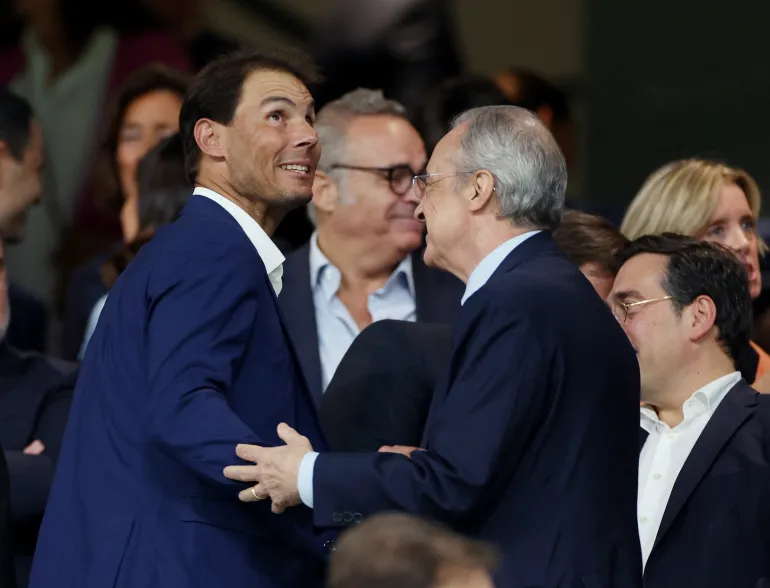
Tennis player Rafael Nadal and Real Madrid president Florentino Perez in the stands [Isabel Infantes/Reuters]
Tennis player Rafael Nadal and Real Madrid President Florentino Perez in the stands [Isabel Infantes/Reuters]

The club highlighted Nadal’s sporting achievements, including 92 singles titles, two Olympic gold medals, five Davis Cup triumphs with Spain and the world number one ranking.

The club said his qualities beyond those honours – including humility, respect for opponents and commitment to charity – mirrored the club’s own.

“All ⁠these values form part of Real Madrid’s identity, and ⁠Rafael Nadal has embodied and championed them throughout his sporting career,” said the statement announcing his appointment at a board meeting on Tuesday.

Nadal welcomed the invitation.

“I would like to thank President Florentino Perez and the Board for ⁠inviting me to join the Board of Directors of Real Madrid,” he wrote on social media.

“I have ⁠accepted this invitation with great enthusiasm, keen to ⁠learn and to contribute as much as I can.”

Nadal, who retired from tennis in November 2024, has long been touted as a potential successor to Perez, ‌although he has played down the prospect.

Perez, 79, secured another four-year term in June after Real’s first contested presidential election in two decades.

More ‌than ‌a third of voting members backed challenger Enrique Riquelme, who opposed plans to bring outside investment into the member-owned club.

Source link

AI’s real bottleneck is electricity. Who will pay for it? | Technology

Within a week, two of the three largest cloud computing companies in the world signed 20-year contracts for nuclear electricity. Amazon has taken 690 megawatts from Constellation’s Calvert Cliffs plant in Maryland, including 190 megawatts of additional generating capacity expected between 2030 and 2032. Google has signed an agreement that will bring 890 megawatts of additional nuclear capacity into the United States. Constellation is investing more than $4.3bn to upgrade 11 reactors across Illinois, Pennsylvania, and New Jersey. Neither agreement, however, involves building a new nuclear reactor. Rather, they are paying to generate more output from reactors that already exist – some of which are even older than the companies themselves.

A few years ago, such agreements would have seemed inconceivable. Nuclear power had fallen out of favour following accidents at Three Mile Island in 1979, Chornobyl in 1986 and Fukushima in 2011. Germany phased out nuclear power, while Japan shut down its reactors after Fukushima, although it has since begun restarting them. In many democratic countries, advocating for nuclear energy became politically difficult.

Today, an undamaged reactor at Three Mile Island is being brought back into service, with Microsoft contracted to buy its output for 20 years. The US Department of Energy is providing up to $4.4bn in loans to support the restart of three shuttered plants, with the aim of restoring about 2.25 gigawatts. Palisades in Michigan, which was closed in 2022, is contracted to be generating again by March 2027. If successful, it would become the first US commercial nuclear plant to restart after entering decommissioning.

What has changed?

The quiet reversal

In the last decade, the industry’s answer to AI’s energy problem was efficiency – things such as better chips, smaller models and smarter cooling seemed appealing and feasible. Industry conferences featured discussions about performance per watt, with modern artificial intelligence (AI) chips performing more computation per unit of electricity than their predecessors.

Yet those efficiency gains did not reduce overall electricity demand. Instead, each gain was quickly put towards something larger. Even when DeepSeek demonstrated that a competitive model could be trained at a fraction of the computing cost many had expected, the result was not a reduction in industry spending. Instead, laboratories continued planning more training runs, models that reason for longer, agents that work continuously in the background, and video generation.

This would not be the first time something like this has happened in history. In 1865, William Jevons observed that more efficient steam engines made Britain burn more coal, not less, because cheaper power created uses that had not existed before. The International Energy Agency estimates that global data centre electricity demand will more than double to around 945 terawatt-hours by 2030, even assuming continued improvements in efficiency.

Hence, the industry has changed strategy – unable to shrink demand, companies are now buying up supply.

The arithmetic of waiting

Money, however, cannot solve every problem quickly.

A new large reactor takes a decade or more from decision to electricity. Tech companies are investing in small modular reactors to power their data centres, although many of these projects are not expected to deliver electricity until the early 2030s. So far, very few of these have been built anywhere in the world. Thus, while reactor restarts and upgrades are the faster option, the “fast option” still means 2027, 2028, 2029, or beyond.

AI capital expenditure, however, does not operate on that same calendar. The chips being installed this year could be overtaken by newer technology long before the 20-year electricity contracts powering them expire. This discrepancy underpins all of these announcements, yet the industry has not addressed the implications if demand weakens while contractual obligations remain.

Who pays in the meantime

This is where the story stops being about technology.

Most of these deals sit inside PJM, the grid operator serving roughly 67 million people across 13 American states and Washington, DC. PJM uses capacity auctions to secure sufficient electricity-generating resources for future demand, with the associated costs ultimately passed on to consumers through their electricity bills. Capacity prices have reached the regulatory price cap in three consecutive auctions. According to the grid operator’s independent market monitor, data centre demand contributed approximately $29.4bn in capacity costs across the four most recent auctions. In the latest auction alone, around $6.3bn of these costs were attributed to data centre demand, including forecasts for facilities that have yet to be built.

In effect, households are already paying higher electricity capacity charges, partly because of projected demand from facilities that may never become operational. The Natural Resources Defense Council estimates that, by 2028, the typical household within PJM could face an additional $70 per month in electricity costs if current trends continue. These rising costs are also having political consequences. Recent US polling shows growing public dissatisfaction with data centres, with electricity bills among the main concerns. In response, Virginia has established a separate electricity rate class for data centres, Ohio has introduced minimum billing requirements, and Illinois is debating legislation.

The aim of the Google agreement is to tackle this objection. Its underlying principle is that major new electricity consumers should bring additional generation capacity rather than compete with existing users for an already constrained supply. This approach represents a constructive step towards mitigating the pressure that data centres place on electricity systems.

However, the arrangement remains voluntary. In October 2026, US federal regulators rejected most of PJM’s proposal to require large new electricity consumers to provide their own generation capacity. As a consequence, the industry is voluntarily offering a commitment that regulators have so far declined to impose through PJM’s proposed rules. This poses the question: how long will such voluntary commitments remain viable if the costs of fulfilling them begin to rise?

What the Gulf should take from this

For Gulf countries preparing their own AI infrastructure expansion, the US experience offers a warning about the costs of getting these arrangements wrong.

For countries with abundant energy resources, the expansion of AI infrastructure presents a significant opportunity.

Qatar’s sovereign fund has committed to a $20bn joint venture with Brookfield for AI infrastructure, beginning with a first phase of roughly 300 megawatts and potentially expanding to near 1.5 gigawatts. Abu Dhabi is pursuing plans for up to five gigawatts of AI data centre capacity. Saudi Arabia is targeting almost two gigawatts through HUMAIN. The region’s competitive advantage is substantial. As demand for AI computing grows, access to electricity is becoming an increasingly important factor in determining where computing infrastructure is built. The Gulf is well positioned to capitalise on this demand.

However, the scale of the proposed developments warrants scrutiny. If the proposed 1.5-gigawatt build-out is completed in Qatar, it would represent electricity demand equivalent to approximately 12 percent of the country’s installed generating capacity. Electricity allocated to AI infrastructure cannot simultaneously serve other purposes, meaning the opportunity costs of these projects deserve serious consideration.

In the United States, the debate over AI infrastructure is becoming increasingly centred on who ultimately bears the cost of its electricity demands, with many of the major commitments already in place. The Gulf is in a rare position of being able to settle that question first: what the industrial tariff is, who funds the new generation, what happens to the contracts when the hardware ages, and what long-term economic benefits the country would see beyond energy revenues and a limited number of jobs.

While hosting AI infrastructure can generate considerable economic value, the greater strategic opportunity lies in determining the conditions under which that infrastructure operates. For Gulf countries, the opportunity to establish these terms exists now, before large-scale commitments constrain their options.

The views expressed in this article are the author’s own and do not necessarily reflect Al Jazeera’s editorial stance.

Source link

Kylian Mbappe, Real Madrid and La Liga face long redemption road in China | Football

Kylian Mbappe, Real Madrid and La Liga have apologised for the French striker’s comments about Mao Zedong, but the damage to their reputation in China will not be easily or quickly repaired, experts say.

The France captain, one of the best footballers on the planet, is at the centre of a controversy after a video emerged this week of him appearing to make fun of former leader Mao.

Recommended Stories

list of 4 itemsend of list

Mbappe talked about being amused by an internet meme of his face digitally altered onto “some guy, think he’s a Chinese dictator”.

Mao remains officially revered as the hero of the communist revolution and founder of the People’s Republic of China.

He is blamed by historians for millions of deaths, but publicly mocking him is taboo, and Mbappe’s remarks saw him become the latest foreign sports figure or entity to infuriate Beijing.

Leading Chinese brands cut ties with the 27-year-old, and Spanish top-flight matches will be pulled from state television broadcaster CCTV’s schedule.

Chinese state media and social media users lined up to lambast Mbappe, although they were left in the dark about what exactly he said.

China is the world’s second-biggest economy and most lucrative market. Within two days, as the video, purportedly filmed in April, circulated online, the striker, his club Real Madrid and La Liga apologised.

A spokesman for China’s Ministry of Foreign Affairs said the government took Mbappe’s apology “seriously”.

‘Very damaging incident’

So is that the end of the matter?

“Viewed from a calm, objective and emotion-free standpoint, this is clearly a very damaging incident,” Yan Qiang, a veteran sports commentator, told the AFP news agency.

“It causes serious damage to the image of La Liga and Real Madrid in China.

“In the age of the mobile internet, things blow up on social media quickly and emotions run high.

“An apology does not necessarily mean the end of the story.

“It’s better to have an apology than no apology at all, but it’s definitely not the end of the story.”

The furore and the fallout are not an unfamiliar tale.

Various overseas sports leagues or players have found themselves in hot water for comments on topics that are politically sensitive to China.

China effectively cut ties with the National Basketball Association (NBA) in the United States in 2019 after then-Houston Rockets general manager Daryl Morey tweeted his support for Hong Kong protesters.

NBA executives said Morey had the right to freedom of expression. In contrast, La Liga immediately distanced itself from what Mbappe said.

Basketball is among the most popular sports in China along with football. However, Morey’s remark saw the NBA wiped from CCTV for more than a year.

NBA preseason matches returned to China only last year.

Australian National University lecturer Debby Chan called the NBA case – and now Mbappe’s – an illustration of China’s consumer nationalism, where online sentiment and state media converge into “a spiral of outrage”.

NBA commissioner Adam Silver said the league lost “hundreds of millions of dollars” over the split.

No way back for Mbappe, Real Madrid and La Liga?

Spanish football also has a lot to lose.

A source within La Liga told AFP that China and the US alone finance the “majority” of international broadcasting rights, which were valued at 748 million euros ($834m) for the 2024-25 season.

According to the Real Madrid-affiliated newspaper Marca, the Madrid club generates 10 to 15 percent of its jersey and other merchandise sales in China.

Real Madrid also counts Chinese companies among its main sponsors, with Hisense, sports betting firm Kaiyun Sports and Linglong Tire all featuring prominently.

Adam Zhang, founder of the Beijing-based Key-Solution Sports Consulting, said showing fast and heartfelt remorse was the first step.

“This will influence the decision on whether to continue the broadcast ban and, if so, for how long,” he told AFP.

Sports commentator Yan cast doubt on whether the reputation of Mbappe, whose face has adorned drink bottles and advertising campaigns in China, can ever fully recover.

“Judging by commercial sponsorships and big ad campaigns he appeared in during the World Cup, he has a huge influence in China,” he said.

“If that influence can’t be sustained, there can be no talk of commercial interests, and La Liga and Real Madrid will definitely be badly affected.”

Yan said it was “genuinely hard to predict” what happens next.

“In the short term, I’m certainly not optimistic,” he added.

“If they want to repair their image and the relationship, their future actions and behaviour will be key.”

Source link

Brazil’s real sinks after Lula’s re-election victory | Financial Markets News

Investors react to Lula’s election victory with a sharp decline in the Brazilian real and concerns over increased spending and fiscal challenges.

Brazil’s real dropped against the United States dollar on the heels of Brazil’s President Luiz Inacio Lula da Silva’s unexpected re-election after right-wing Flavio Bolsonaro, the son of former President Jair Bolsonaro, led in the first round of voting earlier this month.

Brazil’s currency dropped against the dollar by 12 percent in spot trading. Bovespa stock index futures tumbled nearly 15 percent on Monday.

Recommended Stories

list of 3 itemsend of list

“I’m not surprised the real is sinking sharply; traders are covering their bets that assume a Bolsonaro victory and tighter fiscal policy,” Rachel Ziemba, adjunct senior fellow at the Center for a New American Security, told Al Jazeera.

Brazil’s stock exchange halted trading for 30 minutes. The Bovespa index fell 10 percent from its previous close, triggering a circuit-breaker safety mechanism and reversing a rally earlier this month amid expectations of a shift to the right after Bolsonaro won the first round.

Ziemba says Bolsonaro’s refusal to concede the election has driven some financial uncertainty.

“The market pressure is also amplified by the objections raised by Bolsonaro, but the scale of the victory suggests that the result will stand,” she said.

Interest rate futures had also reflected expectations that tighter fiscal policy under Bolsonaro would allow borrowing costs to decline.

“They [investors] assume more domestic spending and higher rates in Brazil. However, the real is still likely to be supported by strong commodity revenues,” Ziemba noted.

Stocks closed on Friday almost 7 percent above their level before the first round, while the Brazilian real was nearly 5 percent stronger against the US dollar.

Interest rate futures are up 3.1 percent, rising sharply after President Lula’s win. Interest rate futures had previously reflected a tighter fiscal policy amid expectations that Bolsonaro would oust the incumbent and that he would allow borrowing costs to decline.

Lula faces an increase in Brazil’s debt and will be challenged with protecting both social programmes and investment, with investors looking for signs of whether his gradual fiscal approach can bring borrowing costs down.

Lula’s team aims to produce a budget surplus of about 1.3 percent of gross domestic product (GDP) by 2030. That would leave money to cover part of the interest bill, reducing the need for fresh borrowing. But public debt already exceeds 82 percent of GDP, while pensions and other legally required spending limit where savings can come from.

“Lula’s policies have talked about spending cuts, but he has not gone into the details of how that is going to look,” said Divya Singaravelu, head of research at Meridian 1305 Capital.

Attention will now turn to Lula’s choice of finance minister and what it signals about his fiscal approach.

Source link

Key takeaways from Real Madrid’s El Clasico win over Barcelona | Football

Real won their fifth straight game across all competitions and are finding their footing under veteran Jose Mourinho.

A Kylian Mbappe double, three vital points and bragging rights.

Sunday night could not get any better for Real Madrid fans.

Recommended Stories

list of 3 itemsend of list

When the action kicked off under the lights at Camp Nou for the Clasico, Jose Mourinho’s side were far from the favourites. But after 90 minutes of drama and fiery football, Real had the last laugh, beating rivals Barcelona 2-1 in a tantalising match.

The victory has renewed belief among the Bernabeu faithful, who are counting on Mourinho to lead them back to glory days.

Here are the key takeaways from Real’s El Clasico win against Barcelona:

Real earn bragging rights and snap Barca’s perfect record

Mbappe’s brace – which took his tally to 14 goals this season – was enough to silence the tens of thousands of Barcelona supporters at Camp Nou.

With that, Los Blancos became the first side to beat Barcelona in the league this season, ending the Catalan club’s nine-game winning streak in the top flight. Had Barcelona won, they would have broken Real’s 1968-69 record for a best-ever start in the Spanish top flight.

It also marked a second straight defeat for Hansi Flick’s side, coming only days after they fell to Paris Saint-Germain in the Champions League.

As for Real, victory brought home bragging rights. Real now lead the head-to-head record with 107 wins to Barca’s 106 in their all-time Clasico record.

BARCELONA, SPAIN - OCTOBER 25: Dean Huijsen of Real Madrid gestures during the LaLiga EA Sports 2026/27 match between FC Barcelona and Real Madrid at Spotify Camp Nou on October 25, 2026 in Barcelona, Spain. (Photo by Alex Caparros/Getty Images)
Dean Huijsen gives a thumbs-up after Real Madrid’s s El Clasico win over Barcelona [Alex Caparros/Getty Images]

Mbappe hits a century of Real goals

A day before the world tunes in to watch the Ballon d’Or ceremony for the best player of the 2025-26 season, Mbappe achieved another milestone.

The French forward’s brace brought up his 100th goal for Real across all competitions since joining in 2024 from PSG.

The 27-year-old, the second-best La Liga scorer this season, is building on a remarkable performance last campaign, which saw him finish as La Liga and the Champions League’s top scorer, the World Cup Golden Boot winner and the all-time leading World Cup scorer.

Those statistics have made him one of the frontrunners for the Ballon d’Or ahead of Monday’s gala in London.

Real Madrid's French forward #10 Kylian Mbappe (2R) celebrates scoring his team's second goal during the Spanish league football match between FC Barcelona and Real Madrid CF at Camp Nou Stadium in Barcelona on October 25, 2026. (Photo by Josep LAGO / AFP)
Real Madrid players celebrate Mbappe’s second goal [Josep Lago/AFP]

Real are slowly closing the gap on Barcelona

Defeats to Real Betis and Atletico Madrid last month shook Real’s top-flight campaign, but recent results reflect stability.

Real have now won five matches in a row – three in La Liga and two in the UCL – and seem to be coming into strong form.

Even though Sunday’s victory was just a second in eight games against Barcelona, Real are slowly reducing the gap on Barca this season, with just over a quarter of the season played.

After 10 matches, they are third in the league standings on 24 points, three points behind Barcelona, while Atletico are sandwiched in between, sitting second with 25 points.

Soccer Football - LaLiga - Atletico Madrid v Real Madrid - Riyadh Air Metropolitano, Madrid, Spain - September 20, 2026 Real Madrid's Jude Bellingham reacts REUTERS/Ana Beltran
Real Madrid’s Jude Bellingham and Kylian Mbappe are two of their star players [Ana Beltran/Reuters]

Can Mourinho bring Real back to glory days?

The improvement in form suggests Mourinho’s Real can challenge Barcelona’s recent La Liga dominance in his first season back in Spain.

After two seasons without trophies, Real turned to old boss Mourinho to find a way to stop Barca’s dominance.

Although Mourinho has not won a league title since guiding Chelsea to the Premier League crown in 2014-15, his record as one of football’s most decorated managers remains formidable.

Thirteen years after his first spell at Real ended, Mourinho’s return to the Clasico offered a chance to make an immediate statement, and victory over Barcelona made it all the sweeter.

The result should also help to boost morale and build unity within the Real squad. ‌‌‌‌More importantly, Mourinho now has evidence that his methods can help return Real to the summit of Spanish football.

“If we win today but lose at El Sardinero, it counts for nothing, because Madrid isn’t ‌‌‌‌playing ‌‌‌‌to win at the Camp Nou,” Mourinho said. “They’re playing to win the championship.”

Mourinho has made his intentions clear.

After celebrating Sunday’s Clasico win with his trademark knee slide, the 63-year-old manager knows his job is far from over.

Having led Real to three trophies during his first spell, including a record-breaking La Liga ⁠⁠⁠⁠triumph, Mourinho knows best what Real are capable of achieving.

Jose Mourinho, Head Coach of Real Madrid, arrives at the stadium before the UEFA Champions League 2026/27 League Phase MD3 match
Jose Mourinho guided Real to three trophies during his first spell [Angel Martinez/UEFA via Getty Images]

Source link

Prem talking points: Leicester vs Northampton fallout, Gloucester real deal & Christian Wade equals record

For all the free-flowing, high-scoring rugby in the Prem so far this season, this weekend was something of a throwback.

There were only 21 tries across the five games, whereas a fortnight ago there were 18 tries in the Northampton against Bath game alone.

But, despite the abominable weather altering the whole complexion of round four, there was no shortage of drama.

In the East Midlands derby on Saturday, Leicester Tigers produced a second-half performance that was as vintage Leicester Tigers as you could possibly get: a brutal set-piece and forward display that shook the old foundations of the Crumbie Stand and would have made the ABC Club proud.

In front of a febrile sell-out crowd, the game was played on the edge – a major scuffle breaking out on the stroke of half-time with England team-mates Henry Pollock and Ollie Chessum in the thick of it.

But tensions will have eased quickly. Thirteen of those involved in the derby met up for dinner in the England camp on Sunday.

“This fixture always has some heat behind it, and we know it means a lot to each other and to the fans,” Leicester and England scrum-half Jack van Poortvliet explained to BBC Radio 5 Live.

“We just try and put all our heart on to the pitch. Sometimes it boils over into a little scuffle, but we will go and have a beer with them now. That’s what rugby is about. You play fierce with each other and then enjoy each other’s company.

“We always end up laughing about it. Being in England camp with them almost makes the fixture mean a bit more, because you always want one over them.”

Northampton are the champions and still the team to beat. However, that’s twice in six months they’ve been handed a lesson by the Tigers at Mattioli Woods Welford Road.

Saints fans will be comforted by the fact the title is decided in the warm early summer months of May and June, but boss Phil Dowson will still want his side to be as effective in the wet as they are in the dry.

Source link

Real Madrid beat Barcelona in El Clasico as La Liga heats up

Jose Mourinho has done it again.

The Real Madrid manager celebrated Kylian Mbappe’s late winner at Barcelona on Sunday with a trademark knee slide, as he maintained his midas touch over their bitter rivals.

Mourinho has become just the third Real boss to go six El Clasicos in a row without defeat – 13 years after he last led Los Blancos in this fixture.

Four wins and two draws in his past six matches in charge of Real Madrid against Barcelona put him up there with Miguel Munoz (1962 to 1965) and Vicente del Bosque (2001 to 2003) as Real managers who have gone six in a row without defeat against the old enemy.

It was also just a second victory in eight games against Barcelona for Real, with the return of Mourinho to the fixture haunting the reigning champions

And more importantly for Mourinho, Mbappe’s double in Real’s 2-1 win ended Barcelona’s nine-game unbeaten domestic run with a crucial Clasico victory at the Camp Nou.

A Real defeat would have allowed Barcelona to establish a commanding nine-point advantage but the result has transformed the top of La Liga, bringing Mourinho’s side to within three points of their rivals.

“In my view, Real Madrid do not play to win at the Camp Nou, Real Madrid play to win La Liga,” he said.

“We could win with luck, but we won with calmness and with all merit,” he said. “It’s a very strong group. Everyone works very hard. Everyone was ready to win.

“The credit goes to the players. When you win, the credit goes to the players. But when you lose, the blame falls on you. And that’s why we see coaches being sacked from their positions every week.”

The Portuguese, who returned to Real 13 years after his first stint in charge this summer, has now won six and lost six El Clasicos.

He said: “I’ve learned that I have an extraordinary group, with the quality and mindset to play.

“In midfield, having a mix of talents gives us more than just having two players with similar characteristics. This mix of talents gives us balance when defending and quality when we go on the attack.

“We’ve beaten several teams by four or more goals, but this is Barca, and the players put on a great performance. We need to continue like this and don’t go over the moon after this win.”

Barcelona boss Hansi Flick said he didn’t want to give excuses for the defeat but admitted his team lacked fresh legs after a demanding few weeks.

“We missed the freshness,” he said. “It’s not easy for our players. We have to recover well, train well and we have to respond from this defeat.

“In big games, small things are important and they decide the games and today, it wasn’t on our side.

“I can see that today we were not fresh and this is what we have to change.”

Source link

Real Madrid beat Barcelona 2-1 at Camp Nou to halve gap to La Liga leaders | Football

French superstar Kylian Mbappe scores brace for Madrid to inflict Barcelona’s first domestic defeat of the campaign.

Kylian Mbappe struck twice to earn Jose Mourinho’s Real Madrid a 2-1 El Clasico victory over La Liga leaders Barcelona at Camp Nou, cutting the gap to three points.

French superstar Mbappe opened the scoring before half-time on Sunday and then slotted home late on to inflict Barca’s first domestic defeat of the campaign after Raphinha had equalised for the champions.

Real Madrid remain third, behind Atletico Madrid and Hansi Flick’s Barca, who had won their first nine games before a chastening week.

The Catalans suffered a second straight defeat after losing on Tuesday against Paris Saint-Germain in the Champions League.

Barca had won six of the seven previous Clasicos since the German arrived but were surprisingly subdued against Mourinho’s side.

“In general we didn’t have a great game, in the first half we weren’t ourselves, there were a lot of things we could have done better,” Barcelona midfielder Pedri told DAZN.

“We wanted to win the Clasico in front of our fans, but the season is very long … a league is not won here.”

Los Blancos, without suspended winger Vinicius Junior, won their fifth straight game across all competitions and are finding their footing under veteran Portuguese coach Mourinho.

After two trophyless seasons Madrid turned back to Mourinho to try and stop Barca’s dominance, and this result will give them hope they are on the right track.

The opening period of the game was cagey, with few opportunities.

Barca defender Pau Cubarsi twice reacted well to shut down Mbappe, while Real Madrid’s Marc Cucurella took a rapid liking for Lamine Yamal’s shirt, constantly grabbing at the 19-year-old winger.

Anthony Gordon, playing in his first Clasico since joining Barcelona from Newcastle, backheeled the ball to Raphinha, who fired narrowly wide as Barca threatened.

The hosts were dealt a setback when young defender Xavi Espart pulled up hurt and needed to be replaced by Alejandro Balde before the half-hour mark.

Andriy Lunin, playing in goal for Madrid after Thibaut Courtois pulled out of the squad with flu, saved at his near post from Gordon before the visitors took the lead.

Mbappe scored his 10th league goal of the season and also his easiest, with Barca’s Gerard Martin clearing a cross straight at the Frenchman, who deflected it into the net.

Barca responded by carving out a glorious chance for an equaliser but teenage sensation Yamal for once miscued in front of goal, firing wide when poised to level.

The game opened up and Yan Diomande came close to doubling Madrid’s lead before half-time, drilling into the side-netting.


Martin redeemed himself early in the second half as he held off Jude Bellingham, who could neither beat the defender nor find a free Mbappe.

Raphinha, who had a quiet first half, pulled Barcelona level just after the hour mark.

Pedri fed the Brazilian, La Liga’s top goalscorer with 13, who fired through Bellingham’s legs and Lunin could not keep the shot out.

The Ukrainian goalkeeper did make a superb save to deny Martin at a corner, as Barcelona flowed forward with the wind finally in their sails.

Yamal bent an effort wide with Lunin at full stretch and Barca substitute Frenkie de Jong had a shot desperately blocked by Dean Huijsen.

There was a sting in the tail for the Catalans though as substitute Gabriel Jesus lost possession and Madrid raced through on goal.

Eduardo Camavinga beat Cubarsi and unselfishly cut the ball back for Mbappe to tuck home his second of the night into an empty net with Joan Garcia drawn out of position.

Source link

DJ Lizz, Tomasa del Real reflect on 10 years of neoperreo movement

Amid all the turmoil of 2026, some may yearn to dial the culture back to 2016 — in all its rainbow-saturated, Rio de Janeiro Instagram-filtered glory.

Neoperreo, the Latin American genre born of that internet era, turns 10 this year. Artists built it as a reimagining of reggaeton music, by and for femmes and freaks: cis and trans women, as well as the frikis from Latin America’s punk and alt scenes, who never fit the mold. For them, this cutting-edge sound and the internet community around it offered a lifeline.

A decade after the term first circulated, neoperreo (as in, the new perreo) has exapanded from SoundCloud and DIY parties into a global network of artists, DJs and festivals.

The genre takes a distinctly techno-infused approach to the dembow rhythm, stripping reggaeton of any acoustic elements and assembling them anew on a laptop to sound colder and faster. With the bass hollowed out and Auto-Tune cranked up, the vocals take on a metallic sheen — as women spit risqué verses claiming their rightful place as subjects, as opposed to the sex objects that men would relegate them to.

Both released in 2016, two of the songs that defined the genre early on — Tomasa del Real’s “Bien y Mal” and Ms Nina’s “Tu Sicaria” — pair hooks you can perrear to with beats that sound like they were built in a bedroom, because they actually were.

Beyond its sound, the genre created worlds: digital networks where outsiders across the Americas and Europe found each other, and parties where queer, trans and friki Latines could show up exactly as they were.

As trans and Latine communities face mounting attacks on their rights and safety, those spaces, alongside the new ones they’ve inspired, keep carrying weight.

“It didn’t have a name yet, but it was born from this desire to experiment and create something new at its core,” says Elisa Espinoza, the 34-year-old Swiss Army knife of an artist known as DJ Lizz. Raised in the southern Chilean town of Hualpén, she traces that initial spark to her country’s history.

“Chile is a country [that experienced] a dictatorship, a country that always sought a kind of homogeneity — a sickness that hopefully we’d all think the same, look the same, act the same,” she says. “At that moment, everyone was trying to create something, to identify with [who] we really are. Out of that constant search comes experimentation, which goes hand in hand with sexual liberation, liberation from social class. That spoke to a revolutionary spirit.”

For Espinoza, that liberation meant reclaiming a femininity she had once feared, by drawing from drag culture and the ’80s vogue tradition. “I hypersexualized myself, I hyperfeminized myself, just like a drag queen — and that somehow empowered me even more,” she says, recalling men who yelled obscenities at her on the street or tried to grab her ass when she wore shorts.

“Men were the owners of women’s sexuality, and now we’re the owners of our sexuality,” she says.

From the other end of the country, artist Tomasa del Real, born Valeria Cisternas, began to approach music with a similar ethos in her hometown of Iquique, which sits on Chile’s northern coast. When both eventually moved to, and met in, Santiago, they realized that other artists from around the world were chasing the same idea.

“On the internet, people found freedom they didn’t find in their own country or city,” says Espinoza. “We were all united by the same search.”

From this virtual community came neoperreo’s signature sound: a hedonistic mix of reggaeton and Latin rhythms with industrial, electronic, funk and trap elements. “What came out was, for some people, a work of art; for other people, a monster,” says Espinoza.

As cisgender, straight women, the community they describe both includes and extends beyond their own identities. “It was the first time someone said, ‘No, this music I make, at least in Latin America, isn’t for men.’ It’s for women, and it’s for gays,” Espinoza says.

The term “neoperreo” came about almost by accident. On an episode of Red Bull Radio in 2016, Cisternas, now 39, says she tried to explain in her “basic English” that she wasn’t really sure the music she made should be called reggaeton at all. Reggaeton came from Puerto Rico, by way of reggae en español; her lyrics and rhythms were different, and the people collaborating with her came from electronica, not the island.

She didn’t want to appropriate a culture that wasn’t hers, so she reached for another way to describe it: not as the new reggaeton, but the new music you can perreo to. Twerking, she wanted to explain, a woman can do alone; but perreo takes two. “So I meant to say el nuevo perreo, but in English, I said neo — neoperreo,” she says.

And the name just stuck.

That same year, Cisternas and Espinoza started throwing parties in Santiago under the hashtag #NeoPerreo. They called in a crowd from society’s margins: a community “of DJs, dancers, strippers, tattoo artists, of the alternative world, the more gothic world, the misfits themselves,” says Cisternas.

At their first event, the line wrapped around the block.

“It was a really important moment for the history of reggaeton, because there were no spaces where someone gay could show up with [both] their metalhead friend and their crazy girlfriend to dance reggaeton. Those spaces didn’t exist; reggaeton was very marginal, completely removed from society. This brought us closer,” says Cisternas.

The scene also became a way to make money. “It gave work to a lot of us who didn’t have access to money that immediately; we created a lot of work for ourselves,” she says. “A lot of people built their careers at that moment too.”

Jorgelina Andrea del Valle Torres, the Argentine neoperreo artist known as Ms Nina, also remembers those first parties affectionately. “It widened the audience,” she says. “In the end, we created a community where everyone feels seen and safe.”

But neoperreo wasn’t always received so warmly. “People didn’t understand it because they weren’t used to it. They were used to basic reggaeton,” Torres says. “There was a scene in Spain too, with trap and reggaeton built on SoundCloud and turned-up Auto-Tune. [But it was] a new kind of music nobody else was making. Everybody kind of hated it. And now everybody’s doing it.”

Growing up in central Argentina, Torres always felt judged and bullied for being different; she’s spent the last 20 years in Alicante, Spain, where she says she finally feels free to explore her bisexuality. Still, the cumbia villera of her childhood — a heavily synthesized subgenre born in the outskirts of Buenos Aires in the late 1990s — runs through everything she makes.

Argentina, like Chile, was barely a generation out from a military dictatorship when it had partnered with Augusto Pinochet’s regime to hunt down dissidents. Music of the margins — which before neoperreo was punk rock and hip-hop — had been framed in opposition to polite society.

Although reggaeton originated in the streets, the genre hit its zenith in the mainstream this year, thanks to Bad Bunny’s historic Super Bowl halftime show and Karol G’s headlining set at Coachella. Yet Cisternas, despite having performed at Coachella herself in 2019, argues that neoperreo will never be mainstream in the same way.

“It’s too weird — and that’s fine,” she says. “The weirder, the better.”

For the often overlapping worlds of sex work and queer nightlife, the underground movement provided a natural shelter for those unsafe to be themselves in the mainstream, from the leading artists who candidly promote their music alongside erotic content on OnlyFans, to trans artists like Sasha Sathya, who discuss gendered violence and labor in their lyrics. And as governments in Argentina and the U.S. roll back protections for queer and trans people, the freedoms cultivated on the dance floor remain far from assured outside it.

“Above all, because of the trans laws, that’s where there’s still a long way to go,” she says. “It’s important that we keep going.”

Yet now, 10 years in, the movement’s heirs may not call themselves neoperreo at all.

On another late summer night in New York, under the red glow of the DJ booth and a canopy of globe string lights, the rooftop’s wooden floorboards dip beneath scores of platform heels. An outdoor thermometer clocks a temperature of 100 degrees as the sounds of Y2K-era reggaeton reverberate. There’s no shortage of snapbacks, piercings, baby bangs and baggy jorts.

For queer people who never had the canonical experience of grinding in their high school gym, a party called Trakata fills that primal need — and operates on the same queer, rebellious frequency as neoperreo.

At these incandescent parties, Trakata founder Tani Shimizu, a 26-year-old trans man, can be found entrenched on the dance floor, often perreando with one or more beautiful, curly-haired femmes. At a local Caribbean cafe, complete with pastel floral tiles, plastic-covered couches, and the trills of guitar from “Pa’ Que Retozen” echoing through maxed-out speakers, he explains how it all began.

When looking to fundraise for his top surgery last winter, the 26-year-old joined together with some friends from the trans collective Body Hack to throw a queer-friendly perreo party. Hosted at the Bush, a Brooklyn lesbian bar Shimizu had been infamously bartending at, the first event drew close to 600 attendees. “People were like, ‘Oh, my God, we’ve been dying for this,’” he says.

The turnout convinced Shimizu there was a market for the party, along with the chance to create paid work for himself and others. “I cared a lot about how this could be an opportunity for people to make money, myself included,” he says. “I believe in compensating people fairly, even my friends.”

Shimizu, a first-generation Peruvian from Los Angeles, admits he isn’t too familiar with the specifics of neoperreo. Though Ms Nina’s “Tu Sicaria” makes its way onto the playlist some nights, his resident DJs mostly stick to the classics at their parties, and that’s intentional.

Whereas artists back home innovate to push against the status quo, in predominantly white U.S. spaces — especially for queer Latines — the older reggaeton tracks feel more alt.

“Trans and queer people are often pigeonholed to this idea of being really alternative in sound,” he says. “There’s something arguably subversive about going, ‘No, it’s actually OK to honor culturally what we have always held onto’ — and what was principal in our identities, regardless of these other subversive or subaltern identities that we embody.”

While the sonic identity of the space roots itself in nostalgia and reconnection, Shimizu strives to balance novelty in the construction of the space, while reaffirming the desire for Trakata to reflect what has been historically true of queer gatherings.

“There’s this deeper desire and this deeper politic. It just so happens to take place in the context of a club on a Friday, or Saturday night, at these hours.”

Nearly a year into his transition, he reflects on a newfound enlightenment. “Transness has given me the liberty to not be so consumed with what I look like,” Shimizu says. “I’m not dwelling any longer, which is really freeing. [It] gives you a lot of mental space to focus on things that are more important.”

That freedom from the mirror is core to neoperreo’s mission: The pursuit of a dance floor where your body, and everyone else’s, are besides the point. Shimizu has built that into Trakata’s foundation. “I want people of all body types and existences,” he says.

Shimizu also wants to make it clear that Trakata isn’t for people who just want to look hot online. “It’s anyone who is interested in engaging with the cultural experience that we’re co-creating, and if you want to come to dance, and you want to stay off your damn phone.”

Trakata wasn’t created with neoperreo in mind; but with the same sweaty dance moves and the same people finding each other, it’s hard to tell where one stops and the other begins. Since Cisternas and Espinoza threw their first neoperreo party 10 years ago, their legacy has carried over to popular Boiler Room sets and underground queer sanctuaries in equal measure.

“[For] anyone who felt like a bit of a misfit, unwelcome in reggaeton,” says Cistnernas, “neoperreo is their home.”

This story was produced in partnership with the Trans Journalists Assn.

Source link

EastEnders fans ‘work out’ real reason Jack hates Max at New Year after shock twist

EastEnders fans are pretty sure they know the real reason Jack Branning isn’t on speaking terms with brother Max at New Year, after a shocking twist concerning his daughter Amy

No one seems to fight more than the Branning brothers, but EastEnders have set Jack and Max Branning up for a major clash by New Year’s Day.

The flashforward that aired at the start of the year showed that Jack Branning (Scott Maslen) no longer talks to his brother Max (Jake Wood) and fans think they know why after a shocking twist in tonight’s episode. Over the past few weeks, Jack’s daughter Amy (Ellie Dadd) has been groomed by Craig Ingram (Matthew James-Bailey).

Craig has been pushing Amy for money and she was determined to empty her trust fund, which held £100,000 in it. Needing the signature of one of the trustees, she turned to Uncle Max.

To see more of the stories you love from The Mirror and to find them easily in Google then make us your preferred source. Free and easy-to-do, just click on the link here to find more from The Mirror at the top of your feed.

Max, who has money troubles of his own, seemed keen to help Amy – for a cut. Though he didn’t know why Amy wanted the money, he later saw her getting into Craig’s car. Max clearly sensed something was up and rushed to tell Jack… only to change his mind.

The slimy businessman chose not to say anything about his niece getting into the car of an older man because he still wanted money. He told Amy that he would help her get the money, but it had to be a secret.

Fans are now sure this is the reason Jack hates Max at New Year – if something happens to Amy and Jack finds out what Max did, he will blame his brother, who could have said something and didn’t.

One fan said: “So Jack and Max aren’t on speaking terms on NYD because he’s gonna help Amy get the money to run off with Craig, isn’t he?”

Another said: “I could also see max and jack not being on speaking terms due to the fact max uses her trust fund money. Either or is possible.”

A third slammed Max for his actions saying they weren’t surprised no one seemed to like Max on New Year’s Day: “It’s never about anyone else it’s always me me me with that guy then he makes himself look good by helping Jack break into Craig’s flat . No wonder everyone is gunning for him at New Years .”

On 1 January 2027, it isn’t just Jack who seems to hate Max. Peter Beale (Thomas Law) also isn’t speaking to his father-in-law and refuses to attend his wedding.

Likewise, Max is arrested for soliciting a murder and claims he’s being set up, implying someone else hates him enough to want him in prison. Finally, a mystery gunman takes Max’s children Lauren (Jacqueline Jossa) and Oscar (Pierre Counihan-Moullier) hostage and forces him to pick one to save.

Like this story? For more of the latest showbiz news and gossip, follow Mirror Celebs on TikTok , Snapchat , Instagram , Twitter , Facebook , YouTube and Threads .


Source link