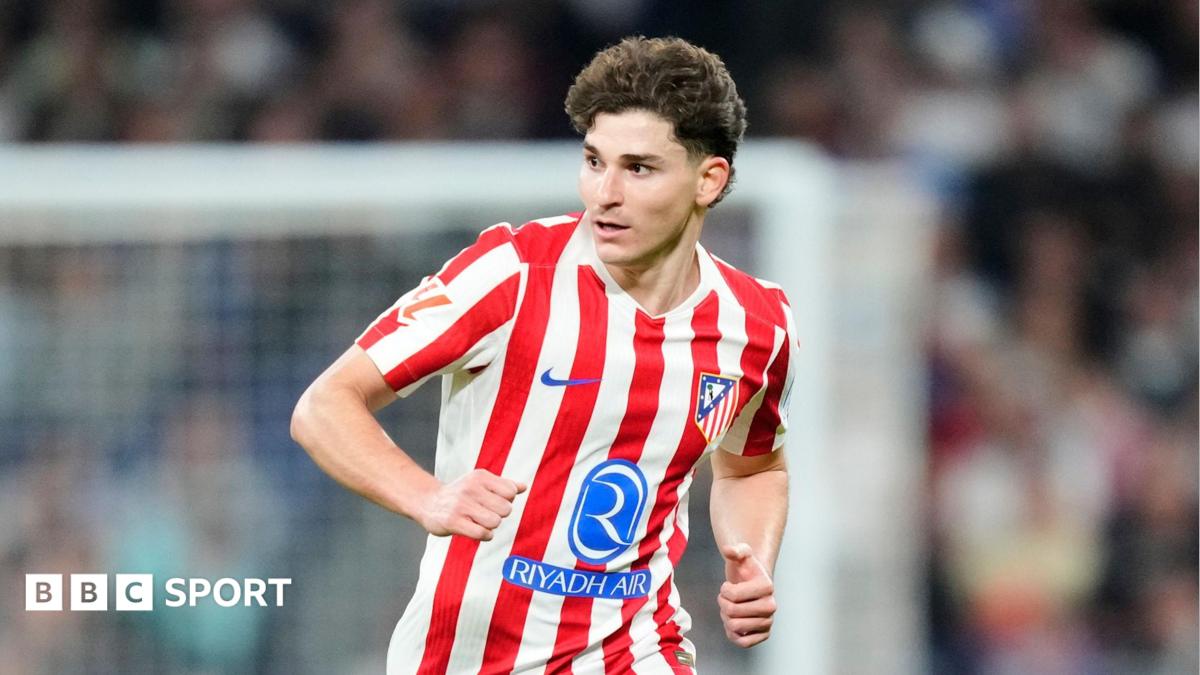
Real Madrid have had a 150m euro (£130m) offer for striker Julian Alvarez rejected by city rivals Atletico Madrid.
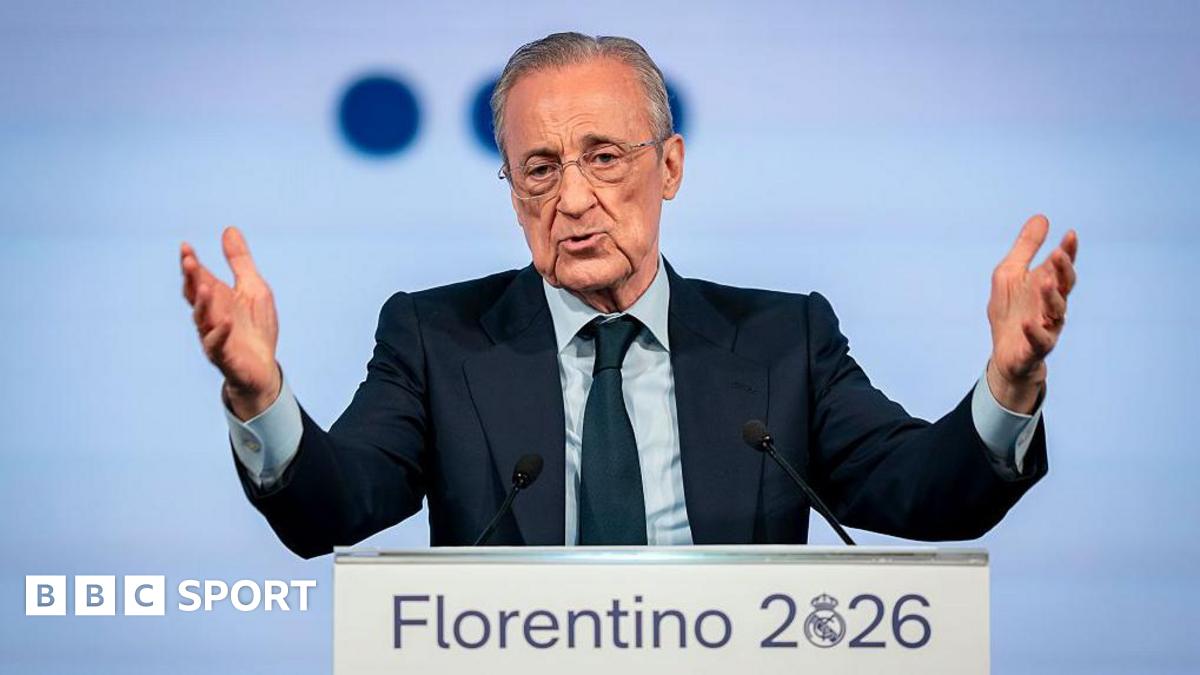
Real president Florentino Perez last week pledged to make a 150m euro offer for an unnamed “galactico” player if re-elected to his position.
Having successfully retained control on Sunday, Perez made good on his promise.
However, the move for the 26-year-old Argentina international was turned down by his club, who cited Alvarez’s release clause of 500m euros (£430m).
In a statement, Real said: “Following the meeting of the board of directors held today, it has made an offer of 150 million euros to Club Atletico de Madrid for the federative rights of the player Julian Alvarez.
“After reviewing and evaluating the offer, Club Atletico de Madrid has expressed its gratitude for the proposal, made within the framework of the good relations between both clubs, and has rejected it, referring to the player’s release clause.”
Atletico did not immediately comment.
Former Manchester City player Alvarez, who won the 2022 World Cup with Argentina, joined the La Liga club in an £81.5m deal in 2024.
He scored 20 goals in 49 appearances for Atletico last season as they finished fourth in the table and reached the Champions League semi-finals.
LOVE Island viewers have been left baffled after spotting Ellie Chadwick is rarely seen without her iconic £2,000 Prada bag.
Despite engaging in some tense chats in the villa, fans of the hit ITV show have been left distracted by her trusty wicker basket bag never being far from sight.
Sign up for the Showbiz newsletter
Thank you!
Love Island’s Ellie has left fans in hysterics after spotting she is rarely without her iconic Prada bagCredit: EBayITV2 viewers have been confused by Ellie’s constant need to carry her designer bag in the villaCredit: EBay
And it turns out there is a key reason why real estate videographer Ellie, 24, is always carrying her beloved accessory around the villa.
Amy Bannerman, eBay‘s Pre-Loved Style Director, told The Sun that bags were added into the Love Island pad for the first season of Love Island All Stars in January 2025.
She explained: “I wanted a way to add more eBay to the Islanders’ non-swimwear looks and give us an opportunity to talk about eBay’s Authenticity Guarantee (AG) offering.
“The Love Island All Stars cast all really veer towards premium brands too, so it felt like the perfect place to introduce it.
Some viewers said it reminded them of Teletubby character Tinky WinkyCredit: BBCOne fan shared a picture of Mr Tumble and his yellow spotted bagCredit: BBC
“There isn’t more of a focus on bags this season, but they have got more airtime from Ellie’s iconic Prada moment, which is great.”
Viewers have been left in fits of giggles after spotting Ellie’s bag habit and have taken to social media to discuss it further.
One wrote: “Ellie is the first girl I’ve seen carry a bag around the villa, she’s so real go find those designer bags girly show us the villa collection.”
This person replied: “And the only thing in there is probably her phone and some lip gloss.”
This person asked: “Can tell you right now that there’s nothing in Ellie’s bag,” while someone else echoed: “Why is Ellie the only person in love island to ever carry a handbag?”
Someone shared a picture of Teletubbies character Tinky Winky and their famous red handbag, while another posted a picture of Mr Tumble and his yellow spotted bag.
This viewer shared: “Ellie walking around the villa with a handbag, quite possibly is the first time I’ve seen that happen on that show, since I began watching it, all those years ago. Definitely not on my bingo card.”
Another added: “It’s really making me laugh that Ellie carries a handbag, like girl why do you need a handbag in the villa?”
And some fans have even suggested: “If she stays long enough, she’s going to have some bag deals.”
Amy clarified that there is no quota for how many eBay items Islanders have to use, but they have the option to choose from their “incredible choice of brands and styles.”
Amy explained: “They pick pieces from a shared wardrobe that includes everything from Versace and Gucci to vintage Topshop and Marks & Spencer.
“Last season, unbranded vintage was the most-worn category, which was very exciting for us!”
The eBay staff member said they also added men’s bags as the “boys all seemed keen to join the girls in carrying AG bags.”
She added: “We have also added luxury AG men’s sliders too, so they’re wearing more eBay around the pool during daytime moments.”
Since Kavan entered the villa as a surprise bombshell he caught Ellie’s eye, despite her previously being coupled up with his brother.
The blonde beauty continued to express interest in both of the lads for a while until Sunday when everything came crashing down.
Ellie and Aidan were sitting on a sofa together talking about how Aidan kissed someone else when she was briefly booted from the villa.
Ellie left for around 12 hours alongside Samraj after bombshells Yasmin and George were tasked by host Maya Jama to axe a lad and a lady from the show.
Real Madrid is owned entirely by members who decide its president. Each pay an annual fee of around £130 and nearly 100,000 of them will vote on Sunday.
Following his first election in 2000, Perez pursued a ‘Galacticos’ policy of signing expensive world-class players including Luis Figo, David Beckham and Zinedine Zidane.
Real Madrid won two La Liga titles and a Champions League before Perez resigned in 2006 amid disappointing results.
In 2009, he successfully stood for the presidency again unopposed and has done so a further four times in his 17-year second term.
Trailing La Liga champions Barcelona by eight points, Real Madrid ended the 2025-26 season with no major trophies for the second season in a row.
As the season drew to a close, Perez called a news conference in which he railed against the club’s enemies and urged those unhappy with his leadership to run against him for president.
Renewable energy magnate Riquelme stepped forward, leaving Perez to compete with another candidate to retain his role for the first time in 20 years.
On Wednesday, Perez promised voters he would initiate a Galacticos-style transfer bid days after he hopes to be re-elected.
“I have some news for you,” he told Spanish TV show Horizonte.
“On Tuesday or so, I’m going to make an offer to a major Champions League club for a great player. It would be the largest transfer fee Real Madrid has ever paid in its history.”
Perez was asked the identity of his target and the scale of the fee.
“Olise is a great player but it’s not Olise,” Perez said. “It’s not Doku either.
“We’re going to make a significant offer, at least around 150m.
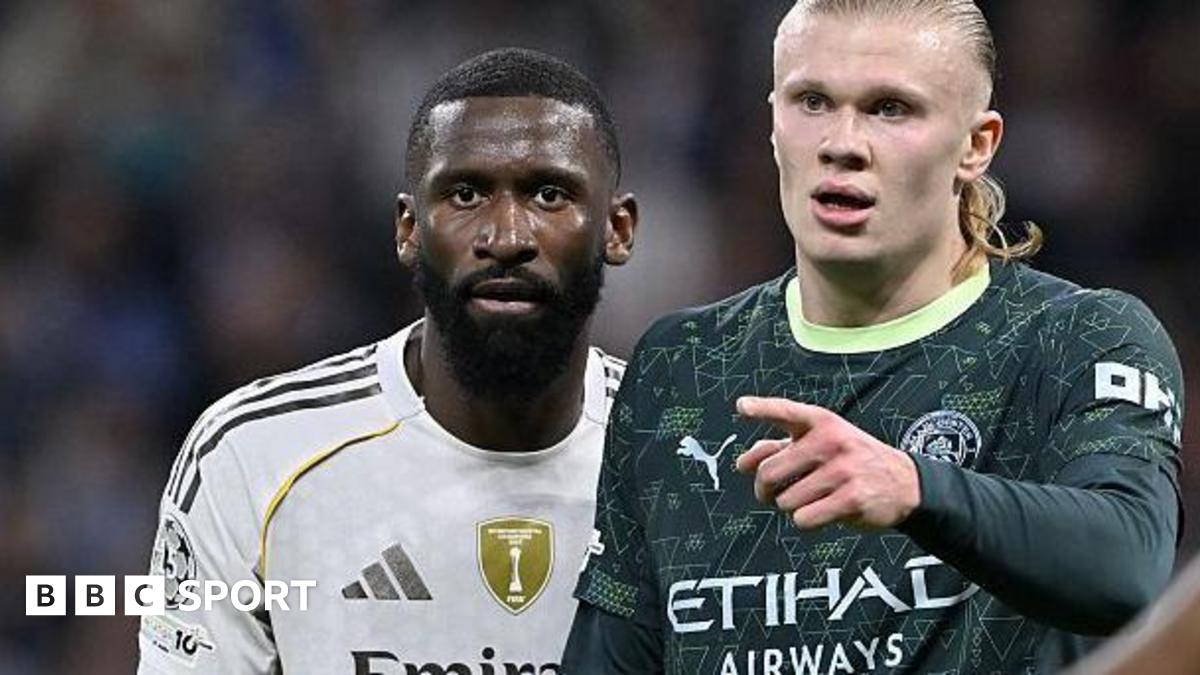
“He needs to be a player from midfield who can go forward. And it’s not Haaland.
“The player is not from the Premier League. And the first thing we’ll do is talk to the club.
“It’s a signing meant to generate excitement because that’s what it’s all about, generating excitement.”
He also reminded voters his re-election would activate already-agreed deals for manager Jose Mourinho, Inter Milan defender Denzel Dumfries and Ibrahima Konate, whose contract at Liverpool won’t be renewed.
Enrique Riquelme held up a Real Madrid shirt bearing Erling Haaland’s name, while campaigning for club presidency.
Published On 4 Jun 20264 Jun 2026
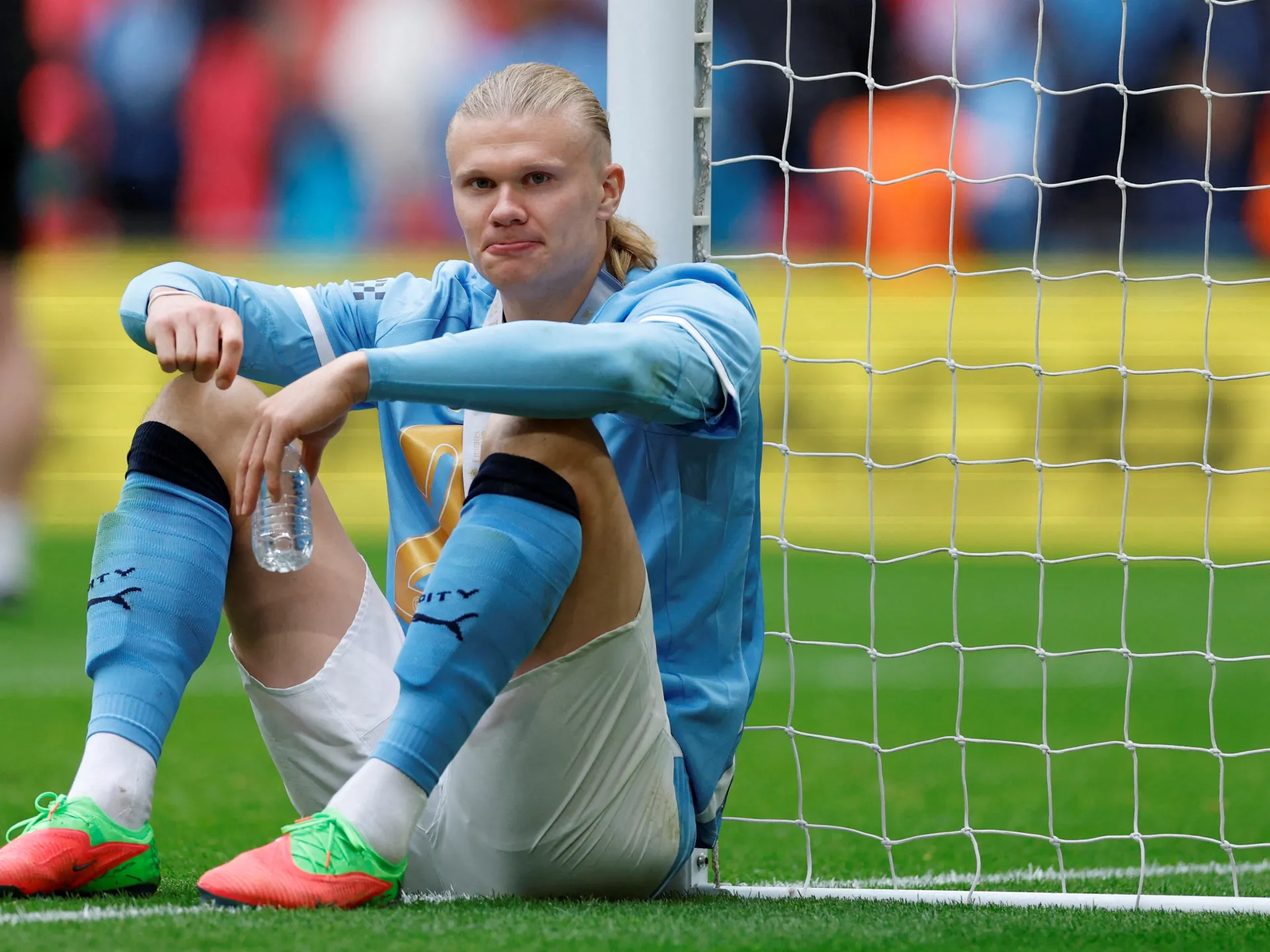
Manchester City is considering legal action after Real Madrid presidential candidate Enrique Riquelme said he would sign the Premier League club’s Norwegian striker Erling Haaland if elected.
Riquelme, a renewable energy entrepreneur challenging incumbent Florentino Perez, made the pledge during an appearance on Spanish television on Wednesday, where he held up a Real Madrid shirt bearing Haaland’s name.
Recommended Stories
list of 4 itemsend of list
“The stories which have emerged from Spain regarding the future of Erling Haaland are untrue,” a City spokesperson said on Thursday.
“There is no chance of this happening, and there is no contractual clause to enable it. We are considering legal action for the use of our player’s image in this context.”
Riquelme said Haaland, who scored 38 goals in all competitions last season, had a release clause and wanted to move to the Spanish club, adding that he would make the transfer a priority if he wins Sunday’s election.
A joint statement from the 25-year-old footballer’s father, Alfie Haaland, and his agent, Rafaela Pimenta, swiftly rejected the suggestion, describing it as “not true”.
Riquelme added he would try to sign City’s Spain midfielder Rodri, saying he had spoken to the player’s agent and would “do everything possible” to bring the Ballon d’Or winner to Madrid.
The remarks come against the backdrop of Real’s presidential election, the first in two decades in which Perez is not running unopposed, after the club’s two seasons without a major trophy.
Voting is scheduled for Sunday, with some 100,000 club members eligible to take part.
Haaland had the option to join Real in 2022, when he left Borussia Dortmund. But he chose City, where his father played.
While the striker, who won the Premier League Golden Boot for the third time in four seasons, said he would like to play for Real one day, there has been no suggestion he is unhappy at City. He signed a new nine-and-a-half-year contract in January 2025.
Perez announced on Wednesday that, should he be elected, he would bring Benfica manager Jose Mourinho back to Real Madrid for a second term at the helm of Los Blancos.
The Portuguese former manager of Manchester United, Chelsea and Inter Milan previously won the La Liga title during a three-year spell in Madrid.
Manchester City are contemplating taking legal action over a promise to sign striker Erling Haaland by a candidate in Real Madrid’s presidential election.
Enrique Riquelme – a renewable energy magnate who is challenging current president Florentino Perez for the position – unveiled a Real Madrid shirt bearing Haaland’s name while on television on Wednesday, saying: “He has a release clause and would like to join Real Madrid.”
A swift denial was issued in a joint statement by Haaland’s father and agent, before City rubbished the suggestion.
“The stories which have emerged from Spain regarding the future of Erling Haaland are untrue,” the statement read. “There is no chance of this happening and there is no contractual clause to enable it.
“We are considering legal action for the use of our player image in this context.”
Real Madrid president Florentino Perez says he will bring Jose Mourinho back as manager if he wins Sunday’s election.
Published On 3 Jun 20263 Jun 2026
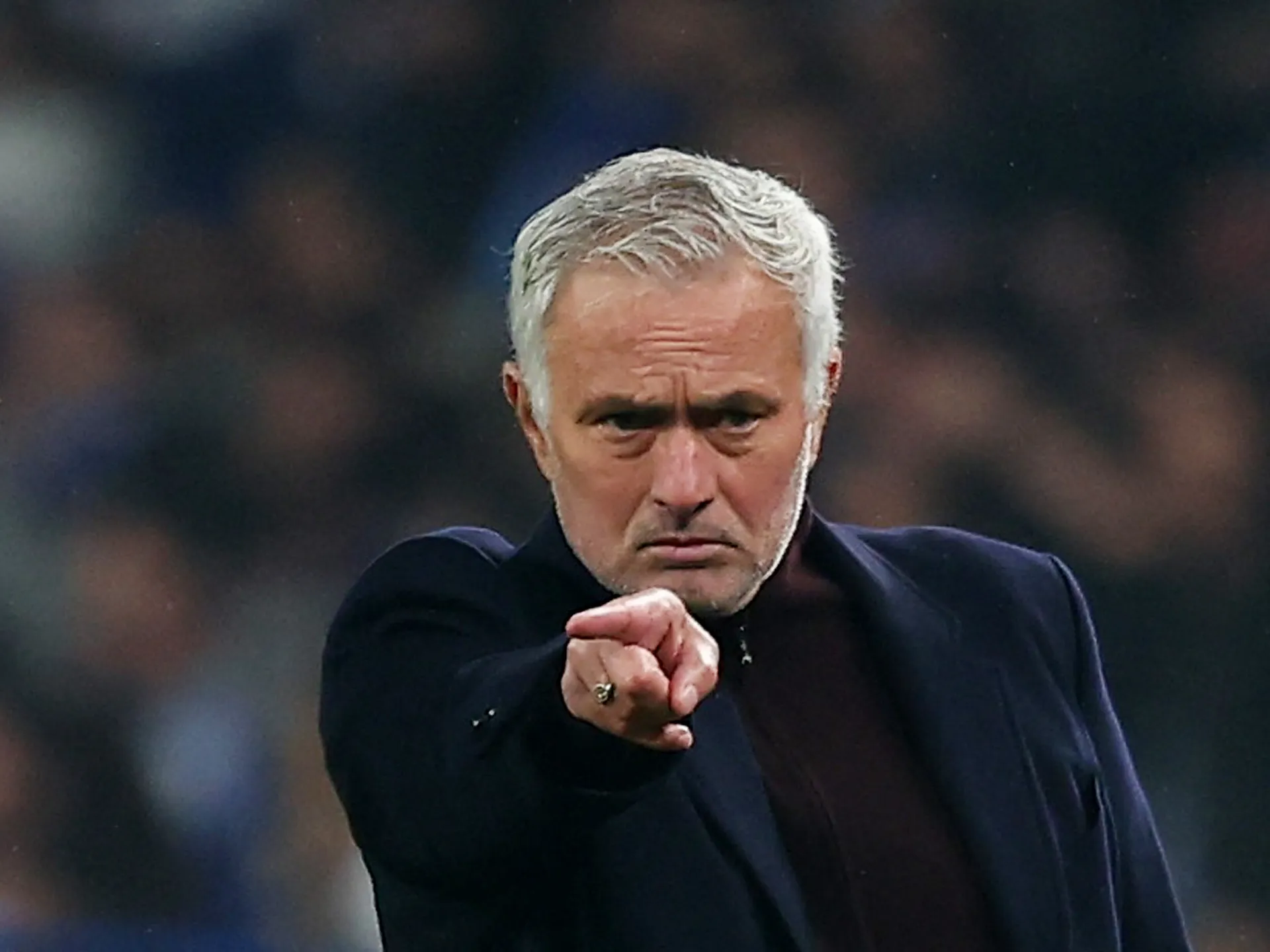
Jose Mourinho will return to manage Real Madrid if Florentino Perez wins the club’s presidential election on Sunday, the sitting president has declared as he campaigns for another term at the helm of the La Liga club.
Perez, facing renewable energy entrepreneur Enrique Riquelme in the club’s first contested election in 20 years, delivered the campaign announcement on his social media channels with a short video featuring Mourinho simply saying “Yes!”
Recommended Stories
list of 4 itemsend of list
The clip followed the slogan “So MOUch history to be made”, a not-so-subtle nod to the Portuguese coach who guided Real to a record La Liga points tally in 2012, but last lifted a league title with Chelsea in 2015.
The move for Mourinho follows a disappointing domestic campaign in which Barcelona secured back-to-back league titles.
Real, 15-time Champions League winners, have also exited Europe’s top club competition at the quarterfinal stage in the last two seasons, with the absence of major silverware prompting Perez to call elections.
Perez’s announcement landed while Riquelme was appearing on Spanish television programme El Hormiguero, in which he said Manchester City midfielder and Spain captain Rodri would be his first signing if elected.
He said he would also target Manchester City striker Erling Haaland, and that former forward and club great Raul would be his sports director.
Since leaving Chelsea, Mourinho’s trophy haul has been more modest. He won the League Cup and Europa League with Manchester United, and later led AS Roma to the third-tier Conference League title.
His managerial road has also taken him to Tottenham Hotspur, Fenerbahce and Benfica, where he was under contract until June 2027 and had said the Portuguese club had proposed a renewal.
While pundits argue that the game has moved beyond Mourinho’s pragmatic style, Perez appears to see him as the manager to restore discipline and edge to a squad featuring Kylian Mbappe, Vinicius Jr and Jude Bellingham.
Mourinho previously stated that no contact had been made with Real, despite heavy reports linking him with a return to the Bernabeu.
Should Perez win the election, Mourinho would return to the club 13 years after his departure in 2013.
Mourinho first joined Real Madrid in 2010, spending three seasons at the club.
During his tenure, he won one La Liga title, a Copa del Rey and a Spanish Super Cup.
Xabi Alonso was sacked by Real in January, in his first season in charge of the Madrid club, while Alvaro Arbeloa carried the team to the end of the season as interim coach.
Mourinho was seen speaking with Vinicius after he walked off the pitch following the interaction with Prestianni.
But it was Mourinho’s post-match comments that were the most shocking.
While publicly backing his player Prestianni, Mourinho suggested Vinicius had incited tensions through his celebration in front of the home support.
“You score a goal from another world, why celebrate like that?” Mourinho said.
“The same thing always happens in so many stadiums. In how many states has this happened? In how many stadiums? How many? How many?
“He’s an out of this world player, I love him. Vinicius tells me one thing and Prestianni tells me another. I want to be balanced.”
The remarks sparked widespread criticism, with many accusing Mourinho of shifting attention away from the racism allegations and placing responsibility on the victim instead.
In addition to expressing his belief that Vinicius had been disrespectful with his goal celebration, he pointed to the club’s legendary striker Eusebio as proof that Benfica are not a racist club.
Asked if he felt Vinicius incited the crowd, Mourinho said: “Yes. I believe so.
“It should be the crazy moment of the game, an amazing goal. Unfortunately [he was] not just happy to score that astonishing goal. When you score a goal like that, you celebrate in a respectful way.”
He added: “When he was arguing about racism, I told him the biggest person in the history of this club [Eusebio] was black.
“This club, the last thing that it is, is racist. They [Vinicius and Prestianni] told me different things. But I don’t believe in one or another. I want to be an independent.”
ELLA Bright left fans absolutely stunned when she revealed her ‘real’ voice on The Kelly Clarkson Show.
The Off Campus actress, 19, has seen huge success in her role as college junior Hannah Wells on the new YA series, where she speaks in an American accent.
Sign up for the Showbiz newsletter
Thank you!
Ella Bright left Kelly Clarkson and fans shocked after revealing her ‘real voice’Credit: TiktokKelly was blown away by Ella being British, saying she does ‘such a good’ American accent on the showCredit: Tiktok
However, both Kelly and viewers were left absolutely stunned by what her day-to-day speaking voice actually sounds like.
Bringing it up with Ella, a surprised Kelly said: “Your accent is f*****g throwing me. It’s throwing me, it’s crazy.
“It’s weird. I was doing research on you last night because you were coming on and I was like, ‘Oh my God, she’s British.’
“Because I only saw the clips from Off Campus so I was like, ‘Wait, what?’
Ella plays the role of Hannah Wells in Off CampusCredit: GettyThe young actress is only 19 years oldCredit: Liane Hentscher/PrimeBelmont Cameli plays her fake boyfriend, Garrett, on the showCredit: AP
“You do such a great American accent!”
Fans watching the clip felt the same way and commented about it on TikTok.
One user said: “I didn’t know she was British. Wow.”
A second shared: “I’m loving that raspy voice.”
A third added: “Insane insane insane.”
Season 1 of Off Campus debuted earlier this month, corresponding to the firstbookin Elle Kennedy’s viral series, The Deal, released in 2015.
It follows aspiringfilmcomposer Hannah as she pretends to date cocky Briar Uhockeycaptain Garrett Graham to win the attention of her real crush,Justin Kohl (Josh Heuston).
Ella’s on-screen partner, Garrett Graham (Belmont Cameli), is 28 years old and also plays the role of a college student.
Coronation Street fans think they have figured out why Idris Nazir is keen on a romance with Leanne Battersby, and it could be linked to a past villain on the ITV soap
13:00, 29 May 2026Updated 13:01, 29 May 2026
Fans of Coronation Street think newcomer Idris Nazir is targeting Leanne Battersby(Image: ITV)
Fans of Coronation Street think newcomer Idris Nazir is targeting Leanne Battersby in a new twist.
Leanne met Idris this week, while it soon emerged they had actually met years earlier. Idris is related to Leanne’s late ex Kal Nazir, but that hasn’t stopped the pair pursuing a romance.
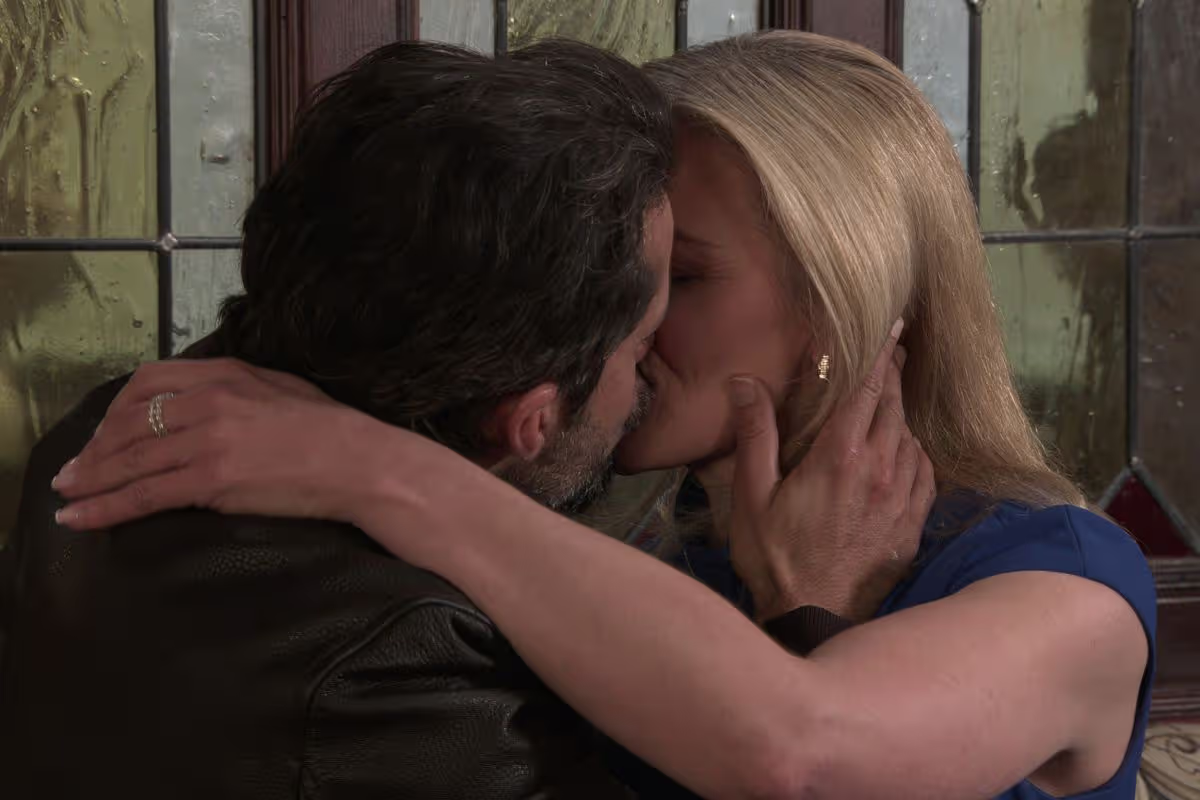
Corrie had revealed Idris would be Leanne’s new love interest before he debuted, and then this week we saw them kiss. Amid Idris’ cousin Alya Nazir being unimpressed by their blossoming romance, some fans think Idris has a motive.
Viewers are theorising that Idris is targeting Leanne on behalf of someone else, and perhaps he knows a past Corrie villain. A new theory has predicted that Idris is “in cahoots with” Harvey Gaskell, who was sent to prison after Leanne helped the police put him behind bars.
Harvey escaped and tried to kill Leanne, actually murdering Sam Blakeman’s mother Natasha in a case of mistaken identity. Harvey then went back to prison.
But fans are wondering if there is more to Idris’ sudden arrival and his interest in Leanne. With it heavily teased he is involved in some dodgy dealings, a theory being shared online is that Idris could be working for Harvey, and targeting Leanne for him.
Taking to social media, one viewer posted: “I know that Idris is a wrongun but, does anyone else think that he might be in cahoots with Harvey and that’s why he’s coming onto Leanne?” A fan replied: “Never thought of that!!!”
Another said: “Oooooh never thought of that it’s not gonna be good news whatever.” A further post read: “Good theory and Leanne said she knew him from somewhere – could have been one of Harvey’s henchmen.”
A further fan confessed: “I really hope not! Couldn’t stand Harvey, hated when they kept bringing him back!” A final fan said: “I’ve just seen someone saying on Facebook they think Idris could be connected to Harvey and that’s why he’s wanting to be with Leanne.
“Might be a bit of a stretch but it could explain why after about 3 hours they’re pursuing a romance, so fast when they barely know each other, AND he’s related to her late partner, all a bit weird.”
KATIE Price has found hubby Lee Andrews after two weeks — and he claims he was detained on suspicion of spying.
She spoke to conman Lee, 43, for two minutes this morning after his dad put her in touch. Katie, 48, says the call came from Dubai’s Al Awir jail.
Sign up for the Showbiz newsletter
Thank you!
Katie Price says she got a call from missing hubby Lee Andrews in prisonCredit: Backgrid/InstagramTheir emotional two-minute chat was the first time she had heard from conman Lee in two weeksCredit: BackGrid
She said: “It was very rushed but he said the authorities out there thought he was a spy.”
Relieved Katie added: “I told him how worried I’d been and that I loved him.”
Katie’s contact with her husband came after his dad Peter texted her to explain his whereabouts.
She said: “I have found him. He is alive, and he is OK. I told him how worried I had been and told him I loved him.
“It was very rushed, but he said the authorities out there thought he was a spy. I don’t know much more than that right now.”
Lee, who lives full-time in Dubai, is believed to have been arrested on May 14.
Katie says Lee has told her he was detained on suspicion of spying, and is being held at Dubai’s Al Awir prisonCredit: AFPKatie’s contact with her husband came after his dad Peter texted her to explain his whereaboutsCredit: Getty
The Sun, however, understands he has been detained over claims relating to a private civil matter. Authorities have confirmed to us he was NOT held over spying charges.
He is due for release on Monday, but must pay a four-figure fine.
Lee once reposted an Instagram post suggesting he should be the next James Bond.
And he is seen “acting” in an excruciating 2016 video on his YouTube channel titled “Charity TV show: The Agent”.
A comment adds: “Featuring billionaire defense (sic) contractor H.E Weslee Peter John Andrews.”
Espionage is one of the most serious crimes in the United Arab Emirates.
In 2018 Brit PhD student Matthew Hedges was held at Dubai airport on suspicion of spying.
He was jailed for life but pardoned and released following intense international pressure.
In the days before Lee’s arrest he had moved belongings out of his rental apartment, and had moved in briefly with his father, staying in his run-down villa.
It is not known where he disappeared to after this, and his family filed a missing person’s report at the British embassy in Dubai.
Before our front-page revelations, two of Lee’s exes shared horror stories involving the fraudster.
The Sun understands Lee has been detained over claims relating to a private civil matter, as authorities confirm he was NOT held over spying chargesCredit: wesleeeandrews/instagram
AL Awir Central Prison is a notorious hellhole dubbed the “Dubai Alcatraz”.
Inmates include Irish gangster Daniel Kinahan, boss of the Kinahan Cartel, who was nicked in April.
The jail has been repeatedly slammed by human rights groups due to the grim conditions.
Prisoners have had to sleep on cell floors due to overcrowding.
Male inmates have their heads shaved, and are punished if hair gets long.
Others have previously been denied HIV treatment while imprisoned, according to Human Rights Watch.
Those caught spying in the UAE face a life sentence, which is capped at 25 years.
Non-Emiratis are deported immediately after completing their term.
PhD student Matthew Hedges, then 31, received the maximum penalty in 2018 after an Abu Dhabi court found him guilty of “spying for or on behalf of” the British government.
Matthew, who studied at Durham University, was left with PTSD after being tortured in solitary confinement for six months.
He was kept in handcuffs and plied with drugs.
Matthew was pardoned by the country’s president in 2018, days after his sentencing.
Texan nurse Crystal Janke said she had put £123,000 into one of his schemes on the promise of getting £1million, only to lose it all.
Lee’s ex-fiancée Alana Percival — who he proposed to over rose petals and champagne five weeks before rehashing the method with Katie — branded him a manipulative narcissist who feigned a heart condition for sympathy.
Alana claimed he was a swindler and told Katie to “run for the hills”.
Mum-of-five Katie and Lee wed in Dubai in January, days after meeting in person for the first time. He is said to be subject to a travel ban there following imprisonment for fraud last October.
She told podcast The Katie Price Show she was “leaving it to the police”, adding: “There’s nothing more I can do, that I can say.
“I’m just staying quiet because it’s getting ridiculous now, people taking the p**s out of everything.”
Katie added: “The police are now handling it, the British police, British consulate, the Foreign Office, Interpol they’re looking for Lee. All I can do is just get on with my life. I’ve got lots of exciting things coming up, and I’m just waiting for a call. What am I supposed to do, sit here and cry and do nothing, stay in bed? For my own sanity, I am taking a step back.”
Last weekend Lee’s dad Peter told the Daily Mail: “Lee is OK. He has not been kidnapped but is under arrest. I don’t know on what charge. I’m not sure where he is being held.”
Katie wrote: “This is fake news. Lee is still missing. Me and his family know what’s going on and are working with the authorities.”
The drama started earlier this month when Lee was due to fly to the UK for an interview with Katie on ITV’s Good Morning Britain.
He failed to turn up, leaving her to face the music on her own, humiliating her in the process.
IN tomorrow’s Sun, we reveal how HSBC investigated Clemmie’s payment to Lee, and within 24 hours her money had been returned — vindicating allegations of him being a scammer.The bank’s head of fraud reveals the steps you can take to avoid getting swindled and how to claim back your money, step by step, should you have fallen victim to a similar scam.
Real’s absence from Spain’s World Cup squad, while Barca dominate picks, explained by coach as ‘united nation’ first.
Published On 26 May 202626 May 2026
Luis de la Fuente has stressed that Spain’s badge outranks any club crest after naming a World Cup squad with a distinctly Barcelona hue and, for the first time, no Real Madrid player in sight.
The European champions head into next month’s tournament among the favourites, with coach De la Fuente’s 26-man squad built around eight Barcelona players and none from the Spanish capital’s biggest club, bringing the fierce El Clasico rivalry into the national team’s debate.
Recommended Stories
list of 4 itemsend of list
Defenders Dean Huijsen and Dani Carvajal were among the Real Madrid names to miss out on a team chasing Spain’s second World Cup title after their 2010 triumph in South Africa.
De la Fuente on Tuesday dismissed the idea that the decision could cost him support among Real Madrid fans.
“For me, the greatest team there is – the very greatest – is the Spanish national team,” De la Fuente said during a breakfast with media representatives organised by Spanish public broadcaster RTVE and news agency EFE.
“I don’t look at where players come from or their background. What matters are Spanish players who are proud to represent their country’s national team and to be part of a united nation.”
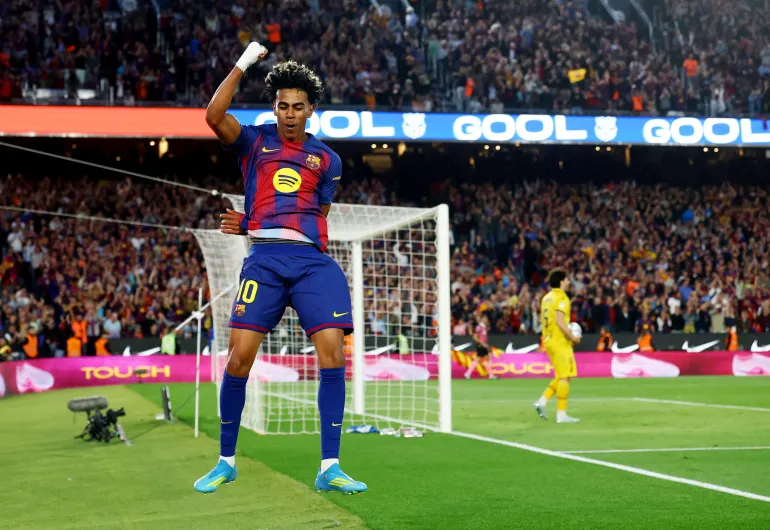
Barcelona’s Lamine Yamal celebrates scoring their third goal in the La Liga match against Espanyol [Albert Gea/Reuters]
Yamal raring to go for Spain at World Cup after injury
Barcelona’s contingent comprises Joan Garcia, Pau Cubarsi, Eric Garcia, Gavi, Pedri, Dani Olmo, Lamine Yamal and Ferran Torres, while seven players called up are based in the Premier League.
The manager said sporting considerations alone guided his selection, even if squad decisions inevitably carried a subjective element.
“The day I make a mistake, fail to make the right choice, or act in a way that might be beneficial just to get a result, I’m putting my job on the line,” he said. Spain open Group H against Cape Verde before facing Saudi Arabia and Uruguay, but De la Fuente may yet take a cautious approach with Lamine Yamal, Nico Williams and Mikel Merino, who are all recovering from fitness concerns.
“We’re in contact with all the clubs,” he said. “We know that these players are in good physical shape; each one is making good progress in their recovery process. I’m very optimistic; I think they’ll be available for the first match.”
Still, De la Fuente said Spain’s view stretched beyond the opener.
“If we have to take a risk, mate, we’ll take it in a World Cup,” he said. “But… our view goes beyond the first match and also the second. So, if we have to wait a little longer, we’ll wait.”
On Yamal, the 18-year-old Barcelona winger expected to carry much of Spain’s attacking threat, De la Fuente said youth had not dimmed his sense of occasion.
“Yamal is absolutely thrilled and raring to go,” he said. “He’s a very young lad, just 18, but he has a remarkable sense of maturity and knows that this is his moment.
“You have to seize the moment. And he knows this is his moment.”
Yamal, one of eight Barcelona players named in the 26-man squad, with seven Arsenal players picked by Luis de la Fuente.
Published On 25 May 202625 May 2026
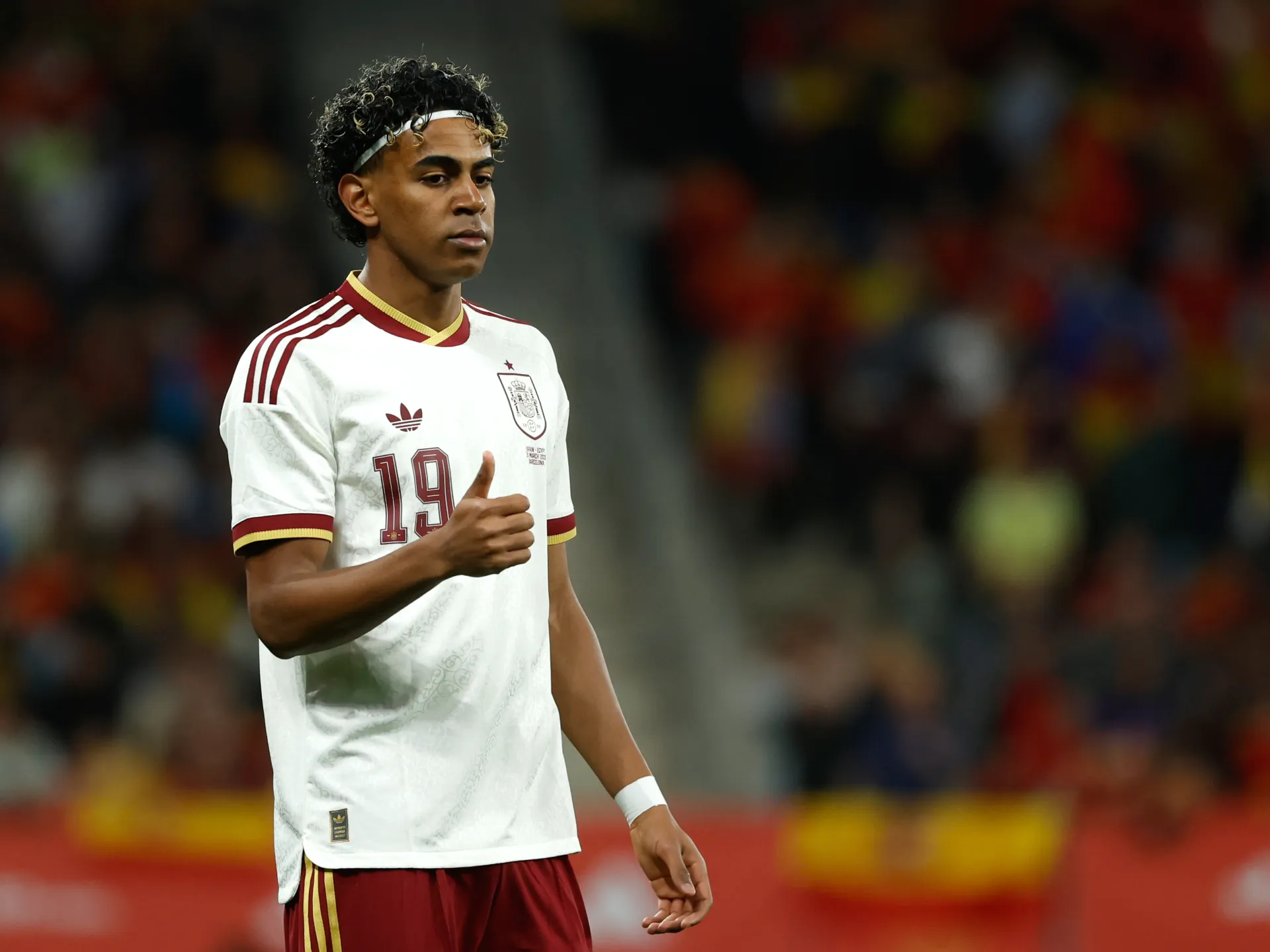
Lamine Yamal has been included in Spain’s squad for the FIFA World Cup, named by coach Luis de la Fuente, who also included Arsenal midfielder Mikel Merino in the European champions’ roster after his recent return from injury.
For the first time since 1950, Spain’s World Cup squad will not include a Real Madrid player as De la Fuente opted against naming one in his 26-man squad announced on Monday.
Real Madrid’s Dean Huijsen was dropped due to an injury, and veteran Dani Carvajal was also excluded after struggling through an injury-hit campaign.
Along with teenage Barcelona star Yamal, Athletic Bilbao’s Nico Williams played a key role as Spain won Euro 2024, and he is in the squad despite a season badly disrupted by fitness issues.
Yamal, 18, is a doubt for the first matches of the tournament after suffering a hamstring injury with Barca, which has kept him out since late April.
De la Fuente played down the absence of Madrid’s players, preferring to highlight those who are in the squad.
“I’m the manager, and I don’t look at where the players come from. They’re national team players; I don’t look at one club or another. I don’t have the same local bias that a fan might have. All I want is for these players to feel proud to represent the national team,” De la Fuente told reporters.
In addition to Yamal, Barcelona’s contingent includes Joan Garcia, Pau Cubarsi, Eric Garcia, Gavi, Pedri, Dani Olmo and Ferran Torres, while seven players called up are based in the Premier League.
“Excitement is the keyword. Passion,” De la Fuente said.
“The reaction of people all over Spain – adults and children alike – is that they are fully behind the national team. It is an honour for me to represent the national team.”
Arsenal provide three of Spain’s Premier League-based players in goalkeeper David Raya and midfielders Martin Zubimendi and Mikel Merino, while Manchester City’s Rodri gives De la Fuente a commanding presence in midfield.
The coach also addressed the injury concern regarding Yamal and Williams, who will arrive at the tournament nursing hamstring issues.
“We’re very relaxed. Barring any setbacks, we’ll have everyone available from the very first match. We’re in close contact with the clubs’ medical teams,” he said.
“We’ll call on them when we deem it appropriate. I’d like to reiterate that we’ll have everyone in top form and we’ll be able to enjoy watching them in the tournament.”
Spain will arrive at the World Cup carrying the confidence of their European Championship triumph in Germany two years ago, but with the weight of expectation from a passionate fanbase.
Spain’s World Cup 2026 squad
Goalkeepers: Unai Simon, David Raya, Joan Garcia
Defenders: Marcos Llorente, Marc Pubill, Pedro Porro, Aymeric Laporte, Eric Garcia, Pau Cubarsi, Marc Cucurella, Alejandro Grimaldo
Midfielders: Rodri, Martin Zubimendi, Mikel Merino, Pedri, Gavi, Fabian Ruiz, Alex Baena
Forwards: Yeremy Pino, Victor Munoz, Mikel Oyarzabal, Ferran Torres, Lamine Yamal, Dani Olmo, Nico Williams, Borja Iglesias