Rama

‘Horizontal revolt’: Why Albania’s young protesters want PM Rama to go | Explainer News

For several days, the streets of Tirana have witnessed a wave of antigovernment demonstrations, with demonstrators engaged in fierce clashes with security forces, while police have fired tear gas on thousands of young protesters to prevent them from scaling barricades.

Protests escalated last week after school and university students joined them, citing rising tuition fees and crumbling infrastructure.

Recommended Stories

list of 4 itemsend of list

What initially began as a targeted environmental protest in May has rapidly escalated into one of the most serious political challenges facing Prime Minister Edi Rama in his more than a decade in power.

Yet, as the unrest reaches a boiling point, a fundamental question remains: Who is behind this movement, and can it force systemic political change?

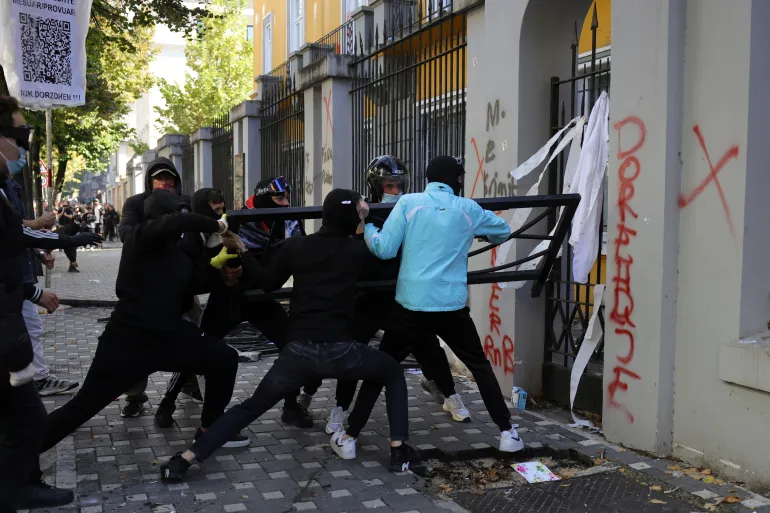
Hooded protesters try to break through a gate at the Education Ministry as the Albanian word “Resign” is displayed on a wall during clashes in Tirana on October 13, 2026
Hooded protesters try to break through a gate at the Education Ministry as the Albanian word “Resign” is displayed on a wall during clashes in Tirana on October 13, 2026 [Hameraldi Agolli/AP Photo]

Contrary to claims by government officials that the unrest is being orchestrated by political opponents or external actors, analysts and journalists on the ground emphasise that the movement is largely decentralised and youth-driven.

Fatos Hakorja, editor-in-chief of TV Klan and Klan News, told Al Jazeera that the demonstrations have evolved organically into a broad coalition of high school students, university students, environmentalists, and aggrieved citizens.

“So far, what can be said with certainty is that the protests have been organised mainly by young people themselves,” Hakorja told Al Jazeera. “What began as the ‘Flamingo Revolution’ gradually developed into a broader student and youth protest… There is no clear evidence that a single consolidated structure stands behind the protests,” he said, referring to the May protest against a luxury resort that threatens the protected coastline.

Hakorja noted that coordination takes place dynamically across digital platforms such as WhatsApp, Telegram, and Snapchat, rather than through formal organisational hierarchies.

Albanian political analyst and publicist Ben Andoni echoed this view, describing the situation not merely as a standard protest, but as “a genuine, horizontal revolt”.

“The protest has turned into a rebellion for the past seven days. It was a protest before, but it has never taken on the character of a movement. If it were so, there would be a leadership group and some short-, medium-, and long-term goals,” Andoni told Al Jazeera.

“It is a horizontal movement, where people are mobilised by TikTok groups and social networks, but not by true cultural and political organisations. That is also a handicap or a source of pressure for Rama’s government, which seeks to negotiate, but finds no single counterpart standing in its way.”

A car burns as clashes erupted during an anti-government demonstration outside the prime minister’s office, in Tirana on October 17, 2026
A car burns as clashes erupted during an anti-government demonstration outside the prime minister’s office, in Tirana on October 17, 2026 [Hameraldi Agolli/AP Photo]

From the ‘Flamingo Revolution’ to broad structural discontent

The roots of the current unrest are multifaceted, blending localised grievances with deep-seated frustration over governance, economic stagnation, and corruption.

The initial spark – dubbed the “Flamingo Revolution” – was ignited by environmental opposition to controversial luxury development projects, notably in the protected area of Zvernec and the planned resort investment on Sazan Island by the firm of Jared Kushner, United States President Donald Trump’s son-in-law.

The flamingo, native to these coastal lagoons, quickly became a symbol of resistance against the perceived commodification of public lands.

However, environmental concerns swiftly converged with student anger over high tuition fees, inadequate dormitory conditions, and low educational competitiveness. Beneath these immediate triggers lies a much deeper structural crisis.

“Problems of corruption, nepotism, and a lack of perspective are the main reasons that drove people to protest,” Andoni explained.

“The protest summarised the entire range of problems that Albania has, and brought them to the doorstep of a government that has crossed lines regarding corruption, inequality, and particularly a lack of empathy for the people.

“Among some protesters, especially on social media, there is also a narrative that Rama is placing the country’s interests at the service of private interests, his personal hold on power, or foreign interests, including Israeli interests. These claims have not been proven, but they seem to have increased the anger of some young people and part of the wider population,” Hakorja added.

Rama has strongly rejected the allegations, calling them conspiracy theories and dismissing them as manipulated disinformation spread through social media by “foreign hands”, aimed at destabilising the government and undermining the country’s public institutions.

Rejection of the entire political class

A defining feature of the uprising is the protesters’ explicit rejection of the ruling Socialist Party (SP) and the traditional opposition, including the Democratic Party (PD) led by Sali Berisha.

While Prime Minister Rama has accused the opposition of taking over the movement, and opposition supporters have joined the crowds on the ground, experts stress that opposition leaders exercise no direct control over the demonstrators. In fact, several opposition MPs who attempted to address the crowds faced open hostility and rejection.

“A large number of these young people seem to feel unrepresented by the whole political class,” Hakorja told Al Jazeera.

“They see the political system as disconnected from their reality and as a system that protects the interests of a minority more than it addresses the problems of the majority of citizens.”

This widespread cynicism has resulted in an uncompromising stance. Demonstrators have demanded the immediate resignation of Prime Minister Rama and the formation of a technical government, refusing official offers of dialogue due to a total breakdown of trust in state institutions.

The deep cynicism towards Albania’s political class stems from a widespread feeling that leaders are entirely indifferent to citizens’ daily struggles. Young people face rampant corruption, high unemployment, and an economy that drives huge brain drain.

This disconnect is further spurred by years of government apathy towards crumbling public education, high tuition fees, and poor dormitory conditions.

Furthermore, controversial state-backed developments – such as the planned luxury resort by Kushner’s firm – serve as prime examples for citizens who believe the political establishment consistently trades national resources and public goods for private and foreign interests.

Heavy-handed security and growing fatigue

Faced with a leaderless movement that refuses to negotiate, the Albanian government has increasingly relied on security forces to maintain control.

Police have been accused of brutality as they have used tear gas, water cannons, and rubber bullets to quell the protesters. At least 167 people have been arrested, including minors.

In a move that highlights the administration’s reliance on law enforcement, Prime Minister Rama announced a 2,500-euro ($2,800) bonus for police officers on the front lines, alongside substantial salary increases set for 2027.

Hakorja pointed out that the government is treating the crisis predominantly as a matter of public order and security.

He also highlighted troubling incidents, such as the appearance of unidentified civilians armed with wooden sticks inside the Socialist Party headquarters. While these individuals remained inside to protect the building as protesters hurled stones and attacked the entrance, their presence – including individuals holding public positions – led to fears of informal, non-state security responses operating alongside or outside official police forces.

What lies ahead?

As both sides brace for further escalation, the immediate outlook remains uncertain. Without clear leadership to negotiate terms, or intervention from international partners such as the European Union and the US, the deadlock threatens to prolong political instability.

According to Andoni, the Rama administration has used force as its main instrument, as it has suffered a severe loss of moral authority and legitimacy.

“Demonstrators remain persistent and aggressive, while Rama plays the card of force through the police,” Andoni told Al Jazeera, adding that “fatigue” is impacting the young protesters.

“It seems that young people may execute a tactical withdrawal first by temporarily stepping back from the streets due to exhaustion, leaving the weight and burden of proof on Mr Rama” – placing the ultimate responsibility on the prime minister to prove that his government has the legitimacy, capability, and sincere intent to carry out deep reforms and resolve a crisis that police force has only further escalated.

Whether this youth-led rebellion marks the beginning of a new political era in Albania or subsides under policing and exhaustion, it has irrevocably exposed the deep rift between Albania’s youth and its governing political establishment.

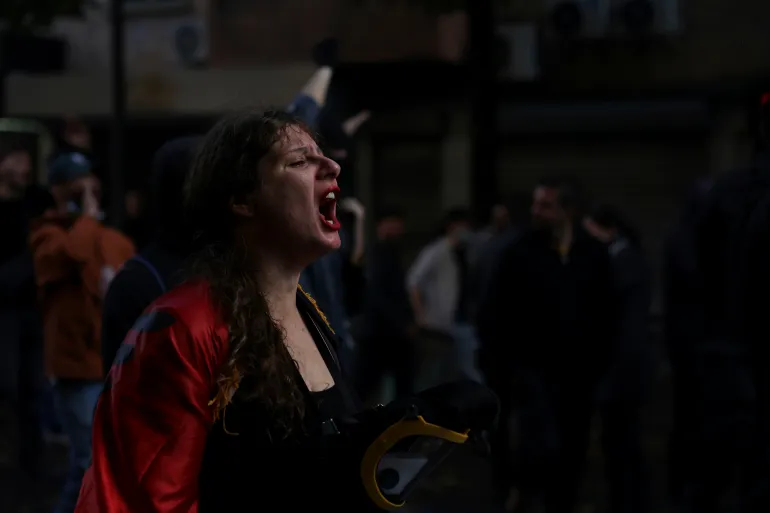
Protesters shout slogans during a demonstration against the government, following months of protests against a planned luxury resort backed by a company linked to Jared Kushner, the son-in-law of US President Donald Trump, on an environmentally sensitive part of the Adriatic coast, in Tirana on September 8, 2026
Protesters shout slogans during a demonstration against the government, following months of protests against a planned luxury resort backed by a company linked to Jared Kushner, the son-in-law of US President Donald Trump, on an environmentally sensitive part of the Adriatic coast, in Tirana on September 8, 2026 [Florion Goga/Reuters]

Source link

Albanian police fire rubber bullets as protests against Rama escalate | Protests News

Five days of clashes rock Tirana as students join a wider movement demanding Prime Minister Edi Rama’s resignation.

Police in Albania have fired rubber bullets at antigovernment protesters in the capital, Tirana, as violent clashes intensify over demands for Prime Minister Edi Rama to resign.

The clashes continued on Saturday for a fifth consecutive day after high school and university students joined a broader movement against Rama, whose governing centre-left Socialist Party has held power since 2013.

Recommended Stories

list of 2 itemsend of list

The unrest has brought growing anger over education, unemployment and alleged corruption into a wider confrontation with the government.

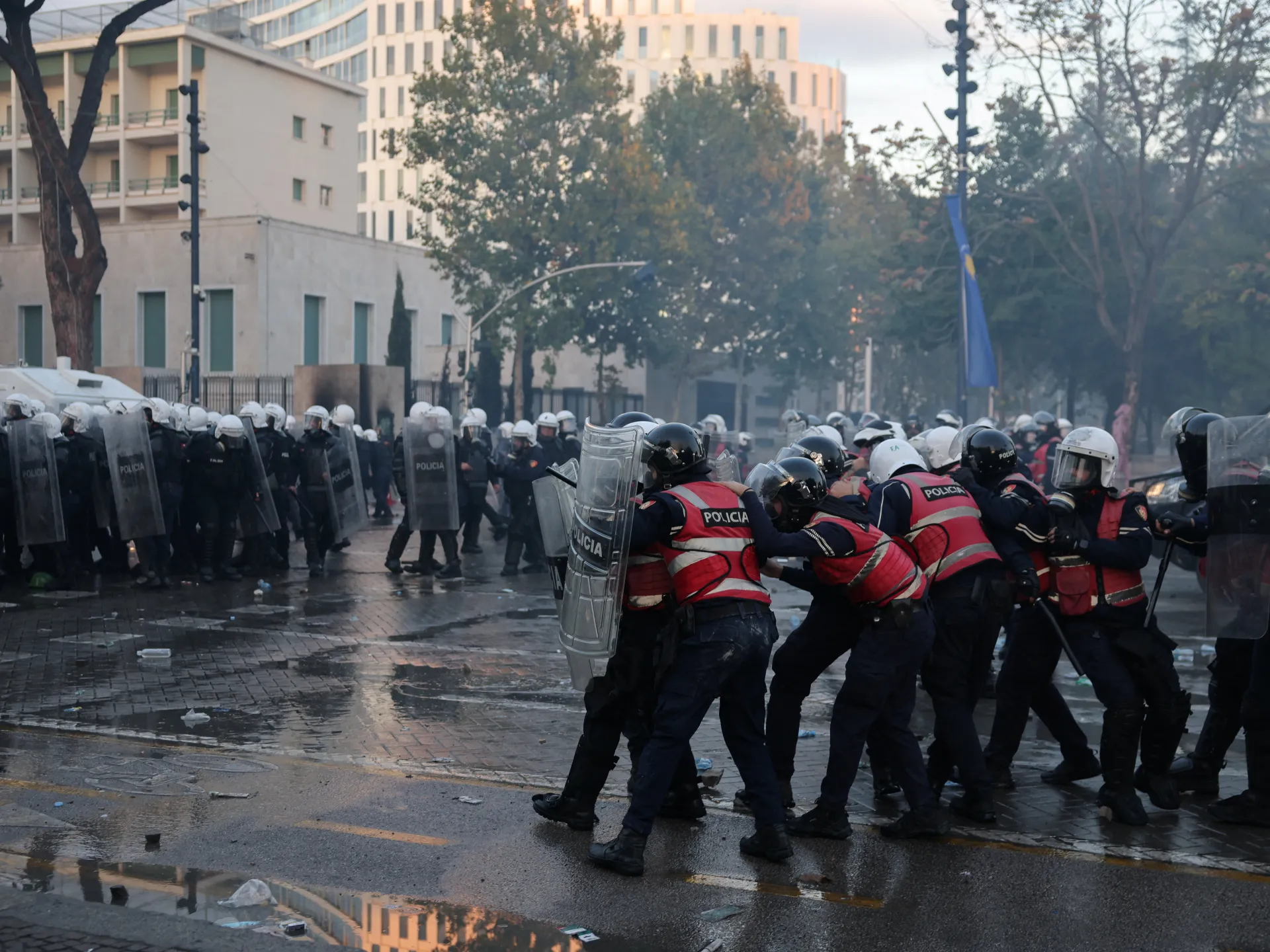
Protesters threw stones, petrol bombs and fireworks at police near Rama’s office and elsewhere in central Tirana.

Some set cars and rubbish bins alight, creating burning barricades across streets.

Police responded with tear gas, water cannon and baton charges as demonstrators pushed against security lines.

The AFP news agency reported that officers used rubber bullets for the first time since the demonstrations began.

National police chief Skender Hita confirmed their use at a news conference on Saturday, saying they had been deployed “in a limited manner”.

The Ministry of Health and Social Welfare said nine protesters and four police officers received medical treatment on Saturday.

Hita said 167 people had been arrested over five days of unrest, while 132 officers had been injured.

Seven police officers were also suspended pending investigations into allegations that they had exceeded their authority.

Rama, who is serving his fourth term and has refused to resign, visited businesses damaged during the unrest on Saturday. He promised to listen to students and protect their right to demonstrate, while warning against further destruction.

He also accused his conservative political opponents of encouraging the violence.

Growing discontent

The students have complained about expensive university fees, poor educational facilities and limited employment opportunities, alongside allegations of government corruption.

At the start of Saturday’s demonstration, protesters set fire to a suitcase and threw it into the Ministry of Education’s courtyard. AFP reported that the gesture symbolised their determination not to leave Albania in search of better opportunities.

“We are demanding our rights, our future and a better country,” journalism student Sinan Billa told AFP.

The student demonstrations have added to months of antigovernment rallies organised by the Flamingo movement, which began as a campaign against a luxury tourism development on Albania’s southern coast.

The project is linked to an investment company founded by Jared Kushner, the son-in-law of US President Donald Trump.

The movement has since widened its demands to include Rama’s resignation amid allegations of corruption against his government.

The unrest has also spread beyond Tirana. Local media reported that protesters in the coastal city of Durres damaged a post office and blocked roads with burning barricades, extending the confrontations beyond the capital.

Source link

‘Boiling point’: Why students are protesting against Albania’s Edi Rama | Protests News

Student protests against poor conditions in Albania’s education system have continued for a third day in the capital, Tirana, as Prime Minister Edi Rama insists he will not resign.

Demonstrators have called on Rama to quit in often violent protests since Tuesday. They have set fire to several buildings across the city, including the prime minister’s office, ministry buildings and branches of several banks.

Recommended Stories

list of 4 itemsend of list

Dozens of police officers and protesters have been injured amid attempts to disperse the crowds using water cannon and tear gas.

“What you are seeing is the boiling point of months of suppressed grievances,” Albanian journalist Arlis Alikaj told Al Jazeera.

A protester shouts slogans during clashes near Education Ministry in Tirana, Albania, Tuesday, Oct. 13, 2026, joining a demonstration organized by the Flamingo protest movement demanding the resignation of Prime Minister Edi Rama. (AP Photo/Hameraldi Agolli)
A protester during clashes in Tirana on Tuesday demanding the resignation of Prime Minister Edi Rama [Hameraldi Agolli/AP]

Students have complained for months about the high cost of education and their limited employment prospects after graduation.

Afrim Krasniqi, a professor and researcher at the Institute for Political Studies in Tirana, told Al Jazeera that students and young people protested peacefully for nearly three months, “yet their demands were largely ignored, while the government often responded with discrediting campaigns rather than genuine dialogue”.

He added that the current escalation reflects “frustration not only with the government itself, but also with the lack of institutional accountability and responsiveness.”

The protests represent one of the most serious waves of public discontent directed at Rama, who won a fourth term last May but has since faced public anger over corruption allegations involving senior officials.

The unrest in Tirana coincides with a broader wave of student protests across Europe. In France, secondary school students have spent weeks protesting and blockading schools, demanding more teachers and better learning facilities. They have warned that deteriorating school buildings and overcrowded classrooms are undermining the quality of education.

Protests against Rama’s government began a few months ago, fuelled by plans to build a luxury resort along Albania’s largely unspoilt southern coast. Jared Kushner, US President Donald Trump’s son in law, is involved in the project.

Local media reported that the protests spread from Tirana to universities in Elbasan and Shkoder on Wednesday.

Albania is among the economies of the Western Balkans seeking to catch up with European living standards. However, the gap with the European Union average remains evident in purchasing power, wages, productivity and the quality of public services. Despite economic progress, the country continues to face challenges including emigration, regional inequalities and the need for stronger institutions and the rule of law.

After Montenegro, Albania stands out as one of the countries that has made the most progress towards full EU membership. However, behind the optimistic political rhetoric, frustration is growing among citizens over the slow pace of European integration and the lack of tangible improvements in their daily lives.

A young protester throws a plastic bottle towards riot police during clashes in Tirana, Albania, Thursday, Oct. 15, 2026, as students joined an anti-government demonstration. (AP Photo/Hameraldi Agolli)
A protester throws a plastic bottle towards riot police during clashes in the Albanian capital on Thursday [Hameraldi Agolli/AP]

While opposition groups seek to support the demonstrators and capitalise on the moment to strengthen their own position, Alikaj said the protests are being driven by young people and students demanding systemic change.

On Thursday, Rama – who has been PM since 2013 – told Reuters, “As for calls for my resignation, governments change through democratic elections. Last year, we had elections, not a revolution.”

Sokol Lleshi, a lecturer at the University of New York Tirana specialising in political science and international relations, said social change is more likely to emerge from a broader coalition of different social groups, rather than mass mobilisation limited to university and secondary school students.

“Elite defection from the current ruling political elite could enable the institutional means to channel societal dissatisfaction or resentment into political and policy changes. Yet, the current student protest does not seem to replicate the December 2018 mass movement of university students and its effects”, Lleshi said.

The student protests that shook Albania in December 2018 began over rising education costs and forced Rama to dismiss eight ministers as part of a cabinet reshuffle and announce a package of measures known as the “Pact for the University”.

But some of the students’ demands remained unmet.

Lleshi drew some more positive conclusions from Albania’s past experience of social unrest.

Albanian society is polarised and unequal, “with hollowed intermediary political institutions”, he said, but the legacy of unrest and political confrontation will serve as a “warning to avoid destabilisation”, he said.

Source link