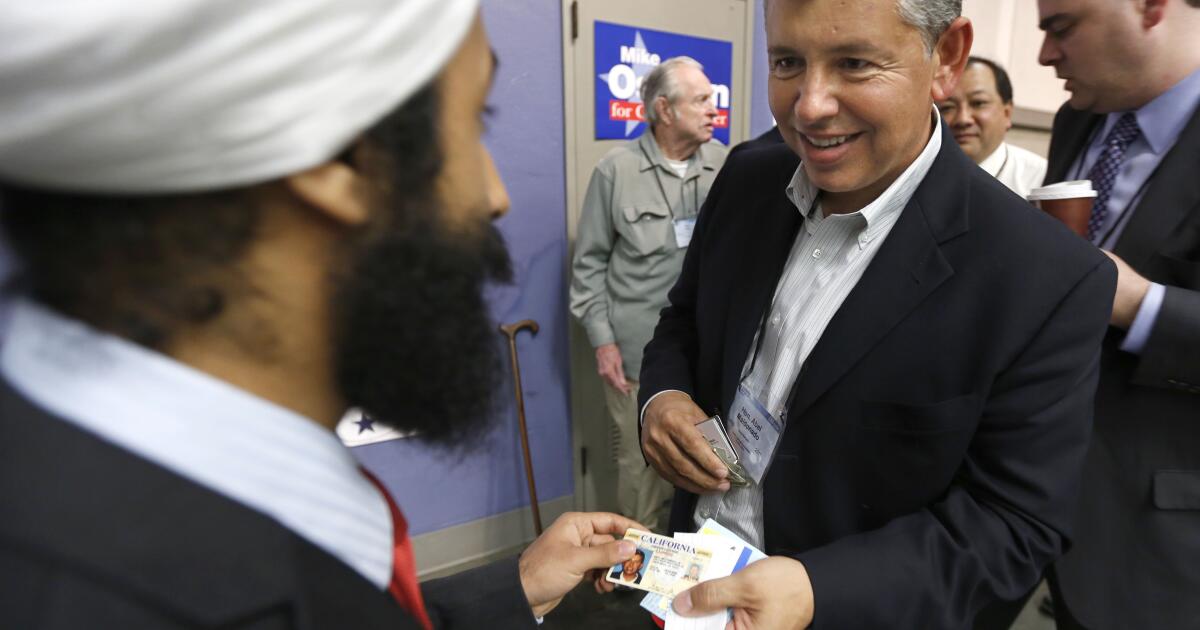
race

Column: Bye, bye Eric. Swalwell needs to go

There has never been a California governor’s race like this one. And that was even before the leading Democrat was shoved aside by shocking accusations of sexual assault.

For months, the contest has been uninspiring, unexciting and unwatchable. It really shouldn’t have been called a “race.” It was more like a slow trot. No candidate has drawn even 20% of voters’ support in independent polling. Half the 10 main candidates have been stuck in single digits.

And in less than a month, voters will start casting mail-in ballots.

But suddenly eyes and ears have opened.

Democratic frontrunner Eric Swalwell, a congressman from the East San Francisco Bay, was accused by a former young female staffer of twice sexually assaulting her when she was too intoxicated to consent.

The San Francisco Chronicle reported that Friday and CNN soon followed with a similar report, adding accusations of sexual misconduct from three other women.

“I was pushing him off of me saying no,” the anonymous former staffer told CNN. “He didn’t stop.”

Swalwell, who is married and has three children, strongly denied the accusations.

The incidents “never happened,” he said. “I will fight them with everything I have….

“I have certainly made mistakes in judgment in my past, but these mistakes are between me and my wife. And to her I apologize deeply for putting her in this position.”

Sorry, congressman, but if someone is running for governor of the nation’s largest state, the mistakes aren’t just between him and his wife.

Former House Speaker Nancy Pelosi of San Francisco told Swalwell, in essence, that it’s his right to fight the accusations, but he should do it on his own time, not the Democratic Party’s. She was among the first of party leaders to call on him to abandon the race.

Bye, bye Eric. Might as well depart the House, too.

A leading candidate for California governor has never crumbled so fast. It was like a dam bursting.

Powerful interests and major politicians had been coalescing behind the 45-year-old congressman because he charmed them or they were loyal colleagues or — most important — he seemed like a potential winner.

Political players, including campaign donors, seek to invest their capital in anticipated victors. Their expected return is access and favors. And Swalwell had been racking up lots of endorsements.

But almost immediately after the sex scandal broke, supporters began fleeing the reeking corpse.

Marital infidelity is one thing, but alleged sexual assault — rape — cannot be tolerated, especially by a party dominated by female voters.

Labor unions, other interests and influential politicians began backing off their endorsements. Many urged Swalwell to fold his campaign. And with his support collapsing, he really was left ultimately with no other choice.

So, now the most pertinent question is which candidate will replace Swalwell as the Democrat with the best chance of surviving the June 2 top-two primary and winning a spot on the November ballot.

If it’s a Democrat against a Republican in November–the most likely matchup–the Democrat is a virtual cinch to succeed the termed out Gov. Gavin Newsom. No Republican has won a statewide race in California in 20 years.

State Democratic Chairman Rusty Hicks — as part of his effort to pressure lagging candidates to exit the race and make more room for faster runners — released a nonpartisan, party-paid poll last week. It was conducted before Swalwell’s collapse.

It showed two Republicans tied for the lead with 14% each: Riverside County Sheriff Chad Bianco and conservative commentator Steve Hilton.

Among Democrats, Swalwell led with 12%, slightly ahead of billionaire hedge fund founder Tom Steyer at 11%. Former Orange County Rep. Katie Porter had 7%. Then came former U.S. Health Secretary Xavier Becerra, San José Mayor Matt Mahan and former Los Angeles Mayor Antonio Villaraigosa, each with 4%.

Former state controller Betty Yee and state schools chief Tony Thurmond barely registered at 1% each.

For weeks, it has been deemed conceivable that both Republican candidates would finish ahead of all Democrats in the June 2 primary. Democratic voters would splinter their support among the party’s crowded field. That would lock out Democrats from the November ballot and guarantee the election of a Republican.

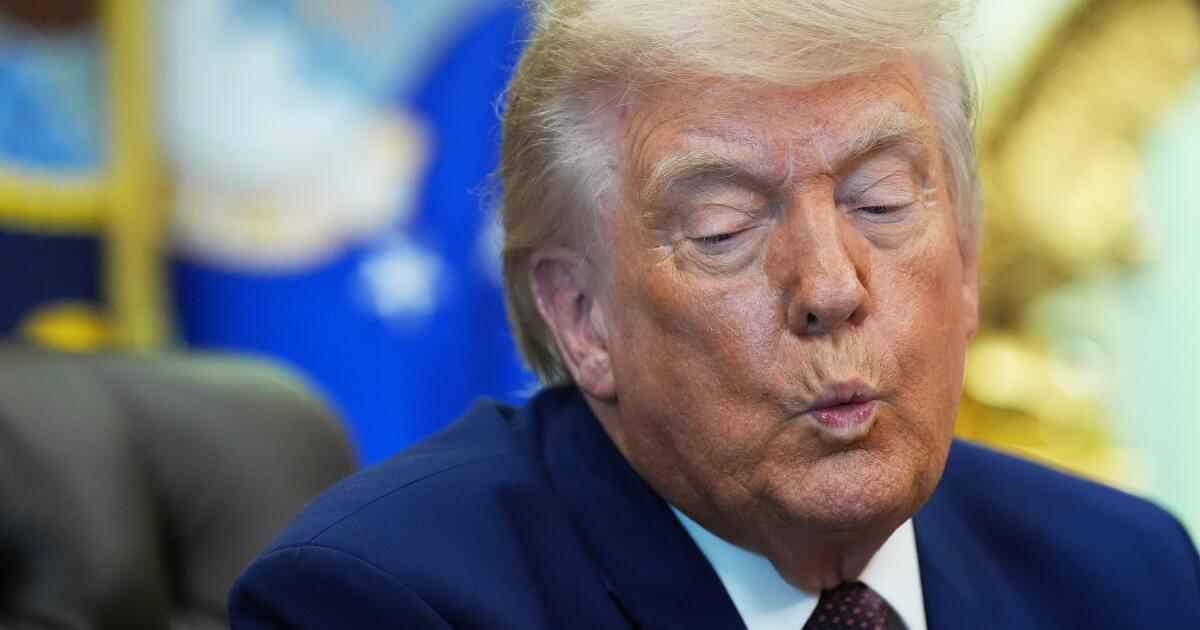
But President Trump seemed to botch that for the GOP last week by endorsing Hilton. Trump presumably will help the former British politico draw votes from Bianco and indirectly assist a Democrat in finishing second.

There’s a new twist, however. Where will Swalwell’s votes go? If enough go to the Democratic laggers rather than the party frontrunners, both Republicans could still wind up one-two.

No gubernatorial contest in modern times has been this wide open.

These candidates’ failure to make waves isn’t all their fault. Some were slow diving into the water. But even those who tried to make a splash were inundated by Trump.

Practically all the public’s attention has been on the president and his oddball or vengeful or unprincipled actions.

Now the Democratic race is more wide open than ever.

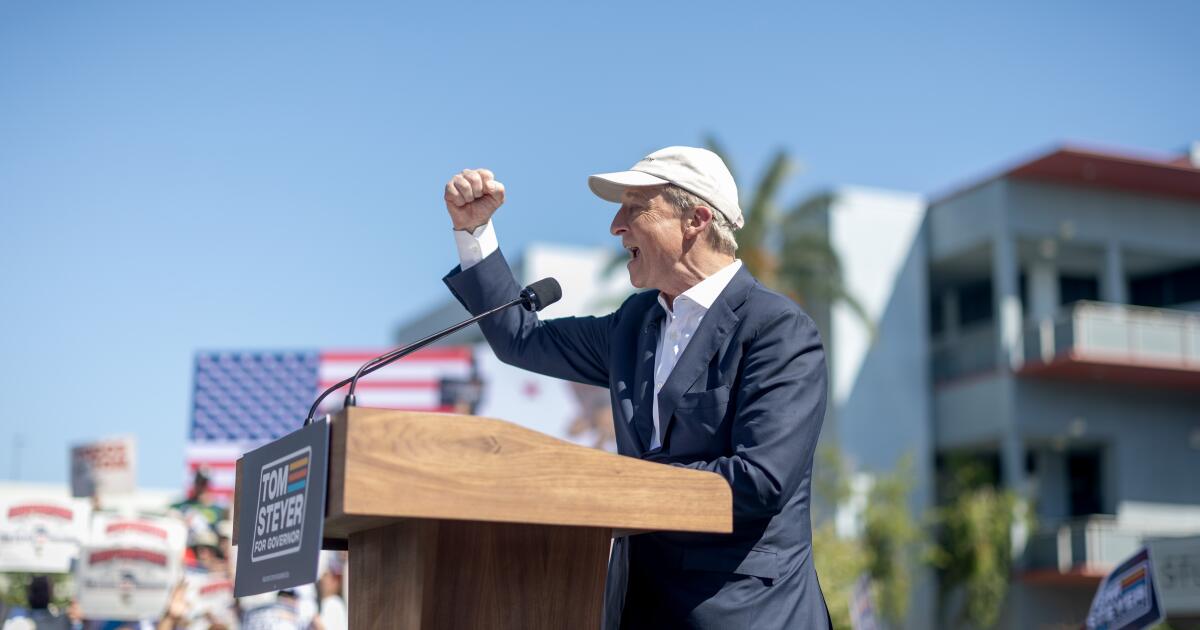
Steyer — a liberal climate fighter — has run an energetic campaign, spending more than $100 million of his own money on TV ads. But will Californians elect a mega-rich governor? They never have.

Porter has been running better in polls than the latest Democratic survey showed. She’s straight forward on all the issues, but a bit too liberal and feisty for some establishment Democrats. Swalwell’s fall is her opportunity to rise.

Becerra — a former state attorney general and congressman — has an impressive resume, but was too slow out of the starting gate. This is his chance to sprint, if he can.

No candidate is more qualified to be governor than centrist Villaraigosa, a former state Assembly speaker. But voters apparently are looking for someone younger. He’s 73.

Mayhan is a moderate who started too late and has fallen far short of expectations. He now has a second chance.

It soon will all be in the hands of voters, whether they’re interested or not.

You’re reading the L.A. Times Politics newsletter

George Skelton and Michael Wilner cover the insights, legislation, players and politics you need to know. In your inbox Monday and Thursday mornings.

What else you should be reading

The must-read: Eric Swalwell’s bid for California governor is over. Let the political scrambling begin
Knives out: GOP’s best shot at California governor’s office in decades mired in angry internal debate
The L.A. Times Special: Newsom reluctant to endorse a successor, break gridlock in governor’s race

Until next week,
George Skelton


Was this newsletter forwarded to you? Sign up here to get it in your inbox.
Source link

Rep. Eric Swalwell faces calls to drop out after assault claims

The fallout over sexual misconduct allegations against Rep. Eric Swalwell grew Saturday as his fellow gubernatorial candidates faced a new race and Democrats were forced into a rapid test of how they respond to accusations of sexual misconduct.

Within hours of the accusations against Swalwell being made public, the Northern California congressman’s campaign began to unravel and a chorus of top Democrats urged him to drop out. Staff members resigned, his fundraising website went offline and allies moved quickly to distance themselves from a candidate who had been gaining momentum as a front-runner in the race to lead the Golden State.

The repercussions extended beyond Swalwell’s campaign for governor. The Manhattan district attorney’s office opened an investigation into sexual assault allegations against Swalwell by a former staffer and issued a statement Saturday that urged “survivors and anyone with knowledge of these allegations to contact our Special Victims Division.” Rep. Anna Paulina Luna (R-Fla.) posted a video on X saying that she plans to force a House vote next week to expel Swalwell.

Swalwell has denied the allegations, calling them “flat [out] false.”

The upheaval has created an opening for lesser-known contenders to gain traction just as voters are beginning to turn their attention to the race — a spotlight now intensified by the controversy.

The speed and severity of the response underscores how quickly political support can erode — and reflects a broader shift in how such allegations are handled in the post-#MeToo era, which has been intensified by the scrutiny surrounding the late financier and convicted sex offender Jeffrey Epstein.

“Ask any woman staffer over the age of 45 what her experience was like, and this was a fairly prevalent sort of situation,” said Elizabeth Ashford, a veteran Democratic strategist. “It was allowed. I really think it shows a lot of growth on the part of political professionalism, that these things are taken seriously.”

As of Saturday afternoon, Swalwell ignored calls to drop out of the race and resign from Congress, even as outrage and criticism swelled. A Bay Area fundraiser was canceled and major institutional backers abandoned the campaign. The California Labor Federation withdrew its endorsement, SEIU California rescinded its backing and urged Swalwell to exit the race, and the California Police Chiefs Assn. suspended its support.

Speculation swirled Saturday about Swalwell’s whereabouts after the congressman announced that he intended to spend time with his wife.

A man who opened the door of Swalwell’s rental home in Livermore early Saturday refused to talk to a Times reporter. Swalwell has claimed that he rents space in the one-story house, located on a quiet cul-de-sac. He also owns a home in Washington, D.C., but no one inside responded when a reporter rang Saturday.

Livermore residents couldn’t escape news of the scandal. “Swalwell faces assault claims,” read the front page of the East Bay Times, stacked up at the Lucky grocery story around the corner from Swalwell’s rental home.

The most serious allegation against Swalwell is from a woman who worked for the congressman who said their relationship was at times consensual, but that he sexually assaulted her twice when she was too intoxicated to consent, according to the San Francisco Chronicle. Three other women have also accused Swalwell of sexual misconduct, including sending unsolicited nude photos, according to CNN.

The allegations prompted several members of his campaign to abruptly walk away from their jobs. One senior campaign staffer said they resigned after hearing the seriousness of the allegations, adding that they didn’t want to be put in a position where they were using their own credibility to defend Swalwell.

Former staffers in Swalwell’s congressional office traded messages in group texts after the news reports, with many expressing shock and horror at the allegations, according to two former employees.

A group of senior staff in Swalwell’s congressional office and campaign said in a statement Saturday that they “stand with our former colleague and the other women who have come forward” and that others “should stand with them, too.”

Kyle Alagood, an attorney who worked for Swalwell’s congressional office and his short-lived presidential campaign, told The Times he was “disgusted and pissed off.”

“I pray he has the decency to resign for the sake of his wife and kids,” said Alagood, adding that Swalwell must also “face the full legal consequences of his actions.”

Rob Stutzman, a longtime GOP strategist, said the impact of Swalwell’s political advisers quitting and his endorsements being yanked has sunk his chances in the governor’s race whether he stays in or not.

Stutzman advised former Gov. Arnold Schwarzenegger during the 2003 recall when The Times reported allegations of inappropriate behavior with women during his bodybuilding and film career. Stutzman said the severity of the allegations against Swalwell makes the situation very different from that involving Schwarzenegger, who didn’t lose endorsements.

“If this had been the circumstances … I would have quit,” Stutzman said. “They’re just not the same.”

While Swalwell’s political future hangs in the balance, political insiders are closely watching who will be the beneficiary of the chaos. There are eight Democrats running: billionaire Tom Steyer, former Orange County Rep. Katie Porter, state schools Supt. Tony Thurmond, former U.S. Health and Human Services Secretary Xavier Becerra, San José Mayor Matt Mahan, former Los Angeles Mayor Antonio Villaraigosa, former state Controller Betty Yee and Swalwell. There are two GOP candidates: Steve Hilton, a former Fox News commentator, and Riverside County Sheriff Chad Bianco.

Loyola Marymount University law professor Jessica Levinson said that with key endorsements, such as labor, now back up for grabs, anyone can jump to the front of the pack. She said the safest bet on who will gain an advantage is Porter and Steyer, who with Swalwell have been the top candidates in recent opinion polls.

“But, I think this is a race where there is no heir apparent,” Levinson said. “You can’t rule out surprises anymore in this race.”

Paul Mitchell, a veteran Democratic strategist, agreed that the upheaval benefits Porter and Steyer, adding that Swalwell’s chances have been reduced to zero.

“First off, I think that staying in the race is not tenable,” Mitchell said. “And so if he does drop out of the race, what it means is that you’re going to have a lot of progressive voters looking for somebody else to go to and the primary beneficiaries should be Porter and Steyer right now, because they’re the other two that are in that kind of first tier of Democratic candidates that have been splitting up that progressive base.”

Allegations of inappropriate behavior by Swalwell had circulated for weeks on social media and in political circles. Once the San Francisco Chronicle and CNN posted stories with details from women accusing Swalwell of sexual misconduct, including rape, the swift rebuke was likened by one political strategist to a bomb detonating.

Those media outlets reported that the staff member accusing Swalwell of rape was 21 when she began working for him in 2019 in his Castro Valley district office. She said Swalwell, who is nearly two decades older, quickly began sending her messages and then nude pictures on Snapchat, a platform in which messages and images disappear after being viewed.

She said that in September 2019 she had drinks with the congressman, blacked out and could tell she had had intercourse when she woke up naked in Swalwell’s hotel bed, according to the report. In a separate encounter years later, she said he forced himself on her while she was too intoxicated to consent and despite her protests.

She said she did not report the incidents to police, citing fears she would not be believed and concerns about professional repercussions.

Another woman who began messaging with Swalwell about her interest in Democratic politics last year said she met him for drinks and that she was attempting to fend off his advances without hurting potential job opportunities when she began feeling “really fuzzy” and intoxicated, according to CNN. She told the outlet that she ended up in Swalwell’s hotel room without a memory of how she got there.

Social media creator Ally Sammarco said Swalwell sent her unsolicited nude pictures in 2021, when she was 24 years old. Another woman in her 20s, who works in marketing, said the congressman sent her unsolicited videos of his penis.

Swalwell, who is married with three young children, posted a video on Instagram on Friday in which he called the accusations of inappropriate behavior “flat [out] false,” while also acknowledging unspecified poor behavior.

“I don’t suggest to you in any way that I am perfect or that I am a saint,” he said in the video. “I’ve certainly made mistakes in judgment in my past. But those mistakes are between me and my wife. And to her I apologize deeply for putting her in this position.”

Elias Dabaie, an attorney representing Swalwell, sent cease-and-desist letters to at least two people demanding that they stop accusing the congressman of sexual assault, according to CNN. Dabaie was asked by CNN whether the congressman’s comments can be construed as acknowledging that he cheated on his wife, while denying doing anything illegal.

“I’m not going to get into the details of that,” Dabaie said.

Times staff writers Melody Peterson and Gavin Quinton contributed to this report.

Source link

Kamala Harris says she ‘might’ run for president in 2028

Former Vice President Kamala Harris said Friday she was considering running for president in 2028, offering the clearest signal yet that she could seek to lead Democrats back to the White House.

“I might, I might,” she told an audience in New York. “I’m thinking about it.”

Harris was asked about her plans by the Rev. Al Sharpton during a conversation at a convening of his civil rights organization National Action Network, where several other likely Democratic hopefuls also were appearing this week. Some in Harris’ audience chanted “Run again!” before Sharpton asked whether she might do so.

“I served for four years being a heartbeat away from the presidency of the United States,” Harris said. “I know what the job is and I know what it requires.”

Harris’ loss to President Trump in 2024 was gutting for Democrats, who have faced persistent questions about the party’s direction and what type of candidate would be best positioned to retake the presidency.

Democrats have notched some wins against Republicans in recent state-level races as Trump’s popularity has declined and have set their sights on gains in this year’s midterm elections. Even if the party’s popularity rises, however, the 2028 race likely will be a tooth-and-nail fight as the country determines who will succeed Trump.

“Democrats can win in the midterm through protest votes against [Trump’s] direction of the country, but they’ll clearly need a vision for 2028 and beyond to win the presidency,” said Thad Kousser, a political science professor at UC San Diego.

The number of Democrats vying to put forth that vision is set to be high. Other potential 2028 candidates, including Gov. JB Pritzker of Illinois, Gov. Josh Shapiro of Pennsylvania, Sen. Mark Kelly of Arizona and former Transportation Secretary Pete Buttigieg, also spoke or were scheduled to speak with Sharpton before the conference ends Saturday.

California Gov. Gavin Newsom, who is considering a presidential run, was not on the convention schedule. A recent poll found that Newsom would have a wide lead over Harris among Democratic voters in California for the party’s next nominee.

Whether Harris would seek the nation’s highest office again after a fast, truncated 2024 campaign following former President Biden’s withdrawal from the race has been the subject of speculation for months.

She announced in July that she would not run for California governor — leaving the door open for a presidential run or something else — then published a book in September rehashing her campaign.

Voters’ familiarity with Harris gives her both a strength and a liability — her name recognition and experience have helped put her at the top of recent national polls, Kousser said, but voters often turn to fresher faces by the time primary elections come around. Her loss to Trump also could cause voters to balk ahead of an election that will be largely a referendum on his leadership.

At a time when Democrats are in particular need of a bold vision, that ultimately could give Harris a challenge, Democratic strategist Joe Caiazzo said.

“Elections are about the future, and I think it’s really tough for people who are part of our past to make that case. There’s a yearning for something fresh, new, exciting,” he said.

On Friday, Harris said she was considering who could do the best job for the American people.

“I’ll keep you posted,” she said.

Source link

Swalwell accused of sexually assaulting female staff member, sending nude photos

Rep. Eric Swalwell, a Democratic front-runner in the hotly contested California governor’s race, was accused of sexual assault and misconduct by a former staff member and other women, according to reports published on Friday.

The woman who worked for the Northern California congressman said she had a consensual relationship at times, but that he sexually assaulted her twice when she was too inebriated to consent, according to a report by the San Francisco Chronicle. Three other woman also have accused Swalwell of sexual misconduct, including receiving unsolicited nude photos from the Democrat, according to CNN.

The allegations against Swalwell has his campaign teetering on collapse, with powerful labor organizations and other major supporters pulling their endorsements and dropping political ads promoting the once-promising candidate. U.S. Sen. Adam Schiff, one of many prominent Democrats who supported Swalwell, and others have called on him to drop out of the race.

Swalwell had been gaining traction in the crowded field, and the controversy completely upends the race just as voters are starting to pay attention.

“It’s like a bomb went off,” said Mike Madrid, a Republican strategist who runs the research nonprofit Latino Working Class Project.

Swalwell’s staff member was 21 years old when she started working for the congressman, who is nearly two decades her senior, and said she did not report the incidents to police because of fears she would not be believed.

“I have no skin in the game of who becomes governor of California, but I feel people have a right to know whether the person who leads a state that is a safe haven for so many women actually treats women with dignity and will protect their rights,” the woman, who was not identified because she is the alleged victim of sexual assault, told the Chronicle. “No one protected me from him, and so I have to protect the other young women like me who aspire to work in this field and he could prey upon.”

Swalwell on Friday denied the accusations.

“These allegations are false and come on the eve of an election against the front-runner for governor,” he said in a statement. “For nearly 20 years, I have served the public — as a prosecutor and a congressman and have always protected women. I will defend myself with the facts and where necessary bring legal action. My focus in the coming days is to be with my wife and children and defend our decades of service against these lies.”

State Supt. Tony Thurmond and San José Mayor Matt Mahan, other Democrats running for governor, immediately called on Swalwell to drop out of the race. Multiple staff members working for Swalwell’s campaign have resigned, according to a source close to the candidate who was not authorized to speak about the matter.
.

Allegations of inappropriate behavior by the congressman have been circulating on social media and in political circles for weeks. On Thursday, an attorney representing Swalwell sent a cease-and-desist letter to at least one person demanding that they stop accusing the congressman of sexual assault.

Two days earlier, the congressman denounced online claims that he had inappropriate relationships with young congressional staff members.

“It’s false,” he told reporters after a town hall in Sacramento, saying he had never behaved inappropriately with female staff members or had a sexual relationship with a staff member or an intern, and denied allegations that his staff members were asked to sign nondisclosure agreements or entered into legal settlements.

In 2025, another woman said after drinking with Swalwell, she ended up in his hotel room without recollection of how she got there and that her memory of what happened is “a blur,” according to CNN. Two other women told the cable network’s reporters that the congressman sent them unsolicited photos of his penis and other sexual messages on Snapchat.

The allegations come at a pivotal time in the race to replace termed-out Gov. Gavin Newsom. The primary is June 2, but ballots start landing in voters’ mailboxes in less than a month.

The race to lead the nation’s largest state remains up for grabs, with eight prominent Democrats and two top Republicans jockeying to finish in first or second place in the primary and advance to the November election.

Swalwell, 45, is among the leading Democrats with the support of 13% of likely voters in a recent UC Berkeley poll co-sponsored by the Los Angeles Times. That places him tied for first place among Democrats with former Orange County Rep. Katie Porter, with billionaire Tom Steyer not far behind.

Swalwell has won the support of powerful unions, including the California Teachers Assn., along with Schiff (D-Calif.) and many of his Democratic colleagues in Congress.

CTA President David Goldberg called the allegations “incredibly disturbing and unacceptable.”

“We are immediately suspending our support,” he said. “Our elected board will be meeting as soon as possible to follow our union’s democratic process to determine next steps.”

Rusty Hicks, the chairman of the California Democratic Party, said victims must be believed and also reiterated his call for Democratic candidates to gauge their viability.

“The allegations against Congressmember Swalwell are deeply disturbing,” he said in a statement. “Any person engaged in misconduct must take responsibility and be held accountable for their actions — including a Member of Congress and candidate for Governor. Finally, my call for all — repeat, all — candidates for Governor to ‘honestly assess the viability of their candidacy and campaign’ still stands. In fact, that call is more important now than ever before.”

The woman told the Chronicle that she was hired in 2019 to work in Swalwell’s Castro Valley district office when she was 21. He quickly began sending her messages and then nude pictures on Snapchat.

In September of that year, she said she had drinks with the congressman, blacked out and could feel the effects of intercourse when she woke up naked in Swalwell’s hotel bed, according to the report. In 2024, when she no longer worked for Swalwell, she said she attended a charity event honoring the congressman and met him for drinks afterward. She was intoxicated, but recalled Swalwell forcing himself upon her, and pushing him away and saying, “No,” according to the Chronicle.

The Chronicle corroborated her report with texts she sent a friend at the time and interviews with the friend and the woman’s then-boyfriend. The Chronicle’s reporters also reviewed medical records about a pregnancy and tests for sexually transmitted diseases a week after the alleged assault. She told them she had kept quiet about the alleged assaults because of fears about professional and personal repercussions.

Concern began brewing among Democrats before the allegations were published.

Cheyenne Hunt, a Laguna Hills attorney and executive director of a progressive advocacy group, and social media influencer Arielle Fodor, known online as Mrs. Frazzled, are among those publicizing the allegations online. Republican Rep. Anna Paulina Luna of Florida, who has sparred with Swalwell in the past, has amplified the allegations on social media as well.

The Times has not independently corroborated reports of sexual misconduct.

Many politicians have survived serious allegations of sexual misconduct, including President Trump, who was accused of rape before winning the White House in 2016.

Others have seen a swift reckoning. In the hours and days after the late farmworkers rights leader César Chávez was accused of sexual abuse, his name and image were stripped from schools, streets and murals.

Two recent California governors have been accused of sexual impropriety; former Gov. Arnold Schwarzenegger admitted to behaving improperly during his movie career and Gov. Gavin Newsom acknowledged an affair with a married staffer while mayor of San Francisco.

Swalwell, a former prosecutor, is married and has three children. The Iowa native briefly ran for president in 2020. On Thursday, he canceled a town hall in Palm Desert, reportedly because he was sick.

He has previously spoken out against sexual misconduct, most recently in support of women who told the New York Times that they were assaulted by Chávez.

“The women who have come forward are carrying years of pain. Speaking about that takes real courage,” Swalwell wrote in a tweet last month. “Ana Murguia, Debra Rojas and Dolores Huerta are speaking with clarity and strength. I stand with them and condemn all instances of sexual assault.”

The congressman also defended women who accused Brett Kavanaugh, then a nominee to serve on the U.S. Supreme Court, of sexual misconduct in 2018.

“The more and more cases that are separate and independent that look the same, pretty soon a prosecutor starts to say to a jury … that the arrows are pointing in the same directions and what are the chances that three or four women independently, who never met each other, would have similar experiences with one person,” he said on MSNOW’s Ari Melber in September 2018 amid Kavanaugh’s confirmation hearings.

In Congress, Swalwell has been a prominent critic of President Trump, serving as a manager of the second impeachment of the president and frequently blistering Trump on cable news shows.

In late March, the Washington Post reported that FBI Director Kash Patel may release documents about a decade-old investigation about Swalwell’s connections with a suspected Chinese spy. Swalwell cut off ties with Christine Fang, or Fang Fang, in 2015 after intelligence officials warned him and other members of Congress about Chinese efforts to infiltrate legislators’ offices. Swalwell was not accused of impropriety.

After news of the potential release of the files broke, Swalwell accused Trump of trying to sway the gubernatorial election and weaponizing the federal government against his political enemies.

Swalwell’s attorneys filed a cease-and-desist letter with Patel and the FBI. No documents have been released as of Friday.

He was previously accused of mortgage fraud by Federal Housing Finance Agency Director Bill Pulte. Swalwell sued Pulte last year but dropped the suit this month.

In the gubernatorial race, Swalwell has faced criticism from fellow Democrat Tom Steyer that he was ineligible to run for governor because he did not truly live in California. Earlier this year, a Sacramento County judge ruled against a similar claim made by a conservative filmmaker.

Times staff writer Melody Gutierrez in Sacramento contributed to this report.

Source link

Newsom reluctant to endorse a successor, break gridlock in governor’s race

Gov. Gavin Newsom has dismissed questions about the race to succeed him in California for much of the last year.

“You know my position,” he said to reporters last month. “I don’t talk about this governor’s race.”

But as his party runs the risk of losing the most powerful office in the state, Newsom recognizes that he may need to step in and endorse one of the Democratic candidates whether he wants to or not.

California Democrats have put themselves in an unnecessary pickle in the 2026 gubernatorial election: Too many candidates, with few policy distinctions between them, are running to replace Newsom. Opinion polls show no clear favorite and Democrats largely splitting votes.

The tepid support raises the possibility that two Republicans in the race could place first and second in the June primary and advance to the general election. By their own strategic blunder, Democrats could be knocked out of the contest in a state where they outnumber Republicans nearly 2 to 1.

It’s a disaster everyone saw coming and no Democrat, except perhaps Newsom, has the power to stop, said Thad Kousser, a professor of political science at UC San Diego.

“Gavin Newsom’s megaphone is loud enough to echo across this race, leading other prominent members of the party to endorse whomever he chooses and vaulting someone, finally, out of the crowded pack,” Kousser said. “This could be the last remaining chance for the party to avoid splitting its vote in June and being locked out of November.”

Endorsing a successor before the primary carries inherent risk and perhaps more so for Newsom, who is positioning himself as a potential leading candidate in the 2028 presidential contest. Publicly backing a candidate for governor ties Newsom to the outcome of the race and the candidate.

“If it doesn’t work, his endorsement would broadcast his political vulnerabilities and attach him to his party’s weakness just at the time when he needs to project his personal strength,” Kousser said. “But if his intervention rescues the party and elevates his chosen successor into being an overwhelming favorite in the general, it would further elevate his national profile while winning him a close friend in Sacramento.”

Newsom is taking a wait-and-see approach for now, tracking polls to determine whether his intervention is necessary.

President Trump’s decision to endorse conservative commentator Steve Hilton over the weekend could relieve some pressure on Newsom to weigh in.

Hilton and Riverside County Sheriff Chad Bianco, the top two Republicans in the race, were leading the field of candidates before the president got involved, according to a recent poll by UC Berkeley’s Institute of Governmental Studies.

If Trump’s support causes support for Hilton to rise and Bianco to drop, it’s more likely that one Democrat and one Republican will place in the top two in the primary.

Trump’s endorsement left Kousser and other California political observers scratching their heads. If a candidate from each party advances to November, the Democrat is expected to easily win the race because of the voter registration advantage.

Until this week, Newsom had held back from responding to Bianco’s controversial investigation into voter fraud, in which the Sheriff’s Department seized thousands of ballots in Riverside County. State Atty. Gen. Rob Bonta led the court challenges. Bianco said he paused his inquiry in late March, citing “politically motivated lawsuits and court filings.”

But the governor publicly celebrated a California Supreme Court ruling this week that Bianco halt the investigation.

“This rogue sheriff chased conspiracy theories, tried to undermine our elections, and got the ruling he deserved,” Newsom posted on X, the social media platform owned by Elon Musk. “Trump and MAGA’s election denialism is a cancer, a danger to our democracy, and it must be stopped.”

Rob Stutzman, a Republican political consultant in California, compared Newsom’s posts about Bianco to “trying to return a gift.” The Democratic governor’s attack could boost Bianco’s profile and support among Newsom-hating voters.

“Trump has probably bailed the Democrats out of their dilemma by elevating Hilton and for Newsom’s response to be to elevate and draw attention to Bianco, just doesn’t make any sense, and it’s everything Bianco wanted out of this whole ballot seizure gambit to start with,” Stutzman said.

Newsom’s reluctance to endorse a Democrat in the race is, in part, a reflection of his feelings about leaving a position he’s held for eight years and a recognition of his own “sell-by date” in the post. His answers to questions about the contest vary from declining to comment to pointing out that voters don’t appear interested in the race, either.

The focus on national politics, attention Trump draws “24 hours a day” and earlier speculation over whether former Vice President Kamala Harris or U.S. Sen. Alex Padilla would run for governor distracted from the candidates in the field, he said.

“But when I’m out in the community, people aren’t talking to me about it, which is interesting this late, just weeks and weeks before early voting,” Newsom said in March. “And so, as a consequence, I’m not directly as engaged as perhaps I might need to be.”

His comments suggesting that he isn’t paying attention to the race haven’t sat well with some of the candidates. Some Democrats, including San Jose Mayor Matt Mahan, were already running against Newsom’s record.

For Newsom, inaction is more risky than picking a losing candidate, Kousser said. Though California’s top-two system and poor leadership from the state party would mostly be to blame if Democrats lose, giving control of California to the GOP would bolster criticism of Newsom’s leadership.

“A Republican victory in the state Newsom leads would be read, on the national stage, as a rejection of his legacy,” Kousser said.

Source link

Sam Costelow: Scarlets fly-half to miss rest of season and faces Wales fitness race

Fly-half Sam Costelow will miss the rest of the Scarlets’ season after ankle surgery and faces a race to be fit for Wales’ Nations Championship campaign in July.

Costelow suffered the injury during Wales’ Six Nations defeat against Scotland in Cardiff in February which forced him to miss the final two games of the tournament.

The 25-year-old had been recalled to start against the Scots and was impressive in the narrow defeat before being forced off injured. Ospreys outside-half Dan Edwards returned for the rest of the competition.

Costelow will be absent for the final four games of the Scarlets’ season in the United Rugby Championship (URC) which finishes in mid-May.

He now faces a battle to be fit for Wales’ summer programme which starts with the uncapped international against Barbarians at Twickenham on 27 June.

Source link

News Analysis: A turnabout from Trump gives Iran the upper hand

Morning broke in the Middle East on Wednesday with a wave of attacks by Iran. Air defenses in Kuwait were overwhelmed. Three dozen drones and 17 ballistic missiles were shot down over the United Arab Emirates. The most important oil pipeline in Saudi Arabia suffered a hit. Sirens flared in Tel Aviv, and a devastating drumbeat of Israeli strikes targeting Iran’s allies in Lebanon killed scores in Beirut.

A day after President Trump hailed a ceasefire in his war with the Islamic Republic, reversing course on his threat to escalate, the only country spared from attack appeared to be Iran itself.

The “fragile truce,” as Vice President JD Vance called it, began with a calculated show of force from an Iran militarily weakened by six weeks of U.S.-Israeli strikes, yet strategically positioned to press for sweeping concessions from an American president eager to end the war.

You’re reading the L.A. Times Politics newsletter

George Skelton and Michael Wilner cover the insights, legislation, players and politics you need to know. In your inbox Monday and Thursday mornings.

Strait flush

A ship in the Strait of Hormuz

A naval vessel sails on March 1 in the Strait of Hormuz, a vital waterway through which much of the world’s oil and gas passes.

(Sahar al Attar / AFP/Getty Images)

The president’s main conditions for a truce were the reopening of the Strait of Hormuz and, through negotiations, a definitive end to Iran’s nuclear work. But Tehran offered no sign of relenting on its enrichment program, and by Wednesday afternoon, had warned that tanker traffic would halt through the strait until Israel paused its attacks in Lebanon.

It was the clearest demonstration yet of Iran’s emboldened position to use the strait — treated for decades as a free and open international waterway — as a bargaining tool, threatening its closure over any number of demands, or else implementing a toll system as reparations for its war damage.

By Friday, U.S. negotiators flying to Islamabad for talks can expect Iran’s hold on the strait to weigh against all other priorities, including American demands that Iran relinquish its right to enrich uranium, the source of decades of tortured diplomatic efforts.

The White House said that traffic had increased through the strait on Wednesday. But it also described reports of its closure, briefed to a displeased president, as “completely unacceptable,” serving as a stark reminder in the West Wing of the new world its war had brought.

James Acton, co-director of the nuclear policy program at the Carnegie Endowment for International Peace, called the ceasefire framework “a foreign policy disaster” for the United States that revealed Iranian leverage long predicted by independent experts and intelligence analysts.

“Let’s assume the ceasefire actually takes hold — and as far as I can see, it hasn’t done so far,” Acton said. “Iran has the upper hand, and frankly, it’s not close.”

“The negotiations are likely to focus on opening the Strait of Hormuz, which is clearly Trump’s top goal, not Iran’s nuclear program,” he added. “Because Iran has demonstrated it can close the strait — and inflict large economic costs on the U.S. and large political costs on Trump — it now has plenty of leverage over the United States.”

White House Press Secretary Karoline Leavitt speaks during a news briefing in the James S. Brady Press Briefing Room

White House Press Secretary Karoline Leavitt speaks during a news briefing in the James S. Brady Press Briefing Room on Wednesday. Leavitt spoke to reporters on a range of topics including a two-week ceasefire deal between the U.S., Iran and Israel.

(Anna Moneymaker / Getty Images)

Unclear terms

The Trump administration reportedly urged two allies of Tehran — China and Pakistan — to pressure the Iranians into a ceasefire ahead of a Tuesday evening deadline, self-imposed by Trump, to escalate the conflict. The resulting truce was described not in a shared statement among the warring parties, but in separate, differing social media posts that all but guaranteed misinterpretation between the two sides.

A statement from the Pakistanis, who have helped mediate the talks, said the ceasefire extended to hostilities in Lebanon. The Israeli statement said it did not; Trump’s post omitted any mention of Lebanon at all.

But the president’s statement did say that a 10-point plan from Iran could serve as the basis for negotiations over a long-term truce going forward. The White House was forced to walk that back Wednesday afternoon, claiming that Iran had presented its diplomats with another, secret 10-point plan substantially revised from those detailed in the press.

“They put forward a more reasonable and entirely different and condensed plan to the president and his team,” White House Press Secretary Karoline Leavitt told reporters. “The idea that President Trump would ever accept an Iranian wish list as a deal is completely absurd.”

In social media posts and interviews with select reporters on Wednesday, Trump appeared to suggest exactly that — floating sanctions relief for Tehran and proposing a plan to share revenue from a Strait of Hormuz toll system that could raise global oil prices while directly funding the Iranian government.

Limited achievements

Experts agree that the U.S.-Israeli campaign succeeded in significantly degrading Iran’s drone and ballistic missile infrastructure. But in a statement on Wednesday, Israel’s prime minister, Benjamin Netanyahu, said any deal between Washington and Tehran had to include structural limits on those programs — suggesting concern in Israel that Iran could reconstitute its military within a matter of years.

Iran’s continued attacks on its neighbors Wednesday, its downing of American aircraft last week, and its retention of its nuclear material have raised doubts among U.S. allies about whether Washington’s military capabilities can deliver on its promises.

“There is less respect for what the United States — and Trump in particular — can accomplish, be it through military force or diplomacy, and for the strategic thinking that underlies U.S. policy,” said Patrick Clawson, director of the Iran program at the Washington Institute for Near East Policy. “These attitudes are even stronger in Europe, Russia and China.”

Iran’s military weaknesses have been uncovered as well. Few of its missiles and drones inflicted physical damage throughout Israel and the Arab world.

Yet the psychological impact — on local populations, on the economy of metropolitan Dubai, on the commercial shipping sector and the oil market — has proven Iran is capable of exacting greater pain than its conventional military capabilities would suggest.

Whether the United States can return the Strait of Hormuz to its status before the war, as a free and open waterway, may depend on longstanding allies that Trump has ostracized over the course of the war.

“We launched a war that affected the rest of the world, with little consideration for its effects,” said Dennis Ross, a veteran diplomat on the Israeli-Palestinian conflict who served in the George H.W. Bush, Clinton and Obama administrations.

“When you berate allies and leave them out but expect them to be there when you need them, you discover that you don’t have them,” Ross added. “No one is going to assume that the U.S. is more reliable after this.”

What else you should be reading

The must-read:The new LACMA is divisive. It’s also ambitious, disorienting — and radically alive
The deep dive: Excitement over ‘affordable’ L.A. Olympics turns to angry sticker shock over high-priced tickets
The L.A. Times Special: Bruce Springsteen’s comeback at Kia Forum is no victory lap. It’s a battle against Trump

More to come,
Michael Wilner

Was this newsletter forwarded to you? Sign up here to get it in your inbox.

Source link

Bass has a new goal for the LAPD: Forget growing, just stop shrinking

When she ran for mayor four years ago, Karen Bass said she wanted to regrow the Los Angeles Police Department to the 9,500-officer force it was before the ranks began to shrink. Now up for reelection — and facing a budget crunch — Bass says her plan has shifted.

The aim going forward, she told The Times in a recent interview, is to simply stop the department from getting smaller.

As of this week, the department had 8,677 sworn personnel — the lowest total in nearly a quarter-century. Even after efforts under Bass to streamline hiring and boost recruitment, some officials are concerned there won’t be enough new cops to replace those projected to leave or retire in the coming years.

“My goal changed, unfortunately,” Bass said. “I do hope that one day we get to the expansion, but we are not there now.”

A Bass spokesperson said after the interview that the mayor remains committed to reaching the 9,500-officer benchmark in the long run, but did not provide a timeline for getting there.

On April 20, Bass will release her spending plan for the upcoming fiscal year, which starts on July 1. She and the City Council will spend the coming months working out how to balance the city’s books in a way that avoids deep cuts to other services and the layoffs of city employees. A projection by the city administrative officer estimates the city’s budget deficit to be “several hundred million.”

Bass said she had spent years addressing a years-old administrative bottleneck within the city’s personnel department, which runs the background process for police hires.

The efforts were targeted “at every level: at the top, as well as internal to the department,” said Bass. “At least the impediments that kept us from retaining recruits, to get them in the academy, that has changed.”

The mayor called the old hiring process “archaic,” and said similar issues exist with other city departments. At the LAPD, she said, “We expanded recruitment and had a record number of recruits, and then we couldn’t get them hired, so we had to revamp the hiring process.”

Despite attrition at the LAPD in recent years, crime has plummeted, with homicides in the city falling to levels not seen since the 1950s. Yet public safety remains an issue in the mayor’s race, where Bass faces a challenge from City Councilmember Nithya Raman.

A recent survey co-sponsored by The Times found that more than half of voters view Bass unfavorably in the race. The same poll found that 39% of Angelenos think the LAPD needs to increase in size, with 29% saying the department should stay the same size and 19% saying it should shrink.

Raman came out ahead of Bass in a recent poll that only identified candidates in the mayoral race by their platforms, but not their names, though other surveys that identified them by name showed Bass in the lead.

Raman has said that she believes the police force is the right size at around 8,700 officers. Bass’ onetime ally has argued the mayor has thrown too much money at the LAPD, an approach Raman claims has come at the expense of other basic services such as park maintenance and street paving.

Raman has accused the mayor of signing off on raises for police officers with a contract that has done little to make a dent in the department’s recruitment struggles and only made worse the city’s financial picture. She and other critics say that with the dwindling number of cops, officials need to start investing more in community-led efforts that prioritize prevention over punishment in order to further reduce crime.

Bass said she had embraced a crime-fighting strategy that balances traditional policing with a more public health-oriented approach, pointing out that she had opened an Office of Community Safety to support gang interventionists who help defuse neighborhood conflicts before they explode into violence. Her administration also spearheaded sending mental health teams or other unarmed responders to emergency calls that were once fielded by police.

It’s no accident, she said, that killings in some of the most crime-impacted neighborhoods had fallen by 27%. So far this year, police say that most crime categories are down compared to where they were at this point in 2025.

LAPD Chief Jim McDonnell has said that without addressing police staffing the city’s progress on crime is at risk, especially as L.A. gets set to host large-scale sporting events like the World Cup and the 2028 Olympics.

During his briefing to the Police Commission on Tuesday, McDonnell said roughly 8% of the department’s employees are unavailable to work because they are on sick leave or other work restrictions. McDonnell and other police officials have said staffing shortages are limiting the department’s ability to respond quickly to low-level crimes, leading to high officer burnout rates, and driving up overtime expenses.

Asked to assess McDonnell’s first year-and-half as the city’s top lawman, Bass issued a written statement that said she considered McDonnell a strong partner “lowering crime, hiring more officers, and reversing longstanding trends.”

She added: “I will always keep pushing every City leader to do better by the people of Los Angeles.”

Bass said she would continue working with the chief to “identify measures” to reduce the number of police shootings, particularly those involving people in crisis.

Such changes would go hand in hand with an overhaul of the department’s much-maligned disciplinary system, which has faced criticism from some corners for not meting out harsh enough punishments when officers shoot unarmed people. The union that represents the department’s rank-and-file members has long complained of a double standard that lets well-connected officers and senior leaders off the hook.

Bass said that based on her conversations with officers, “the internal part of the disciplinary system has gotten a little better.”

Broader reforms have also been under discussion, with the council weighing new limits on so-called police pretextual stops, in which officers use a minor violation as justification to pull someone over and then investigate whether a more serious crime has occurred. Bass said she is in favor of further changes to tighten LAPD policies.

A recently published report by Catalyst California, a group that advocates for racial justice, found that such stops have continued to disproportionately affect Black and Latino drivers, even as the LAPD has scaled back their use over the past decade.

“Certainly, when I was younger, I experienced pretextual stops, and they are terrifying,” Bass said, adding that she believed the department’s culture was already changing. “I will tell you that as many roll calls as I’ve been to, a lot of officers already feel like they can’t do pretextual [stops] anymore — so I think there’s been progress there, but clearly more, more to go.”

Times staff writers David Zahniser and Noah Goldberg contributed to this report.

Source link

Swalwell campaign denies online claims that congressman behaved inappropriately with staffers

A spokesman for Rep. Eric Swalwell, a leading Democratic candidate for California governor, on Tuesday denounced online claims that the congressman had inappropriate relationships with young congressional staff members.

“This false, outrageous rumor is being spread 27 days before an election begins by flailing opponents who have sadly teamed up with MAGA conspiracy theorists because they know Eric Swalwell is the frontrunner in this race,” spokesman Micah Beasley said in a statement that was first reported by Politico.

Allegations that Swalwell (D-Dublin) acted sexually inappropriately with young women have been swirling online for weeks, with the tempo growing in recent days as Democratic strategists, Washington, D.C., insiders and social media influencers posted about the allegations, including that he made these women sign nondisclosure agreements.

“In 13 years, no one in Eric Swalwell’s Congressional office has ever been asked to sign an NDA. Ever,” Beasley said. “In 13 years, not a single ethics complaint by any staff in his office or any other office has ever been lodged. Ever.”

The Times has not independently corroborated reports of inappropriate behavior.

Swalwell, 45, did not respond to requests for comment.

He entered the campaign to replace termed-out Gov. Gavin Newsom in November, and recent opinion polls show he is among the Democratic front-runners. Swalwell had the support of 13.7% of voters in an average of recent polling compiled by Real Clear Politics, behind only Republican Steve Hilton, a conservative commentator who had an average of 14.7%

This is the second controversy Swalwell has faced in recent days.

Late last month, he accused President Trump of trying to sway the governor’s race based on reports that the FBI could release documents related to a decade-old investigation about his association with an alleged Chinese spy.

The investigation centered on Swalwell’s ties to a suspected intelligence operative, Christine Fang, or Fang Fang, who worked as a volunteer raising money for his congressional campaign. Swalwell cut off ties to Fang in 2015 after intelligence officials briefed him and other members of Congress about Chinese efforts to infiltrate the legislative body.

Swalwell was never accused of wrongdoing. In an interview with The Times in November, he said he was cleared by the FBI and a GOP-led House Ethics Committee of any impropriety in his ties to Fang.

FBI Director Kash Patel directed agents in the bureau’s San Francisco office to redact the case files for public release, according to a report by the Washington Post, a highly unusual move to release case files tied to a investigation that did not result in criminal charges.

Swalwell’s attorneys filed a cease and desist letter with Patel and the FBI. No documents have been released as of Tuesday afternoon.

Times staff writer Melody Gutierrez contributed to this report.

Source link

Column: Trump’s cries of cheating on mail-in ballots defy logic

Why would an immigrant living here illegally risk jail and deportation by trying to vote? That has always puzzled me.

And why would a political pro waste time and money soliciting votes from noncitizens when there are millions of legal voters available to persuade?

The answer is that undocumented immigrants don’t. And neither do campaign consultants.

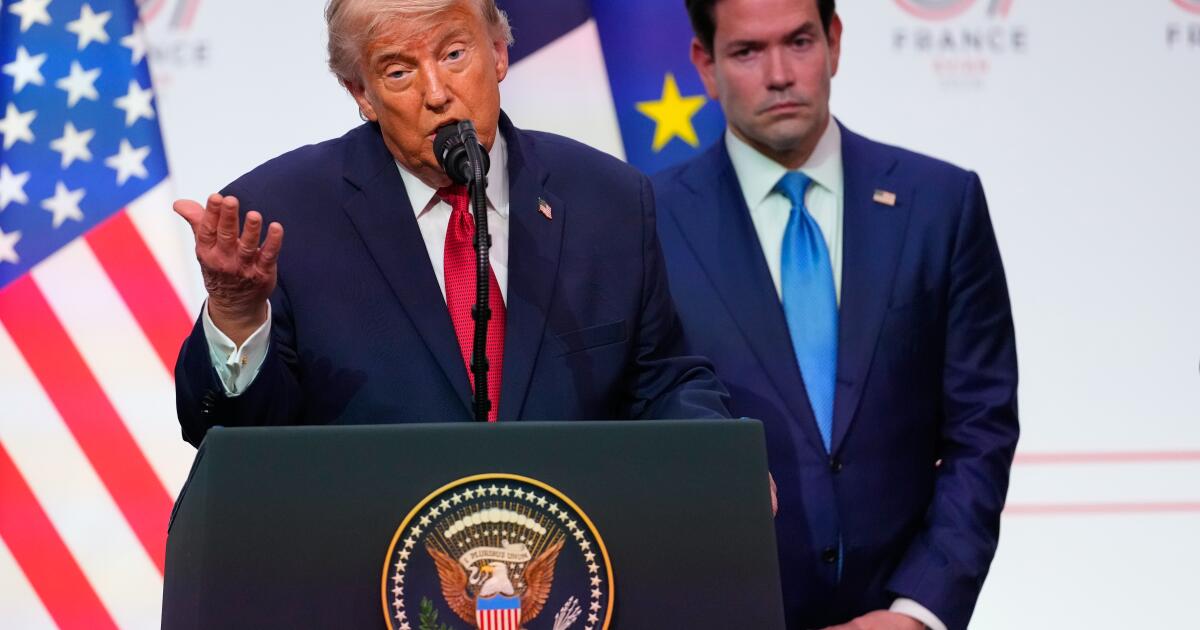
President Trump and MAGA Republicans who echo his diatribe are hallucinating or outright lying when they claim without evidence that there’s widespread fraud in American elections — specifically in blue states like California that vote for Democrats.

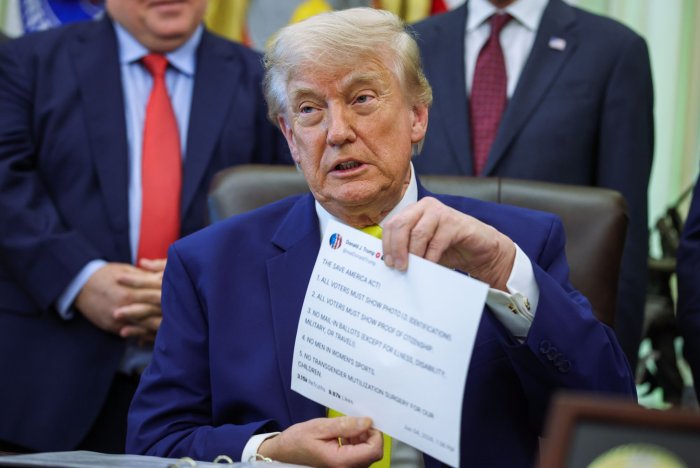
Trump reiterated the fabrication last week when he signed an executive order seeking to place tight federal controls on increasingly popular mail-in voting.

“Mail-in voting means mail-in cheating,” Trump reiterated. “Cheating on mail-in voting is legendary. It’s horrible what’s going on.”

“See you in court,” California Gov. Gavin Newsom replied.

California and several states partnered in filing a lawsuit accusing the president of an illegal power grab. They pointed out that states have a constitutional right to administer elections pretty much as they see fit.

Trump hypocritically voted by mail himself in a recent Florida special election.

“You know what, because I’m president of the United States,” he told reporters when asked about the vote. “I had a lot of different things” to do. For him, voting by mail was convenient.

As for the rest of us, apparently in Trump’s mind we don’t do anything important enough to warrant handy mail voting.

The reality is that egotistical Trump still can’t admit to himself that he lost the 2020 presidential election to Joe Biden fair and square. Democrats must have cheated, he thinks — or says he does.

The main way Democrats cheat, Trump and his followers assert, is to round up noncitizens and register them to vote — especially immigrants from Latin America.

It’s nonsensical. As if some undocumented immigrant struggling to survive and dodge ICE agents really gives a rat who’s elected governor or senator. Voting fraudulently is a crime — a misdemeanor or a felony, punishable by a steep fine and/or jail time.

And a campaign pro is going to break the law by offering cash or groceries to a noncitizen for her vote? That would be felony stupid.

“We can’t get Latinos who have been here legally for three generations to vote. If you’re going to spend money getting votes, that’s where you’re going to spend it,” says Republican consultant Mike Madrid, who has written a book about Latino political influence.

“The notion that Democratic operatives are going after undocumented immigrants is absurd.”

People who migrated here illegally, Madrid adds, “don’t want to touch the government in any shape or form. They just want to put in a hard day’s work and retreat to the shadows. They couldn’t care less about politics and voting in the United States.”

No hard evidence of significant election fraud in America in recent years has been produced by Trump or anyone else.

Riverside County Sheriff Chad Bianco, a leading Republican candidate for governor, apparently was trying to impress Trump and win his endorsement by seizing more than 650,000 ballots cast in November’s Proposition 50 election.

The sheriff said he was investigating claims — unsubstantiated — of election fraud. But the project is now on hold. A good place for it.

It was a waste of the sheriff’s resources to collect the ballots and would be an even bigger misuse of personnel and money to sift through all of those documents in a fruitless search for fraud.

I called Assemblywoman Gail Pellerin, a Democrat who was Santa Cruz County’s chief elections official for 27 years. She chairs the Assembly Elections Committee.

In all of those years supervising elections, Pellerin told me, she encountered only one clear case of fraud. A landlord snatched a ballot that had been mailed to a tenant and illegally cast it.

But a voter must sign the envelope containing a mailed ballot and the landlord’s signature didn’t match the intended voter’s as given when she originally registered. Election officials contacted the intended voter, who said she hadn’t received her ballot yet. The landlord was prosecuted and convicted.

Signatures are checked with the use of technology in California. That’s the main method of verifying a mailed ballot’s legality.

Pellerin says her own signature didn’t match up once. “I got sloppy and my signature had changed since I registered 20 years earlier.” She was contacted by an elections official and her ballot ultimately was counted.

In every election, she says, there are cases of a mother signing the ballot for a daughter who’s away at college, or someone signing for an aging parent. The signatures invariably don’t match and the voters are contacted.

But that’s about the extent of so-called cheating, Pellerin says.

“Immigrants are here to make their lives better,” she says. “They’re not going to risk any path to citizenship by trying to participate in an election.”

When voters register, they must answer under penalty of perjury whether they’re a citizen.

Trump’s convoluted intervention in state-operated voting would, among other things, direct the United States Postal Service to design new envelopes with bar codes that verify voter legality. The feds would refuse to send ballots to people deemed ineligible to cast them.

Gosh, what could possibly go wrong under the Trump administration?

Californians have embraced mail-in voting. In the gubernatorial election 40 years ago, only 9% of ballots were cast by mail; 20 years ago, 42% were. In November, it was up to 89%.

But baseless claims by Trump and his grovelers of “cheating” will persist. It fires up the conservative base and raises political money.

It also maligns noncitizens and dedicated elections officials who keep voting fraud-free.

You’re reading the L.A. Times Politics newsletter

George Skelton and Michael Wilner cover the insights, legislation, players and politics you need to know. In your inbox Monday and Thursday mornings.

What else you should be reading

The must-read: California election experts sound alarm as rate of rejected ballots quadruples
What the … : Californians may need to mail ballots early as Supreme Court signals support for new election day deadline
The L.A. Times Special: The loophole that keeps a Trump loyalist serving as L.A.’s top federal prosecutor

Until next week,
George Skelton


Was this newsletter forwarded to you? Sign up here to get it in your inbox.

Source link

In L.A. mayor’s race, everyone is campaigning on change — even the incumbent

Mayor Karen Bass has had a lengthy political career, spending six years in the state Legislature, 12 years in Congress and the last three in the top elected office at Los Angeles City Hall.

Now, facing the toughest reelection battle of her career, Bass is marketing herself in a way that might surprise some Angelenos: She’s running as a champion of change.

And she’s not alone.

City Councilmember Nithya Raman, who has represented a Hollywood Hills district since 2020, says her last-minute decision to enter the race was fueled by “a sense of urgency that things needed to change.”

Three other major candidates, all political newcomers, argue that an outsider is needed to shake up the status quo.

“We can no longer keep our city together with duct tape and slurry,” said Rae Huang, a leftist community organizer, at a recent candidate forum on housing and transportation.

The race to embrace the mantle of change in the June 2 primary election comes at a moment of political peril for Bass, a veteran Democrat who has racked up high disapproval numbers in several voter surveys.

In recent months, Bass has revamped her messaging, saying she’s been tackling problems that have “been around for multiple decades,” such as homelessness, sluggish police hiring and trash-strewn streets.

Last week, speaking to the Pacific Palisades Democratic Club, Bass said she wants another four years to finish that work. She also implied that, in her zeal to fix the city’s problems, she quietly pushed out a dozen high-level bureaucrats, including those who dealt with trash pickup and police recruitment.

“Let me just tell you that in three years and three months, it is difficult to change what has been a practice for over four decades,” Bass told the group. “I am very clear that there needs to be massive change, and I’ve done a lot of change.”

Raman has portrayed herself as someone who shook up the system while in office, securing a 4% cap on rent increases for more than 600,000 apartments and opposing initiatives she viewed as “disastrous” for the city’s budget. She said the city is falling short on an array of issues, including traffic deaths and housing affordability.

“So much of what’s happening in L.A., our inability to address our biggest crises — our housing crisis, our homelessness crisis, but also essential services like lights and potholes — so much of this has resulted from a lack of clear urgency in decision-making at City Hall,” said Raman, the first L.A. council member to win office with the backing of the Democratic Socialists of America.

Those types of arguments have elicited salty responses from Huang, tech entrepreneur Adam Miller and conservative reality TV personality Spencer Pratt.

Miller, who described himself as a lifelong Democrat, pointed out that Raman runs the powerful five-member council committee on housing and homelessness. He argued that both she and Bass have failed on those issues, as well as on public safety and much needed infrastructure repairs.

“These are the people who have been running the government,” said Miller, who made a fortune developing education software. “So I don’t understand how they could describe themselves as change-makers. They’re the ones who have been the problem.”

Pratt offered a similar take on social media, calling Raman and Bass “two peas in a pod,” while portraying himself as a change agent.

“I’m a wrecking ball to the status quo,” he said in one post.

Neither Pratt nor his representative responded to an interview request.

In one recent high-profile poll, about 56% of respondents said they had an unfavorable view of Bass. In another, about 40% of those surveyed said they had not yet made up their minds about who should lead the city.

“It’s clear that there are concerns among voters about the direction of the city — and the state, quite frankly,” said Pomona College politics professor Sara Sadhwani, referring to the race for governor. “In both instances, there are lackluster candidates, and so we see voters being very much undecided in both of these incredibly consequential races.”

The election season got underway a little more than a year after the Palisades fire, which destroyed thousands of homes and left 12 people dead.

Bass, who was out of the country when the fire broke out, was unsteady in her early public appearances and, since then, has faced sharp criticism over the pace of the rebuilding. She has defended her record on the recovery, saying she cut red tape and suspended city permit fees, while also pressing the Trump administration to crack down on insurance companies that fail to compensate wildfire survivors.

The back-and-forth over change and the status quo broke to the surface during last month’s housing forum in downtown L.A.

At one point, Raman voiced alarm over the city’s elevated “people mover” being built at Los Angeles International Airport, saying it is so far behind schedule that it won’t be ready before the World Cup, which starts in June.

Raman said that as mayor, she would ensure that such projects are finished on time — and replace airport leadership if it fails to happen.

“Nithya, you’ve been on City Council for six years, though,” Huang shot back. “Why have you not moved this forward?”

(At five years and four months, Raman’s tenure is slightly less than that.)

Raman countered that, as a council member, she only has control over certain issues.

“So much of what’s going wrong in Los Angeles requires the mayor to get involved,” she said.

Bass did not attend the forum, traveling instead to New Orleans for a reelection fundraiser. Pratt also skipped. In their absence, the three remaining candidates pounded on a wide array of municipal ills, including broken sidewalks, high rents and sluggish housing production.

Raman, at that event and elsewhere, has sought to differentiate herself from Bass, and City Hall more broadly, by highlighting her dissenting votes.

In 2023, Raman opposed a package of police pay increases negotiated by Bass, saying they were too expensive and would deprive other city departments of funding. Last year, she voted against a $2.6-billion upgrade of the Convention Center, citing similar long-term cost concerns.

Bass, for her part, said she’s been shifting the direction of the city in critical ways. Previous city leaders were too hesitant to build temporary housing for homeless people, she said, leaving them to languish on sidewalks while waiting for government-funded apartments to be built.

After taking office in 2022, Bass declared a local emergency on homelessness and launched her Inside Safe initiative, which has put thousands of people into hotels and motels. Raman signed off on the emergency and the funding for Inside Safe but now says the program is too expensive.

The mayor said she also pushed for changes in LAPD hiring, not just by making officers’ salaries more competitive, but by hacking away at a slow and bureaucratic recruitment process. Speaking to the Palisades Democrats, Bass said she got that done, in part, by changing the leadership and staff at the city’s personnel department.

Bass told the group she’s preparing to launch an initiative to clean up the city’s streets — and that she made a personnel move in that regard as well.

“In terms of cleanliness, I’ve had to change the leadership of the Department of Sanitation, because I couldn’t get the job done,” she said.

Sadhwani, the Pomona College professor, said she doubts that voters will view Bass as a reform candidate. Raman, she argued, is also part of the establishment.

“They cannot run from the fact that they have been in power,” she said.

Source link

Grand National 2026: I Am Maximus & Nick Rockett head confirmations for Aintree race

L’Homme Presse, French Dynamite and Now Is The Hour were all taken out on Monday, while three others below the cut-off line were also scratched.

The field is again set to be dominated by Irish trainer Mullins, with the three-time winner currently having nine horses guaranteed to run.

Joining I Am Maximus and Nick Rockett are last year’s third-placed Grangeclare West, Spanish Harlem, Lecky Watson, Champ Kiely, High Class Hero, Captain Cody and Quai De Bourbon.

Gordon Elliott, who has also trained three National winners, has five entries with Gerri Colombe, Firefox and Favori De Champdou – the beaten favourite in the Cross Country Chase at the Cheltenham Festival – towards the top of the weights.

Another of Elliott’s stable, Pied Piper, is currently 35th on the list and will get a run if one more horse withdraws.

The Ben Pauling-trained Twig is the final guaranteed runner, although Spillane’s Tower has maintained his entry at this stage despite his owner telling RTE on Sunday he is an intended runner in Thursday’s Aintree Bowl instead.

Firefox is also entered in Friday’s Topham over the Grand National fences.

Henry de Bromhead, who won the race in 2021 with Rachael Blackmore and Minella Times, trains Monty’s Star and Gorgeous Tom.

Gavin Cromwell trains Perceval Legallois, who was a faller last year, and Cheltenham Festival winner Final Orders.

Dan Skelton will be represented by mare Panic Attack as he closes in on the UK trainers’ championship for the first time.

The Nigel and Willy Twiston-Davies-trained Beauport will carry the colours of Bryan and Philippa Burrough, whose Corbiere won in 1983 as Jenny Pitman became the first female trainer to triumph.

Nigel is a two-time winner of the race in 1998 and 2022 and the stable are also set to saddle Top of the Bill, who moved into the top 34 with Monday’s withdrawals.

Fourteen-time British champion trainer Paul Nicholls has no entries, while Nicky Henderson, who is yet to win the National, is also likely to have no runners with Hyland currently 41st on the list.

Source link

President Trump endorses Steve Hilton in the California governor’s race

President Trump endorsed conservative commentator Steve Hilton for California governor late Sunday night.

The endorsement could have a major impact on a race that remains up for grabs, with recent opinion polls showing Hilton and his top Republican rival, Riverside County Sheriff Chad Bianco, as top contenders in the 2026 contest.

“He is a truly fine man, one who has watched as this once great State has gone to Hell,” Trump posted on Truth Social, adding that he has known Hilton for many years.

Trump in his endorsement praised Hilton while attacking the record of California Gov. Gavin Newsom, using a derogatory name for the governor. Newsom is serving the last year of his final term as governor as he weighs running for president in 2028.

“Gavin Newscum and the Democrats have done an absolutely horrendous job. People are fleeing, crime is increasing, and Taxes are the highest of any State in the Country, maybe the World. Steve can turn it around, before it is too late, and, as President, I will help him to do so! With Federal help,” Trump said.

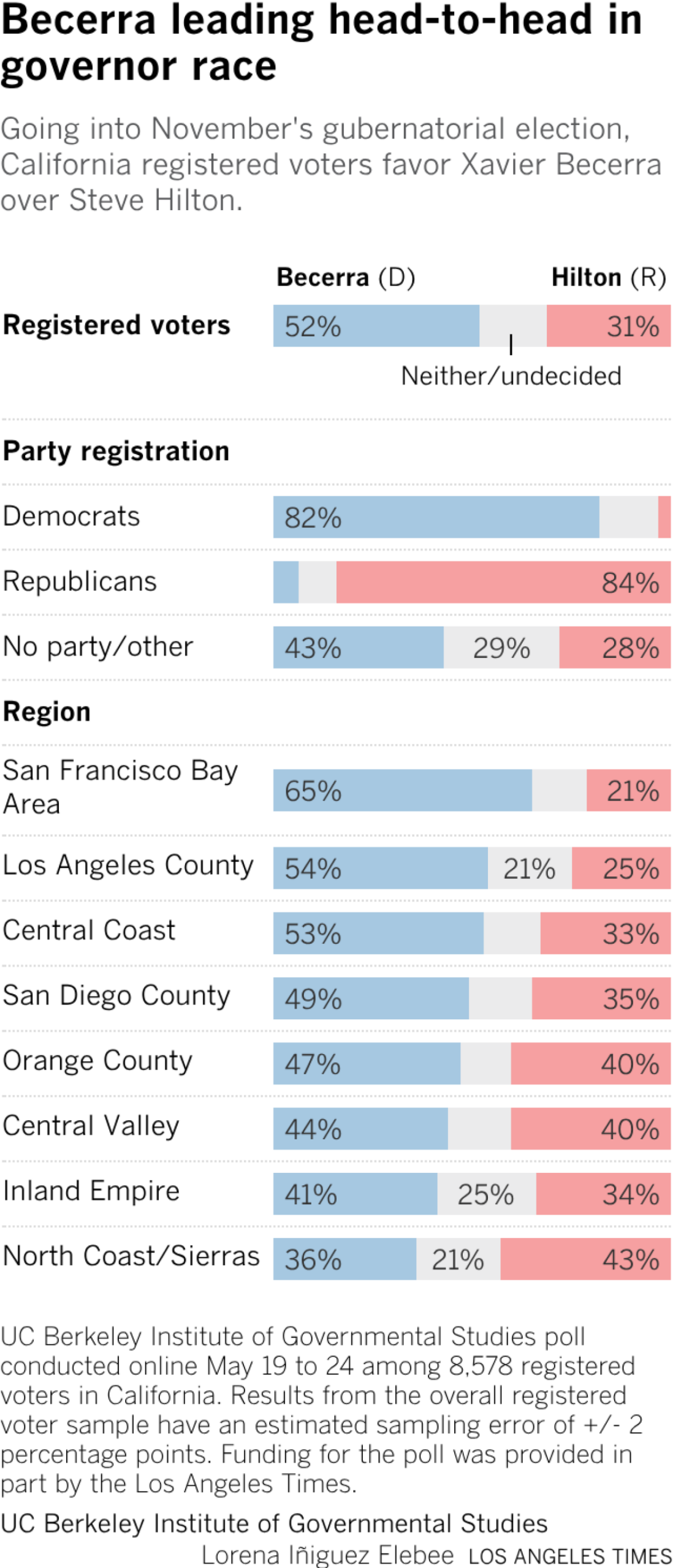
Despite California’s solidly Democratic electorate, a recent poll by UC Berkeley’s Institute of Governmental Studies found Hilton and Bianco leading the crowded field of candidates just months before the June 2 primary — leading to the possibility of Democrats being shut out of a November election that will determine California’s next governor. The crowded field of Democrats in the race has splintered their party’s voters, providing an opening for the Republicans, the poll showed.

Under the state’s top-two primary system, the top two candidates advance to the general election, regardless of their party affiliation.

If Trump’s endorsement leads to California Republican voters coalescing behind Hilton, severely damaging Bianco’s campaign, that likely would reduce the odds of two GOP candidates finishing in first and second place in the primary.

Trump’s endorsement came the day after Hilton and Bianco squared off in a testy debate in Rancho Mirage that was moderated by Richard Grenell, Trump’s former ambassador to Germany, and days before the state GOP meets in San Diego to consider an endorsement in the race.

On Saturday, Bianco said he suspected that Trump would weigh in on the race and that his team had been in talks with the president’s advisors.

“Of course, I would want him to support me. He’s the president of the United States,” Bianco said in an interview.

Hilton on Saturday questioned whether the president would weigh in on the race.

“I’ve said that I’d be honored to have the President’s endorsement. I think that the California Governor’s race is pretty low on his [agenda] right now,” he said in an interview. “I haven’t asked for that, and I’m not expecting him to weigh in.”

Jon Fleischman, the former executive director of the California Republican Party, wrote on Substack late Sunday that he believes that Trump’s endorsement will significantly boost Hilton’s support among GOP voters.

“This Timing Is Not Accidental,” he wrote, noting that while it was previously unclear whether either candidate could receive the 60% of delegate votes to secure the party nod at its upcoming convention. “Well, obviously this endorsement from the President for Hilton will supercharge his momentum going into the weekend convention”

Source link

Get ready for excitement at Arcadia Invitational with arrival of Quincy Wilson

This is the weekend high school track and field takes center stage in Southern California. Quincy Wilson, who won a gold medal at the age of 16 at the 2024 Olympic Games, is coming from Maryland to compete in the 400 and two relays at the Arcadia Invitational at Arcadia High on Saturday.

“I’m so fired up,” Servite coach Brandon Thomas said.

And Thomas isn’t running.

Servite’s 4×100 and 4×400 relay teams will have to deal with Bullis High and Wilson running the anchor leg in races that should have fans standing on their feet while listening to the oohs and aahs.

“From a competitive standpoint, they’re excited to compete against the country’s best,” Thomas said.

Servite’s 4×100 relay team sent a message on Saturday, becoming the first to break 40 seconds in California history, winning in 39.82 at Trabuco Hills.

It’s all a perfect setup, from the atmosphere to the stiff competition, to prepare for next month’s section and state championships.

There’s two Loyola High athletes, sprinter Zion Phelps and 400 runner Ejam Yohannes, who hope to use Arcadia as a springboard to continue their early success this season.

Zion Phelps of Loyola edges Emmanuel Pullins of Sherman Oaks Notre Dame in the 100 meters on Tuesday.

Zion Phelps of Loyola edges Emmanuel Pullins of Sherman Oaks Notre Dame in the 100 meters on Tuesday, winning in 10.56 seconds. Pullins rans 10.59.

(Craig Weston)

Phelps is in his first year of track after being a defensive back and receiver for the football team. He and Loyola’s new coach, Sharaud Moore, were having conversions during the fall.

“He swore up and down he was the fastest kid in the school,” Moore said. “Yeah, put your money where your mouth is.”

Said Phelps: “I told him, ‘Just wait.’ I knew I had that speed and wanted to prove it.”

He ran a wind-aided 100-meter time of 10.39 seconds this spring. Last week in a Mission League dual meet against Sherman Oaks Notre Dame, he won with a time of 10.56.

Said Moore: “I was his harshest critic on the field.“We’re going back and forth and he was right. He’s s really fast.”

Showing his speed is legitimate will help with his football recruiting going into his senior year in the fall.

“Definitely this year has pushed my recruitment out there with my track times,” Phelps said. “I wanted to show the. I’m dedicated to this and being a multi-sport athlete. It will translate a lot.”

Yohannes, set to face Wilson in the 400, has an equally compelling story. He never played organized sports until joining the track team as a freshman. His parents came here from the small African country of Eritrea. His first name is Ethiopian.

He ran the 400 in 52.48 seconds as a freshman, focused more on having fun. Sophomore season he dropped to 50.75 and said to himself, “Wow, I’m fast.” He started getting serious.

“Now I wanted to be better,” he said.

An injury in January of last year didn’t let him get the foundation to run as fast as he hoped. He dropped to 47.69. Then Moore became coach, and Yohannes finally put in months of training to build a foundation.

“He comes in and kills me,” Yohannes said.

Then came the reward — 46.11 on March 21. In his final tuneup on Saturday, he ran 47.17 at the Red Rock Running Invitational.

“He’s a student and studies racing, training, race plans, athletes, programs,” Moore said.

As for facing Wilson, Yohannes’ attitude is bring him on.

“I’m excited to go out there,” he said. “It’s great competition. If I don’t believe I can win, nobody else can. If I don’t believe in myself, it’s over. I’m going to give my best. I might be crazy to saying this, but I think I have chance. He’s world class already in high school. He’s top of the line talent, It’s whoever wins on that given day. This is going to be unreal pressure knowing if I win, my name is out there. That puts me on the map. I can dream.”


Source link

Cambridge Men and Oxford Women take Boat Race honours

Cambridge won a fourth consecutive Men’s Boat Race as Oxford claimed their first victory in the women’s race since 2016.

The Cambridge men came in as strong favourites for the 171st event but Oxford did well to stay with them for much of the race in tricky and blustery conditions along the 4.3-mile course from Putney to Chiswick.

But the class of the Light Blues came through in the final third as they pulled clear to triumph by 11.02 seconds for a seventh win in eight years.

In the 80th edition of the women’s race, Oxford made a blistering start and Cambridge were unable to respond as the Dark Blues stayed strong to win by 9.4 seconds and celebrate their 31st overall success.

Source link

‘Iran shoots down US jet’ and ‘race to find pilot’

"Iran shoots down first American fighter jet" reads the headline on the front page of the Daily Telegraph.

The Daily Telegraph reports that one of the helicopters involved in the rescue of the F-15 crew member was trailing smoke as it returned to Iraqi territory but landed safely. Closer to home, the paper says Labour are “to unleash up to 12,000 shoplifters” under new laws “scrapping most prison sentences of under one year”. The paper quotes a spokesman for the justice ministry saying the the move is “part of a wider, urgent reform to ensure our prison system isn’t pushed to the brink of collapse ever again”.

Source link

What a silly ‘Latinos Por Pratt’ salsa video says about L.A.’s mayoral race

You know the political silly season is upon us when campaigns start to make fools of themselves trying to court Latino voters.

In the Los Angeles mayoral race, that moment kicked off last week.

On Friday, a social media account called Latinos Por Pratt released an AI-animated music video praising the mayoral candidate and former reality television star Spencer Pratt. It starts with a fit, sunglasses-wearing Pratt rolling a trash bin brimming with detritus and Mayor Karen Bass past a crowd of cheering Angelenos. The Hollywood sign looms in the background as the title “Spencer, Saca La Bassura” flashes on the screen — Spencer, Take Out Trashy Karen, with “Bassura” a play on the mayor’s last name and the Spanish word for “trash.”

Cut to scenes of Bass playing tourist on her infamous trip to Ghana while the Palisades burn. Splice in Pratt dancing with his wife, Heidi Montag, onstage at a street party where onlookers wave a Mexican and a U.S. flag. And because L.A.’s Latino majority is overwhelmingly of Mexican descent, the thing was anchored by a peppy accordion, dramatic guitar plucks and a bold tuba, right? Right?

Uh, no.

Lyrics such as “Latinos for Pratt we’re singing / Because we’re tired of this dirty beat” play over brassy salsa rhythms that are more Miami and Cuban than L.A., where Latinos are mostly of Mexican and Central American heritage and the soundtrack of the city — corridos tumbados, cumbias, Latin rock and pop — reflect that.

That didn’t stop clueless, mostly non-Latino Pratt fanboys and fangirls from going gaga over it online. Nor did it stop Bass from joining in the we-need-Latino-voters fiesta.

Soon after the video was released, a group called Latinos Con Bass brought out big-name speakers to Plaza de la Raza in Lincoln Heights — state Sen. Maria Elena Durazo (D-Los Angeles), Coalition for Humane Immigrant Rights head Angélica Salas, Service Employees International Union California President David Huerta — so they could pledge support for the incumbent with all the dutifulness of doctors reminding people to take their flu shot. Bass greeted the crowd with a peppy “¡Sí se puede!” — the standard Latino politico rallying cry for decades but one that’s not so kosher right now given its association with César Chávez, the legendary labor leader whom a New York Times investigation recently revealed to have sexually assaulted teenage girls.

Latinos Con Bass came off as a bunch of establishment types sticking up for one of their own instead of anything organic. But at least we know the track record of those involved. Latinos Por Pratt seems to be just one guy: Adrian E. Alvarez, a Cuban American whose online profile says he splits his time between the Miami area and L.A. If the lawyer by trade — who didn’t respond to numerous requests for comment — was really serious about winning Latino votes for his guy, he would’ve commissioned a corrido instead of a salsa tune. The Mexican ballad form has been trotted out by Angelenos for decades for everything from the tragic deaths of Robert F. Kennedy and Kobe Bryant and his daughter to the capture of sundry narco lords.

Those songwriters got it. Alvarez’s diss track doesn’t. And his use of Cuban Spanish on social media to promote it — carajo, fajame, mi gente — in place of Mexican Spanish equivalents such as güey, éntrale and raza sounds like a guy who doesn’t know South L.A. from South Beach.

But to dismiss “Spencer, Saca La Bassura” as an inauthentic joke is to miss what it says about this political moment. In a year when Latinos nationwide will make or break the Democrats’ effort to win back Congress, they’ll play an even more crucial role in L.A.’s mayoral race.

And it’s the Bass campaign that needs Latinos more than any of her opponents — because there’s no guarantee she’ll get them.

Five adults and children stand in a row.

Then-L.A. mayoral candidate Karen Bass, center, is flanked by pioneering farm labor leader Dolores Huerta, left, and former Mayor Antonio Villaraigosa, right, during a 2022 campaign event in Mariachi Plaza.

(Luis Sinco / Los Angeles Times)

A UC Berkeley Institute of Governmental Studies poll released last month and co-sponsored by The Times revealed that 56% of likely voters view the mayor unfavorably, the only candidate to have a majority of those surveyed look negatively on her. She’s the top choice among Latinos — 29%, compared with Pratt’s 16%. But 27% of Latinos remain undecided about whom they want as mayor, the highest percentage of any ethnic group.

Pratt has some name recognition among Latinos as a C-list celebrity, but he’s also a registered Republican who thinks L.A. should coordinate with the Trump administration’s deportation leviathan, a position that’s as popular among Angelenos as rooting for the San Diego Padres. That obviously presents an opportunity for Councilwoman Nithya Raman, who’s running for mayor to the left of Bass — if she can smartly seize it. But Raman represents a district with one of the lowest Latino populations in the city and has yet to make a name for herself across town — no wonder the Berkeley poll found just 9% of Latinos favored her, trailing even Presbyterian pastor Rae Huang.

Those shortcomings should give Bass — whose children are Mexican American and who has worked alongside Latino L.A.’s political establishment for nearly her entire political career — an advantage among Latinos. But all that star wattage didn’t win her the Latino vote four years ago against Rick Caruso. And L.A.’s biggest problems during the mayor’s first term — homelessness, beat-up streets, busted streetlights, President Trump’s immigration deluge — unduly affected the Latino areas of L.A. Even the inferno that engulfed the Palisades led to the loss of thousands of jobs for the nannies, house cleaners and gardeners that kept the neighborhood as pristine as it was.

Bass’ campaign will trumpet all of her supposed accomplishments and trot out endorsements as it did at the Plaza de la Raza event, but she lost the narrative of a healthy L.A. a long time ago.

Pratt — who doesn’t seem to know Los Angeles besides the Westside and television studios — will have to do far more than Bass and Raman to attract Latinos. But by repeatedly referring to the mayor as “Karen Bassura” — a juvenile, obvious insult that nevertheless sticks once you hear it — he’s at least making Spanish a far more constant part of his campaign than his rivals. And Alvarez’s music video, as silly and un-L.A. as it is, speaks to an enthusiasm among at least one Latino Pratt supporter that will most likely remain catchier and more inspired than anything the Bass and Raman campaigns come up with.

That reality seems to have already made Bass blink. She responded to “Spencer, Saca La Bassura” on social media a few days later with a photo of people at her Plaza de la Raza rally holding “Latinos Con Bass” signs with the caption “Latinos Con Bass > Ai Latinos.” It was meant as a political flex but came off as insecure posturing. Meanwhile, Latinos Por Pratt just released a teaser for another video, this time featuring Pratt as Batman carting out a clown-faced Bass and Raman as the villainous Two-Face.

Playing, again, to salsa. That’s weak sauce. Can someone try to really get Latino L.A.?

I promise: Sí se puede.

Source link

A year after ‘Liberation Day,’ what did Trump’s tariffs achieve?

One year ago, Donald Trump stood in a sun-kissed, unpaved Rose Garden and defiantly announced a new era of global trade, raising tariffs on countries worldwide and sending shock waves through the global economy.

The president promised short-term pain rippling through American households would make way for a U.S. economy that would soon take off. But experts say they are still waiting for receipts — and question whether they will ever come.

You’re reading the L.A. Times Politics newsletter

George Skelton and Michael Wilner cover the insights, legislation, players and politics you need to know. In your inbox Monday and Thursday mornings.

A year of turbulence

Tariff rates shifted so unpredictably for so long — across countries and with remarkable speed — that companies are still struggling to build stable, long-term supply chains capable of supporting future planning and growth. U.S. markets recorded one of the most volatile years in history, marked by extreme swings and modest gains driven by a handful of stocks for tech companies largely inoculated from import duties.

A customer visiting a Costco food court

A customer visits a Costco food court in San Diego on March 18.

(Kevin Carter / Getty Images)

Federal customs duties brought in tens of billions of dollars. But a study published this week by the European Central Bank found that U.S. importers and consumers, not foreign exporters, bore the brunt of the costs that paid for it — and that an even larger share of the burden will fall on American households and companies the longer Trump’s tariff policies stay in place.

Despite the president’s pronouncements, tariff earnings have barely made a dent in the federal debt.

Tax cuts and additional spending on defense and immigration enforcement have increased the annual deficit. In the months of January and February alone, net customs duties hit an average of $27 billion — a significant figure that has essentially offset the costs of Trump’s war with Iran, now estimated to be more than $57 billion since its start.

In February, the Supreme Court ruled that Trump had exceeded his authority by bypassing Congress to impose tariffs on an emergency basis. But the decision has merely prompted the Trump administration to look for ways to bypass the high court, as well.

“Even after the court ruling, the Trump administration continues to wield tariffs in a haphazard and ill-conceived fashion,” said Kimberly Clausing, a professor of tax policy and law at UCLA School of Law. “One year in, Trump’s tariffs have only generated higher prices, economic disruption, frayed alliances, and manufacturing job loss.”

Indian farmers taking part in a protest

Farmers in New Delhi take part in a March 19 protest demanding a minimum support price for crops.

(Sajjad Hussain / AFP / Getty Images)

Since the court ruling, Trump has moved away from using broad emergency powers to justify tariff rates, now citing laws on national security and unfair trade practices to keep them in place. Those are being challenged, as well.

“Trump’s tariff mania injected uncertainty into global business supply chains that he is refusing to let the Supreme Court undo,” said Aaron Klein, chair of economic studies at the Brookings Institution.

“It would be one thing if Trump replaced the existing tariff system with a coherent strategy approved by the very Republican Congress he controls,” Klein added. “Instead, Trump’s on-again, off-again tariff by tweet and let the courts figure it out months later destroys business’ ability to plan and undermines global confidence in America’s trustworthiness.”

‘Mounting downside’

Whether or not the president’s tariff policies survive, they have succeeded in ushering in a new era of international trade, shifting global reliance on the U.S. dollar and on the American consumer market, experts said.

“The euro, the Chinese yuan and crypto will be the biggest beneficiaries as the dollar loses market share,” said Kenneth Rogoff, an economist and professor at Harvard. “Future historians may well look back some day and see Liberation Day as marking the beginning of the end of the dollar’s absolute dominance in global markets, and the ‘exorbitant privilege’ it has given to the United States as issuer of what once upon a time was the world safest currency.”

Mary Lovely, a senior fellow at the Peterson Institute for International Economics, said that Trump’s tariff policies have upended global shipping, prompted China to increase offshore investments in countries like Vietnam to process Chinese inputs for the U.S. market, and elevated long-term uncertainty over investing in North America — a trifecta that has ensured that U.S. companies and consumers bear the costs.

“While the president promised an American ‘industrial renaissance,’ manufacturing jobs have been lost every month since early 2023,” Lovely said. “Easy to see the mounting downside of his tariff barrage, hard to find much upside.”

More than 100,000 net jobs in the U.S. manufacturing sector have been lost over the last year, in part due to the increased costs facing U.S.-based manufacturing companies for parts and inputs, said Michael Strain, director of economic policy studies at the American Enterprise Institute.

That has made domestic manufacturing less competitive. “The trade war has also increased the prices facing consumers at a time when affordability is their top concern,” Strain added.

Customers shopping in Sanya, China

Customers shop at the Sanya International Duty Free City in Sanya, in south China’s Hainan province, on Jan. 10. In December 2025, China launched special customs operations in the Hainan Free Trade Port, allowing easier entry of overseas goods and expanding zero-tariff coverage.

(Guo Cheng / Xinhua / Getty Images)

The policy has become a political albatross for the president, who now proceeds through a midterm year with a bipartisan majority of Americans dissatisfied with his approach to their top concern. Seven in 10 Americans believe that tariffs have increased their costs of living, according to a recent poll, including 64% of Republicans and 67% of independents.

Sung Won Sohn, a former commissioner at the Port of Los Angeles, said that inflation aggravated by Trump’s tariff actions has complicated policy at the Federal Reserve, fueling uncertainty in the U.S. stock market.

The Supreme Court’s decision, which prompted legal ambiguity on the administration’s path forward and opened the door to a flood of litigation for potential tariff refunds, further added to uncertainty. “The net result is decreased economic efficiency,” Sohn said.

Trump faces worse poll numbers on inflation than former Presidents Carter and Biden, both of whom faced challenges with increased prices on goods. Today, 72% of Americans disapprove of the president’s handling of rising prices, according to a CNN poll released this week.

“The real damage from the tariffs — and their uneven unwinding — is not captured in headline GDP figures,” Sohn added. “It shows up in slower decision-making, reduced productivity, and a persistent fog over the economic outlook.”

What else you should be reading

The must-read: A serial arsonist terrorized Hollywood. It ended only after two sisters died in a house fire, authorities say
The deep dive: The books that created the César Chávez myth — and those that brought him down
The L.A. Times Special: Electric bikes can be fast and dangerous. Here’s how to stay safe

On a personal note, hats off to my colleagues for stepping in during my parental leave — it’s great to be back.

More to come,
Michael Wilner


Was this newsletter forwarded to you? Sign up here to get it in your inbox.

Source link

Anti-regulation Democrats? Top takeaways from governor’s race forum in Fresno

Four of the top Democrats running for California governor on Wednesday told a agriculture-friendly Central Valley audience that the left-leaning state’s restrictions on business and the environment have made life more difficult for farmers and should be rolled back.

The candidates onstage at the Fresno State political forum, including two Republicans, did their best to appeal to voters in the midsection of California who often feel neglected by a state government dominated by big-city politicians from Southern California and the Bay Area.

“I’m here today because for far too long, the interests of our ag economy and our rural towns and cities and communities have been second tier, if they’ve even been on the agenda in Sacramento,” said San José Mayor Matt Mahan, a moderate Democrat whose campaign has yet to live up to the high expectations it initially received.

Mahan and five others invited to the forum focused on the state’s affordability crisis, water, government regulations and other issues facing the agricultural hub — all doing their best to play up any ties to the farmers and farmworkers who are so essential to providing food to California and the nation.

Mahan recalled growing up in Watsonville, an agricultural community that is the home of Driscoll’s berries and Martinelli’s apple cider. Fellow Democrat and former U.S. Health and Human Services Secretary Xavier Becerra noted his family’s personal ties to the valley. His father picked crops along State Route 99 as a young man, he grew up in Sacramento, and his wife is from Hanford and Fresno.

Former conservative commentator Steve Hilton said his family had a small farm in Hungary, which they fled because of communism. Former Democratic Orange County Rep. Katie Porter, who grew up in Iowa during the farming crisis of the 1980s, spoke of being the descendant of generations of farmers and being a member of 4-H as well the Future Farmers of America.

“I’m not a farmer today, but I thought I would be. … I believe in the future of agriculture with a faith born not of words, but of deeds,” Porter said, repeating FFA’s creed.

The event marked the first gathering of gubernatorial hopefuls since USC pulled the plug on its debate last week. USC officials canceled the event less than 24 hours before it was scheduled to begin after facing criticism for excluding the top candidates of color. The university said it used opinion polls and financial viability to determine which candidates were invited.

Organizers of the Fresno State event invited candidates who have earned at least an average of 3% in recent polls compiled by RealClearPolitics. Along with Mahan, Becerra, Hilton and Porter, the candidates invited included former Los Angeles Mayor Antonio Villaraigosa and Riverside County Sheriff Chad Bianco. State Supt. of Public Instruction Tony Thurmond and former state Controller Betty Yee, both Democrats, were not invited.

Two leading Democratic candidates were not at the Fresno State forum: billionaire Tom Steyer was scheduled to tour the polluted Tijuana River Valley in San Diego County. Rep. Eric Swalwell’s campaign cited a scheduling conflict but did not elaborate. Swalwell (D-Dublin) appeared to be doing media interviews in San Francisco on Tuesday.

Cutting gas taxes and other ways to save

California’s high cost of living is one of the most visible and pressing issues in the race to replace termed-out Gov. Gavin Newsom, and candidates pitched their plans to address it, primarily by lowering housing and energy costs.

Bianco, Hilton, Villaraigosa and Mahan have floated plans to cut oil industry regulations and suspend the state’s 61-cent-per-gallon gas tax. Bianco went further, saying he would completely eliminate the gas tax. Hilton said he would cap vehicle registrations at $71 per year no matter the type of car. Porter said her top priority is to lower housing costs by “building housing faster, building more housing, changing how we permit housing and innovating in construction and design and materials.”

Republican candidates blamed Democratic policies for the state’s high cost of living and argued that it would not be solved under a new governor of the same party. Both Bianco and Hilton pledged to gut state agencies responsible for regulating air and water quality.

“We’re never going to reduce the cost of groceries or anything else until we abandon the climate dogma that has got us to this point,” Hilton said, invoking the state’s goal to reach carbon neutrality by 2045 as a major cost driver.

According to a recent UC Berkeley IGS/L.A. Times poll, lowering the state’s cost of living was the top issue that likely voters want the state’s next governor to address. It was followed by cutting government waste and corruption — the top priority for Republican voters — and addressing homelessness.

Republicans take their shots

Wednesday’s forum was among the rare instances when Hilton and Bianco appeared before the same crowd. The Republicans have led polls for months, raising the specter of two Republicans and no Democrats appearing on the November general election ballot under California’s top-two primary system.

On Wednesday, they each tried to appeal to a more conservative-leaning audience than many other gubernatorial forums by blasting their Democratic opponents and statewide leaders.

”I think every single Democrat on this stage today should start with an apology,” Hilton said. “An apology for what their party has done to this area and this industry, stealing your water, piling on the regulations — 1,000% increase in the last decade or so, cutting the pay of agricultural workers, on and on.”

The Democrats onstage were repeatedly challenged and at times interrupted by Republican candidates who argued that electing another Democratic governor would bring more of the same problems to the region.

“You can’t just believe what’s on this stage,” Bianco said. “You have to listen to what they say in front of groups that don’t think like you, because everything that they’re saying here contradicts what they say in those groups with more cap-and-trade, more regulation, more everything else.”

Democrats talk up their experience

Democrats largely concurred on issues such as reducing regulations and increasing water supply to farmers. So they sought to differentiate themselves based on their experience and records in office.

Mahan painted himself as a pragmatist who led to San José being named the safest large city in the nation, reducing homelessness by one-third and spurring the construction of housing by reducing regulatory restrictions and fees.

“I’m accountable every day for making people’s lives better. I don’t get to make excuses and blame another party,” Mahan said. “You deserve better from Sacramento, and I’ll work with you to make sure we deliver it.”

Villaraigosa pointed to his eight-year tenure as mayor of Los Angeles, saying the city went from being the most violent big city in the country when he took office to being the safest by the time he left. He also said he took on the teachers union, which he once worked for, resulting in a 60% increase in the graduation rate.

Becerra pointed to his experiences leading the sprawling federal health agency in the Biden administration, including dealing with the COVID-19 pandemic, the wildfires that devastated Maui, Hawaii, avian flu and monkey pox.

“We do not need someone who needs training wheels,” he said.

Porter highlighted that she was the only candidate on the stage who refuses to take money from corporations and corporate PACs. The former congresswoman, who gained fame for her aggressive questioning of chief executives and Trump administration officials while in Congress, also pointed to her longtime focus on oversight.

“There are too many regulations that we are passing,” she said. “That is why I’m running for governor, to make sure that when things come to my desk, the first question is going to be, why did we need this?”

Water is for fighting

Nearly half of the forum was dedicated to questions about water policy, a complicated and politically thorny issue for Central Valley farmers and California as a whole. Most agreed the state should fast-track new reservoirs, raise some existing dams and increase water recycling to boost supply.

“We need an ‘all of the above’ solution,” Villaraigosa said. “That means we need recycling, we need [groundwater] recharge. We need dams. We need underground aquifers.”

Some Democrats, along with Hilton, continued to distance themselves from the proposed Sacramento-San Joaquin River Delta tunnel, a huge project to transport water to the Central Valley and Southern California that has been tied up by legal challenges.

Bianco lambasted “environmental regulation[s] that makes weeds and bugs more important than your life,” and Hilton slammed “ridiculous bureaucracy” created by environmental laws such as the 2014 Sustainable Groundwater Management Act.

Fourth-generation tomato and pepper farmer Briana Giampaoli described herself as moderate and said she hasn’t decided whom to support for governor yet, but she was impressed by the candidates’ breadth of knowledge on water and the regulatory hurdles farmers face, particularly Hilton.

“That was really surprising, and I’m glad that both parties seem to understand that there needs to be a change in California, that something is not working,” she said. “The industry is changing as a whole across the country, and the regulations here continue to make it harder and harder to farm.”

Democrats on immigration

Democratic candidates faced a friendlier audience at the Fresno City College forum later in the day, where they unanimously expressed support for immigrant communities and said the state should fully fund Medi-Cal coverage for undocumented people. To close a budget deficit, Newsom and state lawmakers froze enrollment and raised premiums for undocumented adults on the program.

Porter and Thurmond called for Immigration and Customs Enforcement to be abolished but said, short of that, the state should monitor the federal agency’s operations in the state to protect civil liberties. The other candidates agreed; Villaraigosa pledged to ensure federal detention centers comply with all health and safety rules.

Source link

In L.A. mayor’s race, controversial poll shows Nithya Raman ahead of Karen Bass

City Councilmember Nithya Raman came out ahead of incumbent Karen Bass in a new poll on the Los Angeles mayor’s race, though the poll’s director cautioned that it did not give the whole picture.

Raman had a commanding lead in a field of five major candidates, with 33% of voters supporting her, while Bass trailed at 17%, according to the poll by the Loyola Marymount University Center for the Study of Los Angeles.

Leftist Rae Huang came in just behind Bass at nearly 17%, while tech executive Adam Miller had 13% and conservative reality TV star Spencer Pratt had 12%.

Other polls have shown Bass in first place.

She was at 20% in an Emerson College Polling/Inside California Politics poll, with Raman at just over 9%. In a UC Berkeley Institute of Governmental Studies poll, co-sponsored by The Times, Bass was at 25% and Raman at 17%.

In the Loyola Marymount poll, unlike the other polls, respondents were given brief descriptions of the candidates, including their occupations and political priorities.

Raman was labeled a “progressive LA City Councilmember focused on housing affordability, homelessness and systemic reform,” while Bass was “incumbent mayor of Los Angeles, veteran legislator, focused on homelessness.”

One of Raman’s challenges, as a councilmember representing Los Feliz and Silver Lake as well as parts of the San Fernando Valley, is to spread her name recognition citywide, with the June 2 primary election about two months away. She entered the race to challenge Bass, her one-time ally, at the last minute, hours before the early February filing deadline.

The Loyola Marymount poll of 370 registered Los Angeles voters was conducted from Feb. 11 to March 16. It did not include a choice for “undecided,” while the other two polls showed that significant percentages of voters hadn’t made up their minds.

“This poll shows if only positive descriptors are used and context is provided, Raman is ahead,” said Fernando Guerra, director of Loyola Marymount’s Center for the Study of Los Angeles, who directed the poll.

Guerra said he believes Bass is the front-runner, taking the previous polls into account.

Bass’ campaign took issue with the Loyola Marymount poll.

“In 2022, this same LMU poll had Karen Bass at 16% — she ended up winning the primary with 43%. The only thing more ridiculous than this poll is Spencer Pratt’s performance on The Hills,” said Alex Stack, a spokesperson for the Bass campaign, referencing Pratt’s reality show.

Raman’s campaign did not immediately respond to a request for comment. In a post on X citing the poll, Raman wrote, “OUR CAMPAIGN IS SURGING … Angelenos are ready for a city that actually works.”

Paul Mitchell, vice president of the bipartisan voter data firm Political Data Inc., said the poll’s sample size was too small to draw conclusions and that the poll was less reliable because it was conducted over the course of more than a month.

He also noted that with many of the candidates relatively unknown, including the descriptors could have a major effect.

“I’m sure Nithya Raman doesn’t have citywide name recognition, but that description is really great,” Mitchell said.

Guerra said he didn’t include an “undecided” option because he wanted to “force” respondents to give an answer, similar to when they actually vote.

In the Emerson poll, more than 50% of voters were undecided on who to support for mayor. The Berkeley IGS poll showed about a quarter of voters were undecided.

In LMU’s mayoral poll from 2022, released in early March of that year, 42% of respondents chose “undecided/someone else” for mayor.

After Bass, who had 16% support, then-City Councilmember Kevin de Léon was second at 12% in the 2022 poll. Rick Caruso, the billionaire developer, who ended up making the runoff election against Bass, received 6% support.

In that year’s June primary, Bass got 43% of the vote, Caruso nearly 36% and De Léon about 8%.

This year’s LMU poll also asked L.A. voters what kind of candidate they would prefer for mayor.

Nearly 50% said they prefer a Democratic Socialist, while 25% said they want a moderate Democrat, 19% said a conservative and just 8% said an establishment Democrat.

“Los Angeles is much more progressive than its elected leadership. This poll captures that,” Guerra said.

Some disagreed.

Mike Trujillo, a consultant for moderate Democrats who is not representing anyone in the mayoral race, said polling he has done across the city shows that the Democratic Socialists of America’s popularity is much lower.

Raman is a dues-paying member of the Los Angeles chapter of DSA, which endorsed her in her two successful City Council campaigns.

“If you believe this poll, I have bridges to sell you on 1st Street, 6th Street, and Alameda Street — and there’s no bridge on Alameda,” he said. “The poll was basically A to Z in Nithya Raman’s contact list.”

This year’s LMU poll also asked L.A. County voters about the governor’s race. Former U.S. Rep. Katie Porter led at about 16%, followed by Republican Steve Hilton at 13% and billionaire Tom Steyer at 12%.

The Berkeley IGS poll showed two Republicans — Riverside County Sheriff Chad Bianco and Hilton — leading the crowded field of gubernatorial candidates by slim margins among voters statewide, with Democratic support split among multiple candidates in a left-leaning state.

Source link