All you need to know about Premiership title race
Hearts and Celtic head into the final two games in the Scottish Premiership separated by just a single point after an epic season. Here is your guide.
Source link
Hearts and Celtic head into the final two games in the Scottish Premiership separated by just a single point after an epic season. Here is your guide.
Source link
SACRAMENTO — Here’s what the Democratic candidates for governor aren’t telling us: While promising the moon, they’ve avoided saying how they would keep paying for all of Sacramento’s current costly programs.
Termed-out Gov. Gavin Newsom and the Democratic-controlled Legislature have dug the state into a deep financial hole, and it faces severe deficit spending through the next governor’s first term.
The only honest solution is an unpopular mix of program cuts and tax increases, plus a focused, earnest and unlikely effort at making government more cost-effective and efficient.
The worst option would be the easy one that got Sacramento into its current mess: gimmicky budgeting that includes excessive borrowing, program delays rather than outright eliminations and fudged numbers.
Nonpartisan Legislative Analyst Gabriel Petek recently estimated “the state faces structural deficits running from $20 billion to $35 billion annually.”
He warned the state’s financial commitments funded by its revenue “[are] not sustainable” and added that mopping up the red ink “will likely require at least some — if not significant — spending reductions.”
The analyst pointed out that since 2019, under Newsom, state general fund spending has risen by $100 billion to $248 billion in the governor’s latest budget proposal in January. About 70% of the growth went to maintaining existing services and 30% was for expanding or creating new programs.
“In retrospect,” Petek continued, “the state could not afford to sustain its existing services while funding … expansions and new programs.”
Last week, the analyst reported some good news coupled with bad. He estimated a $25-billion boost in unanticipated revenue, driven by artificial intelligence enthusiasm and “the related stock market boom.” But, he added, “these surging revenues likely are not sustainable.”
George Skelton and Michael Wilner cover the insights, legislation, players and politics you need to know. In your inbox Monday and Thursday mornings.
By continuing, you agree to our Terms of Service, which include arbitration and a class action waiver. You agree that we and our third-party vendors may collect and use your information, including through cookies, pixels and similar technologies, for the purposes set forth in our Privacy Policy such as personalizing your experience and ads.
The analyst said the stock market appears to be “in a speculative bubble, rivaled only by the dot-com boom” (that led to the Great Recession) “and the Roaring ‘20s” (that ushered in the Great Depression).
“The state should be prepared for revenues to be tens of billions lower within one or two years.”
Newsom will get another crack at legitimately balancing a budget on Thursday when he revises his spending proposal for the next fiscal year.
You can’t really blame the governor’s wannabe Democratic successors for dodging this fiscal thicket. Program cuts and higher taxes don’t attract voters. Moreover, the subject is weedy and boring. For that reason, I suspect, moderators didn’t even delve into it during three recent televised gubernatorial debates.
Regardless, budget-crafting is a governor’s most sacred duty and the source of much of their power. It would help voters to know where the candidates stand. Right now, they’re in hiding.
Former state Senate leader Don Perata, a Democrat, posted this last week about the chronic deficits:
“Apparently, candidates find this untroubling or maybe someone else’s worry. None … even mentioned it during those juvenile television ‘debates’ and the hundreds of millions spent on campaign commercials.”
Instead, various contenders have been promising voters a Santa’s sleigh of goodies: state-run single-payer healthcare, free childcare, partial no-tuition college, suspension of the gas tax, no state income tax for people earning under $100,000 and generous subsidies for Hollywood filmmaking.
Billionaire hedge fund founder Tom Steyer and former Orange County congresswoman Katie Porter have been touting single-payer healthcare, an idea pushed by politically potent nurses unions and Democratic progressives. Private insurance would be eliminated and, under most proposals, so would the popular Medicare. The state would manage all medical insurance — more efficiently and at less consumer expense, advocates insist.
But this concept seems far beyond the state’s financial reach and operational capability. Its cost could exceed twice the current state budget. And I shudder to think of our state bureaucracy trying to handle healthcare for 39 million people. First, get the DMV working right and the botched bullet train rolling.
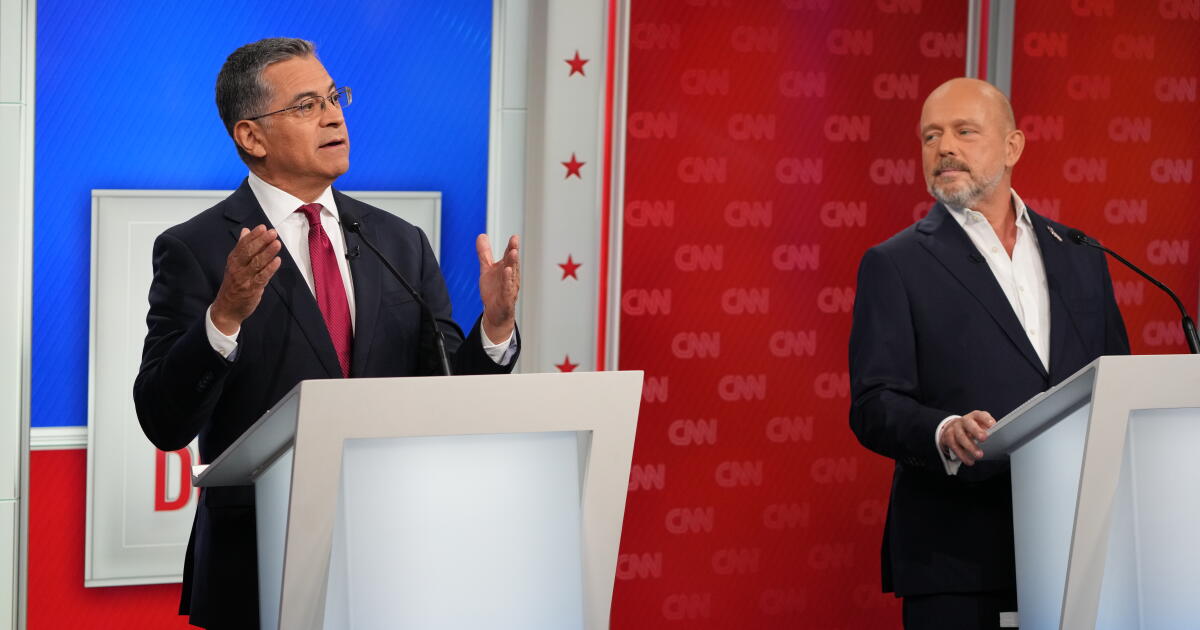
For many years, underdog gubernatorial candidate Antonio Villaraigosa — a former Los Angeles mayor — has called the single-payer notion “snake oil.” In a CNN debate last week, he termed it “pie in the sky.”
Centrist San José Mayor Matt Mahan chimed in, asserting: “The candidates who are fighting for single-payer don’t know how to pay for it, and they’re not being honest about it.”
Practically everyone jumped on new Democratic frontrunner Xavier Becerra — former state attorney general and U.S. health secretary — for seemingly being unable to specify whether he’s for or against single-payer.
“I’ve been consistent for over 30 years,” he said, trying to explain that he favors Medicare-for-all as “the most efficient way that we can do healthcare.”
It was a silly waste of debate time. They were arguing over oranges and lemons — both citrus, but different. Becerra should have just made clear that he’s opposed to single-payer and supports a separate version of universal healthcare: Medicare-type coverage with a supplemental private insurance option for all Californians. If that’s indeed what he favors.
Mahan bragged that he’s “the only candidate in this race who is calling for a suspension of the gas tax.” It’s a highlighted Republican talking point. But no other Democratic candidate advocates suspending the tax because it’s a screwy idea.
The roughly 60-cent-per-gallon state gas tax pays for filling potholes and more serious road repairs and improvements. Moreover, the next governor won’t take office until January. Suspending the tax then — even if the Legislature approved — wouldn’t reduce today’s soaring pump prices.
My take on the debates:
Becerra survived. He’s refreshingly calm but needs to be more crisp.
Steyer was articulate and may have attracted Bernie Sanders fans.
Porter is a talented debater, but seemed overly defensive about her past hot temper.
Mahan was fine, but he just got off the bench and it’s late in the game.
Villaraigosa was straightforward as usual, and finally had a broad audience.
All should bone up on budget-balancing and tell us their thinking.
The must-read: How MAGA Sheriff Chad Bianco is shaking up the 2026 California gubernatorial primary
The other must-read: Tom Steyer tries to sell voters on his own personal change
The L.A. Times Special: Abortion access just took another blow. California wasn’t spared
Until next week,
George Skelton
—
Was this newsletter forwarded to you? Sign up here to get it in your inbox.
CHONGQING, China — Three years ago, in the idyllic town of Woodside south of San Francisco, the United States and China held their first high-level talks on the dangers posed by artificial intelligence. President Xi Jinping and his longtime foreign minister appeared serious in their conviction that a channel should be a established between Beijing and Washington — a red phone for AI in case of emergencies.
They authorized a diplomatic effort that would begin in 2024 in Switzerland, only months before the U.S. presidential election. A large U.S. delegation arrived with high hopes that were abruptly dashed, according to four sources who attended the talks. The Chinese contingent dismissed American concerns over runaway AI as academic, almost theoretical, quickly turning the conversation to export controls seen in Beijing as yet another U.S. effort to hold China back.
“They naturally view any American diplomatic initiative involving limitations or restrictions of one flavor or another on a capability as being a trap,” Jake Sullivan, U.S. national security advisor under President Biden, said in an interview.
Despite the distrust — and Democrats losing the White House to Donald Trump — an accord was struck in November of that year in Peru, where both sides agreed to keep AI out of the command and control of nuclear weapons.
“It was a breaking of the seal that we could actually do something on AI,” Sullivan said. “In the transition, I told the incoming Trump team that they should really pick up that dialogue. But the Trump administration’s view was just far more laissez-faire, and they didn’t seem particularly interested in it.”
“That’s all changed in the past few weeks,” he added.
A Trump administration once eager to gun for technological supremacy is now, for the first time, reckoning with the power AI could unleash if left unchecked.
In a surprise reversal, quiet discussions have taken place ahead of President Trump’s state visit to China this week to explore reviving talks on an emergency channel, officials told The Times, prompted by shared alarm in Beijing and Washington over the debut of Mythos, Anthropic’s powerful new model.
One senior administration official told reporters Sunday that the White House was looking to create a channel of communication for AI like others that they have “in many areas that have intense focus with the U.S. and China.”
“I think what that channel of communication looks like, its formality and what that looks like, is yet to be determined,” the official said, “but we want to take this opportunity with the leaders meeting to open up a conversation. We should establish a channel of communication on that matter.”
Mythos’ capabilities are seen across the industry and government as those of an unprecedented cyberweapon, able to infiltrate and exploit digital communication systems — including government databases, financial institutions and healthcare programs — with untold consequences.
Whether an announcement will come to fruition this week is not yet clear. Any talks between the United States and China over AI regulations — designing some kind of arms control agreement governing the use of a technology that neither side fully understands or controls — will be fraught with suspicion, misunderstandings and risk, experts say.
“Right now, there is almost no support from U.S. policymakers to engage in formal discussions on AI governance with China,” said Aalok Mehta, director of the Wadhwani AI Center at the Center for Strategic and International Studies.
“The logic is that this is a winner-takes-all race,” Mehta said, “and that it’s imperative to accelerate AI progress to ensure that the United States wins that race.”
China would enter those discussions with a powerful argument, that U.S. leadership in AI — and the prevailing strategy of American AI companies — is propelling the world to a fraught frontier.
Every major U.S. player in the arena — OpenAI, Google, Anthropic, Microsoft and Meta Platforms — is racing to be the first to build a model capable of artificial general intelligence, or AGI, a threshold without a common definition, but that most agree will require a model to perform any intellectual human task.
The prevailing theory is that the first to achieve AGI will secure a prize that multiplies itself: a self-training, recursively improving intelligence, growing exponentially and leaving all competitors in its wake.
Chinese companies, by contrast, are following a state-sanctioned strategy focused on integrating AI into siloed industries and systems, training models to improve individual tasks and accelerate growth in a more tailored approach.
“The Chinese believe there is no single race, but multiple races,” said Scott Kennedy, senior advisor on Chinese business and economics at the Center for Strategic & International Studies. “The U.S. is focused on achieving AGI, while China is focused on diffusion and applications of AI into the rest of their economy — manufacturing, humanoid robotics, all aspects of the internet of things.”
China scholars, AI industry insiders and successive administrations have questioned Beijing’s strategic thinking and forthrightness.
“It’s so baked into the community here that AGI will have this transformative potential that people can’t believe China isn’t focused on this, as well,” said Matt Sheehan, a scholar of global technology issues at the Carnegie Endowment for International Peace with a focus on China. “It says it’s focused on applications, but is that a fake out for an AGI program hidden in the mountains somewhere?”
But most insiders believe that Beijing’s guidance to Chinese companies reveals its true intentions.
“They are not as AGI-pilled as the United States is, and I think that remains the case today,” Sullivan said, “so they regarded a lot of the conversation in the U.S. around extreme frontier risk — misalignment and loss of control — as a bit abstract, and not really as relevant to how they saw AI diffusing in China.”
President Biden greets Chinese President Xi Jinping in Woodside, Calif., in 2023.
(Doug Mills / Pool Photo)
Although China’s progress has exceeded U.S. expectations — especially since DeepSeek released its model over a year ago — the state has focused computer power on specific applications rather than the broad strategy needed to develop more powerful models capable of advancing toward AGI.
“It’s not just chips. It’s money,” Sheehan added. “China’s leading companies are much more financially constrained than U.S. companies. There’s concern over a bubble here, but OpenAI is valued at something near $800 billion. Leading Chinese companies that have gone public are valued at $20 billion. There’s just an orders-of-magnitude gap in available financing.”
Still, some in the U.S. government fear China won’t need comparable computing power if it simply steals the technology wholesale.
Doing so isn’t simple. But last month, in a memo, the White House Office of Science and Technology Policy accused Chinese actors of “industrial-scale campaigns to distill U.S. frontier AI systems,” in effect replicating the performance of the most advanced existing models “at a fraction of the cost.” The memo did not accuse Beijing of endorsing the activity.
In the process, the memo added, carefully constructed security protocols are deliberately stripped away.
Whatever its strategic calculus may be, China would enter talks with the Trump administration trailing in the race — while disagreeing on the nature of the finish line.
AGI, in theory, could reach a stage of recursive self-improvement that results in a loss of human understanding or control. But if it is only the Americans, and not the Chinese, seeking to reach that threshold, then who is responsible to stop it?
Daniel Remler, who led AI policy at the State Department during the Biden administration and took part in the Geneva talks, cast doubt on Chinese claims of disinterest in AGI and ignorance of its risks. China falling behind in the race is no strategic design, he said.
“Chinese technologists are close observers of the U.S. AI ecosystem, and sometimes they say what they think,” Remler said. “Many were impressed by the [Mythos] model to the point of despair. Leaders in China’s top AI labs have been vocal in recent months, even before Mythos, about how compute-constrained they are at the frontier. Some have said they may never catch their American competitors.”
Talks at this point in the race could follow a familiar pattern in the recent history of U.S.-China diplomacy, in which Beijing claims it is behind the United States in development, ultimately securing a handicap and greater concessions at the negotiating table.
In other competitive domains — such as with China’s entry into the World Trade Organization and in cybersecurity negotiations between Beijing and the Obama administration — agreements were ultimately reached that Washington believes in hindsight disadvantaged American companies.
The Trump administration, Remler added, “needs to approach AI diplomacy with China with clear-eyed expectations anchored to our own national interests.”
Silicon Valley itself is divided over regulating AI. Anthropic, which was founded on concerns that other AI companies were failing to take safety and alignment concerns seriously, raised alarms over Mythos, its own model, to the Trump administration, a moment that has prompted reflection at the White House on the best path forward.
Spooked after meeting with leaders from America’s top banks over their vulnerabilities, Treasury Secretary Scott Bessent internally advised U.S. government reviews of future model releases — a practice already underway in China, where the training parameters for models, known as “weights,” have been publicly released.
Even the suggestion of government oversight sparked backlash from Silicon Valley. Last week, the White House sent out a memo to reassure industry allies that submitting new models for federal review would be strictly voluntary.
If talks ultimately resume between Washington and Beijing on AI, experts believe the negotiations would be far more complex than those that resulted in arms control agreements governing nuclear weapons in the Cold War.
The superpowers would not only be discussing threats of instability to the global financial system, but also fears of proliferation — advanced AI tools getting into the hands of bad actors interested in using bio- or cyberweapons that could target both countries.
And they ultimately would have to decide whether to discuss regulating the integration of AI into the Chinese and U.S. militaries, an almost unfathomable goal between the world’s biggest adversaries, where trust is lowest and verification would be hardest.
Those in the industry who most fear what artificial superintelligence could bring have told the Trump administration that talks with China are an existential necessity.
Dario Amodei, the chief executive and co-founder of Anthropic, speaks at an event in New York in 2025.
(Michael M. Santiago / Getty Images)
But even within Anthropic, which has championed diplomacy, there are concerns that Beijing could exploit its current disadvantage to entangle American industry at the cusp of its crowning achievement.
Rather than pushing for a single sweeping agreement, industry insiders are advising the administration to pursue targeted deals with Beijing to mitigate specific risks, like the pact on nuclear command and control, two industry sources said.
In private, both Xi and Chinese Foreign Minister Wang Yi seemed to understand that the gravity of the emerging technology before them required some form of cooperation, Sullivan said.
“At a conceptual level, I believe they had a conviction on that and authorized it,” Sullivan said, “but I believe their level of urgency was considerably lower than ours, and saw this as a longer-term process that would play out over time.”
“Their level of urgency and their stake in it has gone up,” he added.
In Congress, Katie Porter’s blunt, combative style helped rocket her to progressive stardom. It has also become her biggest vulnerability as she campaigns to be California’s next governor.
Her brusque approach, prosecutorial instincts and suburban mom appeal fueled Porter’s rise during her three terms in the U.S. House of Representatives, where she rattled CEOs and Trump administration leaders and batted away GOP challengers in a competitive Orange County district.
Her tack, however, made her a polarizing force within her own party, where fidelity remains an essential currency of success and power. In Congress, Porter clashed with then-House Speaker Nancy Pelosi and L.A.’s Rep. Maxine Waters.
The same rough edges that endeared Porter to many voters have also alienated some Democratic insiders and interest groups whose support could prove critical in the race to replace outgoing Gov. Gavin Newsom.
Then-Rep. Katie Porter meets with parents, doctors and diabetic patients in her Irvine office in 2019.
(Mark Boster / For The Times)
“She came in [to the governor’s race] as an outsider, as a mom, as a fighter. She wasn’t pulled into the establishment,” said Lorena Gonzalez, president of the California Federation of Labor Unions. “I think that’s why she’s popular with voters, because they want somebody who’s going to fight, and sometimes that ruffles feathers.”
In the campaign for governor, Porter, a single mother of three, has struggled to convert grassroots popularity into broader institutional support. Even after former Rep. Eric Swalwell dropped out of the race amid allegations of sexual assault, she has yet to see a major surge in support or endorsements from Democratic power brokers.
A pair of embarrassing videos continue to hang over her campaign. The videos, which surfaced in October, showed Porter yelling at a staff member and threatening to walk out of a television reporter’s interview.
As former U.S. Health and Human Services Secretary Xavier Becerra has ascended and she remained stagnant in polls following Swalwell’s exit, Porter has increasingly sought to redeem her image. She poked fun at the incident with her staffer in an ad, smilingly asking a group of whiteboard-wielding supporters behind her to “please get out of my shot.”
In recent debates, Porter has sought to play up the qualities that made her a standout among resistance-era progressives, needling former hedge fund executive Tom Steyer over his past investments in private prisons and the pressing Becerra for a “yes” or “no” on statewide single-payer healthcare. Porter emphasizes her support for single-payer healthcare, providing free child care and college tuition and making wealthy corporations pay their “fair share” in taxes.
Porter said she wants to increase taxes on the state’s wealthiest residents but doesn’t support the proposed billionaire’s tax ballot measure because it is a “one-time tax” that won’t solve the state’s underlying budget issues.
During a particularly chaotic debate last week, she scolded her opponents’ incessant interruptions and called out what she considered a double standard over her behavior.
“I can’t believe, with [the] interrupting and name-calling and shouting and disrespect for everyone up here who’s stepping into public service that anyone wants to talk about my temperament,” she said during the May 5 debate on CNN.
Though she acknowledged she mishandled both caught-on-tape situations and said she apologized to the staffer, the videos hindered her early momentum and have undercut her efforts to make inroads with potential allies in the race.
Porter speaks at a gubernatorial candidates forum on Sept. 28, 2025, in Los Angeles.
(Carlin Stiehl / Los Angeles Times)
Influential lawmakers, labor groups and party insiders have coalesced behind Becerra and Steyer, her top Democratic rivals.
Porter has scored some key endorsements. She is one of three candidates backed by the California Federation of Labor Unions, along with Steyer and former Los Angeles Mayor Antonio Villaraigosa. She also has support from Teamsters California, the National Union of Healthcare Workers and progressive groups such as Emilys List and California Environmental Voters, which dual-endorsed her and Steyer.
Union support is pivotal for Democratic candidates in California, sending a clear signal that they support the priorities of working-class voters. For Porter, who has proudly refused to accept corporate donations throughout her political career, the labor endorsements also help her attract the small-dollar donations that are essential to her campaign.
While in Congress, Porter proved to be a prodigious fundraiser. In her last reelection campaign for the House of Representatives in 2022, she raised more than $25.6 million in contributions — the second-most in Congress, behind only Bakersfield’s Rep. Kevin McCarthy, who was then the House Republican leader.
Still, her backing from elected Democrats remains comparatively thin. Along with her mentor, Sen. Elizabeth Warren (D-Mass.), just three members of Congress have endorsed her gubernatorial bid: Reps. Robert Garcia of Long Beach, Dave Min of Irvine and Derek Tran of Huntington Beach. She also picked up an endorsement from Assemblywoman Cottie Petrie-Norris (D-Irvine) after Swalwell dropped out.
Though none would speak publicly, multiple sources who work in and around the state Capitol expressed concerns about Porter’s temperament and her willingness to work collaboratively with people she disagrees with.
“Katie Porter hurt herself big time because she needs anger management and she doesn’t have the temperament” to be governor, Democratic former Sen. Barbara Boxer said during a recent interview with NewsNation’s Leland Vittert.
Through her campaign spokesperson, Porter’s declined to be interviewed for for this story.
Porter questions Tim Sloan, president and chief executive officer of Wells Fargo, during a House Financial Services Committee hearing in Washington in 2019.
(Andrew Harrer / Bloomberg)
Defenders argue the backlash reflects a double standard for women in politics — a salient point in a state that, despite its liberal reputation, has never elected a woman as governor.
“Sacramento sizes up every gubernatorial candidate the same way: Can they win, and is this someone I actually want to work with?” said Elizabeth Ashford, a Democratic consultant who is not working with any of the candidates running for governor. “The videos showed an angry woman, and for a lot of people that translated to ‘I don’t want her as my boss.’
“It’s a double standard that dogs women in politics. Jerry Brown was famous for his loud, unfiltered outbursts and nobody questioned whether he was up to the job,” said Ashford, who served as the former governor’s deputy press secretary.
Gonzalez agreed, arguing that women who stand up for themselves “are often labeled as ‘difficult.’ Probably a lot of people think I’m difficult,” the labor leader added with a laugh.
Born in Iowa, Porter often connects her politics to her family’s financial struggles after losing their farm during the 1980s farm crisis. She earned degrees from Yale and Harvard, where she studied bankruptcy law under Warren. In 2012, while working as a law professor at UC Irvine, Porter was appointed by then-Atty. Gen. Kamala Harris to oversee California’s $18-billion mortgage settlement.
After defeating Republican incumbent Rep. Mimi Walters in 2018, Porter quickly emerged as one of the Democratic Party’s most recognizable progressives. Armed with a whiteboard and other visual aids in congressional hearings, she confronted banking and pharmaceutical executives over drug prices, consumer debt and corporate profits.
The props, theatrical at times, seemed to aggravate Waters, then the Democratic chairwoman of the Financial Services Committee. On several occasions, Waters sided with Republicans who challenged Porter’s use of visual and audio aids during hearings.
“Please do not raise your board. We’ve talked about this before,” the chairwoman scolded when Porter tried to hold up a “Financial Services Bingo” card during a 2019 hearing on debt collection. (She later got to show the board on “Late Night with Seth Meyers.”)
Eager to force change they campaigned on, Porter and other freshmen, including members of “The Squad,” at times clashed with Pelosi and other Democratic leaders.
Porter speaks to volunteers while campaigning in Mission Viejo in 2018.
(Victoria Kim / Los Angeles Times )
Porter has slammed lawmakers, including Democrats, for stock trading and funneling earmark funding to their home districts, arguing that such practices breed corruption and mistrust in Congress. The critiques irked Pelosi, a powerful force in California politics.
In her second term, the Orange County Democrat lost her coveted spot on the Financial Services Committee after she listed it as her third choice and requested a waiver to stay on it. Typically, members prioritize such high-profile committees and request waivers to serve on lesser ones in addition. The move was seen as a risk, the result a check on Porter’s ambition.
“So many of us, regardless of ideology, run on ‘shaking up Washington.’ But then when you actually come here, there’s a lot of consequences for doing that,” Rep. Alexandria Ocasio-Cortez (D-N.Y.) told The Times after Porter lost the committee position.
Porter’s willingness to buck party norms also raised eyebrows during her Senate campaign, when she entered the race for Sen. Dianne Feinstein’s seat before Feinstein had announced retirement plans in early 2023. Although then-Rep. Adam Schiff also launched an early campaign, he did so only after privately seeking Feinstein’s blessing. She ultimately finished third in the primary.
Her decision to run for Senate did not ingratiate her with Washington’s Democratic leadership. The party was forced to spend millions to ensure another Democrat was elected to her contested Orange County congressional seat, and Schiff, her top rival in the race, was a close ally of Pelosi — who endorsed him — and helped lead the first impeachment effort against President Trump.
Controversy surrounding Porter’s personal relationships have also surfaced during previous campaigns. In 2024, she obtained a five-year restraining order against a former boyfriend who she said bombarded her and her children with threatening messages.
When a whisper campaign about the end of her marriage threatened her first House run, Porter shared details of her 2013 divorce with the Huffington Post, including that her ex-husband, Matthew Hoffman, physically intimidated and verbally abused her. Hoffman also claimed to be the victim of abuse, including an incident in which Porter allegedly threw hot mashed potatoes at him. Both filed for restraining orders and sought anger management during the divorce.
Former employees have also rallied to her defense. In an open letter last month, 30 former staffers described Porter as a “workhorse” who “asked of us what she expected of herself.”
“She demanded a lot, but she also fought for us, mentored us, and stood by us when life got hard,” the former aides wrote. “We believe the public should understand the full person we know, not a caricature built from a few clips on a bad day.”
Porter has argued that voters are looking for someone willing to challenge powerful interests rather than accommodate them.
Katie Porter is interviewed after the California Gubernatorial debate at Skirball Cultural Center on Wednesday.
(Jason Armond/Los Angeles Times)
“It’s on me to keep campaigning and keep demonstrating that,” she told reporters after a recent gubernatorial debate in San Francisco. “It’s also not lost on me that the last time the Democratic Party had a woman nominee for governor was 1994, when I was in college.”
The affordability crisis is at the forefront of the race to replace term-limited Newsom. As a single parent, Porter argues she is acutely aware of gas and grocery prices — as well as higher-stakes consequences.
She described feeling shocked when, during a recent conversation with her 17-year-old son, he asked if she would visit him if he moved to another state.
“I said, ‘Paul, you love California, why would you leave California?’ And he said, ‘Well, I’m thinking I might want to have a family and I might want to have a house, and I know that means I’ll have to leave California,’” Porter recounted at a March forum hosted by the California Assn. of Realtors. “We need to be a state that doesn’t just retain people like my son … but welcomes new families.”
The centerpiece of her proposed “affordability solutions” are free child care, free tuition at UC and CSU schools for students who complete two years of community college, and ending income taxes for those who earn less than $100,000 — an idea she acknowledges she “stole” from Republican candidate Steve Hilton. “I will take a good idea anywhere I can get it,” she said at a recent forum.
To pay for it, Porter would impose a progressive corporate tax, meaning more profitable businesses and corporations would pay a higher rate. A less than 1% tax hike on businesses that earn hundreds of millions in profit would bring in around $8 billion, according to her website.
“I think she deeply and personally understands the everyday struggles that so many Californians are grappling with right now,” said Petrie-Norris, who last month became the first state legislator to endorse Porter.
While Petrie-Norris describes herself as more politically moderate than Porter, the Irvine assemblywoman praised her as a “pragmatic problem-solver” and “proven fighter” who has taken on corporate interests and the Trump administration.
For a while, Porter was one of four women among the major candidates running for governor. One by one they have dropped out of the race, citing difficulties raising money and support.
After sharing the debate stage with five men recently, Porter was asked whether California is ready for a female governor.
“I sure as hell hope so,” she said.
In the Celtic dressing room, there is experience of reeling off wins to secure a title.
Winning their last five league games nods to the defending champions’ ability to harness experience.
They might not have been challenged to the final day much before, but in contrast to Hearts their winning experience is considerable.
“I honestly do feel that Celtic will be calm, just because they’ve been in this situation so many times before,” Halliday said.
“Now, some people don’t think that counts for much. For me, I personally do.
“Hearts have felt the pressure of being the team that’s been hunted for 30 weeks consecutively now, and they’ve handled it already extremely well.
“You talk about a manager’s role, I’ve no doubt whatsoever that Derek McInnes has played a huge part in that.”
O’Dea also believes that however different players and managers handle these situations, neither Celtic nor Hearts, who have come from behind to take points in their last five games, have shown signs of toiling.
“Both teams have an abundance of character,” he said.
“I don’t know if I could pick a winner in terms of the character from both groups, they’ve both shown it, so it makes for a good ending.”
Voters in California may get a chance to remake the state’s open primary system in two years.
Political consultant Steve Maviglio filed an application Friday with state officials that seeks to alter California’s voting system by reverting to a traditional primary. Under the proposal, the top candidates from each party would advance to the general election in November.
The current system allows the top two candidates, regardless of party, to move on to the runoff. That has led to instances in which two Democrats or two Republicans have faced off in the general election.
The state’s gubernatorial election, for example, has prompted concern that two Republicans could shut out the Democratic candidates. Riverside County Sheriff Chad Bianco and former Fox News commentator Steve Hilton have polled high in various surveys and are facing a large field of Democrats.
Democratic voters vastly outnumber Republicans in California, yet some political consultants said they feared there were so many Democrats running that voters wouldn’t coalesce around one candidate and the field would be split. Those fears have eased somewhat in recent months as some Democratic candidates advance from the pack.
The state’s top-two primary system has been in place since California voters passed Proposition 14 in 2010. The goal was to help end partisan gridlock in Sacramento and force candidates in primaries to appeal to a wider range of voters, rather than just those in their own party.
Proposition 14, as well as the state’s once-a-decade redistricting process, has led to some dramatic races, including the 2012 face-off between Democratic Reps. Brad Sherman and Howard Berman for a congressional seat in Los Angeles’ San Fernando Valley. Amid aspersions and attack ads, the pair nearly came to blows at a community debate.
Maviglio described the ballot measure as a simple repeal of Proposition 14, and said he was inspired by the governor’s race.
“It was extremely scary to envision the November ballot for governor with Republicans on it,” Maviglio said.
The New York Times first reported on the ballot measure proposal.
A news release from Maviglio states that the proposed repeal of Prop. 14 “is fueled by concerns that California’s primaries are disenfranchising a majority of California voters by limiting choice to candidates from one party.”
A website for the effort includes criticisms of the current primary system by Democratic Party Chair Rusty Hicks and Ron Nehring, former chairman of the California Republican Party.
Maviglio’s ballot initiative proposes to appear on the 2028 ballot and take effect in 2030.
Talk of changing Proposition 14 has been swirling in Sacramento for months.
Secretary of State Shirley Weber told reporters at an unrelated news conference last week that she had voted years ago against Proposition 14. She questioned whether it had actually succeeded in creating more diversity.
“I did not like the open primary,” Weber said. “I didn’t think it would solve any problems. They had a list of problems it would solve, and none of those have been solved.”
Pity poor California.
It’s not just the eye-watering price of gasoline, the absurd cost of housing, the rising price of utilities and groceries, the Trump-led assault on the state’s immigrant population and his attack on California’s long-cherished values of tolerance and diversity.
No, on top of all that voters have been subjected to — the horror! — a dull and drab gubernatorial campaign, burdened by a surfeit of C- and D-list candidates with all the electricity and elan of a tepid bath.
Where are the A-listers? Where are the lights? The cameras? The action?
That, anyway, is the perspective one gets reading a certain genre of campaign dispatch, written from the perspective that all of California, Land of Reagan and Schwarzenegger, home to Hollywood and Silicon Valley, incubator of the Next Big Thing, is a stage. Woe unto those who fail to entertain, animate or amuse.
The fact that those dreary assessments have very little to do with the actual wants and needs of the vast majority of Californians — not to mention the state’s history of electing mostly dull and drab governors — should give their authors pause.
It hasn’t.
Contra all the stifled yawns and thinly veiled condescension, the contest — now in its final stretch — is the most compelling California gubernatorial campaign in decades. And not just because one of the leading contestants torched himself and his political livelihood in a bonfire of hubris and stupidity.
Come November, voters could elect the first female governor in state history, or possibly the first Latino governor in more than 150 years. (They might also install California’s first billionaire governor, a considerably less uplifting and monumental achievement, but historic nonetheless.)
Depending on the result, the election could also solidify a notable shift in California’s political power balance, from the long-reigning San Francisco Bay Area (think Govs. Jerry Brown, Gavin Newsom and U.S. Sens. Alan Cranston, Dianne Feinstein and Barbara Boxer) to Southern California (think Sens. Adam Schiff, Alex Padilla and, possibly, Gov. Xavier Becerra or Katie Porter.)
True, there’s no pyrotechnic personality in the expansive field of gubernatorial hopefuls. But this is no group of slouches.
“Look at the resumes of these people. There’s nothing embarrassing,” said Jim Newton, a UCLA historian who’s written a shelf-load of biographies of Californians as disparate as Earl Warren and Jerry Garcia. The contenders, he noted, include a former state attorney general and Biden Cabinet member, a high-profile ex-congresswoman, the aforementioned hedge-fund billionaire and men with experience running two of the state’s most populous cities. “That’s a pretty good range of backgrounds in candidates for governor.”
With no glitz, no glamour, what’s a star-seeking, celebrity-hungry voter to do? If you believe the stereotype, Californians take their political cues more from Variety and In Touch magazine than, say, their voter guide or the flood of TV ads and campaign mailers that inundate the state every two years.
In truth, the Hollywood stars elevated to the governorship, Ronald Reagan and Arnold Schwarzenegger, have been the exception — spaced nearly four decades apart — and far from the norm. Both political insurgents were elected under extraordinary circumstances. Reagan amid the tumult and tectonic fracturing of the 1960s Civil Rights and Free Speech movements. Schwarzenegger in an unprecedented, rapid-fire recall of an enormously unpopular governor.
Far more typical are the likes of George Deukmejian, Pete Wilson and Gray Davis. Each was a career politician who spent decades laboriously climbing the government rungs before being elected governor. Collectively, they were featured on the cover of People magazine precisely zero times.
The three were, to use Newton’s description, “mainstream, politically tested, not flashy.” Which also happens to describe several of those currently aspiring to be governor.
Drab, but true.
Boring as it may seem, most Californians want someone who’ll focus on their workaday concerns, not jollification. For all the talk of the “attention economy” — the hearts and minds won by jokey memes, viral videos and other snackable morsels on social media — voters are much more focused on the real economy, which is to say putting food on their table, maintaining a roof over their head and keeping their car fueled and home at a bearable temperature.
“It’s not virtual reality,” said Mike Madrid, a longtime California Republican strategist and one of the state’s most astute political observers. “It’s reality reality.”
“That may not be interesting to the punditry and the East Coast,” Madrid went on, “but it still matters. Reality still matters. The performative nature that has dominated our discourse for 10 years in the Trump era is fading away.”
Imagine, for a moment, if former Vice President Kamala Harris had jumped into the governor’s race, as contemplated. The contest, for all intents, would have ended then and there, save for months of airy speculation on which Democrat or Republican would make the November runoff en route to eventual defeat. That would have been boring.
In Harris’ absence, the sprawling field of candidates has been a good and healthy thing, yielding the most competitive California gubernatorial contest in a quarter century. Fears of a Democratic shutout in June’s top-two primary and a fluky Republican being elected — which were always overwrought — have faded dramatically. Even if they hadn’t, would it really be better for politicians in Sacramento and Washington to anoint the Democratic favorite and cut voters out of the equation?
(While we’re busting myths, another is the fanciful notion that the state party or Democratic grandees like Nancy Pelosi, Gavin Newsom, Jerry or Willie Brown could have cleared the field with just a phone call or two.)
This wide-open fight for governor may not be boffo entertainment or dazzling to those looking in from the outside, but it’s absorbing nonetheless. It’s destined to be remembered as one of the most volatile and surprising political contests modern-day California has ever seen.
When Gavin Newsom ran for California governor in 2018, his support for a state-run single-payer healthcare system was considered a risky move and earned him hefty labor endorsements.
Today, leading Democrats in the wide-open race to succeed Newsom have embraced single-payer healthcare as a political necessity, an answer to voters fed up with rising premiums and other spiraling healthcare costs.
But with no clear front-runner, they are sparring among themselves in debates and political ads over who is most committed to a government-run model. No candidate has outlined how California would fund comprehensive health coverage for its 40 million residents, leaving voters unable to discern which candidate has a concrete plan for the nation’s most populous state.
Healthcare and political experts said the concept of single-payer has shifted from progressive pipe dream a decade ago to today’s mainstream talking points in a state where Democrats outnumber Republicans nearly 2 to 1. Democrats have pledged the model as the best way to lower costs in an attempt to woo voters worried about affordability as ballots arrive for the June 2 primary. The top two Republicans, meanwhile, have dismissed government-run healthcare as a “disaster” and “socialism.”
“In many ways, single-payer healthcare has become a progressive litmus test,” said Larry Levitt, a former White House policy advisor and a healthcare expert at KFF, a health information nonprofit that includes KFF Health News.
Few voters fully understand the term single-payer, let alone expect the next governor to achieve it, Levitt said. Rather, he added, the term has become more of a signal to voters about a candidate’s approach to healthcare reform.
Xavier Becerra, the former U.S. Health and Human Services secretary, who for decades backed single-payer healthcare in Congress, has come under criticism from opponents for a nuanced but clear shift away from single-payer. It came after Becerra secured an endorsement from the California Medical Assn., a powerful group representing doctors and a longtime opponent of single-payer healthcare bills in California.
At a May 5 debate put on by CNN, Becerra declared his support for “Medicare for All,” a proposal for a federally run system that’s been stalled for years, but he declined to say whether he’d pursue a California-led effort. He said his immediate focus would be on mitigating the drastic federal cuts expected to hit low-income and disabled enrollees in Medi-Cal, the state’s Medicaid program, which covers more than a third of residents.
Becerra is counting on voters not to distinguish between the often-confused terms single-payer, Medicare for All, and universal coverage, noting during the debate that “Californians don’t care what you call it, so long as they have affordable healthcare.”
“A lot of people aren’t clear what single-payer is, and they need a metaphor to understand it,” said Celinda Lake, a Democratic strategist and one of the lead pollsters for former President Biden’s 2020 campaign.
Billionaire activist Tom Steyer, who’s touted his self-funding as a signal he can’t be bought, has emerged as the race’s most vocal advocate of single-payer after opposing it during a short-lived 2020 presidential bid. As governor, Steyer has said, he would pass legislation backed by the California Nurses Assn. that has failed to come to fruition under Newsom’s tenure. Pressed on how he would cover the estimated $731.4-billion cost, Steyer told KFF Health News that “God is going to be in the details.”
At a forum last year, former U.S. Rep. Katie Porter said she didn’t believe achieving such a system was realistic in the near term, but the Orange County Democrat later told party delegates that she would “deliver single-payer.” Former Los Angeles Mayor Antonio Villaraigosa and San Jose Mayor Matt Mahan, Democrats who are trailing their competitors in the polls, don’t support single-payer. The top two vote-getters — regardless of party — advance to the November general election.
Some of the most seasoned politicians have failed to deliver single-payer. Newsom, who campaigned on the promise of being a “healthcare governor,” dialed back his ambitions upon taking office, choosing instead to pursue “universal access” to health coverage under a series of Medi-Cal expansions and efforts to contain healthcare spending.
The campaign bus for billionaire activist Tom Steyer, who has made single-payer healthcare a central pillar of his run for governor, in downtown Oakland.
(Christine Mai-Duc/KFF Health News)
Vermont, which remains the only state to pass a single-payer healthcare law, reversed course when leaders there couldn’t identify a funding source.
To enact single-payer, California would need permission from the federal government to redirect billions of dollars from Medicaid, Medicare and other funding that currently flows to the system — approval not likely to come from the Trump administration.
More than half of adults nationally say healthcare costs will have a major impact on whom they vote for in November, according an April KFF poll.
Danielle Cendejas, a Los Angeles-based Democratic consultant who works with state legislative candidates, said single-payer healthcare increasingly appears on candidate questionnaires from small-business advocates as well as hyperlocal Democratic clubs, in state legislative races and national union endorsements. What most California voters want to hear, Cendejas said, is how candidates plan to give them more immediate relief from higher premiums, expensive drug costs and long waits to access care.
The high price tag doesn’t faze Jennifer Easton, a 63-year-old Democrat from Oakland, who said other countries with similar models have proved they can lower costs. She said she supports a single-payer health system because it’s clear to her that Americans have reached the limits of working within the existing system. But she isn’t expecting any of the current candidates to succeed in implementing one, and she hasn’t decided whom to support.
“No one can in four years,” she said. Seeing a candidate enthusiastically support the concept gives her a good idea of their philosophy. “It is, if we’re lucky, a 20-year, 25-year plan.”
Rob Stutzman, a Republican political consultant who advised former Gov. Arnold Schwarzenegger, said while Americans may be supportive of single-payer in polls, focus groups suggest that approval drops quickly when voters realize it could mean losing their current doctor or insurance plan.
At the CNN debate, Steve Hilton, the Republican candidate President Trump has endorsed, said Californians would end up with subpar patient care and “taxes sky high to pay for it,” like in his native United Kingdom. Instead, Hilton suggested the state stop providing “free healthcare for illegal immigrants who shouldn’t even be in the country in the first place.”
Mai-Duc writes for KFF Health News, a national newsroom that produces in-depth journalism about health issues and is one of the core operating programs at KFF—an independent source of health policy research, polling, and journalism.
The comeback win against Rangers was a huge hurdle cleared for Hearts on an emotional Monday evening at Tynecastle.
However, playing Motherwell at Fir Park this season is among the toughest tests in the league. Only Falkirk, twice, have won there and Motherwell have conceded just nine goals in 17 home games – the fewest of any side in the division.
Hearts put in a conservative performance to get a 0-0 draw in their other visit back in November.
But even the games at Tynecastle between the sides have been keenly contested.
Motherwell were 3-0 up and cruising in August before Claudio Braga inspired a remarkable comeback to earn a draw, in a sign of things to come for the Hearts.
Then Motherwell pushed Hearts to the final few moments last month before succumbing to a 3-1 defeat. Had the visitors been more clinical, it could have been a different result.
Motherwell have already derailed Rangers’ title challenge with a 3-2 win at Ibrox a fortnight ago, and Hearts will be well aware of the threat Jens Berthel Askou’s side pose.
Given Celtic visit Fir Park on Wednesday, Motherwell could well be the kingmakers as they chase fourth place and European football for themselves.
A Hearts victory would be a giant step towards history and ensure Celtic have no room for error. So far the men in maroon have handled everything thrown at them.
Sigal’s most recent book is “The Secret Defector” (HarperCollins). He teaches journalism at USC
“We don’t go in for that kind of crap that you have back in New York–of being obliged to print both sides. We’re going to beat this son of a bitch Sinclair any way we can. . . . We’re going to kill him.”
The speaker: Kyle Palmer, Los Angeles Times political editor, to Turner Catledge of the New York Times.
The time: 1934, when socialist writer Upton Sinclair, who had just swept the Democratic primary for governor of California, threatened to beat handily the GOP candidate, Frank Merriam, in the November election.
Kyle Palmer, the pope of Southern California right-wing politics, was neither kidding nor exaggerating. Nor was he exceptional in his venom toward Upton Sinclair and his mass movement, End Poverty in California (EPIC). According to Greg Mitchell in his fascinating and valuable study, EPIC “was nothing less than a roundabout route to socialism.” On this point, “Political pundits, financial columnists, and White House aides, for once, agreed: Sinclair’s victory represented the high tide of radicalism in the United States.” This tide had to be pushed back, or California would suffocate under the weight of Sinclair’s “maggot-like horde” of supporters, as the Los Angeles Times called EPICers.
In 1934, a year racked by general strikes and epidemic unemployment, the maverick pamphleteer-novelist Sinclair–author of muckraking tracts like “The Jungle” and the most widely translated American writer abroad–was a menace not only to the so-called Vested Interests. Down deep, he embodied a revulsion felt by many Californians toward the capitalist system. EPIC’s program of production-for-use-not-profit, land colonies, barter exchanges and cooperation versus competition was a potentially deadly blow to the American Dream. It was subversive because it spoke to the misery of desperate, Depression-ruined Americans yearning for relief from the day-to-day savagery of a skewed, inefficient system that seemed to be failing everybody but the very rich. At its height, EPIC enrolled 100,000 members from San Diego to Sacramento, and its newspaper sold 2 million copies.
In “The Campaign of the Century,” Greg Mitchell has chosen to focus not on EPIC itself but “on the cataclysmic response to Sinclair’s emergence as the Democratic nominee.” Thus we learn relatively little about EPIC or about Sinclair, but a lot about the nuts and bolts of the “most astonishing . . . smear campaign ever directed against a major candidate.” Our present-day “media politics” with its emphasis on image over substance, was born in the ferocious, fraudulent anti-Sinclair campaign, says Mitchell.
A subtext of Mitchell’s book is how strongly adherents felt about Sinclair and EPIC. They “came from every strata, although nearly all were white. It was not . . . a poor people’s movement. Most of the activists were middle-class and middle-aged . . . Many were down-on-their-luck businessmen.” Any given EPIC club might include “Utopians, technocrats, Townsendites, progressive Republicans, New Deal Democrats, ex-Socialists and secret Communists, all united by a belief in a perfectible society.” No EPIC, aside from clerical staff, earned a cent from the movement. “Members paid a dollar, penny, or a collar button” to join; “Some EPICs hocked the gold fillings in their teeth to raise money.” Although broad-based and decentralized, “EPIC was far from democratic” and indifferent to unions. And Sinclair’s portrait occupied a holy place in many homes.
In any other state, EPIC might never have flown. But California’s populist tradition, open-mindedness (or wackiness), absence of party bosses or deep ethnic loyalties meant that a challenge to established authority was as relatively easy to mount as it was difficult to organize a counter-revolution. At first, the state’s wealthy were so rattled that their political representatives were caught completely off balance by Sinclair’s spectacular rise. Only loonies had expected him to win the primary, and nobody had been crazy enough to predict he would outpoll all six of his opponents together.
But like a great octopus, California’s Republicans and conservative Democrats, equally terrified of EPIC, slowly thrashed up from the murk of politics-as-usual to deal with the “enemy within.” “The prospect of a socialist governing the nation’s most volatile state,” says Mitchell, “sparked nothing less than a revolution in American politics.”
Spurred by “fear and desperation,” ad men like Albert Lasker and especially Clem Whittaker, hired conservative guns, broke the old rules and “virtually invented the modern media campaign.” Whittaker and his associate Leone Baxter introduced the radical idea that free-lance outsiders like themselves, not party chiefs, would “handle every aspect of a political campaign.” Whittaker’s “cozy relationship” with California’s 700 newspaper publishers meant that local editors were happy to run his press releases “as news stories–even as editorials.” The anti-Sinclair “lie factory” twisted and distorted; but worst of all, his enemies quoted from Upton Sinclair’s own works, in which he had attacked everything from wedded bliss (“marriage plus prostitution”) to religion (“a mighty fortress of graft”) and the Boy Scouts. After his defeat, Sinclair confessed wearily and with justice, “I talk too much. I write too much, too.”
By most accounts, Sinclair was a decent, generous, puritanical man of genuine sweetness. What his blurted half-jokes and honest indiscretions failed to supply, Hollywood and Madison Avenue concocted by way of movie propaganda and, probably even more effectively, radio shots–like an anti-Sinclair “One Man’s Family”-type series. Film studio bosses, alarmed by Sinclair’s not-very-serious threat to socialize movie production, colluded with what a Scripps-Howard reporter called a “reign of unreason bordering on hysteria.” Big-time screenwriters like Carey Wilson and directors like Felix Feist (later of “Peyton Place” fame) were enlisted or dragooned to produce Goebbelsesque films, often using faked footage, that drilled home the message: EPIC equals Armageddon. Studio workers were forced to contribute to Frank Merriam’s campaign. Very few Hollywood stars had the guts to refuse. (Holdouts included James Cagney and Jean Harlow.)
Law ‘n’ order also came to the rescue of the anti-Sinclair forces. Election officials, GOP activists and local district attorneys intimidated EPIC supporters away from the polls by challenging the credentials of at least 150,000 voters and threatening to arrest them. All across the state preachers thundered, “Go and Sinclair no more!” and Aimee Semple McPherson, hungry for respectability after her recent kidnaping hoax, turned against Sinclair, despite the pro-EPIC sympathies of her flock.
Finally, the Democrats themselves carved up EPIC. At first friendly to Sinclair, President Roosevelt, needing conservative support for his faltering New Deal, cut a deal with the Republicans. In return for Frank Merriam converting to a pallid form of New Dealism, the party dumped the divisive Sinclair. Frightened Democrats and “third party” anti-EPICers formed around a candidate named Haight, who may have drawn off enough votes to beat the insurgent–but not by all that much. Final results: Merriam 1,100,000; Sinclair 900,000; Haight 300,000. In defeat, Sinclair received twice as many votes as any previous Democratic candidate for governor.
EPIC soon disappeared in a backlash of internal Red-baiting. (The communists and socialists opposed EPIC, but the Communist Party also tried to take it over.) Sinclair stopped muckraking to write the “Lanny Budd” series of best-sellers. Waves of fright and self-interest quickly covered over EPIC’s writing in the sand. Today, who remembers it?
Later, Sinclair insisted that the EPIC campaign had “changed the whole reactionary tone of the state.” EPIC was “the acorn from which evolved the tree of whatever liberalism we have in California,” claimed state Supreme Court justice Stanley Mosk, a Sinclair supporter in ’34. And as a direct result of EPIC and the studio bosses’ much-resented bullying, “politics in Hollywood moved steadily to the left over the next few years.”
Of course, the Right learned, too. “A number of men who would become legends in California politics, on both sides of the ideological fence, virtually cut their teeth on the ’34 campaign,” writes Mitchell. These included Earl Warren (Merriam’s campaign manager), Asa Call, Edmund G. (Pat) Brown (sending what encoded messages to his son today?), Murray Chotiner, Augustus Hawkins, Cuthbert Olson–a whole generation of pols whose experience taught them just how powerful the rich, who own the media, can be when aroused.
Lessons for liberals are harder to come by in this sizzling, rambunctiously useful book. If we take note of this nation’s recent rash of insurgencies–from Carol Moseley Braun to Ross Perot–maybe one lesson is that nothing good ever completely dies, it just goes to sleep for a while.
BOOK MARK: For an excerpt from “The Campaign of the Century,” see the Opinion section, Page 6.
In the ancient days of 2022, when the Supreme Court sledgehammered abortion rights with the Dobbs decision, the (Republican) party line was that the issue had returned to where it belonged: the states.
Fast forward to 2026 and it would now seem that the antiabortion crowd, faced with the aggressive pro-choice response of states such as California and lethargy on the part of the Trump administration to do more toward implementing a national ban, is no longer satisfied with that outcome.
They are now out to stomp on California, and a handful of other reproductive health sanctuaries, to ensure that what happens inside our borders fits their ideology.
“It’s strategic, it’s targeted,” Mini Timmaraju, president and chief executive of Reproductive Freedom for All, told me. “Even if you’re in a ‘blue state,’ you’re not safe.”
The U.S. Supreme Court will decide next week whether to take up the abortion issue again, in a case that could end medication-only procedures as we know them.
That would force women into a less-safe regimen with a lower success rate that would almost certainly lead to more complications — and therefore more controversy. Even in California, which would not be spared by what the court could do, and whose policies are central to the case.
Let’s break it down.
Union members, immigrant rights supporters and anti-Israel demonstrators participate in a May Day rally and march in Washington, D.C., on Friday.
(Robyn Stevens Brody / Sipa USA via Associated Press)
After the Dobbs decision, 11 states passed near-total bans on abortions.
Six other states put early time limits on the procedures, and others passed bans in the second trimester, leaving women in much of the South and the Great Plains with no access to in-person care for hundreds or even thousands of miles.
In many of those places, those bans include making it illegal to receive abortion-inducing medications in the mail from states such as California. But that’s a hard law to enforce unless you go around opening lady-mail.
In recent years, the number of U.S. abortions arranged through telehealth and mailed medication has skyrocketed to more than a quarter of all procedures, though the often illegal nature of this route probably means the number is higher but underreported.
To protect the doctors and providers who are prescribing and sending these medications, California and other states have passed numerous laws to make it easier and safer — from allowing the prescriber to remain anonymous to shield laws that ensure those providers can’t be penalized or extradited to other states for prosecution, though some states are trying.
Earlier this year, Louisiana (a state with a full ban) tried to extradite a California doctor with no luck. Gov. Gavin Newsom gleefully denied that request, promising to “never be complicit with Trump’s war on women.”
U.S. House Speaker Mike Johnson, a Republican from Louisiana, speaks during the annual March For Life at the National Mall in Washington, D.C., on Jan. 23.
(Graeme Sloan / Bloomberg via Getty Images)
In the Supreme Court case, Louisiana is thinking bigger — and expressing antiabortionists’ frustration with the Trump administration. The state is suing Trump’s Food and Drug Administration because it allows mifepristone, one of two medications used in abortions, to be prescribed via telehealth.
“Patients and these states with bans and extreme restrictions have relied on providers in blue states, abortion access states, to really help provide care,” Timmaraju said. “And this is a way to stop that.”
Antiabortion groups had hoped (and pushed) Trump to simply have the FDA remove its approvals of mifepristone, but Trump ain’t that dumb. Despite all his promises on the campaign trail, the administration would prefer to kick the can instead of the hornet’s nest on this one, especially before the midterms — since most Americans support abortion rights. So the FDA has said it’s “studying” mifepristone, which could take awhile.
Louisiana is claiming it had to spend $90,000 in taxpayer money to help two women who sought medical treatment after medication abortions (though it has not said they received the medication in the mail).
That’s a real harm, it argues, and gives them standing to sue the FDA to stop mifepristone from being prescribed by telehealth at all, claiming the FDA hasn’t done its due diligence to ensure that’s safe and it makes them really sad that they can’t stop women from ordering it.
The FDA has remained “completely silent on this point because the Trump administration doesn’t want to get involved,” said Mary Ziegler, a UC Davis law professor and expert on reproductive law.
“It’s totally one of the signs that the antiabortion movement is in an open rebellion, and is using the federal courts to express that because the political branches have been pretty non-responsive,” she said.
The Contemplation of Justice statue is seen outside the U.S. Supreme Court building on Monday in Washington.
(Andrew Harnik / Getty Images)
The Supreme Court lifted a stay Monday imposed by the 5th Circuit that stopped mifepristone from being tele-prescribed. So it’s available until at least May 11.
After that, who knows. It’s up to a court that has proven it’s no friend to reproductive rights.
It’s an issue with real consequence for Trump. If the court takes the case, the midterms must contend with abortion. If they don’t, the pressure on Trump to do so sometime intensifies. But its also an issue with real consequence for Californians.
In California, there are 22 counties without an abortion clinic, Ziegler points out. In the far north of the state, women without access to telehealth abortions would be little better off than those in Louisiana if mifepristone by mail is stopped.
Instead, women would probably be forced to use the second medication, misoprostol, alone. This single-drug regimen has a lower effectiveness rate than the combined drugs, meaning more women will have to seek out secondary care — often in places where even in-person care is hard to come by. That could lead to more real harm, and therefore more high-profile cases of botched abortions to fuel a further ban on misoprostol.
Steve Hilton takes an interview after the California gubernatorial debate at Skirball Cultural Center on Wednesday.
(Jason Armond / Los Angeles Times)
And then there’s the fact that Newsom won’t be governor for much longer, and it will be up to the next chief executive to protect in-state providers from extradition. The top Republican contender, Steve Hilton, has previously said he would allow Louisiana to grab our California doctor if he were in charge.
Those kinds of threats have a chilling effect, both Ziegler and Timmaraju said. If enough providers are scared of the consequences of providing telehealth — or any — abortions, a ban becomes self-imposed.
Even in California.
The must-read: Immigration crackdown souring Orange County’s view of Trump, poll finds
The deep dive: ‘How the Fight Over Israel Is Playing Out Inside MAGA
The L.A. Times Special: Who won the California governor debate on CNN? Here’s what our columnists say
Stay Golden,
Anita Chabria
Was this newsletter forwarded to you? Sign up here to get it in your inbox.
PORTLAND, Maine — Republican U.S. Sen. Susan Collins says she has a benign essential tremor, disclosing the longtime health condition for the first time in her decades-long political career as she seeks reelection in one of this year’s toughest Senate races.
Collins first confirmed the tremor to WCSH-TV in Maine on Wednesday after facing questions about her health from appearances in recent videos, including her campaign announcement video.
The condition causes trembling in Collins’ hands, head and voice, and she said she has had it for the entirety of her nearly three-decade Senate career. It affects millions of Americans over the age of 40 and “does not interfere” with work, Collins said in a Thursday statement to the Associated Press. She said it is not a neurodegenerative condition.
“The tremor is occasionally inconvenient, and sometimes the subject of cruel comments online, but it does not hinder my ability to work and, as I said, is something that I have lived with for decades,” the statement said.
Health issues and candidates’ ages have drawn increased scrutiny in high-profile elections following Democratic President Joe Biden’s decision not to seek reelection in 2024 at age 81. Those questions have only lingered with Republican President Trump, who’s 79 and in recent months has been seen with bruising on the back of his hand, sometimes concealed with makeup. The White House acknowledged last year that Trump was diagnosed with chronic venous insufficiency.
Collins is up for reelection in a seat Democrats need to flip to have a chance to take back the Senate. Her likely opponent is Democrat Graham Platner, an oyster farmer and combat veteran, after Democratic Gov. Janet Mills suspended her campaign last week. Age has been an issue in the contest, with Collins, 73, and Mills, 78, more than three decades older than Platner, 41.
Platner acknowledged early in his campaign his own health problems. He has spoken openly about chronic pain in his shoulder and knees stemming from combat service, and he has said he was diagnosed with post-traumatic stress disorder after serving at war. Platner has said he has a 100% disability rating from the U.S. Department of Veterans Affairs but continues to work as an oyster farmer.
“There are a lot of disabled combat veterans, or just disabled vets, at 100%, who still work,” Platner told WCSH last year. “It’s a very normal thing.”
Collins was first elected to the Senate in 1996 and said in her statement that she has had the condition for all of that time. Over the years, the condition has been noticeable in Collins’ debates and frequent public appearances.
As chair of the Senate Appropriations Committee, Collins has been at the forefront of the chamber’s many spending disputes this Congress, often leading the floor debate and providing the GOP’s closing arguments. She frequently engages with reporters in the hallways. Her streak of never missing a Senate vote is up to 9,966 and stands as the second-longest consecutive voting streak in the chamber’s history.
Tremors happen when nerves aren’t properly communicating with certain muscles. Essential tremor, sometimes called benign essential tremor, is one of the most common movement disorders, according to the National Institutes of Health.
The risk of developing it increases as people get older, but at least half of cases are inherited, meaning the tremor runs in the family, and those tend to begin at younger ages. It almost always involves shaky or trembling hands but also can affect the head, voice or lower limbs.
Whittle and Kruesi write for the Associated Press. Kruesi reported from Providence, R.I. AP writers Kevin Freking and Lauran Neergaard in Washington contributed to this report.
A rider has died after an accident in Superbike qualifying for the North West 200 international road race on Thursday.
The incident happened at Station Corner and a red flag brought the session to a close.
The rider has not been named due to the wishes of his family.
“The session was immediately red flagged and emergency services attended the scene but unfortunately the rider succumbed to his injuries,” said North West 200 organisers in a statement.
“The family have given their approval for the event to continue but have requested that the rider not be named at this time.
“Coleraine and District Motor Club, the organisers of the races, offer our sincere condolences to the family and team.”
Superbike qualifying was the first session of the day and the remaining sessions in the afternoon did not take place.
The qualifying sessions have been moved to Thursday night to replace the planned opening three races, and it has not yet been confirmed by race organisers if Saturday’s schedule will contain any additional races on top of the planned six.
The fatality is the first at the North West 200 since Malachi Mitchell-Thomas was killed in a Supertwins race in 2016, and the 20th rider to lose their life in the 97-year history of the event.
The event is an international road race that takes place on 8.97 miles of closed public roads.
The Southern Section will hold its four track and field prelims on Saturday at four high schools, but lots of focus will take place at the Division 3 meet at Yorba Linda.
Servite, with its outstanding sprinters, and Sherman Oaks Notre Dame, with sprinters, hurdlers and shotputters, will be trying to qualify their best athletes in preparation to battle it out at the Southern Section championships on May 16 at Moorpark High.
“We’re trying to qualify but also build upon all our races,” Servite coach Brandon Thomas said.
Servite looks finally healthy. Robert Gardner, a sprinter who was hurt all season, ran 10.87 seconds last week in the 100 meters in his comeback race. He’ll be one of four Servite athletes trying to qualify in the 100. Another previously injured athlete, Jaelen Hunter, has also returned and will be in the 400.
Notre Dame’s Brayden Borquez recovered from his spill at the Arcadia Invitational to win the 110 hurdles last week at the Mission League finals. JJ Harel, the defending state champion in the high jump, is also gearing up to score points in the long jump and triple jump.
Outside Yorba Linda, opponents of transgender track athlete AB Hernandez competing for Jurupa Valley are planning to hold a news conference to protest her participation.
Other finals will be held at Trabuco Hills (Division 1), Ontario (Division 2) and Carpinteria (Division 4).
This is a daily look at the positive happenings in high school sports. To submit any news, please email eric.sondheimer@latimes.com.
Spain international Dani Carvajal injured his right foot during a training session for Real Madrid last week.
Published On 7 May 20267 May 2026
Spain manager Luis de la Fuente says Dani Carvajal could still make his World Cup squad but the right back must prove his fitness and form after suffering a foot injury in training with his club Real Madrid last week.
“Carvajal is a very important figure in our dressing room,” de la Fuente said on Wednesday.
“I actually spoke with him yesterday, so I’m aware of what’s going on. He doesn’t have a specific injury, nothing serious, but he needs time to get back to his usual level.
“We’ll see in the remaining matches whether he truly gets the opportunity and delivers the performances.”
De la Fuente added that Carvajal, who made just one appearance for Spain in 2025, would understand if he is left out of the squad for the World Cup, which is being held in the United States, Canada and Mexico from June 11 to July 19.
He joins a list of players who have sustained injuries in the weeks before the World Cup with Spanish teammate Lamine Yamal among them.
Carvajal, 34, is approaching the final weeks of his contract with Real and has struggled for game time this season amid competition from Trent Alexander-Arnold.
Spain begin their World Cup campaign against Cape Verde on June 15 and also face Saudi Arabia and Uruguay in Group H.

The man sued his tour operator for allowing people to reserve sun loungers with towels despite a hotel ban on the practice.
Source link
There will be no Triple Crown winner in horse racing this year. There won’t even be an attempt.
Trainer Cherie DeVaux on Wednesday announced Golden Tempo, the horse that made her the first female trainer to win the Kentucky Derby, would skip the Preakness Stakes next week at its temporary home, Laurel Park in Laurel, Md.
Just hours after Golden Tempo returned to the racetrack at Keeneland for the first time since his victory Saturday at Churchill Downs, DeVaux posted a statement on X.
“After much thoughtful discussion as a team, we have decided that Golden Tempo will bypass the Preakness Stakes,” the statement read.
“We are incredibly appreciative of the excitement and support surrounding the possibility of a Triple Crown run. The enthusiasm from racing fans, our owners, and our entire team has meant more to us than we can properly express. Golden gave us the race of a lifetime in the Kentucky Derby, and we believe the best decision for him moving forward is to give him a little more time following such a tremendous effort. His health, happiness, and long-term future will always remain our top priority.”
The Preakness, set for May 16, is the second leg of the Triple Crown, followed June 6 by the Belmont Stakes, which for the third straight year will be contested in Saratoga, N.Y. Since 1978, the only horses to sweep all three races are American Pharoah in 2015 and Justify in 2018.
Golden Tempo is the second straight horse and third in the last five years not to run in the Preakness. Sovereignty, who did not participate last year, won the Belmont and later the Travers and was voted Horse of the Year.
Unlike in the past, trainers almost never run horses with just two or even three weeks’ rest. That has prompted talk that the Preakness — which has been run 14 days after the Derby since 1950 — and Belmont could be moved back to allow horses more time between races. Sports Business Journal reported last month that the Preakness was “set to make a historic shift to one week later,” though many trainers have said that won’t make a difference.
DeVaux was asked the day after the Derby if having the Preakness four weeks after the Derby would make her decision easier.
“I mean, it would make anyone’s decision easier, but that’s not the Triple Crown,” she said. “So, the Triple Crown is hard to win for a reason. And I appreciate the history of it.
“You know, the horses are definitely different. They’re not built the same. They’re not trained the same as back then, but current times have shown that it can be done with the right horse.”
There is no shortage of horses aiming for the Preakness, which is limited to 14 starters. One of those — and the likely favorite if he runs — is Crude Velocity, who won the Pat Day Mile on Saturday at Churchill Downs in just his third career start. But trainer Bob Baffert, who has won the Preakness a record eight times, has yet to decide whether he wants to run the horse in two weeks.
“I’m still on fence,” Baffert said Wednesday via text. “Tempted but I’m not leaning yet.”
The Daily Racing Form reported Ocelli, the maiden who finished third in the Derby, is now expected to run in the Preakness. Trainer Whit Beckman told the Form he had Ocelli jog Wednesday and “he looked better than great.”
Added Beckman: “You wouldn’t know this horse ran Saturday. He’s made of something different. Every indication he’s given me is to point to this race. … We’re having fun, the horse is having fun. If everybody’s having fun, why stop the fun?”
According to a news release from the Preakness, other horses under consideration who didn’t run in the Derby are Chip Honcho, Corona de Oro, Crupper, Express Kid, Great White, Iron Honor, Napoleon Solo, Pretty Boy Miah, Silent Tactic, Taj Mahal, Talkin, Talk to Me Jimmy and The Hell We Did.
The Racing Form reported jockey Jose Ortiz, who rode Golden Tempo to his Derby win, will ride Chip Honcho in the Preakness.
Tom Steyer is trying to sell himself to voters as an agent of change.
He has vowed to take on entrenched political and economic forces to create affordable housing, make the wealthy pay more in taxes, lower energy bills and protect the environment.
But perhaps the biggest change he is selling is his own.
The hedge-fund billionaire turned climate activist has faced criticism throughout his campaign for past investments in coal plants and private prisons, to name a few, that helped build his fortune and gave him the means to spend more than $150 million of his own money in his quest for the governor’s mansion.
Steyer’s prolific spending has blanketed the airwaves with television ads and helped propel him near the top of an unsettled gubernatorial field in the polls.
The 68-year-old San Franciscan has helped put many Democratic candidates in office as one of the party’s biggest political donors in the past two decades, but has never held public office himself.
He spent more than $340 million in the 2020 Democratic presidential primary, but dropped out after placing third in the primary in South Carolina, where he had invested heavily.
There is a long tradition of wealthy, self-funding candidates, and the results are mixed at best. Billionaire Michael Bloomberg spent more than $260 million to win three terms as New York City mayor. But he spent more than $1 billion on a 2020 presidential bid and lasted only four days longer in the race than Steyer. Two years later, real estate developer Rick Caruso spent more than $100 million in an effort to become Los Angeles mayor but lost handily to Karen Bass.
Hoping for a better result in his current race, Steyer has staked out a position as the most progressive candidate in the field — touting an endorsement from the Bernie Sanders-affiliated Our Revolution. He’s picked up other key endorsements, too, from the California Teachers Assn., California Nurses Assn. and numerous environmental groups.
But he faces the challenge of convincing enough liberal voters to support a billionaire with controversial past investments the same year a tax on billionaires, currently enjoying strong support, is poised to be on the November ballot.
“This election is about who you can trust to fight for you,” former Rep. Katie Porter said during an April 22 gubernatorial debate in San Francisco. “One candidate is a billionaire who got rich off polluters and ICE prisons and is now using that money to fund his election.”
Steyer said he understands the broad concerns about his wealth and is willing to vote for the billionaires’ tax in November.
“I know that people are skeptical of billionaires, and I’m skeptical of billionaires,” Steyer said Tuesday in an interview with The Times. “But if you look at this race, I’m the only progressive in the race. I’m the person who’s taking on the corporate special interests.”
He pointed to the millions spent by a super PAC supported by the real estate industry and Pacific Gas & Electric — which Steyer has pledged to break up to bring down utility costs — as evidence that he is the candidate most feared by moneyed interests in the state.
“The companies that are running up the costs are fighting like hell, because that’s how they make their money,” he said. “But somebody’s got to stand up to them.”
The departure of former Rep. Eric Swalwell from the race last month after sexual assault allegations doesn’t appear to have resulted in a major surge of support for Steyer. Rather, it is Xavier Becerra, the former Health and Human Services secretary, who seems to have gained momentum.
But veteran California pollster Mark Baldassare said that he hasn’t counted out Steyer yet.
Tom Steyer, in 2013, as he was campaigning against the Keystone XL oil pipeline.
(David Paul Morris / Bloomberg)
“It would be easy to say that he’s reached his peak, except for the fact that there are so many undecideds and Steyer has so many resources at his disposal,” said Baldassare, the statewide survey director for the Public Policy Institute of California.
Steyer has poured at least $875 million into federal and state political committees since 2010, according to an analysis conducted for The Times by OpenSecrets, and federal and state campaign finance records. That total includes the nearly half a billion dollars he has spent on his two races.
In 2013, Steyer left his investment firm and launched NextGen Climate, a progressive political action group geared toward addressing climate change. He has given nearly $270 million to a super PAC affiliated with the group, which was later renamed NextGen America.
The committee has spent tens of millions of dollars on campaigns opposing fossil fuel interests and supporting progressive candidates, though Steyer’s financial support for the group has decreased as he has run for office.
The billionaire also established his climate bona fides by opposing the Keystone XL pipeline during the Obama administration, which became a national proxy fight over climate policy, and by backing environmental ballot measures in California.
Among them was a $5-million investment in 2010’s “No on Prop. 23” campaign, which defeated a conservative effort to overturn California’s greenhouse gas emission reduction law.
Two years later, Steyer invested about $29.5 million in Proposition 39, a winning measure to recoup money from corporate tax breaks to help pay for clean energy projects.
Steyer’s unconventional path to politics began with a privileged upbringing on the Upper East Side of Manhattan. He studied at the elite Buckley School and Philips Exeter Academy before attending college at Yale University, where he captained the men’s soccer team and graduated in 1979.
After a brief stint on Wall Street, he got a master’s degree in business administration at Stanford University, where he met his future wife, Kat Taylor. They wed on the Stanford campus in 1986.
Steyer worked hard — very hard — at making money.
He was one of several “Wall Street Prodigies” featured in a Wall Street Journal profile from the same year he was married.
Steyer’s work began at 5 a.m. in the office and he seldom took days off — he fretted he wouldn’t have time for a honeymoon.
He eschewed the trappings of wealth — driving an eight-year-old Honda — motivated instead by a “desire to compete, excel and keep struggling to do better.”
Steyer began cutting political checks soon after, but his real emergence as a major political donor came during the 2004 presidential campaign, when he pledged to raise more than $100,000 for John Kerry’s campaign and was talked about as a potential political appointee at the U.S. Treasury Department in a Kerry administration.
Steyer hired Kerry to join his sustainable investment company Galvanize in 2024. Steyer stepped down from the company before entering the governor’s race.
The year 2004 was pivotal for another reason.
A group of students at his two alma maters, Yale and Stanford, along with those at a handful of other elite universities, began a campaign to pressure the endowments at their institutions to stop investing with Steyer’s hedge fund, Farallon Capital Management.
They cited concerns about some of the firm’s investments, including a coal burning plant in Indonesia and a joint venture between Farallon and Yale to pump out water from an aquifer in Colorado adjacent to the Great Sand Dunes National Park.
“Stated simply, we do not want our universities to profit from investments that harm other communities,” the students wrote in an open letter to Steyer. “We are concerned about the impact some of Farallon’s recent investments have had.”
Steyer told the students he appreciated “the importance of the issues that you raise,” but defended his firm’s work, saying that it acted “responsibly and ethically.”
Looking back on that time now, Steyer said it was a turning point.
“I think that experience really was a wake-up call to me,” he said. “It’s when I started to very seriously consider leaving Farallon. I really felt like if I was going to be the person with my values, I was going to have to leave and be independent and do what was right.”
Three years later, Steyer and his wife began their initial pivot to public service, opening a bank in Oakland that would cater to low-income customers
Tom Steyer, seeking the Democratic presidential nomination, greets people at an event in Des Moines, Iowa, in 2019.
(Scott Olson / Getty Images)
But this initial venture highlighted the inevitable collision course between Steyer’s burgeoning activism and his firm’s investments.
At an event that year with then-Gov. Arnold Schwarzenegger and Oakland Mayor Ron Dellums, Steyer and Taylor pledged $1 million in loans to support vulnerable people in Oakland facing foreclosure in the wake of the subprime mortgage crisis.
Left unsaid was the fact that Steyer’s firm had extensive financial ties to San Diego’s Accredited Home Lenders, one of the biggest subprime mortgage lenders in the country.
Steyer and his wife began writing bigger philanthropic checks and in 2010 took the Giving Pledge, promising to donate at least half of their wealth before they died.
In 2009, they gave $40 million to endow the TomKat Center for Sustainable Energy at Stanford, the first of several multimillion-dollar gifts to Stanford and Yale to support climate-focused ventures. They pledged $7 million to create the Steyer-Taylor Center for Energy Policy and Finance, also at Stanford, in 2010. It closed last year after its endowment came to an end.
And in 2011, the couple donated $25 million to Yale to help establish an Energy Sciences Institute focused on developing sustainable energy solutions.
But even as Steyer undertook his public transformation from investor to climate activist, his firm continued to make decisions out of step with his newfound commitment.
In 2011, for example, the firm purchased 1.8 million shares of BP, a year after the Deepwater Horizon oil spill, in which a BP-operated project dumped nearly 5 million barrels of oil into the Gulf of Mexico.
Steyer resigned from the firm at the end of 2012, though he still has millions of dollars invested in the firm .
Environmentalists have largely been willing to forgive Steyer’s past investments.
“There’s no question he’d be the most knowledgeable and committed climate advocate that’s ever held really high office in America,” climate activist and author Bill McKibben recently told Politico.
While the nonprofit California Environmental Voters has endorsed both Katie Porter and Tom Steyer in the race, Steyer, in particular, has “taken on Big Oil dollar for dollar, toe to toe, and beaten them,” said Mary Creasman, the group’s chief executive.
“He has made this his career and his investment and his passion, so it’s authentic, and voters see that,” she said.
Leah Stokes, an associate professor of environmental politics at UC Santa Barbara, said she’s impressed by Steyer’s climate track record and progressive campaign platform, noting that he’s been an active presence in California’s climate movement for more than 15 years.
That includes not only his work on ballot initiatives and clean energy technology, but also his focus on biodiversity loss and carbon sequestration at his 1,800-acre TomKat Ranch in Pescadero, where researchers are studying regenerative agriculture.
But Steyer has also played a role in elevating climate into a national political issue — including in the early 2010s when it wasn’t a “politically hot topic,” Stokes said.
“He has been willing to spend an enormous amount of his personal money on elections on climate — whether it’s propositions, whether it’s himself running for president on basically a climate platform, whether it’s the Next Gen giant voter turnout campaign,” she said. “I think he has recognized … that politics is where we have to invest our time if we want to make a difference on the climate crisis.”
Despite concerns raised about Steyer’s early investments into fossil fuels through Farallon, Stokes said she’s more apt to criticize candidates who are taking money from oil companies today, such as Becerra, who accepted a $39,200 donation from Chevron for his gubernatorial campaign.
She was also heartened by the fact that Pacific Gas & Electric has funded a $10-million PAC opposing Steyer, because she said it indicates that he aims to hold utility companies accountable for skyrocketing electricity prices amid soaring profits.
“We could actually have a shot here at having somebody who cares about climate change, who wants to hold utilities accountable, who wants to hold big polluters accountable,” Stokes said. “That would just be transformative.”
Steyer’s focus on climate issues and energy affordability could also be a strategic boon in the governor’s race.
Sixty percent of voters in the state see climate change as a major threat to the country and believe that the government is not doing enough to address it, according to polling from the Public Policy Institute of California.
“Californians connect the dots between what’s going on with extreme climate and wildfires and climate,” said Baldassare, the institute’s survey director.
Recent polling has also shown that voters are very concerned about energy affordability and rising utility costs, with 13% of Americans naming it as the most important financial problem facing their family — a 10-point increase from last year, according to an April Gallup poll.
Overall, energy costs tied housing costs as the second-biggest concern following the high cost of living, the poll found.
In November, Democrats who campaigned heavily around energy affordability swept the field in key races in New Jersey, Virginia and Georgia. Residential electric prices increased nearly 11% between January 2025 and this February, according to the latest available data from the U.S. Energy Information Administration.
“Voters are supporting candidates who are leaning into these issues,” Creasman said.
Wieder reported from Washington and Smith from Los Angeles.
Democrat Xavier Becerra’s rapid rise in California’s race for governor made him a ripe and constant target during a combative nationally televised debate Tuesday evening, his first real test in a high-stakes election that remains highly volatile.
Becerra was ripped throughout the two-hour CNN debate, primarily by his Democratic rivals, who accused him of dodging questions about his stance on single-payer healthcare, falling short as a Biden Cabinet secretary and pocketing a campaign donation from Chevron.
“I think everyone’s invoking my name. It’s nice to hear my name quite a bit,” said Becerra, who served as the U.S. secretary of Health and Human Services during the Biden administration. “I will tell you this: Distorting the facts in your quest to be governor is never good, but using Trump lies to try to damage your opponents is worse, and that’s what we see happening.”
As ballots land in California voters’ mailboxes, the state’s seven top gubernatorial candidates clashed over immigration, President Trump, tax policy, political temperament and a hodgepodge of scandals, mudslinging and other unsavory actions that have risen to the forefront of the hotly contested race.
The snarky, sometimes petulant exchanges reflect how unsettled the race to replace termed-out Gov. Gavin Newsom is, as well as California’s outsize economic and political gravitas on the national and international stage.
Shortly after the debate began, former Orange County Rep. Katie Porter chastised her fellow candidates for their unceasing attacks.
“I can’t believe [the] interrupting and bickering and name calling and shouting and disrespect for everyone up here who’s stepping into public service that anyone wants to talk about my temperament,” said the former Democratic Congress member from Irvine.
Here are the top takeaways from a two-hour debate that somehow seemed even longer:
Beccera, who has surged in the weeks before the June 2 primary, faced a barrage of attacks from his Republican and Democratic rivals about his oversight of unaccompanied immigrant minors during his tenure at the Health and Human Services Department and his relationship with a longtime adviser who, along with other consultants, skimmed about $225,000 from one of Becerra’s dormant campaign accounts.
Becerra is not accused of wrongdoing and has been painted as a victim in the prosecutor’s court filings. Still, conservative commentator Steve Hilton, a Republican, suggested Becerra knew about the scheme, and former Los Angeles Mayor Antonio Villaraigosa, a Democrat, questioned why Becerra paid an unusually high fee to one of the consultants named in the indictment.
“It doesn’t pass the smell test,” Villaraigosa said.
Becerra also was accused of changing his position on single-payer healthcare, a top priority of liberal voters that aims to create a healthcare system run and funded by the federal government.
Though Becerra has long supported single-payer healthcare, he recently assured members of the California Medical Assn. — one of the most influential medical lobbyinggroups in California, which has endorsed him — that he would not support it as governor, according to a KQED report.
When asked directly about this, Becerra said “those reports were inaccurate. I continue to be for Medicare for all.”
Becerra sidestepped repeated questions from Porter about whether he supported a state-sponsored single-payer healthcare system in California, saying that he wants to cover “everyone with something like Medicare for all.”
“Covering everyone with something is not single-payer. It’s not even federal Medicare for all. But you won’t say whether you support California having its own state-run single-payer system,” Porter said.
Democratic billionaire Tom Steyer also has taken heat for changing his position on the issue. The hedge fund founder turned environmental warrior opposed single-payer healthcare during his 2020 presidential bid and now supports a statewide single-payer system called CalCare. He is endorsed by the California Nurses Assn., one of CalCare’s biggest supporters.
A recent analysis by UC researchers estimates CalCare would cost $731 billion to implement in 2027 — a price tag that’s $14 billion larger than all anticipated healthcare spending in California next year.
Villaraigosa said creating a state-sponsored single-payer healthcare system — with a price tag larger than the entire state budget — is a “pie in the sky” proposal. He said he considers healthcare a human right but said a system such as CalCare would require approval from the Trump administration — and that’s not going to happen.
As a former British citizen, Hilton said he is the only candidate who has experienced government-run healthcare.
“As a patient, it nearly killed me,” he said. “That’s another story we don’t have time for. As a policymaker, you end up with the worst patient satisfaction, costs that you can’t afford, taxes, sky-high to pay for it. It is a total disaster.”
The 2026 gubernatorial contest has been an undulating, unpredictable whirlwind. Unlike every governor’s race for more than a quarter of a century, there is no clear frontrunner, leading to a sprawling field of candidates with notable resumes but little recognition among California’s 23.1 million registered voters.
On Monday, the state Democratic Party released its latest voter survey, which found Hilton and Becerra tied at 18%, and Bianco with 14%. Steyer received the backing of 12%, while support for the other top Democrats in the race — Porter, San José Mayor Matt Mahan, Villaraigosa and State Supt. of Public Instruction Tony Thurmond — was in the single digits. Thurmond did not meet the polling threshold to qualify for Tuesday’s debate or an NBC/Telemundo face-off taking place on Wednesday.
Tuesday’s debate with the leading candidates took place at East Los Angeles College and was hosted by CNN, the first time national media has paid such attention to a California statewide contest since 2010.
On the debate stage in Los Angeles, a city that was targeted by Trump administration immigration raids, Bianco criticized California’s sanctuary state laws, which prevent local law enforcement from assisting with federal immigration enforcement.
Villaraigosa defended the undocumented immigrants residing in California, saying they are vital to the economic success of the state. He also accused Bianco of not understanding how California’s sanctuary state policy works — with the former Los Angeles mayor telling him that California has turned over thousands of undocumented immigrants convicted of crimes to federal immigration officials.
Bianco dismissed Villaraigosa’s comment immediately.
“I want Mr. Villaraigosa to tell the mother of the 14-year-old in my county that is dead because of an illegal immigrant that had been deported three times because of DUIs that sanctuary state policy keeps us safe. I don’t think she’s going to agree with you,” Bianco said.
Democrats Porter, Steyer, Mahan and Becerra accused the Trump administration of “terrorizing” Latino communities and targeting people for deportation based on the color of their skin.
Steyer said he would prosecute ICE agents “and the people who send them,” including former Homeland Security Secretary Kristi Noem and Trump advisor Stephen Miller, for illegal racial profiling.
On the issue of housing, the candidates agreed that California has fallen short of providing enough homes to make the state affordable. Mahan, the mayor of San José, said he has reduced the city’s homeless population by making it easier to build ADUs in people’s backyards, and by reducing red tape for additional types of housing.
Villaraigosa said he built more market-rate, affordable and workforce housing when he was mayor of Los Angeles than anyone else on the stage.
Hilton pressed for building single-family homes in areas of the state with space, rather than forcing more housing into places where residents don’t want them.
Steyer said, “Californians can’t afford to live here,” and there has to be a greater conversation about building more housing, and faster. He also said that cities and counties “do not want new housing” because they can’t afford to pay the health and education costs associated with more residents, and he will solve that issue by closing tax loopholes for big businesses.
Still, housing, homelessness and affordability — top-of-mind issues for California voters — overall received scant attention during the debate, even though CNN debate moderators Kaitlan Collins and Los Angeles-native Elex Michaelson pressed the candidates on the state’s incessant problems with affordability.
Steyer did use the affordability issue to criticize Becerra, currently his greatest political threat, for taking a campaign contribution from Chevron.
“Being in bed with oil companies is a mistake,” Steyer said. “Xavier Becerra has taken the max amount of money from Chevron, and he has said they’re good guys that we need. The truth of the matter is the oil companies are ripping us off at the pump. They’re polluting our air and they’re burning up the climate.”
Becerra responded that it was “a rich response from a guy who made his billions investing in fossil fuels and oil companies, in coal companies.”
“Now he makes the billions, and he has spent more than every other candidate combined in this campaign, using those profits to now try to buy his seat in the governor’s office,” Becerra said.
A notable area of policy disagreement among Democrats is a proposal to levy a one-time 5% tax on the wealth and assets of billionaires. Supporters of the measure say they have gathered enough signatures to qualify it for the November ballot.
If approved, the funds would mostly pay for healthcare cuts approved by the Trump administration last year.
Porter said that, although she wants to increase taxes on the state’s wealthiest residents, she doesn’t support the proposal because it is a “one-time tax” that won’t solve the state’s underlying budget issues.
“Yes to a progressive tax code, yes to the wealthy paying more, but this tax is about cheap political points,” Porter said.
Steyer said he would vote for the tax, but he agreed that state leaders ought to go further, including by taxing corporate interests more.
Bianco agreed with Porter that the billionaire tax is a bad idea.
Villaraigosa said California relies too much on the its wealthiest residents to fill state coffers, which leads to “feast and famine” in its budgets. He said businesses and high-earners are leaving the state, and that a plan to tax the wealthiest Americans needs to be enacted at the federal level.
The two Republicans on stage appeared content to spend their time blasting the Democrats rather than each other.
Bianco was asked if he thought that Republican voters could trust Hilton.
“You’ve called Hilton unethical and dishonest and said that he swindled his way into the Republican side,” Collins said, citing an article from the Atlantic.
“I would never use the word swindled, but the context — yes, I have said that,” Bianco said after some back-and-forth about the particulars of his criticisms. “Have Steve and I disagreed? Absolutely we have.”
He avoided directly criticizing Hilton but said he was the only person on the stage “that their entire existence in their job revolves around honesty, integrity.”
Hilton swerved, saying voters cannot keep voting for the same thing — Democratic leadership — if they want to see change in the state.”
Times staff writers Dakota Smith and Doug Smith contributed to this report.
For the third time in as many weeks, the leading candidates for California governor met on the debate stage Tuesday night.
The latest installment was a two-hour session, hosted and carried live from Monterey Park by CNN. The debate marked the first time the candidates appeared before a national audience and came as mail ballots have begun arriving in homes throughout the state.
Columnists Gustavo Arellano, Mark Z. Barabak and Anita Chabria took in all 120 minutes, absorbed every zinger — scripted and otherwise — and dutifully observed each parry and thrust. Here’s what they took away:
Arellano: Antonio Villaraigosa finally rises above his gubernatorial rivals. Is it too late?
I wrote my thoughts about this debate while writing my next columna on … something, stopping to pay attention only when issues in my bailiwick like immigration and the failure of the Democratic Party were the subject of discussion. The rest of the time, what the candidates said came off as one giant shout-fest straight out of the studios of the late, great Wally George, with everyone playing true to form.
Chad Bianco raged, Steve Hilton tried to mask his MAGA-ness with his British accent. Katie Porter scolded, Tom Steyer channeled Bernie. Xavier Becerra did his best impression of the old Bunsen character from “The Muppet Show.” Matt Mahan was just … there.
You know who sounded the best? Antonio Villaraigosa.
Anyone who really knows the former L.A. mayor has always seen him as Chicano Prince Hal, someone who doesn’t take himself as seriously as he should. His infidelities effectively killed his political career after his mayoral years; his consulting for the nutritional supplement company Herbalife made Villaraigosa a walking joke among too many Latinos I know.
He has spent the last decade effectively embodying Marlon Brando’s famous quote in “On the Waterfront”: He coulda been a contender. Even his gubernatorial run, announced way before many of his opponents, has mostly had the air of a has-been — that’s one of the reasons why Villaraigosa has polled so low through most of the race to the point he was excluded from many of the early debates.
But that hangdog Villaraigosa was nowhere to be seen tonight.
His wisecracks were kept to a minimum. He stayed mostly within his time limits and didn’t interrupt much. He hammered Hilton over his refusal to admit that President Trump lost the 2020 presidential election and his dismissal of undocumented immigrants.
Villaraigosa especially went hard on his forever frenemy Xavier Becerra on everything from his time as President Biden’s health secretary to how former staffers have been charged with stealing millions of dollars from his campaign funds. (Becerra has not been accused of any wrongdoing.)
When CNN co-moderator Elex Michaelson asked Villaraigosa if he would cancel California’s much-maligned high-speed rail project, the candidate’s emphatic “No” thundered down like a Lebron James dunk. He called out the waste on the multibillion-dollar project, said he revived L.A.’s subway to the sea, and spoke with a passionate gravitas that Becerra could only dream of doing.
“When I make a mistake, I’m accountable,” Villaraigosa said at the end of the debate. This sounded like a candidate who can win — and now he has a month to make a comeback worthy of his political mentor, the late, great Gloria Molina.
Four weeks to prove them wrong, Antonio.
Barabak: It was a no-hitter.
No startling breakthrough. No game-changing moment. No candidate so irresistibly charming he or she knocked the race akimbo and stamped themselves as the far-and-away front-runner in the slowly consolidating contest.
By now, the candidates are plowing well-furrowed ground.
To anyone who has watched each of the debates — and there may not be a great many of those viewers out there — it was all quite familiar.
What is new, and what may have been the draw for those just tuning in, is a sense the race is finally taking a coherent shape, with Xavier Becerra unexpectedly emerging as the candidate to beat.
A month ago, Eric Swalwell was a leading contender in the dozy contest and Becerra was an afterthought, being urged to quit for the sake of his dignity and the good of the Democratic Party. (Fears of a Democratic shutout in the June 2 primary have greatly receded.)
When Swalwell left the race and vacated his congressional seat amid allegations of sexual assault and other potentially illegal misconduct, it was widely assumed much of his support would move to either Steyer or Porter, the two other leading Democratic contenders.
But Becerra has been the clear-cut beneficiary and his new status was evident Tuesday night as he faced repeated attacks. He didn’t particularly dazzle, but that’s not his appeal. It’s his steadiness and seeming unflappability in a time of great upheaval and stress, and that was again evident.
With less than four weeks to election day — and voting already underway — time is waning for another dramatic shake-up like the one that took place between Swalwell’s implosion in April and Becerra’s surge in May.
It seems, however, as though little to nothing will change, with Becerra steadily gaining ground, Hilton consolidating GOP support and the remainder of the field looking for something — or someone — to drastically shake up the race one more time.
Chabria: I don’t know about a winner, but the debate definitely had a biggest loser: Bianco. The Riverside County sheriff, to his credit I guess, didn’t try for a hot second to hide who he really is — a conspiracy-loving immigration hardliner with ties to an extremist group.
Bianco sort-of said he was a member of the Oath Keepers, a far-right organization best known for some of its members participating in the Jan. 6, 2021, storming of the Capitol. He threw out election fraud theories, even suggesting state Atty. Gen. Rob Bonta could be involved. He made it clear that undocumented folks are breaking the law by existing in the state.
Maybe some MAGA voters will stick by that shtick, but I’m guessing independents and more moderate Republicans will find Hilton, the Trump-endorsed Republican, even more appealing after Bianco’s ragey ramblings. Hilton may well be sending his opponent a thank-you note and a bottle of bubbly for that performance.
As for winners, a couple of the Democrats had their moments. Porter spoke with clarity and force on issues including single-payer healthcare (she supports it) and resisting Trump’s immigration policies in this state of immigrants.
But she also directly addressed the criticism of her having a bad temper in a way that I think may haunt her.
As her male opponents bickered back and forth, taking swipes at each other, Porter said that given all the “shouting” and “disrespect” onstage, she was shocked that “anyone wants to talk about my temperament.” It’s a pushback she tried out earlier in the week with a new advertisement that sought to make a punchline out of the criticism.
I get her point and I don’t think a male candidate would face the same scrutiny for yelling at a staffer as she has, but also — what’s more unappealing to voters than an angry woman? A complaining one. That moment of resistance against the narrative may not land the way she intends with voters.
I agree with Gustavo that Villaraigosa had a good night, and that Steyer had Bernie energy — which may be good.
Steyer was the most lively and direct he’s been in a debate, landing a few punches and making points with clarity (far less wonky than he’s been in the past). He’s owning his far-left politics, and labeling himself the “change-maker.”
Steyer has been trailing Becerra in the polls, but Becerra again had a steady if less-than-thrilling appearance. For fed-up Democrats, Steyer may be looking better all the time.
WASHINGTON — The Supreme Court often resembles a feuding family where the same heated arguments go on for years.
The justices disagree over race, religion, abortion, guns and the environment, and more recently, presidential power and LGBTQ+ rights. And while they try to maintain a cordial working relationship, they don’t claim to be good friends.
“We are stuck with one another whether we like it or not,” Justice Amy Coney Barrett wrote last year in her book, “Listening to the Law.”
And like it or not, the testy exchanges and simmering anger have been increasing, driven by the sharp ideological divide.
The three liberals had known since October the conservative majority was preparing to elevate partisan power over racial fairness.
By retreating from part of the Voting Rights Act, the court’s opinion last week by Justice Samuel A. Alito will allow Republicans across the South to dismantle voting districts that favor Black Democrats.
Justice Elena Kagan, who first came to the court as a law clerk for Justice Thurgood Marshall, denounced the “demolition” of a historic civil rights law.
In dissent, she quoted Marshall’s warning that if all the voting districts in the South have white majorities, Black citizens will be left with a “right to cast meaningless ballots.”
But Alito and Chief Justice John G. Roberts joined the court 20 years ago believing the government may not make decisions based on race.
Their first major ruling was a 5-4 decision that struck down voluntary school integration policies in Seattle and Louisville. It was illegal to encourage some students to transfer based on their race, Roberts said.
When faced with a redistricting case from Texas, Roberts described it as the “sordid business … [of] divvying us up by race.”
With President Trump’s three appointees on the court, the conservatives had a solid majority to change the law on race. Three years ago, they struck down college affirmative action policies.
Watching closely were states such as Alabama and Louisiana.
They had been sued by voting rights advocates, and both had been required to draw a second congressional district with a Black majority.
Their state attorneys appealed to the Supreme Court, arguing these race-based districts were unconstitutional.
In a decision that surprised both sides, Alabama lost by a 5-4 vote in 2023.
Roberts said the Voting Rights Act as interpreted by past decisions suggests Alabama must draw a second congressional district that may well elect a Black candidate. The three liberals agreed entirely and Justice Brett M. Kavanaugh cast a tentative fifth vote.
Alito and Justice Clarence Thomas filed strong dissents, joined by Barrett and Justice Neil M. Gorsuch.
Last year, the justices agreed to decide a nearly identical appeal from Louisiana, and this time Roberts joined the conservative majority and assigned the opinion to Alito.
He argued the Voting Rights Act gave “minority voters” an equal right to vote but not a right to “elect a preferred candidate.”
The decision dealt a double blow to Black Democrats because an earlier 5-4 opinion by Roberts freed state lawmakers to draw voting districts for partisan advantage.
That ruling, combined with Wednesday’s decision, will bolster Republicans trying to maintain their narrow hold on Congress.
As if to highlight that point, the court’s six Republican appointees were guests of President Trump at Tuesday’s White House dinner for King Charles.
Just a few days before, Trump had slammed the court in another social media post.
“The Radical Left Democrats don’t need to ‘Pack the Court’. It’s already Packed,” he wrote. “Certain ‘Republican’ Justices have just gone weak, stupid, and bad.” They had struck down his sweeping tariffs, he said, “they probably will … rule against our Country on Birthright Citizenship.”
That didn’t stop him from inviting them to the White House, nor did the partisan appearances dissuade them from attending.
Alito is enjoying his moment of acclaim as the voice of the conservative legal movement.
In March, the Federalist Society held a day-long conference in Philadelphia to celebrate the “Jurisprudence of Justice Alito.”
He is the subject of two new books. One, by journalist Mollie Hemingway, calls him “the justice who reshaped the Supreme Court and restored the Constitution.”
The other, by author Peter S. Canellos, is “Revenge for the Sixties: Sam Alito and the Triumph of the Conservative Legal Movement.”
Alito attended Princeton during the Vietnam War and was put off “by very privileged people behaving irresponsibly,” as he later described his classmates.
He then went to the Yale Law School and, like Thomas, left with a lasting disdain for the left-leaning faculty and students.
Alito has a book of his own scheduled to be released in October. It is called “So Ordered: An Originalist’s View of the Constitution, the Court and Our Country.”
Last month, rumors and speculation had it that Alito and perhaps Thomas planned to retire this year so Trump and the Senate Republicans could quickly fill their seats.
At age 76, Alito is at the peak of his influence and has no interest in stepping down, and he and Thomas confirmed to news organizations they had no plans to retire this year.
For 20 years, Alito has cast reliably conservative votes at the Supreme Court and regularly argued for moving the law farther to the right.
Most famously, he wrote the court’s 5-4 opinion in the Dobbs case that overturned Roe vs. Wade and the constitutional right to abortion.
Roberts issued a partial dissent, arguing the court should uphold Mississippi’s 16-week limit on abortions and stop there.
Alito has called religion a “disfavored right,” and there too a change is underway.
In the decades before his arrival, the court had handed down steady rulings barring taxpayer funds for religious schools or religious ceremonies or symbols in public schools or city parks.
Then, the court viewed these official “endorsements” of religion as violations of the 1st Amendment’s ban on an “establishment” of religion or the principle of church-state separation.
Those decisions have faded into the background, however.
Instead, Alito, Roberts and the four other conservatives see today’s threat as one of discrimination against religion, not official favoritism for religion.
They ruled church schools and their students may not be denied state aid because of religion. Similarly, Catholic charities and other religious groups may not be excluded from publicly funded programs because they refuse to accept same-sex parents, the justices said.
They upheld a football coach’s right to pray on the field. And they ruled for a wedding cake maker in Colorado and other business owners who refused to serve same-sex couples in violation of a state civil rights law.
Religious liberty has now replaced separation of church and state as the winning formula at the Supreme Court.
The next test on that front may come from Louisiana, which calls for the posting of the Ten Commandments in public school classes.
In the past, the court had ruled such religious displays violated the 1st Amendment, but it is not clear that the current majority will agree.
The court’s oral arguments for this term ended last week. Many of them were dominated by questions from liberal Justices Sonia Sotomayor and Ketanji Brown Jackson.
A statistical tally by Adam Feldman for Scotusblog found that Jackson, the newest justice, had spoken twice as many words as the most talkative of the conservative justices.
Her arrival shifted the “center of verbal energy” to the liberal side, Feldman wrote. While Jackson “sits in a class of her own,” Sotomayor also presses the argument on the liberal side.
The court now has about eight weeks to hand down the decisions in 35 remaining cases. Usually, May and June can be a trying time because of intense disagreements over the opinions in close cases.
But for the liberal justices, it also may be a time mostly for writing dissents.
City have three home games remaining – against Brentford, Palace and Aston Villa, on the final day of the season (24 May).
Their remaining away match is at in-form Bournemouth, who City play just three days after their FA Cup final.
While City are aiming for a domestic treble, Arsenal now have a realistic chance of claiming both the Premier League and Champions League trophies.
Their European semi-final against Atletico Madrid is finely poised before Tuesday’s second leg after a 1-1 draw in the Spanish capital last week.
Arsenal‘s three remaining league games are at relegation-threatened West Ham, then home to already-relegated Burnley before a final-day trip to Palace.
“I am worried for the West Ham game,” added Henry. “Like I was worried for Manchester City‘s match today.”
BBC Sport pundit and former England captain Wayne Rooney, meanwhile, has predicted on his BBC podcast Arsenal will win all of their remaining league games and lift the title.
He said: “We’ve heard a lot about Arsenal cracking under pressure, but Guehi has never been in a position where he’s challenged for the Premier League, [Antoine] Semenyo hasn’t. And I think you’ve seen tonight might be the first sign of that.
“I think it’s Arsenal‘s year. And I hope it is for Arteta’s sake. The work he’s put in over the last five years, and then against his former boss, Guardiola – if he goes and wins that title, that is huge for him.
“Arsenal are very consistent while City can be a little bit up and down. City at their best, you’re the best team in Europe.”
City, though, will be left extremely concerned by their capitulation against Everton, having gone ahead but been unable to see out the game.
January signing Guehi was culpable for the opening goal and City’s defence were sliced open time and time again – Everton should have been out of sight by the time they conceded a 97th-minute equaliser.
City fans who had left the stadium had to scramble back when Haaland scored to give their side hope, before Doku earned a point.
Guardiola looked to the positives by saying: “A really good performance. We played outstanding in the first half. Really, really good.
“In the second half, they made a step up and we maybe weren’t as aggressive and after [that] we gave away the goal.
“They came back and made it a proper English game – so, so aggressive in the duels.
“But in general, we made a really good performance.”