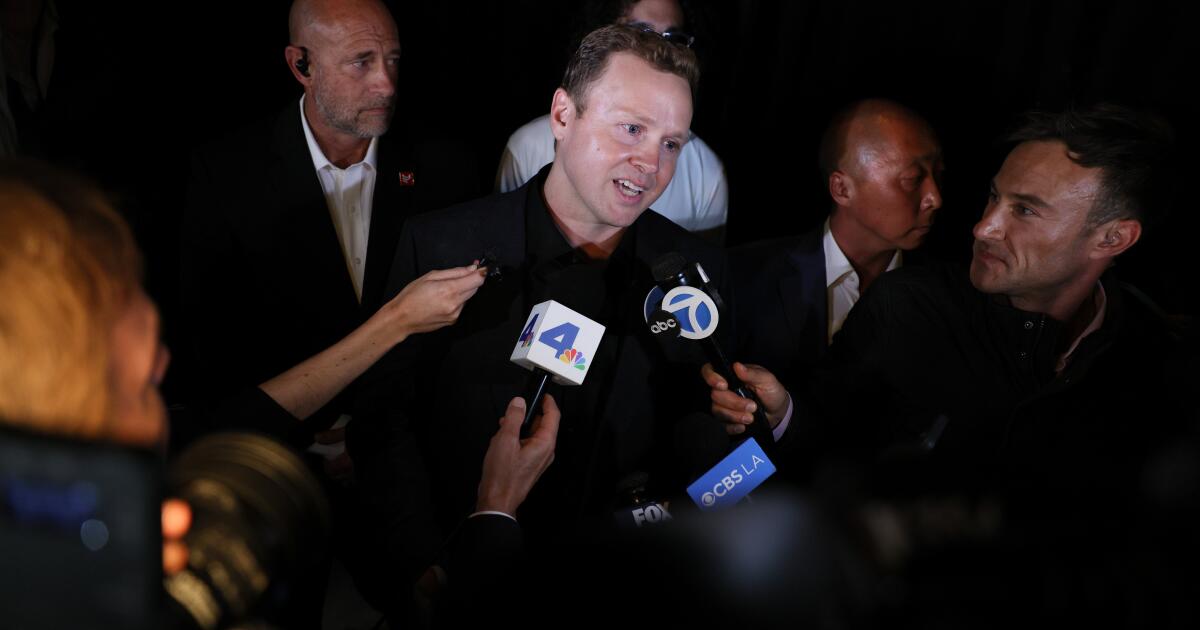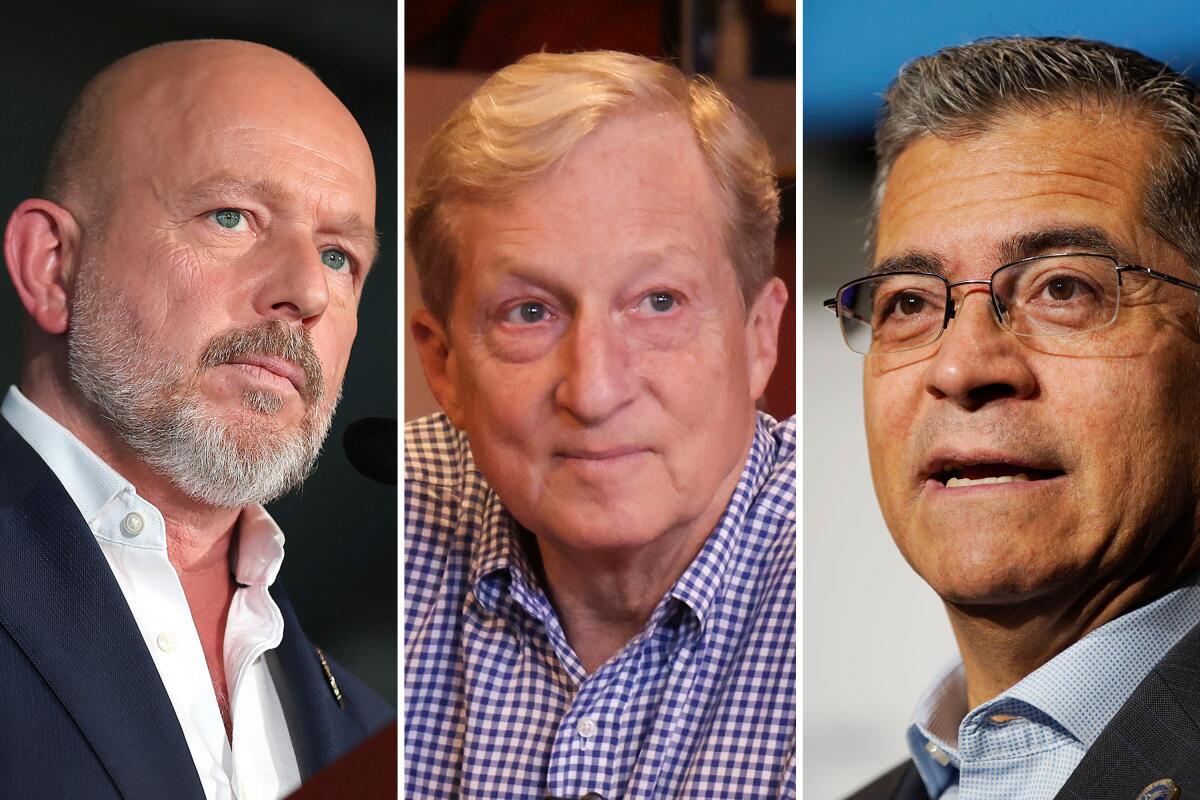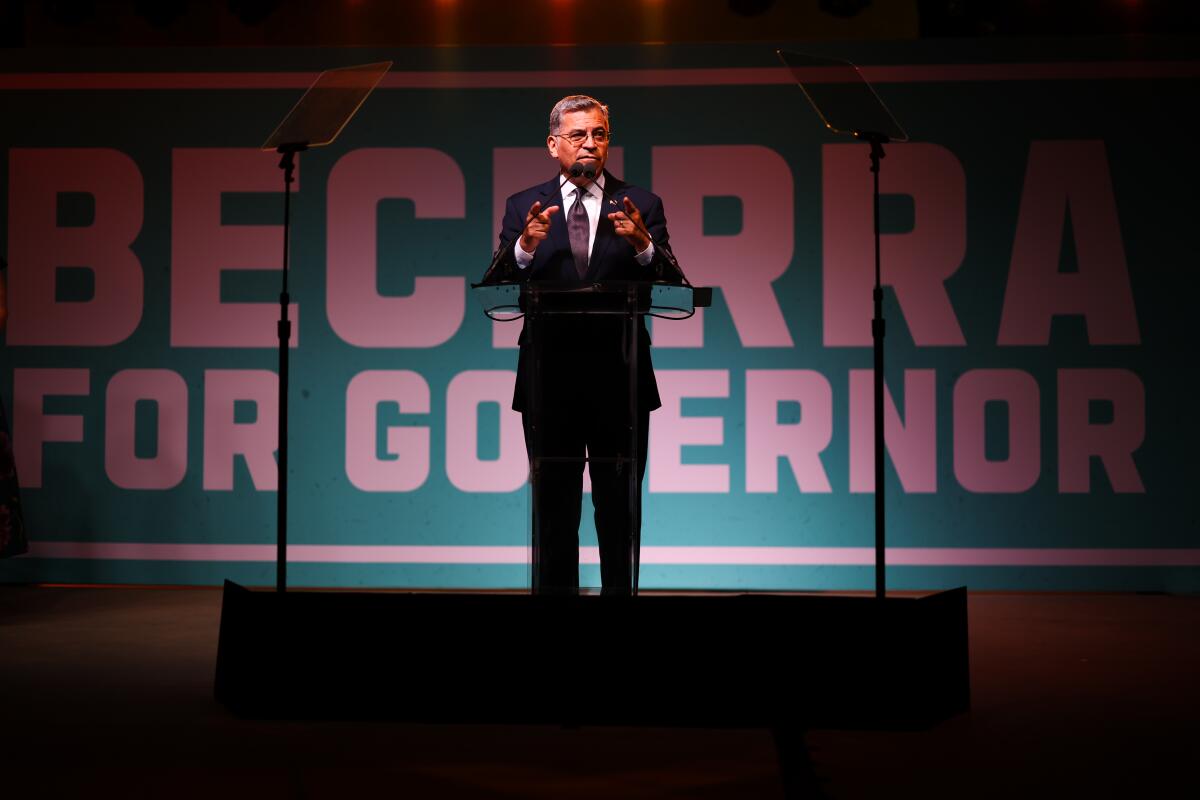
Rep. Eric Swalwell, a leading Democratic candidate for governor of California, has accused President Trump of trying to sway the election following reports that FBI Director Kash Patel may release documents from a decade-old investigation into the congressman’s ties to a suspected Chinese spy.
According to a report by the Washington Post, Patel has directed agents in the bureau’s San Francisco office to redact the case files for public release. According to the outlet, it’s highly unusual for the FBI to release case files tied to a probe that did not result in criminal charges.
The investigation centered on Swalwell’s ties to a suspected intelligence operative, Christine Fang, or Fang Fang, who worked as a volunteer raising money for his congressional campaign. Swalwell cut off ties to Fang in 2015, after intelligence officials briefed him and other members of Congress about Chinese efforts to infiltrate the legislative body.
Swalwell was not accused of impropriety.
The FBI did not immediately respond to a request for comment.
“Through great reporting, we now know the outrageous ends the White House will go to target political opponents,” Swalwell said in a prepared statement Saturday, calling the decade-old story “nonsense.”
“Donald Trump is targeting me. He’s trying to influence the election,” Swalwell said in a post on X. “There is only one reason why: he’s scared.”
Swalwell accused Trump of “desperately trying” to stop him, because he’s now the favored candidate for California governor.
“What Trump wants the most is to have a Western White House. An enabler on the opposite coast,” he said. “A lot of people have bent the knee to this administration. But I will not. And neither will the people of California.”
It’s not the first time Swalwell has accused the administration of targeting Trump’s political opponents.
Last year, Swalwell sued Federal Housing Finance Agency Director Bill Pulte, accusing him of criminally misusing government databases to target Trump’s political opponents. Pulte had accused Swalwell of mortgage fraud and referred him to the Justice Department for a potential federal criminal probe. Swalwell dropped that suit this month.
Swalwell, a former prosecutor who ran for president in 2020, announced his bid for California governor in November. Swalwell said his decision was driven by the serious problems facing California and the threats posed to the state and nation with Trump in the White House.
U.S. Sen. Adam Schiff (D-Calif.), who has endorsed Swalwell for governor, shared the Post story on X Saturday, saying, “This abuse of the FBI is as dangerous as it is unlawful.” Schiff served with Swalwell on the House Intelligence Committee, where they riled Republicans by investigating President Trump during his first term.
Schiff served as the lead manager of Trump’s first impeachment and Swalwell as a manager of Trump’s second impeachment.
“Time and again, the President and his appointees have weaponized the Department of Justice against those who dare stand up to Trump,” Schiff wrote. He added that there was no doubt that Trump and Patel “will stop at nothing to try to tell Californians who their next governor should be.”
The Post story unleashed a flood of critiques from California politicians, including Rep. Jimmy Gomez (D-Los Angeles), who sits on the House Intelligence Committee. On X, Gomez accused Patel of “wasting resources” on a “closed, decade-old case where Swalwell cooperated with the FBI and was found innocent of any wrongdoing.”
“Reopening it now, right as he leads in the polls and ballots are about to drop, is a political hit-job!” Gomez said. “Trump and Kash Patel are weaponizing the FBI against people they deem political enemies.”
Rep. Jamie Raskin of Maryland, the top Democrat on the House Judiciary Committee, released a statement accusing Patel of working at “the behest of the White House” and “wasting the resources of the FBI and perhaps violating the Hatch Act by ordering agents to spend hours preparing a political smear file for a personnel vendetta.”
According to the Associated Press, Fang came into contact with Swalwell’s campaign as he was first running for Congress in 2012. She also participated in fundraising for his 2014 campaign and helped place an intern in his office, the report said. Federal investigators alerted Swalwell to their concerns — and briefed Congress — about Fang in 2015, at which point the California Democrat says he cut off contact with her, the AP reported in 2021.
In 2023, the House Ethics Committee closed a two-year investigation into the allegations of his ties to Fang.
In closing the probe, the ethics committee wrote in a letter to Swalwell that it had “previously reviewed allegations of improper influence by foreign agents and in doing so, cautioned that Members should be conscious of the possibility that foreign governments may attempt to secure improper influence through gifts and other interactions.”
Times staff writer Kevin Rector contributed to this report.
“Trump’s endorsement would be huge,” said Jon Fleischman, a conservative strategist and former executive director of the state GOP.
“Actually,” he went on, ‘I think it would be determinative” — virtually guaranteeing either Hilton or Bianco finished in the top two in the June 2 primary, ushering them past the rope line into November’s runoff.
If there’s an inside edge in the Trump Endorsement Sweepstakes, it would seemingly go to Hilton.
He’s familiar to the president as a former Fox News host. He’s interviewed Trump several times and the two occasionally text and talk on the phone. Bianco has no such personal connection, which might explain his ballot-seizing stunt.
Steve Hilton could have the inside track on a Trump endorsement, given their personal relationship.
A Trump endorsement comes in all sorts of flavors.
As The Downballot recently noted, “His bag of tricks includes dual endorsements, triple endorsements, pre-endorsements, Election Day endorsements, yanking endorsements … belated endorsement of a candidate after initially endorsing just one candidate [and] non-endorsements after promising to endorse.”
There was also the time Trump endorsed “ERIC” when Republicans Eric Schmitt and Eric Greitens faced each other in Missouri’s Senate primary. (Schmitt won and is now the state’s junior U.S. senator.)
Trump’s backing still counts a good deal, even as his approval ratings sink to sub-basement levels. The president remains popular with Republicans and, critically, the kind of GOP loyalists who vote in primary contests, which is why both Hilton and Bianco would welcome a presidential laying on of hands.
There’s good reason, however, to think Trump might pass on endorsing in the governor’s race, or opt to deliver one of his dual he-and-him endorsements.
The GOP’s best — and perhaps only — hope of winning the governorship is the Democratic-freeze-out scenario. So, tactically, Trump’s wisest move may be to bless neither Hilton nor Bianco. Or support both. That would avoid elevating one over the other, which could make it easier for a Democrat to finish among the top two and advance past the June primary.
“I think Trump’s people are smart enough to know that there’s a reason why he may not be served by endorsing a candidate,” Fleischman said. “I wouldn’t be surprised if the prevailing wisdom there is we better not endorse anybody, because we don’t want to tilt this one way or the other.”
If Trump were to back Hilton or Bianco, it’s not hard to imagine Democratic interests seizing upon the president’s benediction and putting significant money behind an ad blitz promoting the president’s favorite in hopes of boosting him — and him alone — into the top two.
In 2018, his main rival was fellow Democrat Antonio Villaraigosa. Two major Republicans were also in the race, John Cox and Travis Allen. There was no real concern about those two nabbing both spots in the June primary. Rather, Newsom and Cox had a shared interest in boxing out Villaraigosa.
So the Newsom and Cox campaigns opened a private back-channel, trading gossip, swapping insights on the race and even sharing some empirical data. One poll, showing Cox getting a bigger boost from a Trump endorsement than Allen, passed from Democratic hands in hopes it would reach the White House and nudge the president into supporting Cox.
When Estuardo Mazariegos was 22, he was pulled over by Los Angeles police officers who found a gun and ammunition in the back seat of his Nissan Sentra.
The gun, he said, was not his. He was holding onto it for a friend, he said, but he got hit with a felony gun possession charge, later pleading it down to a misdemeanor.
Seventeen years later, Mazariegos is running for Los Angeles City Council — and he believes his gun conviction makes him a better candidate.
“I think it’s a strength. It’s not a liability,” said Mazariegos, who was born in Guatemala and grew up in Hollywood and South L.A. “I feel like it creates more of a connection with me and the community, because there’s so many people that are justice-impacted.”
But the gun charge could also be an issue for Mazariegos in his race against five other candidates to represent Council District 9, which covers part of South L.A. He was also convicted of shoplifting when he was 19.
The district is the poorest the city, and the council race is expected to be one of the most competitive city contests this June, with the current council member, Curren Price, terming out.
Mazariegos is head of the Alliance of Californians for Community Empowerment Los Angeles, a grassroots advocacy organization. The 40-year-old is backed by the L.A. chapter of the Democratic Socialists of America and supports leftist policies like reducing funding to the LAPD to spend more on other programs.
Jose Ugarte, a District 9 candidate who was a longtime Price staffer, believes his opponent’s criminal history is a red flag.
“Getting arrested and convicted for multiple crimes, including carrying a concealed loaded gun, should disqualify Estuardo in this race,” Ugarte said in a statement. “Instead, the Democratic Socialists of L.A. are propping up his candidacy and hiding his criminal past from voters who deserve to know the truth.”
DSA-LA co-chair Leslie Chang said her group is “proud” to stand with Mazariegos.
Mazariegos’ supporters say he hasn’t hidden his past.
Georgia Flowers-Lee, a vice president with United Teachers Los Angeles, said Mazariegos discussed his gun conviction and the circumstances surrounding it during his interviews with the union, which ended up endorsing him.
“He was up front, honest about the challenges and honest about the gun charge,” she said. “Walked us through what had happened and where it led and how and why he ended up pleading it out,” she said.
Flowers-Lee, who lives in the district, said that young men of color like Mazariegos are overpoliced.
“I do not see this as a disqualifier. And let’s talk about redemption,” she said.
Wednesday night, Mazariegos released a campaign video featuring him discussing gun violence and his conviction with childhood friends. He said it was a turning point in his life.
“That was the moment where I was like, it’s either now or never,” he said. “Either I leave this s— behind, or it’s going to eat me up. I’m never going back to that lifestyle. I’m going to dedicate myself to the people.”
Mazariegos said he never carried a gun, except for that one day, but many of his friends did.
“Guns were a very common thing. It was almost like having a bike,” he said.
Mazariegos said that in 2009, he was driving home from the San Fernando Valley in the early morning, after dropping friends off, when he was pulled over by the LAPD. He said the officers gave no reason for stopping him, but they made him get out of his car and searched it without a warrant, finding the gun.
He was a permanent resident at the time, after moving from Guatemala at a young age, and was advised by his attorney to plead guilty to a misdemeanor charge of carrying a concealed weapon in a vehicle, to avoid possible deportation, he said.
He was sentenced to 24 months of probation and one day in jail, court records show.
Growing up in Hollywood and Hyde Park, among other parts of the city, Mazariegos was intimately familiar with gun and gang violence.
His friend, Oscar Michael Morales, was shot to death in 2001 at age 14. He remembers Morales’ mother cleaning the blood off the sidewalk the next day.
His gun conviction helps him connect with residents of Council District 9, Mazariegos said, and he frequently discusses it while door-knocking.
Price himself has been criminally charged with four counts of voting on matters in which he had a conflict of interest, five counts of embezzlement and three counts of perjury. Prosecutors allege he voted to approve deals with developers or agencies that had done business with his wife.
“From the very, very beginning, Chad Bianco didn’t say this was political,” Bianco told me, referring to himself in the third person. “Chad Bianco said we have an allegation of fraud with numbers that don’t add up, and no one has an exact reason why. So we have to find out the exact reason why. It’s plain and simple. Plain and simple.”
If you’re clueless as to what Bianco is talking about, let me give you the short version. A citizens group of election “auditors” claimed that in the last election over Proposition 50 in November, there were about 45,800 more ballots counted than cast.
The Riverside County Registrar of Voters, Art Tinoco, a highly respected election official, gave a long presentation explaining why that number was not accurate. He said that the actual difference in ballots cast and counted is only 103, within the acceptable margin of error for the 1.4 million voters in his area.
But unhappy with that answer, the group apparently took their concerns to Bianco, who decided to use his powers of criminal investigation to circumvent the many established avenues for vote audits through his own county and the California secretary of state (though he hasn’t revealed publicly exactly what led to the investigation).
Using a secret, sealed warrant — so none of us actually know what he’s alleging — he seized more than half a million ballots. The court has apparently appointed a special master to count those ballots, though Bianco at first said his deputies would do their own counting. But we don’t know who that special master is, or even if he or she has yet been appointed.
Here’s what we do know, and why it counts as a danger not just to Riverside, but also to American democracy writ large, when a politically ambitious lawman decides to run elections himself.
The fraud fiasco
So where did the citizen-auditors get their 45,800 number? Like many California counties, Riverside tallies ballots as they come in. So for the 11 days voting was happening (and for the mail-in ballots that came later) someone was making a handwritten note for every ballot that the county received.
Yes, I said handwritten, for more than 600,000 ballots going through 2,500 workers and volunteers. It’s often inaccurate and not every ballot is going to end up being a good one — some lack signatures, for example.
Tinoco, the registrar, called these handwritten logs “raw data” that also are missing ballots from other sources that increases the final tally, such as people who register on the day they vote. So no one who understands elections expects this number to be accurate or final.
Once all these ballots are checked to make sure they should be counted, they are sent to an entirely separate system, which reads them electronically and provides the election results.
When the number of vetted ballots is compared with the number of ballots that are counted by the second system, the difference is 103, Tinoco said.
So no fraud, only human frailty with the difficult business of counting by hand.
Matt Barreto, a UCLA political science professor and director of its Voting Rights Project, said Bianco’s actions were similar to what happened in Fulton County, Ga., where the FBI seized ballots after Trump’s debunked claims of fraud — despite plain and simple explanations from election officials.
“In both cases, Georgia and Riverside, independent elections offices had already verified the accuracy of the ballot count, and in both cases the results had been certified by the Secretary of State,” Barreto said. “It is worrisome that a very partisan law enforcement officer is questioning the integrity of an election, perhaps because he did not support the results.”
The investigation
Bianco has been investigating the 45,000 claim for months, but it came to a head in recent weeks, in no small part thanks to a news conference he held. Bianco’s office, as first reported by the Riverside Record, served a warrant on the election office one day before Tinoco made his presentation to the Board of Supervisors in early February.
Since then, the California secretary of state, which handles elections, and the state Department of Justice have both tried to intervene to stop Bianco from taking ballots or doing his own recount, Pillow Guy-style. But they’ve had little luck.
Secretary of State Shirley Weber called the allegations “unsubstantiated” and questioned the legality — and common sense — of having deputies hand count ballots. Now, her office is trying to make sure folks trained in elections are involved in whatever happens next.
“The sheriff’s assertion that his deputies know how to count is admirable,” Weber said. “The fact remains that he and his deputies are not elections officials.”
Separately, California Atty. Gen. Rob Bonta has gone to the courts to try to keep Bianco from spiriting away the ballots. Bonta’s office went straight to the California Court of Appeals to ask it to force the sheriff to comply with their requests to take no further action and supply the Justice Department with the probable cause evidence used to obtain the search warrant — basically tell them exactly what proof he’s using to claim a crime might have been committed.
The appeals court declined to intervene until Bonta went to the lower Riverside County Superior Court. But in the meantime, Bianco went back to his judge and asked for another secret, sealed warrant — which he got.
The bigger problem
And that brings us to why we should all be concerned about Riverside County.
First, why all the secrecy? Shouldn’t elections and everything about them be transparent, so we all can feel confident any investigation is on the up and up?
I asked Bianco why the warrants are sealed, and he told me I didn’t understand investigations.
“In an ongoing investigation, we never unseal the warrants,” Bianco said. “No, I can’t say never. I can’t say never. Why are you coming at me like I’m the bad person here, instead of like a rational person?”
When I asked him why a sheriff needed to be involved, rather than allowing the state officials who handle elections to investigate, he told me this was a crime investigation just like any other — domestic abuse or murder, for example.
“It’s called fraud,” he said. “Let me ask you this: Do we just let, do we let doctors investigate themselves for medical malpractice?”
The implication there is that election officials are in a conspiracy to commit an actual crime — fraud — and can’t be trusted. That jumps the shark from maybe election staff counting sloppy in their handwritten tallies of ballots received, to a — yes, folks, here it is — a conspiracy of Democrats, from those volunteers up to the highest state officials.
“Oh, please,” Bianco said regarding my questions on whether this was, in fact, political. “I’m the sheriff of Riverside County, and my investigators are responsible for crime. I have nothing to do with this investigation.”
His news conference would beg to differ.
And now we have a precedent for a politics-driven sheriff seizing ballots, maybe to make headlines, maybe to please Trump, maybe both. What happens if other Republican sheriffs across the country decide to do some ballot seizing of their own in swing states or contested races come November?
Is it all fair game now for whoever can physically take the ballots to be the arbitrator of results?
George Skelton and Michael Wilner cover the insights, legislation, players and politics you need to know. In your inbox Monday and Thursday mornings.
By continuing, you agree to our Terms of Service, which include arbitration and a class action waiver. You agree that we and our third-party vendors may collect and use your information, including through cookies, pixels and similar technologies, for the purposes set forth in our Privacy Policy such as personalizing your experience and ads.
The outcome was one few anticipated, with Gray Davis romping to victory in the Democratic primary, then winning the governorship in a landslide.
Less than three months before the June primary, Davis had been running dead last, behind two well-heeled Democrats and the eventual GOP nominee. The number of people who told him to quit would have filled the L.A. Coliseum, Davis recalled this week. But he never considered dropping out; the pressure only made him more determined.
“Sometimes it’s meant to be. Sometimes you get every break,” Davis said. “Sometimes it’s not meant to be and you get no breaks.”
His bottom line: “Anything can happen.”
Of course, no two campaigns are the same.
This gubernatorial contest is being conducted under a system in which the top two vote-getters, regardless of party, will advance to a November runoff. In 1998, California held an “open primary,” under rules later voided by the Supreme Court. All candidates appeared on the same ballot, with the top finishers in each party guaranteed a spot in November.
Beyond that, the world has vastly changed: politically, socially, culturally. (Google is now one of the most valuable companies on the planet, pulling in a record $403 billion in revenue in fiscal 2025.)
Voter attitudes are different. One of Davis’ greatest assets was his position as lieutenant governor; that currency — incumbency and government know-how — no longer trade at the same high value.
The media landscape has fractured — back then newspapers set the political agenda, fewer than half of voters were online and streaming was something mostly done by water. Californians aren’t nearly as tuned in to the governor’s race as they were then.
“There’s a sideshow going on internationally and nationally and people are like, ‘Oh, right, there’s a governor’s race happening,’” said Paul Maslin, who was Davis’ pollster and is now working for Democratic gubernatorial hopeful Betty Yee. “Whereas in ‘98, that was clearly the big act in town.”
Having said all that, luck and an opportune break or two are still key ingredients to political success, as Davis suggested.
Feinstein, the state’s senior U.S. senator, had nearly been elected governor in 1990 and her lengthy deliberations froze out other potentially strong contenders. Had Feinstein run, she very probably would have blown away the field and made history by becoming the state’s first female governor.
Davis also greatly benefited when a federal court tossed out strict contribution limits, allowing him to go from collecting bite-size donations to much greater sums. Though he was vastly outspent by his two rich Democratic opponents, multimillionaire Al Checchi and then-Rep. Jane Harman, the decision allowed Davis to remain competitive and eventually pay for the statewide ad blitz that is indispensable in California.
Checchi, in particular, barraged voters with an unrelenting flood of ads. (Shades of the omnipresent Tom Steyer.) In one of them, a spot attacking Harman, Checchi included a photo of the lieutenant governor — and not a bad-looking one at that. The glimpse reminded voters that Davis, who was husbanding his resources for a late advertising push, was still in the race. He enjoyed a significant boost in polls.
Still, Checchi and Harman saw each other as the main opponent and their strategists acted — and tailored their advertising and campaign messaging — accordingly. The result was “a murder-suicide, as the term went at the time,” said Garry South, who managed Davis’ campaign. “They decided to focus so much fire on each other and ignore us that we simply slipped through the hole.”
Davis can well relate to those gubernatorial hopefuls in the position he once was — dissed, dismissed and bumping along near the bottom of horse-race polls. Speaking from his law office in Century City, he had this simple advice:
“Follow your heart,” he said. “Do what you think is right.”
“It’s fine for someone else to tell you you should get out, but that’s not their business,” Davis said. “You’re the candidate, and if you think for whatever reason you want to stay in the race, you should stay in the race.”
But Davis isn’t too worried about that happening. Moreover, he said, it’s easy for those watching from the sidelines to take potshots and offer unsolicited — and not particularly empathetic — advice.
“They’re not running for office,” he said. “Other people are putting themselves on the line. … [If] people have the wherewithal, the courage and the dedication it takes to put themselves in a position to run for office, if they really believe it’s the right thing to do, they should. They should follow their dream.”
Besides which, you never know what might happen come June.
A couple who have travelled to 60 countries after appearing on Race Across the World have blasted a “shocking” airport lounge as the worst they’ve ever experienced. Stephen and Viv Redding, from Uppingham, Rutland were left stunned after paying nearly £50 to access what they thought would be a relaxing business class lounge.
Stephen, 64, and Viv, 68, visited the Avianca lounge while waiting for their flight to Bogotá before returning to London Heathrow, following a six-week trip around South America. They claim to have been met with “tasteless” food and shabby surroundings.
“We bought business class tickets because it was a long-haul flight and that way we can have flat beds and get a bit of sleep,” Stephen said. “We’d been led to believe that we would have lounge access [at the airport] but when we went up to the lounge, we were told that our tickets did not qualify.
“So we decided that we would pay for the upgrade because we knew we had over two hours to spare.”
Once inside, the couple, who appeared on the BBC travel show in 2024, say they were shocked by the poor quality on offer at the San Jose lounge. Stephen said: “There was only one meal available, tasteless and watery spaghetti bolognese.
“The pasta was cold, the sauce was not very nice. There was a little side bread thing that was dried and tasteless. We were given drinks tokens for a glass of wine, which meant we were only allowed one drink each – one glass of wine each!
“The place was not good. The seats weren’t comfy, the tables were shabby, it was not what we’d experienced from any other airport lounge that we’ve been to. And to be fair, there have been quite a few since Race Across the World two years ago.
“We’ve been to about 60 countries now and probably up to a dozen lounges across the globe and this is the worst lounge that we’ve ever been to.”
The pair raised their concerns with staff at the time but claim they were met with little interest. After returning home, they contacted Avianca to request a refund, but say their complaint was rejected. Stephen added: “We asked for money back because of the poor lounge quality but they have refused and rejected that claim and basically said that’s just the way it is.
“I must also say though that the flight with Avianca was absolutely spot on, I have no complaints at all.
“[That being said], we were disappointed and actually after being away for six weeks touring through the north of South America we were tired and just wanted to relax in a bit of comfort, but this did not fulfil our needs by any means.”
When I read all the hype being heaped on Kamala Harris’ lead in early polls for the 2028 Democratic nomination, I have to chuckle to myself.
The release of a Rasmussen Reports poll in February was titled, “Kamala Harris Still Leads 2028 Field for Democrats.” One headline in the Hill predicted, “Kamala Harris may yet be the Democratic nominee in 2028.” A Washington Examiner piece about polling warned, “Democrats won’t get rid of Kamala Harris that easily for 2028.”
I chuckle not because I don’t believe the numbers, but because I don’t believe any poll this far out in an open contest is meaningful, let alone determinative. I’ve seen this movie before, and it didn’t end well.
In 2003, after managing the successful 2002 reelection campaign of California Gov. Gray Davis, I signed on as an advisor to the presidential campaign of Connecticut Sen. Joseph Lieberman — who, I needn’t remind anyone, had been the Democratic nominee for vice president in the 2000 election, which he and Al Gore lost in a nail-biter to George W. Bush.
Based simply on his high name identification from that hellzapoppin’ race, and the fact his name had been on the ballot in all 50 states just two years before, Lieberman initially led the Democratic field quite handily in almost every national poll.
An ABC News/Washington Post survey in January 2003 found Lieberman leading the Democratic field with 27%. A Gallup poll from that same month also placed him first, ahead of both John Kerry and Richard Gephardt.
A Pew poll in the summer of 2003 also found Lieberman atop the field, as the best-known candidate at 85% name recognition, and 58% support, ahead of Kerry, Gephardt and Howard Dean.
Boy, did we brag about Lieberman’s lead at every stop and in every press release. But in the end, the promising early numbers meant nothing. When actual votes were cast, Lieberman totally flamed out, receiving a measly 8.9% of the vote in the critical first primary in New Hampshire, finishing dead last, and dropping out of the race in February 2004, having lost every primary and caucus up to that point.
Why? A lot of reasons, including mistakes made by the candidate and campaign. But fundamentally because, when Democrats started to take a close look at and assess the full field, they relegated Lieberman to the status of a loser, and they wanted to move on. We heard a lot of, “He had his chance and lost.” Does Harris come to mind?
The fact is, we Democrats tend to put defeated presidential nominees in the rear-view mirror pretty quickly. Think of Michael Dukakis, Gore and Kerry. And let’s not forget, Harris obtaining the nomination in 2024 was a fluke; she didn’t compete in one primary or receive one primary vote. The first time she ran for president, in the 2020 cycle, she also didn’t win one primary or receive a single primary vote, because she ran a bad campaign and hightailed it out of the race before a single vote was cast. Two strikes and you’re out?
We Democrats just don’t renominate losers. The last time we did it was exactly 70 — yes, 70 — years ago, with Adlai Stevenson in 1956 after he had lost the 1952 presidential race to Dwight Eisenhower. Stevenson rewarded Democrats for this recycling effort by losing to Eisenhower a second time — by an even worse margin. Democrats learned their lesson: Reheating doesn’t work with failed candidates.
And, come on, Harris not only lost to Trump, not only lost all seven swing states, but was the first Democratic presidential nominee in 20 years to lose the popular vote. And her weak showing also helped Republicans wrest control of the Senate from Democrats. We’re supposed to imagine that’s a credible record on which to run again for the nomination?
All of these breathless stories about Harris leading the field nationally also never mention her perilous standing in her own home state of California. A Berkeley IGS survey in August revealed that by a margin of 18 percentage points, even her fellow Democrats in California did not want her to run again. A Politico poll this month showed Gov. Gavin Newsom with a 2-to-1 lead in California among voters leaning toward voting in the 2028 Democratic primary.
So have fun, Kamala Harris, enjoying your name-ID high while it lasts (although maybe a mite longer than your 107-day presidential effort).
Garry South is a Democratic strategist who has managed four campaigns for governor of California and played significant roles in three presidential campaigns, including that of Al Gore.
Keiko Fujimori, the Popular Force party’s presidential candidate, reacts during a campaign event in Lima on March 8. Fujimori holds a slight lead over former mayor Rafael Lopez Aliaga for first place in voting intentions for the April 12 elections. Photo by Renato Pajuelo/EPA
March 23 (UPI) — With just weeks to go before the April 12 general elections, Peru’s electoral landscape is defined by unprecedented fragmentation and a voter base that appears to be turning away from the traditional political class.
Right-wing candidates Keiko Fujimori and Rafael López Aliaga remain virtually tied for first place in national popularity, according to a Datum Internacional poll for the newspaper El Comercio, published Sunday.
However, analysts say the figure that truly dominates the race is not any candidate’s percentage, but rather the 57% of Peruvians who still do not know whom they will vote for or who plan to cast a null ballot.
The public opinion survey showed that only 43% of Peruvians say they have decided on their vote and will not change it. According to data collected by the pollster, this scenario has remained stable since the beginning of the month, Canal N reported.
Datum analyst and CEO Urpi Torrado said the real protagonist of this process is the “undecided bloc.” According to her assessment, the disconnect is so deep that 53% of voters admit they do not even know the party symbol of the candidate they say they will support.
The results show a technical tie at the top, but with extremely low figures for a race of this magnitude. Keiko Fujimori, of Fuerza Popular, leads with 11.9%, followed closely by Rafael López Aliaga, of Renovación Popular, with 11.7%.
Further behind are rising figures such as leftist Alfonso López Chau with 6.5%, actor Carlos Álvarez with 5.0% and social democrat Jorge Nieto with 4.6%.
Analyst Carlos Meléndez told television channel Latina Noticias that this dispersion of votes, spread across a record 36 candidates, ensures that the June 7 runoff would be decided by very narrow margins.
Analyst Pedro Tenorio said that 75% of citizens believe the candidates do not understand their real problems. Even so, he noted a trend toward center and right-wing positions, which together account for 52% of voter identification, compared with a weakened 11% identifying with the left.
According to experts, the risk is that the next president could come to power with very weak initial legitimacy, facing an equally fragmented bicameral Congress that could deepen political instability and legislative gridlock.
The overall political environment is one of extreme fragility. Unlike previous processes, there is no “coattail effect” or consolidated ideological currents. The prevailing sentiment is rejection, with 81% of the population saying they do not feel represented by any political group.
This detachment has translated into a subdued campaign, where candidates struggle to break through a ceiling that does not exceed 15%.
The emergence of figures such as Wolfgang Grozo, a retired major general and former director of intelligence of the Peruvian Air Force, who has risen in the polls thanks to a strong presence on Instagram and TikTok, shows that sustained anti-establishment sentiment could trigger a last-minute shift among undecided voters and drastically alter the race.
This scenario is not unfamiliar in Peru. In the 2021 general elections, Pedro Castillo staged one of the biggest political upsets in the country’s history, going from a virtually invisible candidate in the polls to winning the presidency in a context of extreme fragmentation.
At that time, weeks before the first round, Castillo, a primary school teacher and union leader from Cajamarca, appeared in the “others” category with less than 3% voting intention. His rise was explosive in the final 10 days, driven by intensive campaigning in rural areas that urban polls failed to capture in time.
Castillo won the first round with just 18.9% of valid votes. It was the first time in the country’s history that a candidate advanced to the runoff with such limited support, highlighting a total crisis of representation among the 17 candidates competing in that election.
George Skelton and Michael Wilner cover the insights, legislation, players and politics you need to know. In your inbox Monday and Thursday mornings.
By continuing, you agree to our Terms of Service, which include arbitration and a class action waiver. You agree that we and our third-party vendors may collect and use your information, including through cookies, pixels and similar technologies, for the purposes set forth in our Privacy Policy such as personalizing your experience and ads.
SACRAMENTO — President Trump claims Gov. Gavin Newsom is unfit to be president because he has a “learning disability.” It’s a classic case of the pot calling the kettle black.
The centuries-old pot-kettle idiom points out hypocrisy — as when one person accuses another of a flaw that afflicts himself.
California’s governor has battled dyslexia all his life — very successfully, by any measure. Dyslexia is a learning disability that makes reading and writing difficult. But it doesn’t mean a stricken person is unable to learn. He just needs to learn differently, as Newsom has done since he was a teen.
Trump apparently isn’t dyslexic. But he clearly has some learning disabilities — including stubbornness, narrow-mindedness and intolerance.
The president still hasn’t learned, for example, that he lost the 2020 election. He persists in the belief — or maybe it’s merely another boldface lie — that the election was stolen in a Joe Biden conspiracy. That’s a bizarre fantasy.
He also didn’t learn from past administrations that a commander in chief should not wage war against Iran without a concrete plan to keep open the Strait of Hormuz so Middle Eastern oil can keep flowing to the world.
And he never has learned what most of us were taught by our parents: that you don’t berate your friends if you expect to keep them friendly — lashing out, for instance, at allies before and after their balking at sending warships to help protect the vital strait.
Moreover, he didn’t learn that the nation’s founders embedded a checks-and-balances governing system in the Constitution and that Congress has a role in imposing tariffs.
When the normally Trump-friendly Supreme Court ruled against his unilateral tariff agenda, the spoiled president did what he usually does: attack, insulting the justices who struck down his edicts.
“Fools,” “lapdogs” and a “disgrace to our nation,” he whined. “It’s an embarrassment to their families.”
Trump still hasn’t learned to shut up and try to be civilized.
Not even after shocking everyone by saying of the late Republican Sen. John McCain, a Navy Pilot who spent more than five years as a tortured POW in the Hanoi Hilton: “He’s a war hero because he was captured. I like people that weren’t captured.”
Any respect I might have had for the guy vanished in 2015 when the then-candidate for president publicly mocked a New York Times reporter’s disability. At a campaign rally, Trump jerked his arms and flailed his hands while making fun of the reporter’s palsy-like ailment.
So it wasn’t a surprise recently when Trump tore into Newsom for his dyslexia four times in one week.
Yes, Newsom has his eye on the 2028 presidential election and has been scoring points nationally with Democratic activists by using Trump as a punching bag. But Trump keeps offering himself up as an irresistible target.
Regardless, there’s no excuse — even in hard knocks politics — for attacking someone because of his disability.
“Gavin Newscum” — Trump’s synonym for the governor — ”has admitted he has learning disabilities, dyslexia,” he told reporters in the Oval Office. “Honestly, I’m all for people with learning disabilities but not for my president.”
“Everything about him is dumb,” Trump added.
In a Fox News Radio interview, Trump said that “presidents can’t have a learning disability.” And on Facebook, Trump wrote: “I don’t want the president of the United States to have a cognitive deficiency.”
A quick Google search could have shown Trump that several presidents have had learning disabilities, including dyslexia.
Start with George Washington, who struggled with grammar and spelling. And Thomas Jefferson, author of the Declaration of Independence, who had trouble with reading and spelling.
Other presidents with learning disabilities: Andrew Jackson, Woodrow Wilson, Dwight Eisenhower, John F. Kennedy and Lyndon Johnson. “It’s a poor mind that can think of only one way to spell a word,” Jackson asserted.
Scientist Albert Einstein was dyslexic. So were Apple co-founder Steve Jobs and Thomas Edison.
Dyslexia affects roughly one in five Americans to some degree — more than 40 million people, although relatively few are aware of it, according to researchers.
Newsom has spoken openly for years about his struggles with dyslexia. It’s difficult for him to read, especially prepared speeches. So he reads and re-reads, underlines and highlights and meticulously takes notes. When a speech must be read off a teleprompter, he practices for hours.
In January, the governor began his State of the State address to the Legislature with this ad-lib:
“I’m not shy or, you know, embarrassed about my 960 SAT score. But I am a little bit about my inability to read the written [speech] text. And so it’s always been something that I have to work through and I’m confronting.”
In his recently released autobiography, “Young Man in a Hurry,” Newsom writes: “My high school grades were all over the place and I scored lousy on the SAT, three hours of dyslexic torture.”
Early in his political career as a San Francisco supervisor, he writes, “speaking to a crowd was not unlike the fear I felt in third grade reading to my classmates …. So I learned to memorize my talking points and best lines … and wing it from there.
“This is how I discovered one of the secret powers of dyslexia. I could read a room with the best of them. I’d walk in and immediately size up the faces, mood and manners. … I learned that an audience didn’t mind occasional hiccups of speech as long as you looked them in the eye.”
Newsom was twice elected mayor and twice governor.
None of this means he should necessarily be elected president.
There may be policy and political reasons to consider him unfit — but not because of any learning disability.
Oh Se-hoon, right, sits with other prospective candidates during a Seoul mayoral nomination interview at the People Power Party headquarters in Seoul on Sunday. Photo by Asia Today
March 22 (Asia Today) — Seoul Mayor Oh Se-hoon on Sunday renewed his call for the formation of a campaign committee aimed at broadening the party’s appeal to centrist voters, as he completed an interview for the ruling party’s Seoul mayoral nomination.
Oh, who entered the People Power Party primary late, urged party leaders to quickly launch what he described as an “innovation campaign committee” led by figures capable of attracting moderate voters.
Speaking to reporters after the interview at the party’s headquarters in Yeouido, Oh said recent opinion polls show a significant gap in party approval ratings, underscoring the need for a strategy that resonates with centrist voters in the Seoul metropolitan area.
“Without a campaign structure that can expand toward the center, winning the election will be difficult,” he said.
Oh dismissed suggestions that his proposal amounts to sidelining the party leadership under Jang Dong-hyuk, saying his goal is to balance the party’s confrontational stance against the opposition with broader electoral appeal.
“At this point, it would not make sense to ask the leadership to weaken its political stance,” he said.
He also pushed back against media reports portraying his proposal as an attempt to take control of the party or position himself for the next party convention, calling such interpretations “unintended.”
Tensions between Oh and the party leadership are expected to continue. Jang has previously rejected calls for an early launch of the campaign committee, saying it should be formed after the nomination process is completed.
While both sides agree on the need for a campaign body with wider appeal, they remain divided over the timing of its formation.
The interview marked the confirmation of a six-way race for the party’s Seoul mayoral nomination. Other candidates include Rep. Park Soo-min, former Gangdong District Mayor Kim Chung-hwan, former lawmaker Yoon Hee-sook, party official Lee Sang-kyu and business executive Lee Seung-hyun.
Gregoire headed a list uniting the traditional left, the Greens and the Communists to victory in French capital.
Published On 22 Mar 202622 Mar 2026
The Socialist Party’s Emmanuel Gregoire has won the Paris mayoral race, as the results of nationwide municipal elections showed gains for the traditional left and right, and a major win for the far right in the city of Nice.
Sunday’s run-off votes in more than 1,500 communes saw Gregoire on course to become mayor of the French capital, with exit polls showing that the far-right National Rally (RN) fell short of taking control of the key southern cities of Marseille and Toulon.
Recommended Stories
list of 3 itemsend of list
Gregoire, who headed a list uniting the traditional left, the Greens and the Communists, clinched the prized mayoralty with an estimated 51 to 53 percent of the vote, according to pollsters, seeing off Conservative rival Rachida Dati, who conceded defeat.
The 48-year-old son of a teacher and civil servant is stepping into the spotlight after previously serving as deputy to outgoing mayor and fellow Socialist Anne Hidalgo. During his bid, he had promised that Paris would stand as a “city of refuge” and a “bastion against the right and the far right”.
In Marseille, the second-largest city in the country, Socialist Mayor Benoit Payan was on track to be re-elected with 56.3 percent of the vote, according to an Elabe poll for BFM TV. RN’s chances of winning the coveted prize took a hit after the withdrawal of a hard-left candidate from France Unbowed (LFI) aimed at uniting left-wing voters.
Socialist Party chief Olivier Faure hailed the wins in Paris and Marseille, positioning his party as a bulwark against the far right. “Only the left can prevent France from this regression,” he said.
In Toulon, an Elebe poll showed centre-right candidate Josée Massi leading at 53.5 percent, with RN candidate Laure Lavalette conceding defeat. Yet, senior RN officials rejected suggestions that the party’s loss indicated it had hit a “glass ceiling” ahead of next year’s presidential election.
“The National Rally and its candidates have achieved tonight, in this municipal election, the biggest breakthrough in its entire history,” RN chief Jordan Bardella said, alluding to wins in local constituencies where it previously had no presence.
In the first round, Bardella’s anti-immigration party won re-election in the southern city of Perpignan, and it won in smaller cities, too. And on Sunday, exit polls indicated that Eric Ciotti, a former mainstream conservative who is now an ally of the RN, won in Nice, France’s fifth-biggest city.
Former Prime Minister Edouard Philippe was re-elected mayor in his northern city of Le Havre, according to the TF1 and LCI broadcasters, delivering a better-than-expected performance that boosts his hopes of running for president in 2027.
Philippe, a centre-right politician who served as prime minister under centrist President Emmanuel Macron, made a speech with a clear national message, saying his victory showed that “there were reasons to be hopeful” in the values of France and that the extremes can be beaten.
Turnout at 5pm local time (16:00 GMT) was just higher than 48 percent in France’s mainland, more than than in the 2020 vote held during the COVID-19 pandemic, but four points lower than in 2014, according to the Ministry of Interior.
Jim Michaelian, the race car driver who helped launch the annual Acura Grand Prix of Long Beach, has died. He was 83.
The Grand Prix Assn. of Long Beach confirmed his death on Saturday, just weeks before this year’s race, which is scheduled for April 17-19.
Michaelian joined the Grand Prix Assn. of Long Beach in 1975, a then-fledgling competitive race, and grew it into one of the most popular street racing events in the world. The annual three-day event draws thousands of race car enthusiasts and brings tens of millions of dollars into the city of Long Beach.
“Jim was a leader of a small, passionate group who believed in the concept of bringing elite open-wheel competition to Long Beach in the 1970s,” said Roger Penske, Penske Corporation chairman, in a statement. “His vision and energy surrounding this great event remained boundless for 50 years.”
Penske Entertainment acquired the Grand Prix Assn. of Long Beach in 2024.
Michaelian was a competitive sports car racer for more than 25 years, competing in endurance events at tracks including Le Mans, Daytona Beach, Nürburgring, Dubai and Sebring in Florida. He told The Times in 2019 that he was still racing sports cars at 76.
“As long as I can achieve some level of success, I’m going to continue doing it until they tell me I can’t anymore,” he said then.
A native of Monterey Park, Michaelian (pronounced meh-KAY-lee-un) graduated from UCLA with a bachelor’s degree in physics. But he turned his attention to business and went on to earn an MBA there. Driven by a love of motor racing, Michaelian eventually talked his way onto the staff of the Long Beach Grand Prix.
He served as the association’s controller and chief operating officer before being appointed president and chief executive in 2001. During his 51-year tenure, Michaelian transformed Long Beach into an iconic stop in the world of motor racing.
A variety of races are run during the three days on the city’s seaside streets, culminating with a big-league IndyCar Series race Sunday. The races feature different types of cars, and one is for trucks, to appeal to a broad audience.
But the Long Beach Grand Prix is more of a festival that’s been built up around the racing. There are concerts, a lifestyle expo, a kids’ zone with go-karts and other activities, along with an array of food and drink spots, all centered on the Long Beach Convention Center and Shoreline Drive.
Michaelian said he kept the pulse of the crowd by constantly walking the track to monitor how the grand prix’s fans were enjoying the activities. He would survey for problems that might need fixing or whether changes needed to be made for the following year.
“Many young people don’t want to sit in the seats now,” he told The Times in 2019. “They’re out taking selfies, they’re chronicling their experience at Long Beach, and the only way to do that is for them to get around.
“So, if they’re moving around, I’m moving around” by creating more places where they can gather, listen to music and having food options nearby, he said then.
Last year, Michaelian was inducted into the Long Beach Motorsports Walk of Fame.
“Jim was a racer’s racer and a dear friend to IMSA and the motorsports community at large,” John Doonan, president of International Motor Sports Assn., said in a statement. “We will sorely miss his presence at Long Beach and racetracks everywhere.”
The Grand Prix Assn. of Long Beach did not release his cause of death.
Michaelian is survived by his wife, Mary, and his sons, Bob and Mike.
Former Times staff writer James F. Peltz contributed to this report.
The Los Angeles chapter of the Democratic Socialists of America will not endorse a candidate for mayor.
After City Councilmember Nithya Raman decided at the last minute to run against her former ally Mayor Karen Bass, the group called a vote on whether to reopen the endorsement process, which it had closed without supporting a candidate.
DSA-LA backed Raman’s two successful city council runs, but she has been at odds with the group on some issues.
Also in the mix was another mayoral candidate, community organizer Rae Huang, whose positions align more closely with those of the group.
The two candidates were present for Saturday’s vote at Immanuel Presbyterian Church in Koreatown, though neither spoke.
The left-wing organization, which has about 5,000 members, is known for running strong ground game campaigns that include canvassing, door-knocking and phone banking. In addition to Raman, three other DSA-backed politicians now sit on the 15-member City Council.
Before the vote, DSA-LA members argued for and against reopening the endorsement process.
“The worst thing we can do right now for our movement is to say, ‘Well, actually, we’re not going to endorse Rae or Nithya. We’re going to do a third thing, which is to issue no endorsement.’ Who is the audience for this message?” said Leslie Chang, a co-chair of DSA-LA.
DSA-LA member Anna Gross argued that neither candidate was ideal, with Huang, who has little political experience, being a long shot and Raman hesitating to fully embrace the group.
“I do want a democratic socialist mayor, but as it stands, we have one candidate who is not going to win … and a candidate who will not openly identify as a democratic socialist,” Gross said.
Of the 488 members who voted Saturday, about 55% supported reopening the endorsement process, falling short of the required two-thirds majority.
If the process had been reopened, the group would have then voted on whether to endorse Raman, Huang or neither.
Huang’s earlier attempt to get the endorsement while the window was still open had failed because she did not obtain enough valid member signatures to qualify.
If the race is not decided in the June 2 primary, DSA-LA can still endorse a candidate in the runoff.
Besides Bass, Raman and Huang, the field of 14 candidates includes conservative reality TV star Spencer Pratt and tech entrepreneur Adam Miller.
Some members believed that a mayoral endorsement would take resources away from the slate of six local candidates they have already endorsed.
In city council races, DSA-LA is backing incumbents Hugo Soto-Martínez and Eunisses Hernandez; Faizah Malik, who is running against incumbent Traci Park on the Westside; and Estuardo Mazariegos for an open South L.A. seat.
The group is also backing Marissa Roy, who is challenging City Atty. Hydee Feldstein Soto, and Rocío Rivas, an incumbent L.A. Unified school board member.
Riverside County Sheriff Chad Bianco, who is a leading Republican candidate for governor, has seized more than 650,000 ballots from last November’s election and is investigating whether they were fraudulently counted.
“This investigation is simple: Physically count the ballots and compare that result with the total votes recorded,” Bianco said at a news conference Friday.
The unusual probe drew a sharp rebuke from California Atty. Gen. Rob Bonta, who said in a statement Friday that it is “unprecedented in both scope and scale” and appears “not to be based on facts or evidence.”
“There is no indication, anywhere in the United States, of widespread voter fraud,” Bonta said. “Counts, recounts, hand counts, audits, and court cases all support this.”
According to Bonta’s office, Bianco’s department on Feb. 26 seized about 1,000 boxes of ballot materials in Riverside County related to the November election for Proposition 50, which temporarily redrew the state’s congressional districts to favor Democrats in response to partisan redistricting in Republican states, including Texas.
The sheriff said his investigators are looking into allegations by a local citizens group that “did their own audit” and found that the county’s tally was falsely inflated by more than 45,000 votes — a claim that local election officials have rejected.
President Trump, who remains fixated on his 2020 election loss, continues to amplify election conspiracy theories and has repeatedly called for the federal government to “nationalize” state-run elections to counter what he says is widespread fraud.
Bonta and California Secretary of State Shirley Weber, both Democrats, have vowed to fight federal interference that could affect voting in California, including efforts to seize election records, as the FBI recently did in Georgia.
Bianco is an outspoken Trump supporter who said in an endorsement video in 2024 that, after 30 years of putting criminals in jail, he figured it was “time to put a felon in the White House — Trump 2024, baby” — referencing Trump’s conviction by a New York jury for falsifying business records while paying hush money to a porn actor.
Bianco’s investigation, which includes all the ballots cast in Riverside County in November, raises questions about how he would handle the election denialism movement if elected governor.
A poll released last week by UC Berkeley’s Institute of Governmental Studies and co-sponsored by The Times showed Bianco and conservative commentator Steve Hilton leading the crowded field of gubernatorial candidates by slim margins, in a left-leaning state.
Last fall, Proposition 50 passed in Riverside County with 56% of the vote — a margin of more than 82,000 ballots.
A citizens group called the Riverside Election Integrity Team has said it performed an audit finding that 45,896 more ballots were counted than were cast.
In a lengthy February presentation to the Riverside County Board of Supervisors, Registrar of Voters Art Tinoco disputed that figure, saying it was based on a misunderstanding of raw data that had not been fully processed.
The actual discrepancy, Tinoco said, was 103 votes, a variance of 0.016% that was far below what he said was the state’s preferred 2% margin of error for certifying results.
Bianco on Friday said that there “is no acceptable error, small or large, in our elections.”
The sheriff did not name the Riverside Election Integrity Team, but his description of the allegations brought to him by “a group of citizen volunteers” matched theirs.
Bianco said the investigation was “not a recount” for the Proposition 50 contest and was “just as much to prove the election is accurate as it is to show otherwise — we will not know until the count is complete.”
Bonta said his office has “attempted to work cooperatively” with the Sheriff’s Department to understand the basis for the probe. The sheriff, Bonta said, “has delayed, stonewalled, and otherwise refused to work with us in good faith” and failed to provide most of the requested documents.
“We’re concerned that there is not sufficient justification for seizing every ballot that was cast in this very largely populated county,” an official in Bonta’s office said in an interview Friday night.
In a March 4 letter to Bianco, the attorney general cited Bianco’s plan to use Sheriff’s Department staffers, “who are not trained and have no experience,” to count the ballots.
“Let me be clear: this is unacceptable,” Bonta wrote. “Your decision to seize ballots and begin counting them based on vague, unsubstantiated allegations about irregularities in the November special election results sets a dangerous precedent and will only sow distrust in our elections. You are also flagrantly violating my directives.”
At his news conference Friday, Bianco fired back by calling Bonta “an embarrassment to law enforcement.”
A Riverside County Superior Court judge, Bianco said, has ordered the appointment of a special master to oversee the ballot count.
In a statement Friday, Secretary of State Weber said “the Sheriff’s assertion that his deputies know how to count is admirable. The fact remains that he and his deputies are not elections officials and they do not have expertise in election administration.”
Driver Daniel Dye has been suspended indefinitely by NASCAR for “insensitive comments made during a recent livestream,” the organization announced Tuesday.
The full-time driver in the NASCAR Craftsman Truck Series was also suspended indefinitely by his team, Kaulig Racing.
In the video, Dye imitated IndyCar driver David Malukas. At one point during the livestream, Dye referred to the voice he had used as a “David Malukas gay voice.”
According to a NASCAR news release, Dye was punished for violating a rule that states members should not make “a public statement or communication that criticizes, ridicules, or otherwise disparages another person based upon that person’s race, color, creed, national origin, gender, sexual orientation, marital status, religion, age, or handicapping condition.”
“Dye used language that officials deemed unacceptable, resulting in Tuesday’s suspension,” NASCAR stated. “Dye must complete sensitivity training before he may return to competition.”
On Tuesday, Dye posted a statement on social media, in which he apologized to Malukas and others for his “careless comments.”
“I chose my words poorly, and I understand why it upset people,” Dye wrote. “I’m sorry to anyone who was offended. That’s not how I want to represent myself.
“I have some close friends in the LGBTQ+ community who I would never want to feel less of themselves because of what I said, and that’s exactly why I should hold myself to a higher standard. In talking with them, I realize that a true friend would know better than to act the way I did and for that I need to be a better friend. What I said doesn’t reflect how I feel about them or anyone else.
“I didn’t think enough before I spoke, and I in no way meant any harm. I know that intention does not erase impact and I need to do better.”
Malukas and his team, Team Penske, did not immediately respond on Wednesday to requests for comment.
Dye, 22, was also suspended four years ago as a driver in the ARCA series, which NASCAR owns. He had been arrested and charged with felony battery for allegedly punching a high school classmate in the groin area. He was reinstated when the charge was reduced to a misdemeanor.
In 49 Truck Series starts, Dye has two finishes in the Top 5 and 10 finishes in the Top 10, earning one pole position. He is in 13th place through three races this season.
At 95, labor icon Dolores Huerta made a shocking and heartbreaking revelation Wednesday, in the wake of a New York Times investigation into sexual abuse allegations against her fellow icon, Cesar Chavez.
“I have never identified myself as a victim, but I now understand that I am a survivor — of violence, of sexual abuse, of domineering men who saw me, and other women, as property, or things to control,” Huerta wrote in a statement Wednesday. “I have kept this secret long enough. My silence ends here.”
Like so many women who have carried the burden of their own attacks behind an iron curtain of guilt and shame, Huerta now finds herself in the difficult, painful position of having not only to relive this trauma as it becomes public, but explain it to the rest of us.
Huerta shouldn’t have to engage in this rite of self-flagellation, of course, but she and Chavez are linked by their legacies as two of the greatest civil rights fighters in our history. Now, this hidden truth rewrites not just his story, not just hers — but the entire legend of a workers’ movement that grew from the grape fields of California into a defining story of Golden State fortitude and hope.
If Chavez was a predator, where do we even go from here? What do we believe in when even our heroes are ghosts, as Pink Floyd long ago warned?
“It’s just a very heavy day,” said Huerta’s spokesperson, Erik Olvera. “It is incredibly overwhelming for her.”
And for all of us, really.
Reports of abuse
The New York Times investigation detailed the molestation and abuse by Chavez of two women who were teens at the time the events took place. Huerta, the sharpest 95-year-old I’ve even seen, also told the reporters that Chavez had forced sex on her when she was in her 30s, once by manipulation and once by force.
“The first time I was manipulated and pressured into having sex with him, and I didn’t feel I could say no because he was someone that I admired, my boss and the leader of the movement I had already devoted years of my life to,” she wrote in her statement. “The second time I was forced, against my will, and in an environment where I felt trapped.”
Huerta had two daughters from these encounters and gave them to other families to be raised, though she is close to both of them, Olvera, the spokesman, said.
Olvera said that Huerta was unaware of the allegations of the two other women interviewed by the New York Times until the reporters contacted her several weeks ago.
“She literally thought she was the only one,” Olvera said. “The guilt is really heavy for her.”
As the news broke this week, shock — but not disbelief — rippled through the political and union worlds where Chavez remains revered (he died in 1993) and Huerta remains active. Despite her age, she speaks at multiple events each week and is a fixture at the state Capitol advocating for workers’ rights.
While Huerta has never spoken before about Chavez’s attacks on her, his infidelities and autocratic leadership style — and rumors of misconduct — have been documented for years. In her 2014 biography, journalist Miriam Pawel detailed some of these complaints as well as Chavez’s troubled relationship with his wife.
In a statement, the United Farm Workers union called the allegations “profoundly shocking.”
It canceled all events celebrating the upcoming Cesar Chavez Day — a state holiday — and is working on a survivor-centered response with outside experts to help ensure a fair and inclusive pathway for other people to tell their stories.
Sen. Alex Padilla, who has worked for years with Huerta but who was a child when Chavez was organizing, called for “zero tolerance for abuse, exploitation, and the silencing of victims, no matter who is involved.”
“Confronting painful truths and ensuring accountability is essential to honoring the very values the greater farmworker movement stands for — values rooted in dignity and justice for all,” Padilla said.
Changing times
If there is the slightest bit of solace to be found in this tragedy, it is in the response. So far, we have been spared the usual attacks on victims — though almost certainly they are happening outside the public eye.
Though Huerta may carry guilt, as all survivors so unfairly do, coming forward now has quickly and forcefully changed the narrative. I suspect there are few people who would dare call Huerta a liar, or challenge her motives. I suspect without her revelations, the other women coming forward would be treated differently.
I imagine that had she spoken out back then, as a young mother in the 1970s, a Latina woman in the male-dominated culture of the Central Valley, she would likely have found little relief.
What must it have been like for her all these years to know the man we idolized had this monstrous side?
But after 60 years of hard work, Huerta is now powerful in her own right. And after 60 years of silence, Huerta wanted to use that power to support the other women speaking out. Olvera said Huerta came to that decision reading the New York Times piece, and for the first time understanding that these other survivors were children when their abuse happened.
“When she learned that, that’s when she was like, I need to come out and tell my story,” he said. “She didn’t want them to stand alone.”
In the end, every survivor stands alone because what needs to heal is a soul shattered by the trivial evil of carnal greed, a pain so personal and unique even another survivor can’t fully understand it. It is daring and noble in the crucible of that personal destruction, which lasts years if not decades, to demand accountability. Not all of our heroes are ghosts.
“Your courage and your voices matter,” Siebel Newsom said. “They open the door for so many others to follow suit and tell their stories so that one day soon, we will break this horrific cycle of repetitive abuse by powerful men.”
These women have now made it clear: Chavez was a predator — a powerful man who used his authority to manipulate and force women and girls into sexual encounters.
In the end, all the good Chavez did, the strength and dignity he brought not just to farmworkers but to immigrants across the country, will forever be bound up with this ugly truth — though the movement is far more than one man.
Chavez earned this ending. Hopefully, for Huerta and the other survivors, speaking out is the beginning of healing.
You’re reading the L.A. Times Politics newsletter
George Skelton and Michael Wilner cover the insights, legislation, players and politics you need to know. In your inbox Monday and Thursday mornings.
By continuing, you agree to our Terms of Service, which include arbitration and a class action waiver. You agree that we and our third-party vendors may collect and use your information, including through cookies, pixels and similar technologies, for the purposes set forth in our Privacy Policy such as personalizing your experience and ads.
Despite a long, entrenched Democratic reign over California politics, a new poll shows two Republicans leading by slim margins in the state’s 2026 race for governor as the June primary election fast approaches.
The confounding results appear to be mostly due to the state’s left-leaning electorate feeling uninspired by any single candidate in the crowded field of eight top Democrats. Because of California’s top-two primary rule, that lethargy could lead to Democrats being shut out of a November election that will determine the next leader of the largest state in the union, though that is still considered unlikely.
Conservative commentator Steve Hilton had the support of 17% of likely voters and Riverside County Sheriff Chad Bianco had the backing of 16%, according to a poll released Wednesday by UC Berkeley’s Institute of Governmental Studies and co-sponsored by The Times.
Following closely behind were Democrats Rep. Eric Swalwell of Northern California and former Orange County Rep. Katie Porter, both of whom had support from 13% of the likely voters surveyed. Aside from billionaire hedge fund founder and environmental activist Tom Steyer, who registered at 10% support after plowing tens of millions of dollars into his campaign, no other Democrat had won support from more than 5% of likely voters, the poll showed.
Mark DiCamillo, director of the poll, said he was stunned by how fractured voters are and how little knowledge they have about the candidates less than 60 days before ballots start arriving in Californians’ mailboxes.
“This is historic for me, and especially given that none of the candidates have really a positive image rating with voters, also startling. I mean, perhaps one of the reasons why voters are disengaged, they’re just not enthusiastic about any of the candidates,” he said. “They’re kind of sleepwalking to this election.”
Swalwell and Porter both hew toward the progressive wing of the party and rose to national prominence as frequent guests on cable news shows and as combative, at times theatrical, committee members during congressional oversight hearings. That notoriety prompted attacks from Republicans and the far right and increased their popularity among the Democratic base — both pivotal for voters seeking a strong candidate to challenge President Trump.
Porter slightly rebounded after a dip in polling in the fall after videos emerged of her berating an aide and a reporter. She also has the highest favorable rating of any candidate in the field at 34%.
According to the survey, Steyer’s support from likely voters increased to 10% from just 1% in Berkeley’s October poll. The momentum comes after Steyer spent about $50 million airing television ads since December, according to an analysis by data expert Paul Mitchell for Capitol Weekly.
Among the other top Democrats in the race: former U.S. Health and Human Services Secretary Xavier Becerra was backed by 5% of likely voters; former Los Angeles Mayor Antonio Villaraigosa and San José Mayor Matt Mahan by 4%, and former state Controller Betty Yee and state Supt. of Public Instruction Tony Thurmond by 1%.
The poll found that 16% of likely voters were either undecided or backed other, lesser-known candidates.
The splintered support for the Democrats hoping to become the state’s next governor has surfaced in other ways as well. On Monday, the powerful California Federation of Labor voted to endorse four gubernatorial candidates — half the Democratic field.
DiCamillo said he believes the poll’s inclusion of the candidates’ titles that voters will see on their ballots is crucial in a low-information contest.
“That really matters in a race where voters don’t have much information, or they say they don’t know much about the candidates,” he said, adding that it could particularly help Bianco, the Riverside County sheriff. “His job title is kind of impressive, and that voters think, well, that’s credible, so let me consider him.”
The fear of two Republicans winning the top two spots in the June 2 primary prompted California Democratic Party Chair Rusty Hicks to urge low-polling candidates to consider their viability and drop out if they didn’t see a path forward earlier this month.
Some candidates bristled, arguing that party leaders were in effect telling every candidate of color to leave the race. Aside from one candidate, all of the top Democrats in the race responded by quickly filing their campaign documents with the secretary of state’s office, meaning that their names will appear on the ballot.
The two candidates who receive the most votes in the primary are the only ones who advance to the November general election — regardless of their political party.
The odds that a Republican will become California’s next governor appear slim. No Republican has won a statewide election in California since 2006, the year Hollywood movie star Arnold Schwarzenegger was elected to a second term as governor. Democratic registered voters in the state outnumber Republicans by nearly 2 to 1.
Compared with prior gubernatorial races that had well-known Democratic front-runners, none of the candidates of either party are particularly well known by voters. Large numbers of voters have no opinion about any of the candidates — including roughly two-thirds of those asked about Mahan, Yee and Thurmond.
Voters were far more tuned in to the issues that they believe are most important for the state’s next governor to tackle.
Affordability was dominant among all voters, regardless of political ideology, the poll found. Four out of 10 voters said reducing the cost of living in California is among the top issues the next governor should prioritize, and smaller numbers also highlighted building affordable housing and lowering gas prices and utility rates.
Affordability “is the top issue for voters, both here in California and across the country. There’s no question,” DiCamillo said. “Perhaps it’s even of greater urgency here in California, just given our cost of living is higher than in most other places.”
Building new housing, paring back regulations to allow such construction quickly and to reduce the cost of buy a home, disincentivizing private firms from buying homes and reducing gas prices are among topics candidates frequently speak about on the campaign trail and in debates.
A notable split was evident among voters when asked about cutting waste, fraud and political corruption in state government, the poll found. Nearly 50% of Republicans said this was a top priority, compared with 10% of Democrats and a little over a quarter of voters who do not state a party preference.
DiCamillo said this sentiment aligns with President Trump’s messaging and what his administration has been pursuing in the federal government. Trump has repeatedly painted California as teeming with waste, fraud and abuse. On Monday, when he launched a task force to fight fraud that will be led by Vice President JD Vance, California was among the states he singled out as having insufficient oversight of federal funds.
GOP voters in California share similar sentiments, DiCamillo said.
In Washington, D.C., “they’re cutting back, trying to make government smaller, and … just cut the waste as well,” he said. California “Republicans, given the fact that Democrats have been controlling things for so long, they think … more of that is needed now here in California as well.”
The Berkeley IGS/Times poll surveyed 5,019 California registered voters online in English and Spanish from March 9 to 14. The results are estimated to have a margin of error of 2.5 percentage points in either direction in the overall sample, and larger numbers for subgroups.
March 18 (UPI) — Illinois Lt. Gov. Juliana Stratton claimed victory late Tuesday in a close race to be the Democratic Senate nominee in November, as voters headed to the polls to cast ballots in primary elections.
Dozens of local and federal contests were held throughout the state on a busy election Tuesday that included 17 U.S. House races but only one for the Senate — a seat being left vacant by the retiring Dick Durbin, the six-term senator and the No. 2 Democrat in the Senate.
Stratton claimed victory in a packed race for the Democratic nomination for Durbin’s seat.
“We did it,” she told supporters in her victory speech in Chicago.
“Tonight, we showed what’s possible when you listen to the people and give the people what they want.”
Stratton ran on a progressive platform of securing a single-payer healthcare system and a $25 minimum wage, while rejecting all corporate Political Action Committee funding during her campaign.
U.S. Reps. Raja Krishnamoorthi and Robin Kelly emerged as her main political rivals.
Krishnamoorthi told his supporters in a brief speech Tuesday night at the Westin Hotel in Chicago’s River North neighborhood that he had called Stratton to congratulate her on winning the primary.
“I offered her my full support on the road ahead,” he said.
Krishnamoorthi positioned himself as the anti-President Donald Trump Democrat, often railing against the Republican leader and campaigning on his so-called Trump accountability plan of reforms to rein in presidential power to prevent abuses of power.
“Obviously, this is not the result we sought, but unlike Donald Trump, I’m not going to question the outcome,” he said.
“Now we must come together as Democrats and as Americans to make sure that we return to principles that made us a beacon of freedom and opportunity for the world.”
Kelly conceded online.
“Tonight’s isn’t the outcome we wanted, but I am so proud of us, and I still believe in putting people over profits,” she said in a statement.
“You want to know that your elected leaders are fighting for YOU, not distracted by outside noise. I’ll continue that fight in the U.S. house. I still have your back.”
As of early Wednesday, when an estimated 92% of the ballots had been counted, Stratton had secured about 40.1% of the vote share to Krishnamoorthi’s 33.2% and Kelly’s 18.1%, CNN and CBS News reported.
In a statement, Durbin, who did not endorse any candidate in the race, said he looked forward to “passing the torch” to Stratton when his term ends, while congratulating Krishnamoorthi and Kelly.
“Now our attention must turn to ensuring Juliana wins the general election on November 3,” he said. “With Donald Trump in the White House for another two years, the challenges facing our country and state will continue to be historic and unprecedented. We need Juliana Stratton fighting alongside Sen. [Tammy] Duckworth every day.”
On the GOP side, Don Tracy, former Illinois Republican Party chairman, was poised to seek Durbin’s vacant Senate seat as his party’s nominee.
Tracy campaigned in the blue state by positioning himself as a center-right candidate at a time of extremism in his party, stating on his website that he would seek “common sense solutions over extreme agendas.”
He also argued to be a voice for the entire state, voicing concerns that all federal elections had become contests for Chicago and Cook County.
“It’s time to make Illinois a two-party state again,” he said in a statement claiming victory on Facebook, while bashing Stratton as “the most extreme far-left U.S. Senate candidate this state has ever seen.”
“I will push for common sense solutions that make life more affordable for working families. I will work for everyday Illinoisans, not special interests or extreme agendas.”
Tracy was poised to win early Wednesday with nearly 40% of the vote share compared to lawyer Jeannie Evans’ nearly 23%, the closest runner-up, CNN and CBS News reported.
Evans campaigned on being a political outsider and a conservative Republican, while championing lowering costs and fighting crime.
In the governor’s race, Illinois is poised to have a rematch of 2022, when Gov. JB Pritzker, a Democrat, beat Republican farmer Darren Bailey.
While Pritzker ran uncontested, Bailey was seemingly coasting to the GOP nomination in a landslide.
With 94% of ballots counted, Bailey had won 53.5% of the vote share to runner-up Ted Dabrowski’s 28.8%, according to CNN and CBS News tallies.
“The first fight has been won, but make no mistake, we are just getting warmed up,” he said in his victory speech.
“Best birthday ever.”
Bailey ran on a law-and-order campaign that included lowering property taxes, cutting government spending and cracking down on repeated criminal offenders.
SACRAMENTO — Murder is considered the worst crime out there, but for my money, it’s child rapists who are the worst of the worst — especially the serial ones who destroy one life after another.
That’s wholly subjective on my part, but I doubt I’m alone. Which is why I was far from surprised at the outrage that accompanied two recent, successful parole hearings for convicted serial child predators in Sacramento.
Gregory Lee Vogelsang, 57, and David Funston, 64, both attacked children and were granted parole through California’s elderly parole program — though both remain behind bars for now.
But the fury over the possibility of their freedom has put the state’s controversial elderly parole program under scrutiny — again — and led to a flurry of legislation to add new restrictions. Should sex offenders be excluded? Especially heinous murderers? Everyone under the age of 75?
It’s easy to answer “yes” to all of the above.
“Part of the problem we have is we shouldn’t be making policy decisions based on speculation and on scary rhetoric that’s disconnected from the facts,” Keith Wattley told me. He’s the founder and director of UnCommon Law, a nonprofit that provides legal services and parole advocacy.
“That’s how politicians make people afraid, but it shouldn’t be how we make law,” he said.
And he’s right, as grotesque as these headline-grabbing cases are. In 2024, there were 3,580 elderly parole hearings and 606 people were granted that relief. Most have remained law-abiding. In the 2019-20 year, the most recent recidivism statistics available from CDCR, 221 people were granted elderly parole. Within three years, only four had been convicted of new crimes, and only one of those was a felony for a crime against a person. That tracks with lots of data that shows men generally age out of violent crimes.
But Funston and Vogelsang are the worst of what we fear when we talk about parole, and their cases rightfully make us wonder what the heck the parole board is doing. Though Gov. Gavin Newsom sent both of these decisions back for review, it’s easy to imagine the attack ads should he run for president: Under Newsom’s watch, child rapists walked free.
“Elder parole has gone too far,” Thien Ho, the Sacramento district attorney whose office prosecuted both men, told me. “I support the opportunity of people to be rehabilitated. But I think that certain individuals, in my opinion, and in my experience, cannot be rehabilitated.”
Here’s where I’m going to make a lot of folks mad on both sides of this issue. I agree with Ho, but also, I agree with Wattley. I don’t think we can pass laws based on our grimmest view of humanity. Removing hope from the system turns our prisons into dungeons and does not ultimately serve public safety.
But then, neither does releasing child molesters into our communities.
Lost in all the wrath about these two cases is the difficult business of justice that led to the early release law in 2014, and any interest in the hard and nuanced conversation that we need to have around terrible crimes. It’s easy and popular to say no violent criminal should ever be released, but we can’t just lock up everyone with no possibility of ever getting out because the “R” in CDCR stands for “rehabilitation,” and also — we just can’t afford the forever scenario, morally or fiscally.
California tried the throw-away-the-key model in the 1980s and ‘90s and ended up with prisons so overcrowded that the federal courts stepped in. The original elderly parole effort came through a 2014 court decision on overcrowding that gave inmates 60 or older who had served at least 25 years a chance to go before the parole board. A chance — no guaranteed freedom, and usually it takes multiple hearings years apart before the board approves it.
Later, the Legislature expanded elderly parole to inmates 50 or older who had served 20 years, but excluded those sentenced under the “three strikes” law or those who had murdered peace officers.
The reality is California has a lot of old, aging and sick people behind bars — at great expense. As we grapple with the idea of universal healthcare, there’s one place in California where it already exists — our prisons and jails. We currently pay more than $41,000 in healthcare costs per inmate per year, according to the Legislative Analyst’s Office.
I’m not going to tell you it’s the best healthcare, but it’s taxpayer-funded, and includes even long-term dementia care. And yes, we do have incarcerated dementia patients.
“This is about reducing our prison population and our liability to cover housing and healthcare for an aging prison population, and we have to balance that with the safety of the community and the rights of victims,” state Assemblymember Maggy Krell (D-Sacramento) told me. She’s sponsoring a bill that would create an additional layer of safety around sex crimes by referring these possible parolees to the civil system that evaluates sexually violent predators for confinement in mental facilities after their prison terms.
“Under some circumstances, it is worth considering paroling some of these defendants,” she said, with the kind of thoughtful rationality sure to offend many. “But the cases that you’re seeing right now are completely egregious, and those defendants should not be released.”
Vogelsang was convicted of almost 30 counts of kidnapping and sex crimes, against kids as young as 5. He’s served 27 years of a 355-year sentence.
David Allen Funston, a Sacramento County child predator convicted in 1999 of multiple counts of kidnapping and child molestation. Funston was granted parole suitability under California’s Elderly Parole Program after serving more than two decades in prison.
(Sacramento County Sheriff’s Office)
David Allen Funston was convicted in 1999 of 16 counts of kidnapping and child molestation for kids as young as toddlers. He was sentenced to three consecutive 25-to-life prison sentences. Newsom bounced his first successful parole bid back to the parole board for a review, and on Feb. 18, it affirmed its decision.
But Placer County prosecutors quickly charged him with an old crime that had never been filed due to the Sacramento case, and he remains incarcerated awaiting trial on those charges.
Vogelsang’s case particularly raised a red flag for me. He told the parole board he’s been working successfully for about five years to control his thoughts about children.
“I don’t want to become aroused, but I know it’s always going to be there,” he said during the hearing.
Newsom also sent Vogelsang’s case back for review, and he will go before the board again on March 18. Vogelsang’s testimony was concerning enough that if I had a vote in this, I’d probably ask him to come back again in a few years, but we’ll see what the board does.
I’ll admit my decision would be emotional, and these cases do make me wonder. But Wattley is right that condemning elderly parole based on the monstrous deeds of these child predators is shortsighted. There is likely little to no public safety benefit in raising the overall age for elderly parole, and certainly no fiscal benefit.
“When you’re paying for older, sicker people to be incarcerated, and they don’t pose a risk to public safety, what are we actually getting for that? We’re not getting anything that supports survivors. We’re not getting anything that prevents crime. We’re just spending taxpayer dollars on something that doesn’t correlate with the public safety risk,” Wattley pointed out.
As hard as it is to wrap our minds around, it’s best for public safety to allow even the worst of the worst their chance in front of the parole board. It may even make sense for some who have committed truly terrible crimes decades ago to be released, if there is strong evidence of change and a low risk to public safety. That’s the kind of fair and realistic justice that no one on either side of the issue wants to talk about.
I’m not convinced Vogelsang and Funston have met those bars. But that doesn’t mean we should throw out the bars.
You’re reading the L.A. Times Politics newsletter
George Skelton and Michael Wilner cover the insights, legislation, players and politics you need to know. In your inbox Monday and Thursday mornings.
Former L.A. mayor and current candidate for governor Antonio Villaraigosa wants voters to know that he navigated billion-dollar budgets, cracked down on violent crime and championed the expansion of bus and rail lines.
The onetime state Assembly speaker argues he’s the only Democratic candidate with the experience to do the complicated job of running California.
But Villaraigosa left City Hall in 2013 — eons ago in the world of politics. President Obama was still in office, singer Robin Thicke’s “Blurred Lines” was atop the charts and Apple Watches weren’t yet a thing.
Because of his distance from elected office, combined with a decent but overshadowed fundraising effort, Villaraigosa lacks a high-profile platform to attract attention in today’s fractured media universe, an essential ingredient he needs to remind voters about his experience and accomplishments as mayor and a state lawmaker.
Antonio Villaraigosa gets his photo taken with students from Hazeltine Avenue Elementary School while visiting Placita Olvera in 2013.
(Irfan Khan / Los Angeles Times)
Recent polls show Villaraigosa, 73, wallowing at the bottom of the field, though none of the major Democratic candidates have an overwhelming edge.
Villaraigosa also ran for governor in 2018, coming in third in the primary election behind Democratic rival Gavin Newsom, who went on to win and is now serving his second term, and little-known Republican businessman John Cox.
Political strategist Mike Madrid, who worked for Villaraigosa on that campaign, said the former mayor’s absence from politics in recent years is a major liability in this race.
“He’s a dogged, determined candidate,” Madrid said. “But there are pretty stiff headwinds.”
Villaraigosa got a boost last week when the State Building and Construction Trades Council of California pledged $1 million to an outside committee supporting him.
His allies argue voters aren’t paying attention to the governor’s race because eyes are on President Trump, immigration raids and the Iran war.
But the new funding is a pittance compared to some of his rivals. Billionaire Tom Steyer is tapping tens of millions of his own money to pump out ads. Tech companies and billionaire Rick Caruso are supporting Matt Mahan, the mayor of San José, with millions.
Another contender, Rep. Eric Swalwell (D-Dublin), has the power of incumbency. Swalwell launched his campaign on “Jimmy Kimmel Live!” and is a regular on cable news shows, while former Orange County Rep. Katie Porter, who is also running, recently served in Congress and campaigned for the U.S. Senate two years ago.
With the June primary looming, Villaraigosa’s campaign risks sputtering out.
Angeleno Celine Mares holds a copy of Newsweek featuring newly elected Los Angeles Mayor Antonio Villaraigosa as he is sworn into office on the steps of City Hall July 1, 2005.
(David McNew / Getty Images)
Leaving a Compton church earlier this month, he reacted to Mahan’s support from technology companies, and the billionaire money in the race.
“When you have overwhelming sums of money influencing elections, there’s a great deal of concern for those of us who care about our democracy,” said Villaraigosa. “As much as they say it’s about free speech, it actually drowns out speech.”
(During his 2018 bid for governor, though, Villaraigosa was a major beneficiary of Californians using their wealth to wield political influence. Charter school backers, including Netflix co-founder Reed Hastings and philanthropist Eli Broad, spent around $23 million on efforts to boost his campaign. )
Earlier in the morning, he rallied runners at a 10K road race in L.A.’s Chinatown, lighting firecrackers, posing for photos and looking as energetic as when he was mayor and would dart into the street to personally fill potholes.
Villaraigosa flitted around the racers’ VIP tent, spotted a bowl of fortune cookies and made a beeline. “You have an active mind and a keen imagination,” he read aloud.
“Antonio V.!” a middle-aged man called out as the former mayor passed.
Minutes later, Villaraigosa swapped his black and white Veja sneakers and jeans for dress shoes and a suit for the church service in Compton, at which an overwhelmingly Black audience gave him a warm reception.
Building a coalition of Black and Latino voters helped him win the 2005 L.A. mayor’s race in a dramatic upset of then-Mayor Jim Hahn, and brought wide attention to the one-time high school dropout, who was raised by a single mother on Los Angeles’ eastside.
Newsweek magazine featured Villaraigosa on its cover with the headline, “Latino Power: L.A.’s New Mayor and How Hispanics will change American Politics.”
But national acclaim can be fleeting. Today, voters aren’t as interested in identity-based politics, said Fernando Guerra, a professor of political science at Loyola Marymount University who has known Villaraigosa for decades.
Guerra said Villaraigosa is struggling to differentiate himself in the race because his pitch to voters is not unlike the moderate path taken by Mahan. Another contender, former Health and Human Services Secretary Xavier Becerra, overlaps with Villaraigosa when it comes to biographical details: Both are from the L.A. area, Latino and relatively close in age.
“What’s made it so difficult is that [Villaraigosa said], ‘Here’s my path,’” said Guerra. “Well, guess what, there are one to two more candidates who are also on that path.”
Strategist Madrid questioned whether voters even want to hear about a candidate’s experience at a time when anti-Trump messages rally Californians. “They want a fighter,” he said.
Since leaving the mayor’s office, Villaraigosa has enjoyed success in the lucrative private sector. He purchased a $3.3 million home in the L.A. neighborhood of Beverly Hills Post Office in 2020. . A recent campaign filing shows he’s spent the last few years advising companies including the health company AltaMed, financial lender Change Company and crypto currency exchange Coinbase Global.
Then mayor Antonio Villaraigosa holds a news conference at the Department of Water and Power on Hope Street July 22, 2005, urging all of Los Angeles to conserve energy in an effort to ensure Southern California avoids blackouts.
(Ken Hively / Los Angeles Times)
He also worked for a few years for consulting firm Actum and briefly advised the Newsom administration on infrastructure projects.
“It’s not that I didn’t like the public sector,” said Villaraigosa, explaining his decision to run again. As he talked about his desire to serve, he cast a gauzy image of the aughts in Los Angeles, taking credit for the downtown resurgence, skyline full of construction cranes and fewer homeless people on the streets during that period.
“Most people look back on those years and say they were some of the best years we’ve had in the last 25 — at least,” said Villaraigosa.
Stuart Waldman, president of the business group Valley Industry and Commerce Assn., argues Villaraigosa’s experience in the private sector and distance from elected office is a good thing.
“Look at what the economy was like, look at what the city was like” under Villaraigosa, said Waldman. “That’s what he’s going to be judged on.”
Villaraigosa started his career working for labor and civil rights groups before entering politics. Elected to the state Assembly in 1994, he pushed legislation that banned assault weapons and created healthcare coverage for children. His outgoing personality established him as a coveted fundraiser for Democrats in Sacramento and paved the way for him to be chosen as Assembly speaker.
As L.A. mayor, he brought down gang crime through a program that used former gang members to broker truces. Voters backed his ballot measure to expand L.A.’s transit system through new sales tax money in the middle of the Great Recession. He drove down pension costs after a bruising battle with city unions. At the same time, he established himself as a national leader on climate issues and education.
His reputation took a hit after an affair with a television reporter led to the breakup of his marriage.
The media scene that covered Villaraigosa back then is vastly diminished, with young people now getting news from TikTok videos, message boards or Instagram posts.
Weighing in on recent TV news layoffs in Los Angeles, Villaraigosa called himself “lucky” that there were plenty of newspaper and television reporters covering him as mayor, recalling that he’d get a dozen cameras to his press conferences.
Asked to compare his 2018 campaign for governor with this one, he said, “I didn’t have to reintroduce myself last time in quite the way I’ve had to this time.”
Villaraigosa spent a significant time in Mexico in recent years to see his now ex-wife Patricia Govea, a clothing designer. “She was in Mexico 80% of the time, the last six years. So I` went to Mexico a lot.” The pair’s divorce was finalized last year.
During a debate in front of Jewish voters on L.A.’s westside last month, Villaraigosa appeared to seize on the fact that he was the sole Angeleno on the stage, introducing himself by saying, “It’s good to be home.”
He told the crowd about his work as president of the American Civil Liberties Union of Southern California and criticized UCLA — his alma matter — for its handling of incidents targeting Jewish students on its campus.
It remains to be seen if he’ll have a hometown advantage. In the 2018 race for governor, Newsom won more votes than Villaraigosa in Los Angeles County. While Villaraigosa did well in Latino communities in central L.A. and on the Eastside, Newsom captured more votes in wealthier, whiter areas.
But at the Compton church, a security guard approached Villaraigosa and told him she’d worked on his 2005 campaign, while others promised to vote for him.
“I know he has a track record,” said Valerie Bland, a 63-year-old former port worker from Long Beach, as she watched Villaraigosa work the pews. “I haven’t even looked at anyone else.”
Former Assembly speaker Fabian Núñez, a longtime friend of Villaraigosa and managing partner at Actum, hopes voters dig into Villaraigosa’s record.
“We have short-term memories in this country,” said Núñez.
“LIGHTS out and away we go!”, the famous F1 cry rang out as we were about to take off from Vegas to fly back to London.
It was a nice touch by the Virgin flight attendant and brought an approving chuckle from a plane packed with motorsport fanatics who had just enjoyed one of the most memorable weekends of their lives.
Every year, the streets of Sin City echo to the sound of F1’s elite machines roaring round a 3.8-mile circuit that takes in the iconic Strip and winds round the jaw-dropping Sphere.
Where else in the world is a more fitting home for the supercharged glam of the F1 circus?
Petrolheads may not be fans of the circuit for its racing quality, but if you want spectacle, well, this is THE place to be.
Whether you’re in one of the many stands dotted around the Sphere or watching the cars whizz by at 230mph on the Strip, it’s an experience like no other.
Those with deeper pockets can take pit lane walks and tours of the track.
For most, however, the only way to get a racer’s eye view of the circuit is at the F1 Arcade in Caesars Palace — one of several worldwide — where you can go wheel-to-wheel with your mates as you blast past all the Vegas landmarks.
If you’re lucky enough to be in town for race week, you can down a beer — or a tequila shot — at the Bellagio Hotel’s legend-ary Shoey Bar.
Named in tribute to Aussie driver Danny Ricciardo’s infamous celebration, when he downed champagne from his shoe, the pop-up bar serves drinks in footwear on a terrace overlooking the hotel’s famous fountains.
One of the best track-side points to watch race action is opposite the Sphere, Las Vegas’s enormous ball of fun that’s become a global phenomenon.
On the inside, it’s currently showing a specially adapted version of The Wizard Of Oz on its 160,000sq ft screen that makes you feel like you’re IN the movie.
As well as the expected special effects like blasts of wind when the hurricane blows in, there are animatronic flying monkeys, apples falling from the ceiling and flurries of snow.
With tickets from $104 (£78), it’s booking until the end of 2026, so there’s plenty of time for you to become the fifth member of Dorothy’s gang of misfits.
Away from the Sphere, another Vegas institution is the gravity-defying Cirque du Soleil — and there are six resident productions to choose from.
Of these, I recommend “O”. It has all the death-defying acrobatics, but with a £100million stage that transforms into a 25ft deep pool in seconds.
With a daredevil cast featuring former Olympic athletes, it’s just another way for Vegas to take your breath away.
The Sun’s Stewart Jackson with a party pair showing off their impressive headwearCredit: SuppliedEnjoy a cocktail with candyfloss at Pinky’s by VanderpumpCredit: Supplied
For a classy dinner after all this fun, head to High Steaks, atop the Rio hotel.
Fifty floors up with 180-degree views from an outdoor terrace, as well as sumptuous steaks, you can gorge on extravagant seafood towers and smoked prime rib.
For something a little more relaxed, how about Pinky’s By Vanderpump at the Flamingo?
It’s no less Instagrammable, due to its sexy Art Deco greenhouse vibe, but with more affordable food.
And I urge you to try the Daddy Issues cocktail (make sure you stir in the candyfloss once you’ve taken a picture!).
For a classier speakeasy experience, The Vault — hidden deep within the sprawling Bellagio casino floor — oozes sophistication. But make sure you book to avoid disappointment.
Then on to a nightclub? Make it Omnia in Caesars Palace. You’ll be captivated by its famous kinetic chandelier that pulsates in time to the music above a dancefloor packed with beautiful people.
Away from the bright lights of the casinos and nightclubs, there is a little gem just off the Strip in karaoke bar Smelly Cat, where you can belt out your chosen anthem with a live backing group.
The resident band can play any tune their super-duper AI gadget can find. They’d never heard of Mardy Bum by Arctic Monkeys when it was requested, but they smashed it out of the park.
You can jump the queue to get up on stage by paying a $100 fee. Depending on how much you would love to sing with your own backing band, that could be an absolute bargain.
After the high-octane fun of casinos, the Strip and all those Daddy Issues, the Arts District is the place to head.
South Main Street, a 15-minute taxi ride from the Strip, is home to chilled bars and cafes, cool vintage stores, antique markets and art galleries.
It’s like an anti-Vegas if you need to decompress, and cafe/bakery 1228 Main is the ideal place to have a relaxed lunch mid-mooch — check out the breakfast burrito. A pit stop, if you will, after all that racing around.
But in Sin City — as in a Grand Prix — pit stops are very much temporary.
Cocktails await, followed by the casino, followed by a club . . .
Lights out and away we go, people!
GO: LAS VEGAS
GETTING THERE: Virgin Atlantic flies direct from London Heathrow to Las Vegas from £835pp return.
TRAVELLERS are rushing to Amazon to bag a large-sized Samsonite suitcase that’s now almost half-price in the retailer’s Spring Sale.
This soft-shell, big-brand luggage usually costs £209, but has since dropped to £112.
Sign up for the Travel newsletter
Thank you!
Samsonite’s soft-shell Base Boost case has a 112.5-litre capacity
Samsonite Base Boost Soft Luggage, £112.19 (was £209)
The retail giant’s Spring Deal Days sale is now in its penultimate day, with thousands of prices plummeted across the site.
With the holiday season fast approaching, small wonder the online giant has decided to drop prices across a wide range of suitcases.
And yes, you’ll find all sorts of third-party options for much less – but if you’re looking for assured levels of quality on your hols, then go for a well-known maker like Samsonite.
Originally £209, the Base Boost Soft Luggage Suitcase has been dropped to just £112.19.
This, by contrast, is a 112.5-litre beast that’s best for families and those long trips away.
Despite its size, it remains incredibly lightweight at just 3.1kg, which gives you more of an opportunity to fill up the case while steering clear of those dreaded overweight baggage fees.
It comes in black and navy blue, with the black being a little cheaper.
For security, it’s got a fixed TSA combination lock built-in for stress-free travel, and inside, it’s got a buckle system to keep your clothes in place and a zipped mesh divider for easy organisation.
Better yet, Samsonite also includes a 10-year warranty with this case.