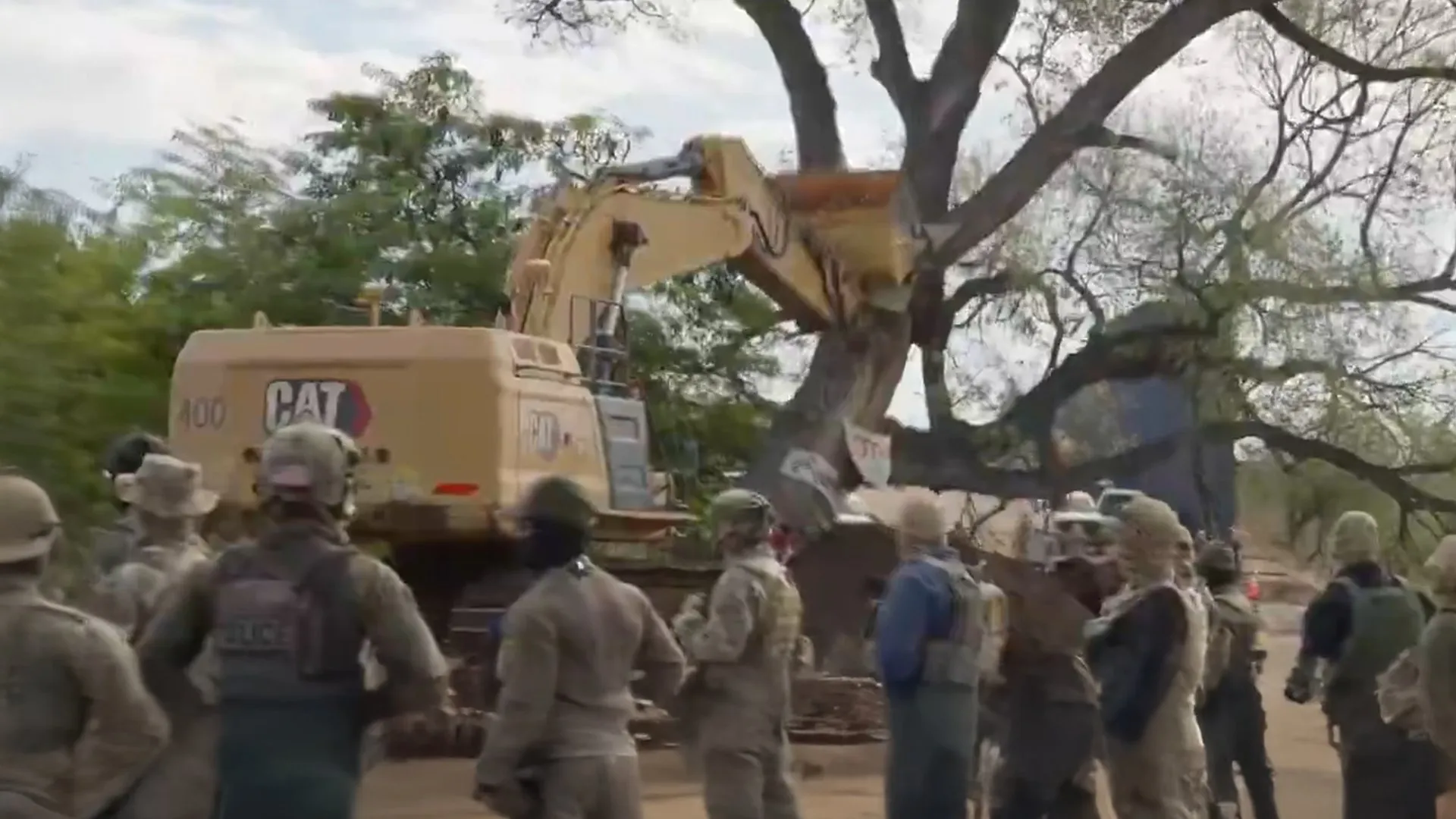
A 200-year-old cottonwood tree has been cut down to make way for an expansion of a US-Mexico double border wall. Activists staged protests for months and camped at the tree to prevent it from being cut down.
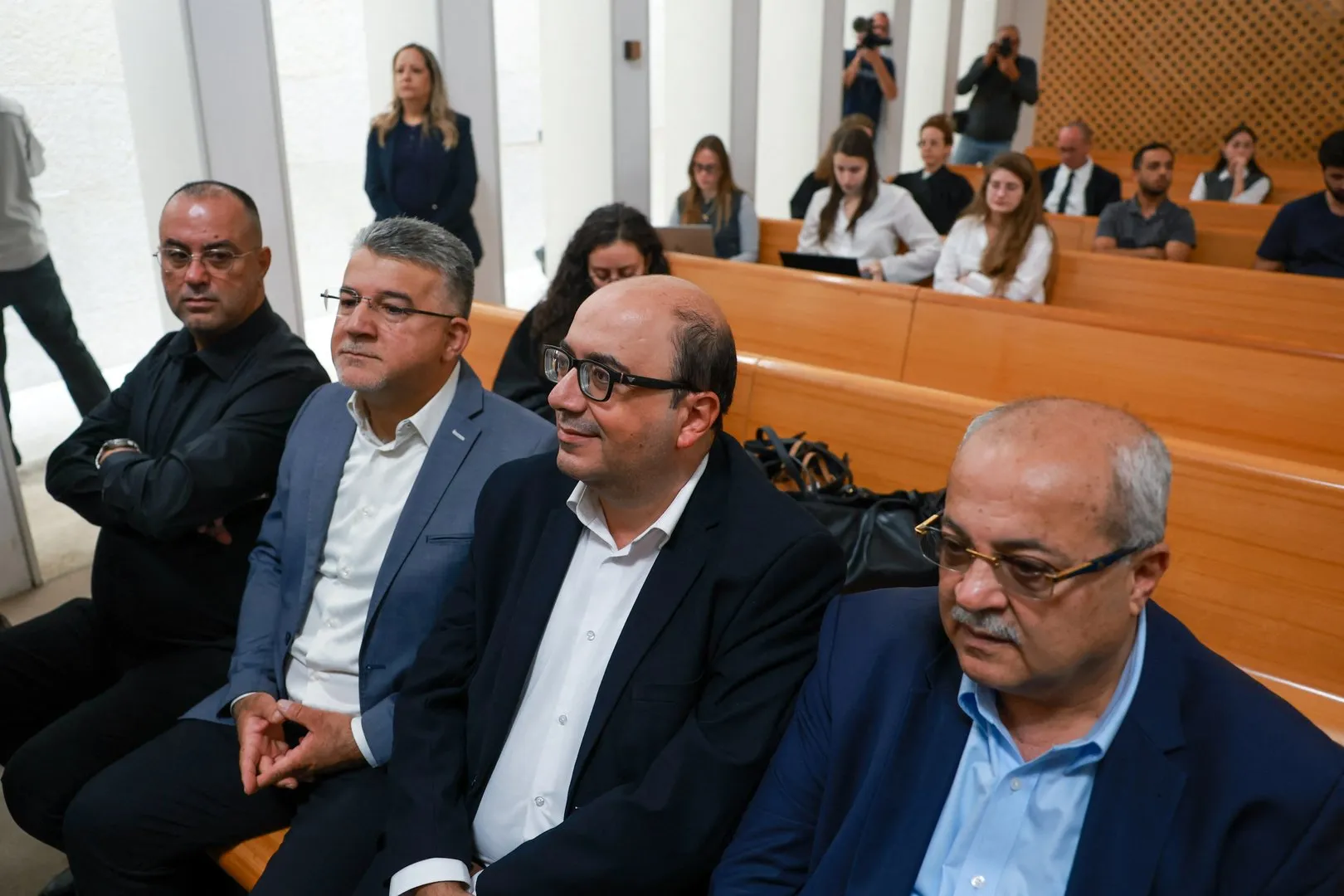
Kosovo faces the risk of turmoil as protests against the convictions of former Kosovo Liberation Army (KLA) leaders coincide with a midnight deadline to elect a president.
Demonstrators have called for changes to the law governing the Hague-based Kosovo Specialist Chambers, including measures affecting prison terms and where convicted people serve their sentences. The protests follow the September 16 convictions of former KLA leaders, including former President Hashim Thaci.
Recommended Stories
list of 4 itemsend of list
The protesters’ demands have become entangled with negotiations over the presidency, raising the prospect of new elections if lawmakers fail to reach an agreement. November 15 has emerged as a likely date for a new vote.
“New elections do not, in themselves, promise anything particularly positive,” political analyst Artan Muhaxhiri told Al Jazeera. “The chances of a radical political change are slim.”
He said that if a president is not elected by midnight, a new vote will take place in a tense political climate.
Anger over the verdicts will become a central campaign issue, he said, “overshadowing fundamental questions of socioeconomic development, and deepening the country’s downward spiral of systemic instability”.
How did Kosovo get here?
In 2015, the Specialist Chambers were established under Kosovo law following international investigations into alleged war crimes committed by KLA members during and after the 1998-99 conflict. Although formally part of Kosovo’s judicial system, the court sits in The Hague. It remains contentious in Kosovo because the KLA is widely revered for having fought against Serbian rule.
In September, protests erupted after the court sentenced Thaci to 25 years in prison.
Later, the opposition Democratic Party of Kosovo (PDK) – formerly led by Thaci – proposed amendments aimed at curbing the tribunal. The plan included capping prison sentences at 15 years, allowing convicts to serve their sentences in Kosovo, enabling appeals before Kosovo’s Supreme Court, granting presidential pardons and narrowing the court’s temporal jurisdiction.
On October 2, 2026, Prime Minister Albi Kurti’s government concluded that there were no legal obstacles to the PDK initiative and forwarded its assessment to the parliament, the Assembly of Kosovo. Days later, Kosovo’s parliament approved the initiative at first reading with 91 votes in favour, although it has not been finally adopted.
Meanwhile, Kosovo has been mired in a political impasse after the expiration of President Vjosa Osmani’s term in April, as the National Assembly has been unable to select a new president.
Now, internal power struggles within the PDK following the September sentencing have left the party fragmented, rendering the largest opposition party incapable of negotiating a cross-party presidential compromise, according to Nexhmedin Spahiu, a Pristina-based professor of political science.
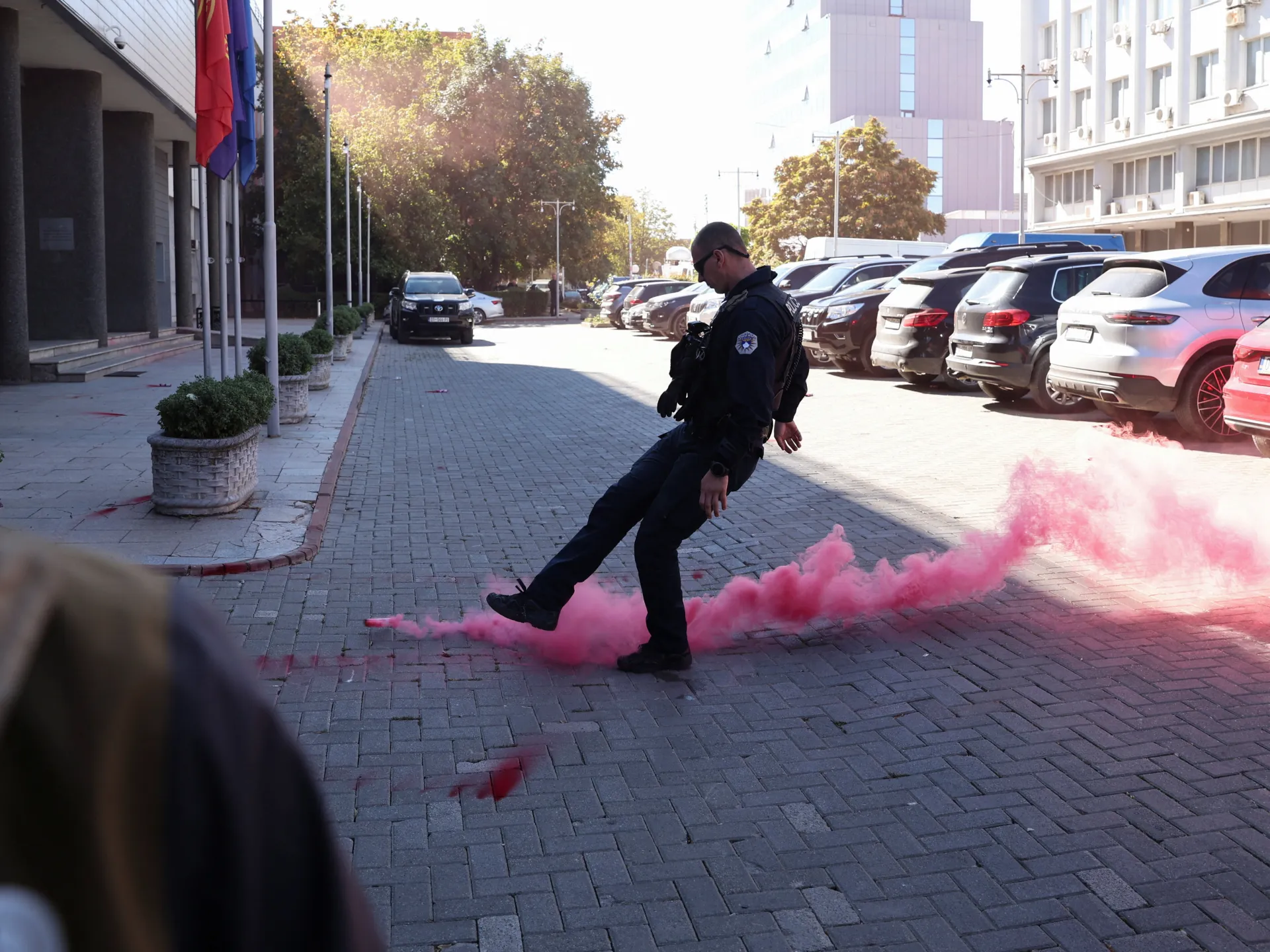
On Monday, as lawmakers failed to secure a quorum to elect a president, police deployed tear gas and water cannon outside the Assembly, following confrontations involving fireworks and bottles. The use of force prompted criticism from observers.
Tensions rise
Pristina-based journalist Gezim Baxhaku believes special police units overstepped their legal authority.
“There was an overuse of force,” Baxhaku told Al Jazeera. He said that while protesters threw firecrackers, police “exceeded their legal powers and acted entirely contrary to the situation on the ground”.
Among the hundreds of protesters were KLA veterans.
Pristina had witnessed nearly three weeks of largely peaceful gatherings before Monday’s escalation.
“Citizens were routinely bringing food, water, and coffee to the officers on duty,” Baxhaku said. “There was absolutely no reason for this to happen. For the first time since the late 2000s, police acted in such an uncalled-for manner – reacting upon orders to escalate a situation.”
Spahiu, the political science professor, said the protests should not be understood as a sign that people in Kosovo broadly reject the verdicts.
“A large majority of citizens in Kosovo are satisfied with the decision of the Specialist Chambers in The Hague,” said Spahiu.
He told Al Jazeera that the court’s rejection of Serbian claims of systematic crimes against humanity by the KLA “validated the liberation struggle”.
“Furthermore, people are relieved that individuals are finally being held accountable for crimes committed against political rivals within the Albanian community itself,” he said.
The political deadlock and Kurti’s ‘transactional’ approach
The Assembly remains deadlocked over the election of a head of state, as the PDK and other opposition parties boycott the voting session, denying the legislature its constitutionally required 80-MP quorum.
Muhaxhiri blamed Kurti for the crisis, criticising his decision to link the presidential vote to the Hague court amendments.
“Tensions escalated further when Kurti presented a plan based on a transactional approach to two fundamentally distinct issues: linking the draft law amending the Law on the Specialist Chambers to the election of the new president,” said Muhaxhiri.
“In effect, this amounted to a quid pro quo. By doing so, he appeared to be placing the historical, national, and identity-related significance of the liberation war on the same political bargaining table as the immediate objective of electing a president who would serve his political interests.”
Tens of thousands have taken to the streets across France as unions and teachers joined high school students who, for days, have been demanding better learning conditions in protests punctuated by violent confrontations.
The French Ministry of the Interior said 86,000 people had already joined demonstrations across the country early on Tuesday, while the General Confederation of Labour (CGT) union put the figure at 260,000.
Students have blocked the entrances to hundreds of high schools since late September, complaining of missing teachers, overloaded timetables, dilapidated classrooms and buildings unable to cope with rising temperatures.
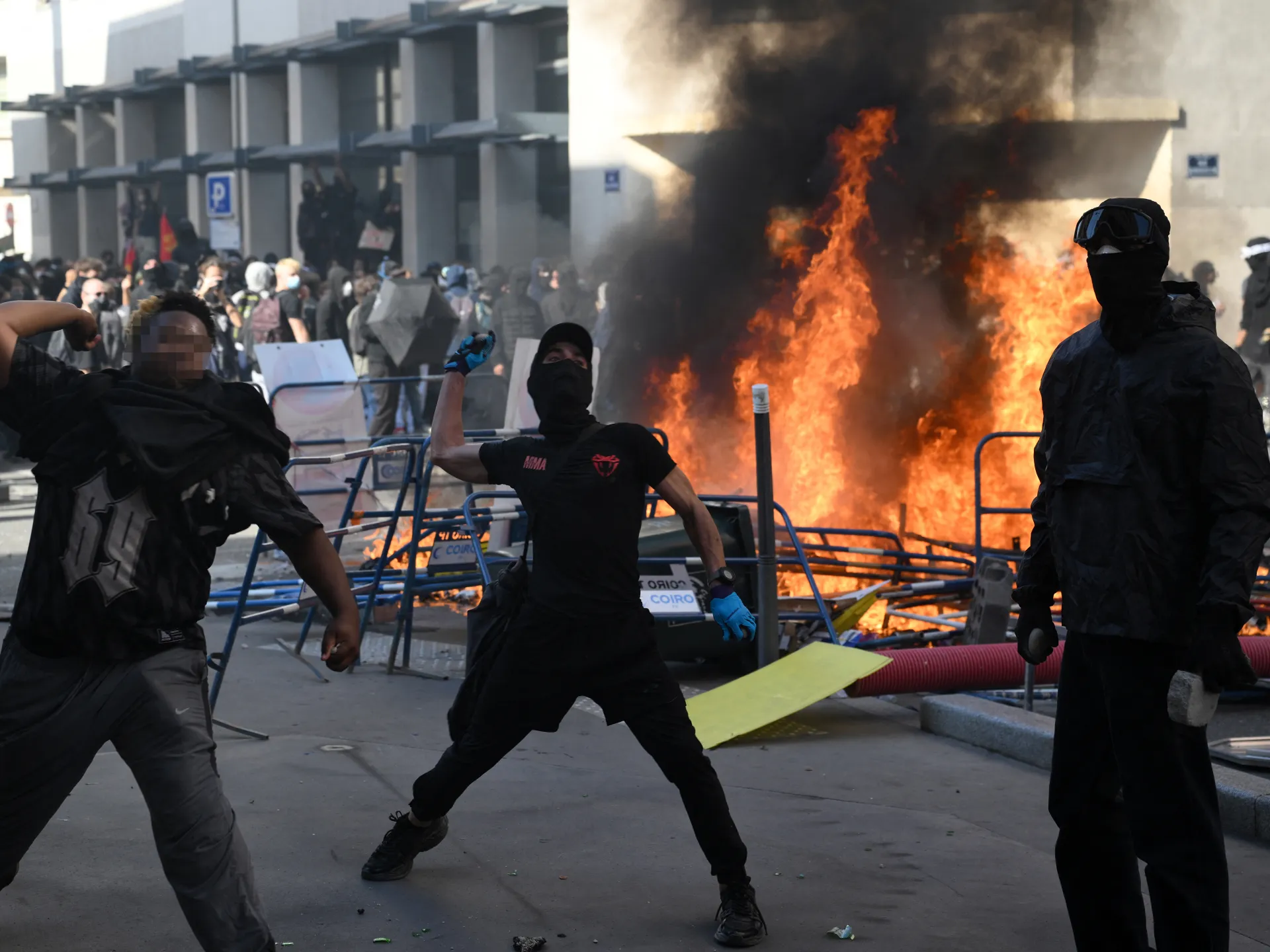
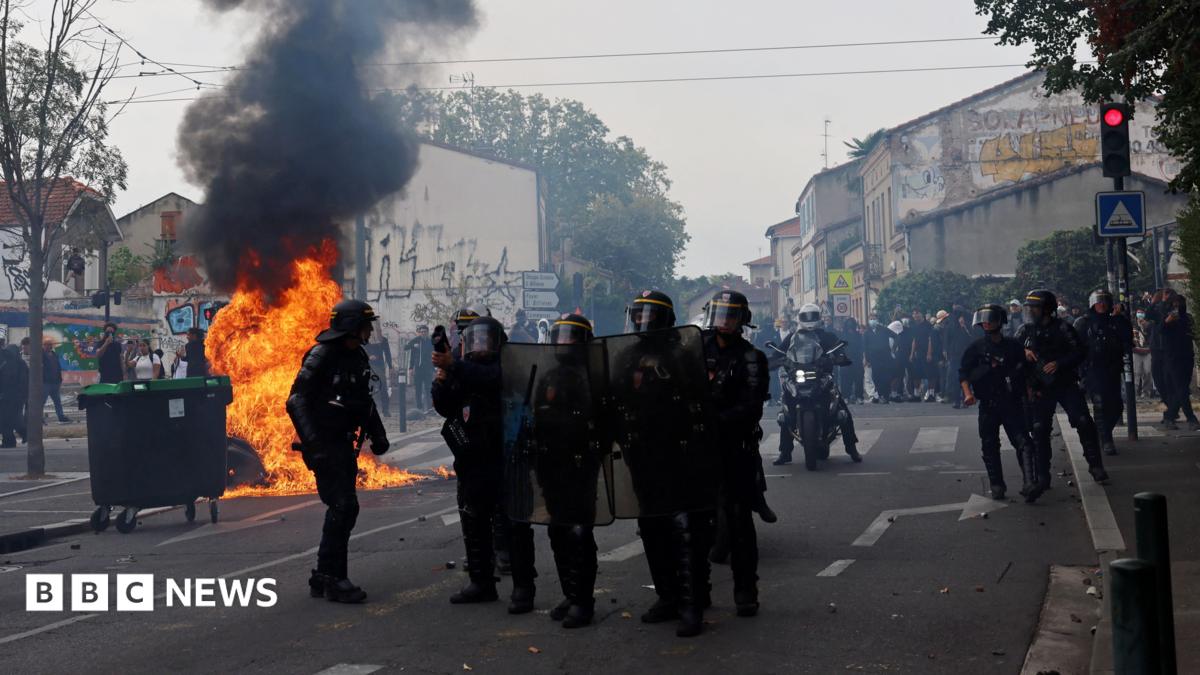
While many protests have been peaceful, some demonstrators have started fires, destroyed bus shelters or clashed with riot police.
Police have responded with batons, tear gas and riot-control rounds.
Injuries, investigations
The government says 215 students and 715 police officers have been injured since the start of the movement.
Unions, rights groups and students have accused the authorities of using disproportionate force.
A 15-year-old lost a hand to a stun grenade fired by riot officers in the northern town of Lens on Monday.
Police have launched 10 internal investigations into allegations of brutality since the protests began, Interior Minister Laurent Nunez said late on Monday.
Since the start of the movement, 24 schools have been burned or ransacked, according to the Ministry of Education.
More than 5,000 people, 87 percent of them minors, have been arrested.
Prime Minister Sebastien Lecornu’s office said 85 members of teaching staff have also been injured.
The government is also pushing legislation to make those responsible for damaging public property pay for repairs themselves, instead of using public funds.
Protests have continued across France for a third week as tens of thousands of school pupils and trade unionists have taken to the streets across many cities.
Students initially began boycotting classes in deprived areas of Paris on September 21 over teacher shortages and poor conditions, but protests have quickly morphed into a nationwide movement, with some of the largest demonstrations taking place on Tuesday.
Recommended Stories
list of 4 itemsend of list
School blockades have turned violent, with protesters accused of hurling items at police and officers allegedly responding forcefully using batons, tear gas and rubber bullets. In one case, a teenager lost his hand in a grenade explosion.
The mass demonstrations, which also coincided with a public sector strike over government budget plans last week, have presented another challenge for President Emmanuel Macron’s cash-strapped government ahead of next year’s elections, amid an ongoing fiscal crisis as government debt has rocketed in recent years.
Here’s what we know:
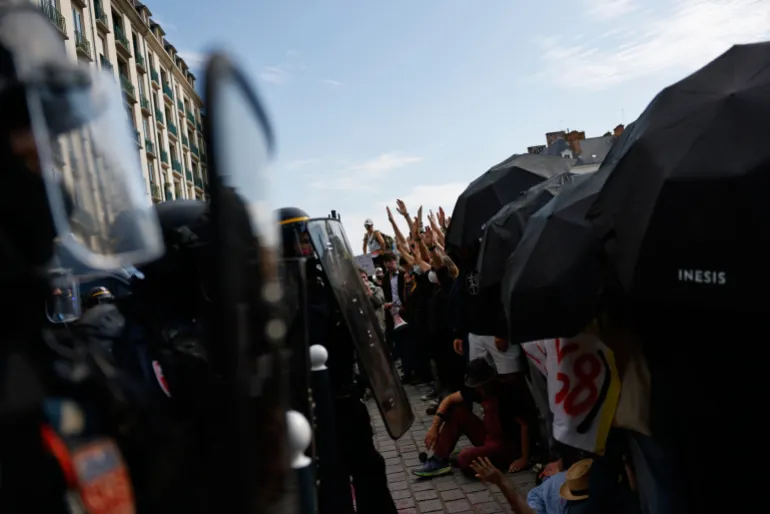
Riot police face students during a protest against under-resourced schools in Rennes, western France, on October 6, 2026 [Jeremias Gonzalez/AP]
What do protesters want?
Students have been protesting over what they say are poor conditions in France’s high schools – or lycees – especially in poorer areas. Protests have been held in Strasbourg, Bordeaux, Nantes, Marseille, Lyon and other towns and cities.
Students say absent teachers are not replaced, dilapidated school buildings are sometimes rodent-infested, there are inadequate tables and chairs, large class sizes and long classroom hours.
The intense heatwave which hit France in the summer exacerbated existing problems in neglected school buildings, which also suffer from a lack of air conditioning, school pupils say.
The protests have coincided with ongoing nationwide public sector strikes over a proposed 2027 cost-cutting budget that aims to achieve 54 billion euros ($61.3bn) in savings as Macron’s government races to bring a large public deficit under control.
Public sector staff and unions object in particular to a government plan to freeze salaries to save about two billion euros ($2.27bn).
Parents are also increasingly present at protests amid widespread anger about the police response to demonstrating minors.
But the protests are happening amid wider discontent over soaring fuel and commodity prices and reduced public spending under Macron.
Government officials have meanwhile accused political opposition groups and unionists of taking advantage of the student movement. Prime Minister Sebastien Lecornu accused political opponents last week of encouraging escalation.
What has happened so far?
At least 6,100 people had been arrested by early Tuesday, many of them under the age of 18, as police tactics come under intense scrutiny.
Serious injuries have also been reported.
A 15-year-old lost a hand in the northern city of Lens on Monday after he reportedly came into contact with a police stun grenade, which then exploded. Public prosecutors say investigations are ongoing into whether the youth actively picked up the grenade or if it landed on him.
Overall, at least 190 high school students have been injured, Education Minister Edouard Geffray said on Monday. On Sunday, he said 78 teaching staff had been injured, and 24 schools had been burned or ransacked.
Some 715 police officers have been injured, according to Interior Minister Laurent Nunez on Tuesday.
Officials said as many as 589 schools have been disrupted this week, down from 735 on Friday last week.
Rights groups, including Amnesty International, have criticised the use of force against minors amid media reports of students being hit with batons and rubber bullets, as well as sprayed with tear gas.
What happened on Tuesday?
Protesters again blockaded schools on Tuesday as thousands demonstrated over their demands.
Placard-waving crowds were reported in southern Marseille, eastern Strasbourg and other major cities.
In Paris’s 20th district, protesters outside the shut Helene Boucher lycee tipped over rubbish bins and bicycles and created a makeshift barricade, The Associated Press news agency reported. Parents, meanwhile, positioned themselves between the demonstrators and police to protect their children.
“They are our children. Teachers, parents, federations, we all share the same goal: the protection of children’s rights, and it is a legitimate right to demonstrate and to make demands,” said Emilia Sichili Suriam, one member of a parents’ association.
Interior Minister Nunez rejected criticism of the police on Tuesday, saying the response has been proportionate in “almost all cases”. He claimed that the protests were transforming into “riots”.
What does this mean for the French government?
These are only the latest in a series of high-profile protests that have marked Macron’s presidency and undermined his government’s reform efforts ahead of elections in April and May.
Macron will not run in next year’s elections, but his image and that of his government have no doubt been tainted by photos of police chasing students in the streets, France expert Jacob Ross, from the German Council on Foreign Relations (DGAP), told Al Jazeera.
“He is not taken seriously any more because many think of him as already out of government,” Ross said of Macron. “But this is still very significant for his government because it has become clear that they don’t have the capacity to calm things down. There’s clearly little fiscal room to manoeuvre.”
Macron’s terms have long been beset by political and financial instability. Successive prime ministers have faced difficulties in pushing through policies in the highly polarised National Assembly where Macron’s centrist Renaissance party and allied blocs lack a majority.
Critics have taken aim at Macron’s deeply unpopular austerity measures, which have seen drastically reduced government spending taking a toll on pensions and healthcare. Officials, however, have defended these policies amid rising debt following COVID-19-era spending.
On Sunday, Lecornu said the government had kickstarted initiatives to address the protesters’ demands and that a report was expected by the end of the month. He, however, added that Paris would not “yield an inch” to violence.
Meanwhile, frontrunner and opposition leader Marine Le Pen of the far-right National Rally party submitted a shadow budget on Tuesday promising 140 billion euros ($157.6bn) in cost savings by 2032 if elected next year.
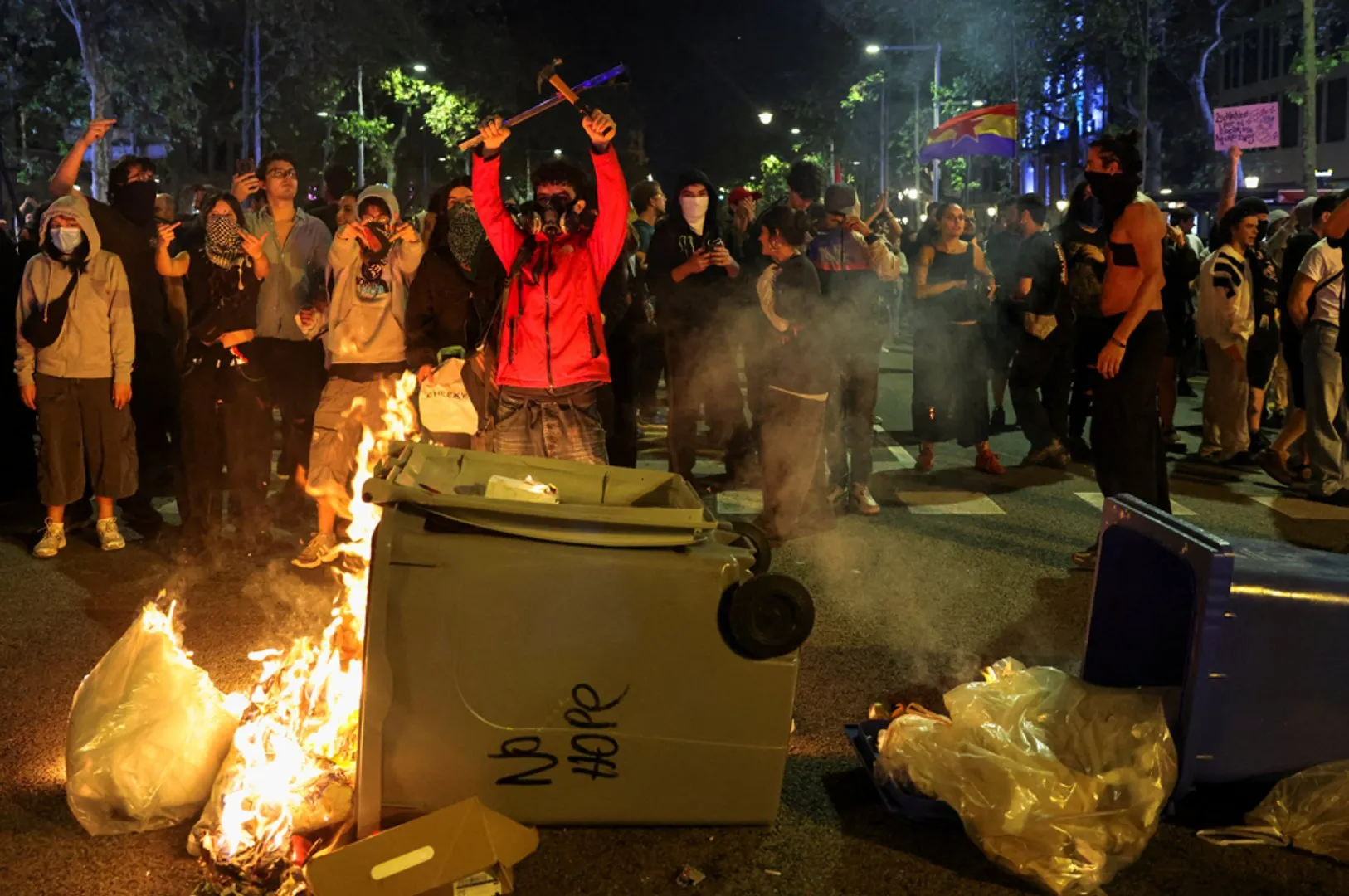
Protesters in Barcelona set fires, built barricades and hurled projectiles as violence erupted at a housing protest. Affordable housing is a key issue in Spain and the prime minister has called for snap elections after parliament rejected a new law expanding renter protections.
Education Minister Edouard Geffray said on Sunday about 500 schools likely to be fully or partially closed on Monday.
Published On 5 Oct 20265 Oct 2026
Hundreds of high schools in France are closed as student protests continue against rundown schools and teacher shortages.
Government spokesperson Maud Bregeon told CNews television on Monday that the priority was to “restore order”.
Recommended Stories
list of 3 itemsend of list
Earlier, National Education Minister Edouard Geffray said on Sunday evening, of the 3,700 schools, 400 to 500 were likely to be closed fully or partially on Monday.
Geffray said 24 schools had been burned or ransacked, while 78 teaching staff had been injured since the beginning of the protests.
Nationwide demonstrations erupted at the end of last month at a high school in a Parisian suburb over teacher shortages, before spreading nationwide.
Reporting from a high school in Paris, Al Jazeera’s Natacha Butler said students had set up a barricade in front of the building’s entrance using dustbins and fences.
“We’ve been talking to many of the students who have come out here, and what they say is that they are here to have their demands heard by the government. They say they are fed up with teacher shortages and often don’t have teachers for subjects like maths and English,” she said.
“They also tell us that they’re here to demonstrate to show solidarity with other high school students who are in perhaps poorer areas in France with less adequate facilities or in France’s overseas territories. They say all young people should have an equal right to education,” Butler added.
French news channel BFMTV showed images of police and students clashing in Lille, northern France, tear gas being used in Toulouse in the southwest and of a fire being set alight as people tried to break into a school in central Paris.
Carole Zerbib, head of the vandalised Lycee Vauquelin in Paris’s 13th district, said a “very determined” group wearing hoods and masks attacked her school.
While police and firefighters quickly put out the fire and the school was evacuated, suspending classes, Zerbib said it was “very violent and happened very quickly”, adding that the attack lasted 15-20 minutes.
Since September 28, about 5,000 people, mostly teenagers, have been arrested across the country and dozens have been injured.
French newspaper La Voix du Nord reported on Monday that a teenager lost a hand after picking up a police stun grenade.
Teachers and members of the public have also been attacked, while estimated costs of property damage are in the tens of millions of euros.
Student unions have called for a national day of demonstration on Tuesday.
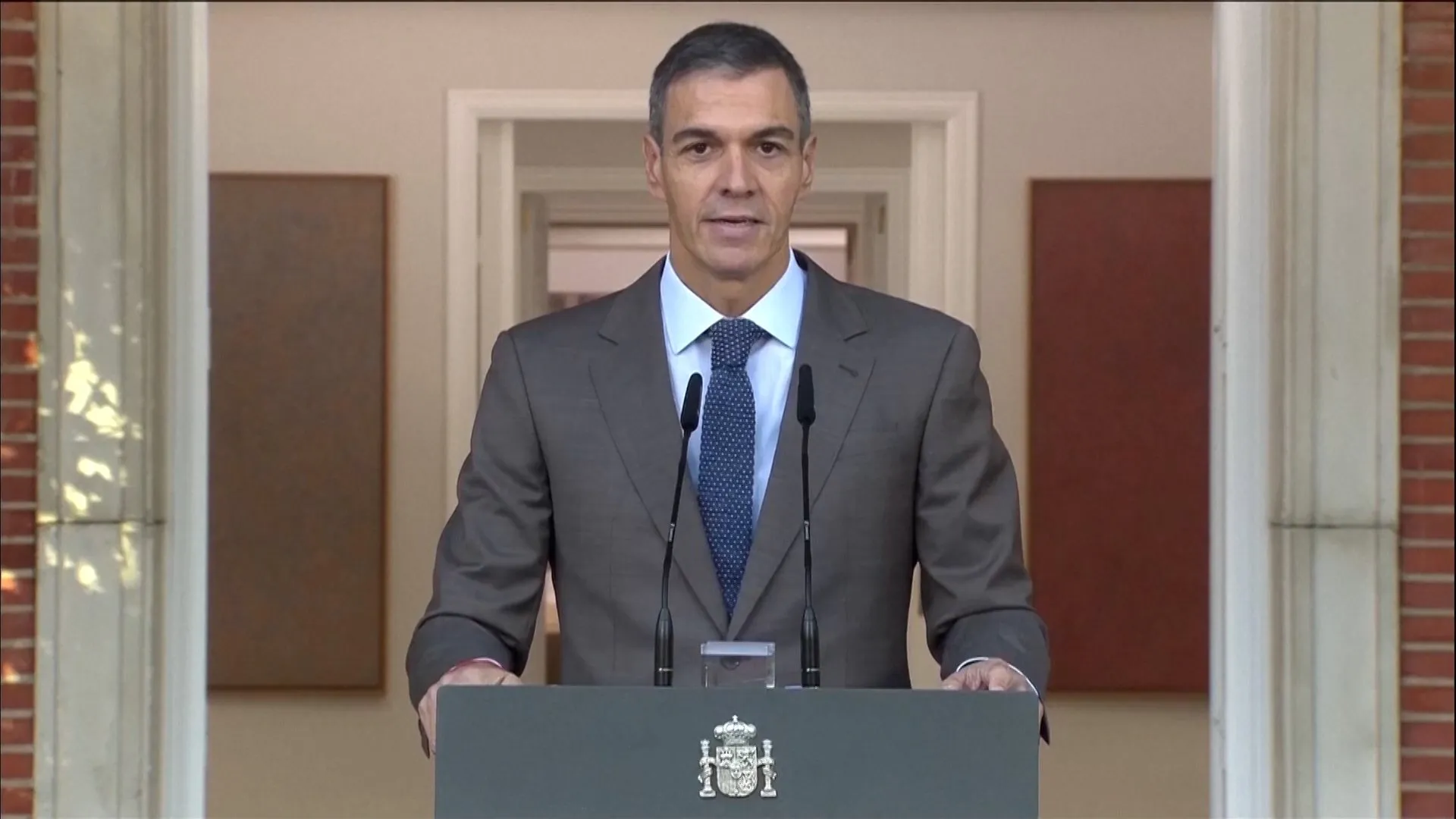
Spanish Prime Minister Pedro Sanchez has called a snap election for November 29. He’s seeking a renewed mandate after parliament rejected proposed measures aimed at easing Spain’s housing crisis amid growing public anger.
Up to 500 schools across France will be partially or totally closed on Monday after clashes between riot police and student protesters in recent days, the French education minister said on Sunday.
Lessons will be “totally or partly suspended” in some “400 to 500” high schools as security conditions “have not been fulfilled”, Édouard Geffray said.
He also said 24 schools had been “burned or ransacked” since the start of the protests.
Thousands of students have been demonstrating over education standards and the protests, which started last week, have spread from Paris to other cities, including Montpellier, Nantes and Marseille.
High school pupils and others have objected to a lack of teachers, overcrowded classrooms and run-down buildings.
On Friday, French Justice Minister Gérald Darmanin said 735 of France’s 3,700 schools had been affected “one way or another” by violent protests.
The education minister warned the number of schools potentially affected on Monday could be comparable to Friday’s figure but promised a “partial, progressive return to lessons”.
“There are activists – particularly from the far-left – who have infiltrated the high school student movement, hijacked it from the students themselves, and engaged in extreme violence,” Édouard Geffray claimed.
“Clearly, this poses a risk to both our staff and our students,” he said. Geffray added that 78 staff members in education had been wounded, which he described as “something we have never seen before”.
On Friday 1,747 people were arrested, according to French Interior Minister Laurent Nuñez.
Government warns of crackdown as supporters of jailed former prime set off from northwest Pakistan towards Islamabad.
Supporters of jailed former Pakistani Prime Minister Imran Khan have set off on a protest march from the country’s northwest after talks with the government to call off the demonstration failed.
More than 5,000 were reported to have begun the rally on Sunday. The march, planned by Khan’s Pakistan Tehreek-e-Insaf (PTI) party, was originally scheduled for September 27 but was postponed until October 4 to allow talks between the government and the PTI leadership to take place.
Recommended Stories
list of 3 itemsend of list
However, two rounds of talks over the weekend failed to break the deadlock, and the PTI decided to carry out its plan, which is the latest attempt to pressure the government into releasing Khan, the country’s most popular political figure according to polls, who has been behind bars since August 2023 following a series of convictions that his party calls politically motivated.
All but one of the convictions against the former PM have since been suspended or overturned on appeal.
Videos posted on the PTI’s official social media showed supporters joining the march in different areas of Khyber Pakhtunkhwa (KP) province, which is ruled by the party, and setting off in convoys.
Sohail Afridi, the region’s chief minister, had earlier posted on social media that the demonstration in support of Khan would go ahead.
He said the march will make its way to Khairabad, 80 kilometres (50 miles) west of Islamabad, by Thursday, where the plan for the “next phase” will be announced.
Government warns protesters
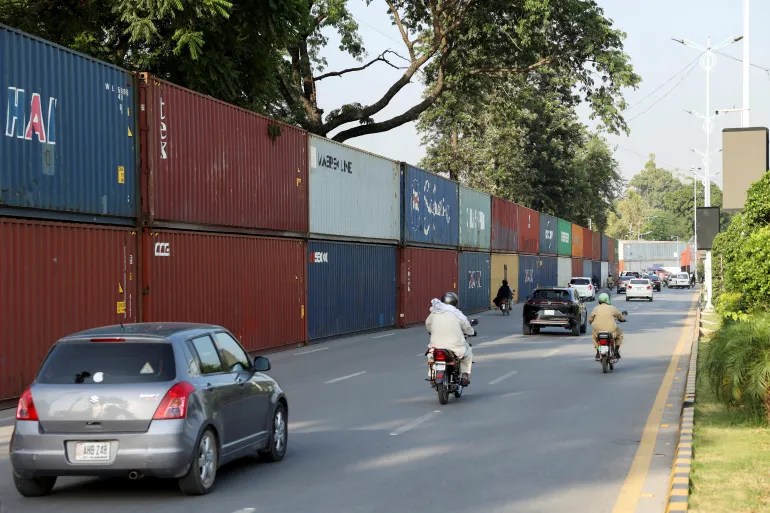
The government has been preparing for weeks for the arrival of PTI demonstrators in Islamabad. It has erected barriers using shipping containers to block main access routes to the capital.
Interior Minister Mohsin Naqvi confirmed earlier on Sunday that the talks between the two sides had failed. He accused Afridi of “sabotaging” the negotiations, and added that the government would not allow the PTI to “create a disturbance”.
He also cited an Islamabad High Court order from September 14, ruling that no political party or its leadership has the “lawful right to occupy public roads, highways, interchanges, toll plazas and buildings in Islamabad”.
“If they violate the orders, whether they are workers or politicians, whether they are protesting within KP or outside KP, we will pursue them one by one. This time, we want to ensure that these repeated episodes of creating disturbance in Islamabad come to an end,” Naqvi said.
Traffic moves past shipping containers used to block a planned march by former Prime Minister Imran Khan’s Pakistan Tehreek-e-Insaf party, in Islamabad [File: Reuters]
Concerns about the 73-year-old Khan’s health, in particular the condition of his right eye that has required months of specialist treatment, have prompted the PTI’s campaign for his release.
The party has also called for the release of Khan’s three sisters, whose arrests last month further heightened tensions.
James Dorsey, a fellow at the National University of Singapore, said Khan was “essentially a populist leader” with “a genuine popular movement that had broad popular support”.
That is behind the “determination by the government to prevent [the protesters] from entering Islamabad,” he told the AFP news agency.
Given Pakistan’s security concerns, particularly following its unresolved February 2026 conflict with Afghanistan, Islamabad wants to avoid escalation in the face of the protests, he added.
“It’s a problem for the government, but I don’t think it’s an existential threat,” he said.
Protesters say the election commission’s voter-roll revision has removed millions of eligible voters to benefit Prime Minister Narendra Modi’s ruling BJP party.
Published On 4 Oct 20264 Oct 2026
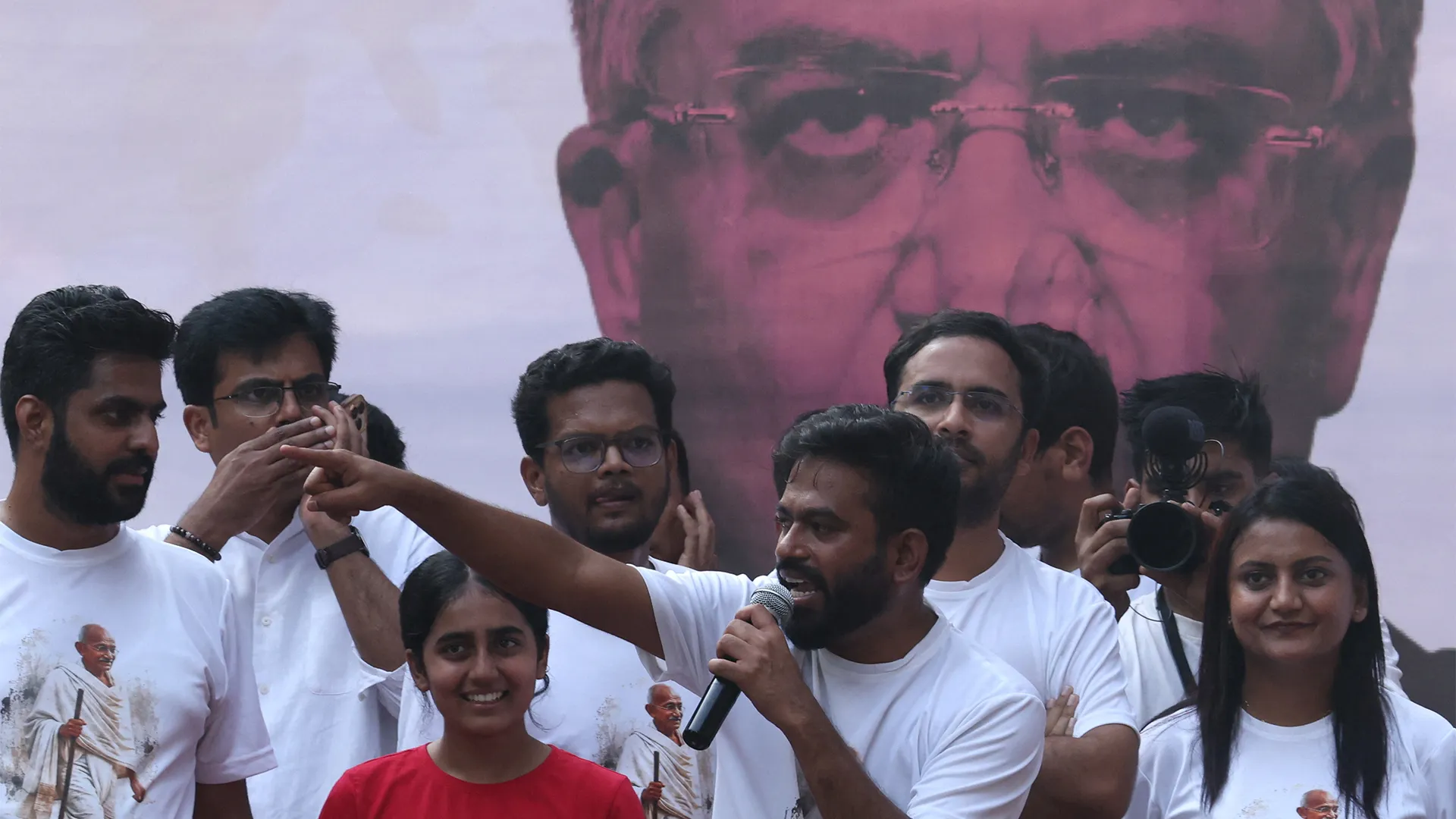
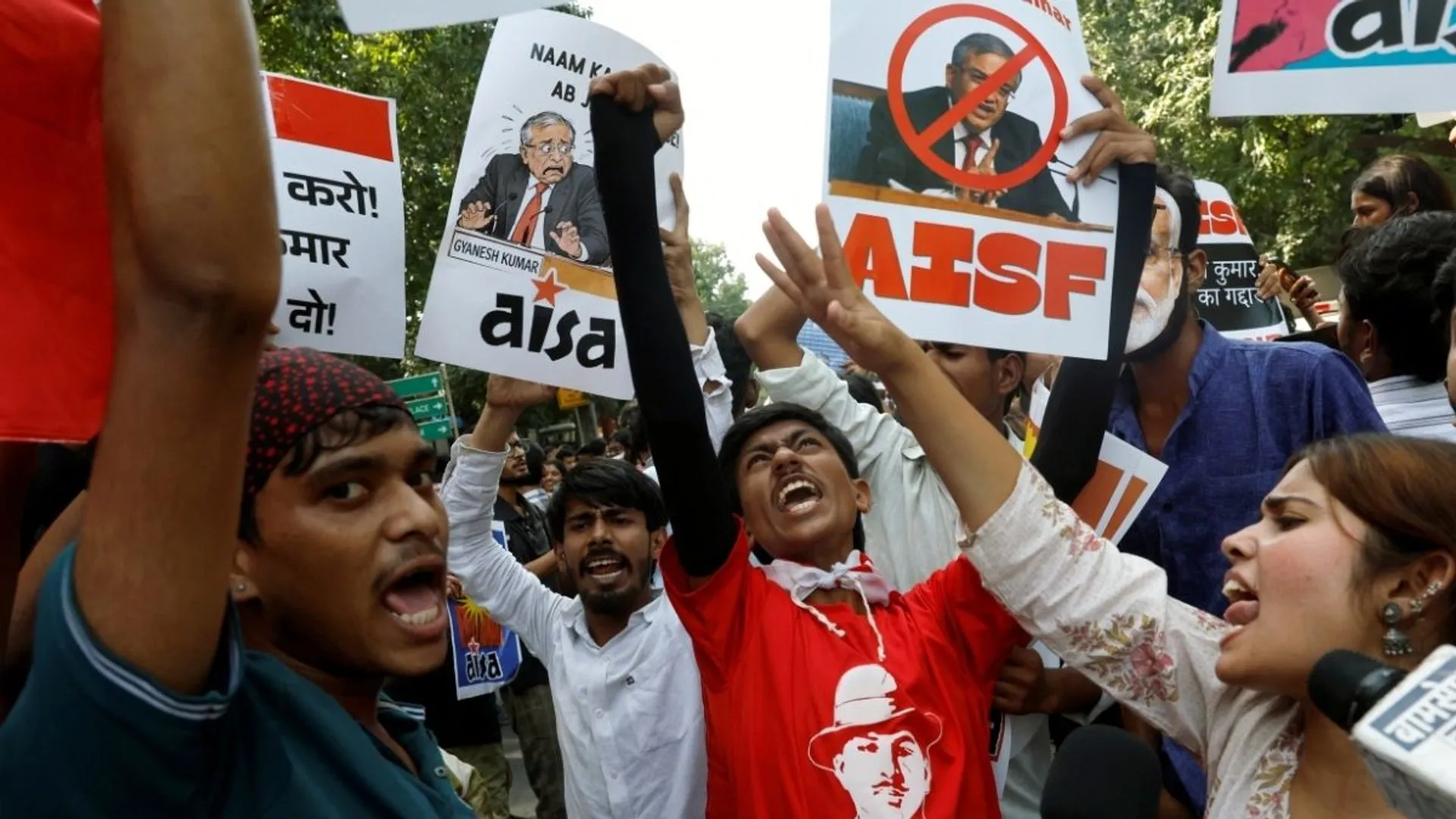
Thousands of youth and opposition protesters have rallied for a third day in India demanding the resignation of the country’s election commission chief.
Thousands marched in Mumbai on Sunday, while others gathered for a third day of demonstrations in New Delhi. The protests began on Friday demanding that Election Commission of India (ECI) chief Gyanesh Kumar step down due to reports that he has overseen voter-roll revisions removing millions from electoral lists.
Recommended Stories
list of 3 itemsend of list
Protesters say the disenfranchisement stands to benefit Prime Minister Narendra Modi’s ruling Bharatiya Janata Party (BJP). Both the ECI and the BJP have denied the allegations.
Led by opposition leaders Raj Thackeray and Uddhav Thackeray, thousands marched in Mumbai on Sunday, waving Indian flags and calling for Kumar to step down.
In the capital, New Delhi, protesters started gathering in the early evening. As on previous days, some were detained by police as they arrived, according to the Reuters news agency.
Police in the capital have clamped down in a bid to prevent protesters from assembling over the last two days, detaining dozens and taking them away by bus.
Some of the detainees were released later on Friday and Saturday, but police registered cases against some on charges of violating orders banning mass gatherings in the centre of the capital.
Police and security personnel detain a protester during a demonstration against India’s Chief Election Commissioner Gyanesh Kumar in New Delhi on October 3, 2026, to demand his resignation [Arun Sankar/AFP]
“I just want to tell the ruling party this much … We are angry about how you are wielding that power. It’s the people of this country who should decide who sits in power and who sits in opposition, not the election commission,” Raj Thackeray told the crowd in Mumbai.
The ECI says the voter-roll revision is designed to remove duplicate, deceased or ineligible entries and maintain electoral integrity. On Friday, it directed its officials to register eligible voters inadvertently omitted from electoral rolls.
Kumar has not publicly responded to the demands for his resignation or commented on the protests, which look set to continue over the coming days, with more rallies planned.
An alliance of India’s opposition parties plans to launch protests to “save democracy” with a march to the election commission office on Tuesday. The Gen Z-led Cockroach Janta Party (CJP) has announced plans for a major rally in New Delhi on October 10.
“Mumbai is out on the streets again for free and fair elections!” Abhijeet Dipke, chief of the CJP, said in a social media post on Sunday.
“Solidarity with all the protesters,” he added. “All Indians need to come together. It’s now or never!”
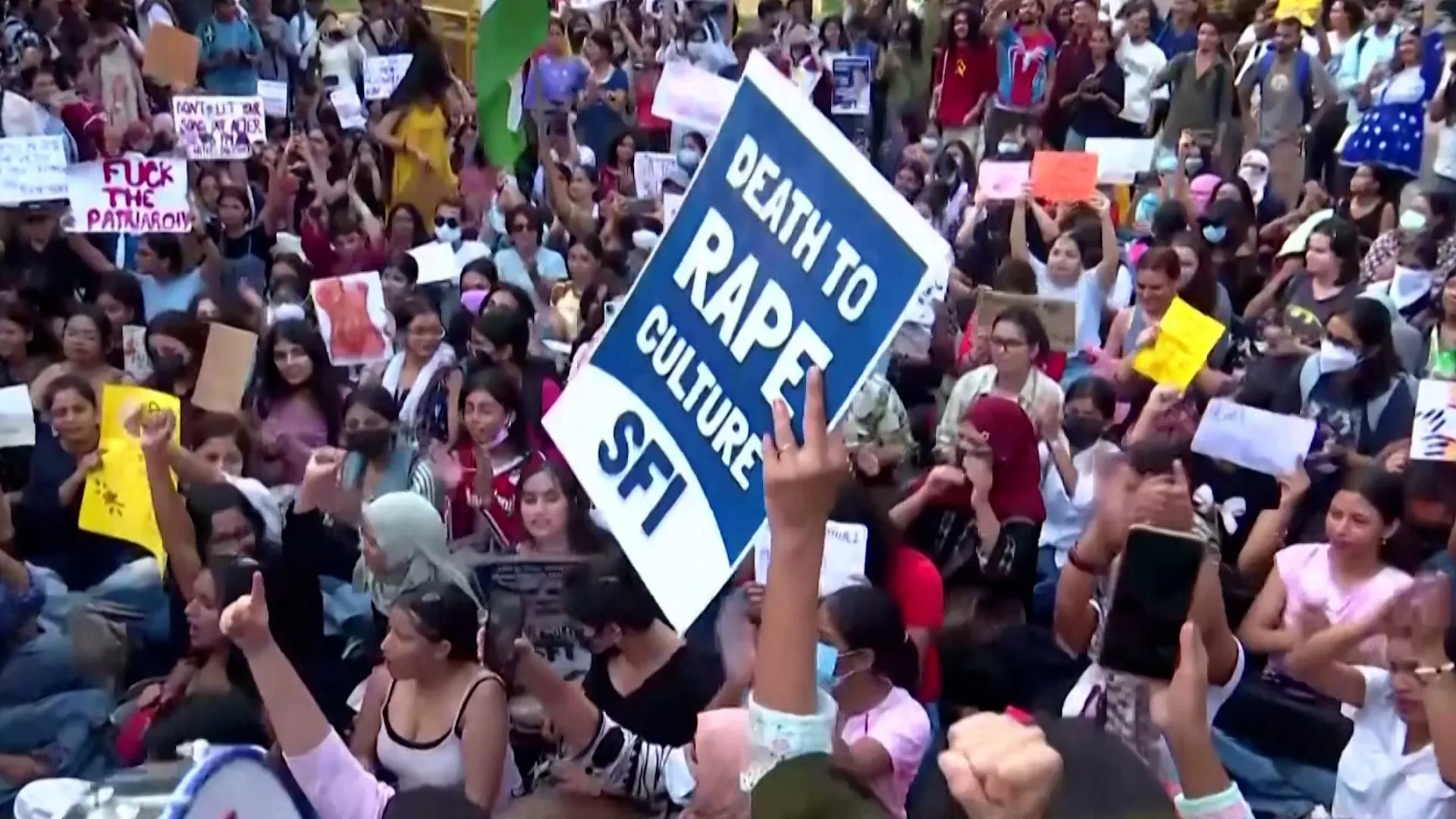
Aditi Subramanian joined protests after the alleged gang rape of a teenager in New Delhi, calling for women’s safety without more restrictions or surveillance. As she and hundreds of others tried to reach the planned protest site, they were detained. This piece was produced in collaboration with Jigyasa Mishra.
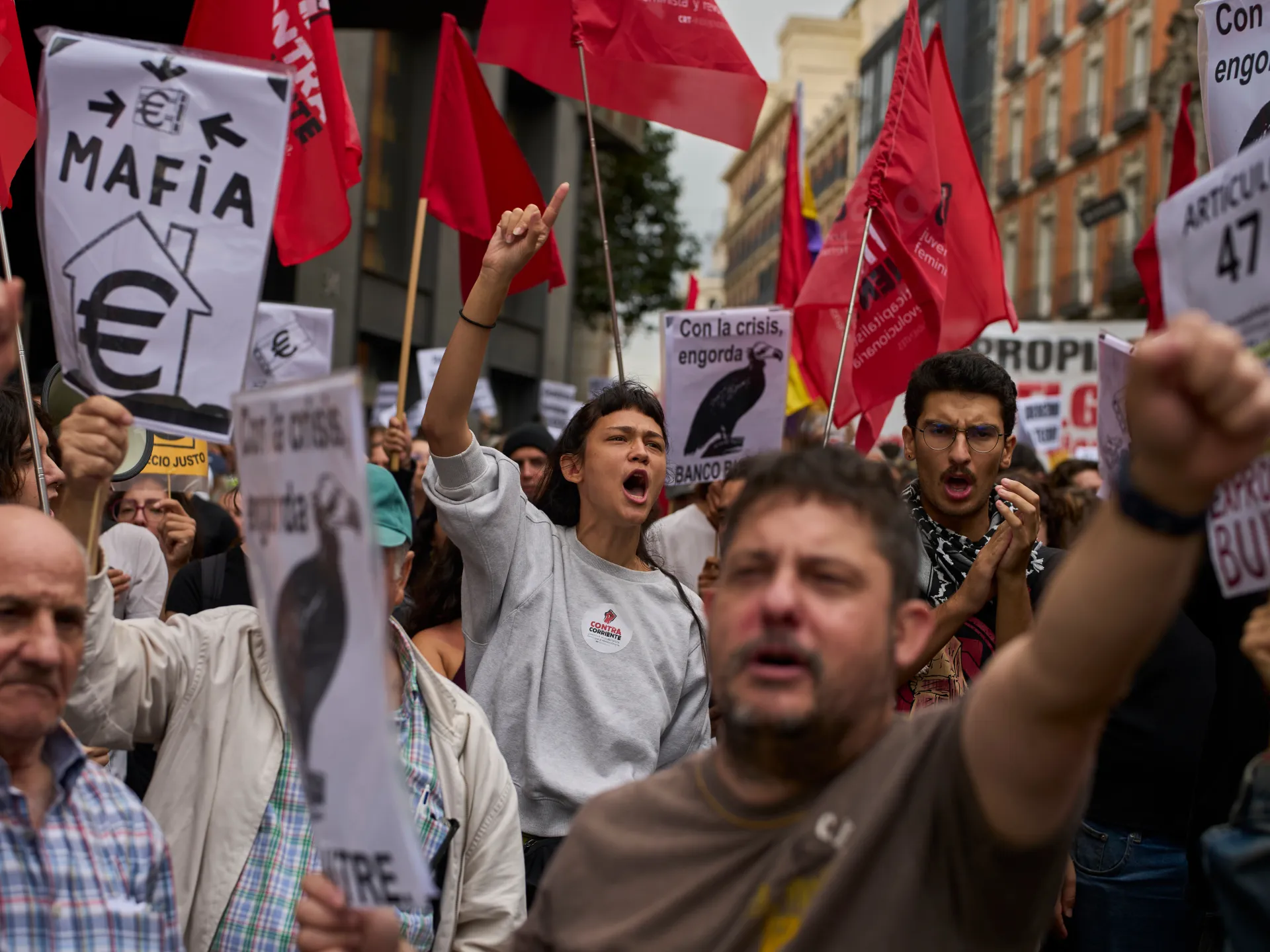
Tens of thousands of people have rallied across Spain as protests have spread since the conservative-dominated parliament rejected a bill proposing measures to tackle a housing crisis.
Parliament on Friday voted down two decrees proposed by Prime Minister Pedro Sanchez’s minority left-wing coalition government that were intended to address the housing crisis.
Recommended Stories
list of 3 itemsend of list
The protests erupted late last month after an 87-year-old woman was evicted from her home of 70 years in the capital, Madrid. Maria del Carmen Abascal’s eviction came after an international investment fund bought her building and hiked the rent.
Local media reports have suggested that Sanchez could call snap elections for as early as November after watching the strength of Saturday’s protests across the country. Spain’s current legislative term is set to end next summer.
Will the housing crisis trigger snap elections? Here’s what we know:
What happened on Friday in parliament?
The emergency measures proposed by Spain’s leftist government to tackle the country’s housing affordability crisis failed to pass on Friday.
The government had proposed two measures to protect renters in the country. The first decree was meant to stop evictions of vulnerable people, make real estate speculation harder, impose tighter restrictions on short-term leases and provide tax incentives to encourage renting and the construction of housing.
The second decree proposed making leases automatically renew when they are set to expire, essentially making them indefinite. A property owner would have to pay a tenant 12 months of rent to break the contract.
Sanchez, who leads a coalition government composed of his Socialist Party and the far-left Sumar, appealed to lawmakers in the run-up to the vote to put aside political calculations and pressure.
“Think about ordinary people, about those who most need the protection of public institutions. Think about the millions of young people who cannot afford to move out of their parents’ homes. Think about the families living with the constant anxiety of ever-rising rents,” he said before the voting.
But his government’s proposed measures were shot down by the majority of the 350-seat lower house of parliament.
The right-wing Catalan separatist party Junts refused to back the housing decrees, saying they would ultimately tighten the housing market. The centre-right Popular Party and far-right Vox also voted against the measures.
Miriam Nogueras of Junts argued the decrees would lead only to owners removing their properties from the rental market and thus driving up prices even further.
“If they really wanted to protect people, collar the vulture funds, and reactivate housing, they would have already done it. They’ve had eight years,” she added on X, referring to Sanchez’s government.
Health Minister Monica Garcia said on X that the right-wing parties “have voted for a feudal economy in which a minority extracts the salary from a majority that works for their luxuries. And they do it against their own voters, who also suffer increasingly high rents, live in fear that the contract will end and can even be evicted.”
“Today the right has given rent-seeking a parliamentary majority that it doesn’t have on the street, but it’s going to pay for it sooner rather than later,” she added.
Before the parliamentary vote, Marta Soler Gallart, head of the Department of Sociology at the University of Barcelona, explained that neither of the two decrees addressed the housing problem in the medium or long term.
“Models such as Vienna’s with its low rents are cited in support of these decrees, but it is overlooked that the Vienna model and others have low rents because of their long history of creating and maintaining public social housing,” Soler Gallart told Al Jazeera on September 30.
“In Spain, however, public funds are invested in social housing which, after a while, the recipients sell at market price.”
Soler Gallart also said the new measures disadvantage landlords with small or few properties by extending five-year tenancy agreements by a further two years and by providing an indefinite extension of their leases.
“However, these extensions are not compulsory if the landlord can prove that they need the property for their own use,” she said.
Why are people protesting across Spain?
Protests erupted across Spain in late September after 87-year-old Abascal was evicted from her home. The investment fund that bought her building hiked her rent by more than 200 percent to roughly $1,880 a month, a move aimed at pushing out the long-term tenant to make way for lucrative tourist apartments.
In recent years, Spain has seen protests against mass tourism, which has been linked to the housing crisis and soaring cost of living. Spain is the second most visited country in the world, attracting 97 million tourists last year.
While Abascal has returned to her home, according to her representatives, she has become the face of the country’s housing crisis, and people across Spain have been demanding the government address the issue.
Angered by parliament’s rejection of the government measures, tens of thousands of people took to the streets.
“It’s a shame,” Nando de Anguulo, 26, who joined Saturday’s protest in Madrid, told the Reuters news agency.
“It only proves that it is us, the people, who have to adapt to the political parties and not the politicians to what the people want, and this can’t go on like that.”
While the protests were mostly peaceful, in the southeastern city of Valencia, police fired rubber bullets and tear gas to break up demonstrations. About 30 protesters managed to get inside the City of Arts and Sciences, a landmark cultural building, before police removed them.
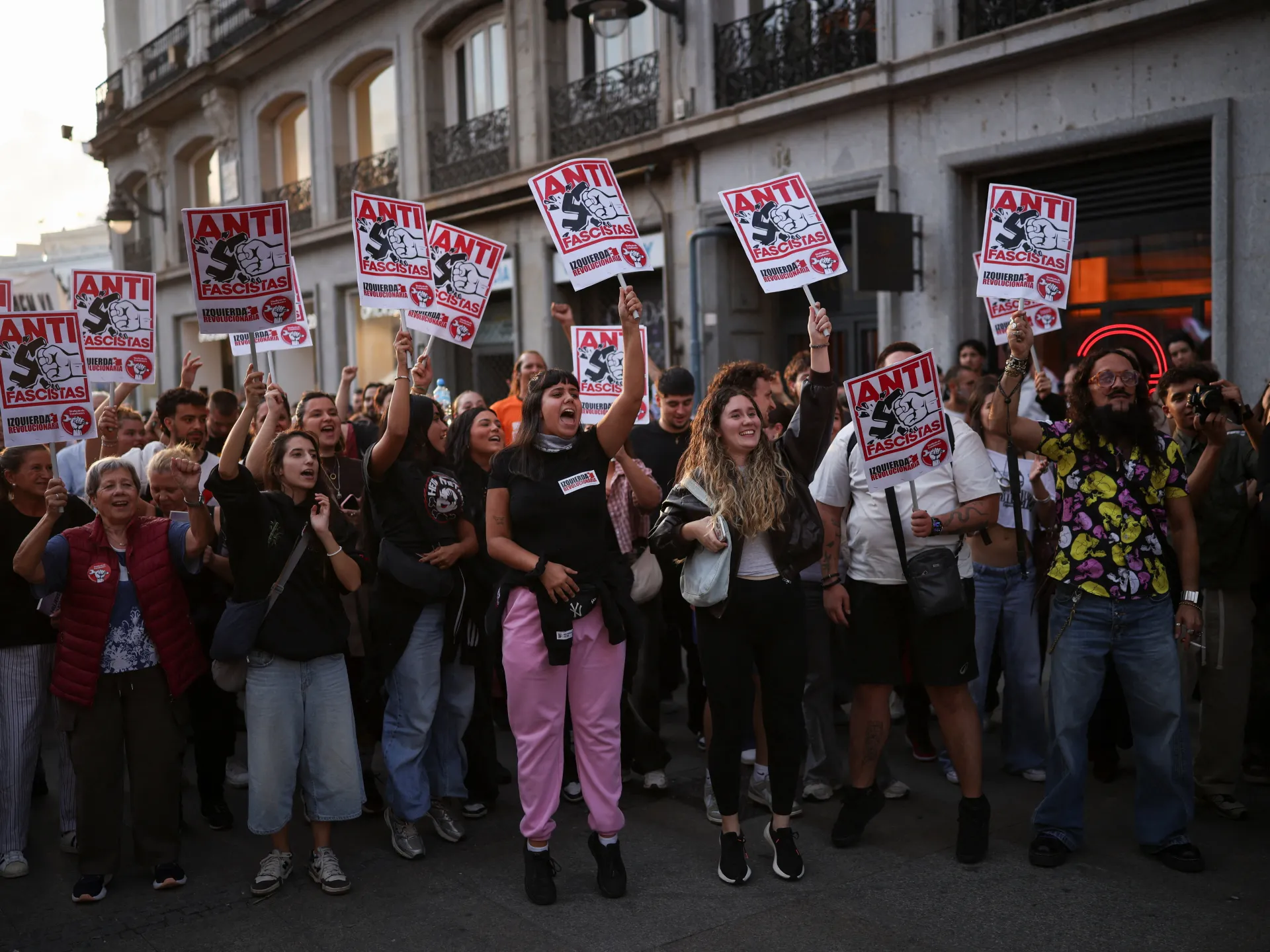
Meanwhile, in Madrid, Spanish police arrested three members of a far-right group and fired rubber bullets on Saturday night.
Far-right activists, some of whom performed Nazi salutes, tried to reach demonstrators camped out in the Puerta del Sol, a central square in the Spanish capital, the Spanish government said.
Valeria Racu, a spokesperson for the Tenants’ Union, said Saturday’s rallies revealed “a new energy that we haven’t seen in a long time and energy that is showing that eight days of people’s power can achieve more than eight years of progressive government”.
“Now begins real politics – politics which has always belonged to the people and which will return once and for all to the streets,” Racu added.
Could the housing crisis lead to snap elections?
Housing is a sensitive issue in Spain because it impacts how people vote. The average rent in the country has almost doubled in the past 10 years. The average price per square metre has risen from 8.20 euros (about $9.08 at the time) in 2016 to 15.1 euros ($17.15) this year, according to the real estate website Idealista.
In an October 1 article for Vanity Fair, Spanish journalist Jorge Dioni Lopez noted that after eight years in power, housing is what is causing Sanchez to lose support among educated young people, children of the middle classes.
“The government faces a difficult situation. Firstly, because most of the relevant powers lie with other levels of government. Secondly, because Spain is a nation of homeowners. Unlike in other European countries, almost all the public housing that has been built has ended up in private hands, and historically, homeownership has been more attractive than renting,” he wrote.
“Housing is our savings system and also the primary means of transmitting wealth between generations,” he added.
After Spain’s parliament rejected the government’s housing reform bills on Friday, the leader of the centre-right People’s Party, (PP) Alberto Nunez Feijoo, urged Sanchez to “call elections as soon as possible”, claiming he had the support of “neither the streets nor parliament”.
While Sanchez has not officially announced new elections, the Spanish online news site El Diario has reported that elections could take place as early as November 29. Spain’s general elections are currently scheduled for July 2027.
Israeli journalists asked coach Hallgrimsson about the Flydubai attack and alleged racist abuse by Ireland’s players.
Published On 3 Oct 20263 Oct 2026
Members of an Israeli media contingent heckled Republic of Ireland head coach Heimir Hallgrimsson’s news conference prior to the UEFA Nations League football match, causing it to end abruptly amid growing political tensions and protests against the fixture.
During the media event on Saturday, an Israeli journalist asked Hallgrimsson about his views on an incident onboard a Flydubai flight to Israel earlier this week.
Recommended Stories
list of 4 itemsend of list
According to the prosecutor general of the United Arab Emirates, the Flydubai co-pilot “attempted to carry out a terrorist act”, using an axe against the pilot to take over the aircraft’s controls.
The plane carrying 174 passengers was on its way from the Dubai in the UAE to Tel Aviv in Israel on Wednesday when the copilot wounded Indian pilot Smit Machchhar, who opened the cockpit door to seek help.
The aircraft briefly plunged about 17,000 feet (5,180 metres) before it was brought back under control.
The attacker was not officially identified, but media reports quoting unnamed sources said he was an Omani national, Hamam al-Hammami.
“What do you say about the people that you support? Their ideology is based on murder,” the journalist asked, purportedly hinting at Ireland’s stance on Palestine and attempting to link it to the aviation incident.
Before the Irish team’s coach could answer, the Football Association of Ireland’s communications manager Kieran Crowley stepped in and asked the journalist to refrain from asking questions not linked to the match.
The journalist persisted, carrying on with her question before Crowley stopped her again.
“We respected your questions at the last press conference, but we are doing football questions today,” he said, referring to Israeli journalists’ pointed questions about the calls to boycott the first leg of the European match.
Icelandic coach Hallgrimsson later termed the incident a “verbal attack”.
Following the match, Israeli supporters were accused of directing racist chants towards Ireland player Adam Idah and were filmed raising military slogans, but evaded disciplinary action from the competition’s organisers.
However, another Israeli journalist turned the incident on its head during Saturday’s news conference and accused the Irish team of calling Israel’s players “monkeys” during the match.
FAI’s Crowley was quick to shut out the accusation and ended the media event.
“That’s a lie. You’ve just broadcast a lie,” Crowley said before getting up to walk away.
According to Irish media reports, the FAI is continuing to investigate allegations that Irish players Adam Idah and James Abankwah were racially abused by Israeli fans.
An Israeli supporter also led chants about his country’s military from the stands as he attempted to brush aside the team’s drubbing on the football pitch.
The day before the first leg, goalkeeper Gavin Bazunu publicly withdrew, saying he felt “it would be wrong to participate in the upcoming fixtures against Israel”.
The second leg will be played at the TSC Arena in Backa Topola in Serbia on Sunday.
Ireland’s Hallgrimsson termed it “a game with a lot of emotions attached to it”.
He said the team was focused on winning the second leg as well.
“There’s been a lot of emotions from the people in Ireland about this and obviously that affects the players as well. We want to do good, but it’s always going to be a challenge when the environment is as noisy as it is.”
Portadown, Northern Ireland – When the summer holidays arrived, Chris Nelson worried about his mother.
At night, he lay awake waiting for her to return. During the day, he rang family members to ask if she was safe. There were threats and letters through the door.
Recommended Stories
list of 4 itemsend of list
“I was afraid to leave the house,” he told Al Jazeera.
His mother, Rosemary Nelson, was a lawyer representing the Catholic residents opposing the Protestant Orange Order parade along Portadown’s Garvaghy Road in Northern Ireland in the late 1990s.
Every July, as marching season approached, there was a standoff.
Orangemen sought to return from Drumcree church along what they regarded as their traditional route. Residents opposed the passage of the anti-Catholic organisation through a majority Catholic street. In some years, police forced the parade through. In later years, it was blocked.
Rosemary would spend summer evenings alongside the residents on Garvaghy Road. Before leaving home each evening, she told her son that she was going to look after families and make sure their children were okay. She compared them to his friends at primary school.
“She was a big believer in helping the underdog,” said Chris, now 39. “She did a lot of work for free.”
His mother helped people from both sides of the community. When work allowed, the family went to Bundoran, across the border, and for a day the fear would pass.
But one night, during a standoff in 1997 when the state police force, the Royal Ulster Constabulary (RUC), used batons to clear Catholic locals from the road, “she was beaten by the police”, said Chris. “She was spat on”, bruised and bloodied.
“That was very traumatic. I was always thinking something was going to happen to my mum.”
On a Monday in March 1999, nearly a year after the Good Friday Agreement brought an end to the conflict, Rosemary drove away from her home in Lurgan.
As she braked at a nearby junction, a bomb beneath her car exploded. Her eight-year-old daughter, Sarah, was at primary school nearby and heard the blast. The family had spent the previous weekend in Bundoran together.
Chris, 11 at the time, and his older brother were away on a school ski trip when they received a phone call with the news of her death.
“That was hard”, he said, his voice tailing off.
A legacy of loss
Nearly three decades later, another standoff has recast these childhood memories into fears for the next generation, with a renewed attempt by the Protestant Orange Order to march through the Catholic neighbourhood, threatening to unravel a fragile peace.
The Troubles began in the late 1960s as protests by Catholics against discrimination were met by repression and violence. Republican paramilitaries fought for a united Ireland as loyalists and the army battled to preserve British rule, in a conflict that killed more than 3,500 people.
The 1998 Good Friday Agreement established a framework for peace and power-sharing.
Under the agreement, the people of Portadown have lived in relative peace for the past 28 years.
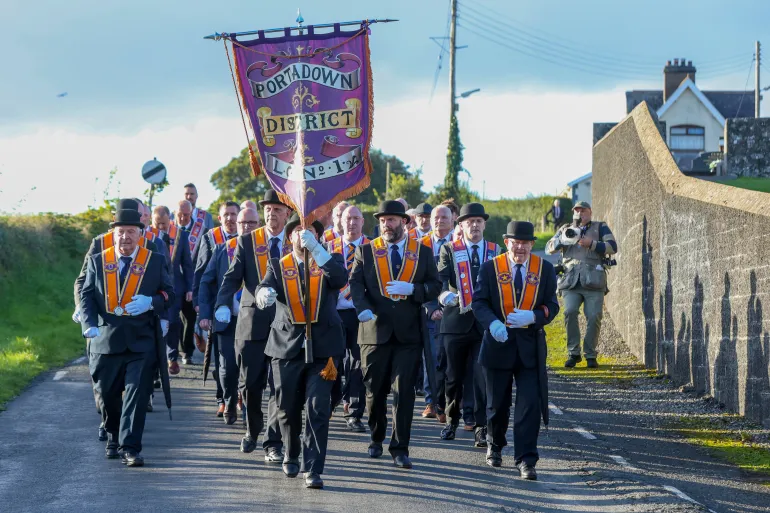
But this was suddenly unsettled by a last-minute decision by the High Court to allow the march. In response, Catholic residents blocked the road. Many camped out as Orange men gathered at the top of the road, awaiting police permission to pass – an image of division that never truly left.
Portadown Orangemen march from Drumcree Church to start their march towards Garvaghy Road, which was stopped a short distance later by police, in Portadown, Northern Ireland on September 27, 2026 [AFP]
Many of the Garvaghy Road residents are now parents, and fear what their children might inherit from a dispute they hoped had been left behind.
Paul O’Connor, of the Pat Finucane Centre human rights group in Northern Ireland, said Rosemary Nelson is among 21 people whose deaths were linked to the Drumcree dispute.
Many are still being investigated, with families continuing to seek justice and pressing for public inquiries amid concerns about collusion between the British state and loyalist paramilitaries, many of which were members of the Orange Order.
“These murders encompass LVF (Loyal Volunteer Force) killings at that time, and are all linked to the Drumcree disputes. They were responsible for many of the killings around the Mid Ulster area at that time. They were trying to destabilise the peace process, with many riots spreading around, including into Derry,” O’Connor told Al Jazeera.
He worked with Rosemary Nelson and is now seeking a public inquiry into the murder of Sean Brown, another Drumcree-linked case, he believes. The 61-year-old father of six from Bellaghy, County Derry, was abducted and murdered in May 1997.
The following year, the three Quinn brothers – Richard, 10, Mark, nine, and Jason, eight – died after loyalists petrol-bombed their home in Ballymoney, County Antrim, as they slept. Their deaths, during the unrest surrounding Drumcree, brought widespread calls for the Orange Order to end its standoff.
Protesters block the Garvaghy Road in Portadown, Northern Ireland on September 27, 2026, preventing a parade of marchers from the Orange Order using the route through the mainly nationalist area of the town [AFP]
Fear and loathing in Mid Ulster
In Portadown town centre, a Union flag flies among plinths dedicated to the Ulster Defence Regiment, a locally recruited unit of the British army and the Ulster Covenant – a document signed when nearly 500,000 people opposed a form of self-government for Ireland in 1912.
Around the corner, in the Edgarstown housing estate, Ulster Volunteer Force (UVF) flags hang from lampposts, and the kerbs are painted red, white and blue, alongside a mural of a Rangers FC badge.
The area is one of the heartlands of unionism. The Orange Order was founded in 1795 in the village of Loughgall, a few miles from Drumcree.
The Orangemen say they have marched the route through Garvaghy Road since 1807. The parade has been blocked from Garvaghy Road since 1998, but the Orangemen have continued submitting requests to march.
The latest Parades Commission decision permitted 35 men to walk without music. Since then, Orangemen have repeatedly approached the police line before returning to the church.
UVF flags fly alongside UK flags in the Edgarstown estate, Portadown, Northern Ireland, on October 1, 2026 [Caolán Magee]
Irish nationalists have criticised the police assessment underpinning the decision to allow the march, while unionists have denounced police for failing to forcibly remove protesters blocking the route.
Al Jazeera contacted the three main unionist parties – the Democratic Unionist Party (DUP), the Traditional Unionist Voice (TUV) and the Ulster Unionist Party (UUP) – for comment but received no response.
Addressing around 200 supporters in Portadown, loyalist activist Jamie Bryson described protesters as “an unlawful snarling mob”.
He has called for the First Minister, Sinn Fein’s Michelle O’Neill, and police Chief Constable Jon Boutcher to resign, and demands that the Orange men must be allowed to walk the Garvaghy Road.
O’Neill has faced criticism for standing beside the protesters.
At Drumcree Church, the Orangemen were not marching, but sitting down drinking tea and eating crisps. Around six men, one wearing his sash, huddled under a gazebo in the cold.
“We are waiting patiently for the chief constable to apply the law of the land,” Nigel Dawson, the Portadown Orange Order district master, told Al Jazeera.
“Portadown District has never in its history stopped a parade down the road to have a confrontation with its neighbours, ever. So I don’t know where the fear and trepidation comes from.”
Another Orangeman, who requested anonymity, added: “We are determined to get home after Sunday service … We just want to go home.”
Orange Order members sit outside Drumcree church as they await passage along Garvaghy Road in Portadown, Northern Ireland, on October 1, 2026 [Caolán Magee]
Around a mile further down the Garvaghy Road, Irish folk band the Mary Wallopers performed to hundreds of residents and supporters.
Children danced and slid down the embankment, as parents watched from above. Palestine and Ireland flags flew in the wind.
Linda O’Neill, 51, a Garvaghy Road resident, told Al Jazeera the scene would have been unimaginable 30 years ago.
“It was horrendous growing up as a teenager. We stayed in our own community. We didn’t access the town centre … This community was a ghetto. And that was deliberate.”
Another resident, Ciaran O Ferghail, remembered summers spent surrounded by British forces.
“This community was turned into a war zone. There were tanks and British Army everywhere, thousands of RUC. This community was completely under siege every summer, by the Orange Order, the British military, the RUC and loyalist paramilitaries. We were surrounded on every road and in every direction.”
O’Neill said the confrontation changed as residents began asserting their rights.
In 1995, hundreds sat down on Garvaghy Road to block the parade. The ensuing violent standoff between security forces and Orangemen and their loyalist supporters ended in a compromise allowing the march through. Residents say they understood it would be the last.
But the following summer, the parade returned. Police initially blocked it, then reversed course after five days of widespread loyalist attacks. Officers forced residents off the road and beat them, sparking riots in Catholic communities.
In 1997, security forces sealed off the Catholic neighbourhood before dawn and allowed the parade through at midday amid loyalist threats to kill Catholics if it was stopped. Nationalist protests and violence followed. From 1998, the march was banned from Garvaghy Road. But for residents, summers remained marked by the army’s steel barricades until 2000.
Children play on the embankment as music rings out along Garvaghy Road in Portadown, Northern Ireland, on October 1, 2026 [Caolán Magee]
Lessons from the past
Chris Nelson, almost 40, is around the same age his mother was when she was killed.
The Garvaghy Road protests mark the first time he has chosen to speak publicly about his mother.
He went on to study law at university, but says his life would have followed a different trajectory if she were still here.
The public inquiry into his mother’s death found no evidence that state security agencies had “directly facilitated” her murder, but it “could not exclude the possibility” that individual members of those agencies had helped the perpetrators.
The inquiry brought the past back repeatedly as he tried to get on with his life. But seeing photographs of families linking arms on Garvaghy Road brought back unavoidable memories of his mother.
“If she were here, that’s where she would be,” he said, “standing with the people of the Garvaghy Road”.
While there has been no violence in Portadown, in Derry’s Waterside, two recent nights of disorder saw petrol bombs and masonry thrown at police. Officers described the crowd on the second night as mostly young people.
The renewed attempt to bring the Orange Order parade through Garvaghy Road risks leaving its mark on children on both sides. With some schools closed, Chris Nelson worries about parents having to explain to their kids what is happening.
“Children don’t forget things“, he said. “They absorb everything.”
He remembers how it felt waiting for his mother each night, and how that worry followed him through the summer holidays. He wants something different for the children growing up now.
“Children shouldn’t grow up knowing the difference between Catholic and Protestant.
“It isn’t something that should be brought into the mind of a child.”
A ‘Garvaghy Road says no’ sign with an Irish tricolour in the background in Portadown, Northern Ireland, on October 1, 2026 [Caolán Magee]
India’s Cockroach Janta Party has launched a new protest demanding change after millions of voters were allegedly improperly removed from electoral rolls. Other protest movements joined the rallies, which led to scuffles and arrests in the capital.
Toronto, Canada: As Canadian Prime Minister Mark Carney races to make the country less dependent on the United States, attract billions in new investment and get major projects built faster, his economic overhaul is running into resistance from a group that says it wants many of the same things: organised labour.
The latest clash, over the right to strike, comes after months of mounting pressure on Ottawa from Washington, DC.
Recommended Stories
list of 4 itemsend of list
US President Donald Trump, since taking up a second term in office last year, has imposed steep tariffs on Canadian goods and weakened trade agreements – perilous moves as Canada has historically sent close to 80 percent of its exports to its southern neighbour. He has repeatedly piled on with the tariff threats to make Canada the 51st US state.
Canada has responded with retaliatory tariffs, while a broader movement to “Buy Canadian” has taken hold. The hockey-inspired “elbows up” — meaning a readiness to defend against an opponent — has become a national rallying cry.
With trade talks stalled since August, Carney has moved with urgency to shore up the economy and invite new investments. Last month, he announced Bill C-39, known as the Building Canada Strong Act, promising to bring “speed, certainty and predictability” to investors.
Along with measures to speed up approvals for major projects, the bill would also give Ottawa clearer powers to intervene in legal strikes and lockouts in federally regulated workplaces — a provision that has put Carney on a collision course with unions.
Canada’s largest unions have come together against the changes. The largest, the Canadian Union of Public Employees (CUPE), had its national executive go as far as voting to defy the bill’s proposed limits on the right to strike if it passes Parliament without amendments.
CUPE National President Mark Hancock credited Carney’s handling of Trump and said the union’s 800,000 members, who work everywhere from hospitals to schools to municipal services, want to be part of “Team Canada”.
“But at what cost?” he said in an interview with Al Jazeera.
A fight over the right to strike
The controversy centres on Section 107 of the Canada Labour Code, which already gives the Labour Minister broad powers to step into disputes if needed to maintain “industrial peace”, end work stoppages and force the two sides into a binding arbitration.
Beginning in 2024, Ottawa used the provision eight times to intervene in disputes involving airlines, Canada’s two largest railways, three major ports and Canada Post and again during the Air Canada dispute in 2025 when flight attendants went on strike.
Unions have challenged the use of that law in court and had hoped the proposed C-39 would restrict, if not repeal, that clause while businesses wanted it strengthened.
The bill does neither. Instead, it introduces two conditions that the government would have to fulfil first before turning to Section 107.
Before stepping in, the government would have to appoint a special mediator, wait for a public report and consider whether a work stoppage is hurting the “national interest”.
Once a strike or lockout is underway, the minister could direct the Canada Industrial Relations Board to get operations running again and impose a binding process, such as arbitration.
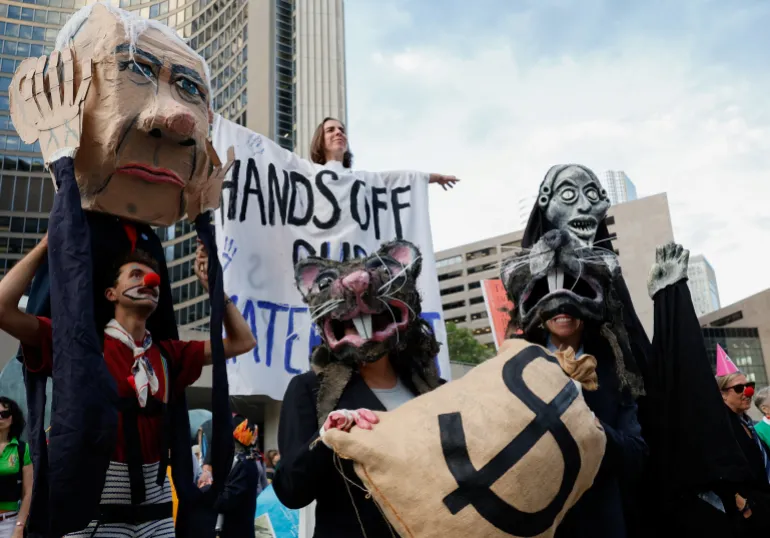
A protester carries an effigy depicting Canada’s Prime Minister Mark Carney as people march to protest against the Canada Investment Summit in Toronto in September [File: Carlos Osorio/Reuters]
The government says those steps put clearer guardrails around a power that already exists, and Carney has said the bill “absolutely reinforces the right to strike”, according to the Canadian Broadcasting Corporation.
Unions have rejected this defence, pointing out that the meaning of “national interest” would ultimately be decided by the minister. They also argue that the prospect of government intervention is bound to change what happens at the bargaining table.
“The political lesson that employers will draw from it is simple,” Larry Savage, a professor of labour studies at Brock University, told Al Jazeera. “Hold out long enough, emphasise the economic damage, and then Ottawa will remove the union’s leverage for you.”
Disruption, Savage said, is precisely what gives a strike its power. “Every effective strike is disruptive,” he said.
Unions say they have already seen employers expect Ottawa to intervene.
Teamsters Canada alleges the Canadian National Railway (CN) and the Canadian Pacific Kansas City (CPKC) railroad companies were counting on Ottawa to step in when they locked out thousands of workers in 2024. Section 107 was invoked within hours.
“Companies have gotten used to the idea that if there is a labour dispute, they can just wait for the government to intervene,” Christopher Monette, Teamsters Canada’s director of public affairs, told Al Jazeera.
CUPE said it saw a similar dynamic at Air Canada in August 2025. Hancock said bargaining stalled after more than 10,000 Air Canada flight attendants voted overwhelmingly to strike because the airline was “expecting the government of Canada to step in and end the strike” — an account Air Canada disputed.
Less than 12 hours after workers walked out, Ottawa invoked Section 107. Air Canada CEO Michael Rousseau later told BNN Bloomberg the airline had expected the provision to be enforced and did not expect a strike.
“That was why they didn’t have a strategy on how to deal with the strike,” Hancock said.
Building Canada faster
The fight over the right to strike is also part of a much bigger argument taking shape around Carney’s economic agenda: Who gets a say in how Canada should change, and how quickly, in the name of making itself less vulnerable to the US?
Critics accuse Carney of using the economic threat from the US to push through changes that go well beyond responding to Trump’s trade war.
New Democratic Party leader Avi Lewis has accused him of using the “fear and disorientation around the trade war to push through a series of unpopular measures that he did not run on, has no mandate for and would never get away with under normal circumstances”.
A protester carries an effigy depicting Canada’s Prime Minister Mark Carney outside the Canada Investment Summit in Toronto [File: Carlos Osorio/Reuters]
That tension was on display in Toronto just a week before C-39 was introduced. Inside Canada’s first national investment summit, hundreds of global investors met with government officials and executives as Carney pitched a country ready to build.
Outside, hundreds of protesters marched through downtown towards the summit’s opening gala under the banner “The Many vs The Money”. The rally brought together labour, Indigenous, environmental and migrant-rights groups, with signs and speeches taking aim at everything from fossil fuel and military projects to AI and the use of public money to attract private investment.
For unions, C-39 has sharpened that debate, pitting the government’s promise of greater certainty for investors against workers’ ability to exert pressure through strikes.
But Jim Stanford, an economist and director of the Vancouver-based Centre for Future Work, questions how much of an economic threat strikes actually pose.
While work stoppages can be costly for individual companies, Stanford said, “It is very, very rare that you would see a noticeable and sustained impact on GDP, employment or incomes.”
Production and transportation are often delayed rather than permanently lost, he added, with businesses catching up once work resumes.
Stanford also questioned the idea that strikes are driving away investment, noting that more than 95 percent of collective bargaining ends without a work stoppage and saying there is “no empirical evidence whatsoever” that strikes have reduced investment.
“This is more of the government giving some icing on the cake for business. It’s not that this has to happen or else our investment won’t work,” he said.
There is also an economic cost to weakening the right to strike, Stanford argued. Workers need bargaining power to win higher wages, which can support consumer spending, productivity and worker retention.
“It may seem like labour peace is a good thing, but if it means that a worker’s share of the pie shrinks, then this actually hurts the economy.”
For labour leaders, that’s where Carney’s economic push goes too far.
“Canada’s unions are part of Team Canada. We have our elbows up,” Canadian Labour Congress President Bea Bruske said in a statement. “But we can’t have our elbows up against Trump with our hands tied at the bargaining table.”
Savage said the government’s “Team Canada” rhetoric risks treating workers’ bargaining power as a national liability.
“I don’t think Canada becomes stronger by telling workers in ports or railways or airlines that their rights have to be surrendered whenever employers invoke competitiveness or the national interest,” he said.
Mahan Air is excluded from the agreement as Baghdad says Washington granted its request for a waiver.
Published On 2 Oct 20262 Oct 2026
Iraq has agreed to let Iranian airlines, except Mahan Air, operate up to 40 flights a day to and from Najaf International Airport, saying the United States granted an exemption from its sanctions.
Prime Minister Ali al-Zaidi’s office announced the agreement on Friday, a day after Tehran urged Baghdad to lift restrictions that it said hurt pilgrims, patients, students and business.
Recommended Stories
list of 2 itemsend of list
The deal eases the links between the two Shia-majority neighbours since Washington sanctioned Iran’s aviation sector last month.
Al-Zaidi welcomed the “positive response shown by the US government to Iraq’s efforts and its cooperation in granting the necessary exemption”, the statement from his office said.
“Air travel does not merely represent transportation between two airports, but rather a bridge of communication between peoples,” it added.
Separately, Iraq’s Foreign Minister Fuad Hussein said the return of flights supports an Iraqi-US partnership premised on mutual respect.
Hussein also welcomed what he described as US understanding of the importance of respecting religious freedom and facilitating access for visitors to holy sites.
Security personnel stand guard as demonstrators gather outside the Al-Najaf Al-Ashraf International Airport in Najaf, demanding the facility to be reopened for flights from Iran [AFP]
Flights suspended
The US Treasury announced sanctions on September 8 against 36 entities linked to Iran’s aviation sector.
Foreign ground-handling companies then refused to service Iranian aircraft for fear of falling foul of US sanctions, and flights stopped at four Iraqi airports.
Soon after, Iraq’s government held direct talks with Washington, seeking an exemption.
Iraq’s ambassador to Tehran, Yasser al-Hajjaj, told Iran’s IRNA news agency that Baghdad had not ordered the halt in flights. The suspension also led to demonstrations outside Najaf airport and in Nasiriya, Karbala and Amarah, according to Iran’s Press TV.
Najaf is the main destination for Iranian flights in Iraq. Flights to and from the city carry Iraqi Shia Muslim pilgrims to Iran’s holy cities or Iranians visiting sacred sites in Iraq.
Iran’s ambassador to Baghdad, Mohammad Kazem al-Sadegh, told the Iranian news agency ISNA that there were “roughly 25 daily flights from Iran to Najaf and about 15 flights to Baghdad” before the ban.
“Around 12,000 to 13,000 people travel between Iran and Iraq and vice versa on Iranian airlines, which is not a small number,” he added.
In a statement shared on Thursday, Iran’s Foreign Ministry said that Washington’s “illegal and inhumane” extraterritorial enforcement of sanctions was disrupting Iran’s trade and air transport.
Restrictions remain
Flights between Najaf and Iran restarted late on Monday, according to the Iraqi News Agency.
However, flights with Iran are still suspended at Baghdad, Erbil and Sulaimaniyah airports, forcing passengers into land journeys of at least 12 hours and disrupting pilgrim traffic.
Al Jazeera has not verified the exemption with representatives in Washington.
Both decrees to tackle housing affordability crisis shot down as critics say measures would tighten the housing market.
Spain’s government has lost key votes to ratify emergency measures aimed at tackling the nation’s housing affordability crisis, after protests intensified last month following the eviction of an 87-year-old woman.
The proposed measures, which comprised two separate decrees, were both shot down by the majority of the 350-seat lower house of parliament on Friday.
Recommended Stories
list of 3 itemsend of list
The move is a heavy blow to Prime Minister Pedro Sanchez, whose government faces public pressure, including from the hundreds of protesters who had gathered outside parliament demanding help for renters.
The first decree was meant to stop evictions of vulnerable people, make real estate speculation harder, impose tighter restrictions on short-term leases and provide tax incentives to encourage renting and the construction of housing.
The second decree proposed making leases automatically renew when they are set to expire, essentially making them indefinite. A property owner would have to pay a tenant 12 months of rent to break the contract.
The right-wing Catalan separatist party Junts refused to back the housing decrees, saying they would ultimately tighten the housing market. The centre-right Popular Party and far-right Vox also voted against the measures.
Sanchez, who leads a coalition government composed of his Socialist Party and the far-left Sumar, appealed to lawmakers in the run-up to the vote to put aside political calculations and pressure.
“Think about ordinary people, about those who most need the protection of public institutions. Think about the millions of young people who cannot afford to move out of their parents’ homes. Think about the families living with the constant anxiety of ever-rising rents,” he said.
“Do the right thing, because I believe that if you do not, history will judge you sooner than you think, and far more harshly than you can imagine.”
Miriam Nogueras of Junts argued the decrees would only lead to owners removing their properties from the rental market, and thus driving up prices even further.
“These decrees still allow speculators to buy property and to evict people,” Nogueras said.
‘Your profits, our misery’
As the vote was under way, protesters marched on the parliament demanding help for renters.
The government decrees were intended to quell a public uproar following the televised eviction on September 23 of Maria del Carmen Abascal, known across Spain as Maricarmen, that set off protests and a camp-in that occupied Madrid’s Puerta del Sol square ever since.
Abascal was living in the property in Madrid’s central Retiro neighbourhood under a rent-capped lease contract signed by her father in the 1950s. The property was then bought by the real estate and investment firm Urbagestion in 2018.
Urbagestion sought to terminate Abascal’s contract and evict her after raising her rent from 500 euros ($572) to 2,650 euros ($3,010) – nearly double her pension of 1,350 euros ($1,533) a month – according to Spanish newspaper El Pais.
When the police carried out her eviction on their fourth attempt, hundreds of activists who had been protesting against her losing a home she had lived in her entire life were waiting outside. Abascal has since been offered a preliminary agreement that would allow her return to her home.
Protesters rallying at the chamber in downtown Madrid on Friday held up homemade signs with images of vultures on them, denouncing the real estate speculators they blame for driving up prices.
Some people gathered outside the assembly chanted “your profits, our misery” as lawmakers voted down the government’s decree.
The average rent in Spain has almost doubled in the past 10 years. The average price per square metre has risen from 8.20 euros (about $9.08 at the time) in 2016 to 15.1 euros ($17.15) this year, according to the real estate website Idealista.
Venezuelan authorities have pledged to incorporate 1,300 MW into the grid by the end of the year. (Radio Fe y Alegria)
Caracas, September 30, 2026 (venezuelanalysis.com) – Venezuelan Minister of Electric Energy Rolando Alcalá announced a plan to add 1,300 megawatts (MW) to the country’s electric grid amid growing protests against recurring blackouts.
In a televised message published on Tuesday, Alcalá pledged that the electricity supply would improve in the final quarter of 2026 to mitigate outages. He explained that a unit at Planta Centro, Venezuela’s main generation complex serving the central-western region, will come online “in the coming days” and provide 600 MW to the area.
The official also announced that seven generation units with a combined capacity of 500 MW will be added to a key thermoelectric plant in Zulia state, which borders Colombia and is one of the areas hardest hit by power failures.
The government is also reportedly working on an alternative energy plan for the state, including the Machango solar panel park, which is expected to come online next year.
The remainder of the planned generation will come from units located in other regions of the country.
“Other units will be brought online nationwide, for a total of 1,300 megawatts during this final quarter of 2026. These will help achieve greater stability, continuity, and fewer interruptions in electricity service nationwide,” Alcalá said in a video shared by Acting President Delcy Rodríguez on social media.
“We have a clear plan to face the challenges of the National Electric System and we are executing it,” she wrote on X. “With organization, coordination, and effort we move forward to overcome this situation.”
Meanwhile, the president of the National Electric Corporation (CORPOELEC), Juan Fernández, explained that “as a complement to the thermal generation plan, major transmission projects are being carried out.” He highlighted the expansion of the Planta Centro substation with the addition of a new 400-230 kV autotransformer, equipment that recently arrived from abroad.
“This year, we have gained access to original spare parts and components from the world’s leading manufacturers,” he added, referencing agreements with US-based GE Vernova, Germany’s Siemens, and Argentina’s Impsa. The US Treasury Department has issued sanctions waivers allowing transactions with Venezuela’s electricity sector.
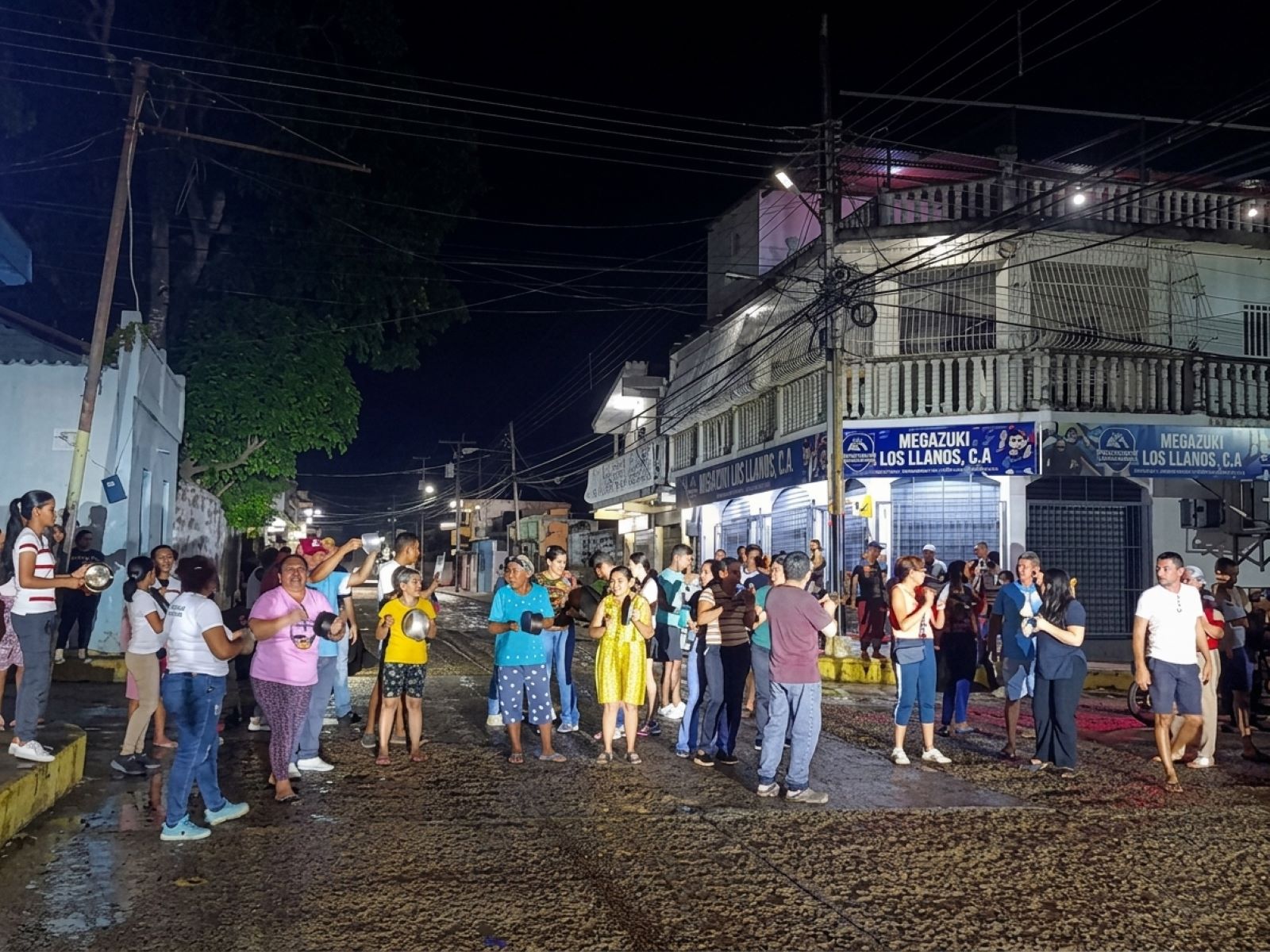
The latest announcements came amid near-daily protests over power outages throughout the country. Demonstrators have taken to the streets to bang pots and pans or block streets to demand that authorities answer for blackouts that can add up to 16 hours per day.
On Wednesday night, protesters from Guacara, Carabobo State, temporarily blocked the Central-Regional Highway, the main highway connecting Caracas to Western regions, after electricity was shut off for a second time in the same day.
In statements to local press, demonstrators have highlighted that high temperatures and mosquitoes make it hard to sleep without ventilators or air conditioning, leading children to fall asleep in school. They have also criticized authorities for not producing a rationing schedule, making it impossible for families and businesses to plan around outages.
In their Tuesday televised message, Venezuelan government officials stated that the country’s electricity demand has risen in recent weeks, driven by a “rebound in economic activity,” high temperatures caused by the El Niño climate phenomenon, and the twin June 24 earthquakes which “delayed plans that had been underway to repair the electrical system.”
On September 22, the Ministry of Electric Energy reported that electricity demand in Venezuela had reached a record high of 16,424 megawatts (MW), the highest level recorded in the past nine years.
Venezuela has a nominal installed generation capacity of approximately 35,000 megawatts (MW), twice the country’s peak demand. However, actual stable generation currently stands at just 12,000 MW due to a deep structural crisis resulting from US sanctions that prevented the purchase of spare parts, as well as issues of underinvestment, lack of maintenance, and corruption.
Nevertheless, authorities claimed that a proposed reform of the Organic Law of the National Electricity System and Service will allow “the integration of the public and private sectors in electricity generation, transmission, distribution, and commercialization,” with the aim of “promoting competitiveness, and attracting investment to strengthen electrical infrastructure.”
The new law was preliminarily approved by the National Assembly in June, with a second discussion and final approval yet to be scheduled.
The previous legislation, enacted in 2010 under President Hugo Chávez, exclusively reserved all activities across the electricity supply chain for the state, centralized through the state-owned CORPOELEC. The reform authorizes strategic partnerships and concession agreements with domestic and international private companies.
In defending the new law, Venezuelan officials have defended the adjustment of electricity tariffs to reflect “real costs” and secure returns for investors.
Many French schools are still closed as protests over learning conditions continue across the country, with violence, blockades and hundreds of arrests. Al Jazeera’s Natacha Butler spoke to students demonstrating in Paris.


![Traffic moves past shipping containers used to block the area, ahead of a planned march by jailed former Prime Minister Imran Khan's Pakistan Tehreek-e-Insaf (PTI) party, in Islamabad, Pakistan, on September 30, 2026 [Reuters]](https://i0.wp.com/occasionaldigest.com/wp-content/uploads/2026/10/2026-10-02T070015Z_265516849_RC2NTNAKEGKJ_RTRMADP_3_PAKISTAN-PROTESTS-CONTAINERS-1791131201.jpg?w=640&ssl=1)
![Police and security personnel detain a protester during a demonstration against India's Chief Election Commissioner Gyanesh Kumar in New Delhi on October 3, 2026, to demand his resignation [Arun SANKAR / AFP]](https://i0.wp.com/occasionaldigest.com/wp-content/uploads/2026/10/AFP__20261003__D24U6XM__v1__HighRes__IndiaPoliticsElectionProtest-1791123918.jpg?w=640&ssl=1)

![Portadown Orangemen march from Drumcree Church to start their march towards Garvaghy Road, which was stopped a short distance later by police, in Portadown, Northern Ireland on September 27, 2026 [AFP]](https://i0.wp.com/www.aljazeera.com/wp-content/uploads/2026/10/afp_6abfeb6d30a8-1790962541.jpg?w=640&ssl=1)

![UVF flags fly alongside UK flags in the Edgarstown estate, Portadown, Northern Ireland, on October 1, 2026 [Caolán Magee]](https://i0.wp.com/www.aljazeera.com/wp-content/uploads/2026/10/DSC00033-1790961495.jpg?w=640&ssl=1)
![Orange Order members sit outside Drumcree church as they await passage along Garvaghy Road in Portadown, Northern Ireland, on October 1, 2026 [Caolán Magee]](https://i0.wp.com/www.aljazeera.com/wp-content/uploads/2026/10/DSC00113-1790961532.jpg?w=640&ssl=1)
![Children play on the embankment as music rings out along Garvaghy Road in Portadown, Northern Ireland, on October 1, 2026 [Caolán Magee]](https://i0.wp.com/www.aljazeera.com/wp-content/uploads/2026/10/DSC00134-1790961539.jpg?w=640&ssl=1)
![A ‘Garvaghy Road says no’ sign with an Irish tricolour in the background in Portadown, Northern Ireland, on October 1, 2026 [Caolán Magee]](https://i0.wp.com/www.aljazeera.com/wp-content/uploads/2026/10/DSC00064-1790961515.jpg?w=640&ssl=1)