proceed

US army says detonation of lead explosives in Iowa will proceed | News

Public outcry led to a legal battle when details surfaced of the plans to conduct two controlled detonations.

The United States military will proceed with its plan to blow up a deteriorating stockpile of toxic lead explosives in rural Iowa, according to the army’s top civilian official, after a federal appeals court gave clearance to the waste disposal operation.

In an announcement late Monday on X, Acting Army Secretary Adam Telle called the choice to move forward a “consensus decision” among all the federal agencies involved, as well as the courts and state officials.

Recommended Stories

list of 4 itemsend of list

“Every expert agency agrees, and both Iowa’s current and incoming governors say the call belongs to the experts,” Telle said.

“We are proceeding with the controlled removal in full coordination with all state, local and federal authorities.”

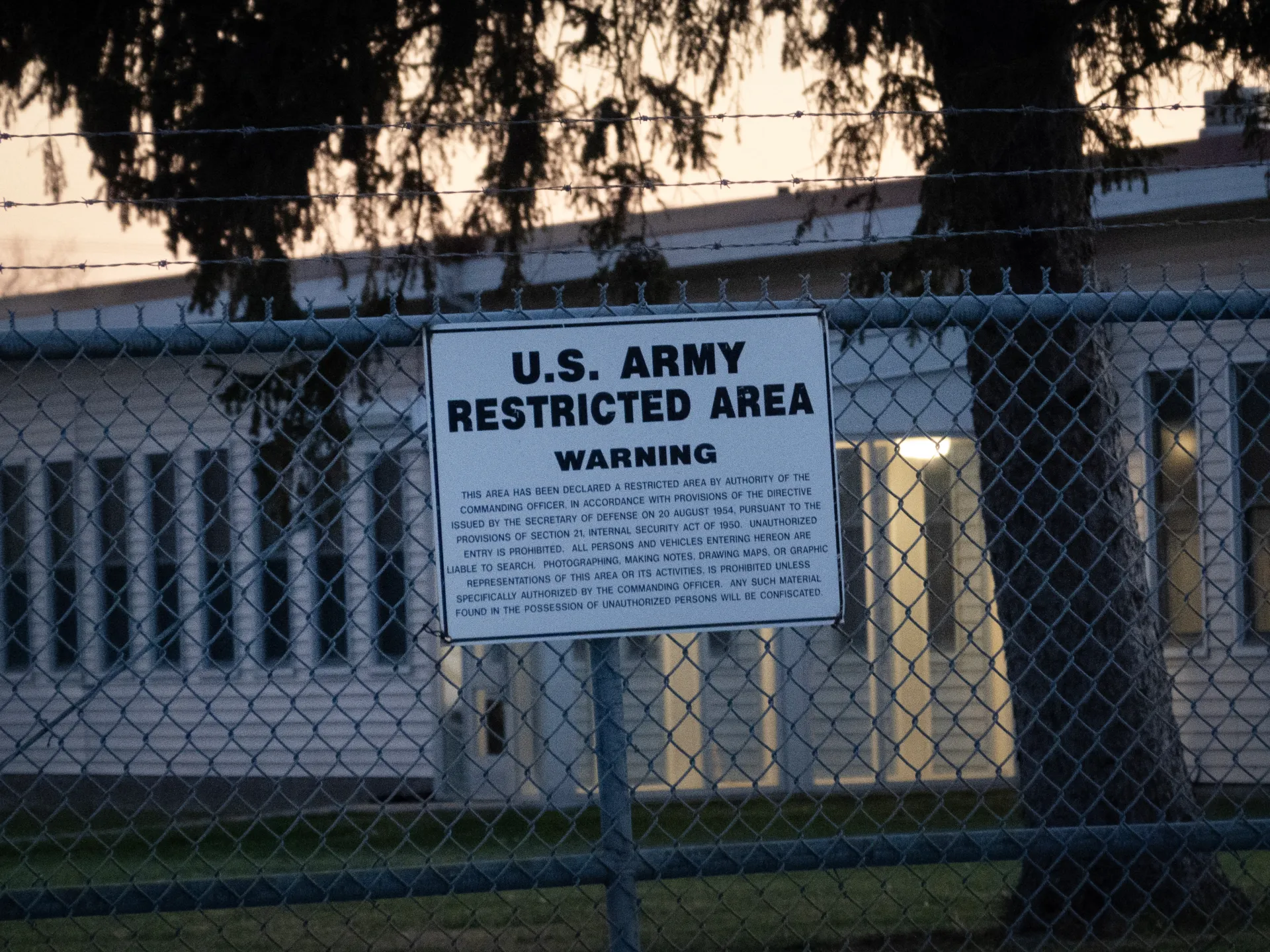
The Army prompted a public outcry last week when details surfaced of its plan to conduct two controlled detonations of 68 drums containing almost 4,500kg (10,000lb) of degraded lead azide, a chemical used in munitions, at the Iowa Army Ammunition Plant in Middletown, Iowa.

Environmental groups immediately filed suit to block the plan, raising public safety concerns over the likelihood that the explosions would release a plume of toxic lead dust over homes, crops and livestock far beyond the detonation site, about 240km (150 miles) southeast of Des Moines.

The lawsuit challenged a special permit granted for the operation by the Environmental Protection Agency (EPA).

The EPA countered that a managed detonation would be far less risky than an uncontrolled, spontaneous explosion of the highly volatile material, a scenario the agency said was growing more likely as the weather turns colder in Iowa.

According to the EPA, any attempt to chemically neutralise or relocate the storage drums would also risk an uncontrolled blast.

A three-judge panel of the 8th US Circuit Court of Appeals last Thursday issued a temporary stay blocking the EPA’s permit while the court more thoroughly reviewed the case.

But Trump administration lawyers filed a legal notice two days later asserting that the Army intended to carry out the controlled detonation with or without court approval, citing an emergency exemption to federal environmental laws.

Then, in another twist on Monday, US President Donald Trump weighed in on the controversy, ordering the Army to hold off on its disposal plan until the appeals court had ruled in its favour.

Hours after Trump’s edict on Monday pausing the army’s demolition plan, the 8th Circuit sided with the EPA and lifted the court’s earlier stay, removing the final legal obstacle. But the status of the detonation plan remained unclear until Telle’s announcement on Monday night.

Source link

Judge allows Trump defamation case against BBC to proceed but tosses one claim

President Trump’s $10 billion defamation case against the BBC remains on track, for the moment.

A federal judge in Florida ruled on Tuesday that Trump’s defamation claim could go forward, though he did not rule on the merits. The publicly funded British broadcaster had sought to dismiss the case.

Judge Jeffrey Kuntz did dismiss part of the case, tossing out a Trump claim that the BBC’s actions violated a Florida law concerning unfair business practices.

Trump filed his lawsuit against the BBC in December. The Republican president accused the BBC of defamation as well as deceptive and unfair trade practices related to a documentary, “Trump: A Second Chance?”

The BBC acknowledged that filmmakers spliced together quotes from different sections of the speech Trump delivered to his supporters on Jan. 6, 2021, before the storming of the U.S. Capitol, to make it seem that Trump was directly urging violence.

The broadcaster apologized over the editing, and that was something the judge made note of in his ruling Wednesday. The head of the BBC and its top news executive both resigned. The BBC has denied Trump’s claims that it defamed him.

In October, a different judge in Florida ordered Trump to sit for a deposition in the case by Dec. 11. Lawyers for the BBC had complained that Trump was delaying his appearance in his own lawsuit. Charles Tobin, an attorney for the BBC, said that with two months left in the discovery period, “we still haven’t been able to depose the plaintiff.” The deposition deadline could yet be extended.

Trump called Kuntz’s latest ruling a major victory.

“A Huge Victory against Fake News BBC, a terrible abuser of the truth, just handed down by highly respected District Court Judge, Jeffrey T. Kuntz, of the Southern District of Florida,” Trump posted on his Truth Social platform.

“We will continue fighting against, and defeating, all of those who try to deceive the American People!” Trump wrote Tuesday evening.

Source link

US Supreme Court allows border wall in Big Bend National Park to proceed | Courts News

A lawsuit had sought to block border wall construction in the Big Bend National Park by targeting the waivers that sidestep environmental protections.

The United States Supreme Court has allowed President Donald Trump’s administration to build a border wall through a remote section of Big Bend National Park in West Texas.

In its decision on Monday, the court granted the government’s emergency request to lift a lower court’s injunction that had paused construction while the matter was litigated.

Recommended Stories

list of 3 itemsend of list

The injunction, it said, “impedes the Government from advancing its ‘compelling interests’ in border security and integrity”.

The border wall has long been a signature part of Trump’s platform to restrict immigration into the US.

During his first successful bid for the presidency in 2016, for instance, he rallied supporters with chants of “Build the wall!”

But the push to expand the border barrier through the popular national park has met pushback from conservationists, local officials and some members of Trump’s own Republican Party.

Big Bend National Park includes mountain ranges and desert that serve as a home to endangered species like the Mexican long-nosed bat.

Opponents say the plan to build the wall through the park would disrupt the ecologically and culturally significant landscape.

The Trump administration, however, has depicted the project as an urgent priority for national security and immigration control. It has described the Big Bend area as an artery for irregular border crossings and drug trafficking.

US District Judge Kathleen Cardone blocked the construction in October, noting that while the Big Bend sector makes up more than 25 percent of the US-Mexico border, it accounts for only 0.3 to 2.2 percent of migrant apprehensions.

“Therefore, if the Big Bend Sector is an area of high illegal entry, so is every other sector, and the waiver authority would apply to the entire US-Mexico border,” Cardone wrote.

The Supreme Court, however, said the government was “exceedingly likely to prevail” on its argument that Cardone lacked jurisdiction under the 1996 Illegal Immigration Reform and Immigrant Responsibility Act, which limits the ability of lower courts to rule on border barriers.

Under that law, district courts can only hear claims alleging a violation of the US Constitution. The Supreme Court found that the challengers’ claim did not qualify, writing that “there is no such thing as a ‘constitutional’ major-questions claim”.

Justice Ketanji Brown Jackson was the only justice to indicate she would have denied the government’s request. She did not explain her reasoning.

The Center for Biological Diversity was among the plaintiffs who brought the lawsuit against the Department of Homeland Security, along with Friends of the Ruidosa Church and a local river guide and landowner.

The lawsuit challenged waivers used by the agency to fast-track border construction and sidestep environmental and conservation laws.

Without those waivers, plaintiffs said that construction would have to comply with laws such as the Endangered Species Act, the National Environmental Policy Act and the National Historic Preservation Act to alter the landscape in “one of the most remote and ecologically and culturally significant landscapes in the United States”.

Source link

9th Circuit denies feds’ appeal over 20,000 ballots; district court hearing to proceed

A federal appeals court Monday denied an emergency request from the U.S. Justice Department to step in and block California election officials from counting about 20,000 ballots from voters whose citizenship the Trump administration has questioned.

The three-judge panel of the U.S. 9th Circuit Court of Appeals — composed of two judges appointed by President Trump and one by President Biden — ruled that it did not have jurisdiction over the request, given that a lower district court has not yet made a ruling on it.

But two of the three judges also wrote separately to make clear they also would have denied the Trump administration’s request on other grounds, if they did have jurisdiction.

In an unsigned order — joined by Judge Mark J. Bennett, one of the Trump appointees, and Judge Gabriel P. Sanchez, the Biden appointee — the court granted a request from Los Angeles County to dismiss the appeal, writing that the Trump administration “failed to allow the district court adequate opportunity to consider” its request for a temporary restraining order barring the ballots from being counted before filing its unusual appeal to the appellate panel.

The court found that the “emergency” the Trump administration asserted was in part a “self-constructed one” and that delays in the district court were partly attributable to its “own delay in filing suit, in realizing that existing California state law governs the issuance and processing of ballots, in recognizing that California has millions of registered voters and processes ballots on a schedule aligned with that scale, and in communicating to the court its desired relief.”

Both Bennett and Sanchez also each wrote a concurring opinion — in which they made clear that they would have denied the Trump administration’s request even if they did have jurisdiction, too.

Sanchez wrote that federal law would bar the court from issuing such a demand on state elections officials so close to an election.

“The United States seeks to have a federal court dictate to California the manner in which it must administer its own electoral process by segregating mail-in ballots and undertaking a citizenship verification process the State has never done before,” Sanchez wrote. “The proposed injunction would transform California’s election rules for an election that is already underway and would cause widespread confusion among voters and election officials, divert election administration resources, and ‘usher in electoral chaos.’”

Bennett wrote that he would have denied the Trump administration’s emergency request for several reasons beyond jurisdiction, including that it would be likely unconstitutional under the Elections Clause of the U.S. Constitution, which he wrote “confers broad authority only on Congress and the States, not the Executive,” and Congress has not acted to say that California’s existing laws for ensuring only U.S. citizens vote are problematic.

“Thus, under the Elections Clause, the legislature’s statutory scheme remains as the only method to do so,” Bennett wrote.

Bennett wrote that there are existing California laws to deal with the harm the Trump administration claims it is suffering, but that granting its request to intervene could “result in immense hardship” to the state “and harm the public by risking the disenfranchisement of eligible voters and putting the entire tabulation process in jeopardy.”

Bennett wrote that the Trump administration “offered no workable plan of any kind as to how the remedy it seeks could be accomplished in practice without potential catastrophic consequences to California’s ongoing election.”

Judge Patrick J. Bumatay, the other Trump appointee, dissented — arguing the Trump administration was well within its legal rights to intervene, and the appellate court did have jurisdiction to grant its request and bar the state “from accepting and processing ballots likely cast by aliens until their citizenship could be verified.”

“The question — does the federal government have the power to stop this potential attack on the integrity of our elections? Under both federal law and the Constitution, the answer must be ‘yes,’” Bumatay wrote. “Simply, the federal government has a sovereign interest in safeguarding federal elections and ensuring that the votes of noncitizens do not undermine our electoral results.”

The ruling clears the way for the lower court to proceed with a hearing scheduled Tuesday afternoon before U.S. District Judge David O. Carter in Los Angeles.

Carter, an appointee of President Clinton, previously rejected an attempt by the Trump administration to obtain California’s full voter rolls, calling that demand unlawful and a threat to democracy in January. Other federal judges made similar rulings in dozens of states across the country.

The question at issue Tuesday — and hashed over by the appellate court during oral arguments Sunday — is whether the courts should bar the state, Secretary of State Shirley Weber and Los Angeles County Registrar-Recorder/County Clerk Dean Logan from processing and tabulating the flagged ballots until they can provide to the Trump administration proof that those individuals are citizens.

The Trump administration has argued in court filings that the federal government is suffering irreparable harm each day such counting is allowed to continue, as once California ballots are removed from their mail envelopes or cast in person, there is “no way to associate the voter with the ballot” or resegregate those ballots from others.

More than 3 million ballots have already been cast in the upcoming Nov. 3 midterm elections statewide, and more than 500,000 have already been cast in L.A. County.

Attorneys for California, Weber and Logan have argued in court filings that the administration’s demands to segregate 20,000 ballots and vet those voters for citizenship with just days to go before the election are impossible to comply with and would cause catastrophic disruptions if elections officials across the state were forced to try.

They have also said the demands are clearly unconstitutional, illegal under state and federal law, and based on federal immigration and third-party data sets that have been shown to be deeply flawed, inaccurate and inclusive of legitimate voters.

While the appellate court’s formal ruling Monday adhered closely to the technical issue of jurisdiction, its conversation Sunday did not — with both Bennett and Sanchez expressing substantial doubts about the lawfulness of the Trump administration’s request, just as they did in their separate concurrences.

Bennett grilled Matthew Donnelly, the attorney for the Justice Department, on how the executive branch’s demands squared with the U.S. Constitution, which explicitly gives states the power to set laws regarding the time, place and manner of elections and Congress — not the executive branch — oversight over those laws.

Bennett said that while the Trump administration is “unhappy” with how California law ensures voters are citizens — namely by requiring that they attest to their citizenship upon registration — the state has the right to determine its election laws under the Elections Clause of the Constitution, and Congress has not challenged its process.

“It seems to me that you want us to issue an injunction that is entirely inconsistent with the law the California Legislature has adopted pursuant to the Elections Clause,” Bennett said. “How can we do that?”

Bennett and Sanchez both questioned how the appellate court could step in and adjudicate whether to grant the Trump administration’s request to intervene in the state’s election when it is not a fact-finding body, and the district court was never given a chance to develop a record of facts — including around the dueling and contradicting claims about the origins and reliability of the federal government’s list of “likely” noncitizen voters and the state’s claims that an order forcing them to segregate out the votes at this late stage in the election would cause catastrophic harm to the election process.

Carter is sure to pick those issues back up on Tuesday.
Source link