Prices

Oil prices surge amid mixed signals on US-Iran peace talks | US-Israel war on Iran News

Brent crude rises more than 7 percent as Washington and Tehran offer conflicting accounts on ceasefire negotiations.

Oil prices have risen sharply following attacks on commercial vessels in the Strait of Hormuz and conflicting messages about the prospect of renewed negotiations between the United States and Iran.

Brent crude futures, the primary benchmark for global prices, jumped more than 7 percent in Asia on Monday as the outlook for peace between Washington and Tehran darkened.

Recommended Stories

list of 4 itemsend of list

Prices eased somewhat later in the morning, with the benchmark at $94.69 a barrel as of 02:05 GMT, up from just under $90.40 on Friday.

The latest price surge came after US President Donald Trump said US forces seized an Iranian-flagged cargo vessel that had attempted to evade the US blockade of Iran’s ports.

Trump’s announcement followed reports by the United Kingdom Maritime Trade Operations (UKMTO) Centre over the weekend that two vessels came under attack while transiting the strait.

Iranian gunboats fired on a tanker, while an “unknown projectile” struck a container ship, according to the UKMTO.

After declaring the strait “completely open” on Friday, Tehran reversed course less than 24 hours later, citing the ongoing US blockade.


Earlier on Sunday, Trump said that a US delegation would travel to Pakistan on Monday to hold a second round of ceasefire talks with Iranian officials.

Iranian state news outlet IRNA later reported that Tehran would not participate in the talks, citing the US blockade and Washington’s “excessive demands” and “unrealistic expectations”.

A two-week ceasefire between Washington and Tehran is set to expire on Wednesday if the sides cannot agree on an extension.

An initial round of talks held in Islamabad earlier this month broke down without any agreement between the sides.

Iran’s effective closure of the strait, which usually carries about one-fifth of global oil and natural gas supplies, has driven a surge in fuel prices worldwide, forcing governments to tap emergency supplies and roll out energy-saving measures.

Nineteen vessels crossed the strait on Saturday, up from 10 the previous day, but far below the historical average of 138 daily transits, according to the UKMTO.

Asia’s main stock markets opened higher on Monday despite the dimming prospects of de-escalation.

Japan’s Nikkei 225 rose more than 1 percent in morning trading, while South Korea’s KOSPI gained about 1.3 percent.

Hong Kong’s Hang Seng Index rose about 0.5 percent, while the SSE Composite Index in Shanghai gained more than 0.4 percent.
Source link

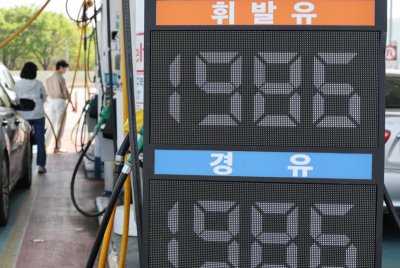
South Korea fuel prices rise for third straight week

Gasoline and diesel fuel prices are displayed on a screen inside a gas station in Seoul, South Korea, 19 April 2026. The average gasoline price in the country rose 0.42 won (0.0003 US dollar) from a day earlier to 2,001.93 won per liter on the same day, according to data from Korea National Oil Corp. Photo by YONHAP / EPA

April 18 (Asia Today) — Average gasoline and diesel prices at South Korean gas stations rose for a third straight week, putting both fuels on the verge of topping 2,000 won per liter.

The average nationwide gasoline price for April 12-18 stood at 1,996.3 won per liter, or about $1.36 a liter and $5.15 a gallon. That was up 28.7 won from 1,967.6 won a week earlier. Diesel averaged 1,990.2 won per liter, or about $1.36 a liter and $5.13 a gallon, up 31.1 won from the previous week.

With both fuels nearing the 2,000 won threshold, the government is set to announce its fourth maximum-price notice on Thursday. The current system partially reflects changes in global oil prices while slowing the pace of retail price increases.

By brand, SK Energy had the highest gasoline price at 2,001.8 won per liter, or about $5.16 a gallon, while self-service budget stations were the cheapest at 1,974.7 won. For diesel, SK Energy was also the highest at 1,995.2 won per liter, while budget stations posted the lowest average at 1,966.1 won.

By region, Jeju had the country’s highest average gasoline price this week at 2,029 won per liter, or about $5.23 a gallon. Seoul followed at 2,026.7 won, or about $5.23 a gallon.

International oil prices have recently eased on expectations that the conflict involving the United States and Iran could wind down. Dubai crude, the benchmark for South Korea’s imported oil, stood at $101.8 a barrel on Wednesday, down $4.7 from $106.5 on Sunday. Changes in global oil prices usually reach domestic pump prices with a two- to three-week lag.

— Reported by Asia Today; translated by UPI

© Asia Today. Unauthorized reproduction or redistribution prohibited.

Original Korean report: https://www.asiatoday.co.kr/kn/view.php?key=20260418010005586

Source link

Katie Price’s son Harvey calls her new husband Lee Andrews ‘daddy’ after star ‘confirmed’ travel ban

KATIE Price’s son Harvey has called her new husband Lee Andrews “daddy” after appearing to confirm Lee’s travel ban.

The self-proclaimed businessman, 43, took to his Instagram stories today to share a picture that Harvey had drawn for him.

Katie Price’s son Harvey has called her new husband Lee Andrews “daddy” Credit: Paul Edwards
Lee shared a drawing that Harvey made for him Credit: Instagram/wesleeeandrews

In the picture, two frogs are seen sitting next to each other with a love heart saying “I love you” in between them.

He addressed the drawing to “Mummy Bullfrog and Daddy Lee Bullfrog,” and said: “I hope you have a great Valentine’s Day and a happy holiday, love from Harvey.”

Lee wrote under it: “Harvey Price. You are just the best human,” as Katie reshared his story on her own profile.

It comes after The Sun revealed Lee’s devotion to Harvey with an apparent tattoo on the side of his left hand.

RUBLE RIDDLE

Katie Price’s hubby Lee reveals ‘REAL source of his huge wealth’


WHEELY UNHAPPY

Katie Price breaks silence on seventh driving ban saying she’s ‘livid’

Harvey’s name could be seen in a fancy font alongside an image of a frog, the 23-year-old’s favourite animal.

He’s yet to fly to the UK and meet her children in person but no doubt he’s spoken to Harvey via FaceTime.

Lee and Katie, 47, tied the knot in a secret ceremony in Dubai back in January before having a second ceremony the following month.

Ever since the pair tied the knot, there’s been constant speculation that Lee is unable to leave Dubai, where he resides full-time.

It was reported that he allegedly forged his ex-girlfriend Dina Taji’s signature to secure a £200,000 loan – something he’s strongly denied.

On several occasions, he’s claimed he’s coming to the UK but each time, he hasn’t ended up coming.

During the latest episode of her podcast with her sister Sophie, the former glamour model was asked directly about Lee’s situation.

She said: “Of course I’m going back to Dubai and Lee will come here when he needs to.

“People have to remember he’s lived in Dubai for 21 years, that’s where he lives and where he does his work. There’ll be a time when he does come to England and he’ll be with me.”

Sophie replied: “I thought he had a travel ban?”

Katie and Lee tied the knot back in January Credit: wesleeeandrews/instagram

While not confirming whether or not Lee is unable to leave the city, Katie said: “Do you know what? Everyone has said to me you can get a travel ban over anything in Dubai.

“A parking ticket or if you owe a bill for electricity or something… you can get a travel ban for absolutely anything.”

Sophie asked: “Do they do anything like that over here?”

The I’m A Celebrity star joked: “No. If they did, I’d be banned for life! But yeah, you can get one for even breathing the wrong way in Dubai. It’s so strict.”

A clip from the podcast was posted on social media, with Katie writing: “Lee’s travel ban… it’s so strict!!!!”

On Thursday, Lee claimed he’s moving to the UK in May.

Posting on his Instagram Stories he shared an image of him with Katie, which read: “LEE ANDREWS CONFIRMS RETURN TO UK.

“With his gorgeous wife Katie to support her family and career commitments.

“The couple are stronger than ever and will make the commitment to live together this coming May. Ahead of their Winter Wedding this Year.”

Katie recently appeared to confirm Lee’s travel ban Credit: wesleeeandrews/instagram

Source link

As oil prices plunge below $91 after weeks, a new Hormuz crisis emerges | Oil and Gas News

Brent crude falls more than 9 percent after Iran said it will reopen the strategic waterway, only to shut it down again over US blockade of its ports.

Oil prices have plummeted to their lowest point in weeks after Iran said the Strait of Hormuz was open for passage during a ceasefire in Lebanon, and United States President Donald Trump said he expected to ⁠reach a deal to end the war soon.

Brent crude, the international benchmark, fell more than 9 percent to $90.38 a barrel on Friday, taking it below $91 for the first time since March 10.

Recommended Stories

list of 4 itemsend of list

The plunge came after Iranian Foreign Minister Abbas Araghchi said the strait was “completely open” and would remain so for the duration of the 10-day ceasefire between Israel and Lebanon, which took effect on Friday.

Hailing Tehran’s announcement, Trump declared the waterway “ready for business and full passage,” but said the US Navy’s blockade of Iranian ports would remain in “full force” until the sides reached a peace deal.

On Saturday, however, Iran rowed back on its decision to reopen the Strait of Hormuz, warning that it would continue to block transit through the key waterway as long as the US blockade of Iranian ports remained in effect.

The announcement came after Trump said the blockade “will remain in full force” until Tehran reaches a deal with the US, including on its nuclear programme.

Roughly one-fifth of the world’s oil passes through Hormuz and further limits would squeeze already constrained supply, driving prices higher once again.

Amid the escalation, Pakistani officials say they are trying for more talks between the US and Iran ahead of the April 22 ceasefire deadline.

Meanwhile, ship tracking data displayed by MarineTraffic earlier on Saturday showed a significant uptick in vessels crossing the strait, which is located between Iran, the United Arab Emirates and Oman.

“It’s busy out there, the busiest I’ve seen it since the Strait of Hormuz was effectively closed at the beginning of the war,” Michelle Wiese Bockmann, an analyst at maritime intelligence firm Windward, said in a post on X.

“Last night there were few ships taking the risk but overnight there seems to have been a change.”

While Iran allowed a limited number of vetted ships to transit the waterway since the start of the war, traffic has remained at a trickle compared with pre-conflict levels.

The near-total closure of the strait has triggered one of the worst energy shocks in history, driving up fuel prices and prompting governments to roll out emergency measures.

Oil prices have swung wildly since the US and Israel launched strikes on Iran on February 28, hitting a post-conflict peak of $119 a barrel on March 19.

Source link