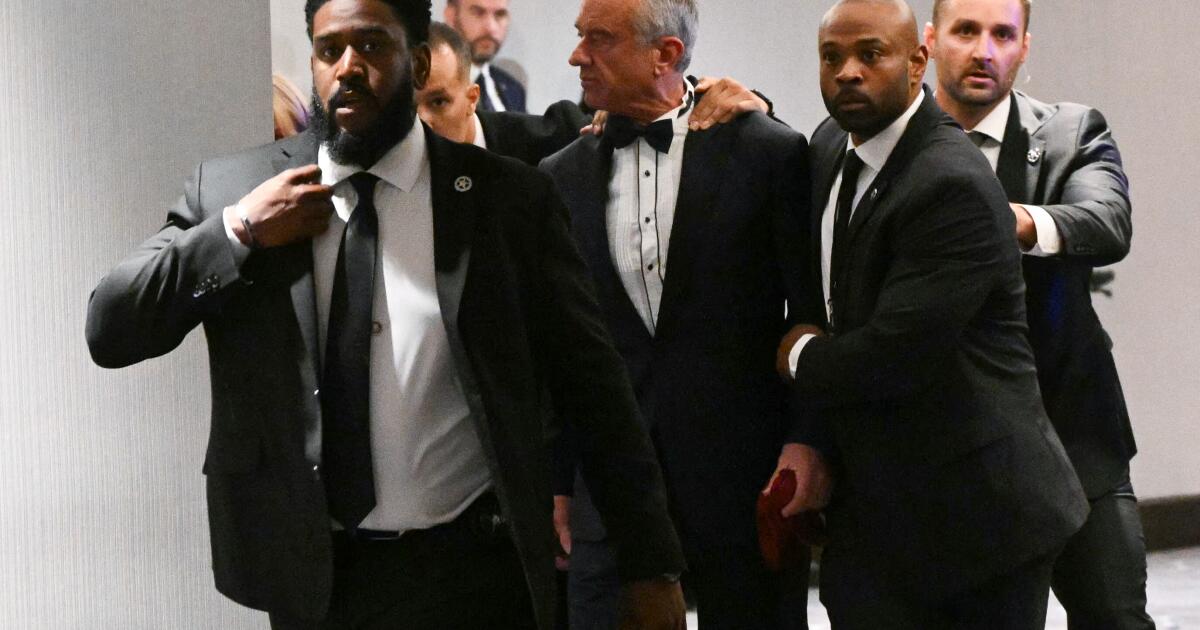
WASHINGTON — A federal magistrate judge on Monday pressed a jail official to explain why a man charged with trying to storm the White House Correspondents’ Assn. dinner and attempting to kill President Trump was placed on restrictive suicide watch after his arrest.
Officials at the city jail in Washington removed Cole Tomas Allen from its designated “suicide status” over the weekend after his attorneys complained that he had been unnecessarily confined in a padded room with constant lighting, repeatedly strip-searched and placed in restraints outside his cell.
But the relaxed conditions didn’t satisfy U.S. Magistrate Judge Zia Faruqui’s concerns that Allen may have received disparate, punitive treatment in violation of his due process rights. Faruqui noted that the D.C. jail routinely houses convicted killers and others charged with violent crimes without placing them on 24-hour lockdown.
“It could drive a person crazy to be in that situation,” he said.
Faruqui apologized to Allen over his confinement conditions. In response to a news report on that apology, U.S. Atty. Jeanine Pirro criticized him in a social media post that said Faruqui “believes a defendant armed to the teeth and attempting to assassinate the president is entitled to preferential treatment in his confinement compared to every other defendant.”
Allen’s lawyers said he wasn’t showing any suicidal risk factors after his arrest. But a jail psychiatrist evaluated him and initially concluded that he posed a suicide risk, according to Tony Towns, acting general counsel for the city’s corrections department.
“Every case is different, your honor,” Towns said.
Allen was moved into protective custody after the jail lifted the suicide prevention measures. His attorneys didn’t object to his new confinement status. They had asked the magistrate to cancel Monday’s hearing, but Faruqui forged ahead with it due to his “grave concerns” about Allen’s treatment in jail.
Allen was injured but was not shot during the April 25 attack at the Washington Hilton, which disrupted one of the highest-profile annual events in the nation’s capital.
Allen was armed with guns and knives when he ran through a security checkpoint and pointed his weapon at a Secret Service agent, who fired back five times, authorities said. Pirro has said that Allen fired a shot that struck the agent’s bullet-resistant vest.
Allen later told FBI agents that he didn’t expect to survive the attack, which could help explain why he was deemed to be a possible suicide risk, said Justice Department prosecutor Jocelyn Ballantine.
Allen, 31, of Torrance, is charged with attempted assassination of the president and two additional firearms counts. He faces up to life in prison if convicted of the assassination count alone.
Defense attorney Eugene Ohm said Allen was prohibited from having anything in his cell. He asked for a Bible and a visit from a chaplain but hasn’t received either, according to Ohm.
WASHINGTON — The Secret Service says a suspect who opened fire Monday on the National Mall did so after being confronted by officers.
Secret Service Deputy Director Matt Quinn said officers returned fire. A bystander was struck by the suspect, Quinn said.
Quinn said the motorcade of Vice President JD Vance transited through the area not long before the shooting, but there was no indication it was the target.
The incident happened Monday afternoon around 15th Street and Independence Avenue near the Washington Monument.
The Secret Service encouraged people to avoid the area as emergency crews responded to the shooting not far from the White House, where President Trump was holding a small-business event.
The White House was briefly locked down as authorities investigated the incident. The Secret Service ushered journalists who were outside into the briefing room, and Trump continued his event without interruption.
Vito Maggiolo, spokesman for the D.C. Fire and EMS Department, said emergency units took an adult male to a hospital and were treating what appeared to be a teenage male for minor injuries. He referred other questions to the police department.
The incident drew a large police presence, coming just over a week after a gunman tried to storm the White House Correspondents’ Assn. dinner with guns and knives. Cole Tomas Allen has been charged in that incident, in which a Secret Service officer was wounded.
BEIRUT — Confusion reigned on Monday over the fate of a fragile ceasefire between the United States and Iran after a wave of fresh strikes on the United Arab Emirates and Oman, along with reports of attacks on ships in the Strait of Hormuz, undermined confidence in the truce.
The drone and missile strikes, the first since a ceasefire halted fighting in early April, come after the Trump administration launched a wide-scale naval operation on Monday to “guide” stranded maritime vessels out of the vital waterway.
But fears over a return to war have driven another surge in oil prices, pushing them above $114 per barrel — levels not seen since the ceasefire nearly a month ago. Hundreds of cargo ships from dozens of countries remain stuck in the Gulf. And strikes in Dubai have raised concerns about further disruptions to international air travel at one of the world’s busiest airports.
Iran’s state-run news agency, IRNA, said the new U.S. operation was part of President Trump’s “delirium,” after the Islamic Revolutionary Guard Corps warned that passage through the strait required prior approval from Tehran.
“We warn that any foreign armed force, especially the invading American army, will be attacked if they attempt to approach and enter the Strait of Hormuz,” said Maj. Gen. Ali Abdollahi, according to a statement reported by the Iranian state-run Mehr News Agency on Monday.
The operation, which Trump over the weekend dubbed “Project Freedom,” is supported by 15,000 U.S. servicemen and 100 aircraft, according to U.S. Central Command. Their aim is to deny Tehran control over the strait, a narrow, 21-mile-wide passageway through which a fifth of global energy supplies flows.
“We have more weapons and ammunition at a much higher grade than we had before,” Trump was quoted as saying in an interview with Fox News.
“We have the best equipment. We have stuff all over the world. We have these bases all over the world. They’re all stocked up with equipment. We can use all of that stuff, and we will, if we need it.”
Iran blocked traffic through the strait soon after the United States and Israel launched their campaign on the country. Last month, days after a ceasefire between Washington and Tehran came into effect, the United States enforced its own naval blockade on Iranian ports in a bid to pressure Iran to make concessions in stalled negotiations.
On Monday, Central Command said in a statement that two American-flagged merchant ships were able to successfully transit the strait, while Central Command head Adm. Brad Cooper said the U.S. military sank six Iranian boats and intercepted missiles and drones targeting civilian vessels.
“We have defeated each and every one of those threats through the clinical application of defensive munitions,” he said.
“Project Freedom is a defensive operation, and we have deployed anti-ballistic missile destroyers,” he added. “Ships in the Gulf waters belong to 87 countries, and we urge ships to cross the strait.”
IRIB, Iran’s state-run broadcaster, quoted a senior Iranian military official who denied Cooper’s claim of sunk Iranian boats. The IRGC said in a statement on the messaging app Telegram that claims of commercial vessels or tankers traversing the strait were “baseless and completely false.”
Though Cooper did not clarify if the ceasefire between Washington and Tehran was now over, a raft of attacks throughout Monday spiked fears that the war would restart, spurring sharp price increases in already-jittery energy markets.
The UAE said a fire broke out and three Indian nationals were injured in the Fujairah Oil Industry Zone, a key export hub for the country, after what it described as an Iranian drone attack.
It also accused Iran of targeting a tanker linked to the country’s state oil company Abu Dhabi National Oil Company in the Strait of Hormuz, while the country’s defense ministry also reported four cruise missiles launched from Iran, saying that it intercepted three of them while the fourth fell in the sea.
“These attacks constitute a dangerous escalation and an unacceptable transgression,” said a statement from the UAE’s foreign ministry, adding that it “reserves its full and legitimate right to respond to these attacks.”
Elsewhere, two foreign workers were injured in an attack on a residential building in the Omani coastal province of Bukha, according to a statement from an unnamed security source quoted by the state-run Oman News Agency. Authorities were investigating the incident but did not elaborate on the perpetrator.
The U.K.’s Maritime Trade Operations Center reported on Monday that a commercial vessel was on fire off the coast of the UAE, while a South Korean bulk carrier ship said it suffered an explosion and a fire in its engine room and the cause was being investigated.
Bulos reported from Beirut, Wilner from Washington.
YEREVAN, Armenia — European leaders on Monday said President Trump’s surprise decision to pull thousands of U.S. troops out of Germany is just the latest signal that Europe must take more responsibility for its security.
The Pentagon announced last week it would pull some 5,000 troops out of Germany, but Trump told reporters on Saturday the U.S. plans on “cutting a lot further.”
Trump offered no reason for the move, which blindsided NATO. But his decision came amid an escalating dispute with German Chancellor Friedrich Merz, who said the U.S. has been humiliated by Iran in talks to end the war it launched with Israel on Feb. 28. Trump has also expressed anger over European allies’ reluctance to get involved in the conflict.
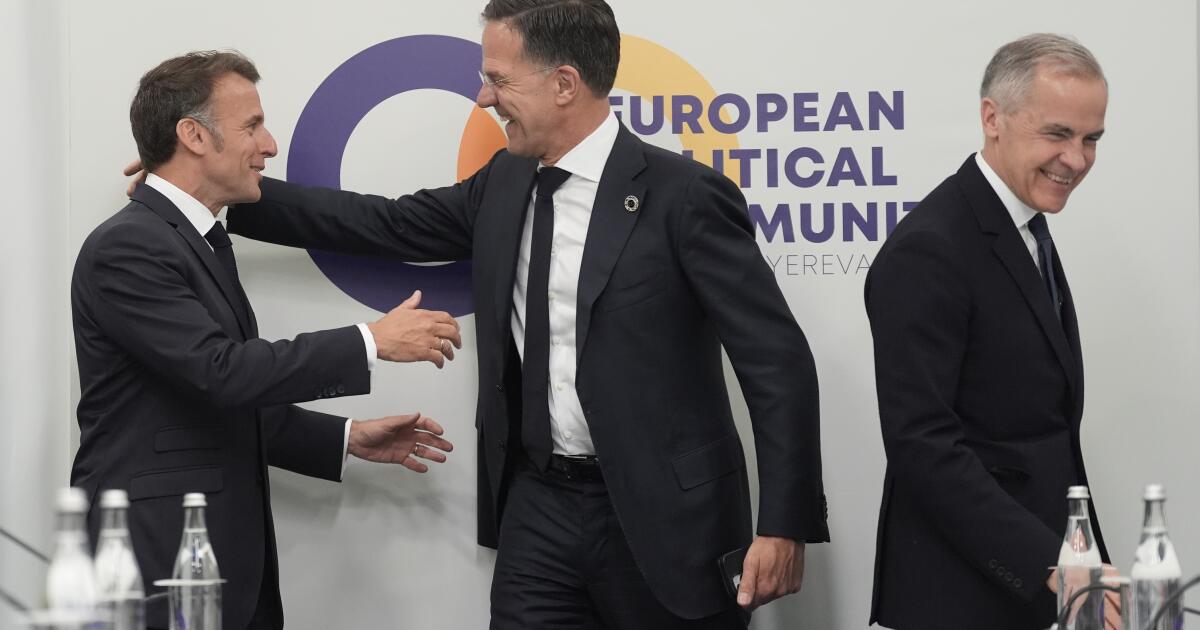
European leaders meeting at a summit in Yerevan, Armenia, sought to both downplay the impact of 5,000 fewer troops in Germany while acknowledging that it provides a useful nudge for the continent to step up its role within NATO.
“I do not see those figures as dramatic, but I think they should be handled in a harmonious way inside the framework of NATO,” said Norwegian Prime Minister Jonas Gahr Støre.
British Prime Minister Keir Starmer said “there needs to be a stronger European element in NATO, I have no doubt about that.”
Tensions within NATO have mounted since the second Trump administration came into office last year warning that European allies would have to defend themselves and Ukraine in the future. Talks on ending the war there, now in its fourth year, have bogged down as the U.S. focuses on Iran.
Taken by surprise
The European Union’s foreign policy chief, Kaja Kallas, said the timing of Trump’s announcement came as a surprise, even though there has been “talk about withdrawal of U.S. troops for a long time from Europe.”
Asked whether she believes Trump is trying to punish Merz, Kallas said: “I don’t see into the head of President Trump, so he has to explain it himself.”
Merz did not attend the European Political Community summit in Yerevan, which included about 30 European leaders, plus Canadian Prime Minister Mark Carney.
At a military exercise in northern Germany, the country’s defense minister, Boris Pistorius, said Berlin has not yet received “official confirmation of when and how this is supposed to happen, on what scale.” The reduction of U.S. troops “would not put into question NATO’s deterrence capability,” he added.
European countries and Canada have increased defense spending and military recruitment efforts over the last year in response to Trump’s threats.
NATO seeks clarity
NATO Secretary-General Mark Rutte also played down the significance of fewer U.S. troops in Germany, while acknowledging U.S. “disappointment” about the level of European support for the Iran war.
France and the U.K. have given U.S. forces limited use of bases on their territories to attack Iran. Spain has outright denied U.S. forces the use of its airspace and bases.
Rutte, who has championed Trump’s leadership at NATO despite the U.S. president’s criticism of a majority of the allies, said: “I would say the Europeans have heard a message.”
European allies and Canada have known since early last year that Trump would pull some troops out of Europe — and some were pulled out of Romania in October — but U.S. officials had pledged to coordinate any moves with NATO allies to avoid creating a security vacuum.
NATO spokesperson Allison Hart said over the weekend that officials at the 32-nation military alliance “are working with the U.S. to understand the details of their decision on force posture in Germany.”
Iran and trade trouble
With the ceasefire between the U.S. and Iran looking shakier, Rutte said European nations “have decided to pre-position assets, key assets, close to the theater for the next phase.” He provided no further details.
European leaders have insisted their countries would not help police the Strait of Hormuz, a key energy trade route, until the war is over.
“If the United States is ready to reopen Hormuz, that’s great. That’s what we’ve been asking for since the beginning,” said French President Emmanuel Macron. But he underlined that Europeans are not ready to get involved in any operation “that does not seem clear.”
Carlson and Cook write for the Associated Press. Cook reported from Brussels. AP writer Geir Moulson in Berlin contributed to this report.
Before authorities charged him with attempting to assassinate President Trump and top administration officials in a brazen attack at the Washington Hilton, Cole Tomas Allen lived what those who knew him described as a quiet, simple existence.
He worked as a tutor and enjoyed video games, manga and riding his blue scooter. Acquaintances said Allen rarely talked about his political views through much of his adult life.
But on social media, he appears to have expressed concerns about the morality of U.S. policy, particularly its role in the wars in Ukraine and Iran.
Now, those who crossed paths with him are struggling to square the accusations against him with the man they knew as an unassuming student, gamer and teacher.
Allen grew up in a middle-class, suburban part of Torrance, one of four siblings who would each go on to study at reputable universities.
His parents were both teachers and “really solid members of their community,” according to Paul Thompson, a Los Angeles County prosecutor who lives next door to the family’s two-story house. Allen’s father knew many people on the block of single-family homes by their first names, Thompson said, and the suspect’s mother once saved Thompson’s dog when it ran into the road.
As a high school junior, Allen led Pacific Lutheran’s volleyball team in a three-set win over Junipero Serra High School. He was homeschooled, but was allowed via a special program to take a class at Pacific Lutheran in Gardena and to play for its respected squad, according to the private school’s principal.
Allen was “a godly person” who never cursed or shared his political views at the time, a former teammate told The Times, but he was also “very competitive.”
That drive extended to academics. After finishing his homeschooling, he was accepted into Caltech, one of the best universities in the nation for aspiring engineers like Allen.
He joined the Caltech Christian Fellowship, taking on a leadership role in which he organized Bible discussions, as well as the fencing team and the Nerf Club. He interned at the Jet Propulsion Laboratory in La Cañada Flintridge for three months.
In 2016, he was part of a five-person team that won an annual robotics and design competition in which teams built robots to play in soccer matches at Caltech. Allen was a teaching assistant at the Pasadena school, where he graduated with a mechanical engineering degree the following year.
Elizabeth Terlinden met Allen through the Caltech Christian Fellowship, where she was co-president during the 2014-15 school year.
“Quiet guy, kind of nondescript, generally polite, got good grades,” she told The Times, describing her impression of Allen. “Christian definitely, but that’s because I interacted with him primarily in that context.”
Michael D’Asaro, who coached fencing at Caltech around the time Allen was in college, said that he didn’t remember Allen but that generally none of the students attended practice regularly.
“Those kids were more interested in studying than sports, as you can imagine,” he said in a text message. “They would spend days and nights in the lab.”
After Caltech, Allen went on to work as a mechanical engineer for a South Pasadena firm called IJK Controls.
Kevin Baragona said he and Allen worked together “making stabilized gimbals for Hollywood” at IJK for about six months.
Baragona, who left IJK in January 2018 to found the company DeepAI, said in an interview via FaceTime from rural China that Allen seemed “kind of tired, unmotivated, like he didn’t want to really work hard, and maybe depressed.”
Baragona said that Allen was mainly interested in video games, and that Allen even showed him a couple of games he had made or was working on.
Allen was at IJK for less than a year and a half, according to his LinkedIn profile, which states that he worked as a self-employed “Indie Game Developer” from September 2018 to March 2020.
In 2019, he registered a trademark for an esoteric video game called “Bohrdom,” a “hybrid of a bullet hell and a racing game” based on atomic theory, in which electrons and protons compete. “Bohrdom” languished on the Steam gaming platform. Three other projects Allen detailed in his professional bio remained unfinished.
Then, in March 2020, he took a job as a tutor at C2 Education. In December 2024, he was named teacher of the year at the test preparation and tutoring company in a Spanish-tiled Torrance shopping center. People who knew him through his work there described him in interviews as intelligent and professional.
In May 2025, Allen received a master’s degree from Cal State Dominguez Hills in Carson, six miles from his parents’ home in Torrance.
Bin Tang, a professor in the university’s computer science department, described Allen as a “very good student. … Soft-spoken, very polite, a good fellow.”
“I am very shocked to see the news,” he told the Associated Press.
Joaquin Miranda knew he recognized the photo circulating online of a man posing in a graduation gown at Cal State Dominguez Hills, but he couldn’t quite place it. So on Monday, the 48-year-old showed the picture to his 13-year-old daughter, who told him it was of Allen, “my tutor guy,” who had tutored her in English at C2.
“She can’t believe it, because he was very nice, very professional and a very cool guy,” Miranda said of his daughter. “So yeah, it’s crazy.”
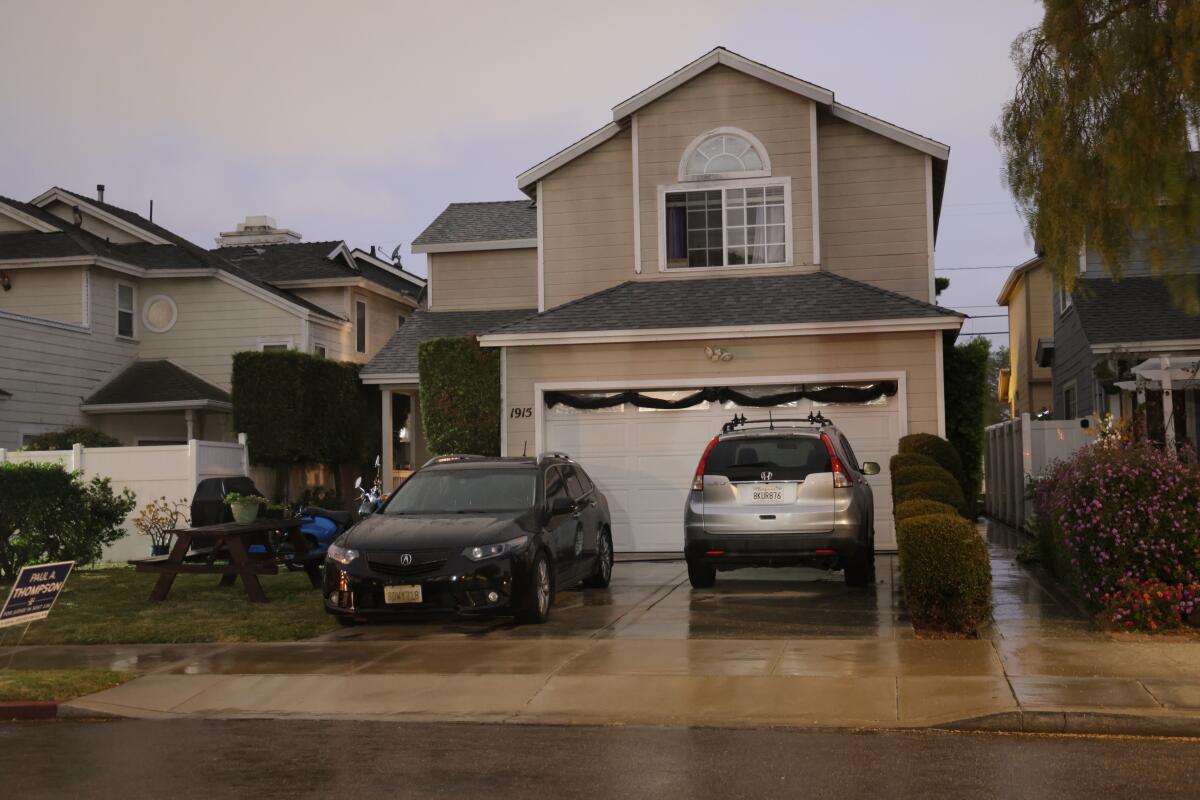
The Torrance home connected to Cole Tomas Allen.
(Robbin Goddard / Los Angeles Times)
At the heart of the case against Allen is a document federal authorities allege he sent family members.
The writer of the document apologized to his parents, colleagues and others before laying out his “rules of engagement” — guests, hotel security and staff and other people not in elected office or government were “not targets.” The author says he was targeting top Trump administration officials because he was “no longer willing to permit a pedophile, rapist, and traitor to coat my hands with his crimes.”
If the document was indeed written by Allen, Baragona said it would represent a fundamental change from the person he knew when they were making gimbals together at IJK Controls.
“It’s kind of sad, really,” Baragona said of the transformation Allen’s worldview apparently underwent in recent years. “It’s tragic and sad.”
The document was signed “Cole ‘coldForce’ ‘Friendly Federal Assassin’ Allen,” echoing the usernames the FBI in a court filing said Allen used online.
Federal authorities have not identified the specific accounts, but The Times found multiple similarly named social media profiles likely used by Allen, with close variations of the same distinctive username, @coldForce3000, that Allen used on a chess account created with his confirmed email addresses. The accounts have been taken down, but much of their contents remain accessible on the Internet Archive.
Across more than 5,000 posts extending from 2021 to days before last weekend’s White House Correspondents’ Assn. dinner, where the attack attributed to him took place, Allen’s social media history shows that what started as a singular immersion into the online gaming world became consumed in condemnation of Trump, his administration and war. The rhetoric was often harsh — likening the president to a mob boss or calling him a sociopath — but did not espouse violence.
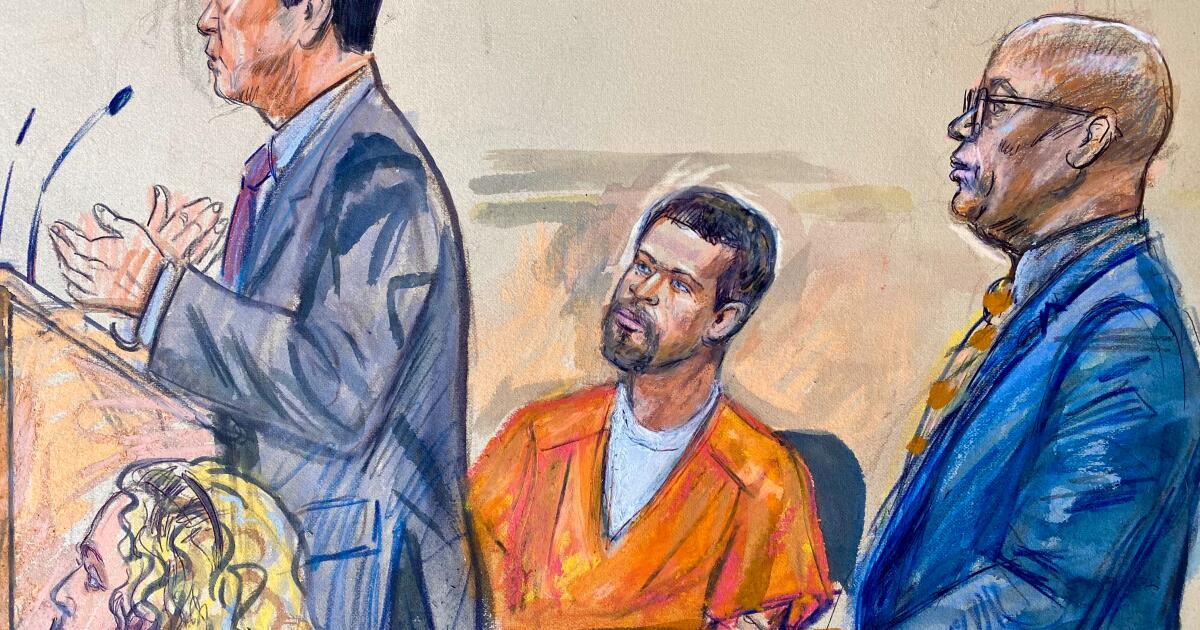
A sketch of Cole Tomas Allen in court.
(Dana Verkouteren / Associated Press)
For years, SoCal Twitter user @CForce3000, under the name “coldForce,” posted almost exclusively about gaming, and “Super Smash Bros. Ultimate” in particular, the same fighting game Allen played competitively as an online brawler.
The account changed abruptly the day after Russia’s April 2023 missile attack on Slovyansk, in eastern Ukraine. Eleven people, including a toddler, died in the shelling of a residential building. The feed from @CForce3000 carried images of the bloodshed.
Subsequent Ukraine-related posts followed, along with pleas for donations to buy jeeps, equipment and supplies for combatants in the country. By early 2024, the account had broadened to domestic concerns, including opinions on student activism at Columbia University in solidarity with Palestinians in Gaza.
“Everyone makes mistakes in college,” @CForce3000 wrote in May 2024, criticizing the activists, who risked expulsion. “Burning down your parents’ life accomplishments and your own future to demonstrably degrade the image of your (presumably) recent cause is not really one I’d recommend,” the user posted, “like, my parents woulda *buried* me if i picked this as a ‘hill to die on.’”
For the next year, @CForce3000 shared hundreds of posts from sources as diverse as Rep. Ted Lieu (D-Torrance), Republican former Rep. Liz Cheney of Wyoming and former Ukrainian diplomat Maria Drutska. The account became a repeater of condemnations by Trump critics calling the president an ally of Russia and decrying his failure to support Ukraine and his involvement with late sex offender Jeffrey Epstein.
In November 2024, @CForce3000 announced the account was migrating to BlueSky, saying of X, “I don’t think there’s much reason to be on here anymore.” In early 2025 on BlueSky, coldForce chose an avatar plucked from the anime series “Gintama”: the heroine Kagura in her berserk state, insane with rage.
“Hi! I’m a random Californian guy with posts about American politics, support for Ukraine, and observations of small creatures,” read the new coldForce account bio. “I choose my own battlefields. Not through my blood, but with my heart. I stand on the battlefield to protect what I want.”
The BlueSky user continued to forward requests for donations to equip Ukrainian troops. It decried federal immigration raids and posted about a toddler who nearly died at an Immigration and Customs Enforcement detention facility in Texas. In reposting a feed that called Elon Musk a white supremacist, coldForce mused that the Tesla CEO and X owner was a “genius with effective(?) autism” struggling to understand humanity.
The rhetoric sharpened this spring when Trump began posting threats to bomb Iran, saying that “a whole civilization will die tonight.” On BlueSky, coldForce shared posts from Democratic pundits and leaders, including in Congress, who called for Trump’s impeachment, and those who described the president as “deranged” and “a sociopathic mob boss.”
Cole Allen reportedly purchased a handgun at CAP Tactical Firearms in Lawndale.
(Eric Thayer / Los Angeles Times)
“Trump must be removed from office. He has no capacity to do the job, and he’s destroying the US and the world with incoherent flailing,” read an April 12 message by Minnesota liberal activist Will Stancil that coldForce reposted. “He thinks he can bully and blackmail the whole world and will start WW3 or nuke someone eventually. He absolutely cannot [be] allowed to continue.”
To these, coldForce added:
“If we can call for russians to oppose putin, we can and must oppose trump no less.”
On April 6, federal authorities say Allen used his phone to search “white house correspondents dinner 2026” and booked a room at the Washington Hilton.
Allen allegedly traveled by train across the country from California, arriving in Washington, D.C., on April 23 and checking into his room at the Washington Hilton, where the White House correspondents’ dinner was scheduled two nights later.
At 8:03 p.m. April 25, he snapped a mirror selfie in his hotel room, according to a pretrial detention memo filed by prosecutors Wednesday. He looked into the camera, eyebrows raised with a hint of a smile. Allen wore a black dress shirt and slacks, a red tie tucked into his pants and a small leather bag prosecutors say was filled with ammunition. He also allegedly wore a shoulder holster and knife in his waistband.
At 8:27 p.m., he pulled up a live feed of Trump en route to the event. Minutes later, as the president sat on an open stage during the fete, Allen allegedly ran through a magnetometer and past Secret Service agents toward the ballroom before firing at least one shotgun round in the direction of the stairs leading down to the ballroom, the memo said.
Secret Service agents respond during the White House correspondents’ dinner.
(Tom Brenner / Associated Press)
A Secret Service officer saw him and fired five shots — all of which missed him — and Allen fell to the ground and was arrested before he could reach the event space. The Department of Justice has said it is investigating whether Allen fired the round that hit one of the agents in the chest; the agent avoided major injuries because he was wearing a bulletproof vest.
People who knew Allen before he was accused of attempting to gun down American leaders told The Times that they never would have thought he was capable of such a violent act.
Terlinden, of the Caltech Christian Fellowship, said she and Allen once got into a heated argument over how to spend the group’s charity money. He advocated for sending toys to children abroad through an organization that was explicitly Christian, whereas Terlinden pushed to feed the homeless locally, which she thought was more pragmatic.
“I think he said it’s not about helping people, it’s about showing the love of Christ,” she recalled. “After I talked about efficiency and helping people.”
She left the room and didn’t return.
“Part of the reason I’m bringing that up is to demonstrate that that’s the most scandalous incident I could come up with,” Terlinden said. “We were arguing over whether we should send toys to poor children or feed homeless people — that’s the big tea.”
Reflecting on the allegations, she said she wondered whether Allen was “acting out of perceived moral duty. … In a twisted way, there is a sense of, you know, standing up for people that can’t defend themselves.”
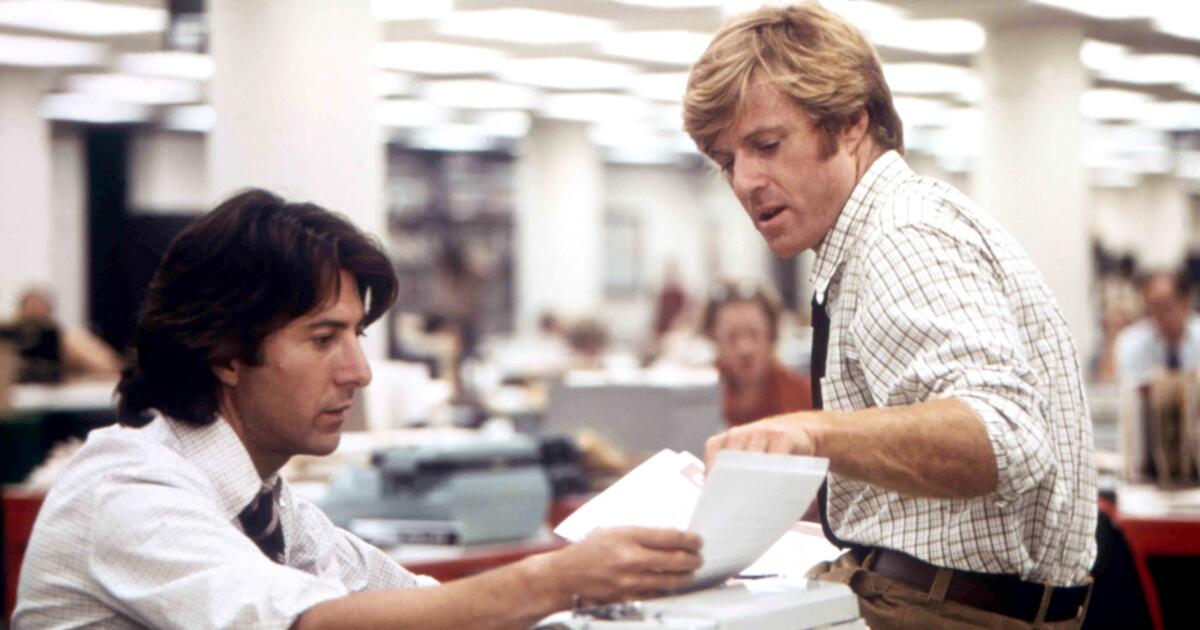
“All the President’s Men” was released 50 years ago this month, an anniversary that’s been greeted with equal parts rue and reverence by the journalists, political junkies and discerning cinephiles who have worshiped the film for five decades.
As a member of all three of those constituencies, I’ve done my share of genuflecting, most recently as chief film critic at the Washington Post, whose city room was as vivid and fully realized in the movie as Robert Redford’s Bob Woodward and Dustin Hoffman’s Carl Bernstein.
Like so many Posties of my generation, I’ll never forget the so-real-it’s-surreal experience of walking into the fifth-floor newsroom for the first time in 2002. By then, standard-issue electric typewriters and six-ply carbon paper had been replaced by far less visually interesting computers. But the office’s pervading atmosphere of hard work and quiet focus felt uncannily similar to its big-screen analog.
For the last two years, I have been researching a book about the making of “All the President’s Men,” whose production involved almost as many contingencies and unresolved questions as Watergate itself. Among the film’s many mysteries, one I’ve found particularly intriguing has to do with Katharine Graham, publisher of the Washington Post and CEO of its parent company during the Watergate investigations. As the movie amply demonstrates, it took guts for Woodward and Bernstein to persevere with their reporting in the face of terrified sources and their own growing paranoia. But, unbeknownst to many observers at the time, Graham was enduring even more withering pressures, with determination that was all the more impressive for being almost entirely invisible.
I’m still in the process of discovering why she remained invisible in “All the President’s Men.” For now, it’s clear that the backstory is more nuanced than mere oversight or, as many are quick to assume, simple sexism.
In fact, William Goldman’s first script of the film featured a sequence with Graham and Woodward, a scene that appeared in every subsequent draft. Based on an actual meeting between the two, it’s a cagey game of cat-and-mouse, with the publisher taking the measure of a nervous, still-inexperienced journalist, looking for reassurance that his reporting will prove out.
Earlier this year, at a January staged reading of “All the President’s Men” at Harmony Gold Theater in Hollywood — a fundraiser for the Stella Adler Academy — it was possible for fans to conjure what might have been. Mark Ruffalo played Woodward and Ethan Hawke played Bernstein in a version of the movie assembled from different Goldman drafts.
A high point of the evening was when Ruffalo and actor Susan Traylor brought the Graham-Woodward scene to tentative, tense and teasingly playful life. After grilling Woodward about his sources and coyly asking him about Deep Throat’s identity, Traylor’s Graham asked him if the truth about Watergate would ever be revealed. “It may never come out,” Ruffalo’s Woodward replied. “Don’t tell me ‘never,’” Graham laments, before bringing the meeting to a close with a gently peremptory “Do better.”
In poring over director Alan J. Pakula and Goldman’s papers, I’ve probably read that scene dozens of times. But when I heard it play out in real time, I was ambushed by the emotions it stirred — a mixture of pride in Graham’s legacy and deep sadness at how that legacy has been so inexplicably ignored in recent years.
I was also sad that Redford, who died in September, wasn’t there. He often expressed regret that Graham wasn’t a featured character in “All the President’s Men.” Keenly aware of how her spine and steadfastness made Woodward and Bernstein’s work possible, he wanted to honor that crucial support. When I interviewed him for the first time in 2005, he insisted that fearless owners were every bit as important in preserving democracy as the reporters he and Hoffman helped glamorize.
Over the next two decades, every time I saw Redford, he bemoaned the “downward slide of this thing,” by which he meant the constellation of institutions “All the President’s Men” celebrates: not just journalism and a robust First Amendment but a Washington where investigators, prosecutors, judges, the Senate and Congress did their jobs regardless of partisan loyalties, and a Hollywood where a studio as mainstream as Warner Bros. would agree to finance a tough-minded film about a contentious and still-raw period in recent history.
Granted, that film was based on a bestselling book and anchored by two huge stars. But today, with political and corporate leaders — including media companies — falling over each other to curry favor with President Trump, “All the President’s Men” feels like an artifact from a vanished age.
Nowhere is this more distressingly true than at the Post itself, where the newsroom immortalized by the movie has been slashed by more than a third, and where Jeff Bezos, who bought the paper in 2013, seems intent on erasing Katharine Graham’s legacy until it vanishes completely. During the first Trump administration, Bezos stood up to threats against the Post and the press at large that would make Nixon blush, or at least pea-green with envy.
Now, Bezos has become a one-man meme of what author Timothy Snyder calls “obedience in advance,” quashing an endorsement of Kamala Harris, ostentatiously grinning his way through Trump’s second inauguration, vastly overpaying for a promotional film about First Lady Melania Trump and staying conspicuously mum (at least publicly) when a Post reporter’s home was raided by the FBI in January.
All of this has come at an enormous moral and material cost, with thousands of readers canceling their subscriptions and an alarming number of the Post’s finest reporters and writers leaving for other publications and platforms. As my former boss Marty Baron told my former colleague Ruth Marcus in the New Yorker in February, Bezos’ turnaround has been “sickening” to witness: “a case study in near-instant, self-inflicted brand destruction.”
Of course, that brand was built, in no small part, by “All the President’s Men,” which taught a generation how to walk, talk, dress and act like real reporters. (Hint: A good corduroy jacket and a pen in your mouth can’t hurt.)
In 1976, Pakula was interviewed about his dealings with Graham, whom he admired tremendously and with whom he would become close friends. “I could do a film about the Katharine Graham story,” he enthused. “It’s a superb story.”
Thirty years later, Steven Spielberg would bring Pakula’s idea to fruition with “The Post,” about Graham’s decision to publish the Pentagon Papers, a dress rehearsal for the even higher stakes of Watergate a year later.
“The Post,” which starred Meryl Streep in a shrewdly judged performance of aristocratic assurance and creeping insecurity, premiered in Washington less than a year into Trump’s first administration. Bezos attended that screening, which many of us saw as tacit acknowledgment that he was taking her lessons in character, comportment and competence to heart.
That was clearly wishful thinking. Graham may have finally assumed her rightful place in the newspaper-movie canon, but we’re still left to ponder her absence from the most iconic journalism movie of the 20th century.
It’s no longer the shoe-leather reporters who need a big-screen tutorial in how to do their jobs. It’s their bosses. A simple place to start would be to memorize the best two-word speech to never appear in a major motion picture: Do better.
Ann Hornaday was a film critic at the Washington Post from 2002 to 2025, when she retired. “All the President’s Men” plays at TCM Classic Film Festival Saturday at 2:45 p.m.
WASHINGTON — House Speaker Mike Johnson has lamented he would like to preside over a “normal Congress,” but the chamber the Republican is leading is anything but.
All-night sessions. Hours of dead zones with no action on the floor. Legislation being written on the fly, behind closed doors. Sudden votes scheduled. Spectacular failures. And, as happened this week, stunning turnarounds in which the House actually passes bills.
“Sometimes it’s an ugly process, sometimes it’s a long process,” Johnson said after House passage of a bipartisan bill to fund much of the Department of Homeland Security, ending the longest agency shutdown in history. “But we got it done.”
Republicans, who face an uphill climb this election year to keep hold of their paper-thin House majority, appear at times as if they are still learning on the job, years after having returned to power in 2022, while they are also about to ask voters in November to rehire them for another term.
This week’s starts and stops — for example, five hours of delay as Johnson huddled behind closed doors to salvage his agenda, then a sudden vote tally near 11 p.m. — would typically have been the kind of situation that shocked the political and procedural senses. Now, it’s just another Wednesday.
Or two weeks ago, when a routine House Rules Committee hearing ended up becoming a midnight forum to debut a just-produced 14-page bill to revise a surveillance bill, known as the Foreign Intelligence Surveillance Act, or FISA, before it was rushed to the floor for a 2 a.m. vote. It failed.
“House Republicans have shown again that they can’t govern,” said Rep. Ted Lieu of California, part of Democratic leadership.
“They routinely pass bills to the Senate that are way too extreme, then it ends up that we have all these floor session days where we’re just doing nothing,” he said.
House GOP’s slim majority makes leader’s job challenging
Johnson, who took over for the ousted Kevin McCarthy more than two years ago, is presiding over one of the slimmest House majorities in modern times, leaving him no room to spare if he’s trying to pass legislation on party-line votes, without Democrats.
The speaker is juggling not only President Trump’s priorities but also those of the various factions that make up his majority, from the conservative House Freedom Caucus to what remains of the GOP’s more pragmatic conservatives.
And Johnson’s own future is always in question, after Republicans chased other speakers, including McCarthy, John Boehner and Newt Gingrich, to early exits.
Last year Johnson, of Louisiana, led passage of the party’s signature achievement, a big bill of tax breaks and safety net cuts, which Trump signed into law. At the time, he quipped about the difficulty of getting it over the finish line.
“I do so deeply desire to have just a normal Congress,” the speaker said in July.
“But it doesn’t happen anymore,” he said. “Our way is to plow through and get it done.”
What’s ahead as House GOP tries to stay in power
Ahead of the fall elections, Johnson and other Republican lawmakers have discussed an agenda that includes the promise of another GOP-only budget package like the tax cuts bill that they could push through the House and the Senate, without Democratic votes.
Budget Chairman Jodey Arrington (R-Texas) said Thursday that he expects “the centerpiece” of that package “will be supporting our troops” with more than $100 billion in funding for the war against Iran as well as money to replenish defense munitions and other Pentagon-related needs.
Despite the turbulent week in the House, Arrington said what they’re calling “Budget reconciliation 3.0” should be the “next order of business.”
Yet GOP lawmakers may decide it’s better to skip the hard work of legislating, and the dramatic upheavals that tend to come with it, and hit the campaign trail to win over voters instead.
Rep. Richard Hudson (R-N.C.), the chairman of the House GOP’s campaign arm, the National Republican Congressional Committee, acknowledged that trying to pass legislation with such a tight majority “can be rough. It’s ugly.”
“I’d be fine with letting us go home and campaign,” Hudson said. “But we’ve got a lot of important work still to do.”
Some of Johnson’s most ardent sparring partners, those most conservative Republican lawmakers, turned their blame for the messy process not on Johnson’s leadership but on their own GOP allies across the Capitol in the Senate, who often dismiss the House’s work.
“Yeah, sometimes, it gets a little tense,” said Republican Rep. Chip Roy of Texas. “But we’re still getting stuff done. We’re sending it over to the Senate. So we look forward to them doing their job.”
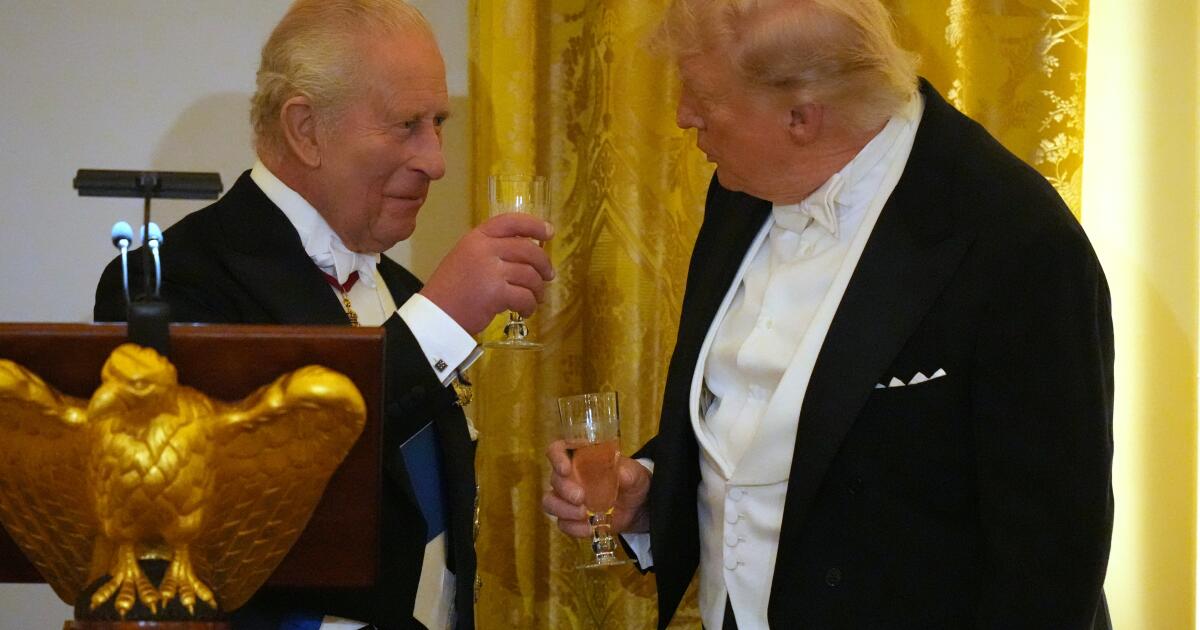
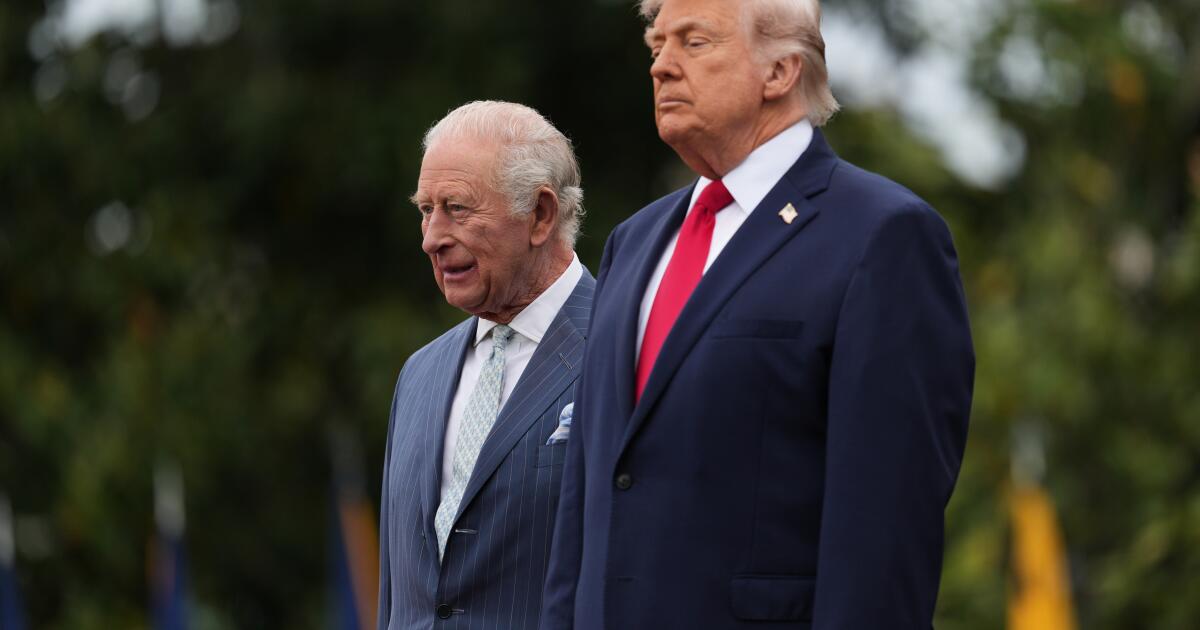
LONDON — President Trump sang the praises of King Charles III after the monarch’s state visit this week. He even lifted some tariffs on Scotch whisky as a favor to the British monarch.
The king delivered a diplomatic master-class on the trip, mixing praise for his host with subtle criticism. It’s unclear, though, whether it will make a major difference to a trans-Atlantic relationship troubled by divisions over issues including the Iran war.
“In the short term probably yes, in the long term probably no,” said Kristofer Allerfeldt, a University of Exeter professor specializing in American history. But he said Charles had “definitely clawed back some of the prestige of the monarchy” in his homeland with his assured performance.
“He’s done us proud,” Allerfeldt said.
Like all royal visits, the four-day trip to Washington, New York and Virginia by the king and Queen Camilla was a carefully choreographed diplomatic event carried out at the request of the U.K. government. Timed to help mark the United States’ 250th birthday, it was a chance to heal rifts between the U.K. government and the Trump administration.
Trump has criticized Keir Starmer
The president has lambasted Prime Minister Keir Starmer — whom he once praised — over his unwillingness to join U.S. military attacks on Iran, dismissing Britain’s leader as “not Winston Churchill,” the World War II prime minister who coined the phrase “special relationship” for the U.K.-U.S. bond.
It’s part of a wider split between Trump and the United States’ NATO allies, whom he has called “cowards” and “useless” for not joining action against Iran.
None of that has soured Trump’s fondness for the British monarchy, which seems to have been deepened by the president’s unprecedented second state visit to the U.K. in September.
Some U.K. opposition politicians had called for the king’s reciprocal trip to be canceled, lest the president do or say something to embarrass the monarch.
In the end, there was much warmth and few awkward moments — though Trump did not always adhere to the convention that conversations with the monarch should remain private.
At a white-tie state dinner on Tuesday, Trump said “Charles agrees with me, even more than I do” that Iran must never have nuclear weapons.
Trump also said that “if that were up to him,” the king “would have followed the suggestions we made with respect to Ukraine.”
Buckingham Palace appeared relaxed about Trump’s Iran comment, noting that “the king is naturally mindful of his government’s longstanding and well-known position on the prevention of nuclear proliferation.”
The king’s speech chided Trump policies
On Ukraine, however, differences were clear. The U.K. has been one of Kyiv’s strongest supporters in its fight against Russia’s invasion, and in a speech to Congress the king underscored the importance of the need for “unyielding resolve” to support Ukraine.
It was one of several implicit rebukes to the “America first” U.S. administration in the speech, the centerpiece moment of the trip.
With regal understatement and in a cut-glass accent, Charles stressed the essential role of NATO, the importance of checks on executive power, the threat posed by climate change and the strength drawn from “vibrant, diverse and free societies.” He spoke of his pride at having served in the Royal Navy, a force Trump has disparaged.
“It’s difficult to imagine he could have gone much further in what he said and what he didn’t say,” historian Anthony Seldon told The Guardian. “He judged it incredibly well: very brave, very smart, very clever.”
Allerfeldt noted the “extraordinary” reception from both sides of the political aisle to the speech, which drew multiple standing ovations.
“Apart from the section on the natural world and the environment, both Republicans and Democrats stood up and applauded,” he said.
In a less formal speech at the state banquet, the king even drew laughs when he joked about British troops burning down the White House in 1814.
The king alluded to Epstein’s victims
The trip was judged a success despite the shadow of the king’s younger brother Andrew Mountbatten-Windsor, who has been stripped of his royal title of Prince Andrew, exiled from public life and put under police investigation over his friendship with Jeffrey Epstein. He has denied committing any crimes.
Epstein victims had urged the king to meet with them and other sexual abuse survivors. He didn’t, but he did refer obliquely to the issue in his speech to Congress, mentioning the need to “support victims of some of the ills that, so tragically, exist in both our societies today.”
Andrew Lownie, author of a biography of the former Prince Andrew called “Entitled,” praised the speech as “the best defense of the monarchy in years.”
After the royal couple left the U.S., Trump announced he was lifting certain tariffs on Scotch “in honor of the King and Queen of the United Kingdom.”
Buckingham Palace toasted the announcement, saying the king “sends his sincere gratitude for a decision that will make an important difference to the British whisky industry and the livelihoods it supports.”
Trump called the king “a phenomenal representative” for his country, before turning back to a familiar theme: criticizing Starmer.
The president told Sky News that Charles is “a much different person than your prime minister.
“Your prime minister has to learn to deal the way he deals, and he’ll do a lot better,” he said.
WASHINGTON — When Homeland Security Secretary Markwayne Mullin was questioned by senators during his confirmation hearing about his vision for implementing President Trump’s mass deportation agenda, he said his goal was to keep his department off the front pages of the news.
To some degree, he has. Gone are the social media video clips of now-retired Border Patrol commander Greg Bovino clashing with protesters. Mullin’s predecessor, Kristi Noem, made her first trip as secretary to New York City to make arrests with Immigration and Customs Enforcement. In contrast, Mullin went to North Carolina to review hurricane recovery efforts.
The Republican administration appears to be recalibrating its approach to a centerpiece policy that helped bring Trump back to the White House, moving in many ways away from aggressive, public-facing tactics toward a quieter approach to enforcement. Despite that shift, the administration insists it is not backing down from its lofty deportation goals.
“Clearly they’ve stepped back from the, for want of a better word, the Bovinoist tactics of before,” said Mark Krikorian, the president of the Center for Immigration Studies, which advocates for immigration restrictions. “But it’s not clear this means they’re actually stepping back from immigration.”
The Trump administration launched a series of immigration enforcement operations last year in mostly Democratic-led cities, which drove up arrests in large-scale sweeps. The crackdown sparked clashes between protesters and enforcement officers and led to the shooting deaths in Minneapolis of two U.S. citizens.
Since then, the president’s hard-line anti-immigration agenda has lost popularity with voters and there have been no new high-profile city-based operations launched, raising questions about the administration’s strategy.
“We’re still enforcing immigration laws. We’re still deporting illegals that shouldn’t be here. We’re still going after the worst of the worst — but we’re doing it in a more quiet way,” Mullin said in an interview April 16 with CNBC.
Immigration arrests have dropped, but deportation goals remain
ICE arrests have fallen in recent months, and the number of people in immigration detention has dropped from a high of roughly 72,000 in January to 58,000 this week, according to data obtained by The Associated Press.
But in a sign of its continued determination, ICE in budget documents says it plans to remove 1 million people this fiscal year and the next compared with roughly 442,000 people last year. The agency also has plenty of money to carry out its mission, with Congress granting the Department of Homeland Security more than $170 billion for Trump’s immigration agenda last year.
The administration aims to have enough space to detain roughly 100,000 people this fiscal year, which would more than double the average daily number held in ICE detention last year. The administration has already expanded its detention capacity with the purchase of 11 warehouses across the country.
“They are working on really building a juggernaut of a system,” said Doris Meissner, who headed the U.S. Immigration and Naturalization Service, a predecessor to ICE, during President Bill Clinton’s Democratic administration and is now a senior fellow at the Migration Policy Institute.
White House spokesperson Abigail Jackson said there had been no change to Trump’s strategy.
“President Trump’s highest priority has always been the deportation of illegal alien criminals who endanger American communities,” Jackson said.
ICE did not respond to repeated requests for comment.
Stripping away legal protections to ramp up deportations
Advocates for immigrants are bracing for the Trump administration to turn its attention more intently to stripping away protections for migrants with temporary legal status to remain in the U.S. while their cases are being adjudicated.
In one example of this, the number of green cards approved by U.S. Citizenship and Immigration Services dropped by half over the course of a year under the Trump administration, according to an analysis by the Cato Institute, which supports immigration into the U.S. Humanitarian visas for refugees or people who qualified for asylum saw the biggest declines.
USCIS spokesman Zach Kahler said the drop was due to increased vetting of applicants by the administration.
The Trump administration has also pushed to strip Temporary Protected Status from hundreds of thousands of people, with a key case weighing whether it’s overstepped its power to do so being heard at the Supreme Court this week.
Advocates see it as a way to send a chilling message to immigrant communities and make more people vulnerable to deportation. It also enables the department to operate without the public spectacle of workplace raids or home arrests.
ICE has also focused over the past year on creating agreements with jurisdictions around the country that allow local and state law enforcement to carry out an expanding array of immigration enforcement tasks, ranging from checking the immigration status of people in their jails to incorporating immigration checks during routine traffic stops.
These agreements, known as 287g, have grown from 135 in 20 states before Trump took office to more than 1,400 in 41 states and territories now.
Some states, most noticeably Florida and Texas, have mandated various forms of cooperation between local law enforcement and ICE.
Meissner, from MPI, said Trump’s border czar, Tom Homan, is likely to prioritize further discussions about how cities and states can cooperate with ICE.
“At the end of the day, some of this may very well succeed in increasing the numbers,” Meissner said.
Calls to enforce work restrictions
Conservatives who want more deportations say the only way to truly crack down on illegal immigration is to make it so difficult for the migrants to work that they’ll leave on their own.
The Trump administration has already taken steps to make life harder for people in the country illegally including limiting who can live in public housing by immigration status, sharing Medicaid information with ICE and requiring people in the country illegally to register with the federal government.
Krikorian, of the Center for Immigration Studies, said the Social Security Administration could send out letters alerting employers when an employee’s name doesn’t match their Social Security number. Authorities could repeatedly and consistently carry out audits of I-9 forms, which companies are supposed to fill out and submit to the federal government showing that new hires are legally able to work. And they could require banks to collect citizenship information on customers.
Whatever the strategy going forward, the administration is facing heavy pressure not to back away from its goals.
“The numbers are too low,” said Mike Howell, part of the Mass Deportation Coalition, which launched a playbook for how the administration can actually get to a million deportations a year by using tactics such as worksite enforcement.
“The deportation numbers are just too low,” Howell said, “and they need to be much higher, and they can be much higher.”
Santana writes for the Associated Press. AP writers Lisa Mascaro and Will Weissert contributed to this report.
WASHINGTON — After weeks of delay, the House voted Thursday to fund much of the Department of Homeland Security, but not its immigration enforcement operations, and send the bipartisan package to President Trump to sign, ending the longest agency shutdown in history.
The White House had warned that temporary funding Trump had tapped to pay Transportation Security Administration and other agency personnel would “soon run out,” and that sparked new threats of airport disruptions.
DHS has been without routine funds since Feb. 14, causing hardship for workers, though much of Trump’s immigration agenda that is central to the dispute is being funded separately.
“It is about damn time,” said Rep. Rosa DeLauro of Connecticut, the top Democrat on the House Appropriations Committee, who proposed the bill more than 70 days ago.
The House swiftly voted by voice, without a formal roll call, to pass the measure.
The House’s narrow Republican majority has repeatedly stalled out under House Speaker Mike Johnson, with his own party tangled in internal disputes on a range of pending issues, including the homeland security funding. While the Senate unanimously approved the bipartisan package a month ago, the bill languished in the House.
Democrats refused to fund U.S. Immigration and Customs Enforcement and the Border Patrol without changes to those operations after the fatal shootings of two U.S. citizens by federal agents during protests against an immigration crackdown in Minneapolis. Republicans would no go along with a plan pushed by Democrats to fund TSA and the other parts of DHS without the money for ICE and Border Patrol.
To break the impasse, Republicans in both the House and Senate decided to tackle the immigration enforcement funding on their own through what is called budget reconciliation, a cumbersome weekslong process ahead.
By beginning that budget process Johnson, R-La., was able to unlock a broader bipartisan bill for TSA agents and the rest of DHS. House Republicans late Wednesday adopted budget resolution on a largely party-line vote, 215-211, that is focused on eventually providing $70 billion for immigration enforcement and deportations for the remainder of Trump’s time in office and ensure Democrats can no longer block funding. Trump’s term ends in January 2029.
One key Republican, Rep. Chip Roy of Texas, said isolating the immigration-related money on a separate track is “offensive to the men and women who serve in ICE and Border Patrol, and are serving this country every single day.”
Cole Tomas Allen, the 31-year-old Torrance man charged with trying to kill President Trump at last weekend’s White House Correspondents’ Assn. dinner, will remain in federal jail pending trial.
Allen agreed to his ongoing detention during a brief hearing in federal court in Washington, D.C., on Thursday. “He’s conceding detention at this time,” one of his federal public defenders, Tezira Abe, told Magistrate Judge Moxila Upadhyaya, according to CNBC.
Abe and Allen’s other public defender, Eugene Ohm, had argued in a filing Wednesday for Allen’s pre-trial release, citing his lack of a criminal record, family support and ties to his church, as well as inconsistencies and weaknesses they allege exist in the government’s case against him.
Abe and Ohm did not respond to a request for comment following the hearing.
In addition to trying to kill Trump, a terrorism-related charge that carries a potential life sentence, Allen faces two firearms charges related to his allegedly transporting two guns across state lines as he traveled from California to Washington by Amtrak train, and allegedly discharging one of those firearms — a shotgun — during the incident.
In arguing for Allen’s release in their Wednesday filing, his attorneys not only insisted he was no danger to the community, but questioned the government’s reasoning and evidence for the charges against him.
Allen was captured on a hotel video camera sprinting past U.S. Secret Service agents and into the secured event space a floor above the dinner while armed, according to prosecutors, with the shotgun, a pistol, and various knives. He then fell to the ground and was detained, according to prosecutors.
Trump administration officials who were at the dinner, including Acting Atty. Gen. Todd Blanche and Jeanine Pirro, the U.S. attorney for D.C., charged him swiftly — leaning heavily on an email Allen had sent to family just as he was breaching event security, which Trump and others referred to as a “manifesto” but which was titled an “Apology and Explanation.”
In that document, Allen allegedly wrote that he was targeting top Trump administration officials, with the highest ranking among them receiving top priority. He allegedly wrote that he would “go through” others at the event to get to those officials, but that he was not targeting guests or hotel staff and had chosen buck shot rather than slugs to “minimize casualties” in the room.
The charge of attempting to kill the president hung largely on that document, according to charging documents.
Blanche and Pirro also alleged that Allen had fired a shot during the encounter with Secret Service agents, in which they said a Secret Service agent was shot in the ballistic vest. Prosecutors also alleged in court that Allen had fired his shotgun, noting their recovery of one spent casing, but made no mention of a Secret Service officer being shot in the vest.
That alleged shot served as the basis for the one count of discharging a firearm.
In their filing arguing for Allen’s release, his attorneys questioned the legitimacy of both arguments.
They wrote that the government’s “sole proffered evidence” of Allen’s intent to kill Trump — the “Apology and Explanation” letter — was “far from clear” and never actually mentioned Trump by name.
“The government’s evidence of the charged offense — the attempted assassination of the president — is thus built entirely upon speculation, even under the most generous reading of its theory,” Allen’s attorneys wrote. “While the government may be able to say that the letter expresses an intent to target administration officials, it falls well short of narrowing those officials to President Trump.”
Regarding the one count of discharging a firearm, Allen’s attorneys wrote that the government “has not asserted that Mr. Allen ever fired any of the recovered weapons.” They wrote that the government, “after essentially asserting that Mr. Allen shot a Secret Service Officer in the criminal complaint, has apparently retreated from the theory by not mentioning the alleged officer at all” in its filing arguing for Allen’s ongoing detention.
In the latter document, prosecutors wrote only that an officer had seen Allen fire his shotgun “in the direction of the stairs leading down to the ballroom.” However, they provided little evidence to support that claim, other than that the shotgun held a spent cartridge in its barrel.
“In sum,” Allen’s attorneys wrote, “the government’s entire argument about the nature and circumstances of the offense is based upon inferences drawn about Mr. Allen’s intent that raise more questions than answers.”
Prosecutors, in a separate filing in the case related to evidence gathering, rejected the defense claims.
“The preliminary analysis of the crime scene is consistent with the government’s evidence that your client fired at least one shot from the 12-gauge pump action shotgun in the direction of Officer V.G., and that Officer V.G. fired his service weapon five times,” they wrote. “The government is aware of no evidence thus far collected and analyzed that is inconsistent with the above.”
They wrote that evidence suggests Allen fired his Mossberg 12-gauge pump-action shotgun “at least one time as he ran past the magnetometers on the Terrace Level of the Washington Hilton.”
They wrote that investigators recovered one spent cartridge from the chamber of the shotgun, that the “government’s preliminary ballistics and video analyses show that your client fired his shotgun in the direction of” the Secret Service officer identified only as “V.G.,” and that “at least one fragment was recovered from the crime scene that was physically consistent with a single buckshot pellet.”
LONDON — In the world of diplomatic faux pas, it could have been a lot worse.
At Tuesday’s state dinner honoring King Charles III and Queen Camilla, President Trump said that during a private meeting earlier in the day the British monarch had agreed with him that Iran should never be allowed to have nuclear weapons.
“We’re doing a little Middle East work right now … and we’re doing very well,” Trump told the audience. “We have militarily defeated that particular opponent, and we’re never going to let that opponent ever — Charles agrees with me, even more than I do — we’re never going to let that opponent have a nuclear weapon.”
While many Britons would agree with the president’s sentiment, the comment triggered mild consternation among pundits in the U.K.
By convention, people aren’t supposed to relay private conversations with the monarch. That is partly because the king has to remain above the political fray, but also because the sovereign doesn’t have the ability to wade into a public debate and correct the record if he’s misquoted.
“Generally, as a matter of protocol, I think I would expect discussions between heads of state to be sort of behind the scenes, in those closed meetings, for those to be sort of kept private,” said Craig Prescott, an expert on constitutional law and the monarchy at Royal Holloway, University of London. “And, you know, this was something that the U.K. government wanted to avoid.”
There had been a fair amount of jitters before the king’s trip to the United States, which comes amid Trump’s very public frustration with U.K. Prime Minster Keir Starmer over his failure to support U.S. actions in the Iran war.
Like all royal visits, this is a carefully choreographed diplomatic event carried out at the request of the U.K. government, which hopes that warm relations between the king and Trump can help repair the rift.
But Trump is an unconventional leader who has a penchant for breaking protocol, and there were concerns about just what he might say or do.
At least in this case, the king’s comments seemed clearly within the bounds of existing U.K. government policy.
“The King is naturally mindful of his government’s long-standing and well-known position on the prevention of nuclear proliferation,” Buckingham Palace said in a statement designed to provide context to the president’s remarks.
Prescott said that “in a sense, this was always the issue, just what Trump would do or say — would he put the king in an embarrassing position?’’ Prescott said.
“You always had that sort of issue of what he would post on social media,” he said. “And I think, you know, this could have been much, much worse.”
Before the state dinner, Charles gave a speech to a joint session of U.S. Congress. The king received repeated standing ovations during the address, which celebrated the longstanding bonds between the U.S. and Britain while nodding to differences over NATO, support for Ukraine and the need to combat climate change.
Now, from the U.K. government’s point of view, the trip is shifting to safer ground as the king and queen leave Washington behind and head to New York, where the focus will be on the city’s creative industries, rather than politics.
The most difficult part of the trip may be over, Prescott said.
“If this is the only controversy arising out of this phase of the state visit, I think overall this has been an enormous success for the king and the British government, because the king was able to make some quite pointed remarks in Congress and it hasn’t really yielded any sort of negative reaction from the president.”
“In a sense,” he said, “you get the feeling that the king rather charmed Washington with his speech to Congress and, you know, his very witty speech at the state banquet.”
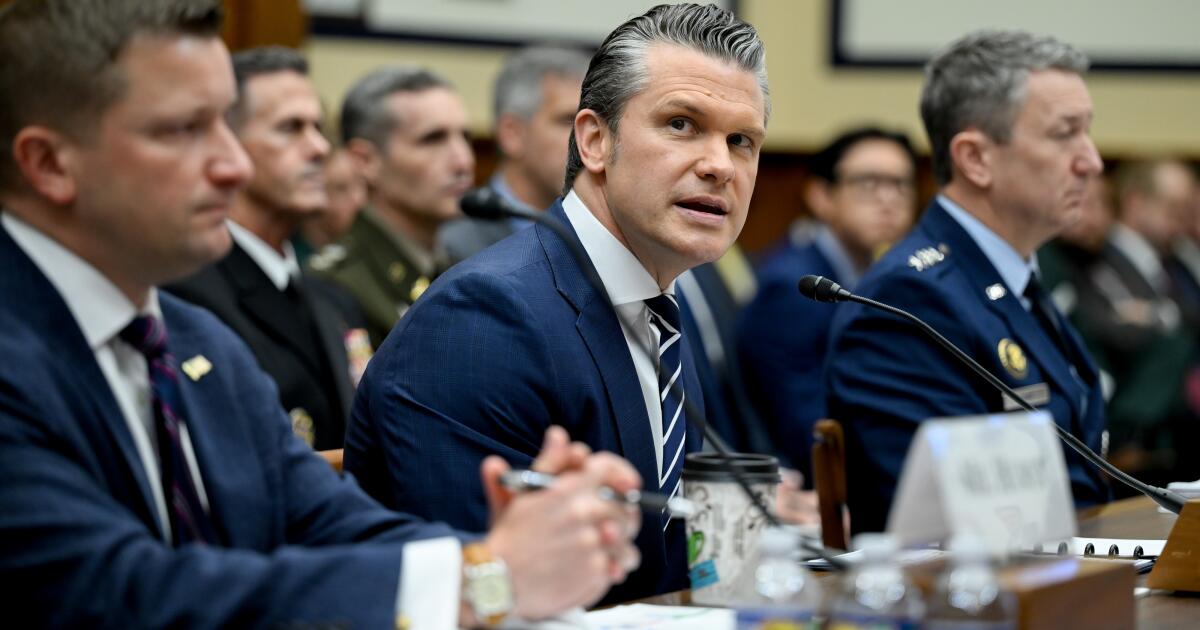
WASHINGTON — Making his first appearance before Congress since the Trump administration went to war in Iran, Defense Secretary Pete Hegseth faced withering questioning from skeptical Democrats Wednesday over a costly conflict being waged without congressional approval.
The war has cost $25 billion so far, according to Pentagon numbers presented to the House Armed Services Committee during the contentious hearing, ostensibly focused on the administration’s 2027 military budget proposal, which would boost defense spending to a historic $1.5 trillion.
While Republicans focused on the details of military budgeting and voiced support for the operation, Democrats pivoted to the ballooning costs of the war, the huge drawdown of critical U.S. munitions and the bombing of a school that killed children. Some lawmakers also questioned President Trump’s dealings with allies and his shifting justification for the conflict.
Hegseth dismissed the criticism as political and rebuked lawmakers who pushed him for answers.
“The biggest challenge, the biggest adversary we face at this point are the reckless, feckless and defeatist words of congressional Democrats and some Republicans,” Hegseth said.
Democrats press about reasons for war
Wednesday’s hearing stretched nearly six hours as Democrats and some Republicans questioned Hegseth over the war and his ouster of several top military leaders.
In one tense exchange, Hegseth told Rep. Adam Smith (D-Wash.) that Iran’s nuclear facilities were obliterated in a 2025 attack by the U.S., prompting Smith to question the Trump administration’s reasoning for starting the Iran war less than a year later.
“We had to start this war, you just said 60 days ago, because the nuclear weapon was an imminent threat,” said Smith, the ranking Democrat on the committee. “Now you’re saying that it was completely obliterated?”
Hegseth responded by saying that Iran “had not given up their nuclear ambitions” and still had thousands of missiles.
Smith said the war “left us at exactly the same place we were before.”
Democrats accused Hegseth of misleading Americans about the reasons for the conflict and said rising gas prices are now threatening the pocketbooks of millions of people in the U.S.
“Secretary Hegseth, you have been lying to the American public about this war from day one and so has the president,” said Rep. John Garamendi of Walnut Grove, who called the war “a geopolitical calamity,” a “strategic blunder” and a ”self-inflicted wound to America.”
Hegseth blasted Garamendi’s remarks.
“Who are you cheering for here?” he asked the lawmaker. ”Your hatred for President Trump blinds you” to the success of the war.
Hegseth defends firings of officers
The Defense secretary faced intense questions from Rep. Chrissy Houlahan (D-Pa.) about his decision to oust the Army’s top uniformed officer, Gen. Randy George, one of several top military officers to be dismissed since Trump’s reelection.
Houlahan said George was deeply respected by both members of the military and Congress and asked why Hegseth fired him. Hegseth’s response that “new leadership” was needed failed to satisfy Houlahan.
“You have no way of explaining why you fired one of the most decorated and remarkable men —” Houlahan began before Hegseth interrupted her. “We needed new leadership,” he repeated.
The Pentagon announced this month that Navy Secretary John Phelan was stepping down. Hegseth previously removed Adm. Lisa Franchetti, the Navy’s top uniformed officer, and Gen. Jim Slife, the Air Force’s No. 2 leader, while Trump fired Gen. Charles “CQ” Brown Jr. as chairman of the Joint Chiefs of Staff.
Republican Rep. Don Bacon of Nebraska said that while Hegseth is empowered to make personnel changes, he shares what he called “bipartisan concern” about the firings.
“We had a huge bipartisan majority here that had confidence in the Army chief of staff and the secretary of the navy,” Bacon said. “And I would just point out it may be constitutionally right … but it doesn’t make it right or wise.”
Hegseth has said the changes are part of building a “warrior culture” at the Pentagon.
Republican Rep. Nancy Mace of South Carolina defended Hegseth’s personnel moves, saying he is “trying to innovate and trying to change the way we do business.”
“I’m glad that you’re firing people,” Mace said. “There are people there that are getting in your way. They need to go.”
Republicans back Trump on Iran
During the extended hearing, Hegseth detailed plans to increase pay for service members and upgrade munitions while also announcing that, as of Tuesday, the Pentagon had authorized $400 million in military aid for Ukraine in its fight against Russia.
But the debate and the questions were dominated by the war in Iran.
While a fragile ceasefire is now in place, the U.S. and Israel launched the war Feb. 28 without congressional oversight. House and Senate Democrats have failed to pass multiple war power resolutions that would have required Trump to halt the conflict until Congress authorizes further action.
Republicans say they back Trump’s wartime leadership, for now, citing Iran’s nuclear program, the potential for talks to resume and the high stakes of withdrawal. Still, GOP lawmakers are eager for the conflict to end, and some are eyeing future votes that could become an important test for the president if the war drags on.
Democrats questioned Hegseth over the war’s economic impact and rising gasoline costs, noting Trump’s promise to lower consumer costs. Hegseth responded by citing the threat posed by Iran.
“What is the cost of Iran having a nuclear weapon that they wield?” he said.
Republicans expressed support for Trump’s decision to strike Iran, including Mace, who in late March had expressed concerns about the justification for the war. “The longer this war continues, the faster it will lose the support of Congress and the American people,” she wrote in a social media post.
On Wednesday, Mace noted her past concerns but said she is “impressed with where we are today.” She told Hegseth: “Everything I have seen, you have surpassed all of my expectations.”
Iran’s closing of the Strait of Hormuz, a vital shipping corridor for the world’s oil, has sent fuel prices skyrocketing and posed problems for Republicans ahead of the midterm elections. The U.S. has imposed a naval blockade of Iranian shipping and three American aircraft carriers are in the Middle East for the first time in more than 20 years.
The countries appear locked in a stalemate. Trump told Axios on Wednesday that he is rejecting Iran’s proposal to reopen the Strait of Hormuz in exchange for lifting the U.S. blockade.
Finley, Groves, Klepper and Toropin write for the Associated Press.
According to Acting Atty. Gen. Todd Blanche and other top administration officials, the U.S. Secret Service did a fine job protecting President Trump and Cabinet members from the gunman who breached the White House Correspondents’ Assn. dinner Saturday.
“That horrible act was stopped because of the courage and professionalism of law enforcement — the officers who responded without hesitation and did their jobs as they were trained to do,” Blanche said Monday.
However, according to a detailed accounting filed Wednesday by federal prosecutors in the criminal case against suspect Cole Tomas Allen, the performance of the nation’s preeminent protection agency was marred by inattentiveness and misfires and saved by “extraordinary good fortune” and the gunman falling to the ground.
“The defendant, armed with a 12-gauge shotgun, a .38 caliber pistol, two knives, four daggers, and enough ammunition to take dozens of lives, was apprehended by [Secret Service] officers mere feet away from the ballroom where his primary target was located, along with other members of the Cabinet,” prosecutors wrote Wednesday, in a filing arguing for Allen to be held in detention pending trial on one charge of trying to kill the president and two firearms charges.
Contradicting a prior claim by Blanche that officers had “promptly tackled and detained” Allen, prosecutors wrote that the 31-year-old tutor from Torrance simply “fell to the ground” after blowing past a team of agents just two open flights of stairs from the ballroom.
They wrote that one officer fired at Allen five times, but never hit him.
The same officer saw Allen fire his shotgun “in the direction of the stairs leading down to the ballroom,” prosecutors wrote, and officers later discovered “one spent cartridge in the barrel and eight unfired cartridges in the magazine tube.”
Prosecutors said nothing about the Secret Service officer who Blanche said was shot in his ballistic vest during the incident — adding to speculation that the officer may have been shot not by Allen, but by a fellow officer, or not at all.
Agency critiqued before
In all, the court filing brought further into focus a chaotic Secret Service response that appeared flawed from the start, including in a video Trump posted shortly after the incident in which agents appeared to be idling around an unobstructed entrance when Allen ran past them.
It added to concerns that law enforcement, security experts and members of Congress had raised about the performance of an agency that has been repeatedly called on to improve after previous attempts on Trump’s life. At a 2024 campaign rally in Butler, Pa., a gunman fired a bullet that grazed Trump’s ear, and that same year, another assailant prepared to shoot him from the unsecured perimeter of a Florida golf course.
Robert D’Amico, a former FBI deputy chief of operations for hostage rescue teams who is now a security consultant, said the security failures he saw in the Secret Service’s preparation for Saturday’s dinner — including its failure to set up basic barriers to prevent people from sprinting into the secured area — were stunning, especially given the past threats and the fact the nation is at war with Iran.
“It’s for a person like Trump, who’s had two assassination attempts before and is at war with Iran, which has terrorist training and proxies up, and you still don’t have the basics?” D’Amico said. “It’s unfathomable.”
Other concerns have been voiced by members of Congress, including Republicans.
The House Oversight Committee has requested a briefing from the Secret Service, and Sen. Josh Hawley (R-Mo.) has called for a hearing before the Senate Homeland Security and Governmental Affairs Committee, which also investigated the Butler incident.
In a letter urging the hearing, Hawley said the latest incident “raises questions about presidential security arrangements, potential resource needs, and the degree to which reforms previously proposed by Congress have been adopted.”
House Speaker Mike Johnson (R-La.) told Fox News that from “a layman’s perspective,” event security “looked a little lax in terms of getting into the building,” and that it “doesn’t sound like it was sufficient.”
Sean M. Curran, director of the Secret Service, has been on Capitol Hill in recent days briefing lawmakers.
He told CBS News that agents did a “great job,” but also that the incident remains under review. White House Press Secretary Karoline Leavitt has said that White House Chief of Staff Susie Wiles would be leading discussions on potential updates to Secret Service plans for securing the president.
Fear of graver threats
Blanche has argued that proof of the Secret Service’s effectiveness at the press gala was in the result: Allen was stopped, Trump and other officials were unharmed and no one was killed, despite Allen’s alleged intent.
However, the concerns being raised have to do with the vulnerabilities that were exposed as much as those that were exploited.
Because the dinner was not designated a major “national special security event” — such as a political convention — there were no trained counterassault agents on standby to prevent a breach or to take down a person with a weapon, officials have said.
Law enforcement experts said that was clearly a mistake given so many top officials — Trump, Johnson, Vice President JD Vance, Secretary of State Marco Rubio, Treasury Secretary Scott Bessent and Defense Secretary Pete Hegseth, among others — were in the room.
Such a gathering could have been targeted by foreign adversaries or others with far more experience, less regard for human life and much greater firepower than Allen, experts said.
“Most of my military friends are all saying the same thing,” said D’Amico, who is also a former infantry platoon commander in the U.S. Marines. “If you had had a team of three or four [gunmen], they would have gotten to [Trump].’”
In the initial criminal complaint against Allen, prosecutors included the text of an email Allen sent to family just as he was preparing to rush the security perimeter, in which he allegedly wrote that he had chosen to use buckshot in order to “minimize casualties” and prevent bystanders from being wounded by more powerful bullets penetrating walls.
He also allegedly wrote that he was willing to “go through most everyone” at the event to get to top administration officials, but that guests and hotel staff were “not targets at all.”
In Wednesday’s filing, prosecutors describe Allen’s actions as “premeditated, violent, and calculated to cause death,” and say he was “laden with weapons” as he breached security. But none of those weapons included assault-style rifles that can fire multiple bullets rapidly and have been used to kill civilians in mass shootings across the country for years.
The filing described Allen — a Caltech graduate and high school tutor — not as some trained tactical expert, but as an ideologue who spent part of his Amtrak journey from California to Washington waxing poetic about the landscape around him, describing Pennsylvania’s woods as “vast fairy lands filled with tiny trickling creeks in spring.”
Could have been worse
D’Amico said he and other Marines learned early on in Iraq that entrances to secured locations have to be designed in a “serpentine” fashion, forcing anyone approaching to move more slowly through the area and giving security officers more time to assess their intentions. And at an event the size of the correspondents’ dinner, with so many top officials gathered in a public hotel, you would want to make entrances “even more difficult.”
And yet no barriers seemed to be in place at the event, he said — something anyone trained more than Allen could have capitalized on.
“If they just had come through in a team of three or four who were coordinated and trained, there absolutely would have been penetration into the ballroom,” D’Amico said. “It would have been a gunfight.”
Allen himself questioned the security at the event, according to court records, allegedly writing that he had walked into the Washington Hilton with multiple weapons and no one considered “the possibility that I could be a threat.”
He wrote that if he “was an Iranian agent, instead of an American citizen,” he “could have brought a damn Ma Deuce in here and no one would have noticed” — referring to a powerful machine gun.
“It is fortunate he was only armed with what he had,” said Ed Obayashi, a California law enforcement expert on use of force.
WASHINGTON — The Supreme Court’s conservative majority sounded ready Wednesday to rule that the Trump administration may end the temporary protection that has been granted to more than 1.3 million immigrants from troubled countries.
Congress in 1990 authorized Temporary Protected Status, or TPS, for noncitizens who could not safely return home because their native country was wracked by war, violence or natural disasters. If those people passed a strict background check, they could stay and work legally in this country.
But President Trump came to office believing too many immigrants had been granted permission to enter and stay indefinitely.
Last year, his Department of Homeland Security moved to cancel the temporary humanitarian protection for immigrants from 13 countries, including Venezuela, Haiti, Syria, Honduras and Nicaragua. Court challenges on behalf of Haitians and Syrians were consolidated into a single case, Mullin vs. Doe, which the justices heard Wednesday.
Immigrant-rights advocates challenged those decisions as political and unjustified, and they won orders from federal judges that blocked the cancellations.
But Trump’s lawyers filed an emergency appeal at the Supreme Court arguing the judges had overstepped their authority. They pointed to a provision in the 1990 law that bars “judicial review” of the government’s decision to end temporary protection for a particular country.
The justices ruled for the administration and set aside the lower court rulings in a series of 6-3 orders.
Faced with criticism over its brief and unexplained orders, the justices agreed to hear arguments on the TPS issue on the last day of oral arguments for this term.
But the ideological divide appeared to be unchanged.
Solicitor Gen. D. John Sauer said Congress had prohibited “judicial micromanagement” of these decisions, and none of six conservatives disagreed.
UCLA law professor Ahilan T. Arulanantham, representing several thousand Syrians, said the Homeland Security secretary had failed to consult the State Department, which says it is unsafe to travel there.
He said the government “reads the statute like it’s a blank check … to give the secretary the power to expel people who have done nothing wrong.”
Chicago attorney Geoffrey Pipoply, representing more than 350,000 Haitians, said the cancellations were driven by “the president’s racial animus toward non-white immigrants.”
The court’s three liberals argued the administration failed to follow the procedural steps required under the law. But that argument failed to gain traction.
Justice Amy Coney Barrett and her husband adopted two children from Haiti who are citizens. Like most of the conservatives, she asked few questions during the argument.
ALEXANDRIA, Va. — Former FBI Director James Comey appeared in court on Wednesday, kick-starting a criminal case against him that legal experts say presents significant hurdles for the prosecution and will likely be a challenge for the Justice Department to win.
Comey, who didn’t enter a plea, was indicted in North Carolina on Tuesday on charges of making threats against President Trump related to a photograph he posted on social media last year of seashells arranged in the numbers “86 47.” The Justice Department contends those numbers amounted to a threat against Trump, the 47th president. Comey has said he assumed the numbers reflected a political message, not a call to violence against the Republican president, and removed the post as soon as he saw some people were interpreting it that way.
The indictment is the second against Comey, a longtime adversary of Trump dating back to his time as FBI director, over the past year. The first one, on unrelated false-statement and obstruction charges, was tossed out by a judge last year. Now prosecutors pursuing the threats case face their own challenge of proving that Comey intended to communicate a true threat or at least recklessly discounted the possibility that the statement could be understood as a threat.
The indictment accuses Comey of acting “knowingly and willfully,” but its sparse language offers no support for that assertion. Acting Atty. Gen. Todd Blanche declined to elaborate at a news conference on what evidence of intent the government has. But broad 1st Amendment protections for free speech, Supreme Court precedent and Comey’s public statements indicating that he did not intend to convey a threat will likely impose a tall burden for the government.
“Here, ‘86’ is ambiguous — it doesn’t necessarily threaten violence and the fact that it was the FBI Director posting this openly and notoriously on a public social media site suggests that he didn’t intend to convey a threat of violence,” John Keller, a former senior Justice Department official who led a task force to prosecute violent threats against election workers, wrote in a text message.
The case was charged in the Eastern District of North Carolina, the location of the beach where Comey has said he found the shells. He is set to make his first court appearance Wednesday at the federal courthouse in Alexandria, Va., the state where he lives.
What the law says on threats
The Supreme Court has held that statements are not protected by the 1st Amendment if they meet the legal threshold of a “true threat.”
That requires prosecutors to prove, at a minimum, that a defendant recklessly disregarded the risk that a statement could be perceived as threatening violence. In a 2023 Supreme Court case, the majority held that prosecutors have to show that the “defendant had some subjective understanding of the threatening nature of his statements.”
Meanwhile, the Supreme Court has found that hyperbolic political speech is protected. In a 1969 case, the justices held that a Vietnam War protester did not make a knowing and willful threat against the president when he remarked that “If they ever make me carry a rifle the first man I want to get in my sights is L.B.J,” referring to President Lyndon B. Johnson. The court noted that laughter in the crowd when the protester made the statement, among other things, showed it wasn’t a serious threat of violence.
Regarding the current case, Merriam-Webster, the dictionary used by the Associated Press, says 86 is slang meaning “to throw out,” “to get rid of” or “to refuse service to.” It notes: “Among the most recent senses adopted is a logical extension of the previous ones, with the meaning of ‘to kill.’ We do not enter this sense, due to its relative recency and sparseness of use.”
Comey deleted the post shortly after it was made, writing: “I didn’t realize some folks associate those numbers with violence” and “I oppose violence of any kind so I took the post down.”
What the government will try to prove
John Fishwick, a former U.S. attorney in the Western District of Virginia, said the government will likely try to prove that Comey should have known better as a former FBI director.
“I think they’re going to try to circumstantially say that you were head of the FBI, you knew what these terms meant and you said them out to the whole world as a threat to the president,” Fishwick said, though he noted that such an argument would be challenging in light of Comey’s obvious 1st Amendment defenses.
Comey was voluntarily interviewed by the Secret Service last year, and the fact that he was not charged with making a false statement suggests that prosecutors do not have evidence that he lied to agents, Fishwick said.
Jonathan Turley, a George Washington University law professor, wrote in an opinion piece published Tuesday that “despite being one of Comey’s longest critics, the indictment raises troubling free speech issues. In the end, it must be the Constitution, not Comey, that drives the analysis and this indictment is unlikely to withstand constitutional scrutiny.”
“If it did,” he added, “it would allow the government to criminalize a huge swath of political speech in the United States.”
Tucker, Richer and Kunzelman write for the Associated Press. Kunzelman reported from Alexandria, Va.
WASHINGTON — The White House is warning Congress that funding to pay Department of Homeland Security personnel will “soon run out,” sparking new threats of airport disruptions and national security concerns as the House slow-walks legislation to end what has been the longest-ever lapse in agency funding.
In a memo late Tuesday to lawmakers, the Office of Management and Budget said money that President Trump tapped to pay Transportation Security Administration and other workers through executive actions will be exhausted by May. It called on the House to quickly approve the budget resolution senators approved in an all-night session last week that would pave the way for full funding for the department.
“DHS will soon run out of critical operating funds, placing essential personnel and operations at risk,” the memo said.
The pressure from the Trump administration could help House Speaker Mike Johnson, whose narrow Republican majority has been stalled out, tangled in internal party disputes on a range of pending issues, including the Homeland Security funding. They have left the chamber at a virtual standstill.
The House was expected to vote as soon as Wednesday on the Senate budget resolution that is designed to unlock a multistep process to eventually fund the department. But by midday, House action again screeched to a halt. The administration has warned GOP lawmakers off making changes that could prolong passage.
“Restoring funding for the Department of Homeland Security has never been more urgent, as demonstrated by recent events,” the memo said, a nod to the situation over the weekend when a man armed with guns and knives tried to storm the annual White House correspondents’ dinner that Trump, the vice president and top Cabinet officials were attending.
Homeland Security shutdown is longest ever
Homeland Security has been operating without regular funds for more than two months after Democrats refused to fund Immigration and Customs Enforcement and Border Patrol without changes to those operations after the deaths of Americans protesting Trump’s deportation agenda.
While immigration enforcement workers have largely been paid through the flush of new cash — some $170 billion — that Congress approved as part of Trump’s tax cuts bill last year, others, including TSA, have had to rely on Trump’s intervention through executive action to ensure their paychecks.
But with salaries topping $1.6 billion every two weeks, Homeland Security Secretary Markwayne Mullin said recently, those funds are drying up.
More than 1,000 TSA officers have quit since the shutdown began, according to Airlines for America, the U.S. airlines trade group that called Wednesday on Congress to fully fund the agency.
“The urgency to provide predictable and stable funding for TSA is growing stronger by the day,” the group said in a statement. “Time and time again, our nation’s aviation workers and customers have been the victim of Congress’ failure to do their jobs.”
Complicated budget strategy ahead
House and Senate Republicans have embarked on a go-it-alone strategy, attempting to approve funds for Immigration and Customs Enforcement and Border Patrol without Democrats. They want to provide $70 billion for those immigration operations for the remainder of Trump’s term to ensure no further interruptions.
It’s a cumbersome process, the same that was used last year to approve Trump’s tax cuts bill, that will play out over several weeks.
The Senate launched the process last week, and is now waiting on the House to act. Once that budget resolution is approved, both the House and Senate are expected to draft the actual funding bill, a process that can take weeks.
In the meantime, Johnson is next expected to quickly turn this week to legislation that would fund the other parts of Homeland Security, including TSA, the Coast Guard and other agencies.
That bipartisan bill has support from Democrats and already passed the Senate a month ago, when Republicans reluctantly agreed to carve out the immigration-related funds that Democrats had opposed. But it has been stalled out in the House, as Republicans in that chamber disagreed with the Senate’s approach.
Mascaro writes for the Associated Press. AP writer Rio Yamat in Las Vegas contributed to this report.
The top candidates for California governor clashed over the high costs of gas, housing and homeowner’s insurance in a testy debate Tuesday evening, a fiery exchange that may finally draw voter attention as the June 2 primary election fast approaches.
Former Fox News host Steve Hilton, a Republican who leads all candidates in the most recent opinion polls, ripped Becerra for promising to declare a state of emergency to address rising homeowner’s insurance rates, saying the governor lacks that constitutional authority.
“We can’t have a governor who doesn’t understand how the government works,” Hilton said.
Becerra, who served as California attorney general before joining the Biden administration, quickly defended himself, saying he knows the law better than Hilton does.
“We don’t need a talking head from Fox News to tell us how the government works,” he said.
And that was after Becerra got in an early dig at Hilton, who has been endorsed by President Trump, by referring to Trump as “Hilton’s daddy.”
The debate was broadcast and livestreamed by CBS stations around the state. Hundreds of people watched from Pomona College’s historic Bridges Auditorium, a Renaissance Revival-style landmark with Art Deco flourishes that was once among the premier performance venues in Southern California.
With eight major candidates from both parties participating, CBS moderators billed it as “the largest and most inclusive debate of the election.” Becerra and Hilton were joined by Republican candidate Riverside County Sheriff Chad Bianco and Democratic candidates San José Mayor Matt Mahan, former Orange County Rep. Katie Porter, billionaire Tom Steyer, state Supt. of Public Instruction Tony Thurmond and former Los Angeles Mayor Antonio Villaraigosa.
Some takeaways from the debate:
Candidates didn’t shy away from the top issues
Moderators set the theme for the first half-hour of the debate as “affordability,” a top concern among California voters, and almost immediately the candidates began sniping and talking over one another.
Almost all of them vowed to accelerate home construction in California, pivotal to reducing the state’s high cost of housing.
There was no shortage of ideas for other ways to ease the financial burdens facing Californians, but few specifics on how they would deliver on those promises given the state’s complex and arduous legislative process.
Hilton promised to cap the price of gas at $3 per gallon, and Mahan vowed to suspend the state gas tax. Bianco said Democrats have long overregulated and overtaxed Californians, and the state’s supermajority Democratic Legislature would have to get in line with him and end those things if he’s elected.
Becerra said he would reduce prescription drug prices. Thurmond said he would provide down-payment assistance grants to those trying to own their first home.
Barbs traded over climate-caused emergencies
Anchors and reporters from local CBS stations moderated the debate, including Los Angeles anchor Pat Harvey, Sacramento anchor Tony Lopez, Bay Area anchor Ryan Yamamoto and national investigative correspondent Julie Watts. They were joined by Sara Sadhwani, an assistant professor of politics at Pomona College and a member of California’s independent redistricting commission.
Moderators pointed to the surge in catastrophic wildfires across the state in recent years due to climate change, as well as the threat of earthquakes, and asked the candidates how they would respond to future emergencies.
As he did throughout most of the debate, Bianco responded by bashing California’s Democratic leadership, which he said created most of the ills facing the state.
Bianco said the root causes of fire disasters in the state are “not because of climate change” but due to “failed environmental activist policies” that prevented fire departments from clearing highly flammable brush around communities for years.
Mahan, after touting his actions as a Silicon Valley mayor during emergencies, quickly pivoted to take shots at Becerra and his role as U.S. Health and Human Services secretary during the pandemic.
He said Becerra had “never met a crisis that he couldn’t ignore” and accused Becerra of failing to deal with COVID-19, monkeypox and the surge of unaccompanied minors at the U.S.-Mexico border during the Biden administration.
Becerra responded by saying that his agency dealt with the crises by working with all 50 states and the federal government to quickly roll out vaccines and other resources.
“You’re not wearing a mask, are you, Matt? You’re not worried about catching monkeypox, right?” Becerra said.
Steyer also came under attack when he starting discussing his plans to “make polluters pay” for the effects of climate change. Porter criticized the former San Francisco hedge-fund founder for making millions off the oil and gas industry, and using those profits to fund his campaign for governor. Steyer has spent more than $143 million of his own money on his campaign, according to fundraising disclosures filed with the California secretary of state’s office.
“How about profiteers pay? You pay the lowest tax rate on this stage, and yet you made the billions that you’re using to fund your campaign off fossil fuels,” Porter said to Steyer.
Steyer responded that he is a “change agent” candidate opposed by special interests and pointed to campaign committees funded by utility and other industry groups opposing his bid. PG&E, the California Chamber of Commerce and the California Assn. of Realtors have put more than $29 million into a pair of committees to fund attack ads against the billionaire.
Republicans focus on blaming Democrats
Just weeks before the June 2 primary, the race to replace term-limited Newsom remains wide open, with many voters still undecided.
Republicans Hilton and Bianco have led numerous public opinion polls while the large field of Democrats have split the vote, leading to fears among Democrats that the party could get shut out of the general election, despite outnumbering Republicans nearly two-to-one among the state’s registered voters. In California’s open primary, the top two finishers advance to the general election, regardless of party affiliation.
The two Republicans avoided overtly attacking each other at the debate but were regularly the targets of other candidates on the stage.
Becerra, speaking about federal healthcare funding cuts approved by President Trump and congressional Republicans last year, referred to the president’s endorsement of Hilton. “The first thing we have to do is stop Steve Hilton’s daddy,” Becerra said.
Hilton responded jokingly that his father, who was the goalie for the Hungarian national ice hockey team, hadn’t weighed in on the race. And he said Becerra’s comment pointed to what is wrong with California politics — a fixation on Trump despite Democrats controlling the state for more than a decade.
“We’ve had the same people in charge for 16 years now, and it’s such a disaster and such a high cost of living for everyone, and the highest poverty rate in the country and the highest unemployment rate in the country, and the worst business plan,” Hilton said. “All these things going wrong, they can’t do anything except blame Trump. Let’s see how many times you hear that tonight.”
Bianco grew visibly frustrated several times over the debate’s format and his opponents’ answers. At different points, he compared the event to “The Twilight Zone” and called it “the hour and a half that [viewers] are never going to get back.”
Pressed on what he would do differently if elected, the Riverside sheriff also focused on criticizing Democrats and accusing them of lying.
“We have a group of of 20-ish-year-old kids and we’re just sitting here lying to them about broken Democrat policies in California for the last 20 years, and we’re going to sit here and blame a president who’s been president for a year. This is absolutely ridiculous,” he said.
Hilton has seen a bump in his polling numbers since he wasendorsed by President Trump earlier this month. A CBS News/YouGov poll of more than 1,400 registered voters released Monday showed Hilton leading with 16%, followed by Steyer with 15%, Becerra with 13%, Bianco with 10%, Porter with 9%, Mahan and Villaraigosa with 4% and Thurmond with 1%. The largest group of voters — 26% — was undecided.
Nixon reported from Sacramento and Mehta reported from Claremont. Times staff writers Kevin Rector, Dakota Smith and Blanca Begert contributed to this report.
BILLINGS, Mont. — President Trump is withdrawing his nomination of a hospitality company executive to lead the National Park Service, the White House announced Monday.
The withdrawal of nominee Scott Socha comes as the park service has been shaken by widespread firings as part of the Trump administration’s pledge to sharply reduce its size.
The park service is currently overseen by an acting director, agency comptroller Jessica Bowron. It did not have a Senate-confirmed director during Trump’s first term, when it was led by a series of acting directors.
Socha is president for parks and resorts at Buffalo, N.Y.-based Delaware North, which has service contracts with numerous parks and describes itself as one of the world’s largest privately owned entertainment and hospitality companies. A White House spokesperson had said when he was nominated in February that Socha was “totally qualified” to execute Trump’s plans for the park system.
But some conservation groups had questioned whether Socha’s private sector work provided the experience he would need to oversee hundreds of national parks and monuments that range from the Statue of Liberty and other cultural sites to remote sites in the Utah desert.
The Associated Press sent email messages to the White House and the Interior Department seeking comment on Socha’s withdrawal.
Thousands of employees have been fired or otherwise left the park service since Trump took office.
Emily Douce with the National Parks Conservation Assn., an advocacy group, said Monday that the next director for the service needs to “undo the damage.”
“It’s very unfortunate that our parks have gone more than a year without a permanent director at a time when they need strong, steady leadership the most,” Douce said.
The Republican administration’s proposed budget for next year would reduce staffing to 9,200 employees. That’s down almost 30% compared to 2025 levels.
The park service’s operating budget would be cut by more than $1 billion, to $2.2 billion, for the 2027 fiscal year that starts in October.
Similar cuts proposed for 2026 were blocked by lawmakers in Congress after park supporters and former employees warned the administration’s proposal would have effectively gutted the agency.
The administration also has faced blowback for the removal or planned removal of national park exhibits about slavery, climate change and the destruction of Native American culture. In February, a federal judge said an exhibit about nine people enslaved by George Washington must be restored at Washington’s former home in Philadelphia after the Trump administration had taken it down.
Administration officials have said they are removing “disparaging” messages under an order last year from Trump. Critics accuse it of trying to whitewash the nation’s history.
Under Trump’s interior secretary, Doug Burgum, the park service has started charging millions of international tourists who visit U.S. parks each year $100 each to visit sites including Yellowstone and Grand Canyon. The service also has put Trump’s image onto its annual passes for U.S. citizens, drawing a lawsuit from environmentalists who said the move was illegal.
WASHINGTON — Former FBI Director James Comey was indicted Tuesday in an investigation over a social media photo of seashells arranged on a beach that officials said constituted a threat against President Trump, according to a person familiar with the matter.
The person was not authorized to publicly discuss the matter and confirmed the indictment to the Associated Press on the condition of anonymity. The charge or charges against Comey were not immediately known.
It’s the second criminal case the Justice Department has brought against the longtime Trump foe, who said he assumed the arrangement of shells he saw on a walk, reading “86 47,” was a political message, not a call to violence. Comey is among multiple foes of the Republican president to come under scrutiny by the Justice Department over the last year, as acting Atty. Gen. Todd Blanche aims to position himself as the right person to hold the job permanently.
Comey was interviewed by the Secret Service in May after Trump administration officials asserted that he was advocating the assassination of Trump, the 47th president. Comey deleted the post shortly after it was made, writing: “I didn’t realize some folks associate those numbers with violence” and “I oppose violence of any kind so I took the post down.”
His lawyer did not immediately respond to a request seeking comment Tuesday.
Merriam-Webster, the dictionary used by the Associated Press, says 86 is slang meaning “to throw out,” “to get rid of” or “to refuse service to.” It notes: “Among the most recent senses adopted is a logical extension of the previous ones, with the meaning of ‘to kill.’ We do not enter this sense, due to its relative recency and sparseness of use.”
Trump, in a Fox News Channel interview in May, accused Comey of knowing “exactly what that meant.”
“A child knows what that meant,” Trump said. “If you’re the FBI director and you don’t know what that meant, that meant assassination. And it says it loud and clear.”
The fact that the Justice Department pursued a new case against the ex-FBI director months after a separate and unrelated indictment was dismissed will likely spark defense claims that the Trump administration is going out of its way to target Comey, who had overseen the early months of an investigation into whether the Republican president’s 2016 campaign had coordinated with Russia to sway the outcome of that year’s election.
The former FBI director was indicted in September on charges that he lied to and obstructed Congress related to testimony he gave in 2020 about whether he had authorized inside information about an investigation to be provided to a journalist. He denied any wrongdoing, and the case was subsequently dismissed after a judge concluded that the prosecutor who brought the indictment was illegally appointed.
Comey was the FBI director when Trump took office in 2017, having been appointed by then-President Obama, a Democrat, and serving before that as a senior Justice Department official in President George W. Bush’s Republican administration.
But the relationship was strained from the start, including after Comey resisted a request by Trump at a private dinner to pledge his personal loyalty to the president — an overture that so unnerved the FBI director that he documented it in a contemporaneous memorandum.
Trump fired Comey in May 2017 amid an FBI investigation into potential ties between Russia and Trump’s presidential campaign. That inquiry, later taken over by special counsel Robert Mueller, would ultimately find that while Russia interfered in the 2016 election and the Trump team welcomed the help, there was insufficient evidence to prove a criminal collaboration.
The department, for instance, is also pursuing a criminal investigation into former CIA Director John Brennan, another key figure in the Russia investigation — one of Trump’s chief grievances and a saga for which he and his supporters have long sought retaliation.
CNN was the first to report the second indictment against Comey.
WASHINGTON — King Charles III will address a joint session of Congress on Tuesday, becoming the second British monarch in history to do so as the United States commemorates the 250th anniversary of its independence from England.
The king’s address, the centerpiece of a four-day state visit, comes at a moment of unusual strain between Washington and London. President Trump has repeatedly clashed with British Prime Minister Keir Starmer over the United States’ war with Iran, derided the British government’s refusal to commit forces to the conflict and even mocked the Royal Navy’s battleships as “toys.”
At a welcome ceremony for the king and Queen Camilla at the White House, Trump struck a more appreciative tone, describing the relationship between the two nations as a centuries-old “cherished bond.”
“Long before Americans had a nation or a Constitution, we first had a culture, a character and a creed,” the president said. “Before we ever proclaimed our independence, Americans carried within us the rarest of gifts — moral courage — and it came from a small but mighty kingdom from across the sea.”
Trump said that some may think it is “ironic” to honor the British king during celebrations of America’s independence, but argued the tribute “could not be more appropriate.”
“Americans have had no closer friends than the British,” Trump said. “We share the same root. We speak the same language. We hold the same values. And together, our warriors have defended the same extraordinary civilization under twin banners of red, white and blue.”
Trump said he will not be attending the king’s remarks at the Capitol due to security protocols, but said he planned to watch from afar. He did not elaborate on any security concerns, but the decision comes in the aftermath of a shooting at the White House correspondents’ dinner in which authorities said Trump was a likely target.
Following the welcome ceremony, the king joined Trump in the Oval Office for a closed-door bilateral meeting.
The president appeared to be enjoying the visit. He told the crowd at the White House that his late mother “loved” the royal family and watched their events on television. The president even joked his mother had a “crush” on the king when he was younger.
“I wonder what’s she’s thinking right now,” he said.
Earlier in the day, Trump posted on Truth Social that he planned to raise with the king and queen a media report suggesting his family roots may be tied to the royal family, a prospect he appeared to find amusing.
“I’ve always wanted to live in Buckingham Palace!!!” the president said in the post.
The king is scheduled to address Congress at 3 p.m. EDT. He is expected to delivered prepared remarks about the two nations’ shared history and their enduring diplomatic ties, while offering measured acknowledgment to the tensions defining the current moment.
The only precedent for an address by a British monarch was 35 years ago, when Queen Elizabeth II addressed a joint session of Congress in 1991. The timing of her address came after the end of the Gulf War.
How the king will address the current geopolitical tensions, including the Iran war and Trump’s threats to leave the North Atlantic Treaty Organization, remains to be seen.
But hanging over the king’s visit is the shadow of the Jeffrey Epstein scandal.
Rep. Ro Khanna (D-Fremont), one of the most vocal lawmakers pushing for the release of the Epstein files, last month requested that the king privately meet with some of the women who were sexually abused by the late financier.
The request was made in a letter to Buckingham Palace. In it, Khanna noted that the Epstein scandal extended to Britain, where the king’s brother, Andrew Mountbatten-Windsor, was tied to the alleged misconduct.
But the king declined to meet directly with the survivors, Khanna said in an MS NOW interview on Tuesday morning. The California Democrat said he expects the king to address the issue during his remarks to Congress.
ABC late-night comedian Jimmy Kimmel explained his controversial joke about First Lady Melania Trump, but declined to apologize for offending her.
On Monday, President Trump repeated his demand that ABC fire the longtime show host over a joke that aired on the L.A.-based “Jimmy Kimmel Live!” program two days before the White House Correspondents’ Assn. dinner in Washington. Kimmel, who has headlined that event before, staged a pretend roast during his Thursday night broadcast that featured spliced-in footage of Melania Trump, Defense Secretary Pete Hegseth, Vice President Vance and others.
During the bit, a tuxedo-clad Kimmel called the first lady “beautiful,” saying she had “the glow of an expectant widow.” There wasn’t much reaction to Kimmel’s comment at the time, Kimmel said during Monday’s show.
On Saturday, the White House Correspondents’ Assn. gala, to celebrate the 1st Amendment, was interrupted when a gunman sprinted past security at the Washington Hilton, where the event was being held. He did not reach the ballroom. The suspect, Cole Tomas Allen, of Torrance, has since been charged with attempting to assassinate the president.
“There was no big reaction to [the joke] until this morning, when I greeted the day facing yet another Twitter vomit storm and a call to fire me from our first lady,” Kimmel said during Monday night’s telecast.
“Obviously, it was a joke about their age difference and the look of joy we see on her face every time they’re together,” Kimmel said.
“It was a very light roast joke about the fact that he’s almost 80 and she’s younger than I am,” Kimmel said. “It was not, by any stretch of the definition, a call to assassinate. And they know that.”
Kimmel added that he has long been vocal “speaking out against gun violence,.”
Melania Trump, who appeared visibly shaken during the Saturday night scare, expressed her outrage in a social media post earlier Monday.
“Kimmel’s hateful and violent rhetoric is intended to divide our country,” she wrote. “His monologue about my family isn’t comedy- his words are corrosive and deepens the political sickness within America. People like Kimmel shouldn’t have the opportunity to enter our homes each evening to spread hate. A coward, Kimmel hides behind ABC because he knows the network will keep running cover to protect him.”