politics

China seeks to block US tech giant Meta from AI acquisition | Technology News

Bejing tightens scrutiny of artificial intelligence industry amid intensifying geopolitical rivalry with the US over the technology.

China has said it is blocking tech giant Meta from an acquisition of artificial intelligence (AI) startup Manus, tightening scrutiny of investment in domestic startups developing frontier technologies from the United States.

China’s National Development and Reform Commission (NDRC) said on Monday that it was prohibiting the foreign acquisition of Manus, without specifically naming Meta.

Recommended Stories

list of 4 itemsend of list

The move highlights Beijing’s increased concern over US acquisitions of Chinese AI talent and intellectual property, as Washington tries to limit Chinese tech firms’ access to advanced US chips.

It was not immediately clear on what grounds China was seeking the annulment of a deal involving a Singapore-based company and how, if at all, a completed acquisition transaction would be unwound.

Manus, which has Chinese roots but is based in Singapore, provides general-purpose AI agents designed to carry out complex tasks with minimal human intervention.

The call to annul the deal was made by the commission in accordance with Chinese laws and regulations, the NDRC’s statement said.

California-based Meta said in response to the statement: “The transaction complied fully with applicable law. We anticipate an appropriate resolution to the inquiry.”

A White House spokesperson said in a statement that the Trump administration “will continue defending America’s leading and innovative technology sector against undue foreign interference of any sort”.

Meta announced in December that it was acquiring Manus. It is a rare case of a major US tech group buying an AI company with strong links to China. The deal was forecasted to help expand AI offerings across Meta’s platforms.

Meta had said there would be “no continuing Chinese ownership interests in Manus” and that Manus would discontinue its services and operations in China.

But China said in January that it would investigate whether the acquisition would be consistent with its laws and regulations.

After a $75m fundraising round led by US venture firm Benchmark in May 2025, Manus shut its China offices, laying off dozens of employees. It then moved its operations to Singapore.

This enabled Manus’s parent company, Butterfly Effect, to reincorporate ⁠in Singapore and bypass US investment restrictions on Chinese AI firms, as well as Chinese rules limiting domestic AI firms’ ability to transfer their IP and capital overseas.

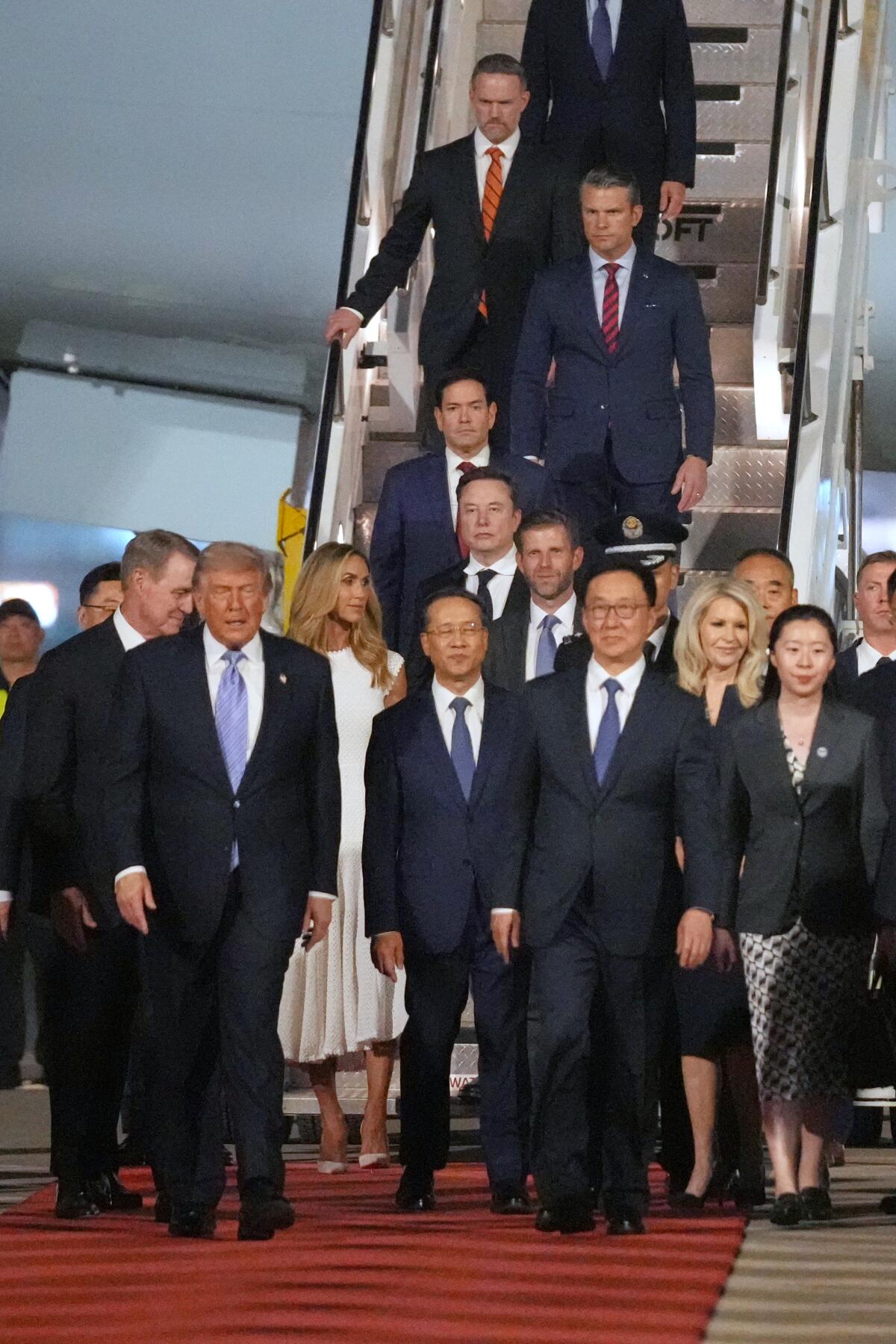
The Chinese bid to block the deal comes weeks before a planned mid-May summit between US President Donald Trump and Chinese President Xi Jinping in Beijing.

Source link

Supreme Court wary of barring police from phone searches to find crime suspects

A divided Supreme Court heard arguments Monday on whether the police use of phone tracking data violates the Constitution’s protection against “unreasonable searches.”

Most of the justices sounded wary of barring investigators from obtaining precise location history from Google or cellphone providers if it helps find a murderer or a bank robber.

“I’m trying to figure out why this was bad police work,” Justice Brett M. Kavanaugh told an attorney representing the defendant, Odell Chatrie.

He said a police detective in Virginia was seeking clues to find a bank robber and sought a “geofence warrant” from a judge that told Google to turn over data from phones that were near the bank during the hour of the robbery.

“In the end, he got three names,” Kavanaugh said, including Chatrie, who pleaded guilty. He said these searches have proved to be practical for finding criminals.

But other justices said the court should not rule broadly to endorse digital searches of vast data bases held by private companies.

What about emails or Google photos, asked Justices Sonia Sotomayor, Neil M. Gorsuch and Amy Coney Barrett.

All three said this information deserves more privacy protection than location data.

In the past, the court has said the 4th Amendment protects against government searches that intrude upon a “reasonable expectation of privacy.” The two sides in this case differ on whether a digital search of location data violates privacy rights.

Gorsuch said he was generally skeptical of broad searches if the government had no particular suspect.

Is it OK to search “all the rooms in a hotel for a gun or all the storage units or all bank deposit boxes for the pearl necklace that has been stolen?” he asked.

Eric Feigin, a deputy solicitor general, said the government probably could not obtain a search warrant for all storage units or hotel rooms, but a Google search is different because it is a software filter.

Chief Justice John G. Roberts Jr. proposed a narrow ruling.

Perhaps unwittingly, Chatrie had agreed to have Google store his location history data. Roberts said he could have turned off the public location data, and for that reason, he may have lost his right to appeal.

“If you don’t want the government to have your location history, you just flip that off,” he said.

Justice Samuel A. Alito Jr. agreed. Chatrie “voluntarily disclosed to Google the information about where he was going to be,” he said.

Eight years ago, Roberts wrote an opinion for a 5-4 majority that said investigators needed a search warrant before they could obtain 127 days of cell tower records that helped convict a Michigan man of several store robberies.

Four of the court’s liberal justices joined that majority, but only two of them — Sotomayor and Elena Kagan — remain on the court.

Since then, Kavanaugh, Barrett and Justice Ketanji Brown Jackson have joined the court.

The National Assn. of Criminal Defense Lawyers and other civil liberties groups backed Chatrie’s challenge to the government’s use of geofence warrants.

Chatrie had “a reasonable expectation of privacy in his location history given both its sensitive and revealing nature and the fact that it was stored in his password-protected account,” Washington attorney Adam Unikowski told the court. “There was not probable cause to search the virtual private papers of every single person within the geofence merely because of their proximity to the crime.”

Feigin, the Justice Department attorney, said a ruling for Chatrie “would impede the investigation of kidnappings, robberies, shootings and other crimes.”

He agreed, however, that email should be protected because it involves personal communication.

The justices will hand down a ruling in Chatrie vs. U.S. by the end of June.

Source link

Google co-founder Sergey Brin confronted Gavin Newsom — then launched a political war

In a treehouse nestled in redwoods north of San Francisco, Gov. Newsom stood cold and hungry as Sergey Brin, the world’s fourth-richest man, and his wellness-influencer girlfriend told him they were leaving the state.

It was late in the evening at a Christmas party hosted by crypto titan Chris Larsen — featuring singer Janelle Monáe and a towering abominable snowman with glowing red eyes — when Brin and his partner, Gerelyn Gilbert-Soto, confronted Newsom about a new proposal to tax billionaires in California, according to people who’ve spoken with the governor. Such a levy could hit Brin’s stake in Alphabet Inc. and his $272.6 billion fortune.

Newsom, who opposes the wealth tax, was still telling people about the lengthy exchange at the party months later, complaining of a lingering cold the pair had given him, according to the people, who asked not to be named discussing private conversations with the governor.

Brin, meanwhile, followed through. He left the state, bought a lakeside mansion in Nevada, and started bankrolling a billionaire political uprising in California.

Newsom, through a spokesperson, declined to comment on the interaction. “The governor has been very clear with everyone, no matter who they are, that this effort will do serious damage to the state, including for public safety workers and schools, at the expense of one special interest group,” Izzy Gardon, a spokesperson, said.

A representative for Brin didn’t respond to requests for comment.

Brin’s political push reflects a broader awakening among California’s ultrawealthy. Over the past six months, the proposed billionaire tax and a heated governor’s race have drawn tech titans and business leaders more directly into the state’s affairs — a space many of them have traditionally kept at arm’s length.

Prior to this year, Brin’s last contribution in a California election cycle was 2010 when Arnold Schwarzenegger was governor and the Google co-founder largely backed climate causes. He’s now spent more than $58 million in the last four months, including an extra $9 million disclosed late Friday, but more importantly has helped mobilize a network of fellow tech titans in a push to sway state issues.

“The wealth tax was a wake up call, it was a fire that just lit up Silicon Valley literally in a matter of weeks,” said Steven Maviglio, a veteran Democratic strategist. “I’ve never seen anything like it.”

Altogether, ultrawealthy donors have injected more than $270 million into California’s political scene in this election cycle. Outside of the wealth tax, billionaire Tom Steyer is emerging as a top Democratic candidate for governor after the downfall of former Representative Eric Swalwell following allegations of sexual assault. Steyer, a former hedge fund manager, has spent more than $140 million in his election bid, crowding TV airwaves with ads and labeling himself a “class traitor” with a campaign modeled after Vermont Senator Bernie Sanders.

Ballots for the June 2 primary election start going out next week. Brin and a cohort of the ultrawealthy including Coinbase CEO Brian Armstrong and venture capitalists Vinod Khosla and John Doerr have plowed millions into supporting Matt Mahan, a Silicon Valley mayor, with a back-to-basics agenda and a penchant for taking on the state’s Democratic establishment.

That money has helped Mahan buy airtime and attracted controversy, but his polling numbers remain stuck in the single digits while Steyer’s well-funded progressive campaign is gaining favor with voters. Brin has also backed Republican Steve Hilton, who’s currently leading polls.

“You have two polar opposites going on. You have a billionaire running who has actually fully adopted an agenda that the vast majority of voters agree with: Taxing billionaires, funding healthcare, fighting back against ICE,” said Lorena Gonzalez, head of the state’s largest union group, the California Federation of Labor Unions. “And then you have billionaires pushing a candidate whose talking points are apologetic to the tech industry.”

The billionaire political activism in California mirrors larger shifts in Silicon Valley and the nation. President Donald Trump has given tech billionaires broad access to the White House, inviting Brin and other industry captains over for dinner and to join advisory boards.

Back in September, Trump singled out Gilbert-Soto as Brin’s “really wonderful MAGA girlfriend” at a White House dinner also attended by Mark Zuckerberg, Tim Cook and Sam Altman. She has publicly supported Republican Steve Hilton for California governor, a candidate Trump endorsed and Brin has also donated to.

In California, Brin’s newfound political action was catalyzed by the wealth tax proposal, which would levy a one-time 5% tax on billionaires to help offset federal healthcare cuts. In a Signal group chat earlier this year with other Silicon Valley elite, Brin floated the idea of raising hundreds of millions of dollars to influence California politics, according to a person who saw the message.

Brin left California for Nevada ahead of a Jan. 1 residency deadline for the proposed wealth tax. He moved to a $42 million mansion on the Nevada side of Lake Tahoe, featuring two glass-walled funiculars.

Shortly after leaving California, Brin contributed $20 million to a new group dedicated to fighting the tax while also pushing pro-business and housing affordability policies, Building a Better California, making him the single largest contributor. He added $37 million over the spring, as the group quickly started supporting a trio of anti-wealth tax measures that could nullify a billionaire tax if it gets passed in an election. One of the measures, the so-called Transparency Act, has enough signatures to qualify for the November ballot, its backers claimed on Monday.

Building a Better California “remains fixed on long-term reforms supported by most Californians: housing affordability, stable funding for education, infrastructure investments, and government accountability,” a spokesperson said.

Joining Brin in the effort were other billionaires, including former Google CEO Eric Schmidt, Stripe CEO Patrick Collison and venture capitalist Michael Moritz. Peter Thiel, who also left California ahead of the New Year’s Day deadline, gave $3 million to a separate committee opposing the wealth tax.

“They don’t trust California anymore,” said David Lesperance, a tax attorney who specializes in relocations and has helped move five families out of the state because of the wealth tax threat.

Brin and his fellow billionaires helped push up the costs to gather the more than 870,000 signatures required to qualify a ballot measure. This forced the union behind the wealth tax, SEIU-UHW, to spend more on their efforts.

Now, the union says it has succeeded in getting the signatures it needed, which will likely force the business leaders opposing it into further spending.

“A very small group of the most controversial billionaires on the planet tried to stop Californians from being able to save their local emergency rooms and hospitals — but our current signature tally proves frontline healthcare workers will prevail in bringing this commonsense proposal to voters,” said Suzanne Jimenez, SEIU-UHW’s chief of staff. “When our growing coalition files these signatures, David will have won the first round against Goliath.”

Other billionaires have bankrolled their own political initiatives, including Larsen, who set up his own network of influence groups with names like Grow California and Golden State Promise.

Many in Sacramento are skeptical that Brin and his fellow ultra-rich will succeed in swaying California state politics. They point to the failed candidacy of former eBay executive Meg Whitman, who spent around $144 million of her own fortune to become governor, or even venture capitalist Tim Draper’s longshot initiative to split California into six separate states.

“They’re trying to extrapolate from their own industry, which might have been fabulously successful, that they know something about political advertising, when they don’t,” said Garry South, a veteran Democratic strategist. “They think, ‘Hey, I’ve got money I can throw it around,’ and they don’t really do their homework.”

Political consultants describe their frustration with some wealthy tech donors, who often view their political giving through an investment lens, promising big checks and not following through if they don’t see momentum. That’s led to questions about whether the California billionaire activism would continue if Mahan’s governor bid fails and the wealth tax passes.

Even Larsen, who’s worth around $13 billion, has expressed anxiety that not enough business leaders are stepping into politics. “It’s a lot of talk, and they’re happy, but we don’t see the firepower we need to take on the SEIUs,” he said, referring to the state’s largest union.

Newsom, for his part, acknowledges that many of the state’s wealthiest residents are willing to donate significant sums of money, but want to do it on their own terms and not through a tax.

“Some will never give a penny away,” he said at a Bloomberg News event in January, not long after his encounter with Brin in the treehouse. “Some I respect. Some I don’t.”

Kamisher and Carson write for Bloomberg.

Source link

Press secretary Karoline Leavitt condemns ‘violent rhetoric’ after correspondents’ dinner shooting

April 27 (UPI) — White House Press Secretary Karoline Leavitt condemned negative comments and rhetoric about President Donald Trump in a press briefing Monday.

Leavitt addressed the press, likely for the last time before she begins her maternity leave, in the wake of a shooting at the White House Correspondents’ Dinner on Saturday. Leavitt blamed the incident on “violent rhetoric” from Democratic lawmakers, television personalities, the media and others on social media.

“This hateful and constant and violent rhetoric directed at President Trump day after day after day for 11 years has helped to legitimize this violence and bring us to this dark moment,” Leavitt said. “Those who constantly falsely label and slander the president as a fascist, as a threat to democracy, and compare him to Hitler to score political points are fueling this kind of violence.”

Leavitt said one member of the U.S. Secret Service was shot in the chest but survived because they were wearing a bulletproof vest.

The Department of Justice will address the arraignment of the alleged gunman, 31-year-old Cole Tomas Allen, on Monday, Leavitt added. She also acknowledged that the White House Correspondents’ Dinner may be rescheduled.

“When you read the manifesto of this shooter, ask yourselves how different is the rhetoric from this almost-assassin from what you read on social media and hear in various forums every single day,” Leavitt said. “Much of the manifesto of the would-be assassin is indistinguishable from the words that we hear daily from so many.”

In response to the shooting, Leavitt said that White House Chief of Staff Susie Wiles will be meeting with Department of Homeland Security leadership to discuss the security of the president.

Asked why she felt it was important to delay her maternity leave after Saturday’s shooting, Leavitt said she is “honored to speak on behalf of President Trump.”

President Donald Trump and first lady Melania Trump participate in the 2026 White House Correspondents’ Association Dinner in Washington on April 25, 2026. Photo by Yuri Gripas/UPI | License Photo

Source link

King Charles III heads to Washington on a delicate mission to restore the U.K.-U.S. relationship

Two and a half centuries after the American colonies declared independence from Britain under King George III, his descendant King Charles III lands in Washington on Monday with trans-Atlantic ties under strain and security in the spotlight.

A shooting at a Washington dinner attended by President Trump on Saturday sparked a last-minute security review of the four-day state visit, intended to celebrate the United States’ 250th anniversary, and the U.S.-U.K. “special relationship.”

Buckingham Palace said the king “is greatly relieved to hear that the president, first lady and all guests have been unharmed.” After a security review, the palace said the trip “will proceed as planned.”

Trump praises the king but derides Starmer

A rift between the U.K. government and Trump over issues including the Iran war had already raised the political stakes for the British monarch’s visit.

In recent weeks, Trump has lambasted Prime Minister Keir Starmer over his unwillingness to join U.S. military attacks on Iran, dismissing Britain’s leader as “not Winston Churchill,” the World War II prime minister who coined the phrase “special relationship” for the U.K.-U.S. bond.

It’s part of a wider rift between Trump and the United States’ NATO allies, whom he has called “cowards” and “useless” for not joining action against Iran. A leaked Pentagon email suggested the U.S. could reassess support for the U.K.’s sovereignty over the Falkland Islands in the south Atlantic. Britain and Argentina fought a 1982 war over the islands, also known as the Islas Malvinas.

The president insists the political chill won’t affect the royal visit. Charles “has nothing to do with that,” Trump said in March, meaning NATO.

The president has spoken in glowing terms about Charles, repeatedly referring to the monarch as his “friend” and a “great guy.”

He also continues to mention his “amazing” trip to the U.K. in September with first lady Melania Trump for an unprecedented second state visit. Starmer hand-delivered the invitation from the king in the Oval Office five weeks after Trump returned to office, in a very public attempt to woo the Republican president.

The U.K. royal family laid on pomp and pageantry for the Trumps, with scarlet-clad guardsmen, brass bands and a sumptuous banquet at Windsor Castle.

“President Trump has always had great respect for King Charles, and their relationship was further strengthened by the president’s historic visit to the United Kingdom last year,” White House spokesperson Anna Kelly told The Associated Press. “The president looks forward to a special visit by Their Majesties, which will include a beautiful state dinner and multiple events throughout the week.”

Trump, meanwhile, told the BBC that the king’s visit could “absolutely” help repair the trans-Atlantic relationship.

“He’s fantastic. He’s a fantastic man. Absolutely the answer is yes,” the president said.

Some have called for the trip to be canceled

Kristofer Allerfeldt, a University of Exeter professor specializing in American history, said the two governments have very different objectives for the trip.

He said that for Charles, the trip is about “reinforcing long-term ties, showcasing the monarchy’s soft power and reminding the world that Britain still carries diplomatic weight.”

For Trump, it’s more about “a media event,” with emphasis on the optics of a visit that resembles a meeting of “two gilded monarchs.”

Some U.K. politicians worry that the trip is fraught with opportunities for embarrassment. Trump’s recent broadsides at Pope Leo XIV have heightened those concerns.

Ed Davey, leader of the U.K. centrist opposition Liberal Democrats party, earlier this month called Trump “a dangerous and corrupt gangster” and implored the government to cancel the trip.

“I really fear for what Trump might say or do while our king is forced to stand by his side,” Davey said in the House of Commons. “We cannot put His Majesty in that position.”

Starmer defended the visit, saying “the monarchy, through the bonds that it builds, is often able to reach through the decades” and bolster important relationships.

Andrew and Epstein cast a shadow

Raising the stakes is the shadow of the king’s younger brother Andrew Mountbatten-Windsor, who has been stripped of his royal title of Prince Andrew, exiled from public life and put under police investigation over his friendship with Jeffrey Epstein. He has denied committing any crimes.

Epstein victims have urged the king to meet with them and other sexual abuse survivors. It’s unlikely he will do so.

Charles has visited the U.S. 19 times, but this is his first state visit to the country since becoming king in 2022. His mother, Queen Elizabeth II, made four state visits to the U.S.

The king, who is 77 and was diagnosed in early 2024 with an undisclosed form of cancer, will spend four days in the U.S. accompanied by Queen Camilla.

In Washington, the king and queen will have a private tea with the Trumps and attend a garden party and a formal White House state dinner. The president and the king will also have a one-on-one meeting.

The royal couple will also visit the Sept. 11 memorial in New York and attend a 250th birthday block party in Virginia, where Charles will also meet Indigenous leaders involved in nature conservation — a favorite cause of the environmentalist king.

Three centuries after Britain’s kings and queens gave up any real political power, the royals remain symbols of soft power, deployed by elected governments to smooth international relationships and send messages about what the U.K. considers important.

A key moment will be the king’s speech to the U.S. Congress on Tuesday. It’s only the second time, after Queen Elizabeth II in 1991, that a U.K. monarch has addressed a joint meeting of both houses.

Elizabeth praised liberalism on that trip, spoke against the idea that “power grows from the barrel of a gun” and praised the “rich ethnic and cultural diversity of both our societies.”

The king’s treasured causes, including the environment and harmony among religious faiths, are in contrast to Trump’s. He’s unlikely to accentuate differences, but Allerfeldt said that, in the monarch’s subtle way, the king could use his speech to send a message.

“He does have an unorthodox way of looking at the world, and I think maybe he can actually have something valid to say when he addresses Congress,” Allerfeldt said.

Superville and Lawless write for the Associated Press. Jill Lawless reported from London.

Source link

Latino leaders surge into local office as Trump-era attacks fuel new urgency

Rhetoric dehumanizing immigrant and Latino communities may appear more open and in-your-face in the current political climate. But that has not been a barrier for Latinos seeking elective office or high-level roles in government.

Voters are choosing an increasing number of nonwhite Hispanic leaders to local elective office — and many of the leaders are the first Latinos to hold their seats. Some political science experts attribute the rise of Latino leadership to years of grassroots organizing, coupled with ongoing demonization of their communities by Trump administration officials and conservative activists.

“That’s the difference now, is that there’s this extra incentive of an unrelenting attack on Latinos across the country,” said Anna Sampaio, an ethnic studies professor at Santa Clara University who specializes in race and gender politics.

There are currently an estimated 7,700 Latino elected officials nationwide, according to data from the National Association of Latino Elected and Appointed Officials. That’s up from 6,883 officials in 2020.

Estimated to number as many as 55 million people — 16% of the U.S. population — Latinos are the largest ethnic minority in the country, with politics, interests and priorities as diverse as the national origins represented within their population. But Latinos also are underrepresented as a demographic across elective offices.

Since the beginning of President Trump’s second term, Latino communities have been a target of his hard-line immigration tactics. The feeling of attack doesn’t stop there. From memes shared from the official White House page perpetuating Hispanic stereotypes, a federally led English-only initiative and an anti-diversity, equity and inclusion push have painted a target on Latinos across the country.

It’s all led to more Latinos seeking office to defend their communities and give voice to those who may be afraid to speak out in the current political climate. As a result, legislators have proposed measures that include providing community members with protections against the U.S. Immigration and Customs Enforcement, halting the approval of ICE detention centers in their cities, and calling for a stop to ICE funding, among other actions.

Pennsylvania Latino mayor makes history

Lancaster, Pennsylvania, with a roughly 40% Hispanic population, recently elected Jaime Arroyo their first Latino mayor. Arroyo took office in January, after being elected with 85% of the vote.

“I think being the first Latino to be in this role and the first person of color to be mayor of Lancaster City has been exciting,” Arroyo told The Associated Press, adding that he finds it “extremely exciting to lead and represent our community in this role.”

With rhetoric and national policies — such as heightened immigration enforcement — hurting the Latino communities, Arroyo said, diverse representation in government is more important than ever. He also believes that the rise of elected Latino officials over the last couple of years is the result of generations of Latinos being politically active fighting for civil rights.

“We’re starting to see a lot of the fruits of that labor come to fruition,” Arroyo said. “There’s never a perfect time to serve your community, there’s the right time. And I think right now is the right time for a lot of Latinos to step up into these roles, especially with everything that is going on.”

Latino representation expanding in city councils

Many more Latinos made history when they took office in earlier this year.

In Iowa, Rob Barron was sworn in Jan. 12 as the first Latino representative on the Des Moines City Council. Antonio Pacheco was sworn on Jan. 7 to be the first Latino member of the city council in Conyers, Georgia. In Ohio, Eileen Torres became the first Mexican American women to win a city council seat in Lorain. Sabrina Gonzalez also took office there as the first Puerto Rican women to serve.

And in Michigan, Clara Martinez and Deyanira Nevarez Martinez were sworn in Jan. 1 to the Lansing City Council, making the city the first in the U.S. to have a council with majority Latino representation.

Martinez said her election, and that of Nevarez Martinez, makes a bit statement about “what people are truly open to despite the national rhetoric.”

“I think because of the rhetoric that we are having to face and some of the backlash on the national stage, I think that’s just fueled the fire for so many people,” she said.

The Salt Lake City Council also has a Latino majority, with four of seven seats, after Erika Carlsen, the granddaughter of Mexican immigrants, was sworn in on Jan. 5. Carlsen said her success is possible because of current and previous generations that put in the work to create spaces where Latinas were encouraged to take leadership positions.

“I feel like I’m building on early generations of leadership,” Carlsen said. “That’s both an honor and responsibility to improve Salt Lake City for the people who live here.”

Carlsen said even if representation at the federal level is not high or visible she said having representation at the local level can have a huge impact.

“I think that it’s critically important that we continue to build on this momentum,” Carlsen said. “The majority of change that can happen starts locally, it doesn’t start in Washington but in City Hall, school boards and neighborhoods conversations. That’s the kind of momentum I’d love to see all across the United States.”

Carolina Welles, executive director of The First Ask, an organization that supports first-time female candidates at the state level, said the reason why Latino representation is more visible at the local level is because those leaders are able to built trust with their community much easier given their proximity.

“They actually know what people care about,” Welles said. “They have a stake because they are facing similar things.”

Local level Latino leadership builds on state and federal representation

It’s not just at the local level. Latinos are making inroads at the federal level too.

The 119th Congress has 56 Hispanic or Latino members. That shakes out to 10.35% of total membership, according to the Congressional Research Service.

For comparison, there were only 14 Hispanic or Latino members and all were male in the 99th Congress, 40 years ago.

At the start of 2025, there were seven Hispanic U.S. senators. That number decreased to six when then Sen. Marco Rubio resigned to become the Secretary of State, the first Latino to hold the position.

Last year also marked a record for Latinas at the state level. Latinas held 214, or 2.9%, of seats in state legislatures, according to the Center for American Women and Politics. That was up from 192 seats in 2024.

Currently, New Mexico Gov. Michelle Lujan Grisham is the only active Latina governor in the U.S. Only two Latinas have been elected governor in U.S. history, and both were in New Mexico.

In March, Gina Hinojosa won the Democratic nomination for governor, making her the second Latina to win a major party gubernatorial nomination in Texas.

Latinos saw the biggest rise in elected officials during the Trump administration in response to attacks on their fundamental rights, said Sampaio, the Santa Clara University professor. She said that trend is likely to continue as the administration continues its attacks on immigrant communities.

“We’re likely to see more Latinos run for office at the local level, at the state level and even at the national level in response to the attack on simply their existence,” Sampaio said. “It is unwittingly both terrorizing the Latino community as well as mobilizing communities.”

Figueroa writes for the Associated Press.

Source link

‘Clearly stronger’: Germany’s Merz says Iran ‘humiliated’ US in its war | Conflict News

German chancellor warns the US risks becoming bogged down in another quagmire similar to Iraq and Afghanistan.

German Chancellor Friedrich Merz says the United States is being “humiliated” in its war with Iran, warning that Washington lacks a clear path out of the conflict as Tehran gains the upper hand.

Speaking to students in the German town of Marsberg on Monday, Merz said the situation has exposed a deeper strategic problem for the US as he drew comparisons with past military debacles.

Recommended Stories

list of 3 itemsend of list

“The problem with conflicts like this is always you don’t just have to get in – you have to get out again. We saw that very painfully in Afghanistan for 20 years. We saw it in Iraq,” he said.

Merz said Iranian officials were “obviously negotiating very skilfully” and appeared “clearly stronger than one thought”, adding that “an entire nation is being humiliated by the Iranian leadership”, particularly by the Islamic Revolutionary Guard Corps.

Merz urged a rapid end to the war, warning that the fallout was already hitting Germany’s economy.

“It is, at the moment, a pretty tangled situation,” he said. “And it is costing us a great deal of money. This conflict, this war against Iran, has a direct impact on our economic output.”

The German leader said Berlin remains ready to deploy minesweepers to help secure shipping routes through the Strait of Hormuz, a vital artery for global petroleum supplies, but stressed that such steps depend on a cessation of hostilities.

Merz made the comments as concerns are growing across Europe over the wider impact of the conflict, including energy disruptions and economic instability.

Earlier, German Foreign Minister Johann Wadephul warned that nuclear threats continue to shape the security environment, even as Berlin reaffirmed its commitment to nonproliferation.

“As long as nuclear threats against us and our partners continue, we will need a credible deterrent,” he said before meetings at the United Nations on the Treaty on the Non-Proliferation of Nuclear Weapons.

France and Germany have recently moved to deepen cooperation on nuclear deterrence, reflecting mounting anxiety in Europe over both the Iran war and broader regional instability.

Source link

Column: After Swalwell scandal, a ‘safe choice’ for Democrats emerges

Xavier Becerra seems like the type of steady, trustworthy fellow you’d like your daughter to marry. But she’s attracted to a charming party animal.

Then the flashy dude does something really stupid and repulsive. Daughter is jarred into her senses and decides to size up the unexciting but reliable guy.

That’s how I’m seeing the suddenly captivating contest to succeed termed-out Gov. Gavin Newsom.

OK, it’s not a perfect analogy. Becerra is 68, been happily married for 37 years and the couple have three grown children. But the principle’s the same: He’s the safe choice. The hot other character merely fooled lots of people for a while.

You’re reading the L.A. Times Politics newsletter

George Skelton and Michael Wilner cover the insights, legislation, players and politics you need to know. In your inbox Monday and Thursday mornings.

Becerra is suddenly getting a hard look because the fast-stepping, front-running Democrat Eric Swalwell revealed himself to be totally unworthy of public office.

Five women accused the married Bay Area congressman of sexual misconduct, including rape. He denied the allegations but apologized to his wife for past “mistakes in judgment.” Donors, endorsers, staffers and voters immediately fled his campaign. And he quickly slunk away.

And Becerra surged.

Why?

“People are looking for something stable,” Becerra answered when I asked. “Everybody likes pizzazz and glitter. Then all of a sudden their hero falls from grace. And they look for who they can trust.”

Dan Schnur, who teaches political communications at USC, UC Berkeley and Pepperdine, says: “Democrats had a near-death experience with Swalwell. They don’t seem to be in the mood to take more risks.”

Schnur calls Becerra “this year’s version of Joe Biden’s 2020 campaign.” He’s the safe choice. “Sometimes being ‘none of the above’ is good enough.”

Since Swalwell’s collapse, the once-floundering Becerra has had a meteoric rise in the polls.

A survey conducted for the state Democratic Party showed Becerra rising by 10 points from single digits to tying Tom Steyer, a billionaire hedge fund founder turned climate warrior. Close behind was former Orange County Rep. Katie Porter.

Those three are now the leading Democratic competitors for a slot on the November ballot. The top two vote-getters in the June 2 primary, regardless of party, will advance to the general election.

Republican former Fox News host Steve Hilton was leading the entire field in the poll, followed closely by Riverside County Sheriff Chad Bianco.

Steyer and Porter are both liberals in their ideology and personalities. Neither are flamethrowers, but they‘re fiery. In contrast, Becerra also is an ideological liberal, but with a low-key demeanor that might cause one to mistake him for a political moderate.

San José Mayor Matt Mahan is clearly a Democratic centrist. But in this era of intense polarization, moderation may be a hard sale. At least, it has been so far for Mahan.

Among those six Democratic and Republican candidates, Becerra boasts by far the most outstanding political resume.

He was U.S. secretary of Health and Human Services under President Biden. Before that as state attorney general, California’s mild-mannered “top cop” showed his aggressiveness by suing the first Trump administration 123 times and winning the vast majority of cases. He also served 12 terms in Congress from Los Angeles and became part of the Democratic leadership. And he served one term in the state Assembly.

That’s an impressive list. But Schnur says Becerra was “the least impressive” candidate in a 90-minute televised debate last week.

“He talked in very vague generalities,” the former political operative says, but adds: “In the middle of the other candidates’ drama and emotional outbursts, he seemed very calm and safe.”

Some pundits and pols have been calling on Becerra to show more fire. But that’s not him. He’s guarded and understated. It’s how he’s wired. If he attempted a personality change, it probably wouldn’t work. There’s a risk of it seeming contrived and phony.

But Becerra should be more specific on issues. Exactly how would he make life better for Californians?

His basic answer when asked how he’d solve a given problem pestering California is essentially: Trust me. I’ll meet with all sides and figure it out.

That’s not just a cop-out. It’s his pragmatic modus operandi.

That reserved style prompted this shot during the debate from Porter, who tends toward specificity:

“Mr. Becerra, you have all these lovely plans. But there are never any numbers, any revenue plan, any details. … The how, the why and how much, it’s all missing.”

Becerra responded with some rare emotion: “That’s very rich to hear from someone who’s never had to actually run a government.” The former Cabinet secretary said he’d balanced four federal HHS budgets that were larger than the California state budget.

I asked Becerra about some issues last week. Here’s partly what he said:

Housing costs: Expedite building by streamlining more regulations. “We’ll continue to have rules, but let’s make them smart rules.”

Gas prices: Keep more refineries from closing. “Let them know they can operate and produce and not lose money. That’s an easy one.”

High-speed rail: ”We’re going to build the bullet train, but not this bullet train. It’s too expensive. Sit everybody down and come out with a position.”

Banning new gas cars by 2035: Is Newsom’s goal realistic? “Seeing what I see, no. We can’t make it by ‘35, but we can make it.”

But let’s be honest. Elections usually turn more on likability than policy positions.

“Decency may be a quality that goes a long way” in the governor’s race, says longtime Democratic strategist Darry Sragow. “In part that’s because of the Swalwell revelations and also because of Trump, who’s not decent. Decency may be what people are looking for.”

But Democrats are riled up by Trump and they’re also demanding backbone and fight.

Many are eyeing Becerra as someone perhaps worth partnering up with. A bit more passion from him could help sustain their interest.

What else you should be reading

The must-read: The congressional landmine stirring fears about the midterm election — and a Trump power grab
Brace yourself: Voter ID controversy headed for California with initiative on November ballot
The L.A. Times Special: How a Trump-endorsed Republican could become California’s next governor

Until next week,
George Skelton


Was this newsletter forwarded to you? Sign up here to get it in your inbox.

Source link

How does targeting water supply during war worsen the scarcity crisis? | Politics

We explore why water infrastructure is increasingly being targeted in the midst of war and conflict.

Water sustains life, but what happens when it is weaponised? In the ongoing US-Israel war on Iran, desalination plants supplying millions in the Gulf have become targets. This reflects a growing pattern: water infrastructure is increasingly vulnerable as global scarcity intensifies. The United Nations warns of looming “water bankruptcy” driven by climate change and rising global demands, including AI data centres.

Presenter: Stefanie Dekker

Guests:

Kaveh Madani – Director, UNU Institute for Water, Environment & Health

Zeina Moneer – Environmental policy and climate programmes expert

Source link

Hollywood residents want more for their tax dollars. Councilman says he’s trying

Hold everything. Hollywood’s Lexington Park will not be getting a new playground after all, and that’s both good news and bad news.

To explain, let me take you back to April 15, when I tagged along with Sabine Phillips on her weekly three-hour inspection of the neighborhood’s chronic trash problem. Phillips, a housekeeper by trade, was hired by one of her clients a few years ago to help clean up their streets.

So each Wednesday, Phillips went out on her yellow Huffy cruiser and routinely logged 50 or more illegally dumped items and reported them to the city’s 311 system for pickup. And each Saturday, she filled up to four or five big bags with smaller bits and scraps of debris.

Near the end of my three hours with Phillips, who got help that day from volunteer Keith Johnson, we visited the Lexington pocket park. There were no kids there, and there never are, Phillips said. That’s because of the glass and needles in the sand, drug activity, sporadic violence, gang tags on the slide and homeless camps.

A guy from the Recreation and Parks Department showed up and said the park was in line for a possible upgrade that could cost as much as $300,000. In my April 18 column, I questioned the wisdom of investing in a playground that would remain unsafe unless there was a plan to address all the aforementioned issues.

Nick Barnes-Batista, communications director for L.A. City Councilmember Hugo Soto-Martínez, wrote to tell me his office was unaware of any playground projects planned for that park.

A spokesperson for Recreation and Parks told me that despite what was said by the employee I met in the park, there is no “immediate playground replacement project on the books.” But the department is “working closely” with the councilman’s office “to identify funding sources and to work with the community on broader park improvements and/or uses.”

OK, so it’s good news that taxpayer funds won’t be plowed into a park that could well be lost to the neighborhood almost immediately, due to all the aforementioned problems.

But it’s bad news and sad commentary that a park in the densely populated heart of the city will remain unusable for the foreseeable future.

The more important consideration, though, is the question of what’s being done to prevent the illegal dumping of furniture, mattresses and other items that sit curbside and often end up as the building blocks of new homeless encampments.

There’s a concentration of social service agencies in the neighborhood, said Stefanie Keenan, a longtime neighborhood volunteer and activist. She’s the one who hired her housekeeper to help look after the neighborhood, and she insists there is not enough enforcement of existing laws to address problems that are both a nuisance and a public safety threat, given the crime and all-too-frequent fires.

A woman pushes her walker past debris in Los Angeles.

A woman pushes her walker past debris in Council District 13 in Los Angeles on Friday.

(Genaro Molina / Los Angeles Times)

Soto-Martínez agreed to talk to me about all of this on Friday morning, when he dropped by the Bresee Foundation, a nonprofit with a range of enrichment activities for youngsters and families in the largely low-income immigrant community, as well as homelessness prevention programs. Staff and volunteers, recruited with support from the council office, were about to head into nearby streets with shovels, brooms and trash bags.

Soto-Martínez acknowledged his district’s many challenges, told the gathering that the strength of a community is its people, and thanked them for their service.

The councilman, a former labor leader who joined the growing progressive wing of the L.A. City Council in 2022 with support from the local chapter of Democratic Socialists of America, has three challengers in the June 2 primary (Colter Carlisle, Dylan Kendall and Rich Sarian). He told me the city has to do a better job of educating people about illegal dumping and how to report it. A related challenge, he said, “is how quickly can we get to it. And that is a budget issue because we’ve cut so many positions on trash pickup.”

Soto-Martínez said his office used discretionary funds to hire two crews from the L.A. Conservation Corps for trash pickup. On homelessness, he said, he has a team strategizing to address the needs, and a medical team that works the streets, and a tiny home village is in the works.

But the housing shortage is a major challenge, he said, and when it comes to entrenched homelessness, “we’re now starting to deal with much more difficult cases.” Namely severe mental illness and serious addiction, both of which generally come under county jurisdiction.

“We created another team that goes out every single day. We door-knock, email and phone-bank people who are at risk of eviction,” Soto-Martínez said, adding that homelessness has declined by 25% during his three years in office.

So what is his message to constituents who say they don’t see enough progress?

“We ask them to give us patience and grace,” he said. “There’s a lot of examples like this, where we’re not just dealing with one thing. We’re dealing with four or five things.”

All of that is true, but the patience he asks for is wearing thin among some constituents.

“We need to find common ground and work together,” Soto-Martínez said. “You know, they see trash as an issue, and they’re doing it their way and we’re doing it our way. But how can we team up and do it together? You know, we’re happy to build those networks out, and under many of the issues they describe, I’m not disagreeing. … We all have the same goal.”

Los Angeles City Councilmember Hugo Soto-Martínez talks about confronting issues in his district.

L.A. City Councilmember Hugo Soto-Martínez gives a pep talk to volunteers before they leave to clean their neighborhood streets of garbage and debris.

(Genaro Molina / Los Angeles Times)

When Soto-Martínez departed for another appointment, the volunteers took to the streets, filling trash bags. They worked their way up Vermont, and a Bresee employee told me he works the same streets every day, trying to clear a path for “safe passage” as students walk to and from school.

As I said in the earlier column, it’s an inspiration to see people step up for their communities, whether out of pride or frustration. And it’s also reasonable to expect more from City Hall.

I drove over to Western and Sierra Vista, met up with Keenan, and told her about my conversation with Soto-Martínez. She said lax city policies and frequent non-response to citizen pleas for help have created the unsolved problems residents deal with daily. She said city officials have to do a better job of helping homeless people off the streets and preventing further deterioration of neighborhoods.

She was encouraged by a message she got from a representative of Mayor Karen Bass’ office who wants to tour the neighborhood with her.

We walked west on Sierra Vista and came upon a dumped sofa, some cabinets, mattresses, and a man who has been living in a curbside encampment for months. He sat near his belongings, which spilled into the street.

Why hasn’t this been addressed? Keenan wondered aloud. She has decided to stop paying her housekeeper to help address the neighborhood’s needs, and she predicted things will only get worse because of it.

I drove over to the Lexington pocket park, which Soto-Martínez called a priority, among many other priorities. Friday was a holiday — Armenian Genocide Remembrance Day. With schools closed, the park would have been a great little neighborhood asset.

But the entrance was closed, with a lock on the gate, and two tarped dwellings were set up against the iron fencing of the empty park.

steve.lopez@latimes.com

Source link

Becerra’s surge in California governor race draws fresh attention to candidacy, long government record

After winning his first race for Congress in 1992, 34-year-old Xavier Becerra credited a wave of community supporters in Los Angeles, many Latino, for backing his upstart campaign, saying he hoped his win was proof that grassroots politics was more valuable than “heavy dollars.”

More than 30 years later, Becerra, 68, is again an upstart candidate — this time for California governor. Again he is facing monied competition — including from chief Democratic rival Tom Steyer, a self-funded billionaire — and relying on Latino and other grassroots support.

California gubernatorial candidate Xavier Becerra speaks during a campaign event in Los Angeles on April 18.

California gubernatorial candidate Xavier Becerra speaks during a campaign event in Los Angeles on April 18.

(Jae C. Hong / Associated Press)

“You are the people power that it takes,” he told a crowd of supporters at a recent “Fighting for the California Dream” town hall in Los Angeles. “California wasn’t built by billionaires. It was built by your families. It was built by our families.”

That Becerra is still fighting in the race — and drawing new people to his events — reflects a remarkable and hard-to-explain turnaround for a campaign that appeared all but dead less than a month ago, then bounded back into contention after Rep. Eric Swalwell dropped from the race and resigned from Congress amid sexual assault allegations.

Before Swalwell’s collapse, Becerra’s biggest splash in the race came in March, when USC excluded him and other low-performing candidates from a planned debate. The criteria left every candidate of color out, and after Becerra and others complained, the forum was canceled.

A California Democratic Party tracking poll, released in early April before the Swalwell scandal broke, showed Becerra near the bottom of the field with 4% support among likely voters. In a party poll taken after it broke, Becerra’s support jumped to 13% — the biggest increase of any candidate.

Certainly some of Swalwell’s supporters shifted to Becerra, but political observers are still pondering why so many did — and not to Steyer, former Orange County Rep. Katie Porter or other Democrats with single-digit support, such as former L.A. Mayor Antonio Villaraigosa or San José Mayor Matt Mahan.

Whatever the answer, Becerra’s surge has sparked fresh interest in his candidacy. It also has raised questions about his time as California attorney general, when he sued the first Trump administration more than 120 times, and U.S. Health and Human Services secretary, when he backed the Biden administration’s strict COVID-19 rules and oversaw the agency’s response to a massive influx of unaccompanied minors at the southern border.

It has also put a growing target on Becerra’s back — including at Wednesday night’s gubernatorial debate, when rivals criticized him as a “D.C. insider” with poorly detailed plans for the state — and sparked hope among many Latinos that California will elect one of them as governor for the first time in state history, sending a strong message of resistance to the intensely anti-immigrant Trump administration.

Of course, Becerra faces hurdles. Steyer, a hedge fund founder who has donated more than $130 million to his own campaign, has been ahead of him in polling, as have two Republicans: Silicon Valley entrepreneur and former Fox News host Steve Hilton, who has President Trump’s endorsement, and Riverside County Sheriff Chad Bianco. Only the top two candidates in the June 2 primary advance to the November election.

Still, Becerra now has a path to victory, one that did not exist even a month ago, and new funding. Many Democratic voters remain undecided, and many — shocked by the Swalwell scandal — are looking for another Democratic front-runner to back.

In an interview with The Times, Becerra said he’s the man for the job, because “California needs a work horse, not a show horse.”

Los Angeles mayoral candidates gather for a portrait in 2000.

Xavier Becerra, left, gathers with other candidates for Los Angeles mayor in 2000.

(Gary Friedman / Los Angeles Times)

Rising wave of Latino political power

A Sacramento native and the son of a Mexican immigrant mother and a Mexican American father, Becerra graduated from Stanford Law School and served as a deputy to California Atty. Gen. John K. Van de Kamp before being elected in 1990 to the California Assembly.

In 1993, Becerra entered Congress on a rising wave of Latino political power and the heels of a fractious presidential election in which former White House aide Pat Buchanan challenged President George H.W. Bush in the Republican primary on a stridently anti-immigrant, “America First” message — one Trump repurposed in both 2016 and 2024.

It was a defining political moment for Latinos across the country, and for Becerra personally, said Fernando Guerra, founding director of the Center for the Study of Los Angeles at Loyola Marymount University.

“He certainly has been and is part of the incorporation of Latinos into California history and California politics, and it really begins in the early ’90s,” Guerra said. “His rise and political career is really a reflection of the rise and political incorporation of Latinos.”

In 1994, Becerra helped oppose Proposition 187, a state initiative to deny undocumented immigrants access to public education and healthcare. In 1996, he sharply criticized the passage of the Personal Responsibility and Work Opportunity Reconciliation Act, which cut federal benefits for many legal immigrants. By 1997, Becerra — just 39 — was chair of the Congressional Hispanic Caucus and the first Latino member to serve on the powerful House Ways and Means Committee.

By 2016, Becerra, 58, was the highest-ranking Latino in Congress when then-Gov. Jerry Brown tapped him to replace a Senate-bound Kamala Harris as California attorney general. There, Becerra played a key role in defending the Affordable Care Act, known as Obamacare, against Republican attacks.

In early 2021, Becerra was confirmed to serve as President Biden’s health secretary, another first for a Latino and a critical post given the COVID-19 crisis, and remained in that role until Trump’s second inauguration.

Xavier Becerra removes a face mask during a hearing

Then-U.S. Health and Human Services Secretary Xavier Becerra arrives for a hearing to discuss reopening schools during the COVID-19 pandemic in 2021.

(Greg Nash / Associated Press)

Criticism and praise

In a rush of endorsements in recent days, Becerra’s supporters have lauded his executive experience, calling him a “proven leader” who, amid constant threats from the Trump administration, is “ready to fight back on day one.”

Becerra’s critics also have pointed to his leadership record, but to highlight what they contend are glaring failures.

Steyer spokesman Kevin Liao alleged Becerra was “absent, ineffective, or too late” in responding to COVID-19 and other public health crises as health secretary, and that California “cannot afford incompetence, or someone who disappears when things get hard.”

The remarks echoed others made during the pandemic, including by Eric Topol, who is executive vice president of Scripps Research in La Jolla, a professor of translational medicine and a cardiologist. During the pandemic, Topol accused Becerra of being “invisible” in the fight to control it. In a recent interview, he said he still believes that.

Topol said the Biden administration’s COVID response was defined by poor data collection and “infighting” among agencies such as the National Institutes of Health, the Centers for Disease Control and Prevention and the Food and Drug Administration, including on vital issues such as when Americans should receive booster shots and how long they should isolate after infection.

Becerra “basically took a very absent, low profile — didn’t show up, didn’t harmonize the remarkable infighting,” Topol said. “The buck stops with him.”

Dr. David A. Kessler, the Biden administration’s top science official on COVID-19 and now a professor of pediatrics and epidemiology at UC San Francisco, fiercely defended Becerra, crediting him with rolling out some 676 million vaccines and steering the nation out of a wildly unfamiliar health crisis with substantial success — what Kessler called a “historical achievement” that proved government “can do big things.”

Kessler said Becerra rightly assessed that the country needed to hear from medical experts, not politicians, and so deferred at times to the doctors, epidemiologists and vaccinologists he smartly surrounded himself with and trusted — but he was never absent. “He enabled us. He was there. Anything I needed, he helped deliver,” Kessler said.

Becerra said there were a lot of people involved with the COVID-19 fight, including a White House team launched before his confirmation as health secretary. Still, it was his agency that ultimately led the response, and helped bring the pandemic to an end, he said.

“At the end of four years, when we had put some 700 million COVID shots into the arms of Americans and pulled the country and our economy out of the COVID crisis, it was HHS — and I was the secretary of HHS,” he said.

Becerra’s rivals in the governor’s race also have attacked him for how he responded to an influx of unaccompanied immigrant minors during the pandemic. They allege Becerra rushed their release to relatives and other sponsors while ignoring concerns from career health staff that some of those placements weren’t safe — resulting in thousands of kids being lost to the system, forced into child labor or trafficked.

The criticism stems in part from a sweeping New York Times investigation that found the health department couldn’t find some 85,000 children it had released, that Becerra had relaxed screening processes for sponsors and that placement concerns from career health staff went ignored or were silenced.

The investigation by reporter Hannah Dreier found that thousands of the 250,000 or so migrant children who arrived in the U.S. between early 2021 and early 2023 had “ended up in punishing jobs across the country — working overnight in slaughterhouses, replacing roofs, operating machinery in factories — all in violation of child labor laws.”

Atty. Gen. Xavier Becerra holds a news conference in Border Field State Park in San Diego in 2017.

Atty. Gen. Xavier Becerra holds a news conference in Border Field State Park in San Diego in 2017.

(Francine Orr/ Los Angeles Times)

It found there were many signs of “the explosive growth of this labor force,” and that staff had repeatedly flagged concerns about it in reports that reached Becerra’s desk. It also reported that, during a staff meeting in the summer of 2022, Becerra had pressed staff to move children even more quickly through the process, comparing them to factory parts.

“If Henry Ford had seen this in his plants, he would have never become famous and rich. This is not the way you do an assembly line,” Becerra said, according to a recording of the meeting obtained by the newspaper.

Danni Wang, another Steyer spokesperson, said children “were handed to gang members, traffickers, and abusers because [Becerra] stripped the background checks that had protected them for years.”

Becerra said the controversy is one he has addressed publicly for years, including in multiple congressional hearings. He said his team worked diligently to properly vet sponsors and do right by the thousands of children in their care, despite Congress failing to provide the budget needed to restore a system of licensed care facilities that the first Trump administration had dismantled.

“It was a wreck. They had closed facilities, they had fired the licensed caregivers. And remember, this was during COVID, [when] you didn’t want anyone to be near each other,” he said. “How do you take care of thousands of kids in a center that could house maybe 50 kids?”

He said he led an aggressive push to stand up temporary facilities — including in places like the San Diego Convention Center — while rebuilding the licensed care facilities Trump had dismantled and working to place kids into the community as quickly and safely as possible.

Ron Klain, who served as Biden’s chief of staff for the first two years of the administration, said Becerra helped lead the administration out of the crisis by being “an outspoken advocate” for the children in its care.

“Xavier was very, very insistent in meetings and very outspoken on the risk that some of these people [the kids] were being placed with were not the proper people to place them with, and pushed hard for more rigor in the process,” Klain said.

Becerra also has faced criticism and questions related to the federal indictment of his former chief of staff Sean McCluskie, who pleaded guilty to conspiracy to commit fraud after authorities accused him of stealing some $225,000 from Becerra’s dormant state political campaign account.

Becerra was not implicated in the scandal — which he’s previously described as a “gut punch” — and said he did everything he could to ensure McCluskie and others were held accountable once it came to light, including by providing “testimony and documents” to the FBI and federal prosecutors.

Hilton has said the scandal, which also implicated a former aide to Gov. Gavin Newsom, showed that “corruption has become totally ingrained and systemic” under Democratic rule in California.

Looking ahead

Experts said Becerra’s long resume will help him stand out in a race with less experienced competitors and no household names — and that Californians electing a Latino for the first time, as the Trump administration conducts one of the largest ever deportation campaigns, dismantles immigrant rights and targets people on the street based largely on their looking and sounding Latino, would be a major political moment.

Becerra said his extensive experience should matter to voters, because such experience will be necessary in the pivotal and no doubt chaotic Trump years ahead, when “pizzazz and dazzle” will matter less than steady competence from “someone who’s actually been in the midst of that hurricane” before.

“It helps to have gone through these things. I’ve been there, I’ve done that, and I’ve done it successfully,” he said. “I’ve proven that, whether it was taking on Donald Trump toe to toe as the [attorney general], whether it was getting us out of COVID working closely with the White House to deploy the resources and get that done, we made it happen.”

Source link

Billionaire-tax backers say they have enough signatures — times two — to qualify for ballot

Supporters of a billionaire tax said Sunday that they had gathered nearly twice as many signatures as necessary to qualify the controversial proposal for the November ballot.

Opponents of the proposal argue that it already has driven wealthy Californians — crucial to funding the state’s volatile budget — to other parts of the nation. Advocates, however, say the proposed tax is critical to compensate for federal healthcare funding cuts that will harm the state’s most vulnerable residents.

“Most Californians and most billionaires recognize how reasonable and necessary this proposal is — both to keep emergency rooms open and to save California businesses from closing,” said Suzanne Jimenez, the chief of staff of the Service Employees International Union-United Healthcare Workers West, the chief proponent of the effort. “A very small group of the most controversial billionaires on the planet tried to stop” this effort, she added, but when “our growing coalition files these signatures, David will have won the first round against Goliath.”

The union, which represents more than 120,000 healthcare workers, patients and consumers, launched the effort to counter massive healthcare funding cuts that President Trump signed last year. The California Budget & Policy Center estimated that as many as 3.4 million Californians could lose Medi-Cal coverage, rural hospitals could shutter, and other healthcare services would be slashed unless new funding was found.

The proposal would impose a one-time tax of up to 5% on taxpayers and trusts with assets valued at more than $1 billion, with some exclusions, such as property. The levy could be paid over five years. Ninety percent of the revenue would fund healthcare programs, and the remaining funds would be spent on food assistance and education programs. The proposal would cost the state’s richest residents about $100 billion if a majority of voters support it.

Supporters need to submit the signatures of nearly 875,000 registered voters to county elections officials by June 24. They say they have gathered nearly 1.6 million signatures.

Opponents of the measure, which has divided liberals — Sen. Bernie Sanders (I-Vt) supports it while Democratic California Gov. Gavin Newsom opposes it — said the proposal would destroy California’s economy and budget, while doing nothing to address the state’s underlying financial issues.

“This wealth tax would have a devastating impact on our economy, state budget, and the cost of living for all Californians,” said Rob Lapsley, president of the bipartisan California Business Roundtable. “The measure doesn’t do anything to reduce the state’s $35-billion-plus budget deficit and does nothing to address the decade of overspending that led to the structural deficit. In fact, because the state relies so heavily on high-income-earner tax revenue, this measure could lead to reduced budget revenue in the long term as highly mobile wealthy individuals leave the state to avoid this new tax.”

He also argued that the proposal could result in higher taxes for all Californians.

“This is an everyone tax that is called a billionaire tax,” Lapsley said, “and we will ensure Californians understand the truth on the devastating consequences this initiative will have.”

Source link

White House correspondents’ dinner becomes the news as reporters take cover

A night devoted to celebrating the 1st Amendment and journalism turned into a breaking story of its own.

The attendees at the White House Correspondents’ Assn. dinner Saturday took cover under the tables in the Washington Hilton ballroom when they heard gunshots outside, which led to the evacuation of President Trump and many of his Cabinet officials at the gala.

But instinct kicked in swiftly, and many of the journalists in the crowd of 2,600 people were using their phones to capture video. Uploading pictures to social media was a challenge as the internet coverage in the ballroom was poor, but they would eventually provide a detailed chronicle of the night.

“I reached for my phone as soon as I could and started shooting video to capture as much of the moment as I could,” said Sara Cook, a CBS News producer and press association board member seated on the dais near the president, First Lady Melania Trump and Vice President JD Vance, who were hustled out while a SWAT team swarmed the stage.

“I could hear Secret Service officers saying, ‘Where is it coming from?’” Cook said. “They seemed to be quite confused onstage about exactly what was happening, where the threat was coming from and if there still was a threat.”

Authorities identified the suspect as Cole Tomas Allen, a 31-year-old teacher from Torrance. He was apprehended after rushing a security checkpoint one floor above the ballroom. Law enforcement officials said Allen was armed with a shotgun, a handgun and multiple knives.

After guests were told the evening program would not proceed, many of the TV anchors and correspondents in the crowd headed to their Washington studios. Many didn’t wait. CNN’s Wolf Blitzer, who was returning from a restroom on the floor where the incident occurred, delivered an eyewitness account from the Hilton lobby using a Webex app on a smartphone.

There was at least one fog-of-war moment as well. CNN anchor Kaitlan Collins reported on air that the armed suspect was killed by the Secret Service, attributing it to security for Education Secretary Linda McMahon. She had to correct the report after Fox News said Allen was alive and detained by agents.

“CBS Evening News” anchor Tony Doukopil and CBS News editor-in-chief Bari Weiss walked several blocks from the Hilton to waiting vehicles that took them to the network’s offices and studios on M Street. (Weiss granted a reporter’s request to go behind the scenes to observe the news-gathering operation.)

Four people around a desk.

Matt Gutman, Nancy Cordes, Tony Dokoupil and Bari Weiss at the CBS News Washington bureau on April 25, 2026.

When Doukopil and Weiss arrived at the bureau, CBS News national correspondent Matt Gutman and Nancy Cordes, chief White House correspondent, were already on the air with a special report, showing video shot by its journalists in the ballroom.

Doukopil joined his colleagues, all still dressed in formal wear, and took over the coverage. The newsroom soon filled with executives and producers arriving from the Hilton, several dressed in long gowns and carrying their high-heeled shoes.

CBS News President Tom Cibrowski stood over a large multiview screen, monitoring his network’s broadcast alongside the competition.

When Cibrowski was on the floor of the ballroom when the commotion began, he texted his family to let them know he was OK. He then called David Reiter, the executive producer of special events for CBS News, to alert him that they would be breaking into regular programming on the network, a rarity lately with so many 24-hour news sources available.

Reiter left his seat at a Broadway show and headed to the CBS News studios on the west side of Manhattan to get the feed on the air.

Weiss walked over to the Washington set and consulted with Doukopil, Cordes and Gutman during a break, providing a bipartisan list of government officials and activists who were subjected to politically motivated violence in recent years. She settled in at a workspace to turn out a memo to staff, acknowledging the rapid work of getting its images from inside the ballroom on the air.

“This is what we do,” wrote Weiss, a digital entrepreneur who has dealt with criticism over her lack of experience in TV news since taking on her high-profile role in October. “Most importantly, we are thankful that everyone is safe.”

Later, she led a lengthy meeting to plan further coverage, which included Norah O’Donnell interviewing Trump for Sunday’s edition of “60 Minutes.”

After Doukopil finished his special report, he was off to prepare a segment to air on “CBS Sunday Morning.”

“It’s very strange to go from drinking wine to drinking coffee,” Dokoupil said as he departed the set.

Every journalist in the ballroom left with a story.

Tom Llamas, anchor of “NBC Nightly News,” was seated next to Secretary of State Marco Rubio when Secret Service agents pulled Rubio and his wife away as White House officials were evacuated. Llamas had to alert the agents that another, less high-profile Cabinet member, Energy Secretary Christopher Wright, and his wife were at the table as well.

Llamas made his way from the hotel to the NBC News bureau with “Meet the Press” moderator Kristen Welker and veteran Washington correspondent Andrea Mitchell. The anchor took over the network’s special report and felt compelled to explain his attire.

A man in a tuxedo and bow tie.

“NBC Nightly News” anchor Tom Llamas reports on the shooting at the dinner on April 25, 2026.

“It is unusual to come on the air in a tuxedo, but this is a very unusual night,” he told viewers.

Llamas praised the performance of his peers who have seen the image of their profession take a beating in recent years.

“There was a while there, we did not know what was going on,” he said. “For all the crap that is written about our industry, I saw people jump into action immediately, and it was incredible. I was proud of all my colleagues.”

The canceled dinner created a predicament for MS NOW and NBC News, which both planned lavish after-parties late Saturday evening. Many of the big-name on-air talent stars and executives expected to attend were working on the story.

After a half-hour of deliberations, both networks decided their parties would go on. But planned stunts for the MS NOW soiree at DuPont Underground — such as a performance by a university drum line — were scrapped.

NBC’s event at the home of the French ambassador was billed as “The After Party.” A text message told attendees to expect a more subdued affair described as “a gathering for people who wanted to convene, eat and drink and be with community.”

Privately, one network executive explained why the festivities moved forward. “Nobody died,” he said.

Source link

Trump was set to ‘let it rip’ with the press. Then came shots, chaos and a call for unity

President Trump was preparing to take the stage at the White House Correspondents’ Assn. dinner Saturday night, eager — by his own account — to “let it rip” before a room of Washington’s elite and reporters he has spent years calling the enemy of the people.

Then shots were heard. Secret Service agents rushed him off the stage. And within hours, the president was at the White House calling for unity, offering overtures to a press corps that he had long clashed with.

“I just want to say you did a fantastic job, what a beautiful evening and we are going to reschedule,” Trump told Weijia Jiang, the president of the White House Correspondents’ Assn., at a news briefing after the shooting at the dinner.

His magnanimity did not last long. On Sunday night, sitting down for an interview with Norah O’Donnell of CBS’ “60 Minutes,” Trump reacted with fury to her reading of the suspected shooter’s manifesto, calling her a “disgrace.”

The manifesto characterized his targets as rapists and pedophiles.

“You’re horrible people. Horrible people,” Trump said. “He did write that. I’m not a rapist. I didn’t rape anybody.

“I’m not a pedophile. You read that crap from some sick person? I got associated with all — stuff that has nothing to do with me,” he added. “You should be ashamed of yourself reading that because I’m not any of those things.”

It marked a return to the familiar dynamic between the president and the press after a night of shared crisis and purpose — raising doubts about how long the goodwill would last.

Just hours before, at the briefing, Trump expressed dismay at the violent outburst at the Washington Hilton, where the black-tie event has been held for more than 50 years.

“I will tell you, I fought like hell to stay, but it was protocol,” the president said. On Sunday he repeated his desire to reschedule the event, telling Fox News that he is committed to attending it in the near future, even proposing to do it within 30 days.

Trump appeared to be enjoying himself moments before Cole Tomas Allen, a 31-year-old tutor from Torrance, allegedly ran past a security checkpoint at the hotel and fired off two shots. Oz Pearlman, a mentalist and the entertainer for the night, seemed to be doing a trick for the president and the first lady when the shots were fired, videos show.

Trump was preparing to deliver remarks at the end of the night. His team was excited about it, and the president had been making tweaks to his speech on Air Force One up until Saturday morning.

“It will be funny. It will be entertaining,” White House Press Secretary Karoline Leavitt said at a red carpet event ahead of the dinner.

The speech was going to mark Trump’s first at the White House correspondents’ dinner. He told Fox News on Sunday that he was “really going to let it rip,” and that he had considered the moment an “important event” until it came to a halt.

Trump said he would like to reschedule the event within the next month, adding that he will make an “entirely different speech” — one that he said will be focused on “love.”

It is unclear how long Trump’s media-friendly tone will last, but some Republicans continued to blame reporters for the violent act. Kari Lake, the senior advisor to the U.S. Agency for Global Media, said some reporters attending the event “have spent a decade spreading absolute lies” about Trump.

Trump, for his part, used the security breach at the event to make the case for his White House ballroom project, claiming that the Washington Hilton is “not a particularly secure building” and is a prime example of why legal challenges holding up its construction need to be dismissed.

“We need the ballroom,” Trump told reporters. “Today, we need levels of security that probably nobody’s ever seen before.”

However, the annual dinner’s venue is picked not by the White House, but by the White House Correspondents’ Assn., an independent organization of journalists who cover the president.

Trump has vowed to return to the event in the near future, and has called for it to take place within the next month to show that “bad people” cannot “change the course of the country.” But the ballroom project could not be ready that quickly.

It remains under construction and “ahead of schedule,” Trump has said. Earlier this month, a federal appeals court allowed construction on the project to continue through early June, as legal challenges remain ongoing.

The construction of the $400-million ballroom on the White House grounds has come under searing scrutiny. The National Trust for Historic Preservation, which sued last year to stop the project, has argued that Trump lacked authority to make architectural changes to the White House grounds.

Carol Quillen, president and chief executive of the National Trust for Historic Preservation, has argued the White House is “the most evocative building in our country” and any changes should go through a review process, including a public comment period. Trump on Sunday described the lawsuit as one brought by a “woman walking a dog.”

The attempted attack, which marks the third time in less than two years that Trump has faced the threat of a gunman, has reignited questions about the tense political environment besetting the United States.

Trump, for his part, called his job a “dangerous profession” and said he believed he has become the target of attacks because of his presidency’s own consequence.

“The people that do the most, the people that make the biggest impact, they are the people that they go after,” Trump told reporters at the White House after being rushed out of the hotel.

In an interview with Fox News on Sunday, he added: “If you’re a consequential president, you’re in much more danger than if you’re not a consequential president.”

As an example, Trump pointed to his war in Iran, a conflict that recent polling shows has contributed to his approval rating falling to around 40%. The president said the war “should’ve been done by previous presidents … but nobody did anything about it.”

At Saturday night’s dinner, people infiltrated the hotel to protest the Iran war and Defense Secretary Pete Hegseth.

Two demonstrators, wearing suits, crashed a red carpet photo shoot in the hotel lobby and called for Hegseth to be arrested for war crimes, underscoring how the foreign conflict is fueling the political rhetoric at home.

In the hours after the shooting, Trump remained defiant. In an interview, he said he was determined to show a unified front and not let “one nut” derail his agenda or events.

“I hate it when a sick, bad person,” he told Fox News on Sunday. “I hate someone like that changing the course of our country.”

Source link

We were there: Hearing gunfire and ducking for cover at the D.C. gala shooting

Directly outside the Washington Hilton ballroom, as the yearly White House Correspondents’ Assn. dinner got underway Saturday, a Times reporter had just entered the men’s room when he heard a handful of loud pops ring out.

“Shooter!” someone shouted. “Get down! Shots fired!”

Inside the ballroom, thousands of journalists and politicians began to duck for cover as the event devolved from a celebration of free speech to a scene of fear.

The Times had six reporters at the dinner, seated at a table near the right side of the stage.

The Times reporter in the restroom, Gavin Quinton, heard the gunfire around 8:30 p.m. He had left The Times’ table minutes earlier, moving past the TV cameras and up toward the raised terrace near the ballroom’s security entrance. He crossed paths with CNN anchor Wolf Blitzer.

Outside the restroom, Cole Tomas Allen, 31, had broken into a sprint through the metal detectors, security footage would later show, getting within feet of the ballroom entrance.

Five or six shots fired by Secret Service agents missed Allen before agents brought him down near a staircase leading to the main floor, where Trump sat prominently in view.

A federal agent was hit in the chest in the exchange of gunfire but was wearing a bullet-proof vest and not seriously injured.

Inside the restroom, Quinton crouched near a corner. Others rushed into the room, including three hotel security guards who flung themselves in so quickly their backs slammed against the tiled wall. Within moments, a Secret Service agent positioned himself at the bathroom entrance, his pistol drawn.

“Head count?” he asked.

“A dozen — no, 15!” someone shouted back.

People stayed locked in bathroom stalls. Some tried to overcome the poor cellphone service to call loved ones. Confused, the mix of tuxedo-clad attendees, uniformed hotel guards and waitstaff tried to piece together what had happened.

“He had a gun,” one of the hotel guards said.

Another witness told Quinton that he initially thought Blitzer had been the shooter’s target.

“I look around and I hear shots as I’m opening the door. And I turn and I see him,” the man said of the gunman. “I look again and I’m like, ‘Oh, they just shot someone.’ ”

Blitzer, who was tackled to the floor by officers during the incident, would later say that “the first thing that went through my mind was whether he was going to shoot me.”

As the group speculated over whether the shooter had died in the volley, one man wondered aloud whether the event would continue. Initially thinking the gunman must have been killed, Quinton replied no.

“Why not?” the man asked. “It’s a bad guy who’s dead. It was a good f— ending. Seriously.”

The Washington Hilton has hosted the annual correspondents’ dinner for decades. The event, referred to locally as “Nerd Prom,” now comes with a slate of pre-parties and after-parties.

This was the president’s first appearance at the dinner since 2015; he had skipped it during his entire first term.

Questions now surround the security protocols. Guests faced little screening to enter the hotel on Saturday — a quick flash of a paper ticket — before heading down escalators to the only area with magnetometers, where bags were also searched.

Trump had entered the ballroom at 8:15 p.m. as the Marine band played “Hail to the Chief.”

Twenty minutes later, videos show, Secret Service officers with ballistic vests and long guns barked instructions to clear a path as they rushed into the ballroom and onto the stage.

One agent pulled Vice President JD Vance away. Another escorted Trump, who appeared to trip, but later explained he had been urged to drop to the floor.

Other officials — Secretary of State Marco Rubio, Defense Secretary Pete Hegseth, FBI Director Kash Patel, Homeland Security advisor Stephen Miller — were quickly whisked away too.

At The Times’ table in the ballroom, nothing appeared amiss at first.

Waiters had just begun to clear plates of spring pea and burrata salad. The reporters did not hear the gunshots, but watched as the room fell silent and others began to drop from their seats and duck under the floor-length white tablecloths.

One reporter lost a shoe in the process and then feared a gunman would spot it. She dragged it under the table.

They stayed in place for several minutes, texting loved ones and waiting for an all-clear, but none came.

From under the tablecloth, reporters heard someone yell out, “God bless America! USA!” They feared that was the shooter.

It turned out to be Dan Scavino, White House deputy chief of staff. The chant did not catch on.

Eventually, others could be heard speaking loudly and dishes clanking. Guests began to peek out from under their tables and warily stand up. Uneasy laughter flickered about the ballroom.

Cellphone service inside the ballroom was spotty. There was confusion at first about whether a shooting had occurred or whether plates dropping to the floor had been mistaken for gunshots.

“I thought it was a tray going down,” Trump said later.

Just before 9 p.m., Weijia Jiang, a senior White House correspondent for CBS News who is president of the White House Correspondents’ Assn., told guests the program would “resume momentarily.”

A half hour later, Jiang returned to the stage and announced that law enforcement had requested guests leave the premises. She said Trump had told her no one was hurt and that he, the first lady and members of the Cabinet were safe.

In closing remarks, Jiang said journalism is a public service “because when there is an emergency, we run to the crisis — not away from it.”

“And on a night when we are thinking about the freedoms of the 1st Amendment, we must also think about how fragile they are,” she said. “I saw all of you reporting, and that’s what we do.”

Law enforcement and media leaders offered conflicting guidance. Quinton was among the first to evacuate the building, though the vast majority of guests waited inside for longer.

On his way out, he noticed a metal detector had already partially been dismantled when the shooter ran through.

Quinton passed the grounded shooter, restrained on his stomach, near the staircase just 20 or so feet from the bathroom entrance. He lifted his phone and recorded a brief, shaky video of the scene before security forced him out of the hotel and onto the street.

The entire spectrum of emotion was on display when security finally ordered everyone to evacuate. Women in gowns ran in fear. One man sobbed into the sleeves of his evening jacket.

Photos on social media showed others stopping to take selfies. Some drank wine straight form the bottle.

Quinton spotted the presidential motorcade outside of the hotel lobby at about 8:45 p.m. Around the same time, an ambulance arrived as about 100 event attendees were escorted out of the secured event perimeter.

More law enforcement was inside the hotel as guests exited the building, including agents from the Secret Service, ATF, FBI and the Department of Homeland Security. National Guard soldiers replaced celebrities and politicians at the red carpet entrance.

Outside, Metropolitan police ushered people north on Columbia Road NW. Hungry guests in tuxedos filed into a nearby 7-Eleven. The dinner’s main course — prime beef and Maine lobster — had not been served.

At the White House afterward, Trump said the event would be rescheduled.

“We’re not going to let anybody take over our society,” he told reporters who had rushed to the news conference still dressed in gowns and black tie. “We’re not going to cancel things out because we can’t do that.”

Meanwhile, the night’s after-parties continued, though organizers attempted a more somber tone. MS NOW, for instance, told those who had RSVP’d that their “Democracy After Hours” party would be a “space for friends and colleagues to be together.”

Independent journalist Tara Palmeri posted a photo on the social media site X of a full party with blue mood lighting.

“People were still partying, still hitting WHCD afterparties last night,” she wrote. “Epstein corruption, an escalating Iran conflict, and an active shooter— and Washington just… kept going. The cognitive dissonance is the system.”

On Sunday morning, the Washington Hilton appeared back to normal, except for the presence of journalists using the hotel as a backdrop for their live shots.

Source link

Shooter’s path to White House press gala prompts security questions

An attack on the White House correspondents’ dinner by a gunman who came within feet of the ballroom where President Trump sat raised immediate questions about the night’s security protocol — and the future of large, high-profile events in a country with easy access to firearms and increasingly high political tensions.

The man breached metal detectors in front of the Washington Hilton ballroom and sprinted dozens of feet ahead before exchanging fire with federal agents. Shots were fired in an anteroom that had not an hour before seen thousands of guests, including senior government officials, streaming through.

A manifesto allegedly written by the suspect described his targets as members of the Trump administration, ranking from the highest to the lowest — but said he was willing to “go through” any guest standing in his way in order to kill the president’s aides.

The attempted attack on a room full of dignitaries underscored domestic unrest in Trump’s second term and deepened questions about how to effectively create security in a modern era of lone actors, online radicalization and mass shootings. It was the third known time an attempted assassin has come close to Trump since his 2024 presidential campaign began.

Acting Atty. Gen. Todd Blanche on Sunday called the U.S. Secret Service response a “massive security success story.” But within hours of the incident, bipartisan leaders of the House Oversight Committee demanded a hearing on the agency’s security plans for the dinner.

In the manifesto sent to his family, the alleged gunman, Cole Tomas Allen, of Torrance, marveled at a lack of security.

“No damn security. Not in transport. Not in the hotel. Not in the event,” he wrote. “I walk in with multiple weapons and not a single person there considers the possibility that I could be a threat.”

The Hilton, in a ritzy Washington neighborhood, has long hosted the White House correspondents’ dinner. It is the same hotel where President Reagan and three others were shot in 1981.

The shooting caused terror among guests, some of whom noted they had expected more security to enter the event and Trump was whisked offstage within the first minute of shots being fired. While the event has traditionally hosted sitting presidents in the past, Trump’s decision this year to appear for the first time since taking office made the event particularly high profile.

His presence, alongside Vice President JD Vance and much of the Cabinet and line of succession, brought with it added security protocols and personnel — raising questions over whether the storied dinner and its guests of congressional members, diplomats and mid-level officials would have been even more susceptible to attack without Trump in attendance.

Trump on Sunday said it is “tough” to secure a hotel in the middle of a city with “buildings all around and hotel rooms on top,” but praised the Secret Service and law enforcement officers. One officer was shot, not fatally.

Talking to reporters after the incident Saturday night, Trump swiftly likened it to the attempt on his life by a gunman in Butler, Pa., during the 2024 presidential campaign, and suggested that it justified his controversial plans to construct a fortified ballroom on the White House grounds. He called the hotel “not a particularly secure building,” though he later said the room was “very, very secure.”

Plans to reschedule the dinner are under review. White House Correspondents’ Assn. President Wiejia Jiang of CBS News said the organization’s board would meet to assess what had happened.

Blanche said Sunday an investigation into what had happened was ongoing. He had attended a reception before the dinner on the first floor of the hotel hosted by CBS News, one of many that did not require any security check by law enforcement authorities.

“The first takeaway, or the takeaway that should be obvious, is that the system worked. And that we stopped the suspect, and we stopped him as soon as he tried to do what he was trying to do,” Blanche said on NBC’s “Meet the Press.”

But the attack raises a question about whether presidential security protocols are effective for modern tactics, or whether the country is “in a new domain” in which those procedures no longer meet the nature of the possible threats, said Neil Shortland, director of the Center for Terrorism and Security Studies at the University of Massachusetts Lowell.

Federal investigators should examine what the security policies were, what type of attacks they were designed to prevent, and whether that protocol was out of date, Shortland said.

“Did you follow the policy is a great question,” he said. “Was the policy correct in this modern day and for this modern situation is a separate question.”

The country is facing “the most complex threat environment in our nation’s history,” particularly from lone actors who are often radicalized online, Sam Vinograd, a former official at the Department of Homeland Security, said on CBS’ “Face the Nation.”

“It can be true that law enforcement and intelligence professionals prepared exhaustively for last night,” she said Sunday. “But it can also be true that in this moment, in this security environment, the paradigms of the past may not be sufficient to meet the moment.”

That raises the “need to rethink what it is going to take to actually secure these mass gatherings,” she said.

Trump appeared to voice the same idea Saturday evening, telling reporters, “Today, we need levels of security that probably nobody’s ever seen before.” He went on to say that “this is why we have to have” the East Wing ballroom, which he described as drone-proof and having bulletproof glass.

Kris Brown, president of the gun control organization Brady — which is named after Reagan’s press secretary, James Brady, who was shot in the 1981 attack — said lawmakers should instead consider passing legislation to help prevent gun violence.

“Not every public event can take place in the ballroom, in that kind of protection — nor can we afford to live in a society where our solution to gun violence is to barricade our public officials, our children, away in fortresses,” Brown said.

About 2,000 journalists, dignitaries and other guests attended the event, rushing through rain to enter using multiple hotel entrances. They were asked to show their tickets as they walked past security guards, but there was no check-in procedure or ID check. A Times reporter was waved toward the entrance without showing a ticket as she tried to get it out of her purse.

Inside, guests milled about on multiple levels where pre-dinner receptions were occurring. Hotel guests mingled with the crowd, granted full access to the hotel’s amenities, including its boutiques and restaurants.

Two protesters briefly took over a small red carpet where guests were lined up to take professional photos; Times reporters saw a third woman dressed in a formal gown and shouting protest slogans being escorted out by security guards after apparently having entered the event.

Guests were required to flash their tickets to go down an escalator to the ballroom level, then present the ticket before walking through metal detectors and having bags searched ahead of the ballroom entrance.

Allen, who had reserved a room as a hotel guest, said in his manifesto obtained by the New York Post that security was far less stringent than he had expected. Two U.S. officials told The Times that the contents of the manifesto are authentic.

“I expected security cameras at every bend, bugged hotel rooms, armed agents every 10 feet, metal detectors out the wazoo. What I got (who knows, maybe they’re pranking me!) is nothing,” he wrote.

He noted that security guards appeared to be focused on protesters and arrivals outside, writing, “apparently no one thought about what happens if someone checks in the day before.”

It is possible that steps to further restrict access to the ballroom level, keep guests away from the event location and check attendees’ identities outside could have provided additional security, said Erin Kearns, director of law enforcement partnerships at the National Counterterrorism Innovation, Technology and Education Center.

“The lesson that can be taken away is just thinking about how to harden and strengthen security at future events when you have so many high-profile people,” she said.

The hotel was a “soft target” with a makeshift perimeter, and there were “almost zero intervention points” where the shooter could have been apprehended before arriving, Shortland said. That was partly because he traveled by train, which does not have security screenings.

Authorities should also examine whether Allen was known to authorities and, if so, whether intelligence operatives could have pieced together his train travel and arrival in the president’s orbit, Shortland said.

The attempted shooting added to a growing list of instances of political violence in the United States. Last year, one Minnesota state legislator and her spouse were killed by a gunman while another lawmaker and his wife survived; the conservative activist Charlie Kirk — whose wife, Erika, was in attendance Saturday — was shot and killed at a speaking event; an arsonist attacked the residence of Pennsylvania Gov. Josh Shapiro.

Some of that violence has been directed toward Trump, something he frequently talks about. He was injured in the Butler incident, but has used his survival to argue that God saved him so he could become president. Two months later, a Secret Service agent shot at a gunman pointing a rifle on Trump’s golf course as the president golfed.

On Feb. 22, an armed man was shot and killed after entering the secure perimeter around Trump’s Mar-a-Lago home, when the president was in Washington.

“It’s always shocking when something like this happens. It’s happened to me a little bit,” Trump said Saturday.

Source link

Trump: Suspect in correspondents’ dinner shooting wrote ‘manifesto’

April 25 (UPI) — President Donald Trump said Sunday a suspect arrested in connection with a shooting at the White House Correspondents’ Association Dinner in Washington, D.C., had written an anti-administration “manifesto.”

Other reports indicated the suspect, identified as Cole Thomas Allen, 31, of Torrence, Calif., had sent a communication to family members minutes before the late Saturday incident at the Washington Hilton Hotel

In the note, he reportedly said he was targeting members of the Trump administration in his attack.

Trump told Fox News Allen’s “manifesto” indicated he “is a sick guy.

“When you read his manifesto, he hates Christians. That’s one thing for sure. He hates Christians, a hatred. And I think his sister or his brother actually was complaining about it. You know, they were even complaining to law enforcement. So he was, he was a very troubled guy.”

Security camera footage supplied by the White House showed a man charging through a security checkpoint outside the hotel ballroom where the correspondents’ dinner was being held.

The Washington Metropolitan Police Department said one person was in custody in connection with the incident and it is believed he acted alone. Two firearms and multiple knives were recovered at the scene and a Secret Service Uniformed Division officer was injured and hospitalized with “non-life threatening injuries,” they added.

The White House told Fox Sunday Allen’s family members had notified the New London, Conn., police department on Saturday when they received the communication. Administration officials also claimed Cole Allen’s sister, Avriana Allen, told the Secret Service her brother had been making “radical” statements and was in possession of weapons.

Meanwhile, NBC News reported the communication shows Allen apologized to his parents, colleagues, students, bystanders and others for what he was about to do.

“I don’t expect forgiveness,” Allen reportedly wrote. “Again, my sincere apologies.”

He also reportedly criticized the president without specifically mentioning him and noted that security precautions at the hotel were not as stringent as he had expected them to be.

Administration officials “are targets, prioritized from highest-ranking to lowest,” he wrote, according to NBC News, adding, “I experience rage thinking about everything this administration has done.”

The New York Times reported federal authorities in Los Angeles served a search warrant on Allen’s house in Torrance but refused to comment on Trump’s assertion that Allen had penned a “manifesto” before correspondents’ dinner attack.

Acting U.S. Attorney General Todd Blanche said a preliminary investigation had determined the suspect “traveled by train from Los Angeles to Chicago, and then Chicago to Washington, D.C., where he checked into the hotel where the correspondent’s dinner was at in the last day or two.”

On NBC’s Meet the Press, Blanche said authorities believe that the two firearms the suspect carried during the attack had been purchased “within the past couple of years,” adding, “We believe that he was targeting administration officials in this attack, attempted attack. But that’s, again, quite preliminary as law enforcement continues to go through all the evidence.”

U.S. Attorney for the District of Columbia Jeanine Pirro told reporters Allen is expected to be arraigned Monday. He is facing two preliminary charges including using a firearm during a crime of violence and assault on a federal officer using a dangerous weapon.

Media analyses of Allen’s social media accounts portray him as self-described independent computer game developer, including a game called “Bohrdom” that was released in 2018. He reportedly earned an undergraduate degree in mechanical engineering at the California Institute of Technology.

At a press briefing after returning to the White House following the incident, Trump said he believed that this was a “lone wolf” attack as he praised the response of Secret Service and law enforcement after recognizing the threat.

Trump said there was no indication of a motive, political or otherwise, but that “we’ll find out very quickly” about this “very sick person.”

Allen has been taken to the hospital, as has the Secret Service agent who was injured, The Washington Post reported.

Dinner was being served at the annual gathering of the Washington press organization when shots could be heard from the ballroom, causing many in the room to freeze.

President Trump, Melania Trump and other members of the administration on the dais and in the ballroom were evacuated within minutes of shots being heard over C-SPAN and other networks broadcasts.

As the officials were cleared from the room, Secret Service agents swarmed it and ordered other guests to stay in their seats.

Trump said in a post on Truth Social that he wanted to return to the dinner and for the “SHOW TO GO ON,” but security insisted that they leave the hotel and return to the White House.

Most of the other guests remained in the ballroom after organizers made an announcement that the show would continue shortly.

There was also speculation whether Trump would return to the dinner after the announcement the show would continue and the Presidential Seal was not immediately removed from the podium on the dais.

“Law Enforcement has requested that we leave the premises, consistent with protocol, which we will do immediately,” Trump posted about an hour after the incident.

“The First Lady, plus the Vice President, and all Cabinet members, are in perfect condition,” Trump posted. “I have spoken with all the representatives in charge of the event, and we will be rescheduling within 30 days.”

An announcement in the ballroom mirrored Trump’s announcement about rescheduling the dinner for next month.

C-SPAN reported that waiters started to clear the salad portion of dinner as guests started to open wine while waiting for more information about the situation before the announcement that the dinner is going to be rescheduled.

President Donald Trump and first lady Melania Trump participate in the 2026 White House Correspondents’ Association Dinner in Washington on April 25, 2026. Photo by Yuri Gripas/UPI | License Photo


Source link

Despite Iran tensions, King Charles will follow his mother’s lead in celebrating U.S.-U.K. bonds

The challenge for King Charles III as he arrives in the United States this week is, as always, to live up to his mother’s example.

The late Queen Elizabeth II wowed Congress in 1991 with a speech that celebrated the shared democratic traditions of Britain and the United States, quoted Abraham Lincoln, Franklin D. Roosevelt and Ralph Waldo Emerson, and highlighted the deep bonds between the two nations.

Those themes will also be at the top of Charles’ agenda as he celebrates America’s 250th birthday and seeks to calm tensions surrounding Prime Minister Keir Starmer’s refusal to support President Trump’s war against Iran, said Douglas Brinkley, a presidential historian at Rice University in Texas.

“We’ve got to always make the distinction that there’s a difference between the government of the U.K. and the kings and queens of Great Britain, who are really always coming to try to put [on] a good face,” Brinkley told the Associated Press. “Politics come and go; prime ministers, presidents, come and go; but there’s something deeper about the special relationship between the United States and the U.K.”

Charles and Queen Camilla begin a four-day trip on Monday, when they will have tea with the president and First Lady Melania Trump, then tour the White House beehive, in a nod to the king’s focus on the environment.

The formal arrival ceremony will take place Tuesday, with a 21-gun salute, brass bands playing the national anthems of both countries and a contingent of U.S. service members passing in review. The ceremonies will be followed by a meeting between Trump and Charles.

Behind the scenes

But beneath the pomp and pageantry will be a carefully choreographed diplomatic event staged, like all royal visits, at the request of the British government. Starmer resisted pressure to cancel it after Trump belittled the British military’s sacrifices in Afghanistan and criticized him personally for failing to back the U.S. in its war alongside Israel against Iran.

Despite those tensions, Trump has continued to speak warmly about Charles.

“History has shown that President Trump really tries to be impressive whenever he’s dealing with British royalty,” Brinkley said. “And I’m sure it’ll be the same this time around.”

Ever since 1939, when King George VI became the first British monarch to set foot on the soil of the country’s former colony, there’s been a special sort of excitement whenever the royals come to the United States.

Take that first visit, which took place as World War II loomed over Europe. The royals toured the East Coast and attended a picnic at President Roosevelt’s private home in Hyde Park, N.Y. “King tries hot dog and asks for more,’’ declared the New York Times.

But the big moment was when the royals traveled to Mount Vernon to lay a wreath at the tomb of George Washington. It showed respect at a time of isolationism.

“People could see the handwriting on the wall and know that it was going to be important for the United States and Britain to stay strong for fighting against Hitler,” said Barbara Perry, a presidential scholar at the University of Virginia’s Miller Center.

But bonding over sausages had broader benefits, helping the royals build links to the general public as well as its leadership. After war broke out in September 1939, Queen Elizabeth, the wife of George VI and mother of the future Elizabeth II, wrote to First Lady Eleanor Roosevelt to say how moved she’d been by letters from Americans who enclosed small sums for British forces.

“Sometimes, during the last terrible months, we have felt rather lonely in our fight against evil things, but I can honestly say that our hearts have been lightened by the knowledge that friends in America understand what we are fighting for,’’ she wrote.

The queen’s connection

Queen Elizabeth II built on those relationships, making four state visits to the U.S. during her 70-year reign. She joined President Ford in celebrating America’s bicentennial in 1976 and met with President George W. Bush in 2007 as British and American forces fought in Iraq and Afghanistan.

Smoothing turbulent waters and reminding both sides about their common bonds were what those trips were all about.

Charles’ visit will be no different. It includes a commemoration of the Sept. 11, 2001, attacks, a ceremony honoring fallen service members and an event to be attended by Queen Camilla to mark the 100th anniversary of Winnie the Pooh stories by British author A.A. Milne.

Certain events will be avoided.

The royals won’t meet with Jeffrey Epstein’s victims, despite calls for the king to address his accusations related to his brother Andrew’s links to the convicted sex offender. Nor are there plans for Charles to meet with his son Prince Harry, who has been a critic of the monarchy since giving up royal duties and moving to California.

Those issues aren’t the priority, said Robert Hardman, author of “Elizabeth II: In Private. In Public. The Inside Story.”

“He’s going because 250 years ago the Founding Fathers of the USA kicked out his great-times-five grandfather, and he’s going to say, `No hard feelings, it’s been a great divorce, we’ve had a lovely 250 years and let’s reflect on the high points,’’’ Hardman said. “I mean, there are going to be some very, very large elephants in the room during that visit … but, you know, there are plenty of other things for the king to focus on.”

History, not politics

Charles’ speech to a joint session of Congress offers the chance to deliver the message that long-term friendship is more important than transient disputes.

He is also likely to offer a bit of humor, as his mother did when she addressed lawmakers in 1991.

Wearing soft peach amid a sea of gray suits, the diminutive monarch began her remarks with a joke about an earlier blunder at the White House when her lectern was so tall it obscured the audience’s view of her.

“I do hope you can see me today from where you are,’’ she deadpanned.

The chamber erupted in laughter. A standing ovation followed. Then she launched into a speech about democratic values, the rule of law and the Atlantic Alliance — the foundation of NATO.

Those are values that critics of the current U.S. administration say it has retreated from in recent years. But Charles will offer his own take on those ideas, Brinkley said.

“The theme of the speech is going to be American exceptionalism, American history, the importance of U.S.-British alliance, and some memories from the past,” he said. “But also about the love affair the two countries share with each other, even though it goes over rocky rapids from time to time.”

Kirka writes for the Associated Press.

Source link

Iran’s foreign minister leaves Pakistan, heads to Russia for more talks | US-Israel war on Iran News

Abbas Araghchi will speak with ‘senior officials’ in Moscow, Iran’s Foreign Ministry says.

Iran’s top diplomat, Abbas Araghchi, has left Islamabad for Moscow, the Iranian Ministry of Foreign Affairs said, as mediators hope to keep the prospect of more Tehran-Washington talks alive.

Araghchi sandwiched a trip to Muscat, Oman, in between visits to the Pakistani capital, leaving on Sunday to be in Moscow the following day. But there was no indication that direct talks between Iran and the United States would resume.

Recommended Stories

list of 4 itemsend of list

However, in a sign that indirect efforts were ongoing, the Fars news agency reported that Iran had transmitted “written messages” to the Americans via mediator Pakistan, which were “about some of the red lines of the Islamic Republic of Iran, including nuclear issues and the Strait of Hormuz”.

But the messages were not part of any negotiations, Fars said.

US President Donald Trump last week indefinitely extended the ceasefire that Washington and Tehran agreed to on April 7, which has largely halted the fighting that began with joint US-Israeli strikes on Iran on February 28.

But a permanent settlement remains elusive, and the economic shockwaves of the war continue to reverberate around the globe.

Iran has effectively blocked the vital Strait of Hormuz, cutting off vast quantities of oil, natural gas and fertiliser from the global market, and sending prices soaring. The US has imposed a blockade of Iranian ports in response.

There had been hopes for a new round of talks on Saturday, with US envoys Steve Witkoff and Jared Kushner due to visit Islamabad, but Trump later told Fox News he had scrapped the trip, saying there was no point “sitting around talking about nothing”.

On Sunday, Trump told the same channel: “I said, we’re not doing this any more. We have all the cards. If they want to talk, they can come to us, or they can call us. You know, there is a telephone. We have nice, secure lines”.

Asked earlier whether cancelling the trip meant a return to open hostilities, Trump said: “No, it doesn’t mean that.”

Shuttle diplomacy

On Saturday, Araghchi met Pakistan’s military chief, Asim Munir, a key mediator, Prime Minister Shehbaz Sharif and Minister of Foreign Affairs Ishaq Dar, before flying on to Muscat. He returned to Islamabad on Sunday.

In Russia, Iran’s Foreign Ministry said he would speak with “senior officials”.

Russia’s Ministry of Foreign Affairs confirmed that Araghchi would visit Moscow, but did not say if he would meet President Vladimir Putin.

Amid the flurry of meetings, Araghchi signalled scepticism over Washington’s intentions, saying he had “yet to see if the US is truly serious about diplomacy”.

Source link

Analysis: Trump loomed over midterms and GOP suffered for it

The protracted uncertainty over control of Congress reverberated through both major political parties on Wednesday, as Democrats basked in the relief of the red wave that wasn’t and Republicans became increasingly clear-eyed that the lingering influence of former President Trump had hamstrung their party.

President Biden’s emphasis during the campaign season on the extremism of “MAGA Republicans” had been greeted skeptically by many. In the Democratic Party’s better-than-expected showing, though, he saw vindication of his appeals for civility and normalcy.

“This election season, American people made it clear: They don’t want every day going forward to be a constant political battle,” Biden said at a White House news conference. “The future of America is too promising to be trapped in endless political warfare.”

Amid high inflation and Biden’s lackluster approval numbers, Democrats’ hopes had hinged on voters being more put off by Trump’s imprint on the Republican Party — be it the divisive candidates he endorsed, the political violence that festered from his lies about election fraud, or the reversal of federal abortion protections made possible by justices he appointed to the Supreme Court.

“We knew going into the cycle that there was going to be an opportunity to rally a moral majority that is an anti-MAGA coalition,” said Tory Gavito, president of Way to Win, a progressive donor network. “When I say that, I include everyone from [GOP Rep.] Liz Cheney to [democratic socialist Sen.] Bernie Sanders. Think about that spectrum of the middle to the left coming together to say Republicans are just too damn extreme.”

If recent history is any guide, Trump’s not going anywhere. The once and likely future presidential candidate is unpopular, but he continues to exercise outsized sway over the Republican base, and could hobble the party for the next two years and beyond.

“While in certain ways yesterday’s election was somewhat disappointing, from my personal standpoint it was a very big victory,” Trump said on his conservative social media network, Truth Social, pointing to the record of candidates he endorsed. “219 WINS and 16 Losses in the General – Who has ever done better than that?”

The specter of the former president hampered the GOP’s ability to frame the midterm as a referendum on Biden, said Ken Spain, a GOP strategist and former spokesman for the party’s House campaign arm.

“Trump was always a looming shadow over this election, more than Republicans probably wanted to admit,” he said. “This essentially became a choice election between an unpopular president and an even more unpopular Trump.”

There were signs that patience was running thin among Republican power brokers. Notably, Trump’s much-beloved New York Post, the tabloid owned by conservative media magnate Rupert Murdoch, featured Florida Gov. Ron DeSantis on its cover Wednesday with the headline “DeFuture.” DeSantis is widely considered Trump’s biggest threat for the 2024 GOP presidential nomination.

Republicans still had a chance of winning both chambers of Congress as vote-counting continued Wednesday. House Minority Leader Kevin McCarthy (R-Bakersfield) projected confidence that his party would win the five additional seats necessary to take the majority there, and announced his intention to run for speaker of the House.

Whether he secures a majority may come down to his home state. California’s 11 competitive races remained unsettled as of Wednesday evening, with results trickling in slowly, as is common with the state’s methodical ballot-counting procedures.

Republicans had targeted incumbent Democratic Reps. Katie Porter and Mike Levin in Orange County, as well as an open seat in the Central Valley, as possible pick-ups. But Democrats were also watching the returns for the potential to oust vulnerable GOP Reps. David Valadao of Hanford and Ken Calvert of Corona.

Republican Sen. Ron Johnson of Wisconsin notched a close win over Democratic challenger Mandela Barnes, giving Republicans a 49-48 advantage in the Senate, with races in Georgia, Arizona and Nevada yet to be decided.

With neither candidate in Georgia winning more than 50% of the vote, the race will go to a Dec. 6 runoff, like the one that decided Senate control in 2020. A 50-50 split in the Senate would let Democrats maintain control with Vice President Kamala Harris’ tiebreaking vote.

Republicans made some successful pushes into blue territory; in New York, for example, they appeared likely to win four Democratic-held House seats. Rep. Sean Patrick Maloney, a New York Democrat who led his party’s efforts to keep the House, conceded his own race Wednesday morning to Mike Lawler, a Republican state assemblyman.

Still, the night was distinctly underwhelming for a party that contemplated a blowout win in the House and an assured majority in the Senate.

“Definitely not a Republican wave, that’s for darn sure,” Sen. Lindsey Graham (R-S.C.) said Tuesday night on NBC as he predicted a narrow win for Republicans in the Senate.

Paradoxically, a small Republican majority in the House would likely give Trump more leverage there, as McCarthy would have to depend on continued support from acolytes of the former president, such as Rep. Marjorie Taylor Greene, to exercise the GOP’s majority power.

Biden, speaking at the White House on Wednesday, said he had not had much occasion to interact with McCarthy but planned to talk with him later in the day. The president promised to work with Republicans in Congress, but noted pointedly that the American people had also sent the message that they wanted the GOP to show similar cooperation.

The president was happy to point out that his party had defied expectations, noting that “while the press and the pundits [were] predicting a giant red wave, it didn’t happen.”

National exit polls gave a glimpse into why Republicans fizzled. The surveys showed inflation was a top concern among voters. But abortion ranked second. That, and the relative weakness of Trump-backed candidates, helped Democrats stay in the fight.

Many voters appeared willing to swallow their disappointment with Biden. An NBC exit poll showed Democrats narrowly winning — 49% to 45% — among voters who “somewhat disapprove” of Biden’s performance.

Results in Michigan underscored the extent of the Republican Party’s disappointments. Democratic Gov. Gretchen Whitmer, whom Trump had attacked relentlessly, defeated his endorsed candidate, Tudor Dixon, and Democratic incumbents held on to the state’s attorney general and secretary of state posts and gained control of the Legislature as well.

The GOP failed to oust Rep. Elissa Slotkin, a vulnerable Democrat in a Michigan swing district that barely backed Biden two years ago. Elsewhere in the state, a Trump-backed candidate — who in the primary beat Rep. Peter Meijer, a Republican who had voted to impeach the former president — lost in the general election, costing Republicans a seat in the surprisingly tight battle for control of the House.

Michigan voters also approved a ballot measure striking down a 1931 ban on abortion, and voters in Kentucky rejected an initiative that would have amended the state constitution to make clear it did not protect abortion rights.

The Republicans’ loss of a Senate seat in Pennsylvania could prove the most consequential if Democrats keep the chamber. Lt. Gov. John Fetterman defeated Mehmet Oz, a television doctor and first-time candidate backed by Trump. Fetterman, still recovering from a stroke, painted the untested Oz as an elite carpetbagger.

Many of the gubernatorial candidates Trump backed also lost or were in danger of losing as of Wednesday afternoon. DeSantis’ double-digit win in Florida, as well as his strong coattails for Republicans in the House, served as a stark contrast. But Trump has said he will run again even if party leaders prefer DeSantis. Opinion polls, at least for now, show the former president as the prohibitive favorite to capture the party’s nomination.

Jason Miller, an advisor to Trump, told the BBC on Wednesday morning that he was urging Trump to postpone an announcement that he will run again from next week — as he has been teasing — to December, to avoid distracting from a potential Senate runoff in Georgia. But Miller said he remained 100% certain that Trump would run.

“Many of the people who are championing Ron DeSantis for president are the same people who were skeptical of President Trump ever since he came down the escalator in 2015,” Miller said, recalling Trump’s improbable announcement for the 2016 race.

Miller predicted that Trump would “have his hands full” but would ultimately win the nomination again.

Mason reported from Los Angeles and Bierman from Washington. Times staff writer Erin B. Logan contributed to this report from Washington.


Source link

D.C. gala gunman wrote ‘manifesto,’ traveled from California before attack, officials say

Cole Tomas Allen, the suspected gunman who rattled the nation’s top leaders by exchanging gunfire with federal authorities after racing through the secure perimeter of a press gala in Washington late Saturday, had made a long journey from Southern California and written a “manifesto” threatening Trump administration officials before the short-lived attack, officials said.

Allen, a 31-year-old Caltech graduate and high school tutor from Torrance, is believed to have taken a train first to Chicago and then on to D.C. before checking into the Washington Hilton with two guns he had previously purchased, authorities said.

The attacker managed to bypass several layers of security at the White House Correspondents’ Assn. dinner before being taken down by armed agents outside the ballroom where President Trump and an array of other top federal officials were seated.

Allen could not be reached for comment, nor could an attorney for him be identified as of Sunday.

According to Trump, Allen had also authored a “manifesto” prior to the attack, which he had shared with family and which his brother had flagged to local law enforcement in Connecticut. The New York Post reported that Allen described himself in the document as the “Friendly Federal Assassin” and revealed he intended to kill Trump administration officials.

New London (Conn.) Police Deputy Chief John Perry said that around 10:30 p.m. a man came into the lobby of the agency’s headquarters to report that he’d received a troubling email from Allen. The relative initially thought it was spam, but then saw the news of what unfolded in D.C. and felt he needed to report it.

Perry would not say what was in the email, and did not know exactly what time it was sent. But the relative said he only saw and opened it around 10 p.m. “I think he was watching what was going on and kind of put two and two together and said I need to go to my local PD,” Perry said.

Police officials provided the email to the Secret Service and FBI, he said. Trump said the document would be released, but it had not been as of Sunday. Officials said criminal charges against the suspect were pending, with an initial court appearance likely Monday.

Late Saturday, both local and federal law enforcement, including from the FBI, swarmed the Torrance neighborhood where Allen is believed to have lived in a home with his family, with Torrance police clearing the road and putting up police tape along part of the street. A man who responded to a knock on the front door said, “Not right now,” and declined to comment further.

The thwarted attack marked the latest in a string of incidents in which gunmen have gotten dangerously close to Trump, renewing questions about the safety and security of the nation’s commander in chief at a time of intense political division at home and roiling conflicts abroad.

Trump was grazed on the ear by a bullet at one of his presidential campaign events in Butler, Pa., in 2024 — the first of two attempts on his life during that campaign cycle. The other involved a gunman targeting the president as he golfed in Florida, before federal agents intervened. Earlier this year, a gunman was killed at the president’s Mar-a-Lago club, after breaching a security perimeter.

On Sunday, questions swirled as to how such a security lapse could have happened again — and whether large, high-profile events are safe for top officials in a nation where firearms are easy to obtain and ubiquitous.

Acting Atty. Gen. Todd Blanche, in an interview on “Meet the Press” Sunday morning, said federal authorities believe the suspect had set out alone “to target folks that work in the administration, likely including the president,” but that a motive was still being determined and evidence still being gathered — including from devices taken from Allen and in interviews with people who know him.

“As of now, we don’t have any connection to any particular policy directive of President Trump or Iran or anything else that we’re doing in this country, but we are looking into it,” he said.

Blanche also downplayed the threat posed to Trump, other officials in the room such as Vice President JD Vance and First Lady Melania Trump, and the hundreds of other attendees to the annual event — suggesting Allen had essentially been stopped in his tracks shortly after making his break through a checkpoint of metal detectors and federal agents, dramatic video of which Trump posted online.

“Let’s not forget that the suspect didn’t get very far. He barely broke the perimeter,” Blanche said. “And so while this was extraordinarily dangerous and put a lot of lives at risk and there’s no doubt that that’s something that we’re going to have to learn from over the next couple weeks, the system worked. We were safe, President Trump was safe. His Secret Service agents kept him safe. All of us were safe.”

Blanche’s assessment of the attacker’s breach past security — which he said was only “by a few feet” — was disputed by some.

According to other attendees, including Times journalists, event staff were checking tickets, though not very thoroughly, at multiple points prior to escalators that descended to the metal detectors where Allen allegedly dashed past armed security.

The detectors were right outside the event hall and where the bathrooms for the event were located, and the assailant was taken to the ground about 10 to 15 feet beyond them, attendees said. The shots — including two from the gunman, according to Blanche — were heard in the ballroom.

Allen, who graduated from Caltech in 2017 with a degree in mechanical engineering and is registered to vote with no party preference, made a $25 political contribution earmarked for then-Vice President Kamala Harris’ campaign challenging Trump for the presidency in 2024.

While at Caltech, he was a teaching assistant and a member of the school’s Christian fellowship and the Nerf club, according to his LinkedIn profile. He later studied computer science as a post-graduate student at CSU-Dominguez Hills.

Allen was named teacher of the month in December 2024 at C2 Education, which specializes in college test preparation, tutoring and academic advising. A representative for C2 Education was not immediately available for comment.

According to the New York Post, Allen himself had derided the event security in his writings beforehand, describing finding far less security at the hotel than he had expected when he arrived, armed, to check in.

“I expected security cameras at every bend, bugged hotel rooms, armed agents every 10 feet, metal detectors out the wazoo. What I got (who knows, maybe they’re pranking me!) is nothing. No damn security. Not in transport. Not in the hotel. Not in the event,” he wrote, according to the Post. “I walk in with multiple weapons and not a single person there considers the possibility that I could be a threat.”

Authorities did not detail Allen’s alleged travel route to D.C., other than to say it was by train. In response to questions about whether Allen had taken Amtrak to get to Washington and whether his luggage would have undergone any security screening, Amtrak said only that it is cooperating with federal authorities.

Trump also zeroed in on security at the hotel being inadequate, in addition to posting the video of the suspect rushing past security and multiple pictures of him detained on the floor of the hotel.

While praising the federal agents who took the attacker down, Trump suggested that events with top U.S. officials should be held in more secure facilities — such as the giant ballroom he is trying to build on the White House grounds after demolishing the former East Wing.

“What happened last night is exactly the reason that our great Military, Secret Service, Law Enforcement and, for different reasons, every President for the last 150 years, have been DEMANDING that a large, safe, and secure Ballroom be built ON THE GROUNDS OF THE WHITE HOUSE,” Trump wrote on social media Sunday. “This event would never have happened with the Militarily Top Secret Ballroom currently under construction at the White House. It cannot be built fast enough!”

Weijia Jiang, president of the correspondents’ association, said in a statement Sunday that the group’s board “will be meeting to assess what happened and determine how to proceed.” She also thanked the U.S. Secret Service and other law enforcement for keeping people safe, and praised journalists in the room for leaping to work to inform the public of what had occurred.

Times staff writers Richard Winton, Ben Wieder and Justine McDaniel contributed to this report.

Source link

Accused shooter was targeting Trump and US officials, authorities say | Donald Trump News

President Donald Trump says suspect wrote an anti-Christian declaration and is ‘sick guy’.

United States authorities believe a gunman who is accused of trying to storm the White House Correspondents’ Association dinner was targeting US President Donald Trump and members of his administration, acting Attorney General Todd Blanche says.

Blanche said on Sunday that authorities believe the suspect travelled from California to Washington, DC, by train via Chicago.

Recommended Stories

list of 4 itemsend of list

Shots were fired on Saturday evening near the ballroom where the dinner was being held as Secret Service agents subdued the gunman and as Trump, top government officials and hundreds of journalists attended the event.

Investigators have not publicly named the suspect, but multiple US media outlets have identified him as Cole Tomas Allen, 31, of Torrance, California.

Trump told Fox News that the family of the suspect raised concerns about him to local police before the event. The president also told the TV news channel that the accused man had written an anti-Christian declaration.

“The guy is a sick guy,” he told Fox News. “When you read his manifesto, he hates Christians.”

Law enforcement officials who made initial examinations of the suspect’s electronic devices and his writings believe he intended to target Trump administration members in attendance at the dinner.

“It does appear that he did in fact set out to target folks who work in the administration, likely including the president,” Blanche told the NBC TV network.

The suspect is believed to have bought the two firearms he carried with him on Saturday night in the past couple of years, the attorney general said. He is not being cooperative with law enforcement and is expected to face multiple charges on Monday, Blanche said.

Social media posts that appear to match the suspect show he is a highly educated tutor and amateur video game developer with multiple degrees in computer science and mechanical engineering.

Video posted by Trump showed the suspect running past security barricades as Secret Service agents ran towards him. One officer in a bullet-resistant vest was shot but was recovering, officials said. The gunman was taken into custody and was not injured but was taken to hospital to be evaluated, police said.

Outside the hotel, members of the National Guard and other authorities flooded the area as helicopters circled overhead.

Trump used the incident to push his plans to construct a large ballroom next to the White House, a plan that has faced legal challenges and that polls indicate most Americans oppose.

“What happened last night is exactly the reason that our great Military, Secret Service, Law Enforcement and, for different reasons, every President for the last 150 years, have been DEMANDING that a large, safe, and secure Ballroom be built ON THE GROUNDS OF THE WHITE HOUSE,” Trump wrote on his Truth Social platform on Sunday.

The $400m ballroom has become a passion project for Trump during his second term.

Trump was unusually conciliatory after what he saw as a third attempt on his life in less than two years, calling for unity and bipartisan healing.

Source link