Mexican President Claudia Sheinbaum cast doubt Tuesday on her attendance at the Fan Fest organized in the Zocalo for the World Cup, pending developments in the demonstrations by teachers and other groups protesting in the city center. Photo by Sashenka Gutierrez/EPA
June 10 (UPI) — Mexican President Claudia Sheinbaum cast doubt whether she will attend the 2026 World Cup Fan Fest on Thursday because of demonstrations by teachers from the National Coordinator of Education Workers.
During her press conference Tuesday, the president said her being there would depend on “how what is happening with the teachers and some other groups develops, because I obviously have to pay attention to that.”
The highly anticipated World Cup opening ceremony in Mexico City and the game between Mexico and South Africa, are scheduled at 1:30 p.n. local time at Banorte Stadium, renamed from Azteca Stadium for the tournament.
The event will be held as social protests seek to capitalize on the tournament’s international attention to publicize demands related to human rights, pensions, public services and labor conditions.
Among the most visible movements those formed by teachers from the National Coordinator of Education Workers, who have maintained a protest camp for weeks in Mexico City’s Zócalo. They have erected blockades at different locations to demand repeal of reforms to the pension system for state employees and salary increases.
The demonstrations have impacted streets, public buildings and areas linked to the operation of the World Cup.
Mexico City’s Secretariat of Citizen Security reported about 6,000 teachers are participating in demonstrations in areas near the stadium. Although the federal government maintains that fully reversing the reform would carry a high fiscal cost, union leaders have warned they will continue protesting until they receive a favorable response.
Political analysts agree that the 2026 FIFA World Cup has become the main battleground for the public narrative in Mexico — a phenomenon in which social tensions are colliding directly with government efforts to project stability abroad.
One example will be the mobilization of groups representing relatives of missing persons, known as “searching mothers.” Thousands of women plan to march on the same day as the opening ceremony under the slogan, “Do not play with our pain,” to denounce a crisis involving more than 134,000 people who are missing or whose whereabouts remain unknown in the country.
The organizations have begun to post photographs and missing-person notices around the stadium and have announced activities aimed at drawing attention to the issue before the millions of viewers who will follow the tournament around the world.
Amnesty International said it will act as an observer of the protest.
“As tens of millions of people around the world prepare to tune in to what FIFA describes as ‘the biggest opening ceremony on the planet,’ in Mexico thousands of brave women will seize the opportunity to take to the streets and remind the world that their loved ones remain missing,” said Edith Olivares Ferreto, executive director of Amnesty International Mexico.
“The Interior Ministry works permanently on the issue of missing persons, is permanently engaged in search efforts in a way that has never been done before and also with prevention at the moment a person finds themselves in this situation,” Sheinbaum said Tuesday.
“Therefore, the issues are being addressed. If they want to demonstrate, then they should do so peacefully.”
Neighborhood organizations have also joined the protests.
With slogans that oppose gentrification and evictions and protest water shortages, anti-World Cup groups contend that projects associated with the tournament have deepened structural problems in different neighborhoods of the capital.
They have been joined by farmers’ organizations, transport workers and retired members of the judiciary, who have called for demonstrations on strategic routes leading to the stadium.
The protests also coincide with questions about infrastructure that must deal with the tournament.
In recent days, users reported water leaks at recently renovated stations on Metro Line 2, one of the main transportation routes for fans attending the opening match. Rainfall also caused delays on the rail network because of speed restrictions implemented for safety reasons.
La estación #BellasArtes de la línea 2 del @MetroCDMX se encuentra saturada para el transborde y el cambio de anden. En el cambio de anden la escalera eléctrica está fuera de servicio por los trabajos de remodelación.
Against this backdrop, federal and local authorities announced a security operation that involves more than 10,000 personnel to safeguard the opening ceremony, guarantee the movement of teams and fans, and prevent incidents around the stadium and the FIFA Fan Festival in the Zócalo.
He had a heart-tugging origin story that saw him transform from a has-been television star into one of the thousands of residents who lost their home in last year’s Palisades fire. He faced an unpopular incumbent in Mayor Karen Bass. He was powered by a vigorous social media presence and an angry electorate thirsty for change.
He was able to capitalize on those conditions to outraise his main rivals, Bass and city council member Nithya Raman, and transform his candidacy from an afterthought into a national story. Running as a Republican in a super-blue city like L.A. put him at an automatic disadvantage — one that might have been extremely difficult to overcome in the end. But the Pratt posse started to feel like a bona fide movement the more it thundered on, the type of revolt against the old guard that in previous eras led to the passage of Proposition 13 and the recall of Gov. Gray Davis — the type of movements that forever alter California politics.
Pratt, however, faced an apparently insurmountable obstacle.
Pratt.
With almost all votes counted, he’s going to finish in third place with about 26% of the electorate — the same slice Donald Trump received in 2024 — while Bass and Raman proceed to face each other in November. Political strategists will teach his failed attempt to their clients as a cautionary tale of how a candidate blew every advantage they had when they couldn’t afford to lose one.
Pratt’s first mistake was thinking that Angelenos wanted a campaign of wanton rage. Yes, many residents are furious at the state of the city. Yes, they want change. Yes, the angry Angeleno archetype is a real phenomenon that flares up in local elections to smack back at the powers that be.
But L.A. is not MAGAlandia — running from the right on apocalyptic, whiny messaging will only get you the few Republicans that remain in the city and some disaffected liberals. Pratt didn’t run as a MAGA candidate, but it’s hard to say he didn’t run like one — even as he swore he was running for everyone.
He took every opportunity to ridicule progressives in a city where four democratic socialists sit on the city council, one of them — Raman — has a good chance of becoming the next mayor, and five of the six candidates endorsed by the local chapter of the Democratic Socialists of America either won outright or are moving on to the general election.
Instead of making overtures to that side of the populist coin, Pratt recorded videos obsessing over Bass’ trip to communist Cuba in the 1970s, a well-known fact he treated as revelatory and which made Pratt sound like he was stuck in a John Birch Society meeting circa 1965. His dismissal of Raman as “stupid” and the mayor as “Basura” — trash — came off as facile juvenilia at a time when we already have the Big Juvenile Delinquent running things in the White House. Ridiculing homeless people as “zombies,” “vagrants” and “bums” only riled up the worst elements of the city and turned off anyone with a heart.
Keith Casey of Casey’s Family BBQ serves up food as L.A. mayoral candidate Spencer Pratt hosts a campaign “block party” event on 10th Avenue in Los Angeles on May 20.
(Robert Gauthier / Los Angeles Times)
Pratt undoubtedly attracted votes from a good amount of non-MAGA people fed up with various problems afflicting L.A. But many of the supporters who brayed the loudest on his behalf were the same people already doing daily propaganda on social media for a failed, hate-filled president and his baleful cronies.
Pratt acted like he believed the AI-generated videos created by fans that cast him as a comic-book hero was real life instead of forgetting that he was a novice trying to take on two experienced politicians. While Bass and Raman trekked across the city during the primary, Pratt limited his public appearances mostly to the Westside and random encounters with supporters he posted on social media. The few times he appeared outside those safe spaces came off as safari expeditions in a mysterious city the 42-year-old lifelong Angeleno obviously didn’t know.
Take the South L.A. block party he hosted last month. Instead of having something thoughtful to say about the state of Black L.A. or how its political leaders continue to neglect the region, all Pratt seemed to take away from that afternoon was that it was in the territory of the Rollin’ 60s Neighborhood Crips, a detail he shared ad nauseum on social media and to the press — as if kicking it with gang members would fix L.A. or gain him any votes or grant some kind of street cred.
That self-centered cluelessness ended up torpedoing Pratt’s best campaign moment. In the one debate he participated in, Pratt put Bass on the defensive, turned Raman into a tongue-tied mess, kept his answers sharp and relatable, and even earned the praise of the moderators. He should’ve demanded more gatherings like that to flex his mastery of television cameras, make his case to as many Angelenos as possible and showcase the self-proclaimed Pratt Daddy as someone willing to take on hard questions anytime, anyplace, from anyone.
Instead, Pratt declined an invite to their only other scheduled debate and never bothered with the forums civic groups across the city held in order for their members to hear from candidates. Instead, Pratt flew out to New York the week before election day to appear on Fox News.
Sticking to largely sycophantic media who lobbed softball questions hardened his ceiling. Pratt needed to proselytize — not preach to the choir.
The thing is, Pratt made some strong points about the inefficiencies of L.A.’s political status quo and the outrage that is having tens of thousands of people live on our streets. And there’s something appealing about an outsider crashing City Hall, which is way too beholden to sclerotic lifers who can be as clueless about what the city needs as Pratt turned out to be.
Instead, he platformed people who saw L.A. as a hellhole — or “shithole,” as Trump likes to call certain places. It was hard to see what some of Pratt’s loudest and most strident supporters actually thought was worth preserving in the city — but not why they felt he was their man.
In the wake of his loss, Pratt sure hasn’t push back against unfounded claims by too many of his followers and Trump, Vice President JD Vance and House Speaker Mike Johnson that Democrats somehow rigged the election against him. Quite the contrary, Pratt has insinuated on social media that they’re onto something.
That last point reinforces the ultimate reason Pratt could never become L.A.’s next mayor: He really doesn’t believe in L.A.
Angelenos don’t mind haters — it’s the type of city that frustrates residents even on its best days. But one insult residents won’t brook is someone who doesn’t have confidence in better days ahead for the city no matter how dire things may be.
Angelenos can spot a phony from far away — and Spencer, you’re turning out to be phonier than the fake drama on any of the television shows you ever appeared in.
You vowed to leave L.A. if you didn’t win the race for mayor. Maybe you should stay and try to righteously pressure Bass and Raman to make much needed changes. If you do, urge your followers to do the same instead of them pouting and sitting out the mayor’s race.
But if you don’t, well, maybe you never really loved L.A. as much as the City of Angels, warts and all, deserves. And you kind of need to really love L.A. to really fix what ails it.
The looming impact of federal Medicaid cuts has reignited a long-simmering, costly battle between California’s medical industry and one of its largest health worker unions.
SEIU-United Healthcare Workers West, with about 120,000 members, has put forward two ballot initiatives to cap the pay of medical executives and require community clinics to spend the bulk of their revenues on patient care.
The California Hospital Assn. has responded with its own ballot proposal that would make it tougher for unions to spend money on political initiatives in the future. It would require approval by a union’s rank-and-file membership for any spending of $1 million or more on statewide measures, or $100,000 or more on local ones.
The competing measures, which have drawn enough verified signatures to qualify for the November ballot, come at a time when the rising cost of healthcare is emerging as a top voter concern.
The Service Employees International Union affiliate has seized upon affordability angst to resurrect a proposal for a cap on healthcare executive compensation, which it has failed to achieve multiple times before. The proposed measure garnered more than 1 million petition signatures.
“This initiative reflects the serious crisis we face and that affordability is a real thing,” said Vikas Saini, president of the Lown Institute, a Massachusetts-based healthcare think tank. “I think it also reflects grassroots anger and a desire to do something.”
Mikey Vaughn, a certified nursing assistant at Cedars-Sinai Medical Center, said the hospital often lacks supplies and staffing levels that he and his colleagues need in order to do their jobs effectively and without undue stress, despite its reputation as the go-to place for the rich and famous.
“The executive pay initiative would, I hope, be used to hire staff and to actually provide better resources for our patients,” he said. Vaughn is also a member of SEIU-UHW’s executive board and political committee.
Thomas Priselac, then-president and CEO of Cedars-Sinai Medical Center, made $8.8 million in fiscal year 2024, according to the organization’s most recent available federal tax filing. Kaiser Permanente’s CEO, Gregory Adams, made nearly $13 million in 2024. Warner Thomas, head of Sutter Health, made just under $12 million.
Cedars-Sinai spokesperson Duke Helfand said the hospital would be unable to recruit and retain physicians, nurses, and specialists if the measure passed, dramatically impairing its ability to provide healthcare.
“Such a scenario would be disastrous not only for Cedars-Sinai but for hospitals across Los Angeles and California,” Helfand said.
The union wants to cap compensation at $450,000 a year for senior hospital and medical group executives, as well as other administrative and managerial staff. However, the initiative does not stipulate how dollars diverted from payroll must be spent.
Carmela Coyle, CEO of the hospital association, called the measure a cynical political ploy.
“It’s bad policy and it’s going to have bad consequences across California,” she said.
Glenn Melnick, a healthcare economist at the University of Southern California, said even if the initiative were fully implemented and pay cuts enacted, he doubts it would reduce the cost of healthcare for patients.
SEIU-UHW does not have an estimated total amount the initiative would claw back from pay packages that exceed the limit.
Opponents of the initiative note that it doesn’t just target executive pay; it would affect medical practitioners who are also managers. That could include chief medical officers and chief nursing officers, as well as heads of surgery, emergency rooms, oncology, obstetrics, cardiology and other specialties, they say.
It would be up to each hospital, health system and physician group to report which staff members exceed the cap and by how much.
Ultimately, who is subject to the pay cap “probably will have to be battled out in court,” Coyle said . “That’s why we are throwing everything we can at it.”
The second SEIU-UHW ballot initiative, on community clinics, is already in court. The California Primary Care Assn., which represents clinics, filed a federal lawsuit in April seeking to invalidate it before it reaches the November ballot.
The proposed measure would require federally designated community clinics to spend at least 90% of their revenues on activities directly related to their mission of providing care for low-income populations. If it were to pass, more than 90% of those clinic organizations would be on the hook for penalties totaling $1.7 billion in the first year alone and “would face similarly crippling penalties every year,” according to a report commissioned by the primary care association and conducted by the Berkeley Research Group, an international consulting company.
Louise McCarthy, president and CEO of the Community Clinic Assn. of Los Angeles County, said many pivotal services the clinics provide — such as translation and transportation — would likely not be counted toward the spending requirement.
“They are targeting a group of what they see as employers and we see as the safety net,” she said.
The lawsuit cites the harm to clinics and claims the proposed spending requirement would interfere with federal authority.
Renée Saldaña, a spokesperson for SEIU-UHW, characterized the lawsuit against the initiative as “a really desperate attempt by the clinic industry to try and avoid accountability.”
SEIU-UHW, proud of its political activism, is also behind a controversial billionaire tax proposal that would impose a one-time 5% levy on California residents with fortunes over $1 billion to backfill the funding gap created by federal cuts coming down the pike under Republicans’ One Big Beautiful Bill Act. The law, passed last July and signed by President Trump, is projected to squeeze nearly $1 trillion from the Medicaid health coverage program for low-income people by 2034, including as much as $30 billion annually in California.
The hospital association, the community clinic group and the California Medical Assn., which represents physicians, are neutral on the wealth tax proposal thus far. But Saldaña said all three of the union’s ballot proposals tie into an overarching strategy to counter the widening healthcare disparities caused by the federal law.
“We believe the primary concern of healthcare providers, including executives, should be to serve the community, heal patients, and not be in healthcare just to enrich themselves,” she said on the proposed pay cap.
Over the years, the union has submitted dozens of local and statewide ballot initiatives, including ones to cap the pay of hospital executives, regulate dialysis clinics, and raise the minimum wage of healthcare workers.
The hospital association calculates that SEIU-UHW has spent nearly $125 million on local and statewide initiatives since 2012. But healthcare industry groups have spent far more opposing them. The hospital association data shows that the union spent nearly $36 million on three ballot proposals to regulate the dialysis industry, but dialysis companies poured in $302 million to defeat them, according to state campaign finance records.
The union’s ongoing political efforts “threaten patient access to quality health care,” according to the hospital association’s ballot initiative, which could limit how much unions spend on future ballot measures.
Saldaña hinted at a possible lawsuit should that measure pass, saying “we don’t see the legal viability” of it. The proposal, she said, is an attempt “to silence the front-line healthcare workers.”
Ultimately, a ballot initiative won’t cure the ills that plague healthcare in the United States, said the Lown Institute’s Saini. What’s needed, he said, is “an evaluation and reimagination of healthcare.”
Wolfson writes for KFF Health News, anational newsroom that produces in-depth journalism about health issues and is one of the core operating programs at KFF — an independent source of health policy research, polling, and journalism.
Californians couldn’t escape billionaire Tom Steyer’s political ads — during newscasts, sitcoms, or sporting events; on streaming services, YouTube, influencers’ social media feeds, or their mailboxes. Even the Puppy Bowl.
Yet despite spending a record-shattering $216 million of his wealth on his run for governor, the Democrat failed to win enough votes in last week’s primary to advance to the November general election to replace termed-out Gov. Gavin Newsom.
“Money isn’t everything, even though it obviously helps,” said Andrea Godfrey Flynn, a marketing professor at the University of San Diego. “It boosted Steyer way up. … But there are so many other factors at play that it may not have been enough.”
Steyer, a hedge fund co-founder turned environmental warrior, polled at 1% shortly before he entered the governor’s race in November, according to a survey by UC Berkeley’s Institute of Governmental Studies that was co-sponsored by the Los Angeles Times.
He climbed in subsequent polls, hitting 19% in the same poll shortly before the June 2 primary, putting Steyer in contention for winning one of the top two spots in the contest that would allow him to advance to the November election. But then he hit a ceiling, and on Tuesday, it became official that he failed to advance.
Steyer emailed supporters Tuesday expressing gratitude for their efforts backing his campaign, endorsements and votes.
“Together, we fought for a California that belongs to the people who keep it running every day, and we insisted that they do not have to settle for a system that protects corporate profits at the expense of working people,” he wrote. “I’m proud of how we never compromised our values or lowered our sights for what California can and should be.”
He pointed with pride at major corporations such as Chevron and Meta spending heavily to oppose his bid, and said their tens of millions of dollars spent attacking him shows the flaws in the electoral system. And he acknowledged that may be part of the reason some voters were skeptical of voting for a billionaire.
“I’m proud of the enemies we made,” Steyer said. “This campaign proved that business-as-usual depends on politics-as-usual, and there is no going back. We must continue to fight for a system where democracy serves Californians, not corporations — and where you do not have to be a billionaire to run on single-payer, or on breaking up monopolies, or on calling out a corrupt system when you see it. Because people are fed up with a system rigged to benefit billionaires and leave them behind.”
As of Tuesday evening, Steyer had received more than 1.9 million votes of the more than 9 million cast, lagging behind the two candidates who will appear on the November ballot: Republican Steve Hilton, a former Fox News commentator, and Democrat Xavier Becerra, a longtime elected official who most recently served in President Biden’s cabinet. Steyer was trailing Hilton, the second-place finisher, by just over 200,000 votes.
Steyer immediately endorsed Becerra, whom he had relentlessly attacked in the closing weeks of the campaign as beholden to corporations with business in front of the governor.
California has a history of unsuccessful self-funders. Former Northwest Airlines co-chairman Al Checchi spent more than $40 million of his money on an unsuccessful gubernatorial primary campaign in 1998, which broke records at the time.
More than a decade later, former EBay chief Meg Whitman spent $144 million of her wealth on her bid to become California’s governor, setting a new national record for spending on a state election. She won the GOP nomination but lost in the general election.
Sheri Sadler, a veteran Los Angeles-based Democratic media buyer, said Steyer’s 2026 gubernatorial deluge was notable.
“I literally saw his spots ad nauseam,” she said. “They left almost no stone unturned.”
Sadler worked for Steyer in the final weeks of his presidential bid and scheduled $50 million of billionaire Rick Caruso’s money on ads during his unsuccessful 2022 Los Angeles mayoral campaign.
She believes that Steyer hit a ceiling because voters who are bombarded by ads eventually feel that the candidate is trying to purchase their affection.
“It’s one thing to give me a message I can resonate with. If they’re just trying to buy my vote, that feels different to me,” she said, adding that Steyer’s wealth undermined his platform, which included support for raising taxes on billionaires. “That’s my gut. And I feel like that’s what happened to us on Caruso and possibly why he didn’t run” for governor this year.
Steyer, 68, made his fortune founding a hedge fund that included investments in fossil fuels, private prisons and other businesses that are controversial among Democrats. He told voters that he walked away from the firm 14 years ago, leaving an enormous amount of money on the table, because it did not align with his morals. Steyer adds that he and his wife have pledged to give away most of their wealth before they die.
And unlike many wealthy self-funders, Steyer did not leap into a campaign as a political neophyte who assumed their business skills would translate into being an effective elected official.
Steyer and his wife, Kat Taylor, are longtime donors to Democratic candidates, but for well over a decade, they have spent hundreds of millions of dollars on liberal causes such as fighting climate change, mobilizing young voters, urging the impeachment of President Trump, opposing an effort by oil companies to suspend California environmental standards, increasing the state cigarette tax and supporting last year’s redrawing of the state’s congressional districts to counter Trump.
Darry Sragow, a veteran Democratic strategist who advised Checchi, said that Steyer’s focus on such causes had the potential to be meaningful to voters who are often skeptical about the sincerity and motives of rich candidates.
“Tom Steyer has done a good job in that respect, because if you’re going to overcome that skepticism, it’s very helpful for the candidate to show that he or she has actually been involved in the world of public policy and politics for an extended period,” and Steyer has, Sragow said.
Assemblyman Isaac G. Bryan (D-Los Angeles), who endorsed Steyer, argued that he promoted proposals that were against his personal interests, such as the proposed billionaire’s tax that is expected to appear on the November ballot.
“Interestingly enough, Tom Steyer is also the only candidate who’s talked about campaign finance reform and wanting to get money out of politics, including his money, to return power to the people and have publicly financed elections,” Bryan said after a Steyer rally near downtown L.A. on May 31.
Former Orange County Rep. Katie Porter and state Supt. of Public Instruction Tony Thurmond also campaigned on limiting the influence of corporate PAC money in elections, or implementing publicly financed elections in California. Porter often criticized Steyer for running as a “change agent” while spending millions he earned from investments in oil and gas.
“You paid the lowest tax rate on this stage and yet you made the billions that you’re using to fund your campaign off fossil fuels,” she said to Steyer during an April 28 debate in Claremont.
Political experts argue that messages that seem contradictory to a candidate’s background, as well as drowning voters with incessant ads, can be jarring and off-putting to the electorate.
“It can be an overload to voters where they hit that tipping point where they’re no longer interested,” Flynn said.
Despite Steyer’s foundational argument that his wealth meant he was not beholden to anyone, she said voters may be unable to reconcile a billionaire’s ability to understand or empathize about an average Californian’s needs.
“The messaging still is a giant factor,” Flynn said. “I’m curious [about] how believable it came across to voters — can you trust a billionaire to really care about affordability, someone who made money working with business or in business not to care about special interests?”
While Steyer campaigned as a hard-left liberal, he failed to be the top pick for progressives. Steyer had the support of 35% of likely voters who identified as strongly liberal while Becerra was backed by 37%, according to Berkeley’s May poll.
After talking to college Democrats at UCLA on the eve of the primary, Steyer said regardless of what happens in the primary, he will remain politically involved, though he would not run for president in 2028.
“I’m going to keep working on these issues, because I’ve been working full-time on these issues for 14 years,” Steyer said. “There’s no question what I’m going to do. How I do it is a little bit up in the air.”
Times staff writer Dakota Smith contributed to this report.
DUBAI — The U.S. military said Tuesday it has begun strikes against Iran following the crash of a U.S. Army Apache helicopter off the coast of Oman that President Trump blamed on the Islamic Republic.
In a statement posted to social media, U.S. Central Command said the strikes would be “a proportional response to unjustified Iranian aggression.” It comes after Trump blamed Iran for downing the helicopter and vowed that the U.S. would respond.
Iranian state media reported that explosions were heard on an Iranian island in the Strait of Hormuz.
Trump had blamed Iran for shooting down a helicopter close to the Strait of Hormuz and said the United States must respond. Iran’s top diplomat said foreign military forces near the country’s territory “are at constant risk.”
The Apache helicopter that crashed went down after colliding with an Iranian drone, according to a U.S. official, who spoke on condition of anonymity to discuss an ongoing investigation.
It wasn’t clear whether the collision was intentional, and official statements only said the crash is under investigation. CNN, CBS News and other outlets earlier reported the Iranian drone collision.
Trump said Iran shot down the aircraft while it was on patrol over the Strait of Hormuz and declared that the U.S. “must, of necessity, respond to this attack,” in a post to social media.
The U.S. military later announced that it had begun strikes against Iran.
In the first known operation of its kind by the American military, a drone boat rescued the two aviators who were aboard the Apache attack helicopter when it went down near the critical shipping lane that Iran has effectively closed during its war with the U.S. and Israel.
Trump said in a social media post that military officials told him “the Iranians shot down one of our highly sophisticated Apache Helicopters.” Both service members “are safe and uninjured,” he added.
“Nevertheless, the United States must, of necessity, respond to this attack,” Trump wrote.
A woman walks past a mural depicting a U.S. aircraft carrier under missile attack in downtown Tehran, Iran on Monday.
(Vahid Salemi / Associated Press)
Soon after Trump made his accusation, Iranian Foreign Minister Seyed Abbas Araghchi said in a social media post that the strait is “thousands of miles away from U.S. shores.”
“Foreign forces in proximity to our territory are at constant risk on account of their own human errors, plain accidents, or potentially being caught in crossfire,” Araghchi wrote. “To reduce risk, best solution is for them to leave.”
The downing of the helicopter further strained a two-month ceasefire a day after Iran and Israel exchanged fire for the first time since the fragile truce took effect. Iranian state television said Tuesday that the Israeli attacks killed at least two members of the country’s air-defense units.
Since the U.S. and Israel began striking Iran on Feb. 28, the war has shaken the global economy, driven up energy prices around the world and made many basics, including food, more expensive.
Officials have been unable to turn the April ceasefire into a deal to permanently end the conflict, particularly as Israel intensifies and expands its military campaign in Lebanon against the Iranian-backed militia Hezbollah.
Army crew members picked up by drone boat
The Army aviators were rescued at 3:30 a.m. local time Tuesday, about two hours after their helicopter went down during a patrol off the coast of Oman, U.S. Central Command said.
The U.S. service members were spotted and picked up by a drone boat that took them to another location on the water, where they were picked up by a helicopter, said Capt. Tim Hawkins, a spokesman for U.S. Central Command. Hawkins initially said the drone took the two to shore, and he did not elaborate on the updated timeline.
It was the first known drone rescue at sea by the U.S. military, Hawkins said.
AH-64 Apache helicopters have been a key asset for the American military as it enforces a blockade on Iranian crude oil shipments and tankers, seeking to pressure Tehran into a deal. The helicopters have also been used by the United Arab Emirates to shoot down Iranian drones.
The drone used to perform the rescue was a 24-foot vessel called a Corsair, Hawkins said. It’s manufactured by Saronic Technologies.
The drone was assigned to the Navy’s Task Force 59, established in 2021 as the Navy’s first uncrewed and artificial intelligence unit that focuses on maritime security in the Middle East, including the Strait of Hormuz and the Suez Canal.
Trump insists an Iran deal is coming
Before he accused Iran of downing the U.S. helicopter, Trump had expressed renewed optimism over negotiations with Iran.
“We have a good chance” of signing a deal in “two or three days,” Trump said late Monday. But he did not provide any details on why there was reason for new optimism. In the two months since the U.S. and Iran agreed to an initial ceasefire, Trump has repeatedly predicted that a deal is near.
“We’re very close to having a very, very good, strong, powerful deal,” the president said.
Mediators, led predominantly by Pakistan, have been trying for weeks to get a deal across the line. However, both Iran and the U.S. have taken hard-line positions.
The U.S. wants to see Iran give up its stockpile of highly enriched uranium, which is believed to be entombed in the aftermath of American airstrikes that happened during the 12-day war in 2025. But Iran is refusing that and demanding relief from sanctions. It also wants the release of frozen assets even before a final agreement is in place, something rejected by Trump.
Before Trump’s comments on negotiations, Qalibaf said Monday that Trump’s remarks so far on a possible deal “contradicted the agreed-upon sections,” showing that the U.S. is “neither seeking a ceasefire nor dialogue.”
The continued fighting between Israel and Hezbollah is still a top Iranian priority as well. Lebanon’s army chief, Gen. Rodolphe Haykal, traveled to Pakistan on Tuesday. There, he met Pakistan’s army chief, Field Marshal Asim Munir, who has been a key figure in the Iran-U.S. talks.
Haykal’s visit comes as Lebanon’s government takes an increasingly hard line on Hezbollah but remains unable to disarm the powerful militia. Hezbollah thanked Iran on Tuesday for attacking Israel “in defense of our Lebanese people,” suggesting that Lebanon’s government should take this opportunity to improve relations with Tehran.
Israel issues a warning for Tyre, Lebanon
Meanwhile, the Israeli military issued an evacuation warning for Lebanon’s southern port city of Tyre, including the Christian quarter, which has so far been spared from airstrikes on the city.
Last week, Israel warned the Christian neighborhoods in Tyre that it believed Hezbollah members were among them. Many Lebanese Shiite Muslims fled to those areas as Israeli strikes hammered the Mediterranean coastal area over the past two weeks.
After last week’s warning, the Lebanese army deployed to the Christian district of Tyre in an effort to prevent Israeli attacks there and to show that Hezbollah has no armed presence in the area. But Avichay Adraee, the Israeli military’s Arabic-language spokesperson, posted on X on Monday that the Israeli military “will have to act against their terrorist activities in the neighborhood soon.”
Gambrell, Superville and Toropin write for the Associated Press. Superville and Toropin reported from Washington. AP writers Michelle L. Price in New York, Will Weissert in Washington, Bassem Mroue in Beirut, Munir Ahmed in Islamabad and Russ Bynum in Savannah, Ga., contributed to this report.
Supporters of a half-cent sales tax proposed to help fund health services in Los Angeles County declared victory Tuesday after days of steadily gaining ground as more ballots were counted.
The latest results show the “yes” camp ahead by a slim margin, with just more than 50% of the vote. The measure needs a simple majority to win.
“Today, Angelenos sent a clear message: we take care of each other,” said Jim Mangia, chief executive of St. John’s Community Health and a spokesperson for the campaign, in a statement. “For months, we watched Washington make decisions that stripped healthcare away from hundreds of thousands of our neighbors — and today, Los Angeles County answered.”
The campaign said it would be organizing a news conference Wednesday to celebrate the “historic win.”
The proposal, on the ballot as Measure ER, had gained traction since election night, when results showed the tax had failed to gain a majority of support among early voters. Voters have not rejected a sales tax hike in L.A. County since 2012, when a transportation measure fell just short of a needed two-thirds majority with 66.1% support.
Approval of Measure ER would impose a new sales tax of half a penny of every dollar spent in the county, with the proceeds going to local hospitals and clinics that say they’re bleeding funding after federal cuts. Officials anticipate it will bring in $1 billion annually to patch the holes in the health services network.
The tax, which was championed by a coalition of healthcare advocates, takes effect Oct. 1 and will last for five years.
WASHINGTON — Mismanagement at a massive Immigration and Customs Enforcement facility in Texas created unsafe conditions that contributed to detainee deaths and suffering even as millions of wasted tax dollars enriched contractors, according to a federal report released Tuesday.
The Government Accountability Office report documents serious problems at Camp East Montana, a sprawling tent facility at Ft. Bliss in El Paso where three detainees have died in a little more than six months. Evidence in one of those deaths, of a 55-year-old Cuban migrant who died in January after being held down by guards, was “missing or destroyed,” the report found.
ICE rushed to open the camp in August before construction was complete and failed to conduct required oversight to ensure detainees were held in sanitary conditions and receiving adequate medical care, according to the report.
The Department of Homeland Security noted that ICE has replaced the contractor running the facility. “This new contractor will allow Camp East Montana to continue abiding by the highest detention standards with the ability to provide more medical care on-site,” said Homeland Security spokesperson Lauren Bis.
The GAO’s findings echo past reporting by the Associated Press and other news outlets about dangerous conditions at Camp East Montana, which quickly became the nation’s largest immigration detention facility.
But the government report also details previously undisclosed incidents, including a detainee escape in October due to what ICE called the contractor’s oversight failure. In January, a security guard lost a loaded firearm inside the facility that was never recovered.
The contractor failed to administer skin tests to screen detainees for tuberculosis, relying on a questionnaire instead, the report said. The inadequate screening allowed a detainee with tuberculosis to be housed with the general population, which later suffered an outbreak.
GAO is an independent, nonpartisan agency in Congress that investigates how federal funds are spent and evaluates whether programs and policies are operating effectively. The office opened its review into Camp East Montana at the request of Democrats in the House and Senate.
Sen. Dick Durbin of Illinois called the report’s findings “damning.”
“We now know even more details of how dangerous and irresponsible the Trump administration’s mass deportation campaign truly is,” said Durbin, the ranking Democrat on the Senate Judiciary Committee, adding that “those detained are experiencing conditions that shock the conscience.”
A rush to build led to an inexperienced contractor
Facing pressure to increase its detention capacity, the Trump administration routed the contract to build Camp East Montana through the Army to speed construction after ICE twice failed to successfully award one. That resulted in the selection of a small, little-known contractor, Acquisition Logistics, for the $1.3-billion deal despite it having no prior experience operating detention facilities and facing what ICE called a “significant learning curve.”
The Army — and later ICE after the camp was transferred to the agency — wasted millions of dollars paying for services it did not need because the contract did not account for fluctuations in the detainee population, the report said.
The Army blew as much as $11.5 million paying for guards, medical services, transportation and meals in the weeks before the camp held detainees. Millions more were wasted because the government was contracted to pay the cost of meals for the camp’s maximum population of 5,000, even when the number of detainees there dropped to around 1,600, the report said.
The facility did not meet ICE detention standards or the contract’s requirements in several ways when it opened, in part because it had not been inspected as required by ICE policy, the report said. The camp lacked security cameras on the perimeter and had other surveillance blind spots that raised the risk of sexual assaults or escapes.
The camp could not accommodate detainees using wheelchairs and had no showers compliant with the Americans With Disabilities Act, resulting in the disabled being held in medical care rooms.
The recreation area wasn’t available for several days, and after one yard was opened, it wasn’t enough space to provide required time for detainees. The law library, space to meet with attorneys and a visitation area did not open for weeks, resulting in detainees being deprived of legal resources and contact with family and friends, the report found.
The problems persisted as ICE began transporting more detainees there from across the country, the GAO found. While built to house up to 5,000 immigrants for short-term stays, its population has averaged about half of that from October until April, according to ICE’s most recent data.
Missing evidence and other problems
Detainees held at the facility didn’t receive comprehensive health assessments, which meant that those with chronic conditions received substandard care, the report said.
The contractor cleaned the dormitories weekly rather than daily as required, resulting in unsanitary conditions. Some guards offered detainees cookies if they would clean their own rooms. Acquisition Logistics didn’t reply to messages seeking comment.
The GAO report says investigations into the January death of Geraldo Lunas Campos were undermined after “evidence associated with the incident was missing or destroyed.” It did not elaborate. Campos died after he was restrained by guards and an outside autopsy report ruled the death a homicide due to asphyxia. The contractor at the facility did not provide use-of-force and death reports to ICE as required, according to the new report.
An investigation by ICE’s Office of Professional Responsibility into the death is on hold pending a criminal investigation by the FBI.
On Jan. 14, Nicaraguan detainee Victor Manuel Diaz, 36, died of suicide after staff put him in a medical holding room instead of suicide-resistant cell and left him unattended for intervals longer than 15 minutes, the report said. Staff could not see into the room because the contractor had failed to install vision panels that had been requested months earlier, it found.
“These are huge discrepancies in their failure to prevent suicides,” said Diaz family attorney Randall Kallinen, noting that the report strengthens a potential wrongful death claim he’s considering. “They are part of an entire laundry list of problems at Camp East Montana.”
Biesecker and Foley write for the Associated Press. Foley reported from Iowa City, Iowa.
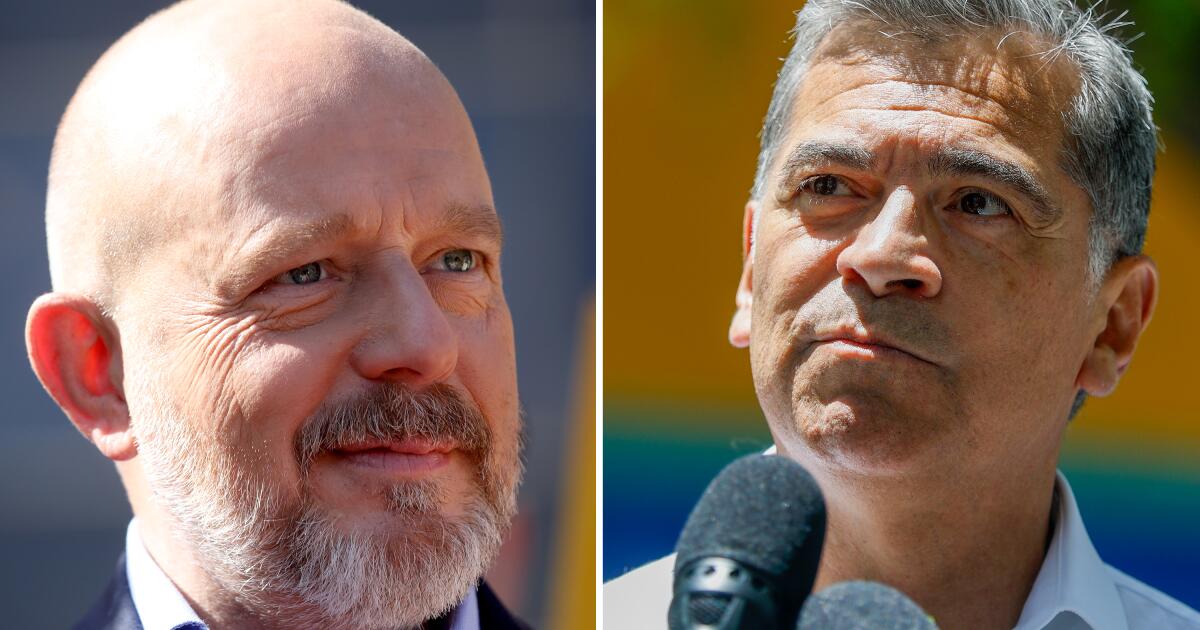
Republican Steve Hilton, a former Fox News commentator, clinched one of the top spots in California’s gubernatorial primary on Tuesday, earning him the right to challenge veteran Democratic politician Xavier Becerra in the November election to determine the state’s next governor.
The contest offers voters two starkly different politicians. Hilton was endorsed by President Trump and has wooed his MAGA supporters, blaming Democratic policies for California’s homelessness crisis, high cost of living and other entrenched ills. Becerra campaigned as a battle-tested warrior against the Republican president and a champion of affordable healthcare. He could make history as the state’s first elected Latino governor.
Hilton’s victory was declared by the Associated Press on Tuesday, days after Becerra secured one of the top spots and a week after the June 2 election. Under California’s primary system, the two candidates who receive the most votes in the primary advance to the November general election, regardless of their party affiliation. According to the latest vote count, which is ongoing, Becerra has a slight edge over Hilton.
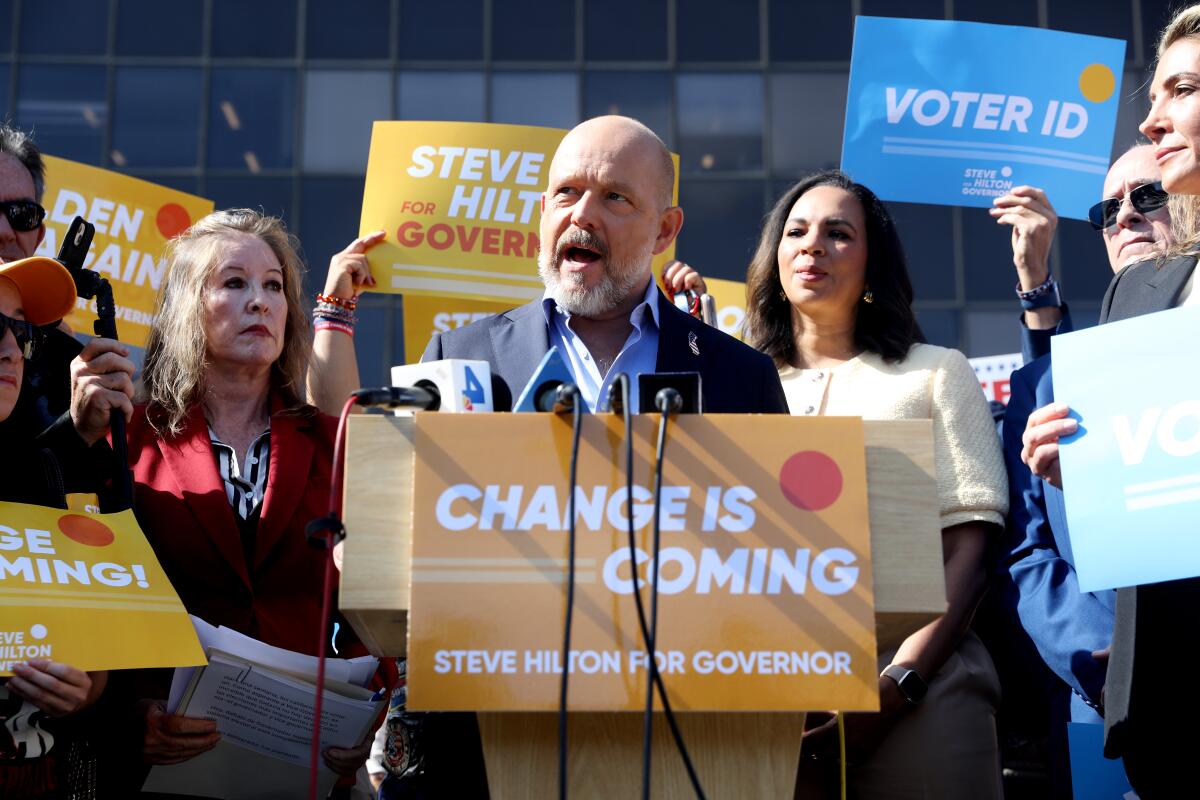
California Republican gubernatorial candidate Steve Hilton, center, flanked by lieutenant governor candidate Gloria Romero, left, and California Republican Party Chairwoman Corrin Rankin, right, hold a press conference to discuss election and voting reforms at the Los Angeles County Registrar-Recorder/County Clerk headquarters on Tuesday in Norwalk.
(Gary Coronado / For The Times)
Democrat Tom Steyer finished in third place. The hedge fund founder and environmental activist spent $216 million of his own money on his campaign, and now joins the legion of other high-profile, self-funding candidates rejected by California voters.
Becerra heads into the Nov. 3 election with a distinct advantage — Democratic voters in California outnumber Republicans by an almost 2-to-1 margin, a telltale reason why no GOP candidate has won a statewide race since 2006.
The contrast between Becerra and Hilton, both on policy and political personas, couldn’t be more pronounced.
A British immigrant and former political advisor to U.K. Prime Minister David Cameron, Hilton, 56, embraces traditional conservative ideals that have echoed across the country since the days of President Reagan — cutting taxes, weeding out government fraud and waste and promising to unbridle entrepreneurs and homebuilders from stifling state regulation.
But he’s also ventured into MAGA territory, declining to acknowledge that Trump lost the 2020 presidential election and promising to extradite California doctors who provide abortion pills to other states for prosecution.
Becerra, 68, came up in Los Angeles politics in the 1980s and has long supported policies to expand protections and resources for immigrants with or without legal status. Married to Harvard-educated OB-GYN Carolina Reyes, Becerra has also staunchly opposed abortion restrictions throughout his career.
In Congress and other positions, Becerra earned a reputation as a cerebral, analytical politician who would fully commit to his positions after taking time to mull them through.
A straight-laced family man with a Catholic upbringing, Becerra was more reserved during the debates — a quiet confidence that drew some voters to support him. He also faced criticism from his rivals for failing to offer detailed housing and healthcare policies.
Hilton, who cuts an unmistakable image with his bald crown and clipped English accent, proved himself as a polished communicator during the debates, skills honed by his years as a Fox News analyst.
Television hosts must translate complex issues into easily digestible sound bites, said Republican strategist Matt Klink. “Most voters want a CliffsNotes version of the issues,” Klink said.
Republican strategist Kevin Spillane credits Hilton’s TV show, “The Next Revolution,” which ran for six years, with boosting his profile, calling Fox News the most important media vehicle within the conservative and Republican framework.
Hilton “understands how politics and how communications work,” Spillane said.
He often appeared relaxed during the gubernatorial debates, at points even complimenting or joking with his rivals as they parried on stage.
At a CBS debate earlier this year, Becerra referred to President Trump, who endorsed Hilton, as the Republican candidate’s “daddy.” Hilton responded with a quip that quickly deflated the attack.
“It would be rather amazing,” said Hilton, at the possibility of being Trump’s son. “My daddy was the goalie for the Hungarian national ice hockey team.”
In an interview last week, before the election, Hilton said he enjoyed the debates. “In a weird way, I was sad when we had the last one,” he said. “I’m looking forward to debating whoever it is.”
As a former political advisor to Britain’s Conservative Party, Hilton helped usher in a green, socially liberal strain of conservatism.
He also infuriated colleagues in the coalition government, the British press reported, proposing a stream of unconventional ideas: scrapping maternity leave, abolishing job centers, even buying cloud-bursting technology so Britain would have more sunshine. In 2012, he moved full time to the Bay Area.
Hilton, who founded a nonprofit on California policies, was known for his frequent visits in the last couple of years to the state Capitol for discussions with legislators.
By contrast, Hilton presented himself as the “more cosmopolitan” candidate who “can talk to the hedge fund manager or the small-business owner or the Sacramento lobbyist,” said Klink said.
“Hilton was more energized at the end, when it mattered,” said Spillane, contrasting the two Republicans.
Past Republican candidates, including businessman John Cox in 2018 and former eBay CEO Meg Whitman in 2010, have self-financed their campaigns with their vast fortunes.
By contrast, Hilton spent just a few million dollars on media advertising, he said in an interview last week.
He said he ignored advice from consultants who told him to do a launch announcement and then unleash a wave of ads in the last month of the campaign.
“I just said, ‘I want to do it the old-fashioned way,’ and that’s what we’ve been doing,” said Hilton in the interview before the election. “We’ve been to nearly every single county…. stepped it up with our town halls.”
Nina Royal, 83, who lives in Los Angeles and is a community advocate for her Tujunga neighborhood, voted for Hilton, saying that he understands California’s problems.
“He’s a realist,” said Royal. “He has a clear view of what needs to be done.”
Times staff writer Jenny Jarvie contributed to this report.
As President Trump pushed unfounded allegations that California’s elections are rigged, the security of the ballot box became a major flash point in the state’s 2026 race for governor on Tuesday.
Republican Steve Hilton called for major reforms to how Californians cast ballots and how their votes are tallied, while sidestepping questions about the president’s claims that the state’s elections officials “were cheating.” Democrat Xavier Becerra defended the integrity of the state’s elections and argued that proposed restrictions would disenfranchise many voters.
The men appeared less than 20 miles apart in Southern California one week after a contentious primary election that prompted Trump to repeatedly make unfounded claims about the integrity of California’s slow vote-counting process, allegations triggered as Democrat Nithya Raman was about to overtake Republican Spencer Pratt for second place in the race for Los Angeles mayor.
Hilton, whose endorsement from Trump pushed him to the front of the GOP gubernatorial field, said he has not seen any evidence of impropriety in this month’s election results.
“We’re very, very focused on making sure that everything’s OK,” Hilton told reporters in Norwalk. “We’ve got teams standing by, we’ve got lawyers standing by, very focused on that. We don’t want to let anyone down, we don’t want to let anything slip away, and we’ve seen nothing.”
The two men emerged from a crowded field of candidates in the most unpredictable governor’s race in more than a quarter of a century. While Becerra on Friday nabbed a spot in the June 2 primary and will advance to the November general election, Hilton has not officially been declared a victor by the Associated Press, as of Tuesday afternoon.
Hilton, however, appears on the cusp of clinching the second spot on the ballot. Billionaire Democrat Tom Steyer is in third place in the current ballot tally, and the odds of him overtaking Hilton appear increasingly unlikely.
“I’m very pleased to say that we remain confident that I will make it into the top two and that California will have a real choice for change in November,” Hilton said at a news conference outside the Los Angeles County elections headquarters. “We’re not popping the champagne yet, but we’re very confident.”
Hilton called for electoral reform, including supporting a voter identification requirement that will appear on the November ballot, ending mail ballots being sent to every registered voter, no longer counting ballots that are received after election day — all of which are being pushed by Trump — and increasing resources at county vote counting centers.
“Voter ID [is] not the only thing, but it’s the biggest, quickest, simplest thing we can do to restore faith in the system and to have these elections completed quickly in a way that inspires confidence, and that’s why I hope that Xavier Becerra will join me in campaigning for it, so we can have a united front,” the former Fox News commentator and British political strategist told reporters.
Hilton did not directly address Trump’s unfounded claims of voter fraud in California. However, he noted that Bill Essayli, the first assistant U.S. attorney for the Central District of California, has the full resources of the Department of Justice and has found no proof of wrongdoing.
Essayli said Monday on NewsNation that his office is investigating voter fraud but doesn’t have a case. However, the voter rolls need to be audited, Essayli told host Chris Cuomo.
“That, to me, is the best way to alleviate most of people’s suspicion. We have a system that breeds skepticism and distrust,” Essayli said. “We should have a little transparency and confidence in our system.”
Becerra, a longtime elected official and a former Biden administration Cabinet secretary, questioned whether Hilton could be trusted to protect the state against Trump’s fraud claims.
“That’s who’s endorsing Steve Hilton,” Becerra told reporters at a South Los Angeles food hall, referring to Trump. “That’s who Steve Hilton is aligning himself with.”
Becerra, who was met with cheers of “Si se puede!” from diners, criticized the proposed voter ID ballot measure, arguing that it would create hurdles for many Californians to participate in the democratic electoral process. Led by Republican Assemblymember Carl DeMaio from San Diego and others, the measure would require elections officials to verify that voters are U.S. citizens to be eligible to cast ballots.
“I’m against voter suppression. I’m against anything that would try to limit a Californian’s right to vote,” said Becerra, who formerly served as California’s attorney general.
Told by reporters that Hilton wanted Becerra to campaign for the ballot initiative, Becerra responded, “Come join me here, where the real people are,” gesturing toward the packed food hall.
Becerra acknowledged his concern over the lengthy time that it takes to count votes in California. He suggested one issue is a lack of workers and equipment at county vote-counting centers.
Another problem is that the “votes get backlogged” because so many people wait until the end of the election to cast ballots, he said, likening last-minute voters to shoppers who go to Costco at the end of the day.
“If you wait till 7:00 p.m. when they’re getting ready to close, you’re probably gonna find more people there,” Becerra said.
The attacks on the elections process by Trump and his supporters appear to have a major effect on people’s confidence in the system. For years, Trump has made baseless claims that the 2020 election was stolen from him, which led his supporters to storm the U.S. Capitol as lawmakers were scheduled to certify the election results. Additionally, Trump’s allegations about California’s elections, as well as an upcoming U.S. Supreme Court ruling about ballot tallying, could have a significant effect on the midterm elections that will decide which party controls Congress for the final two years of Trump’s presidency.
A poll released Friday by the Institute of Governmental Studies at UC Berkeley found that 41% of California voters were “not confident” that this year’s elections would be free of federal interference. Although 48% had confidence that there would be no meddling, the concerns expressed were still significant, said political scientist Eric Schickler, co-director of the institute.
Among Democratic registered voters, 79% said they trusted elections officials to provide an accurate vote count. Among Republicans, 55% said they were not confident that would occur, the survey found.
Ana Cruz was 13 when she arrived to the U.S. from Mexico with her family. But after 23 years of living in Los Angeles, raising two children and working as a community organizer, she has never been able to vote in any elections because of her status as a Deferred Action for Childhood Arrivals recipient, which doesn’t offer a pathway to citizenship.
She’s now among those backing a proposal from Los Angeles City Councilmember Hugo Soto-Martínez that would allow noncitizens to cast ballots in city and Los Angeles Unified School District elections.
“For me, it will be the first time I will have a chance to vote and help decide who represents me,” Cruz said during a press conference in support of the measure at City Hall Tuesday. “Without a doubt, this strengthens our democracy.”
Soto-Martínez is seeking council support to include the measure in a package of City Charter reforms that will go to voters for approval in the Nov. 3 general election. The council is scheduled to discuss this and other proposed charter changes Friday.
The expanded voting eligibility would only apply to Los Angeles city and Los Angeles Unified School District elections, and not county, state or federal contests.
Other cities and states, including Maryland, Vermont and San Francisco, have adopted similar measures.
“People have spent many years here, and in many cases, decades, contributing to the city of Los Angeles,” Soto-Martinez said. “This is about local representation and local democracy.”
The proposal has already faced push back.
Ira Mehlman, spokesperson for the Federation for American Immigration Reform, said Tuesday that noncitizens who pay taxes benefit from public services, and temporary status serves as a probationary period until people take an oath to become citizens.
“Citizenship does mean something, it means you are a fully participating member of society,” he said. “It doesn’t seem unreasonable to say you’ve got to do some time here and demonstrate that you’re somebody that we want as a citizen.”
If placed on the ballot and approved by voters, the City Council would then need to pass an ordinance creating a residential voting program and establishing eligibility requirements.
While those requirements have yet to be determined, advocates have discussed possible options might include extending voting to lawful permanent residents, or green card holders, DACA recipients and others who live, work and pay taxes Los Angeles, according to the council member’s office.
Soto-Martínez first pitched the idea in April, with the support of councilmember Ysabel Jurado, who also signed the motion.
Soto-Martínez represents District 13, which includes many immigrant and mixed-status communities living in Echo Park, Hollywood and Filipinotown. He said the Trump administration has terrorized communities by conducting mass immigration raids and breaking up families, and that his measure is aimed at underscoring the city’s values.
“We say L.A. is for everyone, and that means no exceptions,” he said.
Among those who could benefit are Grace McManus, a Filipina mother, caregiver and resident of L.A. for 24 years. With permanent resident status, she said she has no say in electing officials who shape her everyday life, despite contributing taxes and caring for the elderly.
“I am too familiar with the feeling of working and taking on low-wage work while feeling invisible because my voice is disregarded just because of our broken immigration system,” McManus said.
Public speakers at Tuesday’s City Council meeting also urged approval.
“Trump and MAGA want to limit voting. We need to fight to expand it, so all of our neighbors have the same rights as us,” said Julie Van Winkle, vice president of the United Teachers Los Angeles, during public comment.
Martha Arévalo, executive director of the Central American Resource Center, stood alongside Soto-Martínez as he rallied for support.
“We know that immigrant communities uphold the economy in this nation, and I think that people who contribute to their community, that call this home, should have a say in their local government,” Arévalo said.
California’s slow vote counting process — still underway and causing friction after last week’s primary — may be forced to change before November’s midterm elections, as the U.S. Supreme Court prepares to rule on whether mail ballots must be received by election day to count.
Whether those changes will speed things up — and help tamp down baseless claims from President Trump and others that the slow count is evidence of fraud — will depend on a variety of factors, election experts said, including how the high court rules, how state lawmakers and local elections officials respond, and whether they push any additional steps to quicken the count.
“We’re all on the edge of our seats, waiting to see what the Supreme Court does,” said Kim Alexander, president of the California Voter Foundation.
“We’re certainly planning for a bad Supreme Court decision in this case, but we don’t really know all of our options for how to respond until we see the court’s decision,” said Assemblymember Gail Pellerin (D-Santa Cruz), chair of the Assembly Elections Committee and a former top elections official in Santa Cruz County.
Pellerin said she has been working on contingency plans with other state officials — including some from the offices of Gov. Gavin Newsom, Secretary of State Shirley Weber and Atty. Gen. Rob Bonta — and has requested $35 million in state funds to educate voters on any new midterm deadlines, though that funding has not been appropriated.
Federal law has, since 1872, set “election day” as the first Tuesday following a Monday in November, and gives Congress oversight over elections for the president and members of Congress. However, most authority for running elections falls to the states.
California currently provides a grace period for ballots to be counted as long as they are postmarked by and received within seven days of election day. More than a dozen states have similar laws that allow for counting late-arriving ballots, and most states accept such mail ballots from members of the military who are stationed overseas.
In March, the nation’s high court heard arguments about a five-day grace period in Mississippi, with the court’s conservative majority appearing skeptical. Many observers expect from those arguments that the high court will rule, by the end of this month, that ballots — at least for federal races — must be received by election day to count.
That outcome — in the case Watson vs. Republican National Committee — is considered likely but not assured, and some elections experts believe the high court has little legal precedent to support such a conclusion.
“That is a bogus interpretation of the statute,” said Rick Hasen, an election law expert and director of the Safeguarding Democracy Project at UCLA Law. “It violates what the statute says as a matter of text and history, and just how it’s been understood since the Civil War basically.”
Hasen and others also doubt that such a change would have much impact on the speed of California’s vote counting process, given that huge volumes of mail ballots that are placed in ballot drop boxes or arrive at processing facilities on or just before election day would still count — and would still drag the counting process out for days after the election.
In 2024, California counted more than 406,000 late-arriving mail ballots, but they represented only about 2.5% of the statewide total.
“The main bottleneck is really not ballots that arrive after election day. The bottleneck is ballots arriving before or on election day,” Hasen said. “So I don’t think the Watson case — however it comes out — is going to appreciably change California’s timing on when they’ll get enough ballots counted in a close race for it to be able to be called by news organizations.”
Nonetheless, state and local elections officials are preparing for changes — and looking for other ways to speed up the vote count, which, as of Monday, had resulted in more than 7.7 million ballots counted from last week’s primary, but more than 1.7 million left to process.
State plans unclear
If the Supreme Court were to rule that votes cast in federal elections must be received by election day, California would need to respond quickly.
It would need to craft a messaging campaign to inform millions of voters of the new rules, and determine when to tell voters they must mail their ballots by in order for their votes to count, experts said. That calculation may be shaped in part by efforts by the Trump administration to assert federal control over the mail ballot process through the U.S. Postal Service, which California and other states are fighting in court.
California officials may also need to determine whether they will create a “bifurcated counting process” with different rules for primary and general elections and different rules for federal races and state and local races on the same ballots, Alexander said, as a narrow Supreme Court ruling may not apply to them all equally.
“That’s a big policy decision that lawmakers will need to make, and I’m not sure how that would go,” Alexander said, citing a lack of detailed public plans from state and local elections officials.
Brandon Richards, a spokesperson for Newsom, said the governor’s office doesn’t comment on “hypotheticals,” but that Newsom “is planning for all eventualities, including but not limited to attacks on our democracy and disruptions in our elections.”
Bonta’s office said it is “in communication with election officials and actively preparing for the possibility that the U.S. Supreme Court could require changes to California’s election procedures,” but that it could not provide details.
Dean Logan, head of the L.A. County Registrar-Recorder/County Clerk’s office, said he was “not in a position to discuss specific contingency planning details” given the high court has yet to rule, but that his office “is closely monitoring the case and has begun evaluating potential impacts to election administration.”
If changes are required by the court, Logan said his office “is prepared to undertake a comprehensive voter education and outreach effort to ensure voters understand any new requirements, deadlines, or voting options,” which would be “multilingual, multi-channel, and designed to reach voters directly across Los Angeles County, particularly in communities that rely heavily on voting by mail and those that have historically done so.”
Funds needed for faster count
Alexander’s group has backed Pellerin’s request for $35 million for a marketing campaign to encourage voters to send midterm ballots in early, and advocated for another $55 million in state funding to support county efforts to build up their vote processing capabilities.
H.D. Palmer, a spokesperson for the California Department of Finance, said it would be “premature” to comment on those requests, but “discussions have been underway and are continuing.”
Both Alexander and Hasen said California should be investing more in its ballot processing capabilities even if the current process is fair and secure and the claims of fraud are baseless, because those claims have succeeded in diminishing trust.
“On the one hand, this is a manufactured crisis. There is nothing that is intrinsically bad about a slow count for a race,” Hasen said. “On the other hand, we live in an era of profound distrust in institutions and in the integrity of elections, in no small part because of Donald Trump.”
In 2012, slightly over half of all California votes were cast via mail ballots. However, that number has increased dramatically since, thanks in part to an expansion during the COVID-19 pandemic, and nearly 89% of ballots were cast by mail in last year’s special election.
Alexander said that throughout that same period, California lawmakers have passed new laws to expand access to the ballot but have not provided counties with the necessary funding to keep up with the volume — meaning “counties are left holding the bag.”
Alexander said California should fix that by providing consistent state funding for new ballot counting machines, more modern and efficient county processing facilities, and an expansion of a program backed by Pellerin and available in some counties already that allows voters dropping off ballot envelopes in person to essentially convert those ballots into in-person votes on the spot — which Alexander called a “hybrid” option that saves counties a huge amount of processing time.
She said the state spent millions to educate voters on new COVID-related vote-by-mail protocols and deadlines in 2020, and it led to both record turnout and a faster count — proving access and speed are not mutually exclusive.
“We’re being asked to make a false choice,” Alexander said. “It is possible to have accessible, secure, reliable and verified elections, and also an accelerated vote count.”
Times staff writer David G. Savage in Washington contributed to this report.
Many of Argentina’s country’s leading shopping mall operators to expand capacity to meet growing demand for retail space. File Photo by Juan Ignacio Roncoroni/EPA
BUENOS AIRES, June 9 (UPI) — International fashion, luxury and sports brands are accelerating expansion into Argentina after years of absence, driving multimillion-dollar investments and prompting the country’s leading shopping mall operators to expand capacity to meet growing demand for retail space.
The renewed interest from foreign companies reflects Argentina’s changing economic environment since President Javier Milei took office.
Looser import restrictions and other market-opening measures have revived the appeal of a market that for years had been left out of the expansion plans of many international firms.
The expansion comes despite a challenging consumer environment. According to consulting firm Scentia, sales of mass-market consumer goods fell 3.8% year over year in April 2026 and were down 3.3% during the first four months of the year.
Federico Vaccarezza, an economist and professor in Austral University’s Faculty of Business Sciences, told UPI that international brands closely monitor sales data from Argentina’s leading shopping malls because they reflect the behavior of the consumers targeted by their products.
He noted that many of these brands are not seeking to reach the broader population, but rather higher-income consumers — a segment that has shown greater resilience in maintaining spending levels despite economic difficulties.
Vaccarezza said those groups represent roughly the top 10% to 20% of income earners in Argentina.
The international chains that have announced plans to enter Argentina are focusing their projects on Buenos Aires’ most exclusive shopping centers and key cities across the country. The trend includes companies entering the market for the first time, brands returning after years away and firms expanding existing operations.
International companies view Argentina as a long-term opportunity because of its market size, with more than 45 million residents, and expectations surrounding recent economic changes.
The influx of brands is already affecting the commercial real estate sector. Shopping mall operators report growing demand for retail space from foreign companies.
To meet that demand, several groups have accelerated expansion and construction projects. Chilean retailer Cencosud, one of Latin America’s largest retail groups, will invest $60 million to expand Unicenter, Argentina’s largest shopping mall, betting on rising demand for commercial space from international brands.
The project will add more than 215,000 square feet of space and 85 new stores by 2027.
“This expansion represents a concrete long-term commitment to Argentina,” Dolores Fernández Lobbe, country manager of Cencosud Argentina, told La Nación.
Meanwhile, IRSA, Argentina’s largest shopping mall operator and owner of some of the country’s most valuable retail assets, including Alto Palermo, Patio Bullrich, Alcorta Shopping and DOT, is moving forward with three new developments in the Buenos Aires area and the cities of La Plata and Mar del Plata. The company has not opened a new shopping center since 2015, when it inaugurated a project in the Patagonian province of Neuquén.
“Shopping mall customers are still there. What has changed is that competition on prices is now more intense,” IRSA President Eduardo Elsztain told La Nación.
According to business news outlet iProfesional, the expansion spans multiple sectors. Fashion, beauty, sports equipment, accessories and luxury goods are among the industries seeking to capitalize on Argentina’s new economic environment.
June is expected to be one of the busiest months for store openings. U.S.-based Skechers will open a new location, while Dolce & Gabbana will launch its first store in Argentina.
In July, Bullpadel, a company specializing in padel equipment, will enter the market. Padel has experienced rapid growth across Latin America in recent years.
U.S. apparel company Lucky Brand will enter Argentina through a partnership with local group Oxford. According to La Nación, the company plans an initial $1 million investment, will open its first store in July and aims to develop a network of 30 standalone stores across the country.
The company also plans to align prices with those in the U.S. market to compete with other brands in the segment.
Spanish fashion retailer Mango confirmed its return to Argentina through a franchise agreement with local group Grimoldi. The company plans to open five stores over the next five years, including a first location at Alto Palermo scheduled for September.
Vaccarezza said 2025 was a favorable year for Argentina’s shopping malls, although the trend began to weaken in 2026, with sales declining about 5% in the first quarter compared with the same period a year earlier.
The economist said looser import regulations and previously unmet demand help explain foreign companies’ interest in Argentina. He added that investment decisions by international brands are driven primarily by market-specific studies rather than broader economic indicators.
“It is a calculated risk. Companies have a clear understanding of the consumers they want to reach. The results will become evident later,” he said.
Economist and consultant Néstor Requelme expressed a similar view, saying the arrival of new international brands reflects recent economic changes and the presence of consumers with strong purchasing power.
Martín Burgos, an economist and researcher at the Latin American Faculty of Social Sciences, or Flacso, said the arrival of new companies could increase competition and help lower clothing prices in Argentina, a market that has historically been more expensive than many others.
“There is a policy aimed at reducing clothing prices. For years, apparel prices in Argentina were above international levels, and the easing of import restrictions is facilitating the arrival of these brands,” he told UPI.
However, Burgos agreed that many of the companies entering the country are primarily targeting higher-income consumers, one of the segments that has best withstood recent economic changes.
“The data show that overall consumption remains weak, but these brands are targeting consumers with greater purchasing power. For that reason, their expansion does not necessarily reflect a broad recovery in consumer spending,” he said.
Recent clashes between protesters and police killed at least 11 people.
It’s called the Joint Awami Action Committee, and it’s being accused of fuelling protests in Pakistan-administered Kashmir.
The group has been demonstrating against a rule that sets aside legislative seats for refugees from India-administered Kashmir who live in Pakistan. They say it gives them disproportionate influence in the divided region.
But the government says any change would require constitutional reform.
The issue has long been a subject of political debate in Pakistan-administered Kashmir. But how will its government deal with tensions rising once again?
Presenter: Imran Khan
Guests: Maria Iqbal Tarana – Senior leader of Pakistan Muslim League-Nawaz
Sahar Khan – Nonresident fellow at the Institute for Global Affairs
Imtiaz Gul – Executive director at the Center for Research and Security Studies
WASHINGTON — Vice President JD Vance is pressing federal prosecutors to investigate Minnesota Gov. Tim Walz and state Atty. Gen. Keith Ellison over allegations they failed to stop widespread social services fraud, amplifying concerns the White House will use a new Justice Department division to target political rivals.
Vance, who has been tapped to lead the Republican Trump administration’s anti-fraud efforts as he seeks to raise his political profile as a potential 2028 presidential candidate, cited in a letter to the Justice Department a report from the Republican-led House Oversight Committee that alleges Walz and Ellison were aware of pervasive misuse of government programs for years and let it flourish.
The Justice Department didn’t immediately respond to questions Tuesday about whether it would open an investigation. It was unclear what, if any, potential violations of federal law could support a probe into the Democratic Minnesota officials, who have characterized a separate Justice Department investigation involving state leaders as politically motivated.
A spokesperson for Walz didn’t immediately respond to a message seeking comment. Ellison called the allegations unfounded and said there’s no evidence his office ignored wrongdoing or failed to act as required by law. He dismissed Vance’s referral as “a political stunt from an administration that uses the machinery of government to target its perceived opponents while extending leniency to those aligned with its interests.”
“It is deeply troubling to see official powers and public resources diverted away from serving the people and instead aimed at pursuing political adversaries,” Ellison said in a statement. “That is not what government is for, and it diminishes public trust in our institutions.”
Vance’s referral to the Justice Department’s new National Fraud Enforcement Division marks an escalation in the Trump administration’s stated “war on fraud” in government programs that officials have said would not be political or partisan.
The new division has drawn intense scrutiny over the potential for political influence given its close relationship with President Trump’s White House, which announced its formation in January and initially said its leader would answer directly to the president instead of the typical Justice Department command.
In his referral, Vance wrote that officials in Minnesota or anywhere else in the country “must be held accountable” if they facilitated fraud, prevented officials from stopping it or retaliated against whistleblowers who tried to report it.
“Minnesota state officials are not above the law,” Vance wrote in a post on X.
June 9 (UPI) — An assistant of Jeffrey Epstein told members of the House Oversight Committee on Tuesday that she was unaware of his crimes but that he was a master manipulator.
Lesley Groff, Epstein’s then-executive assistant, told the committee that she believed the massage appointments she made for Epstein with young women and girls were with massage therapists, two sources told CNN. She said Epstein had every reason to keep his crimes secret from her.
Groff helped manage Epstein’s life, including making appointments with women, setting meetings with powerful people and arranging Epstein’s flights with the young women. She worked for Epstein for nearly 20 years, and her name was listed in the Epstein files more than 150,000 times.
Epstein, a billionaire financier and registered sex offender, died by suicide in prison in 2019.
Groff told the lawmakers that she wants to help and that since Epstein was arrested, she’s lost friends and her family has faced harassment.
Groff said Epstein didn’t sexually abuse her, one of the sources told CNN, and that she didn’t need the job. She said that Epstein and Ghislaine Maxwell told her not to associate with their friends, and they insisted that their business was none of hers.
Survivors told a different story.
Sharlene Rochard was skeptical that Groff didn’t know about the crimes.
“One of the hardest parts for survivors is hearing the people who were closest to Epstein claim they saw nothing,” Rochard told CNN. “That doesn’t match my experience. Survivors deserve answers, not claims of ignorance.”
In a previous statement, Groff’s lawyer told CNN that she worked for Epstein as “part of a professional staff that included in-house attorneys, accountants and other office staff” and that her job included making appointments for Epstein, “taking his messages and setting up high-level meetings with CEOs, business executives, scientists, politicians, celebrities, charitable organizations and universities.”
Committee Chairman Rep. James Comer, R-Ky., told MSNow that the panel has referred two names to the Department of Justice, though he didn’t identify them.
“I think the interviews that we’ve done have been very productive,” Comer told reporters on Tuesday morning.
“We’re bringing in the most important people in the whole Epstein criminal enterprise that are still alive, and hopefully we’ll get the proof to the American people that there’s an opportunity for accountability,” Comer said.
The committee is scheduled to interview Microsoft founder Bill Gates on Wednesday.
Lisa Phillips, a survivor of Jeffrey Epstein and Ghislaine Maxwell, speaks out during a rally with other survivors on Capitol Hill in Washington on September 3, 2025. Photo by Anna Rose Layden/UPI | License Photo
TORONTO — A new Canadian-built bridge across the Detroit River that U.S. President Donald Trump threatened to block will open soon, Canadian Prime Minister Mark Carney said Tuesday.
A ribbon-cutting ceremony for the Gordie Howe International Bridge, jointly owned by Canada and the U.S. state of Michigan, is set to take place on Friday, while the bridge itself is expected to open to traffic later this month.
In February, Trump demanded that Canada turn over at least half the ownership of the bridge to the U.S. federal government and agree to other unspecified demands in one of his many salvos over cross-border trade issues.
The bridge, which would connect Windsor, Ontario, and Detroit, and would be a vital economic artery between Canada and the United States, had been expected to open early this year, according to information on the project’s website.
The bridge is named after Howe, the late Canadian hockey great who spent 25 seasons with the Detroit Red Wings.
The project was negotiated by former Michigan Gov. Rick Snyder — a Republican — and paid for by the Canadian government to help ease congestion over the existing Ambassador Bridge and Detroit-Windsor tunnel. Work has been underway since 2018.
“Obviously the bridge will be open at the end of the week. A symbol of, but also a fact of cooperation between our countries,” Carney told reporters as he walked into Parliament.
“Great for Canadians going across the border, Americans coming across the border, and for commerce,” he said, calling it “positive news.”
Trump threatened the bridge as the United States-Mexico-Canada trade agreement is up for review this year, and Trump has been taking a hard-line position before those talks, including by issuing new tariff threats.
Carney, meanwhile, has spoken out on the world stage against economic coercion by the United States.
Sen. Elissa Slotkin, a Michigan Democrat, has said that the Canadian-funded project is a “huge boon” to her state and its economic future.
Michigan is a swing state that Trump carried in both 2016 and 2024.
Snyder wrote in an op-ed in The Detroit News earlier this year that Trump was wrong in asserting that Canada owns both the U.S. and Canadian sides of the Gordie Howe bridge.
“Canada and the state of Michigan are 50/50 owners of the new bridge,” Snyder wrote. “Canada was wonderful and financed the entire bridge. They will get repaid with interest from the tolls. Michigan and the United States got their half-ownership with no investment.”
The Gordie Howe bridge will join the privately owned Ambassador Bridge as the second span connecting Detroit and Windsor, Ontario.
The rival Ambassador Bridge is considered the busiest U.S.-Canadian border crossing, carrying 25% of all trade between the two countries. It plays an especially important role in auto manufacturing.
Companies controlled by the Moroun family, owners of the rival Ambassador Bridge, previously sued to prevent the Howe bridge from being built.
At a campaign rally in Armenia’s capital, Yerevan, on Saturday, one day before Armenia’s election, Prime Minister Nikol Pashinyan, outfitted in a white button-up shirt and a red-brimmed baseball cap, held a look of determination.
Flanked by supporters waving their arms and flashing his campaign’s signature heart-shaped hand gesture, Pashinyan was perched centre stage, pounding away on a drum kit for the crowds – literally drumming up support.
Recommended Stories
list of 4 itemsend of list
By election day, his governing Civil Contract party appeared to have drummed up something more consequential: public backing for his vision of Armenia’s future following the loss of the disputed region of Nagorno-Karabakh to a crushing military defeat by Azerbaijan in 2023.
Pashinyan, who formed a band earlier this year and campaigned with a series of concerts around the country, secured 49.8 percent of the vote in Sunday’s ballot, enough to retain a parliamentary majority.
His victory is seen as a test of his handling of the loss of the Nagorno-Karabakh region and his ability to steer the country away from Russian influence.
He has ultimately prevailed despite Russian meddling in Armenian politics, and the country now looks set to reorient itself away from its former ruler – signalling Armenians’ willingness to embrace a new direction, analysts say.
“Many Armenians are prepared to give his new vision a chance: an Armenia less defined by conflict, more open to normalising relations with Azerbaijan and Turkiye, and increasingly focused on building its future within its internationally recognised borders,” Zaur Shiriyev, an analyst at the Carnegie Russia Eurasia Center, told Al Jazeera.
‘Tired of conflict and war’
The loss of Nagorno-Karabakh could have spelled political doom for Pashinyan. By handing him a second term, Armenians have signalled that they are ready to put the conflict that has intermittently reared its head for decades behind them, analysts say.
“Nationalism no longer resonates among the public, which is demonstrably tired of conflict and war,” Richard Giragosian, director of the Yerevan-based Regional Studies Center, told Al Jazeera, even if the loss of the region remains an “open wound”, he said.
Nagorno-Karabakh, meanwhile, no longer features at all in the Armenian government’s defence reform, nor in its national security strategy, “a final confirmation of the new strategy of diversification”, Giragosian explained.
Peace efforts instead took centre stage in Pashinyan’s campaign, including the agreement he signed at the White House last August with Azerbaijan, finally ending the on-again-off-again war that had raged since the late 1980s.
Unlike in 2021, when Pashinyan’s campaign was shaped by the immediate aftermath of war and questions of political survival, Sunday’s vote became a clearer test of public support for his peace agenda, Shiriyev said.
Peace over nationalism
The result also demonstrates that the nationalist mantras peddled by opposition leaders have not been able to sway the majority of Armenians, said Svante Cornell, director of the Institute for Security and Development Policy and its Central Asia-Caucasus programme.
“The opposition represented a return to oligarchy, nationalism and forever conflict,” Cornell told Al Jazeera.
“While the Pashinyan government has its flaws, it represents something different than the past.”
The election saw the two main opposition forces – Strong Armenia and Armenia Alliance – win 41 seats combined in the new parliament, against the 64 seats the government holds, out of a total 105.
But Giragosian cautioned against overstating the opposition’s strength as, he said, the two opposition parties are unlikely to cooperate given the friction between their leaders – Russian-Armenian oligarch Samvel Karapetyan, whose Strong Armenia took 29 seats, and former President Robert Kocharian, whose Armenia Alliance won just 12.
“The division and dissent within the opposition will present a profound obstacle,” he said.
Although united in their shared pro-Russian leanings, Karapetyan is seen by Kocharian as an “interfering interloper”, with Kocharian himself resenting his third-place position behind Karapetyan, the analyst said.
“This is further exacerbated by Kocharian’s sense of entitlement, and his frustration of being rebuffed by Moscow in his prior attempts to gain direct Russian backing and support,” Giragosian added.
Still, Cornell said, the persistence of pro-Russian, nationalist sentiment in Armenia generally should not be taken lightly.
Until 2020, Armenia was governed by successive administrations that spent three decades pushing a nationalist identity, he said.
“To expect such views, such sentiments would just disappear – would be unrealistic,” Cornell noted.
Supporters of Armenia’s ruling Civil Contract party led by Prime Minister Nikol Pashinyan gather in Republic Square in Yerevan, Armenia, Friday, June 5, 2026, for the party’s final campaign rally [Anthony Pizzoferrato/AP]
Russian influence weakened – but not gone
In the lead-up to Sunday’s election, international observers had accused Russia of attempting to interfere – but its inability to change the result reflects Moscow’s limited reach in the country today, analysts say.
“Moscow still has tools in Armenia, but it no longer has the authority it once had,” Shiriyev said.
“In today’s Armenia, being seen as Russia’s preferred candidate can mobilise voters against you as much as for you.”
As Armenia strives to resist what Shiriyev refers to as the “gravitational pull” of the “Russian orbit”, a window of opportunity has been created by Moscow’s preoccupation with its invasion of Ukraine and a new openness from Western partners.
“The larger risk is from not altering strategy, and the benefits of a pivot to the West are both demonstrable and popular in Armenia today,” Giragosian said.
Russia, he added, is now increasingly viewed in Armenia as a “dangerously undependable so-called partner”.
Benyamin Poghosyan, an Armenia analyst at the Italian Institute for International Political Studies, argues that the primary foreign policy drivers of the election, however, were regional actors – not Russia or the West.
“The reality on the ground is far more nuanced,” Poghosyan told Al Jazeera. Armenia’s future relations with Azerbaijan and Turkiye, as well as the regional fallout from the conflict in Iran, are far greater influences, he said.
There are good reasons not to count Moscow out completely, however. While pro-Russian forces did not prevail this time, they will continue to assert their influence, Cornell said. He referred to the cautionary tale of another Caucasus country.
“In Georgia, the work of undermining a reformist and pro-Western government and turning the country around to a more pro-Russian line took over 15 years,” he said.
At the same time, Moscow still holds massive economic leverage over Yerevan, said the analysts.
Russia remains the primary export destination for Armenian agriculture and wine, is the main source of critical imports like wheat, and supplies the country with heavily discounted gas, Poghosyan noted.
“Because Russia has the capacity to inflict severe economic pain, Yerevan must tread carefully to protect its core interests without completely rupturing its relationship with Moscow,” he said.
Shiriyev added that many Armenians work in Russia, with families depending on remittances, and business ties running deep.
“By contrast, Western integration can still feel abstract and uncertain to many voters. That is why pro-Russian forces can still gain traction, even as Russia’s political image in Armenia has weakened,” he said.
A constitutional hurdle
But while Pashinyan’s re-election has strengthened his hand in the country’s peace process, it has not resolved one key sticking point for constitutional change to ensure it, said Shiriyev.
Azerbaijan has demanded a change to Yerevan’s constitution as a means of guaranteeing that no future Armenian government might revive claims related to Nagorno-Karabakh or Azerbaijan’s territorial integrity.
“But Pashinyan lacks the two-thirds majority needed to move easily toward a referendum, and even a referendum would be politically uncertain,” said Shiriyev.
This election, Cornell said, was “a necessary but not sufficient condition for the peace process to advance”.
Poghosyan warned that if Baku refuses to drop these preconditions, “the peace agreement will remain stalled, leaving both nations trapped in a volatile state of ‘no war, no peace’”.
On the question of regional normalisation, however, the outlook has shifted.
Since the bilateral peace treaty was signed at the White House last August, Azerbaijan has lifted restrictions on trade and transit with Armenia and restarted talks on border demarcation – moves that Giragosian said have also accelerated the opening for Armenia-Turkiye normalisation.
“For Armenia,” said Shiriyev, “the West may offer the road, Russia increasingly acts as the roadblock, and normalisation with Azerbaijan and Turkiye is the real prize.”
WASHINGTON — House Republicans will look to get nearly $70 billion for immigration enforcement over the finish line Tuesday, enough to fund a pair of Homeland Security agencies through the next three years and the rest of President Donald Trump’s time in office.
Speaker Mike Johnson will need near perfect attendance and unity on his side to complete weeks of action on the bill. The legislation got sidetracked when Republicans sought to include $1 billion for enhanced security on the White House grounds, including for Trump’s new ballroom, and the Trump administration tried to create a nearly $1.8 billion fund to compensate allies of the president who claim they have been unjustly investigated and prosecuted. Those proposals proved politically toxic and were scrapped.
Now, the bill is focused entirely on immigration enforcement, a topic that Republicans have treated as a defining issue between the two major political parties and one they hope will carry them to victory in this year’s midterm elections. The bill provides $38 billion for Immigration and Customs Enforcement, $26 billion for the Border Patrol and another $5 billion to cover unforeseen costs, fueling Trump’s deportation agenda.
“It’s long overdue,” said Johnson, R-La., of the bill. “We have to fund border security and immigration enforcement, and it’s sad that Republicans have to do it on our own.”
Funding accelerates Trump’s deportation agenda
The funding comes on top of the nearly $140 billion that the Republican-controlled Congress gave ICE and Customs and Border Protection last year as part of Trump’s tax and spending cuts bill.
Democrats objected to giving the agencies more money without significant changes in the way they operate after the deaths of Alex Pretti and Renee Good in Minneapolis. For example, Democrats insisted that agents be required to display their ID badges during enforcement operations and that they get a judicial warrant before entering private property. Instead, the funding will come with virtually no strings attached.
House Democratic Leader Hakeem Jeffries vowed his party would oppose the package.
“We believe that taxpayer dollars should be used to make life more affordable for the American people – not give ICE another $70 billion blank check so that they can unleash brutality on American citizens and violently target law-abiding immigrant communities,” said Jeffries of New York.
Homeland Security faced longest shutdown in history
The package is the result of a monthslong standoff in Congress after Democrats refused to fund the Department of Homeland Security in the wake of the immigration enforcement actions in Minneapolis and other American cities, leading to the longest shutdown in agency history.
Negotiations had been underway with the White House to alter ICE operations as Democrats were demanding. When those negotiations failed, Republicans turned to a complicated procedural maneuver to get around the filibuster and pass the immigration funding with no Democratic votes.
If approved, the package would next go to Trump for his signature, all but assuring an essentially uninterrupted flow of funds for his immigration enforcement and deportation agenda into 2029.
The Senate completed its work on the legislation last week during an all-night session that extended into the early morning hours Friday. The final 52-47 vote on the bill was nearly party line, with Sen. Lisa Murkowski of Alaska the only Republican to oppose it.
Money comes at pivotal time for immigration agenda
The money will come at a pivotal time for the Department of Homeland Security, which is under new leadership after Trump replaced Kristi Noem with new Secretary Markwayne Mullin in March.
While Mullin has vowed to keep the department out of the headlines, the administration is under pressure from anti-immigration advocates to deliver on Trump’s campaign promise of the largest deportation operation in American history.
So far, the administration has not hit its goal of 1 million deportations a year, but Trump’s border czar, Tom Homan, has promised more to come, including hinting at immigration enforcement actions in New York, the nation’s biggest city, which is heavily Democratic.
At the same time, the administration is making it more difficult for legal immigrants to remain in the U.S. by working to end Temporary Protective Status, changing the processes for obtaining green cards and leaving some Dreamers — the young people who were brought illegally to the U.S. as children — reporting delays in renewing their status, which allows them to stay and work.
Tight vote ahead
On the House side, Johnson has little margin for error. Republicans can afford to lose only a couple of votes if every lawmaker is present. GOP leadership opted to avoid any hiccups and sent lawmakers home last week rather than take up the bill early Friday once the Senate had completed its all-nighter.
The bill is just a slim package, without the hundreds of pages of details and directives that typically come from Congress when it provides funding for agencies.
Leading up to the vote, Democrats portrayed DHS as an agency that has used its new resources to buy private jets for its leadership, warehouse immigrants in deplorable conditions and attack U.S. citizens.
“To give these rogue agencies another $70 billion now when they still have $100 billion in the bank from last year would implicate all of us in the escalating corruption and shameful actions of this department,” said Rep. Jamie Raskin of Maryland, the ranking Democratic member on the House Judiciary Committee.
Republicans countered that they were fulfilling their duty to safeguard the nation and support the men and women charged with enforcing the law.
“Democrats can say whatever they want, but what it’s about is public safety. What’s it about is keeping Americans safe,” said Rep. Michelle Fischbach, R-Minn.
Freking and Mascaro write for the Associated Press.
WARNER, N.H. — For Rahm Emanuel, the road to the White House runs through the uphill climbs of rural New Hampshire.
The onetime Democratic congressman, White House chief of staff, Chicago mayor and U.S. ambassador to Japan hasn’t formally announced his ambition to return to power in Washington. But his weekend trip through the state that typically holds the first presidential primary was hardly subtle.
There were the union hall visits and intimate house parties, staples of New Hampshire political rituals. At one event in the backyard of a handsome home in Concord, Emanuel greeted voters and practiced a stump speech that highlighted strains on the middle class and the excesses of the tax system.
And then there was the bike tour.
Over the course of three days, Emanuel pedaled more than 117 miles across New Hampshire from Portsmouth on the coast to Hanover on the Vermont border in what he dubbed the “Spin-Free Tour,” a nod to his blunt demeanor that he sees as an asset for a Democratic Party trying to move beyond its devastating losses in 2024.
“Tough times require a tough leader,” Emanuel told the Associated Press during a break at a coffee shop in Warner. “I don’t think this is just about learning the words to ‘Kumbaya.’”
For someone who has spent the better part of three decades in the highest orbits of political power, the 66-year-old Emanuel is in the unusual position of lacking a natural platform. His likely rivals in a Democratic presidential contest are mostly younger and, as governors, senators or a recently departed vice president, can more easily attract attention.
And despite his thick resume, Emanuel isn’t especially well known outside political circles, as demonstrated by a woman who asked who he was after he left the coffee shop. When informed that it was Emanuel and that he was considering a campaign, she responded, “A campaign for what?”
How Emanuel taps into tenacity to overcome hurdles
Emanuel is tapping into his hard-wired tenacity in hopes of overcoming such challenges.
As many prominent Democrats focus on castigating President Trump, Emanuel has released a flurry of policy proposals addressing everything from social media bans for children to prediction markets and a mandatory retirement age of 75 for those in public office. That would prevent him from seeking a second term if he were elected.
Emanuel is often on the road, talking education in Mississippi and Michigan. He’ll travel to Israel next month to address the U.S.-Israeli relationship as the war in Gaza has spurred new divisions in both political parties, especially among younger voters.
He is a regular guest on podcasts ranging from those hosted by Katie Couric and Kara Swisher to shows focused on fly fishing. He often uses the appearances to knock his own party for overreaching in cultural debates, particularly those involving the rights of transgender people. It’s a message of centrism that has echoes of that of the first president he served, Bill Clinton.
“We did things that were really ridiculous,” he said of Democrats on an episode of Couric’s podcast that posted last week. “Rather than worry about classroom excellence, we were worried about bathroom and locker room access.”
And he hops on the bike.
The tour gives him a chance to both demonstrate his physical fitness at a time of heightened awareness of the nation’s aging political leaders and to introduce himself to the state’s notoriously picky voters before the rest of the field swoops in after the November midterms.
“It is early,” said Rep. Maggie Goodlander, D-N.H., who appeared alongside Emanuel at the Concord house party. “But what I’d say is the people in New Hampshire know how to vet candidates and they’re the most engaged electorate in the country.”
Martha Kruse, a 76-year-old retired special education teacher from Laconia, New Hampshire, is just that type of voter. Active in her local Democratic Party, she traveled to the Concord event to see Emanuel after hearing him in interviews.
“I’m going away really enthused about him,” she said, adding that he was “right on” to prepare a campaign so early.
Riding through the hills of rural New Hampshire
The future of the presidency seemed a world away during a hilly 20-mile stretch of the ride on Saturday, which included an elevation gain of more than 1,300 feet. Along with a cadre of friends and aides, Emanuel cycled past homes where residents were tending to their yards or celebrating a recent graduation on their front patio. He was chatty at times as he rode with the pack and cycled alone at other points, showing little strain in navigating the steep hills.
With summer finally creeping into New England, the humidity was high and the rain was occasionally intense. The group stopped for water and snacks every 10 to 15 miles, huddling under a barn during one rainy stretch. A small group of local activists met up with Emanuel at the coffee shop in Warner, where he held court from a rocking chair.
But the realities of modern politics occasionally asserted themselves. The group cycled past signs praising Trump and denigrating his predecessor, Joe Biden. As the miles dragged on, a chase vehicle crept by periodically with cameras poking out the window to capture scenes that could later be shared on social media, where Emanuel now has an almost daily presence.
And the whir of the midterms wasn’t far away. In neighboring Maine, Graham Platner was contending with a drumbeat of reports about his history with women that has left some Democrats worried that the party’s path to a Senate majority is suddenly imperiled. Emanuel, who helped power Democrats to their sweeping 2006 victories in the U.S. House, said the “jury is still out” on whether Platner can win the Senate race.
“Everybody is holding their breath whether this is the start of something or the end of something,” he said.
Emanuel hopes voices of moderation are prevailing
But as the broader debate over the Democratic Party’s ideological future unfolds, Emanuel said he thought voices of moderation were prevailing. He noted recent wins by Rebecca Bennett, who emerged from a crowded Democratic primary in New Jersey with the nomination for a competitive House seat, along with Josh Turek, the new Democratic Senate nominee in Iowa.
“There’s a bigger character piece to this than ideological,” Emanuel said. “There’s radical moderates and their profile and character speak to kind of fighting a system, which is what’s needed right now.”
The bike tour was certainly not John McCain’s “Straight Talk Express,” the 2000 campaign bus from which the Arizona Republican senator opined on any question that came his way to seize attention and mount a surprise New Hampshire win over front-runner George W. Bush. But some voters said they were open to Emanuel.
Don Daley, a 60-year-old state employee from Concord, watched Emanuel talk from a bench in the backyard of the house party. He said that Emanuel probably “steps on a few toes.”
“But I think that’s what we need right now,” he said. “Some of our Democratic leaders haven’t been strong enough.”
At least 11 people were killed on Sunday during clashes between police and protesters in Pakistan-administered Kashmir’s Rawalakot city, capital of Poonch district, before a major demonstration scheduled by a banned civil society group for Tuesday.
Authorities in Pakistan-administered Kashmir deployed federal paramilitary troops and issued a strict travel advisory before the Tuesday protest, which has gone ahead despite the restrictions.
Recommended Stories
list of 4 itemsend of list
Here is what we know about the latest unrest.
What’s happening in Pakistan-administered Kashmir?
Eleven people have been killed in clashes between the police and protesters, while more than 70 have been injured. The ban on the organisation, alongside regional grievances, set off the protests.
On Tuesday, Sardar Waheed Khan, commissioner of the Pakistan side of the Poonch district, a militarised region shared between Indian-administered and Pakistani-administered Kashmir, told the news agency Reuters that four police officers and a passer-by died “after miscreants shot at them”. Six protesters were killed, he said.
Police Chief Liaqat Malik said 23 security officials and 50 protesters were among those injured in Sunday’s clashes.
On Friday, local authorities issued an advisory urging visitors to avoid travelling to the area.
“The measure is advised to save intending visitors from any unexpected situation or inconvenience,” an unnamed official said in a statement issued by the region’s Press Information Department (PID).
“The government also requests those already in the territory for sightseeing or any other purpose to leave by Friday evening so that they do not confront any unpleasant situation,” the statement added.
Kashmir is a disputed Himalayan region which is claimed in full by both India and Pakistan, with China also controlling a portion of the territory. Pakistan-administered Kashmir – known locally as Azad Jammu and Kashmir (AJK) – is governed under a semi-autonomous system, with its own prime minister and legislative assembly, but ultimate authority resting with Islamabad. Its population exceeds four million people, according to the 2017 census. It is separated from India-administered Kashmir by what is known as the Line of Control (LoC).
The LoC is the 740km (459-mile) military border dividing the disputed Kashmir region between Indian-administered and Pakistan-administered territories.
Who is behind the protests?
The Jammu Kashmir Joint Awami Action Committee (JAAC) is a grassroots umbrella organisation that emerged in 2023 as the leader of a protest movement across the Pakistani-administered part of the region. The JAAC, led by activist Shaukat Nawaz Mir, represents traders and civil society groups.
On Friday, the local government proscribed the JAAC under a regional legislative framework in Pakistan-administered Kashmir called the Anti-Terrorism Act of 2014.
In a circular, the government’s home department claimed the JAAC “is engaged in terrorism, acted in a manner prejudicial to the peace & security of the State, involved in creating anarchy in the State by intimidating public, promoting hatred & creating sense of insecurity in society and public at large, etc”.
In the past, protests organised by the JAAC have led to violent clashes between protesters and security forces, leading to casualties.
In a video message on X responding to Sunday’s incident, Mir accused the authorities of unleashing violence in Rawalakot, saying, “The state has begun a massacre of our people in Rawalakot.”
In response, Khan, the commissioner of Pakistani Poonch, said, “The JAAC leadership is misleading the masses by terming it a massacre. The state’s action was meant to restore law and order.”
On Tuesday, the internet monitoring group NetBlocks said that its data showed that access to the web remained severely restricted in Pakistan-administered Kashmir for a third day in a row.
What is the trigger behind these protests?
These protests are against the reservation of 12 seats in Pakistan-administered Kashmir’s legislature for refugees from Indian-administered Kashmir who now live in other parts of Pakistan. If the refugees live in Pakistan-administered Kashmir, they are not eligible to contest for these reserved seats.
The region votes on July 27 to elect its next legislature, which has 45 seats in all — including the 12 reserved ones.
The JAAC is calling for the abolition of the reserved seats, arguing that all seats in the legislature must go to those who actually reside in Pakistan-administered Kashmir, and not those living in other constituencies scattered across Pakistan.
Abdul Jabbar Nasir, a journalist currently based in Karachi, but originally from a village near the LoC in the Gilgit Baltistan area, which is the majority of the Pakistan-administered Kashmir region, told Al Jazeera that the seats are reserved for those who migrated from Indian-administered Kashmir to Karachi or any other part of Pakistan in 1947.
Nasir explained that the reserved seats have existed in various forms since the late 1940s and were formalised in Pakistan-administered Kashmir’s 1974 interim constitution, which treats the region as a self-governing, autonomous state, with its own prime minister, president and courts, while defence, foreign affairs, currency and communications remain under Pakistan’s control.
“If the constitutional protection provided begins to be changed by these protesters, then I don’t think things can function,” Nasir said.
“It is essential for these seats to exist. If we abolish them, on one hand, Pakistan’s own case for Kashmiri statehood in the United Nations will be weakened, and India’s case will be strengthened,” he added.
He drew a parallel with India, noting that New Delhi historically kept a number of seats vacant in its parliament and the former Jammu and Kashmir assembly as a way of asserting that those bodies represented the entire former princely state, including areas under Pakistani control. If Pakistan now dismantles refugee representation in Pakistan-administered Kashmir, he warned, India could argue that both countries have effectively “regularised” their control over their respective portions of the disputed region.
Marathon talks between a federal ministerial team, including leaders from Pakistan and Pakistan-administered Kashmir, and JAAC leadership in late May failed to yield a breakthrough. This resulted in the JAAC announcing that the protest on Tuesday would proceed as planned.
On Sunday, a top court in Pakistan-administered Kashmir, called the Supreme Court of Azad Jammu and Kashmir, ruled that the 12 reserved seats are constitutionally protected, and a constitutional amendment would be needed to abolish the reservation.
“This ruling effectively closed the legal route for groups seeking to challenge the existing arrangement and intensified calls for protest by the [JAAC],” Raja Qaiser Ahmed, director for the Area Study Centre for Africa, North and South America at the Islamabad-based Quaid-i-Azam University, told Al Jazeera.
What are the deeper issues?
Experts say the current crisis is part of a deeper, long-running debate about governance, political representation, resource allocation and regional autonomy in Pakistan-administered Kashmir. The protest on Tuesday is the fourth such protest led by the JAAC.
“The current crisis reflects a broader and longer-term debate about governance, political representation, resource distribution, and regional autonomy in AJK,” Ahmed said.
“While the refugee-seat issue has become the focal point of the present mobilisation, it is intertwined with wider grievances that have surfaced repeatedly over the past several years.”
In September and October 2025, the JAAC officially released a comprehensive 38-point charter of demands and initiated a lockdown. The government, in response to a lockdown initiated by JAAC, imposed a complete communications blackout.
The protests had their roots in May 2023, when residents first protested skyrocketing electricity bills alongside widespread flour smuggling and acute shortages in subsidised wheat supplies. The movement hit its first major flashpoint in May 2024, when protesters set off on a long march towards Muzaffarabad. The ensuing violent clashes left at least five people dead, among them a police officer.
The 38-point charter remains the focal point of current tensions. The demands of the charter include economic subsidies, investigation of corrupt officials, social welfare and infrastructure, as well as the abolition of the 12 reserved seats.
Bilawal Bhutto-Zardari, chairman of the Pakistan Peoples’ Party (PPP), the party with the most seats in Pakistan-administered Kashmir’s Legislative Assembly, said on Sunday that he would meet Prime Minister Shehbaz Sharif to discuss the ongoing tensions in the region.
“Thirty-five out of 38 demands have been implemented,” Bhutto-Zardari said during a news conference in Islamabad, explaining that the rest of the demands are not feasible or have court orders barring their implementation.
“More fundamentally, the protests reveal an ongoing tension between constitutional arrangements linked to the broader Kashmir dispute and growing demands for greater local accountability and political participation,” Ahmed said.
“The debate is therefore not only about a specific set of assembly seats but also about competing visions of representation, governance, and the future political trajectory of the region.”
Brits heading to popular Spanish islands this summer may find themselves at the heart of anti-tourism protests, with a pressure group insisting that there will be a “historic turnout”
14:57, 09 Jun 2026Updated 16:48, 09 Jun 2026
Antitourism protests – such as those seen in 2024 and 2025 – could be bigger this summer(Image: Europa Press Canarias via Getty Images)
The news comes as sites in the Canary Islands have been daubed with anti-tourist graffiti, including reports from local news outlet Canarian Weekly of a ‘kill a tourist’ slogan being spotted in Tenerife. The graffiti was spotted by two expats hiking in Punta del Hidalgo, who then claimed they saw further disturbing graffiti during a walk to Bollullo Beach on the island’s north coast.
In a separate incident last week, five estate agents in Majorca with international names were daubed with graffiti including ‘guilty’ and ‘Guiris out!’ in an overnight attack. Guiri is a derogatory Spanish term used for tourists from Northern Europe.
Menys Turisme Més Vida announced a protest in Palma, a popular destination for Brits on the island of Majorca on July 26, which coincides with the start of the busiest school holiday season. Meanwhile there are protests planned in Menorca on June 13 with a similar anti-tourism sentiment.
In a statement on its website, the group said: “️We consider that the demands expressed during previous mobilisations have been ignored while problems such as the housing access crisis, tourist saturation, the destruction of the territory, the precariousness of living conditions and the pressure on public resources and services continue to worsen.
“Under the slogan ‘Majorca at the limit’, the call aims to once again demonstrate the strength of existing social unrest in the face of an economic model that continues to break tourism records while the living conditions of a growing part of the resident population worsen.”, it added.
The group claims that the protest has the support of 53 social , environmental, trade union, neighbourhood and cultural groups on the island, which sees nearly 13 million tourists annually, with Brits the second-largest percentage after Germany.
Majorca saw protests last June that organisers claim were attended by 30,000 people, although varying reports claim numbers from 5,000 to 8,000. This included reports of some people sitting on terraces being harassed by protestors. Another notable protest took place in Barcelona on June 15, 2025, in which smoke devices were used and tourists soaked with water pistols.
While there have been reports of a tourist slowdown in the Balearics and Canaries, anti-tourism protests do not seem to have a massive impact on visitor numbers. In April, the Canaries saw a drop in visitors of 8.3% compared to the year before, but this meant 1.2 million foreign tourists still visited the islands. It was also the first drop seen on the volcanic archipelago since the pandemic.
Over Easter, the Balearics reported a fall of nearly 20% in in-person tourist spending by card, despite an overall increase in spending across Spain as a whole, suggesting visitors were choosing to spend their money elsewhere.
Have a story you want to share? Email us at webtravel@reachplc.com
WASHINGTON — Democrats’ path to winning control of the Senate probably runs through Maine — where voters were set to head to the polls Tuesday after several days of growing party anxiety about Graham Platner, who has faced a string of controversies as the likely Democratic candidate.
Democrats not just in Maine but around the country — including in Texas, Iowa and other red states where the party’s mission to flip Senate seats would become more urgent if its prospects in Maine faltered — were closely watching Platner’s performance in Tuesday’s primary.
“They’ve probably become if not less optimistic, at least more nervous over the last 10 days or so,” said Mark Brewer, a political science professor at the University of Maine.
Democrats face a challenging map as they seek to regain control of both chambers of Congress and claw back power in Washington. Unseating Sen. Susan Collins, the veteran Maine Republican, has been viewed as one of the party’s best chances, Brewer said.
Platner’s primary opponent, Maine Gov. Janet Mills, suspended her campaign in late April, clearing his path. He is generally expected to prevail as the Democratic nominee, but what percentage of his party’s vote he captures could help indicate how strong his candidacy will be in the general election, said John Cluverius, director of survey research for the Center for Public Opinion at UMass Lowell, which has conducted polling on the race.
“It’s critical [for Democrats], because without Maine, to win back the Senate you would need to win in states that Donald Trump won overwhelmingly,” Cluverius said.
Platner, an oyster farmer and Marine Corps veteran, emerged as a political outsider and quickly gained popularity.
But apparent scandals followed him. The latest came Thursday, when the New York Times reported that three ex-girlfriends of Platner’s had described his behavior as volatile and, by one account, physically rough. Platner, who denied the latter allegation, had previously addressed controversies related to his texting of women outside his marriage, a Nazi-style tattoo and old Reddit posts.
Over the weekend, Platner projected confidence. He took questions from audience members at a Sunday town hall, and on Friday, the campaign saw its best fundraising day since Mills suspended her bid opposing Platner for the nomination, bringing in $200,000 in 24 hours, a campaign official said.
“Since the beginning, Maine, you had my back,” Platner told supporters at a Friday rally. He drew a standing ovation when he continued: “Now, as every single piece of that past and journey gets dug up, litigated and weaponized, you have my back.”
Platner described the allegations against him as “politically motivated” and false.
The controversies surrounding him could help Collins, who has a track record as a political survivor, Brewer said. In 2020, the last time Collins was reelected, polls predicted she would lose to her Democratic opponent, but she secured reelection, even as the state went for Democrat Joe Biden in the presidential race.
“Her position has probably improved over the last few weeks,” Brewer said. “She has mostly stayed out of the way on this and let the negative stories pile up.
Last week, Democratic leaders largely stood by Platner, as Senate Minority Leader Chuck Schumer indicated the party would continue to back him. Rep. Ro Khanna (D-Fremont) campaigned with him at the Friday rally. Sen. Elizabeth Warren (D-Mass.) recorded a call to prospective voters on his behalf, and Sen. Brian Schatz (D-Hawaii) appeared at a virtual fundraiser, according to a source familiar with the plans.
The political calculus comes down to whether “they would rather have a Senate majority with Graham Platner in it than a Senate minority without Graham Platner in it,” Culverius said.
Democrats must flip at least four Republican seats to take control of the Senate, a difficult task. The Maine seat is the only possible Democratic flip in a state that went for Democratic presidential nominee Kamala Harris in 2024 rather than for President Trump.
Democrats are also looking for victory in Texas, Iowa, Ohio, North Carolina or Alaska, all states that went for Trump in 2024. The party must additionally retain their seats in competitive races in Michigan, New Hampshire and Georgia.
How Platner affects his party’s chances of taking Senate control depends on what happens next, Brewer said.
“What else are we going to see? And I don’t know that anybody knows that at this point,” Brewer said. “I think that’s really what Democrats have to worry about the most. Is this as bad as it gets, or is there other stuff?”
Voters are willing to overlook scandal more readily than in the past, said Brandon Rottinghaus, a political scientist at the University of Houston. And in these midterm elections, Democratic voters view the stakes as “extremely high.”
“Most voters are looking at the prospect of winning and losing,” he said. “Parties are worried about getting the win.”