Polands

A city break in Łódź, Poland’s capital of cinema and factories | Poland holidays

Sometimes travel delivers a real shock. I’m moving along the boulevards in the Polish city of Łódź, enjoying the excellent cafes and warm sunshine, when I spot the vans. They are parked up on the verge, with racks of clothing and heavily laden tables behind. I can’t resist a Sunday morning market and walk towards a group of men huddled around a car that is covered in blankets. And then it happens. They turn – and I see they are weighing pistols in their hands. I recognise the lean profile of a German Luger, and then the bulkier Colt 45.

There is a second of doubt. I hesitate. They replace the weapons on the display and walk away laughing. I approach. On the car roof is a row of dusty soldiers’ helmets. “We were repairing a pavement in the centre of town,” says the seller cheerfully, handing me a badge to inspect. “Imagine! For 80 years, all this stuff was just under our feet.”

It’s a Wehrmacht shoulder badge from Kuban 1943, a last-ditch post-Stalingrad action on the Crimean peninsula. Who wore this, I wonder? A veteran of the Russian front who almost made it home? Nothing is clear, except that in Łódź, the past is never far away.

Illustration: Guardian Graphics

I arrive the previous night, a little disoriented, whizzing past unlit buildings, huge brick structures like Victorian factories. “Are we in the city yet?” I ask.

The taxi driver gives me a quizzical look. “Yes, this is Łódź.” I note the pronunciation, like “wudge”. I glimpse five-storey blocks, tree-lined streets, a tramline. “I could never live anywhere else,” he adds. A huge blue graffito is caught in the headlights, like a monstrous alien creature.

“Why?” I ask, but we are already pulling up outside an immense red-brick building, my hotel, and he never answers my question. The reception area is huge, with a strange scalloped ceiling in red brick that hints at a previous incarnation as a factory.

Paweł Pawlikowski’s Oscar for the film Ida on display at the Museum of Cinematography.

This is my first visit to Łódź, a city about 75 miles (120km) south-west of Warsaw. My interest has been piqued by a list of notable people associated with the place. It features an astonishing number of Oscar-winning or nominated film directors connected to the city: Andrzej Wajda (The Promised Land), Roman Polanski (The Pianist), Paweł Pawlikowski (Ida), Agnieszka Holland (Europa Europa), Krzysztof Kieślowski (Three Colours trilogy) and Zbigniew Rybczyński (Tango).

But under the bonnet there is a vast array of talent in acting, production and technical excellence. The city’s film school is responsible, of course, but Łódź itself features as a setting, too, notably in David Lynch’s Inland Empire and Wajda’s masterpiece The Promised Land.

Łódź, I had decided, must be fascinating. Any visit starts with Piotrkowska Street, the longest shopping street in Europe at about 2½ miles. My guide, Anna, takes me through Plac Wolności (Freedom Square), where a dance festival is in progress, with hooded hip‑hoppers rubbing shoulders with troupes of line dancers and girls in colourfully embroidered traditional dress. This is a city where music and dance are never far away. We dodge down a side alley and emerge in a striking art installation – an entire street, Pasaż Róży (Rosa’s Passage), covered in mirrors by the artist Joanna Rajkowska. Back on the main pedestrianised route, the mix of ancient and modern continues: 19th‑century porticoed palaces adorned with colourful graffiti.

I ask Anna how Łódź fared in the second world war. “It was not too badly damaged,” she says. “Both the Germans and the Russians wanted the industry intact.”

There is no medieval heart, no ornate houses like in Wrocław or Kraków. What Łódź possesses is an impressive array of 19th-century factories, mostly textiles, built to show off their owners’ power, wealth and architectural aspirations. Now, this heritage has become a stunning example of urban regeneration.

OFF Piotrkowska, where the old mills host a hive of small businesses. Photograph: Paweł Augustyniak

We turn into OFF Piotrkowska, a complex of beautiful old textile mills reborn as a hive of small businesses. There are lots of vibrant restaurants and bars, but Anna wants to show me a shop that she likes: Pan Tu Nie Stał. “It was a saying in communist times: ‘You’re not in the queue.’ We said it to people trying to push in,” Anna says.

This is the spot to pick up a T-shirt featuring Soviet combine harvesters or some Czas Pokaże (Time Will Tell) socks. The shop says a lot about the Polish attitude to communist times: none of the maudlin ostalgie of East Germany; this nostalgia comes with healthy dashes of colour and humour.

It did all start, however, with a disaster. The old mills had survived two world wars, but died in the economic collapse after communism ended in 1989. “Everything closed down,” says Anna. “We call that time the transformacja. It was very hard.”

We stroll into the Manufaktura area, once the site of a vast textile business started by a local scrap metal dealer, Izrael Poznański, in 1872, and now another beautifully restored collection of red-brick buildings housing restaurants, bars, shops and the fascinating Museum of the Factory. Next door is the palace that Poznański built, a neo-baroque monstrosity of bulging wealth, now the city museum.

After the Congress of Vienna in 1815, Łódź became part of the Russian empire, a melting pot of German, Jewish, Polish and Russian influences. In the 1870s, Poznański was one of a group of men who saw the potential of steam power. They imported looms from England and were soon amassing unimaginable wealth, constructing a city of handsome red-brick factories, the core of which still remains.

The Museum of the Factory houses a collection of working looms that date back to the 1880s. Only four machines are ever turned on due to noise pollution laws – in the old days, one factory might have had hundreds. This was the city of the deaf, but the deafest of all were the bosses, oblivious to the terrible hardships of their workforce, from the founders through to their communist successors. When Wajda came to these mills in the early 1970s, planning The Promised Land, he needed to make only minor adjustments to start filming. The tired faces, the crashing looms, the heat and the dust – it was all very much like 1880.

Is that your favourite film, I ask Anna? She shakes her head. “Cold War by Pawlikowski,” she says. “I love that film.”

The Museum of the Factory has a collection of working looms dating to the 1880s. Photograph: Picasa

This 2018 masterpiece is the story of a tragic love affair conducted across the Iron Curtain in the years following the second world war. Based on the lives of Pawlikowski’s parents, it is dark and sensuous, full of great music and dance. Pawlikowski has used Łodż as a location.

We move on to the Museum of Cinematography, a tour de force that warrants some preparation (watch films by Polish directors). They have everything from early working equipment to props from the most recent Oscar triumphs. By the time I get to the end, I have only a few minutes to rush to the Central Museum of Textiles.

There I find a technician, Przemysław, about to start up a 1893 Greenwood loom. He’s a former policeman with a few tales to tell, but right now one question is bothering me. “Why did film-making succeed so brilliantly in this city of textiles?” I ask him.

He taps the cast iron loom and chuckles. “I’ll show you.”

With the flick of a switch, the loom begins to clank and turn. The noise is incredible. Przemysław is moving around, adjusting and calibrating, his face concentrated. I see the spools of thread begin to unwind, the shuttle dashing back and forth, the warp and weft rhythmically rising and falling. The different colours, each no more than a thin line, but magically coming together. And from the lip of the machine spills a beautiful multicoloured cloth.

Przemysław looks at me and raises a questioning eyebrow. “Like weaving a story, right?”

The trip was provided by the Polish Tourism Organisation, with Holiday Extras lending travel support in car parking, insurance, airport transfers and hotels

Source link

Poland’s Name Appears in U.S. F-15EX Deal, Warsaw Denies Procurement Plans

In an intriguing development, Poland has been named among the Foreign Military Sales (FMS) customers covered by a massive new U.S. contract with Boeing for the F-15 program. This has prompted renewed speculation that Warsaw could eventually acquire the F-15EX Eagle II. Poland’s Ministry of National Defense, however, says there is currently no such plan, but there is a precedent here, with the Polish order for AH-64E Apache Guardian attack helicopters following a very similar path.

The U.S. Department of War announced Monday that Boeing had received an indefinite-delivery/indefinite-quantity contract with a ceiling value of $131.23 billion for the “F-15 Eagle Crest” program. The agreement covers production, systems integration, modernization, upgrades, retrofits, sustainment and the establishment of depot-level maintenance capabilities for F-15 aircraft. Work is expected to continue through August 2037, with orders initially permitted through August 2031 and an option to extend that period to 2036.

The distinction is significant. An IDIQ contract establishes a mechanism through which orders can subsequently be placed; it does not itself constitute an aircraft purchase by every country named within it. The $131.23 billion figure is therefore a maximum contractual ceiling for the wider F-15 program, rather than the value of aircraft already ordered by the United States and its foreign customers.

Importantly, the contract also covers Foreign Military Sales customers. The Pentagon specifically lists Japan, Israel, Saudi Arabia, South Korea, Singapore, Indonesia, and Poland.

Of these, it should be noted that Indonesia was once in line to be the first export operator of the F-15EX, but, earlier this year, Boeing confirmed the country had abandoned its plans to buy the jets. The deal had been in stasis for the previous two years.

An Indonesian delegation, led by Indonesian Minister of Defense Prabowo Subianto (center), during a visit to Boeing’s St. Louis facility. Boeing

Poland, however, had never formally announced plans to order the F-15EX, although Boeing eyes the country as a potential customer for the aircraft.

Boeing has actively promoted the F-15EX to Warsaw, while Polish military officials have previously visited the company’s facilities in the United States. In 2025, then-Inspector of the Polish Air Force Gen. Ireneusz Nowak flew an F-15EX at Boeing’s facilities.

The aircraft has frequently appeared in discussions about Poland’s requirement for additional fourth-generation fighters. Warsaw has already committed to a large expansion of its fifth-generation F-35 fleet, with Polish officials confirming plans for another 32 F-35As in addition to the 32 aircraft already ordered.

One of the first three Polish Air Force F-35 fighter jet, known in Poland as Husarz, during a ceremony marking the aircraft's official entry into service at the 32nd Tactical Air Base in Lask, Poland, on June 12, 2026. NO SALES POLAND (Photo by Andrzej Iwanczuk/NurPhoto via Getty Images)
One of the first three Polish Air Force F-35 fighter jet, known in Poland as Husarz, during a ceremony marking the aircraft’s official entry into service at the 32nd Tactical Air Base in Lask, Poland, on June 12, 2026. Photo by Andrzej Iwanczuk/NurPhoto via Getty Images Andrzej Iwanczuk
F35 - HUSARZ thumbnail

F35 – HUSARZ


As we have discussed in the past, the F-15EX could provide a compelling complement to the F-35, providing a large weapons payload, long range, and a substantial air-to-air weapons capacity. But there is currently no indication from Poland that such a procurement has entered a formal acquisition phase.

Poland’s Ministry of National Defence told Defence24 that the Polish Armed Forces “do not plan to acquire F-15EX aircraft” and that the country’s inclusion in the U.S. framework contract does not mean a decision has been made or that a procurement process has begun.

As it is, the wording of the U.S. announcement is best understood as identifying countries that can potentially participate in F-15 Foreign Military Sales under the new contractual framework.

For Poland, Washington has established a long-term contractual vehicle that could facilitate a future F-15EX purchase, even though Warsaw says it has no current plan to acquire the aircraft.

Whether that changes in the future remains a separate question. However, as Gareth Jennings, aviation desk editor at Janes, has pointed out, in 2017 the U.S. Department of Defense denied that Poland had selected the AH-64 after it was named in a similar contract, for sensors. Not long after, Warsaw became the largest international customer for the Apache, buying 96 examples of the attack helicopter.

A Polish Army Boeing AH-64 Apache attack helicopter flies over the city during the Polish Armed Forces Day military parade in Warsaw, Poland on 15 August 2026. (Photo by Marek Antoni Iwanczuk/NurPhoto via Getty Images)
A Polish Army Boeing AH-64 Apache attack helicopter flies over the city during the Polish Armed Forces Day military parade in Warsaw, Poland on August 15, 2026. Photo by Marek Antoni Iwanczuk/NurPhoto Marek Antoni Iwańczuk

Boeing today told Jennings that Poland has not yet made a decision about the F-15EX.

As for the Apache buy, this is just one part of an extraordinary military expansion underway since Russia’s full-scale invasion of Ukraine. Warsaw has pursued major acquisitions across nearly every part of its armed forces, including 48 FA-50 light combat aircraft, 180 K2 tanks and 250 M1A2 SEPv3 Abrams tanks, alongside its 32-aircraft F-35 order. Its existing fleet of F-16 fighters is also set for a major upgrade.

With the FMS case for Indonesia having expired earlier this year, an F-15EX sale to Indonesia now looks far less likely.

For now, there is no Polish F-15EX deal, and Warsaw is clear that no procurement process has begun. But the country’s inclusion in the U.S. framework, combined with Boeing’s continued interest and the Apache precedent, means the possibility is worth watching.

Contact the author: thomas@thewarzone.com

Thomas Newdick is a staff writer at TWZ, where he covers military aviation, defense technology, weapons systems, and international security. Based in Berlin, Germany, he reports on conflicts, military modernization efforts, and emerging aerospace technologies around the world, with a particular interest in airpower and its role in contemporary warfare. His reporting is informed by deep expertise in modern and historical airpower, particularly in Europe, with a focus on military aviation, air campaigns, and aerospace developments across the continent and beyond.


Source link

Poland’s Powerful New Frigate Marks Major Shift For Its Navy

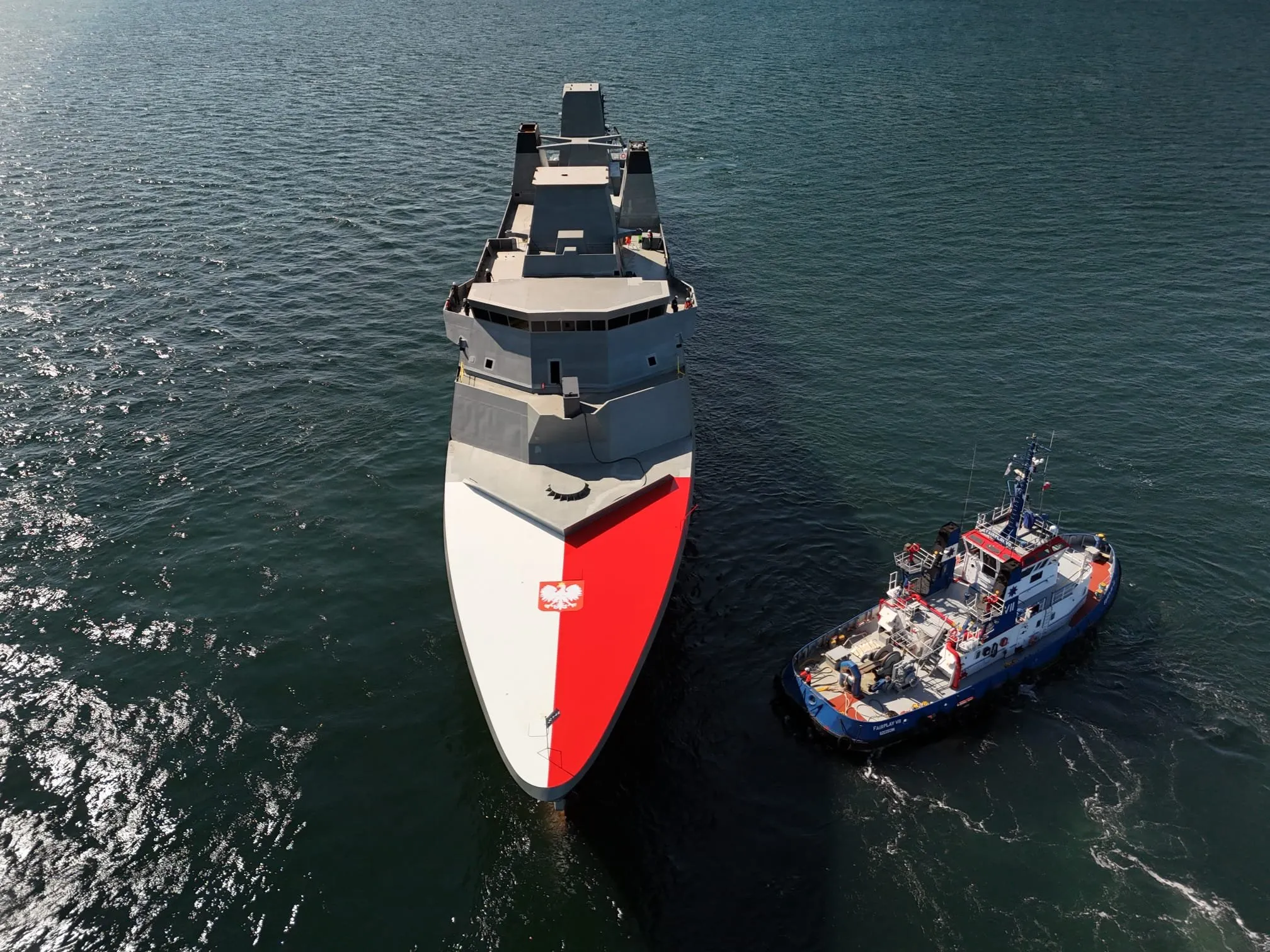
The Polish Navy launched its largest surface combatant since the interwar period, when the frigate Wicher went into the water today. The warship, built locally according to a British design, is the first of three and part of a wide-ranging modernization program for the Polish Navy as it adapts to meet a growing Russian threat in the strategic Baltic Sea region and elsewhere.

Wicher (Polish for gale) was floated off a semi-submersible heavy-lift barge in the Gulf of Gdansk today.

Wicher accompanied by a tugboat in the Gulf of Gdansk today. PGZ SW

Yesterday, the frigate was still on dry land, in the dock at the PGZ Stocznia Wojenna (PGZ SW) yard in Gdynia, on the Baltic Sea, where it had been built. It was rolled out and placed on the barge there before its christening and naming ceremony attended by Polish President Karol Nawrocki.

A wide view shows the future Polish Navy multipurpose frigate ORP Wicher, pennant number 274, aboard the semi-submersible heavy-lift barge BOABARGE 33 with the PGZ Stocznia Wojenna Hull Hall visible behind it in Gdynia, Poland, on August 11, 2026. The frigate was assembled and integrated inside the hall before being rolled out and positioned on the barge for its christening and launch. (Photo by Mateusz Wlodarczyk/NurPhoto via Getty Images)
The future Polish Navy frigate Wicher, pennant number 274, aboard the semi-submersible heavy-lift barge BOABARGE 33 with the PGZ Stocznia Wojenna Hull Hall visible behind it in Gdynia, Poland, on August 11, 2026. The frigate was assembled and integrated inside the hall before being rolled out and positioned on the barge for its christening and launch. Photo by Mateusz Wlodarczyk/NurPhoto

“Within the PGZ Group, we are implementing projects of strategic importance to national security,” said Adam Leszkiewicz, CEO of PGZ. “The christening and launch of the first frigate under the Miecznik program is one of the most important milestones in rebuilding the operational capabilities of the Polish Navy.”

Yesterday’s ceremony was marked by the blasts from the ship horns of two of the warships that Wicher will replace. These are the Kościuszko, which accompanied Wicher during its launch today, and Pułaski, currently in dry dock at the shipyard.

These are Poland’s two Oliver Hazard Perry class frigates, dating from the late Cold War period and transferred from the U.S. Navy.

181025-N-KA046-01223 NORTH SEA (Oct. 25, 2018) – The Polish Navy Oliver Hazard Perry Class guided missile Frigate General Kazimimierz Pulaski ORP 272 transits the North Sea after an underway replenishment, Oct. 25, 2018. Mount Whitney, forward-deployed to Gaeta, Italy, is underway to participate in the multilateral Exercise Trident Juncture 18. (U.S. Navy photo by Mass Communication Specialist 2nd Class James R. Turner/Released)
The Polish Navy Oliver Hazard Perry class frigate General Kazimimierz Pułaski transits the North Sea after an underway replenishment, in October 2018. U.S. Navy photo by Mass Communication Specialist 2nd Class James R. Turner/Released

The three new multirole frigates being built in the Project 106 Miecznik (Swordfish) class — described as the largest program of its kind in Polish Navy history — are far more capable vessels, based on Babcock International’s Arrowhead 140 design.

The Arrowhead 140 design is derived from the innovative Iver Huitfeldt class frigate used by the Royal Danish Navy and also forms the basis of the U.K. Royal Navy Type 31 general-purpose frigate. Overall, the Arrowhead 140 has a modular structure and generous internal space, meaning it can be adapted for a variety of different systems and sub-systems, as required.

An artist’s impression of the U.K. Royal Navy Type 31 general-purpose frigate. Royal Navy

The new Swordfish frigates have a length of 138 meters (453 feet), a beam of approximately 20 meters (66 feet), and a maximum displacement (including additional equipment and armor) of approximately 7,700 tons. They will have a maximum range of approximately 8,000 nautical miles, and a maximum speed of 28 knots, powered by four combined diesel and diesel (CODAD) piston engines driving two propellers. Each will have a core crew of approximately 120, with space to embark an additional 60 personnel.

Babcock’s Arrowhead 140 design was selected by Poland in 2022, after which a keel-laying ceremony for Wicher was held in Gdynia in January 2024.

Construction of the second vessel, Burza (Storm), had begun by early 2026, which is planned to be followed by its launch in 2027 and commissioning in 2030. The keel for the third ship, Huragan (Hurricane), will be laid down in late 2026, followed by a planned launch in 2028 and commissioning in 2031.

While they are multirole vessels, the Miecznik design stresses anti-air warfare (AAW) and anti-submarine warfare (ASW).

Compared to the British Type 31, the Miecznik is more extensively equipped.

For its AAW mission, the primary weapon of the Polish warship is the MBDA CAMM, or Common Anti-air Modular Missile.

Firing trials of the CAMM (also known as Sea Ceptor) from the U.K. Royal Navy frigate HMS Argyll:

Sea Ceptor firing trials from HMS Argyll thumbnail

Sea Ceptor firing trials from HMS Argyll


For medium-range threats, out to beyond 62 miles, the warship will be armed with the CAMM-MR, being jointly developed by Poland and the United Kingdom under the Future Common Missile (FCM) program.

The standard CAMM, with a maximum range of around 28 miles, will also be carried to engage targets at shorter distances.

Versions of the CAMM can be quad-packed, in this case in the U.S.-made Mk 41 vertical launch system (VLS), with 32 cells. That would provide for a maximum of 128 missiles, especially significant bearing in mind current concerns about magazine depth in the face of sustained drone and missile barrages.

Depending on the exact configuration of the VLS, other kinds of missiles and ASW weapons could potentially be integrated at a later date, too.

For ASW specifically, the Miecznik class is provided with two dual-tube launchers for MU90 Impact lightweight torpedoes. The same torpedoes arm the Polish Navy’s AW101 helicopters, seen in the tweet below, which can also be embarked.

For surface strike, the frigate will be armed with eight Kongsberg Naval Strike Missiles (NSM), stealthy weapons that can be used against other ships as well as against targets on land. There is an option to install an additional eight NSM launchers if required.

Gun armament will comprise a Leonardo 76mm Strales, which is compatible with guided ammunition. While these are dual-purpose weapons also capable of striking surface and land targets, the guns are optimized for the anti-missile and anti-drone defense role, for which they fire DART projectiles that employ radio-command guidance for accuracy. The video below shows the Strales/DART combination in action during peacetime:

Strales system with DART ammunition thumbnail

Strales system with DART ammunition


Two 35mm guns will also be able to fire programmable ammunition. These guns will likely be the locally produced OSU-35K remote weapon stations, as seen below on a Polish Navy minehunter:

For self-defense, the vessels will be fitted with the Terma C-Guard system, with eight fixed 130mm launchers that can dispense infrared, radar-frequency, and acoustic countermeasures.

The majority of the sensor suite on the Miecznik class is provided by Thales, integrated under its TACTICOS combat management system (CMS), already used by the Polish Navy. Thales-provided equipment also includes primary and secondary multifunction radars, a panoramic electro-optical system, and an underwater detection suite comprising a hull-mounted sonar and a towed array sonar.

TACTICOS, Thales’s Combat Management System for Warfighting and Maritime Security Operations thumbnail

TACTICOS, Thales’s Combat Management System for Warfighting and Maritime Security Operations


The electronic warfare system is from Rohde & Schwarz, based on that company’s KORA system.

Other additional systems include a laser warning system, navigation radars, and a diver detection sonar.

From the outset, the Polish Navy has schemed the Miecznik class around uncrewed systems, both in terms of operating these itself and countering hostile drones.

While it’s unclear what types of drones may be embarked, the Arrowhead 140 design includes four boat bays, which can accommodate uncrewed surface vessels (USVs) as well as traditional small, crewed boats. The large helicopter deck can also embark rotary-wing drones.

Bearing in mind the emphasis on ASW missions, USVs and rotary-wing drones equipped for this mission could become a regular fixture on the frigate, helping to extend its surveillance range and also for prosecuting targets, especially in high-risk and/or littoral environments.

Under current planning, Wicher is expected to be commissioned in 2029, following sea trials and qualification tests. Before then, the warship needs to be fully outfitted and its systems integrated, which will also be conducted at Gdynia.

The Miecznik program is scheduled for completion by the end of 2031, making it a remarkably compressed effort, reflecting the urgency behind Poland’s military modernization.

PGZ - Miecznik - Nowoczesna fregata dla Marynarki Wojennej RP thumbnail

PGZ – Miecznik – Nowoczesna fregata dla Marynarki Wojennej RP


In the maritime realm, the new frigates are key to Poland’s efforts to transform its navy from a relatively small Baltic force centered on aging, second-hand warships into a more capable fleet able to make meaningful contributions to high-end NATO maritime operations.

The Miecznik class represents a substantial increase in both size and combat capability over the Polish Navy’s existing surface combatants. The transformation is being driven in large part by the changing security environment in the Baltic following Russia’s full-scale invasion of Ukraine.

With Finland and Sweden joining NATO, Germany strengthening its maritime capabilities, and the Baltic states expanding their armed forces, Poland is positioning itself to play a much larger role in the alliance’s regional maritime architecture.

Russia retains substantial air defense, electronic warfare, and strike capabilities in the Baltic region, while its Baltic Fleet is relatively modern and well preserved compared with the Black Sea Fleet. Russian forces in and around the Baltic region — particularly Kaliningrad, western Russia, and Belarus — can combine these capabilities with long-range missiles, submarines, mines and other systems to threaten NATO forces before they even have the chance to concentrate.

BALTIYSK, RUSSIA - JULY 26: The Russian antisubmarine warfare ship "Kalmikiya" attend a naval honour review on Navy Day July 26, 2015 in Baltoysk, in the Kaliningrad Oblast region, Russia. Putin is having a two-days visit to Kaliningrad Oblast, the Russian exclave between Poland and Lithuania on the Baltic Sea. Introduced in 1939 by the Soviet government as a national holiday. Navy Day is celebrated annually on the last Sunday of July. (Photo by Sasha Mordovets/Getty Images)
Russian Baltic Fleet units attend a naval review to honour Navy Day in Baltiysk, Kaliningrad region, Russia, in July 2015. Photo by Sasha Mordovets/Getty Images

Already, Russia is employing cyber operations, sabotage, GPS/electronic interference, drone activity and other “gray zone” measures around NATO’s eastern flank.

A modern frigate force, backed by advanced submarines, coastal anti-ship missiles, and other naval capabilities, will give Warsaw considerably more reach and flexibility both inside the Baltic and beyond it.

However, there remains a question over whether Poland can generate enough people, infrastructure, and sustained resources to turn its ambitious procurement plans into a genuinely effective fleet. The Polish Navy has historically operated with a relatively small personnel base, currently numbering just over 6,000, while the country’s armed forces are simultaneously pursuing one of Europe’s most expansive modernization programs. Manning, training, maintaining, and sustaining an expanded fleet could ultimately prove a challenge.

Poland has an option with Babcock to build a further five ships to the same design. Perhaps more significantly, construction infrastructure built for the program, and the accompanying skills base, will be available for projects in the future, helping the Polish Navy continue its modernization.

Contact the author: thomas@thewarzone.com

Thomas Newdick is a staff writer at TWZ, where he covers military aviation, defense technology, weapons systems, and international security. Based in Berlin, Germany, he reports on conflicts, military modernization efforts, and emerging aerospace technologies around the world, with a particular interest in airpower and its role in contemporary warfare. His reporting is informed by deep expertise in modern and historical airpower, particularly in Europe, with a focus on military aviation, air campaigns, and aerospace developments across the continent and beyond.


Source link