DELTA Goodrem’s first album in half a decade is just around the corner.
The Australian singer, 41, has opened up to The Sun about the project – admitting fans won’t have long to wait.
Sign up for the Showbiz newsletter
Thank you!
Delta Goodrem has revealed that she has just finished recording her first album in five yearsCredit: Shutterstock EditorialDelta performed a surprise pop-up gig in Camden to warm up for her upcoming Eurovision appearanceCredit: AP
Chatting ahead of a surprise pop set in Camden, London with Australian chocolatey biscuit Tim Tam, Delta said: “I have finished the new album.
“When Eurovision came up I was in the studio already as it was naturally time to create the new album.
“I am doing a new video next week when I am back in Aus again for the next song.
“That will be straight out the gate and the new album will be there straight away.”
Delta said: “This is, literally verbatim, all your fault. It is all on you — Bizarre started this.
“Your article went back to the Aussies who were like, ‘Do you want to do this?’ So thank you. I have a big job to do.”
Delta performed her Eurovision track Eclipse for the first time in the UKCredit: AP
Delta will head to Vienna this May to compete with her song Eclipse and it ticks every box, with an infectiously camp chorus and a complex piano bridge.
A beaming Delta explained: “From your article, people started reaching out.
“Then one of the songwriters, Jonas Myrin, who I wrote the song with, took a screengrab of the article and sent it to me saying, ‘Delta, if you ever go to Eurovision, I want to write the song with you’.
“He’s in Sweden. Sure enough he flew to Australia when I said I was doing it.
“Even the first question I got asked when doing my first Australian interview was, ‘We heard it all started from an article from the UK,’ and yes, it did.”
It’s been three years since Australia last qualified for the live final, which adds to the pressure on Delta, who has sold eight million records worldwide.
Delta added: “Of course I am nervous, but it’s so joyous and I am so excited to be a part of it.”
Delta, pictured with Bizarre’s Jack Hardwick, says her interview with The Sun last year sparked her Eurovision callCredit: Bizarre Team
IT’S being billed as a huge tribute concert to Gary ‘Mani’ Mounfield, who died in November.
But I’m told the “Manichester” event in honour of the Stone Roses bassist, organised by his brother Greg, has caused a rift in the family.
Sign up for the Showbiz newsletter
Thank you!
A gig honouring Stone Roses bassist Mani is causing a rift among his family membersCredit: GettyThe Stone Roses in July 1990 L-R Reni, Mani (top) Ian Brown (bottom) John SquireCredit: Getty
The concert will see musicians including Zak Starkey, Baz Fratelli from The Fratellis, John Mcclure from Reverend And The Makers and Simone Butler from Primal Scream come together at Manchester’s Diecast in May.
Cast are also lined up to perform, along with Mick Rossi from Slaughter & The Dogs and Stone Roses guitarist Aziz Ibrahim.
But while the concert was believed to have the full support of Mani’s family, which includes his twin sons Gene and George, insiders say not everyone is in agreement.
A source said: “Mani’s legacy and celebrating that is so important to so many people.
“But not everyone related to him is happy about this concert.
“Even his young son Gene has voiced his concerns on social media.
“It is all very messy and is spilling over into the public domain.
“This is not what Mani would have wanted. His twin boys were everything to him.”
Mani died at home in Manchester in November aged 63Credit: GettyMani was best known for his work with Stone Roses and Primal ScreamCredit: Getty
Greg confirmed earlier this month that he was organising the tribute concert, and said there were hopes of snaring Noel and Liam Gallagher to perform, as well as Johnny Marr.
He said: “I think it will be brilliant.
“With the names already in the hat, and the names we’re yet to announce, it’s a worthy thing, a tribute to our kid, a Mancunian legend, and I know he’d love it.
“He would be absolutely buzzing about it.”
Mani, who was best known for his work with Stone Roses and Primal Scream, died at home in Manchester aged 63.
Noel and Liam made an on-stage dedication to him during their Oasis ’25 Live reunion tour, while rock icons including Stone Roses singer Ian Brown turned out to pay their respects at his funeral.
As a fan of Mani, I hope this can be resolved quickly and without further upset.
LITTLE BRIT OF FAMILY TIME
BRITNEY SPEARS is being supported by her sons following her arrest for driving under the influence – and it’s about time too.
For years, the Circus singer was deserted by her boys – who she has with ex-husband Kevin Federline.
Britney Spears has been spending time with her two sons, Sean Preston and JaydenCredit: Instagram
But it seems they are back in her life and bringing a smile to her face.
She shared a video on Instagram on a boat with Sean and Jayden, during a getaway, including a shot of them smiling together.
Britney wrote: “Thank you guys for all your support… Spending time with family and friends is such a blessing!”
AITCH FIZZES MUSIC
HE was flying high after his stint in I’m A Celebrity last year.
But now Aitch is facing another trial, and it could be just as gruesome.
Aitch is embroiled in a legal row over his Syps drinks brand with two former directors of the companyCredit: Splash
I’m told the Strike Me A Pose rapper is embroiled in a legal row over his Syps drinks brand with two former directors of the company.
Aitch, real name Harrison Armstrong, created Syps back in 2023 with businessmen David Olusegun and Alexander El-Nemer – with the trio proudly showing off their fizzy, flavoured water at events across the UK.
But I’m told that partnership is now well and truly over, with David and Alexander resigning as directors.
A source said: “Harrison has fallen out with David and Alexander and it seems there is no going back.
“They’re in a full-blown legal dispute and it’s all in the hands of their lawyers.
“The three created the brand together so it could get messy.
“Harrison is still working on the brand and is running things with his manager.
“How quickly this is going to get resolved is the question. One thing is for sure though, Harrison wants it dealt with so he can move on.”
TAMER ROLE FOR HARDMAN ACTOR
TAMER HASSAN is swapping punch-ups for pull-ons after landing a major new deal with sportswear giant Reebok.
The hardman actor has filmed an advert for a bold campaign inspired by Robin Hood, of all people.
Tamer Hassan has landed a major new deal with sportswear giant ReebokCredit: Splash
It sees Tamer playing a cheeky “friendly villain” who nicks sports kits before handing them out to kids.
He is joined by UK rapper K-Trap, and starry cameos from Gary Oldman, Laila Morse and Lisa Maffia.
An insider said: “Tamer is genuinely thrilled to be part of something revitalised and forward-thinking.
“Reebok is part of the culture, and seeing it evolve with fresh energy in 2026 makes this really exciting.”
The retro-style campaign is also a nod to 2005 British crime flick The Business, which starred Tamer alongside Danny Dyer.
Filmed at a secret North London location, the advert is set to drop later this month and marks the start of a huge year for the actor.
He’s gearing up for the premiere of Rise Of The Footsoldier: Retribution at Cannes in May, ahead of its UK cinema release this summer.
From the big screen to the high street, it sounds like Tamer has a lot going for him right now.
TEARY NIGHT FOR ELLIE’S WOLF PACK
WOLF ALICE had an emotional night headlining the final evening of the Teenage Cancer Trust’s concert series – with frontwoman Ellie Rowsell breaking down in tears.
The group debuted two new songs, Hit The Sky and Gospel Oak, and towards the end of the latter, her voice broke and she became teary.
She asked the band to restart the track from the beginning of the final verse and was then hugged by guitarist Joff Oddie and bassist Theo Ellis.
Later, Theo admitted that performing in London’s Royal Albert Hall for the charity concert was making him emotional, too.
He said: “These are my best friends. It’s unbearable how much I want to cry all the time in this gaff.”
They deservedly picked up the British Group gong at the Brit Awards last month following the success of their fourth studio album, The Clearing – one of the best British albums of 2025.
If you’re yet to see them, make sure you make it to one of the festivals they’re playing across the UK this summer.
BENSON SWOON
BENSON BOONE got his fans hot under the collar while cooking up this tour announcement.
He whipped off his top, cracked eggs with his biceps and showed off his rippling muscles as he added ingredients to a bowl while baking a cake.
Benson Boone stripped off for his new tour announcementCredit: instagram/bensonbooneIn the video Benson cracked eggs with his bicepsCredit: instagram/bensonbooneBenson made a cake in the videoCredit: instagram/bensonboone
It was eventually topped with the poster for his new Wanted Man tour.
I have to applaud him for the sexy and hilarious snippet posted on Instagram, but it’s a sea change from 12 months ago when he told Rolling Stone magazine that he didn’t want to rely on his body to sell shows.
He told the mag: “I definitely remember there was a time where I would take my shirt off because I didn’t know what else to do.
“I don’t want to rely on my physical form to be the primary driver of my shows.”
It’s a good job he’s had a fair few hits.
Benson previously told Rolling Stone magazine that he didn’t want to rely on his body to sell showsCredit: instagram/bensonbooneBenson’s new tour is called Wanted ManCredit: instagram/bensonboone
YOU BOOTY, KATYA
STRICTLY’S Katya Jones looked the part – and had the footwear to match – when she strutted in to watch the opening night of musical Kinky Boots.
And she was in for a real treat.
Katya Jones at the opening night of musical Kinky BootsCredit: GettyJohannes Radebe stars in the musicalCredit: Getty
With glitter, tinsel, red leather and high heels, this latest production of the hit show is a dazzling spectacle, the likes of which the West End has rarely seen.
Fellow Strictly star Johannes Radebe is mind-blowing as drag queen Lola, above, proving his singing voice and stage charisma are almost as brilliant as his dancing.
But playing the perfect straight man is X Factor winner Matt Cardle as Charlie Price, who inherits his father’s ailing shoe factory in Northampton and comes up with a plan to save it by making footwear for Lola and her fellow artistes.
Fun, feel-good and unforgettable, everyone should try these Kinky Boots for size.
BRISTOL Airport has submitted plans to expand with thousands more flights and long-haul journeys.
Along with more passengers the terminal will be larger, there will be new shops, restaurants as well as an extended runway at the cost of £500million.
Sign up for the Travel newsletter
Thank you!
Bristol Airport has submitted new £500million expansion plans to the local councilCredit: AlamyIt has submitted new plans for a £500million investmentCredit: Farrans
New plans have been submitted to North Somerset Council for Bristol Airport to extend its runway which will allow for long-haul flights.
The proposal revealed the airport had plans to reach “world cities within Europe and beyond”.
The amount of travellers that pass through Bristol Airport is currently 10.8million.
The increased take-offs and landings mean that there could be up to 100,000 flight movements a year- up from 85,990.
On the busiest days, there could be as many as 35 aircraft movements.
Bristol Airport added: “The plans would see around £500 million invested in improvements at the airport and local infrastructure.
“These include extending the runway to accommodate larger aircraft and increasing capacity of the terminal that includes a number of improvements to enhance the customer experience, including more space, a wider choice of retail and restaurants and the ability to walk onto aircraft without getting on a bus.”
Along with the extended runway are plans for a larger terminal with more space for a bigger immigration hall, baggage handling facilities, shops and restaurants.
Other improvements detailed in the plans include travelators, better public transport and the expansion of car hire facilities.
Chief executive Dave Lees said: “Our proposals deliver what customers have told us they want to see at their local airport.
“We will open up opportunities to visit places further afield and for businesses to expand into new international markets.”
The plans reveal increased flights and a runway expansionCredit: Farrans
There are currently 14 airlines operating from Bristol Airport which go to 115 destinations including Alicante, Majorca, Amsterdam, Edinburgh, Tenerife and Barcelona.
In 2024, Amsterdam was the most popular destination, followed by Alicante and Majorca.
Weekly insights and analysis on the latest developments in military technology, strategy, and foreign policy.
The U.S. Navy has unveiled a “marketplace” model for acquiring future fleets of uncrewed surface vessels (USV), which could be owned and/or operated by the service or contractors. The Navy is applying this approach first to the procurement of medium-sized designs, or MUSVs, which could be configured for a variety of missions with the help of containerized payloads. The new strategy, which supplants the Modular Surface Attack Craft (MASC) plan laid out just last year, and aims to cut down on lengthy prototyping requirements, is the latest in a series of Navy efforts to try to speed up the fielding of new USV capabilities at scale.
“The character of warfare is changing rapidly. The Department of the Navy is adapting its acquisition system to deliver capability to our warfighters faster,” Secretary of the Navy John Phelan wrote in a post on X this morning, marking the official roll-out of the new USV acquisition plan. “We are harnessing the talent and ingenuity of the American tech sector by launching a market competition for the Medium Unmanned Surface Vessel (MUSV) Family of Systems. This new approach will leverage private investment and accelerate the delivery of real capabilities to the Fleet. We will reward the companies who are able to deliver capability at the speed of relevance.”
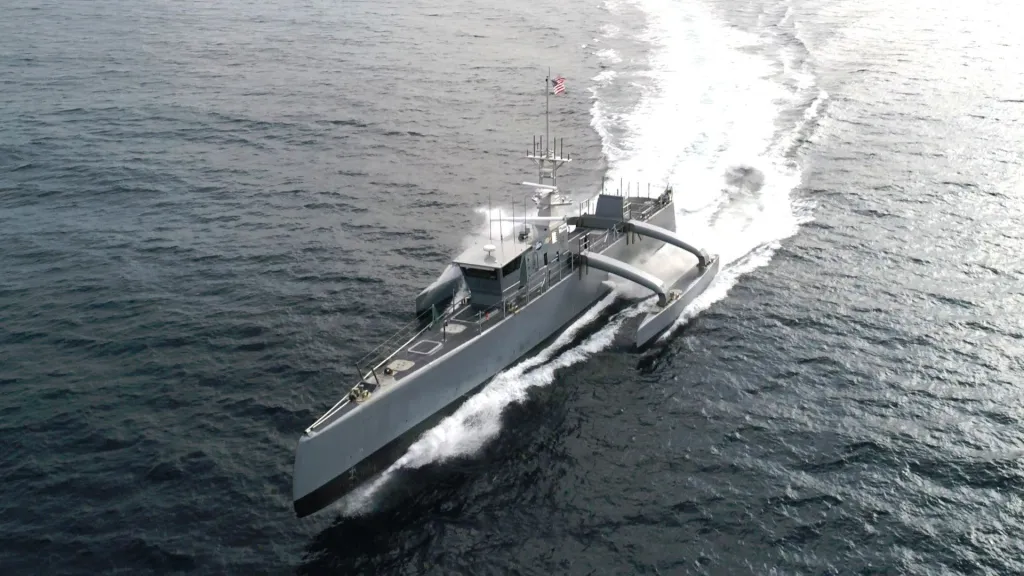
The Sea Hunter seen here is an MUSV-type design that the US Navy has been experimenting with for years now already. USN
“Our goal is to create a regular, recurring marketplace, not just for the MUSV, but for other classes of vessels, as well, over time, designed to match the growing demand for unmanned systems across a range of missions,” Rebecca Gassler, the Navy’s first-ever Portfolio Acquisition Executive for Robotic and Autonomous Systems (PAE RAS), also told TWZ and other outlets during a press call today. “This model that we’ve posted rewards demonstrated performance at sea, not just development, and is not another prototyping award. And it creates a direct path from what’s demonstrated on the water to putting those vessels into the fleet.”
The use of “marketplace” here should not be confused with how the U.S. Army is also now using that term to describe an actual online storefront-style system for ordering small uncrewed aerial systems. “I don’t know how many customers other than PAE RAS there are right now that actually have the funding to go buy or lease an MUSV,” Gassler said in response to a question about whether any kind of comparison between the two might be appropriate.
The Navy also posted a contracting notice regarding what it is now calling the Medium Unmanned Surface Vessel (MUSV) Family of Systems (FoS) program, specifically, online today. Potential offers only have another three weeks or so to submit proposals that involve designs that can be ‘on the water’ by the end of September, underscoring the service’s interest in already highly mature capabilities.
In terms of the actual uncrewed vessels the Navy is seeking through this effort, threshold requirements include a range of at least “2500 nm [nautical miles] at 25 knots while carrying a 25 MT [metric ton] load on the payload deck in NATO STANAG 4194 Sea State 4.” Per this NATO standard, Sea State 4 is characterized by wind speeds of 17 to 21 knots and wave heights between four and eight feet.
The MUSVs also need to be able to carry forty-foot equivalent units (FEU) containerized payloads and to refuel at sea at a rate of “2,000 gallons per minute of fuel through deck connections,” according to the contracting notice. We’ll come back to what might be in those payloads later on.
The Navy also wants designs that are “capable of fully autonomous operations both day and night in varying weather conditions complying with COLREGs [Convention on the International Regulations for Preventing Collisions at Sea], can prescribe keep out and keep in zones, and perform pre-defined behaviors,” per the notice. They also have to be “capable of restricting all Radio Frequency (RF) emissions when commanded while continuing to autonomously operate, perception system for autonomy has a passive mode with no RF emissions.”
The full list of threshold requirements from the MUSV FoS contracting notice released today. USN
In addition, the Navy has outlined a number of desired attributes, including “interfaces between C2, Perception, Machinery Control System, and Autonomy Control System software and hardware systems [that] conform to an open architecture standard with Interface Control Documents (ICD)” and an overall “autonomous system solution [that] enables integration with third party applications, modular upgrades, and component-level interoperability.” The service is also interested in the ability of the MUSV to monitor “health and status and autonomously reports conditions to the offboard C2 station, providing situational awareness of the condition of the vessel to the operator.”
“Vessel can execute 5 days of pre-planned maneuvers without communication connection” and “vessel provides emergency stop functionality to the offboard operator,” defined as “the rapid shutdown of propulsion engines putting the USV into a drift,” are also on the desired attributes list. There are production and operational aspects the Navy is also interested in, such as the ability of a selected contractor to supply between five and 10 operational MUSVs by the end of Fiscal Year 2027 and designs that can be “nested five abeam when moored.”
The complete list of desired attributes for the MUSV FoS from today’s contracting notice. USN
“We believe a number of them [potential offers] will test on production representative, but not full production[-ready designs,] or they’ll test in [sic] surrogate boats, so that we can see the autonomy that they’re bringing, even if it’s not the full production vessel,” Gassler noted today. So, acceptance of a finalized design will include a requirement “to do the full endurance test again, and any additional mission profiles that we have gotten from the Fleet, we will test at the time. And then we will do a full regression test on the autonomy now that it has been connected into the production boat controls.”
Overall, many of the stated threshold requirements for the MUSV FoS are similar, if not identical, to what the Navy had previously outlined for the initial baseline MASC design. The MASC plan was a three-tier approach that also included larger and smaller types, all of which would be configurable for different missions using containerized systems.
At the same time, the new strategy laid out today “is a replacement for MASC, absolutely,” PAE RAS Gassler stressed. MASC “was tailored towards a very specific mission and a very specific ask from the Fleet, [and a] very specific quantity. And we have a much wider variety of requirements for these vessels and missions that they need to accomplish as part of the Golden fleet. And so this is a replacement for that.”
“So, I won’t talk about specifically what mission we’re going after now that kind of gets out of the unclassified realm, but know that we are looking at specific mission profiles,” Gassler added. “For example, some require more complexity in their autonomy features than others, and so when we put these vessels through their tests, those tests will be a superset of those requirements such that we understand they will meet each of those missions.”
“Honestly, inside you could have a sensor, you could have repair equipment for ships,” she also said, speaking more generally about containerized payloads. “You could have any number of payloads inside those, and you basically are able to just swap them on.”
It should be noted here that the Navy did say its initial focus for MASC was on Intelligence, Surveillance, Reconnaissance, and Targeting (IRS&T), Counter-ISR&T, and Information Operations missions. At the same time, the three-tier approach and focus on containerized systems had certainly pointed to additional missions, including surface-to-surface strike and electronic warfare, down the line. The Navy already has a containerized launcher capable of firing SM-6 multi-purpose missiles and Tomahawk land-attack cruise missiles that it has been working to field on crewed ships, as well as in a ground-based configuration. The Navy has test-fired that launcher from an optionally crewed ship in the past.
See the game-changing, cross-domain, cross-service concepts the Strategic Capabilities Office and @USNavy are rapidly developing: an SM-6 launched from a modular launcher off of USV Ranger. Such innovation drives the future of joint capabilities. #DoDInnovatespic.twitter.com/yCG57lFcNW
“As we look across how the Golden Fleet capability, or the Golden Fleet concept, has matured, and we look across where we could use these vessels as part of CNO’s [Chief of Naval Operations Adm. Daryl Caudle] tailored offsets and tailored forces, we bring ourselves to realize there’s a number of missions that we could immediately use these vessels for,” Gassler said. “That is, that is part of the strategy now, is that we will now have a scalable way to procure vessels that meet specific mission profiles.”
Adm. Caudle publicly announced that the Navy would be moving toward a more flexible deployment model using tailored force packages at the Surface Navy Association’s (SNA) annual conference in January. At that same event, he also laid out a new “Hedge Strategy” to try to better maximize Navy resources through a major overhaul of how existing forces are utilized and how new capabilities are acquired and fielded. You can read more about all of this here.
Last week, Caudle also rolled out another new initiative, the Containerized Capability Campaign Plan, which puts new emphasis on containerized weapons and other capabilities, specifically, as a means to help the Navy achieve these broader goals.
Chief of Naval Operations Adm. Daryl Caudle. USN
Perhaps the biggest change the Navy is hoping to see with its USV marketplace strategy is in the processes through which it acquires and fields USVs. This reflects a broader push by the service to shake up how it buys vessels, crewed and uncrewed, to try to avoid the kinds of serious setbacks that have plagued Navy shipbuilding programs in recent years.
From what Gassler said today, the MASC program had been progressing along largely traditional lines, with plans to issue contracts to multiple vendors for a prototyping phase ahead of choosing one or more designs for production. She made clear that the new strategy aims to skip the prototyping phase to the fullest extent possible.
“Industry has leaned forward and has built boats or has built the technology already,” leading to the assessment that “we no longer needed to go through the prototyping phase,” she said. “So this will allow us to test the capability on water and go straight into production. And that will save us approximately on the order of a year, and we will get capability to the fleets faster.”
The Sea Hunter MUSV seen during early testing. DARPA
“What we want to do is capitalize on that investment. So the marketplace will look for several things,” she added. Beyond the “technical design that meets the specifications,” the Navy is also “looking for a variety of business models. So in this case, the [MUSV FoS] solicitation asks for what does a government-owned, government-operated model look like, types of data, rights, things like that, as well as a contractor-owned, contractor-operated model.”
Then there’s “manufacturing readiness. When we go through a normal development program, you don’t consider that until much further into the life cycle of development. Here we’re considering it up front,” she continued. “So we’ll be looking at your staffing, the supply chain, and whether you’ve got any fragility in the supply chain. We’ll be looking at facilities and capacity. So if you say you can produce X number of boats per year, can we really see that in the laydown of your facility, or that of those who you’ve partnered with.”
Gassler says that vendors that successfully complete the on-water test requirements will receive a fixed-price payment as a “reward” to help foster competition. The Navy will then have the option of entering into a production or leasing agreement for the design in question.
With all this being said, as mentioned, this is not the first time the Navy has attempted to accelerate the acquisition and fielding of USV capabilities, especially when it comes to larger types. The service already has a number of smaller USVs with speed boat and jet ski-type designs in service today.
When it was rolled out last year, MASC was presented as finally offering a path forward after more than a decade of prototyping and experimentation efforts that have yet to lead to meaningful operational capabilities. As a prime example of how things have progressed previously, in January, the Navy triumphantly declared its intention to employ two MUSV-type vessels it has in inventory now – Sea Hunter and Seahawk – operationally. Sea Hunter has been sailing since 2016. The Navy acquired Seahawk in 2021.
Sea Hawk and Sea Hunter Participate in Unmanned Systems Exercise
With MASC, the Navy had also hoped to leverage those prior investments, including work that had been led by the Defense Advanced Research Projects Agency (DARPA) and the Defense Innovation Unit (DIU). DARPA’s ongoing No Manning Required Ship (NOMARS) program, which the Navy is also involved in, continues to be particularly relevant in terms of the new operational and production concepts it is seeking to prove out. The NOMARS test ship, the USX-1 Defiant, was designed to be a lower-cost and readily producible design capable of operating without humans ever being on board, as you can read more about here.
USX-1 Defiant At-Sea Overview – No Manning Required Ship (NOMARS)
“All of this comes as USVs have now long been seen as a key way for the Navy to bolster its surface fleets. Distributed fleets of USVs configured for strike and ISR missions, and capable of operating independently or in groups, as well as together with crewed warships, open a door to significant new operational possibilities. Members of the MASC family could also help reduce risks to crewed assets. Modular designs that can be readily configured and reconfigured for different missions using containerized payloads also present targeting challenges for opponents.“
The Navy is clearly hoping that it has found the right formula with its new marketplace strategy to finally get larger and more capable USVs into service.
Austrian officials highlight addiction and ill-health while advocating for stricter age restrictions.
Published On 27 Mar 202627 Mar 2026
Austria plans to ban children under 14 from using social media, with an official saying certain online sites are addictive and making young people “sick”.
“Austria is introducing a compulsory minimum age of 14 for the use of social media platforms,” conservative junior minister for digitisation, Alexander Proll, told a joint news conference on Friday.
Recommended Stories
list of 3 itemsend of list
Proell added that draft legislation would be drawn up by June. Cabinet members from Austria’s two other governing parties were also in attendance.
“We will decisively protect children and young people in future from the negative effects of social media,” Vice Chancellor Andreas Babler of the Social Democrats said.
“We will no longer stand by and watch while these platforms make our children addicted and often also sick … The risks associated with this use were ignored for long enough, and now it is time to act,” he added.
Babler said the government would not list individual platforms the ban would apply to, but would decide based on how addictive their algorithms are and whether they include content such as “sexualised violence”.
The announcement comes days after a Los Angeles jury found Alphabet’s Google and Meta liable for $6m in damages in a landmark social media addiction lawsuit.
The case involved a 20-year-old woman who said she became addicted to the apps at a young age due to their platform design. Meta says it plans to appeal the decision.
Also on Friday, the United Kingdom advised parents of children under five to limit screen time to a maximum of one hour per day.
Similar to Austria, other nations in Europe and elsewhere have banned the use of social media for children.
In January, the French parliament voted in favour of banning children aged below 15 from social media, amid growing concerns about online bullying and mental health risks.
Countries including the UK, Denmark, Spain and Greece are also studying a ban.
The European Parliament has called for the European Union to set minimum ages for children to access social media, although it is up to member states to impose age limits.
POPULAR airline JET2 has launched its first flights from a major UK airport.
Jet2 flights to Tenerife and Alicante in Spain have taken off from London Gatwick, marking its first flights from the airport.
Sign up for the Travel newsletter
Thank you!
Jet2 has launched its first flights from London Gatwick AirportCredit: AlamyLebos is one of the destinations on the listCredit: Alamy
This summer, travellers can fly to 29 destinations with Jet2 from Gatwick, including the Canary Islands, Greece, Turkey, Portugal, Malta, Italy, Croatia, Bulgaria and Cyprus.
And the airline won’t stop at the end of the season either, as for the winter season it will fly to 14 winter sun destinations, ideal for Brits wanting to escape the cold.
Jet2 will also fly to five ski destinations and four Christmas market spots over the winter period.
Looking ahead to next year, even more routes will be added.
The airline’s routes will rise from 29 to 34 destinations including flights to Lesbos – a large island in Greece – which will operate weekly.
Lesbos is Greece’s third largest island and boasts a lot of history as well as sprawling olive groves.
For those flying from Gatwick with Jet2, there will be six aircraft including the new Airbus A321neo aircraft.
Jet2’s arrival at the UK’s second largest airport comes after increased demand, especially with travellers from the South East of England and marks the airline’s 14th base.
Steve Heapy, CEO of Jet2.com and Jet2holidays, said: “Today is an incredibly exciting moment for Jet2, as we welcome our first customers at London Gatwick and wave off our inaugural flight.
“After years of demand to come to London Gatwick, we are delighted to be bringing our award-winning service, recognised 11 years in a row by Which? as its recommended travel provider, to the UK’s largest beach and city leisure destination airport.
He added: “Since going on sale, we have experienced phenomenal demand from customers and independent travel agents, and we are looking forward to a hugely successful future from our newest UK airport base.”
The arrival of Jet2 at London Gatwick Airport is the airport’s largest airline launch in more than a decade.
Pierre-Hugues Schmit, Chief Executive, London Gatwick said: “Today’s inaugural Jet2 flights mark an exciting moment for London Gatwick and for passengers across the region.
“The launch of 29 new routes and the creation of more than 300 jobs demonstrate the strength of demand for travel from our airport and the confidence airlines have in London Gatwick as a place to grow.”
According to The Independent, Jet2 has been trying to get slots at Gatwick Airport for years and it was only when slots were freed up that the airline could move in, first announcing this four months ago.
The first flight to Alicante took off todayCredit: Alamy
Full list of destination Jet2 will fly to in summer 2026 from London Gatwick Airport
HERE are all the destinations Jet2 will fly to from London Gatwick in summer 2026:
WASHINGTON — The U.S. Treasury Department is working on plans to put President Trump’s signature on all new U.S. paper currency, the agency announced Thursday.
The move would be a first for a sitting president. The news was first reported by Vanity Fair.
It’s the latest instance of Trump putting his name and likeness on American cultural institutions, following his renaming of the U.S. Institute of Peace, the Kennedy Center performing arts venue and a new class of battleships, among other tributes.
The plans come in tandem with an effort to get Trump’s face on a coin.
This month, a federal arts commission approved the final design for a 24-karat gold commemorative coin bearing Trump’s image to help celebrate America’s 250th birthday on July 4.
Treasury Secretary Scott Bessent’s signature would also appear on the currency, according to a Treasury news release.
Bessent said in a statement that “there is no more powerful way to recognize the historic achievements of our great country” than with U.S. dollar bills bearing Trump’s name.
U.S. Treasurer Brandon Beach said in a statement that printing Trump’s signature on the American currency “is not only appropriate, but also well deserved.”
The Mint, which is part of the Treasury Department, manufactures and distributes the currency.
Wetherspoon’s is opening two new Spanish pubs after the success of one in Alicante last month (pictured)Credit: WetherspoonThe two new Wetherspoons pubs will be at Barcelona AirportCredit: Alamy
Following this, two more pubs will now open at Barcelona-El Prat Airport in the capital city.
The first one will be at Terminal 1, set to open by September 2026.
This will be followed by a second at Terminal 2 by January 2027.
Passengers will have to go through security to drink at them as they are both airside rather than landside.
Little else is known about the pubs, including what they will be called, but they will have space for almost 600 passengers.
You can get an early drink too – they’ll be open every day from 5am to 11pm, including real ale.
The menu is likely to be similar to the Alicante menu, which is mainly the British classics with a few Spanish dishes as well.
Drink prices haven’t been confirmed, although the also similar to the Spanish pub, beers are around £3.50.
Wetherspoon boss Tim Martin said: ” We are delighted to have secured two fantastic sites at Barcelona airport.
“In the short time since opening our pub at Alicante airport has proven popular with travellers and we are confident we can replicate that at our two new pubs in Barcelona.”
He added that they aim to open more pubs in mainland Europe in the next few years, particularly at airports.
The Sun’s Assistant Travel Editor Sophie Swietochowskiwas one of the first to try the new Wetherspoons in Alicante, called Castell de Santa Barbara.
She explained: “The pub has pitched close to the gates for UK flights to draw in the near 650,000 Brits that pass through this airport monthly.
“Floor-to-ceiling windows flood the small space with light, while candy floss, glossy tiles give it a warm atmosphere.
“There’s a tea and coffee station in the corner, while behind the bar there’s not a whiff of scampi fries or Walkers in sight but instead European holiday favourite, Lays.
“This one boasts something that all other airport Wetherspoons do not, however – an outdoor terrace, where you can catch those last glimpses of Spanish sunshine before jetting off home to drizzly England.”
A proposed gubernatorial forum hastily cobbled together in the hours after USC canceled its Tuesday debate fell apart because the candidates of color who were excluded from the previously planned event were unable to show up in person at KNBC-TV’s studio in Universal City, according to multiple sources.
Facing mounting pressure that its debate selection criteria excluded every candidate of color, the university canceled its debate late Monday. On Tuesday morning, billionaire Tom Steyer — a Democrat — proposed holding an alternative face-off, with KNBC moderating. But the candidates who had not been invited to the USC debate had already made other commitments.
“A lot of this came out of nowhere — there’s a debate and you’re not invited, followed by there’s no debate, and then maybe we should all hang out and have a conversation,” said Kyle Layman, a strategist advising former U.S. Health and Human Services Secretary Xavier Becerra.
USC officials declined to comment on Tuesday’s developments — as did KABC-TV, one of the broadcast partners of the canceled debate. KNBC did not respond to a request for comment, but someone involved with planning a potential debate there said pulling together such an event in just a few hours was impossible, and also unfair to the candidates who had made other plans after initially being excluded from the USC debate.
“We looked into the possibility of doing something. It just wasn’t possible because of the last-minute logistics. It was not feasible,” said the person, who asked for anonymity to speak candidly. “We couldn’t get everybody here.”
The fact that the candidates excluded from the USC debate couldn’t find a way to participate in Tuesday evening’s alternative forum irritated some people involved in the planning, however. Becerra, state Supt. of Public Instruction Tony Thurmond, former Los Angeles Mayor Antonio Villaraigosa and former state Controller Betty Yee had loudly protested not being invited to the USC event.
“This is like probably one of the last opportunities they have to be with other leading contenders of the race, so why not take this opportunity?” said someone who took part in conversations about the proposed last-minute debate, who asked for anonymity to speak openly. “If the whole thing is about bringing your message to the voters, making sure voters have as much information as possible, talking about the issues that matter, wouldn’t you want to take every opportunity to do that?
“If you’re going to talk a big game about taking your message to voters, the importance of debates, why not do it?” this person said.
Becerra, Thurmond, Villaraigosa and Yee have reportedly formed an informal pact not to participate in any debate that does not include all of them, which Yee referenced in a Tuesday afternoon news conference.
“The idea that none of the candidates of color are going to be joining a debate is just inappropriate for a state like California,” Yee said. “We also need to have a commitment from all of the debate sponsors that they will include all of us going forward.”
Yee and Thurmond were not invited to the next major televised debate, which will take place April 1 at Fresno State University. Becerra and Villaraigosa had previously confirmed their attendance, according to a news release from the Western Growers Assn., one of the event’s sponsors.
And all four candidates of color, along with San José Mayor Matt Mahan, were not invited to a debate on April 22 in San Francisco that will be hosted by KRON-TV and broadcast on Nexstar Media Group stations throughout California.
“We don’t need gatekeepers,” Mahan said in a statement Tuesday evening. “I’m calling on my fellow candidates to work together to organize our own debates — so we can take our ideas for a better California to every corner of California. Let’s let the voters truly decide.”
The scrapped USC debate was going to be hosted by the institution’s Dornsife Center for the Political Future and co-sponsored by KABC and Univision. Six candidates had been invited to participate: Democrats Rep. Eric Swalwell (D-Dublin), former Orange County Rep. Katie Porter, Mahan and Steyer; along with the leading Republicans, conservative commentator Steve Hilton and Riverside County Sheriff Chad Bianco.
Candidates and elected officials called the criteria used to determine participation in the debate biased because it included Mahan, a white candidate who is polling near the bottom of the pack but is supported by notable names in the USC community. Hours after the debate was canceled, Steyer’s campaign sought to create an alternate event that would include all of the candidates.
“We were trying to do the right thing upon learning that the debate was canceled at USC,” said a member of Steyer’s campaign who asked for anonymity to speak candidly. “Tom immediately was like, ‘We can do something alternative.’ People want to hear from the gubernatorial candidates. It was on the table. It was offered.
“NBC couldn’t get all the candidates here, but we tried,” this person said. “Given the short amount of time we were trying to put this together, it ultimately could not happen because not all the candidates could get to the studio.”
Thurmond, who was in Sacramento and Richmond on Tuesday, joined a political influencer on YouTube Tuesday evening, while Yee attended previously scheduled events with the East Area Progressive Democrats and a women’s group in the L.A. area. Villaraigosa had lined up other interviews at his Wilshire campaign office, Becerra was traveling, and Porter was scheduled to host a livestream on her Instagram account Tuesday evening.
March 24 (UPI) — The price of oil climbed back above $100 per barrel on Tuesday as hopes for de-escalation in the Iran war faded after Washington said the situation remained “fluid,” Tehran denied there had been any negotiations and a fire put a major Texas refinery out of action.
Claims by President Donald Trump of “major” progress in talks to halt the conflict on Monday sent oil prices tumbling and rallied stock markets, but benchmark Brent crude futures rebounded to more than $103 a barrel on Tuesday after the White House appeared to walk it back, saying no high-level formal meetings were scheduled and denying reports Vice President JD Vance may attend Pakistan-brokered talks.
“These are sensitive diplomatic discussions and the United States will not negotiate through the press. This is a fluid situation, and speculation about meetings should not be deemed as final until they are formally announced by White House press secretary Karoline Leavitt told the BBC.
Iran has, however, acknowledged there had been some contact between the sides regarding talks, with an Iranian foreign ministry official telling CBS that the regime had “received points from the United States.”
“We received points from the United States through mediators and they are being reviewed,” said the official.
The confirmation came amid claim and counterclaim after Trump walked back an ultimatum to destroy Iran’s power plants and energy infrastructure unless it allowed shipping to flow freely again through the Strait of Hormuz by Monday night.
Trump said he was giving Iran a five-day reprieve after “very good and productive” discussions with Tehran on Sunday and Monday but Iranian Parliament Speaker Mohammad-Bagher Ghlaibaf, who has been named as an interlocutor, described it as “fake news” and said there had been no talks.
With a blaze at the Velero Port Arthur refinery still burning after an explosion on Monday at the plant, 90 miles east of Houston, wholesale gasoline and diesel prices were up 10 cents and 16 cents per gallon, hikes Lipow Oil Associates president Andy Lipow said were due almost entirely to the incident, rather than the war.
The affected part of the plant makes diesel fuel and was likely to be out for an extended period, exerting pressure on diesel prices but gasoline production could come back online in the next few weeks as it was in a different area of the refinery, added Lipow who stressed he believed the incident was an accident and that there was no evidence of terrorist sabotage.
Analysts said the market remained fearful of the risk the Iran conflict could be an extended one with knock-on energy supply disruption impacts caused by associated strikes on critical energy production and storage facilities and shipping being unable to leave or enter the Persian Gulf.
“Despite the exuberance on Wall Street, ladies and gentlemen, oil is well off its lows after Tehran denied conducting any weekend negotiations with Washington,” Interactive Brokers senior economist Jose Torres wrote in a note.
“Additionally, in consideration of the vast number of attacks that have affected critical energy in the Middle East … there’s nervousness that there could be capacity and transportation disruptions that keep costs higher than at the beginning of the year even if there’s a deal,” added Torres.
Gulf oil-producing nations meet a large proportion of global oil and natural gas demand, about 20% of which — 20 million barrels a day — is exported on tankers that pass through the narrow Strait of Hormuz, a natural chokepoint effectively closed by Iran since the United States and Israel launched their airborne offensive on Feb. 28.
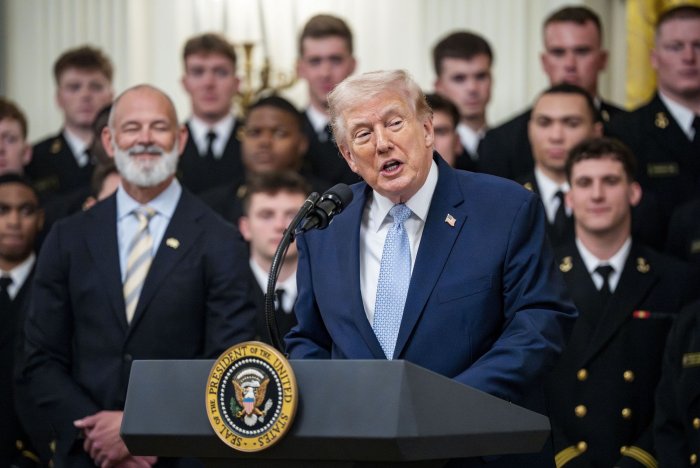
President Donald Trump presents the Commander in Chief’s Trophy to the Navy Midshipmen football team during a ceremony in the East Room of the White House on Friday. The award is presented annually to the winner of the football competition between the Navy, Air Force and Army. Navy has won the trophy back to back years and 13 times over the last 23 years. Photo by Bonnie Cash/UPI | License Photo
The Dodgers’ rotation order is set for the first homestand of the season.
To round out the series against the Arizona Diamondbacks, after Yoshinobu Yamamoto takes the mound Thursday on opening day, he’ll be followed by Emmet Sheehan and Tyler Glasnow. Roki Sasaki is penciled in for Monday against the Cleveland Guardians, followed by Shohei Ohtani on March 31.
Off days on Sunday and April 2 make it possible for the Dodgers to give all their pitchers at least five days’ rest between their first and second starts without needing a sixth starter.
Left-hander Justin Wrobleski is pegged to be that additional starter when the schedule features less frequent days off. In the meantime, he’ll be available to throw multiple innings out of the bullpen.
After starting the season for the Dodgers in Tokyo last year, Yamamoto is looking forward to opening day at Dodger Stadium.
“It’s going to be a different game, and with a different atmosphere,” Yamamoto said through an interpreter. “And then we’re coming off the championship year, then this is the first time I’ll be pitching in front of the Dodgers fans [since then].”
Yamamoto, who was on the mound for the final out of the 2025 season, hasn’t pitched at Dodger Stadium since Game 3 of the National League Division Series against the Philadelphia Phillies.
Sheehan claimed a regular spot in the rotation after returning last June from Tommy John surgery rehab. He had a 2.82 earned-run average through 15 appearances last season.
“I was maybe throwing bullpens right now a year ago,” Sheehan said after his last spring start. “So it’s definitely nice. That’s the main thing, to have my health. Grateful for that every time.”
Sheehan wrapped up Cactus League play with a 5.91 ERA in three starts, but he was encouraged by the progress he made in syncing up his delivery.
Glasnow capped his strong spring with five innings of one-run baseball against the Angels on Sunday.
“When everything’s lined up and feeling good … I think a lot of the other stuff follows,” Glasnow said. “And I was just able to go out and be myself.”
He recorded 11 strikeouts against the Angels, leaning on his curveball as his putaway pitch. It generated a 72% whiff rate, according to Statcast.
“Having my curveball feel so good, I kind of just leaned on it,” Glasnow said. “I’m sure things will change in-season, game to game. But tonight, it was a pretty obvious game plan for me.”
Monty Don has gone under the knife and admits he will need to do it again in 2027 as he opens up about his future with Gardeners’ World and retirement plans
Monty Don has been speaking to Saga magazine(Image: PA)
Monty Don has spoken of his “painful” recovery from a knee replacement in October that briefly slowed the Gardeners’ World host. The broadcaster and horticulturist went under the knife shortly after he turned 70 last Summer.
Looking back he says: “I was finding by the end of a day’s filming I could barely walk upstairs and I certainly couldn’t take the dogs for a walk. It was severely limiting what I was doing. I did it so I could keep on working because it was getting to the point where filming was cutting round me limping.
“However you do it, a knee replacement is horribly painful. But three months on I’m gardening again and haven’t walked with a stick for a month. Sarah says I’ve been doing far too much stuff, but it’s fine and going to plan – though it can be inexplicably painful one day and then not at all another. At some point, I’m going to have to do the other one – but only when I can fit it in, probably late 2027.”
**Ensure our latest headlines always appear at the top of your Google Search by making us a Preferred Source. **Click here to activate** or add us as your Preferred Source in your Google search settings.**
As well as planning his next new knee, the good news for his fans is Monty is also in discussions to continue hosting on screen Gardeners’ World until at least 2028.
Although speaking to Saga Magazine, he admits he may be closer to the end of his run than the beginning now, having been on the show since 2003, with a break between 2008 and 2011.
“I hope I’m continuing, but as I come up to the end of every contract, I seriously consider how it fits the rest of my life.” He ponders. “And each time, it’s come down fairly and squarely that I’d like to continue. But there will come a time when either they’ll say, ‘No, thanks’ or I’ll say, ‘It’s time for a change’. But neither of us, as far as I know, has reached that point yet.”
Almost all of his TV filming is done at his Herefordshire home Longmeadow, which the father-of-three shares with his wife Sarah and their two dogs; golden retriever Ned and Yorkshire terrier Patti.
“Longmeadow has a dual personality,’ admits Monty. “The compatibility between a private domestic garden for all the family and one that works for television is at best a fine line and at worst an impossible line to tread. Everything we do is heavily influenced by filming. I’m often working on the programme seven days a week and when we’re filming, it’s a place of work at every level.”
So whilst that level of work maybe ok for now, it seems there will come a time when he wants to do a bit less. Retirement completely is not on the cards though.
“I genuinely don’t know what retirement would look like. I don’t play golf or tennis, and I can’t see myself doing the crossword all day. Whenever I say to Sarah, ‘Well, thank God, I have no addictions’, she rolls her eyes and says, ‘You are completely addicted to work!’.”
Monty is also well known for being a dog lover with his faithful hounds on screen. He has lost three of his dogs in recent years – Nigel then Nellie who died in 2020 and 2023 – then Peggy who died on 24 January but thinks he is ‘good for one more at least’.
He said: “She[Peggy] was 16, very old, so while it was sad, somehow it was the right thing. She was completely deaf, 90% blind, and walking round and round in circles. So we’re down to just two dogs, Ned and Patti, the lowest number for a long time. Although I’m sure it will go up again, as there’s talk of more. I think I’m good for one more dog, at least.
“I’ve always said the deal with dogs is one of you is going to die, and with ageing it’s more likely to be you. But of course, the dog won’t care particularly, I think we completely romanticise that. They’re absolutely callous.”
* The full interview with Monty Don is in April’s Saga Magazine.
Weekly insights and analysis on the latest developments in military technology, strategy, and foreign policy.
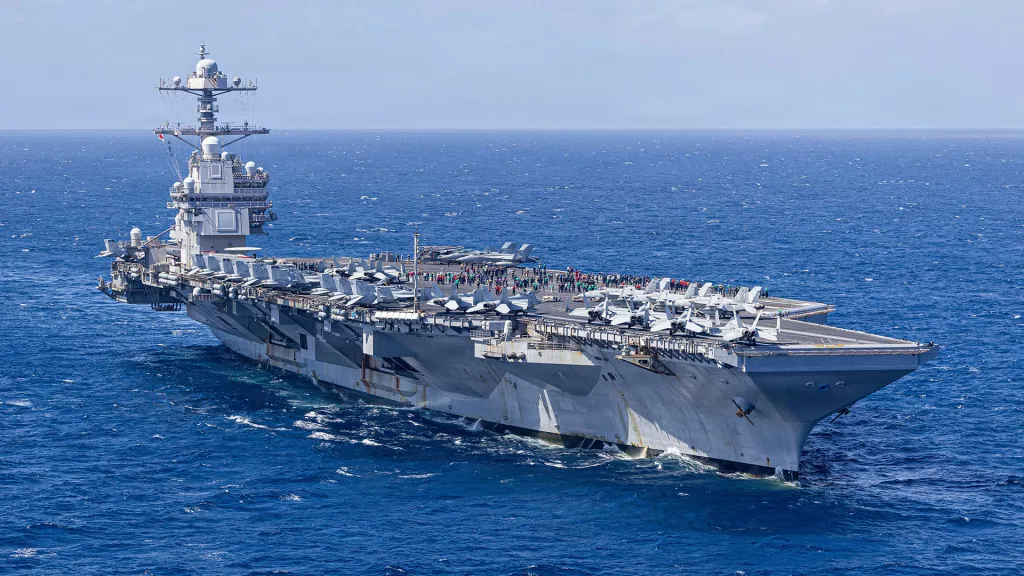
A perfect storm involving three U.S. Navy aircraft carriers highlights the strain on the fleet amid an ongoing war in the Middle East and tensions in Asia. One of the carriers was damaged by a fire, another just saw its service life extended for the second time, while a third had its delivery pushed back until 2027. Though a Navy official told The War Zone there is no connection between the fire and service life extension, taken in concert these events show how difficult it is to build, operate and maintain the huge and expensive nuclear warships, especially when their deployments or service lives are pushed past anticipated timelines.
On March 12, a fire broke out in the laundry area of the USS Gerald R. Ford while underway in the Middle East, injuring two sailors. Though officials initially said the damage was minor, the vessel is now heading to Souda Bay in Crete for repairs, according to USNI, taking it out of war against Iran. On Monday, The New York Times reported that the fire took more than 30 hours to extinguish and left more than 600 sailors “bunking down on floors and tables.”
The aircraft carrier USS Gerald R. Ford was damaged by a fire in its laundry area. (Seaman Apprentice Nathan Sears photo) (Seaman Apprentice Nathan Sears photo)
It is unclear how long the Ford’s repairs will take, but it leaves only one carrier, the USS Abraham Lincoln, on station as the war drags into its 18th day with no immediate end in sight.
The fire was the latest of the Ford’s woes during what has become a 10-month-long deployment that has twice been extended and would set a post-Vietnam War record by mid-April unless it is sent out of theater. The previous record, at 294 days, was set by the USS Abraham Lincoln in 2020. However, a military official told the Times that the Pentagon recognizes that the Ford is reaching the limits of its deployment length. He added that the USS George H.W. Bush is preparing to deploy to the Middle East and will probably relieve the Ford. CENTCOM declined to comment when we asked for additional details.
The Nimitz class aircraft carrier USS George H.W. Bush (CVN 77) transits the Atlantic Ocean, Feb. 15, 2026. (U.S. Navy photo by Mass Communication Specialist 2nd Class Mitchell Mason) Petty Officer 2nd Class Mitchell Mason
As we previously reported, the Ford experienced sewage issues prior to deploying to the Middle East from the Caribbean, the latter of which is where it played a big role in the capture of Venezuelan dictator Nicolas Maduro. Even before that, Adm. Daryl Caudle, the Chief of Naval Operations, was so concerned in January about the condition of the ship and its crew and the scheduled repairs it would miss that he said he would “push back” on any order to extend its deployment.
Typical carrier deployments last about six to eight months, a period designed to ensure the ships can maintain readiness and the crews do not get worn out. When that doesn’t happen, it creates a cascading series of problems that affect not just the ships and crews, but the facilities that have scheduled repairs and lined up workers to make them happen.
The USS Dwight D. Eisenhower, the last carrier to make an extended deployment, has seen its planned maintenance extended for a half year and counting as a result of the additional strain of being away from its home port for so long. The Navy’s Fiscal Year 2026 budget shows that work on the ship was supposed to have been completed last July, but it is still unfinished. The lack of availability reverberates across the rest of the fleet. That in turn limits the options commanders have when planning or preparing for contingencies and puts the overall carrier availability plan out of whack.
The Ford already was going to require an extended refurbishment before the fire, now that could be extended much longer. You can read much more about the problems created by deferred carrier maintenance via extended deployments in our deep dive into the issue here.
Meanwhile, the aircraft USS Nimitz, the Navy’s oldest operational carrier, has seen its service life extended for the second time.
“USS Nimitz‘ (CVN 68) service life has since been extended to March 2027,” the Navy said in a statement. “Accordingly, the U.S. Navy plans to inactivate the ship in 2027.”
On March 13, the Navy signed a $95.7 million contract with Huntington Ingalls Inc. “for advance planning and long-lead-time material procurement to prepare and make ready for the accomplishment of the inactivation and defueling of USS Nimitz (CVN 68). Work will be performed in Newport News, Virginia, and is expected to be completed by March 2027.”
The news of the extension broke after the carrier departed Naval Base Kitsap in Bremerton, Washington on March 7 to head to Naval Station Norfolk in Virginia as part of a scheduled homeport shift prior to decommissioning, according to Breaking Defense, the first to report the change in the Nimitz’s plans. The Nimitz was initially scheduled to be taken out of service in April of 2025, but that was extended to May of 2026.
The Nimitz class aircraft carrier USS Nimitz (CVN 68) transits Puget Sound during the ship’s final departure from Naval Base Kitsap-Bremerton, Washington, March 7, 2026. (U.S. Navy photo by Mass Communication Specialist Seaman Kimberli Ibarra Ruiz) Seaman Kimberli Ibarra Ruiz
It is unclear if the Nimitz will deploy before it will be finally inactivated, but it is no longer assigned an air wing.
However, the decision to keep the ship in service until 2027 coincides with the delivery of the future USS John F. Kennedy, the second Ford class carrier, being pushed back until then.
The Kennedy’s “delivery date shifted from July 2025 to March 2027 (preliminary acceptance TBD) to support completion of Advanced Arresting Gear (AAG) certification and continued Advanced Weapons,” a Navy official told us in December.
Federal law requires the Navy to keep at least 11 carriers in the fleet. We’ve asked the Navy if there is a connection between the Nimitz extension and the Kennedy’s delivery delay and will update this story wtih any pertinent information provided.
The Navy announced that the Kennedy completed Builder’s Sea Trials (BST) at Newport News Shipbuilding (NNS), a division of HII, in Newport News, Virginia, Feb. 4. BSTs provide an opportunity to test ship systems and components at sea for the first time, and make required adjustments prior to additional underway testing.
The future USS John F. Kennedy undergoing Builder’s Sea Trials. (Photo By: Ricky Thompson/HII) ASHLEY COWAN
The current status of the Ford, Nimitz and Kennedy shows the jenga-like nature of trying to meet the needs of commanders while maintaining the condition of ships and crews and adhering to federal law. All of this, of course, is in flux. Given that America is in a new war with an uncertain future, there could be further shockwaves to the Navy’s plans for its carrier fleet.
WORK is set to restart on a disused lido in Cumbria – two years after it was originally set to reopen.
The Grade-II listed lido in Grange-over-Sands has been closed since 1993, but could welcome back locals as soon as this summer.
Sign up for the Travel newsletter
Thank you!
The lido sits on the promenade Grange-over-Sands in CumbriaCredit: The TimesThe pool closed in 1993 and work to reopen it started back in 2023Credit: Alamy
The pool on the promenade in Grange-over-Sands first opened in 1932 and is the only surviving seaside lido in the north of England.
In 1993 the lido closed because of low usage and rising repair costs.
Work then began in 2023 with £6.8million worth of funding to restore the site with an initial opening timeframe of just 14 months.
The opening date was delayed but work continued – during this time there was an upgrade to the pavilion building and an accessible entrance from the promenade was created.
The changing rooms have been upgraded, and work to the roof and terraces has been completed, so have security upgrades, cleaning, and decoration.
A new play area on-site has already been built and work to the diving board has been completed.
However, work was paused in May 2025 after problems with concrete at the site were discovered.
Now, it’s set to restart in April 2026, with Westmorland and Furness Council saying it hopes the site will be open at the end of this summer.
In its initial opening, it won’t be used as a lido.
There is a temporary infill of the pool and the site will be used as a public space before phase two of the restoration begins.
Plans include a new pavilion and an accessible entrance from the promenadeCredit: West Morland and Furness Council
On the Save Grange Lido website, it explains: “There’s to be a 25m 6 lane pool with a depth of 1.35m which can be used for County Level competition and training, a smaller, shallower 13m pool (0.9m deep) and a paddling pool or splash pad.”
Locals have been vocal in wanting the outdoor lido to reopen for swimming.
In 2011, the lido was granted Grade-II listed status and in the same year, the Save Grange Lido group was formed.
18,000 people signed a petition calling on the council to include the reopening of the pool in any plans to restore the lido site.
A SEAFRONT attraction has taken a major step closer to being restored to its former glory.
The seaside town of Worthing is looking to save its lido – but it could come at a cost of £4.5million.
Sign up for the Travel newsletter
Thank you!
The former lido sits on the beachfront at Worthing in West SussexCredit: AlamyThe lido was popular when it opened in 1957 up until its closure in the 1980sCredit: Alamy
Worthing Lido sits right on the front of the town’s beach minutes from its popular art deco pier.
It was once a popular seawater swimming pool between 1957 and 1988.
And it might be making a comeback as the local council has said it will commit £1.29million towards the first step of its redevelopment.
Councillor Sophie Cox, leader of the council, said: “The community has made it clear how much the lido means to them and that they want us to invest in it for the decades to come.
“Using more than £1m from the Community Infrastructure Levy shows our commitment to turning plans into action, but we know that more is needed to cover even the least expensive substructure solution.”
The funding marks the first time ever that a cash sum has been set aside for the former lido.
While the £1.29million will cover initial works, there are predictions that the work will cost at least £4.5 million.
The lido on Worthing Beach was originally built as a bandstand in 1925 and was used as a performing space for 30 years.
In 1957, the space was converted into an unheated swimmingpool.
It was a popular spot for swimmers up through into the 1980s.
In 1988, Worthing Lido was even used as a temporary home to dolphins from Brighton Sealife Centre.
The dolphins were relocated to the lido while their permanent enclosure at the Sealife Centre was undergoing renovations.
In 1989 the pool was covered over and the site transformed into an entertainment centre.
It’s now home to a cafe, arcade, and is occasionally used as an event space.
A MEDITERRANEAN destination nicknamed ‘the land of jasmine’ will soon have an even bigger airport with space for millions more passengers.
Plans have been revealed to expand and modernise Tunis-Carthage International Airport in Tunisia, Africa as it aims to quadruple its passenger numbers in just five years.
Sign up for the Travel newsletter
Thank you!
Tunis-Carthage International Airport will undergo a £743million upgradeCredit: Alamy
The airport – which is the 10th busiest in Africa – will undergo a major £743million makeover over the next five years.
The country’s Transport Ministry shared that the plans will include building a new passenger terminal as well as the existing terminal being renovated.
Between the two terminals, the Transport Ministry aims to increase passenger numbers from five million people per year to 18.5million passengers by 2031.
There will also be a new technical building and the air traffic control tower will be upgraded.
Some reports suggest that the broader project will involve adding VIP lounges as well.
In addition, the Transport Ministry hopes that it will improve connectivity placing Tunisia as a gateway to the Mediterranean with links to Africa, Europe and emerging destinations.
The upgrade could also pave the way for new airline partnerships and flight routes.
News of the makeover follows original plans for building a new airport being put on hold.
Known as ‘the land of jasmine’ for its use of jasmine flowers in festivals, cultural traditions and perfumes, Tunisia takes about three hours to fly to from the UK.
The Sun’s Deputy Digital TV Editor Jill Robinson recently visited the city and said: “Winding my way through narrow streets, the smell of jasmine and mint tea fills the air as I pass craftsmen, locals doing their shopping and an abundance of cats.
“It would have been easy to think I was in the souks of Marrakech, but I’m in Tunis, the capital of Tunisia.
“While its Medina is not as chaotic as its Moroccan counterpart, the historic streets bustle with locals selling their wares as tourists like me squeeze through.
Tunisia is around three hours from the UK with flights in April costing as little as £30 one-wayCredit: Getty
“From traditional clothing to jewellery, perfume to sweet treats, there’s any amount of treasures to be found just as long as you’re prepared to haggle.
“The Medina was built around the big mosque — nicknamed the Olive Tree Mosque due to the trees there in the 8th century — but it is also home to 100 smaller mosques.
“While Tunisia is an Islamic country, its history and influences are vast — including Arab, Andalucian, Turkish and Berber — and are visible to see as you take in the colourful arched doorways, former palaces and humble homes.
“On a day trip from my hotel, I learned about the rich culture of Tunis and the ancient ruins of Carthage, whose most famous son Hannibal (of elephants fame) became one of history’s most celebrated generals and took on the might of the Roman Empire in the Second Punic War.”
If you fancy a beach day, head to La Marsa where you will find a number of calm beaches, with cosy cafes and crystal clear waters.
Nearby, you can also head to the blue-and-white village of Sidi Bou Said, which sits on a clifftop and is often compared to Santorini in Greece.
Near the capital Tunis, you can head to the blue-and-white village of Sidi Bou SaidCredit: Alamy
There’s Djerba Island as well, which is loved for its sandy beaches and vibrant nightlife.
The temperature can reach up to 20C in March and 22C in April, making it the ideal destination to grab a bit of warmth while the UK remains around 10C.
Nouvelair Tunisie offers direct flights from London Gatwick to Tunis-Carthage Airport and Tunisair offers direct flights from both London Heathrow and Gatwick Airports.