pitch

U.S. soccer delivers big unifying win to open 2026 World Cup

The U.S. men’s soccer team chose an incredible day to have an incredible day.

Crucially, the United States aced its only chance to make a first impression, kicking off this colossal World Cup it’s co-hosting with Mexico and Canada with a 4-1 victory over Paraguay.

Consider it a save for the tournament, three points for soccer in America and maybe even a win for uniting the States.

The Americans on the pitch did all that, including making sure a sellout crowd of 70,492 fans got their money’s worth for their exorbitantly high-priced seats to watch football under Friday Night Lights at SoFi Stadium.

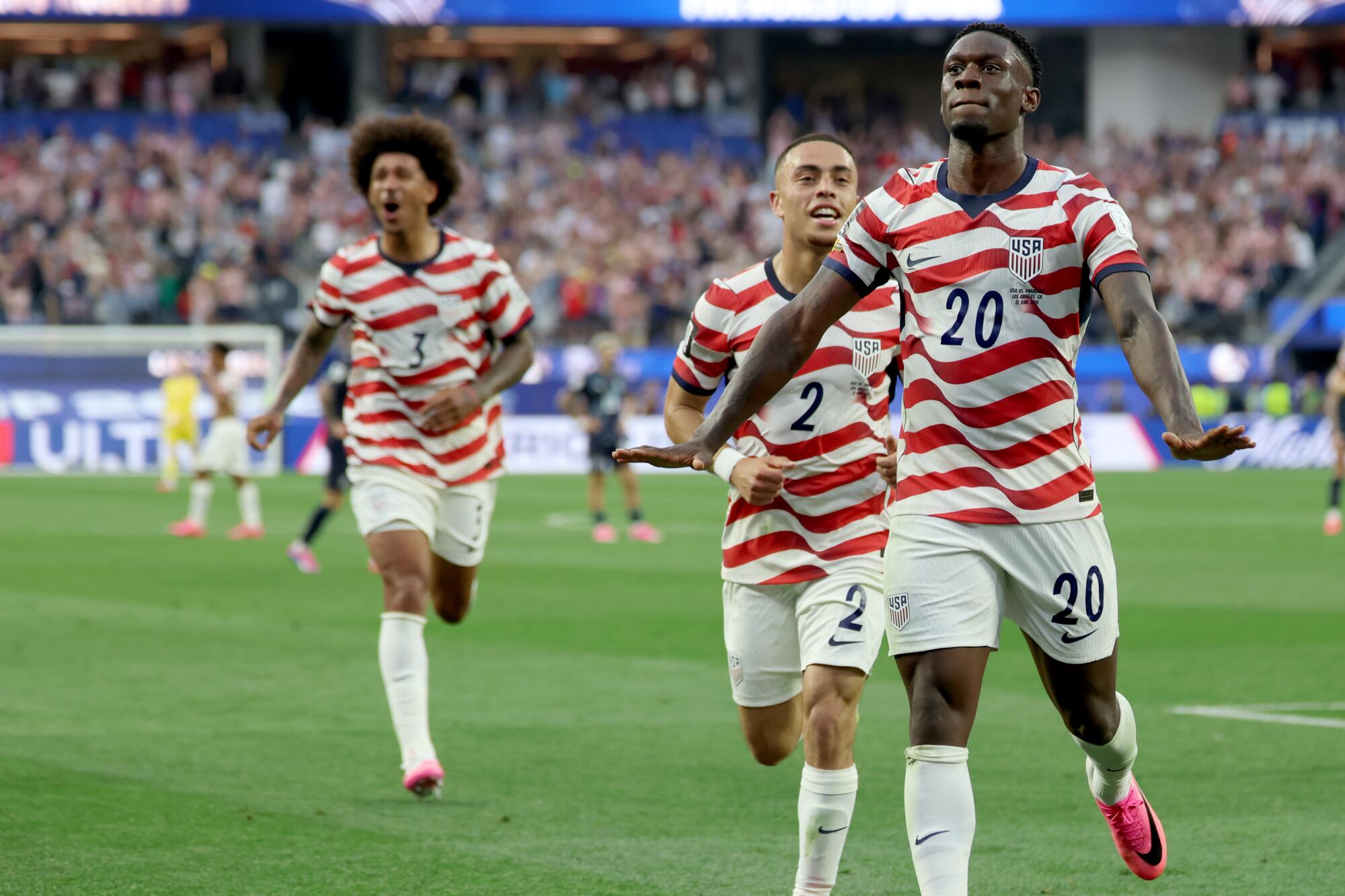
U.S. forward Folarin Balogun celebrates with Sergino Dest and Chris Richards after scoring during a World Cup win.

U.S. forward Folarin Balogun, right, celebrates with Sergino Dest and Chris Richards after scoring during a World Cup win over Paraguay on Friday at SoFi Stadium.

(Robert Gauthier/Los Angeles Times)

It was not a clean sheet. And it wasn’t an elixir for all the issues — visas, tickets, transportation — that ailed the tournament in its buildup.

But the opening statement by the United States confirmed what we thought might be true. Only one thing could save this soccer tournament: soccer.

The U.S. delivered a performance to change the conversation — for the next few weeks and maybe longer.

Making history to alter history.

The United States scored multiple goals in a World Cup first half for the first time since 2002.

It got two of them from Folarin Balogun, the Brooklyn-born, England-raised forward of Nigerian descent who became just the second USMNT player to score two goals in a World Cup game and the first since 1930.

Got a perfect match from Chris Richards, the afro-rocking defender with the long, loping strides, who was 83 for 83 on his passes. That’s better than any player at a World Cup since 1966.

And if possession is nine-tenths of the law of attraction, know that the Americans possessed the ball 71% of the first half, most in the first half of a World Cup game in the modern era.

Landon Donovan, star of the 2002 team that reached the World Cup quarterfinals — a record that still stands — posted on X: “From start to finish, that was the most enjoyable day of soccer I’ve ever experienced.”

That’s the stuff that will get the American people going. Get us invested, get us behind them. That could convert even devout casuals.

Americans love a good underdog story. We also want the best, the finest, the biggest — and this, with its expanded field of 48, is the biggest version of the biggest and best tournament in the world.

And the only thing we love more than winning is dominating. The United States did that Friday against a Paraguayan team that had allowed only 10 goals in 18 World Cup qualifying matches, and whom the United States beat 2-1 in a tense match in November.

Fans cheer during the U.S. win over Paraguay in their World Cup opener Saturday at SoFi Stadium.

Fans cheer during the U.S. win over Paraguay in their World Cup opener Saturday at SoFi Stadium.

(Robert Gauthier/Los Angeles Times)

That was Mauricio Pochettino and his players helping us help them.

“The fans, amazing,” said Pochettino, the team’s accomplished Argentine coach. “On behalf of the whole team, a massive thank you to the fans. Because the energy that they [gave] to the team was amazing. We can do amazing things if the fans are in this as well.”

Friday was so good for soccer in America.

And so good for America. The kind of butt-kicking that’s chicken soup for a nation’s soul.

Maybe it’s idealistic and naive, or apple-pie-in-the-sky wishful thinking, but I believe that they can win. (And by win, I mean make the quarterfinals again.)

There’s no removing politics from this World Cup, but wouldn’t it be fun to all rally behind a team together? Can’t you see the country coalescing behind the right wingers and left wingers on the pitch? Picture people celebrating the freedom inherent in Pochettino’s system? Cheering the all-for-one and one-for-all of this team of dual nationals and Americans raised abroad — or in Alabama?

Postmatch, Pochettino refused to single out any one player, instead giving reporters a recitation of his roster: “[Christian Pulisic] was amazing [setting up two goals]. Balogun was amazing, of course. Tim Ream was amazing, of course. Chris Richards was amazing, yes. Weston McKennie, he was amazing, amazing. Antonee Robinson, Alex Freeman, amazing. Sergiño Dest, amazing …”

Like they put it on the @USMNT Instagram account: “Together as Won.”

U.S. soccer, amazing.


Source link

USC’s College World Series hopes shattered in loss to North Carolina

USC’s 2026 baseball season will be defined by two words — progress and pain.

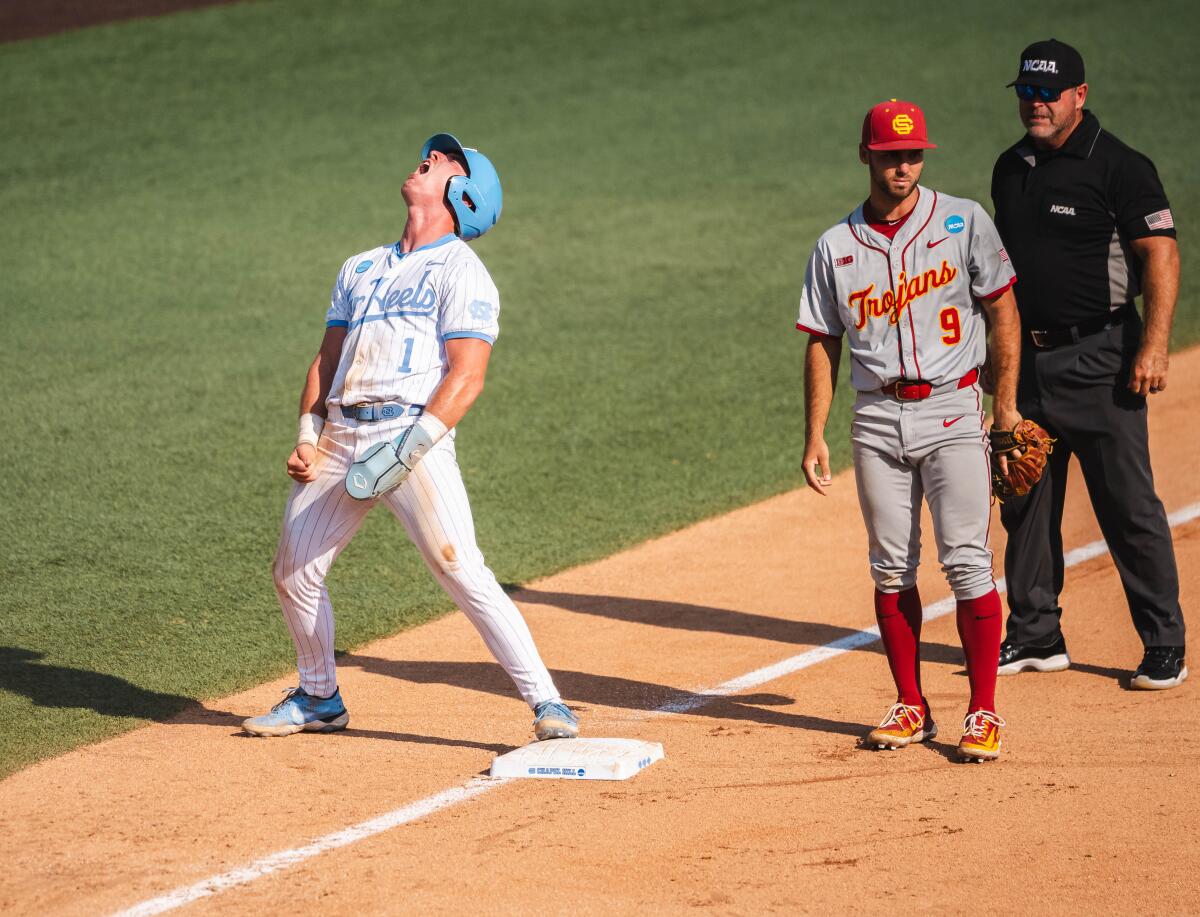
Just two outs away from reaching the College World Series for the first time since 2001, USC suffered a devastating 4-3 loss in game three of the Chapel Hill Super Regional, as North Carolina rallied for two runs in the bottom of the ninth and snatched the trip to Omaha away from the Trojans on Owen Hull’s walk-off RBI double into the left-center gap.

“I’m proud of our boys,” USC coach Andy Stankiewicz said. “I’m disappointed in the results, but I’m never disappointed in our guys. They did something pretty special this year.”

Andrew Johnson did everything possible and then some to get USC (48-18) across the finish line. After already throwing 3 ⅔ innings of shutout baseball to close Game 1, Johnson went a season-high 7 ⅔ innings with two earned runs surrendered to get the Trojans to the doorstep of victory. He glided through North Carolina’s lineup for most of the day, at one point retiring 15 out of 17 batters.

North Carolina's Maddox Riske celebrates during his team's ninth-inning rally to beat USC in their super regional finale

North Carolina’s Cooper Nicholson celebrates during his team’s ninth-inning rally to beat USC in their super regional finale Sunday in Chapel Hill, N.C.

(Laura Wolff/For The Times)

He ended the super regional with 133 pitches thrown in a little over 48 hours, on top of the 145 pitches he threw across two appearances in the College Station Regional for a total of 278 tosses in 22 ⅓ innings with five earned runs given up in a heroic postseason stretch.

“The goal from the beginning of the season is Omaha,” Johnson said. “We’re definitely not just happy that we made it to supers and moved past the regional, but for it was a great season and we can be proud of what we accomplished.”

A first inning run off a Caden Glauber balk, plus Kevin Takeuchi and Andrew Lamb’s solo home runs accounted for all the offense on a day when the Tar Heels (50-12-1) had their own star pitcher going. Atlantic Coast Conference freshman of the year Caden Glauber held the Trojans at bay for most of the game, striking out a career high 11 batters in 7 ⅓ innings.

USC coach Andy Stankiewicz talks to his players after their season-ending loss to North Carolina.

USC coach Andy Stankiewicz talks to his players after their season-ending loss to North Carolina.

(Laura Wolff / For The Times)

Glauber’s work was enough to hold his team in the game, but USC still had a 3-2 lead heading to the fateful bottom of the ninth. After closer Adam Troy retired the first batter, a long, loud foul ball seemed to spark North Carolina.

Third baseman Cooper Nicholson crushed a ball more than far enough for a home run, but just foul into the left field corner. But the near-miss seemed to rattle Troy, who walked Nicholson after getting ahead 0-2 in the count and fell behind 3-0 to nine-hole hitter Carter French.

Stankiewicz made a pitching change mid at-bat, going to Chase Herrell. French lined a 3-2 single through the right side, leadoff hitter Jake Schaffner tied the score on a sacrifice fly and Gavin Gallaher drew a walk, bringing Hull to the plate with the series’ winning run at second.

USC appeared to survive at least with extra innings when a Hull foul ball looked ticketed for the third out, but it dropped with three fielders in the area to give him an extra life. Hull pounded his fourth double of the game, prompting mass hysteria from the 3,913 Tar Heel fans and ultimate heartbreak in the other dugout.

Stankiewicz has built his program in stages, finally making the NCAA tournament last year and then going a step further this year.

But he also knows these opportunities are never guaranteed, and it will take a lot of work to return to the super regional stage.

“It’s a step,” he said. “Things take a moment. Sometimes we want things to happen overnight as humans I guess, but sometimes it takes a moment. We’ve been at this thing for awhile now, and we feel like we’re certainly building it and folks are taking notice. Now we just can’t go backwards. This thing’s got to continue moving forward.”

A positive season, but a nightmare ending sure to haunt the Trojans until they finally return to Omaha.

Source link

England v New Zealand 1st Test: Analysis on ‘poor’ Lord’s pitch – Michael Vaughan and Phil Tufnell

Speaking to Alison Mitchell, former England player Phil Tufnell says the Lord’s pitch was “not a good look'” for Test cricket as he, alongside former England captain Michael Vaughan, criticise the surface used for the first Test between England and New Zealand.

READ MORE: England begin Ashes rebuild with win over NZ

Available to UK users only.

Source link

North Carolina’s Jason DeCaro shuts out USC baseball in Game 2

Grant Govel was good, but Jason DeCaro was almost perfect.

USC baseball lost 4-0 in Game 2 of the NCAA Chapel Hill Super Regional, meaning its season and quest to break a 25-year College World Series drought will come down to a single game on Sunday.

North Carolina (49-12-1) turned to DeCaro with its season on the line, the seventh career NCAA tournament start for the veteran right-hander. DeCaro delivered a complete-game masterpiece, allowing just two hits — singles in the first and fifth innings — with eight strikeouts and one walk on a career-high 117 pitches.

Outside of giving up a solo home run to Colin Hynek in the second inning, Govel had a strong performance. After throwing 153 pitches across two appearances in the NCAA regionals, including 64 pitches in Monday’s clinching win over Texas A&M, he gave up just five hits and struck out three over five innings and 83 pitches to keep the Trojans in the game. His final pitch was a crucial one, inducing an inning-ending double play with runners on the corners to hold the game at 1-0.

But for all of his great work, the day was all about DeCaro’s dominance.

North Carolina found success against the Trojans’ bullpen in the sixth. Erik Paulsen hit a 339-foot home run over the left-field corner wall to double the Tar Heels’ lead, just the second home run given up by USC’s Sax Matson all season. The Tar Heels added two more on sacrifice flies in the sixth and seventh innings, but failed to drive in more with the bases loaded in the seventh and ninth innings.

Game 3 will be Sunday, with time and broadcast information still to be determined.

Source link

Freddie Freeman hits walk-off homer in Dodgers’ victory over Angels

Freddie Freeman battled in the batter’s box.

No stranger to coming through in a big moment, the Dodgers star was hoping to see a fastball up in the zone from Angels reliever Kirby Yates.

So Freeman stayed patient, working his way into a full count.

Then Yates gave him what he wanted — and Freeman delivered the 20th walk-off hit of his career.

The Dodger Stadium crowd erupted in celebration as Freeman watched the ball soar over the right-center field wall in the ninth inning of a 1-0 victory over the Angels.

Freddie Freeman hits a walk-off home run for the Dodgers in a 1-0 win over the Angels at Dodger Stadium on Friday night.

Freeman grinned as he rounded the bases. He threw a thumbs up at his teammates before they swarmed him in celebration. He finally had given the Dodgers something to cheer for after being held to just two hits over 25 at-bats.

“I’ve been feeling good lately,” Freeman said. “I was tweaking things early on, just trying to find a consistent feel for things. Sometimes it’s just get a couple of hits, get confidence and get going. Nothing really crazy. It’s the same routine, hitting some soft line drives at the shortstop, and things have been working.”

Through most of the game, the excitement was contained to a pitcher’s duel — a chess game of defensive plays, waiting to see who flinched first.

Dodgers pitcher Roki Sasaki was red hot in what would tie for his longest outing of the season. Sasaki, for the first time this season, threw triple digits in back-to-back appearances, topping 100.6 mph. The Japanese pitcher threw all three of his pitches harder than his yearly average.

Freddie Freeman watches his walk-off home run clear the wall in center field.

Freddie Freeman watches his walk-off home run clear the wall in right-center field to cap a 1-0 win over the Angels at Dodger Stadium on Friday night.

(Ronaldo Bolanos / Los Angeles Times)

“I’ve been experiencing a lot of good and bad since 2024,” Sasaki said through interpreter Kensuke Okubo. “But I feel like I’m able to maintain this velocity. I think I’m confident about that, but I’m just keeping working on it to make sure I’m in a better place.”

With the speed uptick, Sasaki has also seen an inverse downtick in the earned runs column on his statline. His monthly ERA reached its zenith at 7.23 in his April starts, descending to its current 4.03 ERA.

In Sasaki’s best starts, the elevated velocity and pitch mix makes the right-hander lethal, giving him extended runway to pitch further into the game. Against the Angels (24-40), the elevated velocity allowed him to throw 4⅓ hitless innings in his career-high 11th appearance of the season. He pitched seven innings, giving up two hits and two walks while striking out 10.

It’s a return to how Sasaki looked when he played in Japan, manager Dave Roberts said. Confidence might be the clearest sign things are clicking. Sasaki thumped his chest after striking out Adam Fraizer in the fifth inning, a rare show of emotion.

“I certainly think we can all agree that the floor for Roki is much higher, and the expectation every time he takes the ball is high, and he’s earned that,” Roberts said. “If you look at the last six or seven stats, it’s been as good as any starter in the big leagues in the consistency of performance. So really proud of him and I know that he wants more, and the floor has just been raised.”

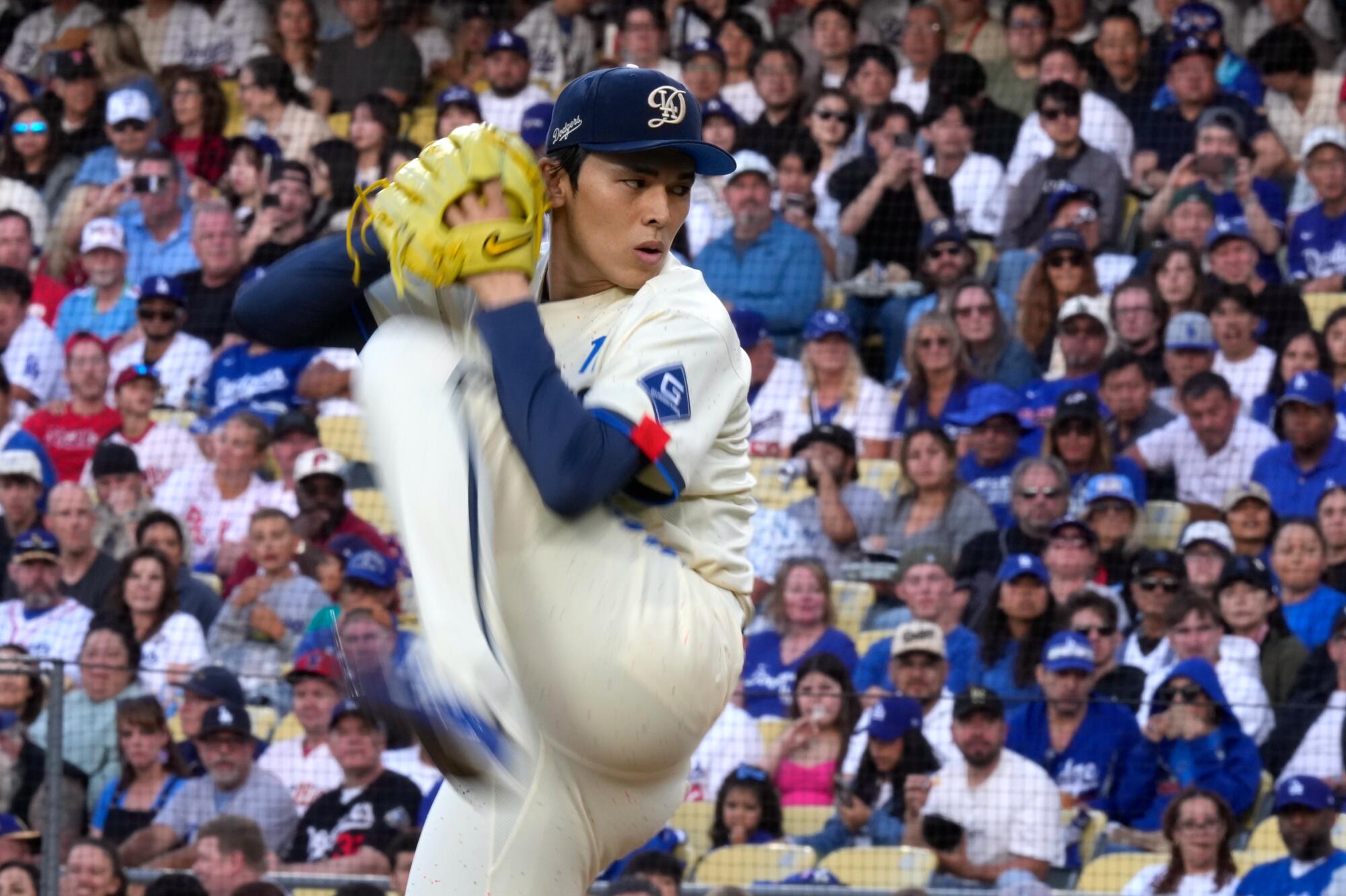
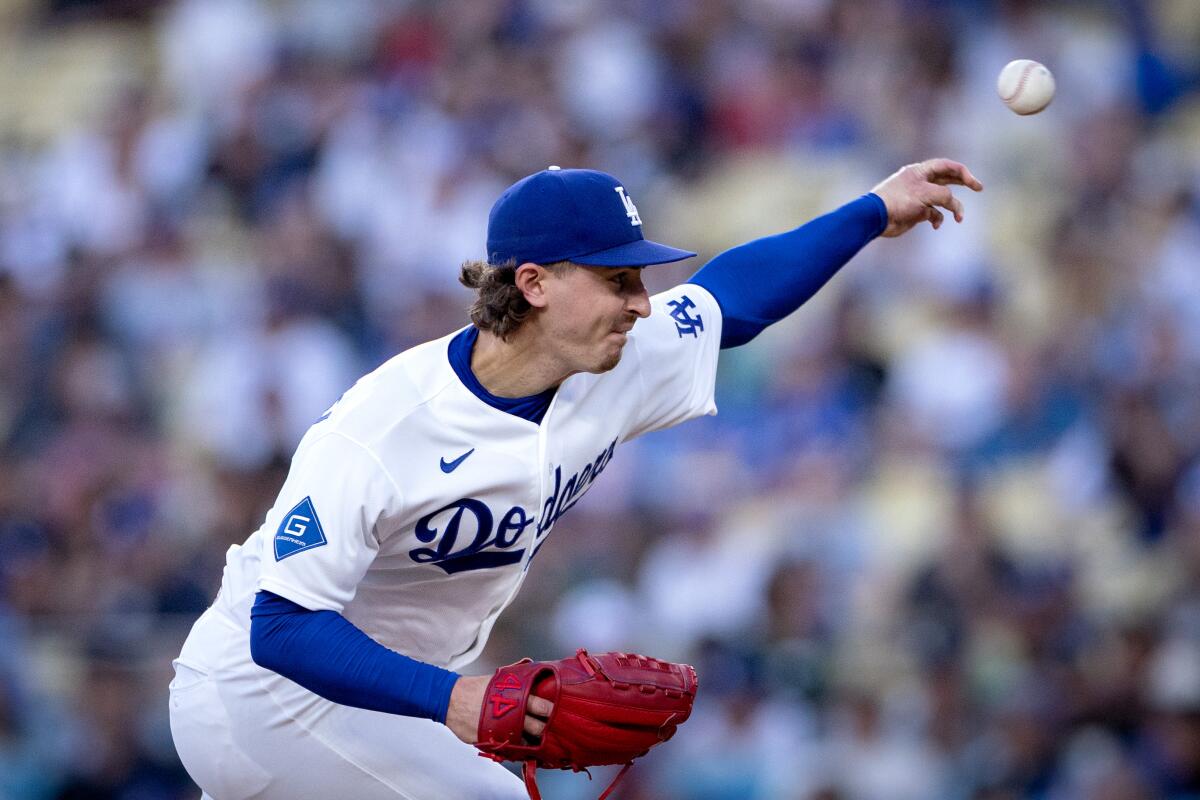
Dodgers pitcher Roki Sasaki delivers in the first inning of a 1-0 win over the Angels at Dodger Stadium on Friday night.

Dodgers pitcher Roki Sasaki delivers in the first inning of a 1-0 win over the Angels at Dodger Stadium on Friday night.

(Ronaldo Bolanos / Los Angeles Times)

Some quick thinking from second baseman Miguel Rojas also helped preserve Sasaki’s strong start. On Nick Madrigal’s sharp line drive in the third inning, the pitcher reached for the ball and popped it up with the tip of his glove. The ball ricocheted off its intended course, but Rojas nabbed it with his bare hand, throwing it to first where a lunging Freeman caught it. The play was initially ruled as an infield single, but it was overturned on review.

“When it hits off a pitcher — you’re already going, committed to one way, then you gotta make another,” Freeman laughed. “The old guy’s still got it.”

Madrigal would break the Angels’ hitless run in the fifth with a double off the left-field wall. But, he was left stranded when Sasaki induced a groundout before his strikeout of Frazier.

The Dodgers (41-23) didn’t fare much better against Angels starter Reid Detmers. In the fourth, Freeman singled and moved to third on a forceout on Kyle Tucker. But, with two outs on the board, Will Smith struck out.

Andy Pages squandered a potential scoring opportunity when he was caught stealing in the sixth. The center fielder, who went one for four, has struggled at the plate in recent games. Against Arizona this week, Pages batted .176, collecting only three hits.

As the innings dragged, both the Dodgers and the Angels failed to find momentum. Reliever Chase Silseth took over in the seventh for Detmers, who gave up just two hits, walked two and struck out six. Silseth silenced the opposing batters, issuing only a walk to Smith.

Edgardo Henriquez took over in the eighth, striking out the first two batters he faced. Then, he hit Zach Neto with a pitch, and after Neto stole second, the Dodgers found themselves in a precarious position with Mike Trout at the plate. Not for long, though, as Henriquez struck out Trout.

Roberts, who had watched Rojas and Santiago Espinal go a combined 0 for 4, pinch-hit for both in the eighth. To a roaring applause, Max Muncy entered the batter’s box, his first plate appearance since a scary collision with the Arizona Diamondbacks’ Ildemaro Vargas on Thursday. Muncy, though, went down swinging.

Tanner Scott took the mound in the ninth a day after he gave up a walk-off home run to Arizona’s Ketel Marte. Jo Adell hit a one-out single then moved to second on a sacrifice bunt by Donovan Walton. Roberts then put Blake Treinen into the game, and he got Oswald Peraza to ground out to first.

With Freeman’s sixth career walk-off home run, the Dodgers beat the Angels for the fourth consecutive time this season.

“Freddie just has aura,” Roberts said. “There’s not too many guys in baseball that you’d want in a game-winning situation, and Freddie does it once again.”

Angels second baseman Oswald Peraza walks back to the dugout after grounding out during the ninth inning against the Dodgers.

Angels second baseman Oswald Peraza walks back to the dugout after grounding out during the ninth inning against the Dodgers.

(Ronaldo Bolanos / Los Angeles Times)

Source link

Trump makes pitch to farmers hard-hit by tariffs, high prices in Wisconsin | Donald Trump News

Trump seeks to shore up support among rural voters hard hit by tariffs, economic fallout of war with Iran.

United States President Donald Trump has sought to reassure farmers hard-hit by tariffs and the economic fallout of the US-Israeli war with Iran during a visit to Wisconsin.

The stop in Chippewa Falls on Friday for a farming roundtable comes months before the midterm elections in November. Trump was seeking to bolster support for Republican US Representative Derrick Van Orden, who has been targeted by Democrats hoping to take control of the chamber.

Recommended Stories

list of 3 itemsend of list

Van Orden has closely aligned with Trump and has long espoused the president as the best leader for rural Americans. Democrat challenger Rebecca Cook has proven a strong fundraiser and has led Van Orden in recent polls.

Democrats are considered favourites to take control of the US House of Representatives, currently controlled by Republicans, in the midterms.

“I love the place,” Trump said, referring to Wisconsin, “and hopefully you’re going to be voting Republican, because frankly, Republican is – I call it the sane way to go.”

Success for Democrats would allow the party to seriously restrict Trump’s agenda in the final two years of his term.

The Wisconsin visit was also more broadly aimed at shoring up support among farmers, who had largely backed the president in his 2024 election bid.

Farmers have been particularly hard-hit by Trump’s aggressive tariff policies, with many countries limiting imports of US products, notably soybeans, in response. The tariffs have also made importing items needed for daily operations more expensive.

The administration has sought to offset the fallout with temporary aid packages for farmers.

At the same time, fertiliser costs have surged since the US and Israel launched the war with Iran on February 28, with the effective closure of the Strait of Hormuz increasing prices of several key components, including urea.

An April survey by the American Farm Bureau Federation found that 70 percent of farmers in the US reported they cannot afford all of their fertiliser needs.

The average gas price of $4.04 per ⁠gallon of petrol this week was also $1.08 higher than a year ago, according to the American Automobile Association.

Trump assured those gathered that the administration had “largely finished” the war “one way or the other”.

He vowed fertiliser and gas prices would come “way down”.

The visit comes as several polls have shown Trump’s overall approval rating hovering at all-time lows, about or under 40 percent.

His approval was lower on specific issues, with a Marquette Law School poll conducted from May 20-26 finding just 19 percent of respondents approved of Trump’s handling of gas prices. Only 22 percent approved of his handling of inflation and cost of living.

Several top Republicans have also warned that several of Trump’s recent actions could risk alienating voters concerned about the economy.

That included a $1.8bn “anti-weaponisation fund” launched by the Department of Justice to repay individuals, including Trump supporters, who allege they were victims of political prosecutions.

The Department of Justice has since abandoned the plan.

Trump has also requested $1bn in funding for security for his controversial White House ballroom, despite earlier saying that taxpayers would not have to foot the bill.

Source link

Tanner Scott struggles and Phillies make him pay in Dodgers’ loss

Philadelphia’s Edmundo Sosa sauntered out of the box, motioning with one hand in a pump-wave in front of 51,794 Dodgers fans. The left fielder, who had taken over for Brandon Marsh in the top of the sixth, connected on a four-seam fastball that Dodgers reliever Tanner Scott left too far over the plate for a two-run home run that put the Phillies ahead.

The Dodgers had been playing with fire all night, but they couldn’t regain momentum after Scott’s struggles, losing to the Phillies 4-3 to set up a Sunday series rubber match.

The Dodgers (37-21) started strong, with pitcher Roki Sasaki giving up just three hits and one earned run over 5⅓ innings.

Sasaki’s elevated velocity posed early concerns for the Dodgers as he struggled more with his command. The right-hander crossed the 100-mph threshold for the first time this season on two pitches: a 100.4mph four-seam to J.T. Realmuto and another fastball, this time 100.1mph, to Kyle Schwarber.

Three of his four pitches — the four-seam, slider and splitter — averaged at least 1.2 mph faster than his yearly average. As a result, he struggled with location. Neither his slider and splitter hit the zone more than 45% of the time. Even his fastball hit the strike zone a mere 55%.

Dodgers manager Dave Roberts warned about this scenario when Sasaki’s fastball had only reached an upper limit of 99.5 mph.

“I think now the velo is certainly in a good spot,” Roberts said before the game. “I do believe that if he wanted to throw 100 miles an hour, he could do that, but it wouldn’t be where he needed to throw it.”

Dodgers starting pitcher Roki Sasaki delivers during the first inning Saturday against the Phillies.

Dodgers starting pitcher Roki Sasaki delivers during the first inning Saturday against the Phillies.

(Mark J. Terrill / Associated Press)

Still, the Phillies (30-28) struggled to generate consistent momentum despite Sasaki’s location problems. Phillies third baseman Alec Bohm hammered a four-seam fastball that skimmed the top of the strike zone over the center field wall. The rest of the Phillies lineup ended most of their at-bats with little luck, striking out seven times and walking only once.

Roberts pulled Sasaki with runners on first and second in the sixth. Left-hander Alex Vesia walked Bryce Harper but escaped a one-out, bases-loaded jam by striking out Sosa and forcing Alec Bohm into a ground out to third.

By then, the Dodgers had already established a lead. Alex Call put them on the board in the second on a poked single through the gap between second and short. In the fourth, Call reached third on a double and throwing error from Adolis García. Santiago Espinal hit a sacrifice fly to deep center field, driving in Call.

Mookie Betts also found his footing after he went 0 for 3 on Friday. The shortstop struggled in the first four games of the Dodgers’ homestand, batting .200 across 15 plate appearances. Against the Phillies on Saturday night, Betts laced two singles and a double.

Andy Pages scored on a close play at the plate after Betts singled to shallow right field in the seventh. Although catcher J.T. Realmuto missed tagging Pages’ foot, the Dodgers center fielder’s cleat didn’t appear to touch the plate. After a long review, the safe at home call stood.

But the Dodgers’ good fortune didn’t last. Scott gave up an RBI single to Bryce Harper, and it was like the Phillies could sense exactly when the reliever’s pitches crossed over the zone. Scott (1-2) then gave up the home run to Soto before going down in order on three groundouts in the ninth.

Source link

Why ABS didn’t deter Dodgers’ Will Smith from honing his pitch framing

Will Smith crouched, his left knee on the ground and his mitt grazing the dirt as his Team USA teammate Mason Miller strode towards the plate.

From there, the only way for his glove to go was up and through the slider that fell out of the strike zone as the Dominican Republic’s Geraldo Perdomo stopped his swing. But, in a full count, home plate umpire Cory Blaser called it strike three.

Miller threw his hands above his head. Smith pumped his first. And the United States advanced to the World Baseball Classic final.

“That’s the work we do in the cage, and off the machine, and drills, and all that coming to fruition, and being applied to in-game,” Smith said in a recent conversation with The Times.

He has a slim chance of replicating that moment during the season, with the ABS challenge system implemented in MLB. If it had been in play during the WBC — as long as the Dominican Republic had challenges left — Perdomo surely would have used one on the final pitch of that 2-1 game.

And yet, as counterintuitive as it may sound, Smith dedicated time and effort during spring training to improving his framing.

“It’s important because you only get two challenges a game, offensively and defensively,” Smith said. “The whole team only gets those two. So the harder I can make it on the other team to challenge pitches, the better. The more strikes I can get and not have to challenge, the better. I think overall, it almost makes it more important, in a way.”

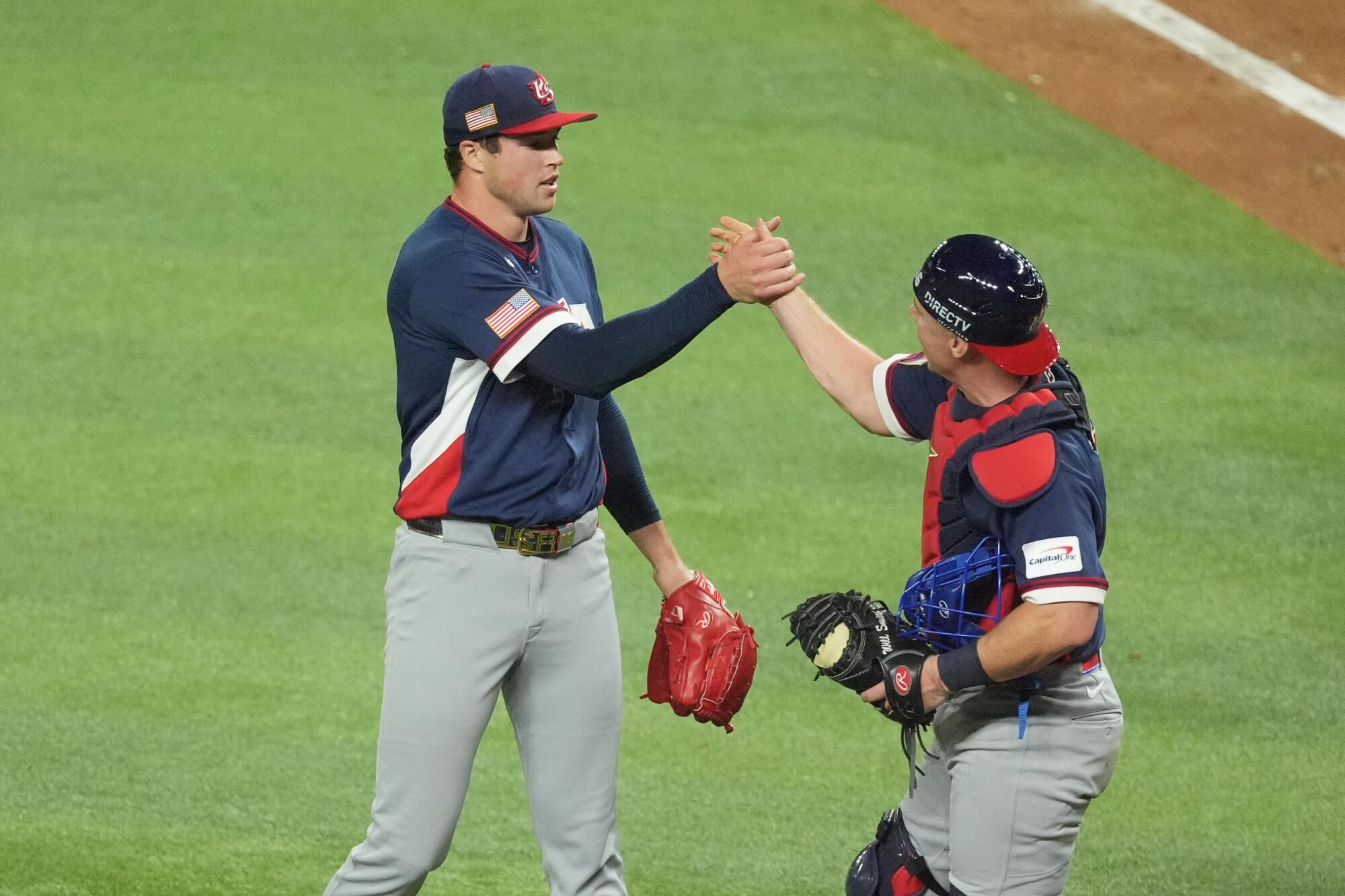
United States pitcher Mason Miller and catcher Will Smith celebrate a WBC semifinal win over the Dominican Republic.

United States pitcher Mason Miller and catcher Will Smith celebrate a WBC semifinal win over the Dominican Republic.

(Rebecca Blackwell / Associated Press)

Framing had been a weakness in Smith’s game in recent seasons, according to Statcast’s catching metrics. His best season was 2023, when he recorded four runs saved via pitch framing. But he slipped to minus-eight and minus-10 the next two seasons. Entering the Dodgers’ series against the Phillies this weekend, he was at an even zero after 43 games at catcher this season, including 39 starts.

And now, when Smith doesn’t get a call, he has ABS to fall back on. Entering Friday, he’s challenged 41 calls through the ABS system from behind the plate, the 10th-most of any catcher. And he had a 71% success rate, the ninth-best mark among catchers with at least 20 challenges.

Because the catcher has the best vantage point, teams across the majors have made their catchers, not their pitchers, the point men for ABS challenges on defense.

ABS as a skill, however, isn’t just about getting the challenges right. Knowing the right times to take a risk is also key.

“There’s so many games within the game,” Smith said, “and that’s just another one of them.”

As Smith alluded to, under the challenge system — as opposed to fulltime ABS, which MLB also tested in the minors — it’s still possible to steal strikes.

“I like the challenge system because you still have the human error element to the game,” Smith said. “…Everyone always talks about how it’s a game of life, dealing with failure and dealing with ups and downs — the umpire screwing you or catching a break, that’s part of the game.”

Dodgers catcher Will Smith walks to the dugout after the fifth inning of a Dodgers-Marlins game at Dodger Stadium on April 27

Dodgers catcher Will Smith walks to the dugout after the fifth inning of a Dodgers-Marlins game at Dodger Stadium on April 27.

(Ronaldo Bolanos/Los Angeles Times)

Now, the players have recourse for the egregious calls and the biggest moments of the game.

The margins are so slim, however, that if a hitter isn’t convinced enough on a borderline strike call, and the situation dictates caution, he may not challenge.

The same goes for a catcher on a borderline ball call.

That’s where Smith’s work on framing comes in. He describes it as a change in philosophy.

“For me, it’s more just understanding the move,” Smith said. “I had to drill it in a little bit obviously, but more understanding the move of going farther out to get it, working through the ball, more like towards the pitcher, as opposed to letting the ball kind of come back to you. That was just not how I’d ever done it.”

That’s what he did on that last pitch of the WBC semifinals. Moving through the ball creates a more seamless motion, compared to pulling it into the strike zone, making the frame job more convincing. And catching it out in front also stops the ball’s own movement before it gets too far out of the zone.

That’s how Smith made a pitch that appeared to cross the plate below Perdomo’s knees look like a strike from Blaser’s vantage point.

The effect Smith’s spring training work behind the plate will have on the Dodgers’ season will be subtler. Instead of a singular game-defining moment, it’ll be an edge here and there.

But over the course of a long season, that adds up.

Source link

NBA’s anti-tanking pitch might be great for Lakers but bad for basketball

In the NBA, it’s all: “Together, on three!” Or “family, on three!”

Or maybe, “Cancun, on three!”

But when the NBA braintrust breaks a huddle, it’s, “3-2-1, overreact!”

“3-2-1, obfuscate!”

“3-2-1, complicate!”

The NBA’s owners are expected to meet Thursday to approve new “anti-tanking draft reform” via a “3-2-1 lottery.” I just know they’re the type of people who love a good board game — one with rules that take a half-hour to explain, by which time their guests’ eyes have glazed over.

Think they’ll get the hint if someone asks, “Y’all got any CLUE instead?”

Actually, I’d prefer to turn on the basketball game, that nuanced, ever-evolving sport that’s beautiful for its simplicity: Make or miss.

What’s wild is that a league that brings together the world’s best shooters keeps missing so badly on draft reform — unless it’s actually their feet that they’re aiming at.

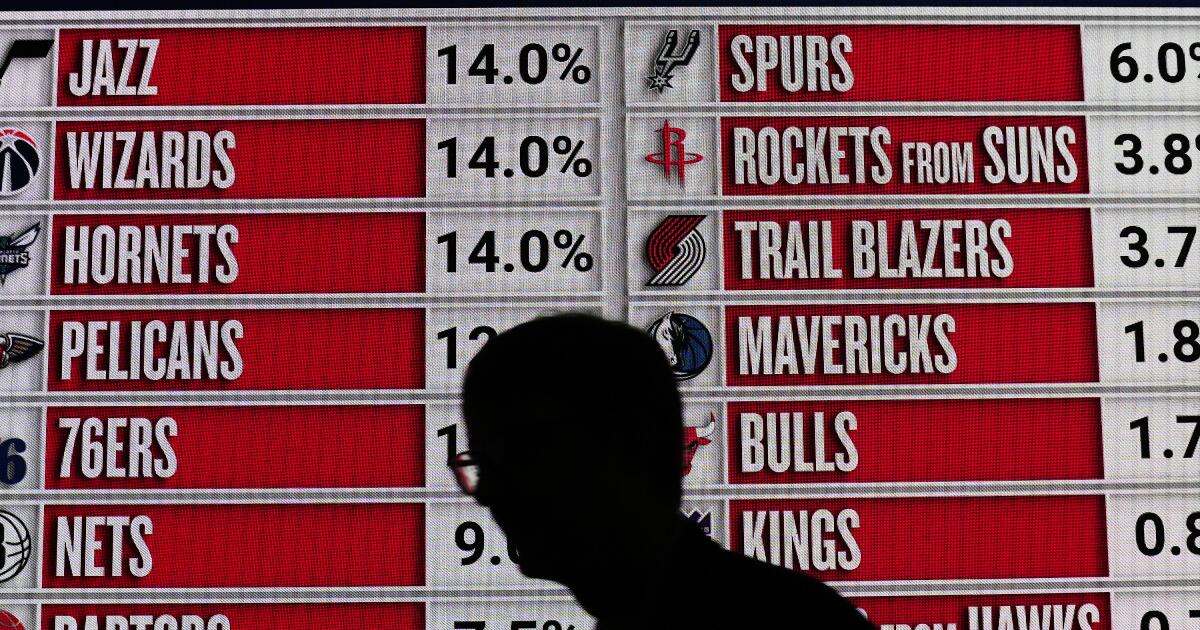
Still, this new reported proposal — which will expand the lottery from 14 teams to 16 and penalize the three worst teams with poorer draft lottery odds than teams with the fourth- through 10th-worst records — might benefit the … Lakers?

You know those first-round picks they’ve been holding onto so that, come draft night, they’ll have three to offer in a deal? To use as bargaining chips for either a big name like the Milwaukee Bucks’ Giannis Antetokounmpo or, better yet, to acquire important foundational pieces to retrofit the roster around Luka Doncic?

Well, those three first-rounders should be much more valuable if other teams are disincentivized to trade their first-rounders, seeing how even middle-of-the-pack teams will have a shot at winning the lottery.

And not only will first-round picks be a rare commodity on the trade market going forward, but the Lakers’ picks could prove more practically valuable than previously imagined.

Without this reform, no one would expect the Luka Lakers to be a lottery team. But under the new proposal, all it would take, say, would be their star missing 30 games and the Lakers sliding into the eighth seed, which would give the team holding that pick a 2.7% shot at the No. 1 overall selection.

And hold on, wait a minute: Will that give Lakers general manager Rob Pelinka and his growing cast of front-office colleagues pause this offseason? Imagine how it would look if they dealt away a pick that turns into one of the top guys in a future draft for a 3-and-D role player on a team that, for whatever reason, slips into eighth? It wouldn’t look good! It wouldn’t feel good.

But would it stop the Lakers from doing what they need to do this offseason? It shouldn’t. But it could! But it shouldn’t! No, really, it shouldn’t: Because after draft night, the Lakers’ next two tradable first-round picks will be in 2031 and 2033 — and, per ESPN, this week’s draft reform proposal will include a sunset provision that would allow it to expire after the 2029 draft.

At that point, if they’re smart, the owners would scrap it. Of course, they’ll probably make it even more onerous so they can feel smart?

No wonder the Lakers went and hired Rohan Ramadas — the guy with an astronautical engineering degree from USC — as an assistant general manager.

But what are we doing here? All this variance and randomness, all these rules on top of regulations, none of it is exactly arbitrary, but neither is it fair. Since the draft lottery odds were flattened in 2019, the team with the worst overall record has not once lucked into the No. 1 overall pick.

The NFL would never! Oh, that plucky little league. With its antiquated worst-picks-first draft system? Seems to be going OK.

The worst thing about what the NBA is up to is how much work they’ve made following along at home. You’ve heard of fan service? This league trades in fan disservice.

The league already ceded its regular season to the offseason, leaning into free agency drama as a driving source of year-round intrigue, letting team-building trump teamwork.

It already asked fans to bone up on contract law to be able to spell out the differences between the NTMLE (non-taxpayer mid-level salary exception) and RMLE (room mid-level salary exception).

Then the NBA introduced rules that incentivized stars to avoid free agency and to try, instead, to get traded — except then the league added a first and second apron to make it harder for teams to trade.

So the possibility of a dream sign-and-trade that has fans fired up? Odds are it won’t happen because it can’t; sign-and-trades are not permitted if the player acquired keeps a team above the first apron.

Perfectly clear? No?

Well, this won’t help: Let’s slather on another thick layer of basketball bureaucracy. To discourage tanking. (And encourage mere mediocrity! Middling is about to be the NBA’s new sweet spot.)

Let us proclaim that, oh, teams can’t land back-to-back No. 1 picks. Unless they can. Unless it’s Team A, by virtue of selecting first using Team B’s pick the previous season, that is eligible to pick first in consecutive seasons. Team B, though, it’s out of luck the next year, no matter what goes wrong.

Got it? Kinda? Sorta? No?

Moving on. Try to keep up.

Don’t forget, class, that some picks won’t be able to be protected. No, not the top few picks — there will be no protections on Nos. 12, 13, 14, or 15.

Yes, that appears actually to be a caveat of the proposed new system. Which, yes, is actually designed to sell Advil.

Fans can figure this stuff out, but at some point soon, they’re not going to feel like it. At some point, everyone’s eyes are going to glaze over and it’s going to be 3-2-1, turn the TV off!

Source link

Mr. Patient: JJ Saffie is ready for Dodger Stadium moment

On the eve of the City Section championship baseball game at Dodger Stadium, let’s explore a sometimes forgotten character trait: Patience.

When JJ Saffie walks onto hallowed ground Saturday as a starting left fielder for 10-time City champion El Camino Real High in the Open Division championship game against Birmingham, he will be finishing a journey few want to travel these days.

He spent three years on the junior varsity team waiting and grinding before getting his chance to start on varsity this season.

“Very patient,” he said. “Freshman year, played frosh-soph, called up for a few JV games. Sophomore year, on and off starter on JVs. Junior year is when it started clicking for me. I found my bat, I found the style I like to play, I started hitting real good.”

He was part of an outstanding JV team his junior year, called up as a pinch runner for the playoffs. He developed power and a knack for hitting balls over El Camino Real’s left-field fence during batting practice.

“I’ve hit two windows and six cars,” said the 18-year-old, who likes to cause mayhem for insurance companies.

El Camino Real celebrates a 4-3 win over Granada Hills to earn a trip to Dodger Stadium on Saturday.

El Camino Real celebrates a 4-3 win over Granada Hills to earn a trip to Dodger Stadium on Saturday.

(Craig Weston)

He’s hit two home runs this season and become a key player for the Royals.

Now he gets to start at Dodger Stadium, a moment every high school baseball player in the City Section dreams of reaching.

“I’m a big believer in good things will come to those who are patient,” he said. “I knew I needed to be patient, work on my game and eventually success would come my way and I’d have my opportunities and here’s my opportunity. I’m trying to prove that Saturday.”

El Camino Real needed a two-run single by RJ De La Rosa in the bottom of the sixth inning on Wednesday to defeat Granada Hills 4-3 in the semifinals at Cal State Northridge.

“I saw my pitch,” De La Rosa said. “I wanted to take advantage. It was the bottom of the sixth. The team needed me most and I pulled through. It was an amazing moment. These boys are my brothers. I will fight for them. I will do everything for them. I can’t wait to make some memories at Dodger Stadium.”

For Saffie, staying and fighting to get better rather than running away from a challenge is a great lesson for others.

“I had a few people tell me to transfer,” he said. “But my sister came here, my dad. I want to prove myself at this school.”

Top-seeded Birmingham will have junior Nathan Soto starting on the mound in the 1 p.m. game. It’s a big assignment and he’ll be working on his mental part of the game.

“It’s just another game,” he said after the Patriots’ 4-1 semifinal win over Carson. “I think it’s everyone’s dream to pitch there, but you have to keep it as a normal game.”

Pitcher Carlos Acuna grinded out a complete game in Birmingham's 4-1 win over Carson to send the Patriots to Dodger Stadium.

Pitcher Carlos Acuna grinded out a complete game in Birmingham’s 4-1 win over Carson to send the Patriots to Dodger Stadium.

(Craig Weston)

Birmingham can thank Carlos Acuna for putting together a sophomore season to remember. His pitching season is done. He finished with an 11-0 record after a complete-game win against Carson.

“It’s an amazing season he’s having,” coach Matt Mowry said.

In six of the seven innings on Wednesday, Carson got the leadoff batter aboard, forcing Acuna to work extra hard while throwing 102 pitches.

“He was on the edge of coming out,” Mowry said.

Acuna wouldn’t let him.

“I love this team,” Acuna said. “I want to play one last game.”

He’ll start on Saturday at second or third base in a game matching two of the most successful programs in City baseball history. El Camino Real is seeking a record 11th title. Birmingham wants its ninth title.

The 10 a.m. game at Dodger Stadium has Verdugo Hills taking on Taft in the Division I final.

Fans will come for the sun, the hot dogs, the fun of cheering on someone they know or enjoying a moment of distraction at Los Angeles’ most sacred stadium.

Just remember those are teenagers out there who’ve sacrificed and spent years working toward this moment. There’s no losers when you get to play at Dodger Stadium as a high school kid.

For Saffie, it validates his belief in trusting the process and trusting himself. He didn’t run when the going got tough. He persevered and learned a valuable lesson: patience still pays off.

Source link

Dodgers offense falls quiet in 1-0 loss to Padres

The Dodgers entered the late innings Monday in an unenviable position: trailing the Padres, whose biggest strength is their bullpen.

“When they have a lead they don’t relinquish it too often,” manager Dave Roberts said after the Dodgers’ 1-0 loss Monday. “You know the numbers — when they’re ahead in the seventh inning they don’t lose. You do have to be a little more aggressive and capitalize when you do get those chances.”

Including Monday, the Padres are 20-2 when leading after six innings, 21-1 when leading after seven, and they have a perfect 22-0 record when leading after eight.

Even when Padres closer Mason Miller got off to an uncharacteristically wild start in the ninth inning Monday, the Dodgers failed to capitalize.

He walked Freddie Freeman and Kyle Tucker on nine pitches. And the next three batters — Will Smith, Max Muncy and Andy Pages — all have proven their ability to do damage in clutch moments.

But it was Miller on the mound, a rare reliever who could actually challenge for the Cy Young Award.

“In this kind of series, you know you’re going to have close games,” Freeman said after the game. “And we just couldn’t get it done.”

Miller got out of the jam with a fly out, strikeout and ground ball, and notched his league-leading 15th save.

Shohei Ohtani dives back to first base in the fourth inning.

Shohei Ohtani dives back to first base in the fourth inning.

(Tony Ding / Ap Photo/tony Ding)

“We still had really good at-bats,” Freeman said. “There’s a silver lining to it. Scoring off Mason is going to be really hard to do. It’s going to take one of those kinds of innings where you can maybe walk a couple of guys and get a bloop. Not much squaring up going on against him.

“But we had an opportunity, maybe with him throwing a lot of pitches might make him be down next game. You just try to have little wins.”

The Dodgers could also avoid him by claiming a lead. On Monday, Dodgers starter Yoshinobu Yamamoto held the Padres to three hits and one run — Miguel Andujar’s first-inning homer.

But the Dodgers’ offense, which scored 31 runs in a three-game series against the Angels, only managed four hits off Padres starting pitcher Michael King, and only one in the first five innings.

“You’re trying to cover realistically 30 inches,” Freeman said. “Because you have ball-to-strike pitches — you’ve got backdoor sliders that are starting as balls coming back, you’ve got front-door sinkers for lefties. So it’s not just the whole plate you’re worried about; you’re going to worry about a whole lot of different things. … He had all of it working tonight.”

The Dodgers finally strung some hits together in the sixth. With two outs and Hyeseong Kim on first, Shohei Ohtani beat out a swinging bunt, and the throw from Padres catcher Rodolfo Duran zipped past first base.

Kim, who took off from first on contact, rounded third hard but slammed on the brakes when third base coach Dino Ebel held up the stop sign.

“It’s kind of the timing of it, where [Fernando] Tatis [Jr.] came up with the ball, and Dino’s got to make the decision,” Roberts said. “You don’t know that he’s not going to come up with it clean. At that point in time, to be quite honest, Dino had the best view of the runner coming in, Kim, and where they were at on the field. So it’s one of those things, I’m definitely not going to second guess it.”

Kim was stranded there.

Then in the eighth, he again made it to third on a single from Ohtani with two outs. And again, he got stuck 90 feet away from tying the score.

Source link

Angels end Athletics’ no-hit bid in ninth, then get a walk-off victory

Adam Frazier singled, leading off the ninth inning for the first hit against Athletics starter J.T. Ginn, and Zach Neto followed with a two-run homer that gave the Angels a 2-1 victory Monday night.

Neto drove a 2-0 sinker 413 feet to center field, stunning Ginn and the A’s while ending a six-game losing streak for the Angels. It was their third walk-off win this season.

Ginn (2-2) struck out 10 and issued one walk on 105 pitches. He also hit Neto with a pitch in the sixth.

The right-hander was perfect through 4 1/3 innings and came within three outs of the first major league no-hitter since Shota Imanaga combined with two Chicago Cubs relievers for a 12-0 win over Pittsburgh on Sept. 4, 2024.

Lawrence Butler had a pinch-hit RBI single in the top of the ninth that drove in Zack Gelof for the first run of the game, but the Angels rallied to win despite getting outhit 7-2.

Walbert Ureña tossed six scoreless innings for the Angels, giving up four hits and striking out four. Ryan Zeferjahn gave up the first run of the game and walked the bases loaded, but Chase Silseth (1-0) worked out of the jam by getting slugger Nick Kurtz to ground into a game-ending double play.

Kurtz’s fifth-inning double extended his on-base streak to 41 games, tying Eddie Joost (1949) for the sixth-longest in A’s history. Kurtz is also tied with Kyle Schwarber last year for the longest in the big leagues across the last four seasons.

Source link

Terror on the Football Pitch: Adamawa Community Recount ISWAP Attack

The referee blew the whistle a few minutes before 5 p.m., on April 26, to kick off the second half of a football game. The players re-emerged on the field, and the spectators once again gathered to witness the second round of the Guyaku Local Championship Football League in the Sabon Gari area of Guyaku, a small community in the Gombi Local Government Area (LGA) of Adamawa State, northeastern Nigeria. 

Just minutes into the match, another sound pierced the air across the football pitch, but it wasn’t the referee’s whistle this time. It was sporadic gunshots that alerted the players and the spectators that something terrible was about to unfold.

The gunshots continued from different directions, their sound drawing closer. As the confused crowd tried to make sense of the situation, some armed men arrived at the football field on motorcycles. They opened fire on the crowd, and in that instant, people scrambled for safety, while others fell dead on the pitch. 

Within minutes, Istifanus Hassan, an eyewitness who narrowly survived the attack, said that everywhere was thrown into chaos as screams and smoke filled the air. 

“We ran into the bushes, but they [terrorists] followed people with their motorcycles and were shooting them in the bush,” he recalled. Although he survived, Istifanus said what he witnessed while hiding in a nearby bush that evening may haunt him forever. 

The terrorists burnt down houses, motorcycles, shops, and a church. They also looted at least three grocery shops and a chemist. “They used motorcycles to pack the items after killing the shop owners. They packed all the items and burnt the shops down,” he said, adding that they made away with medicines as well.

Empty, dusty shop interior with scattered boxes and papers, bare shelves, and a wooden counter in the foreground.
The terrorists looted a chemist and left with all the medicines, leaving behind an empty store. Photo: Hamman Basmani.

“I watched my community members and relatives fall dead to the ground. The men were targeted and shot in the head, and the women were spared,” Istifanus said.

But not every woman survived the attack. Other residents told HumAngle that all the women captured by the terrorists were left unharmed, but two women lost their lives in the incident. Their deaths were attributed to stray bullets. 

One of the deceased was 28-year-old Sintiki Dimas, who went to the football pitch to sell snacks to spectators. As a petty trader, Sintiki relied on selling local snacks like kuli-kuli to support herself and her younger siblings. 

Her mother, Bata Dimas, said Sintiki was killed while trying to flee, adding that her daughter’s trade was a great source of support to her eight younger siblings and the rest of the family. 

The other woman, who also lost her life in the attack, was fleeing with her toddler strapped to her back when a bullet hit and killed her. “The baby was also shot on his leg, but he’s currently receiving treatment,” an eyewitness, who asked not to be named, told HumAngle. 

The attack continued for hours. 

By the following day, the Islamic State West African Province (ISWAP), a Boko Haram breakaway, had claimed responsibility for the assault. The attack, which killed at least 33 residents and injured seven others, happened barely two months after ISWAP attacked a military base in Hong, a nearby local government area. 

Residents say it exposed longstanding security gaps in the border community, triggered fresh displacement, and revived fears of a return to the deadly years of insurgent violence that have devastated the region. 

The first attack in a decade 

It is not the first time terrorists have invaded Guyaku, but it is the first time since 2015, when the Boko Haram insurgency was at its peak in Adamawa. Then, “they burnt almost the entire village to the ground that year, but luckily, we all fled, and no one was harmed,” said Hamman Basmani, the Wakili (community leader) of Guyaku.

By 2016, most residents who had fled the area had returned and resumed their usual activities. 

Guyaku is an agrarian community, and residents – over a thousand of them, according to Hamman – mainly rely on farming for survival. Since the 2015 attack, he said, the residents had lived peacefully until the recent incident.

Map highlighting regions in Borno and Adamawa, Nigeria, including Sambisa and Chibok. Inset map shows location within Nigeria.
Guyaku sits near the border between Borno and Adamawa states. Map illustrated by Mansir Muhammed/HumAngle

While other residents returned to Guyaku after the 2015 incident, Barnabas Benaiah was among those who did not. He relocated to Hong with his nuclear family, while his extended family remained in Guyaku. 

“I’m not currently staying in Guyaku, but I’m always there,” he said, meaning that he visits regularly. He added that he feels attached to his hometown, which is why he stayed in a neighbouring town. 

When ISWAP attacked Guyaku in April, Barnabas lost three family members. Two were his brothers, and the other was his niece. “They [his brothers] all had families and had left behind pregnant wives,” he told HumAngle. 

Barnabas noted that the attack in Guyaku was tactical. 

“They were after men,” he said, echoing testimonies from other residents. “Mostly young men, so they targeted spots where these men could be found, such as the football pitch, local joints, and front yards. They shot the men in the head, and when they encountered women, they told them to walk away because they had nothing to do with them. The women who died were hit by flying bullets.” 

A recent academic study on gendercide in the Lake Chad insurgency found that such patterns have appeared in previous ISWAP and Boko Haram attacks, where adult men are often perceived as potential fighters, vigilantes, informants, or collaborators with the state.

Residents say the terrorists pursued residents who ran towards neighbouring communities and killed them, while also looting valuables, such as motorcycles. “They went to a commercial charging store and packed all the phones from there. They were still looting shops when soldiers from Garkida town arrived, so they abandoned some of the items and ran,” Barnabas said. 

Tela Bala, Kwari, Kwana, and other communities within Guyaku were also affected. “[Several] people from these communities have now fled to urban centres,” he added. 

Istifanus remained in the bush until the gunshots ceased. He came out and joined other residents in recovering dead bodies. Most of the corpses were found at the football pitch, while some were recovered in front of houses and across the street. 

“The corpses I saw and counted that day were up to 28, but I couldn’t stay to continue identifying the bodies,” he recounted. “I became emotional and left.” 

Hamman, the community leader, told HumAngle that other bodies were recovered in the bushes and roads leading to other villages days afterwards. He said that 33 bodies were found; 30 of them were men, and most were young. 

Map showing locations in northeastern Nigeria, including Guyaku, Kinging, Kwapre, Larh, and Dabna, with a zoomed-out view on the lower left.
Map showing hotspots of terror activities in towns neighbouring Guyaku. Illustrated by Mansir Muhammed/HumAngle.

Guyaku sits in Adamawa’s northwestern region. It is about 20 km from the border with Borno State and less than 15 kilometres from Kwapre, Banga, Larh, and Dabnz Kinging communities, each of which has been abandoned due to Boko Haram attacks over the years.

Guyaku, along with these border communities, falls within known terror hotspots, including forests like Alagarno and towns like Mandaragairu, where terrorists often operate and move through to attack surrounding hinterland communities along the southern Borno-Adamawa border.

In April, HumAngle reported how these abandoned agrarian communities fall within the direct line of influence of terror groups from major enclaves like Sambisa Forest and the other forests connecting local bushes in Adamawa State to those across the border in Borno, allowing them to remain geographically threatened by these groups.

Tale of terror 

For residents in these communities, nowhere is safe anymore. During the April 26 attack, 39-year-old Alheri Gabriel was sitting outside his house, playing cards with his friends, when the terrorists rode towards them on motorcycles. 

“At first, I was confused, and I thought they were trying to catch a thief because someone was running in front of them. I thought he was a thief, and had I tried to help them catch him, but I noticed they had guns,” Alheri recounted. 

Suddenly, the terrorists ordered him to come forward, but he hesitated, and when they pointed a gun at him, he immediately started running as fast as his legs could carry him. 

“While I was running, they shot me in the left shoulder, but I didn’t stop. I continued running, and they pursued me with their motorcycles, but I fled into a house and hid there until they lost track of me,” he told HumAngle. 

Person with a stitched wound on the shoulder, sitting on a bed with patterned sheets, others in the background.
Alheri sustained a gunshot wound to his left shoulder. He underwent surgery but is still unable to move it without pain. Photo: Alheri Gabriel. 

He remained hidden while blood continued to gush from his injured shoulder. When the shooting ceased, he staggered into the street and was assisted by other residents. Alheri was first rushed to a hospital in Gombi town, along with other injured people, before being transferred to the Modibbo Adama University Teaching Hospital in Yola, the Adamawa State capital, for further treatment. 

Later, he learnt the men he had been playing cards with were all shot and their bodies set ablaze by the terrorists in the front yard. 

He underwent surgery on May 1 and is still recovering, but he fears his life will never be the same. “I have a wife and young children. I’m a skilled photographer and a barber, and I don’t think I’ll be able to recover soon or resume work,” he said. 

With a family to feed, Alheri hopes to recover soon so he can return to his business. However, something has changed. “I don’t think I’ll return to Guyaku,” he said.

His wife and children have fled to another town, where they are living with relatives. 

Empty streets 

More than a week after the ISWAP attack, residents – especially women and children – have continued to flee Guyaku despite assurances from the Adamawa State government that security would be strengthened in the area and that justice would be served. 

“Only the men are left here, and we are not more than 20,” Hamman said, adding that residents are worried about the security gaps that exist in the area. 

During an assessment visit two days after the attack, Ahmadu Fintiri, the Governor of Adamawa State, said, “We are intensifying security operations immediately to restore peace and ensure every resident feels safe in their home again. We will rebuild, and we will remain resilient.”

Burned metal structure with charred roof, surrounded by melted glass bottles and blackened debris on the ground under sunny skies.
Grocery shops were looted and then set ablaze by the terrorists who invaded Guyaku. Photo: Hamman Basmani.

Despite those assurances, residents say the security presence in the community has remained inadequate. Although a group of soldiers, local vigilantes, and hunters were stationed there in the early days after the attack, the military officers have since withdrawn. 

“The local security team goes round the community, but there is no security post or unit we can report to during emergencies,” Hamman said. 

For many residents, however, the absence of formal security is not new. Guyaku has long relied on the local vigilante group for security, but they are poorly equipped to repel major terror attacks. The nearest police stations are in Gombi and Garkida, about a 30- to 40-minute drive away.

The lingering insecurity has also disrupted efforts to bury some of the victims. Barnabas said some of the corpses are yet to be buried as their family members have since fled the area. “A mass burial was scheduled, but no agreement was reached, so individuals began burying their dead, and those whose relatives fled were paired with other victims,” he said. “At the cemetery, we got a call that the terrorists had just been spotted, and that was how the burial rites were abandoned. Everyone fled,” he stated. 

Hamman, who continues to lead the community during the crisis, said residents are pleading with the government to deploy more security personnel to the area.

“[They should] send soldiers to join hands with the vigilantes and protect us. If people see security personnel patrolling the area, they will want to come home. But if there are no security personnel, even if the people want to come back home, they will be discouraged.” 

Source link

Dodgers muster only 2 hits, drop series to MLB-leading Braves

Dodgers left-hander Justin Wrobleski had a chance to slam the door shut on the Braves’ second-inning rally. He fielded Sean Murphy’s comebacker, and set his feet to start a would-be inning-ending double play at second base.

Angled up the mound, however, he sailed the throw, which second baseman Alex Freeland wrangled to at least salvage an out.

The way the Dodgers’ offense has been scuffling, however, their 7-2 loss hinged on that four-run second inning.

“It’s just,one half-inning of being pissed off about it, and then you’ve got to keep going back out there and doing your thing,” said Wrobleski, who was charged with seven runs but gutted out a career-high 8⅔ innings. “So yeah, it’s frustrating. It’s annoying because now I look back at it and, yeah, that’s what cost me from having a good outing.”

With the Dodgers’ rubber-match loss, the Braves took sole possession of the best record in the majors. The Dodgers (24-16) dropped the series to the Braves (28-13) after scoring three or fewer runs in each game.

“I thought we turned the corner in Houston,” manager Dave Roberts said. “We kind of got back down a little bit this series. … It’s hard to articulate. There’s some empty at-bats, there’s some early outs that are not just quality outs. There’s the passing the baton to the next guy — and sometimes it just doesn’t happen.”

After Wrobleski cruised through the first inning in just six pitches — first-pitch flyout, four-pitch strikeout, first-pitch groundout — he had an uncharacteristically long second inning.

After striking out Matt Olson, Wrobleski gave up three straight singles for the Braves’ first run. Michael Harris II bunted into the open space on the third-base side to reach base. The other two hits came from Austin Riley and Eli White, both of whom registered exit velocities of over 108 mph, according to Statcast.

Then came Wrobleski’s high throw.

Wrobleski walked the next batter he faced, No. 9 hitter Jorge Mateo, in four pitches, prompting a visit from pitching coach Mark Prior.

Dodgers pitcher Justin Wrobleski pitched 8⅔ innings against the Braves on Sunday.

Dodgers pitcher Justin Wrobleski pitched 8⅔ innings against the Braves on Sunday.

(Ronaldo Bolanos / Los Angeles Times)

With the bases loaded and facing Mauricio Dubón, Wrobleski hung an inside slider belt high. Dubón roped a grounder down the left-field line for a bases-clearing double.

The four runs Wrobleski gave up in the second were twice as many as he had allowed in his five previous starts combined.

Then he turned the outing around.

“Just bouncing back after that inning there, and just continuing to attack the zone and do what I do,” Wrobleski said. “I play this game with a long-term view and mindset of, in the long run, what works out, and what I know works. And just continue to do that and see how deep I can get into the game each time out.”

Wrobleski retired 16 straight to get through the seventh inning without further damage. Then in the eighth, he gave up a solo homer to reigning NL Rookie of the Year Drake Baldwin.

Wrobleski was back on the mound again in the ninth, a career first, but he gave up another solo homer, this time to Olson.

Wrobleski exited when his pitch count reached 100, drilling Mike Yastrzemski in the helmet with his final pitch. Wrobleski’s seven strikeouts tied his career high.

Dodgers pitcher Justin Wrobleski reacts after giving up a home run to Atlanta's Drake Baldwin.

Dodgers pitcher Justin Wrobleski reacts after giving up a home run to Atlanta’s Drake Baldwin in the eighth inning Sunday.

(Ronaldo Bolanos / Los Angeles Times)

“For him again to go eight-plus was huge as we look out and have 10 in a row coming,” Roberts said.

The Dodgers’ offense again sputtered. In the sixth, they were handed a gift in the form of three straight two-out walks from starting pitcher Bryce Elder, before he was replaced by reliever Robert Suarez.

Max Muncy then drove a deep fly drive to right. But Braves right fielder Eli White caught it, and held on to it as he slammed into the wall, ending the frame.

“‘Who do I gotta pay off at this point?’” Muncy joked, noting the amount of hard contact he has had lately without results. “Next at-bat, I went up there and just said, ‘I’m going to swing straight up. But if I get in the air, they can’t catch it.’ And it kind of worked.”

More than kind of. Muncy put the Dodgers on the board with a two-run home run in the eighth. But it was too little too late.

“I think everyone’s trying to do a little bit more right now,” Muncy said. “We all know as a group that we’re struggling, and that’s just something that everyone’s trying to take on their own shoulder instead of just passing the baton — myself included. Once we get back to everyone just having really good team at-bats, I think things will start clicking for guys without even thinking about it.

“Just a rough stretch, and we’ve got to get through it.”

Betts on track

Mookie Betts celebrates after hitting a double for the Dodgers against the Cleveland Guardians.

Mookie Betts celebrates after hitting a double for the Dodgers against the Cleveland Guardians at Dodger Stadium on March 30.

(Ronaldo Bolanos / Los Angeles Times)

Shortstop Mookie Betts (strained right oblique) is expected to be activated and in the lineup Monday, and the Dodgers will have to open a roster spot for him.

Betts’ injury created an opportunity for Hyeseong Kim, who began the season in triple-A. He entered Monday hitting .301 in 28 games, and in a shortstop platoon with Miguel Rojas, he’s shown off his glove.

“I think that he’s done a much better job of controlling the strike zone,” Roberts said. “He’s got the ability to put the bat on the ball, get hits, steal bases, play good defense. And I think he’s done all that.”

Freeland beat Kim in spring training for an opening day roster spot, but even though he has improved at the plate of late, Freeland entered Sunday with a .672 OPS. The Dodgers also have utility player Santiago Espinal, who has logged 34 plate appearances this season.

“Obviously we’ve got a tough decision,” Roberts said. “All of the options potentially for the corresponding move, these guys have done a great job and served a very good purpose for our club. It’s a good problem in the sense of where we’re at. But it’s a potentially tough conversation.”

Roster move

In order to add bullpen help, the Dodgers called up right-hander Wyatt Mills. Mills was a non-roster invitee in spring training, after signing a minor-league deal with the Dodgers last August. Mills, who underwent Tommy John surgery in July 2023, last pitched in the majors in 2022.

He was the only Dodgers reliever who pitched in Sunday’s game, allowing two hits.

In a corresponding move, the Dodgers optioned Paul Gervase, who threw three innings Saturday in the Dodgers’ 7-2 loss to the Braves, to triple-A Oklahoma City. And they transferred closer Edwin Díaz (elbow surgery) from the 15-day IL to the 60-day in a procedural move. Díaz isn’t expected to return from the IL until after the All-Star break.

Source link

Republicans pitch $1B for Trump ballroom project

1 of 2 | The demolition of the East Wing of the White House is seen in November 2025 in Washington, D.C. While President Donald Trump has touted the construction of a ballroom on the site as privately funded, a bill proposed by Republicans this week calls for $1 billion in taxpayer money for security upgrades. File Photo by Bonnie Cash/UPI | License Photo

May 5 (UPI) — Senate Republicans have released an immigration enforcement package that includes $1 billion in taxpayer money earmarked for President Donald Trump‘s massive ballroom project at the White House — a project the president has widely touted as being fully funded by private donors.

That $1 billion is to be used for security improvements to the 90,000-square-foot space, including “security adjustments and upgrades, including within the perimeter fence of the White House Compound to support enhancements by the United States Secret Service relating to the East Wing ModernizationProject, including above-ground and below-ground security features,” the bill says.

Since a shooting at the White House Correspondents’ Dinner in late April, Republicans have said the ballroom is needed for presidential security. Trump administration court filings on the plan from early April say the project will be able to withstand drone attacks and include a bomb shelter and underground medical facilities, NBC News reported.

“Congress has rightly recognized the need for these funds,” White House spokesperson Davis Ingle said in a prepared statement Tuesday. “Due in part to the recent assassination attempt on President Trump at the White House Correspondents’ Dinner, the proposal would provide the United States Secret Service with the resources they need to fully and completely harden the White House complex, in addition to the many other critical missions for the USSS.”

This $1 billion is part of a reconciliation bill that Congress plans to pass with only Republican votes, CNN reported. The full package contains about $70 billion for U.S. Immigration and Customs Enforcement and border patrol. Democrats have earlier blocked such funding without reforms, including requiring judicial warrants and banning officers from wearing masks.

Trump has long said the ballroom project, which is expected to cost $300 million to $400 million, is a gift to the nation from private donors with “not one penny” of government funds to be used, NBC News reported. The president demolished the White House’s East Wing without congressional approval for the project, a move that’s drawn ongoing legal challenges.

Last week, after the Correspondents’ Dinner incident, the Department of Justice asked a court to dismiss a lawsuit by the National Trust for Historic Preservation that challenged the ballroom plans. DOJ officials said “there is no better example of why this ballroom is necessary.”

Senate Democrats say they’ll try to force a vote to strip the $1 billion in ballroom money from the bill, which is expected to be voted on later in May.

Source link