passengers

Travel expert warns passengers to check ‘PIR number’ if their suitcase goes missing

Chris Harrington, managing director at travel transfer company hoppa, has outlined what to do to give yourself the best chance at recovering your valuables, or, at least, getting some compensation for the loss

One of the most common travel nightmare scenarios tourists face is having their luggage go missing after a flight.

Mishandling checked-in bags costs airlines around £4.2 billion a year, according to aviation technology company SITA. If you’re one of the unlucky ones who ends up not finding your suitcase on the conveyor belt, here are the seven steps to take immediately, according to an expert.

Chris Harrington, managing director at travel transfer company hoppa, has outlined what to do to give yourself the best chance at recovering your valuables, or, at least, getting some compensation for the loss.

The most important thing, he says, is to act fast. He says: “Ultimately, the faster and more informed your response is, the better your chances of recovering your bag or at least getting clear updates on where it is.”

Chris advises heading straight to the airline’s service desk near baggage reclaim if you notice a missing bag – stressing that delays can reduce the chances of locating your bag quickly.

READ MORE: Ryanair passengers warned over type of bag you can never check inREAD MORE: UK tourists face travel disruption on May 12 as new strike action confirmed

From then on, it’s important to have your baggage tag and flight details ready, as they will help staff begin tracking your suitcase straight away.

You should also be as specific as you can when describing the missing item. “Details matter. Think about the colour, size, brand, and any distinguishing features like stickers or tags. Even better, show photos if you have them,” Chris continued.

And once your case is all documented and reported, never forget to ask for a Property Irregularity Report, or PIR number, as it is “essential for tracking your luggage and for any future claims.”

In the meantime, most airlines try not to leave customers empty-handed. “Some carriers will provide an allowance for essentials like clothes and toiletries,” Chris notes. “If they don’t, keep every receipt, as you may be able to claim those costs back later.”

Another essential step is to contact insurance companies early on, since many policies include cover for delayed luggage after 12 to 24 hours, but the expert recommends being prepared and checking exactly what evidence they require. If, after several days, nothing is found, it’s crucial not to give up.

“You should be following up regularly,” Harrington advises, adding that “after 21 days, luggage is officially considered lost under international guidelines.”

Thats the stage in which travellers are encouraged to put forward a formal claim – according to the Montreal Convention, which sets out airline liability in such cases.

Chris highlights that passengers may then be entitled to compensation of up to around £1,300 if they provide the right documentation.

To claim that sum, “you’ll need proof of your luggage and what was inside it. The more evidence you have, the stronger your claim.”

Source link

British Airways warns passengers taking certain photos can be kicked off flights

British Airways has enforced stricter rules for passengers, including a habit that is now banned, and if failed to comply, the airline may take ‘any measures’ necessary to stop it

British Airways has enforced stricter rules for passengers about a behaviour that could see them removed from the aircraft.

In a world of influencers and content creators, using smartphones on planes has become increasingly popular, with many opting to capture every moment of their journey in photos or videos. Even holidaymakers without a mega social media following often snap their experience on board.

While it might seem like a relatively harmless act, it can actually land travellers in serious trouble, whether they’re a content creator or not. British Airways has updated its terms for passengers on board, introducing stricter guidelines on taking photos and videos.

In an update under section 11a on its ‘behaviour on the aircraft’ conditions, the airline stated: “If, while you are on board the aircraft, we reasonably believe that you have filmed, live-streamed or photographed our crew or other colleagues without their consent, we may take any measures we think reasonable to prevent you continuing your behaviour.”

They further outlined that if passengers fail to comply with these rules, they could be asked to leave the aircraft, upon landing, or be refused carriage on the remaining sectors of the journey shown on their ticket. Additionally, it could also result in the incident on board being reported to relevant authorities “with a view to them prosecuting” the passenger for any criminal offences that might have been committed.

BA also noted that if diversion costs are a result of unacceptable behaviour, and they divert the plane to an “unscheduled place of destination” and make a passenger leave the aircraft, the traveller will have to pay the “reasonable and proper costs of the diversion”.

However, this doesn’t mean that passengers are completely banned from taking photos while on board. They can still grab a snap of their seat, view out of the window, cabin features, meals, drinks and any other personal highlights – as long as they don’t directly film a member of cabin crew without their consent.

This is the same rule for taking photos or videos of other passengers while on board without their consent. So as long as holidaymakers are wary of their surroundings and what they’re capturing, they can still document their journey, be it for social media or a personal travel album.

BA isn’t the only airline to enforce these rules, banning photos of cabin crew without consent. Ryanair states in its terms and conditions: “Recording or photographing our personnel, whether at the airport or onboard the plane, without their consent is strictly prohibited. Only recordings or photographs personal to you may be permitted.”

Do you have a travel story to share? Email webtravel@reachplc.com

Source link

EasyJet says passengers should always keep one item in their hand luggage

The airline advises passengers to avoid putting it in their hold luggage if possible

EasyJet says passengers should keep one type of item with them, ideally in their hand luggage rather than their check-in bags. All passengers can bring one small under-seat cabin bag per person on board for free. It can be a maximum size of 45 x 36 x 20 cm (including any handles and wheels) and must be kept under the seat in front of you.

Regarding what travellers should keep in their hand luggage or handbags, the airline stresses the importance of carrying any medication so it’s always within reach. A statement on EasyJet‘s website reads: “We do advise you to pack your medication in your hand luggage where possible, especially if it is medication that you may need to take during the flight.”

In an additional note, the airline says: “If you pack medicines in your hold luggage, we do not require a letter from your healthcare practitioner.” It adds: “We’re unable to refrigerate medication on board.”

There are certain types of medication and equipment passengers can bring on board. EasyJet says: “If you need to bring medication with you, please pack it in your cabin bag wherever possible.” A letter from your healthcare practitioner is only required if you are bringing any of the following items on board:

  • Liquids that exceed 100ml.
  • Sharp objects such as needles.
  • Oxygen cylinders and concentrators.
  • Any medical equipment that may be considered as dangerous goods in the aircraft cabin, a list of which can be found here.

EasyJet explains: “The letter should confirm that this medication is prescribed to you and it’s necessary for you to bring the items on board. We do not require a letter from your healthcare practitioner for all other medications and equipment.”

These include gel packs and cooler bags to maintain the temperature of your medication. As well as food and specialist devices such as dialysis machines (subject to size regulations), CPAP machines and nebulisers.

If travelling with medication containing a controlled drug, EasyJet advises passengers to check with their doctor or pharmacist if their prescription contains a controlled drug, as some countries have strict laws regarding these medications. Controlled drugs are medications that are subject to high levels of regulation as a result of government decisions, such as Diazepam, Lorazepam, Codeine or Tramadol.

EasyJet said: “If you need to travel with medicine that contains a controlled drug, please check the embassy rules for the country you’re travelling to, as well as the entry requirements before you fly. You will need to prove your medication is yours, either with a prescription or a letter from your doctor.”

Crutches and walking frames can be brought on board. EasyJet’s cabin crew can store them and return them after landing. Walking frames can be stored on board if space is available, or they will be put into the aircraft hold and returned after landing.

Portable medical equipment can be brought on board in addition to your cabin bag allowance. Portable medical devices must be no larger than 56 x 45 x 25 cm, otherwise they will have to travel in the hold. If you need to carry a small portable medical device, such as:

  • CPAP machines
  • TENS machines
  • Nebulisers
  • Portable dialysis machines

EasyJet said: “Then this may be carried in addition to your cabin bag allowance, provided that it’s no larger than 56 x 45 x 25 cm and that you have informed our Special Assistance Team, at least 48 hours before your flight that you require an additional medical bag for your journey. Non-essential medical equipment which exceeds your cabin-bag allowance will be charged in line with our baggage policy and may need to be placed in the hold.

“If you need to bring several medical devices or a large piece of medical equipment, please contact our Special Assistance team at least 48 hours before your flight so that they can advise you.”

Source link

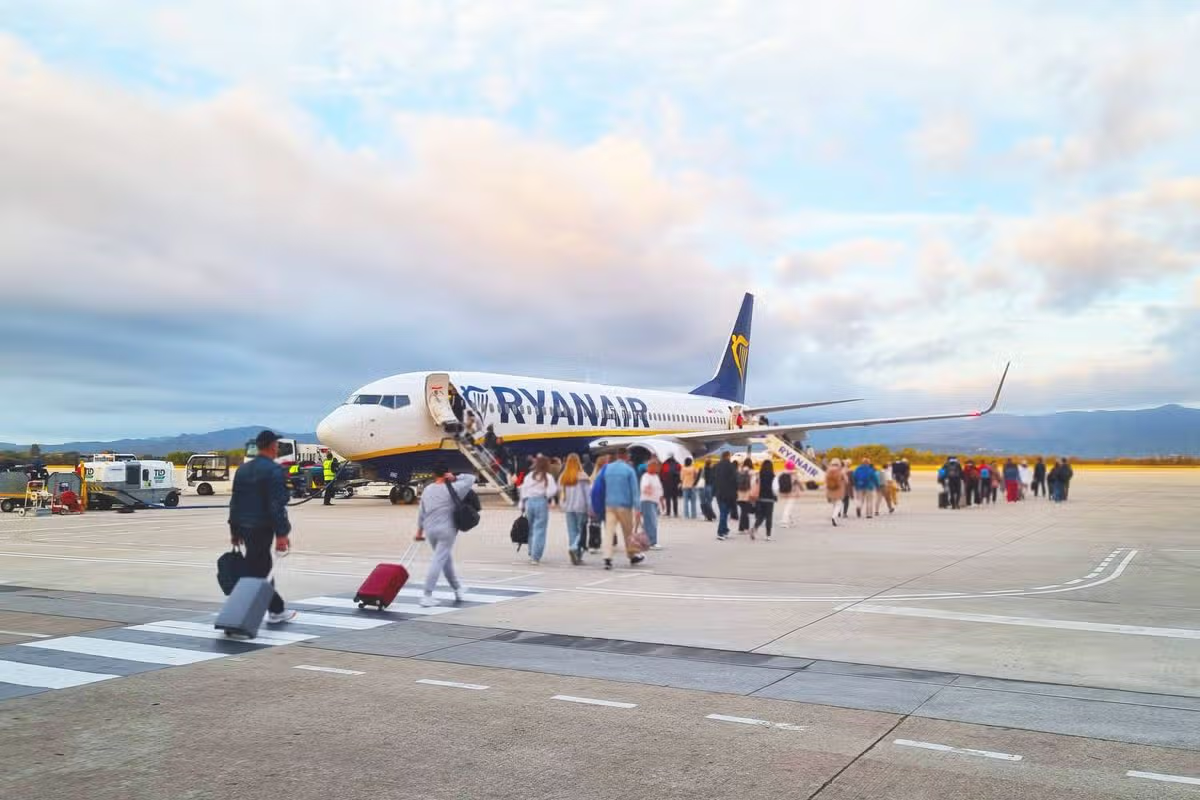
Ryanair passengers warned over type of bag you can never check in

Everyone knows Ryanair’s strict rules around the size and weight of your luggage, but there’s one bag type it won’t accept in the hold even if meets the other requirements for travel

Packing for a flight on a budget airline can be anxiety-inducing, as the baggage requirements seem to change all the time. It’s important to check for the latest luggage rules before you fly, so you can ensure you aren’t forced to pay additional fees at the gate.

However, some holidaymakers might not realise that there is more to luggage regulations than just the size and weight of your case. One particular type of bag, beloved by those who like to take lots of gadgets overseas, can not be checked into the hold on most airlines including Ryanair.

Smart bags, which are bags that have a built-in battery and USB charging port, cannot be checked into the hold on Ryanair flights if the battery is left inside them. There’s also a 100Wh maximum for batteries being carried in the cabin, so passengers should check the capacity before they fly.

Ryanair passengers warned over type of bag you can never check in

READ MORE: Ryanair passengers can ‘boost price of flights’ by making 1 booking mistakeREAD MORE: Major airline cancels all flights to three UK holiday hotspots for June

If you have a smart bag that you’d rather put in the hold rather than the cabin, Ryanair’s website states they “may be checked in as hold luggage only if the lithium battery is removed before the bag is checked in at the bag-drop desk or at the gate.”

It clarifies: “The battery must not be placed in the hold under any circumstances. The removed battery must be carried with you in the cabin and placed in small baggage that is placed underneath the seat in front of you or on your person. Removed batteries must not be placed in the overhead lockers.”

Some bags do not give the option to remove the battery, and Ryanair explicitly notes: “If the battery is non-removable the bag is not permitted as checked baggage.”

Ryanair recently updated its luggage policy for passengers bringing a free under-seat bag onboard. These bags can now be 20% larger, and can measure up to 40x30x20cm, whereas the old allowance was previously 40x25x20cm. Technically, these small bags have no weight restrictions, although they must be light enough for a passenger to handle and carry onboard.

READ MORE: Beautiful overlooked European gem outside Schengen zone has £17 flights and £2 pintsREAD MORE: Europe’s largest all-inclusive hotel has six pools, a waterpark, and its own chocolatier

The budget airline also announced another upcoming change to its baggage policy. Ryanair CMO, Dara Brady, said: “From Tuesday 10 Nov next, Ryanair customers will see airport check-in and bag drops close 60 minutes before scheduled departure, instead of today’s 40 minutes.

“This will allow these 20 percent of our customers [checking baggage] more time to clear through airport security and passport queues, and get to their departure gate on time, especially during busy travel periods when some of these airport queues can be longer.”

It also floated a more tongue-in-cheek idea on its Facebook page, joking: “we’ll be charging yappers on our 6AM flights very soon” and proposing that people who get chatty on its early morning flights should be charged a fee for annoying other passengers.

Have a story you want to share? Email us at webtravel@reachplc.com

Source link

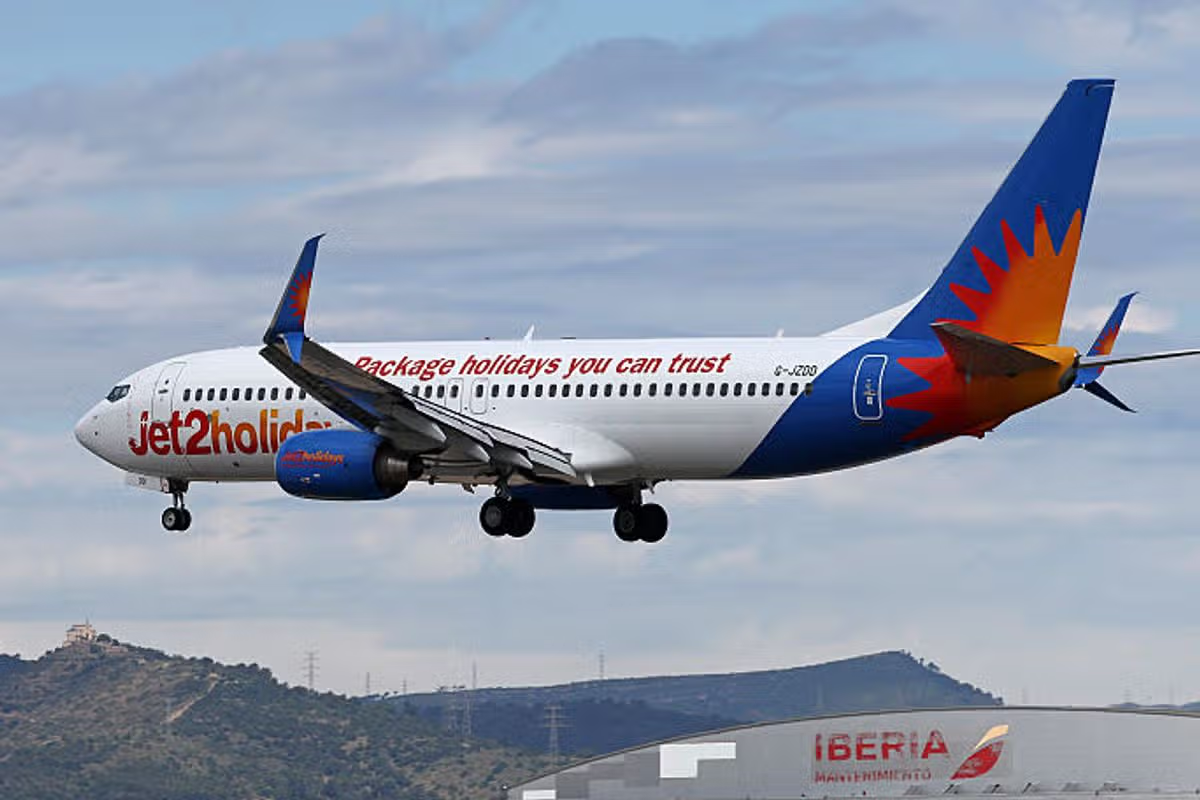
Jet2 reminds passengers of payment ‘rule’ for 2026 flights

People need to remember this, or they could be caught out

Passengers set to head off on holiday with Jet2 soon have been reminded of an important policy they will need to follow on their flight. Failing to prepare could see people caught out by the fairly common airline rule.

Anyone who has been on an aeroplane recently will know that cabin crew will often offer a choice of popular snacks and drinks as well as meal options. On short-haul flights, these are not included in the ticket price, and people can pay extra for them if they choose.

Ahead of their holiday with the airline, a passenger asked Jet2’s customer service team online for a reminder. Posting on X, Kim said: “Am I able to pay with cash on board flight or are you cashless?”

Jet2 responded within minutes to confirm the policy. The airline said: “Hi Kim, that is correct. We operate a fully cashless service onboard all flights, accepting only card and contactless payments.”

Aside from in-flight food and drinks, Jet2 offers customers a selection of in-flight purchases to start or end their holiday. Passengers can use the on-board magazine to browse from the choice of available skincare, makeup, beauty, watches and more.

Content cannot be displayed without consent

Why have airlines stopped accepting cash for on-board purchases?

Accepting payments by debit or credit card, including Apple Pay or Google Pay, helps cabin crew keep services running as quickly and smoothly as possible while in the air. It removes the need for staff to handle and keep cash secure on flights.

Businesses in the UK are under no legal obligation to accept cash. While cash is legal tender, businesses have the right to set their own terms of sale and choose which payment methods to accept, according to Parliament.

There is no law requiring businesses to accept cash, though this is a subject of ongoing debate regarding consumer choice. A business can legally refuse cash, provided they inform customers of its card-only policy.

In Jet2’s case, it is made clear on the company website, as a spokesperson said: “Just so you know, we only accept card and contactless payments onboard all our flights. You’ll need to bring your physical bank card to use chip and PIN when purchasing products from our Jet2shop.”

In other news, Jet2 has shared a new ‘suspended’ Greece holiday update for passengers. On its website, the firm issued an announcement on Tuesday, April 28, that will affect travellers with flights and holidays booked to the European country.

In the announcement, Jet2 praised Greek authorities for “prioritising customers” by putting the European Union ‘s new Entry/Exit System (EES) checks on hold. It follows the country’s confirmation of the suspension of the EES biometric checks for UK holidaymakers travelling to Greece.

Source link

Passengers urged to avoid Ryanair’s ‘expensive £160 fee’ by ‘double checking’

It could cost up to £160 if people do not notice this problem before it is too late

Passengers flying with Ryanair have been warned against making one of the most expensive mistakes, which could leave them facing three-figure bills just before take-off. The mistake can be prevented by carefully checking a small detail when booking a flight with the carrier.

In the rush to snap up a bargain, tiny keypads on mobile phones or a simple typing error mean travellers could easily misspell their name when booking a Ryanair journey. However, this could set them back as much as £160 to correct.

As of April 2026, the charge remains in place and is listed on the Ryanair website. Aside from the £100 missed flight penalty, the name fee is one of the highest charges Ryanair passengers can face.

The budget airline operates a policy for amending passenger information that provides a brief window of opportunity should an error occur. However, this limited timeframe comes with specific terms and conditions, according to the Express.

Ryanair says: “Name changes are allowed on all bookings, with full changes possible online up to 24 hours before departure or at the airport up to two hours before, subject to a fee. Free corrections include swapping first and last names within 48 hours of booking or changing up to three characters per name once, up to 48 hours before departure.”

If travellers only spot the mistake after getting to the airport, it could cost up to £160. The policy was previously flagged by Martin Lewis’ MSE team in an article about the most effective ways to dodge Ryanair’s additional charges.

The budget carrier is known for imposing penalties on travellers who go against their policies when booking, including mistakes that can happen entirely by accident. Correcting a minor misspelling – such as jumbled or missing letters – is free of charge, but only if passengers act within two days of making their booking.

Travellers must also have booked directly through Ryanair, not a third party service. Beyond the 48-hour window, passengers will be hit with a £115 fee for a name change, rising to £160 if done at the airport, according to MSE.

Each airline’s policy varies, so check whether your airline charges to fix these mistakes; some may amend small typos for free if reported as soon as possible. The important thing is making sure that the name on your passport matches for boarding, and errors can lead to being denied a place on your holiday.

The MSE team suggested there is a rather drastic workaround to avoid the charge if it’s too late to make amendments without paying £115 or more. Given the typically low price of Ryanair flights, cutting your losses and starting a new booking could actually be the cheaper option.

MSE said: “If you notice errors after 48 hours, it may be cheaper to make a completely new booking, rather than amend an existing one. It won’t always be cheaper, but it is worth checking the cost of a new flight to see if it’s less than the change fee.”

Ryanair confirmed on its website that certain passengers needn’t worry about being stung by the name change fee. Bookings made under a maiden name can be updated at no extra cost.

It said: “If you booked your flight using your maiden/married name, and you update your name in the passport before the date of travel, we will make the name change on your booking for you free of charge. You’ll need to have proof (a copy of your marriage certificate).”

Source link

Jet2 tells passengers flying to Spain ‘there is a plan in place’ in new message

The popular airline offered reassurance to passengers in a message shared on social media

Jet2 has offered reassurance to passengers worried about passport control queues at Spanish airports. In recent weeks, British travellers visiting the popular destination have reported long queues following the rollout of the European Union’s new Entry/Exit System.

In response, the airport authority, AENA, has reportedly directed staff to take all possible measures to streamline the process and reduce waiting times. In light of the border control queues, passengers have also been contacting airlines on social media to find out what to do in the worst-case scenario.

For instance, a Jet2 customer recently contacted the travel firm on X to ask for advice. @Jet2tweets often offers assistance to Jet2.com and Jet2holidays passengers on social media.

In a post shared on April 28, a passenger named Laura wrote: “With the crazy queues at Spanish airports to get through passport control, can you guarantee that I won’t miss my transfer bus? Thanks.”

In response, Jet2 said: “Hi Laura, any congestion caused by passport control our airport team will be aware off and will make sure there is a plan in place, so customer do not miss their transfers. Thanks, Gemma.”

Sharing a further message, Laura continued: “Thanks Gemma. Last time it took nearly 3 hours to get through – I’m hoping there won’t be any issues even if it’s that long?” Jet2 replied: “Rest assured our team will be aware of any congestion and plans will be in place.”

Passengers with transfers can find more information about the service on the Jet2holidays website, with transfers to and from hotels included with all Jet2holidays. The website says: “You’ll be met at the airport by our friendly Red Team who’ll then show you to your coach. Once onboard, you’ll be informed whether you are the first, second or third stop.
“Coach transfer information will be available in the Jet2 app when you land in your destination. We’ll also send it by SMS. Whether you have a coach, private or adapted transfer, our friendly Red Team will be on hand to guide you and help you on your way.”

The EU’s Entry/Exit System (EES) requires visitors from non-member countries such as the UK to have their fingerprints recorded and a photograph captured to enter the Schengen Area, which comprises 29 European countries, predominantly within the EU. While the new system was initially introduced in October, it became fully operational on April 10, 2026.

The Mirror has contacted Jet2 for comment.

Source link

Budget airline sends out ‘cancellation’ emails to passengers on May and June flights

The low-cost airline is cancelling flights in May and June due to soaring aviation fuel prices linked to the ongoing conflict in the Middle East

An airline that operates routes to and from the UK is axing flights in May and June because of surging fuel costs. Transavia, the budget airline owned by the Air France-KLM group, is scrapping scheduled services for May and June to cut expenses as aviation fuel prices soar due to the Middle East conflict.

The Air France-KLM group’s low-cost arm will change its timetable for May and June to streamline costs amid rocketing fuel prices linked to the Middle East war, a spokesperson confirmed to AFP. The airline operates from London Stansted to Rotterdam several times a week, and is used by tourists who fly to Schiphol airport in the Netherlands before going on to other European destinations with Transavia.

“Due to the current geopolitical situation in the Middle East and its impact on aviation fuel prices, Transavia France is adapting its flight schedule and is forced to cancel several flights scheduled for May and June 2026,” the carrier, which runs medium-distance routes, stated.

The cancellations represent “less than 2% of the flight schedule for the May-June period,” a spokesperson informed AFP. Transavia said “customers affected by a cancellation are notified individually by SMS and email.” Details of which routes are affected have not been disclosed so far.

They can then “benefit, according to their choice, from a free rescheduling, a voucher, or a full refund of their ticket.” Additionally, “for the majority of cancelled flights, a rescheduling solution within 24 hours is offered,” the airline states.

Europe normally gets half of its fuel from Gulf nations. However, since the start of the war between the United States and Iran in late February, the Strait of Hormuz has been shut down by Tehran.

In Brussels, European Commissioner Dan Jorgensen warned that the EU was “approaching very rapidly” a potential supply crisis, raising concerns about a summer characterised by “higher airfares and cancellations.” Airlines including Transavia have already begun raising ticket prices, with increases averaging approximately 10 euros per return journey, according to the carrier’s spokesperson speaking to AFP.

Chief Secretary to the Prime Minister Darren Jones warned on Sunday that the ongoing conflict is likely to push up costs for energy, food and flight tickets in the coming months, with potential disruptions to energy supplies affecting production rather than causing empty supermarket shelves.

“You’re going to see prices go up a bit as a consequence of what Donald Trump has done in the Middle East,” he told the BBC’s Sunday With Laura Kuenssberg programme. “That’s probably going to come online not just in the next few weeks, but the next few months. There’s going to be a long tail from this.”

When pressed on how long elevated prices could last, he indicated it would be roughly eight months after the Strait of Hormuz is reopened and tensions in the region begin to ease. “I think our best guess is eight-plus months from the point of resolution that you’ll see economic impacts coming through the system,” the minister said.

Last week, German airline Lufthansa said it would cut 20,000 European short-haul flights over the summer. It blamed the price of jet fuel.

An industry expert told travel journalist Simon Calder on his podcast last week that he expected more flights to be cut by airlines. Ted Wake, managing director of Kirker Holidays, said: “I think Lufthansa has got a very comprehensive schedule. Twenty thousand flights isn’t a drop in the ocean but it’s a relatively small number if you look at the overall picture.

“I think other airlines within the UK market will be doing something similar.”

Source link

UK passport appearance rules that risk passengers being turned away if broken

People could find themselves unable to travel this summer if they don’t spot these problems

Aside from your plane ticket, your passport is one of the most important documents you need to travel. But Brits need to make sure their passport’s appearance doesn’t put an end to holidays before they even start.

With fuel disruptions and other global events making the thought of holidays a bit stressful, people need to make sure their passports are valid and free of any additional issues that could prevent them from heading to their destination. These could seem minor, but airport security won’t take chances, and Brits could be out of pocket.

Usually, the main concern for people jetting off on holiday is ensuring they have enough valid months left on their passport. However, minor tears and water damage that seem like small issues may render a passport invalid in the eyes of border authorities – regardless of how long it has left to expire.

According to the GOV.UK website, you must replace a damaged passport immediately. This can typically take three weeks, but it can sometimes be longer, with waits of up to six weeks, so anyone with plans coming up soon should act fast.

What kind of damage will make a passport invalid?

The GOV.UK website lists all of the reasons that could render a passport invalid for travel. These include:

  • when the personal details or observation page are unreadable
  • laminate peeling or lifting away from the personal details page
  • unreadable security details
  • missing or detached pages
  • where the front, back or personal details page has been cut
  • damage or discolouration to any part of the passport caused, for example, by water/chemical/ink spills or tears/rips/bite marks

People who have the blue e-Passport may be found invalid for travel if the perforated passport numbers have been torn or the personal details page is torn, damaged, or cracked. People could also be rejected from passport checks if their passport has a chip or antenna that shows through the endpaper on the back cover of a burgundy e-Passport or the personal details page of a blue e-Passport

Damage that does not need an explanation and won’t render a passport invalid for travel includes:

  • any damage that is not on the personal details or observation pages
  • any visas, vignettes or immigration stamps are unaffected by the damage (Passport officers must be happy there are no security features or details missing)
  • any damage or discolouration to the passport cover and blank visa pages is caused by water/chemical/ink spills/tears/rips/burning/bite marks/writing or drawings

To replace a damaged passport, Brits can apply online here to be processed as quickly as possible. It costs £102 for adults, and customers will need a digital photo and a credit/debit card. GOV.UK added: “You’ll need to ask someone to confirm your identity online if you’re replacing a lost or stolen passport.”

People with travel plans that are sooner than the typical three-week turnaround may apply for a fast-track service at a premium cost. This usually results in an appointment at the Passport Office within a week, with documents often being issued the next day.

This express service comes at an added cost compared to the normal wait time and process. It costs £192 for an adult passport (or £206 for a 54-page frequent traveller passport).

Source link

Emirates airline issues Monday afternoon update to passengers

Emirates carries hundreds of thousands of UK passengers every year, including from London Heathrow, Gatwick, Manchester, Birmingham and Glasgow

A major airline has issued an announcement to customers after an update to its service. Emirates carries hundreds of thousands of passengers on UK services every year going through airports including London Heathrow, Gatwick, Newcastle, Manchester, Birmingham and Glasgow.

Using its 615-seater A380s the route from London Heathrow to Dubai alone offers more than one million seats. Now those travelling on the aircraft will be able to access internet connections, which the airline hails as “better than at home” following the completion of the first installation of next-generation Starlink Wi-Fi onboard.

Making the announcement on Monday afternoon, the airline said: “Emirates A380 was one of the first commercial aircraft in the world to offer internet to its customers, with first generation systems offering a total aircraft bandwidth of less than 1 Mbps. Emirates’ installation of three Starlink antennas on each A380 will improve the Wi-Fi available onboard a thousand-fold – offering a ‘better than at home’ connectivity experience for customers, while flying at 40,000 feet.”

The first Emirates A380 aircraft equipped with Starlink made its return to Dubai this week, after its installation and certification were accomplished in Newquay. More A380s are scheduled for accelerated installation throughout 2026 allowing passengers to stream, game, browse, and work throughout their journey on personal devices.

The service will be complimentary for all customers. The airline has future plans to add Live TV streaming over Starlink, initially on personal devices and later integrated into seatback screens.

Making the announcement on X, the airline said: “Our A380 is entering a new era with next-gen @Starlink Wi-Fi onboard. Ultra-fast, complimentary connectivity across all cabins, customers can stream, browse and stay connected seamlessly at 40,000 feet. A fully connected journey, redefined.”

Content cannot be displayed without consent

And passengers were delighted to hear the news. One said: “Let’s go. The old system was under 1 Mbps.” Another added: “Please don’t ever ground this airplane.”

The “double-decker” Emirates Airbus A380 is the world’s largest passenger airliner. It is known for its onboard luxury including shower spas, onboard bars and lounge.

Source link

EasyJet ‘loophole’ that may help passengers avoid paying for extra luggage

MSE, founded by Martin Lewis, has shared the handy trick online

Money Saving Expert (MSE) has shared a handy trick that could help you get more items on board your next flight. This means you may not need to pay for extra luggage.

On its website, the financial experts have said that anyone flying with easyJet may be able to boost their luggage allowance in a post-security “loophole”. MSE wrote: “If you don’t want to pay for a second bag, there is a loophole to get one on for free.

“It lies in post-security shopping. In addition to your standard hand luggage allowance,easyJet allows you to take one shopping bag on board.” It directs people to the easyJet website, where it notes under ‘Accessories’ that passengers are “allowed to bring some extra things into the cabin. e.g. umbrella, overcoat, crutches, walking stick, one standard bag of goods bought at the airport.”

MSE, founded by Martin Lewis, continued: “It’s worth noting that easyJet says this must be “one standard bag of goods bought at the airport” – and of course, we’re not suggesting you purchase unnecessarily. But if you do have a carrier bag from duty-free or similar, it’ll give you some room for manoeuvre when you walk through the departure gate.

“Some passengers report they’ve been able to stuff the odd item which won’t fit in their hand luggage into it, or even a handbag – others say they’ve successfully boarded with a carrier bag they brought with them specially.” Currently, each easyJet passenger, including children and infants, may purchase up to three checked (hold) bags. A standard checked bag allows 23kg, and you can add extra weight in 3kg increments up to a maximum of 32kg per bag.

If you’re travelling with family or friends on the same booking and flight, you can combine your total weight allowance. This allowance can be distributed across all booked bags, provided no single bag exceeds 32kg. The maximum total dimensions (length + width + height) must not exceed 275cm.

This means it’s good news for travellers. If you’ve picked up a few extras after passing through security, you may now have space to bring a bit more on board.

Source link

Hundreds of passengers stranded after 34 flights cancelled and 272 more delayed

Major airlines cancelled 34 flights with 272 more delayed on Sunday, April 26, leaving hundreds of passengers stranded at several different airports

Hundreds of passengers have been left stranded after 34 flights were cancelled and a further 272 delayed across the region.

Widespread disruption was recorded throughout aviation networks across Australia and New Zealand on Sunday,April 26.

Travellers were left stuck at major airports, including Sydney, Melbourne, Brisbane, Wellington, Auckland, and Christchurch.

Jetstar, Qantas and Virgin Australia were responsible for the bulk of the cancellations, though the knock-on effect was felt throughout the broader travel network.

New Zealand saw numerous flights fail to operate, while Australian passengers endured lengthy hold-ups, reports the Express.

Melbourne’s Tullamarine airport bore the brunt of the delays, with 84 flights failing to depart or arrive on time.

A further seven flights from the Victoria airport were also axed throughout the day, all of which belonged to either Virgin Australia or Jetstar.

As Australia’s busiest airport, Sydney recorded the highest number of cancellations, with 10 flights failing to take off and leaving scores of passengers stranded.

A further 69 flights at the airport also faced significant delays.

Brisbane was similarly affected, with 62 flights experiencing considerable hold-ups and lengthy waiting times.

Across New Zealand, Auckland was hit with eight cancelled flights and 44 delays, with the disruption particularly affecting long-haul connecting services from the country.

Wellington experienced fewer disruptions overall, though four flights were still cancelled.

The travel disruption comes amid mounting concerns surrounding air travel as a result of the ongoing Middle East conflict and rising fuel costs.

While this is not considered the cause of the current chaos, New Zealand airlines have spoken out about the impact that soaring energy prices are having on the industry.

On April 7, Air New Zealand announced that it would reduce flights throughout May and June and increase ticket prices, noting it had been amongst the first carriers to introduce widespread fare hikes when the conflict erupted.

Passengers affected by the travel disruption have been advised to get in touch with their airlines to discuss compensation.

Source link

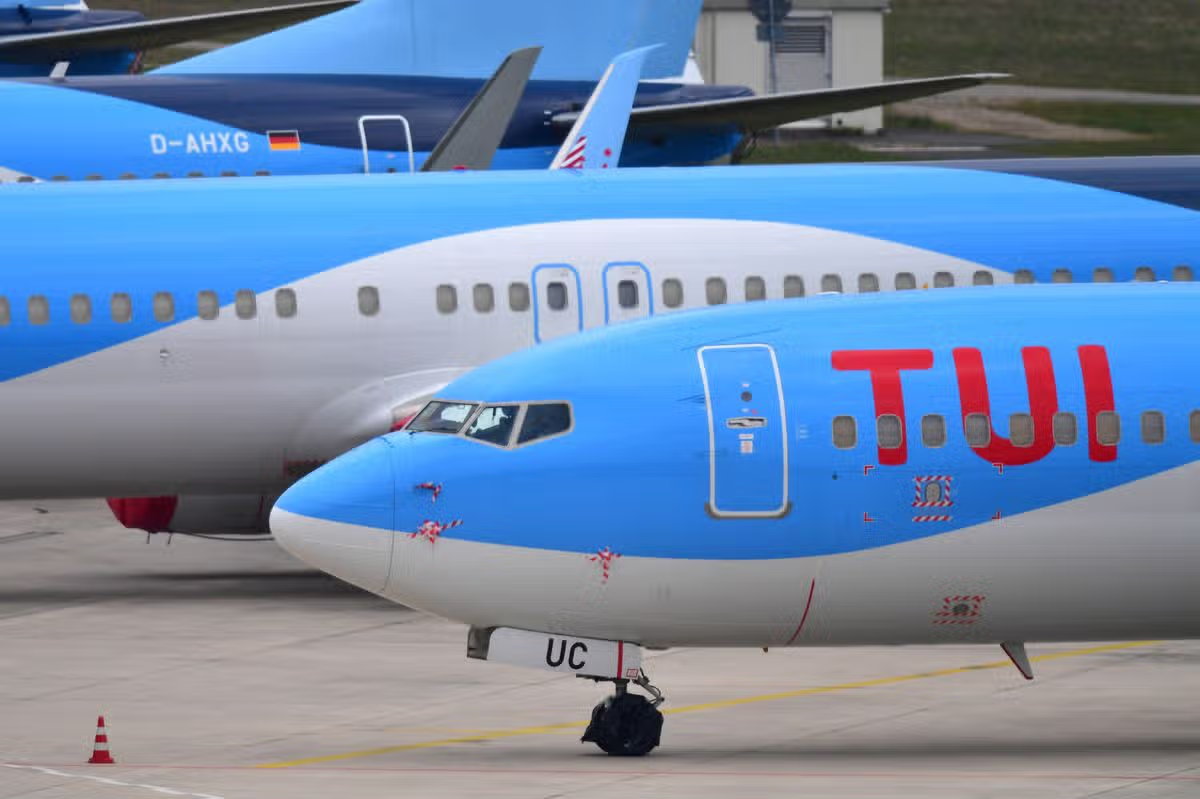
TUI issues update today, April 26, for passengers who have paid for holidays

TUI, Jet2 and easyJet have all confirmed they will not add fuel surcharges to pre-booked or new package holidays and flights this summer

Airline TUI has this afternoon released a statement for passengers worried about being slapped with surcharges on holidays they’ve already booked. The conflict in the Middle East has disrupted oil deliveries, raising the prospect of serious jet fuel shortages.

This has also caused fuel prices to skyrocket, leaving those who’ve already secured their holidays – and those preparing to – anxious they’ll be asked to stump up extra cash to offset the soaring costs facing airlines.

Jet2 and easyJet confirmed over the weekend that they will not be passing on any price increases to passengers via surcharges. Now, this afternoon, airline and tour operator TUI has announced it will not charge passengers additional fees.

Neil Swanson, Managing Director at TUI UKandI, said: “We understand that customers want both confidence and clarity when booking a holiday. Our teams are here to support people who are thinking about booking, and those who have already booked with TUI can be reassured that their holiday price is fixed, with no fuel surcharges added.”

easyJet has issued a fresh statement confirming the airline and tour operator will not add surcharges to any pre-booked flights and package holidays, or future bookings. The company said travellers can book their package holidays with confidence thanks to its Best Price Guarantee and Ultimate Flexibility policy: “easyJet and easyJet holidays has confirmed that it will not introduce surcharges on its flights or package holidays, giving customers complete peace of mind when booking.

“No surcharges will apply to any pre‐booked easyJet holiday packages or to any new bookings for summer 2026.easyJet currently sees no disruption to its jet fuel supply and all flights and package holidays continue to operate normally.” Garry Wilson, CEO of easyJet holidays, said: “We know that holidaymakers may have questions about what recent global events might mean for their travel plans this summer so we are giving our customers absolute peace of mind that no surcharges will be added to their flights or package holidays.”

“Our operations remain unaffected, so customers can be confident that not only will their holiday go ahead as planned, but there will be no surprise extra payments, and they can enjoy their brilliant holidays at unbeatable prices.”

Jet2 has confirmed it won’t be slapping surcharges on any pre-booked flights or holidays to cover increased costs, including those related to jet fuel. In an effort to calm growing anxieties, the Department for Transport yesterday issued direct guidance to passengers with bookings through carriers such as Jet2, Ryanair, Wizz, easyJet and British Airways. Jet2 has axed surcharge provisions across all its flights and holidays, despite the carrier never having previously imposed them. The policy applies to all flights and holidays booked through any channel, be it online, via the mobile app, contact centre or independent travel agent. It does not cover tourist taxes, which are payable at the resort during the stay and are settled directly with the accommodation provider.

Steve Heapy, CEO of Jet2 said: “Holidaymakers should have every right to book their hard-earned break in the sun, without worrying about being hit with additional costs, and they can have that complete assurance when they book a flight or holiday with Jet2. As a result of today’s announcement, customers booking with Jet2 know that they are locking in their price without additional cost surprises later and we strongly believe that is the right thing to do by them. Ahead of a busy summer this is yet more evidence of why, on top of our incredible holidays and award-winning customer service, nothing beats a Jet2holiday.”

The DfT said on Friday: “There is no current need for passengers to change their travel plans. UK airlines buy jet fuel in advance, and airports maintain stocks to support their resilience. The government is working closely with the aviation industry to monitor risks and minimise disruption to passengers.

“If your flight is cancelled, you have clear legal rights, including the right to a full refund or re-routing. Read this factsheet for the full picture on the current situation and what it means for you.”

Meanwhile, IAG – the parent company of British Airways, Aer Lingus and Spain’s Iberia – has referred to “pricing adjustments to reflect these higher fuel costs”. A spokesperson commented: “We are not seeing jet fuel supply interruptions, but fuel prices have risen sharply and, despite our hedging strategy, which gives some shorter-term mitigation, we are not immune to the impact.”

Source link