part

Race is an integral part of Obama’s story, and he embraced its complexity

President Obama had occupied the Oval Office for nearly a full term when government engineers came to him with a request: that he move out for a few months while they completed an overdue renovation of the West Wing.

Valerie Jarrett, Obama’s oldest family friend and a senior advisor, objected.

“Nobody else had to do that,” she said. Other White House staffers were concerned that displacing Obama, though he had no problem with it, could be read as a sign of disrespect for the nation’s first black president.

The moment was a small glimpse into how Obama and his image-makers navigated the sensitive question of race during their eight years in the White House.

On policy and in speeches, Obama showed a determination to pursue equality for all minorities. But he faced resistance — not only from the right but also from allies on the left who felt he wasn’t moving decisively enough. That resistance, along with high-profile instances of racial violence that rekindled a national debate over racial progress, resulted in an uneven record for the Obama administration on the issue of race.

The president leaves office in an age marked by increasing racial tensions. The election to choose his successor featured a backlash reminiscent of the political upheaval of a half-century ago, when the so-called Silent Majority ushered Richard Nixon into office after the turmoil of the 1960s. On Jan. 20, President-elect Donald Trump will take the oath of office in part because a significant number of voters rejected Obama’s quest for broader equality.

Though the election of Obama was celebrated as a moment transcending the country’s dark racial history, the president himself has always taken a more measured view: that race is a complex issue and progress comes in fits and starts.

“After my election, there was talk of a post-racial America,” Obama said in his farewell address last week. “And such a vision, however well-intended, was never realistic. Race remains a potent and often divisive force in our society. … And all of us have more work to do.”

From the beginning of his presidency, Obama made clear to his staff that he wanted to do two things at once — lift up the disenfranchised while moving beyond stereotypes and prejudices. He encountered those personally from the start.

In one of his first White House meetings with Republican lawmakers, one representative lectured the new president — and former senator — on how the legislative process works.

So dismissive was his tone that Obama would marvel afterward to a couple of aides, “He did everything but call me ‘boy.’”

As the meeting broke up, Vice President Joe Biden started to make a beeline for the offender when he felt Obama’s hand on his arm.

“Let’s let that go,” Obama said, stopping him.

Biden attributed Obama’s cool to a lifetime of navigating such dismissiveness.

“His self-awareness is so damn amazing,” Biden said in an interview last month. “It doesn’t mean, I don’t think, he doesn’t remember [or] it doesn’t hurt.” But, Biden added, it suggested that, as a black man growing up in America, Obama had learned when to fight and when to let go.

Another early experience reinforced that. During his first summer in office, police arrested a black Harvard professor and leading scholar of African American literature, Henry Louis Gates Jr., at his home. Asked about the case, Obama said officers had “acted stupidly in arresting somebody when there was already proof that they were in their own home.”
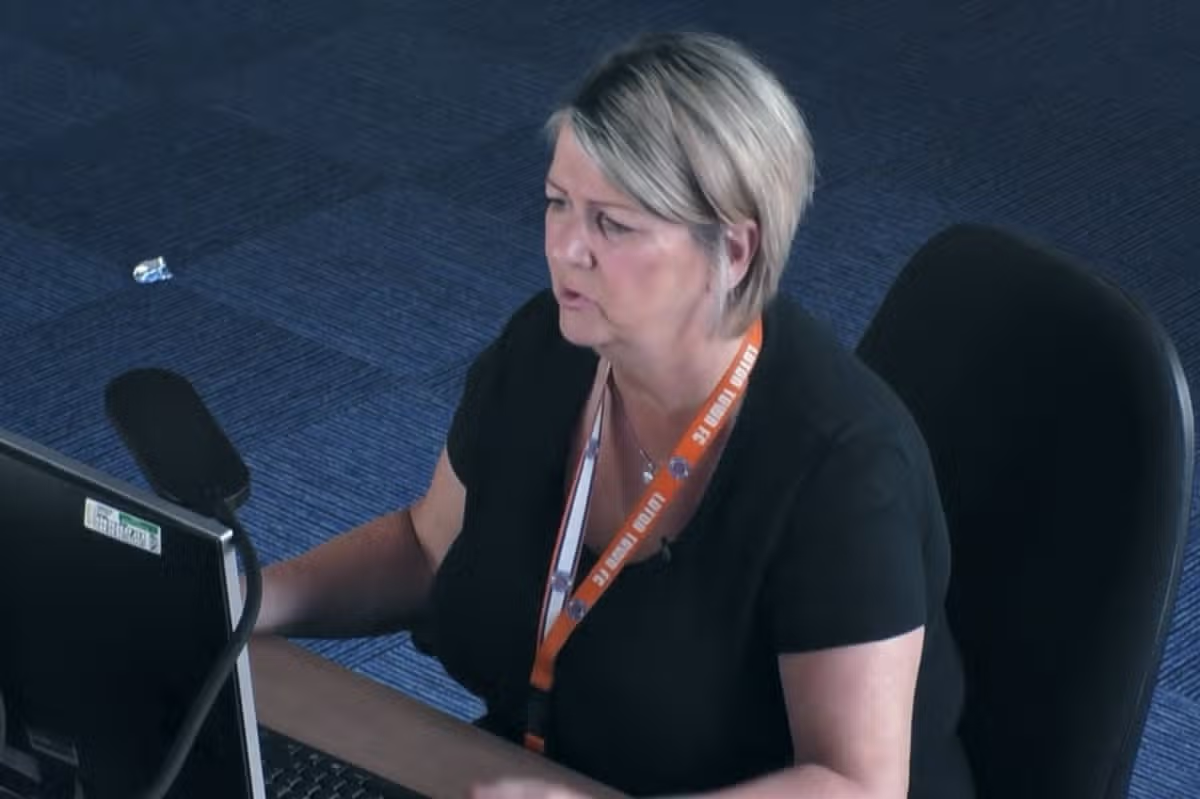
The backlash from police around the country stunned the president. Aides say the reaction taught Obama he had to speak more carefully on race.

“When the president says it,” one senior aide said, “it has enormous weight.”

Obama instead set about shaping his policy agenda, which over the next eight years would include lasting gains for minorities.

Obama’s signature healthcare law, the Affordable Care Act, nearly erased the disparity in healthcare access between black children and white children and helped more than 20 million Americans get health coverage. He signed the Lilly Ledbetter Fair Pay Act, which banned sex-based wage discrimination. His immigration policy has at least temporarily freed millions of Latinos from life in the shadows.

By the administration’s estimate, the economic stimulus law that was one of Obama’s earliest accomplishments kept 5.3 million Americans, a group that was heavily black and Latino, from falling into poverty.

And though he was slower to publicly embrace same-sex marriage than some others, his support for those he warmly referred to as “LGBT folks” helped foster a movement that ultimately saw gay marriage legalized through a Supreme Court ruling. He celebrated the moment in vivid fashion by ordering the White House exterior illuminated in the rainbow colors of the gay pride flag.
Obama pushed for fair-sentencing laws that narrowed the gap in penalties between felonies involving crack and powder cocaine, a divide that had resulted in disproportionately long sentences for blacks. He commuted the sentences of 1,176 people, more than the past 11 presidents combined. The vast majority were drug offenders.

High school dropout rates also fell to historic lows, with African Americans and Latinos charting the greatest progress.

Other gains are harder to quantify. When the killings of black men by white police officers thrust the issue of race and policing into the national spotlight, he directed the Department of Justice to examine the practices of police at the center of those conflicts, including in Cleveland, Baltimore and suburban Ferguson, Mo. Investigators there found a pattern of abuse against blacks and recommended dozens of reforms.

Additionally, he ordered that surplus military equipment no longer be sent to local governments. The sight of law enforcement officers riding in tanks or conducting raids in riot gear helped contribute to the perception among some that police were invading, rather than protecting, communities.

In early 2012, amid Obama’s campaign for reelection, a shooting in Florida overwhelmed his reticence to speak up amid heated debates on race. Trayvon Martin, an unarmed black 17-year-old, was shot to death by a neighborhood watch captain who told a 911 dispatcher he was suspicious of Martin’s movements.

The shooting seized the nation’s attention, provoking an outpouring of complex emotions.

At the White House, Obama told aides he had something he wanted to say if asked about the shooting, as he was certain to be.

“If I’d had a son,” Obama said, “he’d look like Trayvon.”

Are you sure you want to make it that personal, one advisor asked.

Obama’s answer was to repeat the line, as if considering the sound of it. Yes, he said. He did want to say that.

Uttered later on live television, the remark proved a defining moment in Obama’s tenure; the president had injected himself into a racially charged story for the first time since the Gates episode.

Obama’s description that day of how he had personally grappled with racial injustice was the first of several instances in his second term in which he used his rhetorical gifts to guide the nation through its most emotionally complicated moments.

He broke out into a chorus of “Amazing Grace” in Charleston, S.C., in 2015, during a memorial service for nine people gunned down by a white man at a historically black church. A year later, in Dallas to mourn the shooting deaths of five officers during a peaceful protest of killings of black men in confrontations with police in Louisiana and Minnesota, Obama exhorted both law enforcement and protesters to search for common ground.

“With an open heart, we can learn to stand in each other’s shoes and look at the world through each other’s eyes, so that maybe the police officer sees his own son in that teenager with a hoodie who’s kind of goofing off but not dangerous. Maybe the teenager will see in the police officer the same words and values and authority of his parents.”

By then, the campaign to succeed Obama was shifting into a bitter general election, pulsing with an undercurrent of racial animosity that would culminate in the election of Trump.

The anti-Obama backlash was evident months earlier at rallies for Trump, the most prominent promoter of the lie that the president was born outside the U.S., itself an attempt to delegitimize him.

Trump railed against Obama, complaining that he had presided over a period of “political correctness” that prevented whites from speaking frankly about their concerns and confronting conflict. Trump’s crowds roared their approval.

White nationalists supported Trump more actively than they had any presidential candidate in decades. Trump named as his campaign chairman the chief executive of a website that has given a platform to the so-called alt-right, a collection of openly racist and anti-Semitic activists.

Trump, who kicked off his campaign by saying Mexican immigrants were “criminals” and “rapists,” threatened to ban Muslims from entering the country and said little about his backing from white supremacists, downplaying accusations that he stoked racial unrest.

In Obama’s final year in office, a friend from his days in the Illinois Statehouse told him that he was convinced many of the roadblocks the president had faced were based on racism.

Republicans in Congress “were afraid of you, more so than anything else,” said Denny Jacobs, a white Democrat and longtime state senator from farm country. “They were afraid of you for a couple of reasons. No. 1, you were black. And I talk to my Republican friends — and I’ve got a lot of them — and that’s all they could ever talk about, was the race card, the race. You know, he’s a nice guy, he’s this, he’s that, but he’s black.”

Obama paused and smiled.

“I have no doubt that there are people who voted against me because of race, or didn’t approve of my agenda because of race,” he told Jacobs. “I also suspect there were a bunch of people who were excited and voted for me, or I got political benefits because of the notion of the first African American president.”

“Those things,” he said, “cut both ways.”

christi.parsons@latimes.com, michael.memoli@latimes.com

Twitter: @cparsons, @mikememoli


Source link

DR Congo releases 15 prisoners to M23 rebels as part of Doha peace process | Conflict News

ICRC facilitates first known transfer of detainees between Congolese government and M23 rebels in North Kivu.

The Democratic Republic of the Congo (DRC) has released 15 prisoners and handed them over to rebels from ⁠the Congo River Alliance/March 23 movement (AFC/M23) in the east of the country.

The release was announced by the International Committee of the Red Cross (ICRC), which facilitated this first known transfer of prisoners under last year’s Qatar-mediated deal to end the fighting in the region.

Recommended Stories

list of 3 itemsend of list

The handover happened on Thursday and Friday after months of talks thrashing out the names of detainees to be freed.

An ICRC statement said the 15 prisoners agreed to be transferred before leaving the government-held eastern Congolese city of Beni in a convoy on Thursday evening.

The journey continued through Uganda before the convoy arrived in Rutshuru Territory in DRC’s North Kivu province, where the prisoners were ⁠⁠handed over to AFC/M23 on Friday, the statement added.

M23 seized the regional capitals in North and South Kivu from the Congolese government’s control in early 2025.

Stephanie Eller, head of ICRC operations in the capital ‌Kinshasa, said she hoped the transfer would pave the way for more releases.

“We hope that this ⁠operation will help bring relief ⁠to families who have been separated from their loved ones for a long time,” Eller said.

The release of detainees was one of the conditions in the Qatari-mediated agreement signed by the Congolese government and AFC/M23 in September.

Qatar welcomed the releases on Friday.

“The release of the detained persons represents an important step towards enhancing confidence between the parties and creating favourable conditions for further progress towards reaching peaceful and sustainable solutions,” Qatar’s Ministry of Foreign Affairs said in a statement.

It added that Qatar “expresses its hope that this step will serve as an impetus for further measures that enhance confidence-building between the parties and meet the aspirations of the Congolese people for peace, development and prosperity”.

DRC, the United Nations and Western powers have repeatedly accused neighbouring Rwanda of supporting the M23 with its ‌own ‌troops and weapons as the armed group has advanced in the east, a charge Rwanda denies.

Source link

Chargers and Jim Harbaugh reconnect to their San Diego origins

This is where it all started for Jim Harbaugh, this idyllic hilltop University of San Diego campus with its sweeping views of the city and ocean, Spanish Renaissance architecture and courtyards lined with palm trees.

Harbaugh had been an assistant coach elsewhere, learning the ropes as an offensive consultant at Western Kentucky and quarterbacks coach for the Oakland Raiders, but this was his first chance to be a head coach. It launched a second career for the longtime NFL quarterback, taking him to Stanford, the San Francisco 49ers — where his team fell just short of a Lombardi Trophy — to a national championship at Michigan, and now to the Chargers, with whom he’s beginning his third season.

The Chargers have moved training camp to USD for Tuesday and Wednesday this week, reuniting Harbaugh with a place legendary Raiders owner Al Davis advised him not to come.

“Awww, Jimmy, Jimmy, I thought you wanted to be a pro coach,” Davis, voice dripping with disappointment, told him in 2004 when he learned Harbaugh was leaving his Raiders gig.

“But Mr. Davis, you coached college football,” Harbaugh countered.

“Yeah,” Davis said, “but that was at USC, not U-S-D.”

Harbaugh knows he made the right decision, and never doubted it, even when he and defensive coordinator Dave Adolph — another NFL fixture — had to roll up their sleeves and scrub down the cramped and filthy USD locker room themselves; even when he and his assistant coaches routinely made hundreds of PB&J sandwiches to provide late-night snacks for their players, who don’t receive scholarships at the NCAA Division I FCS level; and even when he pushed himself so hard at practice — he was the head coach, mind you — that he got sick all over himself.

“He was very demanding of us,” recalled former Toreros linebacker Matt Gabbard, “but it wasn’t something he didn’t demand of himself.”

They still call it Harbaugh Hill, a steep dirt road overlooking the practice fields on campus. Football players would plod up it as part of their training camp, and Harbaugh would run with them and urge them along. It bothered him that nobody could keep pace with receiver Nick Garton, who also excelled in soccer and track in high school, and could breeze up the grade like it was nothing.

“Isn’t anybody going to challenge this guy?” Harbaugh said. “Finally, I said, ‘I’ll do it.’”

Jim Harbaugh smiles during a practice with the University of San Diego in November 2005.

Jim Harbaugh smiles during a practice with the University of San Diego in November 2005.

(Lenny Ignelzi / Associated Press)

So he did, matching Garton stride for stride before losing his breakfast all over himself. The coach didn’t stop running, though.

“I finished second,” he said, recalling the episode after Chargers practice this week and clearly still proud of his accomplishment.

Harbaugh coached at USD for three seasons, starting in 2004, and was three years removed from his playing career. He was 40 when he took the job and still had thoughts of putting the pads back on. He even looked into playing arena football and entertained the idea of playing for the Los Angeles Avengers, but that thought only lasted a day or so. He really wanted to be a coach, and brought along his dad, Jack Harbaugh, to oversee the running backs in that first season.

Jim and Jack would carpool to campus every day from their Coronado homes, father and son talking plays, personnel, family and life.

“What I saw was passion,” said Jack Harbaugh, who spent six decades coaching high school and college football. “If I could use one word, it’s Jim’s passion for the game. He would coach as if that was maybe the last job he’d ever had.”

That resonated with the players.

“When we saw coach Harbaugh come in and have that next-level intensity, you kind of get chills running down your spine,” defensive back Phil Bretsch said. “Like, ‘Oh boy, this is going to be different.’ But you’re ready for it, right? We’re not there for any other reason other than we love football.”

The turnaround was abrupt. Harbaugh inherited a historically mediocre program and coached his team to a 29-6 record in three seasons. The 2006 team went 11-1, won the Pioneer League, and Harbaugh was a finalist for the Eddie Robinson Award, presented to the top coach in the FCS.

One of his biggest accomplishments was luring Adolph out of retirement. The defensive specialist was almost 70 and was a turnaround artist with all sorts of NFL franchises — Cleveland, Kansas City, Raiders and Chargers — but in his later years was the primary caregiver for his ailing wife. Harbaugh asked and asked and asked, and finally got a yes when he helped arrange for in-home care for the Adolphs for several hours a day.

Coaching at this level was about making sacrifices for the love of the game. There was no school money to feed the hungry players after their team meetings, so Harbaugh and the other coaches — essentially volunteers — shelled out for tubs of peanut butter, vats of jelly and dozens of loaves of bread every night.

“We were always on the hunt for calories,” Bretsch said. “I think I stayed alive off Carl’s Jr. 99-cent chicken sandwiches for about six months throughout my career. We always joked, ‘What if we would have had the training table the big programs had? What would we have been like?’”

But those teams had something different. They had Harbaugh.

“We had a competitive advantage from a coaching standpoint every game we went into,” said running back J.T. Rogan, who went on to work with Harbaugh at Stanford and Michigan. “I would refer to him as my father in football, but that would probably be diminishing the impact he’s had on my life.”

It wasn’t just about Harbaugh’s football mind or unwavering intensity and enthusiasm. He had connections. When he took his team up to play Menlo College, he had Jerry Rice deliver the pregame talk. Steve Mariucci spoke to the team as well. So did longtime college basketball coach Tom Crean, Harbaugh’s brother-in-law.

Jim Harbaugh #4, Quarterback for the San Diego Chargers talks to his offensive line.

Jim Harbaugh huddles with his teammates during a game between the San Diego Chargers and Denver Broncos in October 2000.

(Stephen Dunn / Getty Images)

When the Toreros needed cold-weather clothing for a game at Dayton, Harbaugh cajoled the Chargers, with whom he spent part of his playing career, into donating some of their mothballed gear.

“We got turtlenecks with the Chargers insignia on them,” Rogan recalled. “We’d have these jackets with a big Chargers lightning bolt, the dark-blue stuff before the baby-blue stuff was en vogue.”

For Harbaugh, the job was part-coaching and part “Let’s Make a Deal.”

When Saint Mary’s dropped its football program, he called the East Bay school not only to recruit players but to round up equipment that would otherwise go unused. He wound up buying virtually everything the program had, writing a $10,000 check out of his personal account.

“I got all the practice pants, the helmets, the thigh boards, everything,” he said.

He rented a U-Haul and drove to Moraga to collect the stuff. When Harbaugh was about to head out, the Saint Mary’s coach asked one more question:

“You need goalposts?”

Harbaugh was all ears.

“He showed me these year-old goalposts,” he said. “They were beautiful. I put them in the U-Haul and took them too.”

Chargers coach Jim Harbaugh looks on during training camp at the University of San Diego.

Chargers coach Jim Harbaugh watches training camp at the University of San Diego on Tuesday.

(Gregory Bull / Associated Press)

With the truck loaded and as he was preparing to pull out, Harbaugh got a call on his cell. It was an unheralded USD quarterback recruit from Oakland named Josh Johnson. He was supposed to be at freshman orientation but didn’t have a way to get from the Bay Area down to San Diego.

Harbaugh was quick on his feet.

“He said, ‘My parents are working and can’t take me down there,’” Harbaugh said. “I said, ‘Tell you what, can you be ready in an hour?’ He said he could be, so I drove the U-Haul over to his place and picked him up an hour later.”

The two spent the next seven hours together, driving to USD. Even now, Harbaugh made clear he wasn’t bending the rules.

“It wasn’t an extra benefit for Josh Johnson,” he said. “I put him to work. He unloaded the whole truck.”

In his first practice, Johnson went from seventh on the quarterback depth chart to second. He would go on to become one of the greatest players in the history of the program, leading the Toreros to back-to-back Pioneer League championships. He set many school records, including his 2007 season in which he threw 42 touchdown passes with one interception.

Johnson, now playing for the Cincinnati Bengals, has played for 14 NFL franchises, some more than once. That’s the most in league history for a quarterback. It’s an astounding rise from a tiny, non-scholarship university in San Diego. An odyssey of an ascent.

Harbaugh, for one, can relate.

Source link

Dory Funk Jr. dead: WWE Hall of Famer, part of famed wrestling family

Dory Funk Jr., a pro wrestling icon and one of three members of the Funk family to be inducted into the WWE Hall of Fame, has died at age 85.

Marti Funk, Funk’s wife of 40 years, told Florida’s Ocala Gazette that her husband died Tuesday while in hospice care. No further details were given.

Born on Feb. 3, 1941, in Hammond, Ind., Funk was the oldest of Dory and Dorothy Funk’s two sons. Spending most of his childhood in Amarillo, Texas, Funk grew up admiring his father, a professional wrestler and promoter who once wrestled in Canada as a heel named the Outlaw who hailed from the fictitious location Double Cross Ranch. As wrestlers, Funk and his brother, Terry, often were billed as being from there as well.

“As a kid, I used to dream I could do all the things my father could do,” Funk said during a 2007 interview for World Wrestling Entertainment. “I wanted to be just like him.”

Funk played offensive and defensive line on the West Texas State University football team (now West Texas A&M) from 1959 to 1962 — he was inducted into the university’s athletics Hall of Fame in 1990 — and went straight into professional wrestling. His 50-plus years in the business included stints in a number of associations across the U.S. and Japan.

He was the National Wrestling Alliance heavyweight champion for more than four years uninterrupted (February 1969 to May 24, 1973). In 1986, Funk and his brother joined WWE (then known as WWF) as a team and defeated Tito Santana and Junkyard Dog at WrestleMania 2.

Funk’s involvement in wrestling also expanded into promotion. In addition, he and Marti owned and operated the Funking Conservatory, a wrestling school where he trained a number of future WWE superstars including Kurt Angle, Christian, Edge, the Hardy Boyz, Mark Henry and Mickie James.

“He was such a good guy,” Marti told the Ocala Gazette, “such a good guy!”

The Funk brothers were inducted into the WWE Hall of Fame in 2009. Dory Funk Sr., who died in 1973 at age 54, was inducted posthumously to the hall’s Legacy Wing in 2025. Terry Funk died in 2023 at age 79.

WWE chief content officer Triple H announced Funk’s death Tuesday afternoon on social media.

“From the Double Cross Ranch to the @WWE Hall of Fame, Dory’s style inspired countless performers in our industry” Triple H wrote. “Whether it was at WrestleMania 2, WCW, ECW, or the dozens of NWA-affiliated promotions, his travels across North America and Asia were a part of the early blueprint that helped build this business into a global phenomena.

“A hard-nosed and fierce competitor, his rugged in-ring style was only eclipsed by the decades he spent training athletes to perform in the squared circle he loved so much. My thoughts and those of the entire @WWE Universe are with his loved ones during this difficult time.”


Source link

82 lawsuits saved $207 billion for California, Bonta says

California Atty. Gen. Rob Bonta said Tuesday that his office has protected more than $200 billion in federal funding for the state, defended core civil rights and removed military forces from Los Angeles streets by suing the Trump administration about once a week.

“Since President Trump returned to office, California has been under attack — and has led the way in fighting back,” Bonta said.

Bonta said his office has filed 82 lawsuits against the administration since Trump’s inauguration last year, in addition to 122 amicus briefs supporting lawsuits against the administration by other parties and 112 comment letters in response to federal actions.

That work has saved the state an estimated $207.1 billion, Bonta said, including $168 billion — equal to a third of the state’s annual budget — that was threatened when the Trump administration tried to freeze trillions of dollars in federal funding to the states last year. Billions in threatened cuts to transportation, emergency preparedness, education and family assistance funding were also prevented, Bonta said.

The work has also protected birthright citizenship for the U.S.- born children of immigrants, ensured that National Guard troops are not deployed in major California cities against the wishes of local leaders, lifted multiple sets of tariffs driving up costs for American consumers and repeatedly blocked administration efforts to interfere in California’s elections, Bonta said.

“We’ve protected funding that keeps our communities safe, feeds hungry families, and ensures our kids get the education they deserve. We’ve gone all the way to the Supreme Court to defend constitutional rights — and won. We’ve protected our elections and stopped the militarization of our cities. We’ve defended our right to prioritize public safety over assisting with the President’s inhumane immigration agenda,” Bonta said.

As it has done in the past, the White House on Tuesday derided Bonta’s lawsuits as misguided.

“Instead of bragging about filing frivolous lawsuits against the Trump Administration, the California AG should focus on addressing problems in his own state — like the countless criminal illegal aliens the Newscum Administration allows to roam free and terrorize communities,” said White House spokeswoman Abigail Jackson in a statement to The Times.

The White House has previously said Trump is “trying to restore American Greatness” and that Californians would be “infinitely better off” if Bonta got out of the president’s way.

Bonta’s office is required to report annually to the state Legislature on its work fighting the Trump administration as part of a 2025 special session measure delivering it an extra $25 million to fund such litigation. His office published its latest report to lawmakers Tuesday.

The report said the office had received $19.2 million of the special session funding through July 30, which had “contributed to — but in no way has been sufficient to cover — the costs of the litigation.”

Bonta’s office has also received regular appropriations to fund such litigation in each of the state’s last two budgets, of $14.2 million last fiscal year and $23.9 million this fiscal year. The office’s overall budget is about $1.4 billion.

At a morning news conference with other state leaders, Bonta said his office has spent close to $30 million on its “federal accountability work” overall since Trump took office, and argued that investment has been “paying off in droves” given the billions saved.

Senate President Pro Tempore Monique Limón (D-Goleta) and Assembly Speaker Robert Rivas (D-Hollister), standing with Bonta, agreed.

Limón said she was proud to have worked with Bonta and Gov. Gavin Newsom to form a “collective backstop” against the Trump administration, while Rivas said the funding provided to Bonta’s office “may be one of the smartest investments that this legislature has ever made.”

Of the 82 lawsuits, 66 remain active, according to the report. Despite that, Bonta said his office has won 45 orders providing some early relief from the Trump administration’s actions, and 21 final orders in its favor. In eight cases, he said, the administration “backed down” in advance of a trial.

Bonta’s office has lost arguments made against the Trump administration, including on behalf of other litigants, particularly on issues related to transgender rights and the scope of Trump’s executive power to reshape government and federal immigration policy.

However, Bonta claimed his office has won in 83% of the court orders issued in cases brought by the state and praised his team for having “worked around the clock on behalf of Californians, pulling countless all-nighters along the way” to make it possible.

Bonta, who is up for reelection in November, is campaigning in part on his willingness to stand up to Trump — which polling and voting has suggested many Californians want their elected officials to do.

Xavier Becerra, the Democratic candidate for California governor, is running on a similar message. Before he was the U.S. Health and Human Services secretary, Becerra had Bonta’s job and sued the first Trump administration more than 120 times, often successfully.

Bonta said he expects Becerra will be an “incredible partner” in the fight moving forward.

Republicans Michael Gates, who is running against Bonta, and Steve Hilton, who is running against Becerra and is endorsed by Trump, have said they would work collaboratively with the Trump administration to ensure the needs of Californians are met, rather than fighting it at every turn.

“I would be wanting to work with the administration to help Californians,” Hilton has said. Gates has called Bonta’s campaign against Trump “out of touch.”

Many of the lawsuits Bonta’s office has brought against the administration have been filed as part of a multistate coalition of Democratic attorneys general. As presidents of both parties have flexed more executive power in recent decades, state attorneys general have become more collaborative and litigious in fighting back — and that has been especially true under Trump.

Bonta said Trump will be remembered in part for his “repeated attacks on California, on Californians, on our Constitution, and on our democracy,” but California will be remembered for fighting back.

“Are these trying times? 100%. Absolutely, yes,” Bonta said. “But we shouldn’t be helpless, because we’re not helpless.”

Source link

Cubs tee off on Justin Wrobleski as Dodgers lose fourth straight

The Dodgers came away from the trade deadline with major wins — a two-time Cy Young Award winner in Tarik Skubal, necessary catching depth with Ben Rortvedt and Hunter Feduccia, and a 2025 All-Star in pitcher Kris Bubic.

All of that momentum, and the staggering amount of talent on the roster, have overshadowed the Dodgers’ recent poor play. A clean slate against the Chicago Cubs at Wrigley Field was a chance to set a new tone after being swept by the Boston Red Sox at home. Instead, they lost 10-5 to open the three-game series.

“This is a playoff-contending team,” manager Dave Roberts said of the Cubs before the game. “We’ve got to play well. Like I said [Sunday], we got outplayed. Outcompeted against. So we need to play better. We’re going to play better this series. I don’t know the results, but we will play with more urgency.”

The Dodgers (69-44) essentially played out that prophecy to begin the game. Against left-hander Matthew Boyd, Shohei Ohtani and Andy Pages hit back-to-back singles, and Tommy Edman roped a three-run homer to left.

Then Boyd settled in. He got out of the inning with three straight fly outs — Cubs fans enthusiastically booing Kyle Tucker, who was never expected to re-sign with the team when he hit free agency after one season in Chicago, when he flied out to right field.

Dodgers left-handed All-Star Justin Wrobleski struggled. For the second start in a row, he surrendered four home runs.

The first three came with men on base, expediting the damage. And they came from all over the Cubs lineup. In the first inning, No. 2 hitter Seiya Suzuki lined a fastball into the stands for two runs. The next inning, it was No. 9 hitter Kevin Alcántara who put the Cubs (64-49) ahead with a two-run blast. In the third, cleanup hitter Carson Kelly jumped on a slider for a two-run shot.

Dodgers star Shohei Ohtani, right, is tagged out by Chicago Cubs first baseman Michael Busch.

Dodgers star Shohei Ohtani, right, is tagged out by Chicago Cubs first baseman Michael Busch, left, on a pickoff at first base in the second inning Monday.

(David Banks / Associated Press)

Wrobleski finally threw a hitless fourth, working around a leadoff walk to briefly stymie the Cubs’ offensive push. Then in the fifth, he threw a sinker down the middle to left-handed hitter Michael Busch, who drove it out for a solo homer.

Busch, a former Dodger, coincidentally is part of the Skubal trade tree. The Cubs acquired him and reliever Yency Almonte for pitching prospect Jackson Ferris and outfield prospect Zyhir Hope. Hope was part of the trade package for Skubal.

Roberts pulled Wrobleski after Busch’s home run. The seven earned runs he gave up tied a season high. But this time, he only pitched 4⅓ innings, compared to the 8⅔ innings he threw against the Atlanta Braves on May 10.

The Dodgers countered with a one-run rally in the fourth, and Teoscar Hernández hit a solo home run onto Waveland Ave. in the sixth inning.

The Cubs, however, squashed thoughts of a potential comeback with a three-run rally in the sixth against Edgardo Henriquez and Tanner Scott.

Source link

Inland Empire’s KCAL FM laid off entire on-air radio staff

Over the weekend, the Inland Empire radio station, KCAL-FM 96.7, started playing music without any on-air staff.

The Redlands-based radio station laid off all of its radio personalities last week and transitioned into an “All Music, All the Time” classic rock format.

“96.7 KCAL Rocks is turning the page today. Thank you to every listener who made the last chapter what it was,” the station’s staff wrote in a social media post. “Classic rock. Nothing but music. All day across the Inland Empire.”

The station’s veteran radio hosts, part-time and weekend fill-ins, were all cut from the rock station, including Daryl Norsell, who worked at the station for 42 years; Patrick Tish, who said he worked at the station for 15 years and Nikki Preston. John DeSantis, the evening host and program director for the past six years, confirmed the layoffs in a social media post.

“They will be moving to an automated, human-less format. To say this is shocking is an understatement. I have a lot to process, and will be saying more shortly,” DeSantis wrote. “But for right now, I just want to thank all of you for letting me be part of the KCAL family. It has been a radio dream come true. You will always rock.”

The radio station has served the Inland Empire ever since first hitting the airwaves in 1965. KCAL is owned by Anaheim Broadcasting Corporation, which also operates the area’s classic hits radio station, KOLA 99.9FM. Together, the two stations reach over 800,000 weekly listeners in the Riverside-San Bernardino market, according to Anaheim Broadcasting. The company could not be reached directly for a comment on the layoffs.

“We rebuilt KCAL around the music our listeners grew up on, the songs and the artists that made classic rock,” Kelly Sanders, the chief operating officer of Anaheim Broadcasting Corporation, said in a news release to the Southern California News Group “KCAL will deliver a focused, consistent listening experience with broader appeal for both our audience and advertising partners.”

The release also noted that the change “expands the station’s musical focus and will have fewer interruptions and more music throughout the day” and did not address the layoffs, according to a report from the OC Register.

This is the second major blow to the Inland Empire’s broadcast community this summer. In June, the last local on-air hosts at Riverside-based KGGI-FM were laid off, in iHeartMedia’s latest round of national job cuts. In an internal memo, the media giant said the cuts were meant to restructure its radio programming to better “leverage” the company’s technology.

Steve “Razz” Brazill started working at KCAL FM in 1987, as the station’s resident concert photographer and radio personality. In a social media post, he called KCAL his “home” and reminisced about hosting live events at the now-closed Whiskey Creek restaurant in Redlands.

“KCAL has been a part of my identity. And I’m so happy to say I never really had coworkers, I had friends and family, and memories I’ll cherish forever,” wrote Brazill. “Being a part of KCAL ended for all of us today, but those relationships won’t. I’ll miss seeing you all at the studio, but I look forward to seeing you in real life.”

Source link

BP puts North Sea oil fields up for sale as part of restructuring

British oil giant BP announced plans Friday to sell off its North Sea business ending six decades of exploration and extraction on the U.K. Continental Shelf since the company first struck gas there in 1964. File photo by Neil Hall/EPA

July 31 (UPI) — British oil giant BP announced plans Friday to sell off its North Sea business, ending six decades of exploration and extraction in the U.K. Continental Shelf since the company first struck gas there in 1964.

The firm said that nothing would change for the time being while a buyer was found, vowing in a news release that it was fully committed to continuing to run its operations, prioritizing safety and dependability, while delivering for its customers, partners and investors.

The outcome of a review of its portfolio, BP said the goal was to enhance the value of the company by making it simpler and stronger through adhering to its approach of allocating capital in a rigorous fashion.

“The North Sea remains integral to the U.K.’s energy system. However, as we focus our portfolio and direct capital to our highest-value opportunities, we believe our North Sea business will be better positioned as part of another company. It has world-class people, resilient assets and a proud heritage, and it is precisely these qualities that can attract an owner ready to back its next chapter,” said BP.

“We are seeking an outcome that recognizes that value.”

CEO Meg O’Neill stressed that Britain would remain of key importance to the company going forward, saying BP was proud of the employment it generated, its input to the economy and its role in keeping energy flowing every day.

As recently as May, O’Neill described the North Sea basin as one of “untapped potential.”

The share price gained slightly on the news, rising a little more than 1% to $7.36 in mid afternoon trade on the London Stock Exchange on Friday.

BP has 24 fields across five main nodes in the North Sea, including its key Clair Ridge and Schielhallion fields of the Shetland Islands, with 1,100 workers pumping a little under 100,000 barrels of gas and oil daily.

Energy consultant Rystad, which estimates the North Sea business was worth $2.6 billion, told the Financial Times that it believed that the TotalEnergies-HitecVision-Repsol joint venture Neo Next +, Delek Group of Israel or Eni of Italy were in the running to buy it.

Source link

George and Amal Clooney evacuate home in France amid wildfires

George and Amal Clooney evacuated their 425-acre Provence wine estate in southeastern France amid the wildfires spreading across Europe.

The “Jay Kelly” star revealed the news in a letter to Didier Bremond, the mayor of the town of Brignoles, east of Marseille.

“Dear Didier, [a]t this point we have no idea whether our beautiful home makes it through this terrible moment,” the letter read.

“As we evacuate Brignoles we want to emphasise 2 things, first we hope you and the people of our city are safe and second that Amal and [I] are committed to making sure that whatever happens to our village, we are part of this community and we’ll be part of making it whole.

“We love Brignoles and our friends who live there.”

The fire near Brignoles sparked on Wednesday and burned about 250 acres. The Brignoles fire was significantly smaller than the massive wildfire that recently ravaged southwestern France near Bordeaux, where 84,000 evacuees were allowed to return home Thursday as firefighters gained control over flames that had burned an area four times the size of Paris.

In December, the French government announced that the Clooneys, including their 9-year-old twins, Ella and Alexander, were awarded citizenship.

The Clooneys bought property in France — a farm, he recently told Esquire — in August 2021 for $8.3 million, when their twins were 4. He said it was a “much better life” there for the children.

“Yeah, we’re very lucky. … A good portion of my life growing up was on a farm, and as a kid I hated the whole idea of it. But now, for them, it’s like — they’re not on their iPads, you know?” he said in the interview, published in the magazine’s October/November issue.

“I was worried about raising our kids in L.A., in the culture of Hollywood. I felt like they were never going to get a fair shake at life. France — they kind of don’t give a s— about fame. I don’t want them to be walking around worried about paparazzi. I don’t want them being compared to somebody else’s famous kids.”

George Clooney and Amal Alamuddin, a human-rights lawyer, tied the knot in September 2014 in Venice, Italy.

The Associated Press and former Times staff writer Christie D’Zurilla contributed to this report.

Source link

I visited thriving seaside town loved by tourists – but the beach was my least favourite part

This popular tourist town started as a small fishing village and is now an iconic British location

Summer is here and the temperature is rising. If you’re like me and live in a city with no easy access to the beach, fleeing the urban sprawl for a seaside town is a very tempting idea. It was this idea that struck my boyfriend and I a few weeks ago when we decided to get out of London for the day and head to the coastal city of Brighton for some fresh air and sunshine.

I had visited before, but never as an adult. On the weekend we decided to take our trip, temperatures in London were forecast to soar above 30°C, and it felt like the perfect excuse to escape the capital and breathe in some fresh sea air.

Brighton may now be one of the UK’s best-known seaside destinations, where millions flock every summer but it didn’t always feel that way.

From fishing village to tourism hotspot

In the 18th century this once small fishing settlement began to become a tourist destination for Britain’s wealthy. At the time, there was a belief that sea air, bathing in the ocean and even drinking seawater could have health benefits – and so Brighton became one of the UK’s first wellness retreats.

It was also a favourite of King George IV who created the Royal Pavilion – one of the city’s most iconic landmarks.

He’s not the only member of the elite who loved Brighton.

The city’s mix of history, creativity and seaside charm continues to draw artists and performers and it is easy to see why.

The city of Brighton has long since been a haven for famous creatives. From DJ Fatboy Slim to Oscar winner Cate Blanchett, Brighton has been home to all sorts of famous people.

When the railway arrived in the 19th century, it became more accessible for people from London (like my boyfriend and myself) which helped Brighton become even more popular now.

Today, Brighton is still an incredibly popular place to visit – and the railway is still letting Londoners flock to the sea in droves, as we found out.

Joining the crowds

The moment my boyfriend and I arrived at London Bridge to catch our train,it became abundantly clear we had no chance of getting a seat. It seemed almost everyone in London had decided to spend the day by the seaside.

The carriages were so rammed that the train bypassed several stops and took us directly to Brighton. As we travelled towards the coast alongside droves of heat-weary Londoners, I quickly realised that spending the day on the beach was not at the top of my agenda.

For one thing, I hadn’t brought a swimming costume. For another, I’m from New Zealand, where beaches are often made up of pristine white sand and, even at the height of summer, can be blissfully quiet.

The prospect of squeezing onto Brighton’s pebbles alongside thousands of strangers held absolutely no appeal.

Instead, we hopped off our train and headed for North Laine.

And escaping them

Tucked away in the heart of Brighton, North Laine is a vibrant maze of colourful streets and winding lanes packed with independent shops, boutiques, cafés and restaurants.

While much of the bank holiday crowd had gravitated towards the seafront, North Laine felt noticeably calmer.

We wandered through the lively streets, dipping in and out of shops as we went. There was everything from jewellery and homeware to driftwood art and vintage clothing, with something to suit almost every taste.

For me, it was the perfect way to while away an afternoon — and a far more appealing alternative to fighting for a patch of pebbles.

After a few hours of browsing, we had worked up an appetite and began the hunt for somewhere to eat.

We settled on Mange Tout, an independent French restaurant tucked away in North Laine.

Having travelled from London during a bank holiday heatwave, we had prepared ourselves for a scramble to find a table or the prospect of being added to a lengthy waiting list.

Instead, we had our pick of tables.

We sat outside in the glorious sunshine, watching the world drift by. It felt worlds away from the mayhem we knew was unfolding on the seafront.

For lunch, my boyfriend ordered a breakfast bun while I tucked into moules marinière. We washed it all down with a couple of drinks — we were on holiday, after all.

Seeing the sea – and the surprise cost

After lunch, we decided we couldn’t visit Brighton without at least catching a glimpse of the sea.

We made our way back through North Laine towards the coast, stopping in several shops we had overlooked during our first walk.

Eventually, the ocean came into view.

I had expected the beach to be busy, but the sheer number of people sprawled across it had to be seen to be believed.

As far as the eye could see in both directions, the pebbled shore was packed with sunbathers, paddlers and groups sheltering beneath umbrellas.

Out at sea, jet skis darted back and forth while one particularly intrepid snorkeller ventured further and further from the shore.

In the distance, the outline of a wind farm stretched across the horizon. Curious to get a closer look, we decided to head down the pier.

Entry to the pier cost £1 each — another surprise — and as we made our way along it, we passed through an enormous arcade roughly halfway down. It was one of two arcades on the pier and, much like the beach, it was absolutely heaving.

The space was dark, deafening and so stifling that I felt as though I had tumbled straight off the pier and into the water below. Horrified, I quietly turned to my boyfriend and asked: “Why does this even exist? Who comes to the beach just to be inside?”

He immediately replied: “How often do you think the weather is actually good here?”

He had a point.

The pier was certainly an experience — although not one I would particularly rush to repeat. That said, if I were seven years old, I imagine it would feel utterly magical.

There were fairground rides, candy floss and doughnuts, all accompanied by the sound of waves lapping beneath your feet. Sadly, I’m 31, and the thrill of a fairground ride is well and truly lost on me.

Will I ever return?

Once we reached the end of the pier, we agreed it was time to make our way back to London.

But not before making one final stop in North Laine for a well-earned end-of-day pint.

Brighton’s beach may be its biggest draw, particularly when temperatures climb above 30°C, but for me, the city’s real charm was found away from the packed pebbles.

And while I may not have been tempted to join the crowds on the beach, I’ll happily return to explore more of Brighton’s vibrant streets.

Source link

NBCUniversal’s Peacock to join YouTube Premium

NBCUniversal’s Peacock is stretching its wings by joining the subscription YouTube Premium service — a significant boost for the streaming platform that has struggled to find its niche in the increasingly crowded landscape.

NBCUniversal and YouTube on Monday announced the multi-year partnership. Beginning early next year, Peacock will be available as part of YouTube Premium’s U.S. subscription bundle, which also includes ad-free videos and music.

The pact represents Peacock’s largest wholesale distribution agreement to date, one that will introduce the service into millions of new homes.

On Friday, NBCUniversal owner Comcast disclosed the service had finally reached profitability in the second quarter after billions of dollars of investment.

The important benchmark comes as Comcast prepares to spin off NBCUniversal entertainment and news media businesses into a separate company. Peacock, which launched in 2020, grew its paid subscribers by 4% to 48 million in the second quarter, compared to the first quarter.

Comcast has long tried to make Peacock an asset for its Xfinity broadband and cable TV subscribers, but recently began to expand its partnerships in recognition that consumers were getting overloaded with pricey choices.

As part of the agreement, NBCUniversal’s linear television channels will remain on the YouTube TV service.

“This partnership brings NBCUniversal’s world-class content and iconic franchises to YouTube’s unmatched scale and global platforms,” Mike Cavanagh, NBCUniversal’s chief, said in a statement. “We’re excited to deepen our relationship with YouTube through a collaboration that reflects our strategy of partnering with industry leaders to drive sustained growth for NBCUniversal.”

The deal will give YouTube, owned by Google, a bevy of sports, including NFL football, NBA basketball, soccer and Major League Baseball.

“We’re incredibly excited to expand our partnership with NBCUniversal to redefine what a modern entertainment subscription can be for consumers,” YouTube Chief Executive Neal Mohan said in the statement. “YouTube Premium brings your favorite creators, artists and cultural moments together uninterrupted, and now, we’re pairing that ultimate viewing experience with Peacock’s expansive lineup of live sports.”

Source link

Kevin Lyman on making Warped Tour the entry point for a new generation of festivalgoers

Kevin Lyman has always lived life on the move. For years it was a symptom of working to keep up with Warped Tour, a punk rock circus on wheels. Since bringing the festival back last year to celebrate its 30-year anniversary, he’s switched his mode of transport from buses to planes. What started as a two-month tour across the U.S. and parts of Canada is now a strategically placed, five-date extravaganza starting this weekend in Long Beach. With stops in Montreal, Mexico City, Orlando and Washington, the tour has gotten bigger with the partnership of EDM promoter Insomniac but Lyman insists that the soul of it remains the same.

Thriving on a mix of punk, emo, ska, hardcore, metal and action sports, Warped has become an entry point to festival culture for a new generation of fans, requiring Lyman to always move forward in his musical tastes while still trying to stay true to the essence of what made Warped more of a community than just an annual event.

Recently he chatted with The Times to discuss the process of continuing the fest’s revival and why it’s still a vital part of the summer festival ecosystem.

What were your initial thoughts after Warped Tour’s big comeback in Long Beach last year?

I was really nervous. To be honest, I knew I had one shot at getting it right. I knew there were going to be bigger stages, we were going to have video and lights, but I also knew that I had to make it feel like Warped Tour between the performances. So that little bit of controlled chaos we had between the stages — the merch tents, all the sponsorship booths, the skate ramps, the surprises we threw out each day — I think it was mission accomplished. The feedback overall has been fantastic from the fans. For some people closer to my age demo, maybe it was a little too much — their feet hurt. But Warped came back strong, we went back on sale [for 2026] fairly quickly, and to still have 50% of the people buy the tickets right away without knowing a band on the bill yet was great.

Jimmy Eat World is doing like their 25th anniversary of “Bleed American” at the fest this year. What does it mean to you to have some of those early Warped Tour bands like that on the bill again?

It felt good to have a lot of those bands. For me, one of the more emotional ones last year was Rise Against. They had such a big moment. They were such a part of Warped Tour, and you get them to come back and then watch that crowd, every phone went up in the crowd, and probably 50% of the people there had never seen them before.

Kevin Lyman sits in front of a bright background.

“I’ve been a disruptor, and the disruption I’ve caused has attracted enough people. Now we’re a niche of people,” Lyman says. “Warped is a great niche.”

(

)

You’ve always had your own way of doing things that created the culture of Warped Tour. Why do you feel it is still so vital in the festival ecosystem today?

I had to carve a niche out for myself in the industry. I was never going to really quite conform. I kind of came from that rebellious spirit that Goldenvoice instilled in me back in the ‘80s when I worked for them, and Gary Tovar was rebellious. So I’ve always kind of had that mentality of, “Hey, let’s go against the norm. Let’s make it something our own.” And even when I’m teaching at USC now, I say you have to learn the foundations of every business. And those foundations, to me, were working 12 years in the clubs of L.A., 320 nights a year, and then you have to make something your own. I always say when you decide to go for it — go for it. And I did, and it seemed to connect with enough people and resonated with enough people that I’d been around that said, “Wow, this is different. He needs to work on it. But instead of knocking him down, let’s support him.”… I’ve been a disruptor, and the disruption I’ve caused has attracted enough people. Now we’re a niche of people. Warped is a great niche.

How did you keep Warped on people’s minds year-round while you were planning it out this year?

That was a challenge because before we used to have the two-month tour, so we were able to build community to keep the conversation going. Community is a big driver for me. Everything we’re doing now is investing in the community, and I think it’s working. [In January] we had a downtown Long Beach event with the band Holy Wars, we had an event in Orlando. We had one event in a fraternity house backyard in Virginia, we had events in Mexico City and Montreal … canned food drives, blood drives or, you know, register to vote. We’ll drop those kind of events so we’re constantly in everyone’s mindset. And it’s not about monetizing. I think people are always asking “How do you monetize the superfan?” I’m like, “How do you reward them?” Giving people a free Sunday afternoon event in Long Beach, that’s a thank you. Those are the people that are going to spread the word when you post a video, they’re going to share it with all their friends, and then they’re going to be telling kids at their schools. A third of the people going to Warped had never been to a festival or even a concert before, so we need to engage them in a different way.

What are your ways of scouting out bands you want to take a chance on when booking the festival?

Well, I have a great booker named Amanda Phelan. She books with me, so she’s kind of that on the ground talking to the agents and things. I don’t necessarily do that much anymore. I talk to them, but my part is more like, “Oh, I want to see what bands other bands are talking about, or young people are talking about.” And then I’m also talking to lots of the independent promoters out there that you know I used to work with.

Why do you think younger generation of fest goers will keep discovering Warped Tour?

We used to be that festival where you know it was over by sunset, your mom could pick you up at the curb or you could get home by dark, and then you went off to other festivals. We were your entry point to festivals. We may be that entry point again, but a lot of it now will come down to price point. We know the economics of Warped Tour are conducive for people that want to go on two levels: ones that want to come and explore a festival, and other ones, maybe some of your peers, who don’t get to go out every night and see bands anymore because they all have real jobs and things. But they can go for one for two days and catch up on all music, which makes you feel like you’re staying young.

Source link

Trump: Saudi Arabia must join Abraham Accords as part of nuclear deal

July 23 (UPI) — President Donald Trump said on social media Thursday that Saudi Arabia must sign the Abraham Accords as part of its nuclear deal with the United States.

Trump added that the nuclear deal will be approved but Saudi Arabia’s entry into the Abraham Accords is a required condition.

“The Civil Nuclear Deal (There will be no enrichment of material!) being made between the United States Department of Energy and Saudi Arabia, which pertains only to non-military use such as the ones that Iran and UAE (and others) already have, will be approved, but it is totally subject to Saudi Arabia joining the very respected and successful Abraham Accords,” Trump wrote. “The United States is not opposed to Civil (Non-Enriched) Nuclear Facilities.”

Energy Secretary Chris Wright and Saudi Energy Minister Prince Abdulaziz bin Salman signed the agreement on Wednesday. The Department of Energy says U.S. companies will benefit from the deal with involvement in establishing nuclear facilities in Saudi Arabia to the tune of billions of dollars.

The nuclear deal is to last 30 years and will involve the United States supporting Saudi nuclear development.

The Abraham Accords are meant to normalize relations between Israel and Arab nations in the Middle East, including the United Arab Emirates. Saudi Arabia’s entry into the Abraham Accords would be a step toward a diplomatic relationship with Israel.

Saudi Arabia has called for progress toward Palestinian statehood, a sticking point that has drawn Israel’s criticism of the nuclear deal with the United States.

Lawmakers on both sides of the aisle have also voiced skepticism over the nuclear deal, fearing that it may ultimately lead to the enrichment of uranium and plutonium for the development of nuclear weapons.

“This agreement will set off a nuclear race in the region, further disincentivizing Iran from limiting its own program,” Sen. Chris Murphy, D-Conn., posted on social media.

Secretary of Defense Pete Hegseth speaks during a Senate Appropriations Committee hearing on President Donald Trump’s June 24 supplemental funding request at the U.S. Capitol on Tuesday. Photo by Bonnie Cash/UPI | License Photo

Source link

Academy Museum feting Mexican American film with new exhibit in fall 2027

Over the weekend, the Academy Museum announced that it will honor Mexican and Mexican American film history in an upcoming exhibition titled “Cinelandia: Celebrating Mexican American Cinema.”

Currently scheduled to open in September 2027 — likely to coincide with the onset of Hispanic Heritage Month — the showcase will span from the silent film era to the present day and examine movies from both sides of the border.

The idea for the exhibition was first discussed back in 2019 and work on it officially began in late 2022, Academy Museum associate curator Sophia Serrano told The Times.

“It grew from a previous research and programming project we did as part of the Getty Foundation’s Pacific Standard Time: Los Angeles x Latin America initiative, before we opened the Academy Museum in 2021,” Serrano said.

The display will focus mostly on Mexican American cinema, but examines those films in conversation with Mexican features and other Spanish-language movies, made both in Hollywood and internationally.

Films included in the exhibit will be Day of the Dead flicks like “The Book of Life” and Disney’s “Coco” — as well as the Spanish-language version of the 1931 horror classic “Dracula,” plus director Luis Valdez’s “La Bamba” and “Zoot Suit.” Three groundbreaking works by Gregory Nava will also be honored: the Oscar-nominated “El Norte,” “My Family/Mi Familia” and the Jennifer Lopez-led biopic “Selena.”

Among the classic Mexican films included are the 1932 film “Santa,” which was the first Mexican narrative sound movie, as well as 1946’s “Enamorada.” Features from Mexico’s Oscar-winning “three amigos” of cinema — Guillermo del Toro, Alfonso Cuarón and Alejandro Iñárritu — will also be highlighted.

Along with curator Serrano, “Cinelandia” is guided by a 12-person advisory panel: cartoonist  Lalo Alcaraz; UC Santa Cruz professor emeritus Rosa-Linda Fregoso; LACMA curator and head of contemporary art Rita Gonzalez; animator-director Jorge R. Gutiérrez; writer-director Cristina Ibarra; Pitzer College professor Jesse Lerner; director-writer Carlos López Estrada; University of Arizona assistant professor Orquidea Morales; director Gregory Nava; UCLA professor Chon Noriega; University of Texas at Austin professor Charles Ramirez Berg; and USC professor Laura Isabel Serna. 

Given that L.A. County’s population is almost 50% Latino, Serrano noted that part of the exhibition’s aim is to connect to the millions of Latinos in the county and show how they’ve been critical in informing the cultural landscape of L.A.

“Mexican American cinema is … a big part of Los Angeles’ history,” Serrano said. “We want this exhibition to connect with the broader Los Angeles community, as well as illuminate the history behind many of the beloved films from Mexican American and Mexican filmmakers. The exhibition is designed to offer something for everyone and bring people of all ages and backgrounds together to celebrate this important cultural heritage.”

As with previous exhibitions centered on minority populations, the Academy Museum won’t be shying away from the uncomfortable truths around Latinos in Hollywood — from the demographic’s stereotypical portrayals in film to its underrepresentation in the industry that continues to this day.

“Many of the films and artists featured in the exhibition draw attention to or push against these challenges in a variety of ways,” Serrano said. “A guiding principle of the exhibition is foregrounding the voices of film artists themselves via interviews, written quotes, and guest curations and collaborations alongside the hundreds of original objects that will go on display, and this aims to tell an earnest and engaging story about this history.”

“We are also aiming to show how vast the contributions of Mexican American artists are, and these histories are often unknown or underrecognized. It’s essential that the exhibition celebrates these moments of impact and influence in a dynamic and educational manner.” 

“Cinelandia” isn’t the museum’s first foray into identity-based exhibitions centered on underrepresented populations. In 2022, the museum opened the “Regeneration: Black Cinema 1898-1971” exhibition which highlighted the work of Black creatives from filmmaking’s early days through the civil rights movement. The showcase — which closed in April 2023 — tackled such themes as the representation of Black people in early cinema (1897-1915), the era of “race films” made by Black filmmakers for Black audiences (1910s-1940s), musical films and stories born of the civil rights movement.

The museum’s ongoing showcase titled “Hollywoodland: Jewish Founders and the Making of a Movie Capital,” explores the stories of the Jewish filmmakers and studio founders who helped cement the L.A. area as the world capital of entertainment.


Source link

HHS withholds $867 million in Medicaid payments to California as part of ‘crackdown on fraud’

In the latest salvo in the war between the Trump administration and California, Health and Human Services Secretary Robert F. Kennedy jr. said Tuesday that his agency withheld $867.5 million in Medicaid payments to the state over concerns about fraud.

Kennedy also said his agency defered $199 million in Medicaid payments to Minnesota over similar concerns.

“If Gov. Gavin Newsom or Gov. Tim Walz wants this funding released, all they have to do is provide basic documentation showing that these services are legitimate and not fraudulent,” Kennedy said at a news conference.

Just under half of the funds withheld from California were in connection with in-home health services.

Dr. Mehmet Oz, the administrator for the Centers for Medicare and Medicaid Services, said California’s spending on in-home health services went up by more than double the national average over the last two fiscal years.

“That doesn’t make sense,” he said.

About a quarter of the funds withheld involved care provided to individuals with “unsatisfactory immigration status,” whose eligibility to be in the country and receive these services is in question, which Oz characterized as an “ongoing massive problem for California.”

The announcement by Kennedy and Oz on Tuesday comes two months after Vice President JD Vance announced that the administration would be deferring $1.3 billion in Medicaid payments over fraud concerns, largely connected to hospice services and in-home healthcare.

Newsom’s office, in a social media post, called the announcement a “recycled political stunt.”

“California isn’t being targeted because Trump has evidence of fraud,” the post said. “We are being targeted for political reasons — and because Dr. Oz doesn’t understand that we are *SAVING* taxpayers money by keeping seniors and people with disabilities out of far more expensive nursing homes!”

Newsom’s office also said that the state stands “ready to collaborate” with the Centers for Medicare and Medicaid Services “in good faith efforts to combat fraud.”

The office of California Atty. Gen. Rob Bonta said it is reviewing the deferral of payments and allegations of fraud.

“We have not hesitated to challenge unlawful actions by the Trump administration, and we will continue to act whenever Californians’ rights or access to critical services are threatened,” Bonta’s office said.

Despite Newsom’s claims that the accusations are political, the California state auditor has repeatedly flagged Medi-Cal eligibility discrepancies that have exposed the state to billions of dollars in questionable payments.

California Department of Healthcare Services spokesperson Anthony Cava noted, however, that a 2020 state audit of in-home care found “no program integrity concerns” and encouraged expansion of the program to reduce spending on institutional care.

Cava also pointed out that the federal government had previously approved California’s approach to in-home care.

Newsom and Oz have clashed before.

Newsom filed a civil rights complaint in January against Oz, after Oz posted a video to social media from Van Nuys in which he accused the “Russian Armenian mafia” of being a leading driver of $3.5 billion in fraud in hospice and home-care services.

Newsom said that Oz’s claims were “baseless and racist.”

The announcement by Kennedy and Oz on Tuesday is the latest effort by the Trump administration to crack down on suspected Medicaid fraud in numerous states across the country.

Source link

Colson Whitehead’s Cool Machine review: A masterful end to the Harlem trilogy

Colson Whitehead’s latest foray into the bent world of “reluctant fence” Ray Carney — “Cool Machine,” the third and final installment of his Harlem Trilogy — is an American epic disguised as a heist novel. It’s a dizzyingly brilliant measure of the versatility and depth of the acclaimed author’s literary talent.

Book Review

Cool Machine

By Colson Whitehead
Doubleday: 368 pages, $30

If you buy books linked on our site, The Times may earn a commission from Bookshop.org, whose fees support independent bookstores.

After writing two books dealing with monstrous historical trauma and institutional abuse — “The Underground Railroad” and “The Nickel Boys,” for which he won two successive Pulitzers — Whitehead pivots to an entirely new genre, subverting it, toying with it, making it wholly his own. And while the Harlem novels, too, have a great deal to say about serious subjects such as systemic racism, corruption, and crimes and misdemeanors of various proportions, they often lean on humor to get the message across.

In fact, it’s easy to envision the author at his laptop, as exhilarated as his prose, cracking himself up over how he bends language, employs slang, and forges descriptions like this one about a bar where Carney and a partner in crime conspire over how to fence a stolen diamond necklace: “He met Flinch Wilson at the Marlin, a narrow dive on 110th and Broadway with a decor inspired by an old leather shoe that lived in a drainage pipe.” Or this about a rival who has it out for Carney and his cohorts: “Buzz struck him as a plumber, one who comes back when you aren’t home to strangle your parakeet if you stiff him on the bill.”

“Cool Machine” is set in the 1980s, and Carney is still in the picture. It’s the Reagan era, and predatory capitalism rules, as does Mayor Giuliani, who’s waged war on the mafia and the homeless. What Whitehead dubs the “churn” roils the city and his protagonist. It’s that “churn” that beckons Carney to break his promise to himself and once again divert from his legit furniture store business. The excuse this time is that his wife Elizabeth wants to open her own travel agency, and can’t get a bank loan. Despite the couple’s closeness, for all these years her husband has managed to conceal that he’s a part-time crook. He desires respectability, but savors the buzz, the camaraderie — the honor among thieves. Carney falls in with criminal mastermind Uncle Rich and signs on to his outrageous plan to break into the Waldorf Astoria; the goal is to liberate Jesse Owens’ Olympic gold medal from those who forced him to cash it in.

The intricacy with which Whitehead details the planning and execution of this caper marks him as a top-tier researcher — he’s drawn on many primary sources to ground this work of fiction in historical fact. (There’s also his obsessive use of Pinterest.) The scenes set in the bowels of Grand Central, where there’s a secret train track leading to the Waldorf, are thrilling enough to read for their action, but the atmospheric descriptions are equally delectable: “Track 23’s next departure pulled into the station. One commuter joined Carney and Uncle Rich on the platform, a deflated man in a pinstripe suit with shiny elbows, then another businessman who sagged on one side, as if his briefcase was filled with lead weights.” One of the marvels of this novel is how effortlessly such sentences land, despite being honed to perfection. It would be a spoiler to say anything further about whether the thieves’ mission impossible yields their reward.

Part two of the novel shifts downtown, into the heart of the ’80s East Village art scene. A preoccupation of Whitehead’s — Jean-Michel Basquiat — is the inspiration for a fictional graffiti artist whose omnipresent scrawls capture the pretensions of the burgeoning wheelers and dealers, who, like uptown crooks, are relentless strivers, albeit with sleeker facades. Their snobbery is juxtaposed with Carney’s friend and colleague Pepper’s unsettling bluntness and eyeball to eyeball stare. He’s on the trail of a psychopath-for-hire dubbed “the Melancholy Hitman,” while battling stomach issues that have him downing Pepto-Bismol and coughing up blood in random bathrooms. In this section, Carney plays a supporting role to Pepper’s lead; “Escape from New York” is the enveloping soundtrack.

In the novel’s final act, Carney reemerges from straight life and Pepper from retirement in Delaware to rescue Carney’s nephew, Robert, who’s on the mob’s hit list for a murder he witnessed. Political corruption is rampant, and the revelation of who’s on the take has rattled a lot of cages. Robert is unwittingly entrapped, and has absconded with something mob bigwig Lombardi wants revenge for. Carney dons his best furniture salesman hat to make the pitch of a lifetime, a deal that could save Robert’s life, or take Carney’s. As Carney drives to the meet-up, he reflects on New York’s evolution: “Crime transformed the city by degrees. He thought of what John [his son] told him about rap music, where it came from. Rap was part of the New York environment now, barging from boom boxes and windows. They created something new from the spoils, the theft of turntables from record shops, the rip-off of a musical line or riff from another song — a crooked art.”

For those who enjoy knowing how an author’s inspiration arrives, it’s amusing to note that in the case of the trilogy that kicked off in 2021 with “Harlem Shuffle,” Whitehead told the New Yorker: “I was staring off into space and thinking about how much I like heist films and how much fun it would be to write a heist.” That sounds simple enough, but “Harlem Shuffle” turned out to be years in the making. The idea initially came to him around the same time he was writing “The Underground Railroad,” which was published in 2016. It wasn’t until after the release of that book, and then “Nickel Boys,” that Whitehead decided to lighten the mood by composing a crime novel set in New York City in the 1960s. And while he usually avoids staying on the same topic or voice from book to book, in the midst of writing “Harlem Shuffle,” Whitehead found he was still imagining further escapades for his main character, this time in the 1970s, with the city on the verge of bankruptcy, and incendiary conflagrations between the NYPD and the Black Liberation Army trending. As he envisioned what would become “Crook Manifesto,” Whitehead thought: “Why not make it three?”

Carney is part poet. Part crook. Part salesman. Part philosopher. To my knowledge, Carney’s creator is neither crook nor salesman, but Whitehead can lay claim to those other two mantles. His vocabulary appears boundless, as does his apparent love for the city he grew up in, where he still lives. “Cool Machine” is a modern masterpiece and an ode to New York, no matter that rats skitter and cockroaches scamper underfoot. When Carney has the chance to move anywhere in the world he wants, he ponders the appeal of fresh air. “Fresh was nice,” he reflects, “but so was other stuff. Noise, dirt, and struggle.” After escaping Manhattan, he wonders, “Where do you go? There’s no place else. It was like going on the lam from yourself.”

Whether or not New York is your jam, or a place you have escaped from or to, Whitehead’s Harlem Trilogy is destined to live on as an American classic. Never mind the rats and cockroaches — it’s the churn.

Haber is a writer, editor and publishing strategist, and co-founder of the Ink Book Club on Substack. She was director of Oprah’s Book Club and books editor for O, the Oprah Magazine.

Source link

Trophies for Trump are part of new protest art on the National Mall

On Monday, more than 40 fake trophies were stacked at the base of a 10-foot-tall “Iran War Participation Trophy” made for President Trump and placed on the National Mall by the anonymous satirical activist group Secret Handshake.

The large golden trophy is part of a growing trove of protest art pieces erected by the group since Trump was reelected to his second term in office. Previous installations, which have all received the necessary permitting for legal display, include one of Trump and convicted sex trafficker Jeffrey Epstein holding hands, and a playable retro video game called “Operation Epic Furious: Strait to Hell.”

The new participation trophy is equipped with a plaque that reads:

“We hereby award President Donald J. Trump this participation trophy for his enthusiastic involvement in the Iran War. While some concern themselves with military strategy, diplomacy, or measurable outcomes, President Trump demonstrated the courage to participate regardless of the final score.

As recipient of this prestigious award, President Trump joins the ranks of children everywhere who receive recognition for simply showing up. We join you in celebrating this remarkable achievement.”

Secret Handshake noted in a letter to The Times that the installation serves as the nation’s first official “Donald Trump Trophy Donation Center, encouraging the public to drop off their own personal trophies, medals, and ribbons at the base of the monument for The President to claim as his own. Together, we hope that if enough trophies are donated he will be perceived as a winner and not feel the need to bomb other countries.”

A representative for Secret Handshake said the dozens of donated awards include certificates, trophies, medals, a wrestling belt and a Kennedy Center sash.

“I’m really thrilled to see people taking an active interest in joining in and bringing their own creativity and having their own voice heard by adding trophies to the base of this instillation,” the representative wrote in an email. “I think it’s exciting and I think when people can take a moment to tangibly express their opinion about this government’s war it helps to create a reminder that we aren’t alone. This isn’t normal. This shouldn’t just be accepted at face value.”

One of the best offerings is titled, “First Place in ‘I Know a Pool guy,’” and reads in part, “Participation trophy for Donald Trump in recognition of his renovation of the nation’s historic reflecting pool to more clearly reflect his efforts to criminalize the touching of a public monument in order to cover up the damage he caused …” The award also recognizes Trump’s “development of American Flag Blue pool liner, which he said was indestructible (unless cut by left wing radical terrorist vandals).”

Secret Handshake has extended an offer to “hand deliver both the participation trophy and all smaller trophies to the Trump Administration for The President’s glowing collection of fake accolades.”

I’m Arts editor Jessica Gelt taking First Place in time wasted mulching my garden in the heat. This is your arts and culture news for the week.

You’re reading Essential Arts

Our critics and reporters guide you through events and happenings of L.A.

The week ahead: A curated calendar

FRIDAY

"Etai & Felipe Pantone: Parallel Practices: Tailored Structures & Kinetic Surfaces" at albertz benda.

“Etai & Felipe Pantone: Parallel Practices: Tailored Structures & Kinetic Surfaces” at albertz benda.

Etai & Felipe Pantone
“Parallel Practices: Tailored Structures & Kinetic Surfaces” combines Pantone’s wall-based artworks and a series of collaborative design pieces to challenge ideas of use, intimacy and lived experience, placing each work in the interconnected artistic system.
Opening, 6:30–9:30 p.m. Friday; exhibit continues through Aug. 8. albertz benda, 8260 Marmont Ln. albertzbenda.com

New Swan Shakespeare Festival
The Bard is back in the O.C. at the troupe’s open-air, Elizabethan-style portable theater with “The Merry Wives of Windsor Cove,” a musical adaptation set in a 1950s SoCal beach town, in repertory with “Romeo & Juliet,” the classic tragedy reimagined amid the scarcity of the Dust Bowl.
“Merry Wives,” 8 p.m. Friday, Saturday, Thursday and various dates through Aug. 30; “Romeo,” 8 p.m. Sunday, Wednesday and various dates through Aug. 29. New Swan Shakespeare Festival, Inner Ring Road, UC Irvine. newswanshakespeare.com/

SATURDAY

"Cyrano" at the Old Globe, San Diego.

“Cyrano” at the Old Globe, San Diego.

(Ben Wiseman)

Cyrano
An irreverent take on “Cyrano de Bergerac” by Edmond Rostand, adapted by Jason O’Connell and Brenda Withers, directed by Annie Tippe.
Previews, 8 p.m. Saturday; 7 p.m. Sunday, Tuesday and Wednesday; opening night, Thursday, 7 p.m.; continues through Aug. 9. The Old Globe, 1363 Old Globe Way in Balboa Park, San Diego. TheOldGlobe.org

F**king Strangers
The world premiere of a dark comedy about love and loneliness by Erik Patterson, directed by Chris Fields.
Previews, 8 p.m. Friday; 8 p.m. Fridays and Saturdays; 4 p.m. Sundays; through Aug. 24. Echo Theater Company, Atwater Village Theater, 3269 Casitas Ave. echotheatercompany.com

Yoko Ono’s ‘Sky Piece to Jesus Christ’ + ‘Cut Piece’
A six-piece classical music ensemble from the Los Angeles Chamber Orchestra will be gradually wrapped in gauze until the musicians can no longer play their instruments in “Sky Piece,” first presented to the public by Ono at Carnegie Recital Hall in New York in 1965. In “Cut Piece,” performed by artist MPA, the audience will be invited to cut away pieces of the artist’s clothing to take with them while the artist sits silently onstage. The performance was premiered by Ono at Yamaichi Hall in Kyoto in 1964.
6 p.m. Saturday; 2 p.m. Sunday. REDCAT, 631 W. 2nd St., downtown L.A. redcat.org

Marvelous Musicals
Professional and student dancers perform numbers from classic shows to modern favorites.
6:30 p.m. Irvine Barclay Theatre, 4242 Campus Dr. thebarclay.org

Koak, "Portrait of Myself, the Shell," 2024. Flashe and acrylic on linen; diptych. 74 x 118 inches

Koak, “Portrait of Myself, the Shell,” 2024. Flashe and acrylic on linen; diptych. 74 x 118 inches

(Photo by Chris Grunder. Courtesy of the artist and Perrotin.)

Summerlove Sensation
A group show featuring Isabelle Albuquerque, Alex Anderson, Mustafa Ali Clayton, Gregor Hildebrandt, Susumu Kamijo, Rae Klein, Koak, Asuka Anastacia Ogawa, Katherina Olschbaur, Jean-Michel Othoniel, Andrew J. Park, Gahee Park, Aya Takano, Honor Titus and Pilar Zeta.
Opening, 6-9 p.m. Saturday; exhibition continues through Aug. 28. Perrotin Los Angeles, 5036 W. Pico Blvd. perrotin.com

A Weekend With Robert Rodriguez
The multi-hyphenate filmmaker will be on hand for anniversary screenings of “From Dusk Til Dawn” (1996) and “Spy Kids”(2001) with the filmmaker in person and performing with his musical groups, Chingon Band and The Rodriguez Family Spy Band.
“From Dusk,” 7 p.m. Saturday. “Spy Kids.” 2 p.m. Sunday. Academy Museum, 6067 Wilshire Blvd. academymuseum.org

SUNDAY

Tensions, Personified
Readings of four short plays by John Binder are presented as part of the Odyssey’s Thresholds of Invention series.
4 p.m. Odyssey Ensemble Theatre, 2055 South Sepulveda Blvd. odysseytheatre.com

TUESDAY

Ann Noble, left, and Robin McDonald in "Dead Man."

Ann Noble, left, and Robin McDonald in “Dead Man.”

(Carolina Rodriguez)

Dead Man
Ann Noble writes, directs and performs in this clown noir murder mystery co-produced by Theatre Ghosts. Co-starring Christian Haines, Jeffrey Johnson and Robin McDonald.
8 p.m. Tuesdays, through Aug. 4. Echo Theater Company at Atwater Village Theatre, 3269 Casitas Ave. echotheatercompany.ludus.com

UCBackrooms
A one-night-only immersive, participatory comedy experience turns the Upright Citizens Brigade Theatre into an escape room.
Shows begin every 15 mins., 6-7:30 p.m. Upright Citizens Brigade Theatre, 5919 Franklin Ave. ucbcomedy.com

THURSDAY

Falsettos
The O.C. theater company The Wayward Artist presents William Finn and James Lapine’s Tony Award-winning, sung-through musical set in 1979 and 1981 about a Jewish man who leaves his wife and son for his male lover, and the ensuing upheaval to their lives.
8 p.m. Thursday, July 24-26 and July 30-Aug. 2. Irvine United Congregational Church, 4915 Alton Pkwy. thewaywardartist.org

Arts anywhere

Jason Huber, from left, Scott G. Jackson and Dana Dewes in "The Price" at Pacific Resident Theatre.

Jason Huber, from left, Scott G. Jackson and Dana Dewes in “The Price” at Pacific Resident Theatre.

(Ian Cardamone)

The Price
The critically acclaimed production of the Arthur Miller drama at Pacific Resident Theater closes this weekend. “‘The Price,’ directed by Elina de Santos, thrives in the intimacy of Pacific Resident Theatre’s main stage,” wrote Times theater critic Charles McNulty when he reviewed it in April. “There’s not a moment in the play that isn’t deeply inhabited by a cast that understands the value of listening.” But don’t worry if you are unable to make it to the Westside. The final two shows will be available from the League of Live Stream Theater for $35, which includes a 24-hour on-demand replay.
2 p.m. Saturday; 3 p.m Sunday. Pacific Resident Theatre, 703 Venice Blvd., Venice; streaming at lolst.org/theprice

— Kevin Crust

Culture news and the SoCal scene

Shakespeare’s “A Midsummer Night’s Dream” at Will Geer’s Theatricum Botanicum.

Miller Friedman, Ashley Maimes, Jonathan Blandino and Torianna Turnbow in Shakespeare’s “A Midsummer Night’s Dream” at Will Geer’s Theatricum Botanicum.

(Ian Flanders)

Summer is the ideal time to see theater out of doors (well, maybe not this broiling week, but at other times), and Times theater critic Charles McNulty has compiled this breezy list of “11 enchanting places to see outdoor theater in Southern California.” Spoiler alert: Shakespeare is well-represented, but remember, the Bard’s work was originally staged in an open-air theater.

McNulty also headed to Pasadena Playhouse for the opening of the two-person hip-hop musical “Mexodus,” which tells the little-known story of an Underground Railroad route to Mexico. McNulty was taken with the show, which arrived at the Playhouse after its award-winning off-Broadway run, calling it “hands down the most charming, innovative and warmly embracing new musical I’ve seen in the last year.”

Artist Betye Saar at her home in Laurel Canyon.

Artist Betye Saar is photographed at her home in Laurel Canyon on Tuesday, June 30, 2026.

(Christina House/Los Angeles Times)

Betye Saar turns 100 on July 30, but the famed artist is still more interested in creating new work than discussing her groundbreaking legacy. Times contributor Tara Anne Dalbow wrote this lovely profile of Saar after a visit to her vibrant home studio in Laurel Canyon. “There are certain people who redefined what was a very narrow definition of American art, and Betye is absolutely one of them,” curator Zoé Whitley told Dalbow.

Los Angeles County Museum of Art this week revealed that artist Vija Celmins and filmmaker Denis Villeneuve will be honored at its upcoming Art + Film Gala, the first to be hosted since the spring opening of LACMA’s new David Geffen Galleries.

Enjoying this newsletter? Consider subscribing to the Los Angeles Times

Your support helps us deliver the news that matters most. Become a subscriber.

The exterior of a stone, tile and glass concert hall.

Younes and Soraya Nazarian Center for the Performing Arts — better known as the Soraya — on the campus of California State University Northridge.

(The Soraya)

If you’re interested in buying single tickets to shows that are part of the Soraya’s upcoming season, now is the time. The venue just opened up its access from membership presale to the general public. Sutton Foster, Dance Theatre of Harlem and Audra McDonald are all making their Soraya debuts, as is the Los Angeles Philharmonic.

— Jessica Gelt

And last but not least

And you thought making the “Mona Lisa” out of Legos was hard. The company has now paired with Vienna’s Belvedere Museum to release a 4,000-piece Lego set of Gustav Klimt’s “The Kiss.” You can buy the set, beginning Aug. 1, for $299.99.

Source link

India debuts hydrogen-powered train as part of sustainability drive | Energy News

India joins a handful of countries that have successfully deployed the zero-emission technology in their rail networks.

India has launched its first domestically built, hydrogen-powered train, as it pushes its efforts to expand clean energy use.

Prime Minister Narendra Modi inaugurated the locomotive ahead of its first trip on Friday, hailing the event as a significant day for India’s drive to become self-reliant and sustainable. The introduction of the train sees India join just a handful of countries that have successfully deployed the zero-emission technology in their rail networks.

Recommended Stories

list of 2 itemsend of list

Dubbed the “NaMo Green Rail”, including an abbreviation of the PM’s first and last names, the train will make two return trips each day along a 90km route linking the cities of Jind and Sonipat, in the state of Haryana. The 10-coach train can seat about 2,600 passengers and can travel at speeds of up to 75km/h.

Designed, engineered and built in India, the NaMo produces only heat and water vapour when running, making it an attractive alternative to diesel.

While India has already electrified almost all of its 70,000km railway network, one of the largest in the world, hydrogen trains can plug the gap where electrification is not possible.

Other countries operating hydrogen-powered trains include Japan, China, the United States and Germany, which launched the world’s first hydrogen-powered fleet in 2022.

The rollout is part of India’s wider push to expand use of hydrogen and cut its carbon emissions, with the government aiming to make the country’s railways net-zero by 2030.

Prime Minister Modi has long pushed other clean-energy efforts too, from expanding renewables to advancing India’s nuclear energy programme.

While the country still struggles with enacting effective climate policy, the launch of NaMo Green Rail marks another step towards a green transition.

Source link

Celebrity Gogglebox unveils two music legends as part of Channel 4 line-up

Two new stars will be joining the latest Celebrity Gogglebox line-up as they showcase their TV opinions on the popular Channel 4 show

Rock stars and longtime friends are joining the Celebrity Gogglebox sofa this week.

Making their debut on the show, Jake Shears and Josh Homme will give their opinions on the week’s biggest TV moments, combining their close friendship with their signature wit.

Best known for fronting Scissor Sisters and Queens of the Stone Age, Jake and Josh have spent years performing to huge crowds around the world and building careers that have sold millions of records.

This time, they’ll be watching from the comfort of the sofa, sharing their candid, entertaining reactions to the programmes that have everyone talking.

Talking about his appearance, Jake said: “Josh and I have spent years making noise for a living, so sitting on a sofa and talking over the television felt surprisingly natural. We laughed far more than we probably should have and somehow got away with calling it work. It was a longtime dream to be part of Celebrity Gogglebox.”

Meanwhile, Josh said: “You’ve never watched anyone watch TV until you’ve watched Josh and Jake watching TV. And then you know you’ve watched it. So set your watch for 9pm on Friday. We are breaking ground that should largely have gone unbroken.”

It’s a busy week for Queens of the Stone Age frontman Josh, as the band has unveiled plans for their new album, Everything Under The Sun.

The upcoming release marks the American rock group’s first studio album in three years. They also dropped the lead single, Easy Street, on Tuesday, featuring guest vocals from Nikki Lane.

Fans may already recognise the song after it made its live debut during the band’s Catacombs tour last year.

Elsewhere in the new series of Celebrity Gogglebox, singer Mollie King will be joined on the sofa by her partner, former England cricketer Stuart Broad.

Olivia Attwood has been taking part in the latest series alongside her mum, while her partner Pete Wicks has been appearing separately with his close friend Vicky Pattison.

The new season has also welcomed back a host of familiar faces, including Vernon Kay and Paddy McGuinness, Bez and Shaun, Roman and Martin Kemp, Ashley Banjo and Perri Kiely, Nick Grimshaw with his niece Liv, the Mangans, and Rylan, who once again joins his mum Linda on the sofa.

Celebrity Gogglebox airs this Friday at 9pm on Channel 4.

Source link

Where tourists seldom tread, part 21: two northern powerhouses on the rise once more | England holidays

This double act of “Lancashire” locations is my final celebration of Britain’s bypassed towns. My native county has dominated my life of late, and one key question asked in these columns has been: can you holiday right at home?

The French author Xavier de Maistre believed you could fit a journey inside a single room. And in Instructions on How to Climb a Staircase the Argentine-French writer Julio Cortázar turned a walk upstairs into a quest. An entire county offers enough adventures to fill a life.

Touring seldom-trod places, I’ve witnessed a lot of regeneration and redevelopment, demolition and disappearance. Preston, my closest city, has a £45m leisure complex, a revamped museum and a new bridge over the River Ribble, with lots more planned. St Helens, my childhood town – proudly in historic Lancashire, but administered as Merseyside, and now part of the Liverpool city region – looks and feels like a drawing board at the moment. But both are changing for the better, if you look beyond the frayed fabric of their townscapes.

Preston

St Walburge’s church, Preston. Photograph: Paul Melling/Alamy

At first, I was struck by the city’s low-slung eastern edges, as if land had been cleared. It was simply that areas have been Americanised – all squat, boxed retail, yawning carparks, and ring roads. It left me feeling flat. But Preston began to grow on me the minute I stood beneath the extraordinary hypodermic spire of St Walburge’s church – the tallest parish church in the UK, designed by Joseph Hansom (of cab fame), and a testament to the strong Roman Catholic presence in “Priest’s Town”. Looking up signifies hope; doing it is primitive cognitive therapy.

Then I discovered the imposing Harris museum and gallery, which reopened after a £19m refurbishment last September. It’s become the place to go for art, local history, textiles, fashion, ceramics, coffee, library books – the ultimate rainy-day or, indeed, heatwave refuge. It’s a regional treasure (and perhaps the Ashmolean and British Museum might like to return the complete Cuerdale hoard, the largest Viking hoard found in England, unearthed beside the River Ribble).

I used the Harris a lot while doing jury service at the crown court and turned my walks to town from the park-and-ride into sightseeing tours. Highlights include the brutalist bus station and Guild Hall, built for an unrealised new town; the monument to the 1842 martyrs gunned down by infantry and coppers during the General Strike; the Victorian market hall and court and Miller Arcade; Winckley Square with its park and Georgian terraces; St Wilfrid’s, St John’s Minster, the Saint Alphonsa Syro-Malabar Cathedral.

Preston’s brutalist bus station. Photograph: Radharc Images/Alamy

Made a city in 2002, Preston has long been a place of power and influence. It’s where the cotton-town trail through east Lancashire begins, geographically and chronologically. Richard Arkwright, father of the factory system and co-creator of the water-powered spinning frame, was born here in 1732. Centenary Mill was built for the empire-spanning textile firm Horrockses, Crewdson & Co – its magnificent chimney was mammon’s shameless challenge to the churches; an annexe off the yard contains a magical emporium of antiques, and fixtures and fittings culled from mouldering mansions.

Industry, one way or another, led to many of Preston’s other inventions. Temperance and teetotalism, spearheaded by the nearby Walton-le-Dale’s Joseph Livesey, son of a clothier, were partly reactions to urban “immorality”. Professional football was what professional workers wanted on Saturdays. Preston North End was a founder member of the English Football League. Deepdale, on the same site since 1875, is one of England’s oldest grounds. Dick, Kerr Ladies, founded in 1917, was one of the first women’s teams.

In fine fettle … the interior of the Black Horse pub. Photograph: Kevin Walsh/Alamy

I respect the temperance movement, but love the Black Horse – to me, Preston’s most beautiful old pub, with etched windows, fixed snug-like seating, gorgeous tiling and a rare ceramic bar. Trad spaces have been complemented by new food venues, with the cool Korean restaurant Kimji, authentic Spanish dishes at Pintxos and modern British at Aven.

When they hacked up counties in the 1974 local government overhaul, they accidentally made Preston a future “capital” of sorts. It’s beginning to live up to the billing.

A little bird (an old pigeon outside the Harris, actually) tells me Manchesterism is misnamed. The big central idea, of local authorities exerting control and investing in a place, comes from Preston – with local living standards rising fast as a result. Manchester’s former mayor Andy Burnham has acknowledged this. Prestonism may yet change Britain and the world, all over again.
Things to see and do: walk or cycle the 21-mile Guild Wheel, Tram Bridge, Preston England Temple and the Devil’s House on St Wilfrid Street, Ribble Steam Railway and Museum

St Helens

Reflection Court on Canal Street, St Helens. Photograph: Radharc Images/Alamy

Till now, I had never been inside St Helens Minster, though I was born nearby. In my defence, it was just the parish church till May of this year, when the name was changed to reflect its role as mother-church of the whole community.

The town began here, with four ancient rural manors ranged around a chapel of ease where wayfarers could rest and pray. Windle, Parr, Sutton, Eccleston; old names that contain even prettier-sounding villages: Clinkham Wood, Thatto Heath, Nutgrove. St Helens was once fields. Then it was shops, pits and workplaces. Now it’s something else.

Two big things are unfolding to that end. One looks small on a map but is mightily symbolic. Conservation work is progressing at No 7 Cannington Shaw Bottle Shop. Built in 1886, there were originally nine such shops – factories – making up the largest glass bottle production site in the world. This lovely redbrick circular building, with a classic conical roof, is the sole survivor, occupying a rare patch of rough land beside a big Tesco and Saints’ flashy rugby league arena. Once tons of molten glass were heated here, with glassblowers scooping up gobs to skilfully inflate, shape and place in a mould to create bottles.

On the first Saturday of every month, No 7 Cannington Shaw Bottle Shop now hosts artisan craft markets, with a bar and food stalls. After serving as an air raid shelter and storage depot, the site was abandoned and was only spared demolition by happy accident. John Tabern, director of the project, says: “As an ex-glassman, it’s extremely important to me. I’m proud of St Helens and want people to know its story. But we must monetise it with gigs and markets and all those things.”

No 7 Cannington Shaw Bottle Shop. Photograph: Liam Bluck/Alamy

The other thing is large on the map, equally important, if less evocative. Following blitz-level demolition, a large area east and south of the town hall is being given a new bus station, homes, offices, a hotel, green spaces, piazzas and “revitalised retail spaces”.

They’re always knocking things down here. But the Gamble building will soon house a smart new library, youth space and offices. This and the town hall are solid examples of redbrick Victoriana. The Beecham’s building, built in 1887, cost a fortune at the time and is topped by a coquettish clock tower. Its founder, Thomas Beecham, began selling laxatives to costive Wiganers; St Helens, like a crucible, allowed his business to flourish. The smart St Helens college faces the former HQ and the marriage of old and new works well.

Reflection Court, the old Pilkington’s headquarters on Canal Street, has a streamlined brick facade, influenced by the architecture of the Dutch modernist Willem Marinus Dudok. The former Pilkington’s complex at Alexandra Park on the edge of town was built by modernist architects Jane Drew and Maxwell Fry – who collaborated with Walter Gropius and Le Corbusier. Everything seems to be earmarked for apartment conversions.

I leave town via the Book Stop community bookstore, which I have “shares” in and where I gave a talk on my recent Lancashire book earlier this year. With no prompting from me, the manager titled it “Don’t Call Us Merseyside”. The newer “Liverpool City Region” is equally unpopular. I pass a church that, as a child, I thought was huge and ominous. Renowned architectural historian Nikolaus Pevsner wasn’t overly keen on St Mary’s Lowe House Catholic church, but I like the competing Byzantine dome and gothic tower. It’s as if the architect couldn’t make up his mind. The brickwork is black – the patina of two centuries of factory fumes. I pass the Turks Head pub, routinely lauded by Camra, and FC St Helens, where the rugby league team played in the 1880s.

The Camra-lauded Turks Head pub. Photograph: PSC-Photography/Alamy

Finally, I come to St Helens cemetery and crematorium. I have been here too often this past couple of decades. St Helens was built on furnaces; this one is still busy. I head to an area beyond the neat ranks of modern gravestones, walking on a path that, from the sky, is heart-shaped. In the wooded corner stands St Helens most ancient structure: Windleshaw Chantry, dating from 1415, when this was open countryside.

Beneath it is a large tomb, with a flat tablet full of abbreviated words. Spelled out, they say, “Here lie the remains of Jean Baptiste François Graux de la Bruyere – He was the first Who brought to Perfection A Work of very considerable Magnitude And Importance To the Commercial Interest of the British Nation.” This immigrant from Picardy, who died in 1787, aged 48, is thought to be the hero who brought glass-making to St Helens. I’m sure he’d be pleased that the town is at last celebrating his legacy.
Things to see and do: World of Glass, The Book Stop, North West Museum of Road Transport, the Dream sculpture, Café Laziz

Where Tourists Seldom Tread: Postcards from Bypassed Towns by Chris Moss is published by Guardian Faber (£20). To support the Guardian, order your copy for £16 at guardianbookshop.com. Delivery charges may apply. Chris Moss will be talking about the book at the Harris in Preston on 30 July


Source link

‘Batman Part 2’ release date, cast, storyline and what we know so far

Hold the Bat Signal — “The Batman Part II” has been delayed yet again.

The DC Studios film is now set to hit theaters Feb. 18, 2028. The sequel to Matt Reeves’ 2022 reboot “The Batman” was previously slated to bow Oct. 1, 2027 after it was pushed back from its original release date of Oct. 3, 2025.

Reeves took to social media Wednesday to share the new date along with camera test footage from the film. The video, the first proper look at Robert Pattinson’s return as the Caped Crusader, shows him in a new Batsuit, turning toward the camera as what appears to be snow falls around him. There are also some flashing lights in the background.

The filmmaker has previously shared “The Batman Part II” casting news as well as a glimpse of the Batmobile in social media posts.

Many details about “The Batman Part II” have been kept under wraps, but here is everything we know about the upcoming sequel.

Which characters are returning?

In addition to Pattinson’s return as Bruce Wayne, “The Batman” alumni Jeffrey Wright, Andy Serkis and Colin Farrell will reprise their roles as James Gordon, Alfred Pennyworth and Oz Cobb (a.k.a. the Penguin), respectively. Zoë Kravitz is not expected to return as Selina Kyle/Catwoman.

Other actors confirmed to come back include Jayme Lawson as Gotham’s mayor, Bella Reál, and Gil Perez-Abraham as Gotham City Police Dept. officer Martinez.

Barry Keoghan, whose character was briefly teased at the end of “The Batman,” is also reportedly likely to return as the Joker.

Who are the new cast members?

The newcomers venturing into Gotham for this next installment include Sebastian Stan, Scarlett Johansson, Charles Dance, Sebastian Koch and Brian Tyree Henry.

While their roles have yet to be confirmed, a number of outlets have reported that Stan is expected to portray Harvey Dent, a Gotham district attorney who is perhaps better known as the villain Two-Face, while other rumors say the Marvel star will play the sadistic killer Victor Zsasz. According to other rumors, fellow Marvel alum Johansson could be playing Gilda Dent — Harvey’s wife — or Poison Ivy.

What is ‘The Batman Part II’ about?

Details around the sequel’s plot have yet to be revealed, but the movie is expected to take place after the events of the HBO series “The Penguin,” which was set after “The Batman.” A number of Reeves’ social media teases have included glimpses of snow.

Over the years, the director has mentioned that the sequel will see the young Dark Knight struggling with his understanding that the world is more morally gray than his previous worldview, and that the film’s big villain will be someone who hasn’t appeared on the big screen before.

Source link

Fabrizio Guido discusses ‘Running Point,’ young Latino Hollywood, stand-up comedy

In the latest episode of “The De Los Podcast,” actor and comedian Fabrizio Guido spoke with hosts Fidel Martinez and Suzy Exposito about his role in the Netflix series “Running Point” — as well as being a part of a new wave of young Latino Hollywood stars and how he got his start in the stand-up comedy world.

Having grown up in L.A. himself, Guido talked about owning the persona of “Running Point” character Jackie Moreno: a concession-worker-turned-executive-assistant from Boyle Heights.

“I just felt I had all the tools necessary to bring this character to life,” Guido said. “It was a really important opportunity for people to see this side of L.A. … to get to know that kid that you see on the street or at the mall [and say] ‘Oh, that guy reminds me of Jackie.’”

Part of the appeal of the character was the chance to “showcase how much heart L.A. has.”

Alongside actors like Xolo Maridueña, Keyla Monterroso Mejia, Isabela Merced and Jenna Ortega, Guido is part of a new class of young Latinos taking Hollywood by storm — something the “Running Point” star said is “an honor.”

“It can be isolating if you’re the only Latino on a set,” Guido shared. “So to have peers that share a similar upbringing as you — you walk away with a friendship most of the time because you have stuff in common.”

He also mentioned that the bump in Latino talent has led to diversity in roles within the community.

“For the longest time, it could’ve been stereotypical — the only things Latino could play,” Guido said. “For the first time we’re starting to see this emergence of what it means for each one of us to be Latino. I’m bringing my experience to the table, Keyla is bringing her experience to the table, Xolito is bringing his. We’re not going by what the industry thinks Latino is, we’re bringing what we think Latino is.”

But beyond the acting world, Guido has also tackled the stand-up comedy scene in recent years.

He shared that he got his first gig thanks to comedian Gabriel Iglesias, who he worked with on the Netflix sitcom “Mr. Iglesias.” The arena comic convinced Guido to do a five-minute set — which Guido worked on for two weeks — at the Brea Improv.

“I got on stage, did my first joke and was super nervous,” he said. “Second joke did really well and it afforded me enough time to get present and then I ran through my five minutes, got off stage a different person. I knew I was in love. I felt like something in my life had shifted in that moment and I’ve been in love with stand-up ever since.”

Source link