Sony Pictures will invest $100 million and take a minority stake in virtual reality venue operator Cosm, as the studio continues to build a business in communal experiences.
As part of the investment, Sony Pictures Chief Executive Ravi Ahuja will also join Cosm’s board of directors, the studio said Wednesday. The size of Sony’s minority stake was not disclosed.
The El Segundo-based Cosm currently operates three venues — one at Hollywood Park in Inglewood, and the others in Dallas and Atlanta. The company plans to open additional venues in Detroit and Cleveland.
Cosm bills itself as a “shared reality venue,” and its facilities center around a massive, wraparound screen that is intended to envelop viewers with additional digital effects. The company has largely focused on sports, though it has also shown Cirque du Soleil shows and done several collaborations with Warner Bros., including recent screenings of 2001’s “Harry Potter and the Sorcerer’s Stone” in honor of the film’s 25th anniversary.
“Cosm sits at the intersection of several trends shaping the future of entertainment,” Ahuja said in a statement. “We’ve followed Cosm since before launch and have been impressed with the quality of the experience and the enthusiasm it’s generating with audiences.”
FORT WORTH, Texas — A demonstrator who shot and wounded a police officer outside a Texas immigration center last July 4 was sentenced to 100 years in federal prison Tuesday, while other protesters accused of having links to antifa were given multiple decades in federal prison.
Benjamin Song was convicted of attempted murder last March after prosecutors say he opened fire and wounded a police officer at the Prairieland Detention Center in Alvarado.
The seven other protesters sentenced Tuesday received prison terms ranging from 30 to 70 years.
“Our issue with this case has always been this isn’t a bunch of terrorists. This is a bunch of kids and young adults who really have a really big heart and really wanted their voice to be heard,” Philip Hayes, Song’s attorney, said outside the federal courthouse in Fort Worth. “It was never intended that anybody get hurt. It was never intended that any shots would be fired.”
He said his client would appeal the sentencing.
“Song, aside from this day, has had an impeccable life. A former Marine. A good student,” Hayes said. “He had a lot of good qualities that were just ignored. The judge went ahead and gave as much as he could.”
One of the defendants, Daniel Sanchez Estrada, was convicted of corruptly concealing a document and conspiracy to conceal documents. Others pleaded guilty to providing material support to terrorists rather than take their case to trial.
Prosecutors say the eight are members of antifa, a decentralized anti-fascist organization that has become a target of the Trump administration. They have denied any affiliation and maintain they attended the demonstration to show support for immigrants inside the detention center.
President Donald Trump last fall signed an executive order designating antifa a domestic terrorist organization, even though there is no domestic equivalent to the State Department’s list of foreign terror organizations.
Critics warn the case could have wide-reaching impact on protests given that organizations operating within the U.S. are supposed to be protected by First Amendment free-speech rights.
Short for “anti-fascists,” antifa is not a single organization but rather an umbrella term for far-left militant groups that confront or resist neo-Nazis and white supremacists at demonstrations.
Last week, federal prosecutors charged 15 people with impeding the Trump administration’s immigration crackdown in Minnesota. They claimed the demonstrators were members of antifa who conspired against the federal government to block arrests and deportations by setting up blockades around government buildings and throwing chunks of ice at federal vehicles, among other actions.
Stengle and Marcelo write for the Associated Press. Marcelo reported from New York.
When CBS announced that it planned to outsource the hallowed “Late Show” slot occupied by Stephen Colbert and David Letterman before him to “Comics Unleashed,” the syndicated, low-budget talk show with stand-ups riffing on their routines, many saw politics at play.
But the show’s host and producer, comic-turned-mogul Byron Allen, saw the math. Once a cultural touchstone, late-night television has seen its prominence erode greatly over the years with viewers and advertising dollars shifting away from broadcast TV to streaming.
“I said, ‘Look guys, you’re spending a small fortune on late night,’” recalled Allen, who estimated that the programming was costing the network more than $200 million. He offered it a solution.
His company, the Los Angeles-based Allen Media Group, would pay $15 million for the airtime to run “Comics Unleashed,” which previously aired after “The Late Show,” while keeping most of the advertising time on the program to sell. It was the same time-buy model that propelled his fledgling media empire and made him wealthy many times over.
“Comics Unleashed” drew 1.1 million viewers in its debut in the new time slot last month, down substantially from the 2.7 million Colbert’s show averaged in its final season. Critics chimed in, with one outlet even calling it a “ratings disaster.”
But Allen, typically, was not fazed, saying his show bested the competition in key markets and was more comparable with the same time period last May before Colbert’s post-cancellation victory lap.
“CBS has won big-time because they have zero production costs and now they are saving $55 million a year,” he said in an interview.
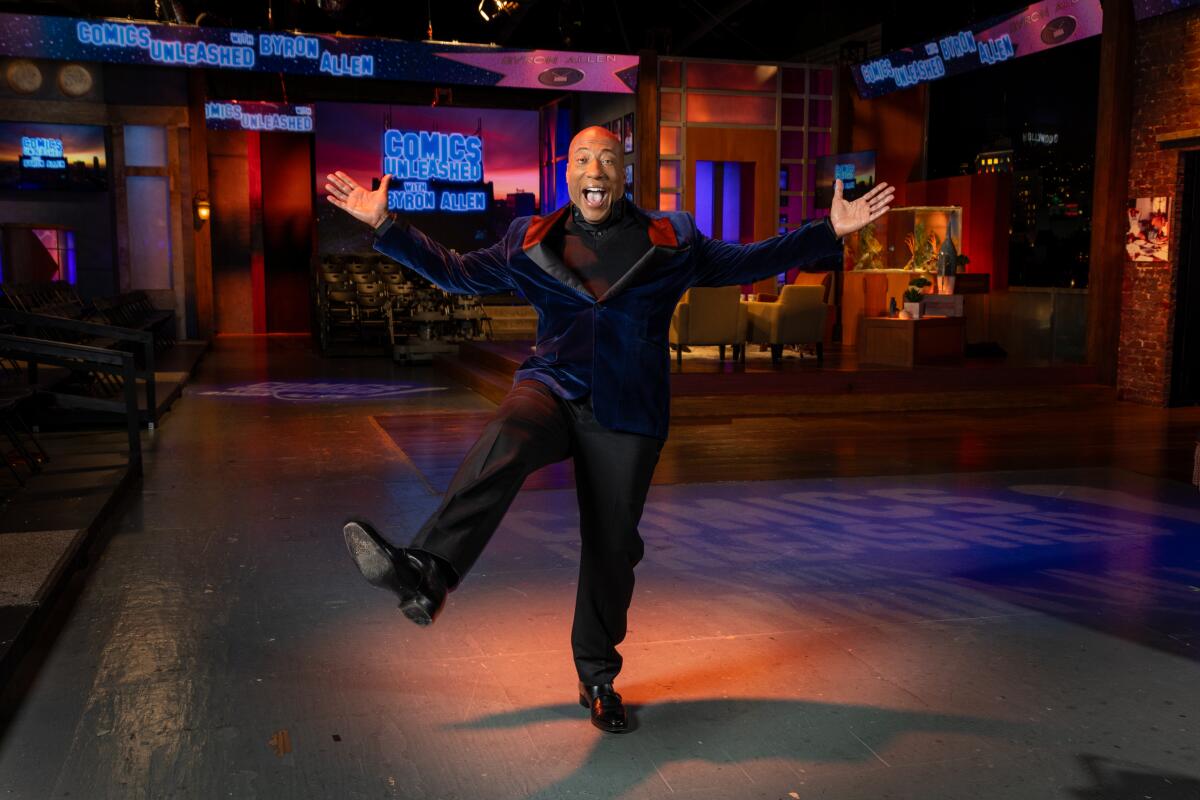
Media mogul Byron Allen at his studio on the set of “Comics Unleashed” in Culver City.
(Jason Armond/Los Angeles Times)
A relentlessly driven, shrewd dealmaker and entrepreneur, Allen is used to defying skeptics and seeing opportunity in assets overlooked by others. He was one of the first entertainers to recognize that there was more money to be made in owning your content, rather than just performing it.
Over the last three decades, he has built a multibillion-dollar business, Allen Media Group, which now has 2,000 employees across various media properties.
In addition to creating a trove of accessible, family-friendly programs, he’s taken a number of big, bold swings, buying up distressed assets that now span broadcast, cable, streaming and film distribution.
At times, he appears like a minnow trying to swallow a whale. Although many deals have landed, others, such as his bids for ABC, BET, Paramount Global and Tegna, have not.
“He’s had misses, but that doesn’t stop him from going to bat,” said Lloyd Greif, president and chief executive of Greif & Co., a Los Angeles-based investment bank.
After a major restructuring that began two years ago during which the company laid off staffers and sold off properties, Allen is back with a slew of ambitious acquisitions. In addition to owning CBS’ late-night block, he also took over the 12:35 a.m. slot with his comic game show, “Funny You Should Ask.” He declined to reveal how much he paid for that airtime.
Allen recently snapped up controlling interest in the digital media company BuzzFeed (including HuffPost) for $120 million and bought a 10.7% stake in cable channel Starz for $25 million.
Although Allen’s programming has been dismissed as low-budget, apolitical comedy, and his finances have been questioned by some, he remains undaunted by doubters.
“I like to say I’m a 65-year-old overnight success.” And he remains focused on his mission, even proclaiming he is “building the world’s biggest media company.”
An entrepreneurial streak
Allen was born in Detroit, where his grandparents owned a roller rink where he worked as a floor guard. Being surrounded by a family of factory workers and the legacy of 20th century American industry set the stage for his entrepreneurship. “I didn’t play sports; I played office,” he said.
At age 7, after his parents’ divorce, Allen moved to Los Angeles with his mother, Carolyn Folks. It was the summer of 1968 and they planned a two-week vacation. But Detroit was in flames following the assassination of the Rev. Martin Luther King Jr., and they stayed.
Folks put herself through UCLA and eventually worked her way up at NBC from an intern to a publicist, a move Allen credits with changing the trajectory of their lives. His mother couldn’t afford child care, so Allen often accompanied her at the studio, where he soaked up tapings of “Sanford and Son” and “The Tonight Show.” After Johnny Carson finished filming and the studio was empty, Allen would sit at his desk, mimicking the legendary late-night host.
At 14, he convinced his mother to let him do stand-up at the Comedy Store on Sunset Boulevard.
“There were literally four people and 200 chairs. And I said, ‘I have to figure out how to make these chairs laugh.’”
A writer for Jimmie “J.J.” Walker, who was starring on the groundbreaking Norman Lear hit comedy “Good Times,” caught his act. He hired Allen to write jokes for Walker along with a pair of yet-to-be discovered comics: Jay Leno and David Letterman. Allen earned $25 a joke.
Howie Mandel met Byron Allen when they were both starting out at The Comedy Store.
(Allen Media Group)
“Most people in my business wait for other people to give you an opportunity,” said Howie Mandel, the actor and comic who met Allen when they were starting out at the Comedy Store during this period. “Byron and his mom constantly made their own opportunities.”
In 1979, when Allen was 18, he became the youngest comic to appear on “The Tonight Show.” Like a shot out of a cannon, the performance catapulted his career.
While various offers poured in, Allen chose the NBC prime-time series “Real People” as a host and correspondent. It was an embryonic version of reality TV. Allen traveled around the country showcasing quirky, heartwarming stories. The hit show brought Allen to every pocket of America. It also made him a star, delivering him to the country’s living rooms each week.
He continued to tour, doing stand-up and serving as the opening act for such musicians as Lionel Richie and Dolly Parton, and starred in TV movies.
Allen became a hero to young, Black entertainers who were just starting out. Among them was Eddie Murphy, who has called Allen “one of my first inspirations.”
“He just loves comedians,” said Whitney Cummings, co-creator and executive producer of the hit CBS sitcom “2 Broke Girls.” She recalled crucial career and financial advice Allen gave her after she first appeared as a young comic on “Comics Unleashed.” “It gave me like a true north. It changed my life.”
Whitney Cummings says Allen helped her early in her career.
(Troy Conrad)
As Allen’s success swelled, he said, he realized the industry was what he calls “business show, not show business.”
“You need to know the business side and learn the business side and then you can do as many shows as you want. And I knew that I didn’t want to work for anybody,” he said.
While on “Real People,” he sat in on sales meetings and went to the National Assn. of Television Programming Executives, where he introduced himself to Al Masini, the syndication trailblazer who produced “Entertainment Tonight” and “Star Search.”
“I understand you’re the best. I’m here to learn from you,” Allen said.
In 1989 he began hosting the syndicated “The Byron Allen Show.” Two years later, he created BYCA Television Distribution to take over his talk show’s distribution and syndicate other shows.
But Allen and his new company were soon facing legal and financial issues. A group of former employees and an investor sued, claiming they had not been paid. The dispute forced the company into Chapter 7 bankruptcy.
Allen pressed on. He had absorbed another key lesson.
Learning from Richard Pryor
When he was still hanging out at the Comedy Store, he watched Richard Pryor trying out new material.
Iconic comedian Richard Pryor.
(Bettmann / Bettmann Archive)
“He would bomb night after night for almost three months,” Allen said. “I’ll never forget, he told me, ‘Byron, you’re only as good as you dare to be bad.’ I learned, OK, take risks. It’s about growing and taking chances.”
In 1993, Allen launched CF Entertainment on his dining room table in Los Angeles. The production company, later Entertainment Studios, became the foundation of his media empire. He focused on producing low-cost, syndicated programming, including interview series and court shows. Allen produced and often served as host.
His first show, “Entertainers With Byron Allen,” packaged the five-minute celebrity interviews during hotel press junkets, a conveyor belt of actors promoting their latest projects set up by the studios into an hourlong talk show.
Allen bartered the show for free to TV stations in exchange for a split of the revenues from selling commercials to advertisers. Success was not immediate. He said he received countless rejections at first.
“My house went in and out of foreclosure probably 14 times,” he said. At one point, he said, his telephone service was turned off, forcing him use a pay phone for calls.
But the format established the template for what became Allen’s highly successful business. Forbes has estimated his net worth in the billions. Allen declined to discuss his personal or business finances.
The mogul now owns multiple homes, including a $91.3-million mansion in Aspen, Colo., that was recently featured in the Wall Street Journal.
“A lot of people didn’t take him seriously and saw him as a comedian,” said Joan Robbins, Allen’s first employee, who has stayed on for 32 years as president of talent relations. “I don’t think anybody realized the extraordinary business sense he had.”
Byron Allen gets final touches at his studio on the set of “Comics Unleashed.”
(Jason Armond/Los Angeles Times)
As Allen’s media ambitions have expanded beyond comedy and syndicated talk shows, so has his company. It produces, distributes and sells advertising for 74 television programs (“Mathis Court With Judge Mathis” and “Career Day” among them) as well as owns 13 broadcast stations affiliated with the major networks in 11 markets and several dot-TV cable and digital networks including Cars.TV, Automotive.TV and Comedy.TV.
In 2016, he acquired the Black entertainment platform TheGrio and later purchased the assets of the Black News Channel out of bankruptcy for a reported $11 million, merging its TV assets and carriage deals into TheGrio’s network.
A year earlier, Allen made waves by filing the first of several multibillion-dollar racial discrimination lawsuits to tackle what he called the “trade deficit between Black America and white corporate America.” His case against Comcast for not carrying Allen-owned stations and networks reached the Supreme Court before being settled.
“I feel good about starting that conversation … because we were going in circles and we were definitely suffering from economic genocide,” he said.
In 2018, Allen’s company bought the Weather Channel and the streaming service Local Now for $300 million. His firm also announced it had raised $500 million in credit facilities organized by Deutsche Bank Securities, Jefferies Financial Group, Brightwood Capital Advisors and Comerica Bank to finance production and other acquisitions.
What unites these disparate assets? “We’re directed at where the viewers are,” he said. “That’s where we’ll be.”
But in his tireless push to expand his sprawling company, Allen has made several failed bids for high-profile assets.
In 2023, he offered Disney a reported $10 billion for ABC and some of its cable networks, and the following year bid $30 billion for Paramount Global. He also made plays for Tegna and BET.
None of his offers succeeded, prompting skepticism about his ability to finance such deals. Allen Media Group is wholly owned by the entrepreneur.
Allen dismissed such concerns. “I raised the money to buy the Weather Channel in one day,” he said. “There’s trillions of dollars looking for really good executives and really good deals. I have no problem raising capital.”
The Times viewed multiple letters from private equity firms and banks. Several indicated that Allen had financial backing on the deal to buy BET, and another showed he had $4 billion in funds to back the purchase of Paramount assets.
Over the years, former employees have criticized some of Allen’s employment practices. In 2012 he faced a class-action suit from performers and staffers on “Comics Unleashed” who alleged they were not paid residuals or reimbursed for travel and other expenses. The suit was settled in 2023.
Allen called the suits “frivolous,” saying, “I couldn’t be in business if I actually conducted myself that way.”
Last year, Allen came under fire after announcing sweeping cuts at about two dozen local affiliates that included laying off meteorologists, part of a reorganization to centralize forecasts at the Weather Channel in Atlanta. The move sparked viewer outrage and the plans were reversed.
The controversy came as Allen’s company was retrenching. He sold off about a third of the TV station portfolio for $171 million.
Allen said this was a case of “rightsizing,” paying down debt and investing more in digital. “I sold 10 of my ABC, NBC, CBS and Fox affiliates to Gray [Media] at a great price for us and a great price for them.”
Allen confirmed he is negotiating with lenders over substantial debt payments coming due in the next year, but said he is “highly confident they will get refinanced or extended.”
Shortly after he bought a stake in Starz, Allen announced his intentions to own the cable channel. Starz responded by adopting a poison pill.
“Good luck,” he said. “I still plan to take over Starz, and I will eventually get control of Starz.”
“The Listeners,” which premieres Friday on Starz, began unusually as a story written by Jordan Tannahill as the basis of Missy Mazzoli‘s 2022 opera, also called “The Listeners” (libretto by Royce Vavrek), which he turned into a 2021 novel, which became a 2024 BBC television series, also written by Tannahill. Starz has cut its original four episodes into five, which means that they end in odd places, but given its controlled, glacial pace, shorter might be better.
Tannahill’s inspiration is an unexplained phenomenon reported in the real world — though exactly how real it is is open to interpretation — generally called “the hum,” where people experience a low but persistent background noise inaudible to others. (It isn’t tinnitus, or any diagnosable medical condition.) One such sufferer is Claire (Rebecca Hall), a high school literature teacher with a husband, Paul (Prasanna Puwanarajah) and a teenage daughter, Ashley (Mia Tharia), with whom she gets along well. We begin on an up note, Claire and Ashley singing along to Richard and Linda Thompson’s “I Want to See the Bright Lights Tonight” as they drive to school (she also has Nick Drake on her phone). And then the 1970s British folk rock gives way to a less pleasant auditory landscape, as the hum appears, bringing on headaches and nosebleeds and affecting her concentration and mood, her work and family.
Any condition can be isolating from those who don’t share it, and Claire gets some relief when she’s approached by a student, Kyle (Ollie West), who also hears it. They go investigating possible sources of the sound — wind turbines, a radio telescope — and wind up eventually at something like a support group for hum-hearers run by Omar (Amr Waked) and Jo (Gayle Rankin). There is some sketchiness in their past, including a changed identity, and they like to keep the group on a tight rein, but the breathing exercises and visualizations seem pretty standard, and more benign than, say Scientology, and the suggestion that one may tame an affliction by embracing it is pretty reasonable. Claire’s mistake here is not to get a signed parental permission slip, as it were, or enlist a chaperone, and her growing closeness with Kyle (not romantic, not sexual we are assured) will cause them trouble, cost Claire her job and mess up her marriage. She makes some insufficiently careful decisions, but those around her tend to overreact. This is very much a story about listening and not listening.
Directed by Janicza Bravo and photographed with great intention by Jody Lee Lipes, it has the studied look and tempo of a 20th-century art film. (It is always great to look at.) I was reminded of Antonioni’s “Red Desert” and Bergman’s “Persona,” psychological studies of women going to pieces, but also, thematically, of Spielberg’s “Close Encounters of the Third Kind,” with its characters driven to what looks like madness by private bulletins from the ether, pushing them away from family and toward others who are getting the same message. No aliens here — not a spoiler — though I might have liked that ending more than this, which in its own way seems to drop from space.
You can look for metaphors and social comment here — there are references to conspiracy theories and industrial noise pollution and such — but it seems to me to operate most effectively as a beautifully rendered mood piece and character study, and, certainly in the case of Hall, whose story this is, a platform for some exquisitely subtle acting.
WASHINGTON — President Trump said Friday that a “swift and lethal kinetic” U.S. strike has killed Hector Rusthenford Guerrero Flores, whom he called “the infamous leader” of the Tren de Aragua gang.
Tren de Aragua has been labeled by the United States as a terrorist organization. Guerrero Flores was charged in a New York federal court with racketeering conspiracy and other crimes, including lending support to terrorists in crimes that stretched more than a decade, authorities announced in December.
Defense Secretary Pete Hegseth posted on X that the strike occurred earlier in the week on a Tren de Aragua compound in Venezuela.
U.S. Atty. Jay Clayton alleged at the time that the gang is responsible for countless acts of violence, extortion and drug trafficking in North America, South America and Europe. Trump nominated Clayton on Thursday to be director of national intelligence.
The U.S. State Department had offered rewards of up to $5 million for information leading to Guerrero Flores’ arrest.
In a post on his social media site, Trump wrote, “Tren de Aragua terrorists no longer have safe haven in Venezuela or anywhere else and, under my leadership, we will find these vicious murderers and drug lords anytime, anyplace, and send them to the depths of hell where they belong.” Trump’s post referred to Guerrero Flores by his alias, Niño Guerrero.
Hegseth said, “The operation underscores the shared U.S. and Venezuelan commitment to take the fight to narco-terrorists and deny them any safe haven in our hemisphere.”
Venezuela’s ministry of communications did not immediately respond to a request for comment on the operation.
Trump has taken a series of extraordinary actions against the gang, including a series of strikes on small boats his administration has accused of smuggling drugs to the U.S.. At least 207 people have been killed in boat strikes by the U.S. military in the eastern Pacific Ocean and Caribbean Sea since the Trump administration began the campaign in early September.
Independent investigations, by the Associated Press and others, have raised questions about the boat passengers’ alleged connection to drug trafficking. And, in any case, many legal experts say the boat attacks amount to extrajudicial killings in violation of international law.
Trump and administration officials have consistently blamed Tren de Aragua for being at the root of the violence and illicit drug dealing that plague some U.S. cities. The president spent months repeating the claim — contradicted by a declassified U.S. intelligence assessment — that Tren de Aragua had operated under Venezuelan President Nicolás Maduro’s control. The U.S. invaded Venezuela and seized Maduro in January to face U.S. drug charges.
Tren de Aragua originated more than a decade ago at an infamously lawless prison in Venezuela’s central state of Aragua. The gang has expanded in recent years as millions of Venezuelans migrated to other Latin American countries or the U.S. in search of better living conditions.
Guerrero Flores returned to the prison in Aragua on murder and other convictions in 2013, when Venezuela’s crisis began and corruption, mismanagement and a drop in crude prices wrecked the oil-dependent economy. Guerrero Flores and a few other inmates saw a profitable opportunity as the government neglected prisons.
They assumed control and administration of the prison, establishing a system that controlled the entire inmate population through force and extortion. Over time, they transformed the lockup into a sort of city that included a zoo, baseball field, casino and restaurants. Guerrero Flores had his own lavish suite.
The size of the gang is unclear. Countries with large populations of Venezuelan migrants, including Peru and Colombia, have accused the group of being behind a spree of violence in the region. Still, unlike other criminal organizations from Colombia, Brazil and Central America, Tren de Aragua has no large-scale involvement in smuggling cocaine across international borders, according to InSight Crime, a think tank that tracks crime across Latin America.
In Venezuela, gang leaders have long been known to participate in various illegal activities, including illicit gold mining.
Weissert writes for the Associated Press. AP writer Regina Garcia Cano in Mexico City contributed to this report.
Xavier Becerra’s campaign for California governor appeared doomed just two months ago. Every major opinion poll showed the longtime Democratic politician mired near the bottom of the pack, overshadowed by his flashier or wealthier rivals.
Now Becerra tops them all, according to the most recent opinion polls, emerging as a surprise front-runner in a race that has confounded voters and political experts alike.
Both his loyal supporters and well-financed critics have a hard time explaining Becerra’s rapid ascent, with theories ranging from outright luck to a nefarious social media push. Others credit Becerra’s mild temperament, describing him as a steady figure — the Goldilocks candidate in a field of competitors who weren’t just right.
Becerra, when assessing his sudden rise, believes voters wanted experience, not “glitz and sizzle.”
“Folks put their faith in someone who’s done that kind of work and achieved results, someone who’s taken on real crises and been able to pull us out of them,” Becerra said in an interview Friday after a union rally in the Inland Empire. “Now it’s time to get things done. I think they’re looking for someone who could actually do that.”
Becerra’s team also points to the fortuitous timing of their seven-figure political ad campaign that launched shortly before explosive allegations of sexual assault and misconduct against the then-leading Democrat in the race, former Rep. Eric Swalwell. After Swalwell suspended his campaign on April 12, Becerra’s ascent began.
Becerra is backed by 25% of likely California voters, followed by Republican Steve Hilton at 21% and environmental activist Tom Steyer, a fellow Democrat, at 19%, according to a new UC Berkeley Institute for Governmental Studies poll co-sponsored by the Los Angeles Times. Two months ago, before Swalwell dropped out of the race, support for Becerra registered at just 5%.
“It’s almost too good to be true,” said Carrie Webster, a Becerra supporter and Long Beach hairdresser who interviews political candidates on social media using the name “Crowd Source Carrie.”
“He shot through the roof, but it feels like it’s all organic,” said Webster, 49, who said she isn’t paid for her political work.
A Sacramento resident, Becerra, 68, served one term in the state Legislature, more than two decades as a Los Angeles congressman and then as California attorney general, and most recently worked as the secretary of Health and Human Services in the Biden administration.
His only previous statewide race was his 2018 bid for attorney general. In that contest, which he won handily, he had the major advantage of incumbency after being appointed by Gov. Jerry Brown to fill the vacancy caused by then-Atty. Gen. Kamala Harris’ election to the U.S. Senate.
Running for governor has proved to be much more daunting. His top Democratic challengers not only include Steyer, a free-spending billionaire, but also former Los Angeles Mayor Antonio Villaraigosa, current San José Mayor Matt Mahan, former Orange County congresswoman Katie Porter and state Supt. of Public Instruction Tony Thurmond.
In early March, the chair of the California Democratic Party, Rusty Hicks, urged stuggling candidates to drop out of the race. He feared the crowded field of candidates would splinter the party’s voters and lead to a Republican being elected as the next governor of California.
Under the state’s top-two primary system, only the first- and second-place finishers in the primary advance to the November election, regardless of party. While Hicks did not mention Becerra by name, he was certainly among the struggling candidates at the time.
Until now, Becerra’s splashiest moment was in late March, when he launched a public pressure campaign to boycott a gubernatorial debate hosted by USC after he and other candidates of color were excluded from lineup. University officials based the invites on opinion polls and a controversial campaign fundraising formula. The debate was canceled less than 24 hours before it was scheduled to take place.
Then came the allegations against Swalwell, which prompted nationwide interest in the otherwise sleepy California governor’s race. Political data strategist Paul Mitchell compared the moment to a dramatic scene midway into a “Real Housewives” season.
“Finally, somebody flipped a table, threw wine on somebody else, and all the voters started paying attention,” he said.
Alf LaMont worked for Swalwell’s team as a digital communications expert until his firm quit on April 10 following news reports about the allegations against the East Bay Democratic congressman.
LaMont said he was “doomscrolling” that same night when he saw an “organic, random” push for Becerra on Threads and other social media sites. LaMont said he immediately called Becerra’s campaign team and signed up to work for him.
Webster, the Long Beach content creator, also noticed the online buzz about Becerra.
“People were saying, ‘Let’s print out yard signs, T-shirts,’” Webster said. “Or someone would say, ‘I’m going to start Gen X for Becerra,’ or ‘I’m going to start Millennials for Becerra.’”
The push was so noticeable that Steyer’s campaign hired an intelligence agency with ties to a major Israeli firm to study the trend.
The agency’s report found about 3,000 fake accounts that amplified Becerra across social media platforms X, Facebook and Instagram while also criticizing Steyer, according to Steyer’s team. In all, the fake accounts generated 1.3 million views and 42,000 engagements, the report stated.
Steyer spokesperson Kevin Liao alleged a coordinated network from Becerra’s team or his supporters. Becerra’s campaign denied any role and dismissed the influence of the fake accounts.
Earlier opinion polls also offer a possible explanation for Becerra’s rise.
Even as he remained stuck behind other candidates in support among voters, Becerra’s favorability ratings versus his unfavorability ratings were better than rivals, including Porter and Villaraigosa.
Swalwell also had high favorability ratings, and when he dropped out, Becerra was “seen as the least objectionable of the candidates that were remaining,” Mitchell said.
The UC Berkeley Institute poll released Thursday shows more likely voters viewed Becerra favorably (44%) than unfavorably (38%). By contrast, 39% of voters viewed Steyer favorably and 43% unfavorably.
Becerra’s campaign credits part of his April surge to good fortune. His team unleashed a large advertising buy — a major chunk of his remaining campaign funds — placing spots on cable TV and online beginning in late March.
The timing was opportune given the chaos caused by Swalwell.
Becerra’s ads depicted him as calm and experienced. One showed him speaking to a diverse group of young people about his record of challenging President Trump, suing his administration more than 100 times when he served as attorney general, and his plan to bring down the cost of living for “the next generation.”
At the same time, LaMont’s team — which also is behind Gov. Gavin Newsom’s political communications — created a more “earthy” and “grassroots” look to Becerra’s campaign ads and messaging. Words like “Tio” and “carne asada” emphasized the candidate’s Latino heritage.
Polls done in the wake of Swalwell’s exit showed Becerra gaining ground.
Special interest groups, including California Medical Assn., which had supported Swalwell, switched to Becerra. A well-financed, independent political committee campaigning against Steyer — an effort intended to benefit Swalwell — also moved over to Becerra. Major corporations, including Chevron, Meta and McDonald’s, lined up next.
Becerra appeared unprepared for the speed at which voters and others gravitated toward him. He stammered through hastily filmed videos asking for small-dollar donations as his campaign sought to convert the new interest around him into donors.
He appeared stiff during his first post-Swalwell debate appearance; he mistakenly referred to Trump’s “war in Iraq” instead of Iran during his first answer and fended off the first of many attacks to come during an April 22 debate. During a sit-down interview with a KTLA-TV reporter in Los Angeles in early May, Becerra went immediately on the defensive — questioning whether it was a “gotcha piece.”
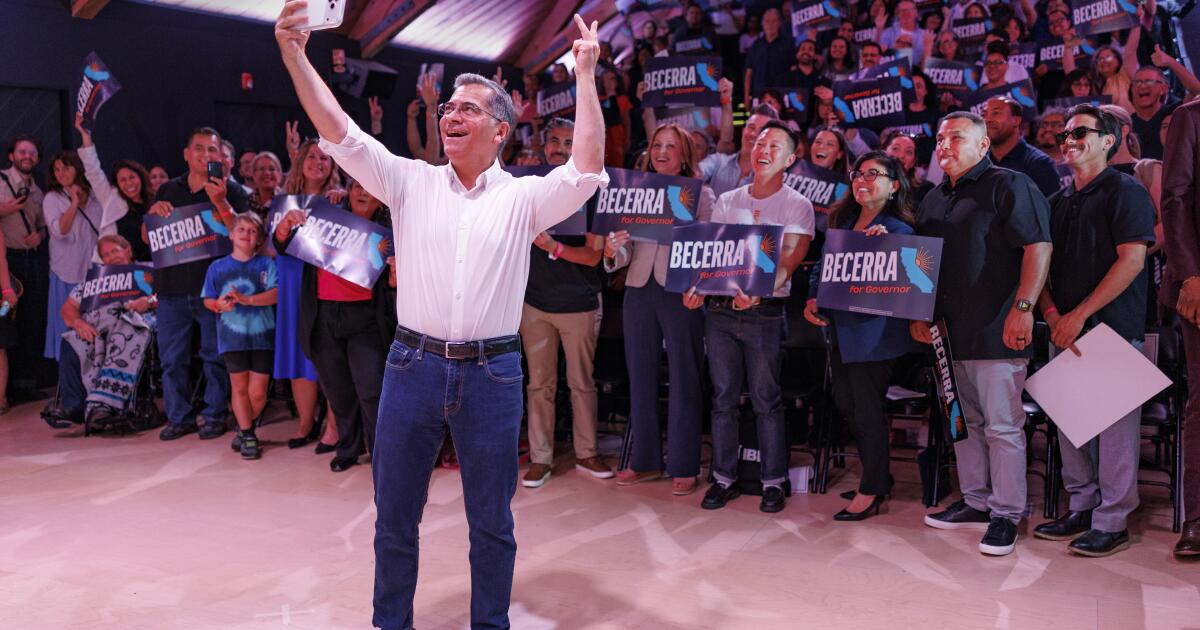
Still, people flocked to town halls, including one in Oxnard in May, where he leaned into his “bad dad joke” persona. He greeted the large crowd with his corny, familiar line, “Did you think you were coming to a Bad Bunny concert?”
Oxnard audience member Rose Castren, 68, told The Times she liked Becerra’s “calm and reassuring” style. The retired nurse watched the CNN debate in early May, where the candidates piled on Becerra to try to undercut his momentum.
“The other candidates seemed to be coming unglued,” she said. “And he didn’t.”
Times staff writer Seema Mehta contributed to this report.
Politics is about persuasion and emotion, not rocket telemetry, so it’s not hard to figure out what’s going on.
“You look at Xavier and he seems to be perceived as a thoughtful, credible, trustworthy choice. That’s what I hear when I talk to regular people who aren’t political insiders,” said Darry Sragow, a Democrat strategist who’s spent decades running California campaigns. “So you see the people who want to take him out going after one of the words I just used here, which is ‘trustworthy’ and, to some extent, ‘credible.’”
A recent Steyer mail piece — which, naturally, features a grim-faced portrait of Becerra — accuses him of “mismanagement,” “scandal” and “incompetence,” and cites a 2024 quote from Susan Rice, a former Biden domestic policy advisor, describing the ex-Cabinet member as an “idiot.” (Apparently “bitch-a—,” another Rice epithet from the same Axios news report, was deemed unsuitable.)
The mail piece also quotes Xochitl Hinojosa, a Justice Department spokesperson in the Biden administration, saying Becerra “was not effective in government,” though several people who worked in the White House could not think of any occasion, or any reason, Hinojosa would have meaningfully interacted with Becerra.
Pretty weak sauce. But at least Hinojosa, who delivered her gibe on one of CNN’s talking-head shows, was willing to publicly attach herself to the criticism.
Six former Biden administration officials were quoted by Politico “reacting with a mix of incredulity, mockery and resignation” to Becerra’s sudden ascendance in the governor’s race. Critics also unloaded to NBC News and other outlets. All of them spoke anonymously.
Therefore, it’s impossible to discern their motivations. Jealousy? Ego? An attempt to stay politically relevant?
Or maybe Becerra was, indeed, a feckless, flailing and thoroughly awful Cabinet member, deserving of scorn and shame.
Ron Klain, who was Biden’s chief of staff during the first two years of his presidency, doesn’t believe so.
“I think he did an excellent job as HHS secretary and I think the record shows that,” Klain said, citing, among other accomplishments, Becerra’s work helping negotiate a drop in the price of prescription drugs and expanding healthcare coverage under the Affordable Care Act.
On COVID-19, Becerra “wasn’t confirmed until several months into the Biden administration. Dr. [Anthony] Fauci had been on the job and was quite a well-known figure to Americans. So, of course, he became more the face of the COVID response.”
“On immigration,” Klain went on. “Xavier’s part was small and discreet. He wasn’t the secretary of Homeland Security. He didn’t run the border. He oversaw an office called the Office of Refugee Resettlement” responsible for processing children who crossed the border alone. “I was in meetings where he was a passionate and forceful advocate for these minors,” Klain said.
Still, there are legitimate questions, notwithstanding Becerra’s deflections — Trump! MAGA! Trump! — about his handling of the migrant children, some of whom died, suffered horrible abuse or were catastrophically injured, according to revelatory reporting by the New York Times. It’s worth noting, however, that Becerra inherited a plan to deal with unaccompanied minors that was drafted and phased in by Rice and her Domestic Policy Council.
There is an unhappy history between the two; apparently Becerra was not alone in drawing Rice’s ire. In 2022, an article in the American Prospect accused her of creating an “abusive and dehumanizing workplace,” in which Rice routinely berated others, including the Health and Human Services secretary.
On social media, Rice has made no secret of her continued contempt for Becerra, a display that carries no small whiff of ax-grinding and score-settling. She highlighted the refusal of Biden’s Homeland Security chief, Alejandro Mayorkas, to endorse Becerra in the governor’s race, though it would be surprising if Mayorkas, Biden, Kamala Harris or any high-level Democrat picked a favorite in such a fiercely contested primary.
Becerra “had big things to do and he got them done,” said Neera Tanden, who succeeded Rice as head of Biden’s Domestic Policy Council and has vigorously defended Becerra against attacks on social media.
“I am not on or coordinating with the Becerra campaign,” Tanden said. “I just know these attacks are ridiculous.”
If Becerra makes it past Tuesday’s primary to the November runoff, his career merits careful scrutiny — and not just those years spent in the Biden Cabinet. Many voters are still getting to know Becerra, who is the likeliest candidate to be California’s next governor. Anonymous quotes, drive-by commentary and incendiary mailers may be standard campaign fare. But voters deserve better.