order

Trump plans to appeal order allowing all U.S. companies that paid illegal tariffs to seek refunds

American businesses big and small have started receiving tariff refunds after the U.S. Supreme Court ruled that President Trump lacked the constitutional authority to impose higher import taxes on goods from nearly every other country.

The process could grind to a halt, however, after the Trump administration said Friday that it intended to appeal a federal judge’s order to allow all companies that paid the illegal import taxes to seek refunds, not just the ones that filed lawsuits.

Until the Department of Justice informed the judge of its planned appeal, the refund system overseen by U.S. Customs and Border Protection had been working fairly smoothly. Refunds reached the bank accounts of the first successful applicants on May 12, about three weeks after American importers and their customs brokers could start submitting claims through an online system, according to CBP.

Applications for refunds totaling $85 billion — more than half of the $166 billion the agency estimated the government owes to companies that paid the illegal tariffs on imported goods — were accepted for processing as of May 22, CBP reported in a legal filing earlier in the week. It said it had so far directed the Treasury Department to issue $20.6 billion in refunds.

The administration revealed its appeal preparations while objecting to a demand by Judge Richard K. Eaton for CBP Commissioner Rodney Scott to appear in the U.S. Court of International Trade to answer questions about how long it would take to repay all 330,000 importers that might be eligible for refunds. The judge has scheduled a June 9 hearing on why he shouldn’t require the government do whatever it takes to speed up the process.

Justice Department lawyers asked Eaton to allow one or two of Scott’s deputies to appear in his place, arguing that as a high-ranking presidential appointee, the CBP chief could not be compelled to testify in court. They also argued that Eaton exceeded his own authority when he determined in March that the Supreme Court’s ruling entitled “all importers of record’’ to refunds.

“For that reason, defendants intend to appeal the court’s universal injunction,” the lawyers wrote, adding that CBP would continue to move “as quickly as it can to process refunds in a phased approach” for businesses that filed some 485 pending trade court complaints to assert their rights to refunds.

In a terse reply Friday, Eaton said he needed to hear directly from Scott whether the government would return all of the money it collected between when Trump imposed what he called “reciprocal” tariffs on goods from most countries in April 2025 and when the Supreme Court struck them down in late February.

“This case involves $166 billion,” the judge wrote. “It is undisputed that the remedy for this unlawful collection is for the United States government to refund the unlawfully collected duties.”

Some national retail chains said they planned to use their tariff refunds to lower customer prices on some items. Walmart Chief Financial Officer John David Rainey told analysts last week that the company would implement price cuts even though the maximum refund it might be eligible for represented less than half of 1% of Walmart’s $483 billion in annual U.S. sales.

Some smaller companies told the Associated Press that the partial refunds they’ve received so far would go toward paying remaining or future tariffs, reducing debt or just keeping the lights on after more than a year of uncertainty and additional import costs.

Jay Foreman, chief executive of toy company Basic Fun, said he received about $450,000, or 7% of his total claim, over two consecutive days this month. He took the initial repayment as a positive sign but said that after having less than $10,000 refunded since then, the process seemed like a “total slow roll.”

“It’s time to release the funds back into the economy, especially given how much we and others need these funds to support our businesses and fund our operations,” Foreman said.

Anderson writes for the Associated Press.

Source link

Judge refuses to block Trump order to limit mail voting

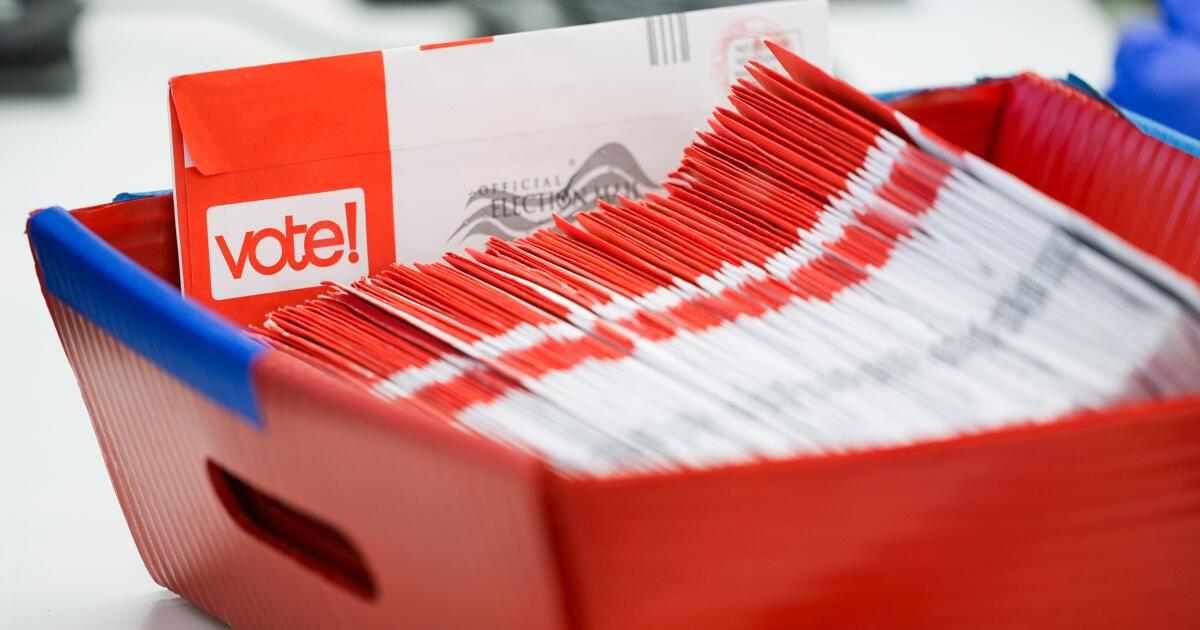
A federal judge has declined to halt President Trump’s executive order creating a federal voter list and limiting mail voting, clearing the way for potential sweeping changes in how American elections are run shortly before this year’s midterm elections.

U.S. District Judge Carl Nichols, a Trump appointee in Washington, late Wednesday rejected the request by Democrats and civil rights groups that had argued Trump’s order would likely be found unconstitutional because the states and Congress, not the president, have the power to set election rules. Nichols agreed with the Republican Trump administration’s contention that it was too early to block the order because it has yet to be implemented.

Nichols’ ruling leaves the door open for further challenges when the Trump administration moves to implement the president’s directive. A separate lawsuit seeking to block the executive order is underway in Boston. No matter how rapidly the administration acts, no voting changes are expected during primary elections, which continue into next month.

“The Court recognizes that the Postal Service may ultimately issue a final rule that directly affects Plaintiffs or their members, or that the Government may develop State Citizenship Lists that omit specific individuals due to particularized flaws,” Nichols wrote. “Plaintiffs may, of course, renew their motions if and when those future actions occur. Until then, however, Plaintiffs cannot show that preliminary injunctive relief is warranted.”

The Trump administration has yet to formally issue lists of eligible voters, and those who filed the initial request for a temporary halt said they’d be back if the administration moves in that direction.

“We are ready to resume the fight if and when the administration takes those next steps,” said Juan Proaño, chief executive officer of the League of United Latin American Citizens, one of the organizations that sought the stay from Nichols.

Trump issued the order in March after a bill he supported to overhaul voting stalled in Congress. The order would have had the federal government create a list of eligible voters and then directed the U.S. Postal Service to deliver mail ballots only to those on the list. Election officials argued it was ripe for abuse and could cause chaos, and the postal union has objected to the idea of mail carriers policing ballots.

Since his 2020 presidential election loss to Democrat Joe Biden, Trump has groundlessly claimed mail voting is rife with fraud and has launched a federal investigation into that year’s vote, even though repeated audits and investigations, including ones run by Republicans, found it was free of widespread fraud. Trump also has said he wants to “take over” election administration in Democratic areas.

Democrats and civil rights groups argued it was urgent that Nichols issue a restraining order in the midst of primary season and with states already gearing up for the fall midterm elections.

This was Trump’s second executive order seeking to overhaul elections and voting. His initial election executive order, issued just months after he took office in his second term, has been blocked by multiplefederal judges. That order sought to require documentary proof of citizenship to register to vote, among other changes.

Riccardi writes for the Associated Press.

Source link

Pro-Palestinian activist Mahmoud Khalil wants Supreme Court to weigh in on deportation fight

Former Columbia University graduate student Mahmoud Khalil will ask the U.S. Supreme Court to intervene after a federal appeals court on Friday declined to reconsider a decision that put the government a step closer to deporting him, the pro-Palestinian activist’s lawyers said.

Judges on the 3rd U.S. Circuit Court of Appeals in Philadelphia voted 6-5 against having the court’s full complement of judges review the ruling. In January, a three-judge 3rd Circuit panel found that a federal judge in New Jersey who had sided with Khalil and ordered his release last year from immigration detention didn’t have jurisdiction to decide the matter.

The American Civil Liberties Union, which is involved in representing Khalil, said his lawyers will ask the 3rd Circuit for an order preventing the decision from taking effect — and barring Khalil from being detained or deported — while it asks the Supreme Court to take up the case.

An appeal to the high court is expected in the coming months, possibly in late summer.

“Today’s decision is not the final word, and we still strongly believe in our arguments going forward,” ACLU senior counsel Brett Max Kaufman said in a statement.

In its January ruling, the 3rd Circuit found that Khalil’s lawsuit challenging his detention and U.S. District Judge Michael Farbiarz’s subsequent rulings in the case were premature because federal law requires that such challenges first move through the separate immigration court system. That system is part of the Justice Department, not the judicial branch.

The decision didn’t decide the key issue in Khalil’s case: whether the Trump administration’s effort to throw Khalil out of the U.S. over his campus activism and criticism of Israel is unconstitutional.

Judge Cheryl Ann Krause, who had voted for the 3rd Circuit to review the decision, wrote in a dissent that the court was “abdicating our duty to meaningfully review Khalil’s constitutional claims. The Judicial Branch, she wrote, cannot fulfill its role as a check on the other branches of government, “if we write ourselves out of relevance and leave the Executive Branch to check itself.”

Khalil, 31, has also appealed to the 5th U.S. Circuit Court of Appeals in Louisiana, where he was detained, after the Board of Immigration Appeals upheld his removal order.

Through his lawyers, Khalil argued that the immigration judge who issued the order failed to consider relevant evidence and wrongly upheld a charge that he had misrepresented information on his application for legal permanent resident status. That charge, Khalil’s lawyers said, was brought in retaliation for his protest activity.

The immigration judge suggested Khalil could be deported to Algeria, where he maintains citizenship through a distant relative, or Syria, where he was born in a refugee camp to a Palestinian family. Khalil’s lawyers have said he would face mortal danger if forced to return to either country.

An outspoken leader of the pro-Palestinian movement at Columbia, Khalil was arrested in March 2025. He then spent three months detained in a Louisiana immigration jail, missing the birth of his child.

Federal officials have accused Khalil of leading activities “aligned to Hamas,” though they have not presented evidence to support the claim and have not accused him of criminal conduct. They also accused Khalil of failing to disclose information on his green card application.

Khalil has dismissed the allegations as “baseless and ridiculous,” framing his arrest and detention as a “direct consequence of exercising my right to free speech as I advocated for a free Palestine and an end to the genocide in Gaza.”

The government justified the arrest under a seldom-used statute that allows for the expulsion of noncitizens whose beliefs are deemed to pose a threat to U.S. foreign policy interests. In June 2025, Farbiarz ruled that justification would likely be declared unconstitutional and ordered Khalil released.

President Trump’s administration appealed that ruling, arguing the deportation decision should fall to an immigration judge, rather than a federal court. The 3rd Circuit ruled 2-1 in the administration’s favor.

Judge Emil Bove, who was involved in investigating student protesters while a top Justice Department official, did not participate in the 3rd Circuit vote on whether to review the decision. He later issued an order denying a request by Khalil’s lawyers that he step aside from the matter, calling it moot.

Sisak writes for the Associated Press. AP writer Lindsay Whitehurst contributed to this report.

Source link