Orban

Viktor Orban resigns seat in Hungarian parliament

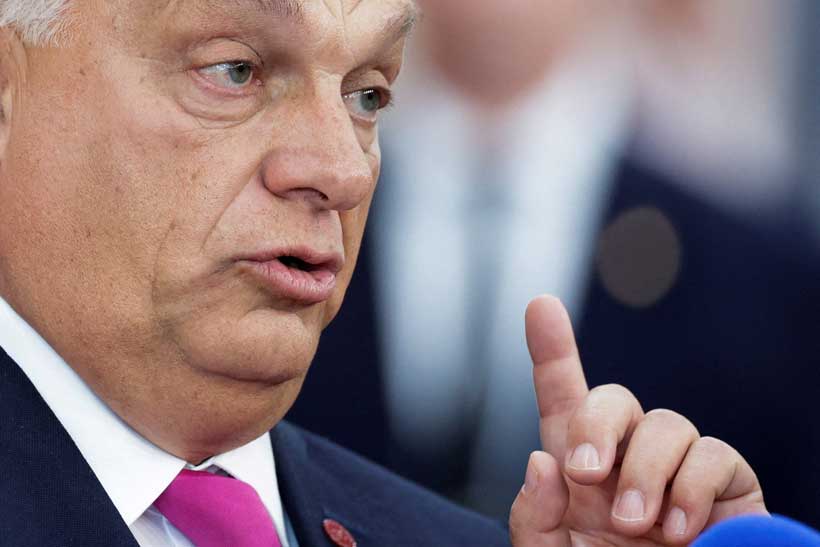
Former Prime Minister of Hungary Viktor Orban, pictured at a meeting at the White House in November 2025, on Saturday announced that he will step down from the Hungarian parliament to focus on rebuilding his party after its landslide defeat in recent elections. File Photo by Aaron Schwartz/UPI | License Photo

April 25 (UPI) — Former Hungarian Prime Minister Viktor Orban on Saturday said he will give up his seat in Parliament to focus on rebuilding his Fidesz-KDNP party after its election losses two weeks ago.

Orban said that he is leaving the parliament to focus on rebuilding the far-right, Russia-aligned party after it secured only 55 seats in Hungary’s parliament in elections on April 12, Politico and The New York Times reported.

Peter Magyar’s Tisza party won 138 of the parliament’s 199 seats in a landslide victory ending 16 years of Orban running the country.

“I am needed not in Parliament but in the organization of the patriotic movement,” Orban said in a video message posted on social media.

“Discussions are in full swing about renewing the patriotic camp, strengthening our parliamentary group and protecting our communities,” he said.

Magyar will take over as prime minister on May 9 and, because Tisza has more than two-thirds of the parliament’s seats, he can undue some of the actions Orban took during his rule, which included cracking down on the media and a host of democratic institutions.

Orban, who was in Hungary’s parliament since 1990 and prime minister since 2010, said he plans to remain in charge of Fidesz and will seek re-election in June to keep the job.

President Donald Trump speaks during a Health Care Affordability event in the Oval Office at the White House on Thursday. Trump announced announced a new drug price deal with Regeneron. Photo by Will Oliver/UPI | License Photo

Source link

Hungary’s Political Shift Ends Orbán Era but EU Reset Faces Deep Political Fault Lines

The election victory of Hungary’s Tisza party on April 12 marks the end of the 16 year rule of Viktor Orbán, a figure who has long defined Hungary’s contentious relationship with the European Union. His tenure reshaped Hungary’s domestic institutions and repeatedly placed the country at odds with EU norms, laws, and political consensus.

The incoming leadership under Péter Magyar now inherits not only a domestic mandate for change but also the complex task of rebuilding trust with the EU after years of institutional confrontation.

A fractured relationship with Brussels

Under Orbán, Hungary frequently clashed with EU institutions over rule of law, judicial independence, media freedom, and migration policy. One of the most controversial measures was the lowering of the retirement age for judges and prosecutors, which critics argued enabled political reshaping of the judiciary.

Tensions escalated further after 2022, when Hungary’s stance on sanctions against Russia and support for Ukraine created repeated deadlocks within EU decision making processes.

Financial pressure also became a key tool of EU leverage. The European Commission suspended billions of euros in funding to Hungary, citing concerns over corruption and democratic backsliding, deepening the political divide.

Allegations and escalating mistrust

Relations deteriorated further following leaked reports alleging that senior Hungarian officials coordinated with Russian counterparts during sensitive EU discussions. These claims intensified accusations within parts of the EU that Hungary had undermined collective decision making during a period of heightened geopolitical tension.

While Budapest has rejected many of these allegations, they contributed to a climate of mistrust that severely weakened Hungary’s position within the bloc.

A new government with a reform mandate

The Tisza party’s victory signals a clear domestic demand for change, particularly around governance and corruption. The new administration has strong incentives to restore relations with the EU, not least because of the approximately 17 billion euros in suspended funding that could be unlocked if conditions are met.

EU leaders, however, have made it clear that financial normalization will depend on compliance with a wide set of governance and legal reforms. These include anti corruption measures, judicial independence safeguards, and adjustments to policies affecting migration and minority rights.

Structural constraints on reform

Despite political momentum for rapprochement, significant obstacles remain. Hungarian society remains more socially conservative and more sceptical of the EU than many of its Western counterparts. This limits the political space for rapid liberal reforms, particularly in sensitive areas such as LGBTQ+ rights and asylum policy.

Economic pressures further complicate the situation. The new government will inherit fiscal strain linked to years of disputed EU funding and broader geopolitical uncertainty, including the economic effects of the ongoing war involving Iran, which has disrupted global energy markets and increased financial volatility.

Ukraine and the Russia question

One of the most sensitive areas in Hungary’s future EU relationship will be its position on Ukraine. While Péter Magyar has signaled a willingness to improve relations with Ukraine and align more closely with NATO and EU policy, key ambiguities remain.

His stated openness to continuing Russian energy imports for the foreseeable future, combined with proposals for a referendum on Ukrainian EU membership, suggests that strategic continuity with aspects of the previous government may persist.

Given public scepticism toward Ukraine within Hungary, any referendum could significantly complicate EU enlargement plans.

Analysis

The end of Orbán’s long tenure represents a clear political inflection point in EU Hungary relations. It removes a persistent source of institutional confrontation and opens the possibility of renewed cooperation with Brussels.

However, the assumption that relations will automatically normalize is overly optimistic. The structural sources of tension between Hungary and the EU extend beyond one leader. They include divergent political cultures, competing interpretations of sovereignty, and deep disagreements over migration, rule of law, and foreign policy alignment.

The new government’s dependence on EU funds gives Brussels significant leverage, but also creates domestic political risk if reforms are perceived as externally imposed. This creates a delicate balancing act between compliance and legitimacy.

On foreign policy, Hungary’s position on Russia and Ukraine will remain the most consequential test. Even partial continuity with previous policies could reintroduce friction at a time when EU unity is under pressure from multiple geopolitical crises.

Ultimately, Orbán’s departure may mark the end of one chapter, but it does not resolve the underlying tensions that have defined Hungary’s relationship with the European project. The reset, while possible, will be gradual, conditional, and politically contested.

With information from Reuters.

Source link

Orbán Down: María Corina’s Dream Scenario Unfolds in Hungary

On Sunday night, tens of thousands of Hungarians packed the banks of the Danube waving flags, crying of joy, popping bottles. Celebrating something that political analysts had spent years telling them was almost impossible: the electoral defeat of Viktor Orbán, the autocrat whose ploys and manipulations made him a uniquely disturbing force in the European Union. After 16 years in power, Hungary’s self-proclaimed architect of “illiberal democracy” conceded defeat within hours of the polls closing.

His rival, Péter Magyar (the equivalent of Pedro Veneco), had won 137 seats in a 199-seat parliament, a two-thirds supermajority that gave him not just a government, but the ability to rewrite the very constitution Orbán had rigged to protect himself. This appears to be the plan.

Venezuelans watching from afar could be forgiven for feeling two things at once: genuine joy, and a familiar, creeping doubt. 

Sure, but that’s Hungary.

The doubt is understandable. It’s also, at this particular moment in Venezuelan history, worth interrogating.

To understand whether Hungary provides a useful lesson, we need to venture farther than our diasporic links, like La Danubio, Catherine Fulop and Shirley Varnagy. You first need a category distinction that political scientists call the difference between a closed authoritarian regime and a competitive one. A closed autocracy doesn’t bother with the pretense of real elections. Or when it does, it simply invents the results. Especially after July 2024, Venezuela had become exactly this: we all know what happened. Politically, there was no game to play unless you played by the regime’s rules. The game was a charade. 

Orbán’s Hungary was something different, more insidious. Similar to what Chávez did to the institutions in the 2000s, while using hyper-ideological and reactionary rhetoric. The European Parliament had classified it as a “hybrid regime of electoral autocracy.” Orbán bent every institution he could reach: the judiciary, the media, the electoral rules themselves.

The scene on the Danube on Sunday night was a piece of great news in a political era that doesn’t offer many of them. The scenes in Budapest matter to us. But it shouldn’t be mistaken for a mirror.

He gerrymandered the system to favor the largest single party, confident that party would always be his. But he never quite crossed the line into fabricating vote counts, à la Maduro or Lukashenko. The game was still real, even if the playing field was tilted.

That distinction is now relevant because Venezuela’s political reality has shifted in ways that were unimaginable five months ago. The current regime Delcy Rodríguez leads is not identical to that of 2024 and 2025. Under US pressure, a few hundred political prisoners have been released and an amnesty law was approved in February. albeit with mixed results (more than 500 political prisoners are still behind bars, and amnesty has been formally denied to high-profile politicians and NGO leaders like Javier Tarazona). Overall, we see gestures that try to transmit magnanimity, but are moves meant to look like compliance while chavismo waits for Washington’s attention to wander.

But here’s the thing: even performative openings create real cracks, and the cracks are showing. In February alone, Venezuela has recorded dozens of protests, an exponential increase compared to the same month in 2025. Workers and students have taken to the streets of Caracas four times this year demanding salary increases, openly calling on the Rodríguez siblings to answer for their pleas. Last weekend in Valencia, in a football game between Carabobo and Universidad Central (a game which has enough backdrop to make a book about it), football fans directed chants against the son of Alexander Granko Arteaga (who plays for UCV): “¡Dónde están que no se ven, los enchufados de la UCV,” loud enough so it could be hear transmission (that would translate roughly to “nowhere to be seen, the UCV cronies are nowhere to be seen”). In 2025, that chant would have landed them in jail. That was exactly the outcome in the last domestic football final.

Waiting for the opportunity

Venezuela is still not a democracy. But the differences remain significant: a regime slowly, reluctantly slipping out of its authoritarian fortress, coming to terms with the fact that it will eventually have to face a reckoning at the ballot box. That’s what happened to Orbán. He controlled the courts, the media, the electoral geometry, and still got swept out because of the accumulated weight of economic failure, corruption, and sheer exhaustion that eventually overwhelmed the machinery he had built.

The lesson is not that rigged systems are beatable through optimism. It is that rigged systems have structural limits, and that opposition alliances which survive long enough, and build broad enough coalitions, tend to be standing when those limits are reached. In our case, we’ve seen all possible iterations of what an opposition can be. In 2024, the Maria Corina-led movement became the most formidable electoral force the country has seen in a while. That should have been our Orbán down moment. Nonetheless, the inertia we have seen since the beginning of the year is too good to let it slip away.

Political scientist Yascha Mounk, writing about Magyar’s victory, made an interesting observation that some might believe applies to Venezuelan democratic forces: the Hungarian opposition ousted Orbán on its fourth try, after years of humiliation, internal divisions and strategic errors. Patience, he argues, is its own form of political discipline.

This is Mounk’s post-populist dilemma, live, and a miniature preview of what a potential democratic government in Caracas would have in front of itself.

Again, the Venezuelan opposition doesn’t need that lesson. It already learned it, the hard way, and on a harder playing field. In 2015, it won a supermajority in the Asamblea and watched its powers get neutered one by one. In July 2024, it beat Maduro overwhelmingly and proved its victory with the official tally sheets. Edmundo González Urrutia did not become president because the movement backing him lacked organization, or coalition-building, or the kind of credible leadership that Magyar built from scratch since leaving Orban’s party two years ago. González Urrutia failed to take power because the regime decided that electoral results were optional.

The question was never whether the Venezuelan opposition could win an election. They already did in a way that should clarify the terrain for future opportunities. The actas and the popular support are powerful symbols that should endure. The question is whether they can repeat that performance, seizing the minimal opening they have in front of them whatever the broader circumstances. Then yes, the patience Mounk mentions is relevant.

The post-autocracy trap

Mounk is right to poop the party a little bit with a warning he calls the “post-populist dilemma.” Even with his supermajority, Magyar inherits a State that Orbán hollowed out and refilled with loyalists. He has two options: either fire them and bring about an anti-Fidesz purge; or leave them in place and be sabotaged from within. In his first week in power, Magyar is showing he wants to go for the first option. He has already called for the resignation of several key ministers of the Orban regime.

Venezuela would face this dilemma on steroids. Chavismo has had 27 years to embed itself across nearly everything. Rodríguez herself operates within a questionable agency on security forces (a certain someone remains interior minister and vice president for security). Any future Venezuelan government elected under competitive conditions would inherit an institutional landscape far more captured and complex than anything Magyar faces in Budapest.

This is not a reason for despair, but it does require confronting an uncomfortable asymmetry. When Magyar navigated Hungary’s post-populist transition, he did so with the EU at his back, a bloc that had spent years dangling billions in frozen funds as an incentive for democratic reform, and whose membership gave Hungarian voters a concrete, tangible alternative to Orbán’s model. Venezuela’s external anchor is the Trump administration, which has been explicit about its priorities: oil first, stability second, elections somewhere further down the list. Rubio’s three-phase roadmap (stabilization, economic recovery, reconciliation and transition) is not an explicit democratic transition plan. It is a business plan with democracy on the side.

Preparation, then, means the opposition must be the one holding the democratic line demanding verifiable electoral conditions, refusing to let institutional reform become a performance to please DC, and cementing a coalition broad enough that can translate the popular inertia and mood towards a margin so big it can’t be tweaked. The EU didn’t save Hungary. Hungarians did. The lesson travels.

Magyar won because Hungarians were organized, patient and ready when the moment arrived. Venezuelans have already proven they can do the same.

Magyar isn’t waiting. Within 72 hours of his victory, he demanded that Hungary’s president resign immediately, and sent the same message to the heads of the Supreme Court, the Constitutional Court, the State Audit Office and the media authority calling them “puppets who have been in power for the past 16 years.” On Wednesday morning, in his first radio interview in over a year and a half, he told the State broadcaster its news operation would be shut down and relaunched as a true public service. Some are already calling it a witch hunt. Others call it the bare minimum required to transform the country.

This is Mounk’s post-populist dilemma, live, and a miniature preview of what a potential democratic government in Caracas would have in front of itself. If Magyar, armed with a two-thirds supermajority and the EU at his back, is already navigating accusations of overreach on day three, imagine what a Venezuelan opposition government would face trying to dismantle 27 years of institutional occupation in the police, intelligence agencies, the military, the public media, the judiciary. The task ahead is massive, and solving the dilemma probably requires an orderly phase-out agreed before the next presidential vote.

The scene on the Danube on Sunday night was a piece of great news in a political era that doesn’t offer many of them. The scenes in Budapest matter to us. But it shouldn’t be mistaken for a mirror.

Venezuela is not Hungary. Delcy is not Orbán, she is arguably more pragmatic, but also more constrained. Orbán was a standalone autocrat who built his system around his own political survival. Rodríguez governs by a permanent balancing act: between Washington’s demands, the military high command, the hardline faction and other peripheral actors. The competitive opening, if it comes, will be narrower, more fragile and more dangerous than anything Magyar navigated.

These are reasons to take the Hungarian lesson seriously without taking it literally. Magyar won because Hungarians were organized, patient and ready when the moment arrived. Venezuelans have already proven they can do the same. The question now is simpler, and harder: when the moment comes again, can the popular will (and not just the results) be allowed to stand?

Source link

Election loss for Hungarian Prime Minister Orbán has ripple effects for Trump, U.S. conservatives

The big election over the weekend was in a small European country nearly half a world away from Washington, but the defeat of Hungarian Prime Minister Viktor Orbán has significant reverberations in the United States.

That’s because President Trump and many U.S. conservatives have long embraced Orbán, who has become an icon among the global right for his anti-immigrant stance. The American president’s agenda has striking parallels with the way the Hungarian leader used the levers of government to tilt the media, judiciary and electoral system to keep his party in power for 16 years.

Trump supported Orbán’s reelection bid and even dispatched Vice President JD Vance to Budapest last week — in the midst of the Iran war — to stump for the incumbent.

Orbán’s loss was a reminder of how the war has diminished Trump’s ability to help allied politicians overseas, as well as of the limited ability of leaders to use their power to tilt voting in their direction in an age of worldwide discontent over incumbents of all ideological stripes.

“Oppositions can win despite a tilted playing field,” said Steven Levitsky, a politics professor at Harvard and coauthor of the book “How Democracies Die.” “Democracies are facing many challenges in many parts of the world, but so are autocracies.”

Orbán’s defeat has immediate global implications because he was the European leader closest to Russian President Vladimir Putin and had blocked European Union aid to Ukraine, which is defending itself after Russian’s 2022 invasion.

His fall was celebrated on Sunday by both Democrats and Republicans, some of whom criticized their own administration for such overt support for the Hungarian leader.

“Don’t fiddle-paddle in other democracies’ elections,” Republican Rep. Don Bacon of Nebraska said on the social media site X.

“The freedom-loving people of Hungary have voted decisively in favor of democracy and the rule of law,” posted Republican Sen. Roger Wicker of Mississippi.

Matt Schlapp, chairman of the American Conservative Union, is part of the wing of the American right that embraced Orbán. The Conservative Political Action Conference, which Schlapp’s group hosts, held its first European session in Budapest and has made Hungary a regular destination.

Orbán was a featured speaker at the group’s conference in Dallas in 2022.

Schlapp said there’s an easy explanation for Orbán’s loss.

“Eventually, democracies just want change,” he said. “In democracies, you don’t have kings, and the people in the end speak.”

“The people of Hungary were saying, ‘We’re having a difficult time with inflation, the economy and the war. Let’s try the new guy,’” Schlapp said, noting that he backs Trump’s Iran war but the turmoil it’s created, especially in European energy markets, hurt Orbán.

Diana Sosoaca, a far-right member of the European Parliament from Romania, on Sunday called Vance’s Hungarian visit “a big mistake” given widespread revulsion at the Iran war on the continent.

“You invite a representative of the United States of America, who created the big disorder in this world?” Sosoaca said in an interview posted by the Kremlin-controlled network RT, formerly known as Russia Today. “It was the biggest mistake he could do before the elections.”

How Orbán consolidated power

An anti-communist activist in his youth, Orbán was initially elected prime minister in 1998 but took a turn to the right after being voted out in 2002. Upon returning to office in 2010, Orbán and his Fidesz party implemented a legal framework to consolidate authority that he and his allies developed while he was out of power.

Orbán embraced what he dubbed “illiberal democracy,” building a barrier on Hungary’s southern border to block migrants from Africa and Asia who were moving northward through Europe. He and his party stifled LGBTQ+ rights, cracked down on freedom of the press and undermined judicial independence.

Orbán cemented his power when his Fidesz party won enough seats in Parliament during the 2010 global recession to rewrite the country’s constitution. They restructured the judiciary to funnel appointments to the bench through party loyalists, redrew legislative districts to make it much harder for Fidesz members to lose elections and helped push Hungary’s media companies to be sold to tycoons allied with Orban.

The European Union has declared Hungary an “electoral autocracy.”

Orbán backers have scoffed at suggestions that the Hungarian leader is an enemy of democracy, and on Sunday he quickly conceded his loss. Democrats have worried that Trump will try to use his own executive power to tilt November’s midterm elections or the 2028 presidential vote to his party, much as Trump tried to use his official powers to overturn Democrat Joe Biden’s win in the 2020 presidential election.

“Most importantly for American voters, even a guy who rigs the system can be defeated when the people unite and turn out against him,” said Ian Bassin of Protect Democracy, a nonpartisan group that says it combats authoritarianism.

Democrats weigh in

Democratic Rep. Ro Khanna of California took the opportunity to jab at Vance: “Your ally Orban conceded. In 2028, will you @JDVance follow suit if you lose?” he posted on X.

Levitsky said defenders of democracy shouldn’t take too much comfort from Orbán’s loss, noting that in some ways Trump has been more oppressive. He cited Trump’s use of the Justice Department to investigate political opponents and the shooting deaths of protesters by immigration officers — steps that Orban’s government never took, Levitsky said.

But Sen. Chris Van Hollen, a Maryland Democrat, said he sees parallels between Trump’s and Orban’s political projects, as well as the potential fate of their parties at the polls.

“He was essentially doing what Donald Trump is trying to do here in the United States,” Van Hollen said of Orban. “My read of the election is that the people of Hungary rejected that, just like people in the United States are rejecting that here at home.”

Trump made no public comments Sunday about the election results in Hungary.

Riccardi and Brown write for the Associated Press. Riccardi reported from Denver.

Source link

Record turnout in Hungary as election could oust Orban and unsettle Russia

Hungarians were voting on Sunday in an election that could potentially end Prime Minister Viktor Orban’s 16-year rule. Orban’s leadership has drawn international attention, also affecting right-wing politics in the West, including the U. S. under President Donald Trump. Despite having been in power for many years, many Hungarians are dissatisfied due to economic stagnation, rising living costs, and perceived wealth accumulation by government-linked oligarchs.

Recent opinion polls indicated that Orban’s Fidesz party was trailing the new center-right opposition, Tisza party led by Peter Magyar, by 7-9 percentage points. Tisza was polling around 38-41%. Voter turnout was predicted to be a record high, with 74.23% having voted by 1500 GMT, up from 62.92% at the same time during the 2022 election. Long queues were observed at voting stations in Budapest.

Magyar encouraged voters to report any election irregularities, calling election fraud a serious crime, and expressed hope for a majority in parliament, which would allow Tisza to amend Hungary’s constitution. Orban emphasized the importance of respecting the people’s decision and following the constitution. Four years earlier, the OSCE noted that, while the election was run well, an uneven playing field may have affected the results.

Voter opinions varied; some wanted change due to tension in society, while others supported Orban for his welfare policies, claiming Fidesz delivered on promises since the end of communism. Orban characterized the election as a choice between “war and peace” and campaigned against claims that a Tisza victory would lead Hungary into Russia’s war in Ukraine.

The election drew attention from Brussels and could reshape Hungary’s ties with the EU, particularly concerning Russia. An Orban loss could weaken Russia’s influence within the EU and possibly facilitate financial aid for Ukraine. Despite Tisza’s lead in polls, analysts warned of uncertainties due to undecided voters and support for Fidesz among ethnic Hungarians in neighboring countries. Polling stations were set to close at 7 p.m. (1700 GMT).

With information from Reuters

Source link

Hungary’s Viktor Orban concedes election loss after 16 years as prime minister

Hungarian Prime Minister Viktor Orban (R), pictured speaking with U.S. Vice President JD Vance in front of his office last week during Vance’s two-day trip to Hungary, is projected to lose his re-election campaign and has already conceded the race. Photo by Akos Kaiser/EPA

April 12 (UPI) — Hungarian Prime Minister Viktor Orban is projected to lose his re-election effort, with more than half the ballots counted, and has already conceded after 16 years in the position.

Peter Magyar and his Tisza party are projected to win a super-majority in Hungary’s parliament, taking 135 of 199 seats, and ending Orban’s long-time rule of the country, NBC News and The Washington Post reported.

Orban, who is an ally of both U.S. President Donald Trump and Russian President Vladimir Putin, spent his four terms as prime minister cracking down on courts and the media amid alleged corruption and illiberal rule of the country.

Magyar posted on Facebook that Orban called to congratulate the Tisza party leaders for their victory after what has been reported as a historic election that brought out nearly 80% of registered voters.

This is a developing story. Please check back for updates.

Secretary of Defense Pete Hegseth speaks during a press briefing at the Pentagon on Wednesday. Yesterday, the United States and Iran agreed to a two-week ceasefire, with the U.S. suspending bombing in Iran for two weeks if the country reopens the Straight of Hormuz. Photo by Bonnie Cash/UPI | License Photo

Source link

Hungarian election: BBC reports from Budapest as Orbán concedes

Prime Minister Viktor Orbán has conceded defeat in the Hungarian election after 16 years in power, with the opposition on course for a landslide win.

Péter Magyar is set to be the country’s new prime minister, after record numbers turned out for an election which was seen as pivotal to the future of Hungary and Europe.

With two thirds of the votes counted, Magyar’s party is set to win a massive majority in parliament. Vote counting will continue in the coming days.

The BBC’s Rajini Vaidyanathan broadcasts from outside Hungary’s parliament as crowds hear about the prime minister’s concession.

Source link

Hungarians vote as PM Orban faces toughest election challenge in years | Elections News

The parliamentary election could end Prime Minister Viktor Orban’s 16-year hold on power.

Polls have opened in Hungary’s parliamentary elections with incumbent Prime Minister Viktor Orban facing his biggest electoral challenge after 16 years in power.

Voting in the election for the 199-seat parliament started at 6am local time (0400 GMT) and is due to close at 7 pm (0500 GMT).

Recommended Stories

list of 3 itemsend of list

Opinion polls over the last two weeks have shown Orban’s Fidesz party trailing Peter Magyar’s upstart centre-right opposition Tisza party by 7-9 percentage points, with Tisza at around 38-41 percent.

Orban, a eurosceptic nationalist, has cast the election as a choice between “war and peace”. During campaigning, the government blanketed the country with signs warning that Tisza leader Magyar would drag Hungary into Russia’s war with Ukraine, something he strongly denies.

“I am looking forward to Sunday’s election with the best hope,” Orban told supporters in his birthplace Szekesfehervar.

“If we know ourselves well, if we know our country well and if we know our own people well, then I must say Hungarians will vote for safety on Sunday,” he added.

Many Hungarians have however grown increasingly weary of 62-year old Orban, after three years of economic stagnation and soaring living costs as well as reports of oligarchs close to the government amassing more wealth.

“I am very excited but also very scared,” Kriszta Tokes, a 24-year-old who sells postcards and trinkets in Budapest, told the Reuters news agency.

“I know that my future depends on this,” she said, adding that she plans to leave Hungary if Orban wins.

Source link

JD Vance slams Zelenskyy comments on Orban ahead of Hungary election | News

US vice president in Hungary calls Ukrainian leader’s ‘threatening’ remarks ‘completely scandalous’.

US Vice President JD Vance has said Ukraine’s prime minister made “scandalous” comments about Hungarian Prime Minister Viktor Orban, as he echoed Budapest’s accusations that Kyiv is trying to influence the upcoming elections there.

Vance’s remarks on Wednesday came during a visit to Budapest days before the far-right Orban, a Trump ally, faces the toughest challenge of his 16-year rule in an election on April 12.

Recommended Stories

list of 4 itemsend of list

Hungary’s strained relations with Ukraine have taken centre stage in the election campaign, with Budapest’s government accusing Kyiv of deliberately stopping flows of Russian oil through the Druzhba pipeline in an effort to sway the ballot.

Kyiv says the pipeline was damaged by a Russian drone attack in late January, and it is fixing it as quickly as it can.

Hungary responded by blocking a 90-billion-euro ($105bn) EU loan for Ukraine, prompting Ukrainian President Volodymyr Zelenskyy to say he could give the address of whoever was responsible to the Ukrainian army, who could “speak with him in their own language”.

‘Completely scandalous’

Speaking at a Hungarian university, Vance said Orban had told him about Zelenskyy’s remarks.

“It’s completely scandalous,” Vance said. “You should never have a foreign head of government … threatening the head of government of an allied nation.”

Vance then accused the media of double standards in their coverage of alleged foreign interference in the 2016 US presidential election and in the Hungarian vote.

“You saw this back in 2016 where a lot of the American media said that it was a true scandal that the Russian government bought like $500,000 of Facebook advertisements … That’s foreign influence,” he said.

“But what’s not foreign influence is when the European Union threatens billions of dollars withheld from Hungary because you guys protect your borders… What’s not foreign influence is when the Ukrainians shut down pipelines, causing suffering among the Hungarian people in an effort to influence an election.”

Budapest has been embroiled in a long‑running dispute with the European Union over issues ranging from judicial independence to the treatment of migrants.

Vance had already lambasted what he said was EU meddling in the Hungarian vote at a news conference on Tuesday.

A European Commission spokesperson said on Wednesday Brussels would use diplomatic channels “to convey our concerns to our US counterparts” following those comments, according to the Reuters news agency.

Source link

On Hungary visit, Vance urges voters to support Orbán days before pivotal election

Vice President JD Vance on Tuesday urged Hungarians to back Prime Minister Viktor Orbán in upcoming elections, dubbing the populist leader a defender of “Western civilization” during a visit to Hungary meant to help push Orbán over the finish line.

Vance’s two-day visit to Budapest was the clearest sign yet that President Trump’s administration is going all in for an Orbán victory when Hungarians go to the polls on Sunday. With only five days until the vote, Orbán, the European Union’s longest-serving leader and a close Trump ally, is trailing in the polls.

Speaking before over 1,000 Orbán supporters at an election rally at a sports arena in Budapest, Vance campaigned openly for the autocratic leader, telling the crowd: “We have got to get Viktor Orbán reelected as prime minister of Hungary, don’t we?”

Orbán is running for his fifth-straight term as prime minister. He and his nationalist-populist Fidesz party are facing their toughest race in two decades against a center-right challenger, the Tisza party led by Péter Magyar, that could bring an end to his 16 years in power.

Orbán has bristled at the slightest mention of the Hungarian election by any of his EU partners, decrying any expressions of support for his opponent as a grave breach of Hungary’s sovereignty and meddling in the election.

Yet Vance’s appearance alongside Orbán at the election rally — dubbed a “Day of Friendship” event — was an unusual step from a foreign leader, and a break with most politicians who avoid taking an active role in the political campaigns of other countries.

To loud applause, Vance asked rally attendees: “Will you stand for Western civilization? Will you stand for freedom, for truth, and for the God of our fathers?”

“Then, my friends, go to the polls in the weekend. Stand with Viktor Orbán, because he stands for you, and he stands for all these things,” Vance said.

‘I love that Viktor’

Long accused by critics of taking over Hungary’s institutions, clamping down on press freedom and overseeing entrenched political corruption — charges he denies — Orbán has become an icon in the global far-right movement.

Trump has repeatedly endorsed Orbán’s candidacy for reelection, and many in the Make America Great Again movement approve of the Hungarian leader’s opposition to immigration, curtailing of LGBTQ+ rights, and capture of the media and academia.

But with most independent polls showing a double-digit deficit for Fidesz among decided voters ahead of the vote, Orbán has sought to boost his profile by appearing publicly with his international admirers.

Vance spoke at length on Tuesday about what he views as the civilizational dangers posed by progressivism, “faceless bureaucrats” and censorship. He lauded Orbán for his strong stand against immigration, and his adversarial approach to the EU.

“I admire what you’re fighting for,” Vance said. “I am here because President Trump and I wish for your success, and we are fighting right here with you.”

Vance used his phone to call Trump from the lectern, to loud applause. After first reaching an automated message about the caller’s voicemail box not being set up yet, Trump answered the call and told the crowd through a microphone: “I love Hungary and I love that Viktor, I tell you he’s a fantastic man.”

Trump said Orbán had not allowed migrants “to storm” and “ruin” Hungary.

“He’s kept Hungarian people in your country,” Trump said.

Hungarian ‘reconquista’

The Trump administration’s embrace of Orbán reflects its affinity for European far-right parties broadly, and the admiration, from Spain to France to Germany and the Netherlands, has been mutual.

Orbán has long been a thorn in the side of the EU, and has tested the bloc’s system of governance by frequently using his veto power to paralyze decision-making in order to leverage concessions.

Last month, he vetoed a major, 90-billion euro ($104-billion) EU loan to Ukraine, angering the bloc’s leaders who accused him of hijacking the critical aid while undermining the EU in an effort to win his election.

At the rally on Tuesday, Orbán declared that “freedom-loving Americans and Hungarians must unite and save Western civilization.”

“To do this, we must fight the progressives that nest in Brussels,” the EU’s de-facto capital, he continued. He declared that Hungary had launched a “reconquista” of EU institutions which “will bring new patriotic governments to power.”

Late last month, Orbán hosted dozens of allies from around Europe and beyond at the Hungarian iteration of the Conservative Political Action Conference, and at a meeting of the far-right Patriots for Europe party family, the third-largest group in the European Parliament.

Trump sent a video message to Conservative Political Action Conference Hungary, saying Orbán had his “complete and total endorsement” and was a “fantastic guy.”

Still, Trump’s recent approach to foreign affairs has reverberated in Europe, with his actions over Greenland, Venezuela and Iran straining those relationships. Some commentators have suggested support from Vance and Trump may not help boost Orbán’s popularity at home.

Orbán, however, has remained deferential, and echoed Trump’s false claims that he won the 2020 election.

Russian energy

Orbán’s government has broken with most EU countries by refusing to assist Ukraine with financial aid or weapons to ward off Russia’s full-scale invasion. Meanwhile, it has remained firmly committed to purchasing Russian energy despite EU efforts to wean off such supplies.

In November, Hungary received an exemption from U.S. sanctions on Russian oil and gas after a White House meeting between Orbán and Trump.

Yet at a joint news conference with Orbán earlier on Tuesday, Vance seemed to contradict U.S. efforts to push its allies to break with Russian energy, excoriating other EU countries for moving to cease their imports of Russian fossil fuels in response to the war.

“It’s funny to watch prime ministers and leaders in some of the Western European capitals talk about the energy crisis when frankly they should have been following the policies of Viktor Orbán,” he said.

Despite his clear endorsement of Orbán, Vance lashed out at the EU for what he said was “one of the worst examples of foreign election interference that I’ve ever seen or ever even read about.”

Vance did not address numerous recent reports that Russian secret services are meddling in Hungary’s election to tip it in Orbán’s favor.

Spike writes for the Associated Press. Mike Catalini in Morrisville, Pa., contributed.

Source link

EU leaders slam Hungary’s Orban for blocking Ukraine aid package | Russia-Ukraine war News

Hungarian leader sparks EU outrage with veto on $103bn Ukraine aid, citing pipeline dispute amid tense election campaign.

European Union leaders, meeting for a summit in Brussels, have piled pressure on Hungarian Prime Minister Viktor Orban, accusing him of hijacking and blocking a vital aid package for Ukraine and undermining EU decision-making as Russia’s war on its neighbour is now in its fifth year, with any peace deal remaining elusive.

The EU’s top diplomat warned on Thursday that it was urgent to show support for Ukraine’s war effort.

Recommended Stories

list of 3 itemsend of list

“It’s really, really time to show our support to Ukraine,” Kaja Kallas told reporters on arrival at EU summit talks where leaders hope to unlock the 90-billion-euro ($103bn) funding, which Hungary had signed up to in December along with the rest of the 27-member bloc.

EU leaders agreed to the $103bn loan in December, but Orban has clashed with ⁠Ukrainian President Volodymyr Zelenskyy and blocked its implementation last month, citing a dispute over a war-damaged pipeline.

Orban, Russian President Vladimir Putin’s key ally in an unfriendly bloc, has taken a stance that has angered other EU leaders, as Kyiv could run short of money in weeks if it does not receive new funding. His U-turn has called into question the credibility of the European Council, the EU’s highest decision-making body.

Germany's Chancellor Friedrich Merz (L) speaks with (from L) Bulgaria Caretaker Prime Minister Andrey Gurov, Latvia's Prime Minister Evika Silina, Estonia's Prime Minister Kristen Michal, Finland's Prime Minister Petteri Orpo, Cyprus' President Nikos Christodoulides and EU High Representative and Vice-President for Foreign Affairs and Security Policy Kaja Kallas ahead of rountable during the EU Summit at the EU headquarters in Brussels, on March 19, 2026.
European leaders during a summit at the EU headquarters in Brussels, on March 19, 2026 [AFP]

Several leaders arriving at the summit said Orban, who faces a difficult election next month, had to stick to the December deal and stop blocking the loan.

“He’s using Ukraine as a weapon in his election campaign, and it’s not good,” Finnish ⁠Prime Minister Petteri Orpo said, accusing Orban of betraying fellow EU leaders.

Orban, a strident right-wing nationalist admired by United States President Donald Trump, is trailing in opinion polls ahead of elections on April 12.

Part of his election campaign has been to portray Zelenskyy as an existential threat to Hungary.

At the summit, leaders ⁠are expected to point to an agreement by Zelenskyy this week to fix the Druzhba pipeline with EU technical help and funding, and to try to convince Orban to drop his opposition to the loan, diplomats say.

The pipeline carried Russian oil through Ukraine to Hungary and ⁠Slovakia but was damaged by a Russian attack in January, officials say. Ukraine says it will take some time to repair. Hungary says it is already ready to operate.

Source link