ongoing war

Trump, Putin and Xi will meet in historic summit. Here’s what to expect

President Trump will get his wish for a historic meeting among the three most powerful men in the world — Xi Jinping of China, Vladimir Putin of Russia and himself — at a summit Thursday in southern China.

But Moscow, Beijing and Washington already know their leaders are arriving at the Shenzhen conference with disparate aims.

Trump hopes to focus the meeting on nuclear nonproliferation, urging the Russian and Chinese presidents to work with him to scale back the world’s largest nuclear stockpiles. Putin pressed for the meeting to discuss his ongoing war in Ukraine. And Xi wants to discuss neither, only embracing the idea of the summit to show the world China can help broker peace on the international stage, Chinese officials told The Times.

“That’ll be interesting,” Trump said earlier this week, teasing the trilateral summit before the White House formally confirmed the meeting Friday.

“We’re talking a lot of things, including denuclearization,” he added, “but we’ll be talking a lot of things.”

U.S. officials have acknowledged they do not expect the meeting to result in a breakthrough on arms control. China is openly racing to build up its nuclear capacity — a nonnegotiable policy in Beijing, which sees its arsenal dwarfed by an American stockpile nearly 10 times the size.

“We do not expect to get to any kind of agreement. I would characterize this as the entry point,” one senior Trump administration official said. “This is the beginning of hopefully a conversation that can be productive going forward.”

The Chinese, too, threw cold water on the chances of a breakthrough, with one Chinese official telling The Times the central government saw no benefit to a pause.

“It is a matter of survival,” the official said.

The United States and Russia still command the world’s two dominant nuclear arsenals, with over 5,000 warheads each. China has an estimated 620 — but in catching up, it is developing new warheads with more sophisticated delivery systems.

Moscow, too, is modernizing its weapons, after the Trump administration allowed the last major U.S.-Russian nuclear arms treaty to expire earlier this year.

Though expectations are low for a nuclear breakthrough, Trump doesn’t want to discuss Putin’s priorities, either, the U.S. official added.

“He does not intend to talk about Ukraine in that meeting,” the official said. “China is not really part of that track, so it doesn’t really seem appropriate.”

Ukraine has grown increasingly concerned by Trump’s pressure campaign to force it into concessions to Moscow as he pushes to end the war.

The Trump administration has brought Russian and Ukrainian officials together at a working level to explore the viability of peace talks. But a long-standing U.S. policy on the war — not to negotiate about Ukraine without Ukraine — could be further compromised at a trilateral with Putin and Xi.

The only American business leader confirmed to join Trump in Asia is Elon Musk, the Tesla and SpaceX chief who was seen as instrumental in the decision last month to restrict Ukraine’s access on the battlefield to Starlink, the satellite internet service owned by Musk.

Beijing has struck a careful balance on Ukraine, publicly issuing its respect for sovereign borders — a position popular among Chinese voices who support Kyiv — while giving Moscow diplomatic cover, an economic lifeline and technological support throughout the war.

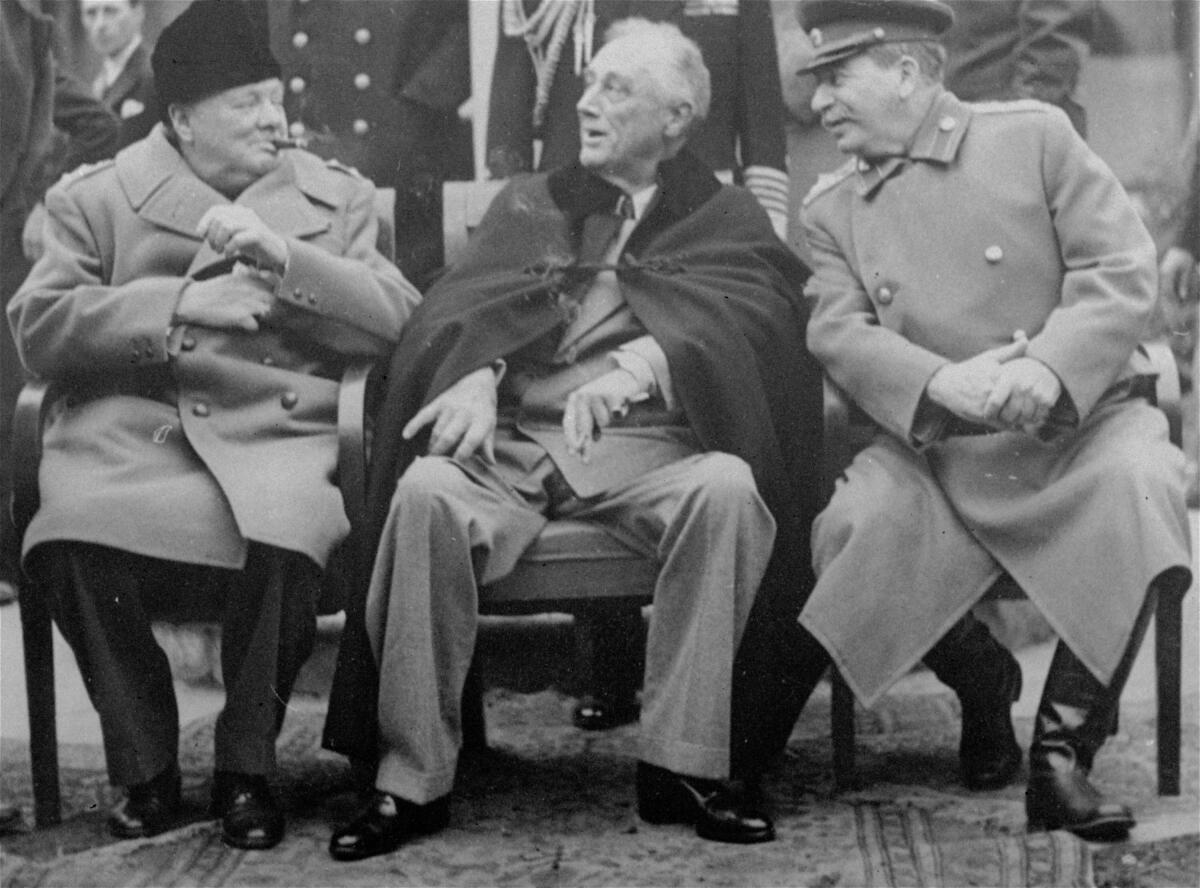
Their competing agendas could make the summit little more than a spectacle, yet still produce images that hark back to the famous Yalta Conference — held in Crimea, the Ukrainian peninsula currently occupied by Russia, in 1945 — where Josef Stalin, Franklin Delano Roosevelt and Winston Churchill carved up a postwar order.

World War II allies Winston Churchill, Franklin D. Roosevelt and Josef Stalin meet on Feb. 4, 1945, at the Yalta Conference.

World War II allies Winston Churchill, Franklin D. Roosevelt and Josef Stalin meet on Feb. 4, 1945, at the Yalta Conference.

(Associated Press)

The summit on Chinese soil offers Xi a powerful image to broadcast worldwide, demonstrating an emergent superpower can bring together the leaders of two historic rivals in the name of peace.

Putin gets to present himself as a global player, despite the devastation wrought on Russia’s economy and military standing after four bruising years of war.

And it allows Trump to reassert his global relevance after this month’s midterms delivered the worst electoral rebuke to a president in half a century, rivaling the backlash against President Nixon during Watergate.
Source link

Senate rivals seek support from Alaska Native voters

Becky Bohrer and Haven Daley

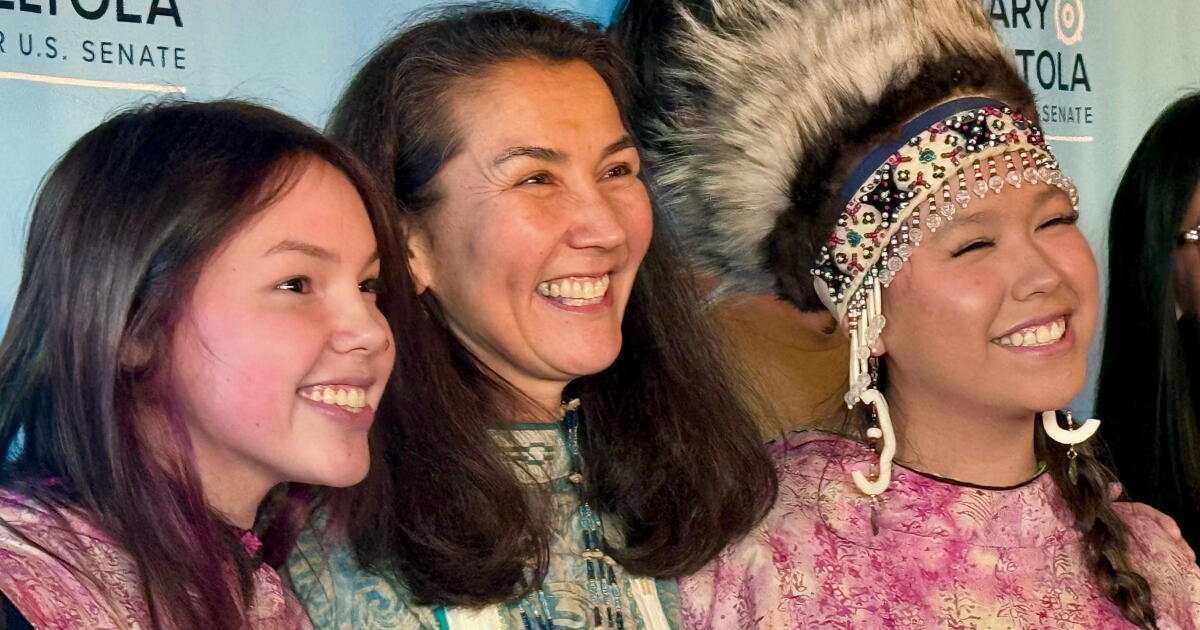
A little more than one week before the midterm elections, the leading candidates in Alaska’s U.S. Senate race are trying to rally support from Alaska Native voters, a key constituency.

Republican Sen. Dan Sullivan and Democratic former Rep. Mary Peltola both spoke at last week’s Alaska Federation of Natives conference in Anchorage.

The organization previously endorsed Peltola, who is Yup’ik, during her House races in 2022 and 2024, but it did not issue endorsements this year.

Both candidates have highlighted support from Native organizations and leaders ahead of the Nov. 3 election. Sealaska Corp., a regional Native corporation in southeast Alaska, has endorsed both of them, calling it a way to “honor their contributions and commitment to our communities, and to honor the diverse positions of our shareholders.”

The race is among the most closely watched nationally, with control of the Senate at stake. On Friday, President Trump — who held a rally in support of Sullivan earlier this month — said he told the Department of Justice to sue to block certification of the race if the incumbent loses. The lawsuit cites potential confusion with another candidate who is listed on the ranked-choice ballot as Daniel J. Sullivan Jr.

Sen. Sullivan is listed as a Republican and the incumbent, while Sullivan Jr. is listed without a party designation. U.S. Atty. Gen. Todd Blanche wrote on social media that the lawsuit is necessary to make sure officials “have the information necessary to make a determination as to whether Alaskan voters were confused or [misled].”

Many voting rights advocates and Democrats have pointed the lawsuit as an improper political use of the Justice Department and an example of Trump’s interference in the upcoming election, following up on his threats to assert federal control over the vote.

Alaskan Natives represent about one-fifth of the state’s population, but they can face challenges to voting in remote communities. Advocates have raised concerns in recent years with polling locations in some villages opening late or ballots not arriving on time to be fully counted due to mail delays.

There’s also cynicism about whether participating in elections will make a difference.

“There’s legitimate hesitations about whether whoever they vote for is actually going to impact them,” said actor and activist Dallas Goldtooth, who is Bdewakantunwan Dakota and Dine and came to Alaska to encourage conference attendees to vote. “And our job is to say, hey, whether that matters or not, there’s an opportunity for you to make sure that your voice is counted. And I want to encourage people just to take the opportunity as much as possible.”

Sheri Buretta, who chairs the board of Chugach Alaska Corp., an Alaska Native corporation, introduced Sullivan to the conference Thursday as “one of our strongest champions.”

Sullivan, speaking as part of a congressional delegation update, said he’s learned important lessons from Native leaders. He cited work he’s done on issues such as pushing to ensure that Alaska Native Vietnam War-era veterans have access to land allotments.

Peltola, during a candidate forum Friday, became emotional speaking about the crisis of missing and murdered Indigenous people and said additional law enforcement resources are needed. She also expressed support for fisheries. Subsistence fishing is critical in many Native communities.

“I will always fight to restore our fisheries. I feel like working on fish issues is my life’s work,” she said.

Energy is also a crucial issue in Alaska, including within Native communities.

Peltola recently said Alaskan Native people were being “absolutely crushed” by high costs from the ongoing war with Iran, which Sullivan has supported. Many rural communities rely on diesel for electricity and to heat their homes.

Sullivan has argued the war against Iran is temporary and that the “forever war is the Democrats’ war against Alaskan energy.”

Many Native leaders on Alaska’s petroleum-rich North Slope see oil drilling as crucial to their region’s economy, and they believed their voices weren’t heard while President Biden was in office. His administration sought to restrict drilling in places like the National Petroleum Reserve-Alaska and Arctic National Wildlife Refuge, but Trump and the Republican-led Congress have rolled those efforts back.

Peltola has said she supports expanded oil and gas drilling and would work with Trump to accomplish that. But Sullivan and his allies have tried to align her with what they refer to as “Lower 48 liberals” who oppose more drilling.

Bohrer and Daley write for the Associated Press. Bohrer reported from Juneau.

Source link