When President Trump announced the initial wave of US and Israeli strikes on Iran at 8:30 a.m. CET on Saturday 28 February, marking the start of Operation Epic Fury, all traditional financial markets were closed.
ADVERTISEMENT
ADVERTISEMENT
Most markets operate Monday to Friday only, meaning weekend developments, however significant, cannot be priced in until trading resumes on Monday morning, creating a bottleneck of reaction at the open.
US equities, futures, major foreign-exchange platforms, commodity markets, Asian and European bourses were all closed on Saturday.
Middle Eastern exchanges, such as those in Saudi Arabia and Qatar, opened on the second day of the conflict, as they trade Sunday to Thursday, but these attract fewer Western participants and, consequently, lack liquidity.
In the past, investors facing such a major geopolitical shock on a Saturday would have been forced to wait until US futures reopened Sunday evening to start pricing in an expectedly chaotic Monday.
Crypto never sleeps
This time, however, they had a genuine alternative — crypto-based platforms that trade 24 hours a day, 7 days a week and 365 days a year, are globally accessible and settle transactions almost instantly.
The standout choice was Hyperliquid, a decentralised perpetuals exchange that offers contracts not only on cryptocurrencies but also on real-world assets including crude oil.
According to on-chain data, trading volume on the platform spiked sharply, reaching peaks near $200mn (€172mn) in a single 24-hour period on Saturday.
The oil-linked perpetual contracts on Hyperliquid, such as OIL/USDH and USOIL/USDH, rose more than 5% almost immediately after the US-Israeli strikes were announced, providing one of the first real-time price signals before traditional markets reopened.
Hyperliquid contracts were not the only instruments drawing attention.
Tether’s XAUT, a token fully backed by physical gold held in vaults, saw its 24-hour trading volume exceed $300mn (€258mn) — a remarkable figure for a weekend.
Prediction markets such as Kalshi and Polymarket also posted massive volumes, while Bitcoin, Ethereum and other crypto tokens were sold off as proxy assets for broader negative risk sentiment.
For the first time in many observers’ memories, crypto markets were effectively “the market” during the weekend.
In a memo published on Tuesday, Matt Hougan, chief investment officer at Bitwise, described it as “the weekend that changed finance”.
Critics will point out that crypto markets remain smaller and more volatile than their traditional counterparts, and that regulatory and operational risks persist.
However, the events of the past weekend showed that on-chain finance is moving from the fringes to the core of global capital markets far faster than most forecasts anticipated even six months ago.
Traditional exchanges accelerate push for 24/7 trading
The success of crypto platforms during the Iran conflict adds to the pressure already felt by legacy financial institutions to follow suit and provide perpetually open markets.
The New York Stock Exchange, owned by Intercontinental Exchange, is actively developing a blockchain-based alternative trading system for tokenised equities and exchange-traded funds that would enable genuine 24/7 trading with instant settlement.
Announced in early 2026 and still subject to regulatory approval, the platform would combine NYSE’s existing matching engine with private blockchain networks for post-trade processing.
Trades could be funded and settled in real time using stablecoins, bypassing the T+1 settlement cycle, which dictates the transfer of securities and the corresponding payment must be completed by the next business day and still governs equity markets.
The tokenised venue has a potential launch window as early as the second quarter of 2026, with broader 22 to 23-hour weekday trading on NYSE targeted for later in the year or early 2027, subject to coordination with the SEC, DTCC and market-data providers.
Nasdaq has filed similar proposals to extend US equities trading to 23 hours a day, five days a week, with an anticipated rollout in the second half of 2026.
These moves represent a direct response to the competitive pressure exerted by always-on crypto venues and the growing frequency of market-moving events that occur outside traditional hours.
The Iran weekend served as a vivid case study.
With hedge funds and proprietary traders already active on Hyperliquid and other decentralised platforms, established exchanges recognise that failing to offer comparable access risks losing order flow permanently.
Tokenisation provides the technological bridge, allowing continuous trading while preserving existing regulatory safeguards around custody, dividends and shareholder rights.
Crypto market bill stalls despite Trump backing
While the crypto infrastructure demonstrated its resilience over the weekend, progress on the legislative front remains frustratingly slow.
The Digital Asset Market Clarity Act of 2025, known as the CLARITY Act, passed in the US Congress last year with strong bipartisan support but has since become bogged down in the Senate.
The primary sticking point is friction between the banking and crypto sectors over the treatment of stablecoin yields under the separate GENIUS Act, which established the first federal framework for stablecoin issuers.
Banks argue that yield-bearing stablecoins could drain deposits, and they have lobbied to close perceived loopholes.
Crypto proponents counter that such rewards are essential for customer retention and innovation.
On Tuesday, President Trump weighed in directly via Truth Social.
“The Genius Act is being threatened and undermined by the banks, and that is unacceptable — we are not going to allow it. The U.S. needs to get market structure done, asap.”
Moreover, President Trump further sided with the crypto sector by stating that “The banks are hitting record profits, and we are not going to allow them to undermine our powerful crypto agenda that will end up going to China, and other countries, if we don’t get the Clarity Act taken care of.”
Despite the presidential intervention and earlier White House meetings between the two industries, no resolution has been reached.
The Senate Banking and Agriculture committees continue to advance differing drafts, and a full vote remains elusive.
With the bill effectively stalled, market participants are left without the regulatory certainty many had hoped would arrive before the end of the first quarter.
The irony is not lost on observers. While crypto markets proved their worth during a real-world crisis, the very legislation designed to integrate them safely into the traditional system remains hostage to lobbying battles.
Until a resolution is achieved, the speed of innovation will continue to outstrip the pace of rulemaking — a dynamic the Iran weekend has only made more apparent.
March 4 (UPI) — Venezuela state oil company Petróleos de Venezuela S.A. announced signing new contracts to supply crude oil and refined products for the U.S. market.
The agreements were signed with several international trading companies to ensure a stable flow of energy to refineries along the U.S. Gulf Coast, according to a statement from the company.
Although PDVSA did not disclose the names of the parties, the contracts add to existing operations involving major companies such as Chevron, which plans to increase exports to about 300,000 barrels per day this month.
PDVSA said the agreements maintain a “historic commercial relationship” with the United States and reaffirm the company’s “commitment to the stability of the international energy market.”.
The newly signed contracts mark the official return of Venezuelan crude to U.S. refineries after the United States captured former President Nicolás Maduro on Jan. 3.
The agreements were facilitated after the U.S. Treasury Department’s Office of Foreign Assets Control issued licenses, signaling significant changes in Washington’s licensing policy this year.
The authorizations allow U.S. entities to participate in lifting, transporting, storing and refining Venezuelan oil. The current regulatory framework favors companies from the United States and Western countries, while maintaining strict restrictions on entities from countries such as China, Russia and Iran.
In addition to Chevron, four other oil companies — BP, Eni, Shell and Repsol — have received authorization to resume operations and sign investment agreements in Venezuela.
In its statement, PDVSA reiterated the Venezuelan government’s call for the removal of sanctions on the country’s energy industry.
“The Venezuelan nation reiterates the need for a hydrocarbon industry free of sanctions in order to boost national production and strengthen international trade,” the company said.
Through these contracts, PDVSA aims to restore its position as a strategic supplier in a global market that continues to demand heavy crude, while Washington seeks to use Venezuelan oil to stabilize domestic fuel prices and reduce dependence on other suppliers.
During his State of the Union address, President Donald Trump highlighted the arrival of 80 million barrels of Venezuelan crude, describing Venezuela as a “new friend and partner” in energy cooperation.
U.S. Interior Secretary Doug Burgum visited Venezuela on Wednesday, marking a new step in the energy and diplomatic agenda between Washington and Caracas.
Since January, Burgum has led discussions with executives from Chevron, ExxonMobil and ConocoPhillips aimed at granting general licenses that would allow private operations in the country, local outlet Efecto Cocuyo reported.
The plan aligns with Trump’s “Energy Dominance” policy, a central strategy of the administration designed to position the United States as a global energy superpower.
Under the approach, U.S. companies would provide private capital without federal subsidies, while the government would guarantee security and stability for investments.
Global energy markets remain in a state of high alert after several Gulf states suspended oil and gas production following escalating tensions in the region.
Since Saturday’s attacks by the United States and Israel, Tehran has targeted various sites in Israel and across several Gulf countries.
Recommended Stories
list of 4 itemsend of list
Initially, these Iranian attacks focused primarily on US military assets, but Gulf states have reported that Iran has since broadened its scope to target civilian infrastructure, including hotels, airports and energy facilities. Iranian officials have publicly denied targeting Gulf energy facilities, however.
The Middle East remains the world’s dominant source of hydrocarbon reserves and a major driver of crude oil and natural gas output.
How much oil and gas does the Middle East have?
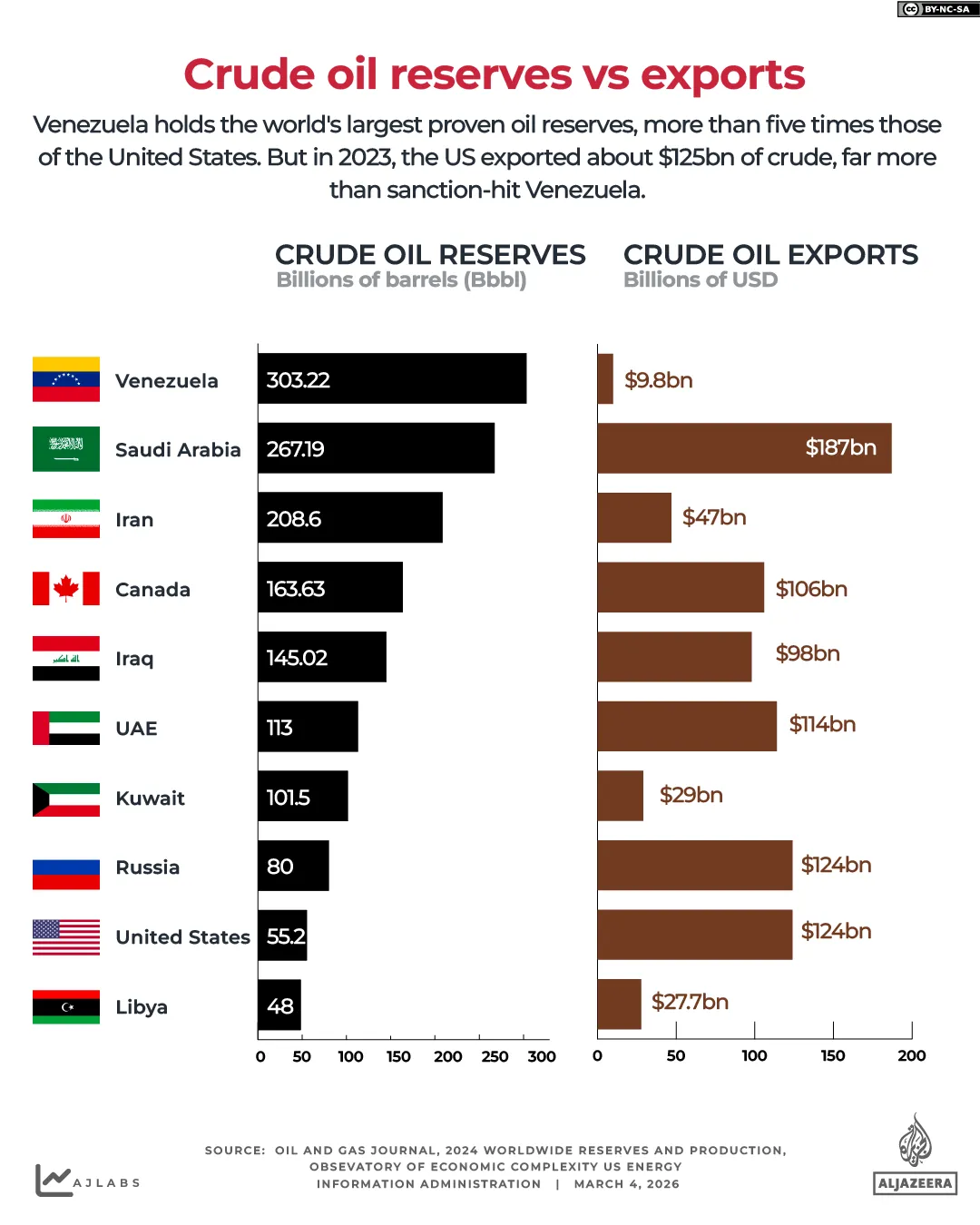
Nearly half of the world’s oil reserves and exports come from the Middle East, which contains five of the seven largest oil reserves in the world.
Once refined, crude oil is used to make various products, including petrol, diesel, jet fuel and a wide range of household items such as cleaning products, plastics and even lotions.
After Venezuela, which has 303 billion barrels, Saudi Arabia holds the world’s second-largest proven crude oil reserves, estimated at 267 billion barrels.
The Middle East’s largest oil reserves:
Saudi Arabia: 267 billion barrels
Iran: 209 billion barrels
Iraq: 145 billion barrels
UAE: 113 billion barrels
Kuwait: 102 billion barrels
Saudi Arabia is also the world’s top oil exporter with an estimated $187bn of crude in 2024, according to data from the Observatory of Economic Complexity (OEC).
The Middle East’s top oil exporters:
Saudi Arabia: $187bn
UAE: $114bn
Iraq: $98bn
Iran: $47bn – largely sold at a discount due to US sanctions
Kuwait: 29bn
Other Middle Eastern countries with sizeable oil exports include: Oman ($28.9bn), Kuwait ($28.8bn) and Qatar ($21bn).
(Al Jazeera)
In addition to crude oil, the Middle East is a global powerhouse for natural gas, accounting for nearly 18 percent of global production and approximately 40 percent of the world’s proven reserves.
Natural gas is primarily used for electricity generation, industrial heating, and in chemicals and fertilisers.
The heart of Middle Eastern gas is a single, massive underwater reservoir called the South Pars/North Dome field. It is the largest gasfield in the world, and it is shared directly between Qatar and Iran.
Gas is transported either through pipelines or by tankers. When using pipelines, the gas is pressurised and moved through steel networks. When pipelines are not feasible, such as across oceans, Liquefied Natural Gas (LNG) is used.
To create LNG, the gas is cooled to approximately -162C (-260F), shrinking its volume and allowing it to be safely loaded onto specialised tanker ships for global transport.
To transport oil and gas, tankers from various Gulf states must navigate the narrow waterway known as the Strait of Hormuz. Approximately one-fifth of global oil and gas passes through this strait, primarily heading to major markets in Asia, including China, Japan, South Korea and India, as well as to Europe.
(Al Jazeera)
Which energy facilities have been attacked?
Here are the facilities which have recorded damage as of Wednesday:
Saudi Arabia – Ras Tanura oil refinery
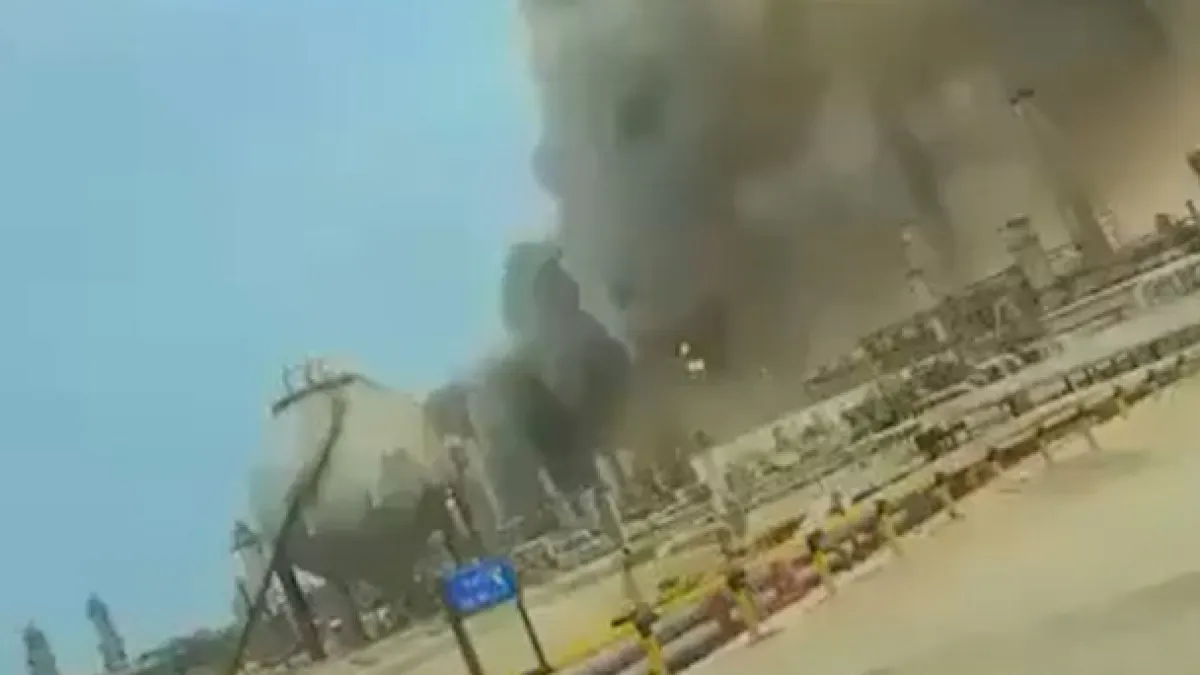
On Monday, one of the world’s largest oil refining complexes, the Ras Tanura oil refinery owned by Saudi Aramco, was forced to halt operations after debris from intercepted Iranian drones caused a small fire.
This handout satellite image, courtesy of Vantor, released on March 2, 2026, shows damage at Saudi Aramco’s Ras Tanura refinery [AFP]
Saudi Aramco is one of the world’s largest companies, with a market capitalisation exceeding $1.7 trillion and revenue of $480bn. Headquartered in Dhahran, in eastern Saudi Arabia, Aramco controls 12 percent of global oil production, with a capacity of more than 12 million barrels per day (bpd).
On Wednesday, Saudi defence officials reported a second drone attempt on the facility but this was successfully intercepted with no damage or disruption to operations reported.
Qatar – Ras Laffan Industrial City LNG facilities
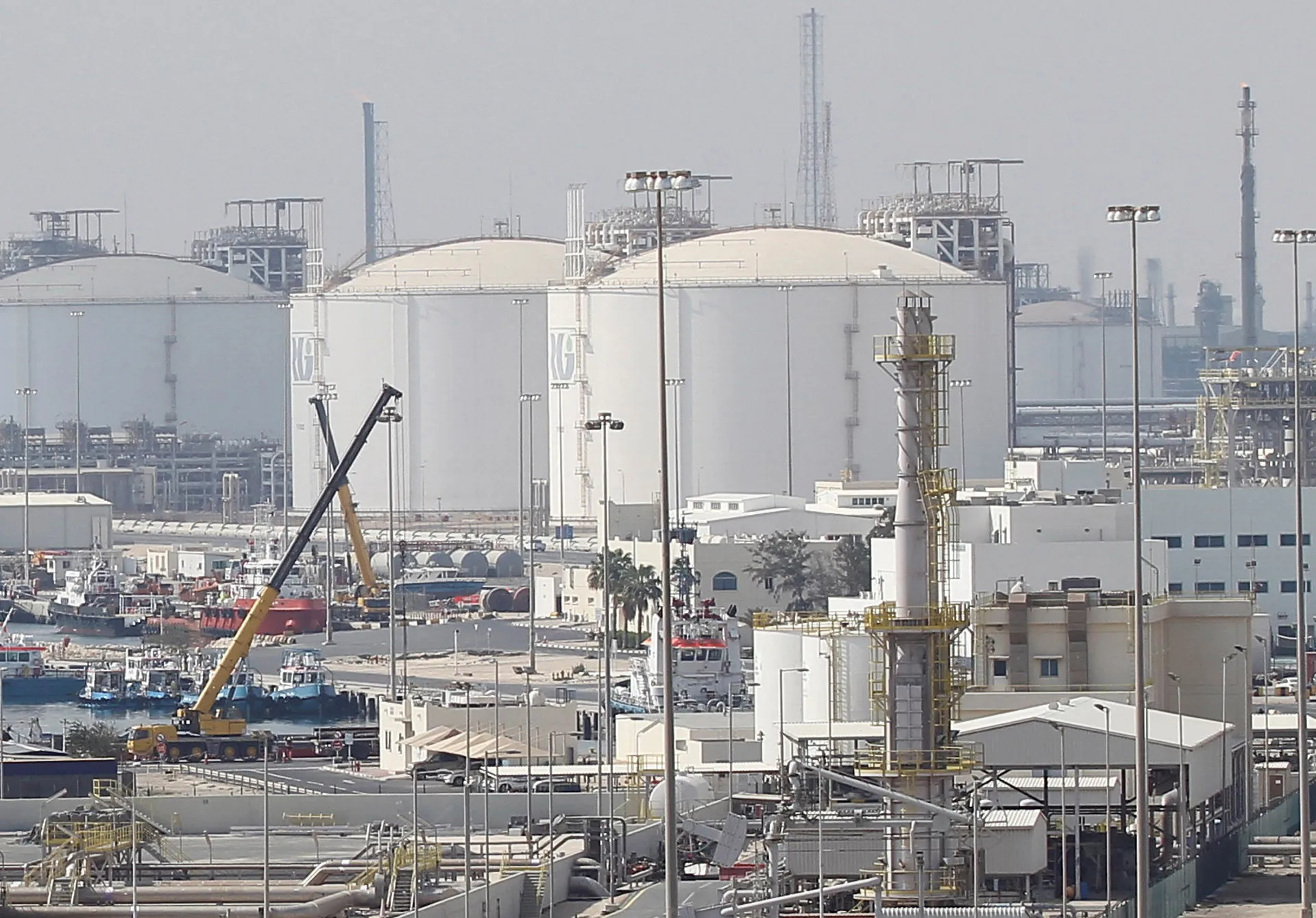
On Monday, Qatar’s Ministry of Defence reported that Iranian drones had targeted an energy facility in Ras Laffan belonging to QatarEnergy, the world’s largest LNG producer.
While no casualties were reported, QatarEnergy suspended the production of LNG and other products at the impacted sites.
QatarEnergy’s operating facilities on March 3, 2026, in Ras Laffan Industrial City, Qatar [Getty Images]
QatarEnergy’s 81 million metric tonnes of LNG exports are mostly bound for Asian markets, including China, Japan, India, South Korea, Pakistan and other countries in the region. The halt in production hiked global gas prices to a three-year high this week.
Qatar – Mesaieed Industrial City
Qatar’s Defence Ministry said the country was attacked by a second drone launched from Iran on Monday, targeting a water tank belonging to a power plant in Mesaieed, without reporting any casualties.
On Tuesday, QatarEnergy also stopped production of some downstream products like urea, polymers, methanol, aluminium and others.
UAE – Fujairah and Mussafah oil terminals
On Monday, a fire broke out at Mussafah Fuel Terminal in southwest Abu Dhabi after it was struck by a drone.
On Tuesday, falling debris from a drone interception caused a fire at the Fujairah Oil Terminal along the eastern coast of the United Arab Emirates. No injuries were reported.
A large fire and plume of smoke are visible after debris from an intercepted Iranian drone hit the Fujairah oil facility, in Fujairah, United Arab Emirates, on Tuesday, March 3, 2026, according to authorities [Altaf Qadri/AP Photos]
Oman – ports of Duqm and Salalah
On Tuesday, multiple Iranian drones struck fuel tanks and a tanker at the port of Duqm, with at least one direct hit on a fuel storage tank, causing an explosion.
On the same day, a drone strike was recorded at the Port of Salalah, which handles fuel and industrial minerals.
Athe Nova – oil tanker
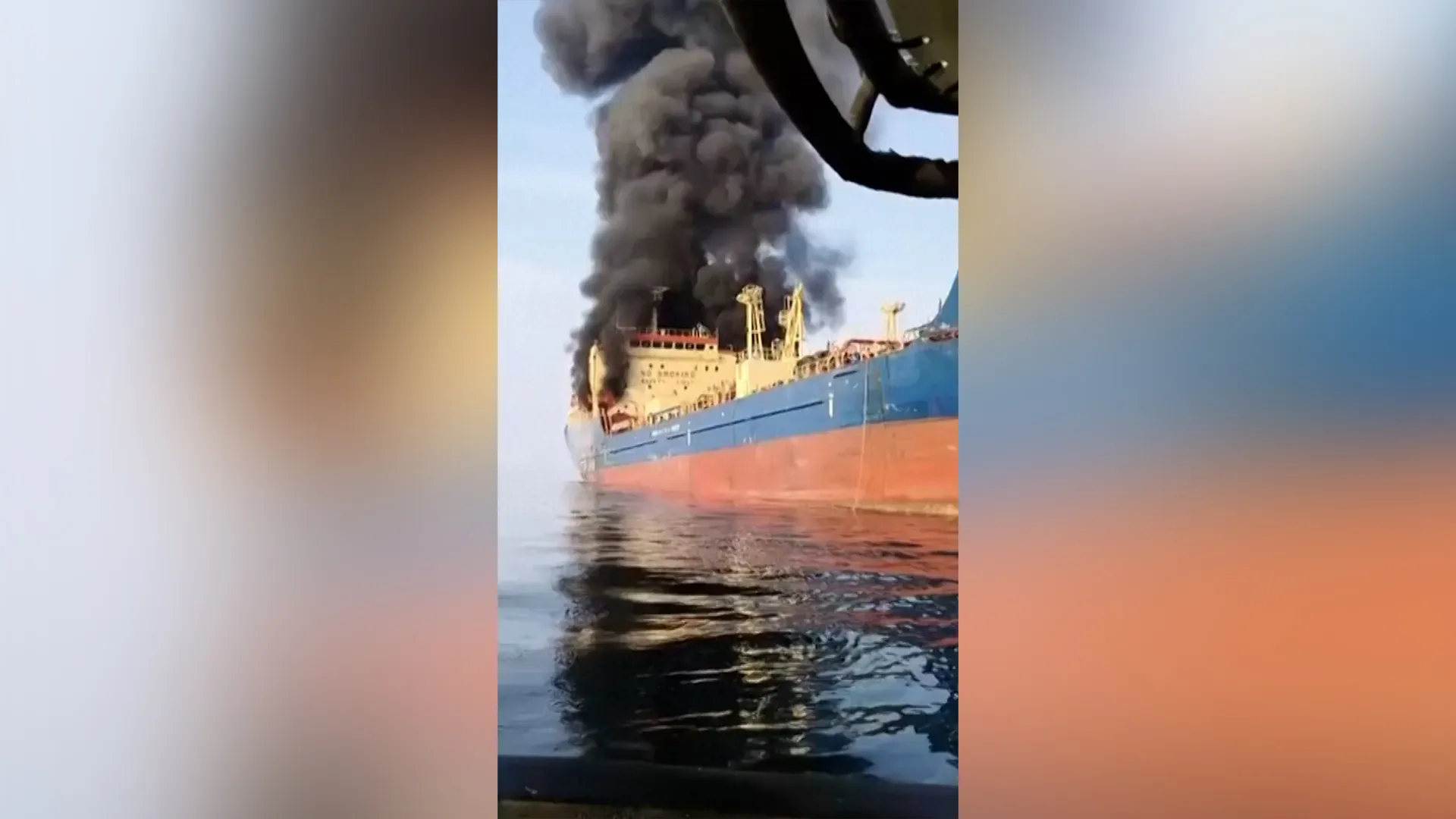
On Monday, the Athe Nova, a Honduran-flagged tanker positioned off the coast of Khor Fakkan, UAE, was struck by Iranian drones as it was transiting the Strait of Hormuz, setting it ablaze. Despite the fire, the vessel managed to exit the chokepoint into the Gulf of Oman, and no casualties were reported.
Iran’s Islamic Revolutionary Guard Corps (IRGC) claimed responsibility for the strike, identifying the Athe Nova as an “ally of the United States”.
On the same day as the attack, Iran declared the Strait of Hormuz closed, warning that any ship attempting to pass would be “set ablaze”.
Since then, several other tankers have been hit.
(Al Jazeera)
Other regional energy disruptions
Although not directly targeted, the following energy sites suspended operations in response to Iranian retaliatory attacks:
Israeli offshore gasfields – Major gas production fields such as Leviathan and Tamar were shut down as a precaution following regional drone and missile launches linked to Iran.
Oil fields in semiautonomous Iraqi Kurdistan – Producers including DNO, Gulf Keystone and Dana Gas halted output as a safety measure amid the escalation.
Rumaila oilfield – Operations at Iraq’s largest oilfield – operated by BP – in southern Iraq were halted on Tuesday as a security precaution due to its proximity to the escalation zone.
WASHINGTON — The United States plunged further into conflict with Iran on Tuesday as a new round of strikes heightened fears of an expanding war in the Middle East, sending markets reeling and oil prices soaring and drawing urgent calls from European leaders for a plan forward.
President Trump acknowledged during an Oval Office appearance that the public would feel some economic pain as fighting continues to threaten areas that are critical to the world’s oil and natural gas production.
“As soon as this ends, those prices are going to drop, I believe lower than ever before,” Trump said, though he did not provide a clear time frame for when the conflict might end.
As the war stretched into its fourth day on Tuesday, Israel struck Iranian missile launch facilities and weapon factories and Iran retaliated across the Persian Gulf region, including attacks on U.S. diplomatic sites in Saudi Arabia, Kuwait and Dubai.
The conflict simultaneously set off alarms in the global markets, prompting stocks in Europe and Asia to plunge and the S&P 500 to drop nearly 1% after falling as much as 2.5% in early trading.
European governments were also forced to contend with the fallout, with some countries increasing their military presence in the region as their actions are closely monitored by Trump, who publicly singled out countries that he thought had been helpful in his war efforts so far.
“Spain has been terrible,” Trump told reporters in the Oval Office while threatening to “cut off all trade with Spain” after he said the country had denied American forces access to its military bases.
Trump said he was “not happy with the U.K. either” and complained about not being allowed to use a military base on Diego Garcia in the Chagos Islands. Without access to that military base, Trump said American planes were forced to fly “many extra hours.”
“We were very surprised. This is not Winston Churchill that we’re dealing with,” Trump said. Churchill served as Britain’s prime minister during World War II.
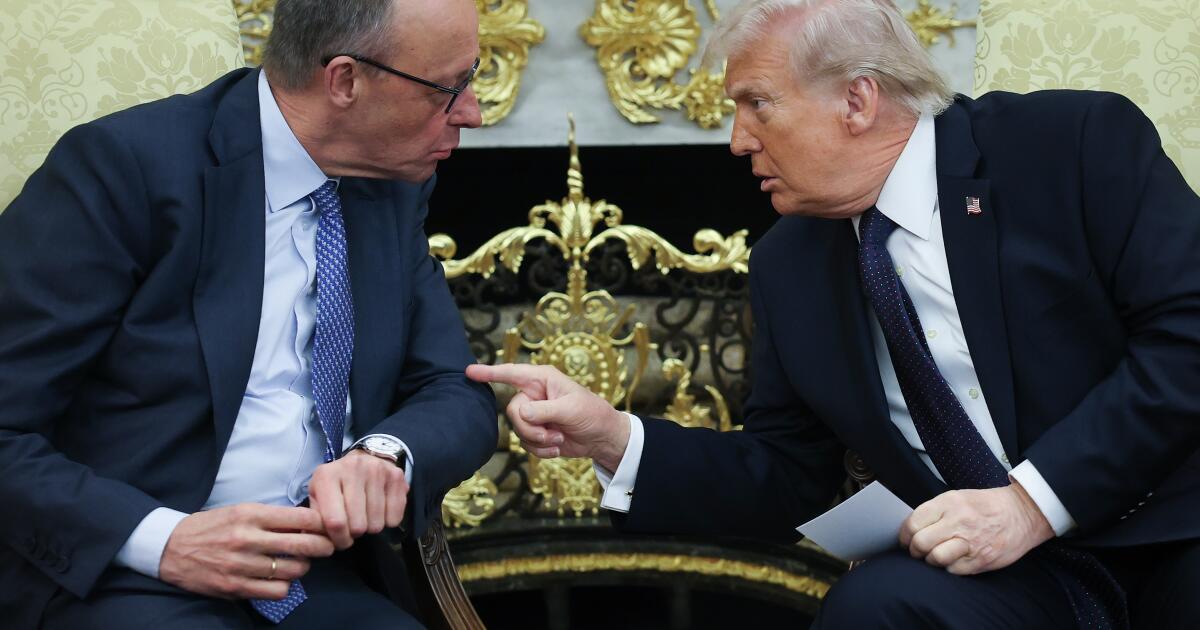
As Trump threatened European allies, he sat next to German Chancellor Friedrich Merz, underscoring the fraught landscape that world leaders are navigating as American and Israeli forces work to destroy Iran’s missile capabilities and nuclear program and eye a potential change in government.
During their meeting, Trump said Germany has allowed the United States to use its air bases. Beyond that help, Trump said, “we’re not asking them to put boots on the ground or anything.”
When asked by reporters how Germany intended to help in the conflict, Merz said he wanted to focus on talking to Trump about what comes “the day after” the war ends.
“We are on the same page in terms of getting this terrible regime in Iran away and we will talk about the day after, what will happen then, if they are out,” Merz said.
Trump talks about regime change options
Trump did not have much to say yet on what will come next and was unclear on who will lead the Iranian government, saying that U.S. and Israeli military operations had killed the people who he thought could have filled the leadership vacuum.
“Most of the people we had in mind are dead,” Trump said. “Now, we have another group, but they may be dead also based on reports so I guess you have a third wave coming in and pretty soon we’re not going to know anybody.”
His remarks were a startling acknowledgment in part because minutes earlier he said the worst-case scenario in his mind was that the military operation would take place and “then somebody takes over who is as bad as the previous person.”
“That could happen,” Trump said.
Asked if Crown Prince Reza Pahlavi, son of the former shah, is someone he would like to run the country, Trump said he is a “very nice person,” but did not say for sure whether he is his choice.
The president and his top aides have offered varying explanations when asked about regime change, drawing criticism from Democrats and some conservatives who are demanding to know why Americans are being dragged into a war with no clear end in sight.
On Saturday, when U.S. and Israeli forces first struck Iran, Trump said overthrowing Iran’s theocratic regime was part of his rationale. But on Monday, he emphasized that Iran’s missiles posed a threat to the United States, and therefore theattack was carried out to eradicate its missile capability and nuclear program.
After briefing lawmakers Monday afternoon, Secretary of State Marco Rubio told reporters that the United States launched a “preemptive” attack on Iran because officials knew Israel was going to strike the country — a move that he said would have put U.S. forces at risk and led to even more U.S. casualties. As of Tuesday, six American troops have been killed in combat.
House Speaker Mike Johnson (R-La.), after being briefed by Trump administration officials on Monday afternoon, said, “Israel was determined to act in their own defense, with or without American support.”
“If Israel fired upon Iran, and took action against Iran to take out the missiles, then they would have immediately retaliated against U.S. personnel and assets,” Johnson told reporters.
Trump disputed the suggestion that Israel’s plans to attack Iran prompted him to launch the strikes, saying it was the other way around.
“If anything, I might have forced Israel’s hand,” Trump said Tuesday. “But Israel was ready, and we were ready, and we’ve had a very, very powerful impact because virtually everything they have has been knocked out.”
But it was unclear how far along the U.S. military is in accomplishing its mission.
In a letter Monday, Trump told Congress that while the “United States desires a quick and enduring peace, it is not possible at this time to know the full scope and duration of military operations that may be necessary.”
Senate Minority Leader Chuck Schumer (D-New York) warned in a speech on the Senate floor that the administration’s murky strategy is not good for the country.
“History teaches us a simple lesson: Wars without a clear objective do not stay small. They get bigger, they get bloodier, they get longer, they get more expensive,” Schumer said. “This is not a defensive war. This is not a necessary war. This is a war of choice.”
The latest attacks on the region
Tuesday saw yet another expansion of the war when Israeli troops blitzed into Lebanon in a bid to dislodge the Iran-backed Shiite militant group Hezbollah.
The ground invasion comes one day after Hezbollah lobbed rockets and drones at an Israeli military position across the border; an attack, the group said, that was vengeance for the killing of Iranian Supreme Leader Ayatollah Ali Khamenei and a response to Israel’s near-daily violations of a ceasefire brokered by the U.S. in November 2024.
The attack sparked a massive Israeli assault on dozens of villages and towns in southern Lebanon, as well as on the southern suburbs of the Lebanese capital, Beirut. The strikes killed 40 people, wounded 246 others and saw tens of thousands forced to leave their homes and scramble for shelter in Beirut and elsewhere, according to Lebanese authorities.
The Lebanese army said Tuesday that it was withdrawing from positions in southern Lebanon ahead of a ground incursion by Israeli troops. The Israeli military’s Arabic-language spokesman then issued a warning to residents of some 80 towns and villages in that region to “immediately evacuate your homes” and move northward.
Hezbollah, meanwhile, maintained a defiant stance and continued rocket and drone launches into Israel.
“The era of patience has ended, and we have no option but to return to resistance,” said Mahmoud Qatari, who chairs Hezbollah’s Political Council. “If Israel wants an open war, so be it.”
The invasion comes more than a year after Israel occupied parts of southern Lebanon in 2024. After the ceasefire came into effect, Israel withdrew from most parts of the country save for five positions near the border. Yet in the 15 months since the ceasefire was signed, it has proved to be more notional for Lebanon, with Israeli warplanes and troops conducting well over 10,000 truce violations, according to the U.N.
Israel says its actions are to stop Hezbollah from reconstituting itself near the border, but the result has meant residents of border towns and villages in southern Lebanon have been unable to return home.
Israel’s military spokesman, Brigadier Gen. Effie Defrin, said in a statement that troops were “creating a buffer” inside Lebanon between residents in northern Israel “and any threat.”
As the conflict has escalated, some 1,600 Americans stranded across the region have requested assistance and the Trump administration is trying to help evacuate them, Rubio said. But the effort has faced challenges because Iranian missiles have struck many Mideast airports.
“We know we are going to be able to help them,” Rubio said. “It is going to take a little time because we do not control the airspace closures.”
Ceballos reported from Washington, Bulos from Khartoum, Sudan.
A tanker anchored in the Persian Gulf off coast of Dubai, one of scores halted on either side of Strait of Hormuz after it was effectively closed due to threats against shipping made by the regime in Tehran that have sent global energy prices soaring. Photo by Stringer/EPA
March 3 (UPI) — The price of Brent crude oil rose to $80 a barrel and the price of natural gas jumped 30% to $1.97 per therm on Tuesday after Iran effectively shut the key Strait of Hormuz shipping lane, with an official threatening its forces would “set fire to anyone who tries to pass.”
Prices continued their upward trajectory from Monday when markets reopened following the military strikes over the weekend on Iran by the United States and Israel and Tehran’s strikes on its oil and gas producing neighbors across the Gulf.
Concerns over supply disruptions are growing as the conflict widens across the region with Iranian strikes going beyond military bases used to launch attacks on Iran to target oil and gas production facilities, as well as Amazon data centers in the United Arab Emirates and Bahrain.
On Monday, Qatar Energy, one of the world’s largest exporters of liquefied natural gas, shut down production following “military attacks” on its Ras Laffan plant and Saudi Arabia’s state-run Aramco shuttered its giant Ras Tanura refinery near the port city of Dammam after it was set ablaze in a drone strike.
Analysts warned the oil price could surpass $100 a barrel if the disruption continued for very long — translating to a 25-cent-a-gallon rise in U.S. petrol prices.
The risk to maritime traffic was also pushing up the cost of moving oil from the Gulf to Europe and Asia and around the world with the leasing cost of a tanker to ship Middle East to China doubling to $400,000 a day on Monday.
The president of logistics technology platform Flexport, Sanne Manders, told the BBC that while Iran had not physically blockaded the strait, through which 20% of the world’s oil and gas transits, it was closed as far as global shipping was concerned.
Manders said it was partly that shipping lines were simply unwilling to expose their vessels, cargo and crews to potential jeopardy and partly insurance companies “not being willing to insure this risk anymore.”
He warned that expectation of higher fuel costs would feed through to movement of all goods by sea with carriers hiking rates “for any shipping in the world.”
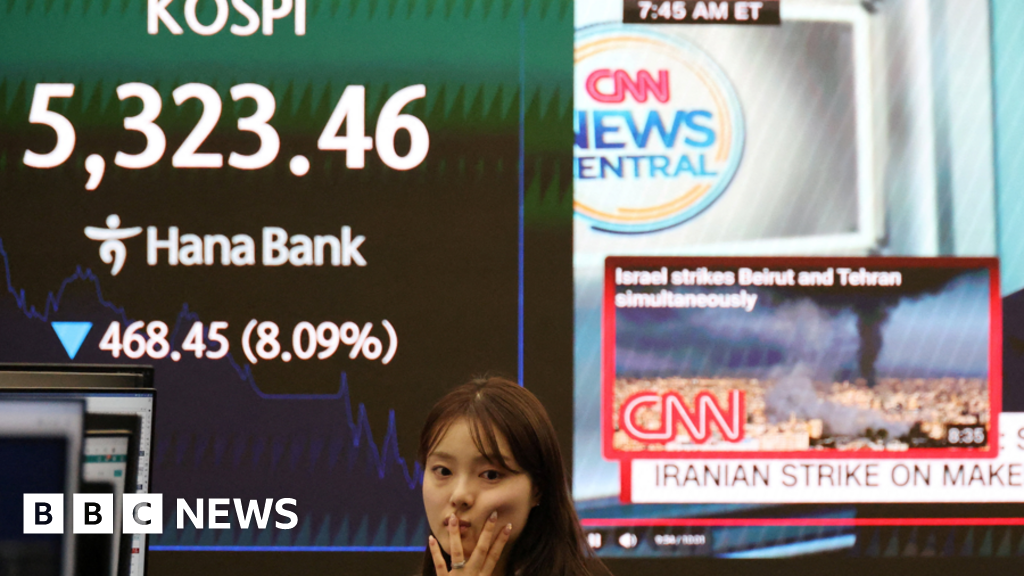
That all fed into investor fears over the consequences for inflation and interest rates, sending global stock markets tumbling overnight, led by Japan’s Nikkei 225 Index, which ended Tuesday down more than 3%.
In mid-morning trade London’s FTSE 100 was down 2.8 %, Germany’s blue-chip DAX was trading 4% lower, down more than a thousand points, and the CAC 40 in Paris was off by 3.2%.
The pan-European Stoxx 600 Index continued its retreat, with across-the-board falls in all sectors pulling it 2.9% lower, while the blue-chip Euro Stoxx 50 was even lower, down 3.1%.
However, hotels, airlines and utilities took the biggest hits while energy firms and defense contractors performed better.
Ahead of the opening of U.S. markets, S&P 500 futures fell by 1.8%, Nasdaq 100 futures were down 2.3% and Dow Jones Industrial Average-linked futures moved lower by around 1.7%, or 821 points.
Defense and energy stocks rose on Monday led by Northrop Grumman, up 6%, and Palantir, up 5.8%, which together with a surge in NVIDIA’s share price, helped the overall market erase big losses early on to end the day in the black.
U.S. President Donald Trump was due to discuss the economic and cost-of-living impacts with Treasury Secretary Scott Bessent and Energy Secretary Chris Wright on Tuesday while Secretary of State Marco Rubio trailed administration plans to cope with energy price spikes.
“We knew that going in would be a factor. Starting tomorrow you will see us rolling out those phases to try to mitigate against that,” said Rubio.
Former South African president Nelson Mandela speaks to reporters outside of the White House in Washington on October 21, 1999. Mandela was famously released from prison in South Africa on February 11, 1990. Photo by Joel Rennich/UPI | License Photo
While the US pursues fossil fuel dominance, China is looking to lead the way on renewables. Which model of energy security will the rest of the world follow?
Aside from regime change, a central goal of President Donald Trump’s military actions in Venezuela and against Iran has been to reinforce the US as a dominant petroleum producer while curtailing federal support for alternative energy. The war in the Middle East has already injected new uncertainty into global energy markets — with strikes on Iranian infrastructure driving oil prices higher and disrupting flows through the Strait of Hormuz — and may prompt some countries to rethink their dependence on fossil fuels even as short-term demand spikes.
In sharp contrast, China is intent on advancing its lead in renewable technology, even as it meets massive domestic demand for coal and oil. These divergent national approaches set up a fundamental global contest: Will fossil fuel dominance or renewable leadership define the future of energy security?
As these two superpowers intensify their competition for economic and geopolitical dominance, the world’s climate future and investment flows will largely hinge on which energy model—oil or renewables—proves most viable. The global energy landscape risks a clear split: one path leading to enduring fossil-fuel dependence, the other to a renewable-powered world.
As a November report by the Washington, DC-based think tank the Center for Strategic and International Studies put it, “Nearly 10 years after the signing of the Paris Agreement, a new energy investment paradigm is taking shape” that is likely to influence, if not determine, government and industry policy decisions on energy security, affordability, and competitiveness.
Ray Cai, associate fellow and CSIS author
At this point, the CSIS report notes, the paradigm shows fragmentation, volatility, and scarcity, even as state intervention rises. Its author, associate fellow Ray Cai, writes: “A widening bifurcation between hydrocarbon and low-emission value chains—in part accelerated by strategic competition between the US and China—is already reshaping global energy investment flows.”
This bifurcation, as Cai describes, is a world of “two tracks.” One track features economies with secure, affordable access to fossil fuels. Most countries are net importers, while exporters are few. As a result, the US has become a significant oil and LNG producer and exporter. According to Cai, this shift also reinforces the country’s retreat from its postwar role as “facilitator and guarantor of global trade.”
On the other track, he continues, economies are turning to electrification and renewables. Nearly 90% of energy generation capital expenditure in the Global South in 2024 was allocated to low-emission sources, about double the share from 10 years ago. “Driving this shift is China,” says Cai, noting that the nation has led global supply chain and manufacturing investment both at home and abroad.
Much of the globe, including China, is adopting what Martin Pasqualetti, an Arizona State University professor and author of several books on energy geography, calls “an all-of-the-above” approach to energy policy, pursuing all power sources, including oil, natural gas, nuclear, hydroelectric, solar, geothermal, and wind.
Meanwhile, the US under the Trump administration has ended subsidies for electric vehicles and other alternative-fuel applications as it seeks to boost fossil fuel production and exports. Yet this emphasis risks squandering its many competitive advantages across other energy sources, including alternatives, according to a September report by JPMorgan Chase.
“North America has a significant strategic advantage in energy because of the sheer number of energy resources it has a competitive advantage in—fossil fuels, solar, geothermal, and wind,” the authors noted, adding that if the US fully takes advantage of all those energy resources, it will be unrivaled in what they call “the New Energy Security Age.” But they point out, “recent policy shifts from Washington are creating uncertainty for America’s offshore wind ambitions—which can be a key strategic advantage for the US alongside fossil fuels, geothermal, and nuclear.”
Cai agrees that recent US policy shifts are creating uncertainty for investors in alternatives, telling Global Finance in an interview that “policy pullbacks and regulatory obstruction can raise financing costs, slow project timelines, and erode competitiveness for US firms.”
Navigating The Valley Of Death
Pasqualetti says moving from fossil fuels to renewables means passing through a “valley of death,” a period when returns must prove profitable before funding runs out. Sometimes these investments rely on government subsidies until they can become profitable at scale. He notes that the “valley” has narrowed sharply as the prices of renewables have dropped. “We’re not going to make conversion quickly,” he says, “but we’ve been making it faster than expected.”
On the other hand, oil is proving less profitable for producers at its recent price of around $60 a barrel. Experts estimate that the “heavy” oil that characterizes Venezuela’s hefty reserves may cost at least $80 a barrel to extract and process for sale. So Pasqualetti finds the Trump administration’s plans to take over its petroleum industry puzzling. “If you increase our domestic supply, increase production, capture Venezuelan ghost ships and sell the oil on the market,” he asks, “won’t that just drive the price down?”
Cai noted in the interview that while the Trump administration has signaled its clear intent to advance the US fossil fuel and mining industries, “industry stakeholders remain constrained by market fundamentals and capital discipline.” He continued, “Producers and investors alike have shown limited appetite for aggressive expansion due to soft demand expectations and oversupply conditions in global markets.”
Cai doubts the Trump administration will see its stated policy goal materialize quickly, if at all. “Heightened geopolitical risk resulting from further military action may increase volatility and suppress near-term investment,” he said in the interview.
In contrast, China is forging ahead on all fronts, as the JPMorgan report notes: “For the foreseeable future, Beijing will continue to deploy an energy strategy that seeks to dominate … global renewable energy innovation, exports, and markets while still relying on sources like coal at home to power China’s industrial and technological rise.”
If China is hedging its bets, much of the rest of the world is as well. JPMorgan notes that India and Brazil, along with China and others, are forming new energy alliances and setting their own standards based on competitive advantages in natural resources, shifts toward energy self-sufficiency away from fossil fuels, and technological exports. “Strategic energy independence actions are strengthening to reduce geopolitical exposure to former trade partners,” the authors note.
India, the world’s most populous nation, is especially active in pursuing alternatives to fossil fuels. Renewables account for 89% of India’s newly installed power capacity, with the majority being solar.
Despite holding the third-largest oil reserves after Venezuela and Saudi Arabia, Iran aims to get two-thirds of its power from natural gas over the next five to seven years. Pasqualetti says, “They want to move to renewables as fast as they can.” Of course, Tehran’s plans are in question now that it is under attack by the US and Israel. And the regime faced Western sanctions and popular unrest even before war broke out in the region.
Imports Versus Exports
To better understand global energy trends, Richard Bronze, co-founder of Energy Aspects, an energy consultancy based in London, says it’s helpful to distinguish between countries’ domestic and international policies. Bronze describes China’s “pragmatic” energy strategy, for example, as embracing both fossil fuels and alternatives for domestic purposes and exporting large quantities of green technology while resisting international climate agreements. He says this reflects China’s reliance on fossil fuels to power domestic consumption and on green technology to power exports.
Richard Bronze, co-founder of Energy Aspects
Similarly, he says Saudi Arabia is successfully diversifying its economy. Reliance on oil for government revenues has fallen from almost 90% in 2014 to 60% in 2024. While the country aims to be less of a “petro state,” shifting power generation from oil to natural gas and solar, it still sees itself as “the last man standing” in oil exports before the global shift to renewables.
Bronze sees the world as three groups, not just two tracks: One group is pursuing alternatives, including Europe and India. A second “all-of-the-above” group includes China and Saudi Arabia. The third focuses on fossil fuels and nuclear power, as in the US and Russia. While the third group may oppose transitioning to renewable energy, Bronze says this strategy has short-term geostrategic logic for the Trump administration.
In effect, Trump’s policy aims to counter Chinese influence everywhere. This includes discouraging imports of Chinese technology and products, affecting alternative energy and high-tech exports such as rare-earth minerals. This may explain the recent, though apparently abandoned, interest in acquiring Greenland, which has significant reserves.
And of course, the Trump administration is “championing a domestic oil industry,” as Bronze puts it. In sum, by using petroleum to counter China’s exports of alternatives, US policy reflects what he calls “a somewhat coherent political thesis.”
Still, he notes that the transition to renewables is inevitable if you accept the premise that a sustainable environment requires moving away from fossil fuels. “All the science says it’s necessary if we’re going to keep a livable world,” he asserts.
Cai sees energy geopolitics differently. Rather than countering China’s advantage in alternatives, he contends that the central motivation of recent US moves is to reinforce US comparative strengths, particularly in fossil energy, in service of what he terms the administration’s “hemispheric security ambitions,” as outlined in its recent National Security Strategy.
Regardless, Bronze notes that a change in US administrations may be accompanied by a shift in energy policy. “We saw a handbrake turn” away from the Biden administration’s policy by his successor, Bronze observes, suggesting a similar turn is possible, if not likely, in the future.
Alice C. Hill, senior fellow for energy and the environment at the Council on Foreign Relations,
Other observers are skeptical that a U-turn by the US is likely anytime soon. As Alice C. Hill, a senior fellow for energy and the environment at the Council on Foreign Relations, told a roundtable discussion last March, “The US is not going to be a player in the international arena on climate. We’ve got this pendulum that swings back and forth, and so it’s very hard to maintain that sort of true north right down the middle.” In an interview with Global Finance, Hill added that given the Trump administration’s policies, “it will be harder for a new administration to turn back, because there will be that much more to unravel.”
The Reign Of Uncertainty
As a result, the only certainty at this point may be uncertainty. The Trump administration’s actions in Iran and Venezuela could produce what Bronze calls “a spectrum of outcomes,” ranging from chaos to the reintegration of oil exports into the market. And while the latter outcome might indeed bring oil prices down further, he says it would also serve the administration’s goal of lowering inflation. At present, however, with oil prices soaring, that goal is in doubt.
If Trump seems isolated in insisting that global warming is a hoax, that view is increasingly shared, to some degree, among right-wing political parties in Europe, Bronze points out. There’s been a real politicization of the energy transition,” he says.
Cai of CSIS agrees, noting that recent electoral results have contributed to policy diversity. As he sees it, the European Union “is moderating from an aggressive decarbonization drive to rebalance for energy security and industrial competitiveness.” In contrast, he adds, “the US has retreated from climate leadership in favor of fossil fuel abundance and trade protectionism. China, on the other hand, has deepened its commitment to renewables manufacturing and exports while maintaining coal capacity.”
Still, most countries accept that renewable energy must eventually replace fossil fuels. Notwithstanding rising opposition in some European circles, the European Union and China recently pledged an expanded partnership, JPMorgan notes, “even as Brussels drives forward on a campaign to diversify its supply chains away from China.” One of the agreements between Beijing and the EU is to accelerate the deployment of global renewable energy. Pasqualetti contends that US efforts to slow a similar renewable future are misguided. “We’re not going to get out of the oil age because we ran out of oil,” he says.
Cai puts it more even-handedly. “Ultimately, the policy challenge ahead is pragmatic rather than ideological,” he says, noting that it will likely shape global investment flows. “Investors are gravitating toward jurisdictions that can combine strategic clarity with consistent execution.” By that standard, he argues, neither the US nor China fully qualifies. “Most countries will not replicate either model wholesale,” he tells Global Finance.
“The fracturing of the post-World War II global system is reinforcing divergence in energy pathways shaped by political economy and practical constraints.”
As a result, Cai adds, energy investors—and policymakers elsewhere—now face risks under both regimes. “Heightened policy uncertainty in the US has contributed to capital outflows that have, in some cases, even raised concerns about the dollar’s reserve-currency status,” he says.
China, by contrast, presents what he calls “a different trade-off.” Investors increasingly recognize its structural advantages in renewable manufacturing and supply chains, yet remain wary of geopolitical risk and the broader trajectory of decoupling. He points to Canada’s recent electric-vehicle trade deal with Beijing as an example of how widening rifts between the US and its traditional allies may create new opportunities for China.
How durable or profitable those openings prove remains to be seen. But on current trends, the Council on Foreign Relations’ Hill warns, “the US will isolate itself over the long haul.”
“This is the very lifeblood of the Qatari economy.” Qatar has announced it is halting liquid natural gas (LNG) production because of Iranian attacks on key facilities. Al Jazeera’s Zein Basravi explains the impact in Doha.
March 2 (UPI) — Belgium has seized a Russian oil tanker believed to be part of a shadow fleet of vessels the Kremlin uses to sell its energy products blocked by sanctions, Belgium’s defense minister said.
The armed forces of the European nation, with the support of French navy helicopters, boarded the oil tanker in the North Sea over the weekend, Defense Minister Theo Francken said in a statement.
The vessel was being escorted to the Belgian port city of Zeebrugge where it would be seized by authorities, he said.
French President Emmanuel Macron, who announced that French helicopters were used in Operation Blue Intruder, published a 23-second video online of clips from the night siege edited together, showing soldiers rappelling down ropes from a helicopter to the vessel’s deck.
A major blow to the shadow fleet: in the North Sea, our French Navy helicopters helped last night in the boarding by Belgian forces of an oil tanker under international sanctions.
Europeans are determined to cut off the sources of funding for Russia’s war of aggression… pic.twitter.com/CnoxyND7BB— Emmanuel Macron (@EmmanuelMacron) March 1, 2026
Macron described the mission as having dealt “a major blow to the shadow fleet.”
“Europeans are determined to cut off the sources of funding for Russia’s war of aggression in Ukraine by enforcing sanctions,” he said.
The vessel was identified by Belgian federal prosecutors as the Guinean flag-flying Ethera. The federal prosecutor’s office said it has opened an investigation into potential violations of the Belgian Navigation Code.
The office said an on-board inspection confirmed evidence of a “false flag,” public broadcaster RTBF reported, which said the operation was conducted over Saturday night and into Sunday morning.
The vessel had departed the Moroccan west coast port city of Mohammedia on Feb. 21 and arrived in Zeebrugge on Sunday morning, according to Marinetraffic.com.
British, European and U.S. governments had all previously sanctioned the vessel.
Ukrainian President Volodymyr Zelensky said despite its repeated blacklisting, Ethera continued to illegally transport Russian oil with the use of a false flag and forged documents.
“We welcome this strong action against Moscow’s floating purse and thank France for supporting the operation,” he said in a social media statement.
“We must be resolute. Russia operates like a mafia organization, and the response must match that reality,” he continued, calling for modern European laws permitting tankers carrying Moscow oil to be seized and its oil repurposed for Europe’s security.
“If they reject the rules for the sake of war, the rules must foresee a clear and firm answer.”
The seizure comes as Europe has been targeting Russia’s shadow fleet of vessels to further increase the impact of sanctions.
Western allies have imposed thousands of sanctions on Russia over its four-year invasion of Ukraine. It is now the most blacklisted in the world.
Oil is a significant revenue source for the Kremlin, and Ukraine’s allies are trying to hinder is ability to pay for its war.
This shadow fleet consists of between 600 and 2,500 ships, according to an October 2025 document from the European Union. An S&P Global report from the month before estimated the fleet consisted of 978 tankers alone. Meanwhile, a Brookings report estimated the fleet comprised 343 tankers, though stating its true scope is likely far larger.
With the seizure, Belgium is the second European nation to detain a tanker of Russia’s shadow fleet. France became the first in January when its forces seized the Grinch oil tanker.
Videos show smoke rising from a refinery operated by Saudi Aramco after a fire broke out, which Saudi officials say was caused by debris from an intercepted Iranian missile. Oil prices have surged sharply amid the disruption and the closure of the Strait of Hormuz, raising fears over global supply.
A vessel is seen anchoring off the coast of Dubai, United Arab Emirates, 01 March 2026. Following a joint Israel-US military operation targeting multiple locations across Iran in the early hours of 28 February 2026 and Iran’s retaliatory attacks across the region, many ships are anchored as Iran threatened to close the Strait of Hormuz, where hundreds of ships carrying oil pass daily, potentially affecting worldwide trade. Photo by STRINGER / EPA
March 1 (Asia Today) — Japan is closely monitoring the risk of a potential blockade of the Strait of Hormuz as tensions surrounding Iran intensify, with officials and media warning of possible energy supply disruptions similar to those faced by South Korea.
Japan relies on the Middle East for about 90% of its crude oil imports, most of which passes through the narrow waterway connecting the Persian Gulf to global markets. South Korea imports roughly 70% to 90% of its crude from the same region, making both economies vulnerable to prolonged instability.
Japanese newspapers including The Asahi Shimbun and The Yomiuri Shimbun reported Saturday that shipping traffic in the strait has already been affected following recent U.S. and Israeli strikes on Iran. According to Asahi, Iran’s Revolutionary Guard has broadcast warnings to vessels transiting the strait, prompting some tankers to halt operations or reroute. British maritime authorities said several ships reported receiving notifications that the waterway was “blocked,” though the actual status could not be independently confirmed.
About 20 million barrels of crude oil pass through the Strait of Hormuz each day, making it one of the world’s most critical energy chokepoints. The Yomiuri said roughly 80% of tankers bound for Japan transit the strait, raising concerns that a prolonged disruption could lead to supply shortages and sharp price increases.
The Japanese government convened a National Security Council meeting Friday night to assess the situation, focusing on the safety of Japanese nationals and potential economic fallout. The Foreign Ministry issued an advisory urging about 200 Japanese citizens in Iran to consider evacuation while commercial flights remain available.
Japan’s trade ministry said the country holds combined public and private petroleum reserves equivalent to about 254 days of domestic consumption as of the end of December, providing a short-term buffer against supply shocks. However, media outlets warned that stockpiles would not shield consumers from rising fuel costs.
On commodity markets, West Texas Intermediate crude has risen about 17% over the past two months, with the April contract settling at $67.83 on Feb. 27, the highest level in six months. Japanese analysts cited projections that oil could exceed $100 per barrel if Hormuz traffic is severely disrupted, potentially shaving 0.3% to 0.6% off Japan’s gross domestic product.
Analysts note that South Korea shares similar structural exposure, as most of its Middle Eastern oil imports also pass through Hormuz and the Strait of Malacca, underscoring the broader regional economic risks tied to escalating tensions.
Oil prices climbed on Monday morning as investors assessed the economic impact of US and Israeli attacks on Iran, which triggered swift retaliation from Tehran targeting assets in multiple Middle Eastern countries.
ADVERTISEMENT
ADVERTISEMENT
In early trade, the price of a barrel of US benchmark crude initially surged by about 8%. It later traded 5.9% higher at $71.00 per barrel. Brent crude rose 6.2% to $77.38 per barrel.
Traders were betting that oil supplies from Iran and elsewhere in the Middle East could slow or grind to a halt. Attacks across the region, including on two vessels travelling through the Strait of Hormuz — the narrow mouth of the Persian Gulf — have restricted countries’ ability to export oil to the rest of the world.
“Roughly one-fifth of global oil and LNG (liquefied natural gas) flows squeeze through the Strait of Hormuz. This is not an obscure canal. It is the aorta of the global energy system,” Stephen Innes of SPI Asset Management said in a commentary note.
A prolonged war would likely result in higher prices for other fuels and petrol, and could ripple through the global economy, adding to overall production costs.
Likewise, prolonged interruptions to oil flows through the Middle East would have “huge implications for oil and LNG and every market everywhere if it occurs. Energy is an input to all production,” RaboResearch Global Economics & Markets said in a report.
Iran exports roughly 1.6 million barrels of oil a day, mostly to China. Beijing may need to look elsewhere for supply if Iran’s exports are disrupted — another factor that could push energy prices higher.
However, China has ample oil reserves of up to 1.5 billion barrels and could offset a decline in Iranian oil by increasing imports from Russia, said Michael Langham of Aberdeen Investments.
The attacks had been anticipated, following a significant build-up of US forces in the Middle East, so traders had already adjusted their positions to account for that risk.
In other early trading on Monday, the price of gold — usually viewed as a safe haven in times of uncertainty — rose 2.4% to about $5,371 per ounce.
Elsewhere, futures for the S&P 500 and the Dow Jones Industrial Average were down about 0.8% by mid-morning in Bangkok.
Asian shares also opened lower. Japan’s Nikkei 225 initially fell more than 2%. In Hong Kong, the Hang Seng lost 1.6% to 26,215.91, while the Shanghai Composite was flat at 4,163.01.
Taiwan’s benchmark index fell 0.6% and Singapore’s dropped 1.9%. In Bangkok, the SET declined 2.1%, while Australia’s S&P/ASX 200 shed 0.3% to 9,173.50.
Footage from near the Strait of Hormuz shows a Palau-flagged oil tanker ablaze after what Oman’s maritime security centre said was a hit from an unidentified projectile. At least three ships have been struck in the area. More than 150 others have dropped anchor to avoid entering the strait.
President Trump’s decision to strike Iran creates new risks for a significant chunk of the world’s oil supply.
The Islamic Republic itself pumps about 3.3 million barrels a day, or 3% of global output, making it the fourth-largest producer in OPEC. But the nation wields far greater influence over the world’s energy supplies because of its strategic location.
Iran sits on one side of the Strait of Hormuz, the shipping lane for about a fifth of the world’s crude from key suppliers including Saudi Arabia and Iraq. While the waterway remains open, some oil tankers were avoiding sailing through following the attacks and ships were piling up on either side of the entrance, tracking data compiled by Bloomberg show.
Oil markets are closed for the weekend, and there was no initial information on whether the attacks on Iran and the country’s retaliatory strikes across the region Saturday targeted any energy assets.
Here are the pressure points to watch in oil as events unfold.
Iran’s production
Iran produces about 3.3 million barrels of oil a day, up from less than 2 million barrels a day in 2020 despite continued international sanctions. The country has become more adept at skirting these restrictions, sending about 90% of its exports to China.
The largest oil deposits are Ahvaz and Marun and the West Karun cluster, all in Khuzestan province.
Iran’s main refinery, built at Abadan in 1912, can process more than 500,000 barrels a day. Other key plants include the Bandar Abbas and Persian Gulf Star refineries, which handle crude and condensate, a type of ultra-light oil that’s abundant in Iran. The capital, Tehran, has its own refinery.
For Iran’s overseas shipments, the Kharg Island terminal in the northern Persian Gulf is the main logistical hub. There was an explosion on the island Saturday, according to Iran’s semiofficial Mehr news agency, which didn’t provide details or make any reference to the oil terminal.
Kharg Island has numerous loading berths, jetties, remote mooring points and tens of millions of barrels of crude storage capacity. The facilities have handled export volumes exceeding 2 million barrels a day in recent years.
U.S. sanctions discourage most potential buyers of Iran’s crude, but private Chinese refiners have remained willing customers, provided they get steep discounts. For international shipments, Iran relies on a fleet of aging tankers that mostly sail with their transponders deactivated to avoid detection.
Earlier this month, Iran was rapidly filling tankers at Kharg Island, probably in an effort to get as much crude on the water and move vessels out of harm’s way in case the facility was attacked. It was a move similar to last June ahead of Israeli and U.S. attacks.
Any strike on Kharg Island would be a desperate blow for the country’s economy.
Iran’s main natural gas fields are farther to the south along the Persian Gulf coast. Facilities at Assaluyeh and Bandar Abbas process, transport and ship gas and condensate for domestic use in power generation, heating, petrochemicals and other industries.
The area is the main point for Iran’s condensate exports. During the June war, an attack on a local gas plant sparked jitters among traders, but didn’t cause a lasting spike in oil prices because it didn’t affect any export facilities.
Regional Dangers
Iran’s Supreme Leader Ayatollah Ali Khamenei warned on Feb. 1 of a “regional war” if his country was attacked by the U.S. Tehran has claimed that a full closure of the Strait of Hormuz is within its power.
It would be an extreme step that the country has never taken but remains a nightmare scenario for global markets.
Hormuz is the chokepoint for bulk of the Persian Gulf’s exports of crude and also refined fuels such as diesel and jet fuel. Qatar, one of world’s biggest liquefied natural gas exporters, also relies on the strait. At least three gas tankers going to or from Qatar had paused voyages following the latest attacks in the region, according to ship-tracking data.
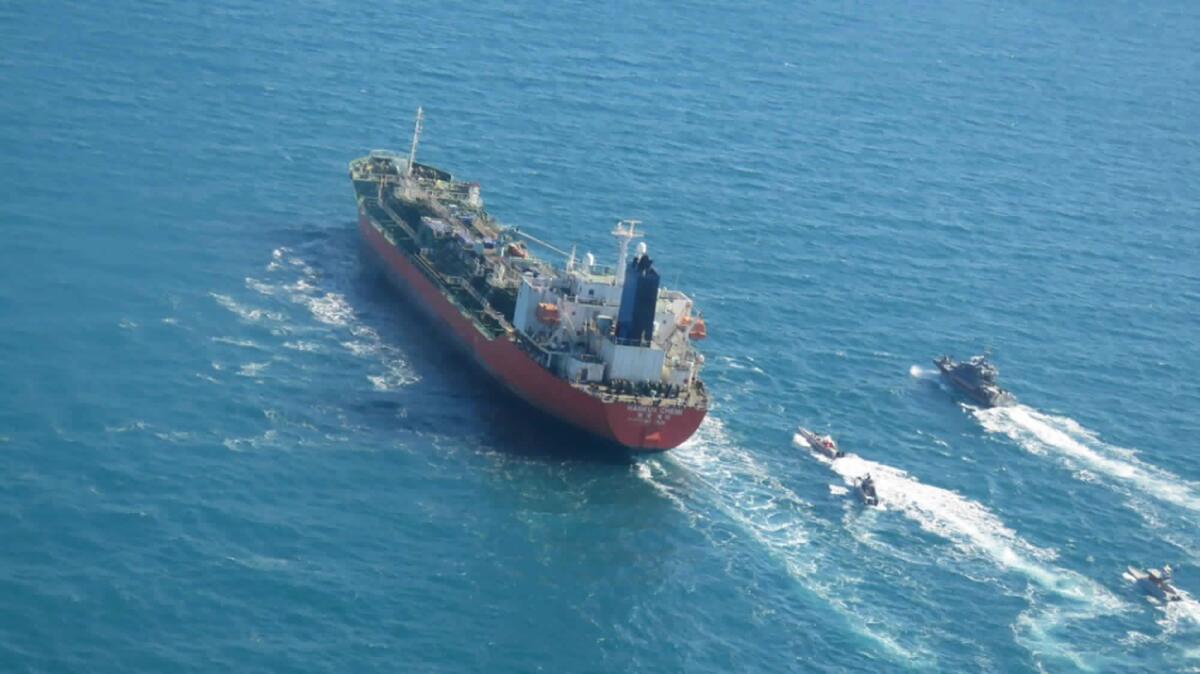
A seized South Korean-flagged tanker is escorted by Iranian Revolutionary Guard boats in the Persian Gulf’s Strait of Hormuz in January 2021. If Iran were to close the strait after the U.S.-Israel strikes Saturday, it would likely cause a massive disruption to exports and cause crude prices to spike.
(Tasnim News Agency via AP)
While OPEC members Saudi Arabia and the United Arab Emirates have some ability to reroute their shipments via pipelines that avoid Hormuz, closing the strait would still cause a massive disruption to exports and cause crude prices to spike.
There were signs that other Gulf producers were also accelerating shipments in February. Saudi Arabia’s crude shipments averaged about 7.3 million barrels a day in the first 24 days of the month, the most in almost three years. Combined flows from Iraq, Kuwait and the United Arab Emirates were set to climb almost 600,000 barrels a day from the same period in January, according to data from Vortexa Ltd.
In the past, Tehran has made retaliatory strikes on some of its neighbors’ energy assets. In 2019, Saudi Arabia blamed Tehran for a drone attack on its Abqaiq oil processing facility that halted production equivalent to about 7% of global crude supply.
Many observers say it’s improbable that Iran could keep Hormuz closed for long, making lower-impact actions like harassment of shipping more likely.
During last year’s war on Iran by Israel and the U.S., nearly 1,000 vessels a day were having their GPS signals jammed near Iran’s coast, contributing to one tanker collision. Sea mines are another long-threatened option for deterring shipping.
Market reactions
Oil surged the most in more than three years during the June war, with Brent crude rising above $80 a barrel in London. However, the gains quickly faded once it became clear that key regional oil infrastructure hadn’t been damaged.
Since then, concerns about an oversupply have dominated global markets, with crude in London ending 2025 about 18% lower than where it started.
Despite those fears of a glut, prices have surged 19% this year, partly due to fears of U.S. strikes on Iran.
With the main oil futures closed for the weekend, there’s limited insight into how traders are reacting to the latest attacks. However, a retail trading product, run by IG Group Ltd., was pricing West Texas Intermediate as high as $75.33, a gain of as much as 12% from Friday’s close.
Burkhardt and Di Paola write for Bloomberg. Bloomberg writer Julian Lee contributed to this report.
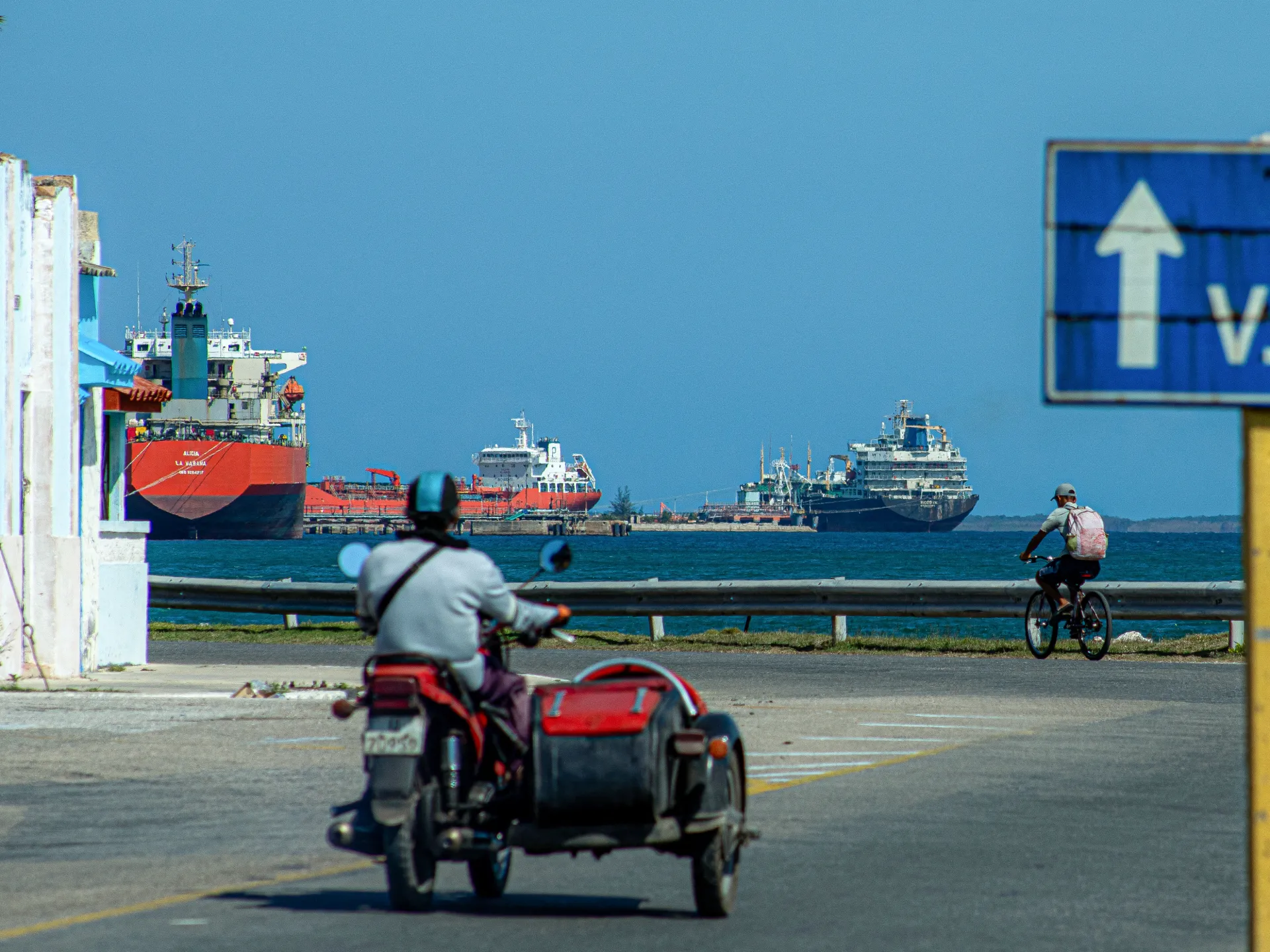
A loaded oil tanker tanker enters Matanzas Bay off Havana, Cuba, on February 16 and docks near the city’s energy logistics port amid ongoing U.S. energy sanctions on the island. Russia has been sending fuel considered to be aid. Photo By EPA
Feb. 26 (UPI) — The U.S. Office of Foreign Assets Control said it will allow certain operations to resell Venezuelan-origin oil destined for Cuba, provided the fuel is used by citizens and private companies on the island.
The island nation relied for years on Venezuela for fuel, but shipments stopped after the United States captured Nicolás Maduro on Jan. 3 and took control of Caracas’ energy industry.
After the operation, President Donald Trump repeatedly warned that Cuba was on the brink of economic collapse, and he threatened to impose further economic pressure on the country to reach an agreement with the United States. Trump has not publicly defined what kind of agreement he seeks.
The trade measure, published Wednesday, says that the transactions must comply with the conditions of General License 46A for Venezuela. This license is an authorization issued by foreign assets office that allows companies to conduct operations involving Venezuelan oil under specific terms, despite the sanctions in place against that country’s energy sector.
Companies that seek authorization will not need to have an entity established in the United States, and the usual Cuba-related restrictions set out in that license will not apply.
The Treasury Department specified that the policy will cover only exports for commercial or humanitarian purposes that benefit Cuba’s private sector.
Operations involving the Cuban armed forces, intelligence services or other government entities will not be permitted, including those listed on the U.S. Department of State’s Cuba Restricted List.
The Treasury Department recalled that the Commerce Department primarily regulates the export or re-export of U.S.-origin oil to Cuba.
Under the Support for the Cuban People License Exception, certain exports of gas and other petroleum products intended to improve living conditions and support independent economic activity in Cuba do not require separate authorization from foreign assets office provided the applicable terms are met.
The agency referred to its Frequently Asked Question 1226 for the definition of “Venezuelan-origin oil,” which includes petroleum products.
Preliminary data from the Energy Information Administration show that Venezuela exported 339,000 barrels per day of crude to the United States in the third week of February.
At the same time, regional fuel supply to Cuba has been limited. On Jan. 29, the Trump administration declared a national emergency with respect to Cuba, creating a new mechanism to impose tariffs on imports from any country that provides oil to Havana.
On Feb. 17, Mexican President Claudia Sheinbaum said her government would not send fuel to Cuba “for now” amid the current situation and potential U.S. trade measures.
Cuba faces fuel shortages that have affected electricity supply, transportation and other basic services, and it relies heavily on oil imports.
Separately, the Russian Embassy in Havana confirmed two weeks ago that Russia will send crude oil and refined products to Cuba as humanitarian assistance.
Russia is sending the oil directly, not through intermediaries, and the shipments are considered to be aid, not commercial sales.
US eases oil embargo on Cuba as Caribbean neighbours warn worsening humanitarian crisis could destabilise region.
The United States has said it will allow the resale of some Venezuelan oil to Cuba in a move that could ease the island’s acute fuel shortages, as neighbouring countries raised the alarm over a rapidly deteriorating humanitarian situation caused by Washington’s oil blockade.
In a statement on Wednesday, the US Department of the Treasury said it would authorise companies seeking licences to resell Venezuelan oil for “commercial and humanitarian use in Cuba”.
Recommended Stories
list of 4 itemsend of list
It said the new “favorable licensing policy” would not cover “persons or entities associated with the Cuban military, intelligence services, or other government institutions”.
Venezuela had been the main supplier of crude and fuel to Cuba for the past 25 years through a bilateral pact mostly based on the barter of products and services. But since the US abducted Venezuelan President Nicolas Maduro last month and took control of the country’s oil exports, Caracas’s supply to Cuba has ceased.
Mexico, which had emerged as an alternate supplier, also halted shipments to the Caribbean island after the US threatened tariffs on countries that send oil to Cuba. The US blockade has worsened an energy crisis in Cuba that is hitting power generation and fuel for vehicles, houses and aviation.
The shift in US policy came as Caribbean leaders gathering in Saint Kitts and Nevis expressed alarm at the impacts of the blockade on the island nation of some 10.9 million people. Speaking to Caribbean leaders during a meeting of the regional political group CARICOM on Tuesday, Jamaican Prime Minister Andrew Holness affirmed solidarity with Cuba.
“Humanitarian suffering serves no one,” Holness said at the meeting. “A prolonged crisis in Cuba will not remain confined to Cuba.”
The Caribbean summit’s host, Saint Kitts and Nevis Prime Minister Terrance Drew, who studied in Cuba to be a doctor, said friends have told him of food scarcity and rubbish strewn in the streets.
“A destabilised Cuba will destabilise all of us,” Drew said.
But addressing the meeting in Saint Kitts and Nevis on Wednesday, US Secretary of State Marco Rubio claimed that the humanitarian crisis had been caused by the Cuban government’s policies, not Washington’s blockade.
Rubio, whose parents migrated to the US from Cuba in 1956, warned that the sanctions would be snapped back if the oil winds up going to the government or military.
“Cuba needs to change. It needs to change dramatically because it is the only chance that it has to improve the quality of life for its people,” Rubio told reporters.
It is “a system that’s in collapse, and they need to make dramatic reforms”, he said.
Rubio went on to blame economic mismanagement and the lack of a vibrant private sector for the dire situation in Cuba, which has been under communist rule since Fidel Castro’s 1959 revolution.
“This is the worst economic climate Cuba has faced. And it is the authorities there, and that government, who are responsible for that,” Rubio said.
The US pressure on Venezuela and Cuba has left several fuel cargoes undelivered since December, according to the Reuters news agency, contributing to the island’s inability to keep the lights on and cars circulating. A Cuba-related vessel that loaded Venezuelan gasoline in early February at a port operated by state-run company PDVSA remained this week anchored in Venezuelan waters waiting for authorisation to set sail.
Mexico and Canada have meanwhile announced they would be sending aid to Cuba, and Russia’s Deputy Prime Minister Alexander Novak also said his government was discussing the possibility of providing fuel to the island.
Separately on Wednesday, Cuba’s Ministry of the Interior announced killing four people and wounding six others on board a Florida-registered speedboat that it said entered Cuban waters.
Rubio told reporters it was not a US operation and that no US government personnel were involved.
“Suffice it to say, it is highly unusual to see shootouts in open sea like that,” he said. “ It’s not something that happens every day. It’s something frankly that hasn’t happened with Cuba in a very long time.”
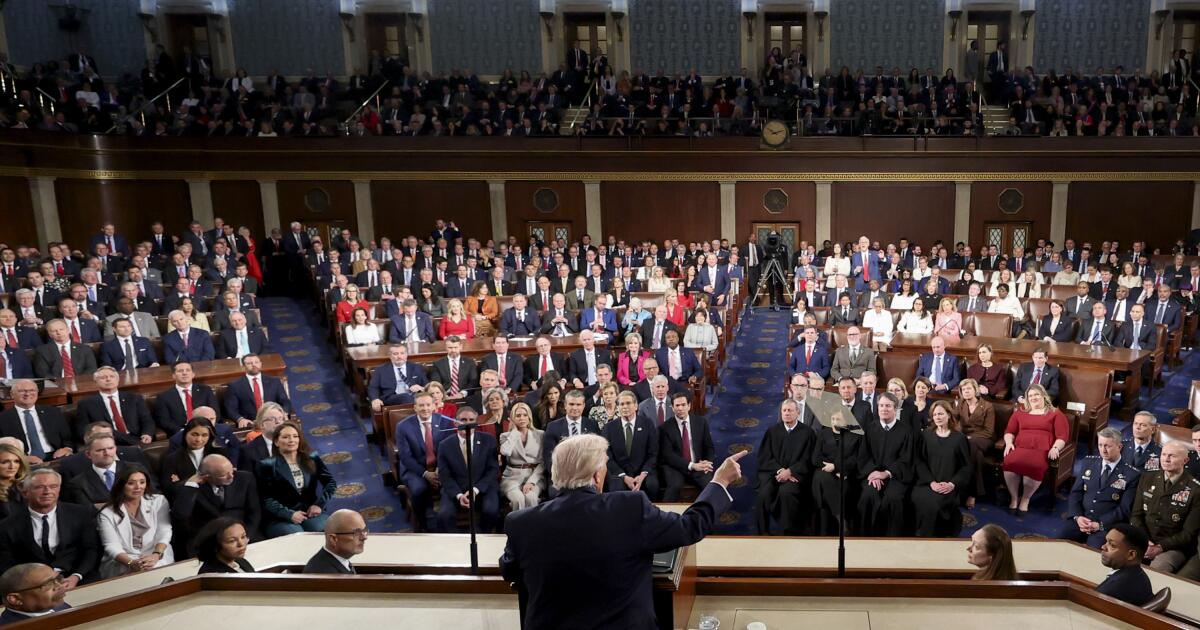
Energy affordability was in the spotlight during President Trump’s lengthy and at times rambling State of the Union address Tuesday evening as the president promised to bring down electricity prices in an effort to assuage voter concerns about rising costs.
The president announced a new “ratepayer protection pledge” to shield residents from higher electricity costs in areas where energy-thirsty artificial intelligence data centers are being built. Trump said major tech companies will “have the obligation to provide for their own power needs” under the plan, though the details of what the pledge actually entails remain vague.
“We have an old grid — it could never handle the kind of numbers, the amount of electricity that’s needed, so I am telling them they can build their own plant,” the president said. “They’re going to produce their own electricity … while at the same time, lowering prices of electricity for you.”
The announcement comes as polling shows Americans are dissatisfied with the economy and concerned about the cost of living. Experts on both sides of the political spectrum have said the energy affordability issue could translate to poor outcomes for Republicans in the midterm elections this November, as it did in a few key races in New Jersey, Virginia and Georgia last year.
While Trump has focused on ramping up domestic production of oil, gas and coal, residential electric bills have been soaring — jumping from 15.9 cents per kilowatt-hour in January 2025 on average to 17.2 cents at the end of December, according to the U.S. Energy Information Administration.
Through one year into his second term as president, Trump has vastly changed the federal landscape when it comes to energy and the environment, reversing many of the efforts made by the Biden administration to prioritize electrification initiatives and investments in renewable energy via the Inflation Reduction Act and Bipartisan Infrastructure Law.
Among several changes, Trump’s administration has slashed funding for solar programs, ended federal tax credits for electric vehicles and canceled grants for offshore wind power — even going so far as to try to halt some such projects that were nearing completion along the East Coast.
Trump has also championed fossil fuel production and on Tuesday doubled down on his “drill baby drill” agenda, touting lower gasoline prices, increased production of American oil and new imports of oil from Venezuela.
Many of the president’s efforts are designed to loosen Biden-era regulations that he has said were burdensome, ideologically motivated and expensive for taxpayers.
Trump has taken direct aim at California, which has long been a leader on the environment. Last year, the president moved to block California’s long-held authority to set stricter tailpipe emission standards than the federal government — an ability that helped the state address historical air quality issues and also underpinned its ambitious ban on the sale of new gas-powered cars in 2035.
Trump also slashed $1.2 billion in federal funding for California’s effort to develop clean hydrogen energy while leaving intact funding for similar projects in states that voted for him. In November, his administration announced that it will open the Pacific Coast to oil drilling for the first time in nearly four decades, a move the state vowed to fight.
But perhaps no issue has come across voters’ kitchen tables more than energy affordability.
So far this term, Trump has canceled or delayed enough projects to power more than 14 million homes, according to a tracker from the nonprofit Climate Power. The group’s senior advisor, Jesse Lee, described the president’s data center announcement as a “toothless, empty promise based on backroom deals with his own billionaire donors.”
“Making it worse, Trump is continuing to block clean-energy production across the board — the only sources that can keep up with demand, ensure utility bills don’t keep skyrocketing, and prevent massive new amounts of pollution,” Lee said in a statement.
Earlier this month, Trump’s Environmental Protection Agency repealed the endangerment finding, the U.S. government’s 2009 affirmation that greenhouse gases are harmful to human health and the environment, in what officials described as the single largest act of deregulation in U.S. history. The finding formed the foundation for much of U.S. climate policy. The EPA also loosened guidelines around emissions from coal power plants, including mercury and other dangerous pollutants.
The president’s environmental record so far is “written in rollbacks that put the interests of some corporate polluters above the health of everyday Americans,” read a statement from Marc Boom, senior director of the Environmental Protection Network, a group composed of more than 750 former EPA staff members and appointees.
Further, Trump has worked to undermine climate science in general, often describing global warming as a “hoax” or a “scam.” During his first year in office, he fired hundreds of scientists working to prepare the National Climate Assessment, laid off staffers at the National Oceanic and Atmospheric Administration and dismantled the National Center for Atmospheric Research, one of the world’s leading climate and weather research institutions, among many other efforts.
In all, the administration has taken or proposed more than 430 actions that threaten the environment, public health and the ability to confront climate change, according to a tracker from the nonprofit Natural Resources Defense Council.
The opposition’s choice for a rebuttal speaker is indicative of how seriously it is taking the issue of energy affordability: Virginia Gov. Abigail Spanberger focused heavily on energy affordability during her campaign against Republican Lt. Gov. Winsome Earle-Sears last year, including vows to expand solar energy projects and technologies such as fusion, geothermal and hydrogen. Virginia is home to more than a third of all data centers worldwide.
Feb. 24 (UPI) — The U.S. military seized a third oil tanker moving from the Caribbean Sea to the Indian Ocean, the Pentagon said Tuesday.
The Bertha, a ship flying the Cook Islands flag, was intercepted overnight in the U.S. Indo-Pacific Command region after the Defense Department said it attempted to evade U.S. forces.
“International waters are not a refuge for sanctioned actors. By land, air, or sea, our forces will find you and deliver justice,” the Department of Defense said in a post on X. “The Department of War will deny illicit actors and their proxies freedom of maneuver in the maritime domain.”
The department alleges that the ship was “operating in defiance of President [Donald] Trump’s established quarantine of sanctioned vessels in the Caribbean.”
The Cook Islands is a nation of 15 islands located in the South Pacific.
Two more oil tankers were seized in the Indian Ocean by the United States earlier this month.
On Feb. 9, the military pursued an oil tanker from the Caribbean Sea to the Indian Ocean without incident.
On Feb. 14, another oil tanker was captured. The Veronica III was the ninth oil tanker the United States had intercepted or seized that was linked to Venezuela since Dec. 10.
The United States has enforced a blockade on oil tankers from Venezuela since Dec. 10. The initial operation was meant to pressure President Nicolas Maduro to step down. In January, the U.S. military captured and detained Maduro and his wife.
President Donald Trump speaks alongside Administrator of the Environmental Protection Agency Lee Zeldin in the Roosevelt Room of the White House on Thursday. The Trump administration has announced the finalization of rules that revoke the EPA’s ability to regulate climate pollution by ending the endangerment finding that determined six greenhouse gases could be categorized as dangerous to human health. Photo by Will Oliver/UPI | License Photo
Recently, the United States reached a new historic milestone: it produced over 13.6 million barrels per day, a staggering feat for a country that many thought had peaked in 2008 when production bottomed out at 5 million bpd. This staggering increase was not achieved by a state giant, but by an ecosystem of thousands of independent operators driven by market-based incentives that, in Venezuela, might seem from another planet.
Meanwhile, Venezuela has traveled the opposite path: from a proud peak of 3.7 million bpd in 1970, it has collapsed to a stagnant output below 1 million bpd.
In Texas, the landowner owns the oil; in Venezuela, it is the State—which claims, all the while, to represent us all.
The hundred-year war
Since the Los Barrosos II blowout in December 1922, our oil history has been defined by a relentless tug-of-war between private capital and the State over the capture of oil rent. This conflict is not unique to Venezuela, but as we enter this “third opening,” the question is unavoidable: how do we prevent a third nationalization?
Having done it twice before (1976 and 2006), Venezuela has established a precedent that alters risk assessment across all investment horizons. How can we guarantee investors that history won’t repeat itself? While often sold as a patriotic triumph, nationalization is a terminal breach of contract and a direct assault on property rights, deterring the very capital profiles that otherwise would be participating. International arbitration, legal reforms, and institutional frameworks are necessary, but they are not sufficient.
Government take and the global race
To put things in perspective: before the 2026 reform, the Venezuelan fiscal system was among the least competitive on the planet. Between royalties on gross income, income tax (ISLR), and “windfall profit” taxes, the State extracted a “Government Take” that often exceeded 80%, with marginal tax rates reaching up to 95% depending on price thresholds. In a scenario where the operator’s net margin was squeezed to a minimum, production became a game of survival and reinvestment became technically impossible.
While the January 2026 reform moves in the right direction, we aren’t just competing against our own past; we are competing against the world. Consider the current margins (Operator Share) in the region:
Canada (Alberta, Heavy Oil): Private 50%-55% | Government 45%-50%
Texas (Permian Basin): Private 45%-55% | Government 45%-55%
Colombia (New Reforms): Private 40% | Government 60%
Brazil (Pre-Salt): Private 39% | Government 61%
Guyana (2025 Model): Private 25%-35% | Government 65%-75%
Venezuela (2026 Law): Private 20%-35% | Government 65%-80%
Even with the recent reform, Venezuela is far from being a “bargain” for long-term investment.
The proposal: from State-partner to citizen-owner
To mitigate expropriation risk and attract long-term capital, I propose a model built on four foundational pillars:
Private Capital-Citizen Partnership: The State is removed from operations. Incentives are aligned directly between citizens—the ultimate owners of the subsoil—and those who risk the capital to extract it.
Zero Corporate Taxes (Tax Displacement): Eliminate corporate income tax, royalties, and all “shadow” taxes at the source. This slashes the operational break-even to technical average levels of $30 to $40 per barrel, turning “iron cemeteries” into profitable ventures even in low-price environments. This is not a tax holiday, but a redirection of the fiscal take: the operator delivers a major share of the value directly to the citizens, while the State sustains itself by taxing the total income of the citizenry and companies in the rest of the economy.
The Citizen Dividend (Oil-to-Cash): Instead of paying a traditional tax to a discretionary Treasury, the operator delivers 50% of its net profit—effectively a flat tax paid to the owners—directly into a sovereign trust (or similar non-state mechanism) managed by top-tier international banks. While 50% is a significant share, the absence of any other fiscal burden makes this model one of the most competitive in the region. This trust distributes periodical dividends to every Venezuelan citizen, including those abroad. The State then funds its operations by taxing these dividends as part of the citizens’ total income via personal income tax (ISLR) and other tax sources from a diversified economy. This ensures that the government’s budget depends on the collective prosperity of its people, not on political control over the oil.
The Citizen as “Guardian” and Auditor: This is the ultimate shield. In 1976 and 2006, the State nationalized because it was easy to seize control from a “multinational” and hand it to a bureaucracy. Under this scheme, any government attempting to expropriate would be taking directly from the pockets of 30 million owners. Transparency is embedded: citizens monitor production and distributions through real-time digital platforms, independent audits, and other decentralized oversight mechanisms. The citizen ceases to be a spectator and becomes the industry’s most powerful defender.
Unlike the State, whose lust for oil rent is political and lacks immediate consequences for those in power, the citizen acts with the prudence of an owner—because they become one. Under this model, any attempt to “suffocate” the private partner translates immediately into a drop in personal dividends. Private ownership of the benefit is, in itself, the best guarantee of stability for capital.
Application and reality
Under this model, the direct net profit split for the oil industry would be: Private 50%, Citizens 50%, State 0%.
This “State 0%” applies exclusively to the source to insulate the industry from political rent-seeking. It does not mean a zero-revenue State; the government continues to fund its functions, but through a transparent tax system (ISLR, VAT) derived from a citizen-owned economy.
To illustrate, with oil at $100 and production at 3.5 million bpd, each citizen would have received $1,500 annually ($6,000 for a family of four). At a $60 base price, the dividend would be $640 per person. Today, with production stalled below one million barrels, a citizen would receive a mere $185. It is modest, but it represents the starting point of a virtuous cycle where the State only prospers if its citizens do first.
Herein lies the virtue of the model: the alignment of interests. Under the current system, citizens watch from the sidelines as oil wealth vanishes into the state vortex. With this approach, each Venezuelan has a personal stake: the more their private partner thrives, the more they themselves benefit. Citizens move from passive critics to primary stakeholders in the nation’s industrial growth.
Considerations for a new Venezuela
Under other circumstances, I might not be a proponent of direct “cash” transfers. But given the alternatives, it is the “lesser evil”. The political class will likely claim this is neither feasible nor “patriotic.” For many politicians, the incentive is two-fold: the salivating prospect of managing an immense oil “booty,” and the recurring ideal of “doing good” with other people’s resources.
Still in doubt? Look at our track record: despite having the world’s largest proven reserves and over 20 different administrations of every political stripe since 1922, the State captured and managed over $1.2 trillion in rent between 1920 and 2015. The result? A Guinness world record in squandered booms, the largest migration in the hemisphere without a formal war, and unprecedented institutional destruction.
Isn’t it time to withdraw the State from oil?
This proposal would achieve:
Real competitiveness: By matching Texas and Alberta margins (50%+ for the private sector), we compensate for institutional risks with top-tier global profitability.
A limited State: The State ceases to be an inefficient businessman and becomes an arbiter: providing control, arbitration, and security. Its funding would come from taxing other economic activities, forcing it to foster general prosperity rather than living off the subsoil.
A path towards a dividend-producing nation: Why not extend this to all extractive activities (gas, gold, iron, rare earths)? Perhaps the gold of the Arco Minero would stop being a black hole and become a direct dividend, shielding resources from looting and opacity.
The January 2026 reform is just a sigh in a prolonged agony. We cannot expect different results by doing the same thing. The “Hundred-Year War” over oil rent has left the State as a jailer rich in promises and a citizenry poor in realities.
Avoiding a third nationalization requires moving the subsoil out of the political arena and into the sphere of economic freedom. The US does not dominate markets by government mandate, but through an ecosystem that rewards risk and efficiency. Venezuela can emulate this success, but only by breaking the State lock and allowing a fabric of investors to flourish in direct alliance with citizens.
True sovereignty is not the State running the wells; it is Venezuelans themselves being the real owners of the benefits. Only through this pact of ownership can we hope that oil becomes, at last, an engine of development and not the tool of our own institutional destruction.
Slovakia had issued a two-day ultimatum to Ukraine to reopen the Soviet-era Druzhba pipeline so that it could receive Russian oil deliveries.
Published On 23 Feb 202623 Feb 2026
Share
Slovak Prime Minister Robert Fico has said his country will halt emergency electricity supplies to Ukraine until Kyiv reopens a key pipeline transporting Russian oil to Slovakia, making good on an ultimatum he issued to Ukrainian President Volodymyr Zelenskyy.
Fico’s announcement on Monday came two days after he warned Zelenskyy on social media that he would ask state-owned company SEPS to halt emergency supplies of electricity if flows of Russian crude oil via the Soviet-era Druzhba pipeline crossing Ukraine did not resume.
Recommended Stories
list of 3 itemsend of list
“As of today, if the Ukrainian side turns to Slovakia with a request for assistance in stabilising the Ukrainian energy grid, such assistance will not be provided,” Fico said in a video on his Facebook page.
Ukrainian grid operator Ukrenergo said in a statement that it had not been officially informed yet, but that it would “not affect the situation in the unified power system of Ukraine”.
“The last time Ukraine requested emergency assistance from Slovakia was over a month ago and in a very limited volume,” it said.
Fico said the stoppage would be lifted “as soon as the transit of oil to Slovakia is restored”.
“Otherwise, we will take further reciprocal steps,” he said, adding his country would also reconsider “its previously constructive positions on Ukraine’s EU membership”.
He said the stalled oil supply was a “purely political decision aimed at blackmailing Slovakia over its international positions on the war in Ukraine”.
Slovakia and neighbouring Hungary, which have both remained dependent on Russian oil since the Kremlin launched its invasion of Ukraine almost four years ago, have become increasingly vocal in demanding that Kyiv resume deliveries through the Druzhba pipeline, which was shut down after what Ukraine said was a Russian drone strike hit infrastructure in late January.
Ukraine says it is fixing the damage on the pipeline, which still carries Russian oil over Ukrainian territory to Europe, as fast as it can.
Slovakia and Hungary say Ukraine is to blame for the prolonged outage and have declared emergencies over the cut in oil deliveries.
The EU imposed a ban on most oil imports from Russia in 2022, but the Druzhba pipeline was exempted to give landlocked Central European countries time to find alternative oil supplies.
Meanwhile, the European Union failed to agree on new sanctions on Russia for the fourth anniversary of Europe’s biggest war since World War II, after Hungary vetoed the move.
Hungary’s Prime Minister Viktor Orban – the friendliest EU leader to the Kremlin – is stalling the sanctions and a 90-billion-euro ($106bn) EU loan to Ukraine until Kyiv reopens the oil pipeline.
Fico also said he has refused to “involve the Slovak Republic” in the latest EU loan due to Zelenskyy’s “unacceptable behaviour”, alluding to Ukraine’s earlier halting of Russian gas supplies after a five-year-old transit agreement expired on January 1, 2025, which Fico claimed is costing Slovakia “damages of 500 million [euros; $590m] per year”.
Hungary and Slovakia have accounted for 68 percent of Ukraine’s imported power this month, according to Kyiv-based consultancy ExPro. It was not immediately clear if emergency electricity supplies were included in that figure.