The Manchester City striker scored his first goals at a major international tournament as Norway powered past Iraq.
Published On 17 Jun 202617 Jun 2026
Erling Haaland scored twice in his World Cup debut as Norway powered past Iraq to win 4-1 in their Group I opener in Boston.
The Manchester City striker scored his first goals at a major international tournament on Tuesday as Norway returned to the World Cup for the first time in 28 years.
Recommended Stories
list of 4 itemsend of list
Haaland turned in from close range to give Norway the lead on 29 minutes, but Aymen Hussein’s header brought Iraq level.
Haaland then pounced on an error at the back to put Norway ahead again before half-time and take his goal tally at international level to 57 in just 51 matches.
Leo Ostigard headed in a third for Norway moments after coming off the bench to effectively wrap up the victory. Norway then got a fourth deep into stoppage time through a Hussein own goal.
The win left Norway on top of Group I on goal difference, level with France on three points after Les Bleus overcame Senegal 3-1 earlier in the day. The Norwegians face the African powerhouses in their next game in New Jersey on June 22 .
No team has endured a longer or more perilous road to the World Cup than Iraq, who secured their place as the 48th and final qualifiers in March after a 21-match campaign that stretched across 867 days.
Hussein, the scorer of the decisive goal in the play-off win over Bolivia, was held and questioned for hours by US immigration officials after arriving with the squad ahead of Iraq’s first World Cup since 1986.
Norway’s impressive return
Norway last played at the tournament in 1998, when coach Stale Solbakken was a member of the squad that famously beat Brazil in the group stage before exiting in the last 16. He also featured at Euro 2000.
After breezing impressively through qualifying, twice thrashing Italy, they are hoping a golden generation of players – led by Haaland and Arsenal midfielder Martin Odegaard – can break new ground in North America.
Solbakken predicted that Haaland would make a “very big impact” at his first major finals, and the Manchester City star was quick to deliver on that promise.
Antonio Nusa’s trickery was a problem for Iraq, and his incisive pass released the overlapping David Moller Wolfe clear before Haaland stretched to steer in the low cross from the left.
Iraq, who lost all of their group games in their only previous appearance, did not let that get to them as they equalised 10 minutes later.
Amir Alammari found space just inside the area and clipped in a cross, with Hussein rising brilliantly to power a header past Orjan Nyland.
But Iraq only had themselves to blame as they gift-wrapped Haaland’s second of the contest.
Goalkeeper Jalal Hassan was slow to react to a softly hit back pass, his attempted clearance smacking off Haaland’s shin and ricocheting into the net.
Iraq again responded well with Ibrahim Bayesh denied by a desperation block, Ali Alhamadi dribbling an effort wide, and centre-back Akam Hashim lashing a spectacular volley just over the bar.
Ostigard nodded in Odegaard’s corner on 76 minutes to seal the points for Norway, before Haaland was thwarted by Hassan when another loose pass sent him clean through and seeking his hat-trick.
Haaland, nonetheless, had a hand in Norway’s late fourth, his looping header back across goal deflecting off Hussein before trickling over the line.
It’s midnight, in June. Powder pink and dark grey clouds drift across a pallid sky, the palette reflecting in the motionless water of Lake Inari. Islets of pine and just-budding birch create pools of distorted shade close to the horizon of this 420 sq mile (1,080 sq km) lake in Lapland, northern Finland. There is not a sound. It’s so silent, I barely breathe to avoid disturbance. Only me, the lake and a moonbeam-coloured moth, whose wingbeat is inaudible.
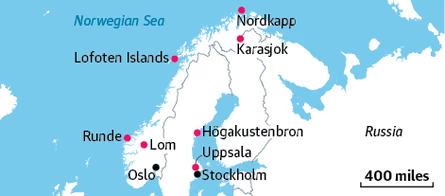
I am sat beside my car-sized campervan, with mesmerised reverence for the rose-tinged panorama. I do not wish to go to bed and miss this moment. And I am loving the wild freedom and deliciousness of being entirely alone, with nobody in the world knowing my exact whereabouts. Ordinarily, I would be long asleep by midnight, exhausted after a day of work and family life. But I have left my husband and (adult) children at home in England for an eight-week solo camping adventure through Denmark, Sweden, Finland and Norway, with the singular aim of reaching Nordkapp (North Cape) and Knivskjellodden, Europe’s northernmost point at the top of Norway, in time for midsummer.
Earlier in the day, I’d met Father Christmas. “If you’re driving north, be careful of the reindeer,” the costumed gentleman said as I sat beside him at Santa Claus’s Main Post Office in Rovaniemi, the capital of Finnish Lapland, a place considered over-touristy in winter, but certainly not during my summer visit.
“We have 230,000 reindeer here in Finland, but only one of them has a red nose.” As it happens, I see countless reindeer, in Finland, as well as Norway and Sweden, creeping through forests and grazing at the coast. Not Rudolph to my knowledge, but many females with calves, all legs and ears.
A pitstop along the way – off-grid camping is legal in Norway.
My meetings with reindeer and the night beside Lake Inari are two of many memorable experiences on my road trip through the Land of the Midnight Sun, so called because north of the Arctic Circle the sun doesn’t set below the horizon during the summer months. It doesn’t set for long south of it either, including in Denmark, where (after I’d driven my campervan from the UK via Germany) my Nordic adventure started in Rødby, on the island of Lolland.
Other than reaching Nordkapp, I have no plan; no accommodation booked either. Instead, I am utilising the popular practice of Allemansretten (everybody’s right, as it’s known in Norway), which is also legal in Finland and Sweden: the right to stop off-grid overnight on uncultivated land, leaving without a trace. On my journey I’m able to park up and stay overlooking fjords, beside mountain passes, with lake or coastal views.
From the flat plains of Lolland, Denmark’s fourth-largest island, my route north takes me to Helsingør for the ferry across the Øresund to Helsingborg in Sweden, leaving a rear-view image of Kronborg Slot – “Hamlet’s Castle” – at dawn.
Luminous lupins and puce pinks litter the roadsides of my 370-mile cross-country route to Sigtuna, 30 miles north-west of Stockholm. The lakeside settlement of colourful timber houses is Sweden’s oldest town. Half an hour’s drive north is Linnaeus’ Hammarby, a pretty 18th-century farm that once belonged to Carl Linnaeus, the botanist who developed the binomial system of naming species we use today.
Watching the midnight sun from Nordkapp.
Hammarby is wonderfully representative of this Uppland region of Sweden. I walk 10 miles through the cultivated countryside along the Dannmark Trail between Linnaeus’s farm and Uppsala, a route he would walk with his biology students for nature studies. Students at Uppsala University (where Linnaeus was a professor) are celebrating finals when I arrive, mingling around ice-cream cafes and in floral parks and botanical gardens. Nearby, the vast twin spires of the city’s rust-red cathedral protrude above blossoming rowan trees.
From Uppsala, I follow the E4, a road that reaches the border with Finland, covering more than 600 miles over six days. Along the way I cross Scandinavia’s longest suspension bridge, the Högakustenbron, at the Höga Kusten, or High Coast, a Unesco world heritage site.
Vast stretches of empty road lined with little but pine trees provide a chance for contemplation. But it’s not until I arrive in the colourful town of Karasjok days later, having crossed from Finland into Norway, that I truly understand the scale of the Nordics. For Karasjok feels very far north, yet it is still a four-hour drive to Nordkapp.
Karasjok is the Norwegian administrative centre for the indigenous Sámi population of Sápmi, the cross-border cultural region that includes parts of Norway, Sweden, Finland and Russia. The parliament building resembles a traditional lavvu tent and, nearby, Sápmi Park offers an introduction to Sámi traditions.
Leaving Karasjok, the road winds its way alongside Porsangerfjorden, passing fishing hamlets, waterfalls, shaly mountain cliffs and tremendous viewpoints before dipping beneath the Arctic Ocean by tunnel to reach Magerøya, the island upon which Nordkapp sits. I chance upon fine weather as I climb beyond Honningsvåg, one of Norway’s northernmost towns, over snowy mountain plateaux to reach Nordkapp. A tear forms in the corner of my eye. I am alone, about 2,500 miles from home by the quickest route, and I wish my family could see what I can. But this is a solo adventure, and I have reached my goal, staying up all night to watch as the midnight sun sends orange beams across the Arctic Ocean. Captivating.
The writer on a windswept plateau near Nordkapp.
It is not by the quickest route that I return home, though. My journey back south through Norway (and ultimately Sweden and Denmark, too) is contorted, meandering west and east. Picnics beside turquoise sea coves on the Lofoten Islands, watching pods of dolphins in the Norwegian Sea. Bulging rivers and thundering waterfalls in Saltfjellet national park. Then small farms and meadows with emerald stripes of hay, amassed buttercups, and long lakes through the region of Trøndelag. It is Norway bursting into colour after the bleached landscapes of the north. Occasionally I’ll put in a long stretch in one day – 200 miles or so. Other days, I simply stay put, enjoying the view or stepping out for long walks.
Atlanterhavsvegen – a 22-mile national scenic route across skerries and strung together by bridges – is captivating. Then Runde, one of Norway’s westernmost islands, renowned for a colony of puffins that breed on the cliffs here. A steep mountain walk across the island reveals clusters of people perching on cliff edges in the hope of witnessing the spectacle of birds coming in to roost.
But it is the east of the island where I park up and sit alone for days, watching an otter swimming among the lichen-speckled black rocks, alerted by a clatter of ducks and ducklings, shelducks, wigeon and oystercatchers. Keeping my distance, I observe parent gulls sheltering fluffed-up chicks as curlew call overhead. Orchids, sea campion, clover and a host of other flowers smother the coastal ground. A memorable time.
View from the campervan while overnighting on Norway’s Atlanterhavsvegen scenic route.
So, too, my wild camp at the summit of Sognefjellet mountain pass, the highest road in Scandinavia. I set out from Lom, an attractive town that sits between three national parks and possesses a famous stave church and the fascinating Norwegian Mountain Centre. The road, also a designated national scenic route, runs alongside the pretty Bovra River initially, then climbs into some of Norway’s wildest scenery. My overnight is cold, with huge frozen lakes of glacial blue and roadside snow above the height of the campervan. In the morning, as Nordic skiers and a pack of snowmobiles head out to nearby glaciers, I brush snowflakes from my windscreen to begin the descent to the green and luscious Sognefjord. It’s as if I have stepped through a wardrobe and imagined the wintry summer scene.
I appreciate that being alone by choice is entirely different to loneliness. I am often asked of my solo travels, “Don’t you ever get lonely?” I can feel lonelier, I explain, in a crowded room than camping in the wild. Yes, leaving family behind creates a sense of “wish you were here”; special moments I’d like to share. Then again, this adventure is understanding that the memory is mine alone. The thrill, the excitement, the calm and occasionally the trepidation. I’d do it all again tomorrow.
The writer travelled in her own campervan, using Scandlinesferries between Puttgarden, Germany, and Rødby, Denmark.In the UK and Europe, hire of Roadsurfer’s smaller vehicles starts at £49 a night
Israel continues to expand settlements in the occupied territory, which are illegal under international law.
Published On 11 Jun 202611 Jun 2026
The Israeli government has allocated a first tranche of an expected $388m in new funds for the construction of settlements in the occupied West Bank.
The anti-settlement group Peace Now reported on Thursday that the government had allocated 152 million shekels ($51m) to prepare construction plans for 69 illegal settlements and outposts in the occupied West Bank.
Recommended Stories
list of 3 itemsend of list
The cabinet later reportedly postponed a decision about a 1-billion-shekel ($338m) allocation. That proposal, if passed, would mark one of the largest expansions of illegal Israeli settlements in decades.
“The government decided to postpone the decision [on the 1-billion-shekel allocation] and refer it to the Security Cabinet which is expected to convene on Sunday,” Peace Now wrote.
Under the yet-to-be-approved plan, construction for the settlements, including infrastructure and public buildings, would begin despite necessary planning protocols not having been carried out in accord with Israeli law.
Peace Now accused the government of intending to bypass planning and construction regulations.
“October 7 proved that the right-wing approach has failed: the conflict cannot be ‘managed,’ and the Palestinians cannot be ‘defeated’,” the group said in a statement.
“Israel must reach a political solution and diplomatic agreement, but instead the government is only sinking us deeper into the mire and condemning us to many more years of bloody conflict.”
Israel has come under growing condemnation for expanding settlements in the occupied West Bank, which are illegal under international law.
On Tuesday, the United Kingdom, Australia, New Zealand, Canada, France and Norway imposed sanctions on networks involved in financing, enabling and carrying out settler violence against Palestinians.
According to Peace Now, the current Israeli government has approved 103 settlements since it took office in December 2022. From that figure, 51 are entirely new settlements.
On Wednesday, Amnesty International published a report accusing the Israeli government of playing a central role in what it describes as the ethnic cleansing of Palestinians in the occupied West Bank. The report described the government’s actions as “integral”.
At least 117 villages in the West Bank have been subject to either complete or partial displacement due to settler attacks, according to the United Nations Office for the Coordination of Humanitarian Affairs (OCHA).
Amnesty also condemned the upcoming “Great Israeli Real Estate Event”, which is due to take place in London on Sunday.
The event, which has also been held in the United States and Canada, promotes the sale of properties in the occupied West Bank, which campaigners say is in violation of international law.
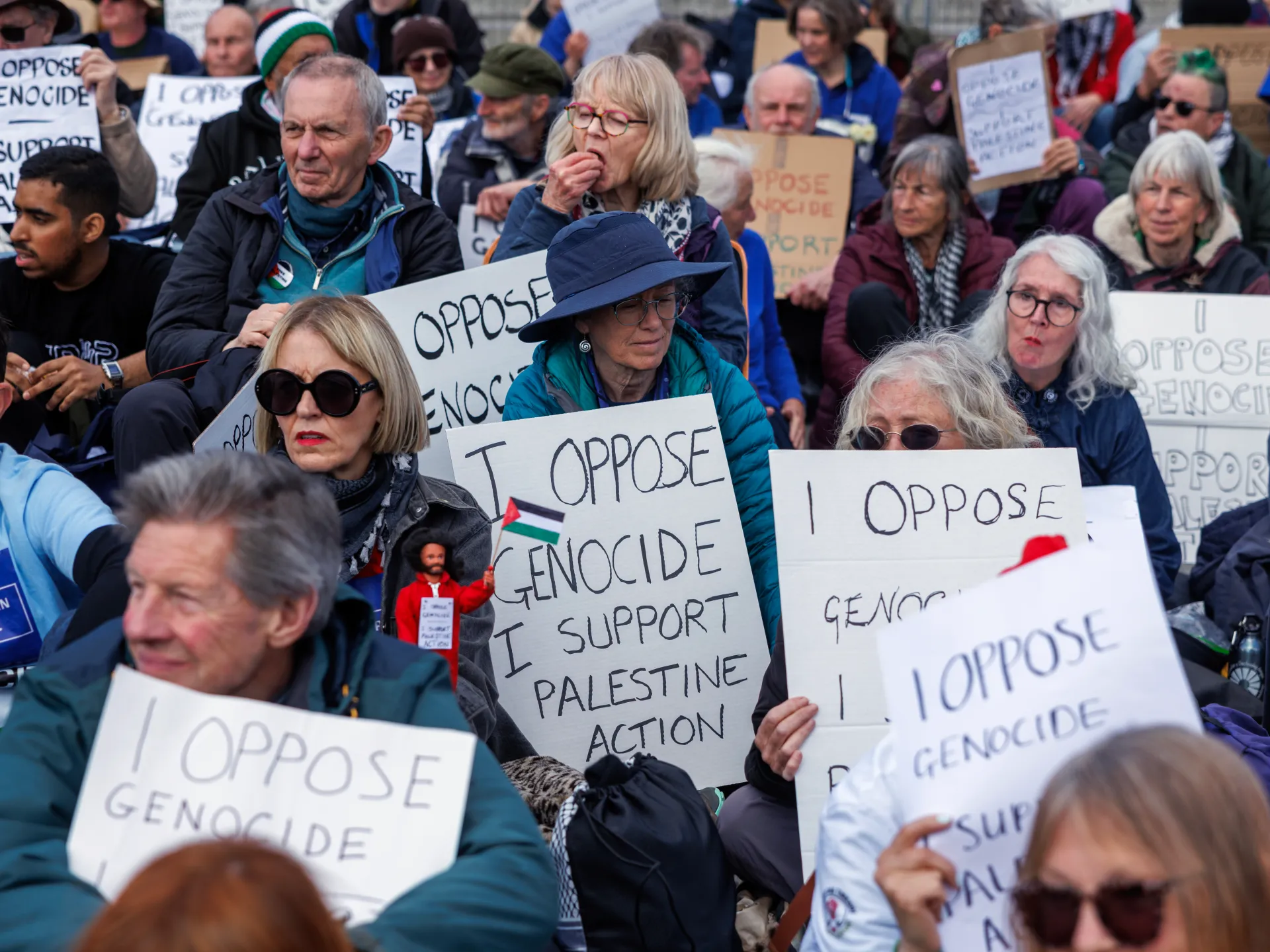
Four activists from the Palestine Action group face sentencing in the United Kingdom as “terrorists” on Friday, despite only being convicted by a jury of other criminal charges.
Palestine Action was formally proscribed as a “terrorist” organisation in the UK last July.
Last month, four of six activists on trial were convicted at Woolwich Crown Court in London of criminal damage during a 2024 raid on a factory in Filton, Bristol, operated by Israeli defence firm Elbit. One of the defendants was also found guilty of striking a police officer with a sledgehammer.
The possibility that the judge will rule that the offences have a “terrorist connection” for sentencing purposes has prompted protests.
What is Palestine Action?
The protest group Palestine Action, launched in July 2020, describes itself as a movement “committed to ending global participation in Israel’s genocidal and apartheid regime”.
It seeks to use “disruptive tactics” to target “corporate enablers” and companies involved in the manufacture of weapons for Israel, such as Israel-based Elbit Systems, Italian aerospace company Leonardo, French multinational Thales and Teledyne from the United States. The group has targeted British facilities linked to those companies.
The UK parliament voted in favour of proscribing the group on July 2, 2025, classifying it as a “terrorist” organisation, and bringing it into the same category as armed groups such as al-Qaeda and ISIL (ISIS). The proscription came days after its activists sneaked into an air force base in southern England.
Critics decried the move by MPs, arguing that while members of the group have caused damage to property, they have not committed violent acts that amount to terrorism.
What were they convicted of?
In August 2024, Palestine Action activists raided a factory in Filton near Bristol in southwest England, operated by Israeli arms manufacturer Elbit Systems. They entered the site and caused extensive damage in an attempt to disrupt the production of weapons and drone components they say would be used by Israel in Gaza.
The raid, which prosecutors said caused about one million pounds ($1.36m) of damage, happened 10 months into Israel’s genocidal war on Gaza that began in October 2023.
Last month, jurors at Woolwich Crown Court convicted Charlotte Head, 30, Samuel Corner, 23, Leona Kamio, 30, and Fatema Zainab Rajwani, 21, of criminal damage. The four activists have become known as “the Filton 4”.
Corner was also found guilty of striking a police officer with a sledgehammer and convicted of inflicting grievous bodily harm.
Two other Palestine Action activists, Zoe Rogers, 22, and Jordan Devlin, 31, were found not guilty.
The verdict followed an earlier trial, at which all six defendants were acquitted of aggravated burglary, while the jury was unable to reach verdicts for the criminal damage charges.
Each of the defendants gave evidence, admitting that they damaged Israeli military drones and equipment inside Elbit’s research and development facility in Filton – in order to “save lives in Palestine”, according to a statement by their lawyers.
What would a terrorism sentencing mean?
The jury was not told that, if they convicted, the four could be sentenced under terrorism laws. Criminal damage is not usually a terrorism offence, but in England and Wales judges can decide to treat an offence as having a “terrorist connection” at sentencing, even when the charge itself is not a terrorism offence.
If the court decides there was a terrorism connection, the activists would have to serve their entire sentences in prison, unless they have already completed at least two‑thirds of the sentence and a parole board decides they can be released.
Conversely, non-terrorist prisoners usually serve about 40 percent of their sentence in custody and are released early, but under conditions and supervision, sometimes called licence conditions. If they break those conditions, they can be sent back to prison to finish their sentence.
Additionally, if the activists are sentenced in this way, they can be recorded as “terrorists” for the rest of their lives, would be required to register new mobile devices, email addresses and bank accounts with the police for their lifetime, and face being returned to prison if they breach their licence conditions or reoffend.
What has the reaction to all this been?
On Wednesday, a group of more than 50 lawyers and law professors published an open letter denouncing plans to sentence the four Palestine Action members as terrorists.
The letter highlights that damage to property has been a recurring feature of protest campaigns from the Suffragettes who fought for women to have the right to vote, to environmental protest group Extinction Rebellion.
“It has never previously even been suggested that those taking such action should be treated as terrorists. Blurring the distinction between principled direct action and terrorism is the hallmark of authoritarian regimes,” the open letter stated.
The letter has been signed by law professors from universities in the UK, the Netherlands, Norway and Canada as well as by dozens of practising barristers and solicitors.
According to local news reports, a protest is expected at Woolwich Crown Court on Friday against the potential judgement.
1 of 4 | German officers stand before Oslo’s National Theater in 1940 after taking control of Norway during World War II. On June 10, 1940, Norway surrendered to Germany during World War II, with King Haakon and members of the government fleeing to Britain. File Photo by Willi Ruge/German Federal Archives
On this date in history:
In 1692, Bridget Bishop was found guilty of the practice of witchcraft and hanged in Salem Village in the Massachusetts Bay Colony. She was the first colonist executed during the Salem witch trials.
In 1898, U.S. Marines invaded Cuba in the Spanish-American War.
In 1940, Norway surrendered to Germany during World War II, with King Haakon and members of the government fleeing to Britain. National Unity Party leader Vidkun Quisling led Norwegian fascist forces to assist the Germans, seizing strategic locations.
In 2014, Rep. Eric Cantor, R-Va., the U.S. House Republican leader, was defeated by Tea Party challenger David Brat, a college economics professor, in one of the most stunning primary election upsets in congressional history.
In 2021, the U.S. Senate confirmed Zahid Quraishi to the U.S. District Court in New Jersey, making him the first Muslim federal judge in the United States.
In 2024, Apple introduced its new generative artificial intelligence technology, called Apple Intelligence, at its annual Worldwide Developers Conference in Cupertino, Calif.
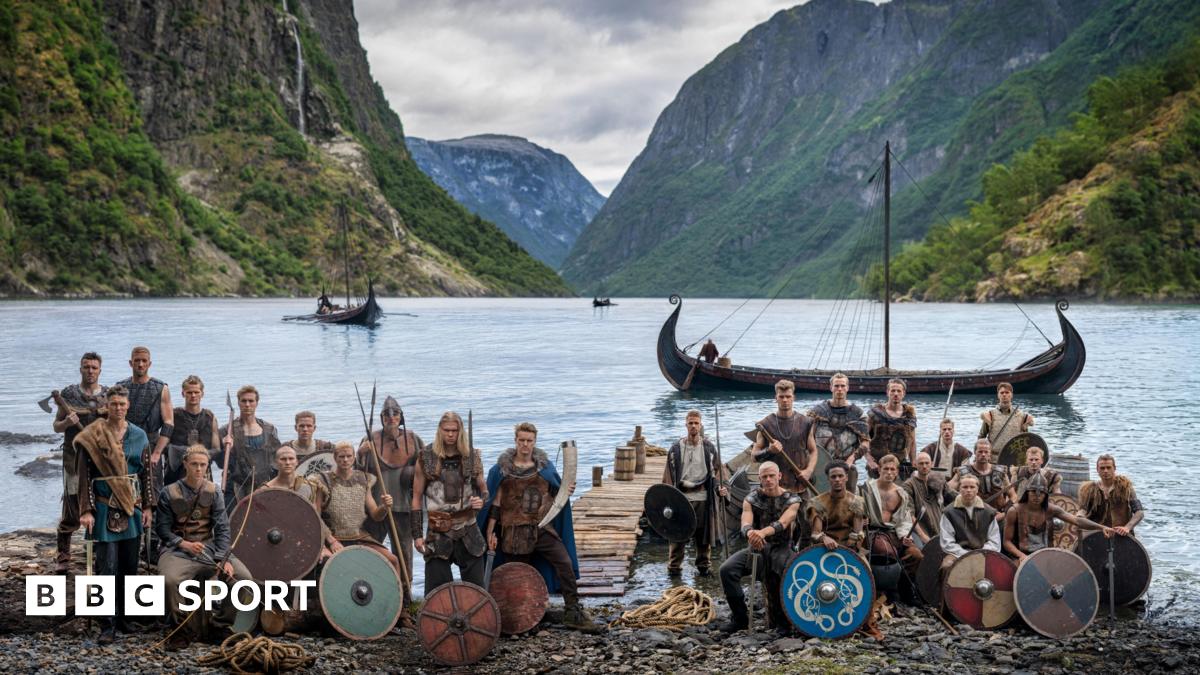
Realising his vision for photo, though, was not so straight-forward.
Yarrow had to navigate the packed schedule of Norway captain and Premier League champion Martin Odegaard – who was in Budapest with Arsenal for the Champions League final on the day of the squad shoot.
After the parade had left north London, Odegaard joined Yarrow for a solo shoot, and the cloudy conditions matched those of the original shoot – meaning his figure could be added in without too much fuss.
But it was crucial to Yarrow that Odegaard and his title rival Haaland did not steal the show.
“The one thing that was important about that picture is if, in the Norwegian squad, you’ve got someone that’s worth £200m and then you’ve got Watford’s goalkeeper [Egil Selvik] that’s worth £250,000, the third-in-line goalie – that they both occupy the same amount of the frame,” Yarrow told BBC Sport.
“That’s very important for me.
“That is was not seen to be Haaland and Odegaard and 24 others – it was important to foster a sense of team.”
Yarrow was a guest of Norway as the side beat Sweden 3-1 in a warm-up friendly on Monday, with goals by Jorgen Strand Larsen and Antonio Nusa.
He was struck by the breadth of talent in the Norway team.
“People think it’s a team of two people and it’s so not,” said Yarrow, who was born in Glasgow.
“It’s a seriously good football team, from their wingers to their backs, and I think they’ll go quite far in the tournament.
“But, like Scotland – they’ve got to win their first game.”