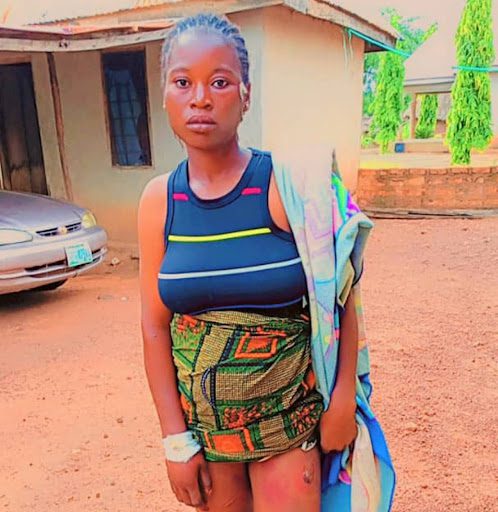
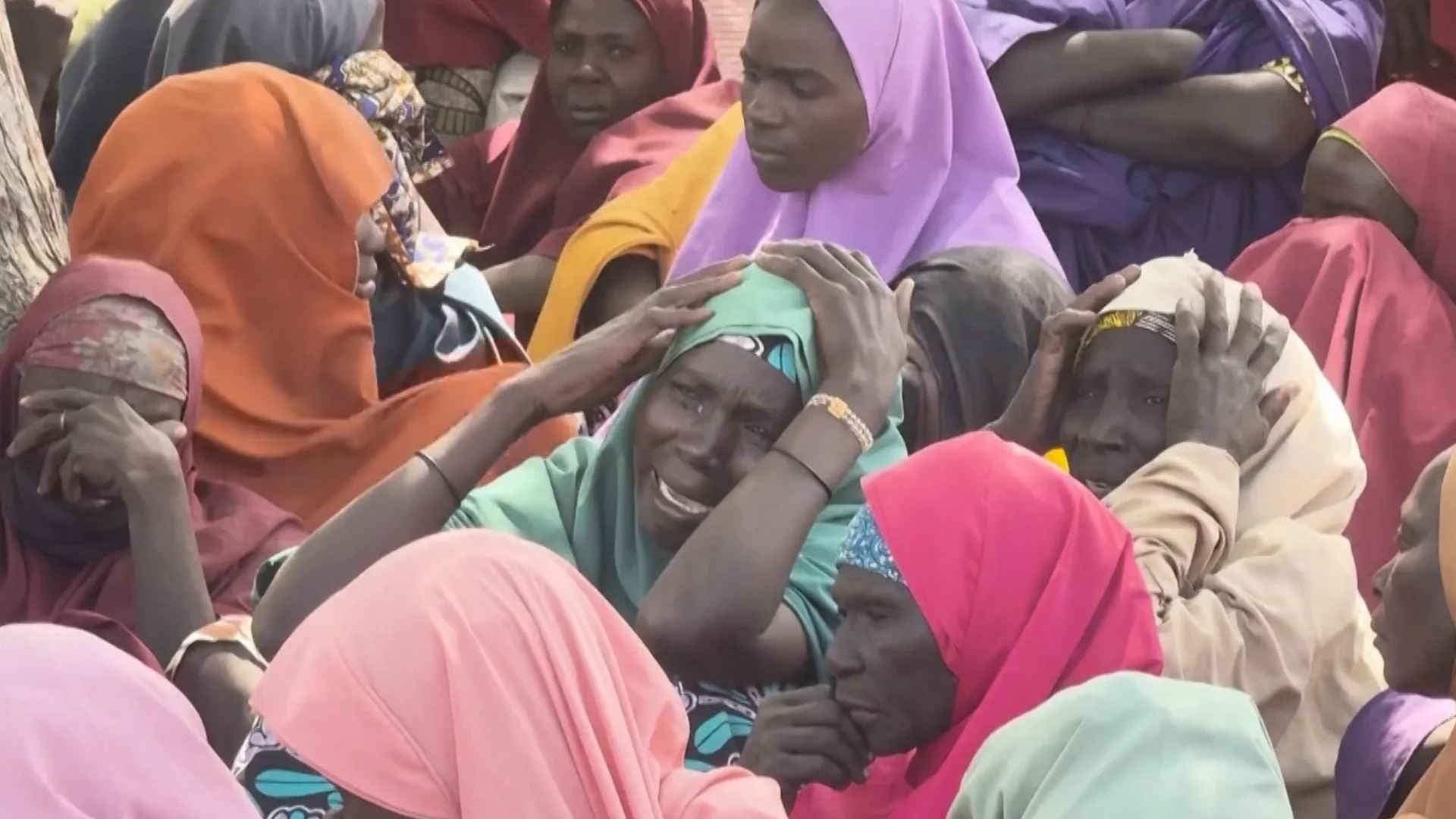
Joy Oga, a pregnant woman in her second trimester, was harvesting yams on her farm in Kwanta/Dooshima area when armed men attacked. The 31-year-old farmer had gone out with three others from her community on June 16 to harvest the farm she had been unable to reach since her village was invaded in September 2025. She never finished the harvest.
“I went to the farm to pack yams when I was attacked,” Joy told HumAngle.
Joy had farmed in her village in Chanchanji, Takum Local Government Area, in Taraba State, northeastern Nigeria, for five years, and farming is her only means of livelihood. After enduring months of hardship in a displacement camp in Chanchanji town, she was eager to resume farming as soon as she and other residents were asked to return home. On the day of the recent attack, she was there to also clear the land for a new planting season.
Joy said the attackers, whom she claimed were herders, confronted her and the other people that were with her, and immediately started hacking them with the machete. She ran back to the community with a cut on her face, wrist, and legs.
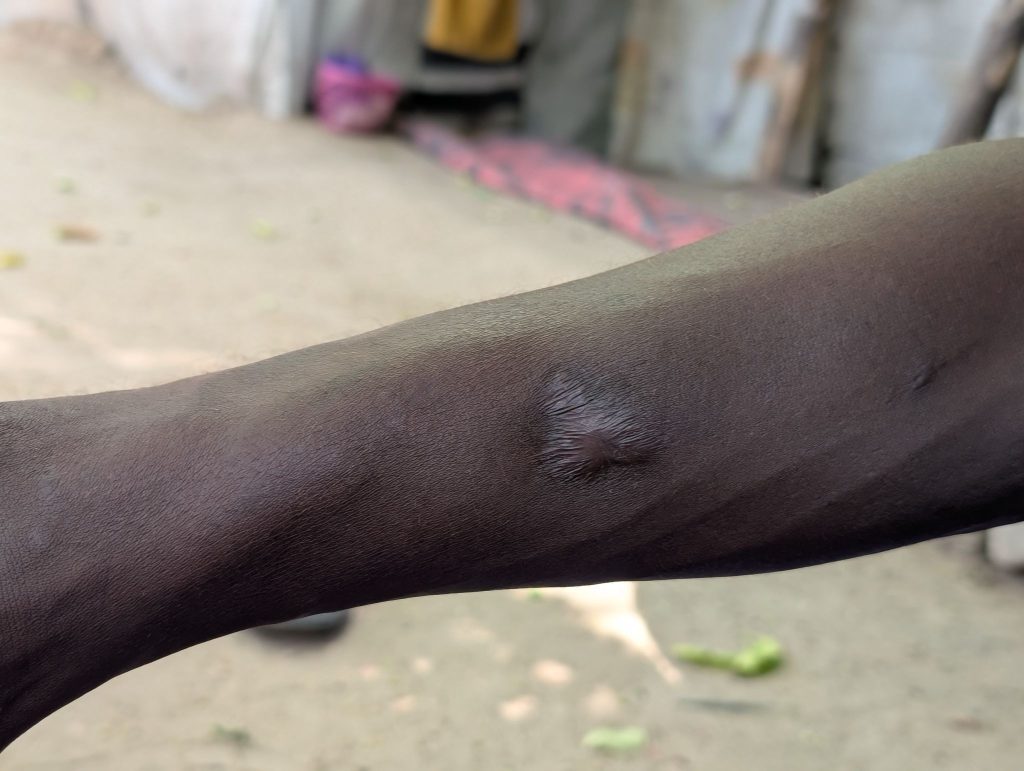
Joy was pregnant in her second trimester when she was attacked on June 16. Photo: Felix Ashe
The attack came barely two months after a peace deal was struck between the Fulani and Tiv communities of southern Taraba, and has raised questions about the restoration of peace and the fate of residents who rely on farming for survival in the area.
In April, a peace dialogue organised by the Taraba State government, northeastern Nigeria, brought together leaders of the Fulani and Tiv ethnic groups to put an end to the series of clashes that claimed lives and properties in communities within southern Taraba. The Fulani in the area are predominantly nomadic herders, while the Tiv are mostly farmers. During the dialogue in Jalingo, the state capital, both parties agreed never to raise arms against one another.
The government also instructed displaced residents across the affected areas to return home. Weeks later, some residents began to exit the displacement camps in Chanchanji and Amadu for their hometowns after months of facing terror attacks, mass displacement, and food shortages. Three committees were set up by the government to manage the displaced persons’ return, inter-boundary and migration control, and boundary assessment and settlement.
A multitude of motives
Southern Taraba has witnessed recurring violence involving farming and pastoralist communities for more than two decades. The area comprises five Local Government Areas (LGAs): Donga, Ibi, Takum, Ussa, and Wukari. Researchers say the conflict is driven by a complex mix of competition over land and water, population growth, the proliferation of small arms, weak law enforcement, and criminality. While these clashes are often described as “farmer-herder conflicts”, several studies caution that they increasingly involve organised armed groups whose activities go beyond disputes over grazing routes. Indigenous Tiv communities in Taraba and neighbouring Benue State also say the attacks are a strategic move to take over their lands and resources.
A security expert, who has also worked as a police officer in the area, told HumAngle that the crisis goes beyond ethnicity. “This is terrorism, because the attackers come into town, destroy property, and run back. They do not have a settlement around that area, and whenever they come to Chanchanji, it does not only affect one tribe — it affects other tribes living in Chanchanji too,” the source, who pleaded anonymity, noted.
Locals in Chanchanji said the Sept. 2025 attacks were the worst they have experienced in the area. Photo: Moses Uko
He argued that terrorists are exploiting the unresolved ethnic clash between both parties to infiltrate the area, particularly in ungoverned spaces, adding that if it were purely an ethnic conflict, only the Tiv and Fulani would be affected; since every tribe in the area suffers during the attacks, he believes it is more accurate to describe the situation as terrorism.
Other claims about the motive of the attacks have been circulating; one of them originated from the deceased leader of a criminal gang that operated along the border between Benue and Taraba. Before his death in the hands of the Nigerian Military in September 2020, Terwase Akwaza, known popularly as Gana, a notorious criminal gang leader in Benue, claimed during an interview that armed groups posing as herders had approached him and asked him to carry out attacks in “about three states they want to [capture], being Plateau, Taraba, and Benue.” Joy, like many other residents, believes that the attacks were carried out by these armed groups.
After Gana’s death, his allies fractured into rival factions, with the most prominent ones being led by Fullfire and Chen. Despite attempts by community leaders urging these groups to cease fire, they have continued to operate violently in the region.
On the allegations from both parties about the hiring of militias, the security expert acknowledged that “in an environment where there is crisis, there are people who try to bring up some things to justify their actions”, adding that parties might exaggerate casualties or incidents.
A blow on both sides?
Benjamin Kwazza, who also survived the June 16 attack, told HumAngle that the attackers were tactical, targeting their heads and necks with the intention of causing instant death. “They pursued us, and along the line when they got us, they started to cut my neck,” he said, adding that he sustained a deep neck wound.
When Joy, Benjamin, and the others returned to the village, residents organised a search party, but the attackers had already fled.
The following day, June 17, two other farmers were attacked on their farmland in the same community. While the other farmer managed to escape untouched, Terkura Mathew was brutalised and left in his pool of blood. Locals found him and brought him back to the village. His condition remains critical.
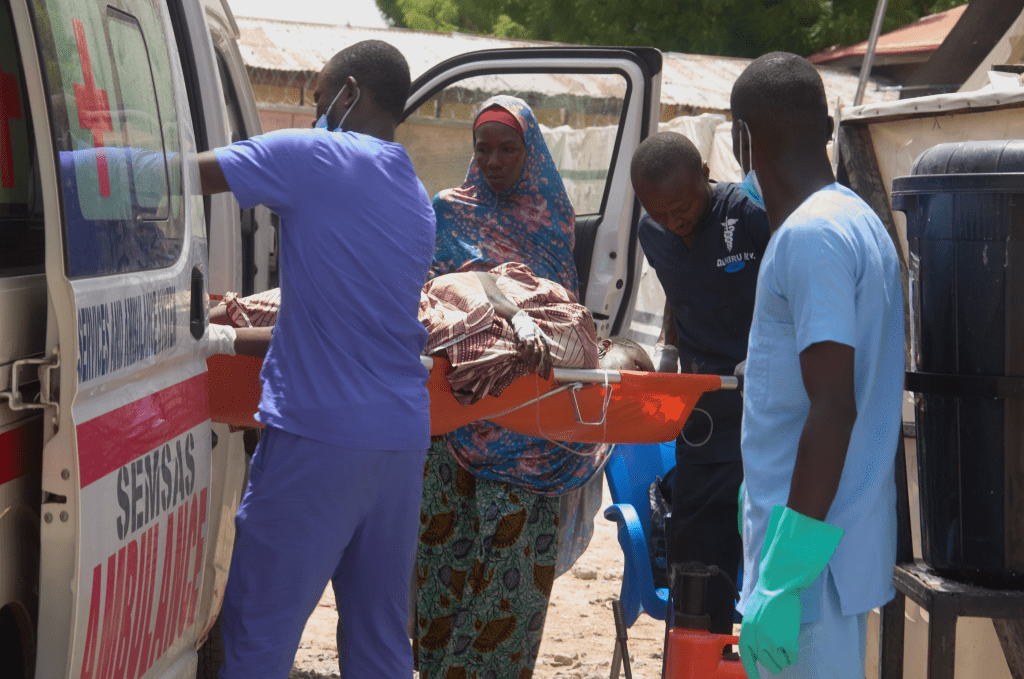
HumAngle reviewed videos and photographs of the June attacks, which showed visible wounds sustained by survivors, including deep cuts and injuries consistent with machete assaults.
Bello Mbela, the Taraba State chairperson of Tabital Pulaaku International, an organisation that serves as a unified voice for Fulani communities across the continent, explained that the southern Taraba crisis is a blow to both sides. Tabital Pulaaku represented the Fulani community during the signing of the peace deal in Jalingo.
According to him, Fulani people who live around Southern Taraba communities like Kofai Amadu, Tor Damisa, Kurmi and other areas are always caught up in the violence, which has led to loss of lives, cattle, and properties, with many who are currently displaced.
Illustration: Akila Jibrin/HumAngle
Bello said the most recent incident occurred in February. “In Kofai Amadu under Takum Local Government Area (LGA), several women and children. The children were grazing when they were attacked, and their necks were snapped,” he stated.
Get our in-depth, creative coverage of conflict and development delivered to you every weekend.
Subscribe now to our newsletter!
The Tabital Pulaaku leader also stressed that the herder communities in the region were set ablaze by aggrieved locals multiple times. “Also, around Kurmi LGA, there were rape cases. When a young woman sets out, she’s captured, threatened with a knife and raped. Especially those who go to hawk Fura da Nono,” Bello claimed.
Although he did not provide visual evidence of the alleged violence, he said attacks against herders and their families often go unreported and undocumented. “We do not record their deaths. We bury them instantly and keep moving. Most of the deaths are common among the elderly, disabled, pregnant women, and children,” he told HumAngle.
Bello added that the affected herder communities are afraid of seeking shelter in temporary displacement camps in the towns due to fear of being profiled. Hence, they retreat farther into the bush for safety when their homes are razed. “Some of them come to Jalingo where they are sheltered by the Muslim council,” he said.
Similarly, farming communities report a similar pattern of targeted abuse. Uzaki Peter, a local leader in Bachula, a community in southern Taraba that was displaced by attacks, told HumAngle that farmers have been experiencing a series of fresh attacks since they resumed farming in June. According to him, locals were adamant about returning home despite the hardships in the camp, but the peace meeting in April gave many hope.
HumAngle learnt that locals and herders lived together in the region for years until clashes started recurring in 2025. “We always meet with the herders. They were telling us there is no problem. We should invite our people to come back. So, we started feeling like there was a solution, so our people started going back,” he said. However, Bachula is currently experiencing the same pattern of attack that occurred last year, according to Uzaki. “They will come and attack you. If you have a phone, they will collect it, and if you have money, they will collect it. They were sleeping with our women who were going to the farm,” the community leader said.
Despite the peace dialogue
Bello, who was present during the peace dialogue, told HumAngle that both parties have been trying to abide by their agreement that no party must attack the order. However, new cases are coming up. “In May, two women went to the Chanchanji area and did not return. They were killed.”
He explained that the incident sparked outrage and nearly led to fresh clashes. Since there was a peace dialogue, the issue was reported to the police station, and an investigation began. To date, none of the perpetrators has been caught.
“If someone goes to the bush to graze alone, he does not return,” Bello gave another instance, stating that they are probably killed because such incidents took place in the past.
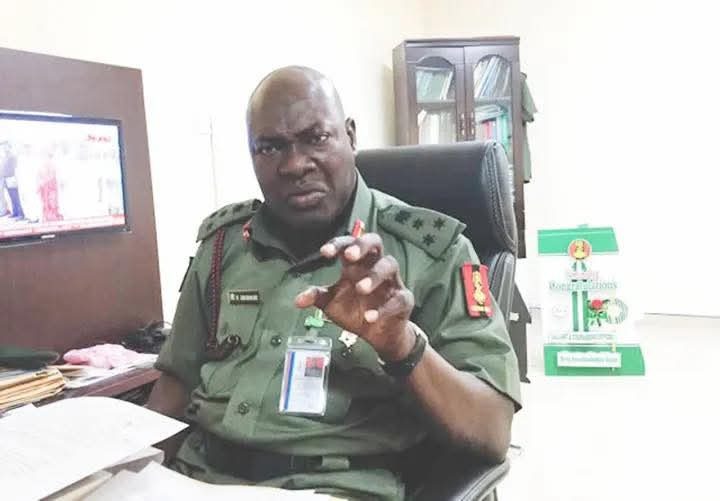
When HumAngle reached out to James Lashen, the Taraba State Police Command’s Public Relations Officer, regarding the recent attacks in the region, he said that Kwanta/Dooshima and other areas in Chanchanji that are constantly under attack fall under “ungoverned spaces”.
“Taraba is the third largest in landmass in this country after Borno and Niger,” he stated, explaining that the landmass affects security response and patrol. “But for now, Chanchanji, Amadu and other areas, there is peace. There is a sustained patrol. We would like to embark on a convoy patrol due to the length of the road. You know, from Takum to Wukari, it is a long distance. And that is where they normally perpetrate. But for now, we have already taken charge of that area. For now, no incidents are taking place there,” he asserted.
When asked about the recent incidents in the area, despite his assurance of peace, Lashen said it is quite common during the farming season and that it is the responsibility of the Divisional Police Officers to report to the command. However, he noted that he had yet to receive a report of the incident in Kwanta/Doorshima or Bachula at the time of our communication.
The PPRO stressed that the Taraba State Police Command has ensured displaced communities returned home. “Everybody has been back. Policemen are stationed there. We have posted tactical teams there in that area. Everybody has gone back to his house,” the officer said.
However, some residents disagree. Uko Moses, a farmer and resident of Peva, another affected area in the region, told HumAngle that the Peva community remains deserted to date, and locals are still in displacement camps in Amadu and Chanchanji town due to recurring attacks and unresolved tension. He also noted that areas such as New Gboko, Demavaa, and other southern Taraba communities remained abandoned.
“Those who try to access their farmlands are being hurt on a daily basis,” Moses said.
According to him, food, clothing, and healthcare are the basic challenges faced by displaced people still in camps due to fear of returning home. Also, children have been out of school for over nine months. “We depend on the government, humanitarian organisations, and philanthropists. The insecurity has made us become beggars,” he stated.
To cushion the suffering of displaced persons in the displacement camps, HumAngle learned that Kefas Agbu, the Taraba State Governor, donated bags of rice and other relief items across the camps in March. Also, Benue State Governor Hyacinth Alia visited the displaced and assured those living along the Benue border that they would soon be able to return home.
“His words were full of hope. According to him, it will not take long for the people to return to their communities and continue with their daily business.” Moses spoke of the Benue State Governor’s promise.
However, locals remained in the displacement camps, and despite the hardship, Moses said they prefer to stay in the camps rather than come home where their safety is not guaranteed.
“The security architecture there is very poor. In some of the villages, there are no checkpoints close by or police stations built there,” he said.
Uzaki, the Bachula caretaker, echoes Moses’s security concerns in the area. “Yesterday [June 16], I reported a case of three people. They were admitted to the hospital, and the day before yesterday [June 15], I reported a case involving two people. They are also here. And today [June 17] two have been brought out that have been matcheted,” he said.
Lashen, the police spokesperson, said officers in the region cannot be everywhere. “So that is why we always engage with the stakeholders within the community to talk to their people. Because the police cannot be everywhere. Because of this landmass,” he said.
Several displaced residents are seeking refuge in overcrowded camps in safer communities within southern Taraba. Photo: Uko Moses
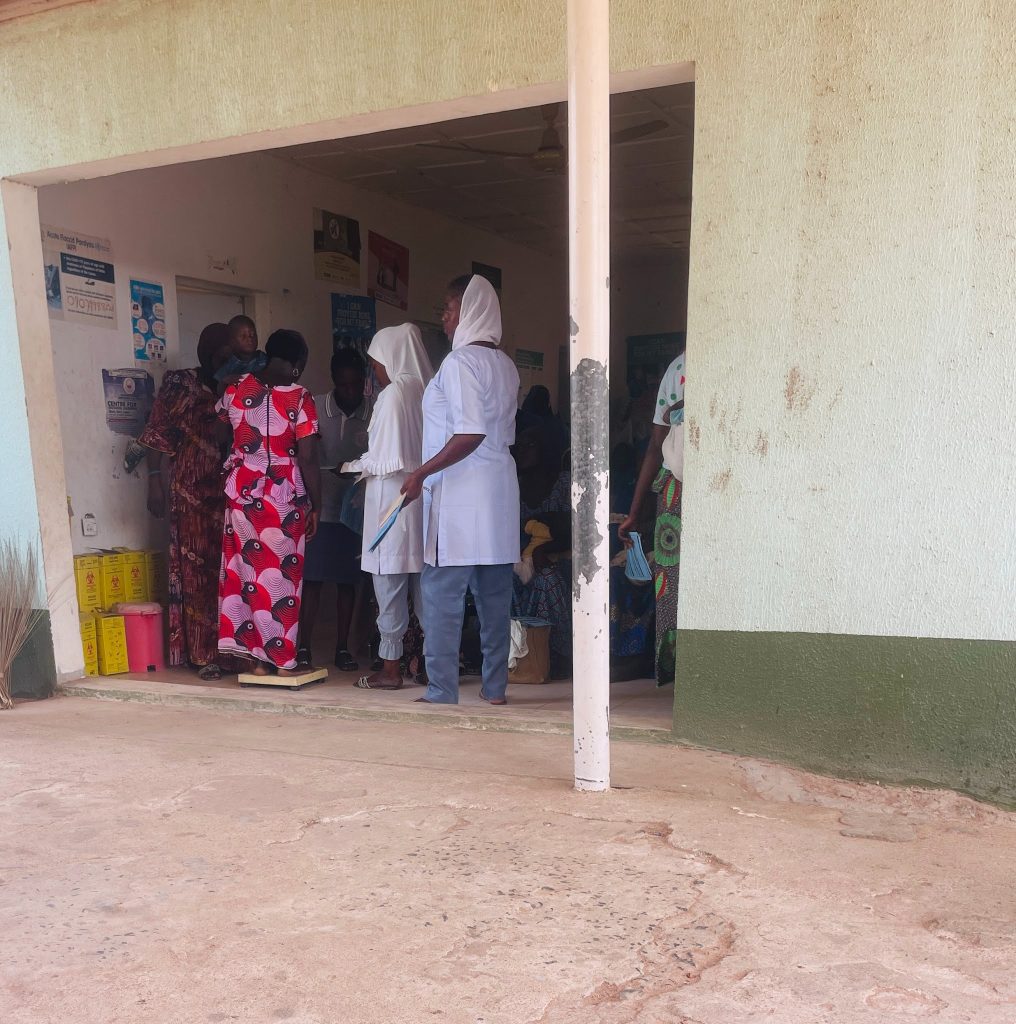
Herder communities are also grappling with another crisis. According to the Tabital Pulaaku leader, herders are often segregated in local healthcare facilities when it comes to receiving treatment for injuries sustained during clashes. “Some of them are even arrested on the spot. This has made some of them stop accessing healthcare centres and rely on home treatment, which leaves them dead,” he said.
What now?
During a summit in 2025, the Federal government described Taraba state as “a cornerstone of Nigeria’s agricultural and industrial future”, owing to its agricultural potential. The state was also hailed as a major producer of export-grade tea, coffee, and livestock for the meat industry.
A recent study by socio-political science researchers in the country’s northeastern region found that the majority of the population in IDPs camps and those killed, injured and displaced due to the conflict are farmers. While the rate of the clashes is said to be high, the impact on food insecurity in the region is also high due to the magnitude of the attacks on farming communities.
Felix Ashe, a farmer from Chanchanji, told HumAngle that the most recent attacks in the area occurred on farmland, prompting locals to abandon their farms. He says hunger now shapes the lives of many who usually depend on farming for survival.
“We planted yams, groundnuts, benniseed and so on. The yam that was planted last year was not able to be harvested, and those who tried to harvest them are being attacked,” he said.
In the Peva and Amadu communities, which are known as agrarian areas, Moses said locals are facing food scarcity. “Seriously, we are living at the mercy of God, because predominantly, we are farmers and we started receiving these unprovoked attacks since last September, and till today, we are still receiving attacks. We don’t have access to farms, and farm produce has been destroyed. We are facing the challenge of hunger,” Moses said.
Several farmlands and barns were set ablaze in the 2025 attack. Photo: Monday Vincent
If the attacks persist, local farmers in the region say they fear for their future.
“The most important thing we need now is peace. That is the restoration of peace in the area. If we’re able to get peace, everything will come back gradually,” Moses said.
While peace efforts are being made, the Tabithal Pulaaku leader said most of the herders around the affected Southern Taraba communities are still displaced, while some remain missing. Through stakeholder engagements and awareness-raising campaigns, Bello said leaders of the Fulani community are sensitising locals to shun violence and embrace peace to resolve the crisis.
To permanently break the cycle, the security expert calls on the government to move beyond temporary peace declarations and to continue engaging local leaders and stakeholders from both ethnic groups, formally entrusting them with responsibility for maintaining peace among their people. He strongly advocates for the establishment of modern ranches and clearly designated grazing routes for herding communities.
“They don’t have a route to follow with their cattle, so they follow people’s farmlands, and that causes a lot of issues. There should be a dedicated path for them,” he said. “The herders should maintain their particular axis and also, people should be notified not to go there and farm.”
He also emphasised the need for a visible security presence in those areas and for constant patrols. “The security agencies should be well equipped and motivated to be very active at work,” the expert added.
South Africa’s government has been accused of not doing enough to crack down on xenophobic attacks.
Published On 6 Jul 20266 Jul 2026
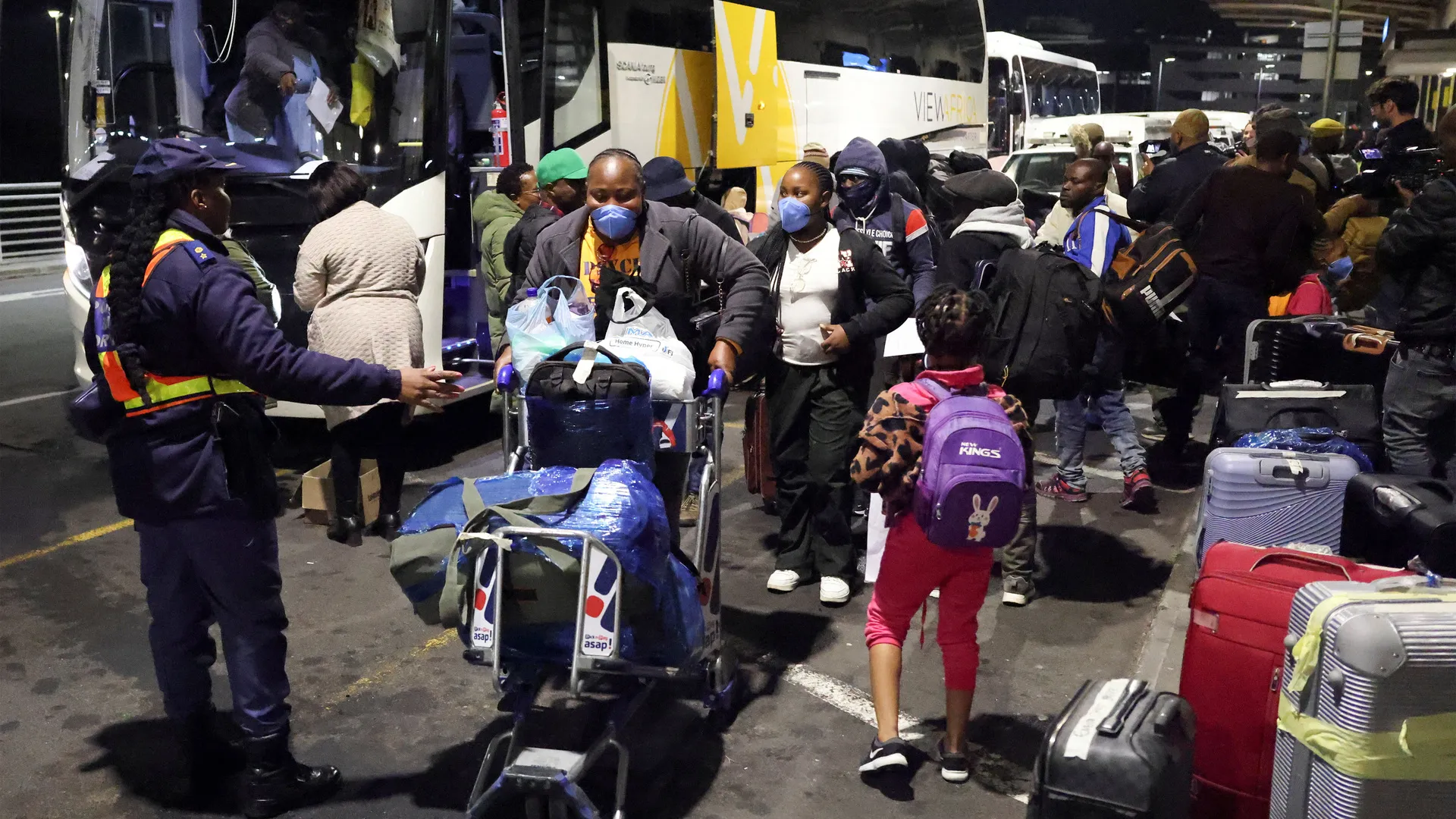
The safety of African immigrants in South Africa is deteriorating, Nigeria’s foreign minister has warned, after two Nigerians were killed in disputed circumstances during anti-immigrant protests.
“There are no signs that the situation is improving,” Bianca Odumegwu-Ojukwu said on Monday, while announcing more evacuation flights.
Recommended Stories
list of 3 itemsend of list
The minister demanded South African authorities investigate the deaths of two Nigerians, Musa Yunana Joe and Charles Iroegbu, killed amid “the ongoing xenophobic protests and attacks on migrants”.
South African police said Joe’s killing did not appear to be related to the protests, but could not immediately comment on Iroegbu’s death.
Nigeria’s foreign ministry says Joe was killed in front of his shop in the northeastern city of eMalahleni by unidentified criminals on June 28 , while Iroegbu was killed by South African police during interrogation in Pretoria on the same day.
In a statement on Sunday, the ministry said: “We wish to place the Government of South Africa on notice that if the situation continues to persist, all options remain on the table, some of which will be activated if the uncultured and provocative trend of intolerance… against foreigners is not addressed”.
South African foreign ministry spokesman Chrispin Phiri said the government had asked Nigeria’s High Commission to submit “any actionable information to our law enforcement authorities, which will enable a thorough, objective investigation in accordance with the rule of law”.
Weeks of anti-immigrant marches
There have been weeks of protests against undocumented migrants, with many South Africans blaming workers from other African countries for taking their jobs and putting a strain on their social services.
South Africa’s government has been accused of not doing enough to crack down on the violence, which has claimed the lives of several foreigners and seen shops owned by immigrants looted and torched.
Mozambique said that five of its citizens were killed in xenophobic attacks in late May. South Africa said the number was only two.
Ghana and South Africa were embroiled in a diplomatic row last week, following the killing of a Ghanaian national. The South African government said the death of Bashiru Isak was not linked to anti-immigrant protests.
Hundreds of Nigerians, among tens of thousands of foreigners, have already left South Africa, once a popular destination for documented and undocumented African immigrants due to its relatively strong economy.
Uganda’s High Commission in Pretoria announced on Monday that a fourth group of Ugandan nationals were voluntarily repatriating.
South Africa has had a longstanding violent crime problem that precedes the outbreak of xenophobic violence.
On a hot Tuesday afternoon in Yola, Adamawa State, in northeastern Nigeria, 32-year-old Fidelis Mbai walked to a point-of-sale (POS) stand to withdraw ₦35,000. The POS operator, Abu Sani, collected his Automated Teller Machine (ATM) card and inserted it into a POS terminal. Fidelis entered his Personal Identification Number (PIN). Within seconds, he received a debit alert. The money had left Fidelis’ account, but Abu’s terminal showed that the transaction had not been completed successfully.
The two men stared at their screens. One had seen ₦35,000 withdrawn from his account; the other had received nothing. For nearly 30 minutes, they kept refreshing their mobile bank apps. “I was angry because the money had left my account immediately,” Fidelis said. “As far as I was concerned, the transaction was successful.”
Abu understood the frustration, but he had a problem of his own. “The customer was debited, but I didn’t receive the money,” he said. “If I gave him cash and the transaction eventually failed completely, the loss would be mine.”
Eventually, Fidelis left without cash. His money would later be reversed. But for several hours, ₦35,000 simply disappeared into Nigeria’s digital payment infrastructure.
This experience has become familiar to many Nigerian residents. As digital payments increasingly replace cash, it is ordinary citizens, not institutions, who bear the cost of failed transactions. The consequences often extend beyond the value of the failed transaction itself. Delayed payments can prevent traders from restocking goods, force customers to borrow money while waiting for reversals, disrupt access to healthcare, transport, or other essential services, and erode trust in digital financial systems. For small businesses and low-income households that depend on immediate access to funds, even a short delay can translate into lost income, missed opportunities, and significant financial stress.
Nigeria’s digital payment revolution
Nigeria’s digital payment ecosystem has expanded rapidly over the past decade. According to data from the Nigeria Inter-Bank Settlement System (NIBSS) – which operates the core infrastructure that processes and settles electronic payments and fund transfers between banks, discount houses, and card companies in Nigeria, and is jointly owned by the Central Bank of Nigeria and all licensed banks – the value of instant digital payments reached ₦1.07 quadrillion in 2024, up from ₦600.36 trillion in 2023. The data also showed that Nigerians conducted 1.38 billion POS transactions worth ₦18.32 trillion during the same period.
These numbers reflect one of the most successful examples of digital public infrastructure (DPI) in Africa. At its core, DPI refers to the digital rails that allow citizens to identify themselves, make payments, and access services. In Nigeria, these rails include bank transfer systems, mobile money platforms, POS networks, identity systems such as BVN and NIN, and shared payment infrastructure.
Photo: Andrew Eseibo/Rest of World.
Together, these systems enable millions of transactions every day. For most users, the process appears simple: send money, receive money, and move on. But when something goes wrong, the burden often shifts away from the infrastructure and onto the people who rely on it.
While there is no official national estimate of the total amount Nigerians lose annually to failed digital payment transactions, the scale is substantial. During the 2023 cashless transition, industry reports indicated that as many as 40 per cent of failed e-payment complaints remained unresolved for extended periods, with affected transactions running into millions of naira.
Given that Nigerians processed over ₦1.07 quadrillion in instant payments in 2024 alone, experts say that even a failure rate of less than one per cent could leave billions of naira temporarily trapped in failed, delayed, or disputed transactions each year.
The last mile bankers of Nigeria
Every morning, Abu begins work with a few simple calculations. How much cash does he have? How much electronic value is in his account? And how much of that money is trapped in pending transactions?
“Almost every week, we experience failed transactions,” he said. “Sometimes two or three times. During network problems, it can happen many times in one day.”
Officially, Abu’s role is to provide financial services. Unofficially, he has become something else: a lender, a mediator, and a shock absorber. He is one of an estimated 1,600 POS operators per square kilometre in Nigeria, according to the International Monetary Fund (IMF). As banks have reduced their physical footprint in some communities, these agents have become the last-mile providers of financial services, connecting millions of Nigerian residents to the formal financial system.
One afternoon, a regular customer named Musa Ibrahim arrived to withdraw ₦50,000. The debit alert arrived immediately, but Abu’s account was not credited. Musa needed the money urgently for a hospital bill, and Abu had to choose between trusting the system and trusting the customer. “I knew him very well,” Abu said. “So I gave him the money from my own cash.”
The confirmation took two days to arrive. For 48 hours, Abu had effectively given Musa an interest-free loan. Nobody paid him for the risk. Nobody compensated him for the anxiety. Yet this informal lending happens every day across Nigeria. Thousands of POS operators use their own money to bridge gaps created by delayed transactions.
At Jimeta Modern Market in Yola, 38-year-old Aisha Mohammed sells food items. More than half of her customers now pay by bank transfer. Like many traders, she has adapted to Nigeria’s cash-light economy, but that adaptation comes at a cost. Several months ago, a customer purchased a bag of rice worth ₦80,000. He presented a transfer receipt. The money did not arrive.
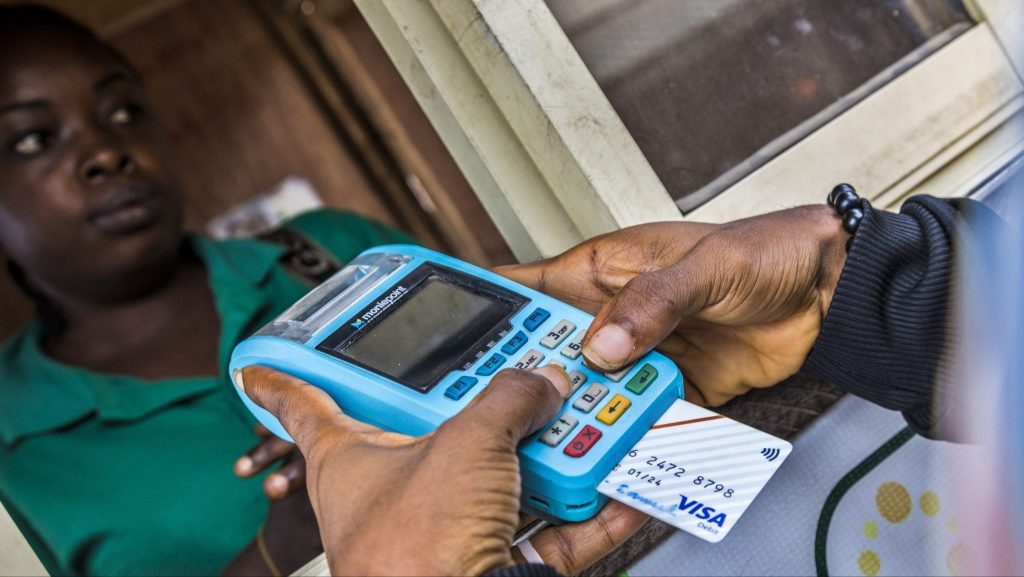
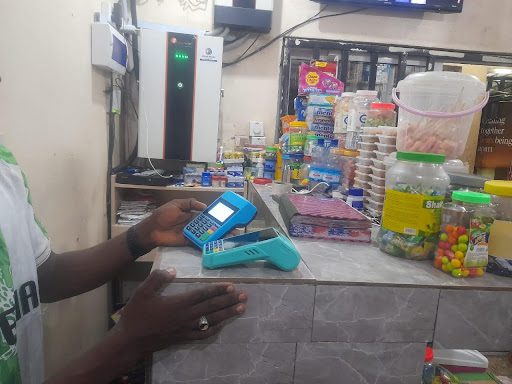
File: A grocery store attendant operating a POS terminal. Photo: Opay
“The customer looked genuine,” Aisha said. “He showed me everything on his phone.”
She released the goods. The payment did not arrive until the following day. That night, she barely slept. “You start asking yourself whether you have been scammed,” she said.
Delayed transactions create a dilemma for traders like Aisha. If they reject digital payments, they risk losing customers; if they accept them, they risk losing money. Many solve the problem through selective trust. “If I know the customer, I may release the goods,” she explained. “If I don’t know them, I wait until I see the money myself.”
This has created a parallel trust economy operating beneath Nigeria’s digital economy. In theory, transactions are guaranteed by technology; in practice, they are often guaranteed by relationships.
Get our in-depth, creative coverage of conflict and development delivered to you every weekend.
Subscribe now to our newsletter!
Dr Ibrahim Sule, a financial inclusion expert at the Adamawa State Ministry of Finance described it as a hidden feature of Nigeria’s digital economy. “It shows that people are finding ways to compensate for weaknesses in the system. Personal trust often fills the gaps where technology falls short,” he said.
Borrowing money while waiting
For Ibrahim Yusuf, a resident of Damilu, a community in Jimeta, the consequences were far more serious. In October 2025, he transferred ₦43,000 to a shop owner as payment for foodstuffs he had purchased. The money left his account instantly, but the shop owner never received it.
One day passed, then two, three, four, five, and six. During that period, Ibrahim had no extra money with him. “The money was meant for foodstuffs, but I couldn’t leave the market with what I bought because the shop owner didn’t receive an alert,” Ibrahim said.
By the third day, Ibrahim borrowed ₦20,000 from a friend. The irony was difficult to ignore. His own money existed somewhere inside the banking system, yet he needed someone else’s money to survive. “It wasn’t even the financial loss that hurt the most,” he said. “It was the uncertainty. Nobody could tell me exactly where the money was.”
His experience illustrates a hidden cost rarely captured in transaction statistics. When payments fail, people do not simply lose access to money. They lose opportunities, business deals collapse, and relationships become strained.
The financial system eventually restores the funds. But it rarely restores the time, trust, or opportunities lost along the way.
How the money moves
While a bank transfer feels like a simple process for customers, financial experts say that transactions often travel through multiple systems. According to Hakeem Abdulkareem, a tech expert at NIBSS, “When you initiate a transfer on your bank app or through your bank, your bank first authenticates the transaction and verifies the beneficiary’s account details. The payment instruction is then routed through the NIBSS Instant Payment (NIP) platform to the receiving bank, which validates the request before crediting the beneficiary’s account. For the transfer to succeed, each of these systems – the sending institution, the NIP switch, and the receiving institution – must exchange information correctly and in real time,” he explained. “Each stage must communicate properly for the transaction to be completed.”
Any disruption along that chain can create problems. Not every failed transfer originates from NIBSS. Payment experts note that delays can occur at the sending bank, the receiving bank, a fintech platform, telecommunications networks, or the central payment switch. One way to determine where a transaction stalled is through the unique ‘Session ID’ generated for every transfer, which allows institutions to trace the payment through the system.
“Delays often occur when there are network issues, system outages, or communication problems between institutions involved in the transaction,” Hakeem added, noting that NIBSS continues to work with banks and fintech companies to improve transaction monitoring, automate reconciliation processes, and strengthen the resilience of the NIBSS Instant Payment (NIP) platform as transaction volumes continue to grow.
In the first quarter of 2025, electronic payment transactions reached ₦284.99 trillion, a 17.7 percent increase from ₦234.49 trillion recorded during the same period in 2024. POS transactions alone rose to ₦10.45 trillion during the same period, more than double the ₦3.62 trillion recorded in the first quarter of 2024.
While these figures highlight growth, Hakeem noted that “as transaction volumes increase, maintaining system efficiency becomes even more important.”
The institutions behind Nigeria’s digital payment system agree on one point: public confidence depends on reliability. As transaction volumes continue to grow, banks, fintech companies, and regulators say they are investing in infrastructure, monitoring systems, and consumer protection to reduce delays and strengthen trust.
Adi Dansanda, Customer Protection Officer at the Central Bank of Nigeria, Yola branch, told HumAngle that “Consumer confidence is critical to the success of Nigeria’s digital payment ecosystem. We continue to work with financial institutions and payment service providers to strengthen compliance, improve service quality, and ensure that customer complaints are resolved within established timelines.”
CBN Yola Branch Office. Photo: Obidah Habila Albert/HumAngle.
Despite these commitments, the experiences of everyday Nigerian residents suggest that the gap between policy and practice remains significant. For them, confidence is built every time a transfer arrives on time, every time a complaint is resolved quickly, and every time money moves when it is needed most.
Lessons from elsewhere
Building a reliable real-time payment system is not unique to Nigeria. Countries with some of the world’s most advanced digital payment platforms have also experienced outages and technical failures as transaction volumes increased.
In India, the Unified Payments Interface (UPI), which processes more than 18 billion transactions each month, experienced several nationwide outages in 2025. An investigation by the National Payments Corporation of India (NPCI) traced one of the largest disruptions to excessive transaction-status requests from participating banks that overwhelmed the system. In response, the regulator tightened technical protocols, limited repeated status checks, and strengthened monitoring to reduce the risk of similar failures.
Brazil’s Pix platform has also experienced periodic service disruptions linked to participating financial institutions and network issues. Rather than eliminating failures entirely, authorities have continued to improve interoperability, operational resilience, and incident response as usage has expanded.
Nigeria has already built one of Africa’s largest real-time payment systems through the NIBSS Instant Payment platform. Experts who spoke to HumAngle say the lesson from other countries is not that payment systems can avoid failures altogether, but that maintaining public trust depends on continuously strengthening infrastructure, improving coordination among participants, and responding quickly and transparently to disruptions.
This report is produced under the DPI Africa Journalism Fellowship Programme of the Media Foundation for West Africa and Co-Develop.
The Benin Bronzes are a broad term used for the carved ivory, wooden works, metal sculptures and plaques looted by British troops during the Punitive Expedition in 1897.
Scholars estimate that more than 5,000 artefacts were stolen, some of which were gifted to Queen Victoria, others sold in auctions, held in private galleries or donated to museums across Europe and elsewhere.
The call to return the art, which began in the 1930s, intensified in the recent decade, inspired by growing pressure, repatriation activism and the relentless effort of the Benin Dialogue Group, a multilateral stakeholders’ group.
As momentum built at the peak of the homecoming of these arts, Igun Street unexpectedly found itself in the global spotlight. Diplomats, state officials, museum curators and researchers began arriving in numbers local artisans say they had never witnessed before.
A crucible of molten bronze rests above charcoal embers before artisans pour the metal into clay moulds using long iron tongs [Orji Sunday/Al Jazeera]
This noon, Double Chief’s voice brims with pride as he points to a recently completed sculpture resting on a wooden bench. The bronze figure, a man in a suit and tie, had received its final polish only that morning after months of work.
Yet for many bronze casters, the attention has done little to solve underlying concerns.
“We are struggling to keep the industry alive,” says Oriakhi Osazee, who sits on a wooden stool at the entrance of a store in Igun. A sculptor whose mediums are clay, fibre, brass and bronze, Osazee has been in the craft for more than 35 years. He speaks with depth and conviction, drawing from vivid dates and past events to reinforce his ideas.
Efforts to recruit apprentices have stalled, he says. Young people, on whom the future of the craft depends, are increasingly leaving in search of what he calls “quick money” in other professions, cities and countries.
When their ancestors began, he recalls, their craft extended beyond bronze casting. There were, among the Iguns, men who had a gift in ivory carving. Long before the global ban on ivory trade was made official, that layer of art, without heirs and hope of continuity, had died.
For Agbonmwenre Alex, the subject of heirship within the craft is a matter of personal pain.
Alex, who was taking a tour of his workshop, began learning the craft at the age of eight under the guidance of his father. He started with errands and light tasks before progressing to kneading clay pottery. Over time, he learned every stage of the casting process, from preparing moulds to the final polishing of finished works.
Today, he is the only one of his father’s seven sons who remains in the profession. But uncertainty now hangs over the next generation.
“I would like my sons to take after me,” Alex says. “Unfortunately, I started exposing them to this craft so late. They literally see this work as outdated, archaic, and dying. The zeal, the love for the job, is dead.”
I would like my sons to take after me. They see this work as outdates, archaic, and dying. The zeal, the love for the job, is dead.
by AGNONMWENRE ALEX, BRONZE CRAFTSMAN
His first son chose to study law. His second is pursuing a degree in healthcare. Despite repeated efforts to pique their interest, including offering workshop space, raw materials and financial support to start a business of their own, neither accepted.
“The number of youths is declining drastically. It [the craft] is at risk of going into extinction. Apprentices are so scarce,” says Osazee. “We used to have a lot of apprentices in the past.”
In the afternoon of May 31, 2026, the Anguwan Hausawa area of the Mokwa Local Government Area of Niger State, North-Central Nigeria, was thrown into mourning. The news of Abubakar Usman’s death in the lodge water had spread through the area, and people were trooping to the house to extend their condolences to his parents.
Abubakar, a 13-year-old, had gone out to play with his friends. Hours later, he was brought back lifeless while his other friend was rushed to the hospital, having drowned in floodwaters caused by a blockage the construction workers working on a culvert had put in to hold the water as they worked.
As the lastborn of his parents, Abubakar was the kind of boy whose presence lit up every corner of the community. He attended the Islamic school close to his house, and his teachers admired how brilliant he was. Residents say he was respectful, and the elders in his community often praised him as he never passed by without greeting people warmly—a rare quality that made him beloved by all.
His father, Usman Shekare, an elderly man in his late sixties, stood heartbroken at the sight, lying on a mat, fixing his gaze on his beloved son. The only words he had the courage to utter were, “God gave him to me, and He has collected him back.”
What broke him further was a simple question: “What message do you have for the government?” He instantly broke down in tears, unable to speak further.
This tragedy is not an isolated incident. Just weeks earlier, residents told HumAngle that three boys fell into the clogged waters and were luckily rescued. The water continues to gather at last year’s Mokwa Flood site, fed by the heavy downpour flowing from the Zugurma and Yagbagba axis, and worsened by another source from gully erosion sites in nearby communities.
One of the flood zones along the Mokwa-Jebba Road in Mokwa LGA, Niger State. Photo: Isah Ismaila/HumAngle.
Hussaini Ibrahim, the Spokesperson of the Niger State Emergency Management Agency (NSEMA), told HumAngle almost a month after the incident that the agency is not aware of any loss of life due to the blockage but will reach out to the community leader and affected family for further actions.
In Mokwa, the echoes of last year’s devastating flood still haunt the community. Residents told HumAngle that farmers had raised alarm before last year’s disaster, warning that water was accumulating, but their concerns were ignored until after the flood struck. Now, the same warnings are being repeated, with little sign of preventive action.
“Barely a year after the flood, Mokwa is once again staring at water lodging in the same vulnerable zones,” Isah Mokwa, a community leader and activist in the community, told HumAngle. “The bridge and waterway reconstruction, meant to symbolise recovery, has inadvertently blocked water channels, creating a dangerous buildup. As we speak, the town is sitting on a ticking bomb.”
Residents told HumAngle how the first rainfall they witnessed in May made them apprehensive. That evening, they revealed, the sound of rushing water sent shivers down their spines. Mothers were seen rushing to gather their children as fathers stood at the site of collapsed structures, staring at the lodging of water in the same flood-prone channel that swallowed over 150 lives and many homes last year, with hopes of it not wreaking havoc again.
Studies indicate that the mental health and wellbeing of individuals, especially children affected by flooding in Nigeria, can deteriorate for extended periods, often lasting months or even years after the event.
The cumulative stress of rebuilding homes, restoring livelihoods, and coping with displacement has been shown to exert a heavier toll on affected populations than the initial impact of the flood, underscoring the need for comprehensive psychosocial support in disaster management strategies.
“The water was coming right from Yagbagba,” Ndako Usman, a resident, said. “It’s accumulating just behind the blockage. Once it gets bigger and more powerful, it could hit our homes again.”
Hussaini told HumAngle that the blockage was caused by construction workers working on the ongoing drainage construction, and the management has taken swift action to address the issue.
“During last year’s flood, we were taken unaware, but we have taken proactive measures to ensure that it does not repeat itself this year. We have a monitoring team, and also volunteers who constantly update us on the flow of water so that we take immediate action.”
“Regarding the culvert, we have written to relevant stakeholders, including the Ministry of Water Resources, to study and assess the situation of the culverts to see if they can handle the water volume in case of a flood-related disaster and advise appropriately,” Hussaini added.
A catastrophe remembered
The fear is not irrational. In May 2025, Mokwa was the epicentre of one of Nigeria’s deadliest flood disasters in recent memory. Torrential rains combined with structural failures to unleash devastation that claimed hundreds of lives, displaced thousands, and left the town grappling with hunger and grief.
Flooding has become one of Nigeria’s most persistent natural disasters, wreaking havoc on communities across the country almost every year. Heavy rainfall, poor drainage systems, deforestation, and the release of water from dams often combine to create devastating outcomes.
In 2024 alone, floods claimed over a thousand lives, displaced millions, and destroyed farmlands and infrastructure worth billions of naira, but the situation dropped in 2025, according to the National Emergency Management Agency (NEMA).
The agency revealed that floods killed 241 people and affected 459,995 residents across 27 states and 128 local government areas. Also, the disaster displaced 158,588 people, injured 839, and damaged 54,684 houses while destroying 96,649 farmlands.
Get our in-depth, creative coverage of conflict and development delivered to you every weekend.
Subscribe now to our newsletter!
The newly constructed culvert in the Anguwan Hausawa area of Mokwa, one of the hard-hit areas of last year’s flood. Photo: Isah Ismaila/HumAngle
Early warnings had been issued by the Nigerian Meteorological Agency (NiMet), but local authorities failed to act.
The disaster struck suddenly. Heavy rainfall battered Mokwa, but the real trigger was the collapse of a railway embankment and blocked drainage channels that redirected torrents into residential areas.
Within hours, homes were submerged, bridges collapsed, and farmlands were washed away. Reports varied, but estimates suggested between 200 and 700 people lost their lives, and about 3000 houses and properties were destroyed, leaving families stranded in makeshift camps.
In the wake of the disaster, the Minister of Information and National Orientation, Mohammed Idris, revealed that President Bola Tinubu approved the release of ₦16.7 billion for the immediate reconstruction of the Mokwa Bridge, which was destroyed by flooding, noting that the project would involve constructing a bridge with 10 spans.
In the months that followed, HumAngle published a damning investigation into the Mokwa flood, among other issues. Our findings painted a picture of systemic neglect. The investigation established that gully erosion in Mokwa has remained a destructive force despite years of significant financial allocations. The erosion continues to expand, damaging infrastructure and farmland and worsening during rainy seasons.
Equally, the report uncovered that billions of naira from ecological funds and World Bank loans were earmarked for erosion control, yet no substantial work has been executed. While officials claimed contractors were engaged, there was no evidence of transparent bidding processes. Field assessments confirmed that erosion control activities remain absent, exposing a gap between official pronouncements and actual implementation.
Last month, NEMA listed Mokwa among high flood-risk local government areas in Niger State for 2026. Yet on the ground, little seems to have changed.
Isah Mokwa, the activist based in Mokwa, confirmed to HumAngle that the bridge constructed to contain the water has proven inadequate. According to him, the community braces for the worst, fearing that heavier downpours could unleash destruction far greater than before.
“Nothing has changed. In fact, the situation has deteriorated even further. In the same direction where the water started gathering before the flood, farmers have raised the alarm that water is already accumulating,” he said.
“We believe there is no accountability for the funds contributed to the state government. What happened to the billions donated after the 2025 flood? Even the shelter that was promised for victims of last year’s flood has not been provided. Just recently, there was a flag-off ceremony, but no contractor has been mobilised to the site, no details were given about the number of houses to be built, and no project timeline was shared,” he said.
According to residents, some of the affected families who were lucky to receive ₦500,000 ($360) in financial support last year to rent houses have exhausted their funds, and the majority are now struggling to renew their rent.
For many in Mokwa, the suspicion is that the tragedy of 2025 has been reduced to a political talking point, while the lived reality of survivors remains ignored.
However, experts warn that Mokwa cannot afford another disaster.
Abbas Idris, the president of the Risk Managers Society of Nigeria (RIMSON), in an interview with HumAngle, said that before now, the government should have taken a proactive disaster management approach through risk assessment and hazard categorisation.
This, according to the risk expert, would help not only the government and state emergency management agency but also residents to put in place measures or tackle the disaster even before it strikes.
In the longer term, Abbas revealed that the Niger State government must enforce urban planning regulations, preventing construction on floodplains and investing in climate adaptation strategies.
“Neglecting risk assessments leaves communities defenceless when disaster hits,” Abbas stressed. “We must address corruption, weak governance, and poor ecological management as root causes of the crisis and pave the way for transparent, science-driven interventions to mitigate future disasters.”
It has been a year since the flood, and despite repeated appeals from the community, the state government, under the leadership of Umar Bago, has yet to provide a lasting solution. Families like the Shekare’s are still left to brace for waters that rise too quickly and claim too much.
And until their demands are met, Mokwa remains vulnerable — a place where the memory of one brilliant boy reminds everyone of both the fragility of life and the urgency for change.
When Kaka Ali said those words over the phone on June 8, I nearly asked him to repeat himself. I had been speaking to him about farming and survival in northern Borno for nearly two years. Kumalia was where he was born, but it was also a place that most people had long stopped calling home.
The community is located within Monguno Local Government Area (LGA) in Borno State, northeastern Nigeria. The Boko Haram insurgency had emptied it in 2016, forcing residents to flee to Monguno town and Maiduguri, the state capital. The government never formally reopened the community. In the years that followed, its name surfaced mostly in conversations about what the insurgency had taken.
“Why would you go back there?” I asked.
“The negotiations did not go through,” Kaka replied.
I did not fully understand what he meant until weeks later.
On June 21, I reached him again. I learnt that he had returned to Monguno to attend the funerals of four friends who were killed the previous day by suspected Islamic State West Africa Province (ISWAP) terrorists while working on a farm near Kartari, a remote settlement close to Cross Kauwa town in Kukawa LGA, on the shores of Lake Chad. Twelve other farmers were also killed in the incident.
The men had travelled to Kartari from different parts of northern Borno, drawn by the search for land to cultivate after farming had been disrupted closer to home. That same day, in Zabarmari, a farming community in Jere LGA, another 11 farmers were reportedly killed. By then, Kaka’s explanation about Kumalia finally made sense.
The warning had come months earlier at the onset of cultivation in February, when farmers across parts of northern Borno began receiving warnings from ISWAP terrorists not to farm this season. The message spread among returning farmers and community leaders through word of mouth.
“They approached farmers who had gone to Kartari and told them we must not cultivate this year,” said Musa Abubakar, a farmer from Cross Kauwa. “They also informed community leaders in villages close to them, and those leaders passed the message to us in other towns,” he said.
According to Musa, farmers who wished to cultivate were instructed to relocate with their families to terror-controlled territories, locally known as Daula, and farm there instead. Many initially assumed it was another extortion attempt because for years, cultivating in parts of northern Borno had meant paying terror groups for access to land. In 2024, HumAngle documented how farmers in the region paid millions of naira in levies and so-called farming permits to ISWAP. This season, farmers pooled their money together, some contributing at least ₦50,000 each, hoping to negotiate their way back to their fields. However, the effort failed, and the warning held.
So they began looking elsewhere. Some moved toward the Lake Chad region. Others returned to abandoned communities. More than 100 farmers from Monguno, according to Kaka, relocated to Kumalia, where they erected makeshift shelters from sticks and dry grass to plant their crops. They plan to stay until the harvest season in November or December.
The women were not left behind either.
“My sister is there,” Kaka, the 30-year-old father of two, said. “Many women went with their children. The older ones trekked with their parents. The younger ones are carried on their backs or transported in push carts.”
Kaka’s older sister, Yabusam Ali, travelled with one of her children and left the others with their grandmother in Monguno. Other women made similar calculations, weighing which children could endure the walk and which would be safer left behind. Yabusam said conditions remain basic but manageable.
“There is drinkable water there,” she told HumAngle.
For now, that is enough. Kumalia has no schools, no health facilities, and no visible state presence. It is a settlement held together by necessity. Over the coming months, the community will once again have residents, not because it is safe, but because it has become the least dangerous option left.
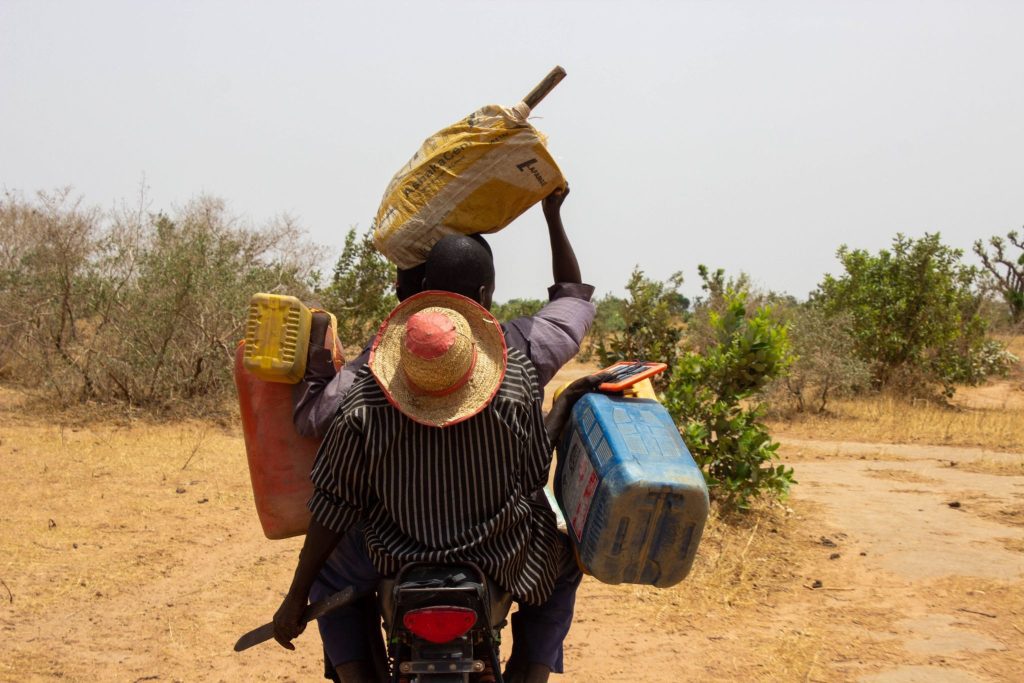
File: A family riding to their farm on a motorcycle in rural Gombe in 2024. Photo: Al’amin Umar/HumAngle.
Across Borno, the farming ban, enforced through violence and the threat of it, is reshaping how rural families survive. Some have abandoned cultivation entirely. Others have confined themselves to plots within sight of military positions. A growing number are returning to communities the state had given up on, betting that the promise of a harvest is worth living beyond its protection. Together, these choices are accumulating into something larger than disrupted planting seasons: a food security crisis taking shape incrementally, in the daily calculations of people who can no longer be certain what the harvest will bring, or whether there will be one at all.
The consequences extend far beyond the communities where cultivation has been disrupted. Agriculture remains one of Nigeria’s largest employers and a critical source of food for millions of households. The World Bank estimates that nearly four in every five rural households in Nigeria depend on farming, while livestock rearing is especially common across the country’s northern regions. When insecurity forces farmers off their land, harvests decline, market supplies tighten, and food prices rise.
The Famine Early Warning Systems Network (FEWS NET), a food security monitoring and forecasting initiative, estimates that between 21 and 22 million people across northern Nigeria will require humanitarian assistance during the June-to-August lean season, driven by escalating conflict, lower-than-expected household food production, and constrained access to food. The Integrated Food Security Phase Classification (IPC) similarly projects that more than six million children across northern Nigeria will experience acute malnutrition this year, with conflict, displacement, and reduced access to food among the principal drivers.
Get our in-depth, creative coverage of conflict and development delivered to you every weekend.
Subscribe now to our newsletter!
Kaka had already made these calculations. “Are you not afraid of attack from the terrorists, or of being mistaken for one by troops?” I asked him. “We will die even if we don’t go,” he replied. “So, it is all the same.”
Flags on the farm
Just as Kaka mentioned, several farmers in northern and central Borno say the people who first heard the warnings were often those who had gone ahead of the rains to clear their fields.
In Monguno, Koso Abubakar said farmers preparing their land were approached and warned against cultivation. They returned to town carrying the news, and from there, the message spread from household to household. In Cross Kauwa, a farming and fishing community on the shores of Lake Chad, the warning reached those working near Kartari, a remote settlement under Kukawa LGA. Community leaders received it and relayed it to surrounding towns.
In Lassa, a farming community in Askira-Uba LGA in southern Borno, it arrived with violence. Andrew Adamu, a farmer there, said suspected terrorists attacked and flogged women they found working on their fields at the beginning of the season. “They said nobody should farm there,” he said. “They [the women] said they had mounted their flags on those lands.”
The flags, a territorial marker used by terror groups across the region to signal control, were understood immediately. Few people in Lassa are now willing to venture beyond the land immediately surrounding the town.
Musa, a farmer in Cross Kauwa, said the warning came with an additional condition in the northern Borno community. He said that farmers willing to cultivate were instructed to relocate permanently with their families to terror-controlled territories and continue to farm there while paying levies instead. The requirement to relocate permanently was new. The levies were not. But this time around, levy negotiations failed in some places.
Farmers handing over money to armed and masked terrorists in a rural setting. Illustration: Akila Jibrin/HumAngle.
However, in parts of southern Monguno, some farmers were reportedly permitted to cultivate after paying ₦50,000 each. The inconsistency stirred speculation that the restrictions reflected internal disagreements among ISWAP commanders rather than a unified policy.
“It was said that two Amirs controlling two farming villages had a dispute over farming fees,” Kaka explained. “The Amir controlling where we farm said he would not allow anyone to farm this season. The other Amir said farmers were welcome to cultivate in his territory after paying this year’s levy.”
HumAngle could not independently verify the claim.
When negotiations collapsed, the consequences began to accumulate. In Lassa, Andrew said, women were beaten while working on their farms. In Auno, Konduga LGA, a 55-year-old farmer was attacked and killed while working on his land earlier in February, according to residents. News of his death, Aja Bukar, another farmer, said, spread quickly through surrounding communities, confirming what many had hoped was merely a threat.
Then, on June 20, 15 farmers were killed near Kartari while working on their fields. Bashir Suleiman, a farmer from Doron Baga, said the victims included four farmers from Monguno, six from Kukawa town, three from Baga, and two from Cross Kauwa.
In Cross Kauwa, Musa said most farmers have stayed away from their fields since. The few still cultivating have been permitted by the military to plant low-growing crops, such as beans and groundnuts, within a fixed distance of the community’s defensive trench. Beyond that line, he said, most no longer believe the harvest is worth the risk.
The return to Kumalia
For the first time in nearly a decade, Kumalia has residents again. Not many, and not enough to resemble the farming community it once was before the insurgency emptied it in 2016, but enough to bring movement back to a place which has long given up — children’s voices have returned. Smoke rises from cooking fires in the morning. The fields are being planted. And temporary shelters made from sticks, ropes, and dry grass stand across parts of the settlement.
Getting there, however, is not easy. According to Modu Baluye, a farmer who also relocated to Kumalia, reaching the settlement takes five hours of walking over terrain most vehicles cannot cross. “We travel by foot,” he said. “There is no means of transportation except push carts.” The shelters, he said, are simple: stick frames with dry grass roofing, which offers little protection from rain or wind, but they are enough to house families for the months between planting and harvest.
A family working together in their field. Illustration: Akila Jibrin/HumAngle.
For years, displacement pushed families out of places like Kumalia and into towns where security forces could better protect them. Now, insecurity around farming is pushing some of those same families back, not into safety but into a different kind of exposure: too far from the state to be protected, yet close enough to armed groups to be noticed.
Communities across northeastern Nigeria have learned, often through grief, that living or farming in remote and ungoverned territories can attract a different kind of violence during military operations. Aerial surveillance, in vast terrains where terror groups move through civilian spaces, collect levies, and use local markets, must be able to distinguish between farmers and fighters. In places like Kumalia, unrecognised by the government, absent from any official resettlement record, populated by people living in makeshift shelters on cultivated open land, that distinction is not guaranteed.
In April 2026, reports showed that more than 30 civilians were killed when a Nigerian Air Force strike hit a village market in Jilli, a remote settlement between Gubio LGA in Borno State and Geidam LGA in Yobe State. Military authorities described it as an active terrorist enclave. Borno State Governor Babagana Zulum later acknowledged that the area’s market had been officially closed due to terrorist activity, yet civilians were among the dead. It was not the first such incident. In 2017, a military aircraft bombed a displaced persons camp in Rann, Kala-Balge LGA, killing more than 100 people including aid workers. And in 2024, HumAngle documented cases in which fishermen around Lake Chad were reportedly misidentified during military operations.
Farmers in Kumalia are aware of this history. It sits alongside the warnings from ISWAP, the distance from town, and the inadequacy of their shelters. It is part of what they weighed before they went.
The price of survival
Every morning before sunrise, Esther Danjuma sets up her stall on the roadside outside the Divisional Council Church (DCC) Internally Displaced Persons’ camp in Shuwari, Maiduguri. She heats cooking oil, prepares her bean paste, and waits for the first customers. By the time most people in Maiduguri are awake, she is already working.
Esther Danjuma fries kosai every morning outside her settlement in Maiduguri. The farming restrictions this season led her to switch professions. Photo: Al’amin Umar/HumAngle.
The 26-year-old was displaced from Amuda in Gwoza LGA years ago. Until recently, she measured time by farming seasons, not calendar months. Before the warning reached Chabbal, a farming community in Magumeri LGA where she and thousands of others from the DCC displacement camp cultivate each season, she grew sorghum, sesame, and groundnuts. Last year, she harvested five bags each of sorghum and sesame and three bags of groundnuts. This year, she planted nothing.
“I never thought I would sell kosai,” she told HumAngle. She earns at least ₦3,000 daily. This helps her care for herself and her elderly grandmother at the camp, she said.
A few shelters away from Esther lives Andrawus Yakubu. While Esther replaced farming with a small business, Andrawus has replaced it with whatever work presents itself each day. On some days, he works at construction sites. On other days, he digs pits, cuts logs, or takes on manual labour wherever opportunities arise. The work is irregular and physically demanding, but Andrawus says he cannot afford to be selective. “I will do whatever legal thing that my strength can do,” the father of nine told HumAngle.
For years, Andrawus supplemented his household income through farming in Limanti, a rural community in Konduga LGA. Like many displaced residents of the DCC Shuwari camp, he relied on the farming season to feed his family and reduce their dependence on the market. Last season, he cultivated four hectares of land, harvesting five bags of millet, 12 bags of groundnuts, and eight bags of beans. This season, however, the farming restrictions have forced him to abandon farming.
Andrawus has replaced farming with whatever work presents itself each day. Photo: Al’amin Umar/HumAngle.
Others have chosen to leave Borno altogether. In Auno, Aja Bukar said the killing of a farmer earlier this year convinced many residents that remaining in the area was no longer worth the risk. Some households, including his, have since relocated to Damaturu in neighbouring Yobe State, hoping to find safer opportunities elsewhere.
These different responses – the roadside stall, the day labour, and relocation to another state – all lead back to the same question: what can replace a harvest, if anything?
Agriculture remains the backbone of rural livelihoods across Borno and the wider North East. In Borno, farming is not only an occupation but also a source of sustenance for families; it is how they feed themselves, pay school fees, buy medicine, and prepare for the long dry season. Yet years of conflict have steadily eroded that foundation, limiting access to farmland, disrupting markets, and deepening food insecurity.
When farmers abandon their fields, the consequences ripple far beyond the households directly affected: Harvests decline, local markets receive fewer supplies, and children and other vulnerable groups bear the greatest nutritional burden. The effects are felt not only in the villages where cultivation stops, but across communities that rely on those harvests for food and trade.
A boy sits, selling grain at the Baga Road grain market in Maiduguri. Humanitarian organisations project that food prices may skyrocket, driving food insecurity across Borno and the wider northern region due to increasing restrictions on farming and attacks on farmers. Photo: Al’amin Umar/HumAngle.
The region has been here before. In 2023, HumAngle documented how repeated attacks on farming communities forced many residents to abandon cultivated fields, leaving crops worth millions of naira to wither or be destroyed. A year later, the trend persisted, contributing to worsening food insecurity and malnutrition among vulnerable households, particularly children.
What is unfolding this season is not unique to Borno. Across the North West and North Central, terror groups have used similar tactics to control access to rural farmland, taxing farmers, threatening communities, and displacing those who resist. In Zamfara, HumAngle reported in June that farmers were displaced despite paying millions in levies. Another report the same month showed that 17 farmers were killed in Maradun while working their fields. In 2024, Reuters reported from Katsina that attacks on farmers were driving up food prices. According to SBM Intelligence, a Lagos-based consultancy, 1,356 farmers have been killed across Nigeria since 2020.
The scale of what is at stake is significant. UNICEF estimates that around three million children may require treatment for severe wasting in 2026, with conflict-affected northeastern states carrying a disproportionate share.
Across Borno, people are making decisions whose consequences they cannot yet fully see.
The attacks targeted a secondary school in the northeastern town of Lassa, in Borno State.
Published On 30 Jun 202630 Jun 2026
At least 37 students remain missing after gunmen raided their school in northeast Nigeria, according to local officials.
The attack occurred on Monday when assailants from the Islamic State West Africa Province (ISWAP) group stormed a secondary school in the town of Lassa, in Borno State, which has faced years of violence by armed groups.
Recommended Stories
list of 3 itemsend of list
The AFP news agency reported on Tuesday that at least 37 students remain missing following the attack, which occurred while they were sitting exams.
At least three people were killed in the attack, including a soldier and a teacher, according to the military, who initially said that authorities had rescued 10 of them and that only one remained missing.
The “list of students in captivity”, showing the students’ genders and their parents’ mobile phone numbers, was shared with journalists by the area’s local government councillor, Ijagla Ijabila.
An intel source also showed AFP the same list.
Borno Commissioner for Education Lawan Abba Wakilbe told reporters in Lassa that 25 female students, 11 male students and one staff member were still being held, reported the Reuters news agency.
Abba Wakilbe added that eight people, including the school’s vice principal, have been freed.
Kidnapping for ransom, especially of students, has become a common tactic for both armed groups and non-ideological “bandit” gangs operating across the country’s conflict-hit north and centre.
While the 2014 kidnapping of hundreds of schoolgirls from the town of Chibok by members of Boko Haram remains Nigeria’s most infamous, school abductions continue to be prevalent across the country.
In May, gunmen kidnapped more than 40 pupils – who remain in captivity – from Borno State’s Mussa village.
That same month, armed men rounded up dozens of schoolchildren from three schools in Oyo State – a rare attack in southwest Nigeria, considered to be the safest region in the country.
Nigeria has been fighting an armed uprising since 2009, concentrated in the northeast.
While violence has waned since the peak of the conflict a decade ago, analysts have warned of an uptick in attacks since last year.
Students at Government Day Secondary School in Lassa, Askira-Uba Local Government Area of Borno State, northeastern Nigeria, were preparing to sit for their National Examinations Council (NECO) Biology paper on the morning of Monday, June 29, when terrorists stormed the school, killing at least one teacher, abducting staff and students, and forcing another disruption to education in a community still reeling from a school abduction barely a month ago.
The attackers struck shortly before 9 a.m., according to school officials and residents, arriving on more than 40 motorcycles, many dressed in military camouflage and armed with AK-47 rifles. Witnesses said the assault lasted about 20 minutes before security personnel pursued the attackers into nearby bushland.
The exact number of abducted students remains unclear as authorities and school officials continue compiling names.
Imperiju Mamza, the school’s examinations officer, told HumAngle that the senior students had assembled for their Biology paper, scheduled to begin at 10 a.m., when the attackers arrived. “They invaded the school some minutes to 9 a.m.,” he said.
“Only one student who is sitting for the exams was abducted. She came very early and was, unfortunately, abducted alongside the other students who were from other classes. The others are safe and are currently writing their paper,” he said.
The ongoing NECO examinations began on June 23. According to Mamza, 243 candidates registered for the examination. “Apart from the one abducted, 242 are currently writing their exams,” he said. “I am trying to compile names of those abducted and cannot yet confirm how many were taken.”
Following the attack, candidates were relocated under armed protection to Government Girls Secondary School, Lassa, where the Biology examination continued.
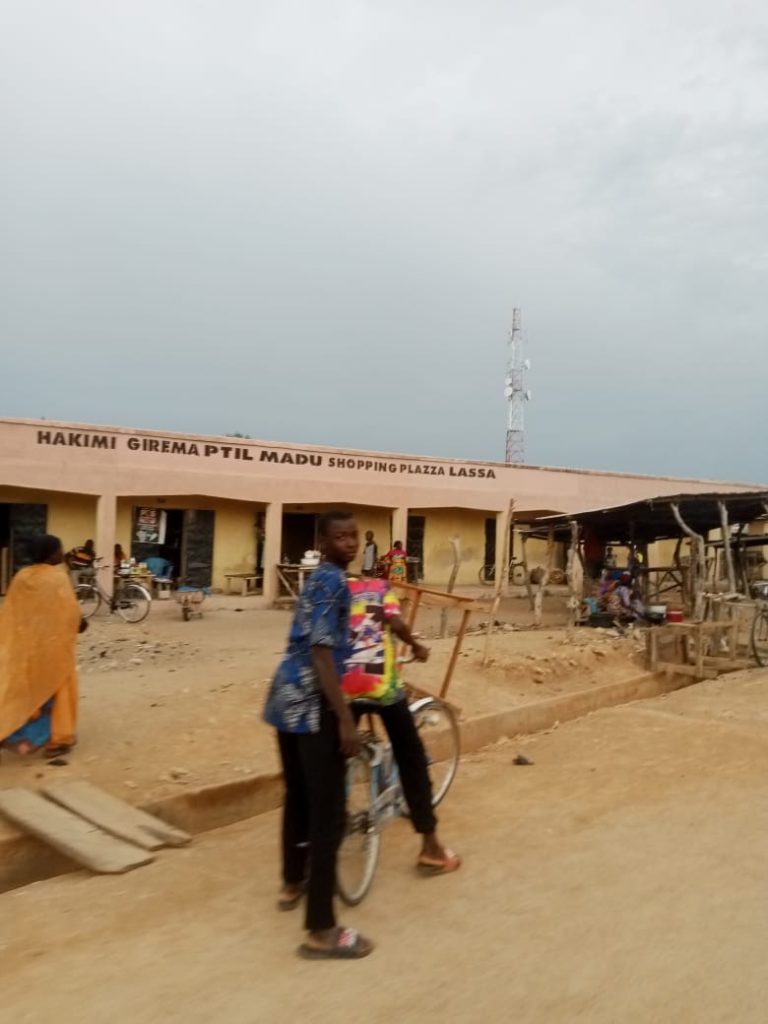
The Hakimi Girema Ptil Madu Shopping Complex at the Lassa Central Market. The Government Day Secondary School, where the abduction happened, sits a few kilometres away. Photo: James Lucky.
Teachers killed, others abducted
Residents who witnessed the aftermath said the attackers appeared to target the school directly rather than the wider community.
Timothy Apagu, whose shop is located near the school, said the community had received reports as early as 7 a.m. that armed men had been sighted around Muthalavu village on the outskirts of Lassa. Community vigilantes were deployed towards the Dille axis after residents raised the alarm, believing the gunmen were approaching from that direction.
“Unfortunately, another team of terrorists followed a different route and attacked the community,” he said.
Apagu said the attackers went straight into the school. “They did not enter the community. I suspect it was a targeted attack.”
He said more than 40 motorcycles participated in the raid. “Most were wearing military camouflage. Others were wearing black trousers. Some wore boots while others wore bathroom slippers. From afar, you would know they were terrorists.”
According to Apagu, one teacher died at the scene while another, who sustained gunshot injuries, later died at the Lassa General Hospital.
He said two teachers, a male Vice Principal identified as Mr Paul and a female teacher popularly known as Madam Angelina, were initially abducted alongside students. The Vice Principal was later rescued after security personnel pursued the attackers, while the female teacher remained in captivity at the time of reporting.
The corpse of the teacher killed at the scene is covered in leaves. Photo: James Lucky.
Another resident, Andrew Adamu, gave a similar account, saying security personnel rescued one teacher and five students during the pursuit and recovered six motorcycles abandoned by the fleeing gunmen.
He added that one female student escaped with gunshot injuries. HumAngle could not independently verify these rescue figures.
Security response
The military and local vigilantes immediately pursued the attackers into nearby bushland, residents said. Adamu said one soldier and one vigilante were killed during the pursuit.
Residents said the military and local vigilantes immediately pursued the attackers into nearby bushland, rescuing the vice principal and six students. Photo: James Lucky.
“There is a military base here, but the soldiers are few. They are not more than 50,” he said. “The school and the military base are less than a kilometre apart.”
The Borno State Police Command confirmed the attack but said the number of abducted students remained unverified. Nahum Kenneth Daso, the Police Public Relations Officer, said the Area Commander for Askira-Uba had deployed to the scene alongside other officers.
Asked what security measures had been introduced after last month’s abduction of more than 40 schoolchildren in nearby Mussa, Daso said police deployments around schools in the area had been increased.
Get our in-depth, creative coverage of conflict and development delivered to you every weekend.
Subscribe now to our newsletter!
“The challenge we had in Lassa is that the school does not have a fence,” he said. “When the invasion happened, they took advantage of that.”
The school vice principal, Mr Paul, and six students who were rescued by security operatives.
Mamza said school authorities had repeatedly raised concerns about the absence of perimeter fencing following the Mussa attack. “The Government Day Secondary School has no fence, and we have complained to the government following the Mussa incident,” he said. He explained that the school is located about a kilometre from the town centre and shares a boundary with the Lassa Vocational Training Centre.
When contacted, Mada Saidu, the Chairperson of Askira-Uba LGA, declined to discuss the attack, saying he was channelling his time and efforts into coordinating the emergency response, which he felt was more important than speaking to journalists.
The latest attack comes barely a month after dozens of schoolchildren were abducted in neighbouring Mussa, also in Askira-Uba LGA, renewing fears over the security of schools across southern Borno despite assurances that protective measures had been strengthened.
Terrorists attacked the Government Day Secondary School in Lassa, northeastern Nigeria, killing at least one teacher and abducting others, causing a significant disruption to the students who were preparing for their NECO Biology exams.
The assault involved approximately 40 armed men on motorcycles and targeted the school specifically, leading to the abduction of students and staff, including the Vice Principal, who was later rescued.
In response, security forces, including the military and local vigilantes, pursued the attackers, with some casualties on both sides. Authorities could not confirm the exact number of abducted students, but following the attack, surviving students continued their exams under increased security at a different location. Residents and officials have raised concerns about the lack of perimeter fencing at the school, an issue highlighted in previous incidents, as local security efforts have been increased following similar abductions in the nearby area.
Even before the first naira changes hands or the first customer calls, Musa Lekki reaches for his phone. It is 5:32 a.m. on a Tuesday, and like many smartphone users, he begins his day with a glance at his phone screen. The 42-year-old provisions trader lives in Yola, northeastern Nigeria, and runs a small wholesale business supplying neighbouring shops and customers with rice, beverages, and household goods.
As he unlocks his phone, there is already work waiting for him. A supplier has sent a voice note. A customer wants to confirm a payment. Another customer has placed an order. Before he has even left his bed, Musa is responding to messages and preparing for the business day ahead.
What appears to be a routine start to the morning is also a series of digital interactions. Within minutes of waking up, Musa has engaged with systems that recognise his phone number, device information, account credentials, and network location.
Each interaction leaves a data trail. A phone call generates telecommunications records. A bank transfer creates transaction logs. A utility payment produces another digital entry. Individually, these fragments may seem insignificant. Together, they form an increasingly detailed portrait of everyday life, which is increasingly mediated and supported by Digital Public Infrastructure (DPI) rails, a set of foundational digital systems that form the backbone of modern societies, enabling secure and seamless interactions between people, businesses, and governments.
Musa does not think about any of this. Most mobile phone and internet users do not.
“During the day, I use my phone for transfers, calls, and ordering goods, and by night I check my account balance before closing for the day,” he said.
As Nigeria expands its digital identity and payment systems, everyday activities such as making calls, sending money, paying bills, and accessing services are becoming increasingly dependent on interconnected digital infrastructure. Musa’s daily routine shows how Digital Public Infrastructure is reshaping daily life, expanding access to services while also raising questions about privacy, transparency and accountability.
What Musa sees is a phone. What he does not see is an invisible infrastructure that increasingly determines who can communicate, who can make payments, who can access services, and who can participate fully in modern economic life. By the time he goes to bed, several institutions will have processed fragments of his personal information. Many of those interactions will happen without him ever knowing.
This is how millions of Nigerian residents increasingly navigate life as data points within systems they rarely see.
The identity that travels ahead
At 6:45 a.m., Musa calls a supplier in Kano. The conversation lasts less than three minutes. It is a routine business call, yet that call depends on a national identity system. In 2020, the Nigerian Communications Commission (NCC) directed all mobile network operators to link users’ Subscriber Identification Module (SIM) cards to their National Identification Number (NINs) and to bar those who did not comply. Musa’s line was among those affected.
“There was a time my SIM was restricted because of an issue with my NIN linkage,” he recalled. “I couldn’t make calls for some days and also lost customers, until I sorted it out.”
The experience taught him something many Nigerians have learned: The ability to make a phone call increasingly depends on proving who you are. Identity is one of the key layers of a DPI. In Nigeria, the NIN is the foundational identity document, managed by the National Identity Management Commission (NIMC).
As of December 2025, the NIMC reported more than 127 million NIN enrolments nationwide, making it one of Africa’s largest digital identity databases, while over 172.67 million SIM cards had been linked to NINs.
Nunaya David, a senior enrolment officer at the NIMC, Yola, said, “NIN is increasingly required for banking, telecommunications, social programmes, and several government services.” Identity is no longer simply something Nigerians carry in a wallet; it is increasingly verified continuously in the background.
The money moves, the data moves too
Shortly after 7 a.m., Musa pays ₦45,000 to a supplier. The transfer takes less than a minute. Money leaves one account and appears in another. With a few taps, Musa has interacted with another stack of the DPI: the payment layer. Behind that transaction, the payment infrastructure operated by banks, fintechs, and the Nigeria Interbank Settlement System (NIBSS) performs multiple checks.
“Once a transfer is initiated, the request passes through several systems before reaching the recipient,” Hakeem Abdulkareem, a tech specialist with NIBSS, explained. “These systems communicate with one another to confirm and complete the transaction.”
Identity verification, fraud screening, account authentication and transaction routing all happen in the background. Most of it occurs within seconds. The customer sees only a debit alert while the infrastructure works in the background.
According to the Central Bank of Nigeria, electronic payment channels now account for the majority of retail payment activity, with internet transfers, mobile payments and point-of-sale transactions becoming increasingly dominant. Data from NIBSS show that Nigeria recorded ₦284.99 trillion in electronic payment transactions in the first quarter of 2025, representing a 17.7 per cent year-on-year increase compared with ₦234.49 trillion recorded in the same period in 2024. This reflects how deeply electronic payments have become embedded in everyday economic activity. Each transfer generates records that move across banks, payment switches, and settlement systems, creating the digital trail that allows modern commerce to function.
A market built on digital trust
For Musa, these systems are largely invisible. What he sees are payment alerts arriving on his phone and customers walking through his door. By mid-morning, those customers have started to arrive. One of them is Aisha Bello, a 21-year-old student at Modibbo Adama University, preparing for a new academic session. Like Musa, she relies on digital systems she rarely thinks about.
Her school registration requires identity verification. Her bank account relies on Bank Verification Number (BVN). Her mobile line and BVN are all linked to her NIN.
Get our in-depth, creative coverage of conflict and development delivered to you every weekend.
Subscribe now to our newsletter!
As she pays Musa electronically, two very different lives intersect through the same digital infrastructure. Neither sees the systems operating behind the scenes, yet both depend on them.
The same is true for Grace Ezra, a nurse at Modibbo Adama University Teaching Hospital in Yola. Like Musa and Aisha, she increasingly relies on digital systems to manage her salary payments, telecommunications services, tax records, and pension contributions.
Frank Akabueze, a digital identity expert, describes Nigeria’s journey as a gradual shift from fragmented systems to interconnected ones. “We have moved from having several disconnected identity systems toward greater integration.”
Increasingly, a person’s ability to study, work, save, communicate, and transact begins with a digital identity record. This speaks to the third layer of DPI, interoperability, the ability of different digital systems to speak to each other securely.
Musa operates his POS terminal. Photo: Obidah Habila Albert/HumAngle
The invisible checks
Around noon, Musa buys airtime through a mobile app. Moments later, he pays an electricity bill. The transactions feel routine, but each leaves a digital footprint. Each creates records, generates data and triggers some form of verification.
Airtime purchases, utility payments, transfers and merchant payments may appear unrelated, but increasingly they travel through interconnected platforms that rely on identity verification, payment infrastructure and data exchange mechanisms working together in the background. The power of DPI lies in the ability of these systems to communicate with one another. This interoperability allows a verified identity, a payment instruction and a service request to move across different platforms within seconds.
Esther Kolo, a staff member at Opay, a leading digital financial services provider in Nigeria, explains that many customers only notice verification during registration. “Most people notice identity verification during account registration, but checks can also happen when account details are updated or when unusual transactions are detected. In many cases, these checks happen in the background.”
The reality is that verification does not end after account creation. It becomes part of daily life. The systems simply become invisible. Every interaction leaves behind another record. Those records may sit in various databases, often connected in ways users never see. By midday, Musa has become far more than a trader buying and selling goods. He is part of a growing collection of records moving across this ecosystem.
When identity becomes the gatekeeper
Later in the afternoon, Musa receives a call from his younger brother. He is trying to resolve a problem involving identity records required to open a bank account.
Across Nigeria, mismatched records, incorrect dates of birth, missing details, and verification failures have become common sources of frustration. As systems become more interconnected, a discrepancy in one database can sometimes affect access to services that depend on another.
Such complaints have become familiar in identity management centres and online forums, where citizens report problems ranging from incorrect personal details and outdated biometric records to difficulties validating identity information across different systems. According to Nunaya of NIMC, “The person may experience delays in accessing certain services until the issue is resolved.”
As more services become interconnected, identity functions as a gatekeeper. When systems work properly, access becomes easier. When records fail, opportunities can disappear, sometimes without warning. The same infrastructure designed to enable inclusion can also create new barriers.
For instance, in August 2025, Catherine Bello, a beneficiary of a humanitarian cash assistance programme in Adamawa, was unable to receive support because a minor discrepancy between her name on the beneficiary list and her National Identification Number (NIN) record caused the verification process to fail. Similarly, others have recounted losing access to mobile services and facing banking restrictions because their NIN, BVN, and SIM records did not match across government databases.
Who is watching the data trail?
As evening approaches, conversations throughout the day prompt Musa to reflect on something he rarely considers: who actually has access to all this information? His answer is uncertain. “I know my bank, telecom company, and government agencies have my details. Honestly, I don’t really know who else can access the information or how it is being used.”
Digital rights advocates say Musa’s uncertainty underpins the challenges facing millions of Nigerians. As more services become digital and become interconnected through digital identity and payment systems, citizens often have little visibility into how their information is shared, stored, or processed across institutions.
Gbenga Sesan, Executive Director of Paradigm Initiative, a digital rights advocacy organisation, said the challenge is not only the collection of personal information but the lack of transparency surrounding its use.
“Many people provide information to access essential services without fully understanding where that data goes, who can access it, or how long it may be retained,” he said, adding that public trust in digital systems depends not only on efficiency and convenience but also on clear safeguards, transparency and accountability.
As identity systems, payment systems, and service delivery platforms become more interconnected, questions about transparency become increasingly important.
According to Vincent Olatunji, the Nigeria Data Protection Commission (NDPC), for identity management to be effective, there is a need for harmonised policies, secure technologies and inclusive systems. “The more systems are connected, the greater the impact if information is mishandled or exposed,” he noted.
Reports have shown how vulnerable these systems can be when safeguards fail. In 2025, the Foundation for Investigative Journalism uncovered websites that offered access to Nigerians’ sensitive personal information, including NINs, BVNs, photographs, and other identity records, for small fees. One platform reportedly sold access to personal records for ₦70-₦150, while another provided unauthorised identity-related services despite not being licensed by the NIMC.
Illustration: Akila Jibrin/HumAngle
These incidents illustrate the risks that emerge when large volumes of personal data are concentrated within interconnected digital systems without proper safeguards.
Olatunji of NDPC noted that the Nigeria Data Protection Act has established rules governing how personal information should be collected, processed, stored, and shared. Citizens have rights and organisations have obligations, but awareness is limited. “Organisations are generally expected to explain why information is being collected and how it will be used,” he explained.
Under the Act, citizens have several rights over their personal information. These include the right to know why their data is being collected, the right to request access to personal information held about them, the right to seek correction of inaccurate records, the right to withdraw consent for certain forms of data processing, and the right to seek redress when their information is misused. The law also requires organisations to explain how personal data will be used and gives individuals the right to lodge complaints with the NDPC when they believe their rights have been violated.
In practical terms, these rights mean that citizens are not merely sources of data, but they are entitled to ask questions about how their information is used, request access to records held about them, and challenge organisations that fail to protect their information. Yet awareness of these protections remains low among ordinary users.
Musa says he has heard of data protection laws but does not know what rights they give him. Like many Nigerians, he uses digital services every day without fully understanding who controls the information he generates.
Before bedtime, by 9:45 p.m., Musa checks his account balance for the final time. The day is over. He has made phone calls, received payments, sent transfers, paid utility bills, purchased airtime and verified identities. Each action took only seconds. Each left a record somewhere. Some records sit inside telecom databases. Others exist in banking systems, payment switches, identity registries and government platforms. Together they form a digital version of Musa’s day, one that is often more detailed than he realises.
“Many people do not realise how often their identity is being checked behind the scenes,” Frank noted.
This report is produced under the DPI Africa Journalism Fellowship Programme of the Media Foundation for West Africa and Co-Develop.
When the first three people fell sick on Thursday, June 11, residents of Doron Baga were unsure what was happening. The symptoms – vomiting, diarrhoea, and weakness – were familiar enough in a rural community where access to healthcare is limited, and illnesses are often treated at home or by local patent medicine vendors. However, as more people began showing the same signs, and deaths followed within days, concern spread across the community.
Ahmadu Haruna watched the disease move rapidly through his household. He is the community leader of Randa, an area within Doron Baga, a fishing and farming community on the shores of Lake Chad, less than three kilometres from Baga town in Kukawa Local Government Area (LGA) of Borno State, northeastern Nigeria.
He lives in a large compound that houses nearly 150 people, including his four brothers, their wives, children, and grandchildren. Within seven days, he said, at least 20 people living in his compound became ill. Seven died. “It started with three people,” Ahmadu recalled. “One of my brother’s children and another brother’s wife were the first to be infected.”
As cases multiplied, residents began drawing connections to reports they had been hearing from Maiduguri, the state capital, where a cholera outbreak had already overwhelmed health facilities and infected thousands. “We knew it was cholera because the symptoms matched what we heard on [the radio] about the outbreak in Maiduguri,” said Bashir Suleiman, a resident. “The people there were vomiting and having diarrhoea, and that was exactly what we were seeing here.”
The outbreak has unsettled Doron Baga, a community that has spent the last six years rebuilding after it was displaced by the Boko Haram insurgency. Residents were officially resettled in September 2020 by the state government. Many residents say that returning home symbolised the beginning of recovery. Families rebuilt their houses, fishermen returned to the lake, and farmers reclaimed their fields. Gradually, life appeared to be returning to normal. The cholera outbreak, however, has revealed how incomplete that recovery remains.
Cholera, according to the World Health Organisation (WHO), is “an acute diarrhoeal infection caused by consuming food or water contaminated with the bacterium Vibrio cholerae”.WHO), is “an acute diarrhoeal infection caused by consuming food or water contaminated with the bacterium Vibrio cholerae”.
A cholera patient is being carried into a waiting ambulance at an MSF facility by health workers in Maiduguri on Monday, June 8. Photo: Jude Mike/AP.
The disease is not new to communities along the Lake Chad shoreline. In 2018, the Borno State Ministry of Health recorded 502 cases and one death across Baga, Doro, and Kukawa wards. Doro accounted for the highest burden, with 254 reported cases. Response efforts at the time involved the Ministry of Health, WHO, and the Alliance for International Medical Action (ALIMA). Six years later, residents of Doron Baga say many of the conditions that enable cholera transmission remain unresolved.
Access to healthcare remains limited, many households depend on self-built water sources, and sanitation challenges persist in parts of the community.
Unlike many urban households, Ahmadu’s home is a large family compound that functions almost like a small settlement. At its centre is a manually operated hand pump, and near the entrance sits an open well. Built by the family years ago, the two sources continue to supply most of the household’s water needs. “Our main source of drinking water is the hand pump and the open well,” Ahmadu told HumAngle.
The compound also relies on pit latrines. Each household maintains its own facility, while another serves as a communal latrine for residents and visitors.
The source of the infection has not been established. But in a compound where dozens of people share water sources and common spaces, many residents may have been exposed to the same source of contamination. The outbreak also comes during the rainy season, a period when cholera cases often increase as flooding and runoff can contaminate drinking-water sources.
From Maiduguri to Lake Chad
The outbreak that has now reached Doron Baga began hundreds of kilometres away in Maiduguri, where it was first detected in early May. Health authorities had reported more than 2,700 suspected cases and 39 deaths across eight LGAs by mid-May, with Maiduguri Metropolitan Council recording the highest burden.
The spread, according to the international medical humanitarian organisation Médecins Sans Frontières (MSF), overwhelmed treatment facilities, prompting an emergency response from the state government and humanitarian organisations.
As the days went by, the numbers continued to climb. By June 7, Borno had recorded 7,850 suspected cases and 74 deaths across 14 local government areas, according to figures cited by MSF and state health authorities. MSF alone said it had treated 7,439 patients between May 1 and June 7.
To contain the outbreak, the Borno State Ministry of Health and Human Services said it is implementing emergency health measures, improving sanitation, and increasing public awareness. In addition, humanitarian organisations such as MSF and Save the Children have activated emergency responses that include cholera treatment centres, oral rehydration points, surveillance, hygiene promotion campaigns, and water, sanitation, and hygiene interventions. MSF expanded treatment capacity in Maiduguri and opened additional cholera treatment units as admissions surged.
At the height of the outbreak, between June 5 and 7, MSF reported treating as many as 500 patients in a single day. Another organisation, Save the Children, said it was responding to more than 7,000 suspected cases reported across the state. The Nigerian Red Cross also supported awareness campaigns, case management, community sensitisation, and emergency response activities.
For weeks, the outbreak appeared largely concentrated in and around Maiduguri and other major population centres. Then it reached Doron Baga.
An MSF nurse carrying a patient with suspected cholera out of a facility in Maiduguri. Photo: Merel van de Geyn/MSF.
The unfinished work of recovery
As cases spread through Doron Baga, residents and health workers say longstanding challenges in healthcare, water access, sanitation, and public infrastructure have complicated efforts to contain it.
Many residents did not consider the local health facility a realistic option. When HumAngle asked why his family did not immediately seek treatment at the hospital, Ahmadu laughed. “Hospital?” he asked. “Do you expect us to take our sick relatives to a hospital without doctors and drugs?”
Residents say the Doron Baga Primary Healthcare Centre suffers from chronic shortages of personnel and medicines. “There are no staff, too,” Bashir said. “Those coming from Baga don’t spend more than an hour.” As a result, many families depend on patent medicine stores as their first source of treatment.
Get our in-depth, creative coverage of conflict and development delivered to you every weekend.
Subscribe now to our newsletter!
The nearest alternative is Baga town, but the cost of transportation, combined with the expense of purchasing prescribed medicines, often places formal healthcare beyond the reach of many households. “We usually take sick relatives to Baga,” Ahmadu said. “However, we did not take these ones there because it is expensive.”
Residents’ complaints come despite years of government investments aimed at improving healthcare services in the area. During a visit to Baga in July 2023, Borno State Governor Babagana Zulum ordered the rehabilitation of the Baga General Hospital and Doro Primary Healthcare Centre. Residents confirmed that the rehabilitation was carried out.
More recently, in May, Kukawa Local Government Chairperson, Mustapha Kukawa, distributed drugs to healthcare facilities across the LGA and warned against the diversion or mismanagement of medical supplies. At the state level, the Executive Secretary of the Borno State Contributory Healthcare Management Agency (BOSCHMA), Saleh Abba, said on June 4 that the agency had disbursed more than ₦400 million to 171 primary healthcare centres and nine secondary health facilities providing free treatment to vulnerable persons across Borno.
Yet residents of Doron Baga say shortages of staff and medicines persist, raising questions about the extent to which investments in infrastructure, medical supplies, and healthcare financing are translating into accessible services in some resettled communities.
Their concerns reflect a broader pattern documented across conflict-affected communities in Borno. In 2023, HumAngle reported that residents of Kirawa, a resettled border town in Gwoza LGA, frequently crossed into neighbouring Cameroon to access healthcare services. In 2024, residents of Baga and Dalori, another resettled community in the Konduga LGA, similarly complained about inadequate drug supplies and limited healthcare services. That same year, a Premium Times investigation found that despite significant investments in rehabilitating primary healthcare facilities across rural Borno, many communities continued to struggle with staffing shortages and inadequate medicines.
Together, these accounts suggest that while reconstruction has improved physical infrastructure in many communities, ensuring consistent access to healthcare workers, medicines, and essential services remains a challenge in parts of the state.
The primary healthcare centre in Doro was reconstructed two years ago, but the residents say the facility lacks adequate medicine and staff. Photo: Umar Ahmad.
Faced with these realities, many residents turn to informal healthcare providers. One of them is Kasim Muhammad Auwal, a patent medicine vendor and community health worker who has operated in Doron Baga since the community was resettled.
“I have recorded 40 cases so far,” Kasim said. “Most have recovered. Four have died.”
Kasim holds a diploma in community health from the College of Health Technology in Maiduguri and believes that sanitation may also be contributing to the outbreak. “One major thing I have observed is increasing open defecation in the community,” he said. “This, I suspect, is the leading cause.”
According to him, the practice is particularly common among children, residents living on the outskirts of the settlement, and visiting fishermen from neighbouring communities.
Public health research supports concerns about the relationship between water, sanitation, and cholera transmission. The WHO identifies contaminated drinking water and inadequate sanitation as major drivers of cholera outbreaks, while studies have linked unprotected wells and poor sanitation practices to increased infection risks.
Like Ahmadu’s household, many residents rely on self-built infrastructure, including open wells and manually operated pumps, to meet their daily water needs. Although these sources may serve communities for years, they can become significant public health risks during disease outbreaks. Studies consistently show that communities dependent on untreated water and limited sanitation infrastructure face a higher risk of waterborne diseases.
Children fetch water at a manually operated pump in the Randa area of Doron Baga. Photo: Umar Ahmad.
As cases spread through the community, humanitarian organisations also began carrying out preventive measures. Residents said volunteers from the Nigerian Red Cross and other organisations had conducted sensitisation campaigns, educating households about cholera symptoms, hygiene practices, and ways to reduce transmission.
A Red Cross volunteer in Kukawa confirmed that awareness activities were ongoing in the community but declined to comment officially, saying he was not authorised to speak on behalf of the organisation.
As of June 23, residents said new suspected cases were still being recorded in the community and that additional deaths had occurred in recent days, indicating that the outbreak had not yet been fully contained. They also said at least 11 patients were receiving treatment at the Doro Primary Healthcare Centre. HumAngle could not independently verify a community-wide death toll.
Residents say most of the staff at Doro Primary Healthcare Centre come from Baga, a town three kilometres away. They leave by 3 p.m. and the burden of catering for the sick falls on volunteers and patent medicine vendors. Photo: Umar Ahmad.
For many residents, the persistence of new cases points to challenges that extend beyond emergency response efforts. Community leaders like Ahmadu say the conditions facing Doron Baga are rooted in a longer history of conflict, displacement, and uneven recovery.
The community was among several settlements around Lake Chad that were emptied by years of insurgency before residents gradually returned under the state’s resettlement programme. Yet rebuilding communities after conflict involves more than restoring security. Across Borno State, reconstruction projects have frequently been disrupted by insecurity, while healthcare, water, and sanitation infrastructure have not recovered at the same pace as population returns.
Studies of recurrent cholera outbreaks in northeastern Nigeria have identified weak water infrastructure, sanitation gaps, poverty, displacement, and fragile health systems as recurring risk factors. Researchers argue that outbreaks often reveal deficiencies that remain hidden until disease transmission occurs.
In Doron Baga, the current outbreak has done exactly that.
Every Thursday, 35-year-old Fatima Sani joins hundreds of other women from neighbouring communities across Demsa, a local government area in Adamawa State, northeastern Nigeria, to obtain Ready-to-Use Therapeutic Food (RUTF) for her one-year-old malnourished daughter at the Demsa Primary Healthcare Centre. The mother of nine has made several trips to the centre to ensure her daughter recovers from malnutrition. Her treatment includes RUTF, a paste made from powdered milk, peanuts, butter, vegetable oil, sugar, and a mix of vitamins and minerals. A sachet contains 500 calories and essential micronutrients.
“My youngest children are twins, and both of them were diagnosed with malnutrition,” Fatima told HumAngle. “One of them has been declared healthy and discharged by the centre, so I no longer bring him here, but I come to obtain RUTF for his twin, and hopefully, she recovers and gets discharged too.”
She noted that the twins were the only children in her household ever to be diagnosed with malnutrition in her household. When asked what the cause might be, Fatima replied: “Hunger.”
She sells fresh vegetables at the local market in Demsa, and her husband, whom she referred to as Sani, is a rice farmer. She explained that most of his harvest is kept for household consumption, while the rest is sold to meet other needs. Then, a disaster repeatedly washed away his produce.
“For three years in a row now, floods have been destroying my husband’s farm,” she said, adding that the destruction in 2025 left him devastated. “The rice had reached maturity, but on the expected day of harvest, the flood came and washed everything away.”
‘Food is scarce’
UNICEF, in its 2025 report, highlighted that flooding is worsening the nutrition crisis in Adamawa, as the destruction of farmlands, disruption of livelihoods, displacement of households, and damage to health and nutrition facilities have all contributed to reduced access to food and essential nutrition services in the state. This has led to a surge in malnutrition levels, doubling the previous year’s estimates and placing children, pregnant women, and lactating women at increased risk.
After the flood ravaged her husband’s farm, Fatima said, feeding her family became extremely difficult. “We now eat once or twice a day. Some days, there is nothing at all,” she said. She added that her husband, Sani, left Demsa about two months ago in search of greener pastures due to feeding difficulties in their household.
Helen Daniel, another woman who collects RUTF for her malnourished granddaughter at the healthcare centre in Demsa, told HumAngle that the 20-month-old child was almost dying when she first saw her. “I had gone to the village to check on my daughter when I noticed that my granddaughter’s ribs were visible. At close to two years, she could barely stand, and she was struggling to keep her head firm,” Helen said.
Her daughter and son-in-law are full-time farmers in Wuro-Laka, a nearby village in Demsa, so when floods ravaged rural communities around their area, including their farmland, they lost their only means of livelihood.
“Food is scarce, and they only eat what they can get,” Helen said.
Since she had seen women trooping into the Demsa Primary Healthcare Centre with their children who exhibited the same symptoms as her granddaughter, Helen returned to Demsa town with the child after her visit and headed there too. There, the child was diagnosed with malnutrition in March.
“This is my sixth trip to the centre, and I can boldly say there has been a significant improvement in my granddaughter’s health since I started feeding her the RUTF. She has gained weight, and I can’t wait for her to start walking,” Helen said.
Dr Innocent Agaba, Senior Registrar at the Department of Paediatrics, Modibbo Adama University Teaching Hospital, Yola, explained that malnourished children who are left untreated do not attain their full intellectual potential and may eventually die. “They will be duller than their peers, and they are literally going to be shorter and smaller than their peers,” he said.
His observation is consistent with global research. Studies by the World Food Programme, World Health Organisation, and UNICEF have found that childhood malnutrition and stunting are linked to poorer cognitive development, reduced educational outcomes and delayed physical growth, with long-term consequences that can persist into adulthood.
The paediatrician also noted that malnourished children are prone to health complications and organ failures.
At the primary healthcare centre in Demsa, a group of healthcare staff are attending to mothers of malnourished children. Photo: Saduwo Banyawa/HumAngle
Across flood-prone areas
According to the Integrated Food Security Phase Classification, armed conflict, inflation, and extreme weather are the main drivers of acute malnutrition in Northern Nigeria, which is affecting about 6.4 million children aged 0 to 59 months, as well as 786,000 pregnant and breastfeeding women.
The 2025 analysis shows that, of the 21 local governments analysed in Adamawa State, the malnutrition rate was reported to be in the Alert Phase (Phase 2), indicating a deteriorating nutrition situation requiring close monitoring and targeted interventions. Meanwhile, some LGAs in Borno were in the Critical Phase (Phase 4), meaning malnutrition levels had reached an emergency threshold, with a high risk of illness and death among affected children and urgent action was needed to prevent further deterioration.
Members of the International Rescue Committee distributing RUTF supplements to malnourished children at the Imburu primary healthcare centre. Photo: Saduwo Banyawa/HumAngle
The effects of repeated flooding on child nutrition are not limited to Demsa. Across Adamawa State, other flood-prone communities are facing similar challenges. In Imburu, a community in Numan Local Government Area of Adamawa State, families are also grappling with rising cases of malnutrition linked to the loss of farmland and livelihoods.
Twenty-one-year-old Shaawalatu Yakubu is one of the RUTF recipients at the primary healthcare facility in Imburu. She told HumAngle that her family is yet to recover from the devastating impact of last year’s flooding. The family relied on produce from their maize farm. Before the damage, she explained, her family’s needs were fully met, and her daughter was on a different meal plan that included soya beans and custard pap with milk, but now, the child is fed whatever is available.
“The flood washed away our maize farmland that reached maturity, including other farmlands and households in the area,” she said.
Get our in-depth, creative coverage of conflict and development delivered to you every weekend.
Subscribe now to our newsletter!
Shaawalatu, who resides in Ngbalang, a neighbouring community around Imburu, receives RUTF for her malnourished daughter every Wednesday. “The RUTF is free, and I have seen changes in my daughter since I started feeding her with the supplement,” she said.
Aisha Musa, whose son is being treated at Imburu Primary Healthcare Centre, said that the prices of foodstuffs in the area had gone up because most farmers are trying to make up for losses incurred in the previous flood. “One mudu of maize was ₦550 Naira, but now, it’s ₦750,” she said. To help her son tackle the crisis, she feeds him soya beans and guinea corn pap alongside the RUTF supplement.
An assessment conducted by the National Emergency Management Agency (NEMA) and the Adamawa State Emergency Management Agency (ADSEMA) in June 2025 found that over 9,000 hectares of farmland were destroyed by floods across Adamawa State, while over 23,000 people were displaced. Communities in Numan, including Imburu, Ngbalang, Lure, and Zangun, were severely flooded. Farmlands were submerged, and residents were forced to seek shelter in makeshift homes.
A cross-section of makeshift homes erected on the street of Imburu by residents in 2025. Photo: Saduwo Banyawa/HumAngle.
Still, there’s a challenge
Every registered woman receives 14 packs of RUTF per child each week across the state’s nutrition centres. Two sachets are to be administered daily. However, there are times when supply is inconsistent, and the children don’t meet the feeding standard.
Norah Noel, a healthcare provider at a nutrition centre in Fufore, another flood-prone local government area in Adamawa, said that RUTF shortages affect recovery rates among malnourished children in the region and that, despite assistance from the Adamawa State government and humanitarian agencies, these shortages persist.
“Since last October, we haven’t had RUTF on the ground. The rate of malnutrition is increasing because we have plenty of cases that are coming,” she told HumAngle.
Norah stressed that children aged six to 10 months are among the most affected in the region, adding that more cases are recorded during the rainy season because repeated flooding in the area causes food scarcity.
The healthcare provider also explained that the Fufore facility, located in the town centre, is always overwhelmed with cases from neighbouring villages. Since there is a shortage of RUTF, Norah stated that the centre is seeking alternative measures to provide care for those affected, while critical cases are referred to larger healthcare facilities.
She explained that some people spend an average of ₦6,000 to ₦10,000 on transport to reach the centre, only to be disappointed by RUTF shortages.
“What we do is show them how to make Tom Brown,” Norah said. Tom Brown is a locally produced flour mixed with grains to prevent relapse in malnourished children.
While the healthcare centre carries out outreach in some of the rural communities in order to reach the malnourished children, Norah believes some children might never make it to the facility, especially those in inaccessible areas.
In June 2025, UNICEF revealed that over 400,000 children in Nigeria’s northeastern and northwestern regions would be at risk of imminent nutrition stockouts. This means a shortage of RUTF and Supplementary Food, with data indicating a reduction in overall partner and financial volume.
According to the paediatrician, it is important for malnourished children to complete their full course of RUTF, which can last several weeks or even months. Recovery is considered complete only when a child reaches the recommended weight-for-height Z-score or when their Mid-Upper Arm Circumference (MUAC) returns to a normal range.
Stopping treatment too early can undo any progress that has been made. “If a person begins to enjoy some benefits from some recovery and then stops, he just reverses back to his initial stage and returns to a pre-morbid state,” he said.
Yet for many families in rural Adamawa, completing treatment is often easier said than done. During the rainy season, flooding frequently cuts off access to healthcare facilities, making it difficult for caregivers to obtain RUTF or attend follow-up appointments.
Smith Jocthan, the Facility Manager at Demsa Primary Healthcare Centre, told HumAngle that residents from communities like Kodomun, who rely on the facility for RUTF, do not usually show up during the rainy season. Other residents in Fufore raised a similar concern.
“Their culverts have a problem. When it is flooding season, it’s not easy for them to come to the facility,” he said.
For health workers on the frontlines, these access challenges underscore a broader problem. Both Jocthan and Norah identified flooding as a major driver of the malnutrition crisis in Adamawa. In Demsa, Jocthan said, repeated flooding is affecting children’s well-being.
Jocthan Smith, sitting in his office at the Primary healthcare facility in Demsa. Photo: Saduwo Banyawa/HumAngle.
Beyond the physical barriers created by flooding, health workers say social and cultural factors also hinder efforts to tackle malnutrition. Jocthan noted that certain misconceptions also contribute to the slow recovery rate in the region, which leads to low rates of discharge among the malnourished children in Demsa. “One such tradition among some people is that a child under five years should not eat eggs. Because if they do, they will become thieves. We know eggs are a source of protein, but most children are denied the opportunity of getting that protein,” he said.
Despite the setbacks, he said the facility is making progress. “This is because many are educated on how to prepare local foods. Before, there was no knowledge of that,” Jocthan said.
In May, Médecins Sans Frontières (MSF), an international humanitarian organisation, warned that malnutrition is no longer a seasonal emergency but a permanent feature of Nigeria’s humanitarian landscape, especially in the northern region, where cases are extremely critical.
Dr Agaba stated that RUTF supplementation alone is far from enough. “One of the biggest challenges to dealing with malnourished children, especially in impoverished settings, is that people assume RUTF is enough,” he said. The paediatrician stressed the importance of other aspects, such as a healthy, well-fed mother, understanding of a balanced diet, and exclusive breastfeeding.
What to do with the floods?
A study on the causes and effects of floods in Adamawa State has identified the opening of dams, excessive rainfall, rising water levels, and poor drainage as major factors.
When floods pushed families out of their homes in the Benue River Valley in 2025, Agoso Bamaiyi, an environmental scientist, noted that the overflowing of the Benue River through its tributary, the Gongola, is the main driver of flooding in the region. Even though the expert acknowledged climate change and global warming as contributing factors to the rising frequency and intensity of floods, he argues that the Benue’s overflooding remains the central cause in Adamawa. He says dredging the Benue River and constructing a reservoir dam will address the flooding situation.
In May, the National Emergency Management Agency (NEMA) met with the Adamawa State Governor, Ahmadu Fintiri, as part of its response to rising climate-related threats. Zubaida Umar, NEMA’s Director-General, disclosed that no fewer than 33 states are at risk of flooding this year, with Adamawa listed among the most vulnerable according to projections.
Governor Fintiri has said that his administration is preparing ahead of the disaster. While measures such as monthly sanitation and drainage clearing are already in place, he emphasised the need for continuous sensitisation of residents in high-risk areas and revealed the government’s plan to establish temporary shelters to accommodate displaced persons in the event of flooding.
Fintiri also advocated for stronger federal support so as to ease the impact of the flood on affected communities.
HumAngle reached out to the National Emergency Management Agency (NEMA) and the Adamawa State Management Agency (ADSEMA) for comments on their efforts to address the root causes of the flooding, but has not yet received a response.
With little clarity on what is being done to prevent future flooding, families continue to grapple with its consequences on their own. Helen is determined to nurse her granddaughter to full health. “I will make sure she eats well and is taken care of, and once she recovers, I won’t send her back to the village but will live with her instead. I’m not sure she can survive another cycle of hunger,” she said. Fatima shares a similar hope for her child. She wants her daughter to fully recover and eventually get cleared of malnutrition, just like her twin brother.
Nigeria’s security crisis is not only unfolding in forests, highways, villages and cities. It is unfolding inside the institutions responsible for confronting it.
The Nigeria Police Force faces a threat that receives far less attention than inadequate funding, obsolete equipment or personnel shortages: the gradual erosion of merit as the basis for advancement.
Every institution reveals its values through what it rewards. When competence, courage, and sacrifice are rewarded, then professionalism grows. But when proximity to power is rewarded, a different culture emerges.
Across Nigeria, police officers are risking their lives daily against insurgents, terrorists, organised armed groups, kidnappers, and violent criminals. Yet many are watching a different reality unfold. They see colleagues whose careers were built around powerful politicians, governors, ministers, and other influential figures rise rapidly through the ranks, often ahead of officers who spent years in dangerous operational theatres.
Some officers remain Superintendents of Police (SPs) while coursemates have risen to Assistant Commissioners of Police (ACPs). Similarly, some officers are Deputy Superintendents of Police (DSPs) while their contemporaries have become Chief Superintendents of Police (CSPs), largely as a result of special promotions granted at different times. Due to these irregularities, an Assistant Commissioner of Police who has spent years on the frontlines can find themselves taking orders from a coursemate who has advanced higher than them, largely because of political connections and privileged appointments rather than demonstrated operational excellence.
Promotions signal to young officers and the outside world what behaviour the institution values. If political visibility matters more than operational excellence, ambitious officers will pursue access instead of experience. Dangerous assignments become career risks rather than opportunities for leadership. No security institution can survive such incentives.
This is not the time for a leadership pipeline shaped by patronage, but a time for leaders tested under pressure and promoted because they have demonstrated competence.
The Police Service Commission exists to protect the integrity of promotions and shield them from political influence. That responsibility has never been more important. The Commission has tried to tie promotion to examination, but has not been able to completely resist the pressure to award “special promotions”. Consequently, officers have questioned promotion outcomes that appear disconnected from performance, operational achievements and professional record. Whether every complaint is justified is not the point. Confidence in the system is eroding.
As thousands of police officers converge in Abuja for promotion examinations, this conversation must be a wake-up call for the institution. The credibility of the process matters as much as the process itself.
The consequences extend beyond morale. A police force that ceases to reward merit eventually ceases to attract and retain its best leaders. When this happens, strategic thinking suffers, professional standards decline, operational effectiveness weakens, and public trust erodes.
These concerns are compounded by longstanding allegations of corruption, extortion, abuse of authority and weak accountability. The EndSARS protests reflected years of public anger over police brutality and impunity. Although reforms were promised, many Nigerians remain unconvinced that accountability has become deeply embedded within the institution.
Merit is not only about promoting the best. It is about ensuring that leadership positions are occupied by individuals whose conduct strengthens public trust. Officers who demonstrate integrity, discipline, and excellence must see those qualities rewarded. Officers whose records are tainted by corruption, abuse, or chronic underperformance should not continue advancing without scrutiny.
Citizens are also noticing a troubling pattern. Some officers attached to powerful political figures are increasingly perceived as beneficiaries of privileges unavailable to most of their colleagues.
The reforms required are straightforward. Promotion criteria should be transparent and publicly accessible. Exceptional promotions should remain exceptional and be clearly justified. Service in high-risk operational environments should carry significant weight. Promotion records should face greater scrutiny. The Police Service Commission must demonstrate visible independence from political pressure.
Nigeria is moving steadily toward state police. If we do not fix the obvious gaps in the federal police before 36 states establish their own police services, the consequences could be chaotic. State policing requires a strong, disciplined, and professional federal police capable of setting standards, enforcing accountability and preventing abuse. A weak federal police cannot effectively keep state police in check.
The future leadership of the Nigeria Police Force is being determined today. Every promotion creates tomorrow’s commanders, investigators, and strategists.
A system built on merit produces leaders. A system built on influence produces loyalists. Nigeria cannot afford a police force where political proximity outranks professional excellence. The country is already paying too high a price for failure.
The editorial highlights a critical issue within the Nigeria Police Force: the diminishing role of merit in promotions, overshadowed by political connections.
It contends that rewarding political proximity over operational excellence weakens the institution’s integrity and deters talented officers, ultimately endangering public trust and operational effectiveness.
To restore credibility, the editorial advocates for transparent and merit-based promotion criteria, emphasizing the importance of recognizing officers who demonstrate integrity and competence. It warns of the dire consequences if the federal police fail to address these issues before state police services are established, as current leadership decisions shape future command and strategic capabilities.
Get our in-depth, creative coverage of conflict and development delivered to you every weekend.
Subscribe now to our newsletter!
“Officer, abeg! I go tell you everything. Na my friend na him deceive me. E de Sapele, I go carry you go the place. I no know anything concern. Officer!”
These were the last words of 28-year-old Oghenemine Ogidi before he was shot at close range by Usman Nuhu, an Assistant Superintendent of Police (ASP), on April 26, 2026, in Effurun, Delta State, South South Nigeria. Oghenemine died instantly from the gunshot.
A disturbing video had captured him speaking Nigerian Pidgin while begging for mercy from the police officer with his hands and legs tied. He was said to have visited the Effurun Main Park along the Warri-Sapele Expressway to collect a waybill for a friend. However, transport union workers intercepted the parcel, which allegedly contained a Beretta pistol and ammunition. The transport workers informed the Uvwie Area Police Command.
At the park, the police, led by ASP Usman, a former member of the disbanded Special Anti-Robbery Squad (SARS), arrived in a 2010 Toyota Sienna with other officers, supposedly to intervene and arrest the suspect, who had already been restrained by the transport unionists. The police whisked him away from the scene and took him to the front of the Ekpan Police Station in the state, where Usman allegedly shot him three times, while the other officers watched.
The horrific incident triggered a cascade of criticism against the police on the internet, with many condemning the extrajudicial operations of ASP Usman and other officers in the country. Before his death, Oghenemine was an up-and-coming musical artist and the second child in the family to have been killed by the police. The mother of the slain artist said his elder brother was also killed in 2022 by a high-handed police officer.
Human rights defenders and lawyers have condemned the incident, stressing that it betrayed Nigeria’s judicial system. Abba Hikima, a human rights lawyer, told HumAngle that it is unjust for a police officer to execute the most severe form of criminal justice without a fair trial or proper judicial process in any case. He emphasised the need for swift justice for the victim.
“If someone is found culpable or liable for the allegations against him and a judgment of a death sentence is passed, even the court has to hand that out to the executors of the judgment, which is a department of its own; even the judge cannot do that. It is the sheriffs of the court and the executors that execute the judgment of the court,” Abba said, noting that Usman’s job was to arrest, investigate, and charge the suspect in court so that justice could be administered accordingly.
Oghenemine’s murder forms a part of the troubling pattern of extrajudicial killings that have plagued Nigeria for decades, eroding public trust in law enforcement and fuelling cycles of protest and repression.
A disturbing pattern
Many civilian lives have been lost to police extrajudicial killings, ill-treatment, and abuse of power. Oghenemine only fell victim to a policing system enmeshed in impunity and brutality. Far worse cases have occurred in the past, and disturbing incidents of police officers unleashing cruelty against civilians continue to disrupt Nigeria’s civic spaces.
In 2005, for instance, six young traders were killed by some police officers during a supposed anti-robbery patrol. The traders were said to be returning from a nightclub in Abuja, North Central Nigeria. One of them, Augustina, had allegedly rejected the advances of a senior police officer, Danjuma Ibrahim, leading to a bitter confrontation. The angry Danjuma then told officers at a nearby police checkpoint that armed robbers were approaching. When the group arrived in their car, the police blocked them and opened fire. Four died instantly, while two survivors were taken away and left to die. The police had reportedly planted weapons on their bodies to frame them as criminals.
The killings sparked outrage across Nigeria, with widespread condemnation of police brutality and impunity. Then-President Olusegun Obasanjo ordered a panel of inquiry, which confirmed that the victims were innocent traders and not armed robbers. Findings from the panel revealed the deliberate framing of the victims and exposed the systemic abuse of power within the police force. The case became emblematic of the dangers of unchecked authority and the lack of accountability in Nigeria’s law enforcement system.
Image of ‘Apo six’ killed by police in 2005. Photo: Family members.
It took more than 11 years for justice to be partially served. In 2017, two of the six policemen involved, Ezekiel Acheneje and Baba Emmanuel, were sentenced to death for their roles in the killings, while others were discharged.
The Apo Six case remains a relevant example of extrajudicial killings in Nigeria, projecting a system that harbours police misconduct and the long struggle for justice faced by victims’ families. Between 2020 and 2023 alone, 848 Nigerians were victims of extrajudicial killings, according to Global Rights’ Mass Atrocities Tracker.
During the #EndBadGovernance protests in 2024, several protesters were killed in Kano, Jigawa, Katsina, and Kaduna, with experts raising concerns over growing police brutality. In Oghenemine’s case, however, the Nigerian Police Force seems to have moved swiftly to dismiss the officers involved and hand them over for prosecution.
“The Force does not shield officers who violate the law. No rank, no position, and no circumstance will be permitted to place any officer above accountability,” DCP Anthony Placid, the Police spokesperson, said in a statement at the time.
On June 1, a High Court in Delta State ordered the detention of five police officers over the alleged killing. The officers – ASP Usman Nuhu, ASP Onoloko Dauroupamo, ASP Okoh Kelechi, Inspector Goodluck Kingsley, and Inspector Omonigho Ahweyevu – were arraigned before Justice Marshal Onome Umukoro under Suit No. THC/ASB/CR/M/66C/2026. The court directed that they be remanded at the Ogwashi‑Uku Correctional Centre pending legal advice from the Directorate of Public Prosecutions (DPP) and adjourned the matter until June 15, 2026, for further proceedings.
On the scheduled hearing date, Harrison Gwamnishu, a human rights activist who has closely followed the case and was present at the High Court in Asaba, revealed that the DPP had filed the necessary information before the court. He noted that the matter is now awaiting legal advice before proceedings can continue.
The court document. Photo: Harrison Gwamnishu.
“The burial date has not yet been fixed, pending the conclusion of the trial,” he noted.
The activist emphasised that the murder of Oghenemine symbolises Nigeria’s ongoing challenges with police reform, noting that this incident shows the critical need for reform, accountability, and the protection of human rights. He added that moving forward, the Nigerian police should begin to use body cameras, as they will help reduce the incidents of extrajudicial killings of suspects who are supposed to be charged in court in the country.
“Even though Nigeria stands at a crossroads, I believe that justice will be served, and the judge has ordered that some of the hearings be delivered online to avoid technicalities, even right from the correctional centre. When there is accountability, justice is possible,” the activist said.
Get our in-depth, creative coverage of conflict and development delivered to you every weekend.
Subscribe now to our newsletter!
Nigeria’s policing system has long been associated with excessive use of force. SARS, for example, was established in 1992 as a branch of the police under the Criminal Investigation Department (CID) and was designed to find a lasting solution to violent crimes, specifically armed robbery, kidnapping, and carjacking across the country. However, it became notorious for torture, extortion, and unlawful killings.
Despite repeated promises of reform, the culture of impunity persisted. Amnesty International, a global human rights organisation, described the promises of Nigerian leaders to reform the police as “ineffective”. In its 2016 investigation, the organisation painted a damning portrait of SARS, exposing how the unit had strayed far from its original mission of tackling violent crime. SARS officers were accused of turning torture and extortion into a profitable enterprise, routinely brutalising detainees to extract confessions or money.
The report documented harrowing abuses, including beatings, shootings, starvation, and mock executions. Detainees were held in notorious centres such as the “Abattoir” in Abuja, where overcrowding and inhumane conditions compounded the suffering. Despite clear evidence, officers implicated in torture were rarely suspended or prosecuted; instead, they were transferred to other stations, perpetuating a cycle of impunity.
Beyond violent crimes, SARS extended its reach into civil disputes and business disagreements, exploiting its power to intimidate and extort. Victims reported theft of property, raiding of homes, and confiscation of valuables, with families describing how officers stole cars, emptied bank accounts, and looted homes during arrests.
The #EndSARS protests of October 2020 were a watershed moment in Nigeria’s struggle against police brutality. Sparked by years of abuses by SARS officers, the protests drew thousands of young Nigerians into the streets, demanding an end to extrajudicial killings, torture, and extortion. The movement culminated in the Lekki Toll Gate massacre, where security forces opened fire on peaceful demonstrators, killing and injuring dozens. According to Amnesty International, the government’s denial and lack of accountability deepened public mistrust.
“These shootings clearly amount to extrajudicial executions. There must be an immediate investigation, and suspected perpetrators must be held accountable through fair trials. Authorities must ensure access to justice and effective remedies for the victims and their families,” Osai Ojigho, former country director for Amnesty International in Nigeria, said.
The death of Oghenemine highlights the same issues that triggered the EndSARS protests: unchecked police violence, lack of accountability, and the erosion of public trust. However, extrajudicial killings are not confined to SARS alone. Regular police units, military detachments, and other security agencies have been implicated in unlawful killings during routine patrols, protests, and even minor disputes.
For instance, in April 2026, Abdulsamad Jamiu, a youth corps member, was shot in Abuja by Guards Brigade personnel. A similar incident occurred elsewhere on January 1, when Timothy Daniel, a 13-year-old boy, was killed by a soldier in Akwa Ibom. In May 2025, Japhet Njoku, a security guard, died in police detention at Tiger Base, Imo State, after severe beatings. Experts say this systemic problem reflects weak accountability structures, inadequate training, and a justice system that rarely prosecutes officers for abuses.
“If the lives of human beings can be taken by security personnel, whether or not they have been found guilty of any crime or not and no matter how harsh that crime is, someday somewhere, somebody may be framed for a similar offence, and his life will also be taken unjustifiably,” human rights lawyer Abba warned.
For years, the Boko Haram and the Islamic State West Africa Province (ISWAP) terror groups have told Muslims in Nigeria and the Lake Chad Basin that the world outside their camps is not merely corrupt, but that living in it constitutes unbelief. They reinforce this stance through the misinterpretation of scripture, selective history, and the authority of armed men. They use terms such as tawheed (monotheism), hijrah (migration), bay‘ah (allegiance), jihad, daulah (sovereign state), Darul Islam (abode of Islam), Darul Kufr (abode of unbelief), and takfir (excommunication).
To the ordinary ear, it may sound like religion, but beneath the vocabulary is a hard political claim: only their authority can certify Islam. Through this doctrine, they decide who is allowed to live, who must die, who is Muslim, who is no longer Muslim, which land is pure, which land is condemned, which ruler is apostate, and why a farmer, teacher, cleric, trader, voter, soldier, journalist, or civil servant can become a target.
The Takfir
At the centre of this war is takfir, the act of declaring a professed Muslim to be an unbeliever. Mainstream Islamic scholarship treats takfir as a grave matter. It requires knowledge, evidence, context, intention, and due process. A Muslim does not leave Islam because he lives under a flawed state, or because he carries an identity card, works in a hospital, teaches in a school, votes in an election, or refuses to migrate to a forest camp – all of which the terror groups view as signs of belief in Western values.
Boko Haram, or Jama’atu Ahlis-Sunna Lidda’Awati Wal-Jihad, shortened as JAS, loyal to Abubakar Shekau, decreed that if you did these things, you were suspect. The most frightening part of Shekau’s doctrine was that he demanded others declare the same people unbelievers, too. If he declared a Muslim in Maiduguri an unbeliever because he lived under the Nigerian state, then ISWAP also had to declare that person an unbeliever. If ISWAP refused, Shekau’s logic turned against the group; they too became unbelievers because they failed to excommunicate those he had excommunicated.
This doctrine explains why JAS could kill villagers, denounce scholars, attack mosques, murder defectors, bomb displaced people, and fight ISWAP while still claiming to defend Islam. In Shekau’s universe, the circle of Islam narrowed until only his faction stood inside it. Everyone else stood outside the gate.
The doctrine of Boko Haram. Illustration: Akila Jibrin/HumAngle.
Colonial rupture and the question of authority
Abdulbasit Kassim, assistant professor of religion and classics at the University of Rochester, who specialises in the histories and cultures of Muslim societies in West Africa, places this doctrine inside a longer history. He argues that the question did not begin with JAS but reaches back into debates in Muslim West Africa over land, power, law, colonial rule, and the status of Muslims living under non-Islamic authority.
“Before colonial rule, much of what is now northern Nigeria, southern Niger, northern Cameroon, and western Chad belonged to a wider region known as Central Bilad al-Sudan. Muslim polities such as the Sokoto Caliphate and the Kanem-Borno Empire governed social, economic, political, and legal life through Islamic norms,” he said.
Colonialism disrupted that order. By conquering territory, the British introduced a hierarchy of laws in which Islamic law survived, but with a narrowed jurisdiction. Sharia courts continued in civil matters, especially marriage, inheritance, and family disputes. Criminal punishments under the Islamic canon became restricted, weakened, or rendered practically dormant.
“After 1999, when Zamfara State under Ahmad Sani Yerima revived the criminal aspect of Sharia, old tensions returned,” the professor added. “Some scholars and activists welcomed it as a restoration. Others argued that full Sharia could not operate inside a constitutional democracy where any law inconsistent with the 1999 Constitution could be struck down.”
JAS, evidently, did not emerge in a vacuum. Kassim said, “Mohammed Yusuf rejected Nigeria’s Sharia implementation because, to him, it remained trapped inside a secular constitutional order.” For him, it was not enough for a northern governor to introduce Sharia penal codes. The state itself had to be Islamic. Its sovereignty had to come from Islamic political precepts, not a constitution inherited from colonial rule. This is where the movement’s argument becomes more dangerous. It is not only saying that Nigeria fails to implement Sharia properly, but that the entire political foundation of Nigeria is illegitimate.
To Kassim, figures such as Ibrahim Zakzaky and Mohammed Yusuf shared one major point, even though their methods and movements differed. “They rejected the possibility of fully reconciling the Islamic juridical canon with Nigeria’s inherited secular constitutional order.”
This was the opening JAS exploited.
Screenshot of a 25-page book cover by Abubakar Shekau, where he explains his own interpretation of Islam, his arguments against the people he declared as Taghut and the arguments against Western schools.
Nigeria as Darul Kufr
After JAS’s leaders convinced followers that the Nigerian state was illegitimate, the movement moved to the next step: migration. If Nigeria is Darul Kufr, the abode of unbelief, then Muslims had a duty to leave it, they said. If JAS’s territory was Darul Islam, the abode of Islam, then migration into its territory became a religious obligation. The group took an old legal category and weaponised it to control territory, Kassim argued.
This was not abstract in Borno, Yobe, Adamawa, Niger, Chad, and Cameroon. It meant families were pressured, threatened, abducted, or killed. Villages were told to submit. People who remained under government control became suspects; those who cooperated with the military became enemies; those who joined the Civilian Joint Task Force (CJTF) and their families became legitimate targets in the eyes of the insurgents; and traditional rulers, clerics, teachers, and government workers became exposed.
Shekau then stretched the doctrine further.
According to Kassim, “Shekau held that Muslims living under the Nigerian state were no longer Muslim if they refused to migrate into JAS-held territory. ISWAP contested this. It did not accept Shekau’s blanket takfir against all Muslims living in government territory. ISWAP argued that such Muslims became unbelievers only if they gave material support to the Nigerian state or its security forces in the war against the insurgents.”
This difference shaped the split between the factions. ISWAP still accepted the larger jihadist fiction that the Nigerian state was illegitimate and that true authority flowed from the Islamic State. It still treated soldiers, political rulers, security officials, and those directly supporting the state’s war effort as apostates. It still imposed taxes, punishments, surveillance, recruitment, and control over civilians. It still placed armed authority above the lived Islam of communities that had practised the faith for generations.
The difference between Shekau’s terror and ISWAP’s brutal governance is the difference between reckless excommunication and structured coercion. One faction burned the village and shouted scripture. The other taxed the village, citing the doctrine. Both denied ordinary citizens the right to live safely and peacefully.
The internal civil war
Kassim captured this danger years ago in his 2018 study, JAS’s Internal Civil War: Stealth Takfir and Jihad as Recipes for Schism. He wrote that the internal war between JAS factions could only be understood through “a close reading of the constant stream of primary sources produced by the two factions”.
Kassim wrote a sentence that still sits heavily over this conflict: “Those who kill know why they kill, but the majority of those about to be killed will hardly understand why they are being targeted.”
Get our in-depth, creative coverage of conflict and development delivered to you every weekend.
Subscribe now to our newsletter!
That is the tragedy of takfir in the Lake Chad war.
A farmer on his way to the field may not know the difference between JAS and ISWAP doctrine. A displaced woman in a camp may not know what Shekau wrote about Darul Kufr. A trader at a market may not have heard of Abu Malik al-Tamimi, Anas al-Nashwan, or the arguments ISWAP sent to Islamic State scholars. A village imam may know the Qur’an, but not the way and manner in which insurgents interpret it. Yet their lives can be judged based on those interpretations.
Shekau saw ISWAP’s caution as a compromise and that is where the blood began to flow inward. Kassim explains that Shekau’s rigidity helped push internal revolt. Ansaru had earlier objected to JAS’s killing of Muslims and the violation of what its leaders considered the ethics of jihad. Later, Abu Musab al-Barnawi and Mamman Nur moved against Shekau from within the Islamic State framework. They accused him of extremism, arbitrary killing, and corruption of the cause.
What Boko Haram and ISWAP condemn. Illustration: Akila Jibrin/HumAngle.
Civilian life as suspicion
Kassim’s 2018 chapter recorded that Shekau viewed people living beyond JAS’s controlled territory as infidels and therefore legitimate targets within Darul Harb (abode of war). He also noted that Shekau’s position was harsher towards those who fled from JAS territory to areas controlled by the Nigerian state. In that logic, their camps, mosques, markets, and places of refuge could be attacked until they repented and returned.
ISWAP challenged part of this logic. Abu Musab al-Barnawi argued that Muslims who had always lived outside JAS territory could not be declared unbelievers merely for that reason. In his view, they crossed the line when they gave active or passive support to the Nigerian Army, the Civilian JTF, or other forces fighting the insurgents.
Abu Musab died in Kaduna, northwestern Nigeria, an area that both JAS and ISWAP consider Darul Kufr. This may partly explain ISWAP’s relative fluidity on the issue, compared with JAS.
HumAngle spoke to a former JAS shura member who later joined ISWAP. He subsequently completed the Nigerian government’s deradicalisation programme and now lives freely in Maiduguri. He says the Shekau faction does not recognise the Islam of Nigerians, Saudis, or anyone outside its creed. “To them, whoever is not with them is an unbeliever. Saudi Arabia is no different from a non-Muslim society in their imagination. It is simply another land of unbelief.”
He said ISWAP classifies Muslims living in Nigeria, Cameroon, Chad, Niger, and other states into categories. Those who can migrate but refuse to do so are sinners, not necessarily unbelievers. Their offence is treated as a major sin. The weak, the elderly, women, children, and those without means may be excused. Those who remain outside insurgent territory while openly challenging secular rule and calling people to Islamic governance may even be rewarded. In his telling, Mohammed Yusuf’s preaching before 2009 fits this category.
But those who join the democratic system, legislate, govern, enforce state authority, or fight under the security forces enter a more dangerous category. Politicians and legislators become tawaghit (false gods). Security officials become direct enemies. Soldiers, police officers, Civilian JTF members, and others who bear arms against the insurgents are treated as apostates whose blood is lawful to be spilt.
Doctors and teachers sit lower in ISWAP’s hierarchy of offence. They are not treated the same way as soldiers or politicians, but they still operate inside a system the group condemns.
This is the cold bureaucracy of ISWAP’s worldview. It sorts society by perceived allegiance, measuring sin by proximity to the state. The former Shura member called JAS a Khawarij-type movement because of its sweeping excommunication of Muslims. He said Shekau and his followers misused verses on oppression, migration, and disbelief. They took verses that classical exegetes treated with care and turned them into proof that any Muslim living in Darul Kufr had committed major shirk.
The key verse in their argument comes from Surah An-Nisa, where angels question those who wronged themselves and failed to migrate when Allah’s earth was spacious. ISWAP reads this as a grave warning against remaining in a land where Islam cannot be practised fully. Still, it leaves room for categories such as weakness, inability, and sin below disbelief.
The former shura member says Shekau’s faction then links this to another Qur’anic discussion of zulm (oppression), or wrongdoing, in which classical explanations connect the greatest zulm to shirk (polytheism). From there, JAS concludes that staying in Darul Kufr is not merely a sin but a state of unbelief. That leap is where the danger sits.
The former Shura member said JAS uses this belief to seize wealth, abduct people, kill travellers, attack farmers, and justify arbitrary violence.
Why Hajj became secondary to war
ISWAP and the wider Islamic State network, the former shura member explains, take a more layered position on Hajj (pilgrimage to Mecca), which is generally regarded by Muslims as one of the five pillars of faith. “They still recognise Hajj as an obligation for Muslims who have the means. But they argue that tawheed has been corrupted worldwide and that restoring it through jihad takes priority. In practice, a wealthy fighter should not spend money on Hajj. He should donate it for weapons.”
Islam makes Hajj one of its five pillars. ISIS and ISWAP do not always deny that in theory, but they demote it in practice. They turn the battlefield into a higher obligation that suspends pilgrimage, family obligations, learning, work, charity, and ordinary religious life.
The anonymous source says senior Islamic State scholars issued rulings that no mujahid should spend his money on Hajj when he can spend it on arms.
They take a religion structured around testimony, prayer, fasting, zakat, and pilgrimage, then reorder it around obedience to commanders and permanent war. The recruit is told that the world is corrupt, his parents are ignorant, his old imam is compromised, his country is unbelieving, his passport is a symbol of loyalty to kufr, and his only safe identity is inside the jama‘ah (the jihadists’ community). By the time he is asked to kill, the moral world that could have restrained him has already been dismantled.
Illustration: Akila Jibrin/HumAngle
Saudi Arabia and the battle for religious legitimacy
For Muslims around the world, Saudi Arabia holds Mecca and Medina, the two holiest sanctuaries in Islam. Millions perform Hajj under Saudi administration, yet jihadist ideologues have long denounced the Saudi state as apostate, accusing its rulers of alliance with Western powers, partial application of Sharia, participation in the United Nations system, and military cooperation with the United States and others.
Kassim points to Abu Muhammad al-Maqdisi, the Jordanian jihadist ideologue, whose writings attacked the legitimacy of the Saudi state. The argument is familiar in jihadist circles: Saudi rulers claim Sharia, but rule partly through artificial laws; they belong to the international state system; they support Western military campaigns; they host or cooperate with foreign military power; they have betrayed Muslims.
This is why jihadists can condemn Saudi rulers while still struggling over the status of Hajj. Some declare the rulers apostate but still accept that Muslims may perform Hajj because the holy places remain sacred. Others move closer to rejecting Hajj under Saudi authority or treating it as inferior to jihad.
The anonymous source says ISWAP and Islamic State circles call the Saudi royal and scholarly establishment “Ahl Salul”, a contemptuous distortion linking them to hypocrisy. They do not call them “A’l Saud” or “A’l Sheikh” with respect. They dismiss many Saudi scholars as apostates or compromised because they did not confront the Saudi state.
Who gets to define religion? The scholars of centuries? The community? The custodians of the holy cities? The legal schools? The state? The armed commander in the bush? JAS and ISWAP argue that authority belongs to the armed vanguard. That is why they reject Nigeria’s Sharia states, Saudi Arabia, Qatar, UAE, Afghanistan, Mali, Niger, Chad, and other Muslim-majority or Muslim-populated states.
The third generation of war
Kassim warned in the interview that the conflict is entering a third generation, which JAS described in one of its propaganda videos as “Jiyalit-Tamkin” (reinforcement generation). Many fighters were born into war and therefore did not sit through the early debates or learn the tradition deeply. They inherited fear, slogans, weapons, commanders, and survival inside an insurgent economy.
The first generation, including Mohammed Yusuf, Shekau, Mamman Nur, and others, had some level of Islamic training. One may reject their interpretations, but they tried to ground their actions in texts. Shekau himself wrote books and cited Usman Dan Fodio, even if, as Kassim notes, the citations were often erroneous and shallow.
The current generation is different. For many of them, jihad is the only economy they know, and now functions as the road to food, wives, money, status, revenge, protection, and belonging.
The former shura member says this is visible among the Shekau loyalists who remain under Bakura’s orbit. He says they suffer from a dearth of scholars and describes figures around the faction as lacking deep knowledge, with some retained by kinship, money, fear, or coercion rather than conviction. This is one of the most important revelations.
“The war is no longer driven only by men who believe they are restoring an Islamic order. It is also driven by men trapped inside a violent economy that needs theology to keep feeding itself,” the former shura member said. War has become a livelihood.
Ending the conflict requires more than defeating JAS’s ideology. Many actors are bound to the war by power, profit, survival, and identity, making violence harder to end than extremist beliefs.
Why the war endures
The state did not create JAS’s theology, but it gave the movement that emerged in northeastern Nigeria some of its most powerful stories. The killing of Mohammed Yusuf in 2009, mass arrests, military abuses, corruption, abandoned communities, failed justice, and the humiliation of civilians all became material for insurgent propaganda.
Across the Sahel, the same pattern repeats. Jihadist groups exploit weak courts, abusive soldiers, predatory officials, unresolved local disputes, ethnic suspicion, rural abandonment, and poverty. This is why Nigeria cannot bomb its way out of the conflict.
The anonymous former shura member rejected claims linking recent schoolchildren kidnappings in Oyo State to either ISWAP or JAS. According to him, the perpetrators are unlikely to belong to either group. Instead, they may be newly emerging terrorist cells, former Lake Chad insurgents, or criminal networks that have adopted the rhetoric, tactics, and imagery associated with the Lake Chad insurgency.
Nigeria now faces more than one threat. There are jihadist factions with doctrine, command structure, and transnational links. There are armed gangs with local motives. Some kidnappers borrow religious language. Some opportunists understand that the word Sharia can create fear, attract attention, or confuse investigators.
Bad analysis merges them all while good analysis separates doctrine, network, command, territory, language, and motive.
The need for precision
Experts say mainstream Islamic scholars must speak with more precision and courage. They must confront takfir clearly and explain why residence under a secular state does not erase religion. They must explain why bad governance does not give an insurgent the right to cancel the faith of millions, why Hajj cannot be demoted by men who need money for weapons, and why Sharia without mercy, restraint, due process, and qualified authority becomes rule by fear.
It is not enough to say JAS has nothing to do with Islam. That may comfort outsiders, but it does not answer the recruit who has heard verses, hadith, juristic language, and historical references.
Kassim admits he does not see a clear solution. The idea of restoring an Islamic state will remain as long as many Muslims see the Nigerian system as chaotic, unjust, corrupt, and unable to serve its people. The dysfunction of democracy strengthens the insurgents’ claim.
The insurgents do not need Nigeria to fail. They only need it to be failed enough for a young man to feel humiliated and for a farmer to distrust soldiers. It was enough for a displaced family to feel forgotten. Every abuse becomes a sermon for them.
Submission as the ultimate test
The fight against JAS and ISWAP is often framed as a fight to win back territory in Sambisa, Alagarno, Mandara, Marte, Abadam, Lake Chad, or the borderlands. But it is also about authority: Who defines religion? Who protects life? Who dispenses justice and punishes wrongdoing? Who can call another person an unbeliever?
This explains why the majority of JAS’s victims have been Muslims. The war has devastated Muslim villages, clerics, farmers, traders, women, children, and displaced families.
JAS and ISWAP are defending their monopoly over religion. And inside that monopoly, Daniel the priest, Ibrahim the imam, the displaced mother, the market trader, the farmer, the journalist, and the child on the road can all meet the same fate.
When dozens of farmers bade farewell to their family members on the morning of Friday, June 12, and headed out in different directions to work on their farms, 17 of them were not lucky enough to return home alive. The farmers were killed after terrorists invaded their fields in the Maradun Local Government Area (LGA) of Zamfara, North West Nigeria.
Locals say 13 other farmers were injured during the attack, with three of them referred to the Usmanu Danfodiyo University Teaching Hospital (UDUTH) in Sokoto. A survivor of the attack, who identified himself only as Bello, told HumAngle that he was on his farm in the outskirts of Gora in the Maradun LGA, at around 9 a.m., when he heard the first gunshot. He said he thought it was one of the Yan Sakai local security guards, but it became clear that it was a terrorist attack when the gunshot sounded a second time. Yan Sakai security volunteers are young people carrying weapons to protect residents from terrorist attacks.
Bello recalled that he was lying face down while others fled. As the gunfire persisted, he managed to pull himself to the other side of the road before running home. “I was lucky, my farm is right on the side of the road; most of those killed had their farms a little bit away from the road,” he said.
For over ten years, rural terrorism has become widespread and persisted in Zamfara and other northwestern states. In many ungovernable areas, farmers are compelled to pay a farming tax before they are permitted to work on their fields as the wet season arrives. The armed groups also require farmers to make payments running into millions to cultivate their crops. Even after paying, not all communities are granted access to their farmlands. Many communities have been displaced, and food stores have been torched because residents failed to pay the required farming tax.
HumAngle recently reported that about 40 leaders of a farming community were abducted at a peace deal meeting with a terrorist leader in a village in the Maradun LGA. The community leaders were lured into a meeting to discuss how much they would pay to a terror group, only for them to be abducted by the leader of the criminal syndicate. In a separate report, we also documented how farmers were being displaced after paying millions of naira as farming tax to terrorists in Zamfara.
“There were a lot of motorcycles with bandits on top, shooting sporadically, but I managed to escape. The bandits [terrorists] must have divided into groups because there were gunshots from all corners,” Bello said.
The chairman of the Maradun LGA, Sanusi Dosara, stated that the recent devastating attack reflects the ongoing efforts of terrorists to disrupt farming activities in the state. Since early June, there has been an increase in attacks aimed at farmers in Zamfara.
Prior to the latest incident, two farmers were killed while tending to their fields near the Kaya community, not far from Gora in Maradun. Earlier, eight farmers were killed in an attack in Gima village, located in Anka LGA. According to locals, the farmers who lost their lives in the Gima assault were: Sani Kanen Tidurogo, Salisu Kadda, Bello Kyabe, Ibrahim na Yakubu Ziti, Yusuf Malan Rabi, Masaudu Sani Adake, Abdulmajid Sani, and Adamu Dungo.
Funeral for the 17 farmers killed in Gora. Photo provided by Ibrahim Kaya.
“The terrorists are intentional about what they want,” Abdulmudallib Anka, a resident, told HumAngle. His house in Anka is filled with internally displaced persons from Gima and other villages. “The day of that attack, the terrorists circled a group of farmers working on their farms before they started shooting sporadically.”
Abdulmudallib noted that the recurring attacks have shown the terrorists are ready to continue their onslaught against the civilian population, so as to stop them from gaining access to their farms. There have also been reports of attacks in which farmers were killed in the communities of Kaura Namoda, Tsafe, Zurmi, and Birnin Magaji LGAs over the past few days.
Sulaiman Abdullahi, a youth leader in Birnin Magaji, said the situation has forced several farmers to stop going to the farm.
“Early June, farmers were attacked outside Tungar Danjuma and Gidan Kyafda, which led to the death of about six farmers with several others injured,” Sulaiman said. “That same day, farmlands on the Birnin Magaji – Kaura Namoda road were also attacked around 1 p.m.”
In Zurmi LGA, the terrorists struck on June 7 and invaded the outskirts of the town, along the road to Kaura Namoda, killing two farmers working on their farms.
Seventeen farmers were killed, and thirteen injured in a terrorist attack in Maradun LGA, Zamfara, Nigeria. This is part of a broader issue where rural terrorism has thrived for over a decade, forcing farmers to pay exorbitant “farming taxes” to militant groups for access to their fields.
Despite payments, many communities are displaced, and attacks on farmers are increasing, disrupting agriculture activities.
Local security has been ineffective as indicated by repeated incidents, including the abduction of about 40 community leaders under false pretenses. Recent violence has persisted across various local government areas of Zamfara, further highlighted by incessant attacks which resulted in deaths and injuries of numerous farmers.
The ongoing threat deters farming activities and devastates local economies, leaving residents in fear and uncertainty.
Jadon John keeps a diary in which he records reference numbers for government-mandated registrations. Based in Jimeta, a commercial district in Adamawa State, northeastern Nigeria, one page of Jadon’s diary contains his voter registration details and another lists his Bank Verification Number (BVN). The 34-year-old has also noted down his National Identification Number (NIN), records for Subscriber Identification Module (SIM) registration, and information for his driver’s licence renewal.
All of these are national digital identifiers that Nigerians require for most official documentation. For him, these entries feel like variations of the same repetitive process.
“It has been stressful from the beginning,” he said, sitting outside a phone repair shop near the Jimeta Modern Market in Adamawa. “I first registered for my voter’s card, then later did BVN at the bank, and after that, I spent almost two days trying to get my NIN. Every place asked for almost the same information and biometric capture.”
The queues were always long, he said, and sometimes the network would fail after hours of waiting. His experience has become a normal routine for many people in Nigeria, a country that has devoted years to developing digital identity systems aimed at modernising governance, enhancing financial inclusion, and minimising fraud.
Experts have described the government’s efforts as Digital Public Infrastructure (DPI), which encompasses the collective digital frameworks that facilitate effective online interactions between governments and citizens. Despite the government’s investments in identity infrastructure, many citizens experience cycles of repeated registrations, record mismatches, and fragmented databases. At the heart of the problem is a simple contradiction: Nigeria now has multiple powerful identity systems, but they do not fully connect with one another.
One person, many registrations
Jadon, for instance, says he struggles to remember how many times he has submitted his fingerprints for similar digital identity registrations. “Every agency takes my fingerprints, passport photo, phone number, and address again, as if I have never registered anywhere before,” he complained, especially about how repetitive and tedious these processes can be.
Nigeria has multiple agencies managing different biometric databases for identity verification, banking security, voting, and driver licensing. The National Identity Management Commission (NIMC) manages the NIN database to build Nigeria’s foundational identity system. The Central Bank of Nigeria (CBN) introduced the BVN in 2014 to secure the banking sector and combat fraud. The Independent National Electoral Commission (INEC) maintains its own voter register for elections, while the Federal Road Safety Corps (FRSC) operates another biometric database for driver licensing. Each system has its own valid purpose, but when combined, they frequently function in isolation. Experts say this lack of coordination can sometimes lead to significant problems.
Jadon said that on many occasions, he has suffered service disruptions due to identity mismatches. His bank account was once restricted because his NIN details did not exactly match the BVN record. One system had his middle name fully written, while another used only initials. A similar incident occurred in 2020, when his SIM was blocked amid the government’s NIN-SIM linkage policy.
“When my SIM was blocked because of the NIN-SIM linkage issue, I lost customers because people could not reach me,” he recalled. “I could not receive calls, bank alerts, or access mobile banking for days simply because my records did not match properly across the systems.”
As with the NIN-SIM linkage policy, people also face difficulties linking their BVN to their NIN records. The BVN was introduced in 2014, when Nigeria’s national identity system was not yet fully developed for seamless nationwide interoperability. Abubakar Nuhu Buba, the Deputy Manager of the Currency Operations and Branch Management Department at the CBN in Yola, said the BVN emerged during a period when Nigerian banks urgently needed stronger identity verification systems.
“The original goal of the BVN system was to address the absence of a unique identifier across the Nigerian banking industry,” Abubakar noted. “The banking industry faced an urgent security crisis that the national identity system was not yet equipped to handle.”
The CBN official revealed that the current BVN-NIN integration presents a complex dual effect on financial inclusion. While it builds a more secure foundation for credit and digital banking, he said, it also creates significant friction that risks pushing vulnerable rural populations back into the informal sector. That friction is often felt most sharply in rural communities where internet access is weak, enrolment centres are scarce, and transport costs are high.
CBN Yola Branch Office. Photo: Obidah Habila Albert/HumAngle.
The unified identity dream
Nunaya David, a senior enrolment officer with NIMC in Adamawa, said the NIN is intended to serve as Nigeria’s official foundational identity number. Its primary goal is to establish a unique identity for every Nigerian and legal resident, serving as a central reference point across various platforms and services.
“The long-term goal is one person, one identity across all sectors,” he noted.
In theory, that would mean a citizen registers biometrics once, and authorised institutions securely verify identity digitally, rather than repeatedly capturing fingerprints and photographs. But in practice, the systems continue to function as separate databases.
Nigeria’s broader digital interoperability efforts are also coordinated by the National Information Technology Development Agency (NITDA), which has developed frameworks to improve secure data exchange and interoperability across government institutions. Through initiatives such as the Nigerian e-Government Interoperability Framework (Ne-GIF) and the Nigeria Data Exchange framework, NITDA seeks to enable Ministries, Departments, and Agencies (MDAs) to securely share and verify data across platforms rather than operate disconnected databases. The agency has repeatedly stressed that interoperability is essential to achieving Nigeria’s “One Citizen, One Identity” vision.
“The main reason citizens still repeat biometric registration is that most agencies still maintain independent databases and legal mandates,” Nunaya said. He identified several challenges affecting Nigeria’s digital identity systems, including varying database architectures, inconsistent data formats, outdated legacy infrastructure, network disruptions, and issues regarding data ownership.
“Many citizens have different names, dates of birth, or phone numbers across BVN, voter registration, passport, and NIN records,” he added, noting that minor spelling differences can prevent systems from recognising the same person.
Registration for a voter’s card through the Independent National Electoral Commission (INEC) also presents similar interoperability challenges. INEC officials in Yola told HumAngle that their biometric registration process serves a different purpose from the NIN database. Grace Akpan, an electoral officer in the state, said the electoral body is mandated to conduct its own biometric registration because the voter register is legally separate from the NIN and BVN databases. The commission also captures biometrics specifically for the Bimodal Voter Accreditation System (BVAS) used during elections.
“INEC currently does not use NIN as a mandatory verification requirement during voter registration,” Grace said.
Get our in-depth, creative coverage of conflict and development delivered to you every weekend.
Subscribe now to our newsletter!
Citizens can still register to vote without a NIN because the law allows other forms of identification, including passports, birth certificates, and driver’s licences. The official said that while discussions on collaboration exist between INEC and NIMC, real-time nationwide interoperability has not yet been achieved.
It is the same challenge of duplicated effort for Nigeria’s road safety administration. Samuel Danladi, an Assistant Corps Commander of the FRSC in Adamawa, said biometrics are collected during driver’s licence registration to prevent fraud and maintain unique driver records. Although most applicants already possess NIN or BVN records, the FRSC still performs separate biometric capture.
“Nigeria’s identity systems were developed independently by different agencies with separate mandates,” Danladi argued. “Systems are not fully interoperable, biometric standards differ, and agencies lack full real-time access to one another’s databases.”
Since December 2020, FRSC has made the NIN compulsory for driver’s licence applications and renewals, but citizens still submit fingerprints and photographs during the licensing process. “What exists now is mostly verification-based connectivity, not full data-sharing interoperability,” Danladi said.
FRSC Head Office, Yola, Adamawa State. Photo: Obidah Habila Albert/HumAngle.
The human cost
For ordinary Nigerians, however, the consequences go beyond inconvenience. The burden often falls hardest on people who depend on daily income and cannot afford to spend days correcting identity records. Mercy Barka, a caterer in Yola, encountered an issue while attempting to transfer money to a supplier via her bank’s mobile app. The transaction repeatedly failed despite sufficient funds in her account.
When she visited her bank branch, she was told that her account name did not exactly match the name attached to her BVN records. One database contained her full middle name, while another used an abbreviated version. “The bank told me I needed to correct the information with NIMC first or obtain an affidavit before they could update the records,” she said.
What appeared to be a minor discrepancy eventually took five days to resolve. The resolution required Mercy to shuffle between the bank, a court registry, and the NIMC enrolment centre. “I spent money on transport, affidavit fees, and photocopies,” she said. “The amount I spent trying to correct the problem was painful because I was only trying to access my own money.”
Identity mismatches do not merely create administrative inconvenience; they can interrupt business activities, delay transactions, and impose additional costs on already strained incomes. “It affects everything,” Jadon said quietly. “I lose workdays anytime I have to visit these offices. I spend money on transport, passport photographs, and photocopies.”
Throughout Nigeria, individuals frequently undertake long journeys to resolve discrepancies in records between various databases. This can occur due to a missing middle name, an incorrect birth date, or issues with fingerprint synchronisation during verification. Sometimes, entire systems may just go offline.
“Sometimes one office tells you their server is down after waiting for long hours,” Jadon said. “Other times, they say your information does not match another system. You keep moving from one office to another, trying to correct problems you do not even understand.”
For Charles Anthony, a student who secured a scholarship under the Adamawa State Government, the frustration came during the renewal of his passport. Although immigration authorities already possessed biometric records linked to his previous passport, he was required to submit fresh fingerprints and another facial photograph during the renewal process.
“I thought renewal meant they would simply verify the information they already had,” Charles said. “Instead, it felt like starting the registration process from the beginning.”
The repeated capture was not unique to passport services. Charles noted that he had previously submitted similar biometric information during NIN registration, voter registration, and banking enrolment. “Sometimes it feels like the offices do not know that they are dealing with the same person,” he said.
The privacy question
Beyond the interoperability problem facing Nigeria’s digital identity systems, a growing concern over data protection has also emerged among citizens and digital governance experts. Different government agencies now hold enormous amounts of biometric and demographic information about citizens, including fingerprints, facial scans, phone numbers, home addresses, and financial records. Yet many Nigerians remain uncertain about how securely that information is managed.
“I worry about it sometimes,” Jadon said. “Different agencies already have my fingerprints, face, phone number, and personal details, but nobody explains clearly how the data is protected or who can access it.”
Data protection experts say the concern is legitimate. Vincent Olatunji, the National Commissioner of the Nigeria Data Protection Commission (NDPC), believes that effective identity management requires “harmonised policies, secure technologies, and inclusive systems.” Vincent warned that identity systems must align closely with privacy and data protection frameworks to build public trust. He also said that disconnected databases can increase security vulnerabilities because agencies often duplicate sensitive information rather than securely verify identity through shared infrastructure. He noted that the risks include inconsistent records, unauthorised access, identity theft, and data breaches across multiple systems.
Mohammed Bello Buhari, a digital governance and democracy expert, noted that as Nigeria develops its Digital Public Infrastructure, the primary challenge is ensuring efficient information exchange across systems without repeatedly collecting the same personal data. Mohammed argued that the purpose of modern digital identity systems is not to create more databases but to enable trusted verification across institutions.
“The goal is not to collect more data about people, but to create trusted ways of verifying identity while minimising unnecessary data sharing,” he said, warning that when agencies continue collecting the same information independently, citizens are exposed to greater privacy and security risks because sensitive personal data is duplicated across multiple databases rather than verified through interoperable systems.
Alan Gelb, a senior fellow at the Centre for Global Development and a long-time researcher on identification systems, also argued that global digital identity systems create the greatest value when they are interoperable and trusted across sectors rather than operating as isolated databases. According to him, fragmented systems often increase costs for both governments and citizens while reducing the efficiency that digital identity programmes are meant to achieve.
The World Bank’s Identification for Development (ID4D) programme advocates that trusted digital identity systems should be accompanied by strong safeguards for privacy and data protection. The World Bank noted that digital identity reaches its full potential when combined with secure data-sharing frameworks that allow institutions to verify information without repeatedly collecting it from citizens.
For Jadon, however, those debates remain far from everyday reality. His concern is that several government agencies already possess the same fingerprints, photographs, and personal records, yet he is still asked to provide them.
Learning from other countries
Countries around the world have faced similar identity challenges, but several have moved further towards interoperability. In India, the Aadhaar system allows citizens to authenticate identity across banking, telecoms, and public services through a shared digital identity infrastructure. In Estonia, a European country in the Baltic region, the digital identity ecosystem enables citizens to access healthcare, taxes, voting, and banking through interoperable platforms connected by secure data-sharing systems. The ID4D programme also encourages countries to build interoperable identity ecosystems as part of Digital Public Infrastructure.
As of early 2026, Nigeria had already issued more than 127 million NINs, according to figures released by NIMC, which shows the massive scale of the country’s digital identity expansion. Meanwhile, Nigeria aims to issue up to 180 million NINs by December 2026 and has begun upgrading its identity infrastructure under the NIMS 2.0 platform, which is supported by the World Bank.
Despite the current frustrations, officials across agencies agree on one thing: the future lies in interoperability.
“The key reform needed in Nigeria’s identity system is establishing the NIN as the single foundational identity across government services,” Samuel of the FRSC said, calling for stronger interoperability standards, reduced repeated biometric capture, improved digital infrastructure, and stronger cybersecurity protections.
The CBN official also told HumAngle that Nigeria would soon achieve interoperable digital systems. “There are major plans to move towards a single, unified identity system by December 2026,” the official claimed.
For citizens like Jadon, however, reforms cannot come soon enough. He says he is tired of standing in endless queues to repeatedly provide the same fingerprints. “If the government already has my information, why should I still start from the beginning every single time?” he asked.
This report is produced under the DPI Africa Journalism Fellowship Programme of the Media Foundation for West Africa and Co-Develop.
It was midnight on April 12 when Modu Baluye woke to the sound of gunfire.
He was asleep with his family inside a classroom at Government Girls’ Secondary School (GGSS), in Monguno, Borno’s north, in northeastern Nigeria, which now serves as a temporary displacement camp, when the first shots rang out. Then came another burst, and another, cutting through the night in rapid succession.
“These people are attacking again,” he remembered saying.
He whispered a prayer and stayed awake. Around him, other displaced families were stirring as well. In the darkness, people listened without speaking, measuring the distance of the violence by the sound of the guns. The attack went on for hours.
By Modu’s account, the gunshots lasted about four hours. He later learned it was a gun battle between terrorists and military officers at the nearby Sector 3 base. As the troops pursued the terrorists along the exit route between Gana Ali, another displacement shelter, and the GGSS, they drove over buried explosives, which detonated and killed the commanding officer and six other soldiers.
By morning, fear had settled over the communities.
The military, residents said, became suspicious of the settlements around the base. The attackers had entered on foot under the cover of darkness, and the communities were not far from the military formation.
“They suspected we were hiding some of them,” Modu said. In the days that followed, soldiers raided Gana Ali and the GGSS camp. Residents told HumAngle that five suspected informants in the communities were arrested, and weapons were recovered. Then came an order for the communities to leave.
“They told us: leave or we will kill you all and burn down your houses,” Modu recounted. Within two days, families began dismantling their makeshift shelters. They packed what they could carry and left. Some were moved to a government settlement on the outskirts of Monguno, along the Monguno-Gajiram road, which is about a 30-minute walk from town.
“It is two weeks today,” Modu said when he spoke to HumAngle on May 10. “The place was torched after we left. I am not sure who torched the buildings.”
For Modu, displacement is not new. He fled Ala, his village in the Marte Local Government Area (LGA) of the state, in 2016 as insurgent violence spread across northern Borno. At the time, he was unmarried and found refuge with his parents at the ‘Water Board’ displacement camp in Monguno, where they lived for about six months. He later moved to the GGSS settlement after securing his own shelter and spent nearly a decade there. In 2024, he got married. By the time soldiers ordered residents to leave the community in April, he had begun building a mud house on a piece of land he purchased the previous year. It was there, in the unfinished house, that he and his family began rebuilding their lives after years of displacement.
A war returning to the bases
The Monguno attack came during a renewed wave of terror assaults on military formations and rural settlements across Borno.
File: A military patrol vehicle with personnel parked outside a Civilian Joint Task Force office in Maiduguri. Photo: Kunle Adebajo/HumAngle.
In recent months, terrorists from Jama’atu Ahlis Sunna Lidda’awati wal-Jihad (JAS), commonly known as Boko Haram, and the Islamic State West Africa (ISWAP) have repeatedly targeted troops, bases, weapons, and supply routes. The attacks have killed soldiers, including senior military officers, and Civilian Joint Task Force (CJTF) members.
In Nov. 2025, terrorists ambushed a military convoy along the Damboa-Biu road. Two soldiers and two CJTF members were killed. Brigadier-General M. Uba, commander of the 25 Task Force Brigade, was abducted and later killed.
On Jan. 26, terrorists attacked a military base in Damasak, killing seven soldiers and capturing 13 others, including the commanding officer. Eleven later escaped. Five days later, on Jan. 31, another terror attack on an army base in Sabon Gari killed nine soldiers and two CJTF members; about 16 injured security personnel were evacuated for treatment.
On March 10, a military base in Kukawa came under attack; the commanding officer, Lt. Col. Umar Farouq, and several of his soldiers were killed.
On April 9, three days before the Monguno attack, terrorists launched a joint assault on the headquarters of the 29 Task Force Brigade in Benisheikh, killing its brigade commander, Brigadier-General Oseni Braimah.
The attacks have already weakened the military formations in rural areas. In some places, troops have withdrawn or consolidated around larger garrison towns, leaving smaller settlements more exposed. But when soldiers are killed, residents say the anger does not end on the battlefield. It returns with the troops.
The Nigerian Police officers at the scene of an explosion at the Maiduguri Monday Market in March. Photo: Al’amin Umar/HumAngle.
The trails of suspicion
In rural Borno, civilians are often trapped between two armed powers. Terrorists demand information about troop movements, military positions, and security operations. Soldiers, in turn, demand information about insurgent hideouts, movements, and informants. Refusing either side can be deadly.
Those suspected of helping the military may be abducted or killed by the terrorists. Those suspected of helping terrorists may be arrested, detained, displaced, or punished by security forces. As a result, civilians often face impossible choices, with serious consequences regardless of whom they cooperate with.
Get our in-depth, creative coverage of conflict and development delivered to you every weekend.
Subscribe now to our newsletter!
Despite these risks, communities have at times provided intelligence to the military. In March, for example, residents of Doro, a rural community in Kukawa LGA on the shores of Lake Chad, reportedly alerted troops after observing suspicious insurgent movements, helping security forces prepare for an attack.
The consequences of such actions can be severe. In March 2022, ISWAP executed four civilians in communities within the same local government area after accusing them of spying for government troops. Residents said the killings were intended to deter others from sharing information with security forces. For many civilians, the message was clear: speaking to the military could carry a death sentence.
The Chief of Defence Staff (CDS), Gen. Olufemi Oluyede, recently argued that residents in Borno and Yobe knew some of those behind the attacks during an operational visit to Maiduguri in March, reflecting a long-held security assumption that residents in affected communities often know more than they admit. The CDS said communities must take ownership of the crisis, citing Kukawa, where he claimed two of the attackers were from within the village.
But for many civilians, knowing does not mean consenting. They say in places where terrorists move freely, buy food, collect supplies, and threaten residents, silence is often a currency for survival.
Professor Abubakar Mu’azu, former director of the Centre for Peace, Development, and Diplomatic Studies at the University of Maiduguri, said this suspicion has existed since the early years of the insurgency.
“Right from the start, there was suspicion by the security agencies that the people who are living in areas where these terrorist activities were happening are also supporting the terrorists,” he said. “They never considered the fact that there is a majority of people who disagree with these terrorists’ activities.”
Mu’azu said the reactionary nature of security operations has prevented the military from building a reliable system of trust with local communities.
“They assume that the locals are giving information to the terrorists willingly,” he said. “But they keep saying they want the people to give them information about the terrorists.”
For him, this contradiction is at the heart of the crisis.
The military needs civilian intelligence to fight terrorism, but if civilians fear that any contact with terrorists, even under duress, will be treated as collaboration, they may stop speaking altogether.
File: Men seated, playing a game on a smartphone in an IDP camp in Maiduguri. Photo: Usman Abba Zanna/HumAngle.
Life under duress
In Monguno, residents say terrorists still move in and out of town despite the presence of security forces.
Koso Abubakar, a displaced farmer, said the terrorists often enter on motorcycles, buy food items, and leave.
“They come and leave at will,” he said. “Sometimes, they come to kidnap people. They don’t attack the military, and the military does not confront them. But on other days, they attack the military. That is when the military retaliates.”
According to Koso, most residents live with the knowledge that they can be accused by either side at any time.
“People are living in fear because everyone is a potential target,” he said.
In many rural communities, even work has become dangerous. A farmer going to his field, a fisher heading towards the water, or a trader moving goods through bush paths may first have to pay those who control the routes. The payments are called taxes, levies, or sometimes simply “settlement”, but residents understand what they are: money paid under fear. To refuse is to risk punishment, in lighter cases, or killing and abduction, in extreme cases, from terrorists. To pay is to risk being seen by soldiers as someone sustaining the insurgency. In this way, even the small acts people perform to feed their families can become evidence against them.
Farmers handing over money to armed and masked terrorists in a rural setting. Illustration: Akila Jibrin/HumAngle.
Professor Mu’azu said this fear terrorists use violence to discipline communities.
“They are very good at setting a very deadly example by killing or eliminating people, with or without evidence,” he said. “If they are attacked by security agencies and they did not hear anything from people living in these settlements, they would assume the people gave information about their positions.”
This was what many residents believe happened in Ngoshe in March, when terrorists attacked the community, killed many residents, and abducted others, including women and children. The attack was suspected to be retaliation for a previous military operation in the Mandara Mountains that killed some terrorist commanders. The terrorists reportedly believed residents had given up their location.
For civilians, the lesson is brutal: giving information can kill you. Not giving information can also kill you.
When protection becomes punishment
The military has long accused some civilians of aiding terrorists. In the early years of the war, many young men were arbitrarily detained. Some disappeared. Some were killed. In April 2014, soldiers arrested 42 adult men from Gallari, a village in the Konduga LGA of Borno, on suspicion of links to the insurgency. They were taken to the Giwa Barracks detention facility in Maiduguri. Twelve years later, only three have regained their freedom after years in detention and alleged torture. Through months of on-the-ground investigation and analysis of satellite imagery, HumAngle has also previously reported on disappearances and mass graves linked to military operations, while the wives of detained and disappeared men later formed the Knifar Women movement to demand justice.
Terrorists and suspected civilian collaborators arrested by the military. Illustration: Akila Jibrin/HumAngle.
For communities already carrying the memory of those years, new raids and forced evacuations reopen old wounds.
Mu’azu said security forces should approach communities with more care, especially when allegations of collaboration arise.
“One would assume that when security forces are dealing with situations like this, they would not come with the mindset that the people are sympathetic to the terrorists, or that all the people are giving information to the terrorists,” he said.
He added that soldiers have a difficult job and deserve sympathy for the burden they carry. But he argued that this does not justify indiscriminate punishment.
“They are the ones who are supposed to protect the civilians,” he said. “If there are people they suspect, they should arrest them and hand them over to the police for proper investigation, without compromising the little support they have in the community.”
When communities are burned or displaced after attacks, the consequences go beyond the immediate loss of shelter. Food stocks disappear. Children are pulled out of school. Families scatter. People who had already fled violence once are forced to flee again.
In resettled or displaced communities, where people have spent years coping, another displacement can mean the collapse of everything they had slowly rebuilt.
A dangerous silence
After the Monguno raid, Koso said some residents became so afraid of the military that they fled into the bush.
“Many people, about 30, also left for the bush,” he said. “Most of them fear the military. The military does not trust them.”
Mu’azu warned that this kind of fear can damage counterterrorism efforts.
“They will lose trust, respect, and block chances of receiving information,” he said. “This could also push them to be recruited by the terrorists.”
For Mu’azu, the solution is not to abandon intelligence work, but to make it safer and more systematic. He said the military should cultivate trusted informants within communities, create secure channels of communication, and protect residents when terrorists retaliate.
“This is the gap,” he said. “Oftentimes, communities are attacked after successful military operations. The patterns should be studied. They should do a statistical analysis. They should be mindful of the time and be prepared against such actions.”
He also called for stronger collaboration among the military, DSS, police, civil defence, and intelligence agencies in neighbouring countries such as Cameroon, Chad, and Niger, because terrorists move across borders.
But for Modu and others displaced from Gana Ali and the GGSS, these policy questions remain distant. What they know is simpler: they fled one danger and met another. They were told to leave the place they had made into a home. Then they watched, or heard, that what remained had been burned.
In Borno’s war, civilians are often asked to prove their loyalty to the state while surviving under the shadow of terrorists, and in that narrow space between fear and suspicion, many are losing everything.
More than 360 people abducted by Boko Haram have been rescued in northeastern Nigeria. Former captives recount months of hardship, while families of those still missing say they are running out of answers for children waiting for their parents to return.
For two weeks, the fate of Major General Rabe Abubakar (rtd) had become a barometer for testing whether Nigerian authorities could secure the release of a high-ranking military officer from the hands of terrorists operating in the northwestern region.
The answer came on Saturday, June 13, in a press statement by Nasiru Muazu, Katsina’s Commissioner for Internal Security and Home Affairs. The retired general could not be rescued, the Katsina government itself said. Rabe, who served as the Director of Defence Information at Nigeria’s Defence Headquarters between 2015 and 2017, died while in detention at the hands of the terrorists who abducted him.
Rabe was abducted alongside his wife, Hajia Amina, on May 30. A native of Batsari from Katsina State, he was kidnapped on the Matazu–Sayaya road, a road that has now become one of the most volatile in the North West.
“It is with profound sadness that we confirm the General’s death while in bandits’ captivity. Despite the relentless and concerted efforts of the State Government and various Security Agencies to secure his safe release, the situation ended in this tragedy. The deceased Retired General died a natural death from complications of diabetes and hypertension,” Nasiru said in the statement.
File: Major General Rabe Abubakar in service.
The abduction of the general had exposed how deeply terrorism has eaten into the fabric of Nigeria, especially the North West, where criminals have turned into full-time armed gangs that engage in kidnapping, pillaging, and other forms of terrorism.
For over a decade, Katsina and other states in the region have faced incessant attacks from these terrorists, forcing local authorities to consider a “reconciliation” with the armed groups to restore peace. Some local government areas in Katsina, such as Jibia, Batsari, Kurfi, Safana, Danmusa, Matazu, Musawa, Kankara, Faskari, Malumfashi, and Bakori, have agreed to establish peace accords with terrorists in their areas.
However, while some of these areas have seen relative calm, the situation in Matazu, Bakori, Musawa, Kankia, and Malumfashi has only deteriorated. The Marabar Musawa – Musawa – Matazu – Kafin Soli road (where the General was abducted) became volatile after the peace deal broke.
Even before May 30, there were several cases of abduction on the road as well as attacks on communities and towns in the area. HumAngle reports that Muhammadu Fulani, the terrorists’ leader in the Matazu – Musawa area, is accusing the state government of arresting three of his men and seizing his livestock.
Ambush on a wedding road
Rabe was travelling with his driver and wife to Katsina for a wedding ceremony when the terrorists emerged near a village called Zakin Baure, blocked the road, and opened fire on his vehicle, a red coloured Peugeot 406 car, according to media reports. That forced the vehicle to a halt, enabling the terrorists to abduct him and his wife and push them into a nearby forest. His driver, however, escaped with gunshot injuries and was later admitted to a hospital.
File: The Rabe’s family. Photo: Mohammed Danjuma Katsina.
They were heading toward Katsina city for a family wedding through the perilous corridor, Marabar Musawa–Musawa–Matazu–Kafin Soli, which sits at the fault line of a regional peace architecture that has become increasingly fragile.
Abductiontimeline
June 6: The terrorists released a video clip of the couple begging for the government to rescue them. The wife, who spoke, asked the government to facilitate the release of some three terrorists arrested by security agents in exchange for the couple’s freedom.
June 8: The terror group leader, Muhammadu Fulani, said he would not release the wife of the General, Amina, as promised, after the government dispatched security agents to the area to fight him.
The remains of Maj. Gen. Rabe Abubakar during his funeral rites in Katsina on June 13. Photo: Mohammed Babangida Mafara/HumAngle
June 11: A video clip of the General, his wife and four others went viral on social media. HumAngle checks revealed that the other four persons in the video were members of the All Progressive Congress (APC) from Danja Local Government Area of the state who were abducted last month on the same road.
June 12: A special prayer session was organised at the Sa’ad Bin Abi Waqqas Mosque in Barhim Estate, Katsina city, at 5 p.m.. Several relatives and friends of the Major General attended the prayer session, where the Imam called on the government to ensure the safe return of Rabe, his wife, and all abducted victims.
June 13 (morning): A WhatsApp message began circulating, especially in Katsina. The message said the General had died Friday night, June 12. “Innalillaihi wa ina ilaihil rajiun. This is to announce on a sad note. The death of General Rabe Abubakar last night at the hands of the bandits.” A HumAngle reporter also received a message from a retired civil servant asking for confirmation.
June 13 (afternoon): The Katsina State government, through the Ministry of Internal Security and Home Affairs, confirmed the General’s death, saying that he died “a natural death from complications of diabetes and hypertension”.
Get our in-depth, creative coverage of conflict and development delivered to you every weekend.
Subscribe now to our newsletter!
General Rabe’s death has reverberated through Nigeria’s security establishment and social media platforms precisely because of who he was: a man who had once stood before cameras explaining the state’s fight against terrorism. It also brings renewed attention to Nigeria’s growing terrorism and persistent security challenges facing several northern states despite ongoing military operations against the armed groups.
Dikko Umaru Radda, the Katsina State governor, called the episode a “dark moment,” saying it highlighted the urgent need for a stronger, more coordinated security response, while pledging that those responsible would be pursued.
For residents of Katsina’s volatile corridors, Rabe’s death is a confirmation of what many have long understood: on the state’s insecure roads, rank, fame, and a lifetime of service offer no immunity at all.
His wife’s status was not addressed in Saturday’s statement, and her deceased husband was buried according to Islamic rites, but sources told HumAngle she was released alongside her husband’s remains.
Major General Rabe Abubakar, a retired officer from Nigeria’s Defense Headquarters, was abducted along with his wife on May 30, 2023, by terrorists in the volatile northwestern region of Nigeria. Despite efforts from the government and security agencies, he died in captivity on June 12 from complications of diabetes and hypertension. His death underscores Nigeria’s persistent battle with terrorism, especially in the North West, where areas have seen increasing attacks and failed peace agreements.
The abduction occurred as the couple traveled to a wedding, bringing attention to the terror threats on roads like the Marabar Musawa-Matazu-Kafin Soli corridor. Nigerian authorities have been criticized for their inability to secure his release, highlighting the deep-rooted insecurity facing the region. Rabe’s death, confirmed by the Katsina State government, signals urgent needs for coordinated security efforts, as eloquently stated by the Katsina State governor, Dikko Umaru Radda. Rabe’s abduction and demise spotlight the widespread and growing terrorism despite ongoing military interventions in northern Nigeria.
As a pariah child in search of Islamic knowledge, Goni Abubakar has no clue what it means to hold a gun and pull the trigger. He is just an almajiri who runs errands for his cleric master in Bama, a town in Borno State, northeastern Nigeria. He learns to recite Quran verses by heart; he is one of the brightest pupils under the cleric’s tutelage. In the beginning, the messages are clear: have faith in Allah, the Prophet Muhammad, and the Day of Judgement. Every pupil carries these heavy words around and keenly believes in them. They say the Quranic verses that match those words by heart: “O you who have believed, fear Allah and believe in His Messenger; He will [then] give you a double portion of His mercy and make for you a light by which you will walk and forgive you; and Allah is Forgiving and Merciful.”
The preaching is pious until peril pierces the heart of the preacher.
The teacher sells groceries, and Goni doubles as his shop assistant. Detached from his parents as a child, he was now a teen, tending only to the bidding of his mentor. Dozens of children are on this path to seek knowledge, but Goni is the teacher’s delight: fierce, smart, and completely loyal. Their earliest form of education is the Tsangaya, a traditional Quranic education in northern Nigeria, and most of them have not attended any formal secular school before they are thrown under the control of a man they all call “mallam”. The morning and evening classes are held in the shade of a tree and are led by the teacher, who preaches to them the ways of Islam.
Kids like Goni know what it means to grow up in a local community. A child can sing through the neighbourhood, begging anyone there for food and water. Local farmers prosper in peace after months of tilling and cultivating the land. People sleep at night without fear of being raided by assailants or militants. Fear and terror consumed the town when Boko Haram’s strange ideologies spread like wildfire into the communities. Goni’s teacher is among the first to embrace the ideologies propagated by Boko Haram’s founder, Mohammed Yusuf. As his preaching changed, his way of life changed too, beaming terror and extremism infused into the hearts of children under his mentorship.
In 2009, when Boko Haram went underground before re-emerging in 2010, Goni was already a 12-year-old. Too young and naive to ask questions, he and dozens of children followed their tutor to join the insurgent group that would later destabilise Nigeria. Now, in the northeastern region, the Boko Haram insurgency has uprooted over three million people and killed over 350,000, with government authorities failing to rein in the deadly scourge. Armed violence has spread beyond the region’s borders into parts of the northwestern and north-central regions.
Goni would become a grown man, swallowing the rulings of terrorists until he could no longer bear them. He now seeks redemption and reintegration through the state-backed deradicalisation programme. While it appears he has left a life of violence and attacks for good, it’s not that simple. For him and many other men in his shoes, post-Boko Haram life presents some puzzles that test the true efficacy of the deradicalisation scheme.
Are the terrorist deserters genuinely seeking redemption or only trying to survive? For months – between November 2025 and May 2026 – HumAngle probed the complexities of the former insurgents’ lives, documenting their journeys from the past to the present, their struggles to become civilians again, their secret frontline deals with the military, and the fragile peace their reintegration poses to the civilian population.
Another defector shows the scars he carries around. Photo: Ibrahim Adeyemi/HumAngle.
Snaring the cat
When Goni joined Boko Haram as a teen, his master’s preachings had switched from admonishing children under his watch to have strong faith in their religion to brainwashing them into a life of violence. They embraced it, truly believing that spilling the blood of people who don’t believe in their ideology was the clearest pathway to paradise. Elsewhere in Borno, in the Malam Fatori area, Ali Bukhar also listened to the sermons of Boko Haram’s jihadists. Those sermons summoned the beast in him and took away the best of his humanity. He joined them convinced that true salvation was immersed in the ideology of killing and maiming.
“In the preachings, they’d emphasise that if you died in the cause, you are a martyr. That you are going to paradise straight,” Ali recalls. He joined as an adult in 2014 during the peak of the Boko Haram emergence. About five months after joining the group, he was asked to attend training. His handlers took him to a riverine area and gave him a gun. “They have a specific instructor whose job is solely to train new intakes. You’d train for about four to five months. After the training, they’d return you to the Markaz [Arabic word for headquarters or centre]. And when it is time to go out for a fight, they’d give you guns.”
Suleiman Mohammad tells a slightly different story. He joined Boko Haram in 2013, during the first Baga attack. The militants and the military had been locked in a fierce battle that cost hundreds of civilians their lives and thousands their homes. A retaliatory raid after a military base was attacked in Baga took a bloody turn for mostly civilians, brewing a trust deficit in the operational methods of Nigerian forces in their fight against terrorism. The insurgent group took advantage of the situation to recruit young people into its unholy ways. Suleiman was among hundreds of people brought into the system after the Baga bloody saga and the uprising that followed. He was a herder in Malam Fatori and had grown up through the local Tsangaya education system.
“So after the Baga attack, I was contacted by the fighters who turned out to be from my village,” Suleiman reminisces. “We studied together when we attended Tsangaya and Islamiyya a long time ago. They told me how the other brothers were with them. They told me stories of how they recite the Quran collectively and also wage ‘holy war’ together. Then they invited me to join them. So, we made an appointment to meet at Mairari.”
A week later, the terrorists came as agreed and met with Suleiman’s father in his home.
“Your son is joining us in the cause of Allah. He’d work for Allah,” the terrorists say.
“Allah’s cause?” the father wonders. “Jihad is mandatory for all muslims. And since he has agreed to go with you, I have no objections.”
The terrorists had come with guns and machetes, Suleiman notes, suggesting that his father was made to agree under duress. “That was how I joined them. We had carried out several attacks ever since. From Mairari, Tungushe, and others. In fact, we held Mairari – under Magumeri – captive for quite some time before it was recaptured by the military.”
People joined the Boko Haram insurgency for different reasons. For Goni and his cohorts, it was a case of misguided faith rooted in brainwashing and psychological manipulation. The story is different for many others. The fire of the burning insurgency started from the charismatic oratory and radical sermons by the founder of Boko Haram, Mohammed Yusuf, between 2002 and 2009. Since at least 2021, HumAngle has interviewed dozens of defectors who revealed why they joined the deadly group before surrendering to a deradicalisation scheme organised by the government. Mohammed took advantage of the dysfunctions within the Nigerian state to campaign against a secular system of governance and, by extension, democracy.
Testimonies from defectors and custodians of Boko Haram’s history reveal that the post-2009 state repression, especially the actual brutality of the Nigerian military and police against civilians, and the uprising that trailed it, were among the factors that drove young people into insurgency. At the time, “Tura Takai Bango”was the mantra for the agitation, literally meaning “they had been pushed to the wall”. The era and the ugly events that unfolded encapsulate the desperation that leads civilians to affiliate with insurgents. When the state’s counter-insurgency tactics involve collective punishment, the civilian population often finds itself caught in a “double jeopardy” where both the state and the insurgents are viewed as existential threats.
Isa Alamndiri, one of the victims of the state repression, told HumAngle how he witnessed the summary execution of young people in 2016, in the Marte Local Government Area (LGA), on the grounds that they were shielding terrorists. “They came and gathered all of us in the village. They then separated the elderly and killed all the youths. They shot over 30 youths that day. Their reason was that we were harbouring Boko Haram in our midst,” Isa says.
Another witness of what many believe pushed youths in the state to the wall, Musa Kurama, recalls that the Nigerian military invaded his village in Meleri, also in Marte, to burn his house, among many others, to the ground, saying that the entire community was a hideout for terrorists. The cycle of violence forced young adults and naive teenagers to take the insurgents’ offer of “protection”, which was a predatory alternative to state-sponsored destruction.
Boko Haram also targeted schools for attacks, deliberately conducting mass kidnappings such as in Chibok and Dapchi to enforce their radical ideology by making secular educational institutions unsafe. This insurgent tactic strategically provides a supply of young captives who were groomed as fighters or forced into “marriages” that facilitate the group’s long-term sustainability. The state’s failure to secure these environments has led to the closure of over 600 schools in the region, creating a lost generation of children who are more susceptible to recruitment because of the absence of alternative futures.
Get our in-depth, creative coverage of conflict and development delivered to you every weekend.
Subscribe now to our newsletter!
Insurgents see children as alternative futures for their groups. Photo: Ibrahim Adeyemi/HumAngle.
Jihad: ‘Pathway to paradise’
Goni has grown up knowing nothing but violence and bloodshed, and now claims he’s out of the messy circle. He smiles as he speaks, but when he remembers how he joined other terrorists to pillage villages, uproot people from their homes, farmlands, and abduct scores, he furrows his brow.
“Before we go out, we would prepare. They’d mobilise 100 to 200 fighters, give them arms, and say, ‘We are going out to wage a holy war’. Then we would charge into military barracks,” he tells HumAngle curtly. “I believe we were deceived by our masters because they don’t practice what they preach and twist religious verses to suit their evil acts and intentions.”
Regardless of how and why they joined, newly recruited insurgents are made to believe that killing and spilling the blood of anyone not following their templates of violence has only one name: jihad. Most defectors we spoke to corroborated this during separate interviews in 2025 and later in 2026.
Experts and scholars in political science, human rights, and peace and conflict studies argue that Boko Haram weaponised the concept of jihad to manipulate its followers into believing keenly in killing and destroying those who disagree with their ideology. In the 2021 issue of the Al-Hikmah Journal on Social Sciences and Education, for example, Issa Muhammad-Jamiu, a researcher at Kogi State University in North Central Nigeria, notes that Boko Haram’s ideology contradicts Islamic injunctions. The most disturbing aspect, he states, is the condemnation of any scholarly verdict that falls short of their view.
“How could they attribute Islam to the prohibition of Western education, which has become a necessity, if not compulsory, to Muslims in the contemporary world? Do they mean that they are more knowledgeable and more committed to Islam than those Companions and Tabi’un who studied foreign cultures and sciences for the interest of Muslim communities?” Issa ponders.
At the Bama IDP camp in Borno State, North East Nigeria. Photo: Ibrahim Adeyemi/HumAngle.
Two sides of the coin
As Goni speaks, his lips look pale and peeling. He’s been battling typhoid and malaria and is still receiving treatment. He carries a gentle demeanour that betrays the terror he had perpetrated, and wears a blank face wrinkled with emotionlessness. For him, peace is a no-brainer when violence is pervasive.
He quips, throwing on a long, tedious smile when asked what he thinks of the concept of peace. “Peace tastes good,” he says. “Living peacefully among loved ones is greater than any other thing. I was in Njimia before leaving. I had worked in several places, including Gazuwa, my birthplace. What made me leave was recent developments. The conflict between the factions and the injustice. So, I took my weapon and left. I arrived at Konduga, where I was received. They then brought us to Bama and then to Hajj Camp.”
Goni believes that embracing peace simply means walking away from a life of pain, violence, and gnashing of teeth. Dwelling in the forest with terrorists means dining with the devil, he says. His moral postulation and spiritual freedom were destroyed in the terrorist camp. He had access to the Quran and understood its teachings, but every verse he read had to be interpreted in accordance with the sect’s teachings. He had no freedom of thought or understanding of whatever he read from the scripture. He had no meaningful life in the forest, he says, apart from destroying people’s lives.
He and many of the terrorist deserters we spoke to said they experienced pain in its most extreme form. Whenever they sustained gunshot wounds during field battles with the military, they returned to the forest almost dead. They were being treated by their locally-trained doctors, whom many of the ex-combatants described as quacks. Most times, they gave them dangerous, addictive opioids such as Tramadol and Refinol. They became addicted to these drugs to escape their daily ordeals, even after healing from the wounds.
“They punished us for taking hard drugs they introduced to us in the first place,” Goni complains. “Sometimes a fighter could be killed just because he takes hard drugs. When they knew it was bad, why did they use it to treat us?”
Many terrorists decided to surrender to the military for different reasons. One major cause of mass defections from the terrorist camps was the sudden demise of Abubakar Shekau, the Boko Haram gang leader who took over the mantle of terror from Mohammed Yusuf. There had been cracks within the insurgent group, leading to the rise of the Islamic State for West African Province (ISWAP), which was formed as a rebel group against Shekau’s camp. Another thing that followed the death of Shekau in 2021 was disease and hunger outbreaks.
The Nigerian military took advantage of Shekau’s death to launch several offensive attacks on the terrorist dens in northeastern Nigeria, destroying their logistics bases. That year, the military said it recorded thousands of defections from terrorists who surrendered to embrace peace. Once they submit themselves to the military after years of committing criminal atrocities, they are subjected to deradicalisation through the Borno Model.
Some terrorist deserters now live in the Bama IDP camp in Borno State. Photo: Ibrahim Adeyemi/HumAngle.
HumAngle interviewed several Boko Haram deserters to examine their understanding of peace after committing grave crimes against the human population in the region. Many of them curiously oversimplified the concept, reducing it to simply switching sides and moving from deadly armed violence to living an average civilian life.
“From my understanding, peace is us leaving the group,” Ali simply says and goes ahead to recount how he joined other fighters to enslave girls for sex after kidnapping them from their homes, schools, and farms. He had been through hell as a former Boko Haram member, and now seeks solace in embracing peace by surrendering to the military. He had been imprisoned by his superiors in the terror camp and asked to surrender his arms, but he refused. “I buried it where they could not see it. I was locked up for three months. When they released me, I went and dug up my gun and left them,” he recalls.
For him and several defectors, returning to the civilian community is an exciting prospect. Despite the horror they inflicted on civilian communities as terrorists, they consider living with ordinary locals again, especially close to their families, as a peaceful reconciliation of their horrible past. “We were ignorant when we did those things in the past. But now we know better,” one of them, Abubakar Saleh, says. He was a Boko Haram commander who led dozens of fighters to dislodge communities, rape women and girls and subjugate civilian communities under terrorist control.
He has now returned to Maiduguri with his family. His wife had just given birth when we spoke to him, and he has settled well into the civilian community. To him, peace is relief from the pain that comes with being a terrorist leader. Although he enjoyed authority as a commanding fighter, his life in the forest was miserable, as he was always on the move to evade military operations and surveillance.
“Life here is better,” he affirms. “It is more comfortable and peaceful. In the forest, there is no rest. You’d hunt daily like a lion. Always changing locations. But here, no attacks.”
For civilian casualties of the terror perpetrated by many of these terrorist deserters, however, peace doesn’t come easily. For years, victims of insurgency in the northeastern region have longed for peace and reparations. Thousands of displaced people not only lost their homes, but also lost hope in ever rebuilding their lives or returning to their settlements. In parts of Borno, especially at the Shuwari displacement site, displaced people feed on the leftovers from former terrorists undergoing the government’s deradicalisation programme, a situation that has created an atmosphere of distrust and inequalities. When the Borno State government began a resettlement scheme for displaced people, they were promised protection and stipends to rebuild their lives. Many of them ended up being re-displaced by terrorists and would not get the opportunity to rebuild their lives.
Ensuring peace and justice in the North East is far more complicated than many terrorist deserters have assumed, says Ndubuisi Ani, a Senior Researcher at the Institute of Security Studies. The transitional justice expert told HumAngle that the defectors’ curious understanding of peace undermines the pains and level of destruction civilians have witnessed at the hands of terrorists. He argues that peace and justice cannot be achieved in tackling violent extremism unless there’s inclusivity, good governance, and stability.
“The state must understand that there are basic needs to be responded to (on the side of victims),” Ndubuisi explains. “A lot of communities need a lot of social contracts on the ground.”
The security expert further explains that any transitional justice scheme by the government must be victim-centred. He advised that the state must go back to its original duty of protecting citizens and ensuring peace and tranquillity in society.
“You’ve not psychologically prepared actors. How do you let the victims understand?” he asked, stating that the government can’t successfully reintegrate terrorist deserters back into society without proper public engagement. “The intent is good, but the approach is the problem.”
Seeking peace and redemption
Like many terrorist deserters, Goni accepts that he has lived a complicated life of violence and horror. This is not the time for regret, he says. It’s a moment to seek forgiveness, to retrace his steps, and perhaps to wash the blood from his own hands. When he arrived at the Hajj Camp in Maiduguri after surrendering to the military and going through the process of deradicalisation, he struggled with the guilt of the atrocities he had committed, and, to prove to the military that he had backed off from a life of bloodshed, he agreed to work in the field with soldiers fighting terrorists. He’s not alone in this. Several former combatants we spoke to said they decided to work as auxiliary operatives to fight alongside the military against Boko Haram, the same sect they once belonged to. Several other defectors noted that when they chose to work with the military – as a way to seek redemption – they were handed rifles, loaded onto the backs of patrol trucks, and sent directly into the marshes and forests they had recently fled.
Asked whether they were coerced into joining the military, Goni laughed before saying the escapade was never mandatory.
“It is a choice,” he replies. “I may decide not to work with them again.”
It is a hard nut to crack, but the terrorist deserters say the military operatives have learned to work and walk with them.
“They arm us and take us with them. If, for instance, a Commanding Officer is going out for an operation, he’d request a certain amount of “repentants” from the Hajj Camp officials. And the officials would assign like 50 or 100 persons to him, depending on the scale of the operation,” Goni says.
By fighting the same people who recruited him into the monolithic Boko Haram camp as a teen, Goni says, he has freed himself from a lifetime of guilt. During his time with the killers, he recalls asking many of the fighters if they loved what they were doing. Those fighters feel trapped, he says; they’re homesick, but even their families have rejected them. Now that he has freed himself from the shackles of terrorism, he says he begs God for forgiveness. But while he seeks forgiveness for the atrocities he has committed, he would use every knowledge he has about the group to fight them back. That’s his way of seeking redemption.
“They give us food and allowances, and we give them intelligence. We show them the hideouts. Because we know the terrain better than they do. We know their fighting styles,” Goni brags, smiling and looking directly at the reporter. “We know their escape routes. Isn’t this helpful enough? Also, we lead the way. They’d follow behind. We charge in.”
Displaced persons at the Bama IDP camp live inside makeshift tents. Photo: Ibrahim Adeyemi/HumAngle.
Redemption through revenge
Ali’s life after Boko Haram is even more thrilling: he seeks redemption through revenge. He had fallen for peer pressure to join one of the most brutal terrorist organisations in existence, and his life had since remained terrifying. For years, he was a cog in the Boko Haram machine, serving with vim and vigour. He learned to repair military vehicles in the forest and became renowned as the sect’s mechanic. He would repair heavy military patrol vehicles seized by the insurgents or those stuck in the mud within the forest during ambushes.
Despite his servitude for Boko Haram’s cause, he says, his entire life with the terror group was a lie. He grew to realise that behind the Boko Haram ideology was a hail of deceit and human manipulation. Bamboozled with distorted interpretations of verses from the Quran, Ali recounts how he had joined hundreds of other fighters to trigger plague, tears, and horror in civilian communities in the name of holy war.
“The practice violates the preachings. My biggest reason was that the practice was not what the Prophet truly teaches,” he claims. “The commanders would usually stay behind, leaving a comfortable life, while the foot soldiers are left starving and fighting day and night.”
For Ali, the deal breaker with Boko Haram was during a chaotic raid in the Tungushe town of Borno. He had come under a heavy burst of military gunfire, which tore through his arm, shattering the bone. He had expected that the sect’s medical team would give him some extra care due to his critical condition, but they treated him like disposable property.
“I was so humiliated by the sect’s medical team, as treatments were handled haphazardly,” he laments. “If it were the commanders, they would treat them swiftly with maximum care. But for fighters, there is usually no medical attention.”
For two straight years, he nursed the pain alone and grew bitter resentment for the sect and its ideologies. He realised he was nothing but a tool for achieving the commanders’ personal hunches and interests. One night, he slipped away, through the scrublands, trudging northward until he found himself around the military garrison in Monguno, where he fell flat on the ground and surrendered.
“After surrendering in Monguno, they took us to Hajj Camp in Maiduguri,” Ali tells HumAngle. “Days later, they brought forward an opportunity where you could help in the fight. You may decide to follow the military during attacks or provide them with intelligence. Whatever you think you can do. So, I said I want to fight. I have a friend who also fights alongside the soldiers. I chose to fight because I have realised that we were deceived by the group.”
Repentance or survival?
Unlike Ali and Goni, repentance has an entirely different meaning for Suleiman: it is an illusion or a political statement made by people in government. Calling him a “repentant Boko Haram” is an insult, he says. To him, that word is a subtle qualifier for a coward. With a cold voice and a sour look, he describes how he worked with ground troops to attack Timbuktu, Sambisa, and other terrorist hideouts.
Four fingers of this anonymous terrorist deserter were chopped off while assisting the military on the battlefield against Boko Haram. Photo: Ibrahim Adeyemi/HumAngle.
His case is more of just switching sides than actual repentance. He dreads the term “repentant Boko Haram” and doesn’t hide it. As a terrorist, he lived for violence, pillaging villages and destroying people’s lives and properties. Following the rise of Abu Mushab al-Barnawi, a factional leader of the Boko Haram sect, Suleiman came under his command, joining over 100 fighters under his control. He had fought fiercely against the Nigerian military on many occasions, and he was feared for his precise brutality amid battles.
His cruelty had no bounds, as he had fought against top Nigerian military leaders, as he states, like Captain Bala, Manga, and Abu Ali, leaving scars on the town that are still visible today. He had also raided beyond Nigeria, maiming locals in the Niger Republic, especially in Diffa, Maine-Soroa, and Chabbal.
When factional infighting turned truly brutal, Suleiman chose to be on the safer side. Exhausted by the tireless internal slaughter, he left and surrendered to the military. Now, he does almost the same thing on the other side. The activity is the same, he notes, only the targets are different.
“I am not comfortable with that name [repentant]. I don’t like it,” Suleiman says. He would frown and then laugh during the interview to convey the complexity of the terror drowning him. “In the forest, I followed someone’s commands. Here too, I am commanded and still branded repentant?”
He wears a worn Civilian Joint Task Force (CJTF) uniform during the interview with HumAngle, bragging about following soldiers to the battlefield against terrorists in Geidam, Marte, Kala-Bridge and Malam Fatori. Despite his defiance, however, he seems to have taken bullets for the military during counterterrorism raids in northeastern Nigeria. His four fingers are chopped off, and there are scars all over his body. It was during a joint offensive with Chadian forces in northern Monguno. An artillery explosion had torn through the military ranks and killed several soldiers and terrorist deserters fighting by their side. He would follow the forces into the fortified hideouts of Timbuktu and Sambisa, giving on-the-ground intel to navigate the terrain.
“I got this arm scar, and my fingers were chopped off while digging out a planted landmine about five months ago,” he says of another military raid he participated in. “The explosion killed two other ex-combatants and nine soldiers. When the engineer scouted and identified a planted bomb, he refused to dig it out. None of the soldiers did. So they asked me to do it. One of the wires sparked. Then it exploded. It also affected my leg.”
The deradicalisation scheme
The term “repentance”, which Suleiman and several other defectors loathe, is one of the modus operandi of the Operation Safe Corridor, a military-led deradicalisation and reintegration programme across northeastern states. Established in 2016, the programme has witnessed both criticism and appraisal from experts and affected citizens. The quest for transitional justice, following the mass atrocities committed by Boko Haram against the people and the government of Nigeria, pushed authorities to come up with peacebuilding efforts.
The federal government had introduced the judicial approach of mass trials of Boko Haram figures captured on the battlefield, but systemic failures of the legal system derailed the processes. With a conviction rate of less than 10 per cent after conducting mass trials of thousands of fighters between 2017 and 2020, public distrust in the judicial system grew rapidly. These efforts also faced hurdles due to limited resources and circumstantial evidence, as well as a massive backlog of approximately 10,000 suspected fighters awaiting trial.
Following deficiencies in the judicial and military mechanisms, the government provided non-judicial options, such as the Operation Safe Corridor (OPSC) and, later, the Borno Model, a scheme designed to handle the mass defections of thousands of insurgents.
File: Some of the OPSC graduands. Photo: Solomon Odeniyi/Punch.
HumAngle reviewed at least two research studies that confirm our on-the-ground reporting on the deficiencies and the public misgivings against the counterinsurgency initiative. The independent studies, one led by Idayat Hassan, then of the Centre for Democracy and Development (CDD), and the other by Hassan-Taiwo Adebayo of the Institute of Security Studies (ISS), noted a systemic imbalance that seemed to favour the rehabilitation of perpetrators over the survival and justice of their victims. The disparity in the attention given to terrorist deserters also fueled widespread community resentment and birthed a narrative that terrorists are being pampered at the expense of their targets. The security and transitional justice experts also assert that a flawed public appeal and information management have sparked outrage and a trust deficit on the government’s side.
One concern Taiwo’s research raised is the persistent challenges in providing sufficient economic support to Boko Haram deserters once they leave the camps. Several defectors HumAngle interviewed raised the same concern. Although they vowed to live civilian lives again, they claimed their lives in the forest were more prosperous, and they’re now facing economic hurdles after defecting. The former insurgents, now working as assets to the military, also complained of constant failed promises. When they’re called upon for operations against the terrorists, the military would pledge mouth-watering financial gains only to offer them an amount far less than what they had promised.
“Then they’d say they’ll pay us each ₦1 million or ₦1.5 million for every crucial piece of information and operation. But after a successful mission, they’d go back on their words and pay ₦100,000 or below. Whereas we have families to cater for. Wives, children, and parents,” Suleiman recounts, a claim substantiated by other former combatants we interviewed.
Wayward ways
As many defectors struggle to settle into communities, civilians also struggle to embrace them. The reason is not far-fetched: the villagers have grown resentful of former Boko Haram members who have raided their settlements, stripping them of their homes and stable lives, only to come and live next door. The moment they leave the rehabilitation camps, they escape the military’s watchful eyes. Many times, this escape means defectors choose what they do with their lives, including displaying violent tendencies against civilians. The villagers call them “repentants”, but insist their ways are wayward.
Locals, including displaced people, say so-called repentant terrorists re-terrorise them, making them relive the terror they had inflicted on them. During separate interviews, civilian villagers accused security agents of shielding defectors when they commit offences against the people. They say this has triggered a climate of silence within the Maiduguri metropolis, where everyone is scared of speaking ill of a former Boko Haram fighter, even when they’re guilty of wrongdoing. When HumAngle visited the Bama displacement camp in 2025, for instance, we saw dozens of defectors moving around aimlessly with guns and other weapons. Camp officials claimed the armed defectors were protecting displaced persons, but when we requested to speak with them, they denied us access. Displaced persons also refrained from discussing their situation, fearing persecution.
In Shuwari, a peri-urban area just outside Maiduguri town in Borno, a few locals agreed to talk to HumAngle on the condition that their identities would be concealed. Villagers say these defectors incite violence, rob civilians, and harass women. When they complain or try to fight back, they brag about having ruled the forest for years and having the power to do whatever they want within the civilian communities. Displaced people also live side by side at the Shuwari IDP camp with men they believe are responsible for their displacement. Living with them at the camp comes with fear and mistrust, IDPs say.
When Salihu Garba briefly returned to Bama, following the Borno state resettlement programme, threats from former Boko Haram fighters forced him back to the Shuwari IDP camp, he says. While some defectors seem to be living without fighting their neighbours, others, especially those working as assets for the military, move around brandishing rifles, spurring terror, and instilling fear among locals. Simple communal disputes often degenerate into violence. Salihu tells HumAngle that, two months ago, a quarrel spiralled into stabbing a villager. A former insurgent had stepped on bricks laid by a villager to build part of his compound, and that escalated into an exchange of blows and domestic weapons. Both the civilian and the defector were arrested, but the latter returned the next day to stab the former, who was later rushed to the hospital to fight for his life.
Civilians say Boko Haram deserters are re-terrorising them. Photo: Al-amin Umar/HumAngle.
Rural criminality also adds to the tension that comes with forcibly reintegrating terrorists into civilian communities, locals say. One repentant terrorist was recently arrested for theft after breaking into shops and stealing six bags of beans. Before being sent to the police cell and later prison, he threatened the shop owner: “I will return and kill you after serving my term.”
For Isah Kamsulum, another resident of Shuwari, the fear is deeply personal. In 2015, he witnessed a man named Ba’ana slaughter fifteen people in Bama. Years later, Ba’ana resurfaced as a repentant, working with soldiers in the community. Isah’s nephew confronted him, enraged that someone who had killed his sibling now lived comfortably among them. Ba’ana killed the nephew. He was arrested, held briefly, then released. Today, he fights alongside the military in Gamboru. Residents say they were never consulted before repentants were resettled among them. “We just saw them,” he complains. “The government brought them out of the forest and kept us here, too. We are all under their control.”
Ibrahim Adam of the Zajeri community in the state says he had an even more concerning experience. Over a year ago, about ten former insurgents got an apartment for themselves within the community. They were at first unarmed, but some of their friends, who worked as auxiliary fighters with the military and were armed, would frequently come visiting them daily. Their presence, especially in large numbers, unsettled the villagers. The former insurgents started asking young women to marry them. One divorcee selling food by the roadside was told she must marry one of them. Scared to the bone, the woman abandoned her trade and fled the area.
Villagers say they have grown alarmed living with the repentants, with Ibrahim recounting that they have witnessed about 30 of them crammed in an apartment, talking recklessly and loudly about their past and bragging about their atrocities before surrendering to the army. The community demanded their eviction, but the landlord refused because he’s afraid. While older repentants in the community maintain some decorum, the younger ones, accompanied by armed companions, remain a source of fear.
For Goni, Ali, and several terrorist deserters HumAngle interviewed, relapsing into terror is not an option. They also said they’re not among the young repentants instilling fears into the civilian community. They say they’ve chosen the path of peace and would never return to a life of violence.
The last time Abdullahi Alabi heard from his friend, Oluwafemi Adeyemo, it was a voice note. “I dey Terminus… I sey make I update you,” his friend said in Nigerian Pidgin. He was restocking his foodstuffs at the market, but he never came back.
Abdullahi and Oluwafemi had been friends and coursemates since they came on campus. “We became brothers, I knew his family, he knew mine,” Abdullahi said.
Two days before that, on March 29, terrorists had opened fire on residents and passersby at Angwan Rukuba, a busy roadside community in Jos, Plateau State, North Central Nigeria, killing at least 30 people. The Plateau State government immediately clamped a 48-hour curfew on Jos North, the kind of precaution the city has learned, through painful experience, to take, given how quickly such attacks can tip into ethno-religious reprisal violence.
When the curfew lifted on April 1, Oluwafemi, a final-year Quantity Survey student at the University of Jos (UNIJOS), had just received his upkeep allowance from the Nigerian Education Loan Fund (NELFUND). He headed to Terminus Market that morning, a 15-minute tricycle ride from where he and Abdullahi lived, to buy foodstuffs.
What made Abdullahi check his phone that morning was hearing that something was happening around Terminus. He wanted to know if his friends were alright. That was when he saw the voice note.
“I actually did not take it that seriously,” he said. But as the updates on social media got worse, he started calling. Oluwafemi’s number was not going through. He and other friends kept trying.
By evening, Oluwafemi had not returned and was still unreachable. Abdullahi called the family, who said he had not been in touch with them either. “I took permission from the family to file a missing person report, and we also made a post on social media,” he said.
Then another of Oluwafemi’s friends reached out. She sent Abdullahi a screenshot of her last chat with him. He had told her there was a fight at Terminus, that he had escaped, and that he had made it to Bauchi Road, near the university’s Main Campus. After that, nothing.
The university’s Bauchi Road Campus (also known as the Main Campus) is located along Bauchi Road and is surrounded by volatile communities in the Angwan Rogo area. Map: UNIJOS Navigation Aid.
The next day, Abdullahi and other friends went from one police station to another. On the third day, they started checking mortuaries. That afternoon, a call came asking them to come to the Jos University Teaching Hospital to identify a body.
“When we got there, it was his body,” Abdullahi said, with a sigh. “He was attacked at Bauchi Junction. According to the autopsy, he sustained a gunshot wound to his back and was macheted as well.” He added that they were told that the police officers who brought his corpse to the hospital had intervened. The identities of the perpetrators remain unknown.
Oluwafemi was one of at least eight people killed in reprisal attacks that swept through Jos on 1 April, after the night of terror at Angwan Rukuba took on an ethno-religious colouration.
“Femi was ready to make a change in the world,” Abdullahi said. “A few days before his death, he sent a voice note in a group lamenting about how Nigeria is bad and what he thinks needs to be done to fix the challenges.” He never got the chance.
A portrait of Oluwafemi Adeyemo.
In that same voice note, obtained by HumAngle, Oluwafemi turned his frustration toward the government’s response to the recurring violence. Precautions like curfews, he said, were not enough. “What has curfew done?” he asked. “Make we speak up, abi na until dem kill everybody finish.”
Oluwafemi is not the first UNIJOS student the city has claimed. With over 40,000 students – according to its website – living and studying in Jos’s most volatile neighbourhoods, the university community has, for more than two decades, been one of the most consistent casualties of the city’s recurring violence. And with no meaningful change in how students are protected, many fear it is only a matter of time before the next name is added to the list.
Map of Jos North showing the areas usually affected by the crisis. Map by Mansir Muhammed/HumAngle
Caught in harm’s way
To understand why Oluwafemi’s death is not an isolated tragedy, it helps to know the city he was living in. To outsiders, the speed with which violence can spread across Jos often appears bewildering. Yet the city has endured recurring cycles of conflict for more than two decades, fuelled by a complex mix of ethno-religious tensions, disputes over indigene-settler identities, political representation, land ownership, and access to resources. While many incidents are framed as clashes between Christians and Muslims, residents and researchers have long argued that the roots of the conflict run deeper than religion alone.
“…as is often the case with identity conflicts in Africa, these are socially constructed stereotypes that are manipulated to trigger and drive violence in Jos,” said Prof. Chris Kwaja, a Researcher at the Centre for Conflict Management and Peace Studies at the University of Jos, Nigeria, who also serves as the Plateau State’s Special Envoy on Peace and Security.
“The ethnic or religious dimensions of the conflict have subsequently been misconstrued as the primary driver of violence when, in fact, disenfranchisement, inequality, and other practical fears are the real root causes. Capitalising on such conditions, many political rivals have instrumentalised the ethnic and religious diversity of Jos to manipulate and mobilise support. Each outbreak of violence worsens suspicions and renders communal reconciliation more difficult, deepening the cycle and further incentivising polarisation,” he noted.
Over the years, many neighbourhoods have become identified with particular ethnic and religious communities, creating a city that is deeply polarised along social and geographic lines. Areas such as Angwan Rukuba, Terminus, Bauchi Road, and other mixed communities often function as fault lines where residents from different backgrounds live, trade, commute, and study side by side. When violence breaks out, fear, rumours, and reprisals can quickly travel beyond the immediate scene of an attack, drawing in people who had no connection to the original incident.
For students of the UNIJOS whose campuses, hostels, and daily routines are woven into these communities, that vulnerability is particularly acute. A journey to class, the market, or a friend’s place can suddenly become dangerous when the city descends into unrest.
Map of Plateau State showing Jos North. Illustrated by Mansir Muhammed/HumAngle.
Until his death, Oluwafemi was studying quantity surveying at UNIJOS. Photo: Johnstone Kpilaakaa/HumAngle.
Jos North is where most of the university’s campuses sit, including the Township Campus, Bauchi Road Campus, Naraguta Campus, the Jos University Teaching Hospital, staff quarters, and other facilities. Student hostels, both university-owned and private, are scattered all across the area. Angwan Rukuba, where the March 29 attack happened, is one of the neighbourhoods with the highest concentration of students. Meanwhile, Terminus Market, which borders it, has long been an epicentre of violence in the city.
Get our in-depth, creative coverage of conflict and development delivered to you every weekend.
Subscribe now to our newsletter!
Several residents and students who spoke to HumAngle said the university community is always caught in the middle when violence breaks out, which is hardly surprising, given how deeply the campuses and student hostels are woven into those areas.
Although no comprehensive data exists on the total number of students killed across incidents, HumAngle’s research — drawing on interviews with students and staff, as well as archival news reports — indicates that at least five students have died in every major episode of violence, and often significantly more.
In 2018, Shedrach ‘Kums’ Fenan, a 300-level Law student, was shot and killed by a stray military bullet near the Students’ Village Hostel during a similar crisis. That same year, the bodies of several students were found floating in nearby rivers.
Plangna’an Daor, who studied law at UNIJOS and now works as team lead of the post-conflict rehabilitation and recovery desk at the Plateau Peacebuilding Agency, knew Kums personally.
“I still remember how we were all glued to social media, checking on friends in different parts of Jos, asking questions and trying to understand what was happening,” she told HumAngle. “Imagine finding out that the student was someone you knew personally, someone with immense potential.” As an executive leader of the National Association of Plateau State Students at the time, she travelled with other students for the burial. “It was a stark reminder that students are not merely observers of conflict; they can become direct victims of it,” she said.
Aondona Kwaghaondo, a medical student at the university, almost lost his life when a mob attacked him in August 2021, along the Bauchi Road near the Naraguta Hostels, which sits between major university communities. “It was a very traumatising experience; till this day I am a bit triggered by similar sights and sounds,” he said. Aondona survived, but he sustained several injuries from the attack.
The Bauchi Road route, where Aondona was attacked in 2021, is just beside the highway. Photo: Johnstone Kpilaakaa/HumAngle.
During one of the crises, while she was a student, Plangna’an lived off campus near Dariye Park, barely 100 metres away from the main gate of the Naraguta Campus. “I remember the tension of that period vividly,” she said. “We could hear gunshots at night and constantly monitored developments around us.”
The fear was not abstract. During that same period, Plangna’an narrated that a young man attempting to reach Bauchi Road Junction was stabbed after ignoring a neighbour’s warning and was brought to her compound, where a medical student provided first aid before he could be taken to the hospital. “The atmosphere was one of constant fear and uncertainty,” Plangna’an recalled. Her roommates told her, “This is not the time to sleep in a nightie. Wear trousers. Wear something that, if we have to wake up and run, you can simply get up and leave.”
She also highlights a dimension of the crisis that is easy to overlook: the particular vulnerability of students like Adeyemo, who are from outside Plateau State. “Those of us from Plateau State at least had some understanding of the context,” she said. “But imagine students who came from other states and had no understanding of the local dynamics. They arrived expecting a safe learning environment and suddenly found themselves navigating fear, insecurity, displacement, and uncertainty.” Many students, she notes, are simply unfamiliar with which areas are considered high-risk during periods of tension, and which routes should be avoided.
Prof. Lazarus Maigoro, former chairperson of the Academic Staff Union of Universities (ASUU) UNIJOS chapter, said the pattern has left the university community exasperated. “We have suffered untold damages in relation to loss of lives and property… each time there is a security breach in Jos, and as a union, we have tried to understand how the university community is always at the receiving end of each crisis in Jos,” he said.
“In spite of all the provocations, we have continued to offer community service to all, irrespective of religion, culture and tribe; the university administration has, over the years, made overtures to host communities in terms of undergraduate admissions and staff employment, yet our students and staff are killed at the slightest provocation, however far the epicentre of the crisis from the institution.”
Plangna’an, who now works on post-conflict recovery, points to structural factors that compound the danger. The communities surrounding the university include areas with high concentrations of informal settlements, illegal structures, motor parks, and markets. “Some of these spaces have become hideouts for criminals, street gangs, drug users, and other vulnerable groups susceptible to recruitment into violence and extremism,” she said. Students living off-campus must pass through these environments daily.
As Prof. Maigoro noted, the attacks not only threaten the security of life and property within the university community but also disrupt the academic calendar, causing students to spend more than the stipulated number of years to complete their programmes. “Some who were meant to spend four years will end up doing six, that is, if there are no labour union strikes,” said Liamhuan Akpenmo, a student of the university’s Faculty of Education.
For instance, Adeyemo got admission in 2019, but by the time of his death, he had spent seven years on a five-year programme, his progress interrupted by the COVID-19 lockdown and the 2021 crisis that forced the university to close.
The evacuation
When the situation following the March 29 incident worsened, the university management rescheduled the semester examinations and placed academic and related activities on hold. Prof. Ishaya Tanko, the vice-chancellor, also announced the evacuation of students from hostels, in collaboration with the Plateau State government.
In the days that followed, specifically from April 2, other state governments and private individuals began sending dozens of buses to evacuate students who were indigenes or residents of those states. More than 1600 students were reportedly evacuated by about seven state governments, including Benue, Delta, and Kaduna. Such arrangements are often collaborations with state student union groups and relevant state government ministries.
UNIJOS students living in Benue State awaiting evacuation by the state government on April 2. Photo: Johnstone Kpilaakaa/HumAngle
“It was all familiar,” said Liamhuan, a student who first experienced a similar evacuation in 2021. She and her younger sister, who is also a student, left for Benue; other students travelled as far as Lagos.
Then, even as the crisis was still unfolding, the university management announced that examinations would go ahead. “It was abrupt,” said Liamhuan. The city was not yet safe. A 6 p.m. curfew was still in effect. In one press statement issued around that time, the Student Union Government advised students to either split their journey into two legs or arrive early enough to beat the curfew. Social media was still full of missing-person posters.
“Let me state clearly that since the beginning of the crisis, no single breach of the peace was recorded on any of our campuses,” the Vice Chancellor said at a press briefing. But students like Oluwafemi, who died during the incident, were attacked in areas immediately surrounding the university, a distinction that offered little comfort to those who had lost someone.
For instance, in August 2021, at the peak of a similar crisis, a 100-level microbiology student of the university was murdered by a mob at a filling station, near Dariye Park – where Plangna’an lived – which is located adjacent to the university.
HumAngle reached out to Emmanuel Madugu, the university’s Deputy Registrar for Information and Public Relations, for comment on how the university intends to prevent casualties among students and staff. Madugu acknowledged the request and indicated that he would respond after consulting the relevant units, but had not done so at the time of publication.
An alumnus of the university with knowledge of security matters, who spoke on condition of anonymity, said there is only so much the institution can do. When students and staff are attacked outside the university environment, he noted, the university’s hands are largely tied. The responsibility, he argued, falls primarily on the state and federal governments to secure the city.
For Liamhuan, the management’s decision to continue with the session reflected a pattern she had seen before. “I prefer to leave because the school environment does not feel safe, and everywhere feels threatened. So, home is where I feel safe, and if anything happens to you, it is you and your family that will bear the burden.” She added that the situation is even more difficult for students like herself who live off campus, largely due to a lack of sufficient student hostels.
“Even those on campus are not protected,” Liamhuan added. She once lived in one of the student hostels at the Naraguta Campus before moving off campus. “Students are still attacked by mobs when they are close to the school facilities.” Aondona’s testimony confirms this. Additionally, a viral video during the recent incident showed a man who was attacked right at the entrance of the university’s Naraguta Campus, which houses the administrative building and most of the faculties and student residences.
Although armed security posts existed near university campuses around 2017 and 2018, HumAngle observed that most of those posts no longer exist, and security is now mostly provided by unarmed officers of the university’s Security Division. More recently, through the Tertiary Education Trust Fund, a police station was constructed at the Naraguta Hostels Gate, along the Jos-Bauchi Road, but students say it is insufficient.
Entrance of the student hostels at Naraguta Campus, where Adeyemo lived. Photo: Johnstone Kpilaakaa/HumAngle.
When HumAngle visited the campus in June, no police officers were seen on the grounds, but an unarmed Security Division security guard was at the gate.
For Abdullahi, authorities do not need to wait for violence to break out before they start mapping how to protect the students and the rest of the university community. “If there are checkpoints at flashpoints like Bauchi Road, when a crisis starts, there will be an immediate response, ensuring that killings are avoided,” he said, adding that surveillance cameras can also be installed.
During a condolence visit to Plateau State after the March 29 attack, Nigeria’s President, Bola Tinubu, disclosed that the Federal Government would deploy an artificial intelligence-enabled network of over 5,000 digital cameras to help law enforcement agencies combat insecurity in the state. At the time of this report, the project had yet to commence.
The General Officer Commanding of the 3rd Division, Maxwell Khobe Cantonment, Major Gen. Eyitayo Oyinlola, visited the university during the recent incident “to assure the Vice Chancellor of the Division’s high priority of securing the University in the face of threats to the lives of its community”. But students who were on campus during the incident said little to no security was actually provided.
Younglan Taylong, the university’s Student Union Government president, did not respond to requests for comment. However, students who spoke to HumAngle, including Abdullahi, say the union was supportive during the crisis, providing information, aid, and evacuation support to students.
A police station was recently constructed at the entrance to the hostels on the Naraguta campus, but students and staff say it is insufficient to meet the needs of the university’s vast community. Photo: Johnstone Kpilaakaa/HumAngle.
In the absence of protection, students have had to fend for themselves. Another student, a recent graduate who declined to give his name for fear, recalled that during tense periods, particularly in 2021, students would mobilise to act as a vigilante force around the hostels at night.
“Sometimes, we will just carry kitchen knives, I do not even know what we were thinking,” he said.
What can be done?
For those who have spent years studying or working on the crisis, the frustrating reality is that the recommendations are not new. The Greater Jos Master Plan already includes provisions to relocate illegal motor parks, markets, and informal settlements away from critical public institutions, such as the university. Similar proposals have appeared repeatedly across various commissions of inquiry. “Many remain unimplemented,” Plangna’an said. “There is a need for greater political will to translate these recommendations into reality.”
Among the measures she and others who spoke to HumAngle advocated for are: the establishment of a Mobile Police barracks or dedicated security formation near the university; the construction of additional student hostels to reduce the number of students living off-campus; the strengthening and securing of perimeter fencing at the Permanent Site to control access and deter encroachment; and the provision of secure shuttle bus services for students living off-campus. “While no transport system is completely immune to attack, organised transportation would significantly reduce students’ exposure to risk,” she added.
The post-conflict rehabilitation and recovery expert also calls for dualising major roads around the university and constructing an interchange at the Bauchi Road junction — a congested gateway into the state that regularly creates both mobility and security problems. Beyond infrastructure, she argues for sustained investment in peacebuilding programmes that directly involve students, university staff, and surrounding communities, including support for those living with the psychological aftermath of violence. “There are many students who continue to live with trauma from experiences they have had as victims or witnesses of violence,” she said. “These experiences can affect academic performance, mental health, and overall well-being.”
Plangna’an insists the approach must shift from reactive to preventive. “Every time violence occurs, similar recommendations are made, yet implementation remains weak,” she said. “Early warning without early response has limited value.”
Until that changes, students and experts who spoke to HumAngle say that the university community will remain, as it has been for more than two decades, caught in the crossfire.
Migrants say they are living in fear after a campaign group gave people living illegally in South Africa until June 30 to leave. Nigeria’s diplomatic mission in South Africa says many of those returning no longer feel safe to continue living or working in the country.