‘King [Messi] abdicates, but the prince [Lamine Yamal] takes the throne!’
Spain fans filled the streets of New York with chants and songs ahead of the World Cup final against defending champions Argentina. Spain’s supporters are confident a new generation can bring the trophy home.
BBC Breakfast hosts Lewis Vaughan Jones and Luxmy Gopal shared some sad news on Sunday
08:59, 19 Jul 2026Updated 08:59, 19 Jul 2026
The hosts of BBC Breakfast announced a sad death(Image: BBC)
The hosts of BBC Breakfast announced a heartbreaking death during the latest show.
Lewis Vaughan Jones and Luxmy Gopal were on the red sofa on Sunday (July 19) to deliver the latest headlines from across the UK and around the world.
Later in the programme, the presenters announced the death of beloved Australian actor Terence Donovan. The 90-year-old actor was best known for playing Doug Willis in Neighbours, Senior Detective Mick Peters in Division 4, and Detective Sergeant Vic Cameron in Cop Shop.
Terence’s son, Jason Donovan, confirmed the news on Instagram, posting a joint statement with his brother, Paul.
The statement read: “It is with great sadness but also a sense of celebration of a long, full life that myself and my brother Paul announce our father Terence died peacefully last night here in Melbourne.
“Obviously, this is an extremely emotional time, and we ask you to respect our privacy. We want to pay tribute to all the wonderful staff at Cabrini Hospital, Melbourne, who looked after him in his final days.”
Jason and Paul added, “Our dad was a huge character. Larger than life. He was our best friend… Our world. We will desperately miss him, but we take comfort knowing we were all here by his side in his final days.
“Knowing that he lived life to the max. Knowing that in life it’s either a daring adventure… or nothing at all! How lucky are we to have a dad like you.”
Announcing the news on the latest episode of BBC Breakfast, Luxmy shared: “The Australian actor Terence Donovan has died at the age of 90.”
Lewis added: “He was best known for his role as Doug Willis in Neighbours, who returned to the show several times over the years. His son, the actor and singer Jason Donovan, announced the news on social media.
“[He] described his father as a huge character and his best friend, saying he lived life to the max.”
Jason Donovan has been supported on social media after announcing his father’s death, with Dannii Minogue writing: “I am so sorry you have lost your father.”
Someone else added: “Sending lots of love to the family at this very sad time. What a legacy to leave, an absolute trailblazer. Fly high, Sir Terence.”
A third said, “So sorry for your loss, Jason and Paul. What an absolutely fantastic actor and man your dad was! Sending love and condolences to you all.”
Another fan wrote: “What an amazing man, thinking of you and all your family at this difficult time.”
Who: Spain vs Argentina What: FIFA World Cup 2026 final Where: New York-New Jersey Stadium, East Rutherford, New Jersey, United States When: Sunday at 3pm (19:00 GMT) How to follow: We will have all the build-up on Al Jazeera Sport from 15:00 GMT before our live text commentary stream.
Chaos vs calm. Godfather vs heir. World number one vs world number two.
Recommended Stories
list of 4 itemsend of list
The storylines could not be any better.
As the sun shines on the New York skyline, football’s biggest stage gets ready for its perfect closing act: the FIFA World Cup final between Argentina and Spain.
It is a gift for the football purists, a clash of philosophies, if you will – Argentina, the reigning champions who have made a habit of embracing the suffering, and Spain, the European winners who have taught the world a masterclass in control.
On one hand is the unstoppable, almost unnatural force of Lionel Messi – whose movements on the field are no less than spells from a magic wand – and on the other is Lamine Yamal, the teen prodigy whose flair on the field and flamboyant personality off it show signs of a superstar in the making.
So when the confetti falls and the fireworks erupt, will it be Argentina lifting a historic second straight world title, or will the golden generation of Spain bring back joy after 16 years of waiting?
Here’s all to know about the seismic showdown:
Who will win the battle between Lamine Yamal and Lionel Messi [File: Charly Triballeau and Roberto Schmidt/AFP]
How did Spain and Argentina reach the World Cup final?
Spain topped Group H with seven points, beating Saudi Arabia and Uruguay and drawing with Cape Verde. They began their knockout campaign with a 3-0 thrashing of Austria in the round of 32 before beating Portugal 1-0 with a late goal in an Iberian football derby in the round of 16.
Argentina had a strong showing in the first round, topping Group J by beating Algeria, Austria and Jordan. In the round of 32, they were pushed to their limits before squeezing past Cape Verde 3-2 in extra time, and came from two goals down to beat Egypt 3-2 in a controversial last-16 contest which drew allegations of officiating bias.
Against Switzerland in the quarterfinals, they again played a full 120 minutes before securing a 3-1 win and broke English hearts with a late 2-1 comeback win in a highly charged semifinal encounter.
Marvellous Messi’s Last Dance?
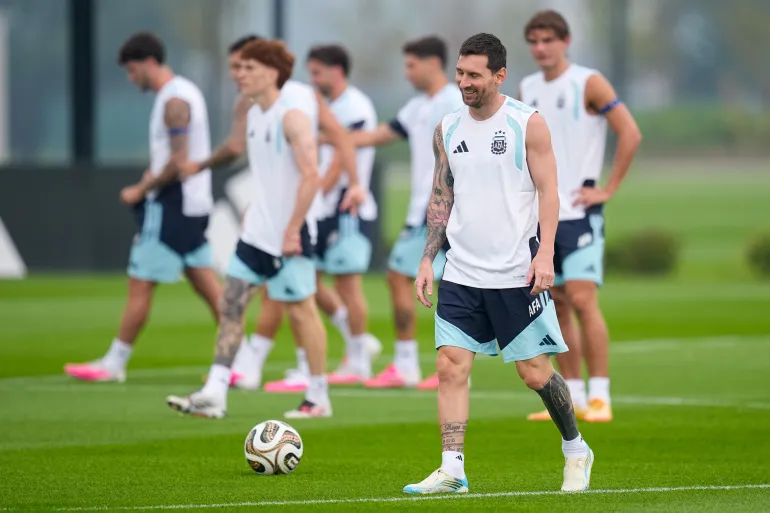
If there were not already enough new records Messi has made in the past month, the 39-year-old diminutive forward is set to add another to his tally – the oldest outfield player to feature in a World Cup final.
It could also be his last.
Leo – as Argentinians commonly call him – has not spoken about his future, but with an illustrious career, headlined by his 2022 World Cup triumph, this year’s tournament seems to be his last, especially if he fulfils a rare back-to-back World Cup title dream.
“He has made history. He is a legend,” Argentina coach Lionel Scaloni said of Messi, one of the greatest players to have graced the football field.
A decade ago, frustrated after a Copa America final loss to Chile, his fourth defeat in a final for Argentina, Messi hung up his boots. The narrative then centred around the fact that despite all his success at the club level, international glory had eluded Messi.
But fast forward to 2026, the Argentina captain has led his team to successive World Cup finals and is bidding for his first Golden Boot – a twist of fate even Messi would not have imagined.
“To have been able to get to a final in the way that he has in this moment, at the age of 39, I think it is incredible,” Scaloni added. “That is why I said we should enjoy having him, because look at what happened with Diego [Maradona] and how we ended up missing him.
“We still have Leo, and we should appreciate that. He is the historic figure and the legend, as are all these players who have given us these marvellous years.”
The little magician from Rosario will lead Argentina’s charge on Sunday, as La Albiceleste aim to become just the third team in the tournament’s history to retain the World Cup after Italy (1934 and 1938) and Brazil (1958 and 1962).
Slick Spain out to silence Argentina
Unlike Argentina, whose game largely depends on the individual brilliance of Messi, Spain are a team built solidly on the collective.
La Roja love to keep the ball and suppress the attacking potential of any opponent.
Their organised, sturdy defence has kept six clean sheets, already the most by any side at a single World Cup tournament, and leaked just one goal en route to the final.
On Sunday, Spain will carry more hunger than fear against Argentina, “the team to beat”, as described by captain Rodri.
“We’ve been through a gradual process of growth, where we’ve seen a team mature over the last few years,” Rodri said. “This team and this generation were going to make a name for themselves … and now reaching the final of a World Cup.
“So we’re pleased with the journey the team has taken, but we’re not stopping there; our ambition goes much further.”
Left to right, Spain’s Lamine Yamal, Dani Olmo and Mikel Oyarzabal are key players of their attack [File: Jessie Alcheh/Imagn Images via Reuters]
The bookmakers’ favourite from the beginning, Spain have played like a side that knows best how to deal with pressure. They produced the performance of the tournament in their stunning semifinal defeat of France, silencing Les Blues’ valiant attack.
Rodri said while that display was “one of the best” the current Spanish side had ever produced, they would need to scale new heights to defeat Argentina and clinch their first world title since 2010.
“I think we have to raise the level because they are the champions. And I’m really confident that we can do [it],” he added.
Spain vs Argentina predictions
The Opta supercomputer views Spain as the favourites in the final, with a 45 percent probability of winning in 90 minutes. It predicts a 26 percent probability of Argentina winning in regulation time, while there is a 29 percent probability of the match going to extra time or penalties.
Overall, Spain have a 59.56 percent chance of winning the 2026 World Cup, while Argentina have a 40.44 percent probability of retaining the title they won in Qatar four years ago.
Who are the referees for Spain vs Argentina?
Referee: Slavko Vincic (Slovenia)
Assistant referee 1: Tomasz Klancnik (Slovenia)
Assistant referee 2: Andraz Kovacic (Slovenia)
Fourth official: Adham Makhadmeh (Jordan)
Reserve assistant referee: Mohammad Alkalaf (Jordan)
Spain vs Argentina: Kickoff time, where to watch
Spain: DAZN Mundial (9pm, Central European Summer Time)
Argentina: TyC Sports, TyC Play (4pm, Argentina Standard Time)
United Kingdom: BBC One, BBC iPlayer, STV, STV Player, ITV1, ITVX, Red Button 1 (8pm, British Summer Time)
US: Fox, Fox One, Peacock, Telemundo App and Network, Universo, Telexitos (3pm, Eastern Daylight Time)
To check the TV listings for your country, head to FIFA’s TV listing schedule here.
Where is Spain vs Argentina being played?
The World Cup final will be played at MetLife Stadium, home to two National Football League (NFL) teams: the New York Giants and the New York Jets. For the FIFA World Cup, the venue has temporarily been rebadged as New York-New Jersey Stadium.
Built in 2010, this huge multipurpose stadium holds up to 82,500 spectators for football matches. The venue also hosted the 2025 FIFA Club World Cup final and both semifinals.
The last World Cup match at the MetLife Stadium was a round-of-16 match that Norway won 2-1 against Brazil [File: Omar Aziz/Reuters]
What is the weather forecast and air quality for New Jersey?
AccuWeather predicts mostly sunny and less humid weather for Sunday in New Jersey.
Smoke from Canadian wildfires has blanketed much of the northeastern US, triggering health alerts. On Thursday, the air quality in New Jersey was rated “unhealthy for sensitive groups” by several air quality measurement platforms.
But for Sunday, the US government’s official air quality monitoring site, airnow.gov, expects the air quality index (AQI) to be “moderate”.
Spain vs Argentina: Head-to-head
This will be only the second World Cup meeting between Spain and Argentina, with Argentina winning 2-1 in the group stages in 1966.
Weekly insights and analysis on the latest developments in military technology, strategy, and foreign policy.
The Pentagon has reached new framework agreements with three defense contractors as part of a strategy to acquire thousands of lower-cost air-launched cruise missiles in the coming years. The deals are directly in support of the U.S. Air Force’s Family of Affordable Mass Missiles (FAMM) program. The Air Force has already said that it is aiming to buy nearly 28,000 FAMM munitions in the next five years.
Under FAMM, the Air Force plans to acquire multiple types of lower-cost cruise missiles in different configurations. This will include ‘lugged’ types (FAMM-L) designed to be launched directly from hardpoints on aircraft, as well as ones intended to be employed from cargo planes via palletized munitions systems (FAMM-P). The service is also pursuing extended-range FAMM-BAR designs, with BAR here standing for “Beyond Adversary’s Reach.”
In FY 2027, the US Air Force is requesting $55 Million in discretionary and $300 Million in mandatory (reconciliation) funds for the Family of Affordable Mass Missile (FAMM) to procure 1,000 All Up Rounds covering both the Palletized (FAMM-P) and Lugged (FAMM-L) variants. The… pic.twitter.com/EgVaefmJgY
— Air-Power | NatSec Ledger (@NatSecLedger) April 22, 2026
“Through [FAMM] agreements with Anduril, CoAspire, and Zone 5, the DoW will accelerate rapid validation of a new family of low-cost, air-launched cruise missiles – capabilities that will strengthen the Arsenal of Freedom,” according to a press release from the Pentagon today. “The agreements are a direct outcome of several Acquisition Transformation Strategy initiatives, including stabilizing demand signals, procuring industry-driven solutions, and maximizing flexible contracting.”
“A key feature of these [FAMM] deals is the establishment of seven-year, multi-year agreements which, subject to congressional appropriations and enactment of all necessary authorizations, will be awarded upon the successful validation and competitive selection of the munitions,” today’s release adds. “The Department was granted 5-year authorization for FAMM in the Fiscal Year 2026 National Defense Authorization Act (NDAA) and is actively seeking congressional approval in the FY27 NDAA and Appropriations Bill for a 7-year multi-year procurement program to provide stability to new entrants.”
The Pentagon’s press release does not name any specific munitions.
Anduril has confirmed that its contribution will be versions of its Barracuda-500 design, and that it is aiming to start making deliveries under FAMM next year. The company will also be delivering a surface-launched version of the Barracuda-500 for the LCCM effort. Anduril first unveiled the full Barracuda family, which includes several tiers of what it calls “expendable autonomous air vehicles,” back in 2024, as you can read more about here. There are reports that at least one version of the Barracuda-500 has received an official U.S. military designation, AGM-189A.
Introducing: Barracuda-M Family of Cruise Missiles
“We joined the FAMM-L program in February 2026 and will execute the first ground and flight tests for Lug-Launched Barracuda-500M in the next several months,” Anduril noted in its release. “We completed the first successful flight test of Pallet-Launched Barracuda-500M in September 2024 and have since conducted dozens of successful flight tests that have further validated the maturity, performance, and modularity of the Barracuda-500 system, including Networked Collaborative Autonomy flights, terminal engagements, and payload performance validation testing.”
Zone 5 has also confirmed that it will be supplying its AGM-188A Rusty Dagger missile.
“By leveraging modern manufacturing and commercial technology, we are breaking the traditional cost curve, enabling the Department of War to field scalable, affordable capacity. The AGM-188 Rusty Dagger will deliver thousands of weapons per year for fighter and cargo aircraft employment but importantly without sacrificing exquisite performance,” Zone 5’s CEO Thomas Akers said in a statement. “Modern conflict has made one thing clear – the ability to rapidly scale production without sacrificing capability is critically important for air superiority. Rusty Dagger is built to deliver affordable, adaptable, highly survivable, incredibly lethal and rapidly deployable weapons that give the U.S. and our allies the ability to outpace and overwhelm evolving threats without being constrained by cost or production limitations.”
An AGM-188A Rusty Dagger missile seen under the right wing of a US Air Force F-16 Viper, just outboard of the drop tank, during testing. USAF
“The inclusion of CoAspire in this groundbreaking FAMM program multi-year agreement underscores CoAspire’s ability to revolutionize our country’s strike capabilities, offering a long-range solution that can be deployed across multiple platforms,” Doug Denneny, CoAspire’s CEO, Owner, and Founder, said in his own statement. “We, and our 56 first-tier suppliers across almost every state are excited to support the Air Force’s need to affordably procure thousands of FAMM cruise missiles over seven years. We applaud the Department’s inclusion of CoAspire as the only small business in this historic production opportunity. This is a true commitment to expand the defense industrial base while growing jobs across the US and bringing affordable cruise missile capabilities to the Air Force.”
Overall, “offering both lugged and palletized variants, the FAMM provides the Air Force with flexible logistics, handling, and deployment options,” the Pentagon’s press release today notes.
“The multi-year approach utilizes firm-fixed-price contracting with a minimum quantity floor. Shares are split among all qualified vendors to ensure multiple production lines are positioned to surge,” the release further explains. “Contractors that meet or exceed production schedules will be eligible for additional procurement quantities – pending congressional appropriations – fostering a competitive environment that rewards efficiency and speed.”
“Furthermore, existing munitions are often exquisite in design, and take months, or more often years, of lead time to produce. The Pentagon’s focus on “disruptive new entrants and commercial innovators,” rather than any of America’s long-established prime defense contractors, with its newly announced framework deals, is extremely significant in its own right. This is the latest example of a major shift away from awarding high-profile contracts to large legacy providers, helping to diversify the industrial base and promote competition. This also means moving away from companies accustomed to very long lead procurement and production arrangements.”
The Pentagon has also made clear that the FAMM framework agreements with Anduril, CoAspire, and Zone 5 do not preclude other companies from being brought into the program in the future. “The Department will also preserve competition opportunities for new vendors to be onboarded for additional quantities and new capabilities in the future as technology continues to advance,” per today’s release.
The market space for lower-cost cruise missiles has exploded in recent years in the United States and elsewhere globally. Relevant designs also occupy a space where the defining lines between these weapons and long-range kamikaze drones, as well as decoys, are increasingly blurry. Overlap between the FAMM and LCCM programs also highlights how many of these weapons are being adapted for launch from air, land, and maritime domains, which can help streamline production and supply chains, as well as offer operational benefits.
Kratos’ Ragnarok, examples of which are seen here loaded on an XQ-58 Valkyrie drone, is just one of several other lower-cost cruise missile designs in development today, just in the United States. KratosImages showing a test of a Lockheed Martin Common Multi-Mission Truck, another relevant design, in a configuration suitable for employment from palletized munition systems. Lockheed Martin
Taking deliberate steps to leave the door open to future competition reflects a larger push to avoid so-called ‘vendor lock’ in the U.S. defense contracting space. This has also been punctuated by moves to ensure greater government control of intellectual property rights and a focus on modular, open-architecture systems across major U.S. military acquisition efforts.
With the FAMM framework deals announced today, on top of the LCCM agreements back in May, the Pentagon is continuing to lay a vital foundation for the procurement of thousands of lower-cost strike munitions for years to come.
Mogadishu, Somalia – Thousands of reel-to-reel tapes sit in an air-conditioned room in the archive of Somalia’s public radio, Radio Mogadishu, stacked on steel shelves and lined up like old manuscripts beneath a thick layer of dust.
Each reel contains a small fragment of Somalia’s 20th-century history, from news bulletins to speeches, music and voices that were once beamed out across the nation’s airwaves, some dating back to the early 1950s.
Recommended Stories
list of 3 itemsend of list
Abdiqadir Geedi Robleh, an archivist at Radio Mogadishu, threads a reel onto an old tape machine, connects it to a computer, and records the contents of each tape. A tape with a love song by Mohamed Mooge Liban, a prominent singer fills the room, and Robleh is transported, he says, to his youth.
He is working with a small team to digitise and methodically order approximately 400,000 hours of broadcasts, officials here say, before the magnetic tape deteriorates beyond recovery, taking with it a crucial record of the country’s past.
Abdiqadir Geedi Robleh cues up a tape, ready to hear a recording. [Abdimajid Abdillahi Farah/Al Jazeera]
“This is the world’s largest store of Somali language music, culture, dramas and everything else, and at the moment it is locked away from the public in a kind of prison,” Robleh tells Al Jazeera. “We’re working to preserve it but also open it up in future to the public.”
Founded in 1951 during the Italian colonial era, Radio Mogadishu would grow into Somalia’s largest and most important public broadcaster. It initially broadcast in Italian and Somali before introducing foreign language services, including everything from Swahili and Oromo to English and Arabic.
In its heyday, it was among the most influential and distinctive voices in East African media, reaching audiences as far afield as Tanzania, Ethiopia, and the Middle East with a style of radical pan-African broadcasting reminiscent of Radio Cairo in the Nasser years.
With the exception of a brief hiatus in the 1990s, when it fell under the control of a warlord, it has served not only as a key source of news for Somalis and audiences across the region, but also as a vital repository of the country’s collective memory.
The effort to preserve its archives has gathered new momentum this year.
In early June, Somalia’s information ministry and the UNESCO regional office for Eastern Africa – the UN’s heritage agency – brought archivists from across the country to a workshop in Mogadishu, aimed at eventually registering its contents with UNESCO’s Memory of the World programme, which catalogues archives of important historical value.
“Protecting this knowledge isn’t just relevant for Somalia, but it is relevant for everyone,” said Guilherme Canela, a senior UNESCO official who is overseeing the project.
Thousands of tapes fill the shelves of Radio Mogadishu’s archive, holding decades of Somali history [Abdimajid Abdillahi Farah/Al Jazeera]
An expert assessment carried out in April counted roughly 45,000 tapes and reels, representing an estimated 400,000 hours of material recorded since the station’s founding. More than 85 percent remain playable, but around one in 10 has deteriorated with age, and more than 5 percent has been destroyed or severely damaged, according to UNESCO.
Radio Mogadishu’s collection was recognised both for its size and because so much of what it holds exists nowhere else.
Some were damaged in an electrical fire in 2018, Robleh says, while others were lost during fighting in 1992, when US forces battled Somali militias in the streets of Mogadishu.
During the worst of the civil war, police colonel Abshir Hashi Ali risked his life to prevent the contents of the archives from being looted. When fighting engulfed Mogadishu following the 1990 collapse of the government, he said he ran back “with the aim of conveying to Somalis the wealth that is stored here”.
Abdi Jeite, the station’s director, says the digitisation drive began as early as 2012, but has been held back for years by a lack of resources. By his estimate, only approximately 10 percent of the archive has so far been converted.
“We’ve got some new tools, and more training for our archivists, but there is still a lot of support needed,” he says.
An old reel-to-reel machine used to play and digitise tapes at Radio Mogadishu’s archive in Mogadishu begins spinning [Abdimajid Abdillahi Farah/Al Jazeera]
To understand why the archive matters so much, it helps to understand what radio once meant in Somali life.
“Radio Mogadishu was arguably the preeminent media institution in post-independence Somalia,” Iman Mohamed, an assistant professor at the University of Minnesota and historian of Somalia, tells Al Jazeera.
“In a society that prizes orality above the written word, radio was uniquely effective at creating a common public sphere through which ordinary people could feel bonded to one another and to a shared sense of nationhood,” Mohamed adds.
Though Somali audiences could also access BBC Somali, Radio Hargeisa, and opposition stations when the government began to deteriorate in the latter part of the 20th century, it was Radio Mogadishu that dominated the “soundscape of urban Somalia”, Mohamed said.
That dominance made Radio Mogadishu a national factory of talent. “If you were a musician, poet, playwright or producer, Radio Mogadishu was the platform you wanted to appear on,” Robleh, the archivist, said. “It made Somalia’s stars.”
Robleh points to the label on a tape of a love song recorded at Radio Mogadishu in 1974 [Abdimajid Abdillahi Farah/Al Jazeera]
Robleh, the archivist, added that many BBC Somali journalists who went on to have distinguished careers first cut their teeth at Radio Mogadishu, which became an important pipeline for Somali-language talent to the BBC.
Hassan Dahir, a former journalist at the station, was one of many Somali children who grew up dreaming of working there. For years, he recalled, Radio Mogadishu was virtually the only source of news for millions, “the eyes and ears of the community”, he told Al Jazeera.
“Its reach was so extensive that even nomadic herders followed events as far afield as the Vietnam War and the American Civil Rights Movement,” Dahir said.
Under Siad Barre, the military officer who seized power in a 1969 coup and ran Somalia for two decades under a self-styled socialist, revolutionary government, the station became an instrument of state ideology, mixing news, drama and religious programming with nationalist and anti-colonial content.
The station beamed pan-African songs Oh Africa, still asleep by Halimo Khalif Magool, which spurred the continent’s inhabitants to awaken and take charge of their own destinies. Mahamud Abdullahi Sangub’s Reject the Color of Imperialism was another popular song of the era in this same tradition of politically charged music, with lyrics like: “Africans listen to each other, reject the colour of imperialism, reject it, reject it, reject it!”
Many of those songs have been covered, sampled or repurposed since, and younger Somalis often encounter them with no idea who performed the originals, or the politics that shaped them, say Mohamed.
Its news coverage focused on anti-colonial wars in places such as Mozambique against Portugal, the struggle against apartheid in Rhodesia and South Africa and the Civil Rights Movement in the US. It covered everything from colonial battles in Guinea-Bissau to the arrest of African American political activist and author Angela Davis.
“We were telling the stories of people resisting their oppressors”, said Dahir.
After seizing power in a 1969 coup, Major General Mohamed Siad Barre used Radio Mogadishu as a key instrument for disseminating his regime’s messages [Abdimajid Abdillahi Farah/Al Jazeera]Portraits of Somalia’s presidents line a wall at Radio Mogadishu above the entrance to the archive [Abdimajid Abdillahi Farah/Al Jazeera]
The station was a “mouthpiece of the government”, cautions Mohamed, but took on a crucial role of inculcating “a patriotic and revolutionary ideological orientation in the Somali people”.
One of the most important projects the radio supported was the Somali mass literacy campaign, when the government sent students to rural Somalia in 1972 to teach the newly developed Somali script. The campaign led to a dramatic increase in literacy across the country.
It also became deeply entangled with Somalia’s regional foreign policy, as the government spent much of the 20th century at loggerheads with Ethiopia before eventually invading in 1977.
That rivalry led Radio Mogadishu to dedicate airtime to Ethiopia’s marginalised ethnic communities, as well as armed rebel movements, particularly those from Eritrea. Among its most notable initiatives were broadcasts in Oromo and Sidama.
Dahir, the former Radio Mogadishu journalist who covered Ethiopia, told Al Jazeera that these were the first-ever radio programmes in either language, both of which had been suppressed for many years in Ethiopia under policies that privileged Amharic, the language of the country’s elite.
The station itself has taken on a far smaller role in Somali life since.
The collapse of the central government in 1991 broke the state’s grip on broadcasting, opening space for private radio, television and online outlets, which have proven popular with the Somali public.
It has lost most of its foreign-language programming, and with it, much of its revolutionary edge. The Somali state also continues to be constrained by limited resources as it rebuilds after decades of conflict.
The entrance to Radio Mogadishu’s studios. [Abdimajid Abdillahi Farah/Al Jazeera]
In November 2021, the al-Qaida-affiliated armed group al-Shabab, which has waged a long rebellion against Somalia’s government, assassinated the station’s then-director, Abdiaziz Mohamud Guled, in a suicide bombing in Mogadishu.
Iman Mohamed, the historian, says that with the civil war in the country, now in its third decade, preserving the archive for posterity has become more urgent.
“The destruction of archives during the civil war has left an enormous gap in Somalia’s documentary record, which means that anyone researching the country’s history is almost entirely reliant on foreign archives or oral history,” Mohamed said.
“That is especially problematic for young people,” she adds. “Recovering what we can matters for the youth who will never have known the world that Radio Mogadishu broadcast in its heyday.”
US Secretary of State Marco Rubio recently launched a public attack on the International Criminal Court (ICC), vowing to “dismantle the ICC—brick by brick.” Washington’s position is that the ICC has no authority to try officials from non-member states—such as the US itself—or their allies, and that it will not accept any international court exercising jurisdiction over American citizens without US consent. Washington therefore intends to use diplomatic pressure and sanctions to counter the Court.
If one still believes in the international community’s definition of war crimes, this looks like a political move to absolve the United States and Israel of war crimes committed in the Middle East. To that end, Washington is pressuring allies — including states that are parties to the Rome Statute — to withdraw from the ICC.
“Trump said in January, ‘I don’t need international law’ to highlight his ‘America First’ policy. He is now keeping that promise, and the ICC is just one example.”
The day before Rubio announced his intent to dismantle the ICC, fourteen countries, including the United States, publicly reaffirmed their support for the ten-year-old ruling in the South China Sea Arbitration—a decision handed down by another international arbitration body: an ad hoc Arbitral Tribunal constituted under Annex VII of the United Nations Convention on the Law of the Sea (UNCLOS), administered by the Permanent Court of Arbitration.
Stay ahead of the geopolitical week.
MD Briefing delivers expert analysis across five global fronts — the Indo-Pacific, energy, geoeconomics, European security, and the Middle East — every Monday morning. Free.
Ironically, of the fourteen countries, only the Philippines—the actual party to the case—has a direct stake in South China Sea rights. The other five countries with genuine interests in the South China Sea did not join this “cheerleading squad”: Vietnam, Malaysia, Brunei, Singapore, and Indonesia. Of these, Vietnam, Malaysia, and Brunei are, like the Philippines, “principal claimant states.”
Aside from the US and the Philippines, every other country among the fourteen marking the tenth anniversary of the ruling is an ICC member state: Australia, Canada, Estonia, Germany, Italy, Japan, Latvia, Lithuania, New Zealand, Romania, Slovenia, and the United Kingdom.
These 12 ICC member states have no stake whatsoever in South China Sea affairs, yet they support an international arbitration body — and are now being pressured by the United States to boycott another international arbitration body they themselves belong to. Fourteen countries are happy to use international law to pressure China, but when international law becomes inconvenient for the US and Israel, is that suddenly a different matter?
The Philippines finds itself in the most awkward position of all. Manila withdrew from the ICC in 2019, yet after Ferdinand Marcos Jr. took office as president, it allowed Interpol and Philippine airport authorities to arrest former president Rodrigo Duterte in 2025 and hand him directly over to the ICC for trial.
The real story behind this episode is domestic political rivalry within the Philippines, combined with Washington’s long-standing displeasure with Duterte. International institutions have played the role of “witch-hunt enforcer,” helping the US and Manila nail a political opponent to the cross.
In the past, the international community could invoke Rome Statute standards to brand Duterte’s “war on drugs” a crime against humanity. But what now?
The ICC cannot prosecute non-member states, but it can prosecute individuals—such as Benjamin Netanyahu. Moreover, under the Rome Statute’s territoriality principle, the Court has jurisdiction if the alleged crime occurred on the territory of a member state. In the Middle East case, Palestine is a state party. In the Philippine case, although Manila withdrew from the ICC in 2019, crimes committed before that withdrawal remain within the Court’s reach.
The reason the US can attack the ICC so freely is that other international arbitration bodies do not follow this same “detour through territoriality” to claim jurisdiction over non-member states, nor do they try individuals—they adjudicate sovereign states (or transnational corporate entities). As such, they strictly adhere to the most fundamental principle of international law: the principle of state consent.
Interestingly, the tribunal that presided over the South China Sea arbitration itself violated the principle of state consent by ruling on a case brought against China, which refused to participate. This is precisely why China has never recognized the ruling as having any legal basis. Yet the fourteen countries that support the ruling seem untroubled by this violation of a core principle of international law.
In other words, both the ICC and the ad hoc tribunal behind the South China Sea arbitration suffer from the same flaw: overreach. The ICC has been accused of an “idealism” that oversteps state sovereignty, while the South China Sea tribunal has been criticized for “procedural overreach”—under UNCLOS, an ad hoc tribunal has no authority whatsoever over land territorial sovereignty, yet the tribunal accepted the Philippines’ framing that “downgraded” what were really sovereignty and maritime-delimitation questions into a simple matter of “the legal status of islands and reefs” and used that framing to assert jurisdiction for itself.
Taiwan was an innocent bystander caught in the crossfire of the South China Sea arbitration. Itu Aba (Taiping Island), which is under the actual control of the Republic of China (Taiwan) and has both fresh water and the capacity to sustain human habitation, was nonetheless ruled to be a mere “”rock”—stripping it of any 200-nautical-mile exclusive economic zone.
Given that both international arbitration bodies suffer from the same problem of overreach, if one follows the US in opposing the ICC, shouldn’t one logically also oppose the South China Sea ruling? This month, the Philippine Department of Foreign Affairs launched an “urgent assessment” to awkwardly grapple with exactly this dilemma, since Manila has skin in both games—the Duterte case and the South China Sea ruling.
If Manila agrees to help dismantle the ICC, what happens to Duterte, still awaiting trial in The Hague? And if China then uses that same logic to reject the South China Sea ruling, what then? The other twelve member states that joined this “witch hunt” find themselves in an equally awkward spot.
Second only to the Philippines in embarrassment is Japan. Tokyo is the ICC’s largest financial backer; the Court’s current president, Tomoko Akane, is Japanese; and Japan has long been one of the ICC’s staunchest supporters. Is Tokyo now expected to help the US dismantle the ICC or to withdraw from it altogether?
Japan also finds itself in a glaring contradiction over the South China Sea ruling. If Taiwan-controlled Taiping Island—with an area of 510,000 square meters (roughly the size of 71 standard football pitches), fresh water, and the capacity to sustain habitation)—was ruled a mere “rock,” then how can Okinotorishima, an outcrop Japan claims sovereignty over that covers just 9.44 square meters (about the size of a double bed), possibly qualify as an “island”?
By that logic, Tokyo’s support for the South China Sea ruling effectively concedes that Okinotorishima has no exclusive economic zone at all — a self-inflicted contradiction that China has been quick to mock.
One could, therefore, say all fourteen countries backing the South China Sea ruling are applying a double standard, and that thirteen of them have no connection to the South China Sea whatsoever. Aside from the Philippines, the only country with any real claim to South China Sea interests is the United States — and the US holds international law in contempt, going so far as to vow to destroy an international arbitration institution outright.
This episode symbolizes the unraveling of the international order—a world reverting to the law of the jungle. The United States is dismantling the very international order it built, and the ones hurt most are precisely its own allies.
The Philippines and Japan have been given the responsibility of encircling China on the front line by the United States, but the footholds of the two countries are also being dismantled by the United States. In front of them, there is only the risk of opposing China and the weakening guarantee.
Above all, the United States has proven, by its own actions, that the so-called international order was never fair and never operated on a fixed standard — it was merely a temporary tool for an empire to rule the world. And when the tool stops being useful, it gets discarded, leaving its followers staring, embarrassed, at the tool still in their hands.
US Central Command says new strikes on Iran are designed to further degrade Iran’s ability to choke the Strait of Hormuz.
By Al Jazeera Staff, AP and Reuters
Published On 19 Jul 202619 Jul 2026
The United States military said Sunday that it launched new strikes on Iran to “swiftly punish” the country’s Islamic Revolutionary Guard Corps (IRGC) for an attack that killed two American service members and left one missing and four requiring hospitalisation.
An area near Sirik in Iran’s Hormozgan province and Qeshm Island have been hit on the eighth consecutive night of US air strikes on Iran, according to Iran’s semi-official Mehr and Tasnim news agencies.
Recommended Stories
list of 3 itemsend of list
The attacks happened early on Sunday, hitting Sirik at 1:30am local time (22:00 GMT, Saturday), and Qeshm Island at about 3:38am (00:08 GMT, Sunday) and again at 6:10am local time (0240 GMT) according to Iranian reports.
Tasnim also said the US military targeted a location near Shadegan in Iran’s Khuzestan province at 5:55am (02:25GMT Sunday).
The reports said there were no casualties and that residential and commercial infrastructure was not damaged in the attacks.
In a post on X, US Central Command (CENTCOM) said the US military launched new strikes “designed to further degrade Iran’s ability to threaten commercial shipping in the Strait of Hormuz”.
The post added that strikes were also in retaliation for Iranian ballistic missile and drone attacks on a US base in Jordan that killed the two US service members on Friday.
US Central Command later said its strikes targeted “Iranian military coastal surveillance and air defense facilities, maritime capabilities, and missile and drone storage sites.”
Since the war began in February, 16 US service members have been killed and more than 430 wounded.
The Tasnim news agency said there were reports of explosions in Qom, Arak and Behbahan that were later denied by local authorities.
The governor of Arak said that “the situation is completely normal and so far we have not had any reports of attack or explosion”.
Iranian retaliatory strikes
Tasnim news agency said the Iranian army targeted US military assets in two bases in Kuwait.
A statement from Iran’s military said, “In response to the repeated aggressions of the enemy”, the army targeted a US “ammunition depot at Al-Adiri camp and the Patriot radar and air radar” at the Ali Al Salem base in Kuwait.
“Unforgettable lessons”
Before the latest US strikes began, Iran’s supreme leader warned of “unforgettable lessons” if the US continued its attacks on Iran.
Initially, the battle focused on control of the Strait of Hormuz. But US strikes have now widened to include civilian infrastructure, including bridges and desalination plants for drinking water.
State-run news agency IRNA said the Bonji desalination plant was destroyed, cutting off water supplies to about 10,000 people, and a desalination plant on strategic Qeshm Island inside the strait was damaged.
Iran’s Deputy Foreign Minister Kazem Gharibabadi told state television the US is violating terms of the interim deal and “no longer implementing them”.
Iranian authorities said at least 50 people have been killed and more than 500 wounded in US strikes in the past three weeks.
Late Saturday, the Iranian embassy in India named two girls – Sogand Dardmand and Fatemeh Zahra Akbari – who were among seven killed in a US strike on Bandar Khamir in southern Iran, which took place on Thursday.
Al Jazeera’s Tohid Asadi, reporting from Tehran, said that the last eight nights of US strikes on Iran have caused “anger” and “frustration” among the populace.
“People don’t really know whether they are going to see the continuation of this confrontation, or how long it’s going to take, and also if there is a possibility for a diplomatic settlement to resolve all these complexities and find a long-lasting solution”, he said.
The US has launched a new wave of strikes on Iran after two American soldiers were killed by Iranian strikes in Jordan. President Donald Trump called it ‘swift punishment’, as Al Jazeera’s Heidi Zhou-Castro reports.
A second delivery on the Cruz de Mayo and San Juan festivities. (Venezuelanalysis)
In defense of Venezuelan culture
On the day of San Juan (June 24), Venezuela was rocked by the strongest earthquake ever recorded in our history. An extremist, elitist discourse immediately arose, attempting to blame these seismic events on Afro-Venezuelan cultural and devotional practices. This reveals deep sociological and historical dynamics and deserves rigorous critical analysis. This diatribe is a clear symptom of the persistence of the coloniality of power, through which Eurocentric epistemologies continue to marginalize, stigmatize, and criminalize cosmogonies that escape their control. (click for more)
This condemnation of devotion to San Juan transcends mere religious intolerance; it constitutes an act of epistemic violence rooted in structural racism. By demonizing the festival, this conservative discourse acts as an ideological mechanism that reproduces the hegemony of the Global North. Historically, the Western “civilizing” project labeled African-rooted spiritualities as “barbaric” or “demonic” to justify dispossession, slavery, and domination. Today, that same framework is being recycled amid a crisis in an effort to invalidate the Caribbean-Venezuelan musical heritage, fully aware that these celebrations are spaces for cultural resistance and the affirmation of life.
Those who echo these condemnations reveal a profound alienation from their own identity. By internalizing and defending the values of the former colonizer, this group seeks to distance itself from its own roots in order to assimilate into an aspirational and illusory “whiteness.” Instead of recognizing and embracing the ethos that defines Latin America’s complex and tense reality, they adopt an imported and punitive morality. They directly attack traditional community-based folk music, disparaging a historical tradition that has been, and continues to be, the fundamental for family and community cohesion.
Ultimately, to claim that the beating of drums and the siren-like chants in honor of San Juan cause the material destruction of our cities and the deaths of our compatriots is a desperate and deeply irrational mechanism for sustaining a decadent racial and cultural hierarchy. We defend and assert the right of peoples to exist, to celebrate their diversity, and to express their ways of understanding the world in the face of a colonial mindset that insists on punishing and blaming everything it cannot tame.
San Juan arrives at the Cruz de Mayo Wake
For this second installment of our work on Venezuela’s life cycle festivities (click here for part I), we present an in-depth conversation with the renowned Venezuelan musician, cultural practitioner, and percussionist Rolando Canónico. Together, we reflect on the immense responsibility of preserving Venezuelan traditions, specifically during festivals such as Cruz de Mayo and San Juan. From his dual role as a professional musician and cultural worker, Canónico addresses the tension between the commodification of music or competitive virtuosity and absolute respect for ancestral rhythmic and melodic patterns, defending the playing of the drum as an act of genuine devotion rather than a spectacle. He further delves into the powerful spiritual and syncretic connection he experiences when “dialoguing” with the instrument, underscoring his firm commitment to protecting and passing on this invaluable family and cultural heritage to new generations in Caracas.
A percussionist, drummer, and cultural creator, Canónico has participated in Fundación Bigott and renowned musical groups such as Caracas Sincrónica and Francisco Pacheco y su Pueblo. His trajectory is intertwined with a more discrete, yet vital, task: safeguarding Venezuelan musical memory. What began as a conversation between friends turned into a deep discussion about ethics, spirituality, and the responsibility of honoring the legacy of our ancestors in the twenty-first century.
Family and heritage: the weaving of a music lineage
To understand Rolando Canónico, one must look back at his ancestry. “My paternal grandparents passed away many years ago: Luisa Amelia Aponte de Canónico and Benito Canónico,” he recounts. Benito Canónico was the author of “El Totumo de Guarenas,” an important folk music composition. A musical heritage that flows through Rolando’s veins. However, as we delve into his role as a “host” of these festivities, Rolando turned his gaze toward his maternal lineage –to the women who, through the energy of daily life, kept the flame of devotion alive.
His story takes us to the Afinque Marín in the densely populated Afro-Venezuelan community of San Agustín, Caracas, where his maternal great-grandmother became a cultural bridge. “When that wave of people from Barlovento arrived –that migration boom from Barlovento to Caracas –she had the opportunity to be there when all these cultural expressions arrived,” he explained. It was there that, without any artistic pretensions, driven solely by faith, his great-grandmother began to adorn the Cruz de Mayo.
This responsibility passed to his grandmother, Rosa Emilia Pérez Sanz. “She embraced it as such,” Rolando told us, describing a pedagogical-community learning process where knowledge wasn’t taught in classrooms, but rather through observation and habits shared with neighbors. Music, for its part, was naturally incorporated through his mother, the founder of local band Los Tucusitos, blending Christmas carols with the fervor of the Cruz de Mayo vigil. For Rolando, that early exposure to music, combined with the discipline of his musical training, allowed him to turn a family passion into a profession.
A double celebration: a rite of transition and coming together
The celebration that Rolando Canónico holds at his home in La Pastora is not a one-off event, but rather part of a 43-year tradition that has been formally recognized by the Culture Ministry’s Institute of Cultural Heritage for the past 15 years. Every last Saturday in May, the house becomes the setting for a symbolic transition: the farewell to May, dedicated to Cruz de Mayo (May Cross), and welcoming June, the month of San Juan.
The logistical effort is monumental. “It’s not just a matter of sitting there, shouting some stuff, and that’s it,” Rolando emphasized. The process begins days in advance, with the presentation of newborn children and spiritual cleansings. Rather than merely attending as spectators, the community becomes an active participant: “People already know when it is; they don’t even ask anymore –they just show up with a small bouquet of flowers, a candle, fruit, or even a kilo of vegetables for the soup.”
The masterfully designed altar serves both festivities. “We make one, but it also serves as decoration for both,” explained Rolando, describing a symbolic overlap where the Cross is moved aside to make way for San Juan. This is the moment when devotion becomes tangible.
One of the most tense and beautiful moments of the night is the ritual procession. When San Juan arrives, the Cross, guarded by its devotees, seems to resist the change. “That encounter there, that clash, there comes a moment when San Juan announces that he’s going to come out, and the Cross doesn’t want him to,” Rolando tells us with the intensity of someone who has deeply witnessed that “struggle.”
To manage this tension, Rolando delegates to a decimista [poet], who acts as a mediator. He not only sings but also has the authority to say “He said it right!” at the precise moment when the euphoria outside the house reaches its climax. It’s a necessary exercise in control: “I have to do it this way because otherwise the whole thing turns into a conflict.” As the sirens* and golpes de tambor** intertwine, the cross at the altar gives way to the triumphal entry of San Juan, closing one portal to open another.
Rolando Canónico narrates the intensity of this coming together:
That encounter there, that clash, there comes a moment when San Juan announces that he’s coming out, and the Cross doesn’t want him to. So the devotees of the Cross hold their ground. It’s something beautiful, truly beautiful. Right there in that moment, with San Juan already coming down the stairs and the fulía [traditional rhythm] playing at the altar, the devotees form a circle so the fulía doesn’t stop. In the end it’s not a struggle but a meeting. The meeting where San Juan rises as he descends the stairs, already looking toward the Cross, and he’s trying to leave the house to welcome those who are coming. It’s as if he’s saying, “I’m letting you know that I’m on my way here.”
Regarding the energy that is unleashed when the festival reaches its peak with the arrival of the San Juan statues, Canónico adds: “That’s the moment when the altar of the Cross begins to be dismantled, when all the crosses are removed to make way for San Juan.” “That clash there between the Cross and San Juan gives you a powerful feeling,” he continued. “And when the three San Juan statues meet in front of the house, I can’t even describe it…”
Responsibility toward our ancestors and their legacy
If there is something Rolando Canónico is known for, it is his intransigence toward shoddy work. In a world where the commodification of traditional music threatens to sever it from its roots, he stands as a bulwark.
“In my house, I don’t accept things done poorly.” For him, the drum is not an instrument for competition or for displaying empty virtuosity. “I’m not putting on a show. I’m fulfilling a family promise,” he emphatically clarifies. His authority within the festival doesn’t stem from arrogance, but from a deep understanding of and respect for the musical codes, styles, discipline, and rigor that his teachers instilled in him.
This rigor extends to his training of new generations. Rolando is fully aware of his role as a guide and seeks to prepare his nephew and other young people so that the tradition is not diluted by stage “improvisations.” It is a pedagogy by example: he inaugurates each drum, ensuring that the rhythmic foundation is consistent with what has been passed down for centuries.
Finally, the conversation heads into more intimate territory: the relationship between the musician-artist and the divine. When asked if he experiences an altered state of consciousness while playing, Rolando responds with overwhelming sincerity. “I am a devotee of San Juan the Baptist; I am a santero… my spirituality is deeply connected to the drum.”
For Canónico, there is no separation between the musician who reads the score and the practitioner who offers his prayer through the drum’s vibrations. “That’s the best spiritual cleansing there can be here –playing the drum the right way,” he affirms. “I say ‘the right way’ because with the drum, you have to communicate with it.”
This dialogue, this meeting between the sacred and the profane, is what makes the festival in La Pastora, in Rolando’s own words, a “formidable experience.” By the end of our interview, it’s clear that his work is not merely a tribute to the past, but a strategy for cultural re-existence. As our interviewee aptly summarized at the end of our meeting, the true responsibility of a cultural artist is to ensure that, when San Juan arrives at his doorstep, the drum sounds exactly as it should: with the truth of the ancestors and the strength of a future that, thanks to people like him, is guaranteed a place in Venezuela’s collective memory.
Notes
*Sirenas are a cappella songs with an octosyllabic quatrain meter used to express devotion to both the Cross and San Juan.
**Golpes de tambor refers to multiple rhythms where drums, usually in sets of three, are the main protagonists. From a melody standpoint, singers take turns between solos and choruses.
See below for more details on the festivities and the surrounding music.
Fabiola José is a Venezuelan singer. She has performed in countries across South America, Africa, Europe, and Asia. Her singles and albums are available on all digital platforms. She hosted and produced “Cantante y Sonante” for Radio Nacional de Venezuela. In 2018–2019, she created a series of videos for social media, published on her YouTube channel #HechoEnCasa. She holds a bachelor’s degree in Music from IUDEM, Caracas (2005); specialized under Maestro Tom Krause in Spain (2007); and an M.A. in Arts and Cultures of the South from UNEARTE, Venezuela (2020).
Fidel Barbarito is a Venezuelan musician and researcher, with a bachelor’s and master’s degrees in music and history, respectively. He teaches in the undergraduate and graduate programs at the National Experimental University of the Arts (UNEARTE). Together with Fabiola José, he promotes several musical projects aimed at disseminating traditional folk repertoires, integrating them with contemporary compositions inspired by these sounds. Joropo llanero. Parranda de reexistencia is one of his published essays.
The views expressed in this article are the authors’ own and do not necessarily reflect those of the Venezuelanalysis editorial staff.
The Sounds of Celebration
To gain a deeper understanding of the rich soundscape that defines the festivities at the Canónico family home, we break down how the musical universe of these celebrations is organized. It is not merely a decorative sideshow, but rather the ritual language through which faith is expressed.
The music in the Cruz de Mayo wake: a devotional geography (drop-downs with more info)
The Cruz de Mayo ceremony, which precedes the arrival of San Juan, features a structure that honors various regions of Venezuela. Canónico explains that this part of the festival requires specific discipline and respect for the different genres according to their geographic origin.
The order of the genres
Devotional music follows a set pattern that begins with the “Salve Llanera.” Afterward, songs representative of various regions are performed: Lara, Oriente, Falcón, and finally Zulia.
The poet and the sirenas
The mediator plays a crucial role. He recites poetry (“décimas”) and also has the authority to sing sirenas. This person is responsible for maintaining the choir and the performance during the most intense moment, when the altar of the Cruz is being prepared for the transition.
Interpretive rigor
There is a strict hierarchy. Although the community is invited to participate, the singers are committed to specific roles. For example, those responsible for the salve must perform it with the rigor that tradition demands, avoiding any “improvisation” or inappropriate mixing with other genres.
Music for San Juan Bautista: the strength of the drum (drop-downs with more info)
Once the ritual procession takes place and San Juan enters the house, the soundscape changes radically. Canónico explains that, unlike the Cruz, San Juan marks the beginning of a sequence in which the drum takes center stage.
Performance spaces
There is a geographical distinction within the house. The genres permitted to be performed inside the home, directly in front of the altar, are limited and sacred: sirenas, culo e’ puya, quitiplás, and San Juan de Guatire. All other musical performances take place outside the house.
The main reference
Rolando Canónico, as the host and a cultural leader, inaugurates each drum. He performs the Afro-Venezuelan section—specifically the Miranda fulía—alongside his nephew and his godson, ensuring that the rhythmic pattern remains true to tradition and does not veer toward competitive or show-oriented styles.
Ethical guidelines
At the Canónico household, a clear policy has been upheld: to play not for the sake of competition or virtuosity, but out of devotion, tradition, and beauty.
Talking to the instruments
For Canónico, playing the drum is not a technical performance, but a dialogue. He asserts that, in this context, the saint dwells within the drum and that playing it is a form of spiritual cleansing. When the instruments sound, the performer seeks to “detach” himself from rigid patterns in order to let a powerful energy flow, especially when several San Juan statues gather in front of the house.
This musical framework is, in Canónico’s words, a “system” in which every drumbeat and every décima has a specific place and time to ensure that the legacy of the ancestors remains alive without being corrupted by trends or commodification.
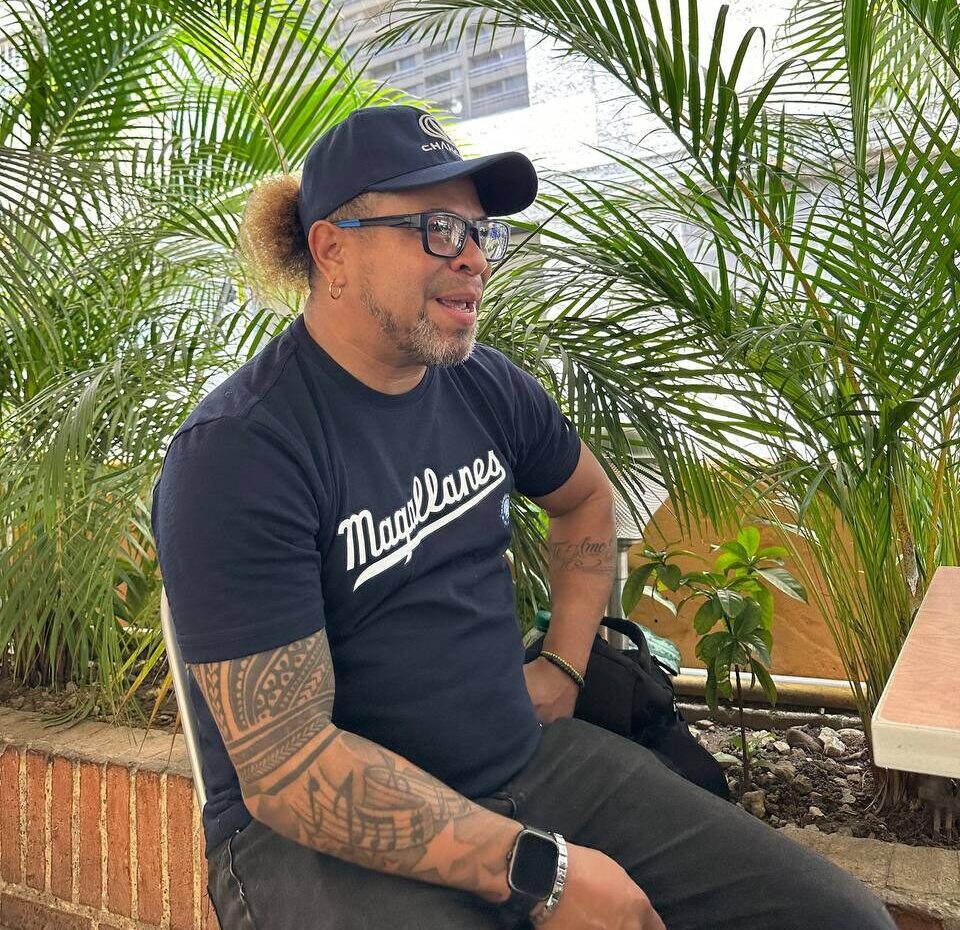
Rolando Canónico. (Photo by Simón Barbarito)
Rolando Canónico is a prominent Venezuelan percussionist, educator, and cultural practitioner, recognized as a key figure in the preservation of traditional community music and Afro-Venezuelan percussion. Initially trained at the Bigott Foundation’s Popular Culture Workshops, he has built a prolific musical career by joining iconic groups such as Francisco Pacheco y su Pueblo, Pomarrosa, and Caracas Sincrónica, as well as accompanying important Venezuelan artists, including Cecilia Todd, Cheo Hurtado, Betsayda Machado, Fabiola José, and Luisana Pérez, on recordings and on stage.
Beyond his virtuosity as a session musician, Canónico stands as an active guardian of Venezuela’s musical tradition, demonstrating a deep ethical and spiritual commitment to organizing community festivals, ensuring that historical accuracy and the identity of the ancestors remain alive for future generations.
Tuchel can continue to rely on captain Kane – for now.
The Bayern Munich striker will be 36 when the next World Cup rolls around, but seems in no mood to hand up his England boots.
Kane – who scored six goals at this World Cup, but was an unused substitute against France – told the BBC: “One of the best England groups that I have ever been a part of.
“When you see the boys around the hotel, when you see us training on the pitch, when you see us in the changing room, it is a unique group. We had that bond and had so much belief in each other.”
On Tuchel, Kane added: “It is his first major tournament. I think he has learned a lot of the squad, the campaign, the travel and the games and what it takes – the pressure.”
One of England’s wounds that was deepened by the win over France was Tuchel’s decision not to send on Bukayo Saka against Argentina.
The Arsenal winger, an unused substitute in the semi-final, scored a hat-trick on Saturday against Les Bleus – then afterwards said he is fully fit, having endured some injury worries earlier in the North American campaign.
“Of course, I would love to have played more but it’s too late to talk about that,” Saka told BBC One. “I try to do my talking on the pitch and it’s done now, move on. I’m fit.”
On noise around the manager, he said: “I think that’s just part of the game… it’s how you react to it, how you use it as fuel and today we finished strong and that’s all we could really do and we did that.”
England’s twisting World Cup 2026 story has a bittersweet ending – with a thrilling victory in the game no-one wants to be a part of.
But how this campaign will ultimately be remembered might not be truly determined until after this team have produced their sequels.
Weekly insights and analysis on the latest developments in military technology, strategy, and foreign policy.
Two U.S. troops were killed in action and one remains missing in Jordan on Friday while defending against Iranian ballistic missile and drone attacks, U.S. Central Command announced on X. Another “four American service members were medically evacuated to Jordanian hospitals. They have since been discharged. Other personnel who were evaluated for minor injuries have returned to duty.”
“Out of respect for the families, CENTCOM is withholding additional information, including the identities of the fallen warriors, until 24 hours after the next of kin have been notified,” the command added.
CENTCOM Statement on Recently Fallen, Missing U.S. Service Members
TAMPA, Fla. — On July 17, two U.S. service members in Jordan were killed in action as U.S. Central Command (CENTCOM) and partner forces defended against Iranian ballistic missile and drone attacks. Additionally,…
CENTCOM did not say where in Jordan, however, yesterday, CBS News reported that “Iran attacked at least two Jordanian bases this week, resulting in several American service members being injured in the attack after their facility was struck.”
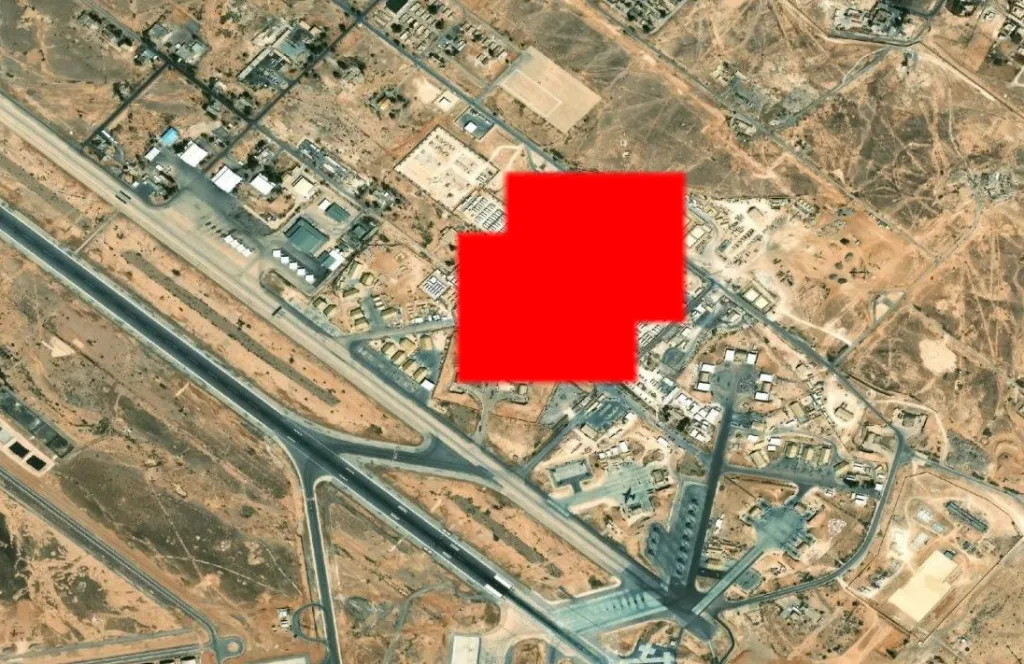
We noted yesterday that data from NASA’s Fire Information for Resource Management System (FIRMS) at 10:59 PM EDT indicated a fire adjacent to the runway near an area where aircraft are parked at Muwaffaq Salti Air Base in Jordan. However, TWZ cannot independently verify what happened at the base and if any equipment was destroyed or damaged and how personnel there were affected. We’ve reached out to CENTCOM for answers.
Data provided by NASA’s Fire Information for Resource Management System (FIRMS) indicated a fire at Muwaffaq Salti Friday night, however TWZ cannot confirm at this time what that indicates. (FIRMS)
We reached out to CENTCOM for confirmation.
Video emerged on social media purporting to show attacks on the base.
Video captures the moment that several Iranian medium to intermediate-range ballistic missiles struck Muwaffaq Salti Air Base in Jordan overnight, killing at least two and injuring several other American Servicemembers. pic.twitter.com/cJz39E1LvP
The air base has long been a major regional hub for U.S. operations, and is being very actively utilized in the current conflict. It hosts the greatest concentration of U.S. tactical aircraft in the region, and thus is an extremely important target, where, as we pointed out last night, even one ballistic missile landing on an apron could destroy multiple prized aircraft and take the lives of U.S. service members or cause injuries.
Iran also hit Prince Sultan Air Base in Saudi Arabia yesterday, Axios reporter Barak Ravid stated on X.
🚨U.S. official: Iran launched a ballistic missile at a U.S. base in Saudi Arabia 🚨Why it matters: This is the first direct Iranian attack on Saudi Arabia in nearly four months
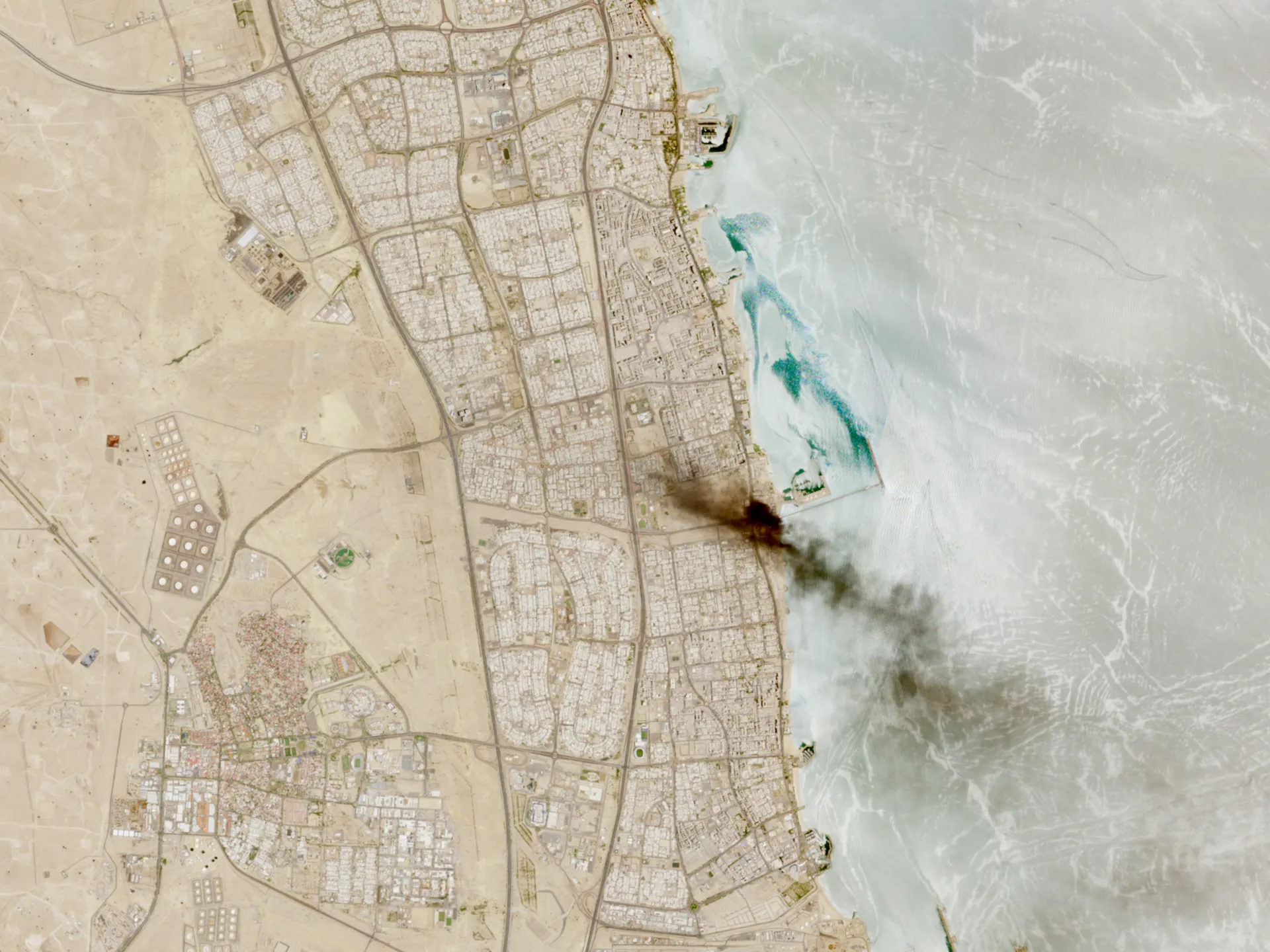
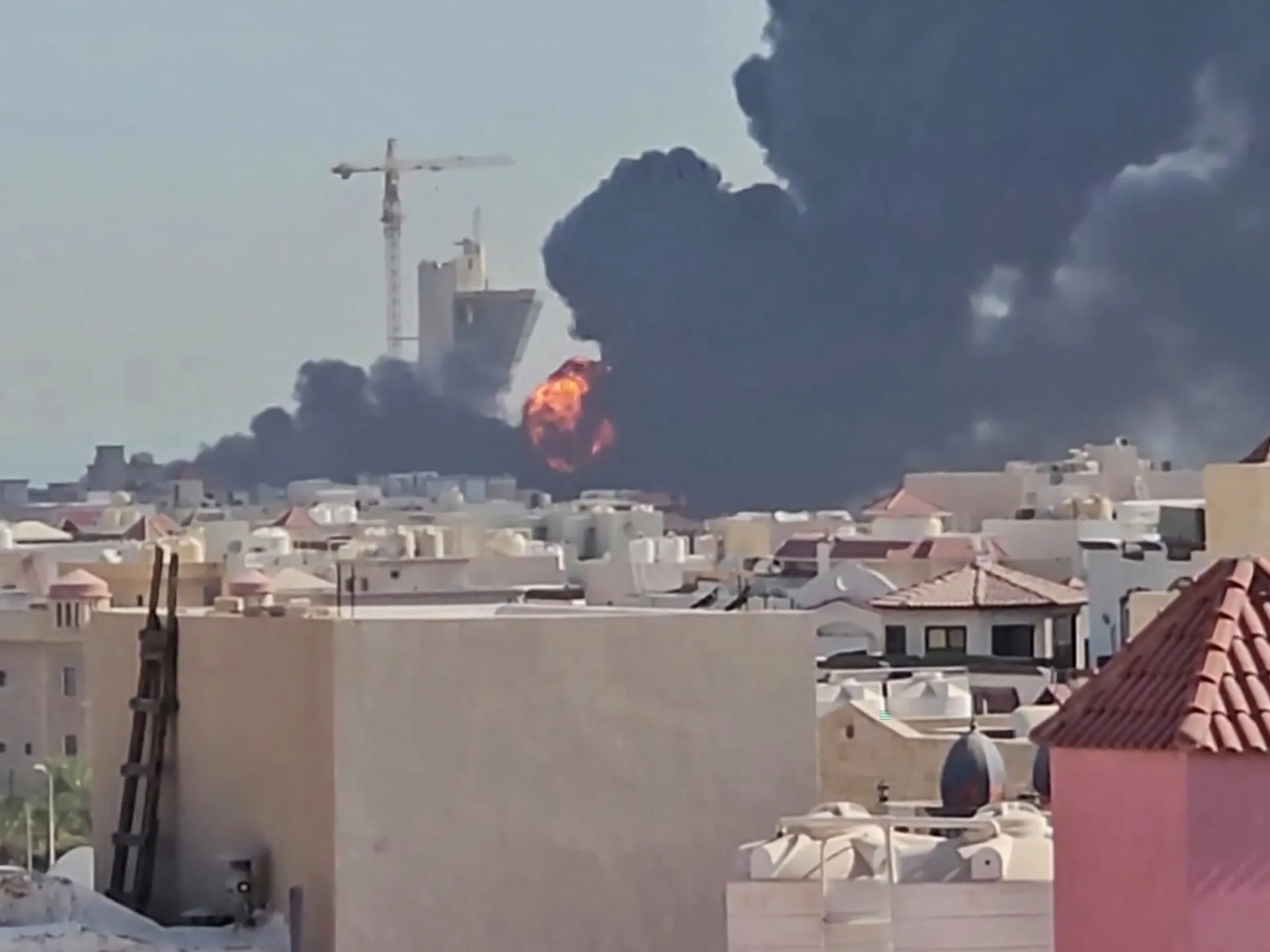
In addition, officials in Kuwait yesterday said one of the country’s power and water desalination plants “was attacked as a result of the Iranian aggression…leading to a fire and damage to the plant’s facilities and several electricity generating units.”
“The fire is now under control and repairs are ongoing,” the Kuwait government added.
Kuwait announces one of its power and water desalinization plants “was attacked as a result of the Iranian aggression…leading to a fire and damage to the plant’s facilities and several electricity generating units.” The fire is now under control & repairs are ongoing. https://t.co/MrFcwkeTHrpic.twitter.com/LoxTCM4v92
The two deaths and the injuries came as the conflict between the U.S. and Iran is escalating rapidly, with each side now attacking critical infrastructure and Iran intensifying strikes on U.S. bases across the region.
Amid the fighting, “Iranian Deputy Foreign Minister for Legal and International Affairs Kazem Qaribabadi stated that Tehran has suspended its commitments under the Islamabad Memorandum of Understanding (MoU) signed with Washington as United States attacks continue,” the official Fars News Agency reported.
This is a developing story.
UPDATE: 6:31 PM EDT-
CENTCOM announced a new wave of attacks on Iranian targets.
“Today at 6 p.m. ET, U.S. forces began launching new airstrikes against Iran at the Commander in Chief’s direction,” the command stated on X. “The strikes are designed to further degrade Iran’s ability to threaten commercial shipping in the Strait of Hormuz and swiftly punish Islamic Revolutionary Guard Corps forces who launched attacks against American service members in Jordan last night.”
Today at 6 p.m. ET, U.S. forces began launching new airstrikes against Iran at the Commander in Chief’s direction. The strikes are designed to further degrade Iran’s ability to threaten commercial shipping in the Strait of Hormuz and swiftly punish Islamic Revolutionary Guard…
President Donald Trump called the deaths of two U.S. service members in Jordan, “a very sad thing,” in a brief phone call with NewsNation, the outlet stated.
Trump told the outlet that the troops died “in service of our country” and reiterated that the war’s central objective is “never allowing Iran to have a nuclear weapon.”
Asked about Iran’s announcement that it was no longer abiding by a U.S.-Iran memorandum of understanding, Trump replied: “I couldn’t care less.”
NewsNation exclusive: President Donald Trump responded to the deaths of two U.S. service members who were killed in an Iranian missile attack in Jordan. Trump said the service members died “in service to our country” and reiterated that Iran cannot be allowed to obtain a nuclear… pic.twitter.com/JykOv5Upla
U.S. officials offered The New York Times a recounting of the last five days of Iran’s attacks on Jordan, which the Pentagon has not yet discussed in detail publicly.
“The first attack to hit U.S. forces in Jordan struck a residential facility at King Faisal Air Base, wounding as many as five U.S. service members, they said,” the publication reported. “The second hit a base in eastern Jordan where U.S. Blackhawk helicopters were operating from, damaging a significant number of them.”
“Then, 48 hours ago, Iranian missiles hit Jordan’s Muwaffaq Salti Air Base in Azraq, which is the same base where the troops were killed on Friday,” the newspaper added, citing officials. “The earlier strike wounded about 20 U.S. troops rushing to take cover in bunkers. No one was killed in that barrage. But on Friday, when the Iranians struck the base again, two U.S. troops were killed and four other service members were injured, according to U.S. officials. Other personnel were evaluated for minor injuries and returned to duty.”
Kylian Mbappe scores twice for France to hit World Cup record but England win 6-4 in third-place playoff final.
Published On 18 Jul 202618 Jul 2026
England beat France 6-4 in a chaotic World Cup third-place playoff as Kylian Mbappe became the all-time leading scorer in World Cup history.
Both teams had higher aspirations at the 2026 tournament but suffered painful semifinal exits – France were outplayed by Spain while England suffered a late collapse against Argentina.
Recommended Stories
list of 3 itemsend of list
Both coaches made multiple changes for Saturday’s match in the oppressive heat of Miami, with a host of stars on the bench at the start.
England boss Thomas Tuchel left out Harry Kane and Jude Bellingham from his starting lineup while Deschamps, stepping down after 14 years at the helm, omitted Bradley Barcola and Ousmane Dembele.
Arsenal midfielder Declan Rice put England ahead with a goal from distance in the third minute and Ezri Konsa headed home to make it 2-0.
Kylian Mbappe and Michael Olise were a threat as France searched for a way back into the game, but they found England’s second-choice goalkeeper Dean Henderson in top form.
The game threatened to become embarrassing for France when Bukayo Saka made it 3-0 after a swift break.
And it was 4-0 in first-half stoppage time when Saka scored his second goal of the game, celebrated with a fist pump by Tuchel.
France coach Didier Deschamps told French TV channel M6 that the first-half display had been “catastrophic”, urging his men to show pride.
He made four changes, bringing on Dembele, Dayot Upamecano, Lucas Digne and Barcola and was rewarded almost instantly when Mbappe scored his ninth goal of the tournament to move clear of Lionel Messi at the top of the Golden Boot standings.
The game had now totally changed complexion, and Barcola pulled another goal back, with Deschamps clenching his fist on the bench.
Mbappe then netted his second of the game to become the all-time leading World Cup goalscorer with 22 goals – slotting home from Olise’s pass.
That put him two ahead of Messi in the race to finish as top scorer at the 2026 tournament.
France squandered a number of chances to equalise, and England were handed a chance to extend their lead when Malo Gusto brought down Djed Spence in the penalty area.
Saka stepped up to the spot and converted to complete his hat-trick.
There was still time for Dembele to grab a fourth for France, but Bellingham then strode forward to score the 10th goal of the match with an individual effort.
In doing so, Bellingham became the first England player to score seven goals at a World Cup.
By finishing third, England secured their best result at a World Cup since winning the tournament in 1966, though they will carry bitter memories of their defeat by defending champions Argentina.
Deschamps led France to World Cup glory in 2018 and finished as runners-up four years ago.
Les Bleus were favourites to win the 2026 tournament after a sensational start but were well beaten 2-0 by Spain in the semifinals.
Three-time champions Argentina face European champions Spain in the final in East Rutherford, New Jersey, on Sunday.
Tries: Freeman, Earl 2, M Smith, Feyi-Waboso Cons: F Smith 3
England held on to beat Argentina in a chaotic match in the Nations Championship after the hosts had a last-gasp try controversially ruled out in Santiago del Estero.
With 13-man England leading 31-24, Argentina wing Bautista Delguy scored in the corner with the final play – leaving a difficult conversion to secure a draw.
Referee Angus Gardner had awarded the try on field, but television match official Brett Cronan insisted Delguy was in touch.
While Gardner repeatedly suggested there was no clear evidence to overturn his original on-field call, the try was eventually chalked off.
Henry Slade’s covering tackle on Delguy proved to be the decisive moment, with Gardner surrounded by frustrated Argentina players at full-time.
A combined seven yellow cards were shown in what was a thrilling and action-packed game.
Steve Borthwick’s side looked set for back-to-back Nations Championship wins after Tommy Freeman’s try and two scores from Ben Earl gave them a 16-point half-time lead.
The Pumas, who wore replicas of the football team’s 1986 World Cup kit for the match, scored next before taking advantage of two England yellow cards, but their own ill-discipline prevented them punishing the visitors further.
Marcus Smith’s try in the corner came with number eight Joaquin Oviedo in the sin-bin, before Santiago Carreras joined his team-mate on the sidelines for 10 minutes.
An individual try from Immanuel Feyi-Waboso then silenced the passionate home crowd.
However, England replacements Henry Pollock and Emmanuel Iyogun were next to be sent to the sin-bin, making for a nervy finish.
Justo Piccardo’s late try and Argentina’s subsequent break had 13-man England scrambling, only for a combination of Noah Caluori and Slade to do just enough to force the full-time whistle.
Having gained the backing of the Rugby Football Union after just one win in this year’s Six Nations – England’s worst performance since the tournament’s expansion from the Five Nations in 2000 – this summer’s fixtures were pivotal for Borthwick’s future.
A tough defeat at Ellis Park against world champion South Africa was expected, but wins over Fiji and Argentina have set England up well for November’s Nations Championship games.
While Latin Americans have traditionally rallied behind football teams from the region who advance deep into the FIFA World Cup, a flood of memes, jokes and criticism has made it clear there is one exception: Argentina.
In one photoshopped image that went viral, Lamine Yamal — who stars for Argentina’s final opponents Spain — is wearing a Brazilian jersey. The snarky caption? “The hope of the Brazilian people.”
The fervour goes beyond the historic rivalry between Pele’s Brazil and Diego Maradona’s Argentina: Mexico, Colombia, Chile, and others are all hoping Lionel Messi’s Albiceleste bite the dust on Sunday.
A similar phenomenon occurred before Argentina won their third World Cup title in Qatar in 2022.
Colombian sociologist German Gomez believes the “dynamic of solidarity … has been broken” with Argentina.
He said the digital era and social networks have fuelled “narratives” that the team is a darling of FIFA and Gianni Infantino, president of football’s world governing body.
“Argentina has had help from referees,” said Francisco Santos, a Brazilian fan trading World Cup stickers at a shopping centre in Sao Paulo, where cheers rang out when England scored first against Argentina in the semifinal.
If Brazil could not become six-time champions, “I would rather see Spain become two-time champions than Argentina become four-time champions,” the 42-year-old said.
Critics say Argentina have received more favourable calls such as penalties and yellow or red cards against opponents, even when such decisions have been backed by FIFA and experts.
“We’re going to cheer for Spain,” said Juan Camilo Abusaid, a 28-year-old finance worker in Bogota, Colombia’s capital.
‘Very political’
Antonio Lopez, 51, a police officer in Mexico City, described Messi as a “legend”.
But he added: “If you’re going to sweat and break your back on the pitch to become champions twice, I accept that. If referees are going to help you, I don’t”.
At a media conference, Mexican President Claudia Sheinbaum jokingly asked journalists which team they were supporting in the final.
“Spain! Spain!” they replied.
For Mexican anthropology professor Jorge Negroe, a specialist in social studies of sport, “this World Cup has proven to be very political”.
Colombian sociologist Gomez added that while Maradona was seen as a revolutionary who confronted FIFA’s power, current narratives perceive Messi as FIFA’s “golden boy”.
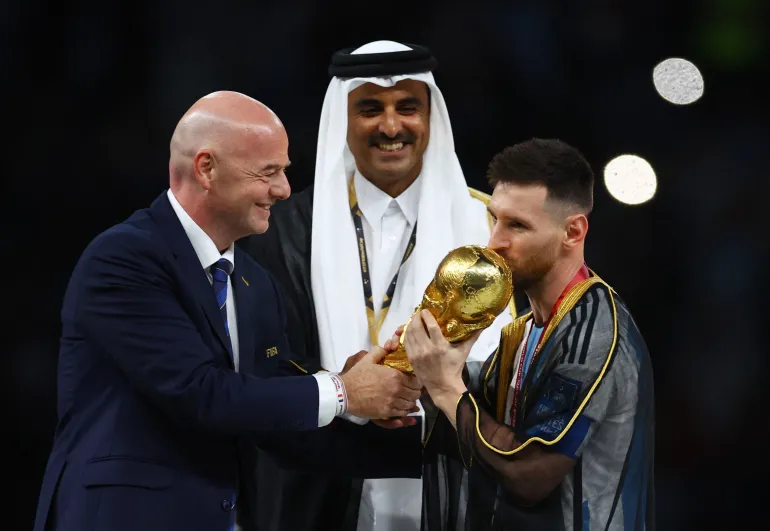
Argentina’s Lionel Messi receives the World Cup in Qatar in 2022 [Kai Pfaffenbach/Reuters]
National politics has also created resentment.
“I really don’t like Javier Milei (Argentina’s president) at all!” said Rachid Sjoberg, a 29-year-old agricultural laboratory operator in Santiago.
“The idea that he would then boast about having won the World Cup if they win does not sit well with me.”
Argentine fans and some players have also faced accusations of racism — such as a chant sung by the team in the past mocking the black players in the French team as not being really French.
There is also a long history of club-level fans throwing bananas on the field or making monkey gestures at Brazilian fans or black players.
During this World Cup, FIFA condemned racism in a statement after an Argentinian supporter told a black US influencer known as IShowSpeed to go “cry at the zoo” during a livestream.
‘We are unbearable’
Messi himself has acknowledged the strong feelings surrounding whether the team wins or loses.
“Four years ago, we achieved what we wanted: to play the final and be the best for four years. Once again, we have shown that nobody gives us anything for free, and we have put ourselves among the two best again,” he said.
“Let it hurt whoever it hurts.”
A brand of fernet, an alcoholic drink which is hugely popular in Argentina, has taken advantage of the anti-Argentine sentiment with humour.
Under the slogan “We are unbearable,” it launched an advert showing fans from different teams sitting in a therapy circle complaining about Argentina’s unbridled passion for football.
While many in Latin America are rooting against Argentina, the team has received a rapturous response at training camps in the US, with fans chanting “Messi! Messi!”
But some still embrace regional solidarity.
“I’m going to support Argentina because it’s a South American country,” said Valentino Tocto, a 20-year-old student in Lima.
A protest by India’s youth-led Cockroach Janta Party has intensified after activist Sonam Wangchuk was forcibly moved to a hospital on the 21st day of his hunger strike. Party founder Abhijeet Dipke was splashed with ink after beginning a fast in solidarity.
With the World Cup final less than 24 hours away, an unlikely factor is grabbing the attention of organisers, fans and players alike.
The lingering smoke from the Canadian wildfires sparked earlier this week has engulfed the northeastern region of the United States, raising questions about its impact on the Spain vs Argentina final in New Jersey on Sunday.
A visible haze hung over the twin World Cup host states of New York and New Jersey on Saturday, with inclement weather causing disruptions.
At one point on Friday, New York rated as the city with the worst air quality in the world.
The World Cup final between the European champions and current title holders kicks off at 3pm local time (19:00 GMT) on Sunday in East Rutherford, New Jersey.
Here’s what we know about the smoke, weather and World Cup final:
Is there a haze in New York and New Jersey before the World Cup final?
Smoke from the Canadian wildfires is hanging over the region, reducing visibility and affecting air quality in most northeastern US states.
Warnings of unhealthy air quality remained in effect across a wide area of the US east coast on Saturday.
However, experts predict conditions will improve for the big showdown in New Jersey tomorrow.
The air quality index forecast shows an improvement from unhealthy air to “moderate” air quality for sensitive groups from Saturday to Sunday in East Rutherford, which means little to no health risk for the general public on the day of the final.
How is the weather and what’s the forecast in New Jersey before the Spain vs Argentina final?
A thunderstorm passed through the area on Saturday afternoon, causing heavy rain and loud thunder at the New York New Jersey Stadium, renamed from MetLife Stadium.
State police urged people to leave the stadium seating bowl and field and take shelter. Volunteers and staff dashed inside for cover as ponchos were handed out. The sky was the same thick, soupy grey it had been for days.
New Jersey Governor Mikie Sherrill warned residents about the potential for damaging winds, tornadoes, flash flooding and large hailstones.
FIFA said it was in close contact with local authorities as it continues to monitor the impacts from the wildfire smoke and the storms on the stadium conditions for the final.
Have the weather and smoke disrupted preparations for Spain or Argentina?
Spain’s last training session ahead of the final at a nearby Melanie Lane Training Ground was suspended because of storms and lightning in the area.
The Spanish football federation (RFEF) said that was in accordance with US storm safety protocol.
“The players are currently taking part in a warm-up session indoors,” RFEF added.
FIFA said that there would not be another time slot for the team to train.
Argentina had an outdoor training session at their scheduled time of 1:30pm (17:30 GMT), with players showing no concerns about air quality or the weather.
Lionel Messi and the Argentina squad unaffected by the weather on the eve of the World Cup final, July 18, 2026. (AP Photo/Ashley Landis)
Will the wildfire smoke affect the World Cup final?
The haze will mostly clear from New Jersey just in time for the final, thanks to thunderstorms passing through the area, meteorologists say.
“This storm front will largely move the smoke out of the northeast before the final between Spain and Argentina,” said Tyler Roys, a senior meteorologist at online weather service AccuWeather.
“There could be some lingering smoke that would make things hazy, but very faint,” Roys said. “In terms of the thickest smoke, the smoke that has really been eye-popping and leads to poor air quality, that is not expected across New York City or much of the northeast.”
Jeff Berardelli, chief meteorologist and climate specialist at WFLA-TV, echoed the forecast, saying the storm front would “sweep the atmosphere clean”, leaving only a thin smoke that World Cup spectators may still smell in the air.
“It won’t be dangerous anymore,” Berardelli said. “It’s going to be dramatically better.”
Temperatures are forecast to be around 27C (80F) with light breezes and low humidity for kick off.
“You couldn’t have asked for much better weather for the World Cup,” Berardelli added.
Both experts expect the heavier smoke on Sunday to be concentrated closer to the fires, hanging over parts of the Midwest and Great Lakes region.
Berardelli said they are burning longer and faster because of climate change.
What was the last time you had trouble finding a specific picture you took three years ago? It usually takes around twenty minutes to find it on your phone, laptop, and external drive. And sometimes you cannot find something even in Dropbox, while you actually saved it there.
It is normal that nowadays people create hundreds of files every week and do not have a system to organize them. Vacation photos are on your phone, tax documents are on your computer, and important contracts are somewhere else. This costs you time and energy.
The good news is that you can change that. All you need is an adequate storage system that allows you to keep all your files in one place and access them from any of your devices.
This guide will help you implement it. Let’s get started!
Stay ahead of the geopolitical week.
MD Briefing delivers expert analysis across five global fronts — the Indo-Pacific, energy, geoeconomics, European security, and the Middle East — every Monday morning. Free.
Why Do You Need A Unified Storage System?
Before diving into the details, let us discuss why this is necessary.
If you do not have a proper system for organizing your files, you waste time trying to find them. You may also lose important memories or documents. What if your phone suddenly crashes and you do not have any backups? What if you accidentally delete an important receipt? These situations can create unnecessary stress.
However, a unified storage system solves these problems because everything is stored, backed up, and easy to find. There is also the peace of mind that comes with knowing your important files are safe.
Choose A Storage Platform That Works For You
The first step in creating a storage system is choosing a platform that suits you best.
There are several major cloud storage platforms available today, and each works differently.
Google Drive is still popular among Android phone users and people with Gmail accounts. It offers 15GB of free storage and integrates well with Google Docs, Sheets, and Photos.
Microsoft OneDrive is a good choice for people who mainly use Windows products. It also integrates well with Microsoft Office.
Apple iCloud is designed for iPhone and Mac users and includes automatic photo backups.
Proton Drive is a good choice for people who value privacy when storing personal files. It offers end-to-end encrypted cloud storage, automatic photo backups, file syncing, and secure sharing across devices.
Your choice of cloud storage depends on three things:
The devices you already use.
The amount of storage space you actually need.
How comfortable you are with the interface.
The price is not the most important factor. What matters most is choosing a service that works smoothly with your existing devices.
Create A Proper Folder Structure
This is where most people fail. They do not plan their folder structure beforehand.
Create your main folders by category instead of using dates or random names. For example:
Personal (receipts, tax documents, insurance, etc.)
Memories (photos and videos organized by year, then month)
Creative (your creative projects)
Reference (articles, manuals, and other useful resources)
Active Projects (your current projects)
Within these main folders, create subfolders whenever needed. For photos and videos, organize them by year, then by month or event, because you will usually think, “I need that photo from July 2026.“
The most important thing is consistency. Decide on your structure, write it down somewhere, and stick to it. Whenever you upload a file, think about how you would search for it six months later.
Use A Consistent Filename Convention
File names are an important part of your system, although many people underestimate them. Names like “Doc1” or “IMG_002847” do not tell you anything about the file.
Create a simple naming pattern and use it consistently. Something like 2026-07-10_VacationPhotos_Day3 works much better than Vacation3.jpg.
For documents, you can use names such as:
TaxReturn_2025_Federal
IRS_v2_FINAL_NEW
This saves a lot of time when searching because you can quickly recognize files just by reading their names. It is also helpful when thumbnails are unavailable.
Your future self will thank you for it.
Organize Your Files By Type
Although keeping everything in one place is convenient, different file types require different approaches.
For photos and videos, use the built-in automatic backup features available in most cloud storage services. Enable automatic uploads from your phone so your photos are backed up as soon as you take them.
For documents, use folders with version control. If you edit an important document, keep previous versions for several months before deleting them. Most storage services either do this automatically or allow you to restore older versions.
For miscellaneous files such as receipts, warranties, and manuals, simply create archive folders organized by year. You do not need a perfect system. Just scan or photograph them, save them as PDFs if needed, and upload them.
Set Up Automatic Syncing And Backups
The best storage system works without requiring constant attention.
When setting up your storage service, enable automatic syncing for the folders you use most often.
Turn on automatic photo and video backup on your phone.
Sync your important folders on your computer.
Let your files upload automatically whenever possible.
For additional protection, enable version history or automatic backups for important documents. Most storage services keep older versions for at least 30 days.
Consider Device Accessibility
Your storage system only works if you can access your files whenever you need them.
Take some time to install the storage app on all your devices, including your phone, tablet, computer, and backup devices. A little effort now can save you a lot of frustration later.
Most services also allow you to access your files through a web browser, even if you do not have the app installed. This can be very useful in an emergency.
Maintain Your Storage System
Creating a good storage system is only half the job. Keeping it organized requires very little effort.
Once every quarter, spend about an hour doing some basic maintenance.
Delete duplicate files.
Archive rarely used photos and documents.
Move completed projects into a dedicated folder.
Just as importantly, stay consistent. Every time you save a file, spend an extra ten seconds placing it in the correct folder with the proper filename. That is much easier than reorganizing a messy folder structure later.
Do Not Forget About Privacy And Security
While organization is important, security matters too.
Make sure you understand your storage provider’s privacy policy. Enable two-factor authentication and use a strong password. These simple steps help protect your files from unauthorized access.
If you store sensitive documents such as tax returns or bank statements, remember that no online storage solution is completely risk-free. Keeping an additional backup on an external drive at home is still a good idea.
Start Now
The hardest part of building any system is getting started.
Choose one storage service, spend about 30 minutes creating your folder structure and naming convention, and enable automatic photo backups on your phone.
That is all you need to do at first. Your storage system will continue to grow naturally as you use it. Within a couple of weeks, you will have a system that works well.
No more lost memories. Quick access to your documents. No more wondering where to save new files. A little effort today can save you a lot of time and stress later.
Mamdani had pledged to arrest Netanyahu during campaign for mayor and says he is consulting city’s legal advisers.
Published On 18 Jul 202618 Jul 2026
New York City Mayor Zohran Mamdani has said that he is consulting with city authorities over the possibility of arresting Israeli Prime Minister Benjamin Netanyahu if he visits the city for the United Nations General Assembly (UNGA) in September.
In an interview with The New York Times (NYT) released on Saturday, Mamdani reiterated his view that Netanyahu, who is the subject of an ICC arrest warrant for possible crimes against humanity in Gaza, must be brought to justice for the Israeli military’s actions in Gaza.
Recommended Stories
list of 3 itemsend of list
“I believe that Prime Minister Netanyahu belongs in the Hague,” Mamdani told The Interview, a show produced by the NYT.
“He’s a war criminal who has been charged by the International Criminal Court,” he added. “And what you will find is that is an opinion that is held by many, purely because of what his actions have wrought over these last many years.”
Mamdani, a democratic socialist who has emerged as an outspoken supporter of the Palestinian cause, pledged to arrest Netanyahu if he came to New York City during his mayoral campaign. Some questioned the feasibility of that promise.
The mayor said that he was in “active conversation” with the city’s law department about whether he has the authority to have Netanyahu arrested, should he travel to New York.
“Whatever the law allows me to do in New York City, that’s what we will do, but we won’t be writing our own laws to that end,” he said.
Asked about Mamdani’s call to have him arrested, Netanyahu told radio personality Sid Rosenberg that he thinks Mamdani secretly “hates America”.
Israel’s ambassador to the United Nations, Danny Danon, also insisted that Netanyahu will be at the UNGA meeting in New York this September, despite the threats of arrest.
During his campaign for mayor, Mamdani was the target of frequent Islamophobic vitriol and insults. Rosenberg referred to the New York mayor hopeful as a “cockroach”, before later apologising.
Mamdani’s election to mayor and his continued calls for accountability regarding Netanyahu point to a dramatic swing among Democratic voters away from Israel.
A poll in May found that nearly three-quarters of Democratic voters oppose US aid to Israel, up from 45 percent three years ago.
Nearly half of those surveyed said that their party was too supportive of Israel, whose war on Gaza has been termed a genocide by a growing number of human rights organisations, international officials, and scholars.
While that shift has yet to translate into concrete policy change at the top of the party, which includes stalwart supporters of Israel, many Democratic politicians have slowly begun to adjust their positions.
Nearly half of the Democratic members of the US House of Representatives voted to end US aid to Israel earlier this week, a measure of the shifting politics around the issue that commentators believe would have been unthinkable just several years ago.
Mojtaba Khamenei says Trump’s signature is ‘worthless’ and that ‘bullying’ is a core element of US foreign policy.
Published On 18 Jul 202618 Jul 2026
Iran’s supreme leader has warned that the United States will suffer “unforgettable lessons” at the hands of Tehran and its regional allies, accusing the US of repeatedly violating the memorandum of understanding (MoU) between the two countries.
A written statement attributed to Mojtaba Khamenei was read out on state television on Saturday, in which the supreme leader said Washington’s breaches of last month’s MoU showed that President Donald Trump’s signature was “utterly worthless and invalid”.
Recommended Stories
list of 3 itemsend of list
“The repeated breach of agreements by the Great Satan vis-a-vis the accord has once again proven to all that the signature of the President of America is now utterly worthless and invalid, and that bullying, hegemonism and savagery are inseparable components of the American creed and doctrine,” the statement read.
“Now that the American enemy is seeking to foment war and suffer heavier costs and further humiliation, it should know that the dear nation of Iran and the Resistance Front hold unforgettable lessons for it,” it added.
The US dramatically escalated its attacks on Iran this week by targeting civilian infrastructure, including bridges, railway lines and water desalination plants.
Tehran has responded by successfully striking civilian infrastructure in Kuwait, with authorities there urging everyone to ration electricity.
The US-Israeli war on Iran, which began in February, is seen as existential by the country’s senior leadership.
Tehran has shown no sign of caving to the increasing demands from the Trump administration, as regional countries continue to push for an end to the conflict behind the scenes.
Khamenei said the US has “revealed its true face,” exposing its “deceitfulness, irrationality, unreliability and wickedness”.
He called on Iranians to trust the leadership to protect the country, urging people to remain “vigilant” and “active” as the fighting grinds on.
Reports have surfaced in recent days that the Houthis in Yemen could close the Bab al-Mandeb gateway to the Red Sea in support of their crucial ally Iran. That would further destabilise global energy markets, increase inflation and apply additional pressure on Trump to halt attacks.
The war is deeply unpopular in the US and has inflicted economic harm on Americans.
The MoU mediated by Qatar and Pakistan and signed last month aimed to create the conditions to bring the war to a permanent end.
However, Tehran and Washington have since declared the accord “over” after accusing each other of violating it.
Weekly insights and analysis on the latest developments in military technology, strategy, and foreign policy.
China’s mysterious next-generation combat aircraft have dominated headlines since a pair of sixth-generation designs broke cover in late 2024. But while those aircraft understandably command attention, the single most important fighter in the People’s Liberation Army Air Force (PLAAF) is arguably the Chengdu J-20 Mighty Dragon. Not only does the J-20 offer a level of capability previously missing from the PLAAF, but it is being introduced in remarkably large numbers. This underscores China’s ability to mass produce even the most advanced weapons in its arsenal. The quantities of J-20s that are now rolling off the production line also highlight the pace of the PLAAF’s transformation and raise the question of exactly how many Mighty Dragons have already been fielded.
The appearance of new Chinese combat aircraft designs, including the J-35 medium-weight stealth fighter in both naval and land-based versions, means that the J-20 is no longer under such a high level of public scrutiny. This contrasts with the situation back in 2021, when TWZprovided a review of the program on what was then the 10th anniversary of its first flight.
A J-20 fighter performs during the Changchun Air Show on September 23, 2025 in Changchun, Jilin province of China. Photo by Zhou Guoqiang/VCG via Getty Images
At that time, we stated that the J-20 was, “without doubt, the main focus of global attention when it comes to China’s military aircraft developments. Within the People’s Republic of China, too, the jet known as the Mighty Dragon has become a totem for the country’s fast-emerging high-technology defense sector and its associated aviation industries.”
It is worth recalling that when the J-20 first appeared on the runway at Chengdu’s sprawling manufacturing plant in late 2010, the black-painted aircraft was deemed by some Western observers to be a technology demonstrator at best, not something that would end up being the country’s first stealth fighter built at scale. It is one thing to fly an impressive, hand-built experimental aircraft. It’s very much another to produce an advanced fighter reliably in large quantities, especially one that incorporates stealth technologies that are notoriously challenging to manufacture. However, after some design tweaks, the J-20’s service entry followed in late 2016, and the jet became only the third true stealthy fighter to become operational anywhere in the world.
Picture of an early J-20 prototype.
Since then, the J-20 has continued to be improved, and new variants have emerged. Perhaps the most significant development concerning the jet has been the introduction of a domestically produced powerplant to the series-built aircraft, superseding the use of previous Russian-supplied engines. A two-seat version of the aircraft has also appeared, representing a notable novelty for a fifth-generation fighter. More advanced weapons — and more of them — and enhanced avionics have also been steadily introduced.
Most important, however, has been the increased production rate of the Chengdu jet, leading to its proliferation across the units of the PLAAF.
A still from an official PLA video showing a J-20 with its novel side weapons bays open, showing two short-range PL-10 air-to-air missiles. via Chinese internet
At the end of 2019, nearly a decade after the J-20 first appeared, Western sources estimated the number of J-20s built to be around 50, a figure that likely also included pre-production machines. At the same time, unconfirmed Chinese reports suggested a production capacity of 48 aircraft annually, but there was no publicly available evidence that that figure had been attained.
By late 2022, Western defense outlets were reporting that the PLAAF had received at least 200 J-20s, a figure based primarily on a study of construction numbers seen on the jets and equating to four production batches. At the same time, more than 240 examples of the J-16 multirole fighter aircraft, a Chinese development of the two-seat Flanker family, were said to be in service, equivalent to 11 batches. Also in production, the number of J-10Cs in service was somewhat lower, but the fleet was also bolstered by older J-10A/B versions.
A YY-20 aerial tanker simultaneously refuels J-16 and J-20 fighters. via Chinese internet
In its assessment of the PLAAF modernization drive, in early 2023, the International Institute for Strategic Studies (IISS), a British think tank, was somewhat more circumspect, counting a frontline fleet of at least 150 J-20s. However, the IISS noted, the fleet was projected to outnumber the U.S. Air Force’s F-22 Raptors by the end of the same year, aided by an annual production rate that “had likely doubled” within the previous three years.
Three U.S. Air Force F-22 Raptors assigned to the 90th Fighter Squadron, Joint Base Elmendorf-Richardson, Alaska. U.S. Air Force U.S. Air Force photo by Staff Sgt. Kevin Long
As for the F-22, the U.S. Air Force currently has 185, but only 143 of the jets are combat-coded, with the rest being assigned to training and test and evaluation activities. Meanwhile, a significant portion of the overall fleet is typically down for maintenance at any given time.
A detailed analysis of the operationalized nature of the J-20 program was provided by Janes in mid-2024. This concluded that, in a period of over 11 months from July 2023, the PLAAF had inducted more than 70 J-20s, for a total of approximately 195 of the aircraft. Using satellite imagery, it was determined that, as of May 2024, the PLAAF operated 12 air brigades with J-20s, of which three brigades were fully equipped with the type. Significantly, it also confirmed that all five of the Theater Commands — joint military commands organized on a geographical basis — had inducted the J-20.
A two-seat J-20S (top), a J-20A (bottom left), and a J-20 (bottom right). via Chinese internet
Moving forward to 2025, it appeared that the J-20 production total had rapidly reached the 300 mark.
In the fall of that year, Andreas Rupprecht, a longtime Chinese military observer and contributor to this website, identified a J-20 with a serial number that indicated it was the 300th airframe, from the 10th production batch.
Meanwhile, the Royal United Services Institute (RUSI), a U.K.-based think tank, assessed that, by late 2025, production rates for the J-20 had likely reached around 120 aircraft per year, and that around 300 of the aircraft were in service across at least 13 PLAAF regiments. “The total produced is likely to be higher,” RUSI explained in a report on the subject, “since a significant number of newly produced fighters will still be awaiting delivery to units.”
Based on the trend, RUSI suggested in its report earlier this year that, by 2030, around 1,000 J-20s of all versions (plus around 900 J-16s) will be in service with the PLAAF. “There is also a noticeable trend towards heavy fighters in general, with J-16s and J-20s being used to re-equip units that previously were operating not only J-11 and Su-27/30 Flanker heavy fighters, but also some J-7 light and J-8 medium fighters,” the report added.
Rupprecht told TWZ that he is confident that, as of mid-2026, around 500 J-20s had likely been delivered. This theory is reinforced by the presence of the jets with 14 frontline PLAAF units, and with another three Flight Test and Training Bases (FTTB), which operate mixed fleets. Of the 14 frontline units, four appear to have introduced the enhanced J-20A version, replacing the initial-production J-20s.
Interestingly, among American officials, there has been some downplaying of the J-20’s capabilities vis-à-vis the U.S. military.
“It’s not anything to lose a lot of sleep over,” Pacific Air Forces (PACAF) head Gen. Kenneth Wilsbach said in 2022. “Certainly, we’re watching them closely and seeing how they field and how they operate them.” Wilsbach qualified his comments by saying that the U.S. Air Force has “had a limited opportunity to assess it [the J-20], but it seems okay.”
On the other hand, other U.S. Air Force leaders have highlighted concern over the rapidly growing PLAAF, an expansion in which the J-20 is playing a major role.
“We are the smallest and oldest that we have ever been,” Air Force Brig. Gen. Doug Wickert, head of the 412th Test Wing at Edwards Air Force Base in California, said of his service during a briefing early last year. “The PLA is the largest and most modern that it has even [sic; ever] been. That is risk. That is uncertainty.”
Brig. Gen. Doug Wickert, 412th Test Wing commander, points to an image of the B-21 Raider. U.S. Air Force
Wickert added that he predicted that, by 2027, China would have numerical superiority of approximately 12 to one in modern fighter aircraft (including five to three in fifth-generation aircraft) in relation to U.S. assets stationed west of the international dateline.
At the same time, we don’t know how many J-20s Beijing intends to buy. As well as its continued development, much will depend on plans for the land-based J-35, which could potentially offer a cheaper alternative for some mission sets. Beyond that, there are at least two sixth-generation crewed combat aircraft designs and various collaborative combat aircraft (CCAs) and uncrewed combat air vehicles (UCAVs) that will need to be factored into the future force structure.
Undoubtedly, the J-20 has faced challenges, too, but it has matured from a prototype that some were quick to dismiss into the backbone of China’s premier air arm. Its continued evolution in terms of engines, avionics, weapons, and variants is important, but the most important development may simply be the rate at which China is able to build it.
In the same way that technologies and tactics developed alongside the J-20 will find their way into China’s next generation of combat aircraft, these will also be able to leverage the advances in production output. China has proven to be remarkably capable of punching out large numbers of advanced fighters, so these new aircraft could hit flightlines in greater quantities faster than some may expect, once they are developmentally mature enough to enter production. Moreover, Chengdu’s serial-manufacturing abilities underscore the wider degree to which China can churn out its most advanced weapons, of all kinds, which is historically a hugely challenging endeavor.
A head-on view of the new-generation Chinese combat aircraft known as the J-36. via Chinese internet Chinese internet via X
In military terms, quantity has a quality all on its own, and if current production estimates are even broadly accurate, the J-20 program has entered a phase where manufacturing capacity is just as strategically significant as the fighter’s stealth and performance.









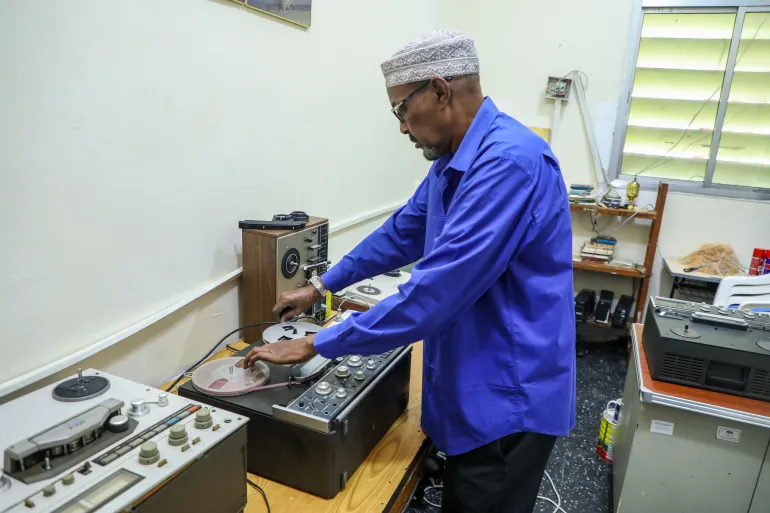
![Abdiqadir Geedi Robleh cues up a tape, ready to hear a recording for the first time in years. [Abdimajid Abdillahi Farah/Al Jazeera]](https://i0.wp.com/occasionaldigest.com/wp-content/uploads/2026/07/2F3A0163-1783253287.jpg?w=640&ssl=1)
![Thousands of tapes fill the shelves of Radio Mogadishu's archive, holding decades of Somali history. [Abdimajid Abdillahi Farah/Al Jazeera]](https://i0.wp.com/occasionaldigest.com/wp-content/uploads/2026/07/2F3A0155-1783253271.jpg?w=640&ssl=1)
![An old reel-to-reel machine used to play and digitise tapes at Radio Mogadishu's archive in Mogadishu. [Abdimajid Abdillahi Farah/Al Jazeera]](https://i0.wp.com/occasionaldigest.com/wp-content/uploads/2026/07/2F3A0085-1783253236.jpg?w=640&ssl=1)
![Robleh points to the label on a tape of a love song recorded at Radio Mogadishu in 1974. [Abdimajid Abdillahi Farah/Al Jazeera]](https://i0.wp.com/occasionaldigest.com/wp-content/uploads/2026/07/2F3A0122-1783253259.jpg?w=640&ssl=1)
![After seizing power in a 1969 coup, Major General Mohamed Siad Barre used Radio Mogadishu as a key instrument for disseminating his regime's messages. [Abdimajid Abdillahi Farah/Al Jazeera]](https://i0.wp.com/occasionaldigest.com/wp-content/uploads/2026/07/2F3A0132-1783255045.jpg?w=640&ssl=1)
![Portraits of Somalia's presidents line a wall at Radio Mogadishu. [Abdimajid Abdillahi Farah/Al Jazeera]](https://i0.wp.com/occasionaldigest.com/wp-content/uploads/2026/07/2F3A0102-1783253246.jpg?w=640&ssl=1)
![The entrance to Radio Mogadishu's studios. [Abdimajid Abdillahi Farah/Al Jazeera]](https://i0.wp.com/occasionaldigest.com/wp-content/uploads/2026/07/2F3A0182-1783253368.jpg?w=640&ssl=1)