50,000 frontline staff to receive a jab for a different Ebola strain, with 20,000 enrolled in a one-year clinical trial.
Published On 20 Sep 202620 Sep 2026
Health workers in parts of the Democratic Republic of the Congo (DRC) have begun to receive a vaccine that many hope will provide a level of protection against the Ebola virus.
The vaccine rollout started on Saturday in Bunia, the capital of Ituri province in the northeastern DRC. Ituri is the epicentre of the fastest-growing outbreak of Ebola in history.
Recommended Stories
list of 3 itemsend of list
The provincial governor, Major-General Gaby Kasongo Mulumba, said health workers there “are particularly exposed and deeply involved in the response”.
The operation, backed by the World Health Organization and Doctors Without Borders, known by its French initials MSF, will also target North Kivu, where cases have been rising sharply, health authorities said.
Some 50,000 health and other frontline workers will be injected with the Ervebo vaccine, which was developed for use against the more common Zaire strain.
Its effectiveness against the current Ebola strain caused by the Bundibugyo virus will be monitored in 20,000 recipients for up to one year.
Clinical trials are ongoing to find a licensed vaccine for the latest outbreak, which has no licensed vaccine or proven treatment.
“We don’t know to what degree it might be effective against the Bundibugyo strain,” Steve Ahuka, a Congolese official who is part of the health task force against the Ebola outbreak, said.
Dr Jeannot Elua said at a health facility in Bunia the vaccine was “beneficial”.
“We healthcare workers don’t really have a choice. We are going to receive it,” he told the Associated Press news agency. “Some people here had already received the previous vaccine. I received it myself, because it was mandatory.”
WHO experts have said that early data on the Ervebo vaccine, notably from animal trials, suggested it could offer some protection in the current outbreak.
The virus has killed at least 3,639 and infected some 7,541 people since May. Some 1,823 people have recovered, according to the latest figures from local authorities.
Workers at the Ceca-20 cemetery in Mongbwalu, Ituri province, Democratic Republic of the Congo, on July 14, 2026, as aid agencies intensify efforts to contain an Ebola outbreak caused by the Bundibugyo virus [File: Gradel Muyisa Mumbere/Reuters]
The WHO said in August that 70,000 doses of Ervebo were approved for use in the DRC.
The vaccine is being used under a compassionate-use programme, which allows a medical product to be used in a serious disease situation even though it has not been specifically approved for that particular use.
While WHO officials have cited “encouraging signs” that transmission may be slowing, MSF warned on Friday that there is no clear evidence the epidemic is coming under control.
Trump has wanted a foothold in Greenland for some time, as a strategic battle unfolds for supremacy in a warming Arctic.
Published On 19 Sep 202619 Sep 2026
Denmark has hailed a “binding” deal by United States President Donald Trump to give Washington “permanent control” over Greenland’s security and bar Russian and Chinese military bases from the Arctic territory.
But Denmark and Greenland – an autonomous Danish territory – said on Saturday that any deal with the US would not compromise Greenland’s sovereignty, and the two countries would sign the agreement next week at the United Nations General Assembly in New York.
Recommended Stories
list of 4 itemsend of list
“A long period of uncertainty will hopefully be replaced by a binding agreement that strengthens security in the Arctic and North Atlantic, and thereby our shared security within NATO and Europe – while respecting the [Danish] Kingdom’s red lines,” Danish Foreign Minister Lars Lokke Rasmussen said in a social media post.
Since returning to the White House in January 2025, Trump has repeatedly insisted that Washington needed to control Greenland for strategic reasons, alarming NATO ally Denmark and sparking fierce pushback from the alliance.
Key details of the agreement have not been made public, including the scale of the US military presence in the self-governing Danish territory and whether any formal power over foreign policy and resources would be ceded to Washington.
Greenland’s Prime Minister Jens-Frederik Nielsen said the agreement “recognises Greenland’s interests” and is “to the benefit of us all”.
Denmark’s Prime Minister Mette Frederiksen said it is “great for NATO and Europe”, as it “strengthens our common security in the Arctic and the North Atlantic Area”.
‘I have mixed feelings’
But in Greenland’s capital Nuuk, residents had mixed feelings.
“I don’t know exactly what the agreement is or what has been signed. But whenever the US and Trump are mentioned, I have mixed feelings. I’m not entirely comfortable with how much attention Greenland has right now,” Soren Kreutzmann, a 29-year-old hairdresser, told the AFP news agency.
“We hope the leaders have made a good agreement, because our country needs to be protected, both from the air and sea. Denmark had not given that enough attention for many years,” said Bibbi Kleist Jepsen, a 64-year-old educator.
Trump, who had previously said the US needs “ownership” of Greenland, announced that Washington would immediately start building up a large military presence in the territory.
“From now on, no US adversary can EVER have a base in Greenland, have a military presence in Greenland, or make sensitive investments in Greenland, without our express written approval”, he said.
Trump has repeatedly warned of Russia and China trying to establish a foothold in Greenland as a strategic battle unfolds for supremacy in the warming Arctic region. The State Department left no doubt that they would not be allowed to do so.
“This agreement guarantees that China and Russia cannot have a base in Greenland, they cannot send troops to Greenland and the necessary mechanisms are in place to prevent investment in sensitive sectors,” a State Department official said.
Fidan highlights Turkiye’s readiness to assist Saudi Arabia militarily, as Houthi attacks escalate in Yemen.
Published On 19 Sep 202619 Sep 2026
Turkish Foreign Minister Hakan Fidan has said that Saudi Arabia may have unmet military needs from the attacks by Yemen’s Houthi rebels and that Turkiye would consider how to support the kingdom as part of a trilateral defence pact.
Speaking to Turkish broadcaster NTV on Friday, Fidan said it was unacceptable for Saudi Arabia to be dragged into the US-Iran war, adding that Riyadh had no desire to join the conflict.
Recommended Stories
list of 3 itemsend of list
He added that proposals had been conveyed to all sides in an effort to end the fighting, without further elaborating.
The Iran-backed Houthi rebels and Saudi Arabia continue trading attacks in an escalating war in Yemen, as the Houthis press gains that have brought large stretches of the Red Sea coast, including the strategic Bab al-Mandeb Strait, under their control.
Pakistan has made a similar pledge to defend Saudi Arabia under the defence pact.
Lieutenant-General Ahmed Sharif Chaudhry, a spokesperson for Pakistan’s military, told Arab News on Thursday that Islamabad would defend Saudi Arabia “to any extent”, including “physically”, though he did not say whether Riyadh had asked for more Pakistani troops.
Pakistan’s Foreign Office has said no military response is currently under discussion under the pact, adding that Islamabad would act “when time comes”.
The trilateral agreement, known as the Mecca Joint Defence Agreement, was signed on August 7 in Mecca by Saudi Crown Prince Mohammed bin Salman, Turkish President Recep Tayyip Erdogan and Pakistani Prime Minister Shehbaz Sharif.
The three countries formally named the arrangement the Mecca Defence Alliance on August 31, after officials meeting in Istanbul agreed to set up a secretariat in Riyadh, to be headed initially by a Pakistani secretary-general.
Its founding principle is that an armed attack against any one of the three states will be treated as an attack against all three.
Fidan said at the time the alliance was built on “respecting the sovereignty of other states, territorial integrity and not intervening in internal affairs”, and remained open to other countries joining.
Analysts have questioned how much substance lies behind the pact so far, noting it lacks the integrated command structure and standing forces that underpin NATO.
Its institutional shape, including how the mutual defence clause would actually be triggered, remains unclear.
The trilateral pact was struck as Gulf states grow increasingly concerned about being pulled into the wider US-Iran war, which has continued for more than six months since Washington and Israel first struck Iran in February.
This was the first time an alert was sounded in Riyadh since an escalation between the Houthis in Yemen and the Saudis.
Published On 19 Sep 202619 Sep 2026
Saudi-led coalition forces fighting Yemen’s Houthis have said that the Iran-backed group fired a ballistic missile at Riyadh at dawn before it was intercepted and destroyed.
“The Houthis also attempted to target civilians and civilian infrastructure in Bisha, Taif, Farasan and Yanbu,” coalition forces spokesman Major-General Turki al-Maliki wrote on X on Saturday, adding that the attacks were thwarted by the Gulf monarchy’s air defences.
Recommended Stories
list of 4 itemsend of list
Saudi Arabia warned of a “hostile aerial threat” and issued a string of emergency alerts across the kingdom overnight on Friday.
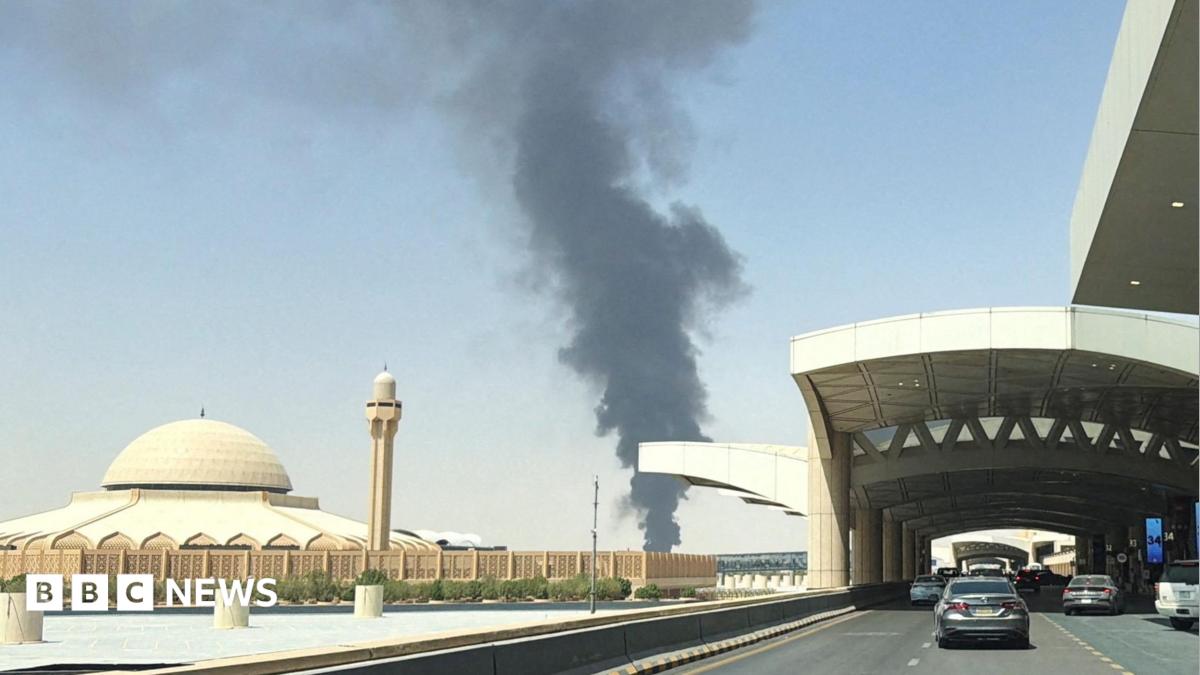
On Saturday, at least one explosion was heard in Riyadh, with residents near the airport saying they saw a large plume of black smoke later in the morning. Saudi authorities reported no casualties or damage.
The Saudi spokesman said that the Houthis are escalating their attempts to target civilians and civilian infrastructure in the capital. He also affirmed the coalition command’s right to take “appropriate” action to deter the Houthis, in accordance with international humanitarian law.
Earlier on Saturday, Houthi fighters in Yemen said they attacked “sensitive” sites in Riyadh as well as an Aramco oil facility in the western coastal city of Yanbu, according to a statement shared by Houthi military spokesman Yahya Saree.
Saree said the Houthis attacked Saudi Arabia with cruise and ballistic missiles as well as drones.
“You could see that the Houthis are determining the timelines and the levels of the escalation,” Yasmeen al-Eryani, executive director for knowledge production at the Sana’a Center think tank, told Al Jazeera. “So, depending on the current situation, it seems that the Houthis are the ones in control,” she added.
Meanwhile, on the ground in Yemen, the armed forces of the Saudi-backed internationally recognised government said their fighters thwarted a Houthi infiltration attempt in the al-Fuliahan sector in southern Marib on Saturday, killing 12 Houthi fighters and injuring others.
The army also said 13 Yemeni soldiers were killed in two days of clashes with Houthi forces in the southwestern provinces of Taiz and Lahj.
Renewed clashes are taking place in Yemen’s Marib, Taiz, Lahj, al-Jawf and al-Bayda as part of a military escalation that began in early July – the most intense since the relative calm following an April 2022 truce.
Al-Eryani told Al Jazeera that military options against the Houthis are currently limited because much of the fighting is taking place in mountainous terrain that is difficult for opposing forces to access and hold.
For now, she said, containing the group may be a more realistic option than defeating it militarily. “Without controlling the peaks that are parallel to the coast, you will not be able to control the coast,” said al-Eryani.
US Secretary of Defence Pete Hegseth has kicked off his ‘Send Me Tour’ in Texas, invoking the biblical words, “Whom shall I send?”, a reference to Isaiah’s declaration, “Here am I. Send me.” The military outreach comes as Hegseth’s net favourability fell to a record low of -24 points amid growing public frustration over the Iran war.
Hair stylist to the stars Chris Appleton and Amy Dowden
Australian singer and actress Delta Goodrem and Kai Widdrington
DJ and social media personality Cach Mercer and Maddie Ingoldsby
TV and radio presenter Will Best and Dianne Buswell
Paralympian Dame Sarah Storey and Julian Caillon
Actress Jaime Winstone and Carlos Gu
TV and stage actress Bethany Antonia and Nancy Xu
Former England footballer Shaun Wright-Phillips and Alexis Warr
Presenter and author Graeme Hall and Lauren Oakley
Actor Lawrence Robb and Jowita Przystał
Skeleton athlete Tabby Stoecker and Mark Karmalita
YouTuber John Nellis and Katya Jones
TV and stage actress Melanie Walters and Aljaž Škorjanec
One pair who won’t need to get to know each other are reality TV star Dani Dyer and Nikita Kuzmin.
Dyer is back to compete for a second time, having withdrawn from last year’s series due to a fractured ankle.
“I’m just over the moon. I’m so, so happy,” she said after the pairing, while Kuzmin added that he had “tears of joy” in his eyes.
Meanwhile, actress Bethany Antonia and professional Nancy Xu became the third two-woman couple to compete in the show.
In a poignant moment, Antonia revealed that watching boxer Nicola Adams and Katya Jones performing together in Strictly’s 2020 series was a “big part of my coming out journey”.
Among the other pairings were EastEnders actress Lacey Turner and Vito Coppola, former Paralympian Dame Sarah Storey and Julian Caillon, and Shaun Wright-Phillips and Alexis Warr.
Also back on the dancefloor for a final spin was reigning Strictly champion, former Lionness Karen Carney.
Clad in the same diamante-encrusted football shirt, Carney recreated the Jive that first marked her out as a contender of her series, alongside dance partner Carlos Gu.
“I absolutely feel like I’m at home,” Carney told Willis after the routine, as she paid tribute to her pro partner.
In 13 weeks time, she’ll have to surrender that glitterball trophy to a new victor.
Whether it’s a brush fire, a mass shooting, a car chase or the aftermath of a major storm, viewers in Los Angeles are used to getting the news from above.
Television news helicopter coverage has become one of the most important elements of any local newscast, with the high-flying helicopters roaring overhead a common fixture of breaking news scenes.
These images are so ubiquitous, it’s easy to take them for granted, until Tuesday, when an NBC4 helicopter carrying reporter Eliana Moreno and pilot George Marciniw crashed while covering breaking news in Chatsworth. Both died, along with a bystander on the ground.
Pilots describe a high-stakes race in the skies of Los Angeles, with the TV stations battling to get breaking news on the air first. The air space easily becomes crowded and in the case of moving stories like car chases, a bit unpredictable and chaotic. The crews who take to the air in Los Angeles must not only navigate each other, but air traffic to three regional airports and smaller, local air strips across the Southland when doing their job.
They say safety is always the top priority and that everyone in the air works together to avoid problems.
The NBC4 crash marks the most serious incident involving an L.A. news chopper crew since 2000, when a Fox 11 helicopter covering the Academy Awards crashed and burst into flames at Van Nuys Airport.
Nationally, National Transportation Safety Board data show that 16 people have died in eight fatal crashes involving news helicopters in the United States since 2000. A cause of Tuesday’s crash has not been determined, but some experts have said they believe mechanical failure might be the cause.
“It crushed us all,” said Tim Lynn, a now-retired helicopter pilot and reporter who flew for 16 years for KTLA-TV. Lynn worked with Moreno and knew how much she cherished her job.
“She loved the job so much that she put her all into it,” he said.
Camaraderie, competition in the air
For all the camaraderie in the air, there is also some competition.
Stations want to be first to get to the scene of breaking news.
Kurt Deetz, a former news helicopter pilot who retired five years ago, said it’s a difficult business to be in.
“It’s very competitive, and at what cost?” Deetz said.
News pilots tend to have plenty of experience, former pilots said, and dangerous incidents are rare. But Deetz said pilots are pushed to be out in the air first, get to the scene, and remain on scene for extended periods of time.
“If you can be the first on the scene, you’re a hero,” Deetz said. “I think about that now and think, that is so dumb.”
Deetz started his career with KMEX in 1995, and worked for nearly every station in the area while working with Helinet, he said.
In the sky, reporters and pilots keep an eye out for one another, warning when one is drifting too close to another or if there is something else to keep an eye on.
“We all know each other,” Lynn said. “Maybe we never met, but we’ve all talked on the radio and know the names.”
There are unspoken rules that news helicopter pilots learn once they join, Lynn said.
During a police chase, for example, the first helicopter on the scene immediately takes the front position left of the fleeing vehicle, he said. The next helicopter takes a position behind that helicopter. The third helicopter takes a spot in the front right side of the chase, and the fourth sits behind it. All four maintain those spots throughout the chase, regardless of the turns and twists throughout the area.
And when the pursued begins to circle a residential area — a common occurrence during police pursuits — all news helicopters are expected to stop and hover in place, even if their shots are temporarily blocked by trees and buildings.
That’s because the tight turns and circles could result in a crash if all helicopters remain in pursuit.
“You never move unless you say something,” Lynn said. “It’s a well-coordinated operation.”
Lynn remembers at least once when a new pilot joined in a pursuit.
“We were all stopped and he’s just chasing the guy like he’s the police,” Lynn said.
Lynn got on the radio and, as the other three choppers kept their position, Lynn asked him to stick to “one of the corners.”
“That was a learning curve for that guy,” Lynn said.
But Lynn said there’s respect for new staff and veterans in the field. Regardless of what station they work for, reporters and pilots are constantly helping each other, abiding by unspoken rules to keep each other safe.
‘A dangerous place to be’
There is one maneuver that pilots say brings them particular anxiety.
Jack Cress, a former helicopter pilot for the U.S. Marine Corps and a helicopter accident investigation instructor for USC’s Aviation Safety and Security Program, said news helicopters will often spend time hovering over an incident, sometimes at a low altitude.
“That is a dangerous place to be,” Cress said.
For Deetz, he said he’d often say that he wouldn’t hover low for extended periods of time, especially if he didn’t see a place he could land in case of an emergency.
“You set up, get your shot, and then you move on,” he said. “I made a point of saying, ‘I’m not going to hover here for hours.’ ”
He knows the practice is still popular among current pilots, which he thinks needs to be rethought.
“In this day and age, there’s no need to hover,” he said. “Those cameras are so powerful. There’s no need to be so low.”
Helicopter pilots are trained to stay away from those conditions because, in case of trouble like engine failure, the lack of altitude and forward momentum gives the pilot little recourse. If the engine were to fail, for example, a pilot can sometimes perform an “autorotation” procedure to use altitude and forward momentum to force the rotors to turn, easing their descent.
The procedure is one that Lynn is familiar with. In 2012, Lynn was covering an incident in Hollywood for KTLA when his helicopter started to smoke heavily. He had no idea until one of the other choppers radioed him to tell him.
“As soon as I turn it, he said, ‘You need to put it on the ground now,’ ” Lynn said.
Lynn headed down and started getting the helicopter ready for an autorotation, as heavy smoke started to shoot from the engine. Lynn looked toward the ground and was eyeing Highland or Los Feliz for a makeshift landing spot. He gripped the controls and expected the engine to give out at any second, until he spotted a parking lot. He watched for the wires, watched for the trees and set it down. The motor never gave out.
Pilots will constantly eye one another in the formation.
News helicopter pilots will normally stay around 1,200 to 1,500 feet above the ground, Lynn said. That is to stay above police helicopters, under commercial flights, and still have enough space in case they need to perform an emergency autorotation procedure.
For the record:
1:38 p.m. Sept. 19, 2026An earlier version of this article stated KCAL’s helicopter is owned by Angel City Air. It is owned by Helicopters Inc.
Although news helicopters are touted as a cornerstone of local news broadcasts, the aircraft are owned and operated by third-party companies. KTLA and NBC4’s helicopters, for example, are owned and operated by Angel City Air, part of Welk Aviation. ABC 7’s helicopter is operated by Helinet, and KCAL’s helicopter is owned by Helicopters Inc.
Many of them are flying the same kind of helicopter that crashed Tuesday, the AS350 B2, which aviation experts said is a popular helicopter for news stations and police departments.
Deetz said he flew that helicopter for his entire career in news, and never once had a dangerous mechanical issue.
‘We all know each other’
It took minutes for word of the NBC4 crash to spread across the world of Los Angeles news chopper pilots and journalists.
“I immediately wondered who. We all know each other,” Lynn said.
One of Lynn’s former colleagues told him they saw a tail rotor on the ground, and Lynn quickly learned it was Moreno and Marciniw who were onboard.
A former police pilot for Huntington Beach and a retired news helicopter pilot after 16 years, Lynn said pilots have established rules in the air to keep each other safe.
He and others have shared several of those rules for new pilots and reporters who joined the business over the years, including Moreno, whom Lynn said he helped train when she first joined Angel City Air as a reporter.
Lynn remembers when she joined the company, he said. She picked up quickly on the equipment she had to use and eagerly sought advice to get better at the job.
The National Transportation Safety Board, which is investigating the crash, is expected to release a preliminary report on the incident in the coming days. A complete report on the incident is expected to take up to 18 months to be completed.
Deir el-Balah, Gaza – A handful of electronic components, a few wires and a basic programmable circuit board are enough to bring a group of curious children around a table in central Gaza to learn about robotics.
Students at The Next Gen Team: Rising Robotics Engineer Project in Deir el-Balah learn how to integrate sensors into alarm systems, study robotics, understand how motors and drive units work, as well as get firsthand experience with programming.
Recommended Stories
list of 4 itemsend of list
The children’s research could save lives in the future. The robotics and early warning systems they are working on could make way for bigger developments such as early detection of gas leaks and fires or help rescue workers access hard-to-reach areas, such as victims trapped under rubble.
Today’s lesson will also teach students the sciences of the future and help them keep pace with technological advancements happening outside Gaza’s borders.
Before the war, students had access to schools, universities, incubators and training programmes to pursue an interest in technology.
With much of that infrastructure now destroyed or damaged during Israel’s genocidal war on Gaza, there are few places and tools for students to work with.
But their interest in robotics and will to learn are helping them maintain their skills and ambitions for the future, something they hope will be of benefit when the bombs stop falling on Gaza.
Hamza al-Atrash, 16, is a student taking part in the “Next Gen” project and learning how electronic components can be used to develop robots and early-warning systems. To do this, he is using an Arduino controller – a programmable circuit board which connects sensors – and some other electronics.
Students work with what they have, but a shortage of equipment and electricity outages make studying a challenge.
A view of a technology incubator in Gaza before the war, where students received training in technology and innovation [Iyad Al-Qatrawi/Al Jazeera]
“We have capabilities and aspirations that we want to develop, and we try to take advantage of every available opportunity for learning and training,” Hamza tells Al Jazeera.
Hamza hopes the skills that he and his cohort learn in class will benefit his community and provide new opportunities for young people in Gaza.
“The lack of devices and equipment doesn’t mean we’ll stop. It pushes us to look for solutions and make the most of the simple tools we have,” he said.
The challenges facing these students are part of a wider disruption to Gaza’s technology and innovation sector.
Before the war, Gaza had several incubators that supported technology projects and startups. Bahaa al-Masri, head of the training team for the Early Warning Systems and Robotics Project, said it provided a rare bit of hope for children and young adults in the besieged enclave.
“These incubators provided an environment for training and development. They helped innovators and entrepreneurs turn their ideas and projects into prototypes and ventures,” he told Al Jazeera.
The war severely damaged this ecosystem: training spaces were lost, equipment difficult to find, and students and innovators left with limited opportunities to experiment and develop their ideas.
A view of a technology incubator in Gaza prior to the war, which provided an environment for training, incubating tech projects, and supporting students in the fields of technology and innovation [Iyad Al-Qatrawi/Al Jazeera]
Although challenges remain, the trainers are continuing their mission of educating budding tech experts in Gaza.
“We have a generation of students who possess genuine passion and talent in technology and digital systems,” he told Al Jazeera. “They need the environment and tools to develop these abilities and turn their ideas into projects that can serve their community and their future.”
Education pays the price
The near-collapse of Gaza’s technology sector has coincided with the widespread destruction of the education system, with schools, universities and research facilities repeatedly targeted by Israel during the war.
Preliminary estimates from the Government Media Office in Gaza put direct losses to the education sector at approximately $4bn. Seventeen higher education institutions have been completely or partially destroyed since October 2023, preventing about 620,000 high school students and 90,000 university students from continuing their education.
Approximately 20,228 students and 830 teachers and educational staff have also been killed, along with 194 scientists, academics and researchers.
For students seeking to enter technical fields, the loss of such educational facilities and teachers means fewer opportunities to gain practical experience and hone their skills.
Before the war, the IT industry was one of the promising sectors of Gaza’s economy and a rare source of foreign income, said Ahmad Abu Qamar, an economic affairs specialist and board member of the Palestinian Economists Syndicate.
It was also an opportunity for employment for thousands of university graduates entering a job market with high unemployment, with roughly 80 percent of its economic activities directed towards foreign markets.
Abu Qamar estimates that the IT sector now runs at less than 25 percent of pre-war levels, while more than 70 percent of IT companies in Gaza have completely or partially halted operations.
But even if a company’s offices or equipment survived the war on Gaza, damage to digital infrastructure has also made it difficult for companies to continue functioning.
Prices of some technical equipment – including computers, mobile devices, servers, routers, fibre-optic lines, and cabling – used in the industry have increased by more than 600 percent due to the difficulties of importing devices during Israel’s ongoing siege on the enclave.
According to his estimates, about 30,000 IT professionals have lost their jobs since the war began. General unemployment is at nearly 80 percent and poverty at more than 90 percent in the enclave.
UCAS Technology Incubator, one of the most prominent incubators of the University College of Applied Sciences in Gaza, was destroyed during the war, as part of extensive damage to the institutions and structure of the technology and digitisation sector in the Strip [Iyad Al-Qatrawi/Al Jazeera]
Brain drain
A severe shortage of vital IT equipment – such as storage devices, routers, and laptops – has been compounded by the destruction of supporting internet and electricity infrastructure, including primary and secondary networks, according to technology and digital economy expert Abdullah Altahrawi with the UCAS Technology Incubator. This makes the task of rebuilding Gaza’s IT sector an even bigger challenge than before the war, particularly with Israel’s more crippling siege on Gaza.
“The repercussions have extended to dealings with foreign markets, including the purchase of servers and electronic services, the management of digital accounts, the use of cards and e-commerce,” Altahrawi said.
Before the war, Gaza’s five main incubators provided training, mentoring, workspaces and support for tech startups. Perhaps most crucially, it also gave students a place to develop their skills, connect with foreign markets, and find job opportunities.
Just two incubators – the UCAS Technology Incubator, affiliated with the University College of Applied Sciences, and the Ma’an Center for Innovation and Entrepreneurship Incubator, have resumed operations since the October 2025 ceasefire. But their capacity has not managed to exceed 20 percent of pre-2023 levels.
Due to the damage caused by three years of Israeli bombing and a shortage of real estate, just 1 percent of technology companies now have offices, while only 10 percent of business incubators have an operational office space.
Companies looking to rebuild and universities ready to teach a new cohort of tech students have also been hit by a brain drain in the sector, severely hindering development and innovation.
“More than 80 percent of highly skilled and experienced professionals in the technology and digital fields have left the Gaza Strip,” Altahrawi said. “Gaza’s future is inseparable from its ability to restore and develop its technology sector.”
Awareness of environmentally friendly construction methods is increasing in Austria, which is reflected in the growing interest in sustainable garden sheds. The term “gartenhütte” refers to a garden hut or shed, typically a small structure used for storage, hobbies, relaxation or other activities in the garden. This development comes not only from ecological considerations but also from the desire for more durable, affordable and comfortable structures that complement outdoor spaces. The key lies in choosing the right materials, improving energy efficiency and integrating the structure into natural cycles.
What makes a garden shed sustainable?
A sustainable garden shed incorporates an overall approach in which materials are not the only consideration. It takes into account the entire life cycle of the structure, from the extraction of raw materials through to disposal or reuse. Key criteria include reducing the ecological footprint, maximizing resource efficiency, and ensuring the health and comfort of users.
Material selection: Preference is given to renewable, recycled or locally available raw materials.
Energy efficiency: Optimal insulation and passive solar energy use minimize energy consumption.
Durability: Robust construction and weather-resistant materials ensure a long service life.
Recyclability: Materials should be easily reused or recycled at the end of their life cycle.
Materials for sustainable garden sheds
A garden shed’s sustainability depends on the materials you choose for it. When building a garden shed, it is best to use locally sourced wood, recycled building materials, and natural insulation materials. Such materials can conserve resources, while shorter transport distances can help reduce the environmental impact of material delivery and contribute to a healthy indoor climate.
Native woods: Larch, spruce, and Douglas fir are particularly suitable due to their availability and weather resistance.
Recycled and reused building materials: Used bricks, windows or doors can significantly reduce the consumption of primary raw materials.
Natural insulation materials: Hemp, sheep’s wool, and wood fiber offer good insulating properties and can be environmentally friendly. Cellulose flakes, at approximately €9–17/m², can be a relatively affordable eco-friendly insulation option.
Ecological surface treatments: Non-toxic, water-based oils, varnishes, and paints protect the wood and are harmless to health.
Austrian municipalities and sustainable construction
Green building methods and sustainable garden projects are increasingly being considered by Austrian municipalities as part of broader efforts related to climate protection and local economic development. This can include funding programs for natural garden design and community gardens.
Stay ahead of the geopolitical week.
MD Briefing delivers expert analysis across five global fronts — the Indo-Pacific, energy, geoeconomics, European security, and the Middle East — every Monday morning. Free.
Funding programs: Some Austrian regions and municipalities offer funding or incentives for environmentally friendly garden and landscaping projects.
Local economic development: By prioritizing regional materials and craftspeople, municipalities and garden owners can support local businesses and help keep economic activity in the region.
Climate adaptation: De-sealing and greening projects can contribute to improving the local microclimate and may complement sustainable garden design.
The 3-pillar model of the sustainable garden shed
The implementation of a truly sustainable garden shed in Austria can be guided by a three-pillar model. The framework considers environmental, economic and social perspectives as part of an integrated approach to planning and implementation. Rather than focusing on a single aspect, it considers how different elements of sustainability can work together.
Material chain: Prioritizing regional sourcing. This pillar focuses on minimizing transport distances and supporting local forestry, sawmills and other suppliers. The use of locally sourced timber and other building materials can help reduce the environmental impact associated with transportation and support regional businesses.
Life cycle costs: Considering long-term economic viability. Through intelligent planning, high-quality insulation with materials such as cellulose or wood fiber, and the use of passive solar energy, operating costs can potentially be reduced. Considering both initial costs and long-term operating expenses can help building owners make environmentally and economically responsible choices.
Community benefit: Supporting local craft businesses. This pillar emphasizes the social aspect of sustainability. Collaboration with local carpenters, joiners, and other craftspeople can support regional businesses while fostering traditional craftsmanship and the transmission of expertise. Choosing local suppliers and craftspeople can therefore be part of a broader approach to sustainable development.
Conclusion: Sustainable garden sheds as a future solution
A sustainable garden shed is not just a building but a statement of a future-oriented and environmentally conscious lifestyle in Austria. By consistently applying environmentally friendly construction methods, garden owners can contribute to climate protection and biodiversity.
The trend is clearly toward durable, energy-efficient and resource-saving solutions that make sense both environmentally and economically. Using the right methods and materials, together with any available local incentives, can help make a sustainable garden shed a worthwhile long-term investment.
Iran-backed Houthi militants in Yemen say they carried out drone and ballistic missile attacks on the Saudi capital Riyadh, as well as energy sites on the country’s Red Sea coast.
Saudi authorities said they intercepted and destroyed a ballistic missile fired at Riyadh earlier that day, without confirming any further strikes or causalities.
Earlier, a column of black smoke was seen rising from fuel tanks near the Saudi capital’s international airport, where flights were disrupted temporarily on Saturday.
Air raid alerts had sounded in the capital for the first time since the Iran-backed Houthis increased their attacks on Saudi Arabia in July.
Air defences also stopped “hostile attempts to target civilians” in the cities of Bish, Taif, Farasan and Yanbu, an official spokesperson for the Saudi-led coalition said in a statement.
In a statement posted online, Houthi military spokesman Yahya al-Sarea said a “large number of ballistic and cruise missiles and drones” had been used to attack “sensitive sites” in Riyadh and Aramco state oil and gas company facilities in Yanbu on the coast.
He added that the attacks were “in response to the Saudi enemy’s criminal attempts” to target the Yemeni capital Sanaa.
Earlier, Sarea had accused Saudi Arabia of carrying out 300 strikes across Yemen during the past week.
The Houthis are locked in a civil war with Yemen’s internationally recognised government, which is backed by Saudi Arabia.
They have attacked targets inside Saudi Arabia on several occasions in recent months, and said this week that they were responsible for downing a Saudi fighter jet over Yemen.
According to an unconfirmed report from AFP news agency, quoting military sources on both sides of Yemen’s civil war, fighting between the Houthis and Saudi-backed government forces claimed 48 lives on Saturday.
The Houthis said 31 of their fighters had been killed while government sources said their side had lost 17 soldiers, according to the news agency.
Justice minister condemns ‘Hitler salutes, antisemitic slogans, violence’ at the anti-immigration rally.
Published On 19 Sep 202619 Sep 2026
Dutch riot police have intervened at a protest against immigration and asylum policies after about 500 far-right demonstrators pelted them with projectiles and fireworks .
Police used baton charges and dogs to break up the demonstration in The Hague on Saturday, reported the AFP news agency.
Recommended Stories
list of 4 itemsend of list
Local authorities said the demonstration was ended because of continued violence, and protesters were escorted away from Malieveld park in the city centre.
Police said they arrested 24 people and deployed water cannon to disperse the rioters. Further investigations were underway, they added.
Prime Minister Rob Jetten said on X that the demonstrators deliberately sought confrontation with the police and chanted “abhorrent” far-right and antisemitic slogans
Justice Minister David van Weel condemned the violent scenes and slogans.
“Identical images from the Malieveld. Hitler salutes, antisemitic slogans, violence against the police and throwing fireworks at the riot squad,” he posted on X. “It is important that hardline action is taken against this.”
He also thanked police officers for helping to maintain the democratic rule of law.
The “Wij zijn het volk” rally, which translates to “We are the people”, was organised to protest against government policies in the Netherlands’, specifically on immigration.
The protesters had planned to march through The Hague, but local authorities banned it when violence began and ordered the demonstration to be broken up.
The Prince’s flag with the symbol of the Dutch East India Company during the far-right demonstration in The Hague on Saturday [Nicolas Economou/Reuters]
Someone at the rally was seen giving a Hitler salute, while a truck serving as a stage displayed a screen reading “The Netherlands is for the Dutch,” according to the country’s largest national news agency, Algemeen Nederlands Persbureau (ANP).
Protester Thijs Jansen, a 31-year-old mechanic, told AFP: “We’re losing our country. We’re literally losing our country to mass migration”.
A police car was then set on fire in clashes between black-clad protesters and police, as the headquarters of the centrist D66 party were attacked. Its leader, Rob Jetten, is now prime minister.
Attending to other matters that are now top priority, I momentarily strayed from the frequency with which I had been writing reflections in the year 2010; however, Hugo Chávez Frías’ proclamation last Thursday the 30th, obliges me to write these lines.
The president of Venezuela is one of the men who has done the most for the health and education of his people; since these are subjects where the Cuban Revolution has accumulated the most experience, we gladly collaborate to the maximum with this sister country in both areas.
It is by no means a matter of that country lacking doctors; quite the opposite. They had an abundance of doctors, among them there were even first-class professionals, just as in other Latin American countries. It is a social matter. The best medical doctors and the most sophisticated equipment could be placed at the service of private medicine, as it is in all capitalist countries. And often not even that, because in underdeveloped capitalism, like the type that used to exist in Venezuela, the wealthy class had sufficient means to go to the best hospitals in the United States or Europe, something that was and is customary and nobody can deny it.
Even worse, the United States and Europe have been noted for seducing the best specialists from any exploited Third World country to abandon their homeland and to emigrate to the consumer societies. Training doctors for that world in the developed countries implies fabulous sums of money that millions of poor Latin American and Caribbean families would never be able to pay. In Cuba, that used to happen until the Revolution took up the challenge, not just of training doctors capable of serving our own country, but also the other peoples of Latin America, the Caribbean or the world.
Never have we stolen the intelligences of other peoples. On the contrary; in Cuba we have trained tens of thousands of doctors and other top-level professionals, for free, in order to send them back to their own countries.
Thanks to the profound Bolivarian and Marti-inspired revolutions, Venezuela and Cuba are countries where health and education have been extraordinarily developed. Every citizen has the real right to receive general education and professional training at no cost, something that the United States has not been able to ensure for all its inhabitants. The reality is that the government of that country invests a billion dollars every year on its military machine and its war adventures. Furthermore, it is the greatest exporter of weapons and the instruments of death and the greatest market for drugs in the world. Because of this traffic, tens of thousands of Latin American lives are lost every year.
It is such a real and well-known fact that more than 50 years ago, a president having military origins bitterly denounced the decisive power accumulated by the military-industrial complex in that country.
These words would be superfluous if it were not for the intervention of the hateful and repugnant campaign unleashed by the massive Venezuelan oligarchy media, at the service of that empire, using the health problems being experienced by the Bolivarian President. We are united to the President with close and indestructible bonds of friendship that came into being from his first visit to our homeland on December 13th, 1994.
Some were surprised by the coincidence of his visit to Cuba with the necessity of seeking medical care. The Venezuelan President visited out country with the same aim that took him to Brazil and Ecuador. He had no intention of receiving medical care in our homeland.
It is well-known that for a few years now, a team of Cuban health specialists are providing their services to the Venezuelan President who, loyal to his Bolivarian principles, never considered them to be undesirable foreigners, but sons and daughters of the Great Latin American Homeland on behalf of which The Liberator fought, right up to his last living breath.
The first contingent of Cuban doctors left for Venezuela when the Vargas Stadium tragedy occurred, taking thousands of this noble country’s lives. This action of solidarity was nothing new; it made up a tradition well-established in our country from the first years of the Revolution, from the time almost half a century ago when Cuban doctors were sent to recently-independent Algeria. That tradition grew stronger while the Cuban Revolution, in the midst of a cruel blockade, was training internationalist doctors. Countries such as Peru, Somoza’s Nicaragua and other countries in our hemisphere and in the Third World were suffering from tragedies as a result of earthquakes or other causes that required Cuba’s solidarity. So, our country became the nation in the world that had the highest rate of doctors and specialized health personnel, with extremely high levels of experience and professional capabilities.
President Chávez put a great emphasis in relating with our health personnel. This way, a bond of confidence and friendship was born between him and the Cuban doctors who were always very sensitive to the treatment of the Venezuelan leader; and he was able to create thousands of health centres and outfit them with the necessary equipment in order to provide free services for all Venezuelans. There was no other government in the world that did so much, in such a short time, for the health of its people.
A large percentage of Cuban health personnel provided services in Venezuela and many of them also acted as teachers in certain subjects that were being taught to train more than 20,000 young Venezuelans who began to graduate as medical doctors. Many of them began their studies in our country. The internationalist doctors, members of Battalion 51, graduates of the Latin American School of Medicine, have earned solid prestige in carrying out complicated and difficult missions. On these bases my relations in this field with President Hugo Chávez were built.
I should add that in the course of more than twelve years, since February 2, 1999, the president and leader of the Venezuelan Revolution has not rested one single day and thus he occupies a unique place in the history of this hemisphere. All of his energy has been dedicated to the Revolution.
One could say that for every extra hour Chávez dedicates to his work, the president of the United States rests for two hours.
It was difficult, almost impossible, that his health would not suffer some sort of breakdown and this is what happened in the last few months.
He is a person used to the rigors of military life and he would stoically put up with the aches and pains that were plaguing him with ever increasing frequency. Given the friendly relations developed and the constant exchanges between Cuba and Venezuela, added to my personal health experience that I underwent since the proclamation of July 30, 2006, it is not unusual that I should have noticed the need for a strict medical check-up for the President. He is far too generous in granting me any special merit in this matter.
Of course, I admit that it was no easy task that I set for myself. It wasn’t difficult for me to notice that he had some health problems. Seven months had gone by since his last visit to Cuba. The medical team devoted to caring for his health had pleaded for me to take up the matter. From the very first moment, the President’s attitude was one of informing the people, with complete clarity, about the state of his health. That was why, at the point by then of returning, via his minister of Foreign Affairs, he informed the people about his health up to that instant and he promised to keep them informed in detail.
Each treatment was accompanied by rigorous cellular and laboratory analyses, of the kind that are done under such circumstances.
One of the tests, several days following the first surgery, showed results that determined more radical surgery and special treatment for the patient.
In his dignified message on June 30th, the noticeably recovered President speaks about the state of his health with absolute clarity.
I admit that it was no easy task for me to inform my friend about the new development. I could see the dignity with which he received the news that –while his mind was dealing with so many important tasks, among them the celebrations commemorating the Bicentennial and the formalization of the agreement on Latin American and Caribbean unity – much more than the physical suffering that radical surgery would imply, signified a test, as he put it, that he compared to the difficult moments he had to face in his lifetime as an unyielding combatant.
Along with him, the team of persons caring for him and who he described as sublime fought a magnificent battle which I have witnessed.
With no hesitation whatsoever, I state that the results are impressive and that the patient fought a decisive battle that shall lead him and Venezuela along with him, to a great victory.
One has to make sure that his declaration is communicated word for word in every language, but especially it should be translated and subtitled into English; this is a language that can be understood on this Tower of Babel into which imperialism has transformed the world.
Now the external and internal enemies of Hugo Chávez are at the mercy of his words and his initiatives. Without a doubt there shall be surprises in store for them. Let us wish him our most steadfast support and trust. The lies of the empire and the treason of the quislings shall be defeated. Today there are millions of militant and aware Venezuelans who shall never be made to submit to the oligarchy and the empire.
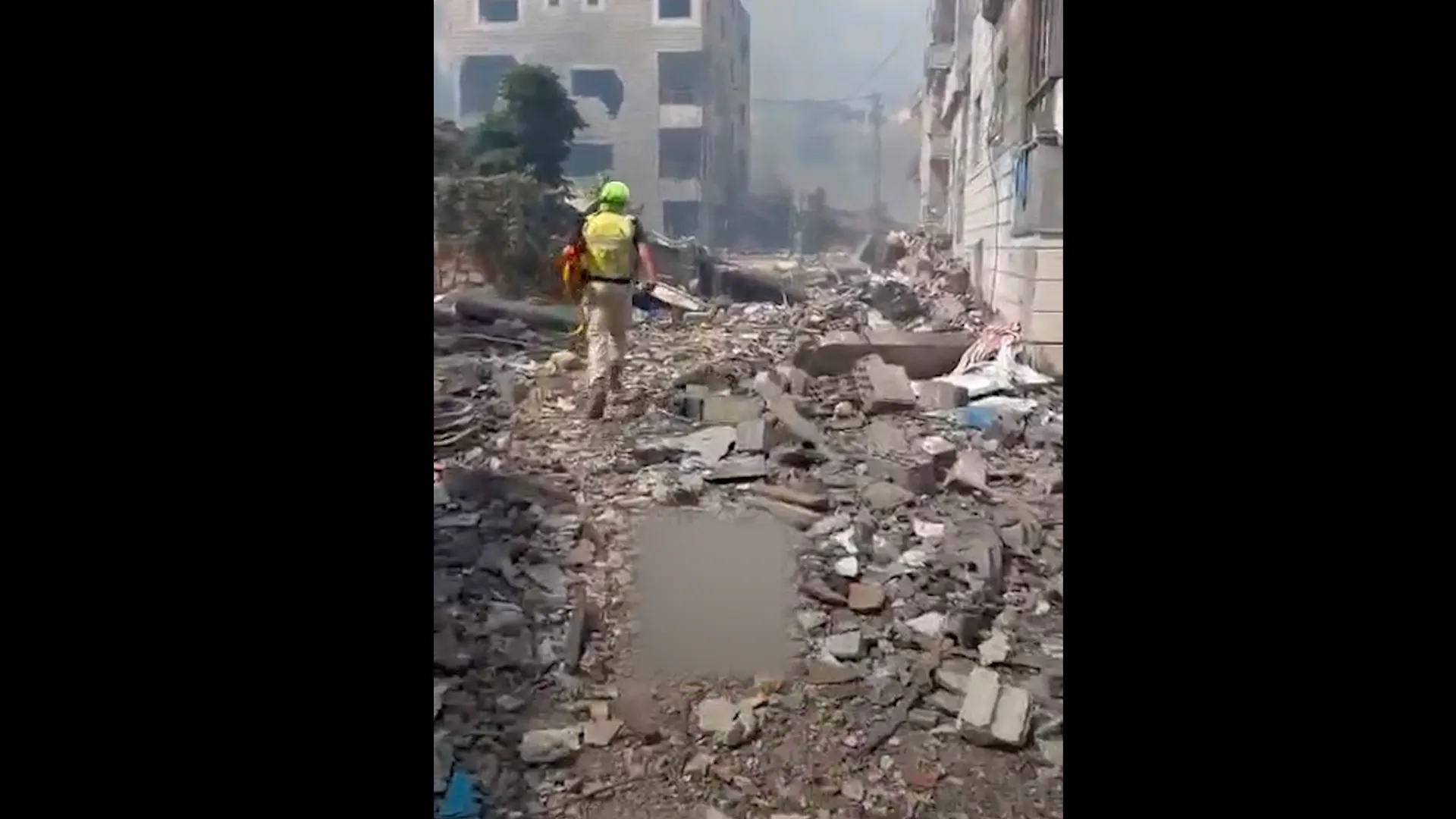
Two back-to-back Israeli air strikes hit Lebanon’s southern city of Nabatieh, while a third strike targeted an ambulance team responding to the attacks. At least 4,386 people have been killed and 12,400 injured since 2 March, when the current Israel-Hezbollah war began.
The outage marks at least the sixth one this year after a United States-imposed energy blockade went into effect.
Published On 19 Sep 202619 Sep 2026
Cuba has worked to restore power after suffering a significant blackout that left many parts of the country in the dark.
The state-run company in charge of operating the country’s electrical system, Union Electrica (UNE), said nearly half of its customers in the capital of Havana had regained power on Saturday.
Recommended Stories
list of 3 itemsend of list
“The re-establishing is being done gradually, as conditions permit,” UNE posted on social media.
The latest blackout, at least the 12th since late 2024, first affected five of Cuba’s eastern provinces, including Havana, before spreading across the whole island. It is at least the sixth this year alone.
Cuban authorities told the Reuters news agency on Friday the collapse was the result of a failure in high-voltage transmission lines in the central part of the country. UNE said “unstable weather conditions” also played a role.
For years, Cuba’s ageing infrastructure and fuel shortages have led to sporadic blackouts. But power outages have become more frequent after the United States, in a bid to put political and economic pressure on the country’s government, imposed an energy blockade in January.
United Nations human rights experts have condemned the US oil blockade, calling it a violation of international law and warning that Cuba risks becoming a “silent Gaza” as shortages and blackouts grow ever more critical.
Some of the island’s residents said they were already out of power when Friday’s blackout happened.
“Yesterday, I’d gone without power for 24 hours. They turned the lights on for an hour, and then the grid collapsed,” Havana resident Frank Lorenzo, 23, told Reuters.
Others, like Lidia Fernandez, told the news agency AFP that a lack of fuel makes it difficult to power backup generators, which run on imported diesel.
“It’s one thing after another: no water, no gas for cooking, no electricity,” the 36-year-old teacher said.
Fernandez added, “Honestly, I don’t know how we haven’t gone crazy.”
Reporters from CNN, MS NOW, and Politico were denied access to White House after Trump calls news outlets ‘fake news’.
Journalists from CNN, MS NOW and Politico have been barred from entering the White House and have had their press credentials deactivated or confiscated, as United States President Donald Trump’s ban on the three news organisations took effect.
Journalists were turned away from the grounds on Saturday after Trump announced on Friday that CNN, MS NOW and Politico would be barred from the White House, accusing the outlets of reporting what he called “fake news”. Trump has said other outlets could also face bans.
Recommended Stories
list of 3 itemsend of list
CNN White House reporter Betsy Klein and MS NOW White House correspondent Akayla Gardner both reported on air that they had been denied access. Gardner said an officer confiscated her badge after telling her it had been disabled and that the decision was “above him”. An MS NOW photographer also had their badge disabled, she said.
Politico reporter Cheyenne Haslett was subsequently turned away, with Politico saying the Secret Service denied her entry and confiscated her White House access pass.
“A few minutes ago, our colleague Cheyenne Haslett attempted to enter the White House to do her job as a POLITICO reporter,” the news organisation said. “Secret Service denied her entry to the complex and confiscated the pass that allows her access to the White House.”
“We stand by her and all reporters here covering the White House,” Politico added. “As we said yesterday, we will vigorously defend our First Amendment rights.”
“The White House belongs to the American people and the decisions made inside are funded by our tax dollars,” MS NOW said in a statement. “MS NOW intends to take any and all steps necessary to defend our First Amendment rights and the essential role of independent journalism in our democracy.”’
CNN media analyst Brian Stelter called the move “a direct threat to press freedom in the United States”.
“It’s so much bigger than CNN,” Stelter said. “This is a free speech test in America.”
The White House Correspondents’ Association said Trump had described “his own planned action as a ‘ban on the free press’”, and said constitutional press protections do not depend on whether a president approves of a news organisation’s coverage.
The ban is the latest in a series of confrontations Trump has had with news organisations during his first and second term.
In 2025, his administration restricted Associated Press access to the Oval Office and presidential travel after the agency declined to adopt the administration’s preferred name, “Gulf of America”, for the Gulf of Mexico. That case remains ongoing.
A key precedent is a 1977 federal appeals court ruling, Sherrill v Knight. The court found that once the White House establishes press facilities for credentialed journalists, access cannot be denied arbitrarily or for less than compelling reasons. It also said journalists denied credentials must receive notice of the factual basis, an opportunity to respond, and a final written explanation.
It is not yet clear what legal recourse CNN, MS NOW or Politico may pursue, or how courts would apply Sherrill to the administration’s decision to revoke existing credentials.
Al Jazeera’s Alan Fisher reported from Washington, DC, on Friday that Trump’s ban will likely be challenged soon.
“The United States has the First Amendment [of its Constitution] that says the government cannot restrict access to this sort of thing,” he said.
Press freedom advocates are watching closely.
Jameel Jaffer, executive director of the Knight First Amendment Institute at Columbia University, said in a news release that the move raises constitutional concerns.
“If President Trump means to expel these news organizations from the White House press pool, his action is doubly unconstitutional because the press pool is a ‘public forum’ under the First Amendment, which means the president can’t exclude journalists from it on the basis of their viewpoints,” Jaffer said.
The fight over access could now become a broader test of the limits on the White House’s ability to control which journalists can cover the administration.
“It’s difficult to imagine a more blatant violation of the First Amendment than Trump banning news outlets from the People’s House for criticizing the government,” said Seth Stern, chief of advocacy at the Freedom of the Press Foundation. “It’s also hard to imagine a dumber move.”
The “Hands Around the Kennedy Center” rally drew thousands after Trump-backed board votes to close the iconic arts venue.
Published On 19 Sep 202619 Sep 2026
Thousands of protesters formed a human chain around the Kennedy Center for the Performing Arts in Washington DC to contest its closure, amid fears that United States President Donald Trump could make good on his threat to demolish the venerated landmark.
The crowd filled streets in the Foggy Bottom neighbourhood of the capital on Friday evening, bringing traffic to a standstill as demonstrators made their way to the “Hands Around the Kennedy Center” protest. Many carried signs and some wore costumes, while boos rang out when Trump was mentioned during the programme.
At one point, some protesters linked hands around the building, whose marble facade remained partly concealed by scaffolding and tarpaulins.
Among the most iconic buildings on Washington’s Potomac waterfront, the Kennedy Center has become a battleground over Trump’s bid to assert control over the institution since he returned to office last year, replacing its board with his own appointees and installing himself as chairman.
Protesters in Washington, DC denounce the Kennedy Center board’s vote to close one of the nation’s premier performing arts venues, September 18, 2026 [Leah Millis/Reuters]
Chris Raleigh, co-founder of Hands Off the Arts, which organised the rally, said in an interview with The Associated Press news agency that he hoped the turnout would show that people were prepared to push back against Trump’s plans for the building.
The demonstration comes just days after the Trump-installed board voted to close the centre for repairs that are expected to last up to two years. That came hours after District Judge Christopher Cooper quashed the board’s latest attempt to restore Trump’s name to the building.
Last December, the new board added Trump’s name to the building’s facade after the Kennedy Center said its Board of Trustees had unanimously voted to rename the institution in his honour.
A federal judge blocked those efforts in May, ruling that the board had exceeded its statutory authority by unilaterally renaming the Kennedy Center and adding Trump’s name to its facade without congressional approval. Congress had designated the centre as a memorial to the late 35th US President John F Kennedy.
In August, the board tried again to inscribe Trump’s name on the building, this time with wording along the lines of “The John F. Kennedy Center for the Performing Arts Restored and Renovated By President Donald J. Trump”.
The federal judge scotched the move in September, ruling that it violated his May injunction.
Protesters outside the John F. Kennedy Memorial Center for the Performing Arts in Washington after its board voted to close the venue. September 18, 2026 [Leah Millis/Reuters]
Trump has since declined to rule out demolishing the building, while a federal judge on Thursday ordered the Kennedy Center to give 30 days’ notice before undertaking any major structural changes, including demolition.
Speaking to reporters in North Carolina on Wednesday, Trump argued that his administration deserved recognition for rescuing the Kennedy Center and that without the repairs, the building risked falling into disrepair and ultimately being forced to shut down.
Raleigh said he, like others, is concerned that Trump could move ahead without first notifying the court.
“Look at the East Wing,” he said. “We got up one morning and there was a giant hole there.”
More than 2,700 Yemenis have fled to Djibouti, many making dangerous sea crossings to escape the conflict. Al Jazeera’s Hasan Razzaq spoke with some of those who have arrived in the northern town of Obock, where they are seeking shelter and assistance.
CNN and MS NOW journalists have been denied access to the White House after US President Donald Trump announced he was banning the outlets.
An MS NOW reporter and a photographer tried entering the White House grounds on Saturday morning, but their badges would not scan and an officer confiscated them, the outlet reported.
CNN also said Saturday morning that one of its reporters was denied access and had her badge seized.
Trump said on Friday he was barring MS NOW, CNN, and Politico – three major US media outlets – from the White House, accusing them of writing “fiction or lies” about his administration. Press freedom advocates called the move “unconstitutional”.
“The officer asked me to hand over my badge. He said that it was disabled,” MS NOW reporter Akayla Gardner said. “I asked why I was not able to get inside. He said it was above him.”
Gardner added that while her and her colleague’s badges were disabled, an MS NOW producer was still able to scan her badge to get in, though she was not given an explanation as to why the producer’s badge still worked.
CNN reporter Betsy Klein said a Secret Service agent told her her badge had been deactivated.
An MS NOW spokesperson said in a statement that the White House “belongs to the American people and the decisions made inside are funded by our tax dollars”.
“MS NOW intends to take any and all steps necessary to defend our First Amendment rights and the essential role of independent journalism in our democracy.”
It was not clear whether Politico reporter were at the White House on Saturday. Following Trump’s ban, all three outlets have spoken out against the decision, accusing Trump of violating their constitutional rights to free speech and freedom of the press.
“We have a right under the US Constitution to do our reporting without hindrance or interference from the government and this ban is an illegal assault on this fundamental right,” CNN said.
In his announcement, Trump did not mention specific stories or reporting from the three outlets that prompted the move, but later said “it’s really just cumulative stories over the last few years”.
Trump added that there “may be others to join them”, but has not given a directive banning additional news outlets. When later asked by a reporter what he meant by others to come, Trump responded: “Others to come in terms of fake news? Well, you know, the New York Times is fake news, the Washington Post is fake news.”
Several groups dedicated to the freedom of the press have called out Trump’s White House ban as illegal and unconstitutional.
A major group that provides legal services to the media – the Reporters Committee for Freedom of the Press – said it expected Trump’s ban to be struck down quickly by the courts because it was “flatly unconstitutional”.
“The First Amendment is clear that once the White House invites in some journalists, it can’t ban others because it doesn’t like their reporting,” said Bruce Brown, president of the Reporters Committee for Freedom of the Press, which provides legal services to the media.
It’s the latest in a series of moves by the administration to target media outlets Trump says are critical of him, including legal action against US and international outlets like The New York Times, The Wall Street Journal, and the BBC.
Some of the lawsuits have resulted in media organisations agreeing to pay multimillion dollar settlements. Trump’s lawsuit against the BBC is ongoing.
Additional reporting from Bernd Debusmann Jr and Max Matza.
Who: Atletico Madrid vs Real Madrid What: La Liga Where: Metropolitano Stadium, Madrid, Spain When: Sunday, September 20, at 4:15pm (14:15 GMT) How to follow:Al Jazeera Sport will bring you all the build-up from 11:15 GMT before our live text commentary stream
Atletico host bitter city rivals Real for the Madrid derby as both sides look to keep up with early La Liga pacesetters Barcelona.
Madrid trail unbeaten champions Barcelona at the top of the table by three points, with Atletico third.
Atletico have bounced back from back-to-back defeats to Bilbao and Liverpool earlier in September, beating Real Sociedad 3-0 and Osasuna 4-0 in their last two games.
Real come into the game in decent form under boss Jose Mourinho but have had wobbles this month, with a defeat to Betis and scoring late to beat bottom club Elche after squandering a two-goal lead.
Improving Atletico cruise to win over Osasuna
Atletico Madrid thrashed Osasuna 4-0 on Wednesday to build some form in the run-up to Sunday’s derby clash against rivals Real Madrid.
Jonathan David, Lee Kang-in, Robin Le Normand and Alex Baena’s goals helped Diego Simeone’s side cruise to a comfortable home victory.
They were without injured striker Julian Alvarez, but it did not matter after they secured a second straight win to cut the gap on top two Barcelona and Real Madrid.
The comfortable victory was important for an Atletico side with lots of new faces still bedding in, after two defeats in their three matches prior.
“We controlled it in the first half even though we weren’t clinical,” said coach Diego Simeone. “We were clinical in the second half and controlled the game.”
Atletico Madrid’s Alex Baena runs with the ball during the win over Osasuna at the Metropolitano Stadium [Oscar del Pozo/AFP]
Mourinho rues lack of game control
Real Madrid squandered a two-goal lead before substitute Carlos Espi struck in stoppage time to secure a dramatic 3-2 victory at Elche in La Liga on Tuesday.
Real went 2-0 up inside 33 minutes through a Matias Dituro own goal and Kylian Mbappe, but second-half strikes from Abiel Osorio and Fer Nino hauled Elche level before Espi restored the visitors’ lead in the 91st minute.
It was the second time in six league matches that the 21-year-old Espi had come off the bench to score a late winner, although Mourinho remained concerned by Real’s failure to control the second half in advance of Sunday’s derby against Atletico Madrid.
“The problem seems obvious to me. It’s harder to know why, but it’s easy to understand that there are matches that seem over and, in the end, aren’t,” said Mourinho.
“[There are] matches where we have three, four, five chances to finish them and don’t,” he said at the pre-match news conference.
“After failing to do so, it feels like we go from ease, because it seemed easy, to losing control.”
Mourinho said his team’s defensive issues were of concern.
“Not just for Sunday’s match, but for every match. I like my team to score goals … but I also like controlling matches,” explained Mourinho.
“I don’t like gifting control. It’s not about the goals, it’s about giving away control of the match.”
Mourinho’s side gave him a fright during their win over Elche [Alberto Saiz/AP Photo]
Prediction
The Opta supercomputer has made Real Madrid the favourites, with a win probability of 46.6 percent. Atletico were given a 28.3 percent chance of winning, while a draw was estimated at a 25.1 percent likelihood.
Head-to-head
The rivals have faced each other on 243 occasions; Real Madrid won 125 games, Atletico won 60, while 58 matches ended as draws.
Last five encounters:
March 22, 2026: Real Madrid 3-2 Atletico (La Liga)
January 8, 2026: Atletico 1-2 Real Madrid (Spanish Super Cup semifinal)
September 27, 2025: Atletico 5-2 Real Madrid (La Liga)
March 12, 2025: Atletico 1-0 Real Madrid (Champions League last 16, second leg)
March 4, 2025: Real Madrid 2-1 Atletico (Champions League last 16, first leg)
What happened the last time the two clubs played each other?
Vinicius Jr scored twice as Real Madrid fought back to beat Atletico Madrid 3-2 at the Santiago Bernabeu in a breathless Spanish capital derby in March.
Atletico’s Ademola Lookman opened the scoring in the 33rd minute, finishing a slick counterattack involving Matteo Ruggeri and a delightful back-heel from Giuliano Simeone.
Vinicius equalised from the penalty spot in the 52nd minute, after David Hancko clumsily tripped Brahim Diaz, and Federico Valverde capitalised on a Jose Maria Gimenez error three minutes later to make it 2-1 to Real.
Nahuel Molina silenced Real’s Bernabeu stadium with a thunderous 30-metre strike in the 66th minute, but Vinicius restored Real’s lead with a cracking solo effort six minutes later.
Vinicius Jr celebrates scoring his team’s winner [Florencia Tan Jun/Getty Images]
What happened in the corresponding fixture last season?
Julian Alvarez scored twice as Atletico Madrid came from behind to thrash city rivals Real Madrid 5-2 in a pulsating derby in September 2025.
Atletico’s aggressive start paid off when Robin Le Normand opened the scoring with a header in the 14th minute.
However, Kylian Mbappe burst through to level with an unstoppable strike from close range in a quick counter in the 25th minute, with Arda Guler netting a volley from a Vinicius Jr cross 11 minutes later to put the visitors in front.
Alexander Sorloth’s header in added time before the break gave Atletico a boost, and they regained the lead five minutes into the second half when Alvarez converted a penalty after Guler’s high boot clipped Nico Gonzalez on the face inside the box.
After Alvarez extended their lead in the 64th minute with a sublime free kick into the top corner, substitute Antoine Griezmann sealed the win in a quick counter in added time.
Alvarez scores Atletico’s third from the spot [Angel Martinez/Getty Images]
Atletico Madrid’s team news
Alvarez, Pablo Barrios, and Sorloth are doubts, as all three are struggling with muscle issues.
Jonathan David is likely to continue up front if Alvarez is absent or starts on the bench.
Tehran, Iran – Hossein, a 32-year-old marketing specialist based in Tehran, has been thinking of replacing his 13-year-old Iranian-made car with a newer model.
Even though he earns about four-and-a-half times the minimum wage after a recent pay rise – his salary is now close to 900 million rials (about $390 at the current exchange rate) – imported vehicles are not even remotely affordable for him.
Recommended Stories
list of 4 itemsend of list
Even finding a locally made car might be out of his budget, with an economic crisis gripping the country since the United States and Israel launched a surprise war on Iran on February 28 and later enacted a crippling siege and sanctions on the country.
“I’m losing hope of ever being able to buy a new domestic production car too, unless the country opens up and becomes a bit more normal again,” Hossein, who asked to keep his full name confidential for security reasons, told Al Jazeera.
His old manual Peugeot 206 model, an originally French-made car but now produced domestically after foreign counterparts left Iran due to sanctions, can fetch up to 10 billion rials ($4,350) if he sells it towards making a new purchase. However, his replacement options are limited.
Upgrading to a slightly improved Peugeot 207 with an automatic gearbox could cost him 28 billion rials ($12,170) now. This means that, after selling his car, he would need more than 20 months of his entire salary.
A domestic sedan Shahin model costs more than 31 billion rials ($13,480), and a crossover Reera is priced at more than 43 billion rials ($18,700).
With these options, he would need to save about 24 months and 37 months of his whole salary, respectively, and that is if prices remain stable and he does not spend a rial on anything else. But the reality of the fast-rising living costs and lagging incomes in Iran means he can barely put aside any money, let alone afford a new car.
Domestic car prices have mostly risen 40 to 80 percent since the start of the war, while some vehicles sell for more than 130 percent of their September 2025 costs.
The costs of maintaining the vehicles are also rising much faster than people’s salaries. Domestically produced tyres, motor oil, brake pads and clutch kits have at least doubled since last year, with some car parts having more than tripled in price.
Domestic vehicles have generally low safety standards, meaning that they contribute to staggering road accident deaths. At least 1,609 Iranians have been killed so far on intercity roads in the current month of Shahrivar of the solar Hijri calendar, which ends on September 22. More than 20,000 people lose their lives on the roads every year. In comparison, fewer people in the whole of the European Union, nearly five times Iran’s population, died on roads last year.
Iran’s fuel-guzzling cars also contribute to smoke-congested city streets, degrade vehicles faster and increase fuel costs, just as petrol prices have risen for users.
How did we get here?
Experts say, due to a combination of protected state-linked businesses, privileged access, economic isolation and a curtailing of imports, Iranian households have no choice but to pay exorbitant prices – compared with their salaries – to buy low-quality cars.
The damage from the war, including the extensive bombing of multiple steel giants by Israel and the US, has only added insult to injury. The naval blockade of Iran’s southern ports has prevented goods coming in from popular neighbouring markets like the United Arab Emirates.
Under such circumstances, domestic vehicle manufacturers have little incentive to improve.
End customers are also beset by government charges, currency and financing costs, margins levied by murky intermediaries – and in numerous documented cases, industry corruption.
“People are forced to buy expensive low-quality cars whose real prices should be a quarter of global prices, and this is a direct harm done to them,” Mohammad Rashidi, a member of the presiding board of Iran’s parliament, told local media on Saturday. “The traces of a mafia system are visible throughout the process.”
His claims echo those of other officials and state-linked media, who have openly described the industry as resembling an organised crime operation.
According to the latest figures released by state media, about 233,000 cars were manufactured or assembled in Iran in the first five months of 2026, compared with 366,000 the year before. Only about 25,000 vehicles were imported in that period.
Only a handful of state-linked companies or intermediaries are allowed to import vehicles, with duties plus value-added tax increasing final prices up to 200 percent.
The government and parliament have discussed lowering import tariffs this year, with no agreement announced so far.
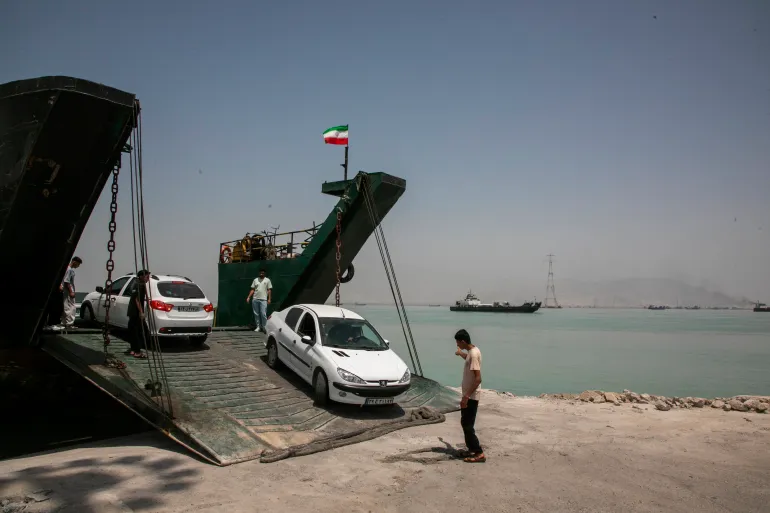
Cars leave a ferry as ships remain anchored on May 16, 2026 in the Strait of Hormuz near Larak Island, Iran [File: Majid Saeedi/Getty Images]
The premiums are more visible for high-end cars, with a 2026 Toyota Land Cruiser VXR going for approximately 660 billion rials ($287,000) in Iran at the moment, while the same model is available for about $86,000 in the UAE. The same story applies to most other models, at different rates depending on the rarity of the vehicle and the availability of parts.
The price of a mid-range Chinese-designed SUV sold as Exeed VX in international markets is listed at about $32,000 in China, while it is priced at about $42,000 in the UAE. The same car, assembled from imported parts by a state-linked company in Iran under a different name, currently costs Iranian customers the equivalent of $53,000.
The bizarre situation was on full display during a three-day “international” car exhibition in Tehran last week that mostly featured Chinese-manufactured vehicles. These remain available in Iran despite the US sanctions, since Tehran exports almost all of its oil to China and barters this for goods, including cars.
Some domestic manufacturers and importers were absent, either because they had no products to offer or because they had angry customers who registered months ago to get vehicles they never received. Spare parts for some of the vehicles on display are currently either not available in the Iranian market or cost several times their price in international markets.
Even the cheapest vehicles offered at the exhibition were completely unaffordable to the average Iranian. It would take a worker on the minimum wage with standard allowances 50 years to buy an XPENG G9, a Chinese-made electric SUV priced at 120 billion rials ($52,150), on his or her salary, without spending a rial on food, housing or clothing.
Still, there were huge queues outside the exhibition centre each of the three days.
“It was sad because most people just came to take pictures with the cars they knew they could never afford,” a young man who attended the exhibition told Al Jazeera. “The doors of the cars were locked too.”
Lockheed Martin and the U.S. Air Force are once again discussing new-build F-16s. The development comes as the service grapples with a fighter fleet that is simultaneously aging, shrinking, ballooning in sustainment cost and being called upon to do more. This also comes at a time when the Air Force is now investing heavily in the F-15EX, another fourth-generation type it hadn’t bought for many years after committing to an all stealth future fighter fleet in the 2000s.
According to Aviation Week, the company has proposed an aircraft called the F-16G, an enhanced derivative of the F-16 Block 70. The proposed configuration reportedly incorporates conformal fuel tanks, 600-gallon wing tanks, an infrared search-and-track (IRST) system, a Sniper targeting pod, and a drag chute. All of these features have appeared on previous F-16s in one form or another. Lockheed is positioning the new version as a potential replacement for USAF F-16 units whose existing aircraft are approaching the end of their useful lives.
A Bahraini Block 70 F-16D flown by members of the 416th Flight Test Squadron pulls away after receiving fuel from a KC-135 tanker with a crew from the 370th Flight Test Squadron during asortie out of Edwards Air Force Base in California on March 7, 2024. U.S. Air Force
The Air Force, for its part, says that it has not yet settled on either the requirements or the options for addressing the problem. As it stands, the service has not committed to buying any new F-16s. The proposal is nevertheless notable because it follows an earlier round of discussions in which the Air Force was already examining whether a new-build F-16 could help address the growing fighter gap.
In December 2025, Inside Defensereported that the Air Force had reached out to Lockheed Martin about pricing for Block 70 F-16s — the current export standard. The conversations were described as exploratory, with no firm procurement plan, but the reporting established that the idea had moved beyond a purely theoretical discussion. One congressional aide told the publication that officials were looking at ways to “plug their holes” as part of their future force-structure planning.
A new Viper variant based on the Block 70 would be cheaper than replacing an aging F-16 with an F-35, while allowing the Air Force to retain much of the infrastructure, training, and experience associated with the existing aircraft. This is a major advantage as the F-35’s unique infrastructure and support requirements are a costly addition to the aircraft’s base price tag. An even bigger factor is unrelated to acquisition and bed-down costs: a Block 70 is far cheaper to sustain and operate over its service life than an F-35, a difference that compounds significantly across a fleet.
A line-up of F-16s assigned to the 149th Fighter Wing, a unit of the Texas Air National Guard. Air National Guard photo by Airman 1st Class Jonathan Rasco Airman 1st Class Jonathan Rasco
The idea of a new Viper buy had already reached the highest levels of Air Force leadership several months earlier.
In May 2025, Sen. Tom Cotton asked then-Air Force Chief of Staff Gen. David Allvin about the possibility of buying a U.S.-configured “Block 80” F-16 if Congress provided additional funding. Allvin did not endorse the proposal, but he did not dismiss it either, saying he needed to examine the time required to adapt the Block 70 design, where a U.S. aircraft could fit into Lockheed Martin’s production line, and what the industrial base could support. He also noted that the existing Block 70/72 line was already heavily occupied by foreign military sales.
At the same hearing, Allvin acknowledged the broader force-structure logic, saying the Air Force needed both the high-end capabilities required for an Indo-Pacific fight and other fighters that “may not need to be as sophisticated as our fifth-generation, sixth-generation.” He also emphasized that the first increment of Collaborative Combat Aircraft (CCA) was intended to augment rather than replace crewed fighters like the F-16.
General Atomics’ YFQ-42 for the first increment of the Air Force’s Collaborative Combat Aircraft program, which has now received the official nickname Vengeance. General Atomics
Taken together, the developments show that the concept has remained alive through the Air Force’s evolving force-structure debate.
The Numbers Game
At first glance, the idea of buying new F-16s for the Air Force in the late 2020s might seem puzzling. The F-16 entered U.S. service in the 1970s, and the Air Force stopped buying new examples for itself more than 20 years ago. The established plan has been to replace the legacy F-16 fleet with the F-35A. For a long time, the service’s stated ambition was ultimately an all-stealth tactical fighter force — but that vision has already largely melted away as budget, operational and industrial-capacity realities have set in.
Today, the fighter fleet is still far older on average than it needs to be and legacy fourth generation types, minus a handful of new F-15EXs, are now well over 20-years old at the youngest. The oldest of these aircraft are increasingly challenging and costly to support. Meanwhile, the F-35 has had its fair share of successes and challenges, but replacing all of the USAF’s oldest fighters with JSFs in a timely and efficient manner, and operating those aircraft over future decades, looks increasingly problematic. The F-47 is also on the horizon, but that aircraft fits a different capability set more aligned with the F-22 than the F-16 and will come at a much higher cost than any fighter currently being procured.
Above all else, the problem is that the Air Force’s fighter challenge is one of numbers.
The service’s 2025 long-term fighter force-structure assessment concluded that it needed 1,558 combat-coded manned fighters by 2035 to reach what it considers a low-risk operational posture. The Air Force had only 1,098 fighters in its inventory as of May 2026, below the statutory minimum of 1,145.
An MQ-28 Ghost Bat and a U.S. Air Force F-15EX participate in Valiant Shield 2026 over the Philippine Sea, June 27, 2026. U.S. Air Force photo by Tech Sgt. Thomas Barley Tech. Sgt. Thomas Barley
For the Air Force, the question has not simply been whether the F-16 remains militarily useful, but also whether the aircraft provides a possible answer to a capacity shortfall, while also dealing with delays in F-35 deliveries, and the retirement of the A-10, blowing another hole in the inventory. Meanwhile, some older F-16s that had been expected to leave the fleet are instead receiving upgrades, including a new radar and electronic warfare suite, to keep them flying longer.
A U.S. Air Force airman works to install a new active electronically scanned array (AESA) radar system onto a 480th Fighter Squadron F-16C at Spangdahlem Air Base, Germany, May 23, 2022. U.S. Air Force photo by Tech. Sgt. Maeson L. Elleman 2nd Lt. Maeson Elleman
That creates a difficult transition period. The Air Force wants to retire aging fighters, but it also needs to keep enough aircraft available while their replacements arrive. The F-16 keeps reappearing because it offers a way of addressing at least part of that problem with a very well known commodity and without requiring every legacy fighter to be replaced by an F-35 or F-15EX.
The Production Line Matters
There is another reason the F-16 procurement idea refuses to disappear: Lockheed Martin already has an F-16 production line operating in the United States.
The Greenville, South Carolina, facility was established to produce Block 70/72 aircraft for foreign customers and is now the world’s only F-16 production facility. The Air Force helped establish the line as part of its broader effort to sustain the F-16 industrial base through foreign military sales. The line moved there after the massive Lockheed Martin plant at Fort Worth, Texas — where the F-16 had been built for decades — transitioned fully over to F-35 production.
So, buying new F-16s would not require reviving a dormant production line or spinning up an entirely new aircraft program. The basic manufacturing infrastructure already exists, and the additional work required for a U.S.-specific aircraft may end up being minimal — potentially amounting to little more than taking an existing Block 70 and tweaking it, rather than a large-scale new engineering, testing, and weapons-integration effort.
A two-seat F-16D Block 70 on the production line in Greenville. Lockheed Martin
The Air Force has been aware of that possibility for years. In 2021, then-Air Force Assistant Secretary for Acquisition Will Roper argued that the service should consider the new F-16 production line as part of its capacity solution. Roper specifically pointed to the upgraded capabilities available from the South Carolina production line.
However, Greenville is not an empty production line waiting for a U.S. customer. Lockheed Martin’s F-16 facility already has a substantial Block 70/72 backlog for foreign operators, with the company reporting more than 100 aircraft in the queue and continued potential for additional international orders. It’s also unclear how much the facility could realistically be expanded, since it was designed around a relatively more modest foreign military sales production volume rather than the kind of surge a large U.S. order could require. Still, the USAF could step in and buy up open slots, which would also ensure the line stays open for the foreseeable future, which has major strategic and industrial protection benefits.
That brings us back to Gen. Allvin’s question in May 2025 about where a U.S. aircraft could fit on the production line. Even if the Air Force decided to buy the jets, it would have to compete for production capacity with an established international order book while developing whatever U.S.-specific configuration, testing, and integration work it requires.
This Is Not Your Dad’s F-16
The proposed F-16G is also significant because it is not simply another upgraded F-16C/D like the USAF already has.
Lockheed’s proposed configuration reportedly would add conformal fuel tanks and 600-gallon wing tanks, along with an IRST, and the latest Sniper targeting pod, as well as a drag chute. All of these systems are already fielded and available today rather than requiring new development.
Those additions point toward an aircraft intended to provide even more basing flexibility, range, persistence, weapons and sensing capability than the current F-16, which had already grown into a medium-weight fighter years ago. That is relevant to how such an aircraft might actually fit into the future Air Force.
A U.S. Air Force avionics specialist prepares to install a Sniper Advanced Targeting Pod onto an F-16. U.S. Air National Guard photo by Airman 1st Class Sarah Stalder Lundgren Staff Sgt. Sarah Stalder Lundgren
A contemporary F-16 is already a very different proposition from the aircraft that entered U.S. service decades ago. Modern AESA radars, electronic warfare systems, digital architecture, datalinks, advanced cockpit interfaces and weapons have substantially expanded its capabilities. The proposed F-16G would push that evolution further, but, like the F-15EX, it would still occupy a different part of the spectrum from the F-35 and whatever eventually emerges from the F-47 program.
That distinction could be useful in a larger force. An F-35 provides capabilities, particularly its combination of stealth and advanced sensor fusion, that an F-16 can never reproduce. But the Air Force does not conduct every mission in the most heavily defended portion of an adversary’s airspace. Homeland defense, training, defensive counter-air, a range of strike missions, and operations in permissive or partially contested environments don’t necessarily require the same characteristics as a penetration mission against an integrated air defense network. In a major conflict, no fighter will fight alone, either. Far from it. Operation Midnight Hammer, the B-2 strikes against Iran’s nuclear program, provides a salient example here, with F-16s flying deep into the country along with F-22s and F-35s, to clear the way for the B-2 strike force. By now, the Air Force is well-versed in leveraging the total-force fourth-and-fifth-generation mix, and it has discovered that they complement each other in unique ways that can be an advantage, not just compensation for lack of capability.
As far as the drag chute, that is a highly relevant addition to the USAF’s F-16 capability set. The chute would allow for the F-16 to better execute Agile Combat Employment (ACE), which includes operating from austere airfields within the enemy’s weapons engagement zone. The F-16 can get off the runway pretty quick, but landing is a different story. The chute can help greatly in this regard.
A U.S. Air Force C-5M Super Galaxy aircraft assigned to the 9th Airlift Squadron, Dover Air Force Base, left, sits beside an R-11 fuel truck and an F-16C Fighting Falcon aircraft assigned to the 122nd Fighter Wing on the flight line at the 122nd Fighter Wing, Fort Wayne, Indiana, July 24, 2025. The C-5 participated in an agile combat employment exercise that included wet wing defueling to the fuel truck which then provided fuel to the F-16. (U.S. Air National Guard photo by Tech. Sgt. David Sherman) Tech. Sgt. David Sherman
There is no question that an F-16 is not a replacement for an F-35. But it could help the Air Force better allocate its limited inventory of increasingly expensive fifth-generation and future sixth-generation aircraft while also maintaining a much larger overall fighter fleet.
CCA Changes the Calculus for Fourth-Gen Jets
One factor that is easy to overlook is Collaborative Combat Aircraft. CCAs are not just a complement to fifth- and sixth-generation fighters, they can also breathe new relevance into fourth-generation types like the F-16. Pairing stealthy, and even optionally expendable CCAs with a fighter like the F-16G could substantially boost its survivability and lethality by pushing sensing, shooting, and some of the risk forward onto uncrewed platforms, extending the F-16’s combat relevance even into higher-end scenarios where it would otherwise be at a disadvantage. In that sense, CCA may end up being arguably as relevant to fourth-generation aircraft as it is to fifth-generation ones.
In other words, CCAs are a positive factor in the F-16G’s business case.
A U.S. Air Force YFQ-44A Fury aircraft, assigned to the Collaborative Combat Aircraft Experimental Operation Unit, takes off for a mission flight during an Agile Combat Employment exercise at Creech Air Force Base, Nevada, July 21, 2026. The flight was part of a broader ACE exercise designed to test the resilience, adaptability, and combat effectiveness of the semi-autonomous fleet. (U.S. Air Force photo by Staff Sgt. Kristal Munguia) Staff Sgt. Kristal Munguia
While the F-22 and F-35 are slated to get CCAs first, the F-16G can be built ready to interoperate with them, which could be a massive force multiplier to what would be the most affordable crewed tactical asset in the inventory. CCAs can eventually be used to also help augment F-16Gs operating in a homeland defense mission and other more mundane roles as well.
The Guard Argument
New Block 70s could make particular sense for the Air National Guard.
The Guard continues to operate F-16s in large numbers, meaning that its personnel, facilities, simulators, and maintenance infrastructure are already built around the aircraft. A new-build F-16 could therefore replace an aging F-16 without requiring the same organizational transition associated with converting a unit to an entirely different fighter, and especially a highly complex fifth-generation type with all its unique support requirements.
That has financial implications beyond the aircraft itself. Replacing an existing F-16 squadron with Block 70s would reduce construction costs and training requirements because much of the existing infrastructure and expertise could be retained.
From left, two U.S. Air Force F-16Cs assigned to the 177th Fighter Wing, New Jersey Air National Guard, and two F-35As assigned to the 158th Fighter Wing, Vermont Air National Guard, follow a KC-135 Stratotanker off the coast of Atlantic City, New Jersey. U.S. Air National Guard courtesy photo by Tech. Sgt. James Norman Andrew J. Moseley
The Air Force would still have to pay for the aircraft and sustainment, but it would not be starting from scratch in terms of operating infrastructure, while the modernized fourth-generation capabilities of an F-16G would still mark a step forward for the Guard over its older F-16s.
It’s worth noting there has also been discussion of replacing more aging F-16s with additional F-15EXs instead. That path, however, is more expensive on both the acquisition and operating-cost side, and it would still require units to convert to a different airframe rather than simply recapitalizing in place.
Viper Refreshed
A new F-16 offers a fresh and highly mature airframe — one with a full service-life ahead of it, on the order of 12,000 flight hours without the need for structural upgrades — double that of the original F-16. This is compared to existing F-16s in the inventory with the decades of wear and fatigue already accumulated on them, with structural upgrades keeping them in the air. That difference in remaining structural life is arguably the single biggest advantage a new-build aircraft has compared with extending an existing one.
U.S. Air Force aircraft armament systems specialists assigned to the Ohio National Guard’s 180th Fighter Wing load 20mm ammunition into an F-16’s M61A1 Vulcan cannon. U.S. Air National Guard photo by Master Sgt. Kregg York Master Sgt. Kregg York
Dumping more money into existing F-16s is becoming questionable. Service life extensions and technical upgrades can only go so far and supporting these jets is becoming harder as parts dry up and suppliers who made them are long gone. A new airframe would give the Guard many decades of highly efficient service and the piece of mind for future force planning that goes with it.
Also, just like F-15EX, the development of the Block 70 F-16 has already been paid for largely by foreign customers over many years. It is as off-the-shelf of a solution as it gets and that is a very attractive proposition to an air arm trying to balance its books.
Above all, F-16 sustainment and operating costs run far below the F-35’s — a gap that already holds true even with older F-16s, and one that would widen further with new-build jets.
The Argument Against Simply Buying More F-35s
One seemingly obvious alternative would be to accelerate F-35A procurement. But the F-35 is not simply another fighter that can be substituted one-for-one whenever an F-16 reaches the end of its service life. That would also be difficult to do in practice. F-35A production is effectively capped and there are dense order books, and the well-documented troubles with the Block 4 upgrade are a huge factor pushing the Air Force to look at alternatives like the F-16G in the first place.
The Air Force’s current force-structure plans call for significantly more fighters overall, while the service is simultaneously pursuing F-35As, F-15EXs, and the F-47.
A U.S. Air Force F-15EX Eagle II. U.S. Air Force U.S. Air Force photo by Tech Sgt. Jacob Stephens
Among the reasons why a modernized F-16 might be considered alongside those programs are concerns not only about the cost of those aircraft, but also about the timing of F-35 deliveries, something that has been disrupted by well-publicized problems with Joint Strike Fighter upgrades. At the same time, keeping older F-16s active through upgrades is an increasingly unattractive way of managing the shortfall.
The issue is therefore less about choosing the F-16 instead of the F-35 than about deciding whether the Air Force should use both aircraft for different portions of the force structure.
The service is already doing something along these lines with the F-15EX. It has accepted that a modernized fourth-generation aircraft can have a role alongside the F-35 and the F-22, rather than requiring every new fighter to be stealthy.
A new F-16 would extend that logic to a lower-cost segment of the fleet, potentially allowing the Air Force to use F-35s where their particular capabilities are most valuable while maintaining additional capacity with a less expensive aircraft.
What Could Happen Next?
Even if Air Force leaders conclude that the F-16G makes operational sense, Congress would still have to decide whether it is worth funding.
The December 2025 reporting identified the central problem: lawmakers would want the service to demonstrate that buying new aircraft is preferable to continuing to upgrade the F-16s it already owns. They would also have to weigh the proposal against the F-35 and CCA programs.
If an existing F-16 can be kept operational with a relatively inexpensive upgrade, a new aircraft has to justify its acquisition cost and the additional long-term sustainment burden. But if maintaining an increasingly old F-16 fleet doesn’t save large sums of money over the long haul, the new Block 70 variant begins to look more compelling.
A U.S. Air Force F-16 takes off at a base in the U.S. Central Command area of responsibility on August 10, 2026. U.S. Air Force photo by Staff Sgt. Justin W. Moore Senior Airman Justin Moore
There remains a substantial gap between Lockheed Martin pitching the F-16G and the Air Force actually buying it. The service told TWZ that it is “in the initial phases of analyzing options for the next Future Years Defense Program.” The Air Force spokesperson added: “At this stage, we have neither defined the precise mission requirements nor the spectrum of options that could fill it.”
That is consistent with the status described by Inside Defense nine months earlier. At the time, the Air Force had no plans to procure Block 70s, and the discussions with Lockheed were described as exploratory. Even if senior officials ultimately favored the aircraft, Inside Defense reported that the program could not appear in the Future Years Defense Program until at least fiscal 2028 because the FY2027 budget process was already too far along.
The F-16G therefore remains a proposal rather than a program. But the persistence of the idea is itself significant. It should be noted that the F-15EX buy emerged out of very similar machinations, with the benefits proving to be undeniable.
The new proposal would let some Guard and Reserve units swap their F-16s for vastly improved F-16s — the same logic that drove the F-15EX buy — while also keeping the Greenville line hot, which is a significant benefit in its own right. And it accomplishes both in the most efficient way possible: not just in acquisition cost, but in sustainment cost, which is really the more problematic burden of the two. In the end, this points to another glaring reality check for the all-stealth-force concept, a vision the Air Force has effectively already abandoned.
The Air Force has spent years describing the F-35 as the replacement for its F-16 fleet, yet it now has to contend with aging F-16s, delayed or constrained fighter production, a larger stated requirement for total fighter capacity, and the lengthy transition toward the F-47 and uncrewed combat aircraft. In that environment, a new-build F-16 provides an option that sits between extending legacy aircraft and buying the most sophisticated — and expensive — fighters available.
Regardless, there are so many priorities facing the force right now, buying new F-16s will be a challenge at every turn, but that doesn’t mean it won’t become too compelling of a proposition to accept. Still, many will argue that every dollar should be invested in higher-end fighter and uncrewed platforms that are more survivable against America’s primary pacing threat, China. That country is rapidly evolving its own air arm with stealth fighters and advanced uncrewed aircraft. Stepping back to the F-16 while facing down such a threat can appear to be counterproductive when taken at face value. At the same time, the F-16 is already slated to stay in the inventory by the hundreds for decades to come, which does take some of the bite out of that argument.
In the end, it is remarkable that the F-16 was supposed to have left the U.S. fighter equation years ago. Instead, every time the Air Force looks closely at the gap between the fighter force it has and the force it says it needs, the aircraft somehow finds a way back into the conversation.






![A view of a technology incubator in Gaza before the war, where students received training in technology and innovation [Iyad Al-Qatrawi/Al Jazeera]](https://i0.wp.com/occasionaldigest.com/wp-content/uploads/2026/09/1-1789814125.jpeg?w=640&ssl=1)
![A view of a technology incubator in Gaza prior to the war, which provided an environment for training, incubating tech projects, and supporting students in the fields of technology and innovation [Iyad Al-Qatrawi/ Al Jazeera]](https://i0.wp.com/occasionaldigest.com/wp-content/uploads/2026/09/3-1789814366.jpeg?w=640&ssl=1)
![UCAS Technology Incubator, one of the most prominent incubators of the University College of Applied Sciences in Gaza, after its destruction during the war, as part of extensive damage to the institutions and structure of the technology and digitization sector in the Strip [Iyad Al-Qatrawi/Al Jazeera]](https://i0.wp.com/occasionaldigest.com/wp-content/uploads/2026/09/2-1-1789814285.jpg?w=640&ssl=1)