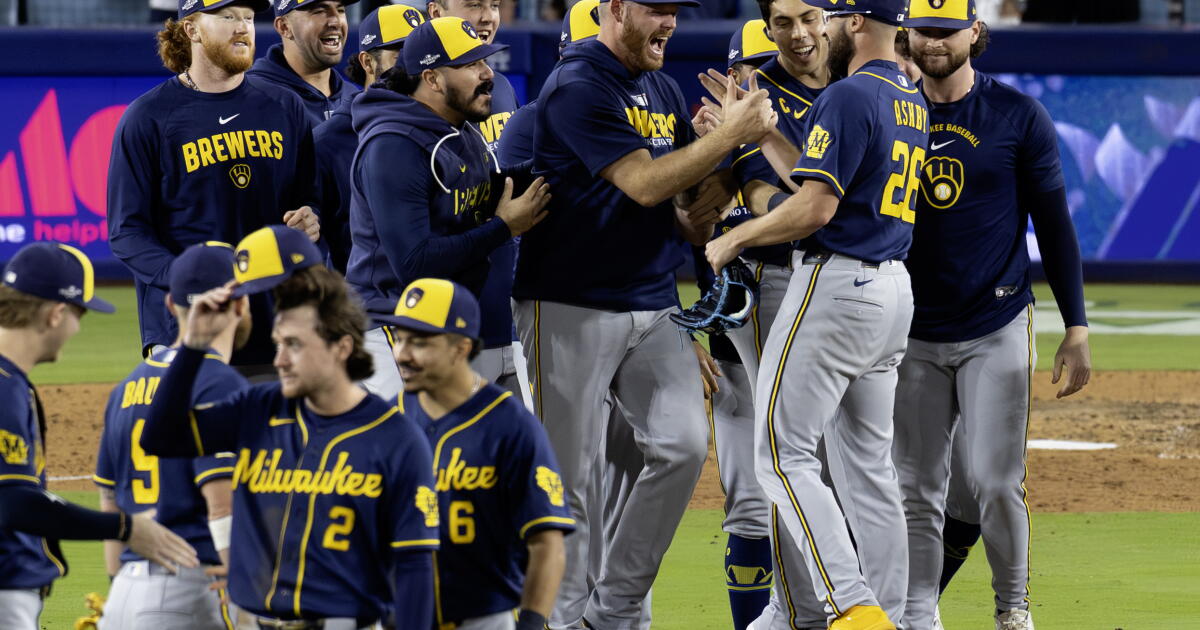
From Maddie Lee: The hope for a Dodgers comeback in the National League Championship Series ended with the smack of the ball hitting leather.
Milwaukee Brewers left fielder Jackson Chourio, sprinting toward the warning track, had to leap to reel in Kiké Hernández’s line drive in the gap. But he secured the catch. And ended the Dodgers’ season.
The Dodgers’ hopes of making National League history with a three-peat died with a 6-4 loss to the Brewers on Thursday, completing Milwaukee’s four-game sweep.
“It sucked,” veteran left fielder Teoscar Hernández said. “Especially after [what] we had done the last two years. This year at the beginning of the year, what we’ve been through, a lot of injuries throughout the year the last two years, a lot of ups and downs. It just sucked that we’re in this situation, but it’s part of the game.
“Somebody has to win, somebody has to lose. This time, we’re the ones that lost, and just reflect on everything that we didn’t do great this year and just try to do it next year.”
As the Dodgers’ postseason hype video declared before the game: “October doesn’t remember who came close. It remembers who triumphs.”
The Dodgers, after reinforcing to their back-to-back championship roster in the offseason and entering the year as the World Series favorites, fell short. And instead the Brewers will represent the National League, making their first trip to the Fall Classic in 44 years.
“They may have a bunch of Hall of Famers, but we have a bunch of gamers,” Brewers manager Pat Murphy said from the stage. “And the gamers won this week.”
Get the latest on L.A.’s teams in the daily Sports Report newsletter.
By continuing, you agree to our Terms of Service, which include arbitration and a class action waiver. You agree that we and our third-party vendors may collect and use your information, including through cookies, pixels and similar technologies, for the purposes set forth in our Privacy Policy such as personalizing your experience and ads.
The veteran infielder stood by his locker at Dodger Stadium, his eyes red and watery, his uniform covered in dirt, knowing that when he pulled them off, it would be for the last time.
“This is it, guys,” he said, announcing his retirement, after the Dodgers were swept by the Milwaukee Brewers in the National League Championship Series on Thursday. “It’s been a lot, the last four years of my life here. And obviously making my debut here in 2014 changed my life, not just for me but for my whole family. They took care of my son, my daughter, my wife, and everybody in my family. It’s really amazing what I can think about, what happened to me and to my family the last few years.”
Rojas addressed the team after the 6-4 loss to the Brewers. He said he was going to stay loyal to the Dodgers organization but in a different role.
No. 1 Milwaukee vs. No. 2 Dodgers at Milwaukee 2, Dodgers 1 (box score) at Milwaukee 7, Dodgers 4 (box score) Milwaukee 6, at Dodgers 2 (box score) Milwaukee 6, at Dodgers 4 (box score)
ALCS
No. 1 Tampa Bay vs. No. 2 Cleveland Cleveland 7, at Tampa Bay 3 (box score) at Tampa Bay 3, Cleveland 1 (box score) at Cleveland 3, Tampa Bay 2 (box score) Friday at Cleveland, 5 p.m., TBS/truTV/UniMas/HBO Max Saturday at Cleveland, 5 p.m., TBS/truTV/UniMas/HBO Max *Monday at Tampa Bay, 5 p.m., TBS/truTV/UniMas/HBO Max *Tuesday at Tampa Bay, 5 p.m., TBS/truTV/UniMas/HBO Max
World Series No. 1 Milwaukee vs. TB/Cleveland Friday, Oct. 23 at Milwaukee, TBD, FOX/FOX Deportes/FOX One Sat., Oct. 24 at Milwaukee, TBD, FOX/FOX Deportes/FOX One Monday, Oct. 26 at TB/Cle., TBD, FOX/FOX Deportes/FOX One Tuesday, Oct. 27 at TB/Cle., TBD, FOX/FOX Deportes/FOX One *Wed., Oct. 28 at TB/Cle., TBD, FOX/FOX Deportes/FOX One *Friday, Oct. 30 at Milwaukee, TBD, FOX/FOX Deportes/FOX One *Sat., Oct. 31 at Milwaukee, TBD, FOX/FOX Deportes/FOX One
* if necessary
Lakers’ Ziaire Williams brings needed energy
From Thuc Nhi Nguyen: He made one of the biggest splashes in the Lakers’ first preseason game. Ziaire Williams set the tone of the Lakers’ new defensive style, pressuring the ball the full length of the court and injecting energy into his teammates. The Sierra Canyon High alumnus sank three three-pointers in a stellar debut for his hometown team.
Then came the swelling in his left foot.
After a minor injury slowed Williams’ preseason ascent, the 6-foot-9 forward could be in position to return to the lineup for the Lakers’ preseason finale at 7:30 p.m. Friday against the visiting Denver Nuggets. Williams practiced fully Thursday after missing the last three games. He’ll leave the final call up to the Lakers’ medical staff as the team tries to maximize its preseason preparation.
“It’s important, man, just to get game reps with each other, but health is key,” said Williams, who had 13 points and a steal as a starter in the preseason opener against the Sacramento Kings on Oct. 5. “If you can’t go, you just can’t. It’s not the end of the world. Going back to championship identity, we’re looking ahead at the bigger picture. So it’s not worth [it] to risk your body for a game that doesn’t count and then be out for the real games.”
From Gary Klein: It was already going to be a short week, but Sean McVay navigated unexpected business that affected the start of preparation for Sunday’s game against the Arizona Cardinals.
Chargers’ Mike McDaniel is always coaching for his job
From Joaquin Ruiz: Chargers offensive coordinator Mike McDaniel didn’t shy away from discussing his job security Thursday amid a frustrating 0-5 start to the season.
“I feel like it’s core to my job to always feel that way,” McDaniel said when asked if he’s coaching for his job. “I need to do the very best I possibly can, all the time, because [of] the players, the organization, the fans.
“So, that’s second nature. … I think it’s disrespectful to all those that choose to invest in our game and our team to not look at things that way. The second you get comfortable in this league, it’s a wrap; it’s too good. I will be doing my very best, because from an integrity standpoint, I think it’s really insulting to do anything else. And that won’t change.”
1897 — Michigan beats Ohio State 34-0 at Ann Arbor, the first meeting between theses storied rivals.
1909 — In his fourth title defense, Jack Johnson KOs Stanley Ketchel in the 12th round at Mission St Arena, Colma, California to retain his heavyweight boxing crown.
1932 — After a 0-0 tie earlier in the season, the Green Bay Packers beat the Chicago Bears 2-0.
1946 — Detroit’s Gordie Howe scores a goal and gets into two fights in his first NHL game. The Red Wings tie the Toronto Maple Leafs 3-3.
1964 — Babe Parilli of the Boston Patriots passes for 422 yards and four touchdowns in a 43-43 tie with the Oakland Raiders.
1968 — Americans Tommie Smith and John Carlos give Black power salutes during the medal ceremonies of the 200-meter race and are later banned for life from all Olympic competition by the IOC.
1971 — Norm Ullman of the Toronto Maple Leafs records his 1,000th point in a 5-3 loss to the New York Rangers. Ullman gets two assists to become the fourth NHL player to reach the milestone.
1976 — Tony Franklin of Texas A&M kicks two field goals over 60 yards for an NCAA record. The distances are 65 and 64 yards as the Aggies beat Baylor 24-0.
1977 — The Denver Broncos intercept seven passes off Ken Stabler of the Oakland Raiders in a 30-7 victory.
1977 — The Minnesota Vikings beat the Chicago Bears 16-10 in overtime with the only successful fake field goal in NFL overtime.
1987 — Mike Tyson retains his undisputed heavyweight title with a seven-round knockout of Tyrell Biggs in Atlantic City, N.J.
1999 — Fourth-ranked Virginia Tech hangs a record-setting 62-0 loss on No. 16 Syracuse. It’s the worst shutout loss by a ranked team in the history of The Associated Press poll.
1999 — Mount Union beats Otterbein 44-20 for its 48th consecutive victory, surpassing Oklahoma’s 42-year-old all-division mark of 47 in a row.
2004 — 17-year-old Lionel Messi makes his league debut for FC Barcelona in a 1-0 win against cross-town rivals Espanyol.
2004 — Mount Union beats Marietta 57-0 for its 100th consecutive regular-season victory. The Purple Raiders’ last regular-season loss was on Oct. 15, 1994, at home against Baldwin-Wallace.
2011 — Danell Leyva becomes the first American man gymnast to win a gold medal at the World Championships since 2003. Leyva wins the parallel bars title to become the first gold medalist for the U.S. since Paul Hamm claimed the floor exercise and all-around titles in 2003.
2011 — Dan Wheldon, 33, dies in a fiery 15-car wreck at Las Vegas Motor Speedway when his car flew over another on Lap 13 and smashes into the wall just outside turn 2.
2017 — Louisville’s Athletic Assn. officially fires coach Rick Pitino nearly three weeks after the school acknowledged that its men’s basketball program is being investigated as part of a federal corruption probe. The association, which oversees Louisville’s sports programs and is composed of trustees, faculty, students and administrators, vote unanimously to oust the longtime Cardinals coach following a board meeting.
Compiled by the Associated Press
Until next time…
That concludes today’s newsletter. If you have any feedback, ideas for improvement or things you’d like to see, email me at houston.mitchell@latimes.com. To get this newsletter in your inbox, click here.
Croatia’s Hajduk Split hosted Ajax on Thursday, but chants for pre-World War II regime precede UEFA Europa League game.
Published On 16 Oct 202616 Oct 2026
Croatian leaders have slammed pro-Nazi and anti-Semitic chants by Hajduk Split football fans before their UEFA Conference League match against Ajax, while Israel’s embassy voiced shock.
Groups of Hajduk Split fans, known as the Torcida, marched through the coastal town of Split before Thursday’s match chanting: “Crush the Jews”, “Rise up Adolf (Hitler)” and “Let’s go Ustasha”, referring to the country’s World War II pro-Nazi regime, local media reported.
Recommended Stories
list of 4 itemsend of list
Dozens of fans were detained before Thursday’s match for violence. During the match, Torcida fans set off flares and other pyrotechnics in the stands, forcing more than a 10-minute stoppage.
An investigation was opened into the pro-Nazi chants and suspects are being detained, police said.
President Zoran Milanovic in a Friday statement condemned the incident as “unacceptable and shameful”.
He urged swift action against the perpetrators to “show that there is no place in Croatia for the glorification of Nazism and Ustasha ideology”.
Israel’s embassy in Zagreb said on X it was “deeply shocked by the serious antisemitic incident that took place in Split and condemns it in the strongest possible terms”.
Conservative Prime Minister Andrej Plenkovic also condemned “messages of anti-Semitism … completely at odds with the values we want to uphold in Croatian society”.
Hajduk Split, who won the game 2-1, in a statement apologised to UEFA and Ajax who “witnessed scenes which we do not want Europe to remember”, while the Croatian football federation also condemned the incident.
Croatia’s ultra-nationalist hardcore supporters have tainted the country’s image for years, notably by chanting pro-fascist slogans and displaying Ustasha symbols.
The Ustasha regime killed and persecuted hundreds of thousands of ethnic Serbs, Jews, Roma and antifascist Croatians.
Croatia were docked a point by UEFA after their fans painted a swastika on the pitch in Split in 2015, before a Euro 2016 qualifier with Italy.
The perpetrators were never found.
In recent years, the country has seen a growing tolerance for its pro-Nazi past, and critics accuse authorities of failing to sanction the use of Ustasha emblems.
A teenager who travelled from Norway to the UK to carry out a “hit” for an organised crime group has been sentenced to 20 years’ detention.
Johannes Natland, 19, was arrested in a hotel room in Huddersfield, West Yorkshire, with two working guns and 19 rounds of live ammunition in March 2025, the Old Bailey previously heard.
During his retrial, a jury heard the teen was “recruited” by the Foxtrot Network, which was described as a Swedish organised crime group backed by the Iranian regime.
Natland, who had admitted to possession of the firearms and ammunition, was unanimously found guilty of conspiracy to murder and sentenced at Woolwich Crown Court on Friday.
The Foxtrot Network has been sanctioned by both the UK and the US for its close links to the Iranian government, with Natland’s target remaining unclear.
Commander Helen Flanagan, head of Counter Terrorism Policing London, said: “We haven’t been able to establish exactly who the intended victim was.”
The Foxtrot Network is known for pioneering a relatively new phenomenon of hiring teenage killers that Europol has called “violence-as-a-service” (VaaS).
At the sentencing hearing, Mrs Justice Cheema-Grubb told Natland: “The Foxtrot Network is an organised crime group which has developed an arm’s-length method of recruiting young people to carry out violent crimes.
“You were recruited to travel to England to kill an unidentified target.”
Natland flew into Manchester Airport on an emergency passport on 17 March 2025, shortly after his 18th birthday.
He was guided by videos on the messaging app Signal to Huddersfield, where the guns, a stolen car and a stash of cash were hidden.
He was prevented from carrying out the hit after Norwegian police arrested the teenager who had recruited him for the Foxtrot Network and found messages about the UK plot on his phone.
There was then a race against time to find Natland before he located his unknown target in England.
Addressing Natland, the judge said: “At the heart of this case is a stark fact. You agreed to assassinate another human being, a stranger to you, in a foreign country.
“You knew nothing of that person’s life or circumstances. You were just 18 years old when you placed yourself in readiness to murder for money.”
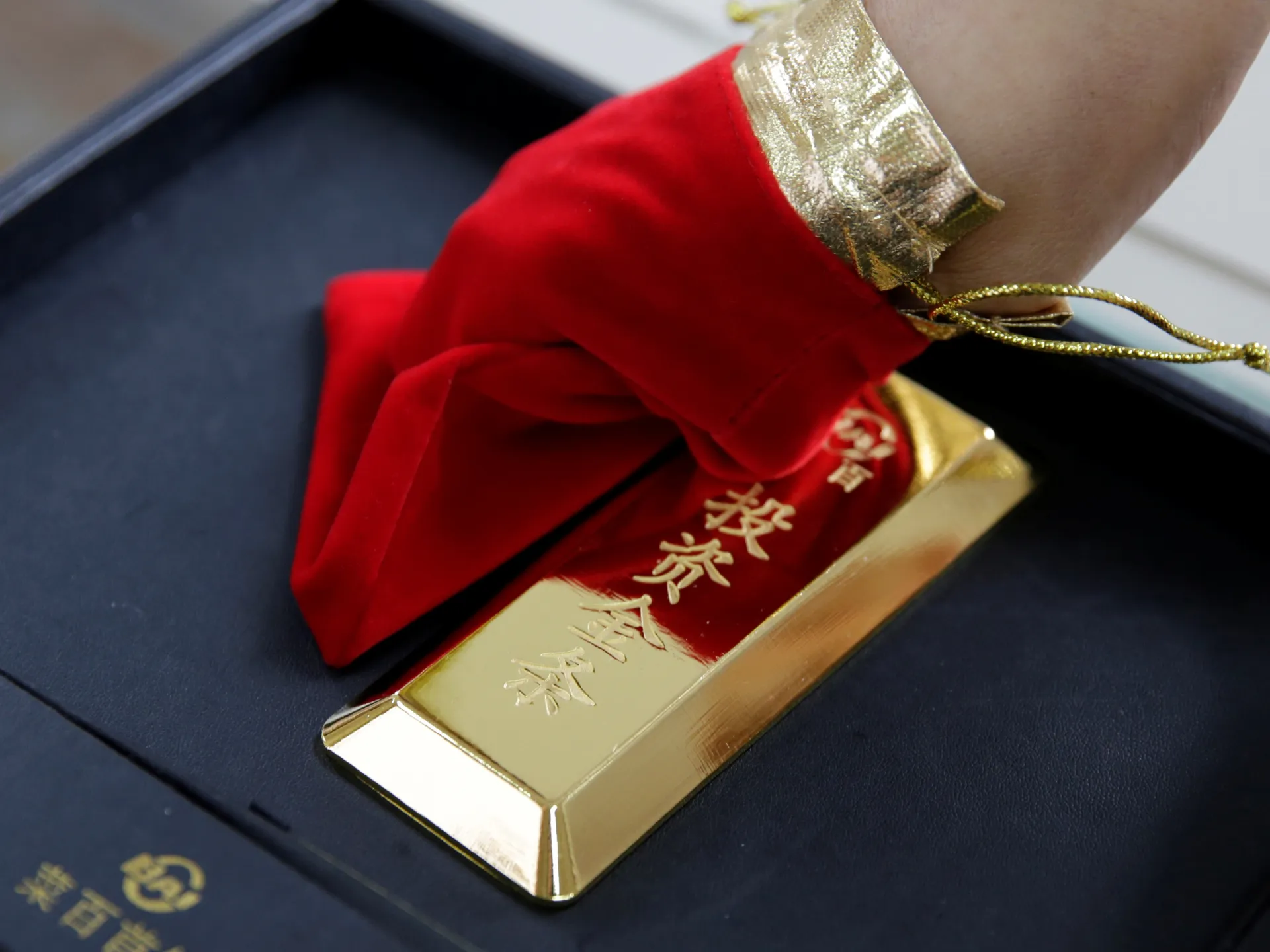
China is increasing its gold reserves in a bid to reduce its dependence on US dollar assets and protect against financial and geopolitical risks, analysts say, while households are turning to the precious metal amid uncertainty over the domestic economy.
The People’s Bank of China reported buying gold for a 23rd consecutive month in September, when the country’s central bank also made its largest monthly purchase in nearly three years. The sustained buying points to a longer-term effort to spread risk associated with its vast reserves, experts say.
Among concerns is high US debt and Western governments’ freezing of assets, which has highlighted the inherent risk in holding money overseas, particularly for emerging market and Global South economies. Gold bought and stored domestically offers protection against that risk because access does not depend on the will of another government.
But central bank buying and household demand for gold in China have different drivers. While Beijing is managing its financial exposure, private investors are seeking somewhere to preserve their savings. Here is what we know.
How much gold has China bought?
China’s central bank added approximately 23 tonnes of gold in September, bringing its reported holdings to about 2,410 tonnes, according to the World Gold Council. That was its largest monthly purchase since October 2023. Gold accounted for 8.5 percent of China’s total official reserves at the end of September, compared with 5.5 percent at the end of 2024.
Reserves are assets central banks hold to ensure they can meet international payments and respond to financial disruption. They usually include foreign currencies, foreign government debt and gold.
Private demand for gold within China has also risen, with purchases of gold bars and coins 28.4 percent higher in the first half of 2026 than during the same period last year, according to the China Gold Association. The buying of gold has continued amid falling prices, with gold down around 8.5 percent over the month.
The World Gold Council attributed the decline in gold prices partly to a stronger dollar and higher returns on US government debt. With interest rates going up in an attempt to curb inflation, these investments are attractive for buyers as they pay interest, making them more attractive to private investors than gold, which does not.
Why is China buying more gold?
A key objective is to reduce dependence on US government debt, known as Treasuries, according to Thu Lan Nguyen, head of commodity research at Commerzbank in Frankfurt.
China holds substantial reserves in dollar-based assets and, therefore, buying gold reduces its exposure to decisions taken in Washington. “China’s gold purchases are part of a broader effort to make its reserves more resilient,” Nguyen told Al Jazeera.
The freezing by Western countries of roughly $300bn in Russian Central Bank overseas assets following Moscow’s invasion of Ukraine in 2022 demonstrated how reserves held abroad can quickly become inaccessible.
The concern for China may be that a future confrontation with Washington could expose some of its overseas assets to similar restrictions. “Gold held domestically has a crucial advantage in this respect: it does not represent a claim on another country and is therefore much less exposed to sanctions or asset freezes,” Nguyen said.
“I would interpret it primarily as risk management,” she added, pointing to increased geopolitical tensions and economic and fiscal risks.
America’s rising debt, which hit $40 trillion for the first time in history earlier this year, adds another source of uncertainty. In February, the US Congressional Budget Office projected that federal debt held by the public would rise from 101 percent of the size of the US economy in 2026 to 120 percent in 2036. That provides context for concerns about Washington’s ability to repay that debt going forward should an economic crash occur. Much of this debt is held by China. Gold, therefore, offers a less volatile and risky asset to hold.
Chinese households have different motivations for buying gold. When confidence in other investments weakens, gold can become more attractive as a way to hold savings. “Strong demand for gold can partly reflect a search for alternative stores of value,” Nguyen said.
The World Gold Council has identified weak Chinese share markets as one factor supporting domestic demand for gold, while its property market is burdened by heavy borrowing and overbuilding, contributing to a fall in housing prices, making it a poorer investment.
What this means for the US dollar
Analysts warned that China’s increased buying of gold does not signal an imminent end to the dollar’s global dominance. “I would be cautious about describing this as a major shift away from the dollar,” Nguyen said. “The dollar remains by far the dominant global reserve currency.”
But a gradual shift could still matter if China and other central banks put more of their new reserves into gold, buying fewer US assets than they normally would. That could weaken one source of demand for US government debt. But the effect would depend on how widely and quickly the shift developed.
“The key point is, therefore, that this is likely to be a slow diversification process rather than a sudden abandonment of the dollar,” Nguyen said. She added that the consequences for the US economy would remain limited unless the trend broadened and accelerated substantially.
Central banks also need readily available foreign currency to support international payments and the dollar remains central to those transactions. So gold can provide financial protection, but it cannot directly replace all the functions of dollar reserves.
Who else is buying gold?
China is part of a wider trend, particularly among central banks in emerging economies, Nguyen said.
“The trend is particularly visible among emerging market central banks,” Nguyen said. “But sanctions are only part of the story.”
Poland has also become a more prominent buyer. Its central bank purchased 31 tonnes in the first quarter of 2026 and another eight tonnes in July, according to the World Gold Council.
Large holdings do not necessarily indicate recent purchases. India, for example, confirmed in June that its physical gold stock remained unchanged at about 880.5 tonnes. India’s gold reserves have changed little since mid-2025, according to the World Gold Council. It bought about four tonnes in 2025, down from 73 tonnes in 2024.
Despite China’s sustained buying, its reserves remain far smaller than those of the United States. Its holdings of about 2,300 tonnes at the end of 2025 amounted to less than one-third of the US stockpile of approximately 8,133 tonnes.
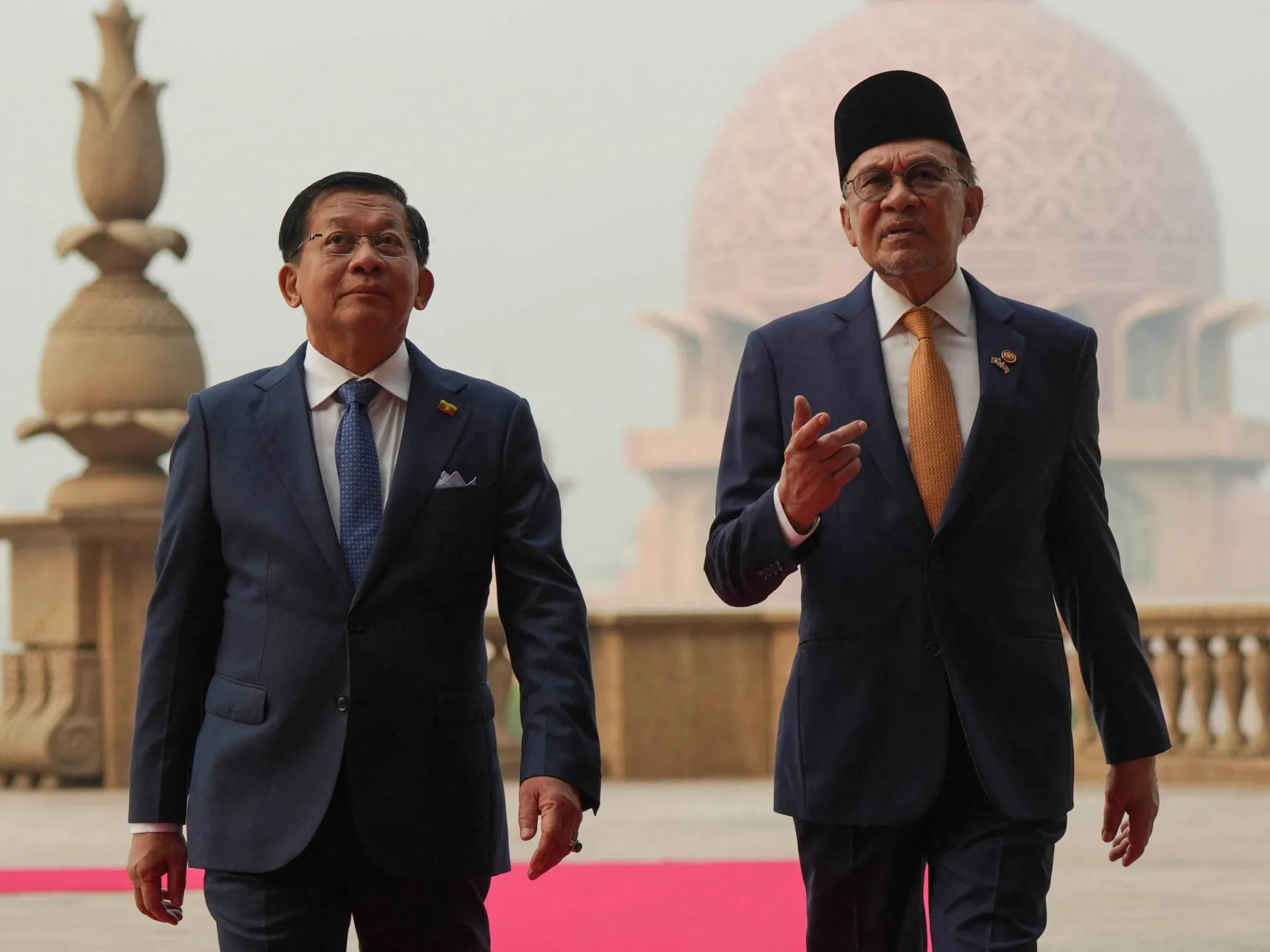
On October 8, Malaysian Prime Minister Anwar Ibrahim received Myanmar’s President Min Aung Hlaing in Putrajaya with a guard of honour and an official luncheon, in the military chief’s first visit since the 2021 coup. Nine days earlier, Malaysia sent 1,476 Myanmar nationals back by sea in the first phase of a plan to return 5,000 people.
Kuala Lumpur calls this pragmatic diplomacy. In reality, it lends a middle power’s credibility to the Trump administration’s retreat from international accountability, weakening the laws and institutions smaller states rely on most.
Domestic pressures
Since May, a surge of online hate speech and misinformation has targeted the Rohingya, Malaysia’s largest refugee community. By late July, at least nine Rohingya community schools had closed or faced closure orders, and more than 100 Rohingya told UNHCR that residents of their Penang village had driven them out.
The hostility ignores the facts: Malaysia’s police chief says Rohingya account for 0.02 percent of crime. Yet research by INITIATE.MY and the Center for the Study of Organized Hate found AI-generated content amplifying anti-Rohingya disinformation across Malaysia, Indonesia, India and Bangladesh, casting refugees as a threat and legitimising vigilante violence.
Electoral politics plays a part. After heavy losses in three state elections, and with a general election due by February 2028, Anwar’s coalition may see a hard line on Rohingya returns as a show of control, though voter disillusionment and right-wing rivals make any electoral gains uncertain.
Impunity goes mainstream
Malaysia is not acting alone. Mongolia hosted Vladimir Putin in 2024 despite an ICC arrest warrant, and Hungary welcomed Benjamin Netanyahu in 2025 despite another. Kuala Lumpur denies this is recognition, yet Anwar says Malaysia will work towards Myanmar’s full reintegration into ASEAN, and Min Aung Hlaing wants a seat at the bloc’s November summit in Manila. Each welcome makes the next easier and tells leaders accused of atrocities, from Netanyahu to Min Aung Hlaing, that diplomatic rehabilitation is possible without accountability.
ASEAN has tried this before. In April 2021, Min Aung Hlaing agreed to the Five-Point Consensus, then ignored it: The violence continued, the ASEAN special envoy never met Aung San Suu Kyi, and inclusive dialogue never began. The bloc’s one real lever was excluding military leaders from its summits. Myanmar Specialist, Arkar Hein, said “Welcoming him back with nothing asked in return rewards that defiance and tells Naypyidaw that time and a staged election can achieve what compromise would otherwise require. Each handshake abroad also makes the regime less willing to offer its opponents real concessions, and convinces them that only the battlefield will decide Myanmar’s future.”
A question of consistency
Malaysia has spent decades building its credibility as a regional peacemaker, a hard-won reputation it now puts at risk. It has facilitated the Bangsamoro peace process since 2001, helping negotiate a landmark peace agreement in the southern Philippines, and has facilitated talks in southern Thailand since 2013. In November 2024, Anwar welcomed the ICC’s arrest warrants for Netanyahu and his former defence minister, saying they “should be arrested even if they are visiting other countries”. That same month, the ICC prosecutor sought an arrest warrant for Min Aung Hlaing for alleged crimes against humanity targeting the Rohingya, and an Argentinian court has since issued its own.
The Gambia’s genocide case against Myanmar at the International Court of Justice centres on the 2016-17 operations Min Aung Hlaing commanded, which killed thousands of Rohingya, included mass rapes and burned hundreds of villages, driving more than 700,000 people into Bangladesh. UN investigators called for him to face genocide charges. Malaysia is not a party to the Rome Statute and has no legal duty to arrest him. But its credibility as a peacemaker and on Palestine rests on applying one standard to everyone.
Returns without safeguards
The returns rest on assurances no independent body can verify. UNHCR says it was not involved in the returns and had no access to verify that they were voluntary, and that safe conditions do not exist. Those returned reportedly included 27 children. Though not a party to the Refugee Convention, Malaysia is bound by the customary principle of non-refoulement, and the UN Special Rapporteur on Myanmar has warned of substantial risks.
Naypyidaw says no Rohingya are involved because it does not recognise them as citizens, but other returnees also risk arbitrary detention, prosecution and forced recruitment. The military does not even control Rakhine State, where the Arakan Army holds more than 90 percent of the territory. On September 28, a day before returns began, a military air attack reportedly killed at least 50 civilians there, following more than a dozen other mass killings by the military earlier this year.
Nor can the military-backed government deliver the peace that safe return requires. Its election saw no voting in 67 of 330 townships, and when Min Aung Hlaing offered peace talks in April, the National Unity Government (NUG) and major ethnic armed groups refused. Without a ceasefire and an inclusive political process, assurances of safe return ring hollow.
Malaysia’s frustration is nonetheless legitimate. It has hosted refugees for decades with little international support, and resettlement has shrunk since the Trump administration suspended United States refugee admissions in January 2025. But failed burden-sharing cannot justify returns without safeguards.
Pressure on the court
The ICC exists so that victims of genocide, war crimes and crimes against humanity can find justice when their own states fail them. That mission now faces unprecedented pressure. On October 9, hours after former ICC judge Navi Pillay won the Nobel Peace Prize, the Trump administration sanctioned the court itself. Burkina Faso, Mali, Niger, Chad and Venezuela have announced their withdrawal.
Yet middle powers can push back. Seventy-nine ICC members, including Canada, Brazil, Mexico and South Africa, backed the court after the first US sanctions in February 2025, and in May Hungary’s new government reversed its predecessor’s withdrawal. In Southeast Asia, the Philippines surrendered former President Rodrigo Duterte to The Hague, and on October 8 judges found him fit to stand trial for crimes against humanity, with proceedings due to begin on November 30.
Middle powers should say no
Middle powers like Malaysia, and blocs such as ASEAN and the European Union, cannot stop US sanctions, but they need not follow the Trump administration’s lead. As Canadian Prime Minister Mark Carney told the World Economic Forum in January, middle powers “must act together, because if we’re not at the table, we’re on the menu”.
Malaysia and its neighbours should lead by saying no: No to efforts to weaken the court, no to treating Min Aung Hlaing’s presidency as a clean slate, and no to Rohingya returns into an active conflict. Malaysia should back efforts to hold him accountable if ICC judges issue a warrant, and reconsider acceding to the Rome Statute, a move it abandoned in 2019.
Saying no does not mean disengaging. Kuala Lumpur should tie Myanmar’s reintegration into ASEAN to real progress on the Five-Point Consensus, starting with an end to violence and inclusive dialogue involving the NUG and ethnic armed organisations. At home, it should pause returns until an independent body confirms they are safe and voluntary, and hold accountable those who evict, threaten or attack refugees.
Malaysia should not carry this burden alone. ASEAN partners, members of the Organisation of Islamic Cooperation and donors should fund refugee registration, education and integration, and resettlement countries should restore their commitments. Governments should also hold tech platforms accountable for amplifying anti-refugee disinformation and require swift action against incitement.
For years, Malaysia has offered refuge to the Rohingya and others fleeing Myanmar when few countries would. That record gives it the standing, and the responsibility, to defend the system of international justice it has long championed.
The views expressed in this article are the author’s own and do not necessarily reflect Al Jazeera’s editorial stance.
United States President Donald Trump has for the first time explicitly ruled out the use of a nuclear weapon against Iran, but has not denied US media reports that his administration is considering deploying the US’s most lethal non-nuclear munition, nicknamed the “mother of all bombs” in the near future.
In an interview published on Thursday by right-wing American news site Newsmax, Trump suggested he does not plan to use nuclear weapons, but also clarified that the devastating aerial weapon, the GBU-43/B Massive Ordnance Air Blast Bomb (MOAB – ‘mother of all bombs ) “is not nuclear”.
Recommended Stories
list of 4 itemsend of list
“I wouldn’t use nuclear. We don’t have to. We’re the greatest nuclear power in the world,” he told Newsmax.
The comments marked Trump’s first definitive statement on the nuclear topic following speculation about a possible atomic conflict earlier in the US and Israel’s war on Iran. They also appeared to confirm speculation that another phase of the war is imminent, likely after the US midterm elections on November 3.
Here’s what we know:
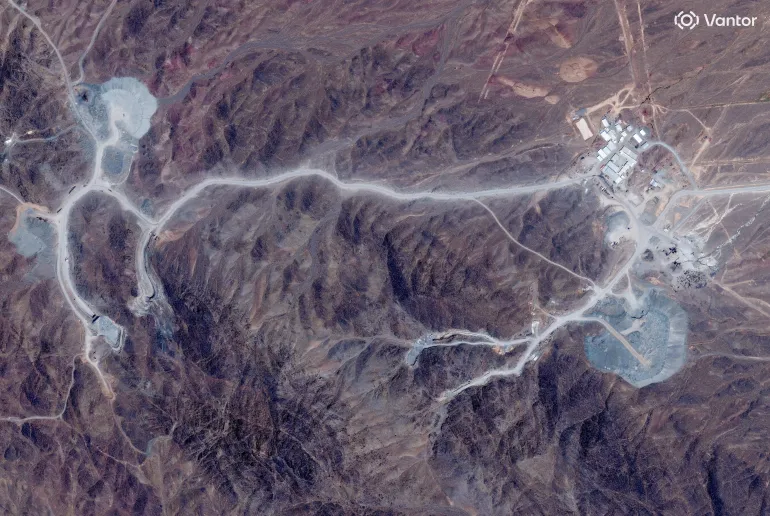
A satellite view of tunnel entrances on Pickaxe Mountain at the Natanz nuclear facility in Iran, June 30, 2026 [Vantor/via Reuters]
What did Trump say?
Trump told Newsmax that the US might indeed launch another strike on Iran’s nuclear sites, particularly on Pickaxe Mountain, where Tehran is believed to be hiding a nuclear facility deep under layers of granite.
He ruled out using a nuclear weapon or a tactical nuclear weapon.
“I wouldn’t use nuclear. We don’t have to. We’re the greatest nuclear power in the world,” he said.
He also clarified that the MOAB, which CNN reported the US government is considering using, “is not nuclear”.
Responding to a question about whether the MOAB is “tactical nuclear” – meaning smaller nuclear munitions – Trump reiterated that it is not.
“Well, the mother of all bombs is not nuclear,” Trump said. “It’s not nuclear at all. This is just an extremely large bomb.”
Trump declined to say whether he had authorised its use in Iran.
Trump also suggested renewed attacks are likely in the near future. The US cannot end the war now because it has to ensure Iran cannot produce a nuclear weapon, he argued, saying he believes that “if they had it, they would use it, in my opinion, instantaneously”.
Trump also reiterated that the war would end “very soon” whether by force or diplomacy and that oil prices would then drop.
When asked if he would put “troops on the ground”, Trump said: “No, I don’t see that, I don’t see it.” Earlier in the war, Trump had made comments regarding sending in troops, a move analysts said would be devastating for US soldiers because of Iran’s mountainous territory.
What is the ‘mother of all bombs’?
The MOAB carries a massive payload of about 8,500kg (18,000 pounds or 8.5 tonnes) of high explosives. It weighs 9,800kg (21,605 pounds or nearly 10 tonnes) – about the same as four cars – and is just over nine metres (about 30 feet) long. Stealth bombers are too small to carry it, so it has to be deployed by larger, Lockheed C-130 Hercules transporters.
It is designed to explode a few metres above the ground, sending out intense fireballs that can blast buildings and other hard-surface structures within a 1km radius, experts have told Al Jazeera. It is so powerful that a mushroom cloud from its blast has been seen 32km (20 miles) away in tests, the US Air Force has said.
“Its large explosive charge can produce devastating blast effects against exposed personnel, equipment and vulnerable structures,” Brussels-based military and weapons analyst Elijah Magnier said. “Its purpose is to generate an exceptionally powerful blast across a surface area.”
However, Magnier said there is doubt about whether using the massive surface explosive would be effective against deeply buried nuclear installations in Iran. He added that the terrain in Iran could be difficult for larger cargo aircraft to access.
What has Trump previously said about nuclear weapons?
Trump has never explicitly mentioned using a nuclear weapon, but he has also never ruled it out.
Speculation regarding whether Washington might use nuclear weapons was rife in the early days of the conflict, largely because of the extreme nature of Trump’s numerous threats against Tehran.
In April, for example, as Iran enforced a blockade on ships in the Strait of Hormuz, Trump posted on his Truth Social site that “…a whole civilisation will die tonight, never to be brought back again”, if Iran did not agree to a peace deal and reopen the strait.
He also threatened to destroy Iran’s infrastructure, saying a bombing campaign “will be Power Plant Day and Bridge Day, all wrapped up in one”, in Iran.
Experts widely interpreted his statements as a threat of nuclear destruction, but one that still failed to force Iran to the table.
Although Trump largely moved away from his sabre-rattling rhetoric in the following weeks, he reiterated at the United Nations General Assembly in New York last month that he could “annihilate” Iran. He also told the assembly that he believed a deal would emerge after the midterms.
What is a ‘tactical’ nuclear weapon?
“Tactical” nuclear weapons (TNW) are smaller nuclear munitions designed for the battlefield as opposed to strategic nuclear munitions designed for mass destruction.
Some perceive TNWs as having a lesser impact than an atomic bomb, but experts warn that their names are misleading and they can nevertheless be devastating. Their explosive yield, between 0.3 and 50 kilotons, can impact areas within a 500-600km radius.
The US dropped a 15-kiloton nuclear bomb on Hiroshima, meaning that weapon would today be considered a TNW. The US, North Korea and Russia have TNWs in their arsenals, although no country has ever used them. TNWs are not subject to any international treaties and are largely unregulated.
What might another US attack on Iran look like?
With Trump failing to rule out dropping the MOAB, analysts speculate that the US might launch another – perhaps final – intensive bombing campaign targeting Iran’s nuclear and defence sites, particularly Pickaxe Mountain.
The US could also continue its naval blockade on Iranian ports, while providing escorts for commercial ships through the Strait of Hormuz.
Iran has vowed to respond to escalatory strikes by targeting oil and digital infrastructure in neighbouring Gulf states.
Senior defence officials have also warned that Iran will invade its neighbours if the US launches a ground operation, although Trump appears to have ruled that out.
Earlier in the war, he hinted at the possibility of sending ground forces to retrieve some 400kg of “yellowcake” – highly enriched uranium that Washington and Israel claim Tehran has hidden underground.
Trump’s phone calls in March to Kurdish militia groups fighting Iran provoked speculation that Washington could coordinate with them for an invasion, although that did not happen.
Rishi told the ITV stars: “There’s the pitter-patter of brand new little dancing feet in the Strictly family. Big Brother host Will Best has announced he’s become a dad for the first time, welcoming a baby boy with his fiancée, Tobi Rose.
“The couple have named their little bundle of joy Sonny. Will shared some adorable snaps from the hospital, saying they’re feeling ‘very lucky’ and, of course, very tired. With Strictly’s Icons Week coming up tomorrow night, Will’s got a very little special supporter cheering him on from home.”
The programme then played a clip from Will’s socials where he was seen holding his newborn in the hospital. He told his followers he had got a “cool new thing today”, and he gave a glimpse at his newly born son.
When the clip ended, Ranvir called it “so lovely” as Rishi highlighted how small the baby was. Ranvir added, “You know what’s funny, though? Will Best will go, ‘Gosh, you know what love, I’m so tired’. She’ll be like, ‘Err, I’ve just given birth to a baby?’. You know what I mean?”
As Kate suggested, Will could get out of the night feeds, Ranvir stated he wouldn’t want to, as she added: “Congratulations, Will and Tobi”.
Will took to Instagram to announce the news himself on October 15 as he shared a selection of adorable images introducing Sonny to the world.
He captioned the post: “Well, who do we have here then?! Welcome to the world, Sonny Best, you little smasher. @tobiroseofficial, you’re a miracle, and I love you so much. A couple of tired new parents (see last slide), but oh my goodness, aren’t we lucky xxx”
Content cannot be displayed without consent
It wasn’t long before people commented on the announcement, with one person saying: “Oh Will! He’s perfect! Huge huge congrats to you and Tobi!” Another wrote: “Huge congrats to you both!! Welcome to the world, Sonny!”
Currently, Will is one of the 13 remaining celebrities taking part in Strictly Come Dancing. He’s been matched with professional dancer Dianne Buswell, with the pair expected to perform an Elton John-inspired routine on Saturday night for Icons Week.
Good Morning Britain continues weekdays on ITV from 6am. Strictly Come Dancing airs Saturday October 17 on BBC One from 6:15pm.
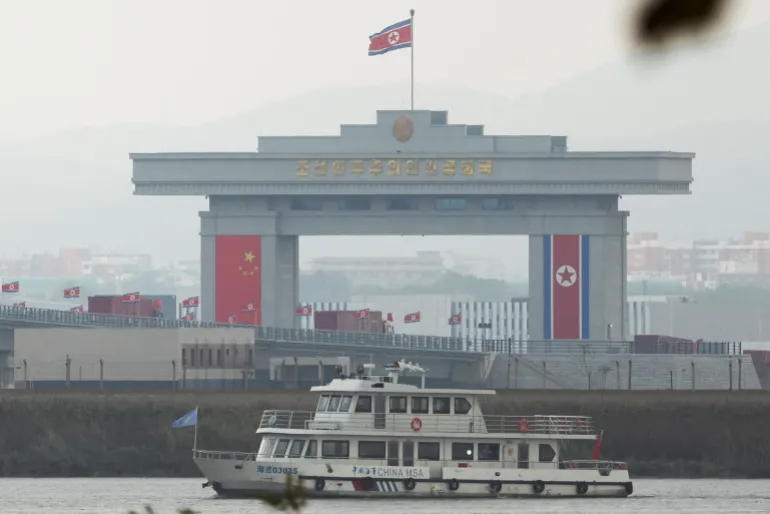
As China and North Korea cut the ribbon on New Yalu River Bridge this week, officials described the new border crossing in momentous terms.
Chinese Premier Li Qiang said the 3km (1.9-mile) bridge, which links China’s Dandong and North Korea’s Sinuiju, would “vigorously promote” trade and “strengthen emotional bonds”.
Recommended Stories
list of 4 itemsend of list
North Korean Premier Pak Thae-song expressed his belief that the crossing would “accelerate the advance for the prosperity of the two countries” and “add fresh vigour” to their economic cooperation.
Analysts on China-North Korea ties are much more circumspect.
While the bridge is a concrete symbol of China and North Korea’s efforts to revitalise relations that have waned from their Cold War-era peak, the prospects for trade are hindered by obstacles ranging from international sanctions to a North Korean leadership that prioritises security above all else, experts say.
“It reflects China’s renewed effort to strengthen its relationship with North Korea at a time of changing regional alignments,” Phillip Park, a professor at the University of North Korean Studies in Seoul, South Korea, told Al Jazeera.
“But whether this leads to substantially deeper economic integration, greater North Korean dependence, or a significant shift in Pyongyang’s strategic orientation remains an open question.
“The bridge could facilitate trade and logistics, but it does not remove international sanctions,” Park added.
A Chinese maritime patrol vessel travels along the Yalu River as trucks adorned with Chinese flags cross the newly opened New Yalu River Bridge into North Korea’s Sinuiju from China’s Dandong New Zone, as seen from Dandong, Liaoning province, China, on October 15, 2026 [Florence Lo/Reuters]
China, whose troops fought alongside Pyongyang in the 1950-53 Korean War, has long been North Korea’s most crucial economic benefactor.
China accounts for as much as 95 percent of official trade with the secretive country, which is among the world’s most diplomatically and economically isolated states.
Before the four-lane New Yalu River Bridge officially opened on Thursday, road and rail freight between Dandong and Sinuiju, the main route for China-North Korea trade, travelled exclusively via the ageing Sino-Korean Friendship Bridge.
Opened in 1943, the bridge, which has a single-lane road and a rail track, can only carry vehicles weighing a maximum of 20 tonnes.
Jae-woo Joo, a professor of Chinese foreign policy at Kyung Hee University in Seoul, said the new bridge could “tremendously” boost trade between the sides, including the transfer of components banned under sanctions against Pyongyang’s nuclear and missile programmes.
“It is therefore really significant to open this bridge with China,” Joo told Al Jazeera.
After coming under strain from North Korea’s nuclear weapons tests in the mid-2000s, Beijing-Pyongyang ties have warmed under Chinese President Xi Jinping and North Korean leader Kim Jong Un.
At Xi and Kim’s most recent meeting in June, their seventh summit since 2018, the leaders pledged to enhance cooperation in areas spanning trade, defence, agriculture, law, science and technology.
Analysts have, in part, cast Beijing’s deepening engagement with Pyongyang as a response to the latter’s growing ties with Moscow, which have included the deployment of thousands of North Korean troops to the front lines of Russia’s war in Ukraine.
Last month, North Korean and Russian officials opened the first road bridge linking their countries across the Tumen River.
Chinese President Xi Jinping walks with North Korean leader Kim Jong Un, right, to a reception following a military parade to commemorate the 80th anniversary of Japan’s World War II surrender held in front of Tiananmen Gate in Beijing, China, on September 3, 2025 [Mahesh Kumar/AP]
North Korea and China’s two-way trade grew 25 percent in 2025 to reach $2.74bn, according to figures from China’s General Administration of Customs.
Bilateral trade has continued to grow in 2026, jumping nearly 20 percent to reach $1.5bn in the first half of the year, putting it on track to reach its highest volumes since the COVID-19 pandemic.
But while growing, trade remains relatively minuscule in the context of global commerce.
With China’s overall trade hitting $6.36 trillion in 2025, North Korea’s contribution to the total was a little more than 0.04 percent.
Official trade between the neighbours also remains substantially below its 2010s heyday.
Trade hovered around $5-6bn throughout much of the decade, peaking at $6.45bn in 2013.
Economists have offered explanations for the slowdown that range from tightened sanctions to China’s waning reliance on imports amid its efforts to boost economic self-reliance.
Christopher Green, a senior consultant for the Korean Peninsula at International Crisis Group, said the new border crossing’s significance should not be overstated, considering that China-North Korea trade “is fundamentally driven by politics”.
“Lack of cross-border transit routes is not the main obstacle,” Green told Al Jazeera.
“If the bridge opening signifies a political desire on both sides to give political cover to rising trade volumes, then a boost to trade should follow,” Green said, describing ties up until now as “steady-as-she-goes” economic engagement.
“Time will tell. But the key is the politics of national security, not economics.”
Vehicles drive through a new bridge linking China and North Korea as it opened in North Phyongan province, North Korea, on October 15, 2026 [Cha Song Ho/AP]
As much as officials have hailed the New Yalu River Bridge as a reflection of Chinese-North Korean cooperation, the project had a long and torturous road to completion.
Construction began in 2011 and was finished on the Chinese side in 2014.
But North Korean authorities only completed roads and customs facilities on their side of the river this year following repeated pauses in construction amid tensions with Beijing.
“The 12-year delay certainly suggests that economic cooperation is more conditional than the language of friendship might imply,” Marco Mari, a PhD researcher at Bocconi University in Italy who studies China-North Korea economic ties, told Al Jazeera.
“The bridge can facilitate supplies and economic activity, while Russian support gives North Korea alternatives that diminish Beijing’s leverage,” Mari added.
“This does not necessarily imply broader economic reform or a comparable improvement in ordinary people’s lives.”
Chinese Premier Li Qiang, on screen, makes a speech through video conference as a new bridge linking China and North Korea opens in North Phyongan province, North Korea, Thursday, October 15, 2026 [Jon Chol Jin/AP]
Weiqi Zhang, an associate professor at Suffolk University who studies relations between North Korea and China, said the history of China-North Korea economic ties is littered with abortive projects, such as the Hwanggumpyong Special Economic Zone, a North Korean-Chinese development near Dandong.
“There were cases, like the Hwanggumpyong Special Economic Zone – established by China and North Korea – where China built infrastructure on its side, but North Korea didn’t even pave the road on their side,” Zhang told Al Jazeera.
“One reason is that, unlike its neighbours, North Korean government doesn’t really pay much attention to trade for economic development,” Zhang said.
“International trade is used by North Korea more like a foreign policy tool.”
With China wishing to demonstrate its “indispensability” as a trade partner and North Korea eager to strengthen their economic ties, trade is likely to grow, said Edward Howell, a lecturer in international Relations at the University of Oxford.
Even so, economic engagement will be subject to political considerations, Howell said.
“North Korea will obviously want to avoid facing any Chinese influence to change its economic model, but Pyongyang will want to reap the economic benefits of trade with its principal economic benefactor,” Howell told Al Jazeera.
A father whose two-year-old boy fell to his death at a five-star hotel in Cyprus has been fined 3,000 euro (£2,500).
Joshua Foster thought the window was closed when he placed the boy on a sill to show him the view of a waterpark and “lost control” of him, Paphos District Court previously heard.
The boy fell nearly 40ft (12.1m) from the fourth floor of the King Evelthon Beach Hotel and Resort on 12 July, the first day of the family’s holiday in Chlorakas.
Foster, 37, from Essex, admitted causing death through a reckless, rash or dangerous act and was sentenced on Friday morning.
He held back tears as his sentence was handed down by the judge, before hugging his lawyer and parents.
Foster had lifted his son on to the windowsill to show him the view of a water park, the court in Cyprus was previously told.
This breaking news story is being updated and more details will be published shortly. Please refresh the page for the fullest version.
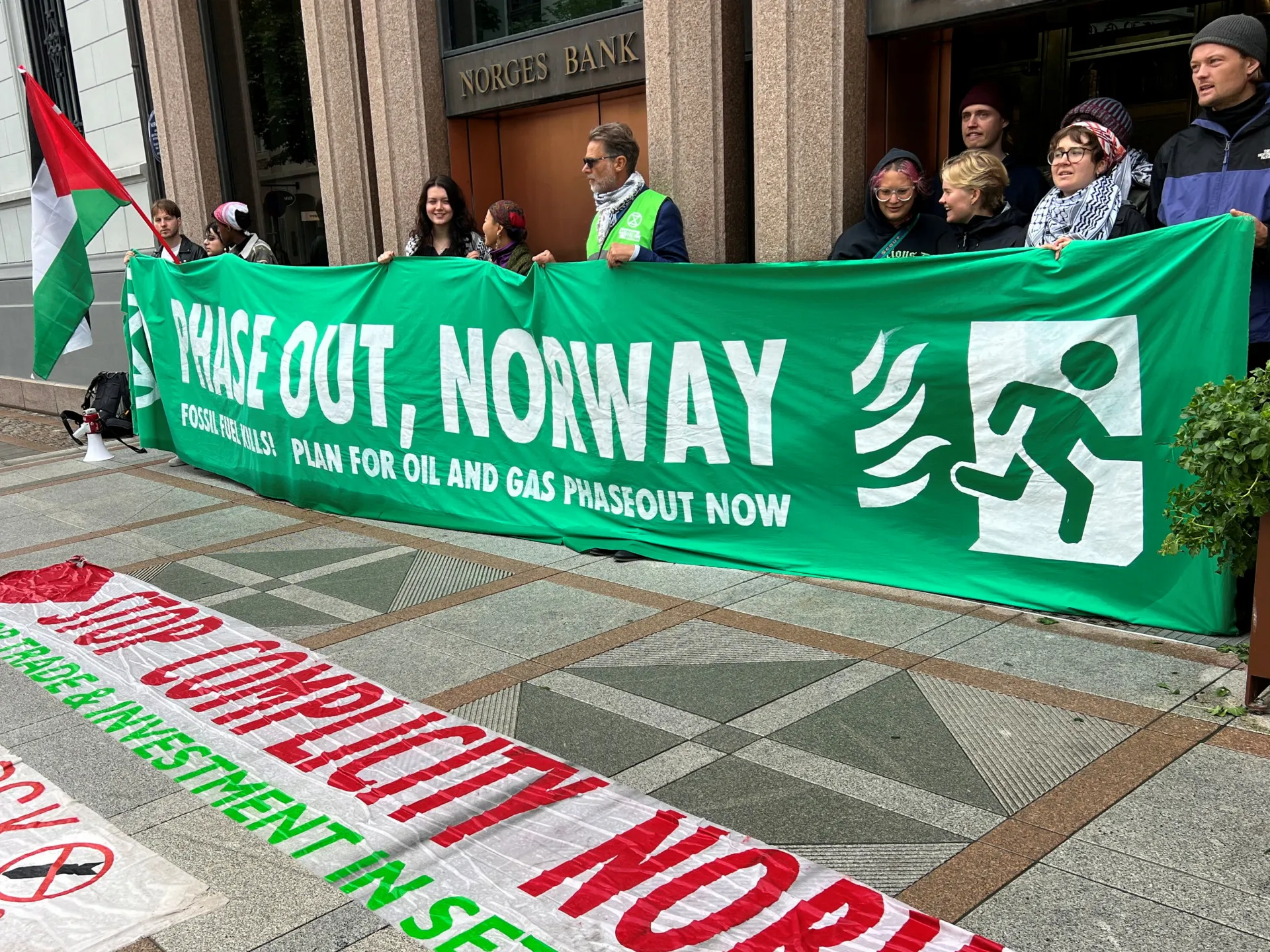
Review prompted by Gaza action calls for Norway’s sovereign wealth fund to lift ethical risk limitations on its investments.
A government-appointed committee has called for Norway’s sovereign wealth fund to lift limitations on its investments based on ethical risks, including those regarding nuclear weapons and Israel’s genocidal war on Gaza.
In a report released on Thursday, the committee said the world’s largest sovereign wealth fund, which controls assets totalling nearly $2.3 trillion, should be allowed to invest in companies that produce nuclear weapons. With reference to Gaza, it also called for the fund to refrain from involvement in diplomatic issues.
Recommended Stories
list of 3 itemsend of list
Led by former Central Bank Governor Svein Gjedrem, the committee recommended easing the fund’s investment conditions as part of a broader overhaul that would give its manager, the central bank, greater discretion over how it addresses ethical risks.
The review was prompted in part by controversy over the fund’s disinvestment last year from United States construction giant Caterpillar. The fund said the move was prompted by Caterpillar’s purported involvement in rights violations perpetrated by Israel amid its genocidal war on Gaza and in the occupied West Bank. Washington has since pressured Oslo over the move.
“Parts of the rationale for the appointment of the Committee was the Fund’s management related to the war in Gaza,” the committee commissioned by the government said. In the report, it argued that decisions regarding “another state’s conduct” should not be made by the fund but “reserved for the ordinary diplomatic channels of the Norwegian authorities”.
The unanimous recommendations of the committee in the report, which was submitted to the Ministry of Finance, also called for a review of the fund’s exclusion of investment in companies involved in the production of nuclear weapons.
Citing Norway’s reliance on NATO’s nuclear deterrent and a worsening security environment, the report suggested that investments in companies based in the US, United Kingdom and France that are involved in the production of nuclear weapons should be allowed.
The proposals also extended to reshaping the role of the fund’s independent ethics watchdog, allowing some assessments of potential investments to remain confidential.
‘Pandora’s box’
The report has already provoked a backlash in Norway, with opposition politicians slamming the potential changes. Meanwhile, analysts suggested that weakening ethics considerations could have a wide impact.
“If the Norwegian sovereign wealth fund – often considered a global gold standard – changes its posture towards nuclear weapons, it will open Pandora’s box for many global investors to follow suit,” Lawrence Loh, director of the Centre for Governance and Sustainability at the National University of Singapore Business School, told Al Jazeera.
The committee framed the proposed change as an obligation to protect Norway’s national security, citing the country’s dependence on its allies’ nuclear umbrella.
“The global security situation has changed. Norway is building up its defence capabilities, and the protection provided by NATO’s nuclear umbrella has become increasingly important. The companies that would be reincluded produce weapons that Norway needs for its own defence”, the report argued.
Gareth Evans, former Australian foreign minister, told Al Jazeera the report was “an encouraging initiative in a world that has become alarmingly complacent about the risks of nuclear war, with every major nuclear arms control agreement dead, dying or on life support, and the longstanding taboo against threat or use eroding”.
Amid US President Donald Trump’s shake-up of NATO, European countries are increasingly looking to join France’s nuclear deterrent umbrella.
Trump said on Thursday that Washington is holding talks with Russia and China aimed at denuclearising the countries with the biggest stockpiles of nuclear weapons.
However, Loh warned that shifting the Norwegian fund’s investment conditions could encourage investment by others in nuclear companies “in scenarios different from the Norwegian’s condition of the invested companies being based in allied, nuclear-armed NATO countries”.
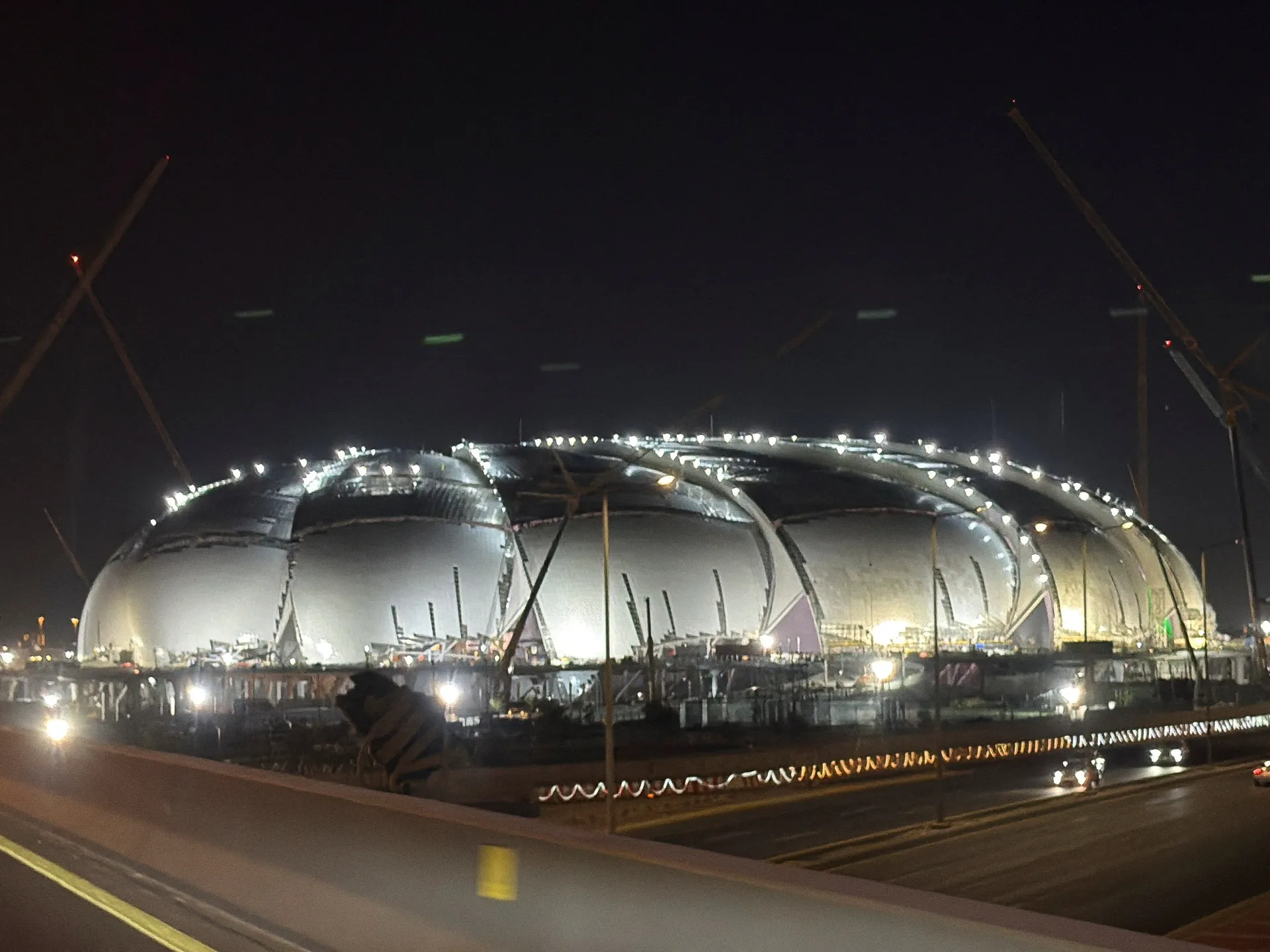
Asian Cup preparations continue for January, but Asian Tour delays golf’s Saudi Invitational after Houthi attacks.
Published On 16 Oct 202616 Oct 2026
The Asian Cup football tournament is on track to take place in Saudi Arabia early next year, local organisers say, but golf’s Asian Tour has postponed the Saudi International indefinitely in the aftermath of a series of attacks on Riyadh.
Yemen’s Houthi group claimed responsibility for the deadliest attack, which took place on Saturday on Riyadh’s international airport. It killed 14 people and wounded more than 300.
Recommended Stories
list of 4 itemsend of list
Australia also withdrew its team from the urban cycling World Championships on Friday, citing safety concerns over travelling to Riyadh, where the event is scheduled to take place in early November.
The Six Kings Slam exhibition tennis tournament in Riyadh has already been moved from October to December while FIFA on Thursday postponed the FIFAe Finals 2026 video game competition in Jeddah until an unspecified future date.
In that environment, serious questions were being asked about whether the 24-team Asian Cup could still go ahead in Saudi Arabia from January 7 to February 5.
Three Saudi Pro League matches, including one featuring Cristiano Ronaldo’s Al-Nassr, were postponed this week while Al-Nassr’s Asian Football Confederation (AFC) Champions League game on Monday was delayed by an hour after Saudi Arabia’s Civil Defence said it had intercepted a missile fired towards Riyadh.
AFC chief Salman bin Ibrahim Al Khalifa said earlier this week that a postponement of the continental championships until 2028 was possible if necessary, but the local organising committee (LOC) said on Friday that it was sticking to the original schedule.
“Preparations across all organisational and operational areas are progressing according to the approved schedule, including work on venues, facilities and supporting services,” it said in a statement.
The LOC “will continue to monitor developments relevant to the tournament and ensure the appropriate conditions are in place for its successful delivery”.
Attacks in Saudi Arabia disrupt sport calendar
The $5m Saudi International, which is sponsored by Saudi Arabia’s Public Investment Fund (PIF), is the flagship event on the Asian Tour and had been scheduled to take place at Riyadh Golf Club on November 18-21.
“The decision to postpone was taken following an assessment of the organisational and logistical challenges associated with hosting the tournament and ensuring the event is delivered to a standard befitting its international stature,” an Asian Tour statement said.
AusCycling said its decision to withdraw the Australian team from the urban World Championships was made “with the safety and wellbeing of our athletes and staff our highest priority”.
The Australian government is advising travellers to “reconsider” trips to Saudi Arabia in general and Riyadh’s King Khalid International Airport in particular “due to recent security incidents”.
The Saudi government has invested heavily in sport through the PIF in recent years, and the Asian Cup was pitched as an early rehearsal for hosting football’s FIFA World Cup in 2034.
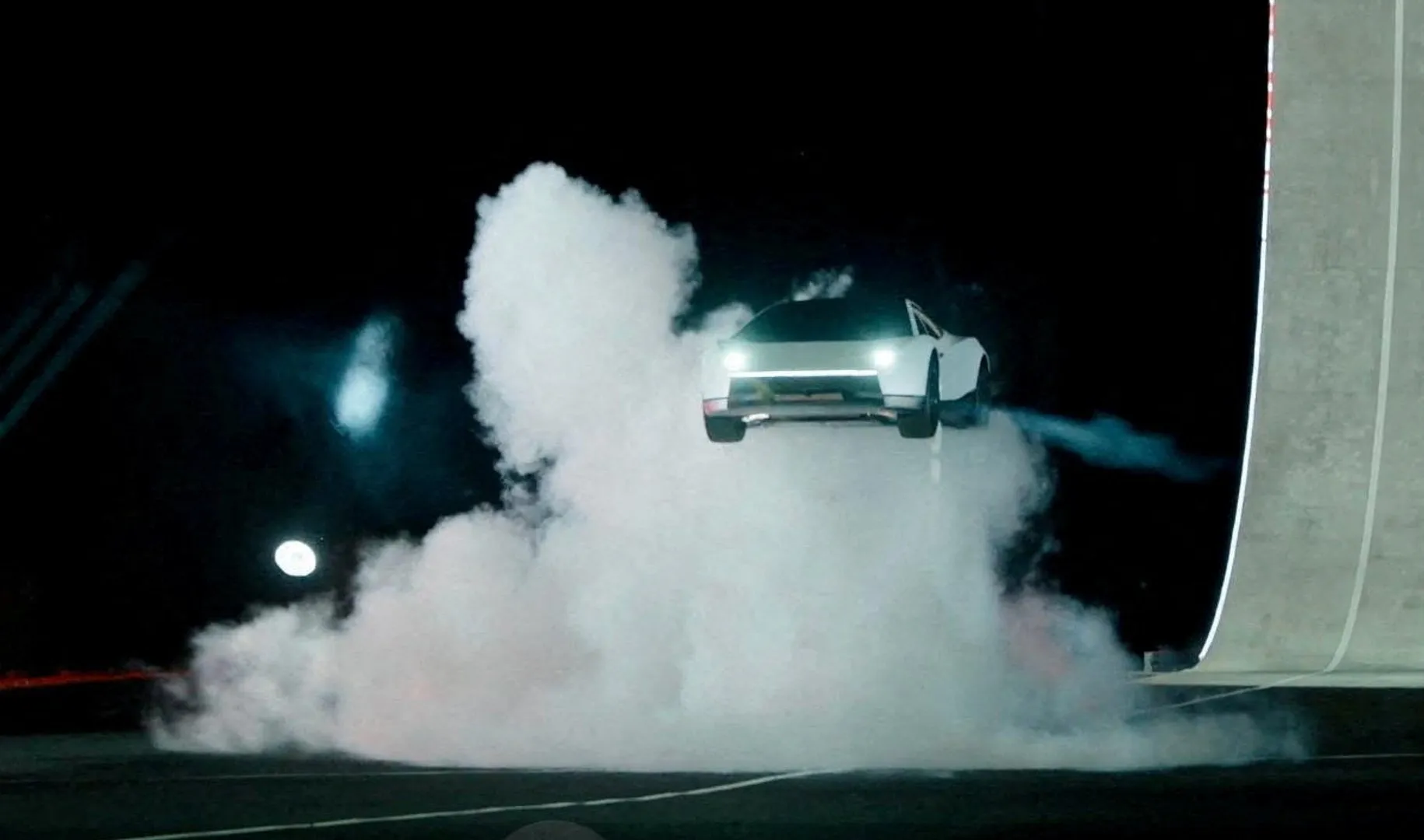
Tesla has unveiled an electric sports car that can drive upside down and use rocket-like thrusters to jump and turn mid-air. Developed with Elon Musk’s SpaceX, it can reportedly accelerate to 97km/h in under a second. First promised in 2017, the car is now expected in 2028.
For every five plates of food served around the world, roughly one ends up in the bin. That adds up to more than a billion tonnes of food a year.
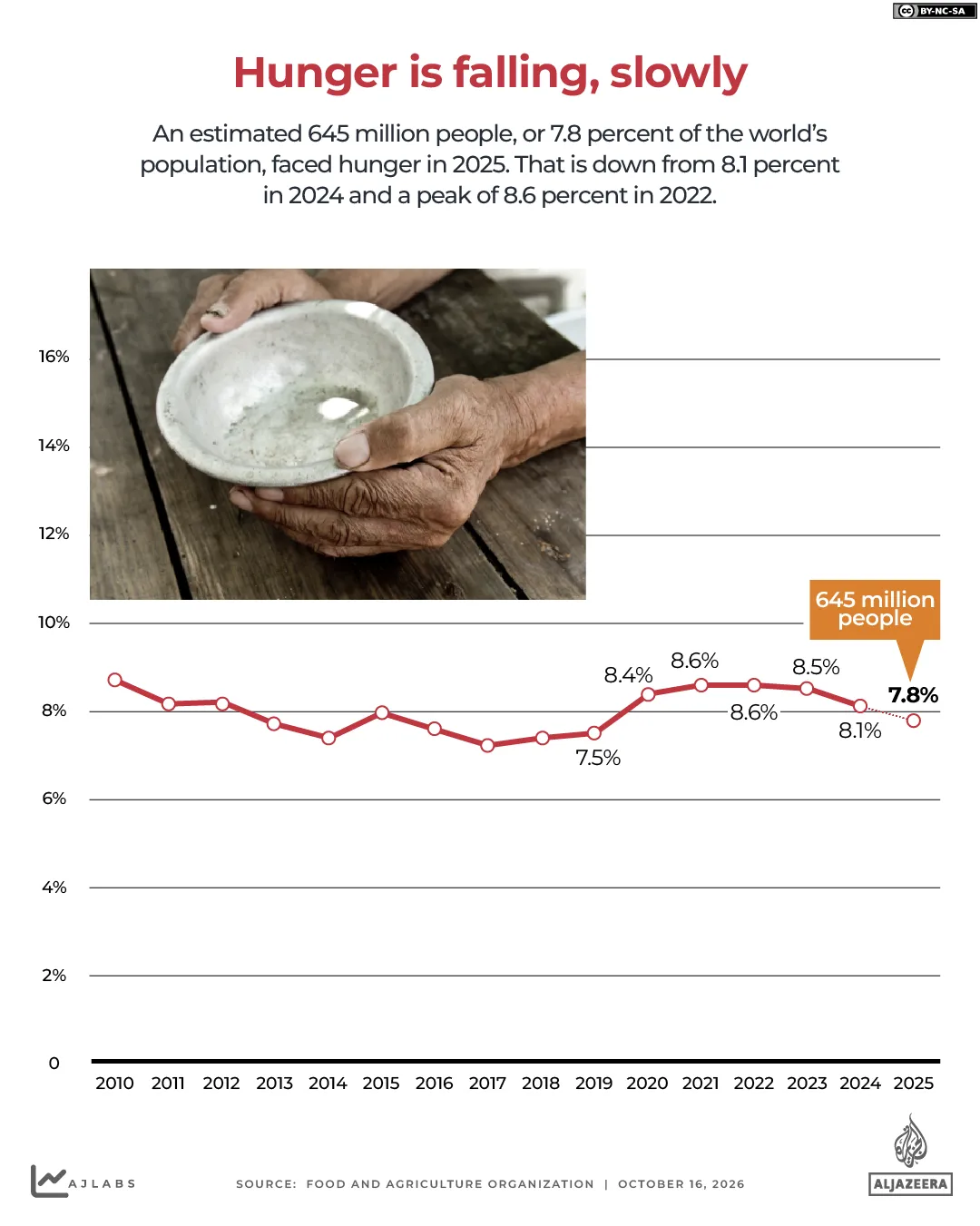
Meanwhile, 645 million people, about one in 13 of the world’s population, went hungry in 2025, according to the UN.
That gap is the focus of World Food Day on October 16, the annual UN observance marking the founding of the Food and Agriculture Organization (FAO) in 1945. This year’s theme, “Innovate today, nourish tomorrow”, calls for food systems that feed more people and waste less.
In this visual explainer, Al Jazeera looks at global hunger, which countries waste the most food and simple ways to waste less at home.
Hunger is falling, slowly
Global hunger has fallen for a third year in a row, but it remains above levels seen before the COVID-19 pandemic.
According to the UN’s annual State of Food Security and Nutrition in the World report, an estimated 645 million people, or 7.8 percent of the world’s population, faced hunger in 2025. That is down from 8.1 percent in 2024 and a peak of 8.6 percent in 2022, but still about 61 million more people than in 2019.
[Al Jazeera]
Where are people the most hungry?
Africa has more hungry people than any other region.
In 2025, an estimated 309 million people in Africa were undernourished. That is one in five people on the continent and almost half of the world’s hungry people.
By comparison, 292 million people in Asia (6 percent of the population) and 32 million in Latin America and the Caribbean (4.8 percent) were undernourished.
The 2026 Global Hunger Index shows a similar pattern at the country level. The index scores countries out of 100, combining undernourishment with child stunting, child wasting and child mortality. Scores of 35 or more are considered “alarming”.
Hunger is classed as alarming in eight countries, seven of them in Africa. Somalia has the worst score of the 122 countries ranked, followed by the Democratic Republic of the Congo, Chad and Madagascar.
Sudan, South Sudan, Burundi and Yemen were also classed as alarming, but conflict and data gaps meant the index could not calculate their scores.
At the same time, a large share of the food the world grows never reaches a plate.
How much food is wasted every year?
Food is lost and wasted at every stage of its journey from farm to table.
According to the FAO, about 13 percent of the food produced globally is lost after harvest and before it reaches shops, spoiling in storage, during transport or in processing. Fruits and vegetables suffer the highest losses.
Food lost before it reaches shops is worth more than $400bn a year, according to the FAO.
Shops, restaurants and households then throw away almost a fifth of the food available to consumers, about 1.05 billion tonnes in 2022, according to the UN Environment Programme (UNEP). That is equivalent to 52.5 million trucks, each carrying 20 tonnes.
Households account for the most, 60 percent, followed by restaurants and other food services at 28 percent and shops at 12 percent.
How to reduce food waste at home
Most food waste happens at home, which means households can make a real difference. Here are some simple steps recommended by food waste campaigners and UN agencies:
Plan before you shop: Check what you already have, plan meals for the week and shop with a list to avoid buying more than you need.
Understand date labels: “Use by” dates are about safety, but “best before” dates are about quality. Food is often still safe to eat after its “best before” date.
Store food properly: Keep your fridge at 5C (41F) or below, and store fruit and vegetables where they last longest. Bananas, for example, speed up the ripening of other fruit nearby.
Use the freezer: Bread, cooked meals, meat and many fruits and vegetables can be frozen before they go off.
Cook the right amount: Measuring portions, especially for rice and pasta, cuts down on leftovers that get thrown away.
Eat the oldest food first: Move older items to the front of the fridge and cupboard so they get used before newer ones.
Use leftovers and scraps: Turn leftovers into new meals, and use vegetable peels and stalks in soups and stocks.
Compost what you can’t eat: Composting inedible parts such as peels and eggshells keeps them out of landfills, where rotting food releases methane.
A ‘best before’ label on Heinz baby food tells shoppers when the product is at its best quality, not when it stops being safe to eat [Anthony Devlin/Getty Images]
Which country wastes the most?
On average, every person in the world wastes about 132kg (291 pounds) of food a year, roughly the weight of two adults. Of that, 79kg (174 pounds) was thrown away at home.
But the amount varies widely. Hotter countries tend to waste more at home, UNEP says, possibly because of more fresh produce and less refrigeration.
The Maldives wastes the most food, with each person throwing away about 260kg (573 pounds) a year, about twice the global average. Syria, the Dominican Republic, Seychelles, Mexico and Tunisia follow, each wasting more than 210kg (463 pounds) per person, according to UN estimates.
Spain recorded some of the lowest levels, at around 39kg (86 pounds) or less per person.
What does food waste cost?
Food loss and waste costs the global economy more than $1 trillion a year, according to the UN.
To put that in perspective, what else could $1 trillion buy?
Use the + buttons to add items to your cart and see how the money would be spent across 35 categories.
Throwing food away also wastes the money, land and energy used to produce it.
About 1.4 billion hectares (3.5 billion acres) of land, or 28 percent of the world’s agricultural land, is used to grow food that is never eaten. That is an area larger than Canada.
Food loss and waste also generate an estimated 8 to 10 percent of global greenhouse gas emissions, including methane released as food rots in landfills.
Vibe coding allows people to use AI to build software without writing code themselves. And now, free AI-generated alternatives to popular programmes like Premiere Pro and Excel are emerging, sparking security concerns and hidden costs.
Lebanon’s president reaffirms the commitment to bring all arms under state control.
Published On 16 Oct 202616 Oct 2026
Lebanon’s President Joseph Aoun has discussed the confiscation of explosives intended for use against Israel during a telephone call with United States Secretary of State Marco Rubio, the Lebanese Presidential Palace has announced.
Aoun received the call on Thursday, assuring Rubio that Lebanese security forces are fully carrying out their duties in confiscating illicit arms across the country.
Recommended Stories
list of 3 itemsend of list
Last week, an explosive-laden truck carrying 780kg (1,720lb) of explosives was intercepted on a highway between Beirut and the eastern Bekaa Valley.
On Thursday, Hezbollah lawmaker Hassan Fadlallah acknowledged the group’s connection to the shipment, stating that the materials were intended for operations against Israel.
Speaking to reporters at the Lebanese parliament, Fadlallah said Hezbollah had immediately contacted security agencies to clarify ownership of the vehicle and cargo, demanding the materials be returned and detained personnel released.
Rubio urged Aoun to hold accountable those who ordered, financed, and directed the shipment, warning that “returning explosives to [Hezbollah] should be out of the question,” a State Department official told US media.
The official added that Rubio also advocated for direct military-to-military communication between Lebanese and Israeli forces “for deconfliction”.
In response, the Presidential Palace reported that Aoun asked Rubio to press Israel to halt its attacks and destruction in southern Lebanon.
Separately on Thursday, Rubio spoke with Israeli Prime Minister Benjamin Netanyahu regarding Iran, according to Israeli media reports.
The explosives-laden truck
On Monday, Prime Minister Nawaf Salam confirmed that Lebanon would conduct an investigation to track down members of Hezbollah linked to the incident.
Judicial officials told The Associated Press news agency that the truck was carrying 780kg (1,720lb) of explosives, including 250kg (550lb) of TNT and 550lb of C4 plastic explosives.
Salam described the transport as a “criminal operation” and praised security forces for intercepting the vehicle along the strategic highway linking Beirut with the Bekaa Valley.
For years, Hezbollah moved weapons freely across parts of the country. However, in March, the Lebanese government declared all military activities by the group illegal. Despite the government’s pledge to bring all weaponry under state control, the group has stated its intention to continue transporting arms in its confrontation with Israel.
Earlier this spring, Lebanese and Israeli envoys met in Washington under the auspices of US Secretary of State Marco Rubio, marking the first direct diplomatic contact between the two nations in decades.
Despite that diplomatic push from Washington, Israel has repeatedly violated the November 2024 ceasefire deal between it and Hezbollah, with Lebanon frequently reporting civilian casualties.
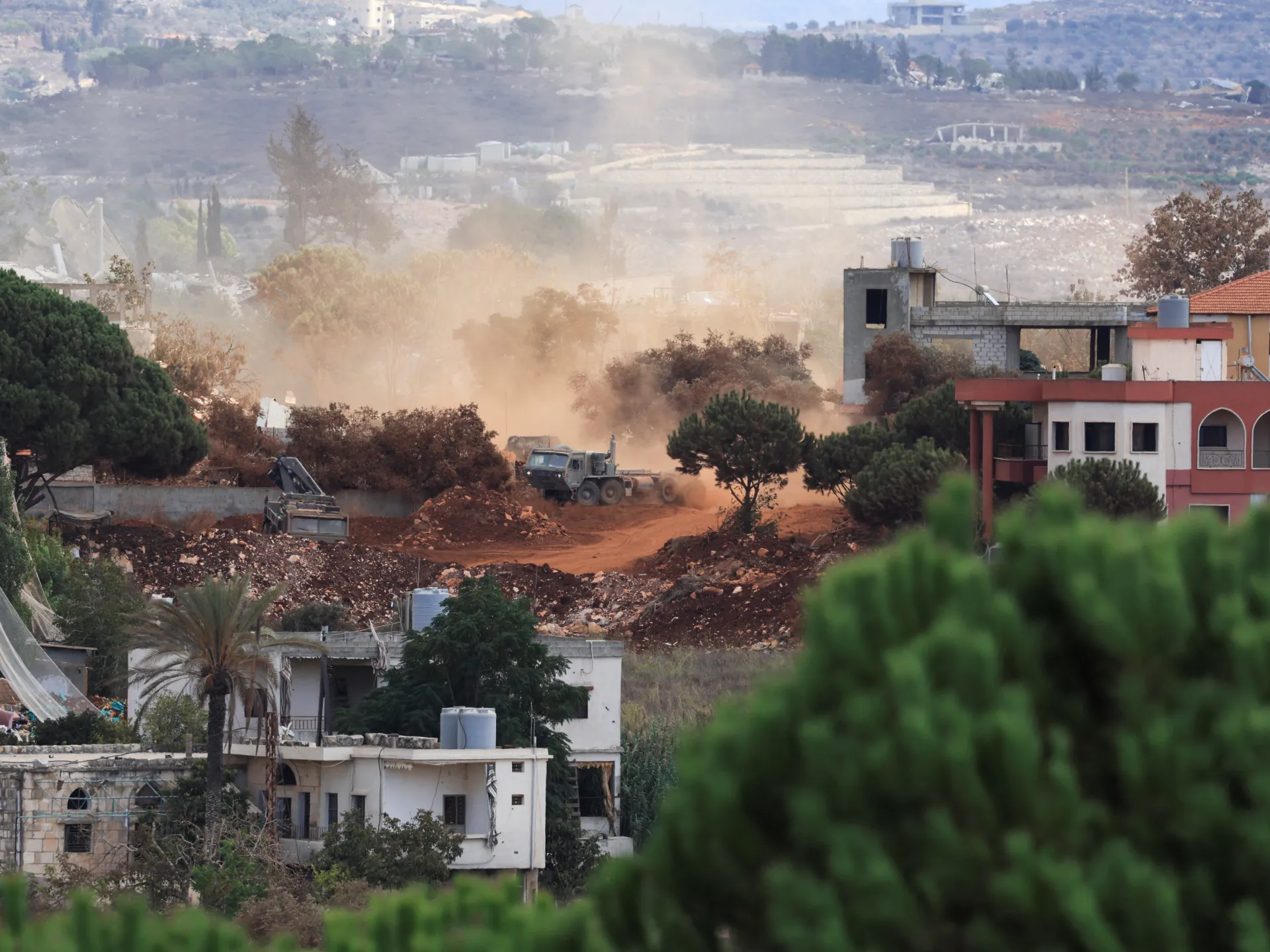
The renewed diplomatic friction comes as heavy Israeli attacks continue across southern Lebanon, where dozens of villages have been systematically demolished and large areas remain under Israeli military occupation, despite a framework agreement signed in June.
A woman holds a sign that reads in Spanish, “Corruption has left us in the dark,” during a protest against power cuts in Valencia, Venezuela, on Oct. 2, 2026. (Graphic by Truthdig; images by AP Photo, Adobe Stock)
The “biggest oil deal in history” was announced almost simultaneously by acting Venezuelan President Delcy Rodríguez and U.S. PresidentDonald Trump on Aug. 28. However, many Venezuelans didn’t find out until the next day because massive blackouts — up to 16 hours a day and partly caused by increased oil production — kept them from scrolling the news.
At the United Nations a month later, Trump bragged that he had taken Venezuela’s “spoils,” while Rodríguez said the deal with the U.S. would contribute to resolving the energy needs of “the hemisphere and the international economy.” Venezuelans then asked: What about our energy needs and economy?
The oil deal, the legal and operational details of which are still unknown, covers the exploitation of 17 fields and 65 billion barrels, which equates to 20% of Venezuela’s total reserves — the world’s largest, at an estimated 303 billion barrels. U.S. companies will invest $100 billion in exploiting the fields, a figure which — according to Venezuelan government projections — would translate into more than $209 billion in tax revenue for Venezuela over the years of the contract.
The announcement sparked questions and criticism from different sectors of the country, with concerns about the lack of information and the impact on sovereignty. In response, Rodríguez tried to explain the deal’s benefits in a nationally televised address, noting, “How much does Venezuela receive? Based on a barrel price of $65 … revenue would reach $209.3 billion for the state. In concrete terms, this means that for every barrel produced and sold, about $19 goes to [Venezuela].”
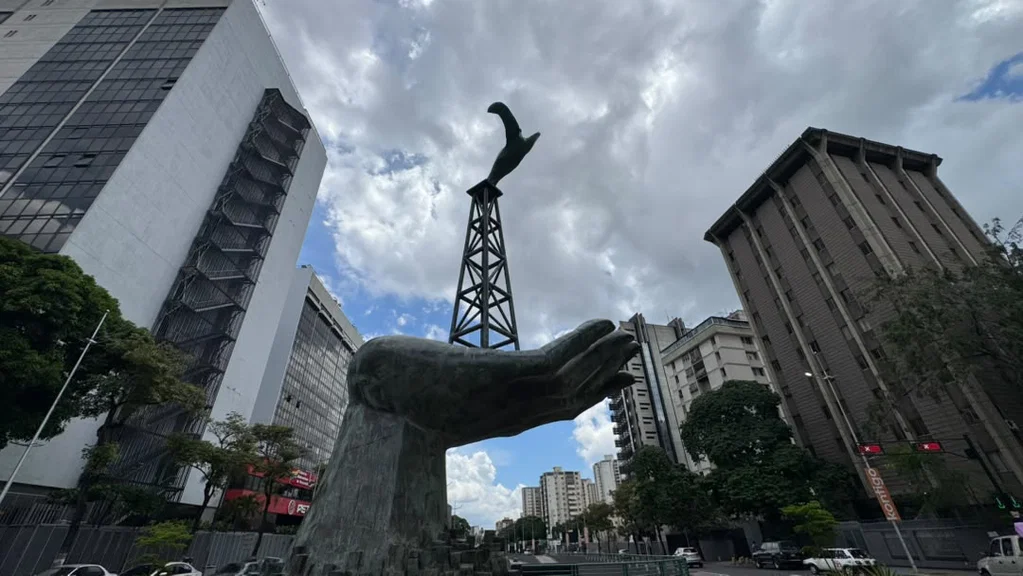
Paúl del Río’s Monument to Peace, erected in 2003, honors the recovery of the Venezuelan oil industry after the government increased state control in 2001, and after the opposition strike ended. (Jessica Dos Santos Jardim)
Oil drives the Venezuelan economy. Currently, it accounts for 71% of the nation’s total exports, but now much of that revenue goes to the U.S. In the first quarter of this year, out of a total of $7.76 billion in exports, $5.5 billion came from oil activity. As the acting president’s address went on, many of us only had more doubts.
A few hours later, Venezuelan economist Francisco Rodríguez summed up some of the nation’s concerns: “Do the projected tax revenues … correspond to nominal amounts, inflation-adjusted amounts, or net present values? A nominal amount of $19 per barrel in 2051, the project’s final year, would correspond to a real value of about $9 today.”
“The $209 billion equates, over 25 years, to about $8.4 billion annually, a relatively low amount compared with the tax revenue Venezuela has collected in the past at similar production levels. The amount would be even lower if it corresponds to a nominal total.” According to Central Bank of Venezuela data, Venezuela took in a record $82.8 billion in 2008 alone from oil sales.
Contradictions
Trump later contradicted Delcy Rodríguez’s 25-year timeline, saying the deal would involve a century of concessions. Francisco Rodríguez, the economist, noted that extracting 65 billion barrels in 25 years would be impossible, due to lack of infrastructure.
“What rights does the U.S. acquire over these resources after 25 years? Can a future Venezuelan government decide to withdraw from this deal if it doesn’t like it?” he asked.
And why wouldn’t they like it? Trump said on Truth Social that Venezuela will begin supplying the U.S. strategic oil reserve immediately through “a gift.” Nobody knows what that means exactly, but since the military intervention on Jan. 3, the revenue generated by the sale of Venezuelan oil — we don’t know how much that is either — is already “in the custody” of the U.S. Treasury.
“It doesn’t look like Venezuela will benefit broadly in the long term. It’s like being on floor minus-18 and going up to minus-10,” Venezuelan researcher Blas Regnault, who specializes in energy policy and oil governance, told Truthdig from The Hague, Netherlands.
“There could be an indirect reactivation of the economy because of the indirect jobs that may emerge in some regions. But let’s also keep in mind that the country has been 100% blockaded, suffocated, so any door that opens will bring some benefits, but this is not the benefit one would expect for a sovereign country,” he said.
“That’s the other problem: There’s no sovereignty of any kind over the resource itself, over what’s being sold. On top of that, there’s a lot of opacity — you’re analyzing blind.”
This “opacity” is also illegal. Articles 150 and Article 187, Paragraph 9, of Venezuela’s Constitution state that contracts of national public interest with foreign states or entities require approval from the National Assembly. However, although the Assembly endorsed the announcement of the deal on Sept. 1, its president, Jorge Rodríguez, said it had not yet been “submitted” to the legislature. Then, a month later he said that “according to some legal experts, it doesn’t need to be reviewed.”
It’s clear that Venezuela is once again, as it was for much of the 20th century, a kind of “U.S. oil province,” Regnault says, “Recovering sovereignty won’t be easy because Venezuela is strategic to U.S. interests.”
“On top of that, the other side of the coin is that China has become a key player [globally]. Today the Chinese do what Saudi Arabia used to do when it cut production and pushed prices up. With this Strait of Hormuz crisis, after the naval blockade of Iran, it was discovered that China had more reserves than previously thought, and that kept the crisis from being bigger and the price from reaching $150.”
That is precisely why U.S. Secretary of State Marco Rubio celebrated the fact that several of the oil fields included in the deal were once “dominated by China and Russia and Iran.” At the same time, the U.S. government has decided to maintain sanctions against Venezuela, thereby preventing any new economic players. In fact, the U.S. Treasury Department, through its Office of Foreign Assets Control, updated its oil licensing policy for Venezuela in late September through Orders 46E, 48D and 49B, which benefit U.S. businesses but maintain an absolute ban on Russia, Iran, Cuba, North Korea and China.
“The [Venezuelan] government has already amended the Hydrocarbons Law to try to create more favorable conditions for investors in the oil and gas sector, but … the [U.S.’] problem isn’t domestic supply. They need to monopolize the world’s energy reserves, markets and prices in order to prevail in the rest of their economic activities,” oil expert David Paravisini explains to Truthdig from Caracas, referring to a legal reform that was passed on Jan. 29 and created the possibility of technical and operational management and direct commercialization by private companies. He believes that for Venezuela, the deal is a diplomatic “quest” to survive.
People block a street during a protest against power cuts in Valencia, Venezuela, on Oct. 2, 2026. (AP Photo/Jacinto Oliveros)
Trump is also maintaining some of his domestic support by presenting Venezuela as the great economic and geopolitical victory of his administration, especially after the war against Iran — which was supposed to last “only a couple of weeks” — reached the six-month mark and cost more than $37.5 billion through the end of July. In fact, Trump has claimed again and again that this oil deal will lower fuel costs inside the U.S. and come “at no cost whatsoever to the American taxpayer.””
Does this mean the $100 billion investment will come from private companies? The deal also aims to exploit eight greenfield blocks, areas where crude has been identified but which have not yet been developed. But what happens if that investment does not materialize? Since Jan. 9, Trump has been trying, without success, to persuade U.S. oil companies to invest in Venezuela.
Corruption is fine if the U.S. profits
So far, the only company we’ve heard about is North American Blue Energy Partners (NABEP), which was selected on Aug. 31 by the Trump administration to lead oil extraction projects in the 17 Venezuelan fields.
According to the White House, the Department of Defense will hold a 35% equity stake in NABEP and, in addition, the Barbados-registered company will grant Washington the right to buy 20% of the oil it produces at the cost of production.
NABEP, which has only operated in Venezuela for two years, was awarded the deal without a prior bidding process. The company belongs to Venezuelan businessperson Alejandro Betancourt, who was under investigation by federal prosecutors in Florida until January 2026 for allegedly laundering more than $1 billion from the state-owned Petróleos de Venezuela (PDVSA). The case was then closed suddenly under the orders of U.S. Deputy Attorney General Todd Blanche (now the attorney general), after a decade-long investigation. He is still the subject of open investigations in Switzerland and Spain.
Betancourt comes from a middle-class family but studied at the private religious school Instituto Cumbres de Caracas, where he befriended Javier Alvarado Pardi, son of Javier Alvarado Ochoa, who later became president of Electricidad de Caracas, deputy energy minister and a PDVSA executive.
Back in 2009, Alvarado Ochoa presented Betancourt and his engineering firm, Derwick Associates, as the best solution to Venezuela’s power generation crisis. Betancourt went on to receive 12 government contracts, awarded without competitive bidding, worth a total of $5 billion, which were either never completed or were implemented improperly, according to Transparency Venezuela and the Organized Crime and Corruption Reporting Project (which is funded by the U.S. government, among other countries).
So why Betancourt? Rubio said that he is no longer under investigation by the U.S., has supported the Venezuelan opposition and he has demonstrated his ability to produce oil. In that vein, NABEP claims it produces 200,000 barrels of crude a day, just behind Chevron.
However, Victor Hugo Majano, a Venezuelan investigative journalist and director of the well-known outlet La Tabla, told Truthdig that Betancourt overbilled the Venezuelan state by billions of dollars for power plants that never worked. He cited information from Thor Halvorssen, an anti-Chavista activist and cousin of Venezuelan opposition leader Leopoldo López. With that money, Betancourt bought a Dassault Falcon private jet and the historic Alamíin Castle in Spain.
Halvorssen also says Betancourt, who is also linked to 50 companies spread across 15 countries, paid former New York prosecutor Adam S. Kaufmann to halt prosecutions; former Wall Street Journal reporters to discredit whistleblowers; and former New York City Mayor Rudy Giuliani to bring the U.S. Justice Department over to his side.
“Despite this, the U.S. still doesn’t attack Venezuelan corruption. They want to protect the dollar and the U.S. financial system. They are only worried about securing capital flow, money that is not controlled by the state, the [Venezuelan] government,” Majano said.
More oil for the U.S., less electricity for Venezuela
Meanwhile, Venezuelans are paying the price for both Betancourt’s alleged corruption and the oil deal. So far this year, oil production has increased by 29.9%, going from 924,000 barrels per day (bpd) in January to an average of 1.2 million bpd. The increase has been driven by the need to deliver oil to U.S. companies, and it has directly worsened the nation’s electricity crisis.
Authorities acknowledge this; Venezuela’s interior minister, Diosdado Cabello, said in May the country is seeing higher electricity demand due to the growth in oil production, which “is a very serious problem.” The Ministry of Electrical Energy also noted that demand has reached 15,625 megawatts (MW), “the highest energy consumption figure in the last eight years, an increase of 3.6% compared with the peak reported in 2025.”
However, this statement omits that Venezuela actually has a nominal installed capacity of approximately 35,000 MW, double the country’s peak demand, but stable real generation barely reaches 11,000 MW. This shortfall is a result of both U.S. sanctions and domestic corruption, which together have led to disinvestment, lack of maintenance, fuel shortages (plants designed to run on natural gas have been forced to use low-quality diesel) and transmission problems.
Where does oil production come in? Víctor Poleo, an electrical engineer and former vice minister of Energy and Mines from 1999 to 2001, told Truthdig that “the national oil industry uses up about 1,500 MW, of which about 250 MW is self-generated, but another 1,250 MW is taken from the national interconnected system. This draw is 24/7 and must be continuous in order to carry out crude extraction, transport, pumps and compressors and refining.”
High-voltage transmission lines cross the Waraira Repano mountain range overlooking Caracas, Venezuela. (Jessica Dos Santos Jardim)
Poleo, who bases his analysis on studies by fellow electrical engineer Nelson Hernández, says light, medium and heavy crudes are estimated to require between 9 kilowatt-hours and 15 kilowatt-hours per barrel to produce. For extra-heavy Orinoco crudes, the estimate is 24 kilowatt-hours per barrel. “As a result, citizens lose their quality of life so that oil can be produced.”
This deterioration is particularly notable in Zulia state, Venezuela’s so-called oil cradle, where production has risen to between 350,000 and 370,000 barrels per day of light and medium crude — far below the historic peak of 1.5 million bpd in 2004, but a figure that, for its residents, has translated into daily blackouts exceeding 12 hours.
From the Isla Dorada residential complex in northern Maracaibo, capital of Zulia, José Javier León tells Truthdig that power failures “have worsened dramatically.” In his area, outages used to last four hours but now exceed seven.
“In many places there are double rounds, meaning the power goes out in the morning and at night, or at night and then before dawn. All the problems have gotten worse, and we don’t know the real reasons. In the suburb of Cuatricentenario, one of the most working-class areas and where the government had the most electoral support, the cuts are the worst,” he says.
León complains that residents are not alerted when the outages will happen. There is nothing like the electricity rationing schedules of the past, which would at least let them plan better. “In my area, there is no domestic gas, so we have electric stoves. Also, these are apartment buildings, where we have to turn on pumps to get water.” To make matters worse, the temperature in Zulia often reaches 39 degrees Celsius (102 Fahrenheit) because of the humidity.
In the Andes, outages add up to as many as 12 hours a day, and 16 hours in rural or border areas. From La Hechicera, an urban neighborhood in the city of Mérida, Silvana Solano tells Truthdig that the power used to go out for seven to eight hours, once a day, “but for the past two months, it goes out twice a day, the first time for seven hours and the other for around five hours, and we can’t predict the schedule. This also affects phone signals, which keeps us from communicating, making payments, etc.”
Some government institutions, including the Mérida mayor’s office, are open only from 8 a.m. to noon. Solano says she is worried that public schools, which operate until 3 p.m., will also adopt this schedule, in turn affecting parents’ working hours. Throughout September, residents of the towns of Caja Seca (Zulia state) and Nueva Bolivia (Mérida state) blocked the Pan-American Highway to protest the power outages.
To Venezuela’s north, on the famous Margarita Island, Alejandro Pérez tells Truthdig there are areas that have gone seven to eight months without water service. “Here we pay for water trucks, $50 for 10,000 liters of water, sometimes with $60 we get 13,000 liters, but you have to pay in foreign cash or at the parallel rate because the Central Bank of Venezuela exchange rate isn’t accepted here.” The black market or informal exchange rate is worth more, for those with foreign currency, than the official exchange rate.
Unlike other Caribbean islands, Margarita doesn’t have significant natural sources of fresh water. Some 90% of the area’s water comes from the mainland, crossing the sea through underwater pipelines that require gigantic pumping stations.
The contradictory rhetoric and the endless problems we face daily mean that, according to the latest AtlasIntel poll conducted for Bloomberg News, only 10% of Venezuelans believe the country will benefit from the oil pact with the U.S. — data that also aligns with the most recent study by the firm Meganálisis, the same one that after Jan. 3 said 92.2% of Venezuelans loved Trump. Emotions change, social problems persist, and without electricity, no economic improvement will be possible.
The views expressed in this article are the author’s own and do not necessarily reflect those of the Venezuelanalysis editorial staff.
Thousands gather for funeral prayers in Pakistan’s Peshawar after a school rooftop collapse killed at least 34 children and a teacher and injured more than 50 people. Police have attributed the collapse to weak infrastructure.
There are just weeks to go until the US midterm elections that will decide control of Congress, with campaigning in full swing around the country and voters weighing who to back at the ballot box.
The elections will have a potentially major impact on the remainder of President Donald Trump’s time in office. He is facing challenging political headwinds with concerns over rising costs and the war in Iran high on the minds of voters.
Ahead of the elections, the BBC’s Sarah Smith travelled across Iowa to speak to voters in the predominately Republican state.
Produced by Cai Pigliucci, filmed by John Landy and edited by Blanca Estrada
A bystander has filmed residents of a condemned building in Peru’s Huancayo throwing flaming gasoline on officials trying to evict them. Nine workers suffered severe burns in the attack.
“The Palestinian question is the greatest historical injustice of this century,” China’s foreign minister said.
Published On 16 Oct 202616 Oct 2026
China’s Foreign Minister Wang Yi has told Israeli President Isaac Herzog during a meeting in Azerbaijan that Israel should stop and reverse its “forced establishment” of West Bank settlements, China’s foreign ministry said in a statement.
Wang told Herzog that China has consistently viewed the Palestinian question as the greatest historical injustice of this century, the ministry said in the statement on Friday.
Recommended Stories
list of 3 itemsend of list
Wang emphasised that the “two-state solution” is the right path to a resolution and said the immediate priority is to fully open access to the Gaza Strip so a humanitarian “catastrophe” is not allowed to spread.
Wang added that China is willing to work with the international community to push all parties to return to dialogue as soon as possible and seek a political settlement.
Wang is attending the Seventh Summit of the Conference on Interaction and Confidence-Building Measures in Asia, held in Baku, Azerbaijan, as the special representative of President Xi Jinping, China’s state news agency Xinhua reported.
China urges new Middle East framework
In September, Chinese President Xi Jinping visited Cairo for the first time in a decade and called on Middle East countries to oppose external influence and consider reshaping the region’s security order.
Xi’s rare visit arrived as Beijing seeks to expand its influence in the region amid the US-Israel war on Iran.
The talks covered the US-Israel war on Iran, with both presidents urging “diplomatic solutions” to reach a “comprehensive agreement to end the war”, according to a statement from Egyptian President Abdel Fattah el-Sisi’s spokesperson.
In March, China criticised the US and Israeli attacks on Iran, with Beijing demanding an immediate halt to the joint attacks. Wang told his Israeli counterpart, Gideon Saar, that the attack on Iran came as negotiations between Washington and Tehran had “made significant progress, including addressing Israel’s security concerns”, China’s foreign ministry said in a statement following the start of the war.
China was Iran’s largest trading partner, buying up to 90 percent of its oil, according to the US-China Economic and Security Review Commission. In 2021, Beijing signed a 25-year “comprehensive strategic partnership agreement” with Tehran.
At the same time, Beijing has spent the past decade cultivating closer ties with Gulf countries, including Saudi Arabia, Qatar and the United Arab Emirates, and remains a top trade partner of both the US and Israel.
Judge fines government for failing to fund universities as protests over Milei’s cuts turn violent.
Reporting from Buenos Aires
Published On 16 Oct 202616 Oct 2026
“This cannot go on!” students shout during an assembly in the middle of the central hall of the University of Buenos Aires Exact and Natural Sciences building.
It is part of Argentina’s prestigious public university system.
Recommended Stories
list of 3 itemsend of list
The faculty’s central hall is covered with dozens of banners protesting President Javier Milei’s spending cuts. Students have called an assembly to announce the occupation of the university, a traditional form of protest in Argentina meant to raise public awareness and pressure the government.
They say they will take over the building for a day. Many students and professors here are concerned about the impact of Milei’s austerity policies on public universities and say the future of free higher education is at risk.
Students gather in protest at a university in Buenos Aires [Lagmi Chavez/Al Jazeera]
“Our best professors are leaving en masse. With salaries that cannot cover their basic needs, they are leaving for private universities,” Emiliano Gato, a physics student who is part of the group, told Al Jazeera.
“I dream of doing research and teaching at the public University of Buenos Aires. It’s a prestigious school. But now, with this austerity plan, I don’t know what will happen.”
Public universities in Argentina have become a major battleground of Milei’s austerity plan. Students and professors are protesting the lack of funding and the erosion of salaries, which they say is a major threat to the country’s public education.
Milei is implementing one of the harshest austerity plans in Argentina’s history.
Since taking office in 2023, he has laid off thousands of state employees, shut down ministries, reduced subsidies and cut government-funded programmes. The measures were meant to fight high inflation, which was a major problem in Argentina. Almost three years later, inflation has fallen to around 2 percent a month. Milei says his plan is going well.
“Argentina is growing at a remarkable pace. We have now recorded 27 consecutive months of sustained growth, and today the country is expanding at four times its historical rate. This growth is being felt across almost every sector of the economy,” said Milei during a recent visit to Washington.
Ripple effects
But not everyone agrees. His plan is also having a profound impact on public education, welfare plans for people with disabilities, pensioners and others who depend on state support. The opposition has tried to block many of Milei’s reforms.
Last year, Congress overturned presidential vetoes and approved two laws, one increasing funding for public universities and another declaring a disability emergency. But Milei’s government has refused to implement them, arguing that Congress failed to identify how they would be financed.
A federal judge has now begun fining the government 100,000 pesos (around $70) a day for failing to implement parts of the financing law, which requires Milei’s government to restore university salaries and student scholarships lost to inflation, regularly update budgets and provide funding for research, hospitals and infrastructure.
And that’s why thousands of people took to the streets on Thursday to demand that the government implement it. All around Buenos Aires, long columns of people blocked the centre of the city as they called for a general strike. Although the protest was meant to be peaceful, it soon turned violent. Police fired tear gas and rubber bullets as protesters threw rocks.
The plaza in front of Congress resembled a battleground. At least 25 people were detained, and several others were injured, including members of the security forces.
Maria Teresa de Jesus is a professor in the University of Buenos Aires chemistry department. She says she makes around $700 a month and it has become difficult to make ends meet. “I have come to this protest as a last resort. I am professor. I love teaching, doing research. I shouldn’t be here,” she told Al Jazeera. “Public education is crucial in this country, to make education accessible to all. And the government is ignoring it.”
Many in Argentina continue to support Milei’s economic plan. They are hoping the government’s plan to exploit the country’s vast natural resources will pay off and translate into more jobs, higher wages and improved living standards.
But many others have stopped believing and are prepared to raise the stakes. They accuse Milei’s government of protecting the interests of a privileged few while asking the rest of the country to bear the cost of his economic plan.
“We are stunned and heartbroken by this senseless tragedy,” Bend-La Pine Schools Superintendent Steven Cook said in a statement.
“No words can adequately express the grief our community is experiencing.”
Local law enforcement responded to reports of an active shooter at Silver Rail Elementary in Bend, Oregon, at 12:59 local time, Bend Police Department spokeswoman Sheila Miller told reporters.
The first call indicated that an unknown suspect had shot into a car, she said. Photos released from the scene show a red truck with bullet holes.
Minutes later, the local county dispatch received a flood of 911 calls and law enforcement were sent to the scene.
The suspected shooter was shot dead at around 13:02pm, Miller said.
While police said the shooter was a local 16-year-old boy, they declined to add further details pending the ongoing investigation.