Saudi Arabia has used its address to the UN General Assembly to accuse Iran of flagrant attacks on civilian and economic targets across the region, while calling on the international community to condemn Houthi actions threatening Red Sea shipping.
Demonstrators are demanding early elections and accuse Pedro Sanchez’s government of negligence.
Published On 26 Sep 202626 Sep 2026
Thousands of people have rallied in the Spanish capital to protest the government’s policy on irregular migration and its handling of a recent migrant influx into the North African enclave of Ceuta.
Saturday’s protest in Madrid was organised by right-wing civil society group Sociedad Civil Espanola and backed by the mainstream conservative People’s Party (PP) and far-right Vox.
Recommended Stories
list of 3 itemsend of list
According to the government, 20,000 people attended, while protest organisers put the turnout at 180,000.
At the end of July, more than 70,000 migrants stormed into the autonomous Spanish city of Ceuta from neighbouring Morocco, before most of them were returned. However, thousands remain stranded.
Demonstrators accused Prime Minister Pedro Sanchez and his government of failing to protect the borders of Ceuta.
They are calling for an early election to be held by mid-November, with Vox demanding Sanchez be tried for treason. Spain’s next general election is not due until August 2027.
PP’s secretary-general Miguel Tellado said there was a “widespread feeling that the government has not acted responsibly; there has been a dereliction of duty, extreme negligence”.
“Spanish society has to take to the streets to ask the government to defend our territorial integrity,” he added.
The July 30 and 31 surge of people into Ceuta led to unprecedented scenes and the deaths of dozens of migrants.
Sanchez said on Tuesday that Moroccan border control failed to adequately handle the incident and that an investigation was still under way, adding that Rabat had been asked for answers.
The Spanish government estimates that between 6,000 and 10,000 stranded migrants remain in Ceuta.
Vox leader Santiago Abascal is demanding that everyone who arrived in late July be deported to their country of origin.
Abascal said Ceuta remained “invaded because Sanchez continues to be Morocco’s servant”.
Spanish newspaper El Pais reported on Saturday that the government is planning to approve a decree on Tuesday to accelerate the return of migrants from Ceuta to Morocco.
The protest is the second under the March for Dignity banner. That demonstration was held in late May before the incident in Ceuta and attracted 40,000 protesters, according to the government.
Israeli daily Haaretz said on Friday that Prime Minister Benjamin Netanyahu has driven Israel’s standing in the US to an “unprecedented low.”
“Anyone following the conduct of Israel and its relations with other countries, especially the United States, has for years warned of an unprecedented crisis in Israel’s strategic relations with its most important ally,” Haaretz said in an editorial. “It was clear that the damage caused by Benjamin Netanyahu and his government would bring relations with the United States to a new low.”
“He has ignored the many warnings regarding the damage he is causing to Israel-US relations,” the newspaper said.
The damage continued with his “blatant interference in American politics in favor of (President Donald) Trump and the Republican Party,” and that “Israel’s standing among Democrats collapsed.”
The newspaper said, however, that the decline is no longer limited to Democrats. “In the past two years, the government of Netanyahu, Itamar Ben-Gvir and Bezalel Smotrich has brought Israel’s standing in the GOP to a new nadir,” Haaretz wrote. “The war in Iran and the sharp rise in gas prices that followed, the violence against Palestinians by extremist settlers and the harm to Christian communities in Gaza, the West Bank and East Jerusalem have led even Israel’s most loyal supporters to express unprecedented criticism.”
US polls from recent months, the newspaper said, show a “sharp and unprecedented decline” in favorable attitudes toward Israel, especially among younger respondents, arguing that “No bombastic speech” by Netanyahu at the UN General Assembly can “paper over this bleak reality.”
It warned about the implications for ties between the two countries, saying: “Every Israeli needs to understand the extent to which Israel’s image has deteriorated in the eyes of the American public and the implications for the future of relations between the two countries.”
Colombian President Abelardo De La Espriella has emerged as close ally the of Trump administration in South America.
Published On 26 Sep 202626 Sep 2026
The Colombian government has extradited an alleged drug trafficking leader to the United States, part of a shift in the country’s security policy into greater alignment with Washington.
President Abelardo de la Espriella announced on Friday the extradition of Geovany Andres Rojas, who is accused of leading an organisation formed by previous members of the FARC rebel group.
Recommended Stories
list of 3 itemsend of list
“You don’t build peace by protecting narco-terrorists like this bandit,” de la Espriella said after he personally oversaw Rojas’s transfer to the US. “I ask US authorities … that he cannot negotiate deals that will leave his crimes unpunished.”
De la Espriella’s left-wing predecessor, Gustavo Petro, shielded Rojas from extradition in order to use him as a mediator in talks between the government and armed and criminal groups, which Petro sought to rein in through negotiations rather than military confrontation.
The far-right president has tossed out that approach, promising to crack down on groups that split off from the former FARC rebel group following a peace deal with the government in 2016. Many of those groups have jostled for control over lucrative drug routes and illicit industries.
Rojas, also known as “the Spider”, was flown to California and placed in the custody of federal agents. He allegedly served as the commander and spokesperson of Comandos de la Frontera, a group associated with cocaine trafficking in the Colombian province of Putumayo that borders Ecuador and Peru.
He will face drug trafficking and terrorism charges in the US, which has sought to expand military operations across Latin America under the pretext of combating crime and drug trafficking during President Donald Trump’s second term in office.
Colombia’s new president has aligned himself closely with those efforts, scrapping peace talks and launching military operations against armed groups since taking office in August.
The New York Times reported that de la Espriella, a former defence lawyer, was previously investigated by US authorities over his ties to powerful drug traffickers, but never charged, and defended politicians linked to right-wing paramilitaries.
Rights groups have warned that a return to militarised confrontation could lead to rights abuses by government forces and an escalation in violence, but many Colombians have expressed support for a harder hand against criminal groups whose operations have often led to violence and mass displacement of civilians.
Cape Canaveral Space Force Station is getting lasers that can zap drones intruding into its airspace. When installed, the new directed energy defense system will be part of a much larger effort to protect the spaceport against drone incursions, a spokesperson for Space Launch Delta 45 (SLD 45) told us.
The idea is to ensure the safety of launches and to keep prying eyes away from an installation full of secrets about America’s military and commercial space efforts. Companies like SpaceX, United Launch Alliance, Blue Origin and Relativity Space use the installation for space launches. The base defense modernization effort comes as the Cape Canaveral region is inundated with drone incursions. There were hundreds last year.
A SpaceX Falcon 9 rocket launches from Space Launch Complex 40 at Cape Canaveral Space Force Station, Florida, on May 29, 2026. (U.S. Space Force photo by Gwen Kurzen) Gwendolyn Kurzen
“As the world’s premier spaceport continues to support an unprecedented launch tempo for national security and commercial missions, securing critical launch infrastructure from low-altitude aerial threats remains a top operational priority,” the spokesperson explained. “The ongoing security modernization integrates detection, tracking, and defensive capabilities to include directed energy systems. These will provide security forces with real-time situational awareness and the necessary tools to safeguard personnel, launch complexes, and national security payloads.”
The spokesperson did not have a timeline for when the directed energy system will be operational. Florida Today was the first to report that lasers will make up this defensive system.
Col. Brian Chatman, who commands Space Launch Delta 45, told the publication that the facility is “bringing on a directed-energy system that can do a kinetic kill against UASs (Unmanned Aircraft Systems) that are coming into the area that are having nefarious intent.”
“The Air Force Research Laboratory [AFRL]-tested system has been proven to be able to safely bring down a drone,” Florida Today noted. “This directed-energy system uses lasers to shoot down any drone that flies into restricted areas.”
Chatman didn’t name the specific system to Florida Today and the SLD 45 spokesperson declined to say.
The following video shows one such AFRL-tested system that has been used in combat before.
Raytheon laser weapon demo: Drones don’t stand a chance
For the spaceport, being able to use lasers is even more important than it is for other locations needing protection from drones. That’s because the traditional method of jamming radio frequencies to interfere with drone connections to controllers could damage spacecraft.
“If you start blasting a bunch of RF energy you run into potential challenges,” Chatman explained. “You don’t want that.”
There is good reason for Chatman to be concerned about drones. The spaceport has been subjected to many unauthorized incursions, the spokesperson told us. However, there were no statistics immediately available on how many or whether they occurred during launches. There were 500 unauthorized drone flights over the adjacent Port Canaveral in 2025, Port Canaveral CEO Capt. John Murray said.
In addition, on Sept. 18, a Chinese tourist pleaded guilty to a federal misdemeanor charge after flying a drone in restricted airspace above NASA’s Kennedy Space Center (KSC) in late July. KSC is located across the Banana River from the space station.
It is unclear if the new laser system will also protect the skies over KSC. The spokesperson did not immediately know and is checking into it.
Cape Canaveral. (Google Earth)
That tourist, Xiaodong He, flew a drone that videotaped the installation, according to federal documents. The drone got within 1.56 miles of pad 39B, from where the next crewed lunar flight is expected to launch in 2028.
NASA’s Kennedy Space Center pad 39B. (NASA)
Encompassing about 25 square miles, Cape Canaveral Space Force Station is a large, unpopulated, open area with a long Atlantic Ocean shoreline. The station’s physical layout allows many vectors for drone incursions, and what’s housed there makes it a logical target for a nefarious actor.
The systems being prepared for launch and launched at the sprawling facility are extremely valuable and can take many years to build, costing billions. When they are out on the pad or being transported around, the rockets are massive tubes packed with high explosives that would cause a devastating secondary explosion if struck.
Even disrupting launches there due to a successful or even attempted attack could have major national security impacts.
The move to bring directed energy systems to protect the spaceport comes as the military is investing heavily in these systems to counter drones. Late last month, for instance, troops from the Joint Task Force-Southern Border (JTF-SB) employed an Army Multipurpose High Energy Laser (AMP-HEL) system during an operation dubbed Ardent Vanguard. The AMP-HEL was used “to engage and defeat three hostile UAS, determined to be such based on their use in direct support of activities posing a physical threat to U.S. military personnel and CBP [Customs and Border Protection] partners,” according to a media release at the time.
The shootdown was part of the U.S. government’s ongoing effort to counter drones being flown by Mexican drug cartels.
Joint Task Force – Southern Border personnel used the Army Multipurpose High Energy Laser system to engage and defeat a hostile drone. (U.S. Army Photo by Sgt. Daniel Huerta) Operation Ardent Vanguard
The military is seeking to expand its ability to counter drones with directed-energy weapons. In May, the Defense Department and Joint Interagency Task Force 401 selected five installations to participate in a directed-energy counter-unmanned aircraft systems pilot program required by the Fiscal Year 2026 National Defense Authorization Act.
“This initiative will accelerate the fielding and evaluation of advanced directed energy capabilities to protect critical infrastructure, military installations and homeland missions,” the Pentagon explained. “The locations were deliberately selected to support rigorous testing and operational assessments across diverse environments and mission sets.”
The Pentagon selected two “key southern border installations” for this program: Fort Huachuca, Arizona; and Fort Bliss, Texas. It also tabbed Naval Base Kitsap, Washington; Grand Forks Air Force Base, North Dakota; and Whiteman Air Force Base, Missouri.
Though the Pentagon is pressing forward with making directed energy a key part of counter-drone efforts, laser weapons have limitations. These include their short-term magazine depth being limited to how many successive shots they can fire before thermal loads require the system to cool down. Energy supply can also be a limiting factor. Additionally, laser systems don’t function as well in heavy cloud cover and other inclement weather.
You can see the Iron Beam’s first claimed kills in the following video.
A World First — Combat-Proven Laser Defense, Powered by Rafael
For the first time in history, high-power laser systems have been used to intercept aerial threats in combat. This unprecedented breakthrough took place during the Swords of Iron War — with Rafael’s advanced… pic.twitter.com/B3D6UdCJvE
— Rafael Advanced Defense Systems (@RAFAELdefense) May 28, 2025
At the same time, a laser weapon of this kind is very much a point-defense weapon, with its short range meaning that multiple systems will be needed to provide coverage of a significant area. In some situations, even a single, large military base like Cape Canaveral Space Force Station might require more than one to provide full defensive coverage.
In addition, there have been concerns about the safety of the systems and the authorities required to use them in the homeland.
Safety concerns about using directed energy weapons, and especially kinetic ones, to take down drones in the U.S. have been a major factor in why they haven’t been previously used in this role. Almost two years ago, officials at U.S. Northern Command (NORTHCOM), which has coordinating authority for counter-drone efforts in the U.S., said the use of such weapons was not yet on the table. The reason is that they can create dangerous or otherwise serious collateral effects that are less of a concern in a war zone.
That the U.S. Space Force is bringing in a laser system to protect some of the nation’s most important and secret military assets is a strong indication that these concerns are being overcome.
Pro-Palestine protesters have marched on Labour’s annual conference in Liverpool, calling for an end to UK arms sales to Israel and the imposition of sanctions. The protest follows Labour’s sanctions on Israeli settlements, but demonstrators say the measures do not go far enough.
Armed fighters from Ethiopia’s Fano movement claim to have seized more than 10 military trucks carrying ammunition, machine guns and mortar shells in the Amhara region. Fighting in the country has intensified following the formation of a new alliance of seven armed groups seeking to overthrow Prime Minister Abiy Ahmed’s government.
On Saturday, Pope Leo addressed a massive crowd in Paris at an outdoor Mass, emphasizing that true happiness comes from faith and not material possessions. The event took place on the Avenue des Champs-Élysées, attracting about 700,000 attendees who cheered as he arrived in an open-top popemobile, blessing people along the way. Notable attendees included Brigitte Macron, Marine Le Pen, Prime Minister Sebastien Lecornu, and billionaire Bernard Arnault.
During his sermon, Leo expressed gratitude for his visit to France, where he aims to restore the Church’s image after recent abuse scandals. He reminded Catholics that only faith can fill their inner emptiness. Attendees appreciated his call for peace, with one supporter highlighting his consistent peace advocacy amidst global conflicts.
The pope raised concerns about the current global leadership and warned of a crisis within the UN and similar organizations. He also addressed the potential risks of developing artificial intelligence, suggesting it could lead to a troubling future.
In France, a nation where church and state are separate, the Catholic Church has seen a decline in affiliation among the younger population since World War Two. Despite recent increases in adult baptisms, official statistics show that only 25% of young adults identified as Catholic compared to 43% a decade ago. During a visit to newly baptized Catholics before the Mass, Leo urged the Church to be realistic about this small rise and to nurture the faith within the community.
Later, Pope Leo is scheduled to visit Lourdes to meet with victims of clergy abuse, continuing his efforts to address the issues within the Church.
More than 40,000 students have taken to the streets of Berlin, with some shredding conscription surveys in protest of Germany’s proposed military service plans.
United States President Donald Trump has rejected a roadmap submitted by Iran to open the Strait of Hormuz within a week.
“I reject their proposal,” Trump told reporters outside the White House on Saturday, before departing for Tennessee by helicopter.
Recommended Stories
list of 3 itemsend of list
Iranian Foreign Minister Abbas Araghchi said on Friday that Tehran formally submitted a seven-day roadmap to the US via mediator Qatar, and was awaiting Washington’s response.
“It appears as though the proposal is dead in the water,” said Al Jazeera’s Mike Hanna, reporting from Washington, DC.
Trump was “privately sceptical” that Tehran would meet his demands, and reportedly told aides that he expects a renewed bombing campaign on Iran after the November US midterm elections, The Wall Street Journal reported, quoting unnamed US officials.
“President Trump has vacillated between extreme optimism, saying that ‘talks are going well’ to ‘I want to annihilate Iran’,” Hanna said about the recent diplomacy between Washington and Tehran.
“There is no consistency in terms of the [Trump] administration’s reaction,” he said.
But “the one thing that has been made clear by President Trump is that he is content to stay in the status of limbo”, Hanna added, despite concerns from much of the American public that the Iran conflict is turning into another “never-ending war”.
The Strait of Hormuz, a waterway key to the world’s oil supply, is central to the conflict between the US and Iran, which is at an impasse after nearly seven months, though new mediation efforts took place this week.
Earlier in the week, Araghchi held talks with Trump’s envoy Steve Witkoff, and previously set out conditions for ending the war and reopening the vital shipping channel.
On Friday, the top Iranian diplomat said: “Iran has conveyed to the United States, through Qatar, a concrete seven-day plan. If the necessary conditions are met, the strait can be reopened, and normal maritime passage restored within seven days.”
He was speaking at the United Nations in New York, where he and other senior Iranian officials were attending the General Assembly.
Under the plan, Washington would lift its naval blockade of Iranian ports, waive sanctions on Iranian oil sales, release an estimated $12bn in frozen Iranian assets and observe a ceasefire covering the region, including Lebanon and Yemen.
“The choice now rests with the United States. Iran does not accept coercion, threats or intimidation, and Iran will not surrender its sovereign rights under pressure,” Araghchi had said.
On Saturday, Iranian President Masoud Pezeshkian told Al Jazeera that Tehran no longer trusts negotiations with the US after previous rounds of talks were followed by attacks and sanctions.
“We have no trust in the American side and do not know on what basis an understanding can be reached with it,” said Pezeshkian, who was also in New York for the UNGA.
He denied that Iran was responsible for blocking the Strait of Hormuz, saying the US “closed the routes before us”. He described the closure as “a natural response when routes are cut off to Iran”.
The Iranian president said the crisis could be resolved through negotiations rather than force, and that the waterway would reopen to commercial shipping if talks ended the war.
George Russell wins Azerbaijan Grand Prix for eighth career F1 victory and first since the Austrian Grand Prix in June.
Published On 26 Sep 202626 Sep 2026
George Russell held off Red Bull’s four-time world champion Max Verstappen to complete a lights-to-flag win in the Azerbaijan Grand Prix for Mercedes, with teammate Kimi Antonelli limiting the damage to his championship lead by finishing fifth.
Russell took the flag 0.196 seconds ahead of the flying Dutchman, who started eighth but crossed the line nearly side-by-side with his Mercedes rival after two safety car phases turned a cruise into a fight for survival for the Briton.
Recommended Stories
list of 4 itemsend of list
Frenchman Isack Hadjar, who was handed a contract extension by Red Bull earlier this week and had missed the last three races with a wrist injury, completed the podium on his racing return.
The win around the Baku street track was the eighth of Russell’s career, the third of the season and his first since the Austrian Grand Prix at the end of June.
It allowed him to close the gap in the overall standings to Italian championship leader Antonelli by 15 points to 66 after 15 rounds.
“It’s amazing to be back on the top step of the podium,” said Russell.
“Every race since the (summer) break I’ve gone from strength to strength and I feel more like myself again.”
Antonelli had started 16th after a rare error saw him crash out of Friday’s qualifying.
His drive on Saturday was less like his Monza charge — where he went from 19th to first — and more of a slow-burn recovery.
Charles Leclerc took fourth for Ferrari ahead of the 20-year-old Italian. His seven-time world champion teammate Lewis Hamilton was sixth.
Racing Bulls rookie Arvid Lindblad finished seventh. Esteban Ocon took eighth ahead of teammate Oliver Bearman in a double points finish for Haas.
Manchester City are understood to be ready to appeal any guilty verdict, but could face ‘severe penalty’ says ex-chair.
Published On 26 Sep 202626 Sep 2026
Former Manchester City chairman David Bernstein said the club could face potentially “drastic” sanctions after reportedly being found guilty on all but one of 115 charges for breaching Premier League financial rules.
The Premier League has not made an official announcement over the case and there is no indication of any possible punishment.
Recommended Stories
list of 4 itemsend of list
Abu Dhabi-backed City have always strenuously denied the charges and a club spokesperson said the position had not changed.
It is understood City will appeal should the charges be upheld.
“The club has diligently respected due process for eight years on the basis that the Premier League board and executive would behave as an independent, impartial and fair-minded regulator, free from partisan influence,” the spokesperson said.
City were charged by the Premier League in 2023 following an investigation into alleged breaches of rules between 2009 and 2018.
The club were accused of failing to provide accurate financial information and details of payments to players and coaches, as well as breaches of financial sustainability rules.
They were also charged with failing to cooperate with an investigation.
A hearing by an independent commission started in September 2024.
Man City face ‘severe penalty’
Bernstein, who was City chairman between 1998 and 2003, told Times Radio that “money is not sufficient” in terms of a potential punishment, urging a swift appeal process.
“The appeal process cannot go on for year after year, I think that would be a disaster,” he said, “not just for this particular case but for English football generally. The timing is crucial.
“I can’t give a view on the punishment. If they are found, after the appeal, guilty of [the] charges, my beloved club is going to face a very severe penalty.
“All I would say is that money is not sufficient, it would have to be something, unfortunately, more drastic than that.”
Oasis star and City fan Noel Gallagher described his “shock” at the developments.
Speaking on the Let Me Talk podcast, he said: “Surprised because only that the club have assured us all along that they vehemently denied any of these charges.
“So it was a bit of a shock to find out that we’ve been found guilty of all but one. But really overall just quite sad really. Sad for the fans and for the players.”
UK culture secretary Lisa Nandy described the case as “unsettling” for football fans and called for a swift resolution.
In 2020, UEFA imposed a two-year European ban on City as well as a fine for breaking financial fair-play rules, though that ban was later overturned by the Court of Arbitration for Sport.
If the reported guilty verdicts are confirmed, sanctions could include a severe points deduction and possibly even expulsion from the Premier League.
Everton and Nottingham Forest were both hit by points deductions in the 2023/24 season for single breaches of profit and sustainability rules.
Other Premier League clubs are understood to be taking legal advice about compensation relating to the charges.
Under the ownership of Sheikh Mansour, whose Abu Dhabi United Group acquired the club in 2008, City have become the dominant force in English football.
They have won eight Premier League titles, a Champions League crown and multiple other trophies over the past 15 years.
The latest developments in the case come just months after former City manager Pep Guardiola left the club following a golden decade in charge at the Etihad.
Guardiola always backed the club’s stance on the charges but threatened to walk away if he felt he had been lied to and they were proven to be true.
Marine Corps Systems Command (MARCORSYSCOM) announced it had awarded a sole-source deal to Anduril, valued at $15,711,445.50, for an unspecified number of Pulsar-Ls, yesterday. This follows a statement of intent the Command put out last month. Anduril first unveiled Pulsar-L, a lightweight addition to its larger Pulsar family of electronic warfare systems, in April 2025.
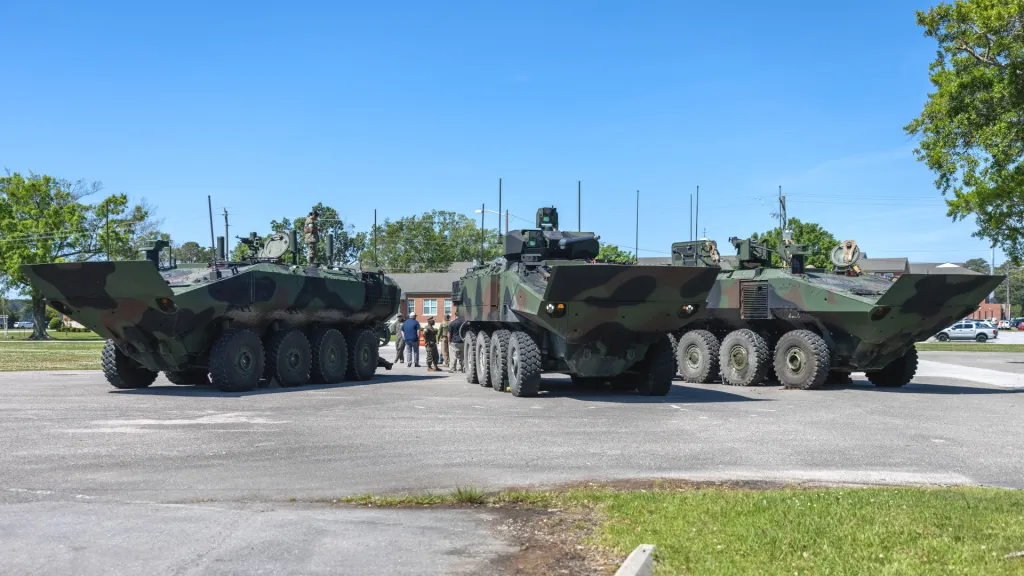
The Marine Corps had 150 baseline personnel carrier variants of the ACV (or ACV-Ps), as well as 21 command-and-control ACV-C versions, in inventory as of April 2026. The default armament for ACV-P currently is just a single .50 caliber M2 machine gun in a remote weapon station on top of the hull. The service’s goal is to eventually acquire 389 ACV-Ps and 33 ACV-Cs, as well as 152 ACV-30s with new 30mm cannon-armed turrets and 34 ACV-R armored recovery vehicle variants. The ACV family has already supplanted the Marine Corps’ previous fleet of tracked Assault Amphibious Vehicles (AAV).
From left to right, an Amphibious Combat Vehicle command and control variant (ACV-C), a 30mm cannon-armed ACV-30, and a standard ACV personnel carrier version (ACV-P). The ACV-R recovery variant is not shown here. USMC/Sgt. Alexis Sanchez
“The Anduril Pulsar-L system is a platform-integrated omni-directional SK C-UAS [soft-kill counter-uncrewed aerial systems] with a combined sensor/jammer package that detects, tracks, identifies, and defeats radio frequency-dependent Group 1 and Group 2 Unmanned Aerial Systems (UASs),” MARCORSYSCOM wrote in a justification for the sole-source contract, which was also released yesterday. “Additionally, the system provides counter positioning, navigation, and timing capabilities.”
Introducing: Pulsar-L
The U.S. military definition of a Group 1 drone is any design weighing up to 20 pounds, that is able to fly up to an altitude of 1,200 feet, and that can reach speeds of up to 100 knots. Group 2 is the next tier up, encompassing types with gross weights between 21 and 55 pounds, that can get up to an altitude of 3,500 feet, and hit top speeds of up to 250 knots. Kamikaze drones and other small weaponized types that fall into Groups 1 and 2 are used on a daily basis in Ukraine to attack armored vehicles, as well as unarmored vehicles and personnel. These are threats that have been steadily expanding to other hotspots globally, and that we will come back to later on.
Furthermore, “the Pulsar-L is the only solution capable of being mounted on the ACV to provide a mobile and organic means to effectively and simultaneously execute the entire kill-chain against hostile UASs in the deployed land and maritime/littoral environment while not exceeding the limited ACV space, weight, and power claim allotted to the SK C-UAS solution,” according to MARCORSYSCOM. “This will provide the ACV with an essential defensive capability, directly contributing to increased survivability and force protection while not sacrificing the mobility and operational tempo of the ACV.”
A row of Marine ACVs seen during training. USMC
Pulsar-L is already “in use by the Special Operations Command due to the system’s low weight, proven performance in engaging multiple UASs, and simultaneous execution of the full kill-chain while static or on the move,” the justification document adds. “Additionally, it is the only known commercially available system that meets the minimum requirement to rapidly identify and respond to emerging UAS technologies and tactics without frequent updates to predefined threat data libraries. The Pulsar-L is the only solution that uses machine based learning to continually adapt to these ever-changing threats without requiring vendor updates, allowing the warfighters to continually be effective in the fight.”
The latter point here is a particularly important consideration for electronic warfare systems, in general, which need to be able to accurately detect, categorize, and respond to different waveforms to be most effective. The emergence of new waveforms, as well as changes to how existing ones are emitted, together with new tactics, techniques, and procedures, can all negatively impact a system’s performance. Historically, the process of responding to those developments with updates to built-in threat libraries has been lengthy and complex. The conflict in Ukraine has shown that the cycle of new developments in the electromagnetic spectrum and then the need for new countermeasures can be regularly measured in weeks.
The U.S. military has been heavily investing in so-called cognitive electronic warfare capabilities to help automate and otherwise accelerate various aspects of this process. The ability of a particular electronic warfare suite to adapt autonomously in real-time, even in the middle of operations, has been viewed as the absolute ‘holy grail’ of this concept, which you can read more about here. How exactly Pulsar-L leverages machine-learning and artificial intelligence to this end, and the speed with which it can adapt to changing threats, is still not entirely clear.
Regardless, “there is an unusual and compelling need for the rapid deployment of SK C-UASs to forward-deployed ground units as Marines currently lack the ability to conduct self-defense against emerging UAS threats,” the justification document stresses. “Failure to deliver this capability places Marines at unnecessary risk, potentially leading to mission failure and loss of life, and hampers the Government’s ability to keep them safe during forward deployments.”
MARCORSYSCOM’s justification for the sole-source deal to Anduril does not otherwise elaborate on the urgent requirements that drove the deal, which it says were only formalized on April 7. That is notably roughly a week after the United States and Israel first launched major combat operations against Iran, which is a prolific developer and user of various tiers of weaponized drones. There is no explicit confirmation of any link, but Iranian drones, as well as missiles and other capabilities, have been a real threat to U.S. forces in the region. We have also just gained more insights recently into how forward-deployed Marine Corps elements contributed to those operations. Counter-drone capabilities would also be especially critical in any future amphibious landing operation, wherever it might occur.
Marines prepare to load an M142 High Mobility Artillery Rocket System (HIMARS) onto a KC-130J aircraft somewhere in the Middle East in July 2026. USAF
All that being said, threats posed by armed Group 1 and 2 drones are not at all limited to Iran and the Middle East, nor are they new. They are only likely to become a more ubiquitous feature in the hands of nation-state armed forces and non-state actors in conflict zones globally as time goes on. The nature of these threats is also expanding significantly in scale and scope, especially when it comes to more automated targeting capabilities, thanks heavily to the increasing democratization of AI-driven technologies, something TWZ has explored in depth in the past.
A number of other significant developments in this arena have emerged from the conflict in Ukraine, where electronic warfare systems are heavily employed against drones. This includes the introduction of physical fiber-optic control links that cannot be jammed, as well as the use of mesh-like and often ad-hoc networks to increase resiliency.
The fighting in Ukraine has also underscored the threat that even small kamikaze drones pose to armored vehicles, including types that are far more heavily protected to start with than the Marine Corps’ ACVs. As mentioned, Ukrainian forces have been sidelining their M1 Abrams and other main battle tanks in the face of constant drone attacks.
MARCORSYSCOM’s justification for the Pulsar-L order makes clear that this is just one part of a larger plan to boost the ACV’s defenses.
“Marine Corps program of record for SK C-UAS is planned to initiate in FY27,” the document mentions toward the very end. “The components of this future program will be procured through full and open competition as it is expected that advanced non-kinetic and SK defeat technologies should be mature by this time.”
Another look at a Marine Corps ACV-P, showing the general configuration of these vehicles today. USMC
“We’re constantly looking at what the next generation of APS is and how we can get that onto the [ACV] platform in a lightweight form factor,” Chris Melkonian, the Marine Corps’ Program Manager for Advanced Amphibious Assault (PM AAA), told TWZ and other attendees at the annual Modern Day Marine exposition in April.
Improved “situational awareness, that’s kind of a gateway to counter-UAS, in terms of the ability to sense your environment,” Melkonian also highlighted at that time. “Take all that video on board and then be able to feed that into [a] counter-UAS system.”
Additional “overhead protection right now is a critical thing that we’re working on right now for this platform,” he added. The practice of adding on anti-drone armor screens on armored vehicles (and now other platforms), especially to protect against top-down attacks, first emerged in Russia in the lead-up to the all-out invasion of Ukraine in 2022. However, the installation of this kind of so-called ‘cope cage’ type armor has now become a global trend, including in the U.S. military.
When it comes to the Marine Corps ACV fleet, the rush order for Pulsar-Ls is an important new step in boosting those vehicles’ defenses against threats that exist now. At the same time, drones are increasingly calling the role of armored vehicles in future conflicts into question.
Ireland are due to play Israel in the Nations League in Hungary on Sunday, but boycott pressure mounts on and off-field.
Published On 26 Sep 202626 Sep 2026
The Ireland team’s news conference and training session the day before its first Nations League game against Israel have been delayed as pressure to boycott the matches grows.
Journalists in Debrecen, Hungary – where Israel’s “home” game is to be played Sunday – were left waiting Saturday after being told the news conference was being pushed back until after training. That was 15 minutes before it was supposed to begin.
Training was also significantly delayed, however, with Irish broadcaster RTE reporting the players were still in their hotel more than two hours after the training session was supposed to begin.
RTE reported that some players had decided they did not want to play the games.
“And if they stay to their stated ambition that they have to be all in it together, if one or more want to be out, maybe they will all be out,” reporter Tony O’Donoghue told RTE Radio 1.
The team has been coming under increasing pressure in Ireland, where affinity with Palestinians is strong, to boycott the two games – the first on Sunday and the second, Ireland’s “home” game, in Backa Topola, Serbia, on October 4.
Ireland midfielder Jason Knight said after Thursday’s 1-0 loss in Kosovo that the players were in a difficult situation and that he didn’t think the matches should be going ahead.
Ireland coach Heimir Hallgrimsson previously said “we’re not playing with genocide, we’re playing against genocide. We’re playing against Israel, we’re not playing with Israel” – drawing a furious reaction from the Israeli football federation, which accused the Icelandic coach of “stupidity, ignorance and hypocrisy”.
The Football Association of Ireland (FAI) had resisted calls to boycott the matches, arguing the team could be hit by punishing sanctions by UEFA. Ireland is cohosting the 2028 European Championship with England, Wales and Scotland.
More than 160 Irish sportspeople signed an open letter urging the FAI to reconsider its decision to go ahead with the fixtures.
There were protesters outside the team hotel in Dublin last week calling on the players to boycott the games. The SIPTU trade union displayed a huge poster in central Dublin beside the River Liffey asking the players to “Go with your conscience!” and “Don’t play with genocide” beside an image of a blood-splattered ball.
Former Ireland coach Brian Kerr said the FAI had “lost the respect of the Irish people” for going ahead with the games.
“The Irish people and the soccer-going public don’t want the games to be played,” Kerr said. “I think they’ve made their opinions clear over the last year. The FAI back in November actually went to UEFA and requested that Israel be put out of the tournament on principle. And yet they went against that principle.”
The Republic of Ireland have delayed the pre-match news conference planned for Sunday’s Uefa Nations League game against Israel in Hungary – a fixture campaigners have called on them to boycott.
Heimir Hallgrimsson’s team are scheduled to meet Israel in Debrecen at 19:45 BST, with the return fixture in Backa Topola, Serbia on 4 October.
They have faced calls to withdraw from the games because of the ongoing Israel-Gaza war with a “Stop The Game” campaign – organised by the pressure group Irish Sport for Palestine – gathering pace.
Former Republic of Ireland manager Brian Kerr and ex-international James McClean are among those to have backed calls for a boycott.
However, there are also Irish supporters, perhaps less vocal, who have always believed that the match should be played with supporters in attendance.
Hallgrimsson and a player were scheduled to meet the media at 09:15 BST (10.15 local time), before training, but the conference was delayed shortly beforehand.
A Uefa official entered the room to inform waiting media teams that the press conference was postponed until after training, which would have been about 11:30 BST (12.30 local time).
But shortly afterwards, the Uefa official returned to the media room to announce that the Republic of Ireland’s training session had also been postponed, with no time given for when it might take place. There is also no confirmed time for the news conference.
NATO member Latvia is moving toward acquiring Anduril Industries’ Barracuda family of long-range strike missiles, with Latvian President Edgars Rinkēvičs highlighting the effort during a visit to the U.S. defense technology company and a series of new defense-industry cooperation agreements involving Latvia. If the acquisition goes through, Latvia would be the first of the Baltic states to field a strike weapon in this category.
“It was great to visit Anduril to meet with Palmer Luckey and to witness signing of memoranda of cooperation with MOD of Latvia and Origin Robotics,” Rinkēvičs said in a post on X. “Looking forward to complete acquisition of Barracuda long-range missiles and [Latvian-U.S.] defense industry cooperation.”
The statement does not specify the precise Barracuda variant involved, the number of missiles Latvia intends to acquire, the expected delivery schedule, or the value of the prospective purchase. We have reached out to Anduril for more details.
A likely candidate weapon is the Barracuda-500M, one member of Anduril’s family of autonomous, jet-powered cruise missiles, alongside the Barracuda-100M and -250M variants. Official descriptions put its range at more than 500 nautical miles, with a stated speed range of approximately 190 to 500 knots. The missile can be air-launched, for which it has received the official U.S. military designation AGM-189A. But with only a handful of utility biplanes and helicopters in its inventory, Latvia would acquire the surface-launched version, designated SLB-500M.
Introducing: Barracuda-M Family of Cruise Missiles
The announcement points to a potentially significant expansion of Latvia’s precision-strike capabilities as NATO’s eastern flank continues to build out longer-range conventional fires.
Latvia has already ordered the U.S.-made Army Tactical Missile System, or ATACMS, which will be fired from M142 HIMARS launchers. The system is expected to enter Latvian service in 2027 and has a maximum range of about 186 miles.
A U.S. Army M142 HIMARS launcher involved in an exercise at at Spilve Airfield and Liepāja Airport in Latvia. Latvian Armed Forces Eriks Kukutis
Latvia’s ATACMS capability will give the country a foundation for ground-launched precision fires, but the broader European trend is toward significantly greater reach.
Ground- and sea-launched cruise and ballistic missile systems capable of hitting targets at between 1,000 and 2,000 kilometers (620 and 1,242 miles) or more are an emerging target for several European NATO members. France, Germany, Poland, Italy, Sweden and the United Kingdom are pursuing combinations of indigenous development and foreign procurement to address this requirement.
Latvia’s neighbor Poland, for example, has been building a layered long-range strike architecture combining JASSM/JASSM-ER air-launched cruise missiles with HIMARS and ATACMS. Warsaw’s ambitions are extending toward ground-launched weapons with ranges potentially reaching 3,000 kilometers (1,864 miles) and the country has previously expressed openness to hosting U.S.-owned nuclear weapons on its territory, too.
A M142 HIMARS launcher is seen during Poland’s Armed Forces Day parade in 2025. Photo by Artur Widak/NurPhoto/Getty Artur Widak
Latvian interest in Barracuda fits into the same larger transformation in European conventional strike capabilities.
For NATO’s Baltic members, the logic is particularly straightforward, with mobile, ground-launched weapons providing an additional means of striking military targets at depth without requiring control of the air over the launch area.
Dragon’s teeth obstacles are among the anti-mobility measures on Latvia’s eastern border with Russia. Latvian Armed Forces
The potential Barracuda acquisition would represent another step in a broader European shift toward deep precision strike, a term increasingly used to describe conventional weapons capable of holding targets hundreds or thousands of miles away at risk.
Deep precision strike is widely acknowledged as an increasingly important European capability gap. European NATO members have historically relied heavily on air-launched cruise missiles and other aircraft-delivered weapons, while ground-launched long-range systems have been comparatively scarce.
The deterioration of the European security environment following Russia’s full-scale invasion of Ukraine, together with the 2019 collapse of the Intermediate-Range Nuclear Forces Treaty, are important factors behind renewed European interest in long-range conventional strike.
A key driver behind Europe’s push for longer-range conventional strike is the desire to build a credible deterrent capable of holding targets deep inside Russia at risk, potentially including Moscow. Ukraine’s long-range strike campaign has demonstrated the strategic value of being able to impose costs at significant distances, while also underscoring the importance of having sufficient stocks of precision weapons. For NATO’s eastern flank, systems such as the ground-launched Barracuda could therefore provide not just another fires capability, but an additional means of imposing costs on an adversary without relying exclusively on airpower.
Importantly for Latvia, the emerging European approach is not limited to large air forces. NATO’s prospective deep-strike requirements are likely to place significant emphasis on mobile ground-launched systems because they can be dispersed and offer survivability advantages while avoiding the cost and vulnerability associated with relying exclusively on aircraft or ships as launch platforms.
An Anduril Barracuda 500, top, and a Barracuda 100, displayed during Modern Day Marine 2026 in Washington, D.C. U.S. Marine Corps photo by Cpl. Abigail Hutcheson Cpl. Abigail Hutcheson
That makes systems such as the surface-launched Barracuda particularly relevant to countries on NATO’s eastern flank.
Anduril has positioned Barracuda as part of an effort to address what it describes as a shortfall in affordable, producible long-range precision weapons. A prototype surface-launched Barracuda-500 successfully demonstrated its launcher, missile, and booster concept in testing in 2025. Anduril has emphasized that the family is intended to be more producible and affordable than many existing “exquisite” long-range weapons.
European governments are increasingly wrestling with the same issue. However, there is a fundamental tension between rapidly filling capability gaps through off-the-shelf purchases and developing indigenous European weapons that can strengthen the continent’s defense-industrial base, which is also a critical political consideration.
Latvia’s emerging relationship with Anduril appears to combine elements of both approaches, by acquiring an American-developed strike capability while simultaneously pursuing industrial cooperation with U.S. defense companies.
Ground launch of Anduril’s Barracuda-500M. Anduril
There is also a recent European precedent for combining Barracuda procurement with local industrial participation.
In July 2026, Anduril signed a strategic agreement with Polish national maintenance, repair and overhaul provider Wojskowe Zakłady Lotnicze Nr 2 (WZL-2) to establish production of the Barracuda-500M at WZL-2 facilities in Bydgoszcz, Poland. Polish state-owned defence group Polska Grupa Zbrojeniowa said Poland was the first European country to sign such an agreement with Anduril.
Bezpieczeństwo zaczyna się od silnych sojuszy.
💥🖊️ Dziś została podpisana umowa o współpracy @PGZ_pl i WZL-2 z firmą Anduril Industries, która umożliwi utworzenie w Polsce miejsc montażu i produkcji autonomicznych rakietowych pocisków manewrujących dalekiego zasięgu… pic.twitter.com/JnmM6lQZ7L
— Ministerstwo Aktywów Państwowych 🇵🇱 (@MAPGOVPL) July 6, 2026
Polish officials have also emphasized the missile’s intended low production cost relative to higher-end U.S. cruise missiles. The planned Polish program is expected to progressively increase Polish content and eventually incorporate broader European elements, including software solutions from Anduril.
Latvia has not publicly detailed whether any Barracuda-related production, assembly, or other industrial work would be conducted in the country.
However, Latvia’s Investment and Development Agency says the country’s defense-technology delegation in the United States is seeking opportunities involving joint development, testing, manufacturing, system integration and supply chains. Origin Robotics is among the Latvian companies participating in that effort.
The broader Latvian delegation includes companies working across unmanned and counter-unmanned systems, communications, electronics, sensors, software, artificial intelligence, cybersecurity, and manufacturing.
A Latvian Army soldier shows drone video footage to U.S. Marines during a HIMARS live-fire exercise at Adazi Training Area, Latvia. U.S. Marine Corps photo by Cpl. Niles Lee Sgt. Niles Lee
Exactly how Latvia intends to employ Barracuda, how many missiles it plans to acquire, and whether any portion of the system will eventually be produced or integrated in Latvia remain unclear from the president’s announcement.
For now, the development marks another indication that long-range precision fires are moving from a capability concentrated among Europe’s largest military powers toward a broader requirement across NATO’s highly strategic eastern flank.
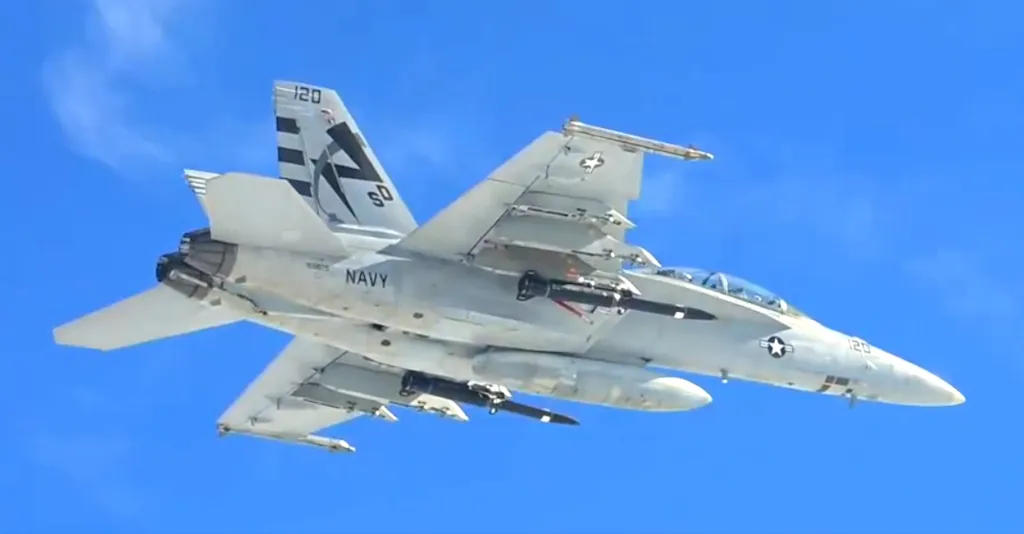
The U.S. Navy has given us the first look at Blackbeard hypersonic strike missiles under the wings of F/A-18E/F Super Hornets during actual flight testing. The Navy is hoping to have Blackbeard in at least limited service no later than 2028, giving its carrier air wings an all-new fast-flying standoff weapon, particularly for engaging enemy ships. The missile is also being designed to be relatively cheap and quick to manufacture.
The Navy’s Office of the Portfolio Acquisition Executive for Aviation (PAE-A) has released a video montage of Blackbeard undergoing flight testing, seen in the social media post below. The service confirmed that it had at least begun test-loading the missiles onto F/A-18E/F Super Hornets in a presentation at the Tailhook Association’s annual convention last month. Now we know the program has moved ahead substantially from that point.
The company behind Blackbeard, defense start-up Castelion, has received several multi-million-dollar contracts from the Navy just this year explicitly to support integration of the weapon onto the Super Hornet, as well as otherwise accelerating its development. In its daily contracting on September 14, the Pentagon announced the Navy had struck yet another deal with Castelion, valued at $43.65 million, “for the manufacturing, assembly, testing, and delivery of the first production lot of 444 All-Up Rounds (AURs), defined as fully functional tactical missiles packaged within specialized shipping and storage containers.”
A screen capture from the Blackbeard flight testing video montage the Navy released today. USN capture
In terms of what we know today about Blackbeard’s design and capabilities, as we have previously written:
“A profile photo [seen below] at the company’s headquarters reveals a weapon with a ballistic missile-like booster, on top of which is mounted what could be an unpowered hypersonic glide vehicle (HGV). A booster brings an HGV to the desired velocity and altitude before releasing it toward its target. The concept is in contrast to air-breathing cruise missiles capable of traveling at hypersonic speeds. Hypersonic speed is generally defined as anything above Mach 5, which larger ballistic missiles also reach in the course of their flights. More precise performance figures for Blackbeard are lacking, but Castelion has previously hinted it could hit targets out to just under 500 miles. Alternatively, the second stage may also have its own motor, allowing it to continue accelerating or sustain high-speed flight. A similar arrangement has been suggested as the propulsion system for the Russian Zircon missile.”
Castelion
“Both stages of the weapon have cruciform fins, while the upper one features a prominent ‘chine’ line along the length of its body, and a slightly beaklike nose. The trolley on which the weapon is mounted provides some idea of its overall size. The blue stripes seen on each stage normally signify that a munition is an inert, non-explosive round utilized for training or tracking purposes. This would indicate a real (unarmed) missile rather than a dummy or mockup.”
A picture shown at Tailhook had also offered a new look at the front of the missile, exposing what looked to be an aperture on one side of the design’s wedge-shaped nose. As we wrote after that image emerged:
“The apparent apertures are also seen pointed up, but many air-launched munitions do flip down after release.”
“How exactly Blackbeard is guided remains unknown, but a downward-angled aperture at the nose end for a seeker system would make sense for this weapon, which the Navy is pursuing primarily as a new way to target enemy ships. In particular, a wide array of existing anti-ship and land attack missiles, as well as certain anti-air types, have variously shaped apertures in their noses for imaging infrared seekers. Imaging infrared has the benefit of being immune to radio frequency electronic warfare jamming. In addition, it is a passive capability that does not send out signals that can give an opponent advance notice of an incoming attack. Blackbeard’s full guidance package very likely also includes some means of navigating to a target area first, and it could have multiple modes of operation.”
The new flight testing footage released today also underscores the relatively small size of Blackbeard overall. While the Super Hornet is set to be the first operational launch platform, it is very likely to be integrated on other aircraft quickly thereafter. The Navy is acquiring Blackbeard under a program called the Multi-mission Affordable Capacity Effector (MACE).
Another screen capture from the new Navy video offering a different of Blackbeards under the wings of a Super Hornet, underscoring their relatively small size. USN capture
Requirements for MACE that the Navy put out previously explicitly called for a design compact enough for carrier-based F-35C (and land-based F-35A) Joint Strike Fighters to carry four of them internally. Whether that remains a goal in any way is unclear. Still, being able to carry some number of Blackbeards internally would not only give those jets a hypersonic strike weapon, but one that they could carry in the most stealthy configuration. The Navy also notably does operate the F-35A outside of the test and evaluation community, which might point to air-launched Blackbeards entering service elsewhere in the future. As an aside, the U.S. Army is pursuing a ground-launched version of this missile, as well.
As mentioned, the Navy’s stated goal now is to reach an early operational capability with Blackbeard by 2028, if not sooner. What the exact fielding plan for those missiles might be is unclear. PAE-A did write “Coming soon to a theater near you” in its post on X containing the video montage, and tagged the official accounts for U.S. Central Command (CENTCOM) and U.S. Pacific Command (PACOM). CENTCOM oversees U.S. military activities in and around the Middle East, including ongoing operations against Iran. U.S. military officials have also long touted hypersonic weapons, in general, as key to success in any future conflict in the Pacific, especially a high-end fight against China.
Julian Ward’s appointment gives Liverpool‘s hierarchy some much-needed stability after a summer of transition.
Ward has done the sporting director job before – and bar a spell between the summers of 2023 and 2024, has been at the club since 2012.
Liverpool did speak to external candidates but Ward was seen as the stand-out choice.
One source described him as: “Calm, well-spoken and with a clear opinion and vision.”
Ward’s previous spell as sporting director came under Jurgen Klopp, where he oversaw the signings of Luis Diaz, Cody Gakpo, Alexis Mac Allister and Darwin Nunez – he has a global contacts network and plenty of experience when it comes to negotiations.
He was also influential when Mohamed Salah renewed his contract in 2022 – flying to see Salah on holiday to seal the deal – and his relationship with the agent Jorge Mendes helped Liverpool in their pursuit of Diogo Jota.
There will be plenty of jobs for Ward to tackle – including the securing of Rio Ngumoha on a long-term deal now that he is 18 and determining whether new contracts are offered to Alisson and Virgil van Dijk before their current agreements expire this summer.
As FSG’s technical director, Ward played a role in Liverpool‘s push to recruit younger talent. And he has a good relationship with Mike Gordon, who oversees the day-to-day running of the club.
Under Klopp, Ward left 12 months into a three-year deal, but should have more of a say now, given how the head coach role has been structured under both Arne Slot and his successor Andoni Iraola.
Time will tell if Ward’s appointment proves successful – but in the here and now, he looks a more-than-sensible choice.
While the circumstances are very different, Norris’ supporters also argue that his case hinges on disputed interpretations of medical evidence.
The story begins in 2002 when Norris, a 26-year-old nurse, originally from Glasgow, found Ethel in an hypoglycemic coma as she recovered from a broken hip.
Doctors took blood samples to find out what caused her blood sugar to drop so low.
The test results seemed conclusive – she had a massive amount of insulin in her blood.
She died 21 days later, sparking a murder investigation.
A nurse who had been on shift on the night Ethel was found told the police that Norris had predicted the 86-year-old might not last the night.
He quickly became the prime suspect.
The police operation trawled retrospectively through all the deaths on Norris’s wards, looking for potential murders that may have gone unnoticed.
They identified three other cases of unexplained severe hypoglycemic deaths and one where the patient recovered.
No blood tests had been taken from these cases at the time of their deaths to be able to prove insulin poisoning but experts for the prosecution said in court that their medical charts showed persistent and severe low blood sugar readings.
They said that because this was so rare in non-diabetics that it must be murder.
When it came to court in 2007, experts called by the defence said four of the five patients had died of natural causes.
But after a five-month trial and a deadlocked jury, Norris was convicted by a majority of 11-1 and told he would not be eligible for parole for 30 years.
After the verdict, Ethel’s son Stuart Hall said: “I don’t think he should come out again. He’s got the knowledge to commit murder but do it discreetly.”
Nonstop rain since Thursday has submerged Thai capital’s roads and canals, sending water into many homes and stores.
Published On 26 Sep 202626 Sep 2026
Bangkok authorities have declared a disaster zone across all 50 districts of Thailand’s capital after three consecutive days of rainfall caused heavy flooding.
The disaster designation, which gives local organisations authority to take action, came on Saturday after Governor Chadchart Sittipunt said almost 300mm (11.8 inches) of rain had fallen since Thursday afternoon.
Recommended Stories
list of 4 itemsend of list
The nonstop rain inundated roads and canals with water, sending water into many homes and stores alongside them, according to reports. Photos and videos showed major roads submerged and cars abandoned after drivers were unable to move through the rising water.
Chadchart said the east of the city was most impacted and warned that more rain was forecast again on Saturday. He added that flooding should recede once the rain subsides, as city officials work to drain floodwaters as quickly as possible.
“The rain keeps falling and we are doing our best. We are trying to pump the water out, but the water in canals are full,” he said on social media. “The risk areas are those who live near canals. Every canal is now filled.”
Later on Saturday, the government said the flooding situation had “stabilised” but added it would still take two or three days for the water to drain, as long as the rain held off. “If more rainwater doesn’t fall in the area, it will be solved,” he said.
People walk past abandoned vehicles on a flooded Phetchaburi Road in Bangkok on September 26, 2026 [Lillian Suwanrumpha/AFP]
Chadchart also advised residents to move their cars to higher ground, as Bangkok’s public transport authority offered free access to MRT train “park and ride” carparks to store their vehicles until October 2.
Reporting from a flooded street in Bangkok, Al Jazeera’s Tony Cheng said the Thai capital is no stranger to heavy rain during the monsoon season, but the continuous rainfall had locals worried.
“What usually happens is we get heavy downpours for a couple of hours, then you’ll see the street often flooded but it would flow away into the drains quickly, and it would only happen in isolated areas too,” he said.
“What’s happening here is … happening all across the city. This is not a flash flood; this is persistent heavy rain since Thursday evening, and it shows no sign of letting up.”
Somkid Pheuk-ngam, 67, a vendor who lives near a canal just north of central Bangkok, said she had to close her shop for two days.
“The water keeps coming in. It’s hard to go out now. It’s at my waist level,” she told the AFP news agency. “I cannot go anywhere,” she said, adding that this was “worse than the 2011 flood.”
Widespread flooding across Thailand in 2011 killed more than 500 people and damaged millions of homes.
The Department of Disaster Prevention and Mitigation has warned of low pressure across eastern, northeastern and central Thailand until Sunday, saying there was a risk of flash floods, forest runoff, mudslides and river overflow.
Welcome to Bunker Talk. This is a weekend open discussion post for the best commenting crew on the net, in which we can chat about all the stuff that went on this week that we didn’t cover. We can also talk about the stuff we did or whatever else grabs your interest. In other words, it’s an off-topic thread.
This week’s caption reads:
BERLIN, GERMANY JUNE 16: Heavy iron doors between different rooms during a media event on June 16, 2026, at the former Cold War-era Pankstraße subway station, now used as a nuclear fallout shelter. Built in the 1970s, the bunker offers sleeping accommodations for 3,339 people, has independent water and electricity supplies, and is hermetically sealed off from the outside world by massive steel doors. The bunker will be open to the public as part of guided tours of Berlin’s underground. Russia’s invasion of Ukraine has rekindled German authorities’ interest in providing nuclear fallout shelters in the event of war. (Photo: Carsten Koall/Getty Images)
PRIME DIRECTIVES:
If you want to talk politics, do so respectfully and know that there’s always somebody that isn’t going to agree with you.
If you have political differences, hash it out respectfully, stick to the facts, and no childish name-calling or personal attacks of any kind. If you can’t handle yourself in that manner, then please, discuss virtually anything else.
No drive-by garbage political memes. No conspiracy theory rants. Links to crackpot sites will be axed, too. Trolling and shitposting will not be tolerated. No obsessive behavior about other users. Just don’t interact with folks you don’t like.
Do not be a sucker and feed trolls! That’s as much on you as on them. Use the mute button if you don’t like what you see.
So unless you have something of quality to say, know how to treat people with respect, understand that everyone isn’t going to subscribe to your exact same worldview, and have come to terms with the reality that there is no perfect solution when it comes to moderation of a community like this, it’s probably best to just move on.
Finally, as always, report offenders, please. This doesn’t mean reporting people who don’t share your political views, but we really need your help in this regard.
Gaza City, Gaza Strip – The partially collapsed roof above Masada Abu Jarad’s apartment is now made up of broken concrete with twisted steel bars protruding from its edges.
And underneath the section of the room that is now open to the elements after the building’s partial collapse, Masada’s family have pitched a tent to provide shelter.
Recommended Stories
list of 3 itemsend of list
The 60-year-old knows the structure is dangerous. The Palestinian Red Crescent and the Civil Defence visited the family last week and warned them that they should leave. But in Gaza, where Israel refuses to allow proper reconstruction to take place after almost three years of its genocidal war, there are few places for them to go.
“We have no options,” Masada says. “I want to leave, but who will give me an alternative?”
She has lived in the building in Gaza City’s Palestine Square area for the past year, after returning to northern Gaza from displacement earlier in the war. But this still isn’t home. Masada’s family is originally from Beit Lahiya in the far north of the Strip, but had to leave early in the war after Israel decimated the area. They are still unable to return.
After repeated displacement, the prospect of moving again without a safe destination has become exhausting. And even if they could move, the cost is prohibitive.
“Even if there is a better place, tell me how I can afford to rent it,” Masada said.
Masada’s experience reflects a wider housing crisis across Gaza for the Palestinians who have survived Israel’s war, which has killed more than 73,000 Palestinians.
A joint assessment by the United Nations, World Bank, and European Union found that 371,888 housing units, 76.6 percent of the housing stock, had been destroyed or damaged as of October 2025. The assessment also found that rebuilding Gaza will need more than $71bn over the next decade.
The dangers of Gaza’s depleted and damaged housing stock became starkly visible on September 16, when a six-storey war-damaged residential building in Gaza City collapsed, killing 21 people, including 12 children, according to the UN and Gaza Civil Defence.
The collapse has become a warning for families living in other damaged structures.
Gaza’s municipality and civil defence have warned residents to evacuate buildings at risk of collapse [Abdelhakim Abu Riash/Al Jazeera]
‘I stay awake so they can sleep’
Abdullah Abu Hajar, 40, lives with his wife and five children in the al-Najma building in Gaza City’s southern Remal neighbourhood.
The six-storey building is severely damaged and unstable. About 17 families, roughly 50 to 60 people, are living there, according to Abdullah.
On the outside walls, municipal notices warn residents and passers-by that the building is unsafe and at risk of collapse.
At night, while his wife and children try to sleep, Abdullah stays awake and listens.
Every unfamiliar sound, such as concrete shifting, stones moving or an unexplained creaking somewhere inside the building, puts him on alert.
“I stay awake all night, keeping watch,” he said. “I can’t close my eyes. I keep just listening to sounds around me.”
Abdullah Abu Hajar stands near the damaged building where he lives with his family [Abdelhakim Abu Riash/Al Jazeera]
Abdullah explained that he feels worried for his children, even though they have adapted to the danger. But he has not.
And after the September 16 building collapse, he grew even more fearful. Since then, he said, he has barely slept.
“I’m already on edge,” he said. “But I don’t know where I can go.”
Abdullah and his family were displaced from Beit Hanoon in northern Gaza after it was attacked by Israel, and moved repeatedly during the war, eventually finding the al-Najma building.
His extended family faces the same uncertainty. Abdullah said that one of his relatives has been moving between southern and northern Gaza, looking for a place where he can pitch a tent.
“I told him to come and stay with us,” Abdullah said. “But he is hesitant because of the condition of this building. At the same time, he has nowhere else to go.”
Islam Hassanein is particularly worried about how weather conditions in the winter will affect the partially collapsed building she lives in [Abdelhakim Abu Riash/Al Jazeera]
A room among the rubble
For Islam Hassanein, 36, the same fears are entwined with the place she calls home.
A mother of five, Islam has spent nearly a year living with her family in a single room on the third floor of a damaged building.
She found the room after searching for somewhere to stay. It was filled with rubble and debris.
“We cleaned it and stayed in it,” she said.
The building is leaning and visibly damaged. The plumbing doesn’t work, so the family uses a bathroom outside. There is little that resembles a family home.
But leaving has proved no easier than staying. “We keep looking, but we can’t find anywhere,” she says. “They might even force us out of here. What are we supposed to do?”
Islam says she would leave immediately if she were offered a safe place.
“If they find us a good place and provide us with a tent, we will leave from the morning,” she says. “But where is this place? And where is the tent?”
Islam’s daughters sit inside the room where they live in the al-Najma building, which is at risk of collapse. [Abdelhakim Abu Riash/Al Jazeera]
The building itself regularly reminds her of the dangers.
“Every day, you hear the cracking,” she says. “People who live here tell us, ‘It’s cracking.’ Then a column fell, and they took us out of the building temporarily.”
The potentially deadly risks will become harder to manage as winter approaches, with its colder and wetter weather.
Water can enter through exposed roofs and walls, and the already weakened structure will face additional pressure from heavy rain.
“Last winter was terrifying,” Islam said. “We were constantly afraid that the building would collapse. I spent most days in my family’s tent because this building was full of openings and would flood whenever it rained.”
“Now, I am very afraid of this winter, and I don’t know what we are going to do.”
The UN says thousands of people are sheltering in damaged buildings considered unsafe because better housing options are unavailable.
Israeli restrictions on the entry of tents, tarpaulins and other essential shelter materials are making the situation more difficult, leaving Gaza in a state of limbo, unable to move on from the war, particularly as Israel can choose to escalate the conflict at any time.
UNICEF estimates that nearly 84 percent of Gaza’s population, more than 1.76 million people, are living in overcrowded displacement sites or damaged and inadequate shelters, with little protection from cold, heavy rain and flooding.
Islam says the war has forced families to take risks they once would have considered unthinkable.
She worries about her five children, but sees few choices available to her.
“They are all afraid,” she said. “But what can we do? If there is an alternative, I will leave. We leave it to God.”
The damaged al-Najma building is among the structures at risk of collapse in Gaza [Abdelhakim Abu Riash/Al Jazeera]