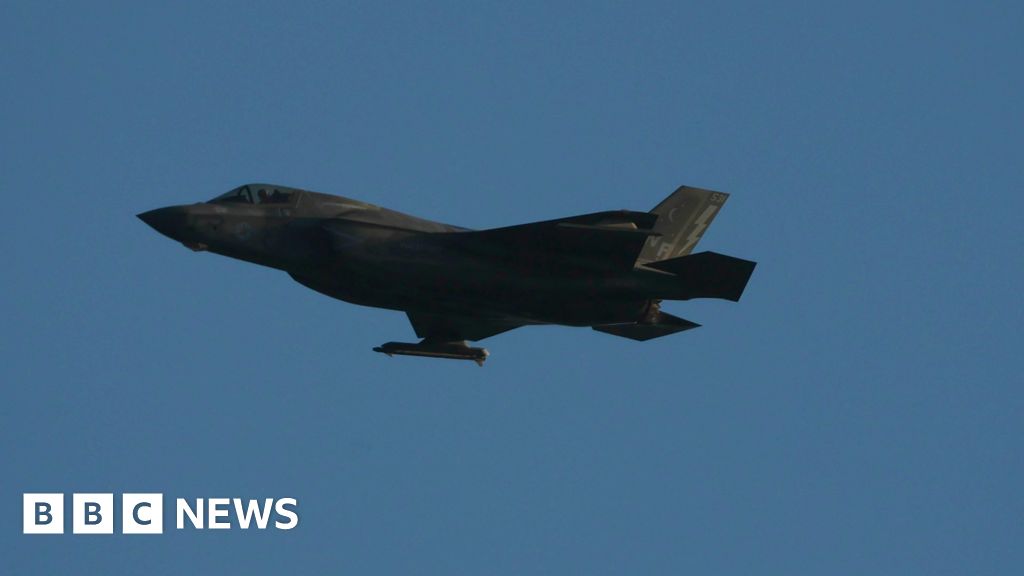
Iran says it struck ships in Strait of Hormuz after US launches new strikes
US Central Command said its latest airstrikes were responding to “unwarranted and continued aggression” from Iran.
Source link
US Central Command said its latest airstrikes were responding to “unwarranted and continued aggression” from Iran.
Source link
DEVELOPING STORYDEVELOPING STORY,
Explosions hit Qeshm Island, ports along Strait of Hormuz after Trump threatens to hit Iran ‘very hard’.

Published On 10 Jun 202610 Jun 2026
The United States has launched fresh strikes against “multiple targets” in Iran at President Donald Trump’s direction, in a fresh escalation that prompted Tehran to declare the Strait of Hormuz closed to “all types of vessels”.
The US military said the strikes late on Wednesday were “in response to Iran’s unwarranted and continued aggression”, as Iranian state media reported explosions on Qeshm Island and in the cities of Bandar Abbas and Sirik along the Strait of Hormuz.
list of 4 itemsend of list
Blasts also hit the southern city of Kargan, wounding at least two people.
Iran’s Islamic Revolutionary Guard Corps accused the US of “repeated violations” of their April ceasefire, and said the Strait of Hormuz was “closed until further notice”.
It said all traffic in the vital waterway, including oil tankers and commercial vessels, would be affected, and firmly rejected the US’s previous claims that it had helped ships pass through the strait.
The IRGC subsequently added that “two oil tankers attempting to illegally pass through the strait were hit”.
The escalation comes a day after the US and Iran exchanged tit-for-tat strikes over the downing of a US Apache helicopter in the Strait of Hormuz.
Earlier, Trump said the US would hit Iran “very hard”.
“We’ll see what happens with the deal. We were really close to a deal. But they keep stringing us along. They keep playing us for suckers because you know what? They dealt with some very stupid presidents. I have to say that I’m embarrassed to say it,” he told reporters at the White House.
Iran’s President Masoud Pezeshkian slammed Trump’s threat in a post on X.
“Critical infrastructures are the lifeblood of the people. Threats to target them – from transportation networks to the electricity and water industries – are not a show of strength but a sign of desperation in the face of a nation’s will,” he wrote.
“Iran, relying on the knowledge and capabilities of its specialists, national unity, and solidarity, will stand firm against any pressure or threat,” he added.
Tehran remains defiant amid US attacks, orders complete closure of Strait of Hormuz to all vessels.


Published On 11 Jun 202611 Jun 2026
Share
The TWZ Newsletter
Weekly insights and analysis on the latest developments in military technology, strategy, and foreign policy.
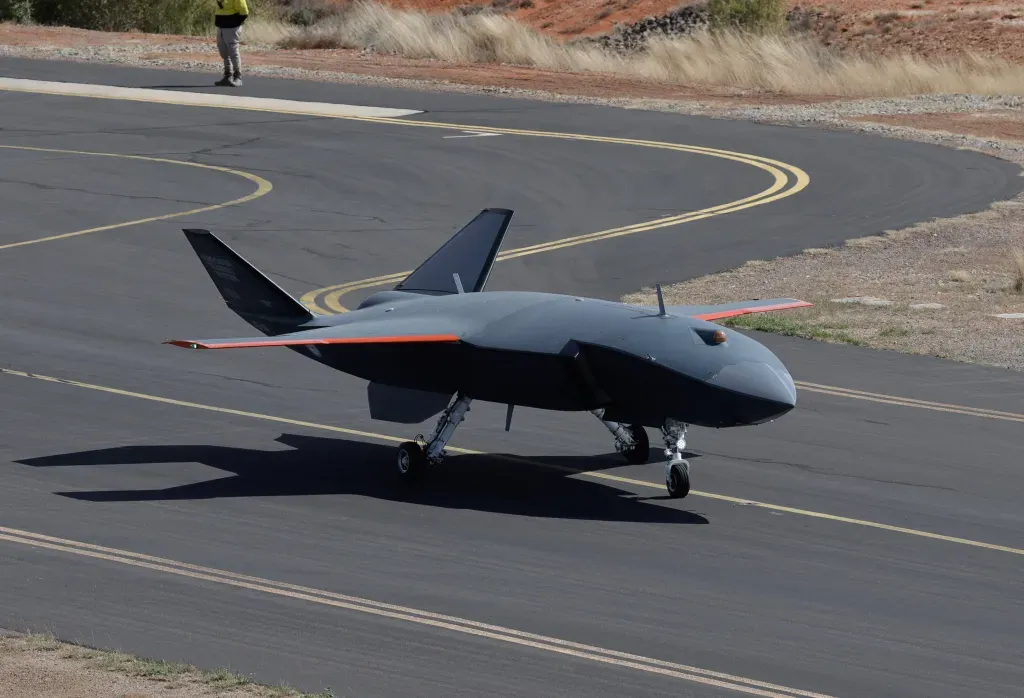
Boeing has provided details of the latest iteration of its MQ-28 Ghost Bat collaborative combat aircraft (CCA). Already, the Ghost Bat was the most mature known CCA, but the enhanced version of the drone, the Block 3, has various new features. These include a larger wing and a pair of internal weapons bays, which means it can carry munitions without diminishing its low-observable characteristics.
The MQ-28 Block 3 was revealed today at the ILA Berlin airshow, taking place this week in the German capital. The unveiling was conducted by officials from both Boeing Australia and Germany’s Rheinmetall. The German firm is partnered with Boeing to offer the drone to the German military, as well as to tap into the potentially very lucrative European CCA market.
✅ >25% larger wing
✅ Increased fuel and payload capacity
✅ Beyond Line of Sight capability
✅ Internal weapons stations for greater mission configurabilityMQ-28 Ghost Bat enhancements deliver flexibility, range and capacity advancements.
More: https://t.co/IPZLUy5Qub pic.twitter.com/7EK5fUD11h
— Boeing Australia (@BoeingAustralia) June 10, 2026
“This is the aircraft that we are offering to Germany,” MQ-28 Global Program Director, Glen Ferguson, said at the rollout. “This is the third iteration of design now, and we are on point to build out first [Block 3] aircraft next year.”
The previous Block 1 and Block 2 variants have completed more than 150 test sorties in Australia and the United States.
Australia has already acquired eight Block 1 MQ-28s, which are configured as pre-production prototypes.
The first nine Block 2 drones, now in production, are seen as a pathway to an operational capability, which is fully realized in the Block 3.

The Block 3 aircraft features a wing that is 25 percent larger, combined with a thrust increase from 10,000 pounds to 12,000 pounds. It’s not immediately clear how that thrust increase will be achieved, but coupled with greater wing area, it will confer an increased payload capability. This translates into an additional 2,000 pounds of fuel, stores, and mission payloads.
“That additional capacity gives operators freedom to balance payload and endurance to configure for the mission at hand, whether that means carrying extra fuel for longer-range operations, increasing weapons carriage, or any combination of both,” Ferguson said.
The latest iteration of the drone also adds beyond-line-of-sight (BLOS) control. Introduction of BLOS communication links means the MQ-28 can be operated at unlimited standoff distances, whether from a ground station, a naval vessel, or a crewed aircraft. With its range of over 2,000 nautical miles, adding BLOS to the drone also ensures that it can conduct independent operations when not controlled by a crewed aircraft, which was always envisioned as a potential role for Ghost Bat. Having a SATCOM option also opens up better resiliency for control in electronic warfare combat environments.
“Inclusion of features such as BLOS capability is a direct result of our learnings to date along with feedback from air forces as they understand more about the role and integration of CCAs into joint force operations,” Ferguson explained.
As for the critical internal weapons bays, these are added within each side of the slab-side fuselage, shown in a video released by Boeing.

Each bay can carry a single AIM-120 Advanced Medium-Range Air-to-Air Missile (AMRAAM) or two Small Diameter Bomb (SDB) precision-guided munitions. These can comprise either the GBU-39/B SDB I or the GBU-53 SDB II, also known as StormBreaker. The Ghost Bat is the first CCA we have seen capable of carrying AIM-120s internally, a significant development in itself. The option for internal stores carriage is also a huge deal at this point, with Boeing having recently validated its radar cross-section (RCS), proving that the CCA is harder to detect and better able to operate in contested environments.

“The combination of a highly capable platform, stealth features and advanced autonomy provides unprecedented ability for air forces to extend their mission effectiveness and operational flexibility,” said Brad Thompson, director for Phantom Works Australia, after the completion of the RCS trials.
The drone also has provision for three external weapons stations. At least one of these has already been tested, during an end-to-end engagement in which a target drone was brought down by an AMRAAM. The air-to-air role is notably relevant since the drone is also envisaged as a force-protection asset, to defend airborne early warning aircraft and tankers, etc, as well as working with fighter aircraft. Combined with more thrust and larger wings, the external pylons would appear to open up the possibility of flying with as many as five AMRAAMs, and at least four, or with a mixed load of air-to-air and air-to-ground weapons.

For Block 3, Boeing is also known to be working on three or four alternative sensor payloads. Integration of these would be facilitated by the fact that the entire nose can be swapped out to accommodate different payloads.

Bringing the MQ-28 Block 3 from Australia to Berlin reflects the relationship between Boeing Australia and Rheinmetall and the fact that the German Air Force — the Luftwaffe — is being pitched to for its CCA requirement.
“At the moment, we are still in negotiations with the German government, but if they want to have the plane by 2029, my expectation is that by at least next year, we have to go into the final stage of negotiating the contract,” Rheinmetall CEO Armin Papperger told Breaking Defense.
In expectation of a German CCA requirement, the ILA Berlin airshow featured a heavy presence of combat drones.
Also making its public debut was a full-scale model of the Airbus U760 Ravenstorm, a combat drone designed to operate alongside fighter aircraft in air-to-air combat, strike missions, and electronic warfare roles. The new uncrewed aircraft is part of a revamped drone portfolio from the company, and you can read more about it here.

As well as Ravenstorm, Airbus is also offering a Europeanized version of the stealthy XQ-58A Valkyrie, which is apparently being pitched as a lower-cost aircraft and one that offers the option of runway-independent operations.
From the United States, General Atomics Aeronautical Systems presented a full-size model of a drone from its Gambit family, with the company also confirming that it has been in talks with Germany regarding its CCA requirements.
8. General Atomics Aeronautical Systems is here as well, with a full-sized version of a drone from its Gambit family, one of two unmanned aircraft selected through the first increment of the US Air Force’s own CCA program. pic.twitter.com/8sEnDuUidr
— Elisabeth Gosselin-Malo (@elisabethmalom1) June 10, 2026
Meanwhile, German firm Helsing revealed a new version of its CA-1 Europa drone — which looks remarkably similar to Ghost Bat. The CA-1EA (for Electronic Attack) follows the CA-1KA (Kinetic Attack) and reflects the high priority Germany attaches to its need for a CCA to accompany its forthcoming Eurofighter EK electronic warfare jets, as well as other combat aircraft.
Helsing says the CA-1KA is planned to begin flight testing early next year. To get around issues of testing this class of drone in European airspace, the first flying prototype will feature a cockpit for a safety pilot.
Even if the MQ-28 Ghost Bat loses out in Germany, in the face of stiff competition, the Block 3 version already has the support of Australia, which also wants to upgrade earlier aircraft to the same standard.
“These features, developed in partnership with the Royal Australian Air Force, will be progressively released to the fleet through a spiral upgrade program, and are available to interested allied countries,” Ferguson said.
The Boeing official added that the MQ-28 will be in service with the Royal Australian Air Force in 2028, and he is “fairly certain that it will be the first operational CCA anywhere in the world.”
When Boeing and Rheinmetall announced their strategic partnership back in March of this year, they said that the MQ-28 could be provided to the German Armed Forces by 2029.
It should also be noted that Boeing is now conducting test flights of the Ghost Bat from the U.S. Navy’s base in Point Mugu, California. The company says its main goals in doing this are to demonstrate the maturity of the design and promote export sales, but the trials could well also point to potential U.S. military interest.
A lot could change before then, and it is unclear to what degree Germany’s CCA requirements have been defined, while any procurement will also have to navigate decision-makers in the government.
In the meantime, the MQ-28 Ghost Bat continues to evolve. The unveiling of the Block 3 version today underscores how rapidly the collaborative combat aircraft market is maturing.
Contact the author: thomas@thewarzone.com
Interim ODNI chief Bill Pulte has been slammed by Democrats as a Trump loyalist with no intelligence background.
Published On 10 Jun 202610 Jun 2026
United States President Donald Trump has directed Bill Pulte to cut staff at the Office of the Director of National Intelligence (ODNI) as soon as he takes up his role as acting intelligence chief.
The order came in a Truth Social post on Wednesday, in which Trump doubled down on his choice of Pulte, a controversial pick.
list of 3 itemsend of list
“I have named William Pulte to be Acting Director of National Intelligence, who will take over on June 19th, and have asked him to execute the immediate and needed downsizing of the office, reverting staff to their home agencies,” Trump wrote.
Pulte’s appointment has sparked bipartisan pushback, with Democrats especially questioning his qualifications.
A businessman with ties to construction and private equity, Pulte has no intelligence or military background, and critics see him as a Trump loyalist who has attacked the president’s critics.
In Wednesday’s post, Trump did emphasise he was already searching for Pulte’s successor. “I am looking for a permanent ODNI Nominee with experience in National Security,” he wrote.
But Pulte’s short-term appointment has become a flashpoint in Congress, with Democrats refusing to renew a controversial surveillance measure until a permanent pick is selected.
When he takes up his interim role next week, Pulte will succeed former Director of National Intelligence Tulsi Gabbard, who stepped down last month after her husband was diagnosed with cancer.
But Congress members like Democrat Mark Warner, a key figure on the Senate Select Committee on Intelligence, have decried Pulte as “grossly unqualified”.
Warner and other leaders have also warned that Pulte’s appointment would complicate negotiations to renew Section 702 of the Foreign Intelligence Surveillance Act (FISA), which allows warrantless surveillance of communications involving foreigners.
That measure is divisive on both sides of the aisle, as it has also resulted in the surveillance of US citizens. It allows intelligence agencies to collect emails, texts and phone data without warrants, if the communications in question are believed to involve individuals outside the US.
Warner said naming Pulte to head the ODNI was like “throwing a live hand grenade” into Congress’s efforts to reauthorise Section 702.
Last week, all but one Senate Democrat and seven Republicans voted against a three-year extension of Section 702, citing concerns about Pulte. Pennsylvania’s John Fetterman was the only Democrat to break party ranks in that 52-47 vote.
But Trump has called on Congress to pass a temporary extension of Section 702, denouncing Democrats for blocking the bill.
“Just like they did on Border Funding, the Radical Left Dumocrats [sic] are trying to take our National Security hostage because of unrelated issues,” Trump wrote on Wednesday. “They should stop playing politics with the safety of our Great Country.”
Still, Trump has faced backlash from within his Republican Party, with congressional leaders calling on the president to select a permanent intelligence chief to put the matter to bed.
“We don’t need a weaponised DNI [director of national intelligence],” Senate Majority Leader John Thune told reporters. “We need professionals here.”
Critics have questioned whether Pulte would use US intelligence capabilities to persecute Trump’s perceived political enemies.
Currently, the 38-year-old Pulte serves as the head of the Federal Housing Finance Agency.
In that position, Pulte has accused several of Trump’s adversaries of mortgage fraud. They include Federal Reserve Governor Lisa Cook, New York Attorney General Letitia James and Democratic Senator Adam Schiff, all of whom Trump has personally attacked.
Democrats have accused the 38-year-old Pulte of weaponising his government role for political aims.

Defence Secretary Pete Hegseth has confirmed that the United States is launching strikes on “key facilities” in Iran, framing the attacks as part of the ongoing negotiations for a permanent ceasefire.
Hegseth spoke to reporters on Wednesday in Tampa, Florida, as he left the headquarters for the US Central Command (CENTCOM), the military apparatus that oversees operations in the Middle East and parts of Asia.
list of 3 itemsend of list
His remarks echoed the escalating rhetoric of Republican President Donald Trump, who warned earlier that Iran would “have to pay the price” for taking too long with the negotiations.
“ CENTCOM — Central Command — will be busy tonight because President Trump said we will be hitting Iran hard, and we will be,” Hegseth said.
He explained that he had just reviewed the plans for Wednesday night’s attack with Admiral Bradley Cooper, CENTCOM’s commander.
“ Those strikes that’ll happen tonight will be strong. They will be clear,” said Hegseth, who then suggested they may continue into a second day. “If they have to happen tomorrow night, they will be strong, and they will be clear.”
CENTCOM followed Hegseth’s comments with a social media post, announcing “additional self-defence strikes” at 5:15pm US Eastern time (21:00 GMT).
“The strikes are in response to Iran’s unwarranted and continued aggression,” it wrote.
Within minutes of those comments, Iran’s IRNA media outlet reported explosions in Bandar Abbas, Qeshm, Gorgan and Hengam.
Wednesday’s attack will mark the second straight day of US attacks against Iran, fracturing the fragile truce struck on April 8.
The US has been at war with Iran since February 28, when the Trump administration joined Israel in an unprovoked attack on the country.
Both Israel and the US have argued that the attack was necessary to prevent Iran from obtaining a nuclear weapon, though Tehran has long denied seeking one.
But the Trump administration has offered contradicting rationales for the war in the months since it began.
At one point, US Secretary of State Marco Rubio suggested that the US acted “pre-emptively” because it “knew that there was going to be an Israeli action” and it wanted to head off retaliation. Rubio has since walked back those remarks.
Hegseth on Wednesday credited the upcoming strikes to frustration with Iran’s negotiating tactics.
“ As President Trump said, they’ve been tap-tap-tapping. You can see when someone’s trying to tap-tap-tap on a deal,” he said. “Instead, they’re going to have tap, tap, tap bombs dropping on key facilities in Iran from the United States of America.”
Since a temporary ceasefire was announced on April 8, much of the most intense fighting between the US and Iran has been paused.
But this week’s escalation began when an AH-64 Apache helicopter was downed near the Strait of Hormuz overnight on Monday.
Trump on Tuesday blamed Iran for the helicopter’s crash. Though no US service members were hurt, he said the US “must, of necessity, respond to this attack”.
In announcing a second round of attacks, Hegseth denied that the US sought to resume full-scale fighting. He instead framed the offensive as a means of kick-starting the stalled negotiations with Iran.
“That’s not because we want to restart anything we don’t have to restart,” Hegseth said of Wednesday night’s attack. “It’s because the War Department is prepared to set the terms to ensure that we get the kind of deal President Trump expects.”
The two sides have differed over issues like the fate of Iran’s nuclear programme and whether Iran would receive sanctions relief.
Trump has repeatedly threatened to attack Iran’s bridges and energy infrastructure, at one point warning that “a whole civilization will die” as a result of US attacks.
Those comments have prompted human rights concerns. Intentionally targeting civilian infrastructure can be considered a war crime, and critics compared Trump’s threats against Iranian “civilisation” to genocidal remarks.
Reporters confronted Hegseth with those concerns on Wednesday.
“You just mentioned you’re going to plan to hit them and strike them hard tonight,” one reporter asked. “If the response is in hitting bridges, electrical infrastructure, how would that not be a war crime, potentially targeting civilian infrastructure?”
Hegseth dismissed the question as “disingenuous” and accused the reporter of “impugning the motives” of the US military. But he did not rule out that civilian infrastructure would be struck as part of Wednesday’s attacks.

Longtime on-air anchor Glen Walker is making his way back to broadcast news in Los Angeles.
After being laid off from KTLA in February, alongside other veteran broadcasters like Lu Parker and Mark Kriski, Walker is starting a new chapter with KTTV, L.A.’s local Fox affiliate. He began his new role as a per-diem anchor this week, where he’s set to have an on-air introduction on Wednesday and begin anchoring shows on Thursday evening.
“I didn’t feel like I was done,” said Walker of his career, in a phone interview Wednesday morning. “I’m still healthy. I’m not ready to retire.”
As Fox’s new rotating anchor, he won’t have a regular broadcast time, but will instead float between the KTTV and KCOP channels to fill in as needed.
Over the last few months, Walker has been eager to get back on air, especially with the local primary elections this month and the coming midterms in November. He said he plans to take the new gig “one day at a time,” but he’s most interested in covering politics and the current state of affairs in Los Angeles.
“With the elections and how it’s all related to the fires and the homeless problem, this city — maybe the whole state — has reached a point where [we ask], which direction are we going from here?” Walker said.
The broadcast news industry has been experiencing upheaval and consolidation — most recently with layoffs and firings at “60 Minutes,” and the pending merger of news giants Tegna and Nexstar. With the ongoing domination of streaming services, many local stations are struggling to compete and maintain viewership.
“[The stations] will get it figured out because there’s an adjustment period. It used to be just newspapers and radio, then you had television,” Walker said. “Now we’ve got the internet. Technology advances, and you just have to adjust to it.”
When he and several of his colleagues received the news of the layoffs at KTLA, the group was met with an outpouring of support from many loyal viewers and fans of the station. Walker, who had been with the station since 2010, was surprised by how many messages he received.
“You make a bigger impact than you think,” said Walker, who’s hopeful the same viewers will start to tune in to the local Fox station. “You just go to do your job every day, and you don’t think about it day to day, but then when something like that happens, that’s when you really see where people appreciate you.”
In between jobs, Walker said he spent his time golfing and trying to keep busy around the house and focused on landing a job. As soon as he stepped into Fox’s studio for a practice run, he said he felt an immediate sense of familiarity.
“I was sitting behind the anchor desk, and there was the teleprompter, the camera and that’s it,” Walker said. “It’s all the same at every TV station. It’s just a little bit of a different environment.”

The first image in months of Gaza doctor Hussam Abu Safia has been released. He’s seen on a video call during his court hearing in Israeli court. His son recounts in an exclusive interview, the moment his family witnessed the images for the first time.
Published On 10 Jun 202610 Jun 2026
Share

An Israeli strike on a vehicle in the southern Lebanese city of Sidon killed two people and sparked a fire that spread to nearby cars. Israel has continued to attack Lebanon despite a US-announced ceasefire on April 16.
Published On 10 Jun 202610 Jun 2026
Share
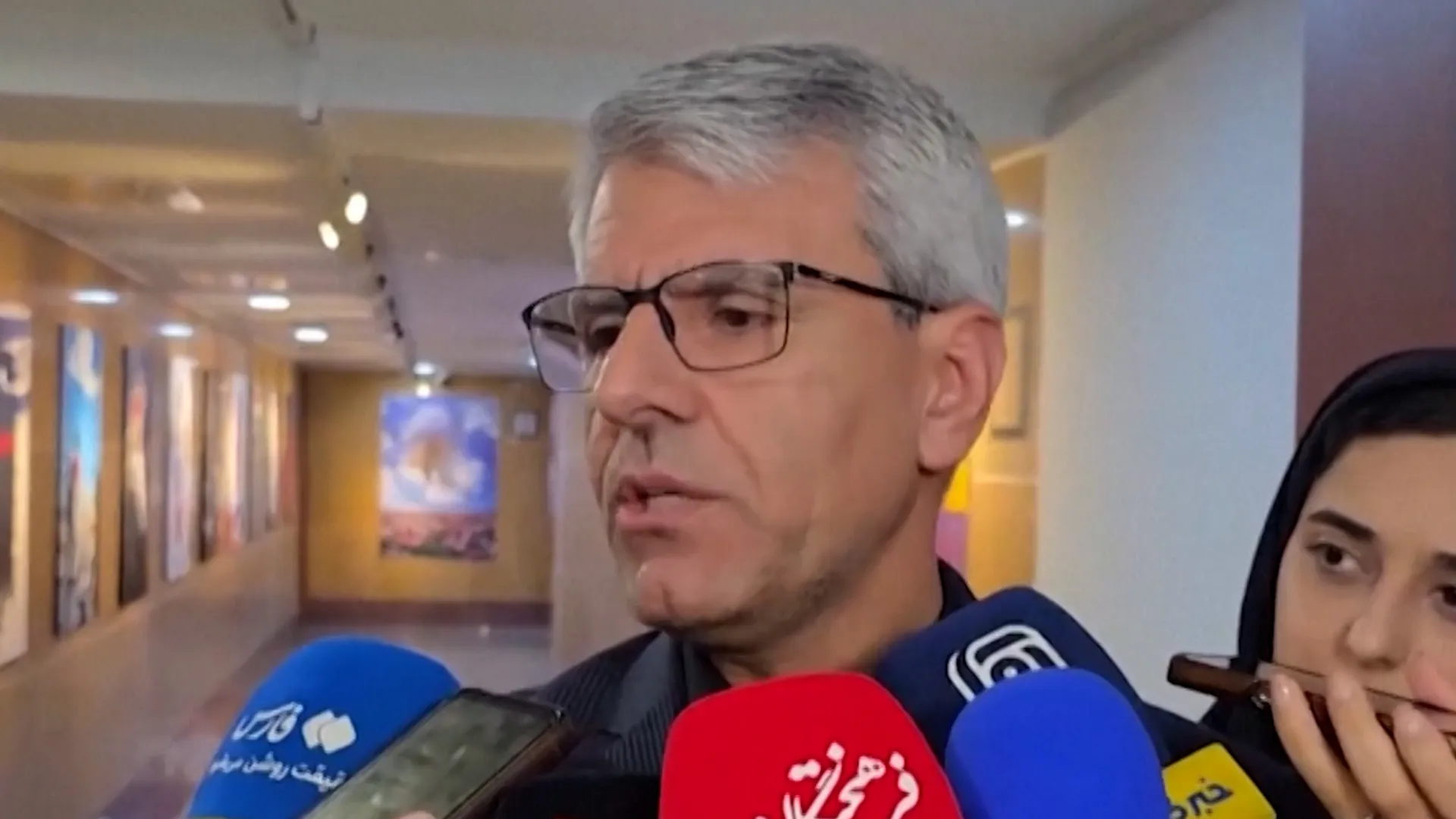
Iran’s Foreign Ministry spokesperson said overnight clashes in the Gulf between Tehran and Washington showed how Iran will respond to the enemy with strength and power.
Published On 10 Jun 202610 Jun 2026
Share

The new EU’s Pact on Migration and Asylum is the most sweeping overhaul of European asylum law in decades.
Al Jazeera’s Marthe van der Wolf explains what’s new.
Published On 10 Jun 202610 Jun 2026
Share

The European Fiscal Board (EFB) criticized the European Commission for allowing some of the defence spending leeway from last year to be used for transitioning to clean energy. Last year, the Commission allowed EU governments to spend an extra 1.5% of GDP annually for four years on defense against potential attacks from Russia, using a national escape clause due to uncontrollable events.
Italy, facing high fuel prices from the U. S.-Israeli war on Iran, sought more fiscal flexibility from the EU to help manage costs ahead of elections. The Commission agreed to permit 0.3% of that 1.5% for the clean energy transition. EFB Chairman Pieter Hasekamp stated that the energy crisis should drive transformation rather than increased spending, urging that fiscal credibility is critical to minimize borrowing costs.
The EFB emphasized the importance of adhering to previously agreed spending paths to reduce debt, noting that many EU countries still need to cut back post-pandemic stimulus. They expressed concern that extending escape clauses for energy could lead to excessive and untargeted financial support. The board also advised that if oil prices remain high, governments should prioritize public investment over efforts to sustain consumer demand.
With information from Reuters
For the Islamic State (IS) and its West Africa Province (ISWAP), the third week of May 2026 began with a compound disaster and ended with a theology lesson. The group faced one of its most shocking moments, at least in West Africa or, more specifically, Nigeria.
With its headquarters in Nigeria, ISWAP has been the most active wing of the Islamic State globally, claiming more attacks than any other IS province since its central operations in Iraq and Syria were largely overpowered. Following the call for its members to migrate to Africa, ISWAP has, in the past two years, temporarily overran Nigerian military installations, including at least one super camp. The group was enjoying relative success when a turning point came: one of its most important first-generation commanders was killed.
The operation that killed Abu Bilal Al-Minuki between midnight and 4 a.m. on May 16 was described by the Nigerian military as “meticulously planned and highly complex”. It not only left the terrorist dead, but it also caused a crisis of morale that ISWAP’s propaganda machine would spend the following days trying to contain through a theological message.
Ahmad Salkida, a leading conflict analyst who has been observing the situation since it emerged, described the killing of Al-Minuki as a “serious disruption” to the activities of ISWAP in the Lake Chad region.
Airstrikes and special forces raids followed. More people were killed, and confusion reportedly descended. The operations, according to some reports, may also have killed the likely successor to Al-Minuki, another terrorist commonly known as Ba Shuwa, opening a new and, perhaps, unplanned chapter in the insurgency.
By May 19, Nigeria’s Defence Headquarters reported that 175 ISWAP and Boko Haram militants had been killed since the joint offensive began. According to the report, at least 20 died in a single engagement. By the time Nigerian authorities stopped counting, the joint operation had become the most lethal week the group had faced in years.
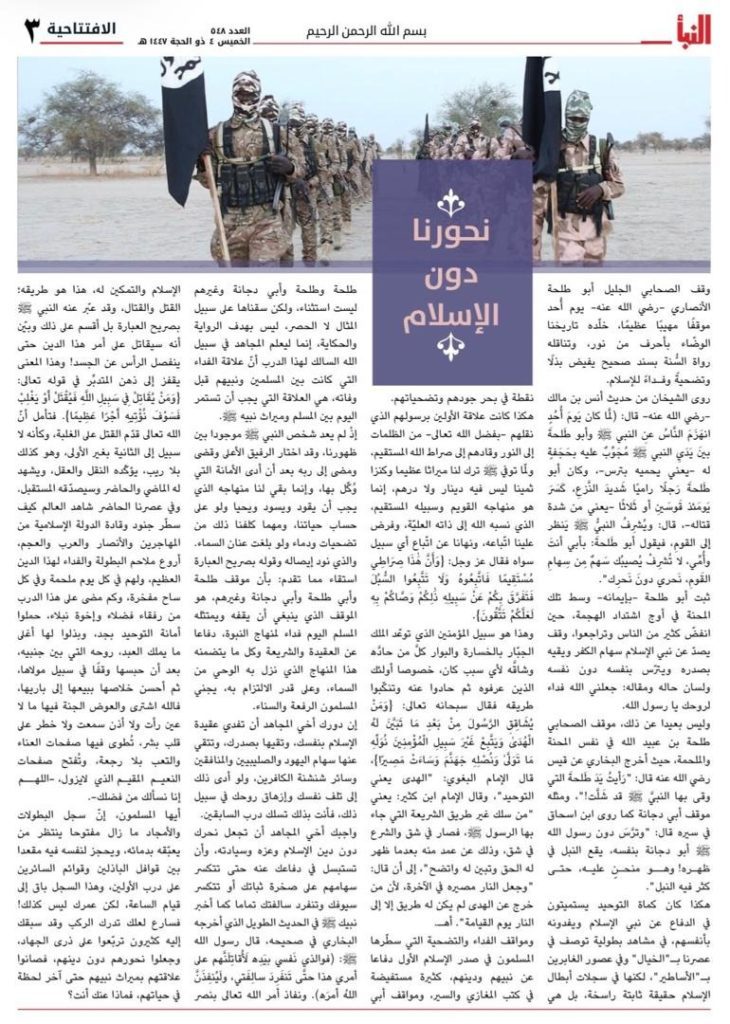
Within that catastrophic week, the Islamic State released its Al-Naba newsletter with a pointed editorial. Although it did not mention Al-Minuki or the numerous fighters killed, the editorial retold a story of a battle that happened 14 centuries ago to boost the morale of a group in disarray.
Reports suggest there was internal suspicion, even before the death of Al-Minuki, that some fighters may have leaked information leading to his death, driven by internal discontent over the unequal treatment between foreign fighters who migrated to the ISWAP and the local fighters in Nigeria. However, the editorial tried to shift away from that and present the losses as a normal sacrifice.

Everything in the editorial is deliberate. The piece opens on Talha ibn Ubaydullah, a companion of the Prophet Muhammad, at the Battle of Uhud. The selection is pointed in ways that any reader with a classical Islamic education would immediately recognise.
Uhud was a near-disaster for early Muslims because of an internal division. It was a battle in which archers abandoned their positions, turning a momentary advantage into a rout that left dozens of companions dead and the Prophet himself wounded.
What Islamic tradition preserved, and what the Al-Naba propaganda wanted to convey from that valley, however, was not only the memory of tactical failure but of individual men who placed their bodies between the Prophet and death – an important sacrifice for the existence of Islam.
The editorial tells ISWAP fighters who have fallen into fear, confusion, or doubt after the loss of Al-Minuki and other fighters that a similar situation occurred during the Battle of Uhud. However, because the Prophet’s companions believed they were fighting for Islam, they did not see it as a problem.
In essence, the message is that they may ultimately be killed, suffer injuries, or even think they have already achieved victory and begin collecting spoils of war, only for circumstances to turn against them. Yet, regardless of whatever hardships or setbacks they face, they should not regard themselves as having lost, because they are fighting for their religion.
“Your role, O my mujahid brother, is to make your chest a sanctuary for the religion of Islam and guard it with your body,” the editorial reads.
This is a recognisable pattern in IS editorial strategy. After senior commanders are killed, Al-Naba invokes early Islamic battles such as Badr, Uhud, and Khandaq as mirrors, casting present losses as the preconditions for eventual triumph. The rhetorical architecture is consistent and has appeared after every major command-level strike against the organisation. What changes each time is only the particular story pulled from the tradition.
In 2019, when Abubakar Al-Baghdadi, the former leader of Islamic State, died, Al-Naba compared the situation with that of early Muslims after the death of Prophet Muhammad, in which many of his companions fell into disbelief until they were calmed by the first caliph Abu Bakr As-Siddiq. Al-Naba issue 207 argued that if Islam could survive the death of the Prophet Muhammad, the Islamic State could also survive the death of Al-Baghdadi.
The choice of Talha in the recent issue of Al-Naba, specifically after the death of Al-Minuki, adds a layer to the editorial. Talha survived Uhud and fought many more campaigns. The editorial addresses not only those who died but also those who lived through the week. The message to fighters still alive in the Lake Chad Basin, still holding ground, is legible between every sentence.
“It is the duty of my mujahid brother to walk those same paths in defence of the religion of Islam, its honour, and its sovereignty,” the editorial says.
The theology in the Al-Naba editorial could steady nerves or explain deaths. It could also transform defeat into sacrifice. However, it could not answer the practical question now hanging over the movement: who would lead after Al-Minuki?
For years, ISWAP’s resilience has rested on its ability to survive leadership decapitation. Commanders and factional leaders have died, been assassinated, or removed. Yet the organisation endured because a pool of experienced first-generation figures remained available to absorb the shock. However, this time may be different.
Get our in-depth, creative coverage of conflict and development delivered to you every weekend.
Subscribe now to our newsletter!
A HumAngle analysis observed that Al-Minuki’s most likely successor was Ba Shuwa. However, he too may have been killed in the subsequent strikes; if confirmed, the movement would lose not only its most influential commander but also the man widely expected to replace him.
Al-Minuki belonged to a shrinking class of terrorists who entered the movement before the 2009 uprising transformed Boko Haram from a fringe extremist religious organisation into a regional insurgency. He embodied institutional memory, battlefield experience, and personal relationships that spanned multiple generations of fighters.
Ba Shuwa, although younger in status within the movement, still belonged to that older ecosystem. Their simultaneous deaths would accelerate a transition that many inside ISWAP had anticipated but few expected to happen so suddenly. The names now circulating inside insurgent circles to replace Al-Minuki and Ba Shuwa show the scale of that transition.
Among the strongest contenders, as HumAngle gathered, is Abu Salem, a commander who grew up entirely within the insurgency’s wartime environment. He reportedly combines military authority with religious credentials, a combination that carries considerable weight inside ISWAP’s hierarchy.
Another frequently mentioned figure is Bana Chingori, long regarded as a close associate of Ba Shuwa and an influential commander in his own right.
However, beneath the movement’s ideological claims lies a complex web of battalion loyalties, personal networks, ethnic affiliations, and historical rivalries. Fighters speak the language of the caliphate, but leadership legitimacy is often negotiated through social structures that long predate the insurgency itself. The question is not merely who is capable of leading, but who can command obedience across the various factions that make up the movement.
This is where the editorial in Al-Naba becomes more interesting. The Islamic State understands that leaders can be replaced. What is more difficult to replace is cohesion.
The editorial’s invocation of Uhud was not simply a sermon about perseverance. It was also an attempt to create continuity at a moment when continuity is under threat. By reminding fighters that early Muslims endured confusion after battlefield losses yet remained united, the editorial implicitly addresses the danger of fragmentation.
For nearly a decade, ISWAP distinguished itself from rival jihadist factions partly through its ability to maintain organisational discipline. While Boko Haram under Abubakar Shekau frequently splintered under pressure, ISWAP developed bureaucratic structures capable of surviving individual losses. The current transition will test those structures more severely than any succession crisis since the death of Abu Musab al-Barnawi and the removal of other senior figures from the Muhammad Yusuf generation.
Beyond the succession question lies another bigger development. ISWAP has announced that the flow of fighters migrating from Iraq and Syria to Nigeria has been effectively paused.
For years, the Islamic State’s call for migration to Africa was one of ISWAP’s most reliable sources of experienced foreign fighters. Foreign fighters who had trained and fought in the central theatre arrived in Lake Chad with tactical knowledge, ideological authority, and direct personal connections to IS central command.
Al-Minuki himself was a product of that ecosystem. The suspension reflects the bigger issue that ISWAP is facing, in which local ISWAP members feel foreigners are given more priority in the insurgency, and they’re being relegated. This, according to some sources, was one of the reasons that opened a loophole that led to the intelligence leading to the killing of Al-Minuki.
Al-Naba issue 550 addressed the question of migration indirectly. The editorial, titled “Africa Between Yesterday and Today”, spoke in the past tense about those who had already made the journey. “Those who came before you from Iraq walked this path,” the editorial told terrorists currently in Africa, “and they carried the weight of this religion on their shoulders.”

The joint US-Nigeria strike that killed Al-Minuki demonstrated a targeting capability that ISWAP had not previously faced at this intensity in the Lake Chad theatre. The use of American intelligence assets alongside Nigerian special forces created a surveillance environment that makes the movement of senior figures, especially those arriving from abroad, significantly more dangerous than before.
For IS central, sending experienced insurgents into a degraded environment risks losing irreplaceable assets to an adversary that has now demonstrated it can find and kill the most protected figures in the organisation. The pause in migration is both a strategic retreat and a rational response to changed targeting conditions.
The commanders now being discussed as replacements for Al-Minuki are men who grew up entirely inside the Nigerian insurgency. Whatever their capabilities, they appear to lack the cross-theatre experience and IS central relationships that figures as Al-Minuki carried. The migration pause has narrowed the field of who can credibly lead it.
The United States and Iran engaged in some of the most intense fighting overnight since all-out hostilities in the ongoing US‑Israeli war on Iran were halted with a Pakistan‑mediated temporary ceasefire on April 8.
A comprehensive peace agreement remains elusive as Iran and the US have exchanged a series of proposals and counterproposals in the weeks since that pause. After a string of smaller escalations, however, the US struck targets in Iran following the downing of a US Apache helicopter close to the Strait of Hormuz on Tuesday, and Iran retaliated by hitting US military bases in the Gulf.
The US military said it targeted communications and radar facilities. Iranian officials, however, said civilian infrastructure was also damaged, including two water reservoirs.
If correct, this is the first reported strike on civilian infrastructure in Iran in several weeks, but it comes at a time when Iran is facing a severe water shortage.
The US launched waves of attacks starting late on Tuesday following the downing of the helicopter in the Strait of Hormuz. The US described the attacks as “self-defence strikes” and a “proportional response to unjustified Iranian aggression”.
While an official US inquiry into what caused the helicopter to crash has yet to conclude, US President Donald Trump quickly blamed Iran, which he said had deliberately shot it down.
“I have just been informed by our Great Military that last night the Iranians shot down one of our highly sophisticated Apache Helicopters while patrolling over the Strait of Hormuz. There were two pilots involved, both are safe and uninjured,” Trump wrote on social media.
“Nevertheless, the United States must, of necessity, respond to this attack.”
Iran’s Islamic Revolutionary Guard Corps (IRGC) said US strikes, which hit targets including Sirik, Jask, Minab, Qeshm Island and the port of Bandar Abbas, had caused major damage to a telecommunications tower in the town of Sirik and destroyed two water reservoirs there.
Iran’s West Asia News Agency (WANA) news outlet reported on Wednesday, citing “available reports”, that two concrete water storage reservoirs in the Bamani district in the Sirik County of Hormozgan Province, in southern Iran, 1,012km (629 miles) from the capital, Tehran, had been hit in the US attacks.
The IRGC claimed attacks on US military bases in Bahrain, Kuwait and Jordan in retaliation.
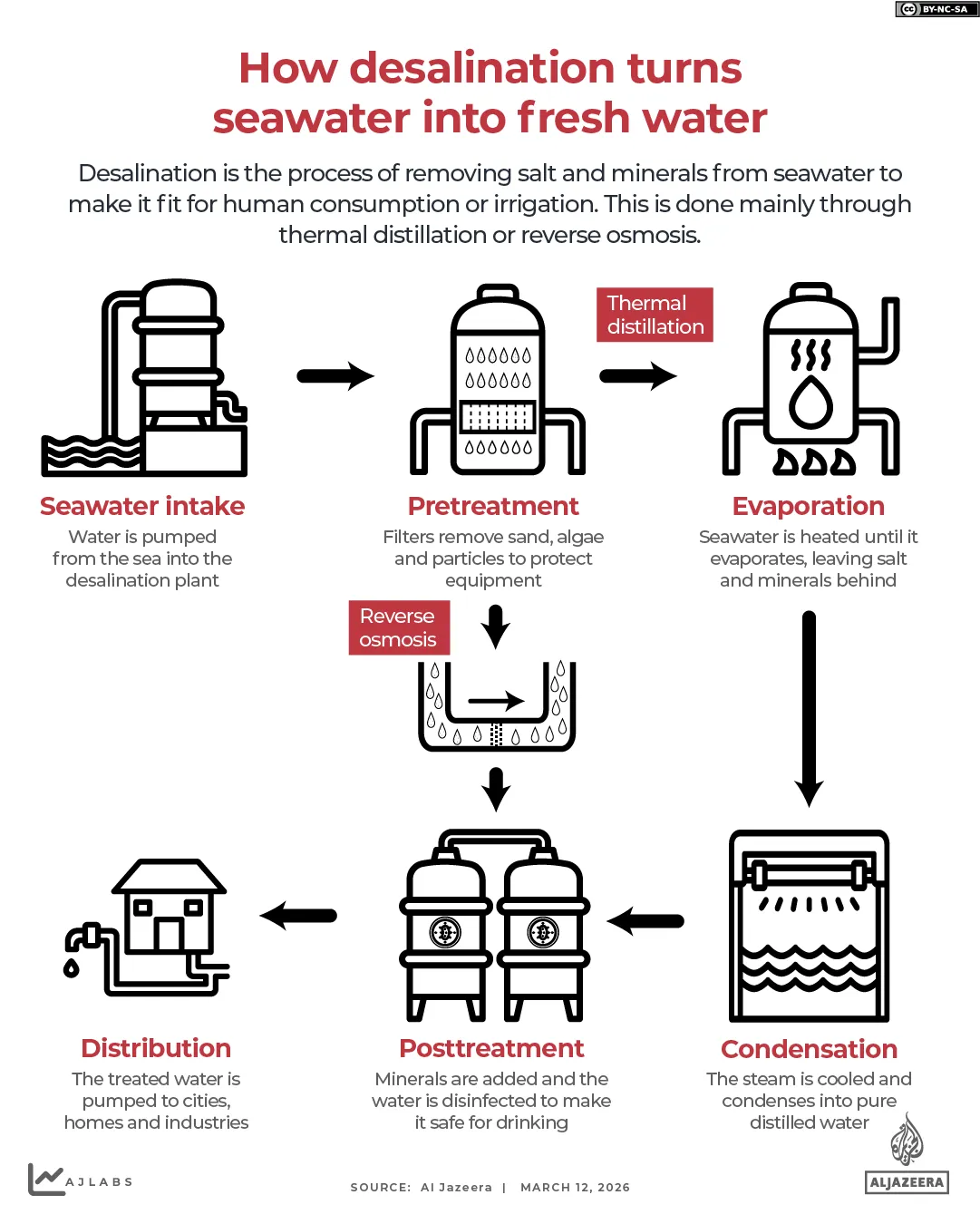
Yes. On March 7, while missiles were flying across the region in an all-out war between Iran and the US-Israel, Iranian Foreign Minister Abbas Araghchi accused the US of striking a desalination plant on Qeshm Island off the coast of Iran in the Strait of Hormuz. The strike reportedly cut off the water supply to 30 villages.
“Water supply in 30 villages has been impacted. Attacking Iran’s infrastructure is a dangerous move with grave consequences. The US set this precedent, not Iran,” Araghchi wrote in an X post.
A desalination plant converts seawater into water suitable for drinking, irrigation and industrial use. These facilities are particularly critical in areas such as the Gulf, where freshwater is scarce.

The reservoirs that were struck provide drinking water to more than 20,000 residents in the city of Kouhestak and 10 surrounding villages. WANA reported initial estimates for damages amounting to $780,000 to $830,000.
Iran was already facing a multiyear drought and decline in precipitation before the US-Israeli war on Iran started. After years of poor agricultural practices and mismanagement, Iran’s main water supplies, including its reservoirs, rivers and groundwater reserves, continued to run dry.
According to Aqueduct data from the World Resources Institute, which tracks global water risk, Iran’s baseline water stress is classified as “extremely high” – meaning the country uses more than 80 percent of its renewable water resources in a typical year.
Last year marked Iran’s fifth consecutive year of drought. In November 2025, the water crisis was so dire that Tehran’s Amir Kabir Dam only held 8 percent of its capacity, while across the country, 19 major dams had run dry.

Isa Bozorgzadeh, spokesman for Iran’s water industry, claimed the US strike on the water reservoirs is a war crime, WANA reported.
International humanitarian law classifies water infrastructure, including drinking water installations, treatment plants and pipelines, as civilian property which is not deemed a legitimate target during war.
The Berlin Rules on Water Resources, drafted by the International Law Association (ILA) and adopted in 2004, are a set of non‑binding international legal principles about how countries should use, share and protect water.
The Berlin Rules prohibit countries at war from destroying water installations “if such actions would cause disproportionate suffering to civilians”.
Four Brazilian players and four members of their coaching staff were sent off during a dramatic encounter in Fortaleza.
Published On 10 Jun 202610 Jun 2026
Brazil were shown eight red cards during a chaotic 1-0 defeat to the United States women’s national team in a friendly in Fortaleza.
Brazilian coach Arthur Elias and three of his assistant coaches were sent off, while Bia Zaneratto and Tarciane were also dismissed. Two other players were shown red cards after the full-time whistle on Tuesday evening.
list of 3 itemsend of list
Sophia Wilson’s shot deflected off Isabela and snuck past Brazilian goalkeeper Lorena in the 63rd minute for the lone goal of the game before a crowd of more than 55,000 fans in northern Brazil. The hosts had no shots on goal, while the US had six.
Brazil manager Elias and several assistants were dismissed from the technical area during the second half.
Brazil then went down to nine in stoppage time after attacker Zaneratto was dismissed after picking up a second yellow card for pushing Emily Sonnett.
Moments later, her teammate, Tarciane, was shown a straight red for elbowing Wilson.
The chaos continued after the full-time whistle, with Brazil’s Kerolin and Ludmila both shown red cards for dissent.

It was the second of two matches in Brazil for the Americans, with the US losing 2-1 in the opener on Saturday in Sao Paulo.
Marta, a six-time FIFA World Player of the Year, was subbed into the match in the 80th minute, making her 212th appearance for Brazil.
Dudinha appeared to hurt her right knee in a collision with Sonnett in the 30th minute and was stretchered off the field in obvious pain. The 20-year-old forward, who plays for the San Diego Wave in the National Women’s Soccer League, returned to the bench in the second half on crutches.
The matches in Sao Paulo and Fortaleza were played at stadiums that will be used next June and July for the Women’s World Cup. The US will start their qualification campaign in November.
The TWZ Newsletter
Weekly insights and analysis on the latest developments in military technology, strategy, and foreign policy.
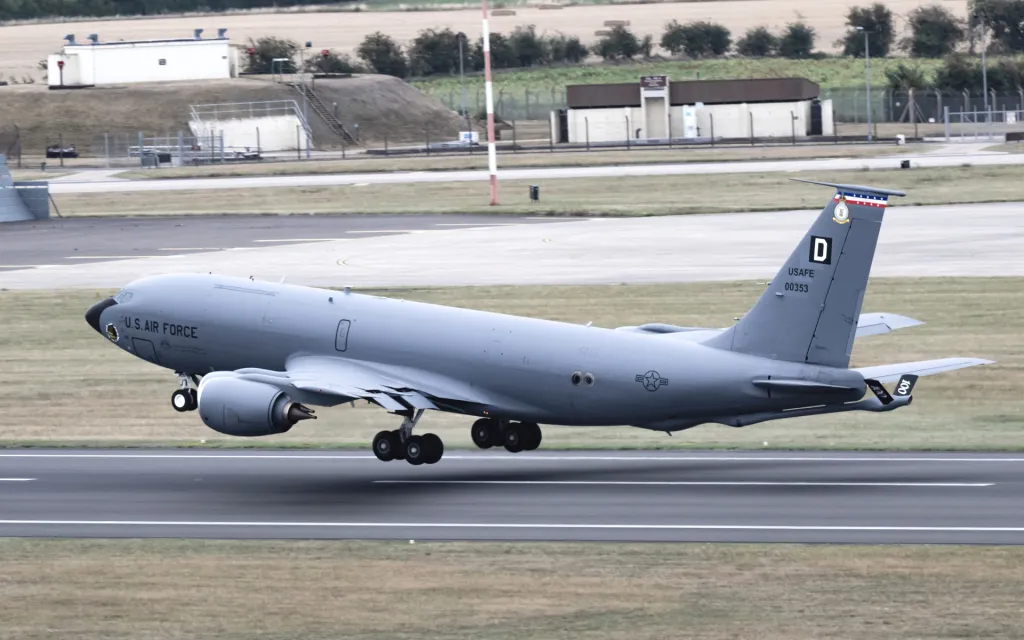
A U.S. Air Force KC-135 tanker appeared in the United Kingdom this weekend with a new antenna on top of the rear of the fuselage. The service has several efforts underway to improve the communications networking capabilities of all of its tankers and cargo planes, including ones that leverage Starshield, the government-focused cousin of SpaceX’s Starlink. This has become an especially critical priority for future survivability and effectiveness of the aging KC-135 fleet.
Aviation photographer Alessandro Ledda, who goes by Aerographist on Instagram, caught the KC-135 in question at RAF Mildenhall yesterday. The base is a major hub for U.S. Air Force operations in the United Kingdom. It has been utilized to support recent operations against Iran, as have other RAF facilities.

Ledda told TWZ that online flight tracking data says this particular KC-135 is serial number 63-7976, but that this might not be correct. The plane is largely devoid of markings, preventing easy confirmation. Two years ago, the Air Force’s Air Mobility Command (AMC) began removing serial numbers and other unique identifying markings from tankers and other aircraft as an operational security measure, as you can read more about here.
Ledda also told us that this is the first time he has seen a KC-135 with the new dorsal antenna, despite regularly photographing tankers of this type at Mildenhall. The base is home to the Air Force’s 100th Air Refueling Wing, which flies the KC-135, but is also a regular staging point for temporary deployments and a stop-over for aircraft just passing through.
A picture of the same antenna on top of a KC-135 had emerged online in April, but where and when it was taken are unclear. This may or may not be the same aircraft seen at Mildenhall this weekend. It is unknown how many Air Force KC-135s may have received this modification so far, and TWZ has reached out to the Air Force for more information. At the beginning of Fiscal Year 2026, the Air Force had 368 KC-135s in inventory, in total. At least a portion of that fleet is set to remain in service through 2050.

The antenna has a very roughly trapezoidal shape with a mostly flat top. There is a single small blade that sticks up at the rear, as well. The size and shape are broadly reflective of ‘hump’ style antennas associated with high-bandwidth satellite communications (SATCOM) suites seen on large military and commercial aircraft. In both pictures we have seen of this installation on the KC-135 so far, the new antenna is also mounted right behind a much smaller existing platter-shaped type typically used to support ultra-high-frequency SATCOM links.
Back in April, the possibility was raised that the new antenna for the KC-135 could be tied to Airlift/Tanker Open Mission Systems (ATOMS) and/or its successor, MAF NEXUS, both developed by the Sierra Nevada Corporation (SNC). MAF here stands for Mobility Air Forces, a collective term for the Air Force’s tanker and airlifter fleets, and the personnel that support them.
ATOMS is “a Starshield-based BLOS [beyond line of sight] satcom system SNC has been installing on a handful of [KC]-135s, [C]-17s, [KC]-46s, [C]-130s. Saw a C-17 getting it last week in Dayton,” Aviation Week‘s Brian Everstine wrote on X, speaking generally, in a thread discussing the first picture of the new antenna for the KC-135 that had emerged. ATOMS is “now transforming to Air Mobility Commands [sic] ‘MAF Nexus.’”

As noted, Starshield is a more secure, government-centric offshoot of SpaceX’s Starlink space-based network. Starshield and Starlink have been in increasing use across the U.S. military on aircraft, as well as warships and in various contexts on the ground, for years now, as TWZ has explored on several occasions in the past.
The size and shape of the antenna on the KC-135 at Mildenhall is, broadly speaking, in line with commercial Starlink antennas used on airliners and other civilian aircraft.

“The SNC solution for ATOMS, originally provided as a Quick Reaction Capability (QRC) in just six months, delivers enhanced situational awareness through multidomain networking and datalink,” SNC had explained in a press release in August 2025. “The system’s ability to provide a Common Operating Picture improves data interpretation and bolsters decision advantage, strengthening AMC’s effectiveness by leveraging multiple communications paths and sensors to seamlessly share data.”
That release followed the conclusion of the Air Force’s Mobility Guardian 2025 exercise, in which ATOMS “played a pivotal role” by “demonstrating its ability to provide seamless data management and communications solutions on multiple aircraft platforms, including the C-17, KC-135, KC-46 and C-130, as well as numerous ground nodes.”
The Air Force’s 2027 Fiscal Year budget request highlights at least two other potentially relevant communications upgrade efforts for the service’s KC-135, specifically, which could also make use of Starlink/Starshield.

There is the “Hybrid SATCOM capability,” which involves “the employment of Multi-Band, Multi-Orbit SATCOM terminals to switch between different government and commercial constellations,” according to official budget documents. This is tied to another project called MAF Connectivity focused on developing a “path forward as the tanker needs to be able to connect to the Joint fight to close kill chains and logistics chains.”
For MAF Connectivity, “possible capabilities include, but are not limited to, intelligent gateways, antennas, radios, software updates, crew displays, and multiple aperture array housings,” the budget documents also note. An “increment 1 first prototype installation” was also scheduled to be completed in the second quarter of Fiscal Year 2026, which began on January 1 and ended on March 31.
The antenna could be part of a different effort, as well. The Air Force has fielded a number of roll-on/roll-off communications and networking suites for the KC-135 over the years, but in an ad hoc manner and on a relatively limited scale. Last year, the Air National Guard also announced the demonstration of a new communications and data-sharing node packaged inside a heavily modified underwing Multipoint Refueling System (MPRS) pod, but the extent to which that capability may now be available for operational use is unclear. KC-135 and KC-46 tankers use unmodified MPRS pods to transfer fuel to receivers via the probe-and-drogue method.

As an aside, a Boeing 757 called Trailblazer (N-number N473AP), which defense contractor L3Harris uses as a testbed, also recently emerged with a new elongated dorsal fairing. Trailblazer’s new addition is similar in some broad strokes, but also distinctly different from the antenna seen on the KC-135 at Mildenhall this weekend. One of L3Harris’ major business areas is satellite communications systems, including for the U.S. Air Force. TWZ has reached out to the company for more information about this development.
For years now, the Air Force has been trying to more deeply integrate new communications and networking capabilities onto the KC-135, as well as other tankers and aircraft across the MAF. Senior service officials have also described this as a gateway to enabling other new capabilities down the road, including ones to help better protect tankers and airlifters from future threats. TWZ has previously highlighted this as a path to airborne control for “loyal wingman” type drones and other uncrewed aerial systems, something the Air Force has already been experimenting with to differing degrees.
“I gotta keep modernizing the tanker force,” Air Force Lt. Gen. Rebecca Sonkiss told TWZ and others at a roundtable at the Air & Space Forces Association’s annual warfare symposium in February. “If I was going to parcel out the things we care about in that, though, it’s connectivity and survivability. So those are the things that we really care about in that effort.”
“There’s various ways to get after survivability,” she continued. “It starts with being connected so that you have battlespace awareness, and then it continues on to how do we protect those assets.”
Sonkiss’ official title is Deputy Commander of AMC. However, she has been serving as the interim head of the command since her predecessor, Gen. John Lamontagne, became Vice Chief of Staff of the Air Force in January.

“The single biggest contributor to survivability in a big airplane is connectivity. The biggest contributor is not having a 12-hour-old Intel brief that you’re relying on to get you through the mission,” retired Air Force Gen. Michael “Mini” Minihan, who led AMC from October 2021 to November 2024, told TWZ in an interview in February, as well. “So real-world updates, real-time updates, just like our fighters and our bombers enjoy. Battle management that gets after maneuver and not just kill chain. Those things matter.”
“The reality is that the car I rented right now, driving from the airport to my hotel room, has more connectivity in it than the overwhelming majority of the mobility fleet. So connectivity matters,” he also told us at that time.
New communications and networking suites could enable AMC’s KC-135, as well as the rest of the command’s fleets, to serve as essential ‘translators’ between disparate networks and waveforms in the future. Providing a link between low probability of interception/low probability of detection (LPI/LPD) datalinks that stealthy aircraft use, such as the Multifunction Advanced Data Link (MADL) and Intra-Fighter Data Link (IFDL), and more general-purpose ones, would be especially valuable. IFDL is currently only found on the F-22 Raptor, while all variants of the F-35 fighter (and future B-21 Raider bombers) use MADL, and the two cannot ‘talk’ to each other directly, which has long created challenges. Upgraded tankers could serve as important parts of a beyond-line-of-sight mesh-like network that incorporates other kinds of line-of-sight links like Link16. In this way, they could help relay data to and from forward battle management and other command and control nodes, including ones in the air.

In addition, improved connectivity stands to provide additional operational and safety benefits across the MAF.
“According to the Air Force, the tankers’ ability to access tactical data links could increase mission success in contested environments by improving survivability, agility, and situational awareness for command-and-control elements and aircrews,” the Congressional Research Service (CRS) wrote in a report published in January. “The connectivity could provide aircrews with such information as potential threats, fuel availability, and safer landing sites. In addition, tanker aircraft could serve as a backup information conduit for other aircraft in a degraded communications environment.”
The points here have become a broader topic of discussion after two KC-135s collided over Iraq in March during the opening weeks of Operation Epic Fury against Iran. One of the aircraft crashed, killing all six onboard. The other tanker involved was able to land in Israel despite suffering severe damage. At the time of writing, the Air Force has not yet shared any official determinations as to the chain of events that led to that fatal incident.
“We should never put mobility crews, especially tanker crews, in a position during combat operations where they have to choose between being seen by everyone, including the enemy, or being seen by no one, including the joint force and civil aviation,” Minihan subsequently wrote in a post on LinkedIn. “Mobility force connectivity now. Write the damn check.”
“Most KC-135s [sic] communications networks are ‘not the type of battle space awareness that shows you where the red is, where the blue is, and the actions that are being taken in real time in a conflict,’”Defense One reported in March, citing an interview with retired Air Force Gen. Jacqueline Van Ovost, who previously served as head of U.S. Transportation Command (TRANSCOM). “All you have is the intelligence you took off with when you got the brief two hours prior to take off.”
All this being said, the Air Force is still years away from integrating more robust communications and networking capabilities onto the entire KC-135 fleet.
“Over the course of about the next six years, you’ll see the full fleet of KC-135s fully connected,” Lt. Gen. David Tabor, Deputy Chief of Staff for Plans and Programs, told members of Congress at a hearing last month.
The appearance of the KC-135 with the added antenna at Mildenhall does point to new progress on key connectivity upgrades for Air Force tankers and airlifters. At the same time, improved communications and networking capabilities are increasingly critical now, and it remains to be seen when they become more commonplace across the KC-135 fleet.
Special thanks again to Alessandro Ledda for sharing the picture of the KC-135 seen at Mildenhall this weekend with us.
Contact the author: joe@twz.com
The Delhi High Court grants bail to Kashmiri rights activist Khurram Parvez, jailed in India for nearly five years.

Published On 10 Jun 202610 Jun 2026
New Delhi, India — A prominent Kashmiri human rights activist who has been imprisoned for nearly five years has won a partial legal victory after being granted bail in a “terror funding” case, but remains in jail over a second case.
The Delhi High Court granted Khurram Parvez, 49, bail in a November 2021 case on Wednesday, according to legal website LiveLaw. However, he will remain in jail in a separate case from March 2023.
list of 3 itemsend of list
Parvez was first arrested about five years ago by India’s main counterterrorism law enforcement bureau, the National Investigation Agency (NIA), over accusations of “terror funding”, recruitment of rebels in Indian-administered Kashmir and mobilising protesters during a civilian uprising. The second case is also related to alleged “terror funding”.
International rights groups have widely condemned Parvez’s arrest and continued imprisonment.
His lawyer, Swati Khanna, said she hoped Parvez could be freed from jail soon if there was a “positive result” in the second case.
“We are hoping, in a month or two, he could be out,” she told reporters.
The trial has not begun in either of the cases – an issue highlighted by international rights organisations, which say the process becomes the punishment for political prisoners in India who have to wait years behind bars before even facing trial.
The conviction rate in the counterterror law, the Unlawful Activities Prevention Act (UAPA), remains low at 5 percent nationally. It dips further, to less than 1 percent, when it comes to Indian-administered Kashmir.
Prime Minister Narendra Modi’s Hindu nationalist government has been criticised for persecuting dissent and criminalising expression in Kashmir, the country’s only Muslim-majority region.

“Khurram’s arrest proved to be the last nail in the coffin of any meaningful rights activism in Kashmir, one of the world’s most militarised zones,” said a political analyst based in Srinagar, Kashmir, who requested anonymity fearing repercussions from the authorities.
“This bail comes in a completely shallow, and nearly fictitious, trumped-up case after years in jail, and Khurram would still not walk free.”
Kashmir remains disputed between India, Pakistan, and China, which control parts of the region. Pakistan controls the northern and western portions – Azad Kashmir; and Gilgit and Baltistan. India controls the southern and southeastern parts – the Kashmir valley, including its biggest city, Srinagar; Jammu; and Ladakh. China controls the Aksai Chin area in the northeast.
The two neighbours have fought three major wars over Kashmir since the end of British colonial rule and their partition in 1947 led to the creation of Muslim-majority Pakistan and Hindu-majority India. Both countries continue to assert claims to the entire region of Kashmir.

From Maddie Lee: It was just one moment in the midst of a persistent Dodgers scoring spree. But in the context of a long and decorated career, Freddie Freeman’s run-scoring single into shallow center field carried weight.
In the seventh inning of the Dodgers’ 12-3 win against the Pirates on Tuesday, Freeman notched his 2,500th major-league hit.
“It means a lot,” Freeman said. “And then when your manager and teammates appreciate what you’ve done over the course of your career, it does mean a lot. Yeah, there’s always another goal to get to. But to step back and realize how long you have to play, … to play at a high level over many, many years to get there, it does mean a lot.”
Only 101 other players have achieved the milestone, according to Baseball Reference. And Freeman, in his 17 major-league seasons, leads all active players in hits.
The future Hall of Famer isn’t really a memorabilia collector, but for this one, Freeman made sure to get the ball and the lineup card. When asked if he wanted his bat authenticated, he said he’d hold on to it.
There are still more hits in it.
“If you would have asked me 10 years ago, I probably would have brushed it off and kept going,’ Freeman said. “But as you get older, you do get more emotional and sentimental. It is nice for people to take a moment and appreciate what you’ve done in this game. It is special.”
Get the latest on L.A.’s teams in the daily Sports Report newsletter.
By continuing, you agree to our Terms of Service, which include arbitration and a class action waiver. You agree that we and our third-party vendors may collect and use your information, including through cookies, pixels and similar technologies, for the purposes set forth in our Privacy Policy such as personalizing your experience and ads.
Wade Meckler and Jo Adell keyed a five-run second inning with two-run doubles, and Walbert Ureña navigated heavy traffic through five shutout innings to lead the Angels to a 10-1 victory over the Houston Astros on Tuesday night.
Houston put two runners on in the first, second and fifth and loaded the bases in the third, but Ureña (4-4) pitched out of each jam to lower his ERA to 2.44 on the season and 1.84 in eight starts since early May.
The 22-year-old right-hander gave up three hits, struck out seven and walked five in his 107-pitch effort, which included a 97-mph fastball to whiff Joey Loperfido with the bases loaded to end the third.
From Kevin Baxter: A strike that had the potential to disrupt the U.S. World Cup opener at SoFi Stadium has been averted, with United Here Local 11 and Legends Global, the stadium’s food-service operator, agreeing Tuesday to a tentative deal.
The nearly 2,000 workers represented by the union, which includes dishwashers, concession workers, bartenders and servers, voted last week to authorize a strike with 96% of those voting supporting the decision to walk off the job. Workers were demanding salary increases, protection against subcontracting and job loss through automation, and were refusing to comply with FIFA’s request to collect sensitive private information such as nationality and home addresses.
Details of the new contract were not released but the union had demanded “substantial increases” in pay to more than $30 an hour while Legends proposed wage freezes for some workers and a 25-cent hourly increase for cooks and dishwashers.
Trump administration sued over ‘illegal’ and ‘corrupt’ UFC event on White House lawn
U.S. captain urges World Cup teammates to enjoy the experience
Mexico and South Africa face off again to open World Cup after 16 years of challenges
From Norway to Jordan, World Cup newbies eager to surprise on soccer’s biggest stage
From Ryan Kartje: His 7-6 record at USC in 2024 would go down as the worst mark of Lincoln Riley’s career as a head football coach. But in his third and rockiest year at the helm of the Trojans, Riley was still compensated like one of the kings of the sport.
Riley was paid more than $11.8 million in total compensation during the fiscal year 2024, according to USC’s latest federal tax returns, which were obtained by The Times. That total includes a $100,000 bonus and $10.4 million in base pay, believed to be more than all but three college football coaches that season: Georgia’s Kirby Smart, Clemson’s Dabo Swinney and Ohio State’s Ryan Day. All three have won a national title.
For Riley, his pay in 2024 marks just a slight increase from the 2023 season, when USC paid Riley more than $11.5 million in total compensation. The coach’s base pay increased by $145,143 between fiscal years 2023 and 2024, slightly less than it rose following his debut season in 2022 ($168,000).
USC freshman linebacker Talanoa Ili joins lawsuit seeking to upend new NIL system
Jordan Staal scored his second goal of the game while stretched out on his stomach at 6:32 of the third period to put the Carolina Hurricanes ahead for good in their 5-3 victory on Tuesday night over the Vegas Golden Knights and even the Stanley Cup Final after four games.
Game 5 is Thursday night at Carolina, which will potentially have two games on home ice to win its first Cup in two decades. The Golden Knights are searching for their second in four years.
This was the first game not decided by one goal.
A two-goal lead has disappeared in all four games in what has been a remarkable series in which momentum often changes at a moment’s notice. Each team has led by at least that many twice.
Rams offensive lineman Alaric Jackson was arrested on suspicion of felony domestic violence Monday night in Los Angeles, according to a person with knowledge of the incident not authorized to speak publicly.
Jackson was arrested shortly before 11 p.m. after police responded to a call at a home in West Hills. Upon arrival, police determined that the woman involved in the incident had recorded the interaction and noticed scratch marks on her arms, the person said. Jackson was arrested and later released on a $50,000 bond, according to jail records. His next court date is scheduled for June 30.
The specific charge Jackson was arrested for is a person who “willfully inflicts physical or corporal injury resulting in a ‘traumatic condition’ [such as a bruise, scratch, swelling, or internal injury] on an intimate partner.”
“We are aware of the incident regarding Alaric Jackson, and we take these matters very seriously,” the Rams said in a statement. “Due to this being an ongoing legal situation, we cannot comment further at this time.”
From Chuck Schilken: Serena Williams is back.
And so is her blistering serve.
After almost four years away from the sport, the 44-year-old tennis legend made a triumphant return Tuesday at Queen’s Club in London. She teamed with Canadian teenager Victoria Mboko for a 7-6 (2), 6-2 victory against Nicole Melichar-Martinez of the United States and Erin Routliffe of New Zealand in an opening doubles match at the grass-court HSBC Championships.
Williams recorded service winners of up to 120 mph during her first professional match since the 2022 U.S. Open.
“It was so fun,” Williams said afterward in an on-court interview. “I had so much fun playing with Victoria. She really was able to hold up the team and really play big on the big points. I could really rely on her. We’ve never played together, but it just felt so natural playing with her.”
1890 — The Preakness Stakes is run outside Baltimore, at Morris Park in New York. The race is then suspended for three years, and resumes at the Brooklyn Jockey Club’s Gravesend Course from 1894-1908.
1932 — Gene Sarazen leads wire-to-wire to win the British Open by five strokes ahead of Macdonald Smith at Prince’s Golf Club in Sandwich, England. Sarazen finishes with a tournament record of 283.
1933 — Johnny Goodman wins the U.S. Open golf title, making him the last amateur to win this event.
1934 — Italy beats Czechoslovakia 2-1 in extra time to win the second FIFA World Cup at the Stadio Flaminio in Rome. Italy trailing 1-0, ties the game at the 80th minute. Angelo Schiavio scores the winning goal in extra time.
1944 — A rare triple dead heat occurs in the Carter Handicap at Aqueduct with Bossuet, Brownie and Wait a Bit crossing the finish line together.
1950 — Sixteen months after near-fatal car accident, Ben Hogan wins the U.S. Open. Hogan beats Lloyd Mangrum and George Fazio in an 18-hole playoff at the Merion Golf Club in Ardmore, Pa.
1968 — UEFA European Championship Final, Stadio Olimpico, Rome, Italy: Italy beats Yugoslavia, 2-0 in a replay (first game, 1-1).
1973 — Mary Mills shoots a 63 in the final round of the LPGA Championship to beat Betty Burfeindt by one stroke.
1977 — Al Geiberger sets a PGA Championship 18-hole record when he shoots a 59 in the Danny Thomas Classic.
1978 — Affirmed, ridden by Steve Cauthen, wins the Belmont Stakes to capture the Triple Crown in one of the greatest battles in racing history. Affirmed edges Alydar for the third time.
1989 — Wayne Gretzky of the Kings is named the NHL’s MVP, winning the Hart Trophy for a record ninth time.
1995 — Trainer D. Wayne Lukas wins a record five straight Triple Crown races as Thunder Gulch takes the Belmont Stakes. Lukas is the first trainer to win the Triple Crown races with two different horses. Lukas’ Timber Country won the Preakness.
1996 — Colorado’s Patrick Roy makes 63 saves before Uwe Krupp scores 4:31 into the third overtime to give the Avalanche a 1-0 victory against the Florida Panthers at Miami Arena and complete a four-game sweep of the Stanley Cup Final.
2000 — Stanley Cup Final, Reunion Arena, Dallas, TX: New Jersey Devils defeat Dallas Stars, 2-1 in double OT for a 4-2 series victory.
2006 — In Atlantic City, N.J., Bernard Hopkins wins a unanimous decision over light heavyweight champion Antonio Tarver, capping an 18-year career with an upset for the ages.
2010 — USC is placed on four years probation, receives a two-year bowl ban and a sharp loss of football scholarships. The NCAA cites USC for a lack of institutional control. The NCAA found that Reggie Bush, identified as a “former football student-athlete,” was ineligible beginning at least by December 2004. The NCAA also orders USC to vacate every victory in which Bush participated while ineligible. USC loses 30 scholarships over a three-year period, 10 annually from 2011-13.
2012 — Shanshan Feng wins the LPGA Championship to become the first Chinese player to win an LPGA Tour title and a major event.
2018 — Rafael Nadal won a record-extending 11th championship at Roland Garros by beating Dominic Thiem 6-4, 6-3, 6-2. Nadal became the second player in tennis history to win 11 singles titles at any Grand Slam tournament after Margaret Court, who claimed 11 Australian Open titles.
2018 — Kristen Gillman led a U.S. singles sweep in the biggest blowout in Curtis Cup history. Gillman, a 20-year-old University of Alabama star, beat 16-year-old Annabell Fuller 5 and 4 to cap a perfect weekend at Quaker Ridge in Scarsdale, N.Y. The Americans won 17-3, breaking the record for margin of victory of 11 set in a 14 1/2-3 1/2 victory at Denver Country Club in 1982.
2023 — UEFA Champions League Final, Ataturk Stadium, Istanbul: Manchester City beats Inter Milan, 1-0 to complete historic Champions League, Premier League & FA Cup trifecta.
Compiled by the Associated Press
1921 — Babe Ruth of the New York Yankees became baseball’s career home run leader by hitting his 120th off Cleveland’s Jim Bagby in the third inning. The Indians took the game 8-6.
1944 — Joe Nuxhall, at 15 years, 10 months and 11 days, became the youngest player in major league history when he pitched for the Cincinnati Reds in an 18-0 loss to the St. Louis Cardinals.
1959 — Rocky Colavito of Cleveland hit four consecutive home runs at Baltimore’s Memorial Stadium, a tough home run park. Billy Martin and Minnie Minoso also homered in the Indians’ 11-8 victory.
1966 — Cleveland’s Sonny Siebert threw the only no-hitter of the year as the Indians beat the Washington Senators 2-0.
1972 — Hank Aaron’s grand slam pushed the Atlanta Braves to a 15-3 rout over the Philadelphia Phillies. It was Aaron’s 649th home run, moving him ahead of Willie Mays into second place on the career home run list. It was also his 14th grand slam, tying Gil Hodges’ NL record.
1997 — Kevin Brown threw a no-hitter and kept himself from a perfect game by hitting a batter in the eighth inning, leading the Florida Marlins over the San Francisco Giants 9-0.
2005 — Baltimore’s 4-3 win over Cincinnati marked the first time that three 500-homer players appeared in the same game — the Orioles’ Sammy Sosa (580) and Rafael Palmeiro (559), and the Reds’ Ken Griffey, who hit a solo shot in the eighth inning for No. 511.
2006 — Reggie Sanders became the fifth player in major league history with 300 homers and 300 stolen bases when he hit a two-run shot in Kansas City’s 9-5 loss to Tampa Bay. Sanders homered off Chad Harville in the ninth to reach the milestone joining Barry Bonds, Willie Mays, Andre Dawson and Bobby Bonds.
2011 — Tony La Russa managed his 5,000th game when the St. Louis Cardinals lost to the Milwaukee Brewers 8-0. La Russa complied a 2,676-2,324 record with the White Sox, Athletics and Cardinals. Only Connie Mack managed more games with 7,755 over 53 years.
2012 — Frankie Vanderka threw a three-hitter, Travis Jankowski had four hits and Stony Brook completed an improbable run to the College World Series with a 7-2 victory over LSU in the deciding game of the Baton Rouge super regional. Stony Brook became only the second team to open the tournament as a No. 4 seed in the regional round and advance to the World Series. The first was Fresno State during its stunning 2008 run to a national title.
2019 — The Diamondbacks and Phillies play “Home Run Derby” at Citizens Bank Park, in a 13-8 win by the D-Backs. Arizona opens the game with three straight homers off Jerad Eickhoff, by Jarrod Dyson, Ketel Marte and David Peralta, on their way to hitting 8 long balls. The Phillies reply with 5 of their own, including two by Scott Kingery, but it’s not enough on a night when balls are flying out of the park right and left. Eduardo Escobar homers from different sides of the plate in consecutive innings for Arizona, and Ildemaro Vargas also homers twice. The combined 13 homers set a new major league record. The D-Backs had been the last team to open a game with three dingers, back on July 21, 2017.
2020 — Because of the ongoing coronavirus pandemic, the 2020 amateur draft is held virtually and limited to five rounds.
Compiled by the Associated Press
That concludes today’s newsletter. If you have any feedback, ideas for improvement or things you’d like to see, email me at houston.mitchell@latimes.com. To get this newsletter in your inbox, click here.

The TWZ Newsletter
Weekly insights and analysis on the latest developments in military technology, strategy, and foreign policy.
The U.S. Air Force has confirmed that the VC-25B “Bridge” aircraft is now wearing its new (and controversial) red, white, and blue livery as it undergoes final preparations for its official delivery.
Aviation photographer Travis Ghormley shared the first picture of the modified Boeing 747-8i with its new paint scheme yesterday. It was taken the day before in Waco, Texas. The aircraft had been undergoing modification and flight testing at L3Harris’ facility in Greenville, also in Texas, as part of the conversion into its new role, since at least April, before subsequently moving to Waco to be painted. The jet, gifted to the Trump administration by the government of Qatar last year, is set to serve as an interim Air Force One aircraft ahead of the much-delayed arrival of two fully outfitted VC-25Bs from Boeing.

“The VC-25B Bridge aircraft has been painted and is going through final modifications,” an Air Force spokesperson told TWZ today when asked for more information about the aircraft’s current status. “I don’t have any additional details I can provide on delivery dates at this time.”
A press release the Air Force put out on May 1 said that the “VC-25B Bridge aircraft has officially completed modification and flight testing” and was “being painted.” We have confirmed that the completed modifications referred to here were on the contractor side, but the U.S. government still has additional modifications to make to the jet.
Ghormley’s picture does clearly show the jet wearing the same red, white, and blue scheme that has already been appearing on various Air Force and other U.S. government VVIP jets. The livery also includes a large American flag, depicted blowing in the wind, painted on both sides of the tail and “UNITED STATES OF AMERICA” written on both sides of the fuselage. The paint job is virtually identical to what President Donald Trump had previously chosen for the future VC-25B Air Force Ones during his first term. President Joe Biden had previously reversed that decision, bringing back plans to paint the VC-25Bs in the iconic scheme that dates back to President John F. Kennedy’s administration.


The Bridge aircraft’s current location is also unclear. Video posted on social media yesterday, seen below, purported to be of the jet departing for its new home at Andrews Air Force Base just outside of Washington, D.C. This is where the two current VC-25A Air Force One jets, as well as a host of other Air Force VVIP aircraft, are based.
Full blown operation to get this thing out without us seeing. Fueled, loaded crew, and preflighted in the hangar. Flipped CRANE01 to face me at the south end and beam me with landing lights. Entire airport blacked out, crew and grounds crew all wearing NOD’s.
You can barely see… https://t.co/kaNB5FCdJ5 pic.twitter.com/JprSF5ykXW
— jadams (@jadamzs) June 7, 2026
Online flight tracking data does show that another U.S. military Boeing 747-8i flew from Waco, Texas, to Andrews on June 7, using the callsign Crane 01. However, this callsign has been associated with an ex-Lufthansa 747 the Air Force has also acquired for use as a trainer in support of future Air Force One operations. This aircraft, which may now carry the serial number 25-3200, has been tracked multiple times flying between facilities in Texas and Andrews in recent months. There does not appear to be tracking data for the VC-25B Bridge jet, which may also now have the serial number 25-3300, but it could have made the trip without broadcasting on ADS-B.
Past reports have indicated that the Bridge aircraft could make its public debut on July 4, which this year is also wrapped up in additional celebrations of the 250th anniversary of the founding of the United States. President Trump’s birthday (June 14) is also this weekend.
Otherwise, TWZ has previously laid out significant questions about the general feasibility of actually using the VC-25B Bridge aircraft in the Air Force One role, given the kinds of modifications that should be required for this demanding mission. Potential operational security concerns have been raised about using the gifted jet as a presidential aircraft, as well.
“L3Harris, known for its executive communications systems and services, was selected to undertake a complex modification of the bridge aircraft. L3Harris not only delivers secure, reliable and resilient communications for VC-25A and the executive airlift fleet but has extensive experience with self-protection and customization of VIP aircraft,” the Air Force wrote in the May 1 press release. “The accelerated timeline was further made possible by a mission-focused partnership with Boeing, who provided the necessary engineering data to support the required structural modifications.”
“Additionally, elite specialists from multiple government agencies developed advanced protocols to detect and-if necessary-neutralize potential technical hazards on previously owned aircraft,” it added. “Their rigorous approach on the Bridge aircraft has literally ‘written the book’ and set the benchmark for integrating used airframes into the secure military inventory.”

“Safety and security were at the forefront of this program. We deliberately minimized interior aesthetic modifications to focus on modifications for safety, security and mission execution. We assessed which requirements were necessary for an interim capability. We had greater flexibility in developing our mission requirements,” the Air Force also told TWZ directly at that time. “After safety and security, we focused on the mission communications systems.”
“We have made deliberate decisions such as the reduction of the number of airstairs, less chiller space, and exclusion of the Golden Eagle mission [to fly the remains of former presidents] to minimize structural modifications, while prioritizing modifications focused on safety, security and secure communications,” the service added.
Getting a new Air Force One aircraft of some kind into service on an accelerated timetable has long appeared to be a major goal for President Trump. The fully-equipped VC-25Bs from Boeing are years behind schedule. Last year, the Air Force announced that there had been some improvement on that front, but that it still did not expect to have the first of the two jets in hand until mid-2028, which would be just months before Trump is set to leave office.
What we do know for sure is that the VC-25B Bridge aircraft is now wearing Trump’s preferred red, white, and blue paint scheme ahead of its official rollout later this summer.
Contact the author: joe@twz.com

Four-year-old Malika was seriously wounded in an Israeli attack that killed her mother while she shielded her from falling debris. Now, with support from her family and the Ghassan Abu Sitta Children’s Fund, she is recovering from her injuries. Her story reflects the lasting impact of war on children in Lebanon.
Published On 10 Jun 202610 Jun 2026
Share
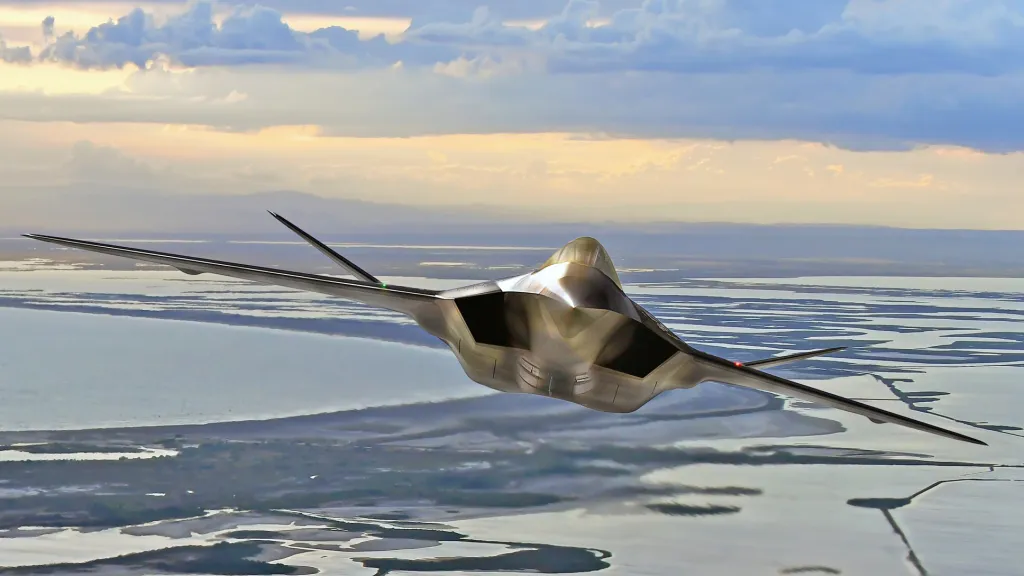
The TWZ Newsletter
Weekly insights and analysis on the latest developments in military technology, strategy, and foreign policy.
Airbus has pulled the wraps off the U760 Ravenstorm, a combat drone designed to operate alongside fighter aircraft in air-to-air combat, strike missions, and electronic warfare roles. The new uncrewed aircraft is part of a revamped drone portfolio from the company, which also includes a Europeanized version of the stealthy XQ-58A Valkyrie, a medium-altitude long-endurance (MALE) platform, various tactical solutions, counter-drone systems, as well as the U145 uncrewed helicopter that you can read more about here.
The timing of the announcement — and the unveiling of the Ravenstorm, in particular — is especially notable given the recent collapse of the Franco-German-led plan to build a crewed New Generation Fighter (NGF) aircraft, as part of the broader, pan-European Future Combat Air System (FCAS) initiative. You can read more about this development here.

On the eve of the ILA Berlin airshow, starting in the German capital tomorrow, Airbus showcased what it describes as “Europe’s most versatile drone portfolio.” The various products have been newly assigned a “U” prefix for uncrewed systems. This reflects the company’s policy of prefixing with an “A” for crewed fixed-wing aircraft, and an “H” for crewed helicopters.
“Whatever uncrewed or ‘drone’ capability our customers need to strengthen sovereign air power, we deliver,” said Mike Schoellhorn, CEO of Airbus Defence and Space, in a company press release. “Our portfolio ranges from rapid-response drone interceptors and various tactical drones, autonomous cargo helicopters to uncrewed fighter aircraft UCCAs (uncrewed collaborative combat aircraft) operating co-operatively with crewed fighter jets.”

“On the other side of the spectrum we have the Eurodrone, our very high payload and very long endurance ISTAR (intelligence, surveillance, target acquisition, and reconnaissance) platform,” Schoellhorn continued. “Airbus provides the entire envelope of uncrewed capabilities required for modern multi-domain warfare. All our systems come with open architectures and a European mission system compatible with the wider European and international defence ecosystem.”
The most significant new arrival in the “U”-product line is the Ravenstorm combat drone, or U760.
A 1:1 model of the Ravenstorm will be on display at ILA. The drone is approximately 43 feet long and has a wingspan of 33 feet. In terms of rough size and general appearance, the drone strongly recalls General Atomics’ YFQ-42A ‘fighter drone’ prototype, now flying under the first phase of the U.S. Air Force’s Collaborative Combat Aircraft (CCA) program. Like the U.S. drone, the Ravenstorm features a swept, mid-wing configuration optimized for stealth and maneuverability. It also has the same twin-tail configuration. Like the YFQ-42, the Ravenstorm has a dorsal inlet, although this is closer to that which appeared on the EADS Barracuda demonstrator that flew for the first time 20 years ago. The drone is clearly optimized with low-observable (stealthy) characteristics, although the inlet is notably large and lacks the trapezoidal shape found on the YFQ-42.

At the same time, it should be noted that, when it comes to combat drones in general, many of them take on a relatively familiar form driven by similar requirements.
Airbus describes the Ravenstorm as “the next evolution” in its “roadmap towards a scalable family of uncrewed collaborative combat aircraft.” It is not clear how many related designs might be planned, and in what kinds of sizes they may come, but the company has highlighted the kinds of missions they will be expected to fly. These include air-to-surface strikes using precision-guided munitions, air-to-air defense with long and medium-range air-to-air missiles, and electronic warfare for suppressing enemy air defenses. Further offensive counter-air missions will involve UCCAs providing non-kinetic jamming.
Ravenstorm will be available in the early 2030s, according to the manufacturer, which is, interestingly, offering the new design alongside a version of the XQ-58. In Airbus parlance, the Valkyrie is designated U740 and combines the Kratos-designed airframe with Airbus’ proprietary Multiplatform Autonomous Reconfigurable and Secure (MARS) Mission System.

For the U740, Airbus provides a notably precise planned date of service entry: 2029, with the German Air Force. This would appear to reflect a specific Luftwaffe requirement for a drone in this class, although it remains unclear if the Valkyrie has been formally selected by the German military. Airbus furthermore expects the U740 to be used in operational experimentation teamed with the Luftwaffe’s Eurofighter combat jet, including demonstrating initial air-to-ground capabilities.

Returning to MARS, this is Airbus’ sovereign mission system, consisting of an AI-supported software core to enable platform autonomy. The system is scalable so that it can be used across the entire Airbus drone portfolio. It is also planned for use on the U950 Eurodrone — the new designation for the Eurodrone MALE platform. This twin-turboprop drone is now in development for missions including ISTAR, early warning, and anti-submarine warfare, and is planned to make its first flight in 2029.

As for Airbus’s two-track approach to UCCAs — U740 Valkyrie and U760 Ravenstorm — the thinking behind the two offerings, also of broadly similar sizes, likely reflects different cost points. The Valkyrie was designed from the ground up as a lower-cost aircraft and is runway-independent in its original form (since then, Kratos has announced a version with wheeled landing gear and there also exists the ability to launch the Valkyrie from a wheeled launch trolley, if required). Meanwhile, the Ravenstorm appears to be a more capable and costly platform, making it a closer match to Increment 1, the first phase of the U.S. Air Force’s CCA program.

It could be that the company has already identified specific national or service requirements (such as the Valkyrie for the Luftwaffe) that it aims to capitalize on. There could also be a plan to use the Valkyrie more for operational experimentation of the UCCA concept before focusing more on the fully sovereign Ravenstorm, including potentially scaling it up or incorporating other significant airframe changes — like higher performance, larger payload, improved low-observable characteristics.
Also unclear is the status of Airbus’s stealthy Wingman, a CCA-like concept that was unveiled at the last ILA Berlin airshow in 2024. This was also presented in the form of a 1:1 model, with a length of 51 feet and a wingspan of 39 feet. The drone was planned to be powered by the same Eurojet EJ200 turbofan as the Eurofighter, providing a proven powerplant and useful commonality.

At the time, Airbus noted that the German Air Force had “expressed a clear need” for a drone that would be able to operate in conjunction with crewed fighters before the arrival in service of the NGF, which was then slated for some time in the 2040s.
Whether the Wingman has now been abandoned entirely is unclear, but the Luftwaffe still has a requirement for an uncrewed companion that can work alongside its forthcoming Eurofighter EK electronic warfare jets. This is a role for which Airbus is earmarking the Ravenstorm, in particular, although it should be noted that the U.S. Marine Corps is also focusing heavily on the electronic warfare mission for the Valkyrie drone.

All of these Airbus efforts are being informed by experience testing the Barracuda, work on which began in 2003, initially as a ‘black program.’ After six test campaigns, the Barracuda was retired.
The company will also be leveraging prior work from the Airbus Low Observable UAV Testbed (LOUT) program. A stealthy demonstrator, LOUT was not flown but was run by the company in strict secrecy until finally it was publicly disclosed in 2019, as you can read about here.

Undoubtedly, the significance of Airbus’s new-look drone roster, and above all the appearance of the U760 Ravenstorm alongside the U740 Valkyrie, is greater now that the FCAS program’s crewed New Generation Fighter is seemingly defunct.
It was always anticipated that the NGF would be operated as part of a wider ecosystem that also included CCA-like drones — what Airbus now refers to as UCCAs. Indeed, there were already efforts in place to start integrating combat drones with crewed fourth-generation-plus fighters like the Eurofighter and Rafale. Now that FCAS, or at least the NGF component of it, has been thwarted, Ravenstorm and Valkyrie offer a glimpse of where Europe’s combat aviation ambitions may be headed instead.
Collaborative combat aircraft like these emerged as a higher-mass, force-multiplying capability for current and future crewed fighters. In the interim, at least, the demise of the NGF means that these kinds of combat drones could be in even greater demand within Europe, where there is already a pressing need for larger tactical air combat fleets, while resources are limited. At the same time, CCA-like drones promise to make existing fourth- and fifth-generation fighters even more potent, further driving demand both in Europe and elsewhere.
Contact the author: thomas@thewarzone.com

Published On 10 Jun 202610 Jun 2026
Anti-immigration protesters have torched buildings and vehicles in the capital of Northern Ireland, a day after a knife attack was captured in a graphic video.
Hundreds of protesters, many of them masked, gathered at several locations across Belfast on Tuesday evening. A bus and several cars were set alight, while a building on the edge of the city centre caught fire and its residents had to be evacuated.
Police helicopters patrolled above the city, and shops closed early.
British Prime Minister Keir Starmer described the initial knife attack, which took place in north Belfast late on Monday evening, as “sickening”.
The attack comes at a time of heightened tensions in the United Kingdom following the murder of a student who was handcuffed by police as he lay dying from stab wounds after his killer falsely alleged a racist attack.
It also follows repeated protests over immigration, with populist parties saying the UK’s asylum policy has allowed dangerous men into the country. There was anti-immigration rioting in Northern Ireland last year amid anger over an alleged sexual assault.
Immigration has become a highly charged political issue and has helped fuel the rise of the hard-right Reform UK and Restore Britain parties in opinion polls.
Northern Ireland’s political leaders and the region’s chief constable have urged people not to incite hate and fear or target particular communities.