News Analysis

Houthis accuse Saudi Arabia of launching 26 strikes in 24 hours | Houthis News

The war in Yemen intensifies with mounting clashes and reciprocal attacks between Saudi forces and the Houthis.

Yemen’s Houthi rebels have said Saudi Arabia carried out 26 strikes against areas under the group’s control in the past 24 hours, as the two sides continue trading attacks amid an escalating war in Yemen, according to the AFP news agency.

On Friday, the group claimed Saudi strikes on Houthi-held territory had reached 300 over the past week alone, hitting positions across the areas it controls, AFP reported.

Recommended Stories

list of 3 itemsend of list

Yemen’s government, backed by Saudi Arabia, said on Friday its forces had killed 30 Houthi rebels and wounded more than 60 in clashes in the al-Wazi’iyah district of Taiz province, one of several fronts where combat has picked up this week.

The exchange has come on the heels of a widening escalation of fighting in Yemen between the government’s military and the Houthi fighters.

Tens of thousands marched through Sanaa on Friday in a show of support for the Iran-backed Houthis and against Saudi Arabia, as the rebels press gains that have brought large stretches of Yemen’s Red Sea coast, including the strategic Bab al-Mandeb Strait, under their control.

Earlier this week, the intensifying attacks between the Yemeni government and the Houthi rebels killed at least five people, including three children, according to reports from both sides.

Saudi Arabia said one person was killed in the Taif governorate after a Houthi drone was intercepted, while Houthi-linked media reported deaths from Saudi strikes in Taiz and the town of Abs.

The escalation has drawn in Washington, though reluctantly.

US officials met Houthi representatives at the US embassy in the Omani capital, Muscat, over the weekend after the group’s rapid territorial gains raised concern over shipping through Bab al-Mandeb, a vital corridor for global trade.

The Houthis reportedly assured Washington that vessels not linked to Saudi Arabia would not be targeted.

Despite appeals from Riyadh for US President Donald Trump to strike the Houthis directly, Washington has so far held back, wary of opening a new front while still fighting a costly war with Iran.

Meanwhile, European Union foreign policy chief Kaja Kallas said on Friday the bloc’s Red Sea naval mission, Operation Aspides, had raised its alert level as the situation in the region worsened, the Reuters news agency reported.

“Houthi attacks on Saudi Arabia are unacceptable and sabotage the global economy,” Kallas said in a post on X.

She added that she had spoken with Saudi Foreign Minister Prince Faisal bin Farhan Al Saud about diplomatic efforts to end the fighting in Yemen and restore freedom of navigation in the Strait of Hormuz.

Source link

Trump claims deal with Denmark gives US ‘permanent control’ over Greenland | Donald Trump News

BREAKING,

Denmark and Greenland plan to sign a US defence pact next week, pending approval from both parliaments.

United States President Donald Trump claimed on Friday that Washington has entered into an agreement with Denmark and Greenland that gives the United States “permanent control over security and all other needs”.

In a post on his Truth Social platform, Trump said, “At my direction, we worked with representatives of Denmark and Greenland to guarantee that the US will FOREVER have the complete ability to do what is necessary in Greenland”.

Recommended Stories

list of 3 itemsend of list

He added that US adversaries will be barred from establishing military bases or personnel in Greenland unless they receive written authorisation from the United States.

Trump alleged that plans will begin immediately to build a significant US military footprint in suitable areas across Greenland, noting there are numerous potential locations.

Denmark and Greenland released a joint statement on Friday indicating that a pact with the US is set to be signed during next week’s high-level United Nations General Assembly summit.

The statement added that the agreement remains subject to formal parliamentary approval in both Nuuk and Copenhagen.

Denmark’s Prime Minister Mette Frederiksen said the agreement “recognizes the sovereignty and territorial integrity of the Kingdom and the right of the Greenlandic people to self-determination.”

Source link

‘Outrageous lies’: How Israeli voters are shrugging off Western sanctions | Israel-Palestine conflict News

Israeli politicians reacted to sanctions by states including the United Kingdom, France, and Canada on the country’s illegal settlements in the occupied West Bank with self-righteous anger. But what is the latest example of Israel’s international isolation brought on by its treatment of the Palestinian people has not been influential in swaying the electorate in the run-up to October’s elections, analysts tell Al Jazeera.

Responding to the UK Foreign Minister Ed Miliband’s accusation that Israelis were ethnically cleansing the occupied West Bank, Israel’s Gideon Saar accused his counterpart of spreading “outrageous lies” and attempting to interfere in the election through foreign pressure.

Recommended Stories

list of 4 itemsend of list

Israeli President Isaac Herzog also condemned the measures, branding them a “gross interference in the democratic elections” of Israel.

But, in reality, the majority of Jewish Israelis have supported their country’s genocidal war in Gaza and the occupation of the West Bank.

A poll from August, published as the death toll for Palestinians killed in the West Bank had already reached 76 this year, showed that more than half of Jewish Israelis supported retaining the illegal settlements as part of any future agreement on a Palestinian state, while nearly 40 percent supported annexing the territory in defiance of international law.

“People just don’t care that settlements are illegal,” Israeli political analyst Ori Goldberg said.

”Ed Miliband expressed a number of laudable sentiments when announcing the measures,” Goldberg said, referencing the UK foreign secretary’s references to his own Jewish heritage when announcing the cessation of trade with Israel’s illegal outposts. “But we’re at the stage where Israelis aren’t even interested in the truth so much as they are the sentiment.”

Little political impact

Israeli Prime Minister Benjamin Netanyahu goes into the elections at serious risk of losing, with many polls predicting that a coalition of parties opposed to him could win the majority in Israel’s parliament.

But it will not be issues like the settlement-related sanctions that will lose him votes, analysts said.

Public backing for the “government and opposition blocs are pretty hardened, and nobody is going to switch from one side to the other over sanctions arising from [the settlements],” Michael Koplow, chief policy officer at the Israeli Policy Forum, said. He added that the sanctions were unlikely to weigh as heavily with the electorate as “this government’s record and the related feelings people have about Netanyahu”.

“When people were asked what would determine their vote, security came first,” Israeli sociologist Yehouda Shenhav-Shahrabani said.

“I think there are several mechanisms operating simultaneously,” he added.

First, he said, is the normalisation of the settlements. In Israeli public discourse, the occupied West Bank is increasingly referred to by the biblical name “Judea and Samaria” – a shift he said was becoming institutionalised.

“Second, external sanctions don’t necessarily translate into domestic political costs,” Shenhav-Shahrabani said. “And perhaps most importantly, politically foreign pressure can be absorbed into an existing Israeli narrative [of anti-Semitism] rather than [changing how the issue itself is understood].”

No criticism of the voters

None of Israel’s most prominent politicians has criticised the government for its support of the settlements in defiance of international condemnation. Yair Lapid, a former prime minister and one of Netanyahu’s leading opponents, has, instead, focused his ire on the countries condemning Israel. “Imposing boycotts and sanctions on Israel is a grave mistake,” he said. “This is a wrong and dangerous policy, at the wrong time and for the wrong reasons.”

Another of Netanyahu’s principal rivals, Gadi Eisenkot – whose Yashar Party manifesto does not mention either the West Bank or Gaza – has declined to speak on the sanctions directly. Netanyahu has also yet to comment on the sanctions publicly, despite his Likud party having championed settlement expansion for decades.

“The sanctions haven’t particularly hurt Netanyahu, at least not as far as we can see in terms of direct influence on … polling,” said Dahlia Scheindlin, a pollster and public opinion researcher based in Tel Aviv.

Instead, the focus has been on other elements of an eventful electoral cycle, including the emergence of new challengers to Netanyahu on the right.

“We aren’t seeing any real backlash from the sanctions,” Scheindlin said. “Instead, it’s just getting filtered through what people already think of him – his critics dislike him even more, and his supporters basically say, ‘Well, the world hates us no matter what.’”

Source link

In Yemen, war at home and in the region drives up prices | Humanitarian Crises News

Sanaa, Yemen – Ahmed Yahya, 28, fills his taxi with 10 litres of petrol as he begins his workday early in the morning.

“I feed my taxi with fuel first so that it can help feed my family,” Yahya, a taxi driver, said as he wiped the dust from his front window at a petrol station on the outskirts of Sanaa.

Recommended Stories

list of 3 itemsend of list

Up until earlier this week, Yahya used to pay 4,750 Yemeni riyals, the equivalent of roughly $8.90 in Houthi-controlled areas of Yemen. The price had remained unchanged for about four years in territory under the rebel group’s control – including the capital Sanaa.

But then, on Monday, the Houthis announced a roughly 10 percent increase in the price of petrol, up to 5,250 Yemeni Riyals ($9.80). After years of economic misery, Yahya described the price hike as another “painful surprise to an already devastated people”.

The Houthi-run Yemen Petroleum Company said the diesel and petrol price increase was the result of a “global increase in fuel prices”, and promised that it would be temporary. The increase in global oil prices this year comes off the back of the impact of the United States-Israel war on Iran. But, more recently, the Houthis’ own capture of Yemen’s southern Red Sea coast from government forces last week, and attacks on Saudi Arabia, have played a major role in increasing prices.

“When I heard the announcement of the new fuel price, I was shocked and frustrated. We’re hardly surviving, and this price increase will make survival even harder,” said Yahya, as he lamented another burden in a country where 18 million already face acute food insecurity – a lack of reliable access to enough food.

‘Rent or food?’

Yahya, a father of three, has been working as a taxi driver for five years. Although the job helps make ends meet, he feels financially insecure, especially with the ongoing changes in food and fuel prices.

“My family spend about 75,000 Yemeni riyals [$140] a month on food expenses such as flour, rice and cooking oil. With the fuel price rise, we will need at least 85,000 Yemeni riyals [$159] a month for the same food items,” said Yahya.

The resumption of fighting in Yemen in the past few months, after a four-year period of relative calm in the country’s war, has contributed to the price rises. But for Yahya, relatively safe in Sanaa, it’s the increased expenses that are the more troubling development.

“When prices rise, they affect what we eat, drink, and how we live,” he said. “Let me give you an example: I pay 25,000 Yemeni riyals [$47] in rent every month. With the increase in food prices, putting money aside to pay the rent has become more challenging. What is the priority? Rent or food?”

An April report by the International Monetary Fund (IMF) said that Yemen’s internal conflict has led to significant macroeconomic vulnerabilities and a marked decrease in income per capita, leaving more than half of the population in urgent need of humanitarian assistance.

“It [the conflict] has caused widespread food insecurity, disease outbreaks, mass family displacement, and limited access to clean water,” the report said.

Risky and costly transportation

One of the links between the renewed fighting and the increase in prices is the longer distances needed to transport products across the country, as truckers avoid roads near the front lines.

“A truck carrying goods from the south to the north or vice versa now takes up to a week to reach its final destination. Before the renewed fighting, a similar journey would have taken three days or less,” explained Saleh Abdullah, a shopkeeper in Sanaa.

The increased transportation costs, including the higher fuel prices, are passed on to the consumer.

“This means no family is immune to this trouble,” Abdullah said. “Whether it is the flour, the baby milk, the fruits, the vegetables, or anything else, families will feel the pain of price increases.”

“Some customers become angry at us when we sell products at a higher price,” he added. “We didn’t impose prices. We just react and adapt to the changes in the country or the region.”

Ibrahim Abdu, an employee at the Nehm customs checkpoint in Sanaa governorate, said the number of trucks arriving in the capital has declined over the past few weeks.

“Fighting has cut off many roads, and merchants have avoided risking their products and drivers,” he told Al Jazeera.

‘A hunger multiplier’

Years of war have taken a heavy toll on Yemen’s economy, disrupted businesses, and pushed millions of people into poverty and food insecurity. Against this bleak backdrop, the country’s humanitarian tragedy has been worsening.

Ahmed Mohammed, a former humanitarian worker in Hodeidah, describes the fuel price rise as a “hunger multiplier” in war-torn Yemen.

“If a breadwinner struggles to buy a family three meals a day, he may be able to afford only two given the rising price of food commodities. This will deepen hunger among families,” said Mohammed.

He added: “War is ugly, and one of its ugliest aspects is seeing a family unable to afford a kilogramme of flour, sugar or rice.”

The UN Refugee Agency (UNHCR) warned this week that the violence threatens to trigger a humanitarian crisis as more people are displaced, pressuring communities with limited resources.

A multi-faceted impact

Wafiq Saleh, an economic researcher and executive director of the Taiz Centre for Yemeni-Gulf Studies, said the 10 percent hike in fuel prices in Houthi-controlled areas deals a blow to Yemeni consumers.

“Its impact will manifest as a major inflationary wave, placing a heavy burden on the most vulnerable and income-deprived segments of society,” Saleh told Al Jazeera.

While this price increase may appear modest in percentage terms, its effects extend far beyond the petrol station, rippling through various goods and services and creating new hardships, according to Saleh.

“Petroleum products serve as intermediate inputs for a wide range of goods and services. Consequently, a 10 percent rise in fuel prices does not merely increase people’s expenses by 10 percent; it triggers a cascading effect on prices,” he said.

“The most severely affected sectors include agriculture – which relies on diesel for crop irrigation – and the transport and services sectors, where rising costs immediately drive up passenger fares and food prices.”

He added that the increase would also affect water and electricity services, many of which rely on diesel-powered generators, further increasing the cost of basic services.

Small- and medium-sized enterprises are similarly affected.

“Small enterprises are operating on narrow profit margins, and they may be forced to either cease operations or pass the increased costs on to the final consumer,” Saleh said.

Source link

US Supreme Court rejects Trump’s plans on postal ballots: Why it matters | Courts News

The United States Supreme Court has rejected Donald Trump’s bid to restrict voting by mail ahead of the November midterm elections, in a setback to the US president’s efforts to change rules governing elections.

The ruling on Monday by the conservative supermajority court allows states to continue sending out mail ballots as they have done for years, dealing a blow to Trump’s plans to stop the ballots before the elections and halting possible last-minute legal actions as voting begins in some states.

Recommended Stories

list of 4 itemsend of list

Trump has repeatedly cast doubt on the security of mail-in voting, citing debunked claims of widespread election fraud associated with it. That is despite the president voting by mail himself, including during the 2024 election.

Mail ballots, in place for decades, have been found to increase voter turnout and currently account for a third of all votes cast in the US.

Here’s what we know about the legal challenge to overturn them:

President Trump speaks at the Republican National Midterm Convention in Dallas, Texas, US, September 9, 2026
President Trump speaks at the Republican National Midterm Convention in Dallas, Texas, US, September 9, 2026 [Evan Vucci/Reuters]

What are mail-in votes?

Voting by post works by sending ballots to the homes of registered voters, who then mail them back before a deadline.

Eight states, several of them Democratic-leaning – California, Colorado, Hawaii, Nevada, Oregon, Utah, Vermont and Washington – as well as the District of Columbia, allow all elections to be conducted entirely by mail.

Others only allow smaller elections to be conducted by mail.

Although there are cases of forgery or repeat voting, they are rare and amount to just four in 10 million mailed votes, according to the Brookings Institution.

What has Trump said about the mail-in votes?

Trump falsely blamed his 2020 presidential election loss on mail-in voting fraud. He and his supporters also opposed changes made during the COVID pandemic to expand mail-in voting.

During the 2020 Republican National Convention, Trump called mail-in voting changes “the greatest scam in the history of politics”.

His attempt to push the SAVE America Act, which calls for sweeping voting laws, has stalled in the US Senate. The bill, passed in the House of Representatives in February, faces opposition over concerns that millions of voters will be disenfranchised.

How did Trump target mail-in votes?

In March 2026, Trump signed an executive order directing the US Postal Service to take control of mail voting by designing new envelopes with special barcodes that would allow the federal government to ensure ballots are only from eligible voters.

For the midterms, that move would force all states to adopt a uniform envelope style in a short time.

The order also required states to provide the US Postal Service with a list of eligible voters ahead of elections. Several government departments, including Homeland Security and US Citizenship and Immigration Services, would also have the voters’ lists.

The postal agency was additionally empowered to deny mailed ballots if they did not comply with new standards or were not associated with registered voters on the states’ lists.

What happened to the order?

Democrats and activists challenged the order in several courts, resulting in a series of back-and-forth rulings between May and August.

US District Judge Indira Talwani imposed an injunction against the rule in June on the basis that it likely violated the US Constitution. Talwani also noted in her injunction that Trump’s executive order would be impossible to apply when the midterms were already so close.

But her ruling was overturned by the conservative-majority Supreme Court in late August in a temporary judgement.

The Supreme Court had not decided at the time whether Trump’s move was constitutionally legal. Rather, it only sided with the Trump administration on procedural grounds after the administration argued that Democrats sued too soon.

What does the latest judgement mean?

In the latest and final decision, the Supreme Court refused to lift Judge Talwani’s injunction.

In a brief written order that did not go into detail, the court noted that the administration was likely to fail in its push to restrict mail-in votes ahead of the midterms.

Justice Brett Kavanaugh, who was appointed by Trump, voted with the majority against the administration, though he indicated he could support the policy at a later stage. Two judges, Samuel Alito and Clarence Thomas, dissented.

Critics have long warned that restricting mail-in ballots could disenfranchise some voters who typically rely on this method.

It could also disrupt the delivery of mailed votes, as some states, including Alabama, North Carolina and Wisconsin, have begun sending in midterm ballots.

Source link

Temporary Hormuz solution deferred as Iran-Arab summit falls through | GCC

Tehran, Iran – Another attempt to clinch a deal between Iran and Oman to restore some traffic to the Strait of Hormuz has been set back by a lack of regional consensus on the future of the waterway.

Officials from Iran, Iraq and the Gulf Cooperation Council (GCC) nations – minus objecting Bahrain – were scheduled to meet in Oman’s port city of Salalah on Monday to confer on new temporary routes in the Strait of Hormuz amid Tehran’s ongoing hot-and-cold war with the United States.

Recommended Stories

list of 4 itemsend of list

On Sunday night, the region’s officials announced the postponement of the meeting, without giving a new date. None of the stakeholders gave any indication that the postponement was directly linked to recent Houthi and Iraqi militia attacks on Saudi Arabia.

However, Iran’s Ministry of Foreign Affairs said Saudi objection was the reason for the postponement, without providing further details.

US media outlets Axios and CNN reported that Saudi Arabia had submitted amendments to the Iran-Oman proposal for Hormuz because it had concerns that the wording would establish a new status quo which would be unacceptable to Riyadh.

It comes days after Saudi Arabia shut down its critical East-West oil pipeline – the kingdom’s key route for energy exports – after drone attacks in the area originating from Iraq. US President Donald Trump said these attacks were likely conducted at Tehran’s behest.

Saudi Arabia has also faced repeated attacks by the Houthis, who took control of Yemen’s Red Sea coast over the weekend.

Hours after the Salalah meeting was postponed, the Saudi civil defence issued alerts for Abha, Khamis Mushait, Jazan and Najran in southern and western parts of the kingdom. The Houthis claimed to have fired dozens of ballistic missiles and drones at military facilities in Khamis Mushait, in retaliation for air strikes across Yemen, which it blames on Saudi Arabia.

What comes next?

Iran has said it will engage with the US on the future of the Strait of Hormuz and ending the war only if there are tangible moves to lift Washington’s naval blockade on the country and return to the June memorandum of understanding.

With continued disruptions to the passage of vessels through the strait, Iran has signalled that it intends to continue pursuing the bilateral agreement with Oman over Hormuz, which it said was finalised last month.

“In consultation with Oman, in the next step, we will make a decision on how to announce or register the agreement,” Ministry of Foreign Affairs spokesman Esmaeil Baghaei told reporters during a weekly news conference on Monday.

When the two countries initially advanced the bilateral deal, Trump threatened to bomb Oman if it “gets in the way” of US talks with Iran.

Ali Vaez, deputy director of the Middle East and North Africa programme at the Crisis Group, told Al Jazeera that Tehran wants to use its leverage over Hormuz for regional legitimacy – and ultimately to pressure the US.

“The broader the regional buy-in, the harder it becomes for the US to dismiss the arrangement as an Iranian diktat,” he told Al Jazeera.

GCC states, suffering from a sharp decrease in energy receipts, want ships moving and their economies insulated from a war they neither started nor can end. But Vaez said Washington is unlikely to lift the blockade on Iran even if the region blesses the arrangement between Muscat and Tehran.

“[The US] will find it much harder to sustain a policy that its own partners increasingly see as perpetuating the crisis,” Vaez said

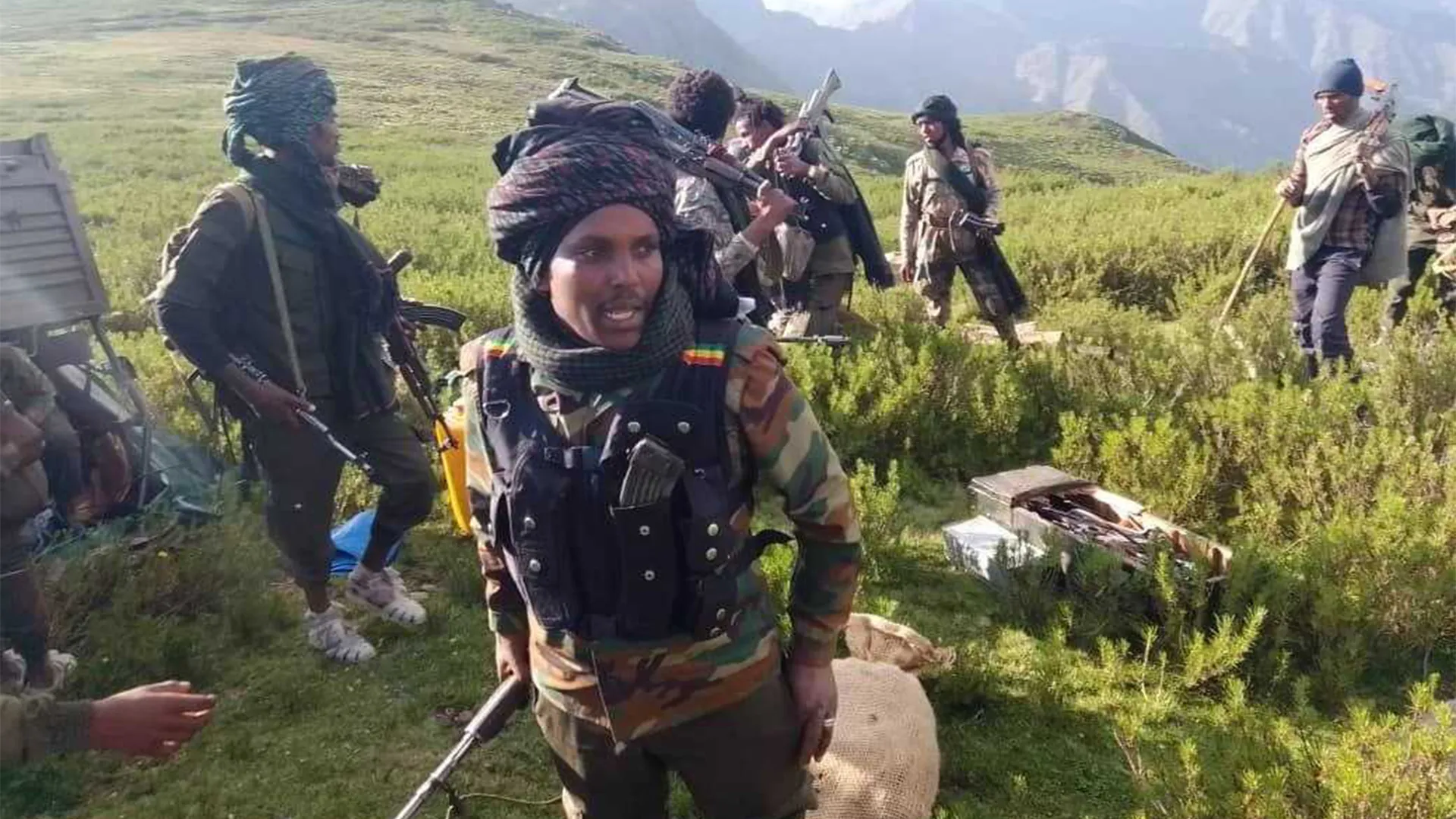
epa13237566 A screen grab taken from an undated handout video released on 13 September 2026 by the Houthi military media center shows Houthi fighters standing guard at a seized camp during an offensive in the port city of Mokha, western coast of Yemen. Yemen's Saudi-backed government accused Iran and its regional allies of supporting the Houthis’ recent offensive, during which the group captured key port areas, including Mokha, and seized control of strategic maritime positions along the Bab al-Mandab Strait. EPA/HOUTHI MILITARY MEDIA CENTER HANDOUT HANDOUT EDITORIAL USE ONLY/NO SALES
Houthi fighters stand guard at a seized camp during an offensive in the port city of Mocha, Yemen [Handout/Houthi Military Media Centre via EPA]

Temporary entry and exit

The Omani-Iranian planned agreement envisions temporary entry and exit routes for commercial vessels in the strait, with Tehran repeatedly stating that this would not mean that the Strait of Hormuz has reopened.

Iran and Oman are the only two countries with territorial waters in the Strait of Hormuz. The proposed inbound corridor reportedly goes through Iranian waters, while the outbound corridor mostly passes through Omani waters, with small parts still in Iranian territory.

During Monday’s scheduled meeting, Iran and Oman were supposed to share precise maps and discuss the details of the routes with GCC members Saudi Arabia, the United Arab Emirates, Qatar and Kuwait, and Iraq, which is outside the bloc. The deal could reportedly include voluntary tolls to fund navigation, environmental protection and search-and-rescue operations.

Bahrain, which has borne the brunt of Iranian attacks since the US-Israel war on Iran started at the end of February, said it would not participate in the forum since it would amount to “appeasement”. The Tasnim news outlet, affiliated with Iran’s Islamic Revolutionary Guard Corps (IRGC), claimed Israel pushed Bahrain to refuse participation.

How does Yemen fit in this picture?

The latest diplomatic movement comes after days of explosive developments in Yemen, when the Houthis, officially known as Ansar Allah, essentially took control of the Bab al-Mandeb strait and the Red Sea after a lightning offensive against government forces.

Thomas Juneau, assistant professor in the Graduate School of Public and International Affairs at the University of Ottawa, said the Houthi advances represent a significant gain for Iran. Its Yemeni allies’ position in the Red Sea offers Iran an important new bargaining chip in future negotiations with the US.

“The Houthis are not a simple arm of Iranian foreign policy. They operate largely based on their own interests, and do not take and execute Iranian commands,” he told Al Jazeera. “But Houthi and Iranian interests are largely, if not always fully, aligned. They cooperate closely on the basis of those shared interests.”

Juneau sees the ability for Iran and the Houthis to potentially partially block traffic in the Strait of Hormuz and the Bab al-Mandeb – two of the world’s most crucial maritime bottlenecks – would give them tremendous influence over the global economy, and thus the US.

The Houthis are trying to seize the opportunity to “institutionalise the de facto reality of their veto on maritime traffic” in the southern Red Sea and replicate partial Iranian success in doing the same in the Strait of Hormuz, Juneau said.

Iran has stressed that their allies’ gains in the Red Sea cannot be separated from the Saudi-led blockade and attacks on Houthi areas in Yemen since 2015.

“We know very well that continued war between Islamic countries in the region only has one winner, and that winner is no one but the Zionist regime, which is after persisting tensions and conflict in our region and between Islamic countries,” Iranian spokesperson Baghaei said.

Source link

‘Divine triumph’: Iran celebrates Houthis’ capture of Yemen’s Red Sea coast | Houthis News

Tehran, Iran – Iranian authorities and state media have praised the Houthis’ capture of Yemen’s Red Sea coast, which some see as giving Tehran more leverage against the United States.

The Houthis, a political and armed group dominated by Zaidi Shia Muslims, have been fighting against the Western-backed Yemeni government since capturing the capital, Sanaa, in 2014.

The Houthis captured a series of Red Sea coastal cities and islands this week, essentially giving them control over the vital Bab al-Mandeb strait.

The Iran-allied group’s recent victories have been praised in Iran, and are viewed by some as part of Tehran’s wider war against the US, ongoing since February 28.

“The victories of Yemen’s Ansar Allah in the western coast is a narrative of a divine triumph and the fruit of years of steadfastness in the most difficult of battlefields,” Hossein Mohebbi, spokesman of the Islamic Revolutionary Guard Corps (IRGC), wrote on X on Saturday.

Amid the Houthis’ recent battlefield wins against the fragmented Saudi-backed forces, senior Iranian officials have cheered their Yemeni allies on.

The Houthis’ capture of the port city of Mocha on Friday delivered a huge blow for the Yemeni government, which now has no direct access to the Red Sea.

Mohammad Bagher Ghalibaf, Iranian parliament speaker and chief negotiator with Washington, reposted a comment made by slain Supreme Leader Ayatollah Ali Khamenei in 2024, saying the “resistance” of the Houthis will inevitably lead to victory.

“The brave Yemeni people will certainly triumph, by permission of God Almighty,” Ghalibaf added on Thursday, in Arabic.

Iran’s First Vice President Mohammad Reza Aref said the government is happy with the Houthi advances, and urged leaders in the region to pursue “the rationality of liberation from dependency [from the US and the West], and unity under the banner of Islam”.

The “grand victory” of the Houthis once again proved that “security is not a commodity that can be bought,” added Mohammad Mokhber, an adviser to Iran’s Supreme Leader Mojtaba Khamenei.

epa13232213 A person reads a local newspaper featuring news of the escalating fighting in the country, in Sana'a, Yemen, 11 September 2026. Yemen's Houthi group said navigation in the Red Sea and Bab el-Mandeb Strait remained safe except for Saudi vessels, which it says remain subject to a blockade, after seizing the port city of Mocha on 10 September and making further gains around the strategic strait on 11 September. EPA/YAHYA ARHAB
A man reads a local newspaper featuring news of the escalating fighting in the country, in Sanaa, Yemen, September 11, 2026. Yemen’s Houthi group said navigation in the Red Sea and Bab al-Mandeb strait remained safe except for Saudi vessels, which it says remain subject to a blockade, after seizing the port city of Mocha on September 10 and making further gains around the strategic strait the following day [Yahya Arhab/EPA]

How could this benefit Iran?

The Houthis began to attack several vessels in the Red Sea they claimed were linked to Israel in 2023, as part of their stated aim to pressure Israel to end the genocidal war on Gaza.

This prompted bombing campaigns by the US, United Kingdom and Israel against Houthi positions in Sanaa, Hodeidah and other areas.

Saudi Arabia, which joined the war against the Houthis in 2015, has largely stayed out of the current eruption in fighting in Yemen.

After their recent victories, the Yemeni group can now exercise more control over the Red Sea and the Bab al-Mandeb strait.

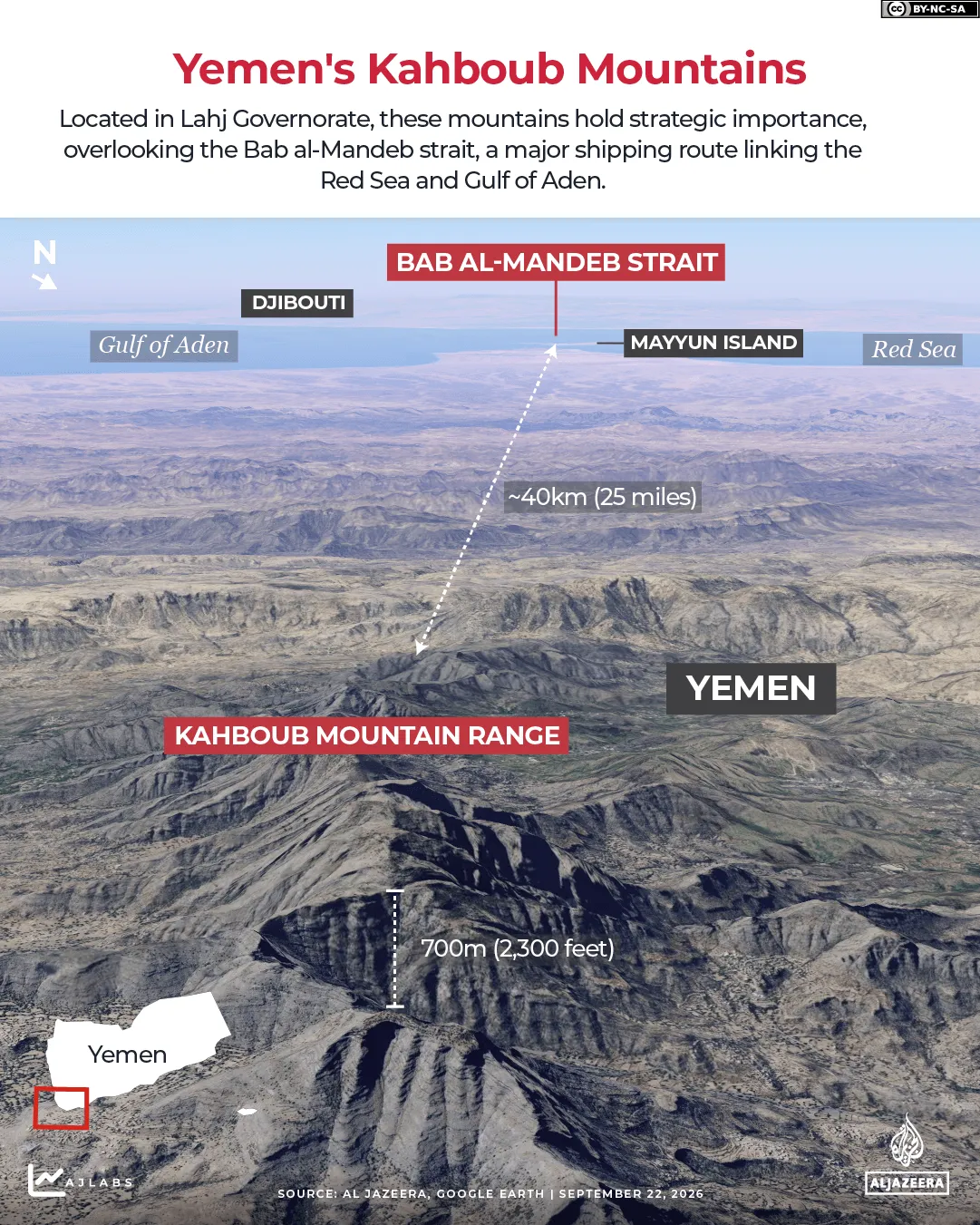
The Houthis’ control of Yemen’s Red Sea coastline and multiple islands – including the island of Mayun, also known as Perim, sitting about 3km (1.9 miles) off Yemen’s mainland – provides the group with close-range access to the Bab al-Mandeb strait.

A video published on Friday showed a Houthi commander telling soldiers they will no longer need missiles and drones to threaten shipping in the crucial waterway. They could simply position artillery along the coast and fire in all directions at ships, he said.

The Houthis have not declared the strait closed, but the group’s military spokesperson, Yahya Saree, said on Friday that “maritime navigation is safe for all companies except for Saudi vessels.”

Likewise, Iran’s partial control of the Strait of Hormuz on the other side of the Arabian Peninsula has been a key tool of leverage for Tehran in the war against the US.

The prospect of closing down the strait could potentially be used by Tehran in future negotiations over ending the war with the US.

Iranian officials are expected to meet regional Arab representatives on Monday for talks over how to facilitate shipping through the Strait of Hormuz, which Tehran maintains remains closed.

They have said they favour a collective regional approach on passage through the strategic waterway.

Iran claims it has reached an understanding with Oman, which also has territorial waters in the strait.

epa13231988 A person watches Houthi military spokesman Yahya Sarea delivering a televised statement, in Sana'a, Yemen, 11 September 2026. Yemen's Houthi group has warned Saudi vessels, which it says are still 'subject to a blockade', against passing through the Red Sea and the Bab Al-Mandab Strait, a day after Houthi forces expelled Saudi-backed Yemeni government forces from the country's western coast and captured several strategic sites on the strait, according to a statement by Houthi military spokesman Yahya Sarea. EPA/YAHYA ARHAB
A person watches Houthi military spokesman Yahya Saree delivering a televised statement, in Sanaa, Yemen, September 11, 2026 [Yahya Arhab/EPA]

The US, which has continued its naval blockade of Iran’s ports and intensified sanctions on Tehran, reportedly opposes the agreement.

Authorities in Tehran have signalled there will be no talks with Washington under the current circumstances.

“As long as the American side does not accept all of Iran’s conditions, dialogue and negotiation are of no use,” Ebrahim Azizi, head of the hardline Iranian parliament’s national security commission, wrote on X on Saturday.

‘Lord of the straits’

At the start of the working week in Iran on Saturday, hardline and IRGC-linked newspapers and media outlets celebrated the recent Houthi advances.

Keyhan, whose editor-in-chief was appointed by Ali Khamenei, called the advances “the miracle of resistance” and said they had “put the US and Israel in a bind”.

The Quds newspaper, published by the influential Astan-e Quds Razavi in Mashhad, called Iran and the Houthis “the lord of the straits”.

But even though Tehran has repeatedly threatened that Bab al-Mandeb could be further disrupted if the war continues, Iran’s diplomatic apparatus did not immediately link the Houthi advances with the current fight against the US.

As has often been the case, Iran’s Ministry of Foreign Affairs insisted that the Houthis make their decisions independent of Tehran, with their own interests at heart, including ending Saudi Arabia’s blockade on Yemen.

The Iranian Foreign Ministry also called for an end to the Saudi siege on Houthi-controlled areas, an immediate return to negotiations between the group and Riyadh, and respect for Yemen’s sovereignty and territorial integrity.

The ministry also pushed back on the idea that the Houthis act merely as a proxy for Tehran.

“What is happening now in Yemen is the result of the Yemenis losing patience,” Foreign Ministry spokesman Esmaeil Baghaei told state television on Friday night.

“It is not fair to ignore the fact that they were under a cruel blockade for years, and concluded that the United Nations and regional mechanisms could not resolve the issues.”

Source link

Yemen envoy warns of wider war as Houthis threaten Bab al-Mandeb Strait | Conflict News

The war in Yemen is threatening to open a new front as the Iran-allied Houthi rebels are trying to advance along the Red Sea coast, through the mountain chains of Taiz province, edging closer to strategic ground that overlooks one of the world’s most vital maritime arteries.

For the internationally recognised Yemeni government, this is an offensive with global consequences.

Recommended Stories

list of 3 itemsend of list

In Wednesday’s interview with Al Jazeera, Yemen’s Ambassador to Qatar, Rajeh Badi, a former government spokesman, said that his government and its armed forces had not violated any truce since 2021.

The Houthis, he argued, are “the aggressors”. “What we are seeing now is a surprise Houthi offensive to seize strategic ground along the Red Sea, in order to allow Iran, through its Houthi proxy, to tighten its grip on maritime routes,” Badi said.

He added that the Houthis, who have advanced on al-Makha (Mocha) and al-Waziyah, and over large stretches of the mountain chain overlooking the Red Sea in Taiz province, “want commanding positions to launch more effective strikes on ships and disrupt navigation in the Red Sea”.

Badi said the Yemeni government responded by opening fronts in al-Jawf, Marib and al-Bayda, and that the consequences could extend far beyond Yemen.

[Al Jazeera]
[Al Jazeera]

“We are now facing a real threat that does not stop at Yemen’s borders,” he said. “It threatens the entire region and the world. If the Houthis manage to choke maritime traffic in the Red Sea, we will be looking at another Hormuz in these waters – with potentially even greater impact.”

The Red Sea and Bab al-Mandeb “represent a vital artery for global shipping, for both energy and food supplies”, he added.

A chokepoint that belongs to the world

Bab al-Mandeb connects the Red Sea to the Gulf of Aden. To the north, the Red Sea leads to the Suez Canal, while farther east, beyond the Arabian Sea, lies another critical chokepoint, the Strait of Hormuz. This geography is what gives Yemen’s conflict consequences far beyond its borders, as Saudi Arabia is already being drawn into the confrontation.

The Houthis have targeted Saudi territory, civilian infrastructure in the kingdom’s south and Saudi-linked vessels in the Red Sea.

Major-General Turki al-Maliki, spokesman of the Saudi-led coalition in Yemen, said the Houthis on Wednesday attacked Saudi cities of Khamis Mushait, Abha, and Jizan with ballistic missiles and drones. He did not elaborate on any casualties as a result of the attacks.

Badi, who has spoken to the media for the first time since taking up his post, said those attacks are designed to change the nature of the war.

“By targeting Saudi territory, civilian infrastructure in the kingdom’s south, and Saudi-linked vessels in the Red Sea, the Houthis are trying to drag Saudi Arabia into their war. Their calculation is simple: they want to rebrand this conflict as a Saudi-Yemeni war,” he said.

The ambassador assessed that “every time their militias suffer heavy losses inside Yemen at the hands of the Yemeni armed forces, they respond by firing missiles and drones at civilian sites in Saudi Arabia, in an attempt to inflame Yemeni public opinion and convince the outside world that Yemen is at war with Saudi Arabia”.

The conflict, he said, is fundamentally about Yemen’s state and its future. The Yemeni people are fighting to “reclaim their state, their republic, their dignity and their stability”.

This screen grab taken from undated video footage released on September 9, 2026 by Ansarullah Media Centre shows what the Houthi authorities said are attacks on Saudi-backed forces in Jawf province's frontlines.
Footage released by Houthi media claims to show attacks on Saudi-coalition forces on the front lines in al-Jawf province on September 9, 2026 [AFP]

Iran’s hidden hand

Behind Yemen’s fragmented front lines, a larger regional confrontation looms, and its architect, according to Badi, is Iran.

The official said that Tehran’s relationship with the Houthis is now impossible to hide. “Iranian officials openly boast about it, and Houthi leaders proudly talk about their ‘strategic’ ties with Tehran,” he said.

The Houthis are “one of Iran’s key regional arms – just like Hezbollah in Lebanon or the Popular Mobilisation Forces (PMF) in Iraq. Many of Tehran’s other proxies have come under pressure,” he added.

“Former Yemeni President Abd-Rabbu Mansour Hadi used to say that if Iran gains control over Bab al-Mandeb and the Strait of Hormuz, it will not need a nuclear weapon – its grip over these two chokepoints would be more powerful than any nuclear arsenal. Events have proved him right,” Badi recalled.

‘We have exhausted all peaceful avenues’

For Yemen’s government, the alternative to another war was supposed to be diplomacy.

Badi urged the world “to stand with us so we can rid ourselves of this scourge – a threat that no longer targets Yemenis alone”.

“We have exhausted all peaceful avenues. For more than 13 years, we have been engaging in dialogue rounds and signing agreements, whether inside Yemen or after the Houthis seized the capital, Sanaa,” he said.

Badi added that the Houthi rebels have effectively “buried peaceful options. Peace is simply not part of this movement’s culture or mindset. That is what ultimately forced us to take up arms”.

“The world must understand this difficult equation,” the ambassador concluded, that the Houthis are “an armed proxy, an extension of the Iranian Revolutionary Guard Corps. The Houthis do not represent us”.

Source link