new map

Though California could be key to House control, it now has few battlegrounds

The nation is set to have its least competitive congressional election cycle in years by some measures, with California partly driving the shift.

The redistricting carried out in California and nine other states since 2024 has left the nation with an unusually low number of truly competitive districts, narrowing the battle for U.S. House control in this year’s historically consequential midterms cycle to a few dozen races at best.

In California, that looks like a paradox: The state has both a shrinking number of political battlegrounds and a handful of critical races that could help decide which party controls the House. Both are a result of Proposition 50, the Democratic-led, voter-passed redistricting effort designed to offset new maps drawn by Republicans in Texas and other states.

Only three California races are rated as competitive by Cook Political Report, the nonpartisan analyst, compared with 12 races in 2024 and nine in 2022, according to a Times analysis of Cook data.

California was also the biggest driver in the nationwide decline of competitive seats, according to a separate Cook analysis released Wednesday. Six of the 14 U.S. House seats that dropped out of the swing-seat zone in 2026 were in the Golden State.

“There’s no question that we’re seeing the consequence” of the state’s redistricting, “of having fewer competitive districts,” said Michael Latner, a professor of political science at Cal Poly San Luis Obispo.

That doesn’t dilute the key role California is expected to play in Democrats’ effort to win the House majority, however. The new map made some blue seats safer and gave the party the chance to flip up to five red seats.

“The path to the House majority still runs through California,” said Anna Elsasser, spokesperson for the Democratic Congressional Campaign Committee, who said the party is investing heavily to flip those seats.

‘Not backing off’

The fight for the majority at the halfway point of President Trump’s second term is fierce. Republicans, who control both chambers of Congress, face headwinds fueled by voters’ feelings on the economy and the war in Iran. Democrats have built their campaigns around Americans’ economic frustration in an attempt to win the House majority and regain some power in Trump’s Washington.

Having more safe seats positions California to have a greater effect on the election, said Thad Kousser, a political science professor at UC San Diego, and in Congress afterward, where the state is expected to have a large blue delegation.

The less-competitive map is a return to the 2000s for California, when the state’s two parties agreed on a congressional map that created safe districts for both, Kousser said.

That decade saw fewer competitive House races before new maps created more battleground areas in 2010 and 2020, the result of regular redistricting that occurs every decade after the U.S. census.

The shift in the state’s competitive seats caused by Proposition 50’s partisan redistricting was so acute because the existing 2020 map was relatively neutral, Cook senior editor David Wasserman said in the report. In Florida, Missouri and Texas, by contrast, the maps Republicans replaced were already partisan, making the shifts less extreme.

Three of the seats Democrats targeted with Proposition 50 are rated as solidly blue, while two present fights: the Central Valley seat held by Republican David Valadao, the state’s only toss-up race per Cook, and the seat being vacated by retiring Republican Darrell Issa in the San Diego area, where the redrawn district now slightly favors Democrats.

Just one seat Republicans hope to flip is rated competitively by Cook, that of Democrat Adam Gray in the Central Valley. Democrats are slightly more favored there under the new map, but it presents a challenge for both parties.

Both parties view California’s three most competitive races as key to win, and each is putting resources toward a few additional contests.

“We’re not backing off a single seat in California,” said Christian Martinez, spokesperson for the National Republican Congressional Committee. “We’re on offense.”

Shrinking battlegrounds nationwide

This year’s push by Republicans to redo state maps ahead of the November election — and California’s move to respond in kind — was without precedent. Ten states approved new maps; before this year, only two states had voluntarily redrawn maps between censuses for partisan advantage since 1970, according to a Pew Research Center analysis.

It was partly enabled by a spring Supreme Court decision that cleared the way for states to redraw their election maps to eliminate voting districts that were drawn with race as a consideration.

The 10 new maps supercharged an ongoing national trend of polarization that has seen the number of competitive seats shrink over the last 30 years. The country used to see election cycles with as many as 50 seats rated as toss-ups, said Erin Covey, who leads the Cook Political Report’s U.S. House coverage, something that has not happened since 2010. As of this week, just 18 of 435 House districts are rated as toss-ups by Cook.

California is not alone in having fewer battlegrounds; no state has a high concentration of competitive seats this cycle. Michigan had four under Cook’s ratings, and Pennsylvania, Iowa, New York and Texas each had three as of this week.

That could be unhealthy for democracy, experts said. Voters can feel as though their votes matter less, and it may contribute to negative public opinion about how the electoral system functions, Latner said.

“The very premise of a free republic is that you are going to have differences in views,” Latner said. “The way those differences get resolved is through electoral competition.”

The erosion of “free and fair competition … is a threat to all voters, regardless of their partisanship,” he added.

Eyes on key races

In California’s most competitive race, Valadao is being challenged in the redrawn 22nd District by progressive college professor Randy Villegas. Republicans are bullish about their chances to retain the seat.

In the neighboring 13th District, which the new map aimed to make safer for Democrats, Gray faces former Stockton mayor and Marine veteran Kevin Lincoln. Also important for both parties is the battle for the 48th District, the seat vacated by Issa. Republican Jim Desmond, a San Diego County supervisor, faces Democrat Marni von Wilpert, a San Diego City Council member.

Republicans have also targeted Rep. Derek Tran’s Democratic seat in the 45th District, another former battleground that Proposition 50 made safer for Democrats, and three other seats that Cook rates as solidly Democratic.

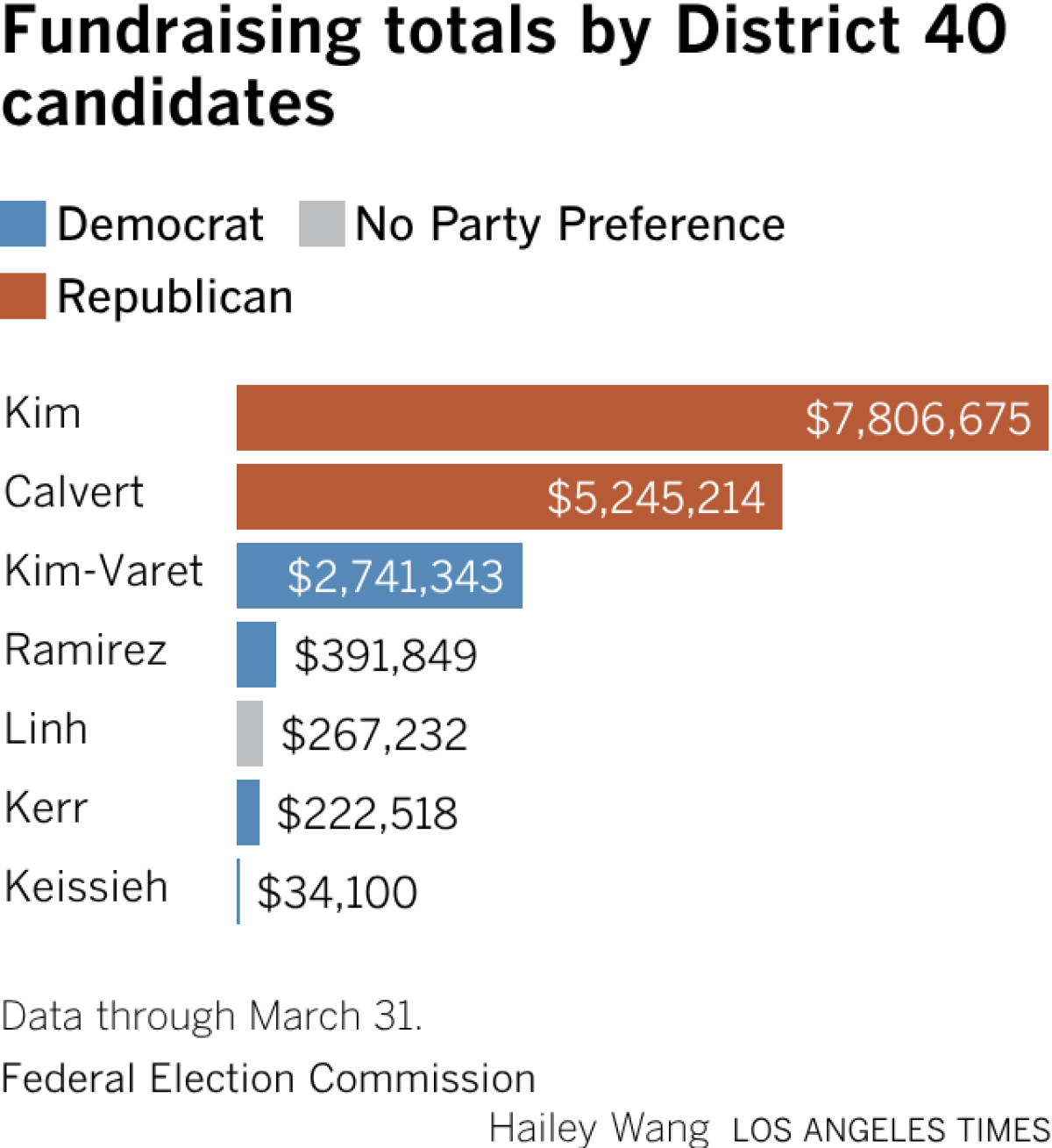
Democrats’ safer flips target Northern California’s 1st and Sacramento County’s 6th districts. They also expect to gain a seat in the new 41st District, which now covers parts of Los Angeles and Orange counties. The new map gave Democrats a Democratic voter registration edge there and forced Republican incumbent Ken Calvert to run in the newly drawn 40th District against fellow Republican Rep. Young Kim.
Source link

California to play big role in fight for Congress. Tuesday’s primary sets the stage

California’s decision to redraw its congressional map to flip as many as five House seats to Democrats in November is poised to play a big and potentially decisive role in the nation’s broader, bare-knuckle fight for control of Congress.

Tuesday’s primary races — where the top two candidates will advance to November runoffs — won’t determine which Republicans are ousted in most cases, but they will provide an important first look at voter sentiment and bring the fall’s most crucial head-to-head contests into focus.

“There will be some real cues and signals about what to expect,” said Christian Grose, a redistricting scholar and political science professor at USC. “We’re going to know how strong the Democrats’ chances are going to be based on who advances.”

As one example, Grose pointed to the redrawn 22nd Congressional District in the Central Valley, where incumbent Rep. David Valadao (R-Hanford) is facing challenges from moderate Assemblymember Jasmeet Kaur Bains (D-Delano) and progressive college professor Randy Villegas.

Grose said Bains is probably a stronger challenger than Villegas in a district that’s still a reach for Democrats — even if “either one could probably beat Valadao if 2026 is a big Democratic wave.”

Grose will also be closely watching the race between incumbent Reps. Young Kim (R-Anaheim Hills) and Ken Calvert (R-Corona) in the redrawn Congressional District 40, which covers a swath of inland Orange County and portions of San Bernardino and Riverside counties, including parts of Kim’s and Calvert’s current districts.

The district race wasn’t designed to deliver Democrats a seat, but will produce “one of the first casualties for Republicans from the new map” — months before other expected ousters — if Kim and Calvert don’t both advance.

The national picture

The redistricting war was prompted by President Trump’s unprecedented pressuring of Republican-controlled states to redraw their maps mid-decade for partisan advantage in order to retain control of Congress, given his sinking approval ratings and a history of midterm voters punishing the president’s party.

After Texas Republicans heeded Trump’s call to redraw five districts in their party’s favor, California Democrats responded with Proposition 50, a ballot measure passed by voters in November to sideline the state’s independent redistricting committee and allow Democrats to redraw five congressional districts in their favor.

The war ratcheted up — with more Republican states suddenly considering map changes — after a U.S. Supreme Court decision in April that weakened the 1965 Voting Rights Act and its long-standing protections for majority-Black districts in the South.

Republicans have now acted to redraw congressional maps in Alabama, Florida, Louisiana, Missouri, North Carolina, Ohio and Tennessee, with varying degrees of success, while a battle in Utah could add a single additional Democratic seat there. Attempts in other states have failed, including by the GOP in South Carolina and Democrats in Virginia.

Experts say the net result from the flurry of redistricting will probably be a gain of a handful or more seats for Republicans — but in a year when Democrats are expected to make gains more broadly, leaving control of the House up for grabs. California’s new map is “a huge deal” precisely because that math is so close, said David Wasserman, senior editor and elections analyst for the independent, nonpartisan Cook Political Report.

“Democrats are modest favorites for House control based on the political environment, but also because of California,” Wasserman said in an interview with The Times. “Picking up these four or five seats is a prerequisite to Democrats getting the majority.”

California seats in play

California has 52 seats in the U.S. House of Representatives, by far the most of any state. With their new map, California Democrats are hoping to increase their 43 House seats to 48. That would leave just four seats represented by members of the GOP despite Republicans accounting for a quarter of the state electorate.

But that outcome isn’t guaranteed.

Paul Mitchell, a Democratic redistricting expert who devised California’s new map, said the reconfigured congressional districts had to create a pathway for new Democrats to win additional seats without undermining incumbent Democrats’ reelection. And the result is a map with three pretty safe pickups for Democrats, and two districts that are “100% on the table, ready for Democrats to win,” but will nonetheless “require shoe-leather and grit.”

The redrawn congressional district boundaries enacted by Proposition 50 promise to shake up at least three seats, experts said.

Congressional District 1: Held by the late Rep. Doug LaMalfa (R-Richvale) for 13 years until his death in January, the district is currently rural and conservative, stretching from the Sacramento outskirts through Redding to the Oregon border and California’s northeastern corner. Under the state’s new congressional district map, it loses some of its rural reaches and picks up liberal coastal communities, and favors a Democrat such as state Sen. Mike McGuire, who is one of the leading candidates.

Congressional District 3: The seat is currently held by Rep. Kevin Kiley (I-Rocklin) and stretches from the Sacramento suburbs through Lake Tahoe and south along the Nevada border. Under the new map, it holds more tightly to the Sacramento suburbs, favoring a Democrat.

The changes were enough to convince an incumbent Democrat, Rep. Ami Bera (D-Elk Grove), to leave his current district — Congressional District 6, which includes the city of Sacramento and the suburbs of Roseville and Rocklin in Placer County — and run in District 3 instead.

Meanwhile, Kiley did the reverse. He quit the Republican Party, became an independent and announced he would be leaving District 3 and running instead in District 6 — the one Bera is leaving — against a slate of new Democratic challengers.

Congressional District 41. The seat is now held by Calvert, a 17-term incumbent, and currently stretches from Corona to the Coachella Valley. The new map made the district more liberal, losing voters in Riverside County and gaining them in Los Angeles County, and Calvert decided to run instead in Kim’s redrawn but still Republican-leaning Congressional District 40 that is just to the west.

The two toughest flips for Democrats, experts said, are Congressional District 22, Valadao’s heavily Latino district in the Central Valley, followed by Congressional District 48 in San Diego and Riverside counties, where Rep. Darrell Issa (R-Bonsall) decided to retire rather than run for reelection.

Valadao is viewed as especially vulnerable because of his recent support for Medicaid cuts, but he has proved resilient in the past. Meanwhile, his two leading Democratic challengers, Bains and Villegas, are in a bitter fight, with Bains receiving Democratic establishment support and Villegas winning endorsements from prominent progressives.

In Issa’s district, moderate Republican San Diego County Supervisor Jim Desmond is running against several infighting Democrats, including San Diego Councilwoman Marni von Wilpert and former Obama labor official Ammar Campa-Najjar.

Not new, or over

Jeff Wice, a New York Law School professor who was involved in California redistricting efforts in 2010, said the state “has long played hardball politics on redistricting,” including when then-Rep. Phil Burton, a powerful San Francisco Democrat, bragged more than 40 years ago that the complex congressional boundaries he’d crafted for Democrats were his “contribution to modern art.”

But in five decades studying redistricting, Wice said he has never seen such “politically driven, partisan politics” as are occurring now across the nation, which he said have “no root in law, reason or fairness” — and are only likely to continue.

“This state-by-state war is far from over, and may continue all the way through 2030,” he said. “A lot of it depends on the outcome of this November’s election.”

Wasserman said the country has “entered an era of no-holds-barred redistricting,” and he also sees redistricting efforts continuing — including in California, where they would present a distinct threat to the state’s few remaining Republicans.

Michael Li, senior counsel in the Democracy Program at the Brennan Center for Justice at NYU Law, said California is a “big part of the story” this election cycle, thanks to Proposition 50. “Democrats in California proved to be very determined and resourceful and managed to get that done, and right now California is the big offset to Republican gerrymandering around the country,” he said.

But what will come of it all — in California and across the country — is still to be determined.

“When you’re gerrymandering, you’re making a bet that you know what the politics of the future will look like, and it’s hard to predict,” he said. “It’s a high-risk, high-reward venture.”

Source link