
net worth

California Propositions 40, 41, 42 last-minute guide: The billionaire battle

The so-called billionaire tax has become one of the most contested California propositions in years, generating national interest and massive spending by opponents. It also has spawned two rival ballot measures.

Here’s a cheat sheet for sorting it all out.

Proposition 40

The basics

Proposition 40 would impose a one-time 5% tax on California billionaires’ assets. The tax applies to people with a net worth of at least $1 billion who resided in California on Jan. 1.

Impact

Ninety percent of the tax would fund healthcare, and 10% would go toward education and food assistance.

The tax would affect hundreds of billionaires whose net worth includes assets such as their businesses, stocks and other investments. Real property, pensions and retirement accounts generally would be excluded.

Proposition 41

It’s called the Improving Transparency, Effectiveness and Efficiency in California Government Act. But it is deeply connected to Proposition 40 and is funded by foes of the billionaire tax.

The basics

Proposition 41 requires the state auditor to review programs funded by proposed special taxes before they appear on the ballot. More importantly, it also prohibits new state taxes from being exempted from a voter-approved state spending limit.

Impact

The Legislative Analyst’s Office says passage of Proposition 41 could prevent Proposition 40, the proposed billionaire tax, from becoming law even if voters approve it. This could happen if Proposition 41 receives more “yes” votes than Proposition 40.

Proposition 42

Proposition 42 would limit the state’s ability to impose certain new taxes. But it’s more complicated and far-reaching than that description might sound. And, yes, it’s also backed by opponents of Proposition 40.

The basics

Proposition 42 would prohibit new taxes on “retirement holdings, individually owned assets, and other forms of personal savings” that take effect after Jan. 1, 2026. It also would bar retroactive taxes on past earnings unless the state is using revenue from the tax to respond to emergencies such as a fire or a flood.

Impact

The Legislative Analyst’s Office says Proposition 42 could nullify Proposition 40 because the two measures conflict with each other. If voters approve both, the one with the most “yes” votes generally would become law, the office says.

Dig deeper

The billionaire tax was pushed by the Service Employees International Union-United Healthcare Workers West and has some labor and progressive support, including from Sen. Bernie Sanders (I-Vt.) and the state Democratic Party. They say the tax is needed to help the less fortunate and that the super-rich can afford it. But key Democrats and some key unions are not supporting it.

Critics include some of California’s richest people, and they are spending a fortune to defeat it. They say it will hurt innovation and drive the wealthy out of the state, hurting the treasury.

More reading

A powerful union and the birth of the billionaire tax (L.A. Times)

Why unions are divided over Prop. 40 (L.A. Times)

The Google co-founder fighting the billionaire tax (L.A. Times)

Inside the massive spending to defeat Prop. 40 (L.A. Times)

How the billionaire tax could spark national movement (The New Yorker)

The academics behind Prop. 40 (Sacramento Bee)

Will Prop. 40 reallly bring an exodus? (L.A. Times)

Why healthcare is divided by Prop. 40 (Bloomberg)

Taxing the “ultrarich,” a guide (New York Times)
Source link

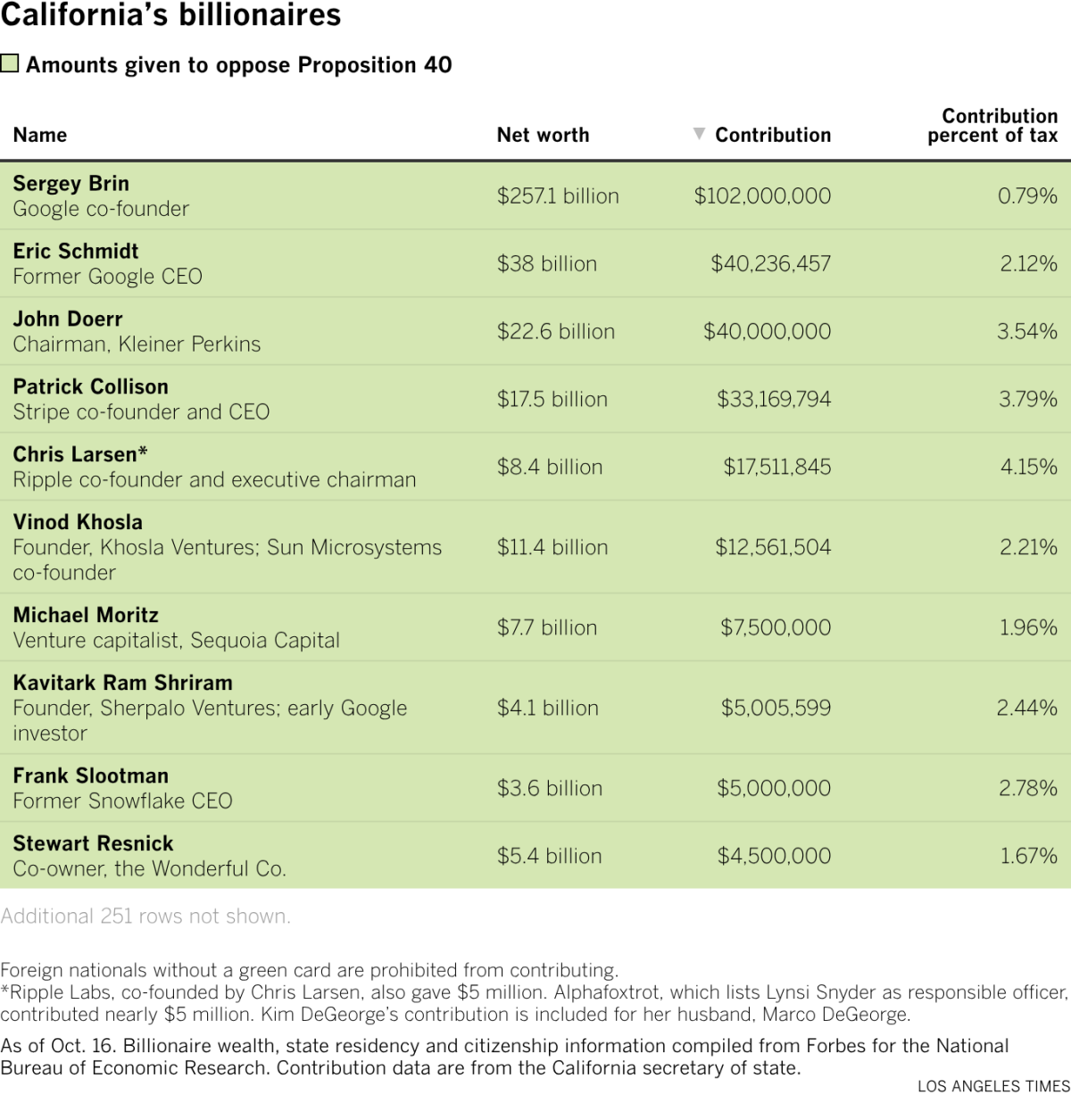
These Californians spent 0.07% of their billions to oppose Prop. 40

About 260 California billionaires would be subject to Proposition 40’s one-time 5% wealth tax according to the Forbes Real-Time billionaires list. Just 30 of those billionaires or their spouses, or 1 in 8, spent money opposing Proposition 40, the billionaire tax, according to a Times analysis of recent campaign filings.

Billionaires have individually contributed $293 million to oppose the tax measure and to support Proposition 41 and 42, which would nullify the billionaire tax if either receives more votes, according to a Times analysis. Sergey Brin, co-founder of Google, has given $102 million, more than a third of all billionaire money against the measure. But this is less than 1% of his estimated tax bill.

Several billionaires also contributed to the political action committee of the California Business Roundtable, which is spending to oppose Proposition 40 and support Proposition 43. Peter Thiel gave $3 million, Eric Schmidt gave nearly $2.6 million, Marco DeGeorge’s wife, Kim, gave $1.9 million, Chris Larsen gave $750,000 and Douglas Leone and his wife gave $500,000.

Proposition 40 would apply the tax to billionaires who were California residents on Jan. 1, 2026, and the taxable amount would be based on their net worth on Dec. 31. The tax is payable over five years.

Altogether, these individuals would owe at least $107 billion in taxes, according to an analysis by economists Jasper Boll, Emmanuel Saez and Gabriel Zucman. Their research was published in the National Bureau of Economic Research in August. Saez and Zucman are also architects of the tax proposal.

This amount is 5% of their combined estimated wealth by Forbes as of Oct. 16 and factors in a certain amount of tax avoidance and evasion. Spread across all 39 million Californians, the $107 billion would be roughly $2,700 per person. The Public Policy Institute of California estimates that the median household net worth in California was $303,000 in 2023.

The four richest Californians — Sergey Brin, Jensen Huang, Larry Page and Mark Zuckerberg — would owe 40% of the estimated taxes to be collected from the billionaire tax, according to a Times analysis. Their wealth largely comes from ownership of stock in extremely high-value technology companies.

Their net worth would increase 5% in about four months if their stock investments continues to grow as they have since December.

California billionaire wealth grew nearly threefold from 2022 to 2026, according to Times analysis of Forbes data collected by Boll and his colleagues, and much of that growth was not taxed. Billionaires’ taxable income is small compared with their wealth, because most of that wealth is invested in public stocks, and gains aren’t taxed until the stock is sold.

Page and Brin disclosed no taxable income in three of the years since 2019. Many others had similarly no publicly disclosed income. For that reason, Boll and his colleagues estimate that the Proposition 40 one-time tax would raise more than $100 billion, “with comparatively minor impacts on income tax revenue” from some billionaires leaving the state.

Based on Meta’s filings, the economists estimated that Zuckerberg’s taxable income was about $947 million in 2025, just 0.4% of his net worth.

Over the summer, Zuckerberg shared with Meta advisors his plans to relocate outside California to avoid the possibility of a significant reduction in his control over the company as a result of selling enough stock to fund a 5% tax. The advisors determined that Zuckerberg’s leadership presence at Meta headquarters was essential to the company’s success. On Wednesday, Meta announced the creation of new, nonvoting Class C common stock, which will allow Zuckerberg to sell the amount he needs to pay his potential tax bill while maintaining his voting power in exchange for his commitment to remain in the state for eight years.

Researchers at the Hoover Institution estimate the revenue to the state to be closer to $40 billion based on reports of billionaires’ residential purchases outside the state before and after Jan. 1 and their estimate of unannounced residency moves.

Chris Hoene, executive director at the California Budget and Policy Center, a nonpartisan group, said the residency question hinges on the amount of time spent living in the state. “Purchasing property in another location does not mean that they have changed their residency,” he said.

Ultimately, the state’s Franchise Tax Board, responsible for administering the tax, will have to assess residency. Hoene says this task is “easier for them to do than people realize.” The board will also calculate the amount of wealth subject to the tax using publicly available stock information and private assessments of personal property, such as artwork and jewelry. Real property, pensions and retirement accounts would be excluded.

Opponents of Proposition 40 are concerned that the threat of wealth taxes will lead to billionaires continuing to leave the state, resulting in a long-term decrease in state income tax revenue. Forbes recently reported that Brin registered to vote in Nevada last year. Peter Thiel disclosed Dec. 31 that he opened a new office in Miami; Florida has no wealth tax or income tax. But in July, he purchased a $130-million mansion in Bel-Air.

“The reality is the income tax loss can never get anywhere near the scale of what the wealth tax gain would be,” Hoene said.

Ninety percent of that gain would be spent on healthcare services to fill a gap in Medi-Cal from losses in federal funding that the measure’s authors estimate would total $190 billion over the next 10 years. Medi-Cal provides healthcare coverage for one-third of low-income Californians, according to the Legislative Analyst’s Office.

Gov. Gavin Newsom opposes a California-only tax and has instead called for a national wealth tax. Democrat Xavier Becerra and Republican Steve Hilton, who are running to replace Newsom, have spoken out against the tax. Other opponents include the California Teachers Assn., the California Medical Assn., and Planned Parenthood Affiliates of California. Supporters include Service Employees International Union, U.S. Sen. Bernie Sanders (I-Vt.), the California Democratic Party and the California Federation of Labor Unions AFL-CIO.

Times staff writer Queenie Wong contributed to this report.

Source link