“A national strike is planned from 9pm on 29 October to 9pm on 30 October.
“The strike may disrupt rail and air travel, taxis, highways, local public transportation, schools, and government offices.
Rome (pictured) Milan and Turin are just some of the cities affectedCredit: AFPThe Government is now warning Brits heading to the countryCredit: Shutterstock Editorial
“Check with your travel provider for the latest information.”
Iran’s authorities are increasing investment in a campaign to arm and train civilians who would serve in the state security apparatus against domestic and foreign threats amid growing fears that fighting with the United States and Israel could resume imminently.
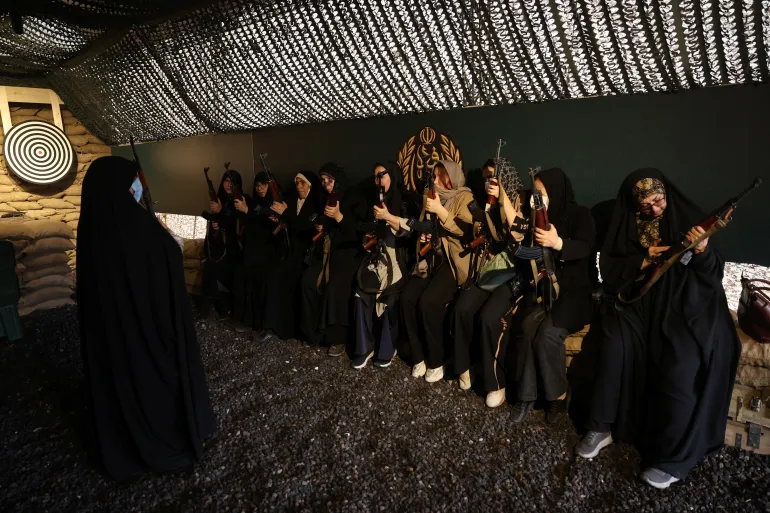
The public mobilisation drive – called Janfada, or “those who sacrifice their life” – was launched in late March at the peak of the war with the US and Israel. It has now spread to large parts of the country and is aiming to attract volunteer men and women. It has a stated focus on youth but is open to all ages.
At their numerous street booths and stations, representatives of the Basij militia of the Islamic Revolutionary Guard Corps (IRGC) and other state bodies offer training on using weapons and other equipment to defend the government and its “revolutionary” values.
State-organised events and armed “exercises” linked with the mobilisation campaign have been held in Tehran, Isfahan, Zanjan, Shiraz, Kerman, Mashhad, Bojnord, Ahvaz and other big and small cities across many of Iran’s 31 provinces.
Ali Kowsari, Basij’s deputy for training, announced during a news conference this month that the IRGC wants to use at least 14 main squares across Tehran as training and equipment stations for Janfada volunteers. The goal is to use at least one to three squares in the capital city of every single province, he said, without divulging how many cities are currently being used as part of the campaign.
State-run nighttime events are sometimes held with rallies and motorcades during the day. A resident of Gilan province in northern Iran told Al Jazeera that people regularly see state-run stations on the streets in big and smaller cities across the province during their commutes.
“Sometimes they hold competitions to win some small prizes. They bring in live bullets, teach people how to load them into magazines, how to arm pistols and assault rifles, and how to aim and fire,” the resident said, asking to remain anonymous for security reasons.
“The organisers are mostly old men. Since the start of the war, they’ve gathered around the main square almost every night, also often playing revolutionary tunes and chanting from loudspeakers.”
In Gilan’s city of Rasht on October 15, residents objected to the noise and blocking of the street for the nighttime pro-government gathering. Videos circulating on social media showed a confrontation that escalated into a brawl although the authorities did not comment.
On Saturday, authorities cautioned residents in Alborz province’s Karaj near Tehran that they could expect explosions and loud noises from one of the Janfada exercises.
‘Revolutions are like riding a bicycle’
Last week, there was a big mobilisation campaign in northwestern Iran’s Kurdistan province, which borders Iraq.
The IRGC-linked Tasnim News Agency characterised a procession in the provincial capital, Sanandaj, as an exercise in “unity” between the Shia and Sunni Muslim populations.
But a number of foreign-based Iranian human rights groups have characterised such armed mobilisation efforts as “intimidation” campaigns that are held months after January’s nationwide protests, during which thousands of civilians, including many young people, were killed from gunshots and stab wounds.
The government has acknowledged that protests took place in more than 400 counties across all provinces but describes them as a “coup” attempt wholly orchestrated by the US and Israel to overthrow the establishment. It also rejected findings by an independent United Nations fact-finding mission that said the authorities committed crimes against humanity while cracking down on the protests.
Mehran Kamrava, a professor of government at Georgetown University in Qatar, said the US-Israeli war on Iran has “presented another opening for the more revolutionary elements of the Iranian body politic”.
“Revolutions are like riding a bicycle. To avoid a nasty fall, you must pedal hard. And this is precisely what the Janfadas and their leaders are trying to do – to remain relevant,” he told Al Jazeera.
“The Janfada’s training mobilisation also gives the more revolutionary-minded figures within the Iranian leadership a chance for choreographed displays of political and ideological loyalty to the revolution and its principles,” the professor said.
Female volunteers receive military training at a training centre at Imam Hussein Square in Tehran on October 4, 2026 [Majid Asgaripour/West Asia News Agency via Reuters]
‘Siege mentality’
The government said 33 million Iranians have signed up on the campaign’s website but has provided no evidence to support this number.
It represents more than a third of the country’s population, or more than half of the over-12 population, men and women.
Earlier this year, foreign-based activists accessed the website’s source code, which showed that fewer than four million people had registered. Only a phone number was required for registration, and no national identification number was needed.
Speaking last week about the political goals of the campaign, Nematollah Bagheri, IRGC commander for the province of Lorestan, said: “The aim is to show that, just as the government supports the people, the people support the Islamic Republic and the Islamic revolution.”
Organisers said registrants could be used in future rescue operations and for social services and media and financial support. The government has also asked them to help ease the pressure of the US war, naval blockade and sanctions by consuming less fuel, electricity and other resources.
The establishment’s efforts to expand the campaign have only grown after nearly eight months of attritional war, which has killed thousands of people, made Iranians poorer and seen parts of the country’s civilian infrastructure destroyed.
Children have become a major focus for the campaign, and schools have increasingly been accommodating mobilisation. Last week, Education Minister Alireza Kazemi said the Basij militia was registering “student Janfadas” and had plans for more mobilisation and ceremonies involving children over the coming weeks.
Kamrava, the university professor, said this kind of mobilisation does not necessarily broaden the scope of the state’s legitimacy among the larger society.
“It does, however, serve to deepen the legitimacy that the state already has among its existing supporters. It reinforces belief in the revolution’s ideological and political mission and reifies the siege mentality that all revolutionaries have,” he said.
President Macron promises to increase security, but stops short of announcing a state of emergency or curfew.
Published On 18 Oct 202618 Oct 2026
French President Emmanuel Macron has expressed “anger and shame” over what he described as violent protesters’ attempts “to bring down the republic”.
In a televised address to the nation on Sunday, Macron promised that rioters and looters would “pay for their crimes”, after Saturday saw some of the worst urban violence in France in years.
Recommended Stories
list of 3 itemsend of list
The country’s Interior Ministry said that nearly 2,400 people were arrested on Saturday, with about 1,000 police and gendarmes injured.
Macron said there must be a distinction between protesters with “legitimate demands” and “those who destroyed, smashed, and looted”.
The president pledged to launch a “crisis unit” to provide “urgent aid … for those who are going through difficult moments”. He added that “lessons will be learned” after the destructive violence erupted this weekend.
“We need to be clear: yesterday, our law enforcement officers and officials, despite their professionalism, were subjected to unprecedented violence in several cities,” he said.
“I’ve asked the government to provide all the lessons learned and to be able to anticipate it to make sure that this does not happen again,” Macron said, adding: “We need unity, we need calm and respect.”
Protests across France descended into violence and looting across the country [Carl Court/Getty Images]
Reporting from Paris, Al Jazeera’s Natacha Butler said Macron’s speech had “perhaps no surprises”.
“Whether it’s going to be enough to placate some people, I’m not really sure, because those who have been out protesting say they’re fed up of hearing these sorts of speeches by the French president,” Butler said.
The protests are quickly becoming a political football for parties vying for public support ahead of presidential elections next year.
Left-wing presidential candidate Jean-Luc Melenchon said the French government is “solely responsible” for the destruction during protests, and has “failed to organise the maintenance of public order”.
Far-right presidential hopeful Jordan Bardella called Macron’s Sunday speech “lamentable” and “cowardly”, saying the government has nothing left to offer the French people and “cannot even protect them”.
Protests have continued across France for a third week as tens of thousands of school pupils and trade unionists have taken to the streets across many cities.
Students initially began boycotting classes in deprived areas of Paris on September 21 over teacher shortages and poor conditions, but protests have quickly morphed into a nationwide movement, with some of the largest demonstrations taking place on Tuesday.
Recommended Stories
list of 4 itemsend of list
School blockades have turned violent, with protesters accused of hurling items at police and officers allegedly responding forcefully using batons, tear gas and rubber bullets. In one case, a teenager lost his hand in a grenade explosion.
The mass demonstrations, which also coincided with a public sector strike over government budget plans last week, have presented another challenge for President Emmanuel Macron’s cash-strapped government ahead of next year’s elections, amid an ongoing fiscal crisis as government debt has rocketed in recent years.
Here’s what we know:
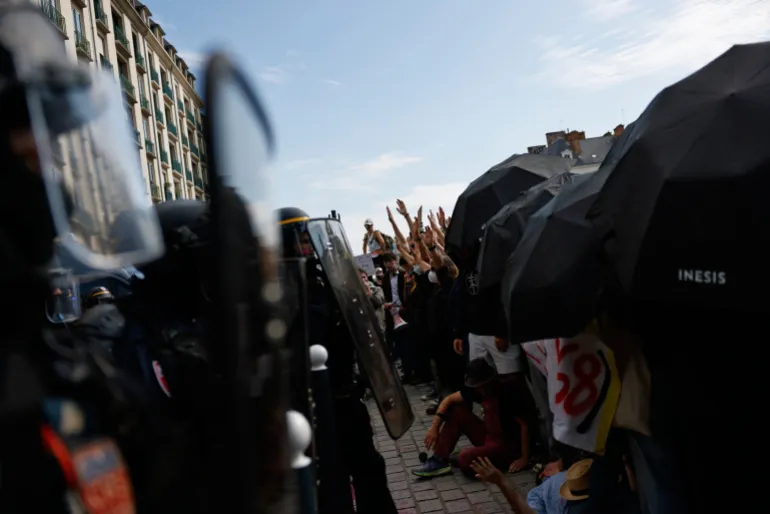
Riot police face students during a protest against under-resourced schools in Rennes, western France, on October 6, 2026 [Jeremias Gonzalez/AP]
What do protesters want?
Students have been protesting over what they say are poor conditions in France’s high schools – or lycees – especially in poorer areas. Protests have been held in Strasbourg, Bordeaux, Nantes, Marseille, Lyon and other towns and cities.
Students say absent teachers are not replaced, dilapidated school buildings are sometimes rodent-infested, there are inadequate tables and chairs, large class sizes and long classroom hours.
The intense heatwave which hit France in the summer exacerbated existing problems in neglected school buildings, which also suffer from a lack of air conditioning, school pupils say.
The protests have coincided with ongoing nationwide public sector strikes over a proposed 2027 cost-cutting budget that aims to achieve 54 billion euros ($61.3bn) in savings as Macron’s government races to bring a large public deficit under control.
Public sector staff and unions object in particular to a government plan to freeze salaries to save about two billion euros ($2.27bn).
Parents are also increasingly present at protests amid widespread anger about the police response to demonstrating minors.
But the protests are happening amid wider discontent over soaring fuel and commodity prices and reduced public spending under Macron.
Government officials have meanwhile accused political opposition groups and unionists of taking advantage of the student movement. Prime Minister Sebastien Lecornu accused political opponents last week of encouraging escalation.
What has happened so far?
At least 6,100 people had been arrested by early Tuesday, many of them under the age of 18, as police tactics come under intense scrutiny.
Serious injuries have also been reported.
A 15-year-old lost a hand in the northern city of Lens on Monday after he reportedly came into contact with a police stun grenade, which then exploded. Public prosecutors say investigations are ongoing into whether the youth actively picked up the grenade or if it landed on him.
Overall, at least 190 high school students have been injured, Education Minister Edouard Geffray said on Monday. On Sunday, he said 78 teaching staff had been injured, and 24 schools had been burned or ransacked.
Some 715 police officers have been injured, according to Interior Minister Laurent Nunez on Tuesday.
Officials said as many as 589 schools have been disrupted this week, down from 735 on Friday last week.
Rights groups, including Amnesty International, have criticised the use of force against minors amid media reports of students being hit with batons and rubber bullets, as well as sprayed with tear gas.
What happened on Tuesday?
Protesters again blockaded schools on Tuesday as thousands demonstrated over their demands.
Placard-waving crowds were reported in southern Marseille, eastern Strasbourg and other major cities.
In Paris’s 20th district, protesters outside the shut Helene Boucher lycee tipped over rubbish bins and bicycles and created a makeshift barricade, The Associated Press news agency reported. Parents, meanwhile, positioned themselves between the demonstrators and police to protect their children.
“They are our children. Teachers, parents, federations, we all share the same goal: the protection of children’s rights, and it is a legitimate right to demonstrate and to make demands,” said Emilia Sichili Suriam, one member of a parents’ association.
Interior Minister Nunez rejected criticism of the police on Tuesday, saying the response has been proportionate in “almost all cases”. He claimed that the protests were transforming into “riots”.
What does this mean for the French government?
These are only the latest in a series of high-profile protests that have marked Macron’s presidency and undermined his government’s reform efforts ahead of elections in April and May.
Macron will not run in next year’s elections, but his image and that of his government have no doubt been tainted by photos of police chasing students in the streets, France expert Jacob Ross, from the German Council on Foreign Relations (DGAP), told Al Jazeera.
“He is not taken seriously any more because many think of him as already out of government,” Ross said of Macron. “But this is still very significant for his government because it has become clear that they don’t have the capacity to calm things down. There’s clearly little fiscal room to manoeuvre.”
Macron’s terms have long been beset by political and financial instability. Successive prime ministers have faced difficulties in pushing through policies in the highly polarised National Assembly where Macron’s centrist Renaissance party and allied blocs lack a majority.
Critics have taken aim at Macron’s deeply unpopular austerity measures, which have seen drastically reduced government spending taking a toll on pensions and healthcare. Officials, however, have defended these policies amid rising debt following COVID-19-era spending.
On Sunday, Lecornu said the government had kickstarted initiatives to address the protesters’ demands and that a report was expected by the end of the month. He, however, added that Paris would not “yield an inch” to violence.
Meanwhile, frontrunner and opposition leader Marine Le Pen of the far-right National Rally party submitted a shadow budget on Tuesday promising 140 billion euros ($157.6bn) in cost savings by 2032 if elected next year.